

1. Define the market-entry decision
The board decision is whether a platform can build a lawful and economically repeatable GCC business without weakening the core company. Market size and strategic narrative are context. Approval requires evidence that the product is permitted, the data architecture can operate, customers can be acquired through controllable channels, localisation can be delivered, partners can be governed and capital can be released in stages.
The mandate should name the first country, customer segment, product, revenue model, regulated activities, data categories, required partners, target economics and maximum capital at risk. It should define the minimum evidence for expansion into a second country. A broad instruction to enter the Gulf encourages simultaneous hiring, marketing and partnership discussions before management has established which product can legally be sold or how revenue becomes cash.
Management should state rejection conditions at the outset. Examples include a licence path that changes the economics, a required local partner without enforceable operating rights, prohibited data flows, customer-acquisition cost above the contribution available from a cohort, weak retention, dependence on one distributor or an acquisition price that assumes scale before localisation is proven.
The decision should use a country-and-product unit. A logistics marketplace in the UAE, a payments feature in Saudi Arabia and a software subscription sold across free zones are different regulated and commercial propositions. Their evidence should not be combined into a single regional score.
2. Use the Southeast Asia-to-GCC Platform Entry Framework
The framework has seven gates. Product permission defines what can be marketed, sold, processed or outsourced. Data control identifies where personal, commercial and financial data are collected, stored, transferred and accessed. Distribution proof tests repeatable acquisition and retention. Operating localisation covers product, language, service, contracting, tax and people. Entry vehicle selects greenfield establishment, partnership, joint venture, minority investment or acquisition. Transaction design allocates control, economics, liabilities and exit. Capital gating limits expenditure until the evidence supports the next stage.
Each gate produces a conclusion, source evidence, unresolved questions, an owner, a deadline and a consequence for valuation or funding. A regulatory issue must change the product design or launch date. A weak distributor must change revenue assumptions and governance. A data-localisation requirement must change architecture and cost. A cohort that fails to recover acquisition cost must stop scale marketing.
The gates are connected. Payment functionality can trigger licensing and safeguarding obligations. The licence can affect the required legal entity, management and outsourcing. The entity and outsourcing model affect data flows and technology control. Those choices change speed, cost and gross margin. The investment model must therefore reconcile legal design, operating design and cash.
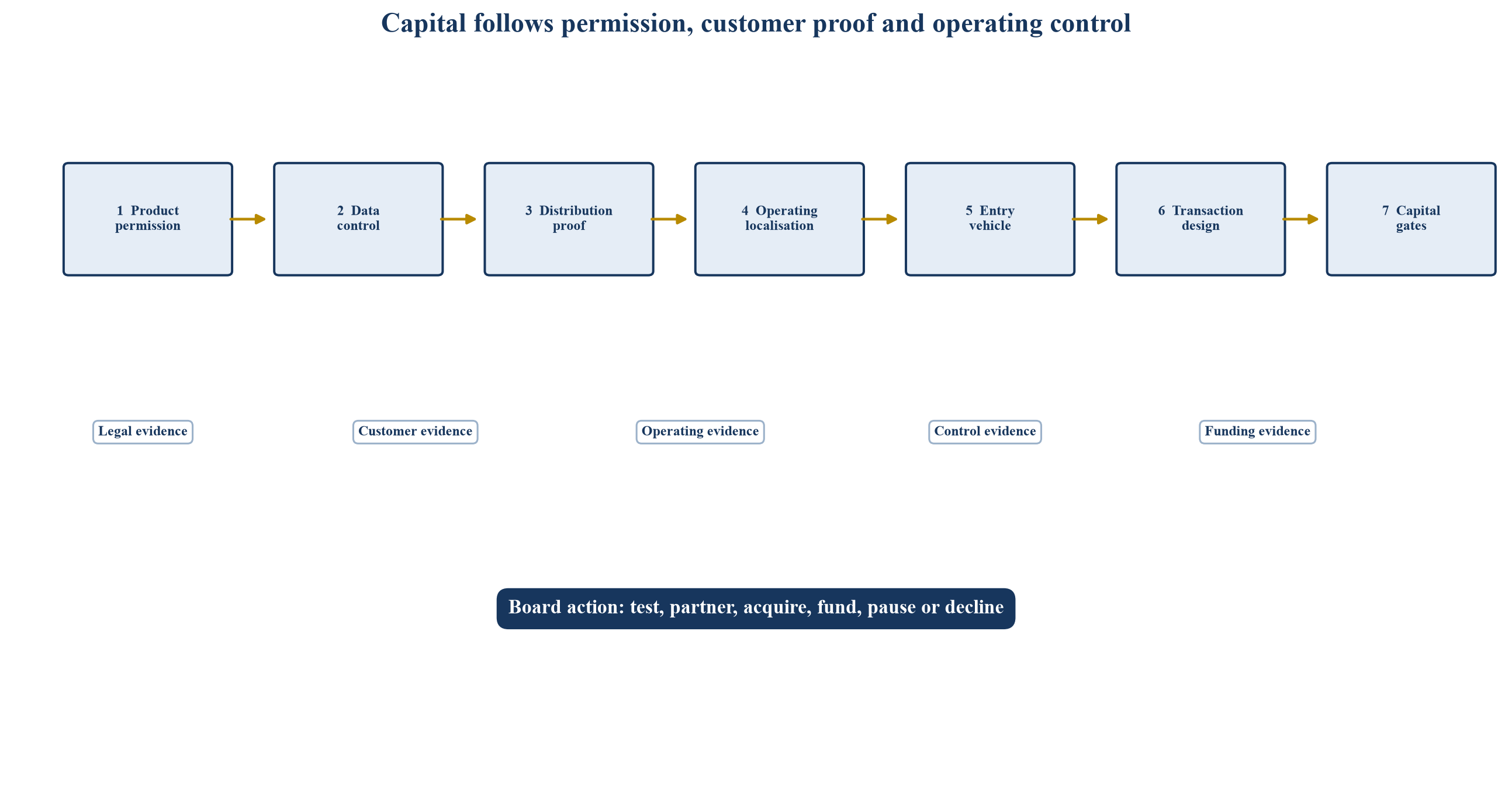
The framework is a proposed decision system and requires country-specific professional advice.
3. Start with the transferable advantage
The platform should identify the capability that can travel before selecting a country. Transferable advantages can include a merchant network model, logistics orchestration, fraud controls, underwriting data, a category-specific workflow, low-cost product development, procurement technology or a repeatable route to small-business customers. A brand that is strong in Southeast Asia may have little recognition in the Gulf. A local super-app position may depend on traffic, subsidies or embedded payments that do not transfer.
Management should separate the product engine from the original market context. The product engine includes code, data models, processes, supplier tools and operating knowledge. The context includes local payment rails, regulation, language, delivery density, customer expectations, labour cost, merchant concentration and incumbent relationships. The entry thesis is credible when the engine retains value after the context changes.
The transferability assessment should test whether the platform can demonstrate faster fulfilment, lower loss, higher conversion, better working-capital outcomes or lower operating cost for a defined GCC customer. Claims should be measured against a local alternative. The team should avoid using home-market growth as proof of Gulf product-market fit.
ASEAN reported the substantial conclusion of negotiations for its Digital Economy Framework Agreement and states that the agreement is intended to strengthen regional digital integration.[1] ADB-hosted research reported that Southeast Asia's digital economy generated USD 300 billion of gross merchandise value in 2025, with 15 percent year-on-year growth.[2] These facts support a pool of experienced digital operators. They do not establish transferability into a specific GCC segment.
4. Select a beachhead through evidence
A beachhead combines a customer with an urgent problem, a sellable product, an accessible channel and a viable gross margin. Country selection should compare the UAE and Saudi Arabia, then examine other GCC states only where a specific customer or partner supports the case. The score should cover permission, customer density, contract value, acquisition route, localisation burden, payment cycle, talent, competition and follow-on potential.
The UAE can provide a regional commercial base, international talent and multiple establishment options. Saudi Arabia can provide a large customer base and strategic procurement opportunity while requiring its own investment, licensing, data, competition and operating analysis. A UAE launch does not create regulatory permission or distribution in Saudi Arabia.
Customer interviews must test purchasing authority, procurement path, integration burden, budget, incumbent alternatives, required service levels and willingness to pay. Letters of intent should state the product, price range, implementation requirements and decision timetable. General expressions of interest should not support revenue forecasts.
The beachhead decision should be reversible. The company can begin with a narrow business-to-business workflow that uses licensed payment partners and limited data. It can add financial, consumer or marketplace functions after permission and economics are established. Starting with the widest feature set increases regulatory and capital exposure before the product has local proof.
| Decision area | Evidence required | Common failure | Approval response |
|---|---|---|---|
| Product permission | Activity map, regulator view and licence analysis | Marketing begins before the regulated perimeter is defined | Narrow product or condition launch |
| Customer problem | Interviews, paid pilots and procurement evidence | Home-market demand is assumed to transfer | Require local paid evidence |
| Distribution | Named channel, economics, data access and termination rights | Partner presents relationships without conversion evidence | Stage exclusivity and consideration |
| Unit economics | Cohort revenue, contribution, acquisition cost and retention | Subsidised volume is treated as product fit | Cap spending until payback is proven |
| Operating model | Entity, people, service, technology and support plan | Regional hub is expected to cover every country | Build country-specific responsibility |
| Capital | Uses, milestones, downside and stop-loss | Full regional budget is released at signing | Fund by verified stage |
The matrix is illustrative and requires current product-specific analysis.
5. Map the product to regulated activities
Digital platforms often describe themselves by technology while regulators classify the activity performed. A marketplace may aggregate payments, hold funds, arrange credit, transmit money, issue stored value, provide investment access, intermediate insurance, facilitate transport or process sensitive data. Each function needs a legal conclusion for each country.
The product inventory should follow the customer journey from registration through identity, listing, purchase, payment, fulfilment, dispute, refund and account closure. For every step, management should identify the legal entity, customer, regulated activity, licence holder, outsource provider, data category, cash flow and responsible manager. Marketing language and application-store descriptions should match the permitted product.
The Central Bank of the UAE states that retail payment services include payment-account issuance, payment-instrument issuance, merchant acquiring, payment aggregation, domestic and cross-border fund transfers, payment tokens, payment initiation and payment-account information.[11] Its rulebook requires prior licensing for covered services unless an exemption applies.[12] Saudi Arabia's payment-services rules also use a licensing framework and set categories and requirements for payment institutions and electronic-money institutions.[16][17]
A platform can use a regulated partner while retaining customer experience and commercial value. The contract must identify who onboards the customer, holds funds, performs compliance, owns transaction data, manages disputes, bears losses, controls pricing and supports migration. A partner model reduces some licensing burden while creating concentration and termination risk.
6. Design the data architecture before launch
Data design should precede application deployment. The company should inventory personal data, merchant data, transaction data, device data, geolocation, communications, credit indicators and inferred profiles. It should identify purpose, legal basis, controller, processor, storage, access, retention, transfer, deletion and incident response for each material dataset.
The UAE Personal Data Protection Law provides the federal framework for processing personal data.[8] Saudi Arabia's Personal Data Protection Law applies to processing in the Kingdom and to processing by parties outside the Kingdom involving individuals residing there.[18] SDAIA guidance also addresses transfers outside the Kingdom and appropriate safeguards.[19] Free-zone or sector regimes can add requirements. The architecture must be reviewed for the actual entity, activity and data flow.
The company should decide which services remain regional, which need local instances and which data can be aggregated or anonymised. Access from a Southeast Asian engineering centre can itself be a cross-border data flow. Support tools, analytics, advertising technology, artificial intelligence services, cloud logs and fraud vendors belong in the map.
Data minimisation can reduce cost and regulatory risk. A platform should avoid importing its entire home-market feature stack when the first GCC product needs only a limited dataset. The board should require evidence that consent, notices, contracts, security, transfer mechanisms and deletion processes work before scale marketing begins.
7. Treat payments as a separate operating system
Payments determine conversion, trust, refunds, fraud, working capital and regulatory exposure. Management should map authorization, settlement, safeguarding, chargeback, foreign exchange, payout and reconciliation by entity and provider. A commercial platform and a regulated payment partner can share a customer journey while retaining distinct legal responsibilities.
The model should show who owns merchant settlement accounts, when the platform earns revenue and when cash becomes unrestricted. Gross merchandise value is not revenue, and customer funds are not operating liquidity. The company should reconcile orders, processor records, invoices, refunds, disputes and bank receipts. It should also establish contingency when a processor, bank or card scheme restricts service.
The UAE retail-payment framework includes obligations relating to anti-money-laundering controls, technology risk, user protection and safeguarding.[11][13] Saudi rules include licensing, governance, outsourcing and risk-management requirements.[16][17] A platform should obtain activity-specific advice before deciding whether it is a technical service provider, agent, distributor, payment-service provider or another regulated participant.
Commercial contracts should allocate failed payments, fraud, refunds, abandoned balances and settlement delays. Service levels need measurable restoration and reporting duties. The launch budget should include reserves and integration cost rather than assuming payment processing is a simple variable fee.
8. Localise the customer proposition
Localisation includes product functionality, Arabic and English content, pricing, tax invoices, customer support, service hours, contracting, dispute handling and accessibility. Translation alone does not create a local proposition. The product must fit decision rights and workflows used by Gulf customers.
Business-to-business customers may expect local implementation, security review, integration with enterprise systems, local invoicing and senior relationship coverage. Consumer users may expect local payment methods, fast refunds, Arabic support and clear service ownership. Government and state-related customers can require registration, local presence, procurement qualifications and data controls.
The platform should establish a controlled localisation backlog. Each requested feature should identify the customer value, regulatory requirement, development cost, owner and reuse potential. Large customers can pull the product into bespoke development that weakens the scalable model. The commercial team should price or reject custom work rather than hiding it inside acquisition cost.
Local service quality should be measured from first use. Response time, fulfilment, refund, error, complaint and retention data should be segmented by country, channel and customer cohort. A regional average can conceal a weak local product.
9. Build distribution as an owned capability
Distribution partners can provide customer access, credibility, merchant supply, implementation or regulatory connectivity. Their claimed network should be converted into a measurable funnel: addressable accounts, qualified introductions, proposals, pilots, contracts, active users, retained revenue and cash. Relationship language is not a substitute for conversion data.
The company should compare direct sales, channel sales, embedded distribution, strategic investors, acquisition and joint venture. Direct sales provide customer knowledge and control but require time and local capability. Channels can accelerate reach but create margin and data dependence. An acquisition can provide contracts and people while importing liabilities and integration risk. A joint venture can combine assets while creating governance complexity.
Partner economics should reward verified outcomes. Upfront consideration can be limited to assets and committed resources. Variable consideration can follow active customers, contribution, retention, regulatory milestones and service quality. Exclusivity should be specific by product, segment, territory and period. It should end when minimum performance is not achieved.
The platform should retain access to customer-level data permitted by law and contract. Without evidence on acquisition, usage, service and cash, management cannot improve the product or value the channel. Exit and migration rights should protect continuity if the partner relationship ends.
10. Choose the entry vehicle after the operating model
Greenfield entry suits a product that can be sold directly with manageable licensing and distribution. A commercial partnership suits an early test where the platform retains product and data control. A joint venture suits complementary assets that require continuing contribution from both parties. A minority investment can align a distributor or regulated provider. An acquisition suits a scarce licence, team, customer base or operating capability that is faster to buy than build.
The vehicle should follow the operating facts. The board should avoid creating a joint venture merely because a potential partner proposes one. It should identify which assets, decisions and risks require shared ownership. Contracts can often test a relationship before equity is issued.
Corporate structure affects tax, transfer pricing, employment, licences, customer contracts, data and cash. The analysis should identify the entity that contracts with customers, employs local staff, owns assets, licenses technology, pays partners, incurs marketing cost and receives revenue. Intercompany services and intellectual-property arrangements need documented substance and pricing.
The UAE and Saudi establishment processes should be verified for the chosen activity. Saudi MISA states that foreign investors can apply for investment registration and that local-partner requirements depend on the selected activity.[22] A general establishment permission does not replace sector approval.
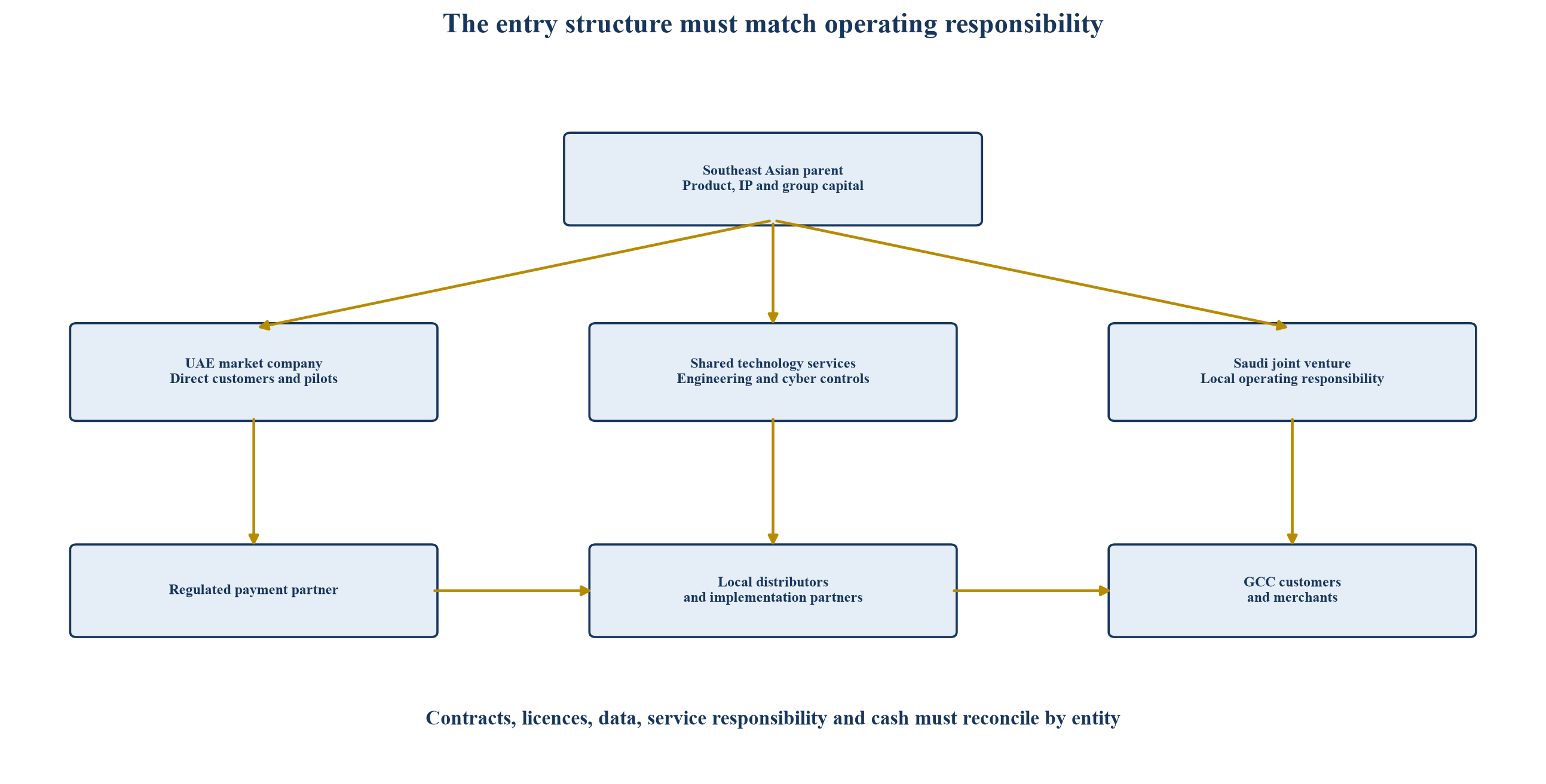
Entities, relationships and funding are hypothetical management assumptions.
11. Use partnership diligence equal to acquisition diligence
A strategic partner can determine licence access, customer acquisition, staffing, government interfaces, premises, payment processing and collections. The platform should diligence ownership, beneficial owners, governance, reputation, financial capacity, regulatory status, customer claims, related parties, litigation, data controls and cyber resilience.
The partner's contribution should be evidenced. A distributor should provide pipeline and conversion history. A regulated entity should provide licence scope and standing. A technology partner should demonstrate service, security and intellectual-property rights. A shareholder should show capacity to fund commitments.
The relationship contract should state duties, resources, service levels, information rights, audit, compliance, data access, intellectual property, subcontracting, pricing, related-party approvals, business continuity and termination. The platform should be able to replace the partner or migrate customers where law and contract permit.
Integrity diligence should cover agents, introducers and public-sector interfaces. Payments need a defined service, documented approval, invoice and evidence of performance. The commercial benefit of access does not justify opaque compensation or hidden control.
12. Structure joint ventures for operating decisions
Joint-venture governance should follow the decisions that create or destroy value. The documents should address product scope, annual plan, pricing, budget, hiring, technology, data, customer contracts, capital calls, debt, related parties, compliance, dividends, acquisitions, litigation and exit.
Board representation alone is insufficient when daily decisions remain outside the board. The agreement should define delegated authority, bank mandates, procurement limits, reporting and escalation. Reserved matters should be narrow enough to operate while protecting fundamental rights. A deadlock mechanism should preserve customer and regulatory continuity.
Capital obligations require dates, amounts, conditions and remedies. A partner that can delay funding while retaining veto rights can transfer the burden to the platform. Funding default can trigger dilution, shareholder debt, loss of rights, a buyout or another negotiated remedy. The mechanism must be lawful and financeable.
Exit provisions should address transfer restrictions, pre-emption, tag, drag, put, call, valuation, payment security, licence consent and customer migration. A put has limited value when the counterparty lacks funding. The platform should test exit while negotiating entry.
13. Use acquisitions to buy scarce capability
An acquisition should solve a specific scarcity: a licence, customer base, distribution network, local management team, data asset, category position or integration capability. Buying revenue without understanding retention, contract transfer and customer ownership can accelerate losses.
Commercial diligence should reconcile customer contracts, users, transactions, pricing, discounts, refunds, retention and cash. Technology diligence should test architecture, source-code ownership, dependencies, cyber incidents, scalability and integration. Regulatory diligence should confirm licence scope, change-of-control requirements and customer obligations. People diligence should identify the individuals who actually hold relationships and operating knowledge.
Competition review belongs in the timetable. UAE competition law defines economic concentration around a transfer that enables direct or indirect control, and the review framework can restrict completion during the statutory decision period.[9][10] Saudi GAC guidance applies a nexus and notification analysis to economic concentrations, including foreign transactions that affect Saudi markets.[20] Current thresholds and filing requirements should be confirmed for the transaction date.
The purchase agreement should allocate pre-closing conduct, data and cyber findings, customer claims, regulatory breaches, tax, employee obligations and earn-out measurement. Integration expenditure belongs in total uses. A platform should not pay for synergies that require substantial post-close capital without reflecting that cost.
14. Build capital around evidence gates
Capital should be released in tranches. The first tranche funds regulatory mapping, customer discovery, product localisation, data design and partner diligence. The second funds paid pilots, the local team and controlled launch. The third funds a joint venture or acquisition after permissions and transaction terms are confirmed. Scale capital follows cohort economics, service quality and operating control.
The board should approve a maximum loss and a decision date for each stage. Sunk cost should not justify the next tranche. A failed pilot can be valuable if it prevents a larger market-entry commitment. The finance team should track cash by country, entity, purpose and milestone.
Funding instruments should match risk. Parent equity suits uncertain product localisation. Strategic equity can align a partner when governance is clear. Vendor consideration can be deferred or contingent. Acquisition debt requires accessible and predictable cash, which an early launch may not produce. Working-capital facilities can support verified receivables after operations mature.
The plan should protect the home business. Management time, engineering capacity, shared services and guarantees are capital uses even when they do not appear in the local budget. The group should identify the maximum exposure to the GCC programme under central and downside cases.
| Stage | Permitted use | Evidence required for next stage | Stop or redesign trigger |
|---|---|---|---|
| Regulatory and customer design | Advice, interviews, architecture and prototype | Product permission, named customers and costed operating design | Licence or data model defeats economics |
| Paid pilots | Local team, integration and controlled service | Paid use, retention, service quality and reconciled cash | Weak conversion or unresolved control failure |
| Partner or transaction | Diligence, contracts, approvals and closing | Enforceable rights, verified assets and funded operating plan | Partner contribution or permission remains unproven |
| Controlled launch | Product, support, channel and working capital | Cohort contribution, repeatability and compliant operations | Acquisition cost or service loss exceeds limits |
| Scale | Additional channels, country or product | Stable unit economics, management capacity and liquidity | Growth consumes cash without improved contribution |
Amounts and milestones should be replaced with approved company-specific values.
15. Model customer acquisition by channel and cohort
Customer-acquisition cost should include sales staff, partner commission, marketing, implementation, discounts, free service, support and failed prospects. Revenue should be net of taxes, refunds, incentives and amounts owed to merchants or regulated partners. Contribution should deduct variable payment, cloud, fulfilment, customer service, fraud and channel costs.
Cohorts should be tracked from first paid use. The model should show active customers, usage, revenue, contribution, retention and cash collection by acquisition month and channel. A channel can produce low headline acquisition cost while delivering small or transient customers. Enterprise direct sales can be expensive but produce durable contribution.
The payback rule should match liquidity. A platform with limited cash cannot rely on a long payback merely because lifetime value appears high. Lifetime value depends on retention that may not exist in a new market. The board should use observed cohort data and a conservative continuation assumption.
Channel partners should be compared on net contribution and cash, not introductions. The distributor's commission, support responsibility, data access and collection terms all change the economics. Management should avoid combining direct and partner cohorts when their margins and retention differ.
16. Separate marketplace volume from economic value
Gross merchandise value measures activity passing through a marketplace. It does not measure revenue, contribution or cash. A platform can grow volume by funding discounts, extending credit, absorbing fulfilment or accepting low-quality merchants. The investment case should bridge volume to take rate, net revenue, variable contribution, fixed cost, working capital and free cash.
The take rate should be analysed by product, customer, channel and service. Payment, logistics, advertising, subscription and financing revenues have different regulatory and cost structures. The model should show whether the platform earns a fee, carries inventory, assumes credit, guarantees fulfilment or acts only as an intermediary.
Working capital can reverse apparent growth. Faster merchant payout, slower customer collection, refunds and disputed transactions can consume cash. The company should model settlement lags and reserves. Customer or merchant funds subject to safeguarding should remain outside operating liquidity.
The board should approve value metrics before launch. Appropriate measures can include net revenue retention, contribution per active account, payback, fulfilment quality, cash conversion and customer concentration. Downloads and registrations are diagnostic measures unless they produce verified economic activity.
17. Test the worked capital case
The hypothetical programme uses USD 60 million. Regulatory design and localisation use USD 8 million. The UAE launch uses USD 14 million. The Saudi partner transaction and launch use USD 25 million. Shared technology, cyber resilience and liquidity use USD 13 million. Parent equity funds USD 35 million, a strategic investor funds USD 15 million after the transaction gate, and deferred partner consideration funds USD 10 million after performance milestones.
Under the central case, year-two GCC revenue is USD 36.0 million. Variable contribution is USD 17.3 million after payment, fulfilment, support, fraud and channel cost. Fixed operating cost is USD 14.0 million, leaving USD 3.3 million before tax, financing and further investment. Cumulative funding need peaks at USD 48.0 million because rollout is phased and partner consideration is deferred.
The slower-distribution case assumes that qualified pipeline converts six months later and year-two revenue reaches USD 27.0 million. Variable contribution is USD 11.9 million, fixed cost is USD 15.0 million and cumulative funding need reaches USD 61.0 million. The higher-acquisition-cost case assumes channel and implementation cost are 35 percent above plan. Revenue reaches USD 31.0 million, contribution is USD 12.8 million and funding need reaches USD 66.0 million.
The remedial case narrows the first product, delays a second distribution channel, converts USD 10 million of partner consideration into performance-linked payment and reduces fixed cost until retention is proven. Year-two revenue is USD 30.0 million, contribution is USD 14.1 million, fixed cost is USD 12.5 million and cumulative funding need is USD 52.0 million. All values are hypothetical management assumptions and demonstrate the method rather than a market forecast.
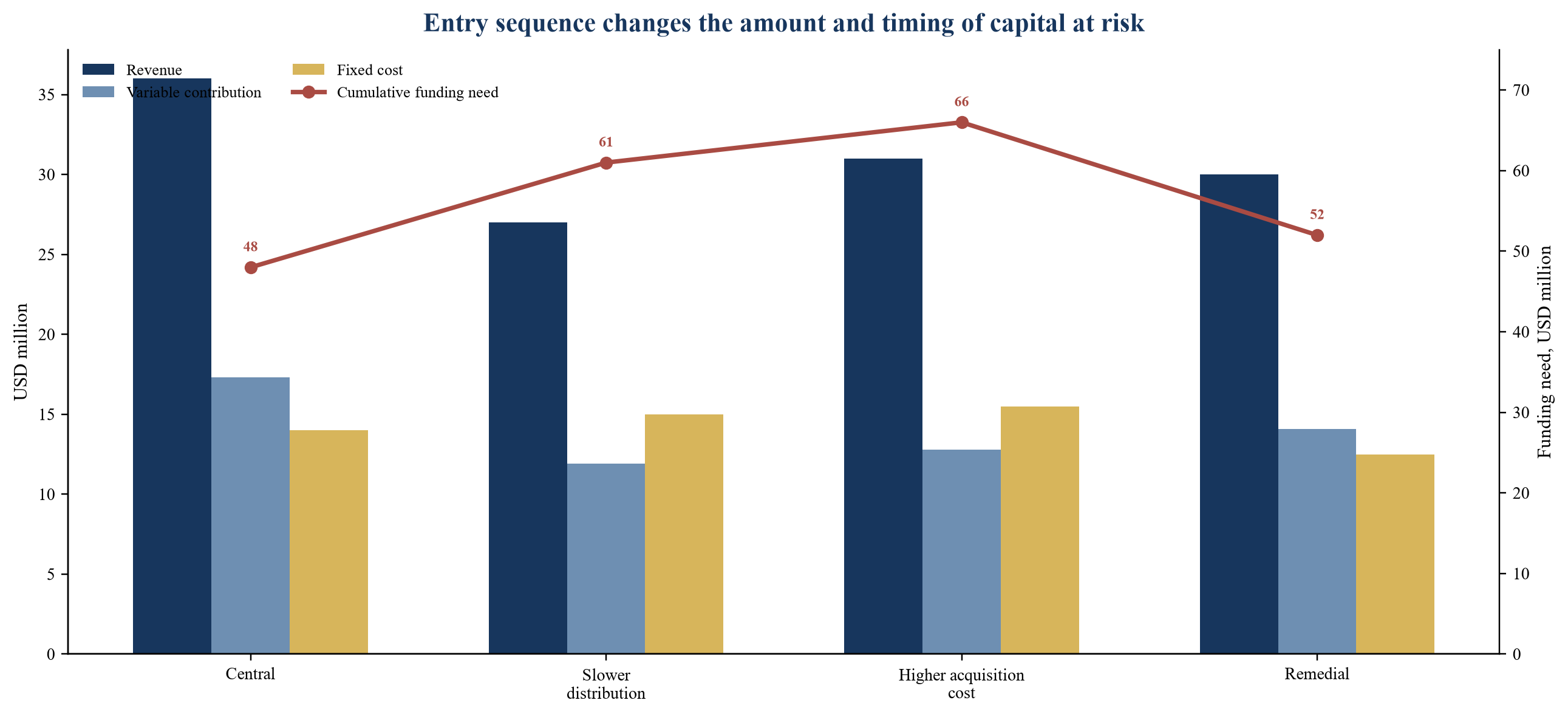
All values are hypothetical management assumptions and are not forecasts.
18. Manage competition and platform conduct
Platform entry can affect competition through exclusivity, parity terms, self-preferencing, access to merchant data, bundling, pricing, acquisitions and network effects. The legal analysis should cover the initial contracts and the conduct expected at scale. A practice that seems commercially convenient can restrict a partner, customer or rival.
The company should review distributor exclusivity, most-favoured terms, seller restrictions, algorithmic ranking, access rules and use of non-public business-user data. It should document objective reasons for differentiated treatment. Commercial teams need approval controls before changing terms or launching incentives.
Acquisitions and joint ventures require a current economic-concentration assessment. The analysis should address control, turnover, local nexus, filing timetable and standstill obligations. A minority investment can confer control through veto, governance or commercial dependency. The legal form does not determine the competition conclusion.
The board should include competition risk in product governance. Pricing tests, merchant incentives, channel changes and acquisitions should have a named reviewer. Records should show the commercial objective, affected users, data used and approval.
19. Protect intellectual property and development control
The parent should identify the software, data, models, trademarks, content, documentation and know-how used in the GCC. Ownership and licence rights should be documented through employee, contractor, acquisition and partner chains. A local entity cannot license rights that the group has not secured.
The operating model should specify which entity develops code, approves releases and bears defects. Local customisation can create jointly developed intellectual property or partner claims. Contracts should define background intellectual property, improvements, local content, feedback, source-code access and rights after termination.
Data rights require separate treatment. A right to use software does not create a right to use customer or merchant data for analytics, advertising or model training. The company should obtain an appropriate lawful basis and contract for each purpose.
The platform should retain the practical ability to operate after a partner dispute. Repository control, credentials, cloud accounts, domain names, application-store accounts and critical vendors should not depend on one person or local shareholder. Business-continuity testing should include loss of partner access.
20. Build cyber resilience into transaction value
Cyber resilience affects licensing, customer trust, service continuity and valuation. Diligence should identify systems, cloud providers, privileged users, third parties, incident history, vulnerabilities, recovery capability and regulatory reporting. The company should test recovery rather than relying on policy documents.
The launch architecture should use identity controls, least privilege, secure development, logging, monitoring, encryption, backup and incident response appropriate to the risk. Local support and regional engineering teams need clear access boundaries. Outsourcing contracts should permit assurance and incident cooperation.
An acquisition or joint venture adds integration risk. Connecting environments before identities, assets and vulnerabilities are known can spread exposure. The integration plan should establish a protected interface, reconcile inventories, validate controls and migrate only accepted systems.
The capital plan should include remediation, independent testing, monitoring and recovery. Cyber work is part of the cost of market entry. Deferring it can create a regulatory, customer and liquidity event that exceeds the saved expenditure.
21. Design talent and authority for local execution
The organisation needs local authority over customers, regulation, service and cash. A country head without budget, product access or accountable functions becomes a relationship representative rather than an operating leader. The responsibility map should state who can price, contract, hire, approve refunds, manage incidents and commit capital.
The group should identify roles that must be local, roles that can be regional and roles that remain at the parent. Regulatory appointments, Arabic support, enterprise sales, implementation, compliance, finance and service operations can require local capacity. Engineering can remain distributed when access, service levels and incident response are controlled.
Incentives should reward contribution, retention, cash and compliance rather than gross bookings alone. Sales plans that pay for signed volume can produce discounts, weak customers and service commitments that destroy margin.
Key-person risk should be reduced through paired relationships, documented processes, succession and access control. The partner's principal should not be the only route to customers or authorities. The platform should own an institutional relationship map.
22. Use a risk heat map tied to decisions
The risk register should separate likelihood, severity, timing, detectability and controllability. Each rating needs evidence. A licence issue with low likelihood and catastrophic effect may require more attention than frequent small support failures. A high customer-acquisition cost may be controllable through product and channel changes.
Risks should lead to a transaction action. Product-permission risk can narrow scope or delay launch. Data-transfer risk can change architecture. Partner dependence can change governance and consideration. Distribution weakness can stop scale spending. Capital risk can reduce fixed cost or add a committed reserve. Cyber risk can require remediation before integration.
The register should use leading indicators: regulator questions, licence milestones, data incidents, pilot conversion, cohort payback, partner pipeline, merchant concentration, payment failures, complaints, service availability and employee departures. Trends should be reviewed monthly during launch.
Risk acceptance should identify the approver, exposure cap, compensating control and review date. Missing evidence should remain open. It should not be converted into a favourable score to preserve the timetable.
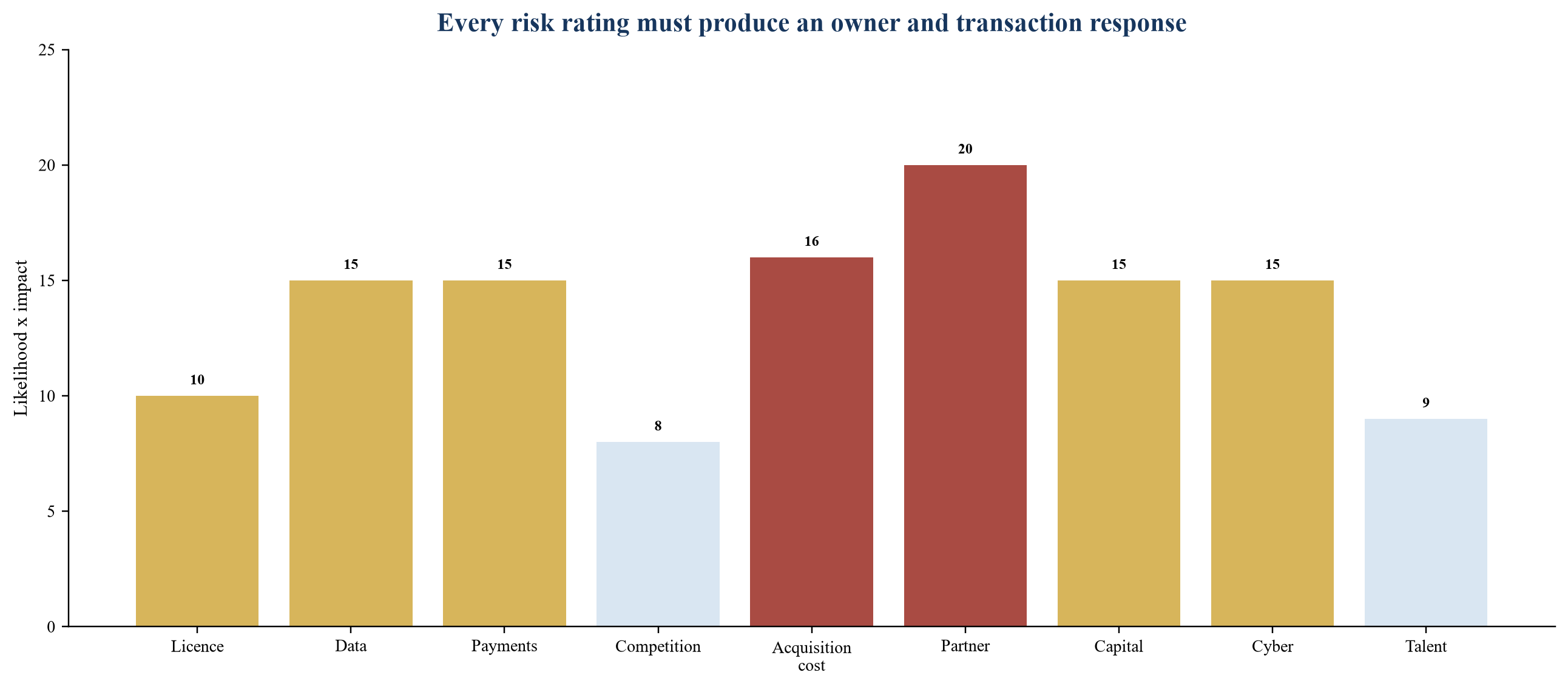
Scores are hypothetical and should be replaced with verified company evidence.
23. Sequence regulatory engagement
Regulatory engagement should begin with a precise activity map. The company should describe the customer, product, legal entity, money flow, data flow, partners, outsourcing and risk controls. A broad presentation about technology can produce an answer that does not resolve the actual regulated perimeter.
The team should distinguish formal applications, no-objection requests, sandbox participation, guidance discussions and legal opinions. Each has a different evidential value. A meeting does not create permission. An in-principle approval may contain conditions and may not authorise commercial operation.
The timeline should include document preparation, management appointments, capital, governance, technology testing, policies, outsourcing review and regulator questions. The commercial launch date should follow the permission path. Marketing and customer commitments should contain conditions where authorisation remains outstanding.
Licensing evidence should remain current after launch. Product changes, new channels, acquisitions, outsourcing, controllers and data flows can require notification or approval. Product governance should route relevant changes through legal and compliance review.
24. Contract the distribution and service chain
Customer contracts should identify the service provider, product, price, data roles, service levels, support, security, complaints, refunds, suspension, liability and termination. They should align with the application and marketing. A platform should avoid presenting itself as the provider of a regulated service when a licensed partner holds that responsibility.
Partner contracts should allocate customer onboarding, sales conduct, implementation, payment, service, data, incidents and regulatory cooperation. The platform needs audit and information rights sufficient to govern its risk. Subcontracting should require disclosure and appropriate controls.
Service levels should use measures the company can monitor. Availability, response, fulfilment, settlement and recovery should have defined clocks and exclusions. Remedies should preserve customer continuity. Liability caps should be assessed against data, payment and service exposure.
Termination planning should include customer notices, data return or deletion, settlement, outstanding complaints, merchant payouts, licences, credentials and transition support. The contract should be usable during a stressed separation rather than relying on goodwill.
25. Integrate tax and cash into the operating model
Tax design should follow where people, contracts, technology and decisions are located. The structure should address corporate tax, withholding, value-added tax, customs where relevant, transfer pricing, permanent establishment and deductibility. The company should obtain current country-specific advice before implementation.
Intercompany charges should reflect genuine services and documented benefit. Technology, management, marketing and support fees affect local margin and cash. An aggressive charge that cannot be supported can create tax, regulatory and partner disputes.
The cash model should identify customer collections, processor settlement, refunds, taxes, payroll, suppliers, partner payments, intercompany charges, reserves and dividends by entity. It should show when cash is available to the group. Accounting profit does not establish distributable or transferable cash.
Foreign exchange should be modelled where revenue and cost currencies differ. The group can reduce exposure by matching local revenue and cost, using permitted hedging and pricing contracts appropriately. The board should avoid funding long-term local losses through unplanned short-term transfers.
26. Design management information before scale
The entry dashboard should connect permission, customers, service and cash. It should report licence milestones, product exceptions, data incidents, qualified pipeline, pilot conversion, active customers, retention, revenue, contribution, acquisition cost, payback, service quality, complaints, settlement, cash and funding headroom.
Definitions should be fixed before launch. An active customer, retained revenue, contribution and acquisition cost should be calculated consistently. Finance should reconcile commercial events to invoices and bank receipts. Product analytics should reconcile to the legal customer and contract.
Partner reports need verification. The platform should have access to source evidence, audit rights and a dispute process. Consideration and exclusivity should use reconciled measures rather than self-reported pipeline.
The board should receive exceptions and decisions, not a large operational data dump. The report should identify the cause, cash exposure, owner, remedy and date. A milestone should be green only when evidence is complete.
27. Prepare the first 100 days of operating control
The first 100 days after a joint venture or acquisition should verify that negotiated rights work. The company should confirm licences, registers, board appointments, bank mandates, systems access, customer contracts, payment relationships, data flows, employees, service levels, tax registrations and reporting.
The operating priorities are permission, customer continuity, service, cash visibility, cyber resilience and employee authority. Product expansion and cost synergy should follow stable control. Rapid integration can disrupt a licence, data environment or customer process.
The team should close discrepancies between the closing file and live operation. Examples include an administrator retaining privileged access, a distributor withholding customer data, an unapproved subcontractor, missing consent, manual refunds or collections outside the reconciled process.
The board should release post-close funding only after defined controls operate. Deferred consideration can follow verified customer, licence and contribution milestones. Governance has greater leverage while consideration and capital remain conditional.
28. Use a twenty-four-month roadmap
Months one to three should define the product, beachhead, activity map, data architecture, customer problem, distribution options and capital limit. The company should conduct paid-discovery work where possible and reject a country or product that lacks a viable permission or customer path.
Months four to six should finalise legal design, regulated partners, initial localisation, pilot contracts and the operating model. The company should appoint accountable leaders and establish finance, security, compliance and reporting. Capital remains limited to the first evidence stage.
Months seven to twelve should run controlled UAE pilots, verify cohorts and complete diligence on any Saudi partner or target. The team should negotiate transaction documents and prepare regulatory submissions. It should avoid scaling marketing until customer economics and service quality are stable.
Months thirteen to eighteen should execute the approved transaction, satisfy permissions and launch the Saudi product within the agreed perimeter. Months nineteen to twenty-four should scale only the channels and cohorts that meet contribution, retention, service and cash thresholds. A second GCC country or wider product should require a fresh approval.
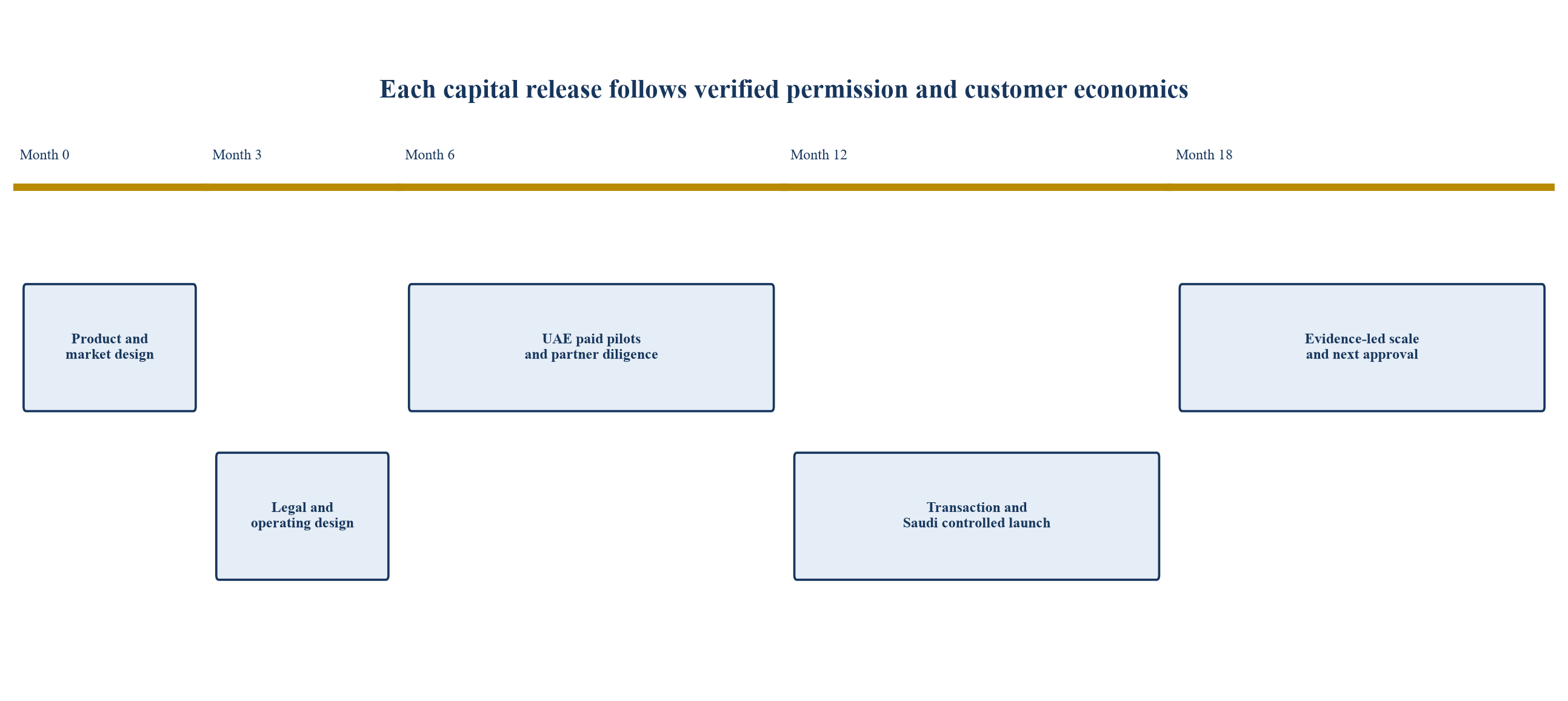
The sequence is illustrative and should be adapted to product and regulatory timetables.
29. Present an investment memorandum that can stop the programme
The investment memorandum should state the beachhead, transferable advantage, product perimeter, customer evidence, regulatory path, data architecture, operating model, partner or target, transaction terms, capital plan, central case, downside, implementation and rejection conditions. It should show evidence by country, entity, product and date.
The committee should receive the activity map, data map, customer interviews, pilot contracts, cohort model, channel funnel, partner diligence, licence analysis, competition analysis, ownership and governance, technology and cyber review, tax and cash model, capital schedule, risk register and implementation plan. Hypothetical assumptions should be visibly separated from observed company evidence.
Approval should specify the maximum capital, permitted product, countries, entity structure, partners, transaction consideration, deferred consideration, governance, milestones, stop-loss and matters requiring renewed approval. It should identify which evidence remains outstanding and when it must be resolved.
The governing principle is that permission, distribution, operations and capital must reconcile. Gulf demand has limited value when the platform cannot sell lawfully, acquire customers economically, control its partners or protect group liquidity. A staged framework converts expansion into a sequence of bounded investment decisions.
| Approval area | Evidence required | Committee decision |
|---|---|---|
| Product and country | Defined customer, product and beachhead | Approve perimeter or narrow scope |
| Regulation and data | Activity map, licence path, data architecture and approvals | Condition launch on verified permission |
| Distribution | Customer evidence, channel funnel, economics and control | Approve pilot, change channel or pause |
| Partner or target | Ownership, capability, integrity, contracts and contribution | Partner, acquire, reprice or decline |
| Operating model | Entity, management, service, technology, security and cash | Approve accountable country design |
| Capital | Uses, instruments, milestones, downside and stop-loss | Release funding by evidence stage |
| Transaction | Control, consideration, liabilities, conditions and exit | Approve terms or require protection |
| Implementation | Owners, timetable, dashboard and first 100 days | Authorise launch within limits |
The checklist supports governance and does not replace specialist advice.
30. Apply the framework by platform type
Marketplaces should focus on merchant acquisition, fulfilment, payment responsibility, consumer protection, pricing conduct and the bridge from gross merchandise value to contribution. Fintech-adjacent platforms should define every regulated payment, credit, investment or insurance function and identify the licensed provider. Software platforms should test data access, local implementation, integration, security and enterprise procurement. Logistics and mobility platforms should map permits, asset responsibility, contractor status, insurance, safety and service recovery.
Consumer applications should examine marketing, subscriptions, refunds, content, children, age controls, privacy and platform-store dependencies. The UAE issued a child digital-safety framework that applies to covered digital platforms operating in or directed to users in the State and includes age and privacy controls.[23][24] The product team should confirm the scope and current implementing requirements for the service.
Business-to-business platforms should verify contracting authority, implementation cost, information security, service levels, tax invoicing, collections and customer concentration. A small number of large local customers can create attractive early revenue while giving those customers disproportionate product influence.
Every platform type should use the same capital discipline: confirm permission, obtain paid customer evidence, build controllable distribution, establish operating responsibility and release scale funding only after the model reconciles to cash. The framework should be refreshed when the product, country, partner, ownership or data architecture changes.
| Platform type | Primary value evidence | Principal regulatory or operating question | Capital discipline |
|---|---|---|---|
| Marketplace | Retained merchants, order contribution and fulfilment | Payment role, user protection and platform conduct | Fund supply and demand only after local liquidity is proven |
| Fintech-adjacent | Active funded users, net revenue and losses | Licence holder, safeguarding, AML and data | Separate regulatory capital, losses and growth spending |
| Enterprise software | Paid deployments, retention and implementation margin | Data, security, local support and procurement | Fund reusable localisation rather than uncontrolled custom work |
| Logistics or mobility | Route density, service quality and contribution | Permits, assets, contractors, safety and insurance | Link fleet or capacity commitments to contracted demand |
| Consumer application | Paid retention, refunds and support cost | Privacy, content, children and marketing | Limit acquisition spending until cohort payback is observed |
| B2B commerce | Repeat purchasing, take rate, credit loss and cash cycle | Payments, credit, invoices and customer concentration | Cap working capital by verified receivables and collections |
Priorities are illustrative and should be expanded for the actual regulated perimeter.
Sources
- Association of Southeast Asian Nations, ASEAN Digital Economy Framework Agreement key documents and statement on substantial conclusion of negotiations. Read the primary source
- Asian Development Bank Southeast Asia Development Solutions, Realising a Confident Digital Society: Spotlight on Southeast Asia, 16 February 2026. Read the primary source
- Association of Southeast Asian Nations, ASEAN digital-sector key documents, including ASEAN Digital Masterplan 2030 and data-governance frameworks. Read the primary source
- Asian Development Bank Southeast Asia Development Solutions, The Evolution of Tech Governance in Southeast Asia, 22 May 2025. Read the primary source
- United Nations Conference on Trade and Development, Digital Economy Report 2024. Read the primary source
- World Bank, Digital Progress and Trends Report 2025: Strengthening AI Foundations. Read the primary source
- UAE Federal Competitiveness and Statistics Centre, UAE and the 2030 Agenda for Sustainable Development, including the Digital Economy Strategy. Read the primary source
- United Arab Emirates Legislation, Federal Decree by Law Concerning the Protection of Personal Data, No. 45 of 2021. Read the primary source
- UAE Ministry of Economy, Regulation of Competition and Federal Decree-Law No. 36 of 2023. Read the primary source
- UAE Ministry of Economy, Federal Decree-Law No. 36 of 2023 Regulating Competition. Read the primary source
- Central Bank of the UAE, Retail Payment Services and Card Schemes Regulation. Read the primary source
- Central Bank of the UAE, Retail Payment Services and Card Schemes Regulation, Article 2: Licensing. Read the primary source
- Central Bank of the UAE, Retail Payment Services and Card Schemes Regulation, Article 14: Obligations Towards Retail Payment Service Users. Read the primary source
- Central Bank of the UAE, Licensing and regulated activity categories. Read the primary source
- Central Bank of the UAE, Payment System Supervision. Read the primary source
- Saudi Central Bank, Implementing Regulations of the Payments and Payment Services Law, in force from 13 June 2023. Read the primary source
- Saudi Central Bank, Guidelines to Apply for Payment Service Providers License. Read the primary source
- Saudi Data and AI Authority, Guide to the Saudi Personal Data Protection Law for Controllers and Processors. Read the primary source
- Saudi Data and AI Authority, Regulation on Personal Data Transfer outside the Kingdom and guidance on binding common rules. Read the primary source
- Saudi General Authority for Competition, Economic Concentration Review Guidelines, 2025. Read the primary source
- Saudi National Platform, Notification About Economic Concentration, General Authority for Competition. Read the primary source
- Saudi Ministry of Investment, Investor Service Overview and investment registration services. Read the primary source
- United Arab Emirates Legislation, Federal Decree by Law of 2025 Regarding Child Digital Safety. Read the primary source
- United Arab Emirates Legislation, Cabinet Resolution No. 106 of 2026 Regarding the Regulation of Children's Access to Social Media Platforms. Read the primary source
- OECD, OECD Guidelines for Multinational Enterprises on Responsible Business Conduct, 2023. Read the primary source
- International Finance Corporation, Corporate Governance Methodology Tools. Read the primary source
