

1. Define the investment decision
The board decision is whether control of a manufacturing platform creates durable economic and strategic value after the buyer accounts for customer qualification, usable capacity, input security, logistics, working capital and execution risk. The location, installed machinery and historical revenue are starting facts. Approval requires evidence that the acquired system can deliver qualified products, acceptable yields, reliable cash conversion and an executable expansion plan.
The mandate should identify the product families, customer segments, plants, legal entities, technologies, licences, critical suppliers, export routes, investment horizon and maximum capital at risk. It should distinguish existing earnings from the value expected from Gulf distribution, new customers, procurement savings, expansion or technology transfer. Each source of value needs an owner, evidence standard, implementation cost and timing assumption.
Management should state rejection conditions before entering exclusivity. Examples include unresolved ownership or permits, capacity that requires unbudgeted replacement, customer contracts that cannot transfer, quality approvals tied to the seller, critical inputs without alternatives, environmental liabilities without a funded remedy, working-capital needs that exceed the facility plan, and an entry valuation that pays upfront for unqualified expansion.
The investment unit should be a product-customer-route combination. A line that produces an automotive component for Japan, an industrial controller for the GCC and an electronics module for the United States can have different qualification cycles, margins, suppliers, logistics and capital requirements. A single plant utilisation figure obscures those differences.
2. Use the GCC-to-Southeast Asia Manufacturing Investment Framework
The framework has seven gates. Demand proof identifies contracted, recurring or qualified customer need. Usable capacity tests equipment, labour, tooling, yield, maintenance and utility constraints. Input resilience maps suppliers, lead times, substitution and inventory. Route resilience tests ports, corridors, customs, insurance and customer delivery windows. Operating control establishes management, systems, quality, cash and compliance. Transaction design allocates ownership, liabilities, incentives and exit. Capital gating releases funding only when evidence supports the next stage.
Each gate should produce a conclusion, evidence file, unresolved issues, financial consequence, responsible owner and deadline. A customer qualification delay must change the revenue curve. A supplier concentration must change inventory, contracting or capital expenditure. A port risk must change route design and safety stock. A weak maintenance system must change availability and replacement assumptions.
The gates interact. Product redesign can require new tooling and customer approval. Tooling affects yield and available capacity. Yield affects input consumption and unit cost. Unit cost affects contract economics and working capital. Working capital affects debt capacity and the amount of equity at risk. The investment model should therefore connect commercial, technical, operational and financial evidence.
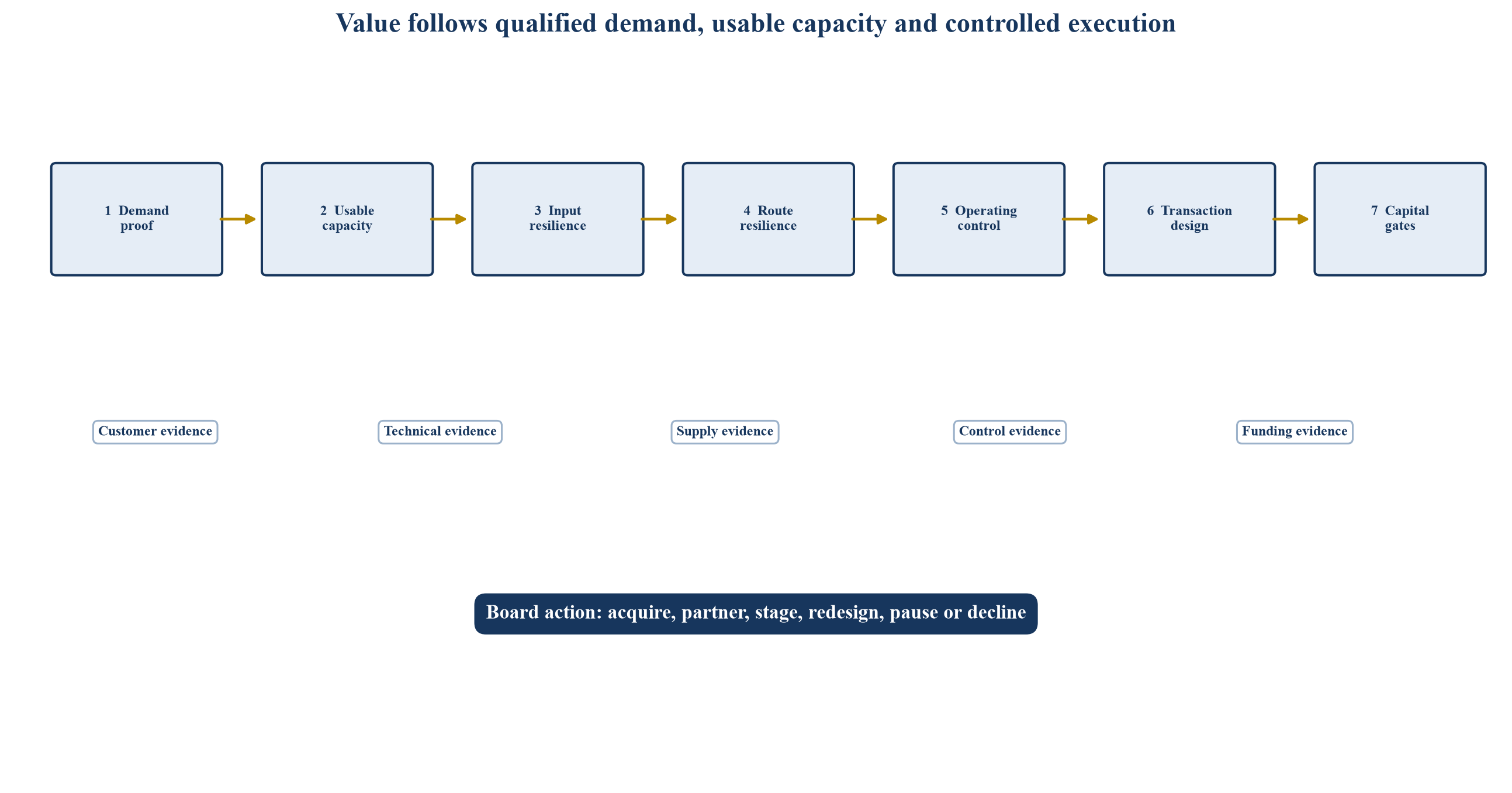
The framework is a proposed decision system and requires transaction-specific professional advice.
3. Start with the strategic link to the Gulf
The investment thesis should identify the specific link between the manufacturing asset and the GCC buyer. That link may be product security, access to qualified capacity, lower delivered cost, technology acquisition, supply diversification, customer access, food security, energy-transition equipment or a platform for third-party growth. A general objective to diversify away from one region is too broad to support valuation.
The ASEAN-GCC Joint Declaration on Economic Cooperation adopted in May 2025 calls for enhanced trade and investment and identifies manufacturing, logistics, advanced technologies, energy and sustainable infrastructure as priority areas.[1] It also recognises the role of sovereign wealth funds in advancing investment cooperation. The declaration establishes policy direction. It does not establish the economics of a factory, product or transaction.
Management should translate the strategic link into measurable outcomes. Examples include the percentage of Gulf demand supplied from the asset, reduction in single-source exposure, customer approval obtained, delivered lead time, gross-margin improvement, product localisation, new export revenue and replacement time after a disruption. These outcomes should appear in the investment case and post-close scorecard.
The board should also test whether ownership is necessary. A long-term offtake, reserved capacity agreement, strategic minority position, tooling finance, joint venture or supplier-development programme can provide access with less capital. Control can be justified when the buyer needs authority over capacity, quality, investment, intellectual property, cash or route redesign that a contract cannot provide.
4. Underwrite demand by customer and qualification status
Manufacturing demand should be separated into shipped revenue, firm orders, framework agreements, customer forecasts, nominated programmes, qualified opportunities and management aspirations. Each category has a different probability, margin, working-capital profile and cancellation risk. A letter of intent does not equal a purchase order, and a purchase order does not remove delivery or acceptance risk.
The diligence file should connect each material customer to the product, site, contract, currency, price formula, minimum order, forecast process, cancellation rights, tooling ownership, quality standard, delivery term, payment history and renewal cycle. Customer concentration should be measured at group, product and plant level. A diversified customer list can still contain one dominant programme that absorbs the critical line.
Customer qualification is often the binding constraint on expansion. New equipment may require process approval, first-article inspection, product testing, audits, sample runs and sustained yield before commercial volumes begin. The model should include the cost and time of each gate. Revenue should enter only after the relevant customer and technical approvals are evidenced.
The commercial case should include replacement demand and programme maturity. A facility serving a product near the end of its life may report high current utilisation while facing a rapid revenue decline. The buyer should identify the next qualified programme, the investment required and the probability-weighted gap between the two.
| Demand category | Evidence | Principal risk | Underwriting response |
|---|---|---|---|
| Shipped and paid | Invoices, acceptance and bank receipts | Historical demand may not repeat | Validate margin, retention and programme life |
| Firm order | Executed order, schedule and cancellation rights | Order can move or fail acceptance | Model delivery and acceptance conditions |
| Framework agreement | Signed terms and call-off history | No committed volume | Exclude uncalled volume from base case |
| Customer forecast | Portal data and forecast accuracy | Buyer treats forecast as obligation | Apply historical conversion and downside |
| Qualified programme | Audit and product approval evidence | Ramp can be delayed | Link revenue to milestone completion |
| Pipeline | Named opportunity and decision process | Probability is management-estimated | Keep outside committed funding case |
The matrix is illustrative and should be adapted to the product and contract structure.
5. Measure usable capacity rather than installed capacity
Installed nameplate capacity describes an engineering maximum under stated conditions. Usable capacity is the output that can be produced at acceptable quality, cost and delivery performance after accounting for maintenance, changeovers, bottlenecks, labour, tooling, utilities and planned downtime. Investment decisions should use the second measure.
The buyer should reconcile theoretical line speed to scheduled hours, availability, performance loss, yield and saleable output. Overall equipment effectiveness can support the analysis, but the underlying records matter more than a single percentage. Production logs, maintenance history, scrap, rework, unplanned downtime and customer complaints should reconcile to shipped units and cost accounts.
Bottleneck analysis should follow each product route through shared machines, test stations, clean rooms, furnaces, utilities, warehouses and quality laboratories. A plant can show spare capacity in assembly while remaining constrained by one testing asset or qualified tool. The investment plan should address the constraint that governs saleable output.
Management should separate maintenance capital expenditure, replacement capital expenditure and growth capital expenditure. Deferring maintenance can inflate historical cash flow while creating future failure risk. Growth equipment does not create revenue without installation, validation, operators, inputs, customer approval and working capital. Each capital line should connect to a defined output and acceptance milestone.
6. Build a product-level unit-cost bridge
Reported gross margin can conceal cross-subsidies, obsolete standards, owner-supplied inputs or favourable temporary prices. The buyer should build product-level cost from bill of materials, direct labour, machine time, energy, consumables, scrap, rework, packaging, freight, warranty and allocated overhead. The bridge should reconcile to the general ledger and recent purchase orders.
Costs should be divided between volume-driven, batch-driven, product-driven and facility-driven components. A new product may require engineering, tooling, certification and minimum purchases before it contributes margin. A small customer can consume disproportionate changeover and quality resources. Average plant margin should not be applied to every growth programme.
The model should test exchange rates and contractual pass-through. Inputs may be purchased in United States dollars while sales are denominated in local currency, euros, yen or Gulf currencies. A price-adjustment clause can protect economics only when its index, lag, cap and customer acceptance are understood. Historical margin during stable input prices may overstate resilience.
Management should identify the delivered cost to the Gulf customer. Factory gate cost is only one component. Export packaging, inland haulage, port handling, ocean or air freight, insurance, duties, certification, destination warehousing, inventory and service obligations determine the economic comparison with alternative supply.
7. Map suppliers beyond the first tier
The supply map should identify every component, material, tool, service and technology whose absence can stop qualified production. For each item, management should record supplier, manufacturing location, lead time, minimum order, currency, price mechanism, inventory, approved alternatives, tooling ownership, substitution process and recovery time. Supplier spend alone does not identify criticality.
The analysis should extend beyond the contractual supplier when the material depends on a single upstream producer, mine, chemical process, wafer fabrication site, specialised tool or logistics corridor. Tier-one diversification can provide false comfort when two suppliers rely on the same upstream source. The OECD recommends risk-based due diligence across operations, supply chains and business relationships.[14]
Alternative sourcing requires commercial and technical qualification. A second supplier that has not passed product testing, customer approval or regulatory certification is not immediately available. The model should include qualification time, dual-tooling cost, minimum purchases, inventory build and possible yield differences.
Supplier resilience should also cover financial health, labour, environmental performance, business continuity, cyber dependency and integrity. The OECD Guidelines for Multinational Enterprises address human rights, labour, environment, bribery, disclosure, science and technology, competition and taxation.[15] Due diligence should prioritise the most severe and likely impacts rather than treating every supplier equally.
8. Design inventory as a resilience instrument
Inventory protects production only when it is the correct qualified material, stored safely, visible in systems and available before the disruption reaches the plant. Blanket increases can consume cash, hide quality problems and create obsolescence. The policy should be item-specific and connected to recovery time and customer service.
Management should classify inventory by criticality, variability, lead time, shelf life, substitution and programme maturity. Safety stock can be justified where the cost of a line stop exceeds carrying cost and obsolescence risk. Long-lead tooling spares may deserve more protection than high-value finished goods with volatile demand.
The working-capital model should reconcile days, units and cash. Purchase commitments, transit time, customs clearance, customer consignment, vendor-managed inventory and payment terms can create funding requirements outside reported stock. The buyer should inspect ageing, slow-moving items, write-offs and differences between physical counts and system records.
Governance should specify who can change safety-stock targets, approve expedites, place non-cancellable orders and dispose of obsolete material. Resilience inventory should have a defined risk owner and review date. A strategic buffer without a trigger for release or reduction can become permanent capital leakage.
9. Underwrite trade routes as operating assets
The route from supplier to plant and plant to customer is part of the production system. The buyer should map origin, consolidation point, port or airport, carrier, transhipment, destination, customs process, inland transport and final delivery. Each route needs lead-time distribution, cost, capacity, documentation, insurance and recovery options.
The World Bank Logistics Performance Index evaluates customs, infrastructure, international shipments, logistics competence, tracking and timeliness.[13] Country scores provide context. Transaction diligence still needs lane-level evidence from bills of lading, freight invoices, customs records, transit history, claims and delivery performance.
Alternative routes should be operationally tested. A second port may require different permits, agents, packaging or inland capacity. Air freight may protect high-value components but destroy the economics of low-margin products. A route can remain physically open while insurance, vessel availability, security conditions or customer delivery windows make it commercially unusable.
The model should translate disruption into inventory, premium freight, lost production, delayed revenue, penalties and customer confidence. Management should avoid applying one generic delay to the whole business. Critical inputs and finished products require separate scenarios by lane, product and customer.
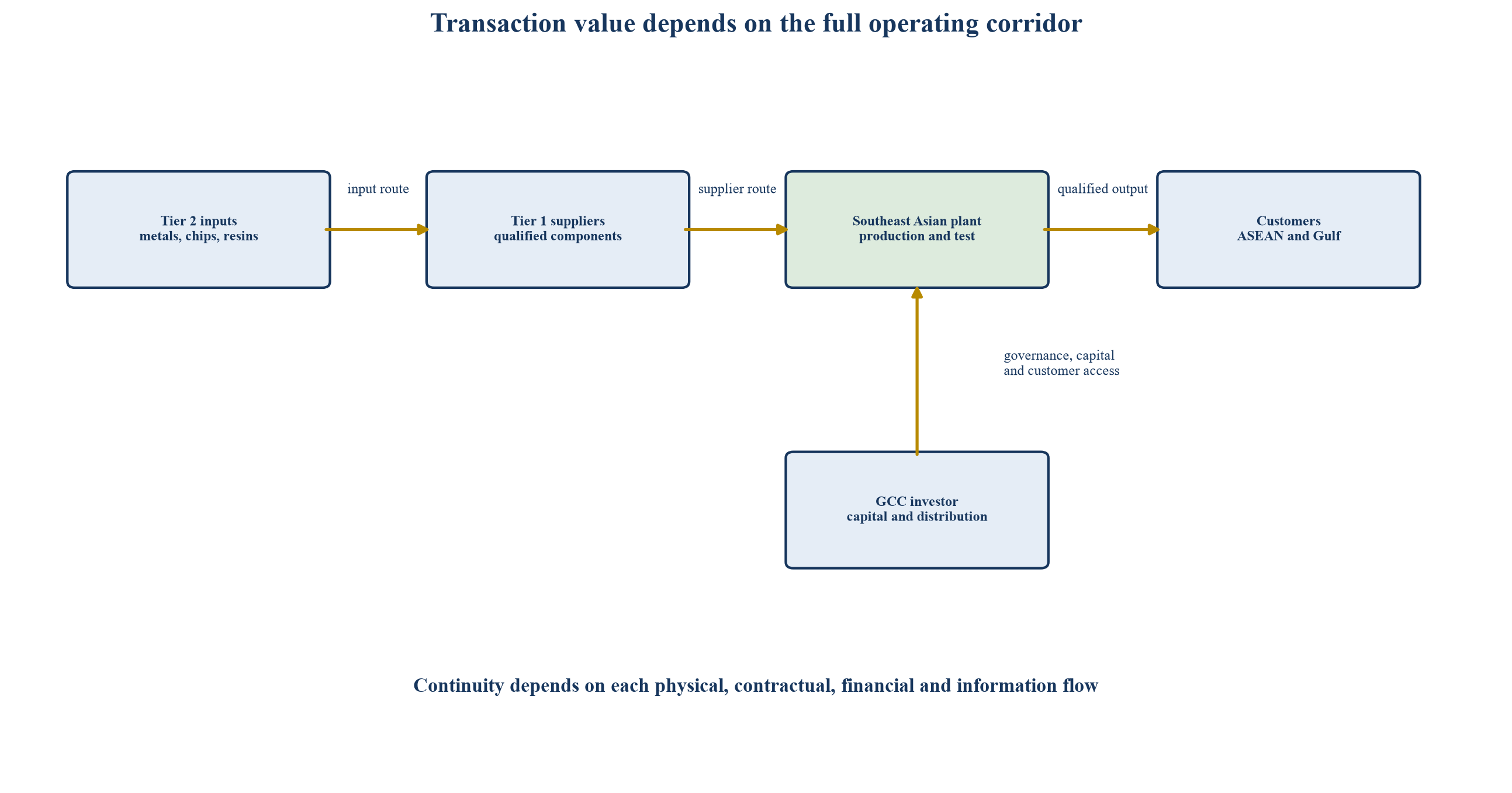
The entities, locations and flows are illustrative management assumptions.
10. Choose the country and industrial cluster by product
Southeast Asia is a production network rather than one manufacturing location. Country choice should follow the product, supplier ecosystem, customer access, infrastructure, workforce, energy, investment rules and route economics. A regional average cannot establish the suitability of a specific site.
ASEAN reports that manufacturing represented 20 percent of total FDI inflows in 2024, up from 9 percent in 2023, with activity across electronics, semiconductors, automotive, textiles and other supply-chain-intensive sectors.[4] The ASEAN Investment Report 2025 states that manufacturing FDI reached USD 44 billion after growth of nearly 150 percent.[2] These regional figures show investment momentum. They do not determine the quality or price of an individual asset.
Cluster depth should be evidenced through qualified suppliers, technical labour, research institutions, industrial services, ports, utilities and customer presence. A lower-cost location can require more inventory, imported skills and supplier development. A higher-cost location can produce better yields, shorter qualification and stronger logistics. The investment case should compare delivered economics and recovery capability.
National incentives should be treated as conditional cash flows. Eligibility, approval, performance obligations, duration, clawback, tax interaction and transferability need current advice. The base case should remain viable before discretionary benefits unless the legal entitlement and compliance plan are established.
11. Test ownership, licences and land rights
The acquisition perimeter may include an operating company, land entity, industrial lease, licence holder, export company, intellectual-property owner and related-party supplier. Each entity has its own owners, permits, liabilities, employees, accounts, taxes, security and contracts. Consolidated financial statements do not establish control of the operating assets.
The buyer should verify legal and beneficial ownership, foreign investment restrictions, sector approvals, industrial licences, environmental permits, building approvals, land tenure, utility rights and import-export registrations. The ASEAN Comprehensive Investment Agreement supports a liberal, facilitative, transparent and competitive investment environment, while actual access remains subject to schedules, reservations and national law.[11]
Land and facility rights require special attention. The legal owner, lease term, renewal mechanism, permitted use, mortgage, access, expansion rights and restoration obligations can determine whether the plant can operate or grow. A seller-owned industrial estate or related-party landlord can create post-close dependence.
Conditions precedent should require evidence that the buyer can own or control the relevant entities and assets on agreed terms. Where approval timing is uncertain, the transaction can use staged completion, escrow, interim covenants or a joint venture. The structure should not transfer full economic value before control and operating rights are available.
12. Separate brownfield acquisition from expansion economics
The existing business and the expansion programme should have separate models. The acquisition price should reflect current qualified earnings, assets, liabilities and risk. Expansion value should reflect future customer approvals, capital expenditure, ramp, yield, working capital and execution. Combining them can cause the buyer to pay upfront for growth it still must fund.
The brownfield model should normalise owner compensation, related-party pricing, maintenance, one-off freight, grants, customer concentration and underinvestment. It should reconcile EBITDA to operating cash after tax, maintenance capital expenditure and working capital. Cash conversion matters because manufacturing growth can absorb inventory and receivables before producing earnings.
The expansion model should identify equipment, building work, utilities, tooling, engineering, recruitment, training, validation, customer approval, initial scrap, inventory and contingency. It should use a monthly or quarterly ramp rather than assuming immediate utilisation. Funding should include delay and underperformance cases.
Transaction documents can allocate expansion risk through earn-outs, seller rollover, milestone consideration, warranties, retention arrangements and capital-call rules. These mechanisms need objective measures and dispute processes. A seller should not receive growth consideration for revenue created entirely by the buyer's post-close capital and distribution.
13. Build the investment model from physical drivers
The model should connect units, yield, price, input use, labour, machine hours, inventory days, receivable days, payable days and capital expenditure. Revenue growth should be traceable to customer-approved volume and available capacity. Margin improvement should be traceable to price, mix, yield, sourcing, utilisation or logistics.
Physical drivers make downside analysis intelligible. A five-point yield loss affects saleable units, material use, labour, scrap and delivery. A two-month qualification delay affects revenue, inventory, cash and debt service. Input inflation affects margin according to purchase currency, price pass-through and stock coverage. A route delay affects transit inventory and customer service.
The model should separate existing products, expansion products and Gulf-specific products. Their ramp, margin and capital requirements differ. It should also separate local and foreign currency cash flows. Translation of accounting results does not show whether cash is available for debt service, dividends or reinvestment.
Assumptions should carry evidence grades. Signed customer evidence, recent production records and executed supplier contracts can support a higher grade. Management targets and unqualified pipeline receive a lower grade. The investment committee should see how much value depends on each grade.
| Stage | Permitted use | Evidence required | Stop or redesign trigger |
|---|---|---|---|
| Confirmatory diligence | Technical, commercial, legal and environmental review | Customer, capacity, supplier, route and permit evidence | Missing control right or unbounded liability |
| Initial acquisition | Share consideration and refinancing | Transfer approvals, contracts, title and closing accounts | Material customer or permit failure |
| Stabilisation | Maintenance, systems and working capital | Verified production, cash controls and management continuity | Yield, cash or service below threshold |
| Expansion tranche 1 | Tooling and constrained equipment | Customer approval path and signed equipment terms | Qualification or installation delay |
| Expansion tranche 2 | Capacity ramp and inventory | Sustained yield, supplier readiness and route capacity | Economics fall below approved return |
| Gulf commercial scale | Distribution and customer support | Qualified Gulf demand and delivered-cost evidence | Channel fails contribution or retention test |
Amounts and milestones should be replaced with transaction-specific evidence.
14. Price working capital as acquisition capital
Working capital is not a residual percentage of revenue. Manufacturing requires cash for inputs, work in progress, finished goods, transit inventory, receivables, customer consignment, tax and supplier deposits. Growth can create an immediate funding need before the income statement records the expected margin.
The buyer should build working capital by product and customer. Long input lead times, batch purchases, customer acceptance and export transit can create materially different cash cycles. Reported year-end balances can understate seasonal peaks or quarter-end collection efforts. Monthly balances and purchase commitments provide stronger evidence.
Closing accounts should define normal working capital, debt-like items and cash-like items carefully. Overdue payables, supplier finance, customer advances, factoring, deposits, warranties and inventory provisions can change the effective purchase price. A headline cash-free, debt-free formulation does not resolve classification.
The financing plan should allocate revolver, trade finance, local borrowing, shareholder funding and contingency. Currency and security constraints need current advice. The board should reserve liquidity for a correlated scenario in which customer ramp is delayed while committed inventory and capital expenditure continue.
15. Design the transaction around control and operating continuity
Ownership percentage is only one part of control. The shareholder agreement should address board composition, reserved matters, budgets, capital calls, key appointments, bank mandates, related-party transactions, intellectual property, customer contracts, dividends, transfer, deadlock and exit. Operating responsibility should align with decision rights.
A GCC investor may contribute capital, customers, procurement, energy-market knowledge and distribution. The local partner may contribute management, licences, supplier relationships, labour systems and site knowledge. The operating model should identify which capabilities remain essential after closing and how they are retained or institutionalised.
Management continuity requires more than retention bonuses. The buyer should map roles, authorities, succession, documented processes, customer ownership and supplier relationships. Key knowledge concentrated in the founder or plant head can create transition risk. The first hundred days should transfer authority without disrupting production.
Minority structures can protect capital through information rights, consent matters, anti-dilution, pre-emption, put or call arrangements and agreed exit processes. These rights must be legally and commercially executable. A paper right without access to information, valuation mechanics or a solvent counterparty may have little practical value.
16. Use acquisition finance only after operating resilience is tested
Debt capacity should be based on cash available after tax, maintenance, working capital and required local liquidity. EBITDA alone can overstate capacity where the business holds large inventories, faces long receivables or needs recurring tooling and qualification expenditure.
The lender case should test customer concentration, cyclicality, raw-material exposure, covenant headroom, security, cash movement, permitted distributions and foreign exchange. Debt service in a Gulf entity should not rely on cash that cannot be lawfully or operationally upstreamed from the manufacturing subsidiary.
Facilities can include acquisition term debt, revolving working-capital lines, trade finance, equipment finance and local-currency borrowing. Each instrument should fund the risk it can monitor. Short-term trade facilities should not finance permanent losses, and acquisition debt should not assume unqualified expansion revenue.
Financial covenants should link to the actual risk. Leverage and interest coverage may be supplemented by minimum liquidity, borrowing-base, customer concentration, capital expenditure and distribution tests. Cure rights, grace periods and reporting need to accommodate a manufacturing ramp without masking deterioration.
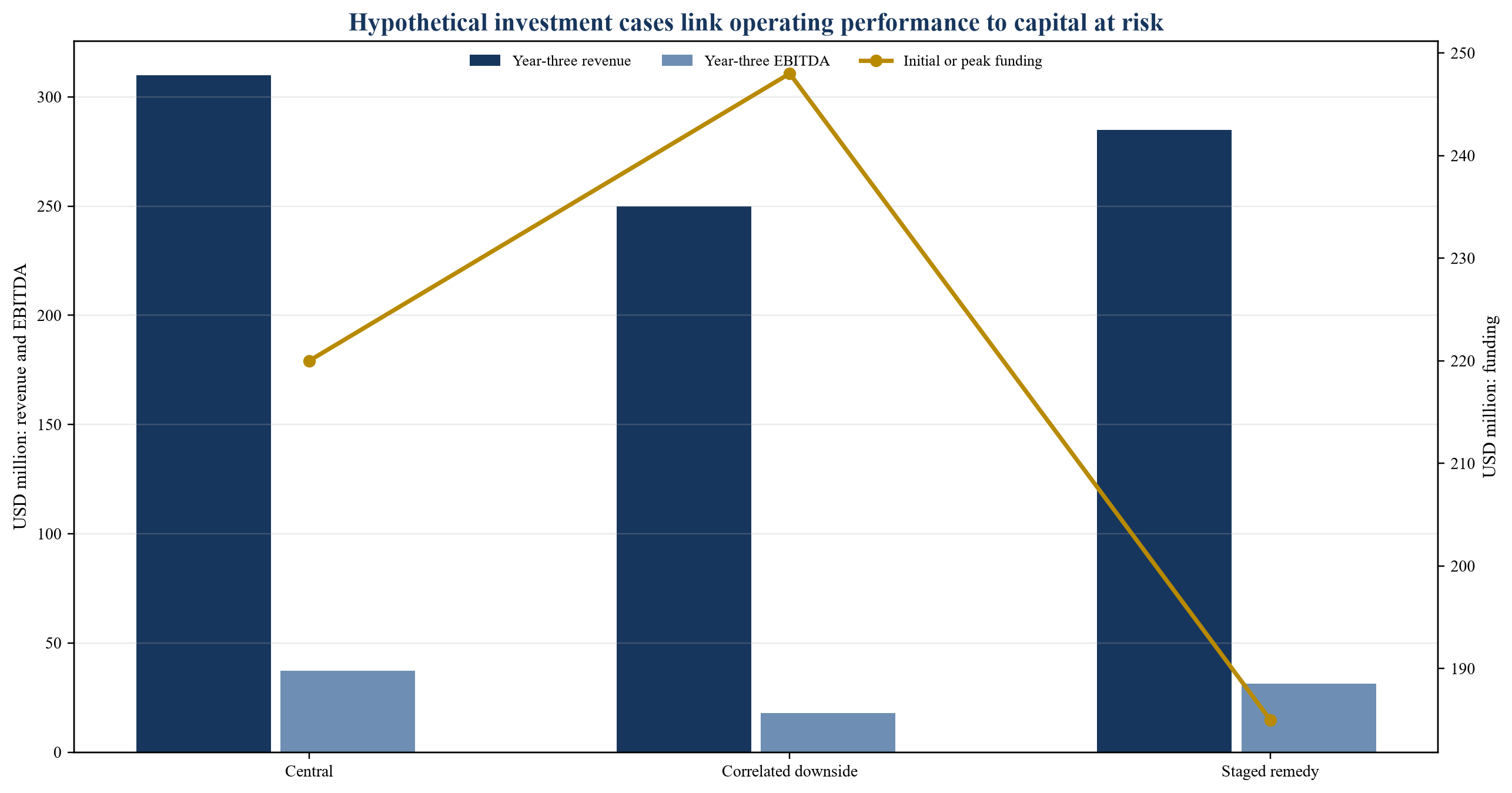
All amounts are hypothetical management assumptions and are not forecasts.
17. Test the hypothetical investment case
The hypothetical target operates two Southeast Asian plants producing electronics modules and industrial-control equipment. Historical revenue is assumed at USD 235 million and EBITDA at USD 24 million. The buyer proposes to acquire 65 percent, refinance selected debt and expand one constrained product line. Total uses are assumed at USD 220 million.
The central case assumes year-three revenue of USD 310 million. Existing products contribute USD 250 million, qualified regional expansion contributes USD 35 million and Gulf-linked programmes contribute USD 25 million. EBITDA reaches USD 37.2 million, or 12.0 percent of revenue. Cash available before financing reaches USD 22.0 million after assumed tax, maintenance capital expenditure and working capital.
The correlated downside delays two customer programmes by nine months, reduces line yield by five percentage points, increases critical-input cost by eight percent and adds twenty days to one export route. Revenue falls to USD 250 million, EBITDA falls to USD 18.0 million and peak funding rises to USD 248 million because committed equipment and inventory continue while customer cash is delayed.
The staged remedy acquires 51 percent initially, defers part of seller consideration, funds maintenance and the bottleneck first, and releases expansion capital after customer approval and sustained yield. Year-three revenue is assumed at USD 285 million and EBITDA at USD 31.5 million. Initial committed capital falls to USD 185 million. All figures are hypothetical management assumptions and do not describe an actual company.
18. Make supply-chain resilience measurable
Resilience should be measured through the ability to maintain acceptable service and economics during defined disruptions. A broad claim that the business is diversified cannot be audited. The board needs indicators that connect exposure, response and recovery.
Metrics can include revenue covered by qualified dual sources, critical items without an approved alternative, time to recover, maximum tolerable outage, safety-stock coverage, route alternatives tested, unplanned downtime, yield, supplier concentration, customer concentration and working-capital headroom. Each metric needs a definition, data source, owner and threshold.
The scorecard should distinguish readiness from outcome. A business may hold a continuity plan without testing it. It may have an alternative supplier without customer qualification. It may have a second route without freight capacity. Readiness evidence includes contracts, tests, approved specifications, rehearsals and inventory. Outcome evidence includes delivery, cost and cash performance during a real or simulated event.
Management incentives should balance efficiency and resilience. A procurement team rewarded only for price can increase concentration. A plant rewarded only for utilisation can defer maintenance. A sales team rewarded only for revenue can accept unprofitable customisation. The post-close plan should align incentives with contribution, service, quality, cash and recovery capability.
19. Price customer concentration and supplier concentration together
Customer and supplier concentration can amplify each other. A plant may depend on one customer whose qualified product also depends on one specialised input. Losing either relationship can strand tooling, inventory and labour. Concentration analysis should therefore connect both sides of the product chain.
The buyer should identify revenue, contribution and cash by customer, then link each product to critical suppliers, routes and equipment. The analysis should show which exposures are contractual, technical or relational. A long customer contract may still permit forecast reductions. A nominated supplier may limit the manufacturer's ability to change source or price.
Valuation should reflect the cost and time required to reduce concentration. Customer diversification can require sales capability, certification, tooling and working capital. Supplier diversification can require engineering, testing, inventory and customer approval. These are investment programmes, not immediate synergies.
Transaction protection can include customer or supplier conditions, price adjustment, escrow, earn-out, warranty and termination rights. Protection should match the evidence gap. A general warranty may be less valuable than a closing condition tied to renewal of the contract that supports the acquisition model.
| Exposure | Evidence question | Value consequence | Mitigation |
|---|---|---|---|
| Customer | What volume is committed, qualified and profitable? | Revenue and utilisation may fall together | Diversify programmes and link value to retained contribution |
| Supplier | Which input can stop a qualified product? | Line stop, premium freight and lost customer service | Qualify alternatives and hold targeted buffers |
| Equipment | Which asset governs saleable output? | Expansion case fails despite nominal spare capacity | Fund bottleneck and critical spares first |
| Route | Which corridor lacks a tested alternative? | Cash cycle and delivery penalties increase | Contract alternate lanes and simulate recovery |
| People | Which authority or knowledge sits with one person? | Transition and customer continuity weaken | Document roles, succession and delegated authority |
| Cash | Which peak cannot be funded by committed facilities? | Buyer faces emergency equity or covenant stress | Size liquidity to correlated downside |
Scores are illustrative and should be replaced by verified transaction evidence.
20. Integrate environmental and social diligence into value creation
Environmental and social diligence should identify legal compliance, operating risk, capital requirements and commercial opportunity. Manufacturing issues can include emissions, effluent, hazardous materials, energy, water, waste, worker safety, labour practices, land, community impact and supply-chain conduct. Each issue should be assigned a remedy, cost, owner and timetable.
IFC's Performance Standards establish a framework for clients to assess and manage environmental and social risks.[16] The standards cover management systems, labour, resource efficiency, community health and safety, land, biodiversity, indigenous peoples and cultural heritage. Their application depends on the investment and financing context. Local law remains essential.
Efficiency projects can create value when the baseline and investment are verified. Lower energy, water, scrap or hazardous-material use can reduce cost and exposure. Claims should be supported by meter data, production volumes, engineering design and implementation contracts. An estimated percentage saving should remain outside committed value until evidenced.
The buyer should also test whether customer requirements will tighten. Global customers can impose product carbon, traceability, labour and material standards through procurement and qualification. A facility that cannot produce the required evidence may lose access even when current local compliance is adequate.
21. Protect technology, tooling and production data
The manufacturing system can depend on process know-how, recipes, machine parameters, software, drawings, customer specifications, tooling and production data. The buyer should identify ownership, licences, access, restrictions, escrow, cybersecurity and change control for each material asset.
Tooling often creates hidden dependence. A customer, supplier, founder or related party may own the tool used at the plant. The diligence file should establish location, condition, ownership, maintenance obligation, permitted use and return rights. The transaction should not assume control over assets that the target merely holds.
Operational technology security should cover machine networks, remote access, vendors, backups, patching, identity, incident response and recovery. A cyber event can stop production or corrupt quality data without affecting the corporate network. Recovery tests should demonstrate that critical systems and configurations can be restored.
Data governance should reconcile production, quality, maintenance, inventory, customer and financial records. Post-close reporting depends on consistent definitions and controlled master data. Systems integration should preserve plant continuity; a rapid enterprise-resource-planning migration can create more risk than value when the operating data are not ready.
22. Build the governance and management-information system before close
The buyer should define the first reporting pack before signing. It should include orders, customer forecast accuracy, output, availability, yield, scrap, complaints, supplier service, inventory, routes, working capital, cash, capital expenditure, environmental and safety indicators, and milestone status. Measures should reconcile to source systems and financial accounts.
Governance should operate at plant, company and shareholder levels. Plant management owns daily execution. The company board owns strategy, capital, risk and leadership. Shareholders exercise reserved rights without bypassing operating accountability. The cadence should support decisions rather than create parallel reporting for each investor.
The information system should preserve negative evidence. Missed yield, delayed approval, supplier failure and customer complaint should remain visible until resolved. Red-amber-green reporting is useful only when definitions are objective and managers cannot move milestones without approval.
The board should require a monthly cash bridge from EBITDA to unrestricted cash. Manufacturing can report strong earnings while absorbing inventory, receivables and capital expenditure. The bridge should identify restricted balances, local liquidity requirements, debt service, dividends and capital calls.
23. Sequence the first two hundred days
Days 1 to 30 should confirm authority, bank mandates, customers, production plans, safety, liquidity and critical suppliers. The buyer should avoid broad systems or organisational changes while validating control of cash and continuity of production.
Days 31 to 75 should complete the product-customer-capacity map, maintenance recovery, inventory validation, route tests and management succession. Quick wins should remove specific constraints, such as overdue maintenance, missing spare parts, unapproved supplier alternates or weak cash forecasting.
Days 76 to 130 should execute the agreed bottleneck programme, supplier qualifications, customer approvals and working-capital facilities. Expansion orders should proceed only where the evidence gate is met. Deferred consideration and seller incentives should be tested against the same measures used in the investment case.
Days 131 to 200 should stabilise the operating rhythm, complete the first resilience simulation and approve the next capital tranche. Management should present actual performance against the acquisition model, explain variances and revise the plan where evidence has changed.
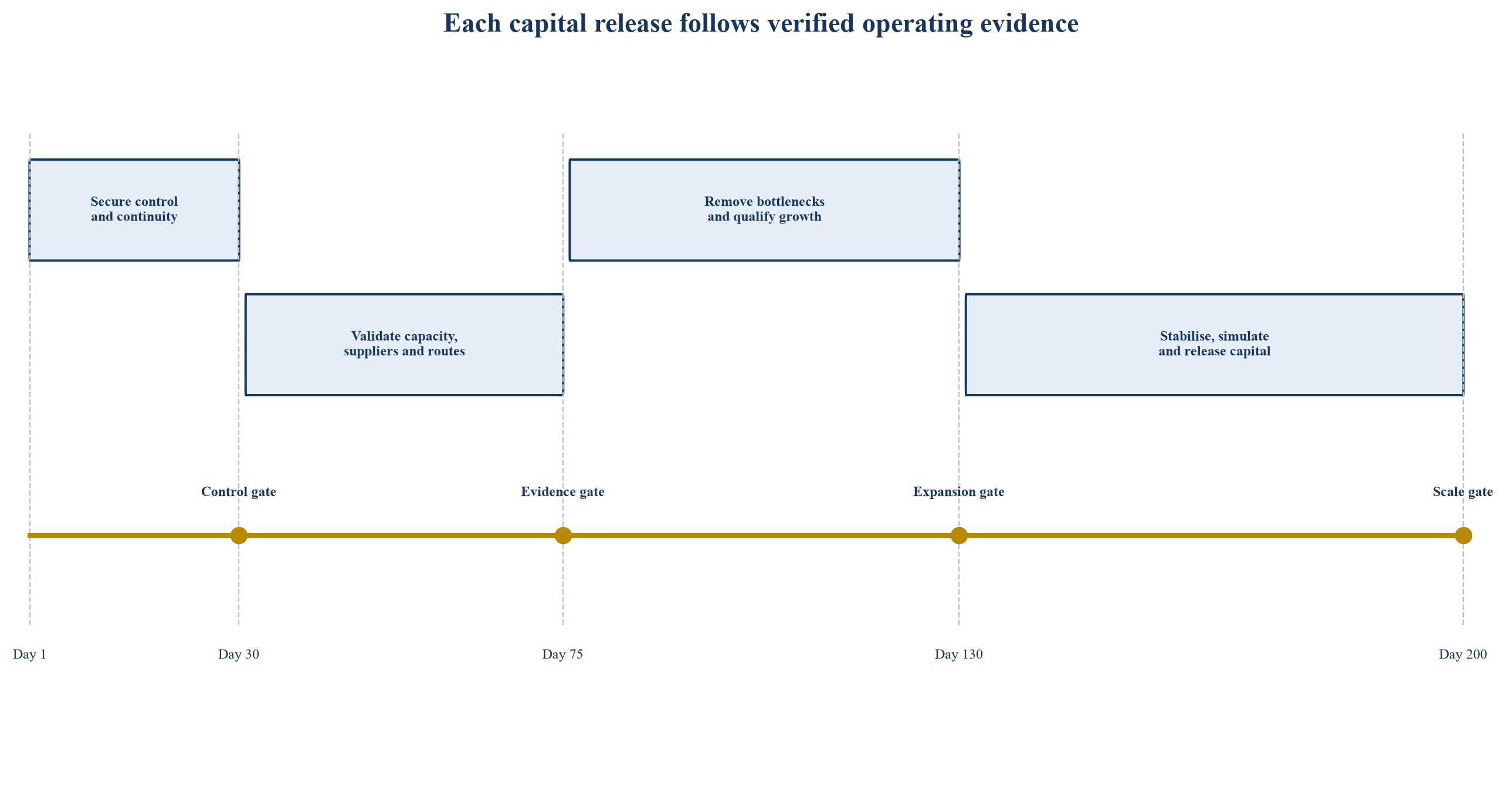
The timetable is illustrative and should be adapted to transaction and regulatory requirements.
24. Use risk-adjusted valuation rather than a resilience premium
Resilience should enter valuation through cash flows, capital requirements, scenario probability and transaction terms. A buyer should avoid applying an unsupported premium to a company described as strategic. The model should show how customer retention, yield, sourcing, routes, maintenance and working capital affect value.
The base enterprise value can use normalised earnings, discounted cash flow and relevant transactions, subject to comparability. Adjustments should reflect maintenance backlog, underfunded working capital, customer or supplier concentration, environmental liabilities, required systems, non-operating assets and contingent obligations.
Growth value should be conditional. Qualified customer programmes, contracted equipment and funded working capital can support more value than management pipeline. Earn-outs or deferred consideration can bridge evidence gaps when the measures are objective and within appropriate control. A buyer should avoid paying for its own future distribution contribution.
The investment committee should see central, downside and staged cases together. The question is not whether one model produces the target return. The question is which evidence supports each cash flow, how much capital is exposed before it arrives, and which contractual or operating action reduces the loss if the evidence fails.
25. Design exit before entry
The exit thesis should identify likely buyer categories, regulatory approvals, information requirements, valuation basis, minority rights and time needed to prepare the business. A strategic acquisition can create assets that are valuable to the owner while narrowing the pool of future buyers. The board should understand that trade-off before closing.
Exit readiness begins with separable ownership, audited accounts, controlled related-party arrangements, transferable customer and supplier contracts, documented intellectual property, reliable management information and resolved compliance issues. These are also operating controls. Building them after close can increase value even when the planned holding period changes.
Minority structures need clear transfer, tag, drag, pre-emption, valuation and deadlock provisions. Put rights require a creditworthy counterparty and lawful funding. A listing path requires governance, reporting and free float that may differ from the operating priorities of a controlled industrial group.
The exit model should test sale proceeds after debt, tax, transaction cost, retained liabilities and trapped cash. A headline multiple does not establish cash returned to the investor. The acquisition model and legal structure should preserve credible exit routes without weakening operating control.
26. Use integration to preserve the manufacturing system
Integration should protect customer service, quality, safety, production and cash before pursuing broad cost synergy. Manufacturing value can be destroyed quickly when a new owner changes suppliers, systems, authority or staffing without understanding qualification and continuity requirements.
The integration plan should separate mandatory control changes from optional standardisation. Bank mandates, delegated authorities, compliance, reporting and cyber access may require immediate action. Enterprise systems, procurement platforms, branding and organisational design can follow evidence and testing.
Synergy should be assigned to a named lever. Procurement savings require comparable specifications, approved suppliers, volume and implementation cost. Gulf revenue requires qualified customers, product compliance, delivered cost and channel capacity. Capital efficiency requires inventory, yield or payment changes that operations can execute.
Management should maintain a decision log linking each integration action to customer, plant, supplier, people, system and cash consequences. A benefit should not be recognised twice across procurement, margin and working capital. One owner should be accountable for realisation and any disruption caused.
27. Apply a risk heat map tied to board action
The risk register should score probability, financial severity, service impact, detectability, recovery time and controllability. A low-frequency licence or safety event can deserve more attention than a frequent small variance. Each rating should cite evidence and identify the person authorised to change it.
Risks should be allocated to price, contract, structure, insurance, operating control, capital reserve or rejection. Customer concentration may support deferred consideration. Supplier concentration may support dual qualification and inventory. Route disruption may support alternative corridors and insurance. Unbounded title, integrity or environmental risk may require the buyer to decline.
Leading indicators should include forecast changes, yield deterioration, downtime, supplier delays, inventory ageing, freight disruption, complaints, employee departures, safety incidents, permit deadlines and cash conversion. The board needs direction and trigger breaches, not a static closing score.
Risk acceptance should identify approving body, rationale, exposure cap, mitigation and review date. Missing evidence should remain an open item. Transaction urgency should not convert uncertainty into a favourable assumption.
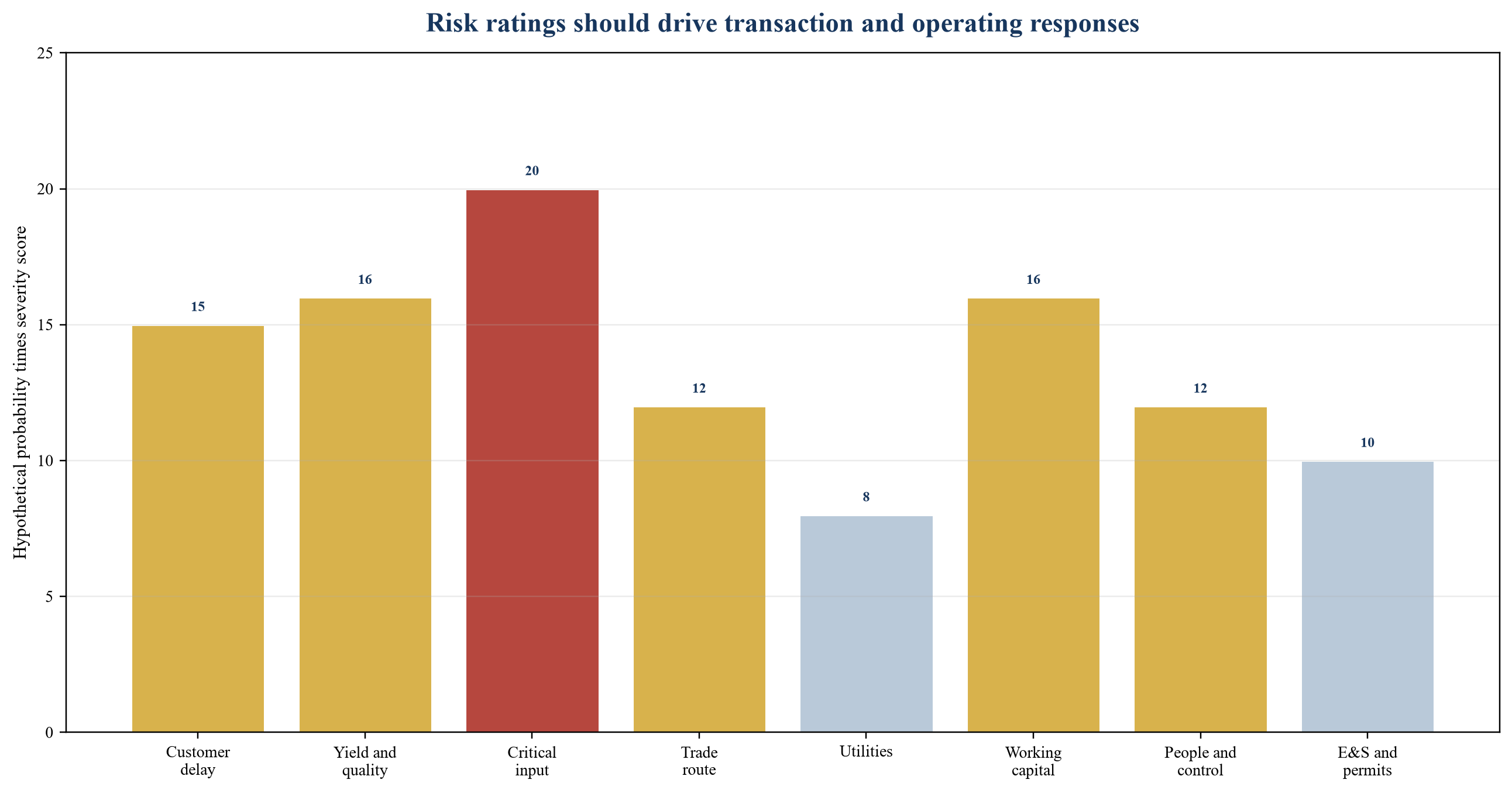
Scores are hypothetical and should be replaced with verified transaction evidence.
28. Present the investment committee with a falsifiable case
The investment memorandum should state the strategic purpose, product-customer perimeter, current earnings, required capital, central and downside cases, ownership and governance, key evidence, unresolved issues, conditions and rejection triggers. The case should be capable of being proven wrong before more capital is released.
The committee should receive a source map for material assumptions. Customer evidence, production records, supplier contracts, route data, legal conclusions and environmental findings should be accessible. Management estimates should be identified as such in the internal decision file and replaced when stronger evidence arrives.
Approval should specify the maximum purchase consideration, initial capital, contingent value, facilities, conditions precedent, capital gates, integration authority and risk acceptance. It should identify which matters return to the committee. A broad approval to complete on substantially agreed terms weakens control over the evidence gaps that determine value.
The memorandum should remain active after signing. New diligence, customer changes, equipment findings or regulatory developments can change the case. The board should require an updated decision before completion when a material assumption no longer holds.
| Decision area | Evidence required | Committee decision |
|---|---|---|
| Strategic link | Defined Gulf need and ownership rationale | Confirm purpose or use a contractual alternative |
| Demand | Qualified customers, programme life and contribution | Approve base revenue and downside |
| Capacity | Verified bottleneck, yield, maintenance and utilities | Approve usable output and capital plan |
| Inputs and routes | Critical-source and corridor evidence | Approve buffers, alternatives and conditions |
| Transaction | Ownership, liabilities, governance and exit | Approve terms or require protection |
| Capital | Purchase price, working capital, capex and liquidity | Set maximum commitment and release gates |
| Implementation | Management, first 200 days and scorecard | Authorise named owners and reporting |
The checklist supports governance and does not replace specialist advice.
29. Apply the framework by manufacturing type
Electronics and semiconductor-related assets require attention to technology access, qualified inputs, clean production, testing, intellectual property, export controls and rapid product cycles. Automotive components add platform life, nominated suppliers, tooling, warranty and just-in-time delivery. Medical products add registration, quality systems, traceability and regulatory inspection.
Food processing links agricultural inputs, cold chain, food safety, water, energy and shelf life. Building materials can depend on energy, quarry or mineral rights, bulky logistics and project cycles. Industrial equipment combines engineering, order backlog, customisation, long-lead components, service capability and warranty.
Energy-transition manufacturing can include solar, batteries, power electronics, smart meters, grid equipment and charging systems. The ASEAN Investment Forum 2026 highlighted smart-grid manufacturing, advanced meters, automation and energy-management systems as investment areas supporting regional energy transition.[24] Each opportunity still requires product, customer, technology and policy diligence.
The framework remains constant while the evidence changes. Demand, capacity, inputs, routes, control, transaction and capital should be defined for the specific product and jurisdiction. Sector labels should not substitute for an operating model.
30. Use a board action plan
The board should begin by defining the GCC strategic need and the minimum ownership required. Management should then build the product-customer-capacity map, identify critical inputs and routes, verify current permits and ownership, and create a monthly cash model. These tasks should precede a binding value position.
Confirmatory diligence should test customer qualification, bottleneck output, maintenance, supplier alternatives, inventory, route history, environmental and labour controls, technology ownership, management continuity and working capital. Findings should change price, conditions, structure, funding or the decision to proceed.
The transaction should stage seller value and growth capital against objective milestones. The first two hundred days should secure control, preserve production, remove verified bottlenecks and prove the expansion case. The board should receive an evidence-based scorecard and a cash bridge each month.
The investment succeeds when the manufacturing system produces qualified products, maintains service through disruption, converts earnings into accessible cash and supports a credible next phase. Strategic language can initiate the mandate. Verified operating evidence should determine the capital decision.
Sources
- Gulf Cooperation Council, Joint Declaration on Economic Cooperation between ASEAN and the GCC, 29 May 2025. Read the primary source
- ASEAN Secretariat and UN Trade and Development, ASEAN Investment Report 2025: Foreign Direct Investment and Supply Chain Development. Read the primary source
- ASEAN Secretariat, Investment overview, accessed 18 September 2026. Read the primary source
- Invest ASEAN, Manufacturing, accessed 18 September 2026. Read the primary source
- ASEAN Secretariat, ASEAN launches the Framework of ASEAN Industrial Projects Based Initiative, 26 May 2025. Read the primary source
- Invest ASEAN, Single Market and Production Base, accessed 18 September 2026. Read the primary source
- Invest ASEAN, Integrated Supply Chain, accessed 18 September 2026. Read the primary source
- Asian Development Bank, Asian Economic Integration Report 2025, March 2025. Read the primary source
- World Trade Organization and partners, Global Value Chain Development Report 2025. Read the primary source
- UN Trade and Development, World Investment Report 2025: International Investment in the Digital Economy. Read the primary source
- Invest ASEAN, ASEAN Comprehensive Investment Agreement, accessed 18 September 2026. Read the primary source
- ASEAN Secretariat, ASEAN Investment Facilitation Framework, 2021. Read the primary source
- World Bank, Connecting to Compete 2023: Trade Logistics in an Uncertain Global Economy. Read the primary source
- Organisation for Economic Co-operation and Development, Due Diligence for Responsible Business Conduct, accessed 18 September 2026. Read the primary source
- Organisation for Economic Co-operation and Development, OECD Guidelines for Multinational Enterprises on Responsible Business Conduct, 2023. Read the primary source
- International Finance Corporation, Performance Standards on Environmental and Social Sustainability. Read the primary source
- International Finance Corporation, Corporate Governance Methodology. Read the primary source
- International Labour Organization, Tripartite Declaration of Principles concerning Multinational Enterprises and Social Policy. Read the primary source
- ASEAN Secretariat, Regional Comprehensive Economic Partnership Agreement, accessed 18 September 2026. Read the primary source
- World Customs Organization, SAFE Framework of Standards, 2025 edition. Read the primary source
- ASEAN Secretariat, Joint Statement of the ASEAN-GCC-China Summit, 27 May 2025. Read the primary source
- ASEAN Secretariat, ASEAN strengthens global value-chain agenda at the third FG-GVC meeting, 20 January 2025. Read the primary source
- Invest ASEAN, ASEAN attracts record FDI in 2025 amid a shifting global investment landscape, accessed 18 September 2026. Read the primary source
- Invest ASEAN, ASEAN Investment Forum 2026, accessed 18 September 2026. Read the primary source
- Asian Development Bank, Asia-Pacific Economic Integration Report 2025: Highlights. Read the primary source
- UN Trade and Development, ASEAN Investment Report 2025 publication page, 25 October 2025. Read the primary source
