

Introduction
Electricity reliability is an economic product before it becomes a payment mechanism. The system operator needs sufficient capability to meet demand across credible conditions, recover from outages and manage uncertainty in weather, fuel, networks and customer behaviour. Investors need a revenue model that supports the assets and services required to provide that capability. Consumers need a design that secures the chosen standard at a defensible cost. Those requirements meet in the reliability market.
The resource mix has changed the shape of adequacy risk. Peak demand remains relevant, but shortage risk can arise during winter cold, summer heat, multi-hour low renewable output, correlated thermal outages, fuel constraints, drought, network limitations or rapid load growth. Data centres, electrified heat, transport and industrial demand can create new load shapes and concentrated connection requirements. The International Energy Agency's Electricity 2025 report identifies extreme weather as a central reliability risk in many regions. NERC's 2025 Long-Term Reliability Assessment also highlights demand growth, delivery delays and uncertainty over resource additions in North America.
A market designed around one historic peak hour or a single resource category can misprice these conditions. A modern framework should assess every credible hour and recognise the marginal reliability contribution of generation, storage, demand response, interconnection and portfolios. It should also distinguish resource adequacy from operating reserves, stability, network resilience and restoration. Each service can require a separate product or coordinated procurement.
This paper explains how boards, regulators, system operators, utilities, investors, lenders and transaction teams can evaluate a reliability mechanism without embedding an unexplained technology preference. It uses current public rules and official assessments as evidence. All numerical examples are hypothetical and illustrate method only.
1. Define the reliability product before choosing the market
A capacity payment can purchase several different things. It can pay for installed capacity, accredited dependable capability, availability during defined scarcity intervals, actual delivery during an event, or an option that limits consumer exposure to high energy prices. These products allocate risk differently. A market should state which one it buys and how that product links to the governing reliability standard.
Installed capacity is the simplest quantity. It can overstate value when a resource is unavailable during risk hours, energy-limited, fuel-constrained or located behind a binding network constraint. Accredited capacity attempts to translate nameplate capability into expected reliability contribution. A performance product adds an obligation to respond and a financial consequence for failure. A reliability option combines a capacity payment with an obligation linked to a scarcity-price strike.
The buyer also needs to define the delivery period. A seasonal product can recognise different summer and winter capability. A monthly or subannual product can reflect maintenance and changing risk. A multi-year forward auction can support investment, while a prompt or incremental auction corrects forecast error closer to delivery. PJM's Reliability Pricing Model combines a forward base auction with incremental auctions and locational requirements. Great Britain's Capacity Market awards agreements through competitive auctions and requires availability during system stress.
The design sequence should therefore begin with the standard, risk model, product and obligation. Auction rules, price caps and contract terms follow from those choices.
2. Interpret technology neutrality as common evidence
Technology neutrality means that eligible resources compete to provide a defined service under comparable evidence and performance standards. It does not require identical accreditation or operating rules for physically different resources. A battery, gas turbine, hydro plant, interconnector and aggregated flexible load create reliability through different pathways. The market can remain neutral when those pathways are translated into a common dependable product.
Several tests make neutrality operational. The eligibility test asks whether a resource can provide the service. The accreditation test measures how much of the resource counts. The deliverability test establishes whether it can reach the relevant load. The performance test evaluates whether it responded when required. The settlement test converts delivery and failure into payment. The entry test checks whether administrative requirements create an avoidable barrier for smaller, aggregated or newer resources.
A single derating factor by technology can be administratively convenient. It can become inaccurate when projects within that class have different duration, configuration, location or correlated exposure. Project-specific models can improve accuracy while increasing data requirements and discretion. A practical design can combine transparent class methods with project-specific adjustments for material attributes.
Neutrality also requires symmetric recognition of support and constraint. Storage should receive credit for discharge capability and duration while accounting for charging dependence and state of charge. Thermal generation should receive credit for firm output while accounting for outage, fuel and weather exposure. Demand response should receive credit for verified load reduction while accounting for baseline error, fatigue and rebound. Interconnectors should receive credit based on correlated scarcity and available transfer capability.
3. Separate adequacy, operating reliability and resilience
Resource adequacy concerns whether sufficient resources are expected to be available to meet demand over a future period. Operating reliability concerns the system's ability to balance and remain within secure limits in real time. Resilience concerns the ability to withstand and recover from high-impact disturbances. A reliability market focused on adequacy cannot automatically procure inertia, voltage control, black start, ramping, network reinforcement or cyber resilience.
This distinction affects investment. A battery can provide capacity, frequency response and reserve, but each revenue stream has different dispatch, duration and performance conditions. A synchronous generator can provide capacity and stability services, but an adequacy payment should reflect only the dependable capacity product. A demand-response portfolio can reduce peak load, but it may require telemetry, notification and customer controls to provide an operating reserve.
The IEA's electricity-security framework treats adequacy, robustness, stability and resilience as related but distinct concepts. Market architecture should follow that separation. The regulator can coordinate products and prevent double payment for the same obligation while allowing one asset to stack revenues when it provides separate services.
An investment model should map every revenue line to a service, obligation, dispatch right and penalty. The map reveals conflicts. A storage asset committed to capacity may need to preserve charge for a scarcity event, limiting arbitrage or ancillary-service revenue. A demand-response provider may face overlapping calls from a retailer and system operator. A lender should test which obligation has priority and how non-performance is measured.
4. Anchor procurement to an explicit reliability standard
The reliability standard converts public policy into a measurable procurement target. Common metrics include loss of load expectation, expected unserved energy and a value-of-lost-load criterion. A one-event-in-ten-years convention is widely used, but its exact interpretation depends on the model, time resolution, weather sample, outage data and treatment of interconnected regions.
The standard should reflect the value consumers place on avoiding interruption and the costs of additional reliability. It should also identify whether critical loads, distribution outages and network constraints sit inside or outside the calculation. A national standard can hide local scarcity when transfer capability is limited. Locational requirements or network planning may therefore supplement the system-wide target.
The Australian Energy Market Operator publishes Reliability Standard Implementation Guidelines explaining how it applies the reliability standard in the National Electricity Market. ENTSO-E's European Resource Adequacy Assessment reports loss of load expectation and energy not served across study zones and scenarios. ACER uses European adequacy work as an objective input when considering whether national capacity mechanisms are justified.
The standard should be reviewed on a governed schedule. Electrification, climate conditions, interconnection and customer flexibility can change the cost and consequence of shortage. A review should preserve stable investment expectations by publishing methodology, consultation evidence and transition rules before changing obligations.
5. Model risk across all hours and system states
An adequacy model should identify the hours and conditions that drive expected shortage. Historical peak demand alone can miss winter fuel risk, multi-day renewable lulls, drought, coincident outages or load ramps. FERC accepted PJM reforms in 2024 that model resource adequacy risk across all hours of the year and incorporate expected unserved energy alongside the loss-of-load standard.
The model should represent weather-linked demand, wind, solar, hydro, thermal deratings, forced outages, fuel availability, storage state of charge, imports, demand response and transmission. Correlation matters. Cold weather can increase demand, reduce gas availability and affect generator performance at the same time. Regional scarcity can reduce import availability when a neighbouring system faces the same weather.
Scenario weights should be transparent. A base model can use many weather years and stochastic outage draws. Stress cases can add delayed construction, accelerated retirements, high large-load growth, fuel interruption or transmission delay. The procurement target should respond to the distribution of outcomes rather than one central forecast.
Boards and investors need a traceable link from the adequacy model to the asset. The key questions are which hours drive risk, how the project's availability aligns with them, and how its contribution changes when similar resources enter. A resource can have strong average output and weak marginal contribution if the system already has ample output from that technology during low-risk hours.
6. Credit marginal reliability contribution
Effective load carrying capability measures the additional load that a resource or portfolio can support while preserving a chosen reliability level. Marginal ELCC measures the incremental contribution of an additional unit at the current system mix. This approach can compare variable generation, storage, thermal resources and demand flexibility through a common adequacy outcome.
Accreditation should reflect the portfolio context. Solar capacity can contribute strongly in a summer-peaking system until evening risk becomes dominant. Storage value can decline as similar-duration batteries saturate the same hours, while longer-duration capability becomes more valuable. Wind value depends on the relationship between wind conditions and risk hours. Thermal value depends on forced outage, weather performance and fuel availability.
PJM's current manuals use ELCC-based accreditation for capacity resources and describe the process for establishing accredited unforced capacity. FERC's 2025 State of the Markets materials note a wider shift toward granular resource-adequacy studies and marginal ELCC. These methods improve comparability, but they require substantial data and governance.
The market should publish the model, classifications, key inputs, validation results and change process. Participants need enough information to forecast accredited output and finance projects. Confidential plant data can be protected while class methods, system assumptions and sensitivities remain visible.
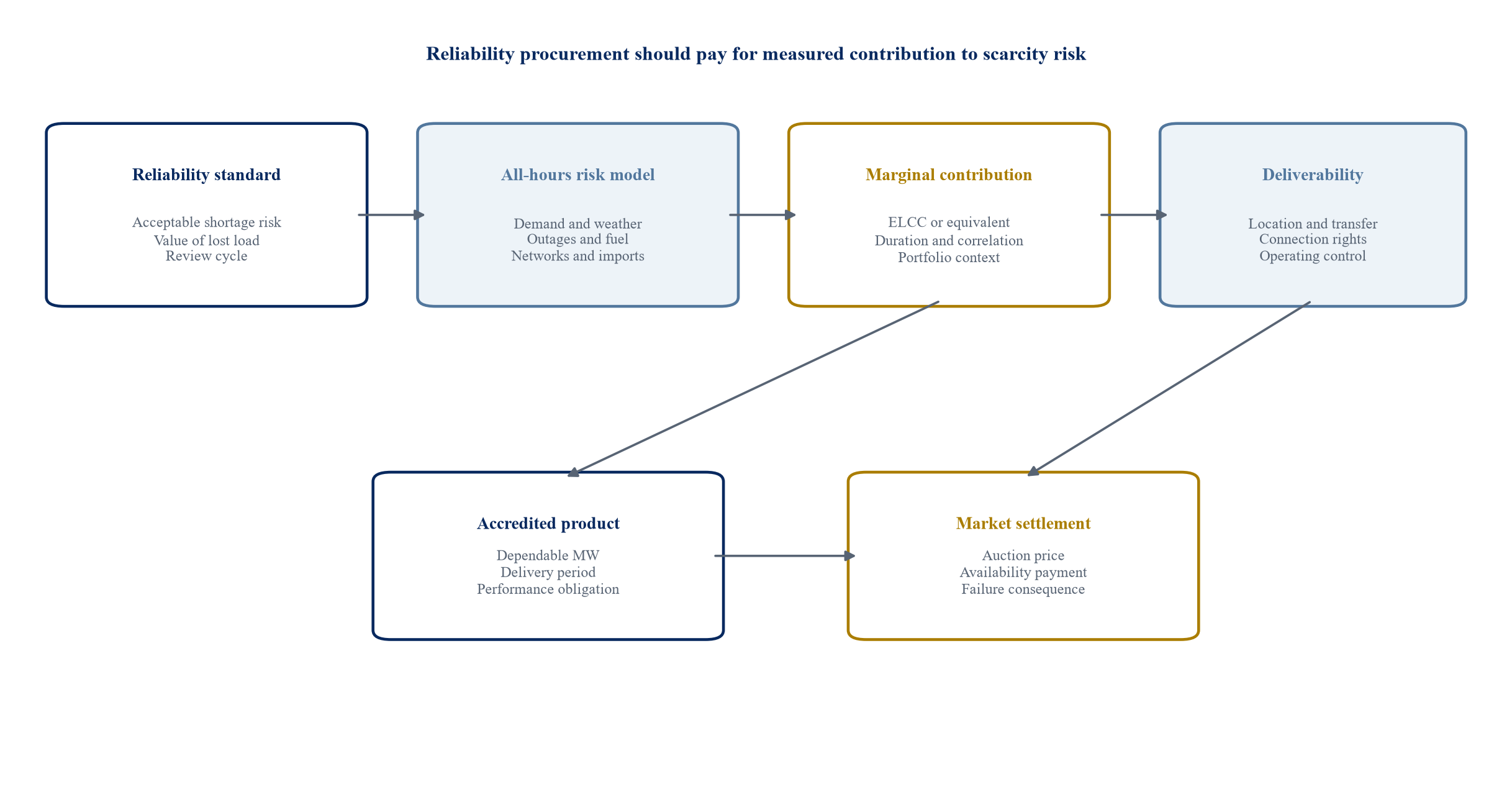
The framework converts public reliability objectives and system risk into a comparable accredited product for auction and settlement.
7. Test deliverability and location
System-wide accreditation can overstate reliability when a resource cannot reach the load area during a binding transmission condition. A deliverability test should examine connection rights, transfer limits, contingency criteria and local resource requirements. Locational capacity zones or subregional requirements can procure additional capability where the network cannot import enough during scarcity.
PJM uses locational reliability requirements and collects capacity costs through a locational reliability charge. Great Britain's Capacity Market is national, while network planning, connection reform and transmission charging address location through separate mechanisms. A design can remain coherent under either approach if the boundary between capacity and network responsibility is clear.
Project diligence should verify the point of interconnection, firm transfer rights, operating limits, planned upgrades and shared dependencies. A resource with a capacity award still faces delivery risk if its connection is delayed or conditional. An interconnector's contribution depends on available transfer capability and the probability that the exporting region has surplus during the importing region's scarcity.
The financing case should include location-specific downside. A project may clear a system auction and still face local curtailment, upgrade cost or commissioning delay. Security and milestone obligations can create liquidity needs before capacity revenue begins.
8. Recognise duration and energy limits
Energy-limited resources need accreditation and obligations that reflect duration. A four-hour battery cannot provide the same service as an asset that can sustain output through a multi-day event, although the battery can have a high contribution to shorter scarcity intervals. Pumped hydro, reservoir hydro, thermal storage, hydrogen, flexible demand and backup fuels have distinct replenishment and duration constraints.
Duration should be measured against the sequence of risk hours generated by the adequacy model. A fixed minimum duration can simplify entry while creating a cliff that ignores partial contribution. ELCC can capture some of this relationship by simulating state of charge and dispatch. The model should disclose charging assumptions, round-trip losses, operational reserve and competition among storage assets.
Performance rules should address recovery between events. A battery may discharge during one alert and lack time or grid access to recharge before the next. Demand response may face customer fatigue or production constraints after repeated calls. Hydro may face water-value and environmental restrictions.
An investment committee should examine accredited megawatts per unit of nameplate capacity, the sensitivity to duration and the expected change as similar resources enter. A project that relies on a stable accreditation factor through a long debt tenor needs protection through conservative sizing or contractual support.
9. Apply comparable performance obligations
Accreditation estimates expected contribution before delivery. Performance settlement tests actual contribution during defined events. The event trigger should be observable, timely and linked to system need. The resource should know its committed quantity, notice period, measurement point and permitted outage treatment.
Penalties should be material enough to support delivery and bounded enough to remain financeable. Unlimited exposure can deter entry or shift risk to consumers through higher bids. Weak penalties can pay resources that fail when needed. A balanced design can cap annual downside while using collateral, testing, termination and reprocurement for persistent failure.
Comparable obligations require resource-specific measurement. Generation can be measured at the meter against its commitment. Storage measurement should account for dispatch instructions, state of charge and charging restrictions. Demand response requires a baseline that estimates consumption without the event. Interconnectors require scheduled flow and available transfer evidence.
Testing outside scarcity events provides additional assurance. Great Britain's Capacity Market applies delivery and testing requirements, including rules that continue to evolve for storage and consumer-led flexibility. PJM's capacity rules include testing and performance requirements within its Reliability Pricing Model. The market should publish event and test outcomes so investors and consumers can evaluate delivery.
10. Enable demand response and aggregation
Demand flexibility can reduce the amount of generation and network capacity required during peak stress. It can also respond faster than new construction when customers already have controllable load, storage, electric vehicles, thermal systems or industrial processes. The IEA's 2025 report on demand flexibility identifies improved asset utilisation, lower peak stress and better renewable integration as important benefits.
Entry rules should accommodate aggregation because individual customers may be too small to meet market thresholds. Aggregators need clear rights over telemetry, dispatch, data, customer consent and settlement. Baseline methods should be transparent and audited. A baseline that systematically overstates ordinary consumption can create phantom capacity.
Availability should reflect customer behaviour and portfolio diversity. The model should test opt-out rates, coincident industrial conditions, communications failure and rebound demand. Repeated events can reduce willingness or physical ability to respond. A portfolio with many independent customers can be more reliable than one concentrated behind a common network or technology platform.
The United Kingdom has consulted on modernising Capacity Market rules and improving the participation and delivery assurance of consumer-led flexibility. FERC Order No. 2222 requires US regional markets to enable distributed-energy-resource aggregations under approved rules. These programmes demonstrate that neutrality depends on entry architecture as well as headline eligibility.
Table 1. Common reliability evidence across resource types
| Resource | Reliability pathway | Core evidence | Principal adjustment |
|---|---|---|---|
| Thermal generation | Dispatchable output during scarcity | Forced-outage history, weather performance, fuel arrangements, tests | Correlated outage and fuel risk |
| Variable renewable generation | Output coincident with shortage-risk hours | Time-synchronised production, weather scenarios, curtailment | Marginal ELCC and network limits |
| Battery storage | Shift energy into scarcity intervals | Power, duration, state of charge, charging access, degradation | Duration saturation and recharge risk |
| Demand response | Verified reduction from counterfactual demand | Baseline, telemetry, dispatch records, customer contracts | Baseline error, fatigue and rebound |
| Interconnector | Imports during domestic scarcity | Transfer capability, regional adequacy, outage and flow data | Correlated scarcity and export limits |
| Portfolio or hybrid | Combined contribution under coordinated control | Component data, dispatch logic, common dependencies | Correlation, shared connection and control risk |
Requirements should reflect physical differences while producing a comparable accredited and performance-tested reliability product.
11. Underwrite storage as a system resource
Storage creates reliability by moving energy from available periods into shortage periods. Its contribution depends on power, energy, efficiency, degradation, charging access, operating strategy and the sequence of scarcity hours. A market should model those attributes rather than assign one enduring credit to every battery.
Short-duration storage can reduce narrow evening peaks. Longer-duration storage can cover extended low-renewable periods or repeated events. The marginal value of each duration changes with the system mix. A large fleet of similar batteries can flatten the original peak and move risk later, reducing the next project's contribution.
Contract design should state whether the system operator controls charging or only discharge, whether the asset can reserve energy, and how competing obligations are prioritised. A capacity commitment may constrain merchant arbitrage. The project model should reduce energy-market revenue when reliability obligations require a conservative state-of-charge policy.
Debt sizing should use accredited revenue, merchant margins and penalties as separate lines. Accreditation changes can affect both revenue and collateral. Degradation reserves, augmentation, replacement and warranty conditions should align with the delivery period. Great Britain's reforms have addressed storage augmentation and extended performance testing, illustrating the interaction between physical maintenance and capacity obligations.
12. Price thermal capability through measured risk
Thermal generation can provide dispatchable capacity and long duration, subject to outage, fuel, emissions and weather risk. Technology neutrality requires accreditation that reflects those risks. A unit with firm fuel, winterisation and a strong outage record can contribute more than a nominally similar unit with constrained fuel transport or poor extreme-weather performance.
Fuel assurance should be assessed across the same system states used for adequacy. Gas-electric coordination matters when power demand and heating demand compete for pipeline capacity. Liquid backup fuel can improve resilience while introducing storage, emissions and replenishment limits. Hydrogen or carbon capture conversion can create a future decarbonisation path, but reliability credit should follow commissioned capability and available infrastructure.
The contract should avoid paying today for an unbuilt conversion. It can use milestones, conditional tenor or separate support for the capital required to decarbonise. The United Kingdom has considered routes for unabated gas assets to transition toward carbon capture or hydrogen while maintaining security through the Capacity Market.
Investors should model carbon cost, running hours, maintenance, start performance and environmental limits. Low annual dispatch does not remove fixed operating cost. Capacity revenue can therefore be central to financeability, especially where energy-market scarcity rents are uncertain or capped.
13. Combine renewables into firm clean portfolios
Wind and solar produce low-carbon energy with output that varies by weather and time. Their reliability contribution can be material when production aligns with risk hours. Portfolios can increase that contribution by combining complementary resources, storage, flexible demand and geographic diversity.
A firm clean portfolio should be accredited as an operating system. The model should use time-synchronised resource and load data, shared-network constraints, dispatch logic and state of charge. Contracted energy volumes should not be confused with dependable capacity. An annual 24/7 matching target can support procurement goals while retaining residual scarcity exposure during specific hours.
Hybrid facilities can share an interconnection. This can reduce network cost and increase utilisation, but the combined export limit constrains simultaneous output. The accreditation model should apply the connection limit and reflect control priority. It should also avoid double counting the same stored renewable energy as separate renewable and storage capacity.
Transaction documents should allocate forecast, dispatch, imbalance and augmentation responsibilities. A portfolio may need an optimisation platform and clear authority during system events. Lenders will examine data rights, operating controls and the enforceability of long-term contracts across the portfolio.
14. Value interconnection with correlated scarcity
Interconnectors diversify supply when regions have different demand, weather and resource conditions. Their reliability contribution declines when scarcity is correlated or the exporting region restricts flows. A neutral method should assess expected imports during domestic risk hours and respect physical transfer limits.
The model should represent outages, maintenance, market coupling, minimum flows, network constraints and export-region adequacy. Historical flows can inform behaviour, but future resource retirements and demand growth can change export availability. Political or regulatory intervention should be included where rules allow emergency restrictions.
Cross-border participation can improve competition. ACER states that European capacity mechanisms should be open to cross-border participation, subject to the applicable framework. The practical design needs a method for allocating interconnector capacity, verifying availability and settling non-performance across jurisdictions.
An acquisition or financing case should separate regulated interconnector revenue, congestion income, capacity revenue and merchant exposure. Capacity accreditation should not be treated as a permanent asset characteristic. It can change when regional systems become more correlated or network rules change.
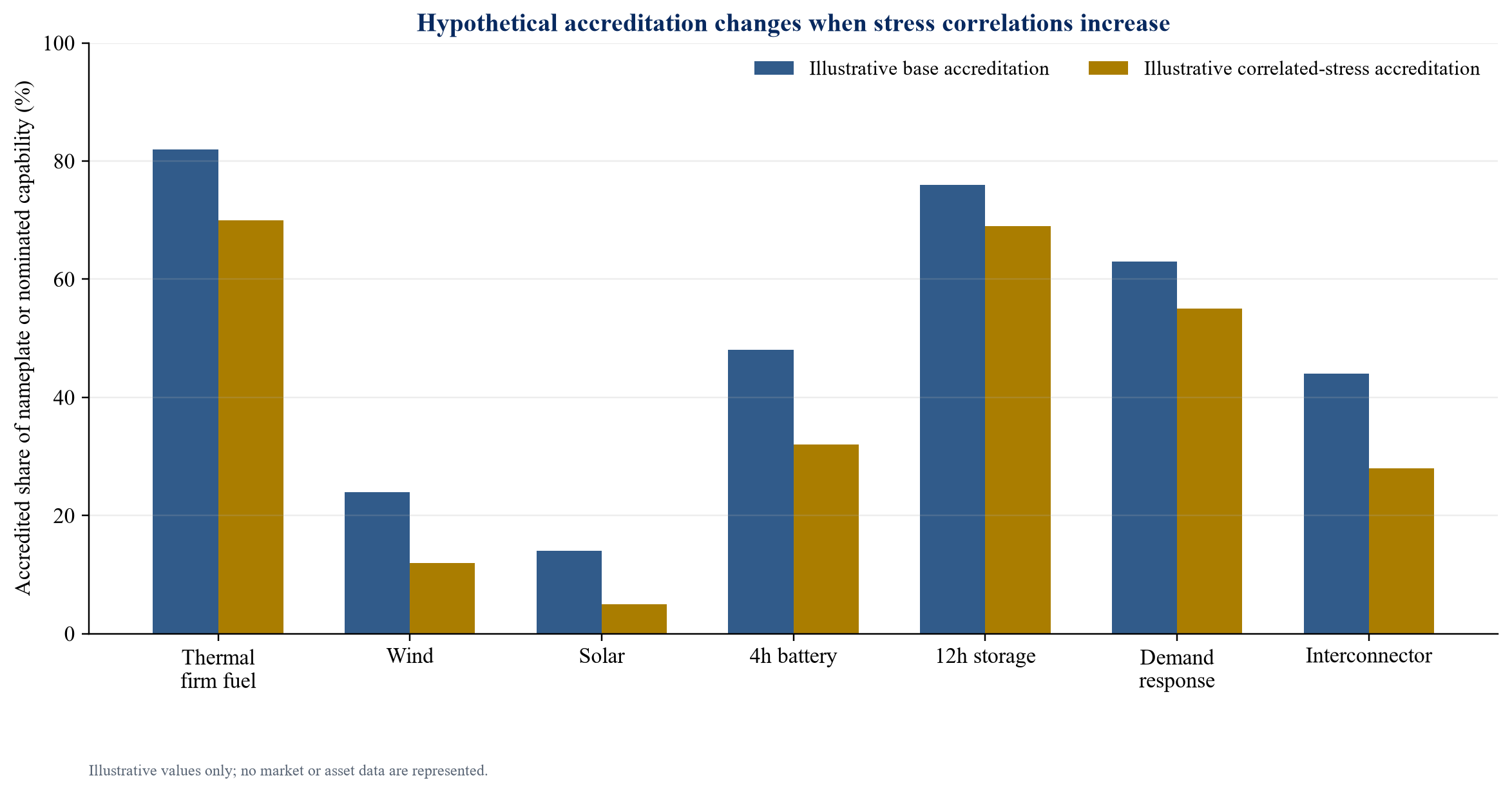
Each resource should be credited for its marginal contribution in the hours and locations that drive shortage risk.
15. Design the auction around the dependable product
The auction converts the procurement target into commitments and prices. A descending-clock or sealed-bid format can procure a target quantity through a demand curve. A vertical demand curve acquires a fixed amount but can produce volatile prices when supply is tight. A downward-sloping curve can trade a limited quantity adjustment for price stability and reveal the value placed on incremental reliability.
The auction should use accredited megawatts. Offers can be submitted per accredited unit, with clearing and settlement based on the obligation. New and existing resources can compete together, or the design can use separate tenors and price caps when financing needs differ. Any segmentation should have a stated policy basis and guard against inefficient displacement.
Locational constraints can be included in clearing. The model should procure the system requirement and any constrained-zone requirement simultaneously. Portfolio and common-ownership rules should address market power. Offer mitigation should distinguish legitimate fixed-cost recovery from strategic withholding.
Auction timing should align with development lead times. A four-year forward auction can support conventional generation or storage while remaining too short for nuclear, hydro, transmission-linked projects or emerging clean firm technologies. Longer procurement can increase forecast error. A coordinated set of forward, supplemental and bilateral mechanisms can manage these differences if obligations remain comparable.
16. Set demand curves and price limits through evidence
Administrative demand curves translate the reliability standard into auction willingness to pay. Their parameters often use the cost of new entry, net energy and ancillary-service revenue, target reserve margin and price caps. Small changes can materially affect clearing price and procurement.
The reference technology used for cost of new entry should represent a credible entrant. Its capital cost, fixed operating cost, financing, construction period, interconnection and expected market revenue should be updated through a transparent process. One reference resource can become less representative as the system moves toward storage, demand response and diverse clean firm options.
Net revenue estimates should match the delivery period and scarcity-pricing rules. A capacity market that assumes high energy scarcity rents while price caps or interventions suppress them can underpay investment. An estimate that ignores ancillary-service saturation can overstate merchant revenue.
Price caps limit consumer exposure and supplier upside. Floors and offer rules affect exit and retention. The regulator should test entry, retirement, forecast error and market power under multiple supply curves. Results should be published with sensitivity rather than one apparently precise administrative value.
17. Align contract tenor with capital formation
Reliability assets have different capital intensity and development periods. A one-year agreement can support an existing asset with limited incremental expenditure. A new clean firm project may need a multi-year contract to raise debt and equity. Tenor policy should therefore connect to verifiable investment and delivery milestones.
Longer contracts reduce revenue risk and can lower the cost of capital. They also transfer forecast and technology risk to consumers. The contract should define indexation, change in law, accreditation changes, termination, assignment, refinancing and treatment of delay. A stable payment with uncertain accredited quantity can still create substantial debt-service volatility.
Lenders will examine the payment counterparty, legal enforceability, termination compensation, collateral, performance downside and interaction with merchant revenue. They will also test whether the project can comply with the obligation through planned outages and extreme events. A debt case should use the contracted dependable quantity and conservative net revenue after expected penalties and operating restrictions.
Emerging technologies can use staged support. Development funding, demonstration grants, cap-and-floor mechanisms or contracts for difference can address risks that a general capacity auction cannot price efficiently. The reliability market should credit the completed capability once it can meet the common service standard.
18. Calibrate penalties, collateral and delivery assurance
Delivery assurance begins before operations. Qualification should verify site control, permits, connection, financing plan, equipment pathway and construction schedule. Milestones should match the project's critical path and provide enough notice for replacement procurement if delivery fails.
Credit cover should reflect exposure without creating a disproportionate barrier for smaller providers. Parent guarantees, letters of credit and cash collateral have different costs. An aggregator can face large collateral relative to its asset-light business. The market can scale requirements by obligation and delivery stage while retaining credible recourse.
Operational penalties should link to the shortage value and the resource's committed quantity. Caps can preserve financeability, while repeated failure can trigger suspension or termination. Excused events should be narrow, measurable and compatible with the system-risk model. Broad force-majeure treatment can weaken the product during the same extreme events that drive adequacy need.
Secondary trading can allow a provider to replace unavailable capacity before delivery. Transfer rules need qualification and locational consistency. They should preserve accountability and avoid moving obligations to a resource that creates less reliability value.
19. Integrate carbon policy without obscuring the reliability product
Reliability and decarbonisation are both public objectives. They can be integrated through eligibility standards, emissions limits, carbon pricing, separate clean-capacity procurement or transition conditions. The selected approach should state which cost and risk each mechanism addresses.
A universal capacity auction can reveal the lowest bid for accredited reliability under current rules. Carbon pricing can internalise operating emissions. Emissions limits can exclude or constrain high-carbon resources. Separate contracts can support technologies with large learning, infrastructure or first-of-kind risk. These instruments can coexist when their obligations and payments are reconciled.
The design should avoid double payment for the same output. A project receiving a clean-energy contract and a capacity agreement can provide two distinct products if the contracts recognise their interaction. The energy contract supports low-carbon production; the capacity contract pays for dependable availability. Settlement should account for shared revenue and dispatch constraints where relevant.
Transition rules matter for existing thermal capacity. Abrupt exclusion can create an adequacy gap. Unconditional long-term payments can create carbon lock-in. Time-bound agreements, conversion milestones and transparent retirement pathways can manage the transition while new clean firm capability becomes available.
Table 2. Design choices and their principal investment consequences
| Design choice | Investment effect | Consumer or system risk | Control question |
|---|---|---|---|
| Marginal reliability accreditation | Rewards contribution during actual risk hours | Model and parameter uncertainty | Are inputs, validation and change rules transparent? |
| Multi-year new-build agreement | Reduces revenue risk and supports leverage | Locks in forecast and technology assumptions | Are milestones, indexation and termination balanced? |
| Strong scarcity performance penalty | Improves delivery incentive | Can increase bids or deter entry | Is downside material, measurable and financeable? |
| Locational requirement | Supports deliverability in constrained areas | May increase local market power | Does transmission planning use the same constraint evidence? |
| Aggregation access | Expands demand-side and distributed competition | Adds baseline, telemetry and control risk | Are verification and portfolio dependencies audited? |
| Carbon or clean-eligibility rule | Aligns procurement with transition policy | Can reduce eligible supply before replacement arrives | Is the implementation path consistent with adequacy modelling? |
The table links market design decisions to project cash flow, financing and consumer exposure.
20. Govern the model as market infrastructure
Accreditation and adequacy models influence billions of dollars of investment and consumer cost. They should be governed as market infrastructure. Governance should identify the model owner, independent reviewer, data sources, validation tests, consultation process, decision authority and appeal route.
Version control should record every material change. Back-testing should compare expected and observed performance during stress events. Model error should be separated from resource non-performance. A recurring public report can show risk hours, accreditation factors, auction outcomes, event performance and consumer cost.
Change timing affects financeability. A sudden reduction in accredited quantity can impair debt service for an operating project. Grandfathering can protect investment while preserving outdated credits. A transition can phase changes, apply them to future delivery years or provide limited floors for existing commitments. The policy should balance investment reliance with consumer protection.
Independent review should test data quality, model bias, correlation, weather coverage, storage dispatch and treatment of imports. The review should also examine whether administrative complexity creates unequal entry costs. Smaller providers need accessible documentation and testing environments.
21. Use scenarios to reveal hidden preference
Technology bias can enter through assumptions that appear neutral. A model can use weather years that favour one resource, assume unlimited storage charging, ignore correlated fuel outages, apply conservative demand-response baselines, or treat imports as fully available. Scenario analysis reveals which assumptions determine the result.
At minimum, the regulator should publish a central case and stresses for weather, fuel, load, transmission, construction and retirements. Resource accreditation should be recalculated under each case. A sensitivity that changes only the procurement target misses the change in relative contribution.
Investors can use the same framework. A battery sponsor should test lower accreditation after portfolio saturation. A thermal owner should test common-mode fuel interruption and carbon constraints. A renewable portfolio should test adverse weather correlation and curtailment. An aggregator should test customer churn, repeated dispatch and telemetry failure.
The investment committee should focus on the assumption that creates the largest change in dependable revenue. The mitigation may involve contract tenor, portfolio design, fuel assurance, duration, locational diversity, conservative leverage or a staged capital commitment.
22. Apply an investment committee decision framework
The committee can evaluate a reliability asset through seven questions. First, what product and delivery period will the project sell? Second, how does the applicable model accredit its contribution? Third, can the output reach the required location? Fourth, what operating actions are required during scarcity? Fifth, what penalty, collateral and termination exposure applies? Sixth, which other revenues conflict with the reliability obligation? Seventh, how can accreditation and rules change through the financing tenor?
Each answer should reference a governing rule, contract, engineering study, data set or documented assumption. Management estimates should be labelled and sensitised. The decision paper should bridge nameplate capacity to accredited capacity, accredited capacity to auction commitment, and gross payment to free cash flow.
Conditions precedent should address material gaps. They can require final connection, qualification, a capacity award, financing, fuel arrangements, customer contracts, telemetry tests or performance security. Reserved matters should cover changes to bidding, dispatch, storage policy, maintenance and transfer of obligations.
The committee should approve a monitoring plan. Key indicators include accreditation forecasts, auction parameters, milestone status, collateral, event performance, outage rates, state of charge, customer availability and regulatory consultations.
23. Conduct transaction diligence around obligations
An acquisition buyer should reconcile the capacity register, awards, invoices, event notices, testing records, penalties, collateral and disputes. It should confirm that the legal entity owning the obligation controls the resource and holds the necessary connection, dispatch and customer rights.
Historical capacity revenue should be normalised for one-off auction prices, temporary accreditation, waivers and non-recurring penalties. Forecasts should reflect published methodology changes and the expiry of agreements. A buyer should avoid applying a stable multiple to revenue that can reset annually through auction and accreditation.
Debt diligence should examine assignment, lender step-in, termination, set-off and collateral priority. A capacity agreement can be valuable while providing limited termination compensation. The lender should model the period after termination and any replacement revenue.
Vendor warranties should cover qualification, compliance, data accuracy, outstanding investigations and event performance. Specific indemnities may address pre-completion penalties or baseline disputes. Price adjustment or escrow can be tied to defined regulatory or milestone outcomes when uncertainty is material.
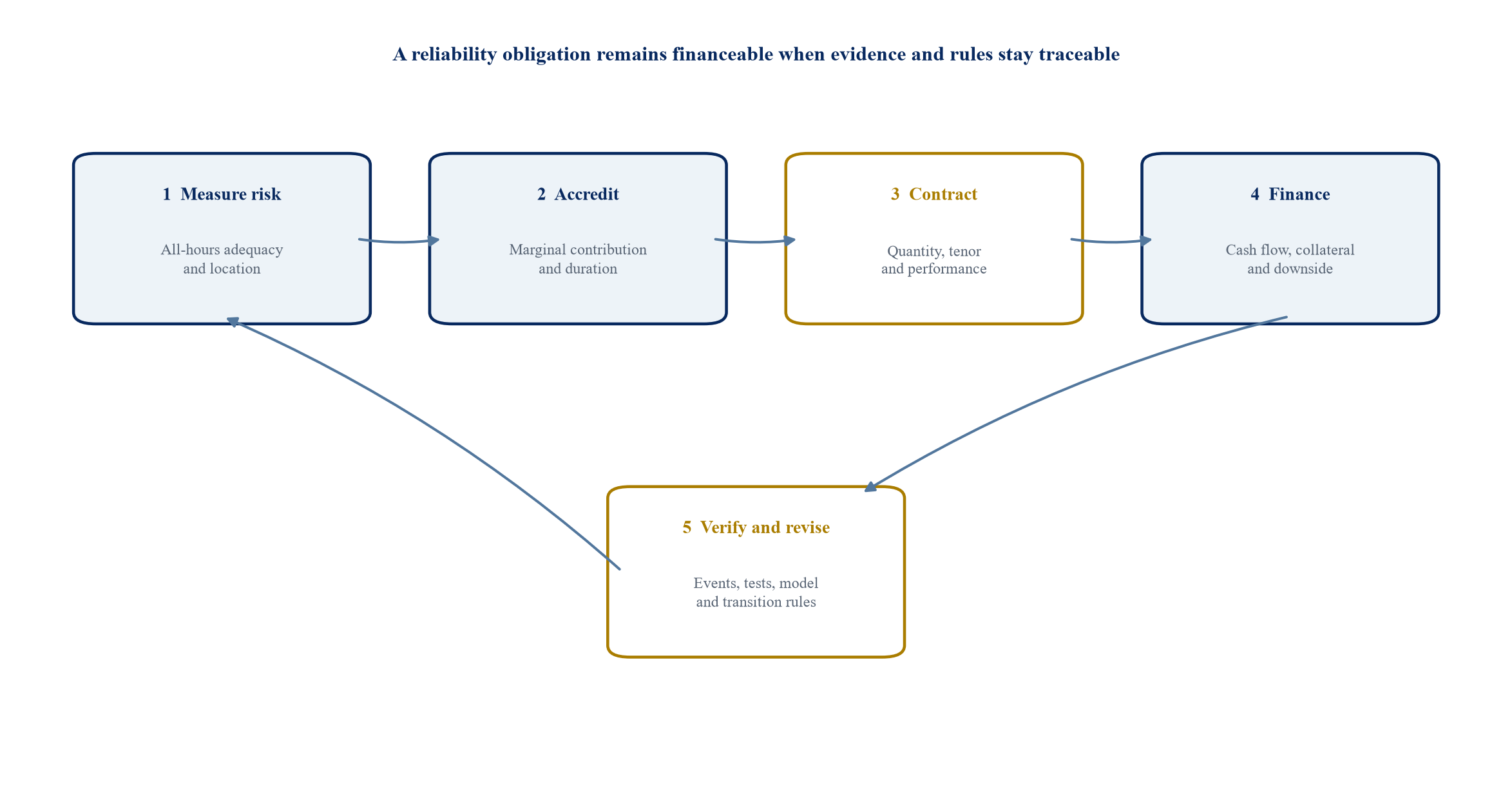
The cycle links system-risk evidence, project control, contractual commitment and observed performance.
24. Compare resources through performance-adjusted cost
Headline bid price per accredited megawatt is a useful starting point. The buyer should also assess delivery probability, expected penalty recovery, duration, location and system interactions. A lower bid can create a higher expected system cost if the accredited quantity is optimistic or delivery risk is concentrated.
The hypothetical comparison below starts with nameplate or nominated capability and applies illustrative accreditation. It then adds the annual fixed payment, expected performance cost and an indicative system-integration allowance. The resulting cost per dependable megawatt is a decision aid rather than an auction-clearing formula.
The example shows why technology labels cannot determine procurement. The twelve-hour storage project has a higher headline payment than the four-hour battery, but a larger dependable contribution in the stated stress profile. The demand-response portfolio has a low capital requirement and competitive cost, subject to verified baseline and customer availability. The thermal unit provides long duration, while fuel and carbon exposures remain material.
Live procurement requires market-specific data and a consistent treatment of network, energy and policy costs. The calculation should avoid adding costs already internalised in the bid or another market settlement.
Table 3. Hypothetical performance-adjusted reliability comparison
| Resource | Nominated capability | Accredited capability | Annual payment per accredited MW | Illustrative adjusted cost per dependable MW |
|---|---|---|---|---|
| Firm-fuel thermal unit | 100 MW | 82 MW | USD 92,000 | USD 111,000 |
| Four-hour battery | 100 MW | 48 MW | USD 78,000 | USD 101,000 |
| Twelve-hour storage | 100 MW | 76 MW | USD 96,000 | USD 104,000 |
| Aggregated demand response | 100 MW | 63 MW | USD 70,000 | USD 88,000 |
| Wind-storage hybrid | 100 MW | 58 MW | USD 84,000 | USD 99,000 |
| Interconnector import right | 100 MW | 44 MW | USD 74,000 | USD 103,000 |
Values are illustrative and do not represent observed projects, bids, forecasts or investment recommendations.
25. Implement reform through controlled stages
Market reform should begin with an evidence baseline. The system operator should publish risk-hour analysis, data quality, current accreditation, projected retirements, load scenarios and network limits. The regulator should define the decision problem and the reliability standard before selecting a mechanism.
A shadow period can test new accreditation and settlement alongside existing rules. Participants can review results, correct data and assess financing effects. Pilot participation can help demand response, distributed resources and emerging technologies prove telemetry and performance without weakening the common obligation.
The transition plan should specify auction dates, qualification, model versions, existing-contract treatment and dispute resolution. System operators, regulators, network companies and government need clear decision rights. The implementation programme should track technology entry, concentration, consumer cost, delivery milestones and event performance.
Reform should include a review trigger. New large loads, prolonged scarcity, model error, major network delay or sustained delivery failure can justify an interim review. The trigger should initiate analysis and consultation rather than an automatic rule change.
26. Recognise analytical and policy limits
Adequacy models simplify weather, outages, customer behaviour, fuel, networks and market response. Results can change when data, scenarios or methods change. ELCC provides a disciplined comparison, but it does not measure every operating service or resilience attribute. Public information may omit confidential asset and contract details.
Auction outcomes reflect policy choices, market power controls, forecasts and administrative parameters as well as technology cost. A low price does not by itself prove adequate delivery. A high price can indicate scarcity, parameter changes, entry barriers or market concentration. Causal conclusions require detailed review.
The hypothetical values in this paper are educational. They are not forecasts, observed bids, valuation conclusions or policy recommendations for a named jurisdiction. A live decision requires current rules, system data, engineering evidence, executed contracts and qualified legal, regulatory, technical, tax and accounting advice.
Conclusion
Reliability markets should pay for a measurable contribution to shortage risk. The product needs an explicit reliability standard, an all-hours adequacy model, transparent accreditation, deliverability and a performance obligation. These elements allow generation, storage, demand response, interconnection and portfolios to compete through common evidence.
Technology neutrality becomes credible when physical differences are translated into dependable megawatts and comparable delivery obligations. Uniform credits can conceal bias when resources face different duration, correlation, fuel, location or verification risks. Resource-specific evidence supports a common product without preselecting a winning technology.
Financeability also matters. Stable rules, visible model assumptions, proportionate collateral and governed transitions can reduce the cost of capital. Strong performance settlement, testing and replacement protect consumers. Carbon and innovation policy can be integrated through clear complementary instruments and reconciled payments.
For boards and investment committees, the decisive bridge runs from nameplate capacity to accredited contribution, from accredited contribution to contractual obligation, and from contractual obligation to downside free cash flow. That bridge makes reliability value auditable and gives capital providers a basis for funding firm clean power.
References
- International Energy Agency. Electricity 2025: Reliability. 2025. https://www.iea.org/reports/electricity-2025/reliability
- International Energy Agency. Electricity Market Design. 2025. https://www.iea.org/reports/electricity-market-design
- International Energy Agency. The Value of Demand Flexibility. 2025. https://www.iea.org/reports/the-value-of-demand-flexibility
- International Energy Agency. Power Systems in Transition: Electricity Security Matters More Than Ever. 2020. https://www.iea.org/reports/power-systems-in-transition/electricity-security-matters-more-than-ever
- North American Electric Reliability Corporation. 2025 Long-Term Reliability Assessment. 2025. https://www.nerc.com/globalassets/our-work/assessments/nerc_ltra_2025.pdf
- Federal Energy Regulatory Commission. State of the Markets 2025. 2026. https://www.ferc.gov/sites/default/files/2026-03/26_State-of-the-Market_0324_1430.pdf
- Federal Energy Regulatory Commission. Strategic Priority: Modernizing Electricity Market Design. 2024. https://www.ferc.gov/sites/default/files/2024-11/FY24%20AFR%209.30.24.pdf
- Federal Energy Regulatory Commission. PJM Interconnection docket and order index. https://www.ferc.gov/industries-data/electric/electric-power-markets/pjm
- Federal Energy Regulatory Commission. Order No. 2222 Explainer. https://www.ferc.gov/ferc-order-no-2222-explainer-facilitating-participation-electricity-markets-distributed-energy
- PJM Interconnection. Capacity Market Reliability Pricing Model. https://learn.pjm.com/three-priorities/buying-and-selling-energy/capacity-markets/capacity-markets-faqs
- PJM Interconnection. Manual 18: PJM Capacity Market. 2026. https://www.pjm.com/library/manuals
- PJM Interconnection. Manual 21B: Rules and Procedures for Determination of Generating Capability and Capacity Accreditation. 2025. https://www.pjm.com/library/manuals
- PJM Interconnection. Powering Reliability Through Market Design. 2026. https://www.pjm.com/-/media/DotCom/library/reports-notices/special-reports/2026/20260506-powering-reliability-through-market-design.pdf
- PJM Interconnection. Open Access Transmission Tariff Attachment DD.5.4. https://agreements.pjm.com/oatt/5145
- UK Department for Energy Security and Net Zero. Clean Power 2030 Action Plan. 2024. https://www.gov.uk/government/publications/clean-power-2030-action-plan/clean-power-2030-action-plan-a-new-era-of-clean-electricity-main-report
- UK Department for Energy Security and Net Zero. Capacity Market: Proposals to Modernise Rules and Improve Participation and Delivery Assurance of Consumer-Led Flexibility. 2024. https://www.gov.uk/government/consultations/capacity-market-proposals-to-modernise-rules-and-improve-participation-and-delivery-assurance-of-consumer-led-flexibility
- UK Department for Energy Security and Net Zero. Capacity Market: Proposals to Integrate Low Carbon Technologies and Enhance Delivery Assurance Ahead of Prequalification 2026. 2025. https://www.gov.uk/government/consultations/capacity-market-proposals-to-integrate-low-carbon-technologies-and-enhance-delivery-assurance-ahead-of-prequalification-2026
- Ofgem. Capacity Market Rules: Change Proposals 2026. 2026. https://www.ofgem.gov.uk/consultation/capacity-market-rules-change-proposals-2026
- Australian Energy Market Operator. Reliability Standard Implementation Guidelines. 2025. https://www.aemo.com.au/energy-systems/electricity/national-electricity-market-nem/nem-forecasting-and-planning/forecasting-and-reliability/reliability-standard-implementation-guidelines
- Australian Government Department of Climate Change, Energy, the Environment and Water. Capacity Investment Scheme. https://www.energy.gov.au/government-priorities/energy-supply/capacity-investment-scheme
- Australian Government. Post-2025 Market Design Final Advice to Energy Ministers. 2021. https://www.energy.gov.au/government-priorities/energy-ministers/energy-ministers-publications/post-2025-market-design-final-advice-energy-ministers
- Agency for the Cooperation of Energy Regulators. Capacity Mechanisms. https://www.acer.europa.eu/electricity/security-of-supply/capacity-mechanisms
- Agency for the Cooperation of Energy Regulators. European Resource Adequacy Assessment. https://www.acer.europa.eu/electricity/security-of-supply/european-resource-adequacy-assessment
- European Network of Transmission System Operators for Electricity. ERAA 2025 Reports and Results. 2025. https://www.entsoe.eu/eraa/2025/reports%26results/
- European Network of Transmission System Operators for Electricity. ERAA 2025 Edition. 2025. https://www.entsoe.eu/eraa/2025/
- European Commission. Electricity Market Design. https://energy.ec.europa.eu/topics/markets-and-consumers/market-legislation/electricity-market-design_en
- European Commission. Capacity Mechanisms. https://energy.ec.europa.eu/topics/markets-and-consumers/capacity-mechanisms_en
- World Bank PPP Resource Center. Power Purchase Agreements. https://ppp.worldbank.org/public-private-partnership/sector/energy/energy-power-agreements/power-purchase-agreements
- National Renewable Energy Laboratory. Resource Adequacy and Reliability Research. https://www.nrel.gov/grid/resource-adequacy.html
- Electric Reliability Council of Texas. Reliability Standard and Market Design Materials. https://www.ercot.com/gridinfo/resource
About the Author
Chennakeshav (CK) is a corporate finance and investment banking executive with 25+ years of global experience in deal origination, structuring and execution across M&A, growth capital and corporate strategy. He has led value-creation mandates for founders, corporates and funds — bridging the boardroom view to hands-on execution and close.
His career spans Morgan Stanley, HSBC, Lloyds Banking Group, EWEC, ADQ portfolio companies and Emirates Growth Fund, across TMT, real estate, fintech, deeptech, cleantech, infrastructure and energy. He has partnered with C-suite leaders, private equity and venture funds, sovereign wealth funds and family offices to finance complex fund raises and scale-up ventures, and has led M&A due diligence, post-merger integration and business-transformation initiatives to create value.
At Matchpoint Partners he is Managing Partner, leading the firm's corporate finance, M&A and capital-raising practice. He holds an MBA from London Business School, an engineering degree from VTU and a Master of Laws (LLM, in progress) from UCL London.
An active start-up mentor, CK mentors at Techstars, DIFC FinTech Hive, Startup Grind, Founder Institute and IN5, serves as Entrepreneur Mentor in Residence (EMiR) at London Business School, and judges the Entrepreneurship World Cup.
https://www.linkedin.com/in/ckadya/
https://www.matchpoint-partners.com/team/ck-adya.html
This paper is part of a continuing series on the structure of private and alternative markets. The views expressed are the author's own. The paper is for information only, describes market structure in general terms, and does not constitute investment, legal, tax or regulatory advice or a recommendation in respect of any security, vehicle or counterparty.
