
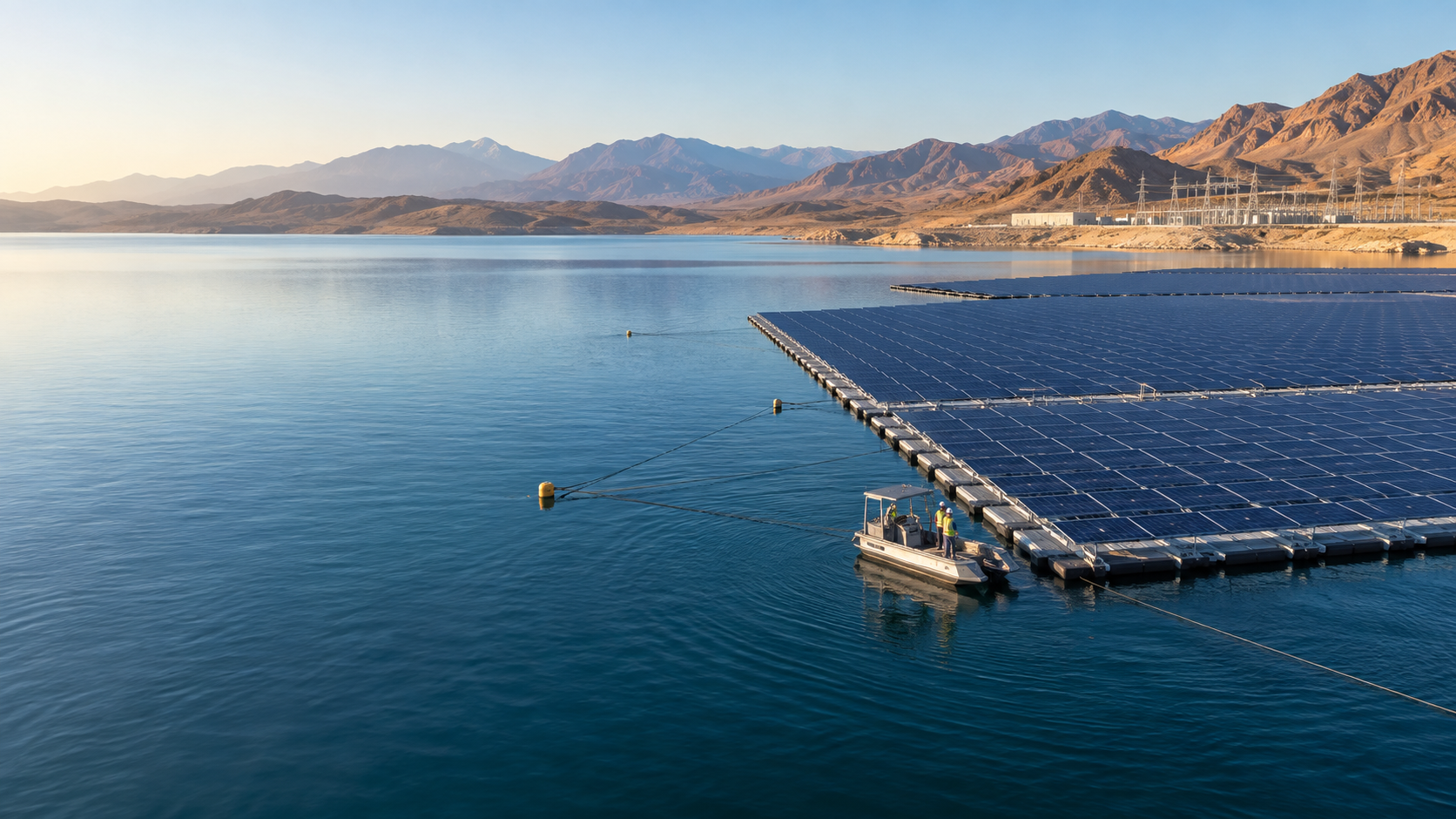
1 The reservoir boundary defines the investment
A floating-solar valuation should begin with a drawing that identifies the proposed generating equipment, the water body, the shore connection and the entity receiving each payment. This paper proposes separate accounts for electricity receipts, any contracted payment for water conservation, reservoir-service obligations and eventual removal. Their combination should follow the actual investment perimeter. A reservoir owner, a generator and a water purchaser can have different interests in the same installation. The proposed framework assigns each benefit and each expense to one named account before estimating a project value.
The January 2025 NREL summary of US reservoir research distinguishes technical potential from development. Its assessment concerns federally owned or regulated reservoirs; human and wildlife activities were outside that assessment, and transmission proximity, development costs and regulatory navigation remained further work. [10]
That boundary suggests a useful acquisition question: which missing condition could make an attractive water surface unusable for the buyer? The diligence schedule proposed here records the equipment footprint, mooring footprint, cable corridor, landing point, access route and exclusion areas separately. Each entry should have a dated survey or document, a responsible counterparty and an unresolved-condition field. A surface-area estimate alone would leave the purchase perimeter incomplete under this proposed test. Any assumed expansion area should carry its own conditional valuation and investigation cost.
The analysis should also specify its counterfactual. An alternative could be a land-based plant serving the same load, an unchanged reservoir, or another use of the same capital. The selected alternative determines which land costs, connection works and water effects belong in the incremental calculation. Financing accounts can then be prepared separately from resource benefits. A proposed water-conservation benefit may support a public-policy case while producing no receipt for the generator. The investment account should include that receipt only when a documented arrangement identifies payment responsibility, measurement and settlement.
For a practical decision record, the initial perimeter would include an operating period, a residual-value convention and a removal obligation. The proposed comparison retains those boundaries through every sensitivity. Changes in surface coverage, operating water level or contract term should be shown as revised cases with visible costs. This produces a traceable decision about a defined installation and its cash recipient, with open permissions remaining explicit conditions of the proposed investment.
2 Cooling requires a matched energy counterfactual
The IEA PVPS 2025 review reports that floating systems can operate at lower, similar or higher temperatures than ground-mounted comparators. Thermal behaviour depends on design and local conditions; rear ventilation and local wind are important for air-cooled configurations. [1]
The TNO study compares field temperatures in the Netherlands and Singapore, using a land-based reference in the Netherlands and a rooftop reference in Singapore. Its annual yield comparison is estimated from measured temperature differences and a PVsyst model. These are distinct reference arrangements and an estimated annual result. [2]
The proposed valuation therefore records an energy bridge with explicit components: reference irradiation, module conversion, temperature response, electrical losses, equipment availability and export constraints. A cooling assumption belongs within the temperature component. A further generic floating-solar uplift would duplicate that benefit if the temperature model already captures it. A project evaluator should ask the supplier to identify the exact baseline, sensor locations, equipment specifications and period behind every claimed gain. An unmatched rooftop comparison would require a separate reconciliation before supporting a land-versus-water investment decision.
A controlled trial could use comparable modules and electrical configurations, concurrent measurements and a pre-agreed treatment of missing observations. The proposal would retain irradiance, ambient temperature, module temperature, wind, water temperature and delivered-energy records. The analysis should distinguish observed trial output from an annual extrapolation and from a long-term cash forecast. An annualisation method should identify uncovered seasons and any assumed weather series. An engineering reviewer would decide whether the trial captures the proposed float arrangement and operating environment.
For pricing, the committee could compare a case with no cooling benefit, a case supported by a local trial and an adverse thermal case. These would be explicitly selected scenarios with no assigned statistical confidence unless the evidence supports one. Each case should use the same export-meter boundary and operating calendar. Additional generation should enter revenue only during periods when the buyer can accept and pay for it. A favourable thermal measurement would remain valuable technical evidence even where a connection limit leaves the incremental energy uncollected. The proposed valuation captures that distinction by carrying separate columns for generated, delivered, billable and paid energy.
3 Evaporation evidence and water receipts need separate tests
Berlioux and colleagues' 2025 paper examines evaporation using computational fluid dynamics, varying float technology, layout, orientation and coverage. The accessible institutional abstract describes numerical results. Its reported reductions should be understood within that modelling scope. [3]
Their 2026 conference abstract describes two eddy-covariance systems on one partially covered reservoir. It reports observations from May to October 2025 and compares evaporation with an estimated free-water reference. This is a site-specific conference account, with a defined observation window. [4]
This paper proposes a water balance that records inflows, rainfall, releases, withdrawals, seepage, storage change and evaporation assumptions using a common time interval. The evaluator should explain how the no-project evaporation estimate is obtained and how observations on covered and uncovered areas inform it. A difference in reservoir storage would require attribution across the full balance. Measurement errors, changed releases and unrecorded withdrawals should remain visible unresolved items. A claimed conserved volume should carry its method, area boundary, observation period and uncertainty description.
The Environment Agency's framework, updated in August 2026, states that rights to abstract or impound water in England are granted through its licensing system. Its water-rights trading section describes regulatory checks and licence changes. This is a geographically bounded licensing account. [9]
The proposed commercial test asks who can lawfully use the retained water, when it can be used and who benefits from that use. A conservation estimate should enter the generator's cash account only through an identified payment arrangement. An assumed water price requires a clearly labelled scenario and a stated eligible volume; it establishes no local permission. Where water remains in storage for environmental or operational reasons, the proposed analysis can report a physical conservation outcome separately from cash receipts. A purchaser should request local advice on the actual rights and restrictions before capitalising either water sales or avoided purchases.
Timing also matters in the proposed framework. Water retained during a wet period may have a different permitted use and operating value from water available during a constrained period. The evaluation should therefore retain monthly or operationally relevant volumes and settlement dates. A contingent conservation payment would need explicit measurement, dispute, deductions and payment provisions. Until those terms are documented, an investment committee could assign no generator receipt while preserving the physical scenario for further investigation.
4 Reservoir operations set the usable envelope
The World Bank, ESMAP and SERIS handbook identifies bathymetry, bed and bank conditions, hydrology and water-level variation as site information. It includes water-level changes caused by reservoir operation and warns that dry-out compatibility depends on float design. These are practitioner considerations from 2019. [5]
The proposed operating envelope should be developed with the reservoir operator. Its purpose would be to define acceptable locations and movements across normal drawdown, refill, maintenance and exceptional operating states. An investor should request the relevant historical records, present operating rules and any proposed changes, with their approval status. A long-term forecast would be a separate assumption. Recorded water levels can describe past operation without establishing the future limits of an expanded or differently managed reservoir.
A useful scenario set would connect the water level to usable floating area, access, cable configuration and inspection opportunities. The cases should identify intake protection zones, spillway access, navigation corridors and any relocation obligation where relevant to the proposed site. These entries are diligence questions; this paper assumes no universal clearance distance. An engineering team and the competent authorities would determine the necessary boundaries for an actual installation. Their conclusions should feed both the physical layout and the cost schedule.
The commercial account should then price the operator's proposed rights to require shutdown, movement or removal. A hypothetical contract could distinguish routine notice, emergency instructions and compensation events. Each would have an evidence requirement and a funding responsibility. The acquisition case should test a prolonged restriction with generation unavailable and operating obligations continuing. If the generator bears relocation costs, those costs should remain in the downside account even when the initial surface concession appears inexpensive.
The proposed coordination record would include a single version of the water-level schedule, agreed communication routes and a procedure for changing the envelope. An undocumented assumption about reservoir priority should remain an open closing condition. Any additional hydropower benefit would require its own dispatch and water-allocation analysis. The floating installation's electricity receipts should stay separate from a proposed change in hydro scheduling until an enforceable arrangement assigns the resulting cash and responsibilities.
5 Station keeping needs a project-specific load and lifecycle basis
DNV-RP-0584's public landing page identifies Edition 2026-09 and a sheltered inland and defined nearshore scope. Offshore or harsher conditions are explicitly outside that scope. The page also states that applicable regulation remains controlling. The complete subscription document was unavailable to this research. [6]
DNV-ST-E309's public scope, Edition 2026-04, addresses mooring-equipment design, loads, load combinations and analysis. It expressly excludes installation, inspection, maintenance, operation and decommissioning requirements. The complete standard was unavailable; no detailed design clause is asserted here. [7]
For the proposed investment process, an engineering submission would identify the adopted design basis and the conditions it covers. The purchaser should request the underlying wind, wave, current, water-level, ground and material inputs, with provenance and review status. A supplier's reference installation should be mapped against the proposed site's conditions. Any condition outside the supported envelope should carry an investigation plan and a cost allowance determined by the relevant specialists. A named standard in a tender would remain one item within the acceptance record.
The proposed cost account should separate initial anchors, mooring lines, float connections, installation works and lifecycle inspection or replacement. It should identify which party bears redesign following an inaccurate survey, a changed reservoir operating instruction or a later approved layout. A price comparison would otherwise combine materially different scopes. Bidders could be asked to state exclusions, access requirements, spare components and the evidence needed to return an affected island to service.
The downside test should couple an assumed station-keeping event to repair cost, lost electricity, access delay and any third-party obligation. The same repair should appear once in the cash ledger. Insurance proceeds would be a separate conditional receipt, supported by the actual cover, deductible and claim process in a real transaction. This paper assigns no event probability or insured recovery from the presence of a recommended practice. A committee could instead use deterministic cases to test whether committed funding covers the selected repair and interruption period. That test would support a financing discussion without representing engineering certification or an actual insurer's decision.
6 Electrical acceptance and ecological permission remain site-specific
The IEA PVPS review identifies potential failure mechanisms involving component movement, cable wear, moisture, corrosion and insulation. Its failure overview includes structural and electrical components. This supports a component-specific diligence scope; the review supplies no universal probability for an individual installation. [1]
PUB's July 2021 account records the opening of the Tengeh floating-solar farm in Singapore. It describes an environmental study conducted during 2015-2018, testbed observations and continuing monitoring. The account concerns that reservoir and its project design, with local assessment and mitigation. [8]
The proposed acceptance dossier would map each electrical component to its intended environment and movement envelope. The review should examine cables, connections, floating equipment, shore interfaces, protection and isolation arrangements together. It should distinguish product documentation, installation inspection and system-level acceptance. A purchaser should ask the responsible engineer to explain what has been demonstrated, what remains conditional and which changes would require further evaluation. The paper assumes no universal test result, certification outcome or permission to energise.
For environmental diligence, the proposed baseline would be agreed with relevant specialists and authorities before a trial or major commitment. Its content should follow the actual reservoir uses and ecological setting. Water quality, aquatic habitat, shoreline activity and construction effects would be candidate investigation areas, with no standardised result presumed. The evaluation should document sampling locations, seasonal coverage, laboratory methods and the response to deviations. A supplier's material certificate would address its stated property and test scope; ecological permission would require its own evidence.
The cashflow model should include the proposed monitoring programme, access equipment, specialist support and agreed corrective obligations. Environmental conditions could change the eligible layout or operating calendar. The analysis should therefore carry the actual permitted case when available, together with a clearly hypothetical restriction case. A reservoir user's acceptance, a regulator's approval and a financing party's consent should each retain its own status and date. The proposed closing record would leave any missing document unresolved and identify the cost of waiting. Local results from Tengeh provide a concrete investigation example; the proposed transaction still requires its own site evidence and approvals.
7 Grid access determines which energy becomes a receipt
ADB's historical Da Mi account in Viet Nam describes floating solar alongside existing hydropower and records additional inverter, substation and transmission infrastructure. Co-location in this case included new connection works. The account establishes no general right to export through an existing hydro connection. [11]
The proposed valuation should identify the contractual delivery point, permitted export, relevant operating restrictions and electricity buyer. An existing line on a reservoir map would enter the diligence record as infrastructure requiring verification. Its capacity, rights of use, protection arrangements and operating availability should be confirmed for the proposed generator. Any shared facilities would need a documented allocation of works, losses, maintenance costs and interruption responsibilities. The investor should retain the cost and time required to establish those arrangements in the investment case.
The energy ledger would start with plant production and deduct the restrictions relevant to the actual delivery boundary. The financial ledger would then apply the proposed settlement terms, deductions, collection lag and counterparty scenario. For behind-the-meter supply, the evaluator should identify eligible demand and the applicable contract. An avoided-purchase assumption should disclose the price and volume used in the hypothetical comparison. Electricity used elsewhere by the same corporate group would require an explicit accounting and contractual treatment before entering this project's receipts.
In the proposed sensitivities, connection delay should shift the revenue start and add the associated holding or maintenance costs. Export restriction should reduce eligible deliveries in the affected periods. Cooling-related production gains should pass through the same restriction calculation. A separate demand or payment scenario can then test whether technical output produces collected cash. These cases should preserve the same plant configuration unless the analysis explicitly pays for a redesign or additional connection capacity.
A potential combination with hydropower should be reviewed as an operating arrangement with specified instructions and settlement. The proposed framework asks who decides dispatch, who retains flexibility and who receives compensation during competing uses of a shared connection. It assumes no automatic storage service from water-side co-location. Until the documents resolve those questions, the generator account should retain its standalone delivery and payment boundaries, with any coordination benefit shown as conditional.
8 Procurement should price an evidenced operating capability
The June 2025 UK Solar Roadmap includes actions to keep floating solar's treatment in the Contracts for Difference scheme under review and to explore planning levers. These are dated policy intentions. They provide no project approval or completed support reform for this valuation. [12]
This paper proposes a procurement comparison built around a common reservoir envelope, electrical delivery point and operating term. Each offer should state the included surveys, engineering, equipment, installation, testing, access, monitoring, maintenance and removal. The bidder would identify which assumptions it accepts and which require further investigation. An owner can then compare the cost of completing an equivalent scope, including retained responsibilities. A low equipment price would have limited meaning if major interface works remain unspecified.
The proposed readiness record distinguishes a design concept, a component test, an installed pilot and operation under relevant conditions. References should describe the configuration and duty actually demonstrated. A project evaluator should request access to underlying records and permission to discuss them with the responsible operator. Claimed experience should be mapped to the proposed water-level and environmental envelope. An investment decision could then define the evidence required before each major expenditure, with a stated consequence if that evidence is unavailable.
For valuation, the committee should combine eligible receipts with a dated schedule of construction, operation, renewal, interruption and end-of-term cash obligations. Residual equipment value, any extension and insurance proceeds would need explicit assumptions. The proposed base case would include only the rights and receipts supported by the transaction's documents. Separate cases could test uncontracted water benefits, thermal performance outside trial evidence and a delayed permission. Those cases would remain conditional decision aids.
The final recommendation should state the proposed price, unresolved conditions, remaining investigation cost and party carrying each material risk. A go decision could depend on a specific engineering acceptance, local permission or payment arrangement. A defer decision could identify the additional evidence that would change the result. The purpose of this framework is a reproducible commercial judgment about a defined floating installation. Its conclusions would remain bounded by local rights, project engineering, the reservoir's operating envelope and the quality of the cash evidence.
9 Separate reservoir value from project receipts
A reservoir owner and an electricity-project investor can reach different conclusions about the same floating array. The owner may value an additional usable volume of water, an avoided land commitment or a different allocation of scarce grid capacity. An investor needs receipts that its project company can collect and costs that it can avoid. The proposed investment record should show both perspectives, identify the party receiving each benefit and reconcile any contractual transfer between them. A consolidated benefit should enter the project valuation once, with its recipient clearly named.
Start with the physical water account. An estimated reduction in evaporation is a volume difference against a defined uncovered-water baseline. Record the covered area, depth of avoided evaporation, measurement period and uncertainty. Then ask whether that volume remains usable at the time and place of demand. Storage limits, water-quality conditions, spills and the reservoir's operating rules require separate examination. A unit of retained water contributes to the proposed economic assessment only through a defined use or cost difference. Its assumed price should identify that marginal mechanism.
The project cash account requires a further step. A water authority could retain the entire benefit, share a saving through an access agreement or buy a defined water-conservation service. Each arrangement needs an identified payer, payment basis and settlement date. The fictional capture share in the later model represents this allocation. It confers no water ownership or right to payment. An unsigned conservation proposal belongs in a separate scenario. Setting project capture to zero preserves the physical illustration while removing the assumed project receipt.
Evaluate avoided land in the same way. A future lease that the land-mounted alternative would genuinely require supplies a recurring comparison. An already-owned parcel requires a separate opportunity-cost assessment of its feasible alternative use. Historical book cost, a sale receipt and an avoided annual lease cannot all represent the same benefit. The later illustration uses a stipulated lease difference only. The investment committee should retain the complete land counterfactual and identify which entity avoids that commitment.
10 Price rights and residual obligations
The useful operating horizon depends on the rights assumed in the investment case. Prepare a dated schedule for water-surface access, shore occupation, cable routing, grid use and removal. Record renewal conditions and the consent needed for a change of ownership. The valuation horizon should end at the boundary the investor can substantiate. An extension case requires its own assumptions about permission, refurbishment, continuing equipment performance and closure obligations. The base calculation in this paper has a finite decision calendar and contains no extension receipt.
Different contracts can place interconnected obligations in separate companies. The reservoir operator might control water levels, a specialist contractor might maintain the mooring system, and the project company might owe delivery or availability obligations to an electricity buyer. A proposed interface schedule should translate an operational instruction into its financial consequences: who receives notice, who can stop work, who funds inspection, and how lost generation is treated. The schedule should also identify disputes that leave the project paying before compensation is resolved.
A contingency provision and an enforceable remedy serve different analytical purposes. The provision funds an assumed expenditure or timing gap. A remedy describes a potential claim whose amount, collectability and timing require their own evidence. The model should retain gross repair cash unless a distinct recovery is explicitly represented. Netting a possible insurance or contractor payment against an immediate repair would conceal the funding requirement. Any recovery scenario should disclose its assumed delay and counterparty exposure.
Removal deserves a dated cash line even when it occurs after the final energy receipt. The proposed closure assessment should cover responsibility for floats, anchors, cables and shore interfaces, along with the agreed condition of the returned site. Evaluate any bond, escrow or other security against those obligations without treating its existence as a reduction in gross removal cost. The fictional comparison includes different land and floating closure expenditures. It assigns no salvage receipt or automatic permission to leave equipment in place.
11 Set a decision threshold for new evidence
An information programme should investigate assumptions capable of changing the investment decision. Begin with the calculated value difference between the floating and land alternatives. Recalculate it while varying one uncertain input at a time, then inspect combinations that share a plausible commercial mechanism. Cooling, the contractual share of water value, the land alternative and floating-system costs should remain separately visible. A large physical effect can have little project-value consequence when the associated receipt belongs to another party.
A break-even threshold expresses the change required to make the alternatives equal under the other stated assumptions. Its interpretation depends on the variable. A required cooling gain concerns measured energy performance after matching equipment and accounting for other losses. A required land lease concerns a feasible, evidenced alternative site. A required water-capture share concerns an agreement with an identified payer. Exceeding a mathematical threshold supplies no permit, engineering approval or signed receipt. Those decisions remain separate conditions for committing capital.
Use these thresholds to define a study question and a stopping rule. If the feasible range of an input remains entirely on the same side of the threshold, a more precise estimate may have limited decision value for that comparison. If credible ranges straddle it, a controlled measurement or firmer commercial quote could affect the choice. The study should state the decision it informs, the precision required and the expenditure being deferred while the evidence is collected. This proposal does not assign a probability to an unknown outcome.
Distinguish decision value from the statistical value of information. Calculating an expected value for additional information would require justified outcome probabilities, a description of what the study reveals and a rule for acting on each result. This paper does not supply that probability model. Its sensitivity and joint-stress cases identify consequences under stipulated inputs. A measured trial or a supplier bid can replace an assumption later; its result should be entered with the applicable date and scope. Its relationship to the original assumptions should remain explicit.
12 Translate project value into an acquisition price
An acquisition adds a transaction boundary to the operating comparison. The buyer should establish which contracts, permits, equipment, liabilities and cash balances transfer. Reconstruct the target's remaining cash flows using the rights it holds at the proposed completion date. A development option, an operating project and a supplier business require different valuation inputs. The numerical illustration later in this paper compares two hypothetical project designs before construction. It supplies no valuation of a real company or completed asset.
For an operating target, remaining equipment expenditure and committed obligations belong in the forward cash-flow assessment. Expenditure already incurred by the seller should be identified separately from a future buyer obligation. Inspect replacement, closure and remedial cash against the sale perimeter. A seller may present a water-conservation benefit in the commercial narrative; the buyer's project case still requires the transferable payment right and its settlement mechanism. A social benefit retained by a public authority should remain separately reported.
The proposed bid record should reconcile operating value to the consideration being negotiated. Identify debt-like obligations, restricted cash, working capital, transaction costs and obligations retained by the seller, while checking which items the chosen valuation already includes. A provision that funds a modelled closure cost needs reconciliation to that same cost. Subtracting both without examining the underlying obligation would count it twice. A reserve funded after completion also changes the dated buyer cash requirement and requires explicit treatment.
Use conditional consideration only where the event, measurement method and payment responsibility can be specified. Possible conditions include receipt of a required consent, demonstration of a defined performance measure or resolution of a known remedial obligation. Their legal effect requires transaction-specific advice. The investment committee should receive the unconditional price, contingent amounts and gross funding commitments together with the downside cases. This connects the purchase decision to the cash and responsibilities the buyer would actually assume.
13 Define the investable comparison and its calendar
The illustrative decision concerns two new 50 MWac projects providing electricity under the same stipulated price. One occupies land and the other occupies a reservoir. Every numerical input in this worked example is author-created. Neither configuration has a verified site, permission, engineering design or power-purchase contract. Equal nameplate capacity provides a consistent starting point; the delivered electricity account explicitly allows their net output to differ. The model prices owner cash from the two packages and retains a separate physical record of electricity and saved water.
The decision calendar runs from time zero through year 25. Construction expenditure occurs 40% at time zero and 60% at the end of year one. Operations occupy years 2 through 25, giving 24 operating years. Each operating receipt and expense is placed at its year-end. Land capital is USD 35 million and floating capital is USD 41 million. The USD 6 million floating premium covers the assumed complete incremental installation package. There is no additional land purchase credit. The land alternative requires an annual USD 600,000 lease that remains uncommitted at the decision date; avoiding that payment is therefore an explicit condition of the comparison.
All cash is expressed in constant purchasing-power dollars and discounted at 8%. Inflation, tax, financing, working-capital balances, insurance recoveries and grants are excluded. Annual receipts are assumed collected when booked. These conventions support an unlevered project comparison and cannot establish sponsor returns or borrowing capacity. If electricity or water invoices remain unpaid, their collection dates and financing requirements need a separate cash schedule.
Both projects pay for a USD 4 million inverter renewal in year 13. Floating PV adds USD 1.2 million of renewal expenditure at the same date. Land closure costs USD 2 million in year 25; floating closure costs USD 2.5 million. The final operating cash and closure expenditure share that date. No residual sale, remaining equipment value, extension or operating receipt is credited after year 25. Renewal downtime is omitted from this bounded illustration and requires a further stress before an investment decision. The selected boundary is an analytical convention, not a claim about either technology's physical service life.
The numerical illustration uses fictional inputs and proposed decision records. Equal 50 MWac projects have construction at time zero and year one, operations in years 2 through 25, and closure in year 25. Cash is real and unlevered; tax, inflation, collection delay, debt, renewal downtime and terminal receipts are excluded. Physical saved water remains fixed during the stipulated interruption cases; electricity deductions alone change in those cases. Water capture and avoidable land lease are separate conditional cash inputs. Values in tables are rounded to three decimals where appropriate; calculations retain unrounded values. These assumptions establish no permission, observed performance, water-sale agreement or site-specific engineering result.
Table 1. Common calendar and owner cash assumptions
| Input | Land PV | Floating PV |
|---|---|---|
| Capacity, MWac | 50.000 | 50.000 |
| Construction capital, USD million | 35.000 | 41.000 |
| First operating year | 2 | 2 |
| Final operating and closure year | 25 | 25 |
| Annual ordinary availability, % | 98.000 | 97.000 |
| Annual lease or access fee, USD thousand | 600.000 | 80.000 |
| Annual operating cost excluding lease, USD thousand | 600.000 | 750.000 |
All values are author-created assumptions or calculations; real USD million unless the row or column specifies another unit.
14 Reconcile cooling with electricity delivered
The common first operating-year reference is 95,000 MWh before ordinary availability deductions. Subsequent gross electricity declines by the stipulated annual degradation factor of 0.5%. Land PV delivers 98% of the reference. Floating PV first receives a 3% gross cooling multiplier, then retains 97% after ordinary availability, followed by a 0.3% auxiliary consumption deduction. These independent assumptions are transfer inputs to the financial model; they do not solve module temperature, weather, electrical conversion or dispatch.
In year two the floating gross amount after cooling is 97,850 MWh. The ordinary availability deduction is 2,935.500 MWh and auxiliary consumption is 284.744 MWh. Net floating export is therefore 94,629.757 MWh, compared with 93,100 MWh for land PV. The net increment is 1,529.757 MWh, or 1.643% of land export. A headline cooling assumption of 3% consequently does not describe the improvement in saleable electricity. Availability and auxiliary consumption materially affect the connection between the physical input and the commercial output.
The model multiplies the net export difference by USD 55/MWh once. It does not add a separate cooling receipt. Ordinary availability represents assumed recurring interruptions; separately specified range and event losses are applied afterwards to the remaining electricity. A 1% range loss therefore removes 1% of post-auxiliary floating export. An event deduction removes a proportion of the remaining amount after that range adjustment. This sequence makes overlap explicit and keeps net export non-negative for the stated cases.
At the base assumptions, the present value of incremental electricity is USD 0.788 million. Removing the cooling gain reduces total incremental project NPV to negative USD 2.359 million. Raising the hypothetical gain to 6% produces positive USD 0.482 million. The one-variable break-even gross cooling increment is 4.981%, holding availability, water capture, costs and every other assumption fixed. This threshold is an evidence requirement for a proposed transaction. A site study would need to establish a compatible delivered-energy estimate and its uncertainty before a buyer could use it in a binding price.
Table 2. First operating year electricity reconciliation
| Step | MWh | Definition |
|---|---|---|
| Common gross reference | 95,000.000 | Before availability |
| Cooling increment | 2,850.000 | 3% of gross reference |
| Floating ordinary availability loss | 2,935.500 | After cooling |
| Floating auxiliary use | 284.744 | After ordinary availability |
| Floating net export | 94,629.757 | No base event or range loss |
| Land net export | 93,100.000 | 98% ordinary availability |
| Net export increment | 1,529.757 | Used once in electricity cash |
All values are author-created assumptions or calculations; real USD million unless the row or column specifies another unit.

View figure at full size; scroll horizontally on smaller screens.
Same 50 MWac capacity. Separate availability and auxiliary deductions produce a 1.643% net improvement from the stipulated 3% gross multiplier; no site yield forecast.
15 Separate retained water from collected owner receipts
The water calculation begins with an assumed covered area of 500,000 square metres, an uncovered-equivalent evaporation depth of 1.5 metres per year and a 50% reduction. Their product is 375,000 cubic metres of physically saved water per operating year. The calculation assumes those conditions remain constant across the operating calendar. It includes no hydrological feedback, rainfall, changing reservoir surface, competing withdrawals, water-quality effect or measurement error. The result is a transparent input-driven volume, with no claim of transferability to a real reservoir.
The project company is then assigned a hypothetical 50% share of that volume's monetisable value, at a net USD 0.50 per cubic metre. Annual captured cash is USD 93,750 and its decision-date present value is USD 0.914 million. The net unit value is stipulated after any treatment, conveyance and selling expense. No additional water revenue or avoided procurement expense is counted elsewhere. A contractual arrangement would have to identify the beneficiary, lawful use, measurement basis, payment obligation and credit exposure before this line could represent investable receipts.
The zero-capture case retains the same saved physical volume and electricity output. Its incremental NPV falls to negative USD 1.852 million. This result isolates the distinction between a reservoir benefit and an SPV cash entitlement. Full capture at the same unit value almost closes the base valuation gap, yielding negative USD 0.024 million. Exact break-even capture is 101.325%, which exceeds the physical 100% bound. Under these fixed assumptions, rearranging ownership alone cannot support the full USD 6 million premium. At 50% capture, the break-even net water value is approximately USD 1.013 per cubic metre. Zero evaporation reduction tests a physical downside; zero capture tests the separate rights and cash downside.
Reduction and capture are separate sensitivity axes. Increasing the assumed evaporation reduction changes physical volume; increasing capture reallocates the value of a given volume to the project company. A joint cooling and capture chart illustrates combinations that would meet the decision threshold, without assigning probabilities or declaring any combination attainable. The land lease also remains a separate right. Floating access costs USD 80,000 annually, and the associated USD 520,000 gross lease saving is included only because the alternative land lease can genuinely be avoided in the fictional decision.
Table 3. Water volume, capture and lease boundaries
| Item | Value | Unit |
|---|---|---|
| Covered area | 500,000.000 | m² |
| Assumed evaporation depth | 1.500 | m/year |
| Assumed reduction | 50.000 | % |
| Physical saved volume | 375,000.000 | m³/year |
| Owner captured share | 50.000 | % |
| Captured water cash | 0.094 | USD million/year |
| Net avoided lease less access fee | 0.520 | USD million/year |
All values are author-created assumptions or calculations; real USD million unless the row or column specifies another unit. Water cash excludes treatment, conveyance and taxes; the stipulated unit value is net of such costs.
Table 4. Separate physical and capture sensitivities
| Case | Net change, % | Incremental NPV, USD m | Premium ceiling, USD m |
|---|---|---|---|
| No cooling gain | -1.317 | -2.359 | 3.532 |
| Base assumptions | 1.643 | -0.938 | 5.018 |
| Six percent cooling | 4.604 | 0.482 | 6.505 |
| No water capture | 1.643 | -1.852 | 4.062 |
| Full water capture | 1.643 | -0.024 | 5.975 |
All values are author-created assumptions or calculations; real USD million unless the row or column specifies another unit.

View figure at full size; scroll horizontally on smaller screens.
All inputs fictional. Physical saved water and owner capture are separate. No water right, contract, field reduction or cooling rate is established.
16 Price the premium and its opportunity cost
The base floating project has a positive standalone unlevered NPV of USD 0.136 million. Land PV has USD 1.074 million. The resulting floating increment is negative USD 0.938 million. The investment choice therefore depends on the attainable alternative as well as whether a project individually covers its assumed discount rate. This comparison assumes the two projects are mutually exclusive uses of the same investment decision and that both remain available on the stated terms.
The decomposition identifies where the difference arises. Electricity contributes USD 0.788 million, captured water USD 0.914 million and annual operating-cost savings USD 3.607 million. The latter combines avoided land lease with floating access and extra operating expenditure. The floating capital premium costs USD 5.733 million in present value because 60% is paid at year one. Additional renewal costs USD 0.441 million in present value and incremental closure costs USD 0.073 million. These components reconcile to the total negative increment without duplicating water, cooling or land value.
The maximum floating premium compatible with equality to land PV is USD 5.018 million, paid in the same 40%/60% pattern. This is a total capital premium ceiling, not an immediate acquisition cheque. The conversion divides the valuation gap by the capital timing factor, 0.4 plus 0.6 divided by 1.08. A price quoted entirely at time zero would require its own timing adjustment. The ceiling also assumes the buyer acquires exactly the same package of future receipts, obligations and rights described in the annual ledger.
The avoided annual land lease must reach approximately USD 696,235 to support the base USD 6 million floating premium with other inputs unchanged. If the land obligation has already been irreversibly committed and cannot be escaped, removing the supposed saving reduces the floating increment to negative USD 6.787 million. The corresponding premium ceiling becomes negative USD 1.103 million. A negative ceiling means the floating package would need a capital discount against the land package under the model's remaining cash assumptions. It provides no permission to omit costs or assume that a seller will accept such a price.
Table 5. Decision-date incremental value decomposition
| Component | PV, USD million |
|---|---|
| electricity | 0.788 |
| water | 0.914 |
| Operating cost | 3.607 |
| capital | -5.733 |
| renewal | -0.441 |
| closure | -0.073 |
| event | 0.000 |
| Total | -0.938 |
All values are author-created assumptions or calculations; real USD million unless the row or column specifies another unit.
Table 6. Dated operating and capital cash
| Year | Land export, MWh | Floating export, MWh | Land cash, USD m | Floating cash, USD m | Increment, USD m |
|---|---|---|---|---|---|
| 0 | 0.000 | 0.000 | -14.000 | -16.400 | -2.400 |
| 1 | 0.000 | 0.000 | -21.000 | -24.600 | -3.600 |
| 2 | 93,100.000 | 94,629.757 | 3.921 | 4.468 | 0.548 |
| 8 | 90,341.681 | 91,826.114 | 3.769 | 4.314 | 0.545 |
| 13 | 88,105.611 | 89,553.303 | -0.354 | -1.011 | -0.657 |
| 25 | 82,962.253 | 84,325.433 | 1.363 | 1.402 | 0.039 |
All values are author-created assumptions or calculations; real USD million unless the row or column specifies another unit. Full annual ledger contains all 26 dates. Renewal downtime is excluded; renewal expenditure is included.

View figure at full size; scroll horizontally on smaller screens.
Real USD, 8% discount, t0-25 with operations in years 2-25. Land lease is avoidable only under the stated uncommitted alternative; no land capital credit.
17 Expose mooring, access and dated funding requirements
The mooring-event case places a USD 3 million repair at the end of year eight and removes 12% of that year's floating electricity after ordinary adjustments. No reimbursement, liquidated damages or insurance recovery is credited. The event is a deterministic stress with assumed restoration in the following year. It lowers incremental NPV to negative USD 2.886 million and the premium ceiling to USD 2.979 million. The repair and lost electricity are different cash effects; both belong in the comparison. Their chosen scale and timing do not imply an observed failure frequency or a calculated structural load.
Two reservoir-access cases describe further stipulated operating consequences. The moderate case adds USD 100,000 annual access expenditure and a 1% recurring export deduction. The wide-range case adds USD 250,000 and a 3% deduction. Their incremental NPVs are negative USD 2.401 million and negative USD 4.838 million respectively. The labels distinguish assumed cost packages. They are not physical models connecting a measured water-level range to outage, cable movement, mooring load or safe working access. Engineering and operating evidence would be required to select an appropriate package for a site. Covered area, evaporation depth and reduction remain fixed during both the event and range cases. Their downtime affects electricity only; the model assumes no resulting loss of coverage or physical water saving.
The combined adverse case joins zero cooling, zero water capture, a USD 7.5 million capital premium, the wide-range package and the year-eight event. Its incremental NPV is negative USD 10.493 million. This case is deliberately unweighted. It supplies an auditable joint downside for decision discussion and does not estimate an expected loss. Sequential energy deductions handle overlap, while repair, access and capital costs remain separate expenditure lines.
Funding requirements are also dated. Land construction requires USD 14 million at time zero and USD 21 million at year one. Floating requires USD 16.4 million and USD 24.6 million. Renewal and closure remain explicit later commitments. The cumulative incremental deficit measure assumes every interim incremental receipt remains available to offset later incremental spending. It cannot be used as whole-project sponsor funding, an intrayear liquidity requirement or available debt. A repair paid before year-end could require cash earlier than this annual convention records. Any financing proposal needs its own opening funds, draw conditions, reserve restrictions and payment calendar.
Table 7. Mooring and reservoir-access stresses
| Case | Incremental NPV, USD m | Premium ceiling, USD m | Incremental deficit peak, USD m |
|---|---|---|---|
| Base assumptions | -0.938 | 5.018 | 6.000 |
| Mooring event | -2.886 | 2.979 | 6.000 |
| Moderate range access | -2.401 | 3.488 | 6.000 |
| Wide range access | -4.838 | 0.937 | 6.000 |
| Combined adverse | -10.493 | -3.481 | 14.856 |
| Land lease unavoided | -6.787 | -1.103 | 9.063 |
All values are author-created assumptions or calculations; real USD million unless the row or column specifies another unit. Stipulated event and range losses compound sequentially; no physical stress correlation is inferred. Deficit uses retained incremental cash, not whole-project financing.
Table 8. Construction commitments and bounded event liquidity
| Requirement | Land, USD m | Floating, USD m |
|---|---|---|
| Year zero capital | 14.000 | 16.400 |
| Year one capital | 21.000 | 24.600 |
| Total construction | 35.000 | 41.000 |
| Year thirteen renewal | 4.000 | 5.200 |
| Year twenty-five closure | 2.000 | 2.500 |
| Separate year-eight event repair | 0.000 | 3.000 |
All values are author-created assumptions or calculations; real USD million unless the row or column specifies another unit. No debt, sponsor commitment, interest, reserve, tax or working-capital facility is modelled. Event repair is a stress, excluded from base.

View figure at full size; scroll horizontally on smaller screens.
Stipulated event and recurring deductions are sequential; no engineering stress relationship or probability is inferred. No debt capacity or sponsor commitment is modelled.
18 Use thresholds to commission evidence and control the bid
The calculation supports a conditional investment process. First, confirm whether the land alternative and its uncommitted lease are genuinely available. Next, reconcile a site-specific electricity assessment with the precise availability and auxiliary boundaries used in the model. Then identify which entity controls saved water and whether the proposed SPV receives enforceable, collectable cash. Each of these steps changes an identifiable valuation line. Combining them into a general sustainability premium would conceal the specific evidence needed to justify price.
The sensitivities preserve the same 24 operating years and closure date. Discount cases span 4% to 12%, electricity prices span USD 35 to USD 75/MWh, and land-lease cases span zero to USD 1.2 million annually. Cooling, evaporation reduction and captured share are varied separately. These are author-selected decision tests. They contain no historical calibration, market probability or regulatory tariff assertion. The premium-frontier figure shows how discount rate and avoided land lease jointly change the amount the owner could pay for the floating package while retaining parity with the land alternative.
The reproducible annual ledger contains 26 dates per case, including both construction dates. All 37 reported cases retain electricity, water volume, water cash, capital, operating cost, renewal, repair, closure and incremental cash. Calculated identities reconcile the energy bridge, project cash differences and discounted component totals. Zero water capture produces zero water cash. These internal checks test implementation consistency. The full specification distinguishes a changed input from an altered modelling rule.
The principal omissions are material. There is no hourly dispatch, hydrological simulation, structural design, degradation uncertainty distribution, tax, inflation, collection delay or financing account. Maintenance and renewal are cost stipulations, with renewal interruption excluded. Any real acquisition would also require an enterprise-to-equity bridge and a review of inherited obligations. Within the stated boundary, the base result establishes a narrow conclusion: the stipulated floating package needs a lower capital premium or demonstrably improved captured cash to equal the stipulated land alternative. The worked thresholds identify the magnitude of that improvement and the evidence that a buyer must obtain before paying for it.
Table 9. Discount rate and land opportunity cost
| Sensitivity | Input | Incremental NPV, USD m |
|---|---|---|
| Discount, % | 4.000 | 1.205 |
| Discount, % | 6.000 | -0.031 |
| Discount, % | 8.000 | -0.938 |
| Discount, % | 10.000 | -1.616 |
| Discount, % | 12.000 | -2.130 |
| Avoided lease, USD thousand | 0.000 | -6.787 |
| Avoided lease, USD thousand | 300.000 | -3.863 |
| Avoided lease, USD thousand | 600.000 | -0.938 |
| Avoided lease, USD thousand | 900.000 | 1.986 |
| Avoided lease, USD thousand | 1,200.000 | 4.911 |
All values are author-created assumptions or calculations; real USD million unless the row or column specifies another unit.
Table 10. Break-even evidence requirements
| Boundary | Value | Unit |
|---|---|---|
| Floating premium at base timing | 5.018 | USD million |
| Avoidable annual land lease | 696.235 | USD thousand/year |
| Net water value at 50% capture | 1.013 | USD/m³ |
| Capture at USD 0.50/m³ | 101.325 | % |
| Cooling multiplier increment | 4.981 | % |
All values are author-created assumptions or calculations; real USD million unless the row or column specifies another unit. Each threshold varies one input with all others fixed. Capture above 100% is infeasible under the stated physical volume.

View figure at full size; scroll horizontally on smaller screens.
Premium follows the 40% time-zero and 60% year-one construction schedule. Negative ceilings require a floating capital discount. Fixed closure at year 25 and no terminal receipt.
19 Establish a reservoir operating mandate before committing capital
We propose beginning with a mapped operating perimeter agreed for diligence purposes by the prospective investor and reservoir operator. The map should identify the proposed occupied surface, shore facilities, cable routes, access points and areas reserved for other activities. Each proposed use needs a corresponding document or unresolved permission question. A project description should also name the party controlling changes in water level and the information that party can supply. The investment committee should retain any unconfirmed access or use assumption as a condition of expenditure approval. A commercial expression of interest supplies a starting point for investigation; the relevant agreements and approvals still require examination by qualified advisers.
The proposed operating mandate should explain how electricity generation would interact with the reservoir's existing purposes. Diligence should request the operator's dated operating instructions, historical level records and planned interventions, including any periods when the proposed installation would have to move, stop or permit other work. The reviewer should distinguish records supplied by the operator from assumptions introduced by the project team. If instructions can change, the financial case needs a defined procedure for incorporating that change and identifying its cost. An assumed compensation payment should remain outside the accepted cash case until its contractual basis and collection treatment have been reviewed.
The resulting mandate should assign a decision owner to each unresolved interface. For example, the reservoir operator can confirm the operating information it provides, while the project engineer interprets its implications for the proposed installation. Legal advisers assess the relevant documents. The investor then approves a bounded scope and contingency budget. This sequence leaves technical conclusions with the responsible specialists and connects their unresolved findings to an explicit commitment decision.
Table 11. Proposed reservoir operating mandate
| Evidence | Decision owner | Required control |
|---|---|---|
| Surface and shore perimeter | Project lead | Map proposed uses |
| Access and use documents | Legal lead | Record unresolved conditions |
| Level instructions and history | Reservoir operator | Date supplied information |
| Operating changes | Investment committee | Approve revised exposure |
Author-proposed diligence record; no ownership, permission or compensation right is assumed.
20 Purchase a controlled measurement programme with decision thresholds
A staged trial should resolve a question capable of changing investment scope or price. We propose agreeing that question before procuring floats, sensors or installation work. A cooling claim would require an appropriate comparison of operating conditions and electrical output. An evaporation claim would require its own measurement perimeter, treatment of weather and water movements, and a clearly stated extrapolation method. The trial specification should identify which quantities are measured directly, which are calculated and which remain unavailable. Results should retain those distinctions when incorporated into an investment paper. The same percentage should never enter several benefit accounts without an explanation of the separate quantities it represents.
The proposed measurement contract should identify reference locations, sensor maintenance, calibration, missing-data treatment and responsibility for changes to the trial. The investor should receive the underlying records and a documented reconciliation to the reported result. Reservoir operations and equipment interventions should be logged alongside observations so that alternative explanations can be examined. If a comparison area or period is removed, the report should preserve the reason and the effect on the result. A short trial should state the seasonal and operating conditions it has not covered. Any use beyond that envelope remains a conditional assumption requiring a separate approval.
Procurement milestones should pay for usable evidence as well as completed installation. The committee should predefine the response to a favourable, inconclusive or adverse result: proceed within the tested scope, commission a targeted further study, redesign or stop. The stop case should include removal and restoration costs already committed. A trial can then purchase decision-relevant information without creating an automatic obligation to fund full deployment.
Table 12. Proposed measurement purchase gates
| Trial element | Evidence required | Decision consequence |
|---|---|---|
| Cooling comparison | Conditions and electrical records | Bound output assumption |
| Evaporation comparison | Water and weather perimeter | Bound physical estimate |
| Data quality | Calibration and exclusions | Retain uncertainty |
| Incomplete trial | Untested operating conditions | Limit rollout scope |
| Stop decision | Removal commitments | Fund orderly exit |
Proposed test controls; no measured benefit or performance threshold is supplied.
21 Translate hydrological evidence into a reviewed anchoring design
The proposed engineering dossier should connect the reservoir information to a site-specific design basis. It should request available bathymetry, bed and bank investigations, water-level chronology, inflow and outflow arrangements, and the environmental loads selected for assessment. Each input should carry its source, date, coverage and uncertainty. The engineer should identify the investigations still required and explain how their absence limits design acceptance. A convenient historical operating range should not silently become the approved design envelope. The investor should ask who has authority to accept the engineering basis and what independent review is appropriate for the actual project.
Mooring and anchoring diligence should trace forces and movement through the proposed system interfaces. The proposed review should cover connections between floats, mooring components, anchors, cables and shore equipment, with the relevant failure and repair scenarios identified by the responsible engineer. The commercial team should request an inspection and replacement plan linked to that design. It should identify the equipment, access, specialist personnel and operating restrictions needed to repair a failed component. No generic repair allowance can establish that the required work is executable at the site. Costs unsupported by a defined repair method should remain estimates with an identified investigation owner.
Design changes should trigger a controlled commercial review. A revised anchor arrangement may change installation scope, access requirements or the equipment held for maintenance. Procurement should preserve the original scope, approved revision and resulting price adjustment in one record. Before the next capital release, the committee should receive the updated design status and remaining exposure. This proposed gate allows a revised scheme to proceed only within the evidence and funding actually approved; it supplies no engineering certification.
Table 13. Proposed anchoring diligence register
| Interface | Evidence owner | Acceptance question |
|---|---|---|
| Bed and bank conditions | Geotechnical specialist | Adequate investigation? |
| Water-level envelope | Reservoir and design leads | Documented design basis? |
| Loads and system movement | Responsible engineer | Reviewed interfaces? |
| Inspection and replacement | Operations lead | Executable repair method? |
| Design revision | Project director | Cost and scope approved? |
Engineering adequacy requires project-specific specialist review; the register is not a design certification.
22 Procure a maintainable system with explicit interface responsibility
We propose issuing a procurement responsibility schedule alongside the technical specification. It should assign delivery and acceptance of the floating system, electrical equipment, anchoring works, shore connection and service-access arrangements. Each bidder should return exceptions against the same schedule. The evaluation should identify activities priced by one bidder and retained by the owner under another offer. Installation support, specialist inspections, replacement parts and removal obligations should appear in the dated cash comparison. Unpriced exceptions should remain open conditions of award. A lower equipment quotation can otherwise leave the investor with an unidentified completion task.
Warranty diligence should examine the actual proposed documents against the installed configuration and operating envelope. The reviewer should identify exclusions, notification requirements, evidence obligations, claim limits and the party responsible for administering a disputed claim. A component warranty should be evaluated alongside the interfaces and consequential costs that it leaves with the owner. The operating budget should retain the gross cost of protective work and replacement while any recovery is separately assessed. Where a supplier proposes a design modification, the acceptance process should establish whether the relevant technical and warranty reviews must be repeated.
Service access should be demonstrated through an agreed mobilisation exercise before the operating handover is accepted. The proposed exercise should test how personnel reach the equipment, isolate the work area, move a replacement component and restore the system to service under the site's authorised procedures. The review should record unavailable resources and outstanding training. Actual safety requirements and emergency arrangements belong to the responsible site specialists. Procurement acceptance should then confirm that the contracted resources and documentation needed for the reviewed service plan have been delivered.
Table 14. Proposed procurement responsibility schedule
| Commitment | Acceptance evidence | Retained owner question |
|---|---|---|
| Installation scope | Bid exception schedule | Who completes exclusions? |
| Configuration and warranty | Reviewed supplier documents | What remains uncovered? |
| Service mobilisation | Access and handling exercise | Which resources are missing? |
| Operating handover | Records and training delivery | Who accepts readiness? |
| Disputed repair | Protective-work budget | Who funds gross cost? |
Actual contracts determine obligations; proposed controls create no warranty entitlement.
23 Condition financing and acquisition price on the cash perimeter
The proposed investment memorandum should separate electrical receipts, water-related benefits and liabilities retained by the owner. Any water benefit needs an identified beneficiary and a supported route into that owner's cash account before it contributes to an acquisition price. A physical reduction in evaporation can also remain an unmonetised project outcome. The memorandum should explain which treatment applies and retain the evidence supporting it. Similarly, an estimated improvement in electrical production requires a separate settlement calculation under the reviewed commercial arrangements. Neither technical estimate establishes a payment obligation by itself.
For an acquisition, the bidder should reconcile the asset perimeter, assumed obligations and remaining capital work to the proposed consideration. Unresolved anchoring investigations, access arrangements or trial conditions should produce a stated response, such as a restricted commitment, a revised price assumption or a condition requiring satisfaction before closing. Any negotiated holdback requires its own legal and collection assessment. The valuation should retain the costs that the buyer may have to fund while responsibility is disputed. A modelled owner value should be described with its exclusions, including any financing, tax, transaction costs or other adjustments that the calculation does not contain.
Financing close requires an additional dated funding plan. We propose reconciling construction payments, deposits, contingency cash, operating receipts and restricted balances with the actual sources available at each stage. Prospective debt or sponsor support should remain conditional until its commitments and draw conditions have been established. The closing memorandum should identify the person responsible for confirming each condition and the consequence of a missed date. A positive value calculation can support a commercial discussion while leaving a funding or completion condition unresolved.
Table 15. Proposed closing cash and value controls
| Account | Evidence required | Approval owner |
|---|---|---|
| Electricity receipts | Settlement basis | Commercial lead |
| Water-related cash | Beneficiary and payment basis | Legal and finance leads |
| Remaining capital | Dated completion scope | Project director |
| Acquisition consideration | Perimeter and obligations | Investment committee |
| Funding availability | Commitments and draw conditions | Treasury lead |
Conditional owner valuation and financing close require separate verification; physical benefits are not automatically cash receipts.
24 Govern operation extension and an executable exit
The operating plan should preserve the design and commercial assumptions used at approval. We propose a joint change register covering reservoir instructions, observed movement, inspection findings, electrical performance and access restrictions. Each entry should identify the person authorised to act, the immediate protective response and any expenditure requiring further approval. The periodic owner report should reconcile operating events with lost receipts, repair cash and outstanding claims. This allows a commercial consequence to be traced to an event and avoids recognising a disputed recovery before its basis and timing have been assessed.
An extension decision should have a fresh evidence gate. The proposed review should examine remaining permissions, component condition, replacement needs, service access and the obligations that survive the original operating period. Earlier test results should retain their dates and applicability limits. Any extension value should use a separately approved operating horizon and funded capital plan. The investor should also identify which agreements require renewal or amendment and who controls that process. Continued physical operation should not silently become an assumption of continued commercial entitlement.
Exit planning should identify how equipment would be disconnected, recovered, transported and dealt with under the applicable reviewed requirements. The proposed plan should allocate responsibility for reservoir access, shore works, submerged components, records and restoration acceptance. It should obtain a cost basis for the relevant methods and state the uncertainty around quantities or condition. The committee should review the funding arrangement for these obligations and the evidence required to release any restricted balance. An executable exit account completes the comparison by retaining costs and decisions that can outlast the period of electricity receipts.
Table 16. Proposed operation and exit decision record
| Decision | Evidence | Responsible role |
|---|---|---|
| Respond to operating change | Event and cost record | Asset manager |
| Approve extension | Condition and permission review | Investment committee |
| Plan equipment recovery | Reviewed access and methods | Technical lead |
| Accept restoration | Agreed completion evidence | Authorised counterparty |
| Release restricted funds | Satisfied release conditions | Finance lead |
Proposed lifecycle controls; extension, disposal and release conditions depend on the actual project requirements.
References
- IEA PVPS Task 13. Floating Photovoltaic Power Plants: A Review of Energy Yield, Reliability, and Maintenance. T13-31:2025, April 2025. Sections 2.3.1 and 3.1-3.3; Table 2. https://iea-pvps.org/wp-content/uploads/2025/04/IEA-PVPS-T13-31-2025-REPORT-Floating-PV-Plants.pdf
- Dorenkamper et al. The cooling effect of floating PV in two different climate zones: A comparison of field test data from the Netherlands and Singapore. Solar Energy 214, 2021. TNO repository abstract; DOI 10.1016/j.solener.2020.11.029. https://repository.tno.nl/SingleDoc?find=UID+db195a46-6040-4c39-9e8d-5123085211cd
- Berlioux et al. Numerical analysis of evaporation reduction in floating photovoltaic power plants: influence of design parameters. EPJ Photovoltaics 16, article 4, 2025. Institutional abstract; DOI 10.1051/epjpv/2024047. https://researchportal.ip-paris.fr/en/publications/numerical-analysis-of-evaporation-reduction-in-floating-photovolt/
- Berlioux et al. Impact of floating photovoltaic power plant on reservoir evaporation: insights from eddy-covariance measurements. EGU 26-11025, 2026. Conference abstract updated 14 March 2026; observation period May-October 2025. https://www.egu26.eu/EGU26-11025.html
- World Bank Group, ESMAP and SERIS. Where Sun Meets Water: Floating Solar Handbook for Practitioners. 2019. Sections 2.3-2.4, printed pp. 19-21. https://documents1.worldbank.org/curated/en/418961572293438109/pdf/Where-SunMeets-Water-Floating-Solar-Handbook-for-Practitioners.pdf
- DNV. DNV-RP-0584 Design, development and operation of floating solar photovoltaic systems. Edition 2026-09. Public scope only. https://www.dnv.com/energy/standards-guidelines/dnv-rp-0584-design-development-and-operation-of-floating-solar-photovoltaic-systems/
- DNV. DNV-ST-E309 Station keeping of floating solar photovoltaic systems. Edition 2026-04. Public scope and exclusions only. https://www.dnv.com/energy/standards-guidelines/dnv-st-e309-station-keeping-of-floating-solar-photovoltaic-systems/
- PUB and Sembcorp. Sembcorp and PUB officially open the Sembcorp Tengeh Floating Solar Farm. 14 July 2021. Opening paragraph and paragraphs 11-13. https://www.pub.gov.sg/Resources/News-Room/PressReleases/2021/07/SEMBCORP-AND-PUB-OFFICIALLY-OPEN-THE-SEMBCORP-TENGEH-FLOATING-SOLAR-FARM
- Environment Agency. Water resources planning and abstraction licensing: National Framework for Water Resources 2025. Updated 27 August 2026. Sections 10.1 and 10.4.1; cited licensing statement concerns England. https://www.gov.uk/government/publications/national-framework-for-water-resources-2025-water-for-growth-nature-and-a-resilient-future/10-water-resources-planning-and-abstraction-licensing-national-framework-for-water-resources-2025
- National Renewable Energy Laboratory. News Release: Floating Solar Panels Could Support US Energy Goals. 14 January 2025. Technical-potential definition and study limitations; current NLR host. https://www.nlr.gov/news/detail/press/2025/floating-solar-panels-could-support-us-energy-goals
- Asian Development Bank. Solar Power Meets Hydropower. Partnership Report 2019; webpage includes a July 2020 update. Partnership Results and Interventions; historical Da Mi account, Viet Nam. https://www.adb.org/multimedia/partnership-report2019/stories/solar-power-meets-hydropower/
- Department for Energy Security and Net Zero. Solar Roadmap: United Kingdom Powered by Solar. 30 June 2025. Floating Solar, Actions 53-54; dated policy intentions. https://www.gov.uk/government/publications/solar-roadmap/solar-roadmap-united-kingdom-powered-by-solar-accessible-webpage
About the Author
Chennakeshav (CK) is a corporate finance and investment banking executive with 25+ years of global experience in deal origination, structuring and execution across M&A, growth capital and corporate strategy. He has led value-creation mandates for founders, corporates and funds — bridging the boardroom view to hands-on execution and close.
His career spans Morgan Stanley, HSBC, Lloyds Banking Group, EWEC, ADQ portfolio companies and Emirates Growth Fund, across TMT, real estate, fintech, deeptech, cleantech, infrastructure and energy. He has partnered with C-suite leaders, private equity and venture funds, sovereign wealth funds and family offices to finance complex fund raises and scale-up ventures, and has led M&A due diligence, post-merger integration and business-transformation initiatives to create value.
At Matchpoint Partners he is Managing Partner, leading the firm's corporate finance, M&A and capital-raising practice. He holds an MBA from London Business School, an engineering degree from VTU and a Master of Laws (LLM, in progress) from UCL London.
An active start-up mentor, CK mentors at Techstars, DIFC FinTech Hive, Startup Grind, Founder Institute and IN5, serves as Entrepreneur Mentor in Residence (EMiR) at London Business School, and judges the Entrepreneurship World Cup.
https://www.linkedin.com/in/ckadya/ https://www.matchpoint-partners.com/team/ck-adya.html
