

1. Founder dependency is a transferability problem
Founder-led companies can combine speed, trust and concentrated judgement. A founder may understand a customer's unstated priorities, know which supplier concession is available, resolve technical exceptions quickly and carry credibility with employees, banks and regulators. These capabilities can create real enterprise value while the founder remains active.
A sale changes the question. The buyer needs to know which cash flows, rights and capabilities will remain with the company after ownership changes and the founder reduces involvement. A business that requires the founder to originate revenue, approve routine decisions, retrieve key information and reassure every stakeholder presents a transferability risk. The risk may affect forecast cash flow, transition cost, management retention, financing confidence and the structure of the purchase price.
The phrase "founder-dependency discount" should therefore be used carefully. There is no universal percentage that applies to an owner-managed business. International valuation standards require a defined basis of value, appropriate approaches, supportable data, documented models and transparent reporting.[13] The 2025 International Private Equity and Venture Capital Valuation Guidelines likewise frame fair value around current market-participant assumptions and the facts available at the measurement date.[12] A buyer or valuer should connect dependency to identifiable operating and financial effects instead of applying an arbitrary haircut.
The practical task is institutionalisation: moving recurring value creation from an individual into a governed organisation. That means customers know a capable team, decisions are exercised under valid authority, knowledge is accessible, performance information is reproducible, managers can lead through an absence, and exceptions are visible to the board. Institutionalisation does not require the removal of entrepreneurial energy. It gives that energy an operating system that another owner can understand and continue.
This paper addresses preparation before a sale process. It complements a full exit-readiness programme, which must also cover financial diligence, tax, legal perimeter, contracts, licences, cyber risk, working capital, debt, intellectual property and transaction execution. The focus here is narrower: whether the organisation can sustain the cash flows presented to a buyer without permanent reliance on the seller.
2. Translate personal capability into buyer questions
A buyer usually encounters founder dependency through diligence evidence rather than through a single disclosure. Customer concentration appears in revenue analysis. Informal pricing appears in margin volatility and approval workflows. Relationship concentration appears during management meetings and customer calls. Knowledge concentration appears when the data room lacks contracts, procedures, records or system ownership. Decision concentration appears when the organisation chart and authority matrix do not match actual practice.
The diagnostic should begin with five buyer questions.
1. Can the company win, retain, serve, bill and collect from material customers through a team? 2. Can ordinary and exceptional decisions be made within valid, documented limits? 3. Do stakeholder relationships belong to the enterprise through multiple credible contacts and reliable records? 4. Can another qualified person find and use the knowledge required to operate safely and profitably? 5. Does the management team demonstrate accountability, judgement and performance without founder intervention?
These questions convert a broad concern into testable outcomes. Each outcome should be tied to evidence: contracts, customer history, CRM coverage, meeting leadership, delegated approvals, board packs, procedure use, role descriptions, system access, performance reviews and absence tests. A stated successor or written procedure has limited value when nobody has exercised the role or used the document under operating conditions.
The legal framework also matters. UAE Federal Decree-Law No. 37 of 2022 provides a framework for the ownership and governance of qualifying family businesses and supports continuity and transfer across generations.[1] It permits governance arrangements including a family charter and addresses management of the family business. Federal Decree-Law No. 32 of 2021 requires a person authorised to manage a company to act within granted powers and with due care for the company.[2] The applicable memorandum, articles, shareholder arrangements, resolutions, licences, bank mandates and free-zone or mainland rules determine actual authority. A management chart alone does not create legal power.
3. Build a five-part dependency index
A dependency index gives the board a consistent way to locate and prioritise exposure. It should remain a management diagnostic. The index does not convert mechanically into a valuation discount, purchase-price adjustment or probability of loss.
The proposed index assesses five dimensions: customer, decision, relationship, knowledge and reputation dependency. Each dimension receives a score from one to five. A score of one represents broad institutional ownership supported by evidence. A score of five represents material reliance on the founder with little demonstrated substitute capability. The board can apply weights that reflect the company's economics, then record the evidence and owner for every score.
Customer dependency asks who originates, renews, prices, serves and collects revenue. Decision dependency asks which operating, financial and strategic actions wait for the founder. Relationship dependency covers suppliers, lenders, regulators, landlords, joint-venture partners and senior employees. Knowledge dependency covers process, product, technical judgement, commercial history, credentials and exception handling. Reputation dependency asks whether the brand and stakeholder confidence are attached primarily to one individual.
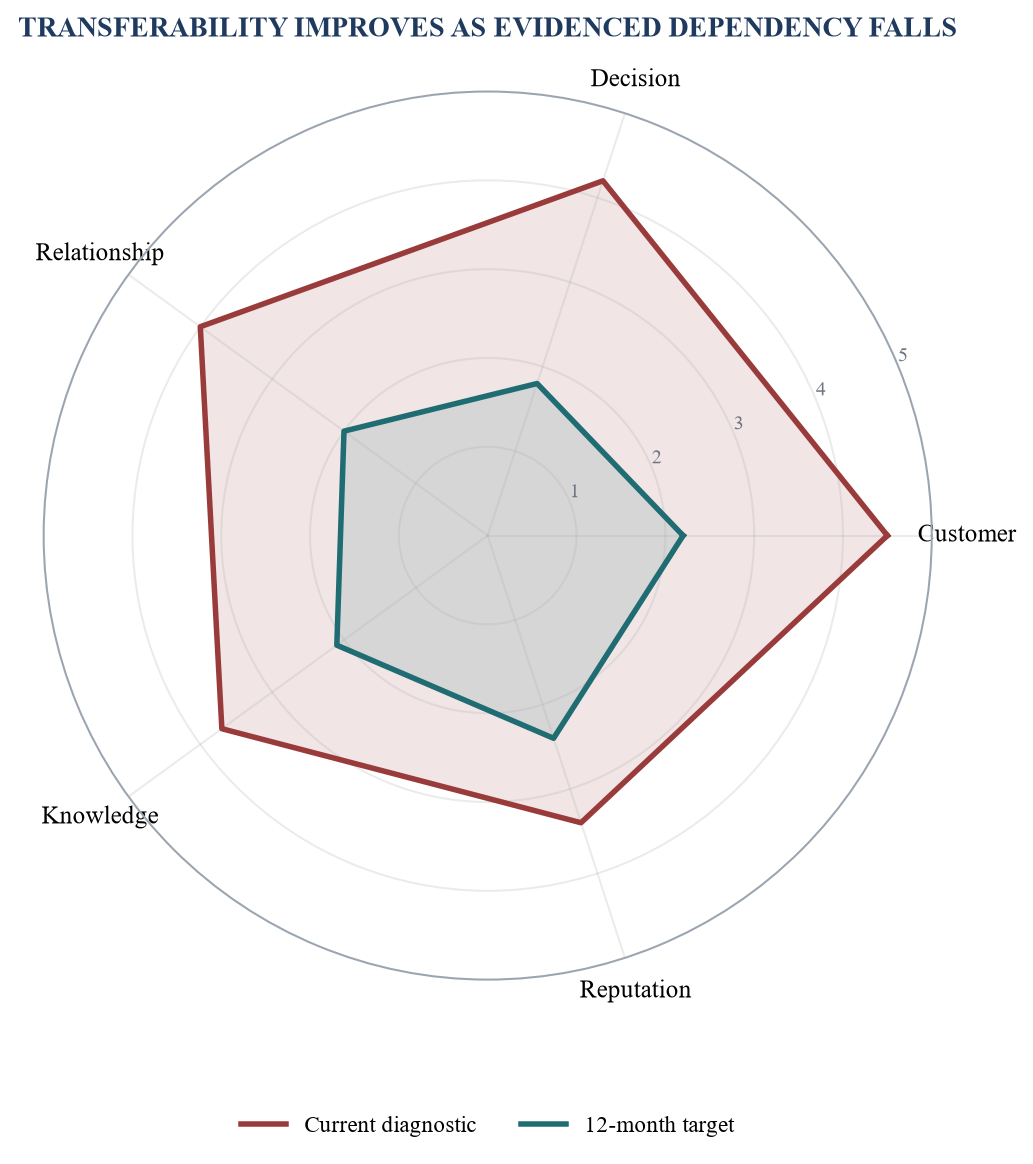
Hypothetical management scores on a one-to-five scale. A higher score indicates greater dependence. Scores require evidence and do not represent a valuation discount.
Table 1. Dependency-index scoring architecture
| Dimension | Score 1 evidence | Score 3 condition | Score 5 exposure | Primary remediation |
|---|---|---|---|---|
| customer | several trusted contacts; team-led renewals; current CRM and contracts | shared coverage exists but founder still leads material negotiations | founder owns access, pricing, renewal and recovery | account teams, transfer meetings, pricing governance and renewal calendar |
| decision | valid authorities exercised within clear limits | routine authority is delegated; exceptions return frequently to founder | ordinary operating decisions wait for founder | authority matrix, decision playbooks, exception log and controlled absence |
| relationship | multiple institutional contacts and documented history | alternative contacts exist but lack credibility or records | lender, supplier, regulator or partner relationship is personal | joint engagement, formal mandates, records and named relationship owners |
| knowledge | current procedures are findable, usable and tested | documentation exists unevenly and relies on explanation | critical process, design or commercial history sits with founder | knowledge capture, process ownership, access control and use tests |
| reputation | company proposition and leadership team carry stakeholder confidence | founder brand remains dominant with emerging company identity | confidence follows the founder personally | institutional brand, visible leaders, consistent service and transition narrative |
The board should define materiality, evidence and weights for the specific business.
Scoring should use a defined period and a source trail. A twelve-month revenue view may be appropriate for customer coverage, while an eighteen- or twenty-four-month view may be needed for long-cycle contracts. Decision logs may use ninety days. Knowledge and relationship tests can use live transactions. The board should retain the denominator, such as the value of revenue assessed, the number of critical decisions reviewed and the number of material relationships mapped.
4. Map concentration to financial transmission channels
Concentration becomes decision-useful when it is linked to cash flow. A founder may control a small number of relationships that represent a large portion of revenue, gross margin or collections. Another relationship may carry little revenue but control a licence, facility, strategic supply or route to market. The map should therefore combine economic materiality with transfer readiness.
Customer analysis should cover revenue, gross margin, contract status, renewal timing, payment behaviour, pipeline, service dependence and the people trusted by the customer. Historical purchases and contracts also matter in acquisition accounting. IFRS material on customer-related intangible assets notes that contractual relationships and information about prior purchases are important inputs when valuing a customer relationship.[11] The institutionalisation programme should preserve those records and demonstrate that several employees can sustain the relationship.
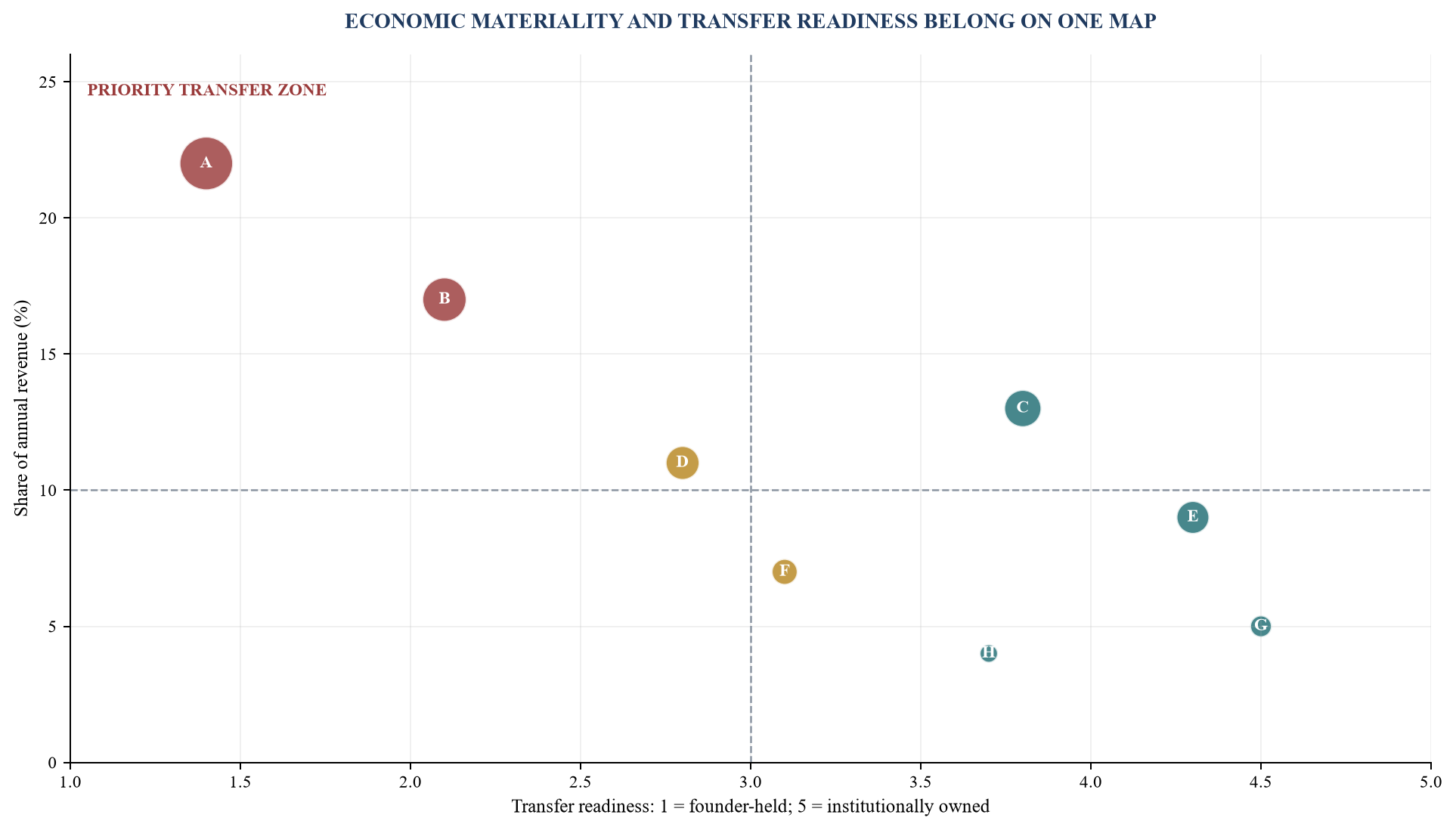
Hypothetical customer data. Bubble size represents annual gross profit. The chart prioritises relationships for transfer; it does not predict customer loss.
The commercial team should then execute a customer-transfer protocol. The founder and account leader agree the customer's objectives, relationship history, open issues and renewal path. The account leader progressively owns preparation, meeting leadership, follow-up, service escalation and commercial negotiation. The founder attends as a sponsor and bridge. CRM notes, proposals, contracts, service evidence and collections history remain with the company.
Table 2. Customer and stakeholder transfer protocol
| Stage | Founder role | Institutional owner | Evidence | Exit test |
|---|---|---|---|---|
| diagnose | explain history, trust drivers, sensitivities and informal commitments | account leader validates contract, economics and service record | account plan, contract file, contact map and issue log | material gaps are disclosed and assigned |
| introduce | sponsor the team and explain operating roles | account leader schedules and leads part of the meeting | agenda, attendance, decisions and CRM record | customer knows who owns ordinary matters |
| transfer | coach before meetings and observe execution | account leader leads proposal, renewal and escalation | proposal, approval trail, renewal plan and feedback | team completes a material cycle |
| test | remain available through a controlled escalation route | team operates during a defined founder absence | service, response, conversion and collection measures | outcomes remain within approved tolerance |
| sustain | support strategic moments under a written transition role | executive sponsor and account team own cadence | quarterly review, risks, pipeline and succession coverage | relationship survives personnel and ownership change |
Sensitive contact, competition and personal data must remain within contractual and legal boundaries.
Relationship transfer extends beyond customers. Banks need current mandates and credible finance leadership. Suppliers need authorised negotiators and documented commercial terms. Regulators and licensing bodies need valid representatives. Senior employees need a recognised reporting line. Each material relationship should have at least one accountable owner, one credible alternative and an accessible institutional record.
5. Move decisions into a valid authority system
Founder dependency often hides in decision latency. Employees may hold work until they receive an informal message, even when formal authority appears to be delegated. The cost emerges through delayed quotations, slow hiring, excess escalation, missed purchasing windows, inconsistent exceptions and limited management accountability.
The authority system should cover legal authority, financial limits, operating decisions and digital permissions. These layers must agree. A manager with a board-approved limit may still be unable to act if the bank mandate, enterprise system role or contract signature authority has not been updated. A system administrator may technically approve an action that the constitutional documents do not permit. Legal counsel and the company secretary should verify the applicable structure.
The board should first map recurring decisions by value, frequency, consequence and information required. It should assign an ordinary owner, a deputy, a limit, evidence, service level and escalation route. Reserved matters remain with the board or shareholders as required. Exceptions should be recorded because repeated exceptions often reveal a limit that is too low, a capability gap or a founder who continues to reclaim decisions.
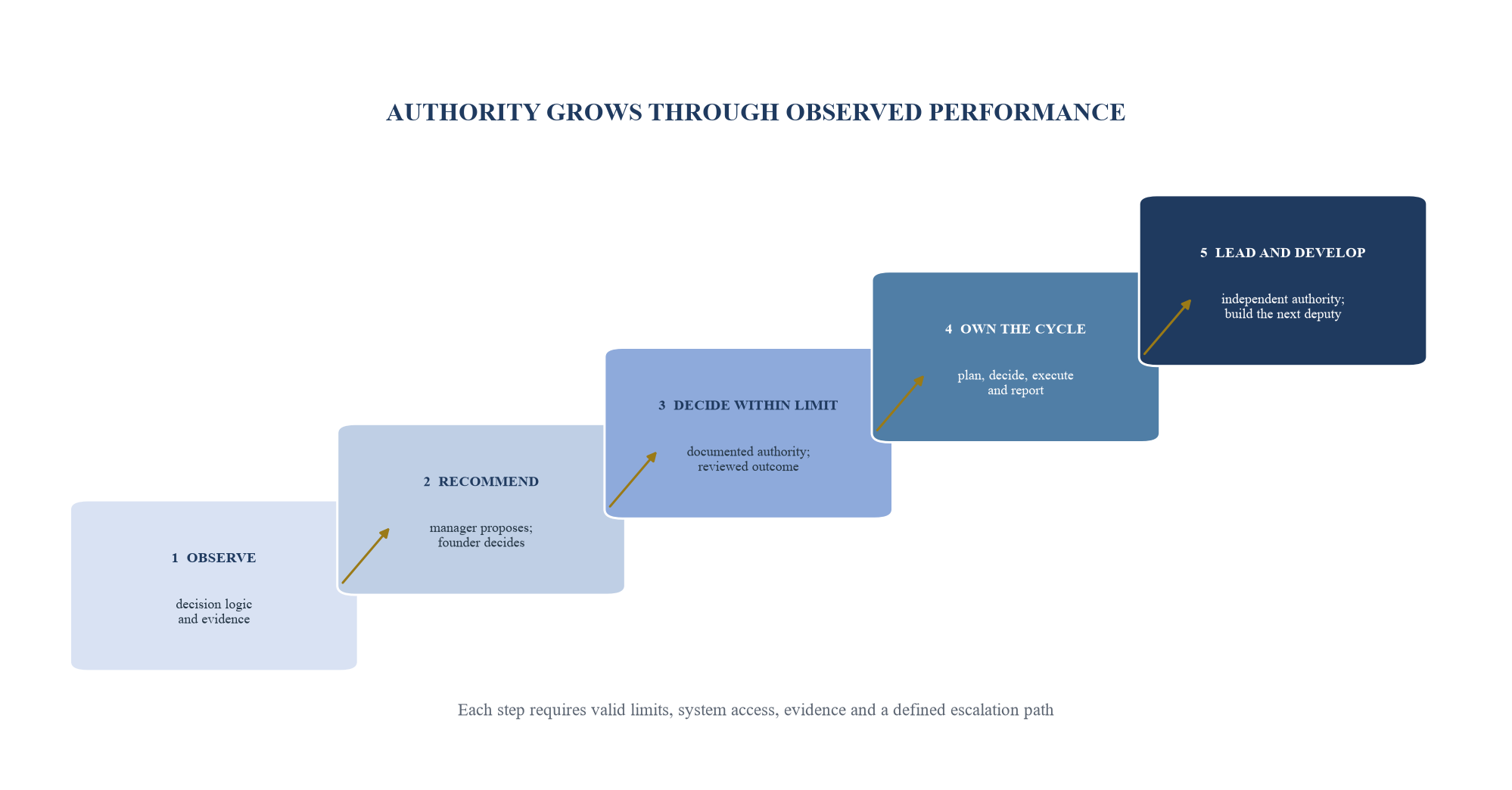
Authority should progress with demonstrated competence, valid approvals and controlled evidence.
Delegation should distinguish authority, accountability and assurance. Authority gives a manager the lawful and operational ability to act. Accountability assigns the outcome and the obligation to report. Assurance gives the board evidence that the decision stayed within policy and produced an acceptable result. Combining these elements reduces ambiguity during a founder transition.
The ladder can be applied by decision class. A manager may own ordinary customer pricing while observing a strategic exception, or lead routine purchasing while recommending a major capital commitment. Progress should depend on competence, decision quality, control performance and stakeholder response. The founder-intervention log should record why an action returned to the founder and whether the cause was an authority gap, missing information, weak capability, stakeholder bypass or a genuine reserved matter.
A transfer test is complete when the manager prepares the decision, obtains the required evidence, acts within valid authority, communicates the result and reports the outcome without an unplanned rescue. The next review should examine timeliness, quality, rework and control exceptions.
Table 3. Decision-rights design for sale readiness
| Decision class | Ordinary owner | Evidence required | Escalation | Transferability test |
|---|---|---|---|---|
| customer pricing | commercial director within approved corridor | margin, capacity, terms and exception code | chief executive or pricing committee | quotations issued accurately during founder absence |
| purchasing | operations or procurement leader within limit | demand, approved vendor, budget and terms | chief executive or board above threshold | purchase cycle completed with control evidence |
| hiring and reward | functional leader and people lead within plan | role, budget, selection and conflicts review | remuneration body for senior roles | critical vacancy filled through approved process |
| cash and banking | finance leader under dual control | liquidity, mandate, purpose and supporting document | board or authorised committee | payment and facility actions completed lawfully |
| capital expenditure | accountable sponsor within approved budget | business case, returns, risk and procurement | investment committee or board | proposal, approval and benefit tracking operate without founder |
| strategic exceptions | designated executive with recorded rationale | facts, options, risk, legal input and recommendation | board or shareholders as reserved | exception log shows timely, accountable decisions |
The actual schedule must reconcile to constitutional documents, resolutions, licences, contracts, bank mandates and system permissions.
Controlled absence is the strongest operating test. The founder steps away from selected decisions for a defined period while remaining available through an emergency route. Management measures decision time, error, rework, customer impact and unauthorised escalation. High-risk, regulated or irreversible actions should stay within approved safeguards. The result is an evidence-based development plan rather than a claim that delegation is complete.
6. Turn knowledge into an accessible operating asset
Knowledge dependency includes more than undocumented procedures. It covers the judgement used when conditions depart from the procedure: how to price an unusual order, distinguish a serious customer concern, diagnose a recurring technical fault or negotiate a supply exception. The programme should capture both the standard path and the boundary conditions that require escalation.
The knowledge map should connect each critical outcome to a process owner, deputy, source record, system, credential route, review date and use test. Sensitive information should remain protected by role-based access, confidentiality and applicable data-protection requirements. Shared access does not mean uncontrolled access. The objective is lawful availability to authorised people.
ISO 22301 describes a documented management system for business continuity that is implemented, monitored, reviewed and improved.[7] ISO 31000 provides principles and a process for identifying, analysing, evaluating, treating, monitoring and communicating risk.[6] These standards support a repeatable method: identify the outcome, understand the dependency, design the treatment, exercise it, record the result and improve the control.
Useful artefacts include current process maps, product and service standards, contract repositories, pricing logic, design history, vendor records, incident logs, decision precedents, customer commitments, calendar obligations, system ownership and protected access procedures. Each priority artefact should pass a use test in which a qualified alternative performs the task without asking the founder where the information sits or how the basic process works.
The test should record time to locate, time to act, errors, missing context and required escalation. A document that cannot be found, interpreted or applied under ordinary conditions is weak transfer evidence. The board should report tested usability and unresolved dependencies alongside documentation completion.
7. Measure management depth through demonstrated coverage
Management depth is the organisation's capacity to sustain leadership, execution and control across critical roles. Headcount and job titles are incomplete measures. A credible management-depth assessment asks whether named people have the competence, authority, stakeholder legitimacy, information and capacity to own the relevant outcome.
The G20/OECD Principles of Corporate Governance 2023 place oversight of key executives and succession planning among core board functions and connect succession planning to business continuity and talent development.[3] IFC's methodology for family or founder-owned companies assesses governance through areas including board structure, control environment, disclosure and stakeholder engagement, using a progression approach suited to company maturity.[4] IFC's Family Business Governance Handbook also addresses senior management, non-family managers and CEO succession.[5]
Empirical research supplies relevant context with important limits. Bloom and Van Reenen found a strong association between measured management practices and firm performance in a sample of medium-sized manufacturing firms across the United States and Europe.[8] Bennedsen and co-authors studied CEO successions in Danish family firms and reported weaker performance following family successions in their sample.[9] Pérez-González reported similar concerns in a United States study of inherited control.[10] These studies concern defined countries, periods and succession settings. They do not establish a GCC transaction discount. They support careful attention to management selection, operating practices and observed succession capability.
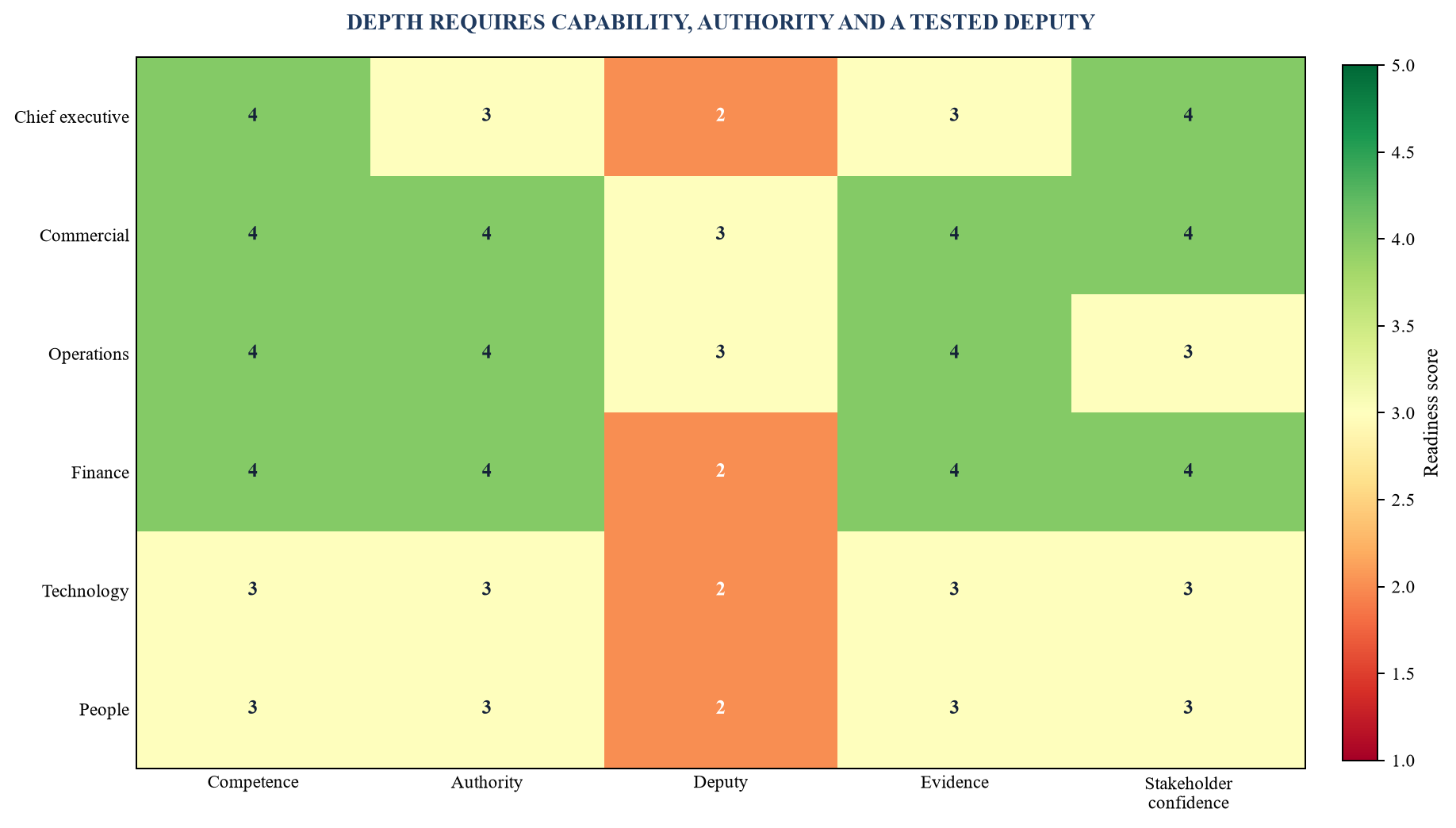
Hypothetical readiness scores from one to five. A score should reflect observed performance, authority, access, stakeholder confidence and capacity.
The scorecard should separate incumbent performance from deputy readiness. A strong leader with no credible alternative remains a concentration. A named deputy with no authority or observed track record remains a plan. The board should examine role outcomes, decisions completed, customer and employee feedback, financial control, incident response and performance during a controlled absence.
Development actions can include leading board agenda items, owning a customer renewal, approving within a new limit, running an operating review, presenting the forecast, handling a defined incident or training the next layer. External recruitment may be required when the gap cannot be closed within the transaction timetable. Retention arrangements should be aligned with the expected role and reviewed with qualified employment, tax and transaction advisers.
8. Replace reassurance with an evidence ladder
A buyer is likely to distinguish between intent and demonstrated capability. "The team knows the business" is a statement. A current role description and authority schedule provide documentation. A completed customer renewal or absence exercise provides observed evidence. Repeated performance across periods provides a stronger operating record.
An evidence ladder can classify each dependency treatment:
1. identified: the dependency is named with an owner; 2. designed: the future role, control or process is approved; 3. enabled: authority, access, information and training are available; 4. demonstrated: an alternative owner completes a live or controlled cycle; 5. sustained: performance remains within tolerance across repeated cycles.
This ladder should appear in the dependency register and board pack. It reduces the risk that the programme reports activity as completion. Drafting a procedure, holding an introduction or appointing a deputy are intermediate milestones. The final readiness signal comes from the organisation performing with evidence.
The board should retain exceptions and failed tests. A failed test reveals the point where institutionalisation still depends on the founder. Corrective action should state the consequence, owner, investment, deadline and next test. Repeated exceptions may require a change in limits, capability, role design or transaction timing.
9. Connect dependency to value without inventing a discount
Founder dependency can affect value through several transmission channels. Revenue may be delayed or lost if customers do not transfer. Margin may fall when pricing discipline or supplier terms weaken. Working capital may increase if collections slow or inventory decisions deteriorate. Additional management, retention and transition costs may be required. Forecast outcomes may become wider, affecting the risk assessment and deal structure.
The model should keep operating assumptions separate from valuation judgement. Management estimates customer retention, conversion timing, interim cost and remediation expenditure using evidence and labelled assumptions. A qualified valuer selects the method, basis of value, market inputs and treatment of risk for the purpose at hand. The analysis should avoid counting the same risk in both reduced cash flows and an increased discount rate without a reasoned basis.
Consider a hypothetical GCC services company with annual revenue of AED 120 million and EBITDA of AED 24 million. The founder remains the senior relationship owner for customers representing AED 54 million of revenue. The company plans to institutionalise coverage over twelve months. The following scenario is a management model; it does not describe an actual company or a market forecast.
Table 4. Hypothetical dependency-transmission scenario
| Input | Current-dependency case | Evidence-led transfer case | Interpretation |
|---|---|---|---|
| annual revenue linked to founder-led accounts | AED 54.0m | AED 54.0m | starting exposure is unchanged |
| revenue delayed or lost in tested scenario | 12% | 4% | management assumption informed by transfer evidence |
| contribution margin on affected revenue | 32% | 32% | simplified common assumption |
| incremental management and transition cost | AED 2.4m | AED 1.2m | recruitment, retention, systems and customer work |
| incremental working-capital requirement | AED 1.8m | AED 0.6m | assumed collection and execution effect |
| first-year cash-flow effect before tax | AED 6.3m | AED 2.5m | revenue effect plus transition and working-capital assumptions |
Illustrative management assumptions only. Values do not estimate a transaction discount or expected GCC outcome.
The illustrative calculation shows a possible chain from exposure to cash flow. In the current-dependency case, 12% of AED 54 million is AED 6.48 million of revenue. At a 32% contribution margin, the operating effect is about AED 2.07 million. Adding AED 2.4 million of transition cost and AED 1.8 million of working-capital requirement produces a first-year cash-flow effect of about AED 6.27 million before tax. The evidence-led transfer case uses the same calculation and different management assumptions.
The scenario should be tested for timing, customer-specific conditions, cost classification, recovery, tax and interaction with the base forecast. It should also disclose whether the figures represent downside, expected value or a stress case. A buyer may respond through price, rollover, earnout, holdback, transition services, retention or a condition to completion. The chosen response depends on evidence, negotiation and the transaction structure.
10. Design the founder's transition role
Institutionalisation works best when the founder has a defined role in the transfer. The founder can explain history, introduce the team, coach judgement, sponsor cultural change and retain a narrow set of strategic decisions during development. The role should have objectives, time commitment, authority, information rights, conflicts provisions, handover milestones and an end state.
Ambiguity creates two risks. Management may continue to defer decisions because the founder remains informally available. The founder may also feel accountable for outcomes without having clear authority after the sale. A written transition architecture helps both parties understand who leads customers, employees, operations and strategic choices at each stage.
Transaction documents may include employment or consultancy terms, transition services, rollover equity, restrictive covenants, retention arrangements and earnout measures. These instruments require careful legal, tax, accounting and commercial design. An earnout tied to results that the buyer controls can create disputes. A long founder commitment can preserve confidence while delaying genuine transfer. The institutionalisation record helps the parties choose a scope and period connected to remaining dependencies.
The founder should also prepare for behavioural change. A delegation plan can fail when the founder answers every copied email, overrides approved decisions or rescues managers before the agreed escalation point. The board should monitor reclaimed decisions, unauthorised workarounds and stakeholder bypass. Coaching and an agreed exception protocol can support the shift from sole operator to enterprise sponsor.
11. Execute a twelve-month remediation programme
A twelve-month programme should use waves and gates. The timetable can be compressed or extended according to the company's risks, transaction objective and operating cycle. A business with annual renewals may need a full customer cycle to demonstrate transfer. A regulated or project-based business may need longer evidence periods.
Months one to three establish the baseline. The board confirms the transaction objective, confidentiality and programme sponsor. Management builds the dependency index, customer and stakeholder concentration map, decision inventory, knowledge map and management-depth scorecard. Legal counsel verifies authority boundaries. The company selects the highest-priority dependencies and defines measures.
Months four to six design and enable the future system. Account teams receive ownership, authority schedules are approved, system access is aligned, critical procedures are updated, deputies receive development assignments and the board pack begins reporting transfer evidence. Missing senior capability is recruited or sourced. The founder starts structured customer and stakeholder introductions.
Months seven to nine demonstrate capability. Management leads renewals, pricing, operating reviews, cash decisions and selected exceptions within approved limits. The company runs controlled founder-absence tests and records results. It closes access, documentation and authority gaps. An independent reviewer can challenge priority evidence where the transaction is material.
Months ten to twelve sustain performance and package the evidence. The company repeats priority tests, confirms management retention and transition roles, refreshes the dependency model and organises the buyer-ready data room. The board records residual dependencies and their financial, operating and contractual treatment. Transaction launch should follow evidence and owner readiness rather than the calendar alone.
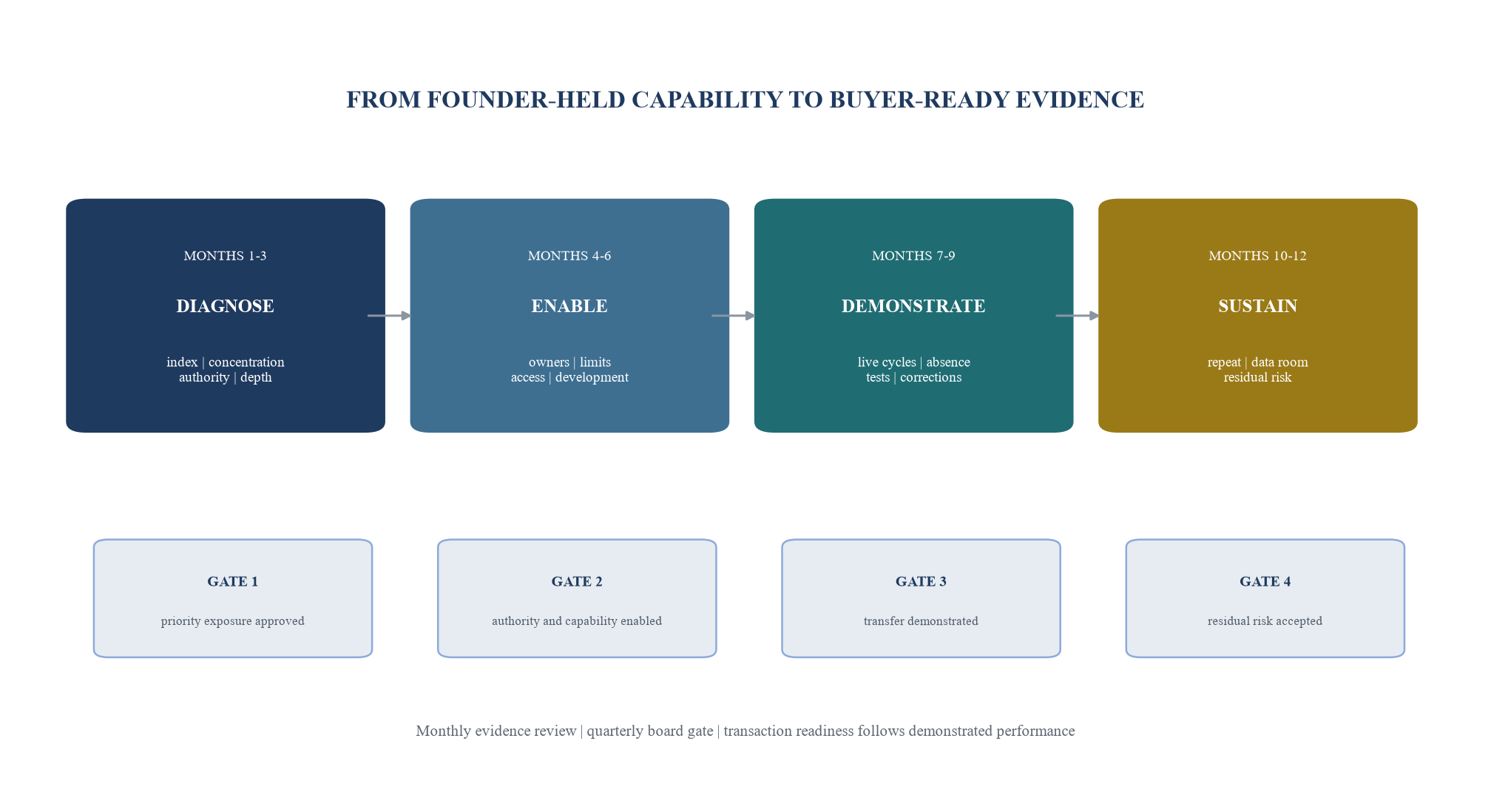
The sequence is illustrative. Timing should follow operating cycles, legal requirements and the proposed transaction timetable.
Table 5. Twelve-month programme governance
| Period | Core work | Board evidence | Gate decision |
|---|---|---|---|
| months 1-3 | baseline dependency index, concentration, decisions, knowledge and depth | verified scope, sources, owners and priority register | approve priority exposures, resources and measures |
| months 4-6 | relationship teams, authorities, access, procedures, recruitment and development | approved role and authority design; enabled alternatives | confirm that named owners can begin operating |
| months 7-9 | live-cycle leadership, controlled absence, customer transfer and corrective action | test results, exceptions, customer outcomes and closed gaps | accept demonstrated transfer or fund additional remediation |
| months 10-12 | repeated performance, retention, transition role, data room and scenario refresh | sustained metrics, residual-risk report and buyer-ready evidence | launch, defer or adjust transaction plan |
Each gate should record evidence, unresolved exposure, owner, financial range and next decision.
Programme measures should include the share of material revenue with demonstrated team coverage, critical decisions completed within authority, priority procedures used successfully, roles with tested deputies, founder interventions by category, customer outcomes, decision time, control exceptions and corrective-action closure. The board should view absolute numbers and denominators. A high completion percentage can hide one customer, licence or bank authority that controls material value.
12. Build the buyer-ready evidence room
The institutionalisation data room should let a buyer trace how value is created and controlled. It should show the current dependency, treatment, demonstrated result and residual exposure. Personal information, customer confidentiality, competition-sensitive information and privileged legal advice require appropriate access controls and disclosure protocols.
Core evidence includes the organisation chart, role descriptions, employment and retention terms, board and committee records, authority schedules, bank mandates, system permissions, customer concentration, contracts, CRM coverage, account plans, renewal evidence, supplier and lender maps, process ownership, knowledge records, management scorecards, absence tests, incident logs and corrective actions. Financial evidence should connect dependencies to revenue, margin, working capital, cost and forecast scenarios.
Management presentations should be consistent with the data room. If the commercial director is presented as the customer owner, the meeting history, CRM, approvals and renewal record should support that position. If the chief financial officer is presented as independent, the forecast, board pack, bank relationships and cash controls should show it. Buyers often test management depth through detailed follow-up and observation.
Table 6. Buyer questions and transfer evidence
| Buyer question | Evidence | Weak signal | Stronger signal |
|---|---|---|---|
| who owns material customers? | contracts, account plans, CRM, meeting and renewal history | founder remains sole recorded contact | team leads a completed renewal and service cycle |
| who can make decisions? | constitutional records, authority matrix, mandates, approvals and logs | titles conflict with actual practice | valid authority is exercised with timely reporting |
| can management lead? | scorecards, board materials, operating reviews and absence tests | named successors lack observed outcomes | leaders deliver results and develop deputies |
| can knowledge be used? | procedures, repositories, access, training and use-test records | documents are incomplete or founder-located | authorised alternatives find and apply current knowledge |
| what remains dependent? | dependency register, scenarios, actions and transition plan | broad reassurance and undisclosed exceptions | quantified channels, transparent assumptions and accountable treatment |
The evidence set should be tailored to the transaction, jurisdiction and confidentiality protocol.
Residual dependency should be disclosed accurately. A company can enter a sale with remaining founder involvement when the parties understand the purpose, duration, authority, cost and route to completion. Transparent residual risk gives the parties a basis for transition and contract design. Overstatement of independence can damage confidence when diligence reveals informal reliance.
13. Scope, assumptions and limitations
This paper is a general research and management framework. It is not legal, tax, audit, accounting, valuation, employment, insurance or investment advice. Corporate authority, family-business status, employment rights, customer consent, restrictive covenants, data protection, competition law, intellectual property, tax and transaction documents require qualified advice in the relevant jurisdictions.
The dependency index and scorecards are original management tools. Their dimensions, weights, thresholds and evidence periods should be tailored to the company. They have not been validated as predictors of transaction value or business failure. A lower score does not establish that a buyer will pay a higher price.
All numerical examples and graphics are hypothetical. They illustrate diagnosis, governance and scenario mechanics. They do not represent an actual company, typical GCC exposure, market valuation multiple, expected customer loss or forecast transaction outcome.
The academic studies cited examine defined samples and jurisdictions, including manufacturing firms in the United States and Europe, Danish family-company successions and inherited control in United States firms.[8,9,10] Their findings should not be generalised mechanically to GCC companies, sectors or sale processes. They provide context for management quality and succession design.
OECD, IFC, ISO, IFRS, IPEV and IVSC materials serve different purposes. Corporate-governance principles, governance diagnostic tools, continuity and risk-management standards, financial-reporting guidance and valuation guidance do not replace transaction-specific diligence or professional judgement. The signed legal documents and verified facts govern the actual transaction.
14. Implementation conclusion
Founder dependency becomes manageable when the board defines it as a set of transferability exposures. Customer trust, decision authority, stakeholder access, knowledge and reputation can be mapped to operating outcomes, financial channels, accountable owners and evidence. The resulting programme gives management a practical agenda before buyers begin their own diagnosis.
The strongest evidence comes from the company performing through its team. Material customers complete cycles with institutional owners. Managers exercise valid authority. Deputies operate with access and legitimacy. Procedures are used. Board reporting identifies exceptions and residual risk. The founder supports the transition through a defined role that develops capability and preserves strategic value.
A twelve-month programme can create a credible record when it follows the company's operating cycle and closes each gate with demonstrated outcomes. The board can then present the business as an enterprise with transparent remaining dependencies, a governed transition plan and cash flows supported by organisational capability.
References
- [1] United Arab Emirates Legislation, Federal Decree by Law No. 37 of 2022 Concerning the Family Businesses. https://uaelegislation.gov.ae/en/legislations/1608/download
- [2] United Arab Emirates Legislation, Federal Decree-Law No. 32 of 2021 on Commercial Companies. https://uaelegislation.gov.ae/en/legislations/1542
- [3] OECD, G20/OECD Principles of Corporate Governance 2023. https://doi.org/10.1787/ed750b30-en
- [4] International Finance Corporation, Corporate Governance Methodology Tools, including the Family or Founder-Owned Progression Matrix. https://www.ifc.org/en/what-we-do/sector-expertise/corporate-governance/cg-methodology-tools
- [5] International Finance Corporation, Family Business Governance Handbook. https://www.ifc.org/en/insights-reports/2011/ifc-family-business-governance-handbook
- [6] International Organization for Standardization, ISO 31000:2018 Risk management; Guidelines, confirmed current in 2023. https://www.iso.org/standard/65694.html
- [7] International Organization for Standardization, ISO 22301:2019 Security and resilience; Business continuity management systems; Requirements, including Amendment 1:2024. https://www.iso.org/standard/75106.html
- [8] Nicholas Bloom and John Van Reenen, Measuring and Explaining Management Practices Across Firms and Countries, The Quarterly Journal of Economics 122(4), 2007. https://doi.org/10.1162/qjec.2007.122.4.1351
- [9] Morten Bennedsen, Kasper Meisner Nielsen, Francisco Pérez-González and Daniel Wolfenzon, Inside the Family Firm: The Role of Families in Succession Decisions and Performance, The Quarterly Journal of Economics 122(2), 2007. https://doi.org/10.1162/qjec.122.2.647
- [10] Francisco Pérez-González, Inherited Control and Firm Performance, American Economic Review 96(5), 2006. https://doi.org/10.1257/aer.96.5.1559
- [11] IFRS Interpretations Committee, Customer-related intangible assets, IFRS 3 and IAS 38, March 2009. https://www.ifrs.org/content/dam/ifrs/supporting-implementation/agenda-decisions/2009/ifrs-3-ias-38-customer-related-intangible-assets-march-2009.pdf
- [12] International Private Equity and Venture Capital Valuation Board, International Private Equity and Venture Capital Valuation Guidelines, December 2025. https://www.privateequityvaluation.com/Valuation-Guidelines
- [13] International Valuation Standards Council, International Valuation Standards, including IVS 200 Businesses and Business Interests and IVS 210 Intangible Assets. https://ivsc.org/standards/
About the Author
Chennakeshav Adya is an independent researcher whose work focuses on corporate finance, value creation, private capital and transaction execution. His research translates financial, commercial and operating evidence into decision frameworks for boards, investors and management teams.
Appendix A: Founder-dependency diagnostic checklist
- Define the transaction objective, expected founder role and evidence period.
- Map revenue, gross margin, collections, renewals and pipeline by relationship owner.
- Identify material stakeholder, decision, knowledge and access dependencies; reconcile actual authority to legal and system permissions.
- Assess management competence, authority, legitimacy, information, capacity and deputy coverage.
- Score each dimension using stated evidence; link priorities to revenue, margin, working capital, cost and scenarios.
- Record each treatment as identified, designed, enabled, demonstrated or sustained.
- Report residual dependencies, assumptions, corrective actions, owners, dates and next tests to the board.
Appendix B: Buyer-ready institutionalisation checklist
- Confirm that customer contracts, history, contacts, account plans, approvals and renewals are current and accessible.
- Demonstrate team-led customer, supplier, lender and regulator engagement through completed operating cycles.
- Reconcile board and shareholder approvals, constitutional authority, bank mandates and digital permissions.
- Run controlled founder-absence tests for selected commercial, operating and financial decisions.
- Verify that authorised alternatives can use priority knowledge; evidence management performance through completed cycles.
- Align employment, retention, transition and incentive arrangements with the proposed transaction role.
- Prepare transparent scenarios and a protected data room organised around buyer questions.
- Obtain board acceptance of residual dependency and qualified advice on legal, tax, accounting and valuation treatment.
