

1. INTRODUCTION
The title of this paper is a metaphor. A founder who moves from the United Kingdom to the United Arab Emirates retains nationality, legal identity and the rights and obligations attached to each relevant legal relationship. The practical difficulty is narrower: the founder can enter a period in which one set of residence facts is ending while the documents, routines and institutional history of the new base are still developing.
That period is an evidence gap. The founder may have left a UK home, reduced UK work and begun to build a non-UK residence position. At the same time, a UAE residence permit may be recent, a tenancy may have only just started, a company may have no trading history, and a bank may still be verifying ownership, authority, source of wealth and expected activity. None of those facts means that the founder lacks a country. They mean that different institutions are answering different questions on different timetables.
The risk becomes acute around a company sale, refinancing, dividend, family investment or new venture. A buyer may require a complete ownership and proceeds trail. A bank may need to understand both the founder's accumulated wealth and the direct source of an incoming payment. Tax advisers may need separate conclusions on UK residence, UAE domestic residence, treaty residence, company residence and transaction timing. Company registries may still require UK addresses, identity verification and statutory filings after the individual has moved [1-14].
This paper develops a documentation bridge across that interval. It maps nine evidence layers, distinguishes personal from company propositions, and introduces a banking-readiness gate, a source-of-wealth narrative, a substance register and a 90-day implementation programme. The objective is a coherent file that explains who the founder is, where the founder lives, how the business is controlled, where the money came from and why the proposed activity makes commercial sense.
The analysis provides general research. It does not determine any person's residence, immigration status, tax exposure, bank eligibility or company obligations. Every worked path and value is hypothetical and simplified. Current official guidance, institution-specific requirements and fact-specific professional advice remain essential.
2. THE EVIDENCE GAP
2.1 One move creates several institutional questions
A relocation can be legally effective for one purpose before it is persuasive for another. Immigration status answers whether the person may reside in the UAE under the relevant permit. Domestic tax residence follows statutory tests. Treaty residence arises only where the convention and the facts require it. A company licence identifies the permitted entity and activity. Bank onboarding assesses the customer and proposed relationship under the bank's risk-based controls. Company residence considers where the company is incorporated and, where relevant, where high-level decisions are made [9,15-27].
The founder's master file should therefore begin with questions rather than documents. A passport supports legal identity and nationality. It does not establish tax residence, beneficial ownership of every entity, the source of sale proceeds or the place where a company is effectively managed. A residence permit supports immigration status. It does not by itself establish the complete domestic or treaty residence conclusion. A certificate of incorporation proves formation; it does not show that the company has employees, premises, customers or substantive decision-making.
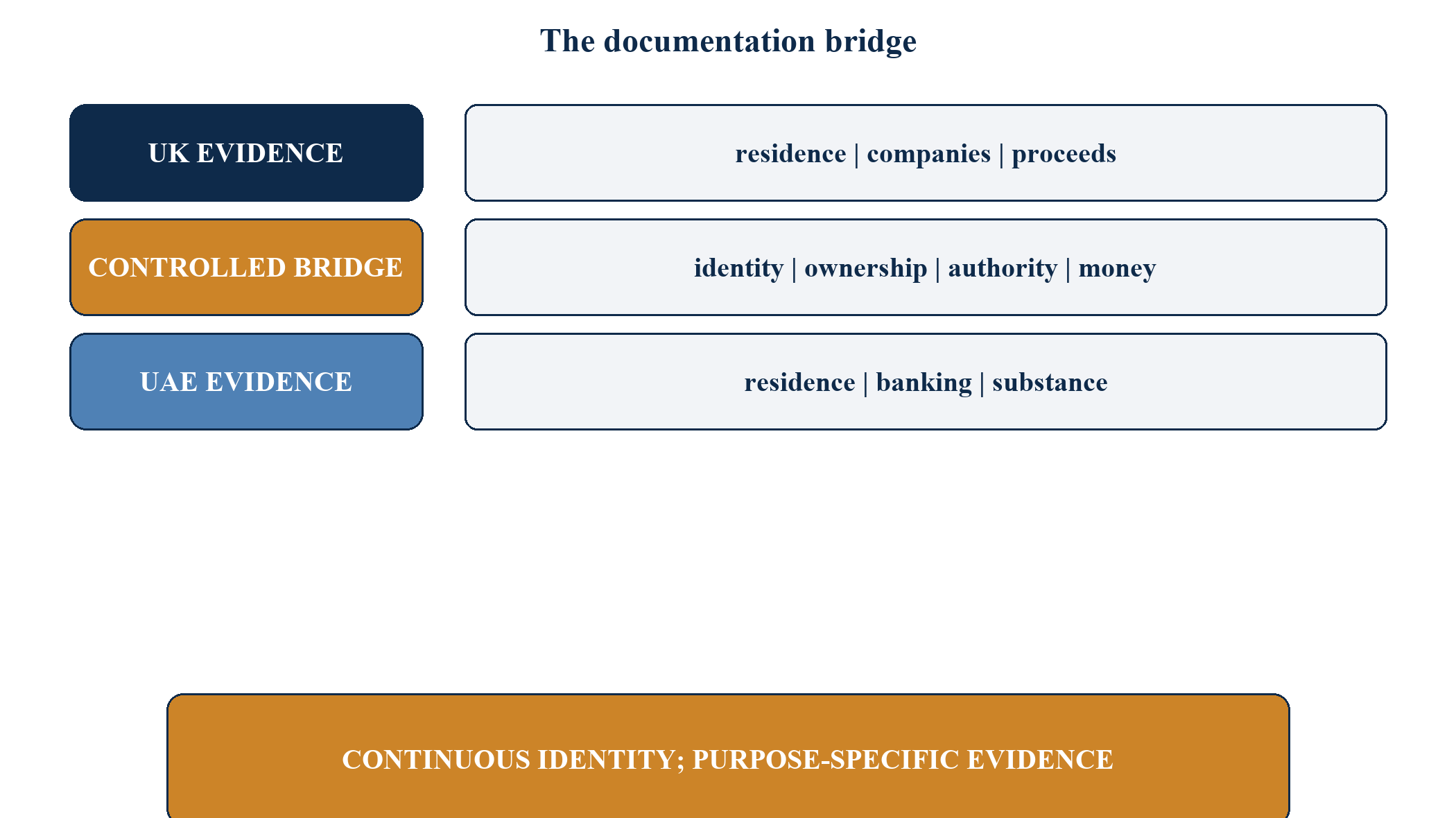
An evidence gap appears when a document is asked to answer a proposition outside its purpose. The bridge closes the gap by assigning each proposition to an authoritative source, recording its effective period and linking it to the decision for which it is being used.
| Proposition | Primary evidence category | Common mismatch | Control response |
|---|---|---|---|
| personal identity | valid government identity records | names or addresses differ across records | maintain a controlled identity schedule and correction log |
| UK residence | day, work, home and ties records with advice | departure date is treated as the conclusion | apply the statutory tests to the complete tax year |
| UAE residence | presence, home, work or business and personal interests | a new visa is treated as the whole tax file | use the evidence route relevant to the rule relied upon |
| company authority | constitutional documents, resolutions and mandates | founder status is assumed to confer every authority | document current signatories and delegated powers |
| bank purpose | business plan, expected activity and counterparties | generic company description conflicts with actual flows | quantify the intended account profile |
| proceeds | transaction documents, completion evidence and statements | gross headline value is treated as available cash | reconcile consideration, deductions, escrow and receipt |
2.2 The bridge has a start and an end
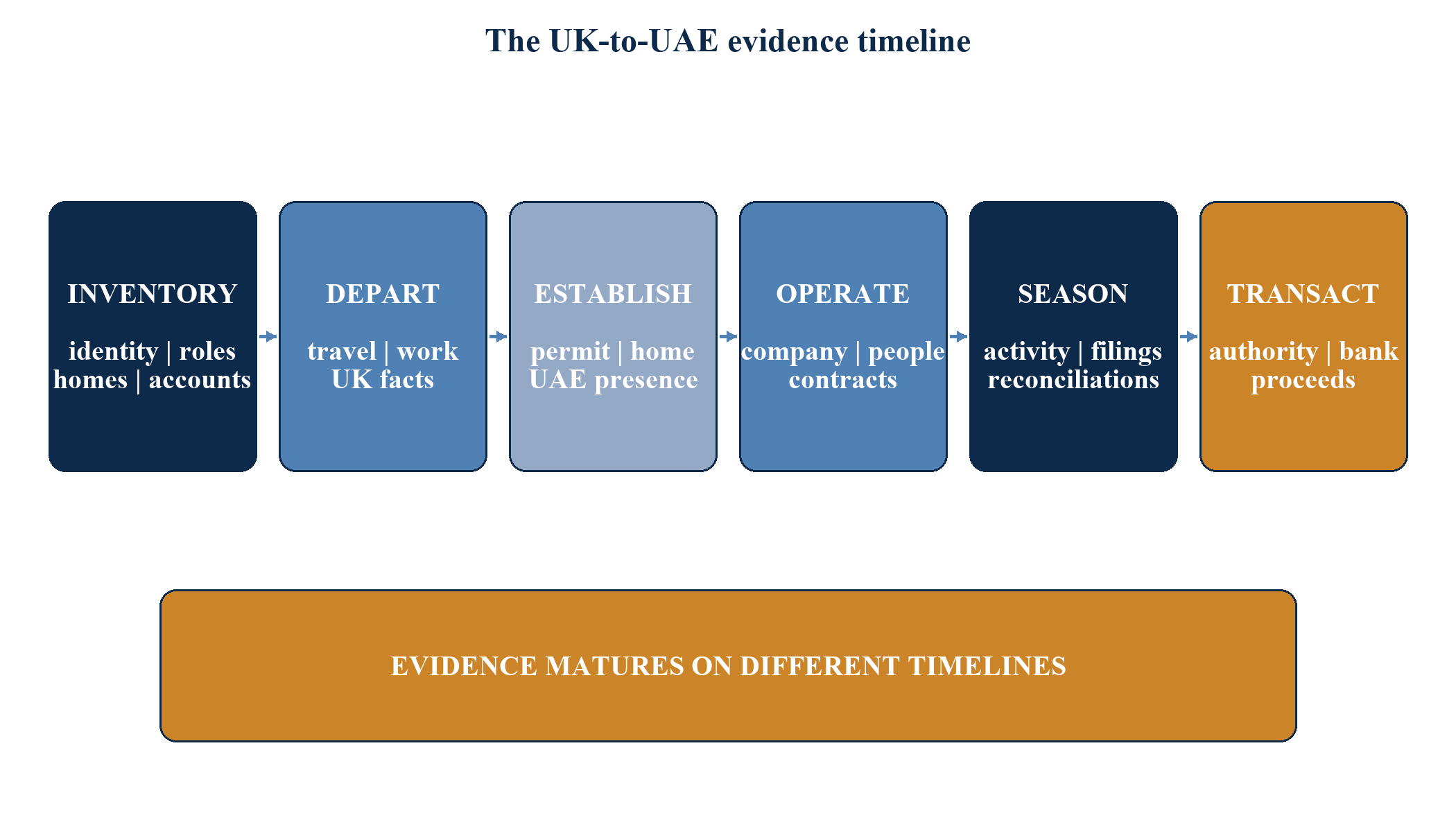
The bridge begins before the physical move. The founder inventories existing identities, entities, accounts, homes, roles, powers, liabilities and expected transactions. The bridge ends only when the new operating record can be evidenced through ordinary activity: consistent residence records, a stable address, documented decision-making, reconciled accounts, known counterparties, tax and registry compliance, and bank activity that matches the declared profile.
The end point is not a fixed number of days. Each institution applies its own law, policy, evidence period and risk assessment. The file should therefore carry maturity dates for each evidence item and should record outstanding dependencies without predicting an institution's decision.
3. NINE EVIDENCE LAYERS
3.1 A layered architecture
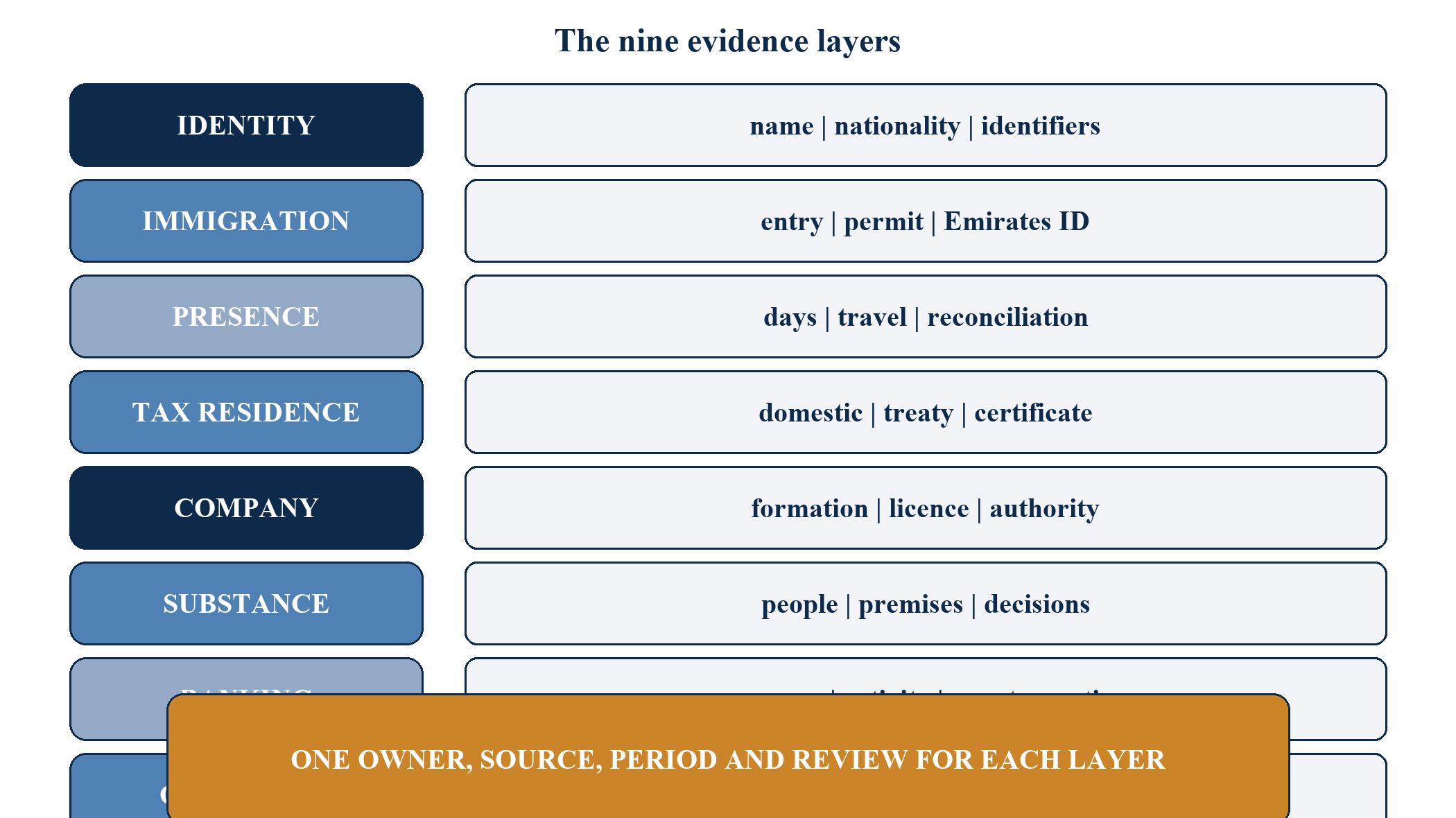
The documentation bridge comprises nine layers: identity and nationality; immigration status; physical presence; domestic tax residence; treaty residence and certificates; company formation and licensing; company management and operating substance; banking and beneficial ownership; and transaction authority and proceeds. Each layer has its own owner, source record, review date and decision.
The architecture prevents circular evidence. A bank reference produced from an account should not become the only proof of the wealth that funded that account. A company board minute should not merely repeat a founder instruction prepared elsewhere. A residence memorandum should cite original travel, home and work records. The bridge should point back to facts that can be independently verified.
3.2 Evidence states
Every item should have one of five states: planned, requested, received, verified or superseded. The state belongs to the document, not to the underlying legal conclusion. A received tenancy contract may still need to be matched to occupancy, payment and utilities. A verified identity document may later be superseded by a renewed passport. A received bank statement may require reconciliation to the transaction agreement.
3.3 Ownership and review
The founder remains accountable for truthful and complete information. Operational ownership should be distributed. A project lead maintains the master index. Tax advisers approve residence and tax conclusions. Company counsel confirms powers, filings and transaction documents. Finance reconciles funds. A compliance lead prepares the beneficial-ownership and source narratives. The bank makes its own onboarding and monitoring decisions.
4. IDENTITY, NATIONALITY AND IMMIGRATION
4.1 Legal identity remains continuous
Relocation does not erase the founder's legal identity. The controlled identity schedule should record the name exactly as shown on each current passport or national identity document, former names, transliterations, dates of birth, nationalities, tax identifiers, residential addresses, service addresses and entity roles. Differences should be explained and supported rather than silently normalised.
This schedule supports registries, banks, counterparties and advisers. It should restrict access to sensitive data, identify the lawful purpose for collection and avoid distributing complete identity packs through uncontrolled email chains. The public Companies House register displays specified director information, while the usual residential address is held on a private register subject to the applicable access rules [12].
4.2 Immigration evidence has a defined purpose
The UAE Federal Authority for Identity, Citizenship, Customs and Port Security describes residence-permit issuance as linked to an Emirates ID application [19]. The immigration file should contain the relevant application, entry or status-change evidence, medical and biometric records where applicable, permit, Emirates ID, sponsor or entity relationship and renewal dates.
Immigration eligibility and timing depend on the applicable route and authority. The paper does not treat any generic investor, partner or employment route as suitable for a particular founder. Counsel or an authorised immigration professional should confirm the route, validity, conditions and family consequences.
4.3 Address continuity
The bridge should distinguish four address functions: the founder's actual residential address; a public service address; a company's registered office; and an operational office. A UK company must maintain an appropriate registered office in the same UK jurisdiction in which it is registered [11]. A director provides both a service address and a usual residential address to Companies House [12]. Those statutory duties continue after a personal move.
| Address function | Person or entity | Public status | Evidence owner |
|---|---|---|---|
| residential home | founder and household | generally private within the applicable system | founder and legal adviser |
| service address | director or officer | may appear on a public register | company secretary |
| registered office | company | public corporate address | company secretary |
| operating premises | business | depends on licence, lease and disclosure | operations lead |
5. CLOSING THE UK RESIDENCE FILE
5.1 Departure is a fact; residence is a conclusion
The UK Statutory Residence Test determines residence for a tax year through automatic overseas tests, automatic UK tests and, where required, the sufficient-ties test [1,2]. The physical departure date is one fact within that analysis. Work, homes, family, prior-year presence and later visits can affect the result. Split-year treatment follows specific statutory cases and conditions; it is not a date selected by the founder [7].
The departure file should preserve daily locations, travel records, UK work hours, home availability, family facts, prior-year day counts and the evidence required for the relevant split-year case. HMRC's current manuals describe day counting and the treatment of work for SRT purposes [5,6]. The office should reconcile diaries, tickets, passport movement where available, expense records, calendars and device or building records without assuming that one source is complete.
5.2 Telling HMRC
HMRC states that a person leaving the UK may need to notify it through form or through the residence section of a Self Assessment return, depending on the person's filing position and work circumstances [3,4]. A founder who usually files a return should confirm the appropriate route with the adviser. The notification process does not replace the residence analysis.
The file should preserve the submitted form or return, supporting schedules, acknowledgement, correspondence and adviser memorandum. It should also maintain a UK income register for continuing rent, employment, director fees, interest, pensions or disposals. Non-residence does not remove every UK tax or filing obligation [4].
5.3 Temporary non-residence
A planned return can engage temporary non-residence rules for specified income and gains when the statutory conditions are met [8]. The bridge should record prior UK residence, the period of non-residence, return plans, distributions, disposals, benefits, loans and other potentially relevant events. The plan should be reperformed when the expected return date changes.
6. BUILDING THE UAE RESIDENCE FILE
6.1 Domestic routes must be separated
UAE Cabinet Decision No. 85 of 2022 and Ministerial Decision No. 27 of 2023 provide domestic tax-residence rules for natural persons [15,16]. The FTA certificate service identifies evidence routes based on at least 183 days in a consecutive 12-month period; between 90 and 182 days with specified status plus employment, business or permanent-residence evidence; or a primary place of residence and centre of financial and personal interests in the UAE [17,18]. The facts and current official guidance determine the available route.
The bridge should maintain a rolling presence ledger and an interests file. Presence records include official entry and exit data, passports, itineraries and reconciliations. The interests file can include a continuously available home, household activity, work or business, family, banking, memberships and ordinary expenditure, subject to the specific test and evidence requirements. A lease signed on day one and a developed pattern of life six months later have different evidential weight and dates.
6.2 Certificate timing
The FTA service states that a natural person can apply once the relevant criteria are met and that the requested period cannot be a future period [17]. The certificate application should therefore be a scheduled output from the evidence file. The requested period, purpose, domestic route, supporting documents and any intended treaty use should be reconciled before submission.
A certificate should not be used outside its period or purpose. The UK residence conclusion remains a separate domestic analysis. Where both domestic systems treat the person as resident, the UK-UAE convention may require its own treaty analysis [9].
6.3 A residence evidence ladder
The evidence ladder begins with legal entry and identity records, then adds physical presence, a continuously available home, actual occupation, employment or business activity, household and personal interests, financial relationships and official tax correspondence. The ladder should describe the actual sequence; it should not backfill a fully mature narrative into a period when facts were still developing.
| Evidence stage | Typical source | Proposition supported | Review point |
|---|---|---|---|
| entry and legal status | entry record, permit, Emirates ID | lawful status and physical movement | issue, renewal and cancellation |
| home availability | executed lease or title, payment | contractual availability | commencement, renewal and access change |
| actual occupation | utilities, household records, ordinary activity | use and settled routine | monthly reconciliation |
| work or business | contract, licence, invoices, payroll, board records | economic activity | first activity and quarterly review |
| financial and personal interests | account, family, membership and relationship records | relevant connections under the route relied upon | adviser review |
7. DOMESTIC AND TREATY RESIDENCE
7.1 Dual domestic residence is possible
HMRC guidance recognises that a person can be resident in more than one country at the same time under domestic rules [4]. The UK-UAE convention then provides treaty rules for persons and taxes within its scope [9]. The bridge must retain both domestic conclusions before considering the treaty. It should not treat a certificate from one jurisdiction as an automatic cancellation of the other jurisdiction's law.
7.2 Treaty analysis follows its own sequence
For an individual treated as resident in both states for treaty purposes, Article 4 of the convention considers permanent home, centre of vital interests, habitual abode and nationality, with a competent-authority process where required [9]. Each concept depends on facts and the convention's wording. Homes, family, economic relationships and habitual patterns should be documented with dates and sources.
7.3 Evidence consistency
Tax filings, bank declarations, CRS self-certifications, registry records and adviser letters should use consistent facts or explain legitimate differences in purpose and period. The founder should never sign a pre-populated residence declaration without reviewing the period, definitions and jurisdictions. A correction log should record when information changes and which institutions were notified.
8. COMPANY FORMATION IS THE STARTING POINT
8.1 Formation establishes an entity
A certificate of incorporation, commercial licence and constitutional documents establish the entity and its permitted legal framework. They do not prove a developed operating business. The opening file should include the registrar record, licence, memorandum or articles, shareholders, directors, managers, registered office, activity description, accounting period, tax registrations, ownership register and initial resolutions.
The company should be formed for a defined commercial purpose. That purpose should appear consistently in the licence, business plan, contracts, website, bank application and expected transaction profile. Differences may be legitimate, but each difference needs an explanation. A generic advisory description followed immediately by large investment or acquisition flows can create avoidable questions.
8.2 The founder and the company are different customers
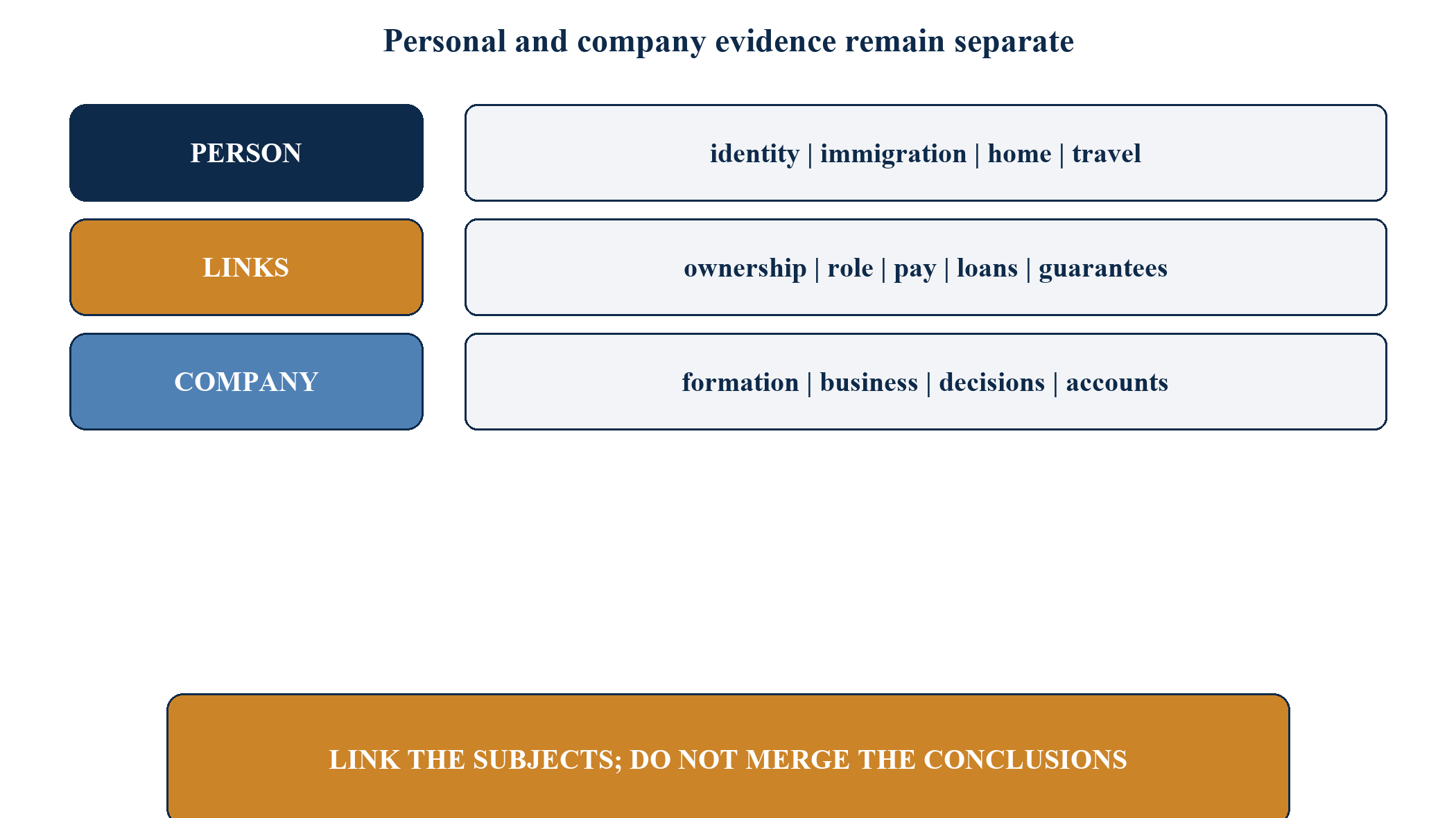
The founder's personal residence does not establish the company's tax residence or banking profile. UAE corporate-tax guidance states that a juridical person incorporated in the UAE is a UAE resident person for corporate-tax purposes, and that a foreign juridical person can be resident where it is effectively managed and controlled in the UAE [20,21]. Natural-person corporate-tax rules use a different business connection and exclude specified personal categories under the applicable rules [21,22].
The bridge should maintain a personal evidence index and a company evidence index. Links between them should be explicit: ownership, director role, employment, loans, capital contributions, distributions, guarantees and authorised-signatory powers.
8.3 Readiness before onboarding
Before a company account application, the board should approve the business purpose, expected counterparties, source of initial capital, expected monthly volumes, currencies, countries, transaction sizes, ownership and signatories. Finance should be able to reconcile the opening balance to the direct funding source. Compliance should be able to trace ownership to natural persons and explain every intermediate entity.
9. OPERATING SUBSTANCE AND DECISION LOCATION
9.1 Substance is a fact pattern
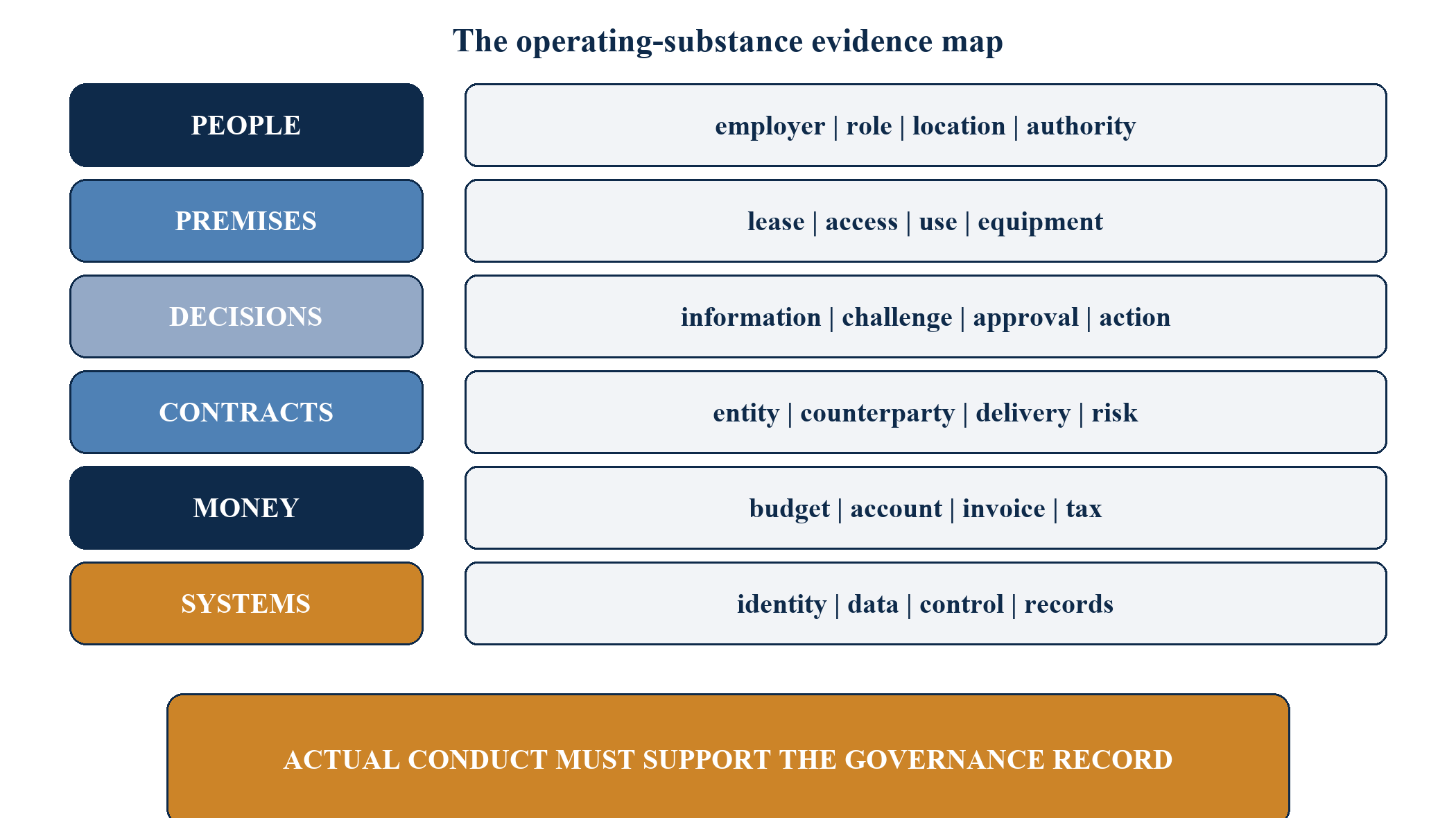
Operating substance is the collective record of people, premises, authority, expenditure, contracts, systems, customers, risks and decisions. The relevant legal or regulatory rule must be identified before deciding which facts matter. A desk lease cannot answer a management-and-control question by itself. A board calendar cannot show who originated, challenged and approved the decisions.
The FTA General Corporate Tax Guide states that effective management and control is fact-specific and focuses on where key management and commercial decisions necessary for the business are substantively made [21]. The guide notes that board location is typically relevant, while controlling-shareholder decisions, delegated authority and executive-management location may also matter. It also states that there can be only one place of effective management and control at a time [21].
9.2 Founder influence requires documentation
A founder can influence strategy while the board retains formal authority. The evidence should show information flows, delegated powers, challenge, alternatives, conflicts, minutes and implementation. If directors merely approve instructions prepared by the founder elsewhere, formal meeting geography can carry limited explanatory value. The actual facts and applicable law require review [13,14,21].
9.3 The substance register
The substance register maps each important business function to the legal entity, accountable person, physical location, system, contract, expenditure and evidence. It should cover strategy, treasury, customer contracting, hiring, product, intellectual property, risk, compliance, accounting and tax. Every monthly review should identify functions whose observed location conflicts with the intended governance model.
| Function | Decision authority | Execution evidence | Location evidence | Exception control |
|---|---|---|---|---|
| strategy and budget | board or delegated committee | approved plan and minutes | attendance and preparation record | record founder instructions and challenge |
| treasury | authorised signatories | mandates, approvals and reconciliations | access and approval logs | dual approval and alternate signatory |
| customer contracts | authorised commercial lead | executed contract and pricing file | negotiation and execution record | counsel review above threshold |
| hiring and payroll | approved manager | contract, payroll and benefits | employee work location | quarterly people register |
| tax and reporting | board and finance lead | filings, computations and payment | adviser and accounting records | compliance calendar |
10. BANKING IS A RISK ASSESSMENT
10.1 The bank forms its own view
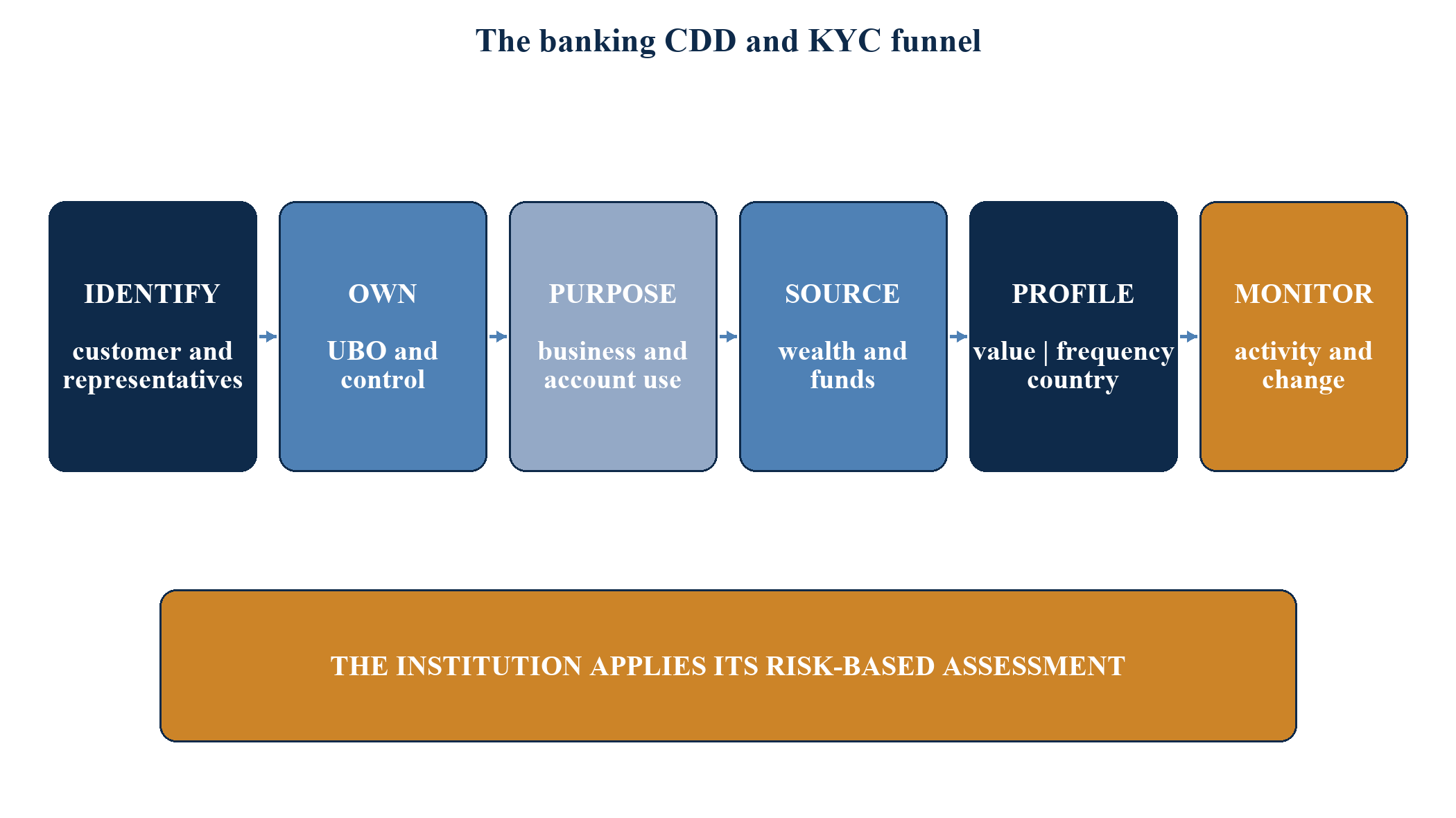
CBUAE guidance applies a risk-based customer due-diligence process. It addresses identity, beneficial ownership, business and expected activity, geographic risk, source of funds, source of wealth, ongoing monitoring and enhanced due diligence where warranted [23-29]. A complete application supports assessment; it does not predetermine an institution's decision, timing or conditions.
The founder should prepare one factually consistent bank dossier and adapt it to each institution's requested format. The dossier should identify the customer, entities, owners, controllers, authorised persons, business purpose, countries, counterparties, expected transaction types, values, frequency, currencies and funding sources. It should also list foreseeable one-off events such as a business sale, capital contribution, escrow release or property purchase.
10.2 Expected activity becomes a control baseline
The expected-activity schedule translates the business plan into quantifiable account use. It should distinguish operating receipts, payroll, supplier payments, investments, intercompany transfers, shareholder funding, debt service, distributions and transaction proceeds. Each type should have expected counterparties, countries, currencies, monthly range and maximum single value.
When actual activity changes materially, the company should update its internal record and respond promptly to institution requests. An acquisition, new geography, fundraising or asset sale can legitimately transform the profile. A controlled change notice gives the bank a coherent explanation and supporting documents.
10.3 Banking-readiness gate
The banking-readiness gate asks whether identity, ownership, authority, licence, business purpose, source of initial funds, source of wealth, expected activity, counterparties, tax status, addresses and supporting contracts are complete and consistent. Each unresolved item receives an owner and date. Application quality should be measured by evidential completeness and consistency, not by volume of attachments.
11. SOURCE OF WEALTH AND SOURCE OF FUNDS
11.1 Two distinct narratives
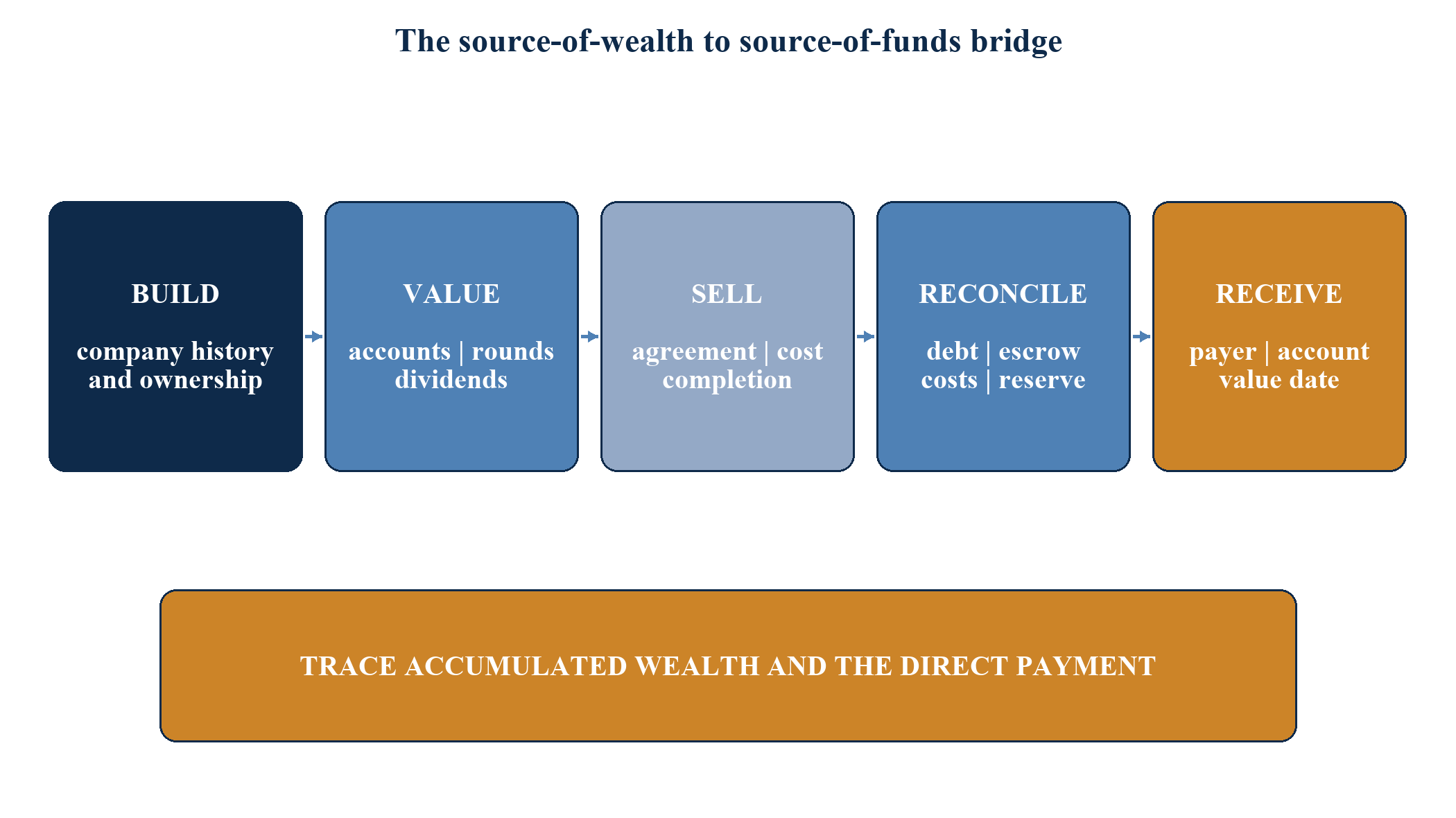
CBUAE guidance defines source of funds as the direct source of the funds used to fund an account or transact through it. It defines source of wealth as the sources that generated or materially contributed to the customer's overall net worth [24]. A founder whose wealth arose from building and selling a company therefore needs both narratives: the multi-year wealth-creation story and the direct path of a particular payment.
The source-of-wealth narrative should show the business's formation, capitalisation, ownership changes, trading history, valuation milestones, dividends, prior disposals and current asset composition. Each material component should link to independent or authoritative evidence such as audited accounts, tax filings, shareholder registers, transaction documents, bank or brokerage statements, property records, probate or court records where applicable.
The source-of-funds narrative should begin with the immediate transaction. For sale proceeds, it should connect the sale agreement, seller identity, ownership, completion statement, escrow or paying-agent record, deductions, taxes or reserves, receiving bank and final credited amount. The amount and dates should reconcile precisely.
11.2 A numerical bridge
Headline transaction value is rarely identical to accessible cash. The reconciliation can include debt, working-capital adjustments, transaction costs, rollover equity, escrow, retention, earn-out, tax reserve and currency conversion. A bank should be able to follow the bridge from contractual consideration to the specific incoming transfer.
| Reconciliation stage | Hypothetical amount | Evidence |
|---|---|---|
| stated enterprise value | AED 100.0 million | executed sale agreement |
| less net debt and adjustments | AED 18.0 million | completion accounts |
| equity consideration | AED 82.0 million | completion statement |
| less rollover equity | AED 12.0 million | subscription and rollover documents |
| less escrow and retention | AED 7.0 million | escrow agreement |
| less transaction costs | AED 3.0 million | invoices and settlement schedule |
| initial cash proceeds | AED 60.0 million | paying-agent and bank records |
The example is hypothetical and simplified. It illustrates reconciliation mechanics only. Tax, foreign-exchange and later contingent consideration require separate analysis.
12. BENEFICIAL OWNERSHIP AND CONTROL
12.1 Trace to natural persons
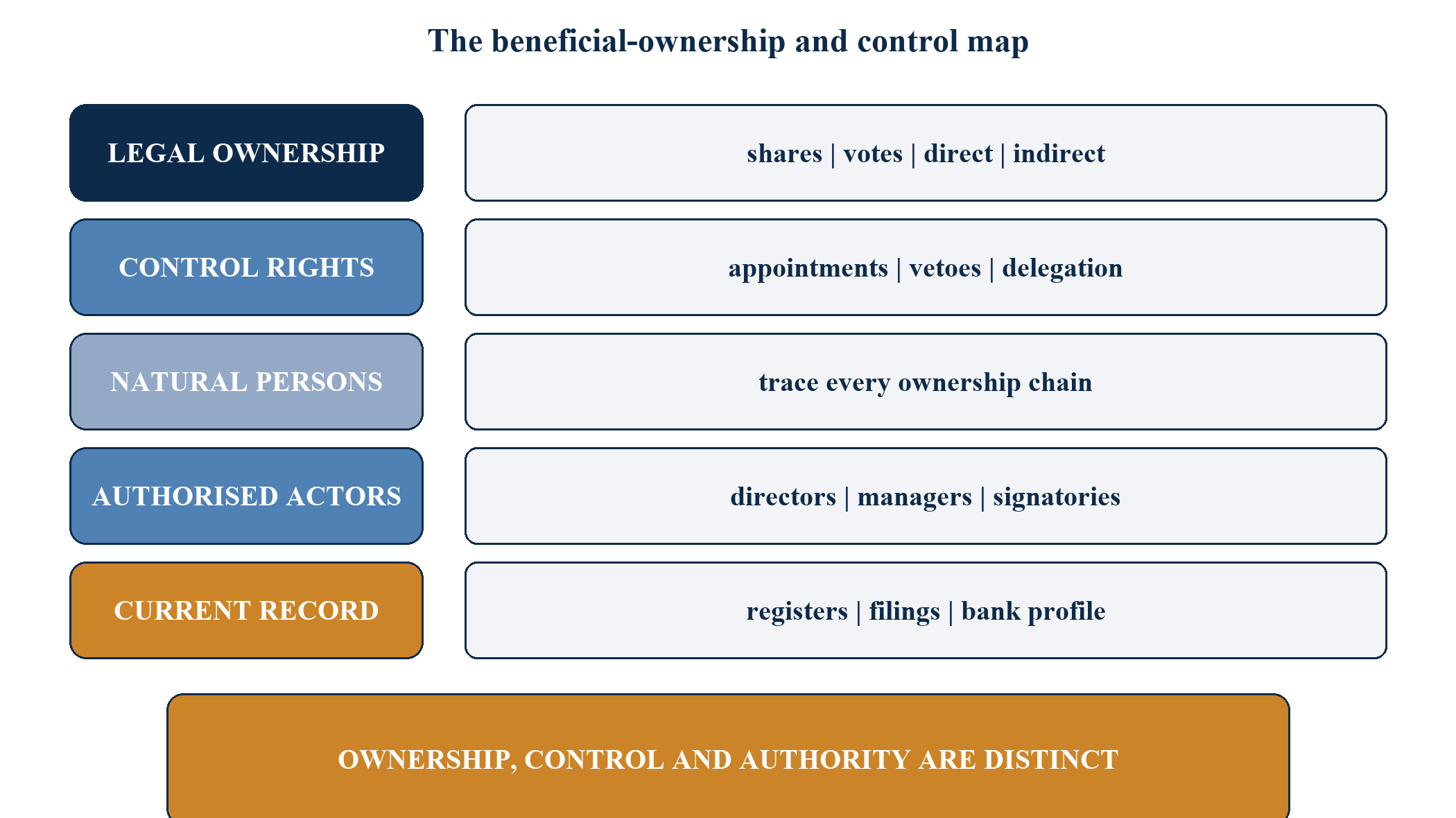
Current CBUAE guidance requires a licensed financial institution to identify and verify beneficial owners of a legal-person customer. The 25 percent controlling-ownership threshold is a starting rule, with control through other means and senior-management fallbacks where the stated conditions apply [25-28]. Higher-risk circumstances can justify identifying additional persons below that threshold [25].
The ownership chart should trace every chain to natural persons. It should show direct and indirect percentages, voting rights, appointment rights, trusts or foundations, nominee arrangements, options, convertible instruments and persons exercising control by other means. The chart should carry an effective date and reconcile to official registers and constitutional documents.
12.2 Control is wider than share percentage
A founder with a minority economic interest can retain decisive voting, appointment or contractual rights. Another individual may hold shares without exercising control. Banks and registrars apply the applicable definitions and risk assessments. The dossier should therefore describe both ownership and control, including reserved matters, vetoes, delegation, powers of attorney and signatory mandates.
12.3 Keep the register current
Fundraising, option exercises, transfers, marriage or inheritance planning, restructurings and transactions can change ownership or control. The company should update the internal register, registrar filings and bank information within the applicable deadlines. The project lead should reconcile the ownership chart before every material onboarding, financing or sale event.
13. THE FOUNDER'S UK COMPANY DUTIES CONTINUE
13.1 A personal move does not close a UK company
A founder may remain a director, person with significant control, employee, shareholder, guarantor or authorised signatory of a UK company after relocating. Each role carries separate duties and facts. The company still requires an appropriate UK registered office and statutory records [11]. Director address information must remain accurate within the Companies House framework [12].
13.2 Identity verification
Companies House made identity verification a legal requirement from 18 November 2025 for relevant directors and people with significant control under the phased implementation [10]. Existing directors generally connect their verified identity through the company's confirmation-statement process; PSC timing depends on the applicable route and dates [10]. A founder with several appointments should maintain a role-by-role compliance schedule and keep the personal code secure.
13.3 Company residence and management
UK incorporation and central management and control require separate analysis under UK rules and any relevant treaty [13,14]. Remote founder activity can matter to the factual record. Board materials should show where decisions were prepared, debated, approved and implemented. Advisers should review the company-residence consequences before changing governance, delegations or executive work patterns.
| Continuing role | Evidence to maintain | Cross-border question |
|---|---|---|
| director | appointment, identity verification, minutes, service and home addresses | where duties and decisions are performed |
| PSC or owner | ownership chart, personal code, filings | current control and disclosure |
| employee or consultant | contract, duties, work location, payroll | employment, tax and workday treatment |
| guarantor | facility and guarantee documents | ongoing liability and notices |
| signatory | bank mandate and approvals | authority, access and decision location |
14. M&A PROCEEDS AND TRANSACTION EVIDENCE
14.1 Build the proceeds file before signing
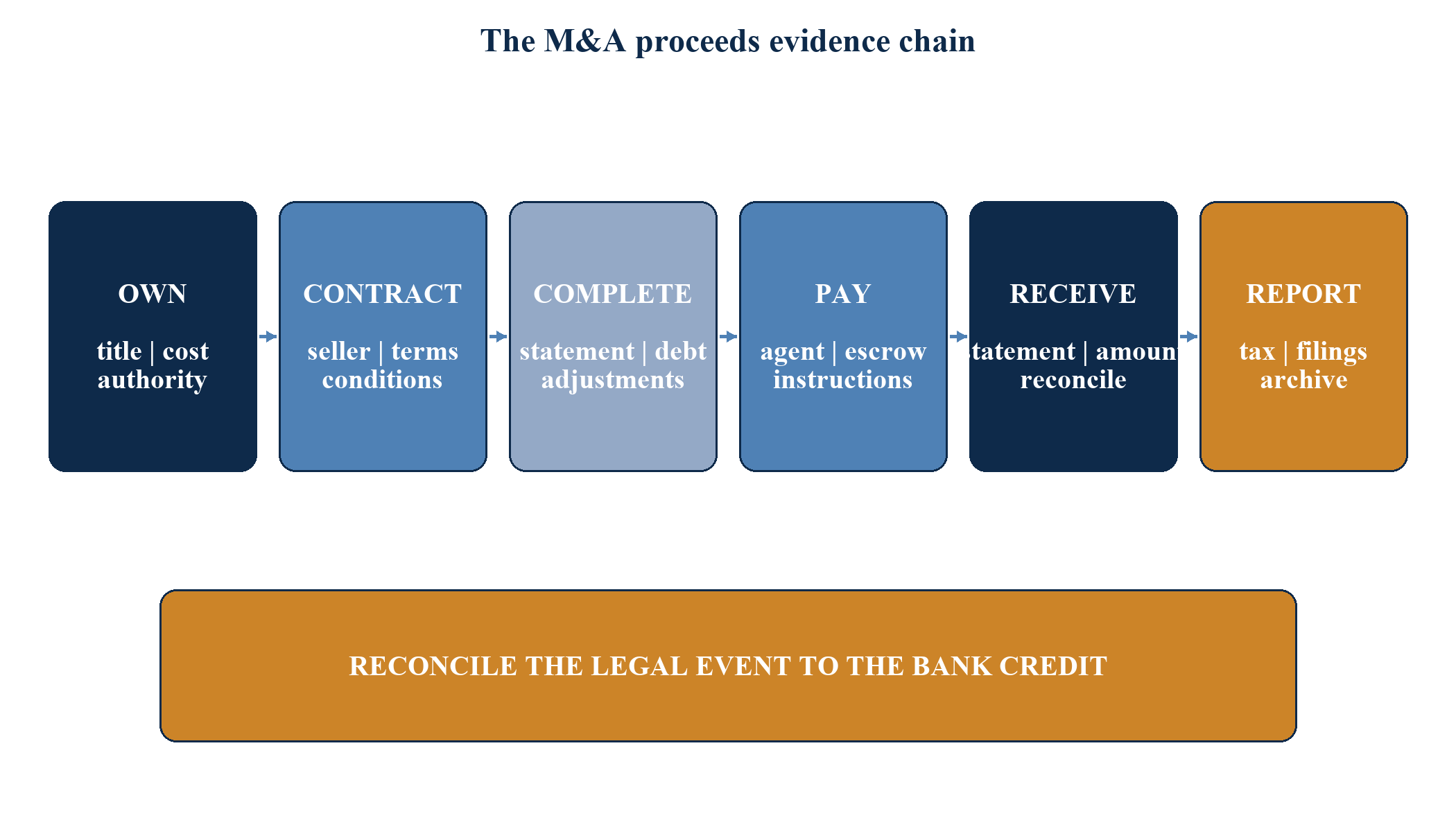
The proceeds file should be designed during transaction preparation. It contains the ownership history, acquisition cost records, option and incentive documents, sale authority, offer, sale agreement, disclosure materials, conditions, completion statement, paying-agent instructions, escrow, rollover, earn-out, tax advice, invoices, bank details and final receipts.
The founder should notify the receiving institution through the appropriate channel before a material payment, subject to the bank's process. The notification should state the expected gross and net amounts, payer, transaction purpose, date range, currency, intermediaries and documents. It should avoid presenting a forecast amount as final.
14.2 Authority and payment security
Payment instructions are a fraud target. The transaction should use verified contact channels, dual approval, callback procedures, controlled bank-detail changes and a closing checklist. The founder's residence move can introduce new devices, telephone numbers, advisers and jurisdictions; those changes increase the importance of authenticated instructions.
14.3 Post-completion reconciliation
Within a defined period after completion, finance should reconcile each contractual amount to the paying-agent statement and bank receipt. It should record currency conversion, fees, escrow, withholding, taxes and later contingent payments. Any difference should have a documented explanation and owner.
15. THE DOCUMENTATION BRIDGE
15.1 A controlled master index
The documentation bridge is a live control system rather than a static data room. Its master index records the proposition, person or entity, jurisdiction, period, source, document state, reviewer, next action, confidentiality level and retention rule. Every document should be searchable by a stable name and effective date. Superseded versions remain traceable.
The index should separate facts from adviser conclusions. A travel ledger is a source record. A residence memorandum interprets those facts. A board pack records information and proposals. A signed minute records the decision. A bank statement records a credit; the source-of-funds schedule explains why the credit occurred and links it to the legal documents.
15.2 Five bridge controls
First, every material proposition has an evidence owner. Second, every quantitative statement reconciles to a source. Third, every document has a period and version. Fourth, differences across forms are explained through a correction or purpose note. Fifth, sensitive data is shared through controlled channels with only the recipients and fields required for the task.
15.3 Evidence maturity
The bridge should score evidence maturity by layer. A newly issued document can be valid and still represent an early stage in the broader operating record. Management should use descriptive states such as complete for stated purpose, awaiting independent corroboration, or due for periodic renewal. The score should never be represented as an institution's approval probability.
| Maturity stage | Description | Required action |
|---|---|---|
| foundation | legal identity, entry, formation and address records exist | verify consistency and effective dates |
| operational | people, contracts, systems and payments have begun | capture ordinary-course evidence |
| reconciled | accounts, ownership, tax and activity records agree | resolve exceptions and obtain review |
| seasoned | recurring activity supports the declared profile | maintain and update for material change |
| transaction-ready | authority, proceeds and bank narrative are complete | run pre-closing gate |
16. HYPOTHETICAL FOUNDER PATHS
16.1 Path A: founder before a sale process
A founder plans to move in August and expects a buyer process to begin in October. The UK company continues trading, the founder remains chief executive, and the family retains a UK home for a transitional period. The UAE company is intended to provide post-sale advisory services. The scenario is hypothetical and simplified.
The bridge opens before departure. UK advisers establish the day, work, home and family record required for the relevant tax year. Company counsel maps the founder's continuing UK duties. The UAE entity is not described to a bank as fully operational until contracts, premises, systems and activity support that description. The sale file identifies the likely proceeds path, and the receiving bank is approached only with documents that accurately reflect the current transaction stage.
The decision gate focuses on three dependencies: the founder's actual UK work during diligence, the legal timing of the sale documents, and the maturity of the receiving-account file. The founder can then make informed decisions without treating an intended residence outcome as a completed fact.
16.2 Path B: proceeds arrive before the operating record matures
A founder completed an earlier business sale through a UK account and later opens a personal UAE account. The founder's UAE residence permit and home are current, but the UAE account has limited transaction history. The founder wants to transfer a large portion of retained proceeds. The scenario is hypothetical and simplified.
The dossier begins with the historic sale, ownership and bank trail. It reconciles original consideration, taxes, costs, investment returns and the present balance. The direct source of the proposed transfer is the sending account; the source of wealth is the underlying business sale and subsequent investment history. The founder provides the institution with the requested information and allows its review process to run.
16.3 Path C: the founder retains two company systems
A founder relocates personally, retains a UK operating company and establishes a UAE company for regional expansion. Shared personnel and intellectual property create intercompany relationships. The scenario is hypothetical and simplified.
The bridge documents which entity employs each person, owns each asset, contracts with each customer, bears each risk and makes each decision. Intercompany agreements, transfer-pricing advice, board authorities and actual conduct should align. Personal residence evidence remains separate from company residence and business activity.
| Path | Principal evidence pressure | Early control | Escalation trigger |
|---|---|---|---|
| pre-sale move | UK work, home, transaction timing | integrated residence and deal calendar | signing or work pattern changes |
| historic proceeds transfer | long source-of-wealth chain | proceeds-to-current-balance reconciliation | unexplained account or asset movement |
| two-company system | ownership, contracts and decision location | substance and intercompany register | people or rights operate outside documents |
17. A HYPOTHETICAL STRESS TEST
17.1 Scenario
A founder arrives in the UAE, receives a residence permit and leases a home. The founder remains a director of a UK company and returns for negotiations. A UAE company account application is in review. A buyer accelerates completion, and a large payment is expected within ten days. The bank requests updated ownership, source-of-wealth and transaction documents. The founder's tax-residence memorandum is still being finalised. Every fact in this scenario is hypothetical and simplified.
17.2 Failure sequence
The founder's name is transliterated differently across two documents. The bank application describes expected monthly operating receipts and does not mention a one-off sale payment. The UAE company is mistakenly named as the sale-proceeds recipient even though the founder is the seller. The source-of-wealth narrative gives the headline transaction value but omits debt, rollover and escrow. UK travel is recorded by flights, while negotiation work hours are absent. A board resolution approves the account but does not match the bank mandate.
Each defect has a different remedy. Identity records need a controlled explanation. The expected-activity schedule needs an accurate material-event update. Payment instructions must match the legal seller and receiving account. The proceeds bridge must reconcile net cash. The residence ledger needs actual work records. The mandate and resolution require company-secretarial correction.
17.3 Controlled response
The project lead freezes further unverified submissions, opens an exception register and assigns legal, tax, finance and company-secretarial owners. The bank receives a concise correction package through the approved channel. The transaction team confirms whether the receiving-account timeline affects completion mechanics. Tax advisers complete the residence analysis from the updated travel and work file.
The stress test demonstrates why a thick data room can still be weak. Readiness depends on accurate relationships between facts, documents, entities, dates and money.
18. A 90-DAY IMPLEMENTATION PROGRAMME
18.1 Days 1 to 30: establish the facts
The first phase creates the identity schedule, personal and entity map, role register, residence calendar, UK departure file, UAE immigration file, bank inventory, beneficial-ownership chart and expected transaction list. Advisers identify the legal tests and filing routes. Finance opens a source-of-wealth ledger and locates historic evidence.
Management should prioritise discrepancies that can stop a filing, payment or onboarding review: mismatched names, expired identity records, unclear ownership, missing authority, inaccessible historic bank statements, unsupported shareholder loans and accounts whose declared purpose no longer reflects actual activity.
18.2 Days 31 to 60: build the operating record
The second phase documents premises, people, systems, contracts, counterparties, invoices, payroll, tax registrations, board processes and delegated authority. The company prepares its banking dossier and expected-activity schedule. The founder's residence records are reconciled monthly. Any planned M&A or funding event receives a transaction-evidence index.
18.3 Days 61 to 90: test and approve
The third phase runs the banking-readiness gate and a proceeds stress test. Advisers review residence and company-management facts. The board approves the business profile, authorities and exception plan. The project lead tests whether another qualified person can locate and explain every critical record without relying on the founder's memory.
| Period | Deliverables | Approval gate |
|---|---|---|
| days 1-30 | identity, residence, entity, ownership and transaction maps | facts complete enough for adviser scoping |
| days 31-60 | substance record, banking dossier and source narratives | documents consistent with observed activity |
| days 61-90 | stress test, exception closure and board dashboard | proceed, condition or pause decision |
19. LIMITATIONS AND CONCLUSION
The framework is an evidence and governance method. It does not replace statutory interpretation, treaty analysis, bank policy, immigration advice, tax compliance or transaction counsel. Official rules, forms, service conditions and institutional requirements can change. A bank can request additional information or decline a relationship under its applicable controls. A residence certificate addresses the period and purpose for which it is issued.
The title's metaphor identifies a temporary administrative condition. The founder remains a legal person with nationality and continuing duties. The practical problem is that old and new evidence systems mature at different speeds. UK residence facts close across a tax year. UAE domestic evidence can develop across a consecutive 12-month period. Company substance emerges through actual decisions and operations. Bank confidence is formed through risk-based due diligence and consistent activity.
A well-built documentation bridge connects those systems without merging them. It assigns each proposition to the correct source, distinguishes personal and company facts, traces ownership to natural persons, reconciles wealth and funds, records actual decision location and prepares transaction proceeds before they arrive. The result is a more intelligible file for advisers, registries, banks, boards and counterparties.
The operating discipline is straightforward: capture facts contemporaneously; state the purpose and period of each document; reconcile amounts and identities; disclose material changes; obtain specialist conclusions; and preserve a controlled audit trail. Those practices support defensibility while the founder's new residence and operating record develops.
APPENDIX A. MASTER EVIDENCE INDEX
The master evidence index should be maintained in a controlled system with role-based access. Sensitive identity, financial and family records should be distributed only where required. Every line should have a stable identifier and an audit trail.
| Field | Purpose |
|---|---|
| proposition | exact fact or conclusion the item supports |
| person or entity | legal subject of the evidence |
| jurisdiction | country and authority relevant to the item |
| period | start, end and effective date |
| source | issuing body or original system |
| document | controlled file name and location |
| state | planned, requested, received, verified or superseded |
| reviewer | accountable professional or function |
| sensitivity | access and transmission classification |
| next review | renewal, reconciliation or filing date |
Minimum monthly procedures:
- Reconcile new documents to the identity and entity schedules.
- Check expiries, renewals, filings and adviser actions.
- Resolve differences in names, addresses, roles and ownership.
- Reconcile bank activity to the expected-activity profile.
- Record material changes in travel, work, homes and decisions.
- Archive superseded documents without breaking the audit trail.
APPENDIX B. RESIDENCE EVIDENCE REGISTER
The residence register should be maintained separately for each person and each relevant period. Household members can have different facts and conclusions.
| Field | UK record | UAE record |
|---|---|---|
| daily location | end-of-day and other test-specific facts | days and parts of days for the relevant route |
| travel evidence | itinerary, boarding, passport and reconciliation | official entry and exit report plus supporting travel records |
| work | hours, duties, location and employer or business | employment, business, licence and actual activity |
| homes | availability, access, use and family occupation | continuous availability, occupation and household evidence |
| family and interests | facts relevant to UK tests and treaty | facts relevant to domestic route and treaty |
| adviser conclusion | SRT, split year, temporary non-residence and UK obligations | domestic route, certificate period and treaty analysis |
Exception questions:
- Do flight records and official movement records differ?
- Was work performed during a visit, and where is the time record?
- Did any home become available or unavailable on a different date from the contract?
- Did family, health or education circumstances change the travel pattern?
- Does any bank or registry declaration use a different residence period?
- Has a material transaction changed the relevance of a date or certificate?
APPENDIX C. BANKING ONBOARDING PACK
The onboarding pack should follow the institution's requested list. The following register is a preparation tool and does not represent a universal bank requirement.
| Module | Contents | Reconciliation |
|---|---|---|
| customer identity | current identity, address and tax declarations | controlled identity schedule |
| company | formation, licence, constitution and registry extracts | current legal name, activity and status |
| ownership | shareholders, UBOs, control and intermediate entities | chart agrees to registers and documents |
| authority | directors, managers, signatories and powers | resolutions agree to mandate |
| business | purpose, products, clients, suppliers and geographies | contracts and website support description |
| expected activity | types, values, frequency, currency and countries | budget and transaction pipeline |
| source of funds | direct origin of opening and later material funds | statements and legal transaction documents |
| source of wealth | accumulated wealth origins and current composition | accounts, tax, transaction and asset evidence |
| tax and residence | requested self-certifications and supporting records | period-specific adviser review |
Submission control:
- Confirm the named customer and account purpose.
- Date every chart, schedule and narrative.
- Remove obsolete drafts and duplicate identity records.
- Confirm that amounts, ownership and addresses agree across forms.
- Route questions and corrections through the authorised channel.
- Preserve the submitted package and subsequent correspondence.
APPENDIX D. SOURCE-OF-WEALTH NARRATIVE MAP
A source-of-wealth narrative should be concise enough to understand and detailed enough to verify. It should use a chronology and an asset reconciliation.
| Narrative element | Core question | Evidence examples |
|---|---|---|
| origin | how did the founder first acquire the asset or interest? | incorporation, subscription, employment or inheritance record |
| growth | how did value develop? | audited accounts, funding rounds, valuations and dividends |
| ownership changes | what dilution, transfer or restructuring occurred? | registers, agreements, filings and tax records |
| liquidity event | what legally created the proceeds? | sale, dividend, redemption or disposal documents |
| deductions | why is net cash below gross value? | completion accounts, escrow, costs and tax reserve |
| current position | where is the wealth held now? | bank, brokerage, property and entity statements |
The narrative should distinguish evidence from estimate. A management valuation should be described by its date, method and purpose. A transaction price should be connected to the executed terms. The current net-worth schedule should state the valuation basis for illiquid assets and avoid presenting an appraisal as cash.
APPENDIX E. COMPANY SUBSTANCE REGISTER
The company substance register records actual operations and decision-making. It should be tailored to the relevant company, licence, tax rules and commercial model.
| Domain | Evidence fields | Monthly exception |
|---|---|---|
| governance | agenda, materials, attendance, challenge, resolution and implementation | decision originated or executed elsewhere |
| people | employer, role, work location, payroll and authority | person serves a different entity in practice |
| premises | lease, access, equipment, utilities and use | address exists without operating use |
| customers | contracting entity, delivery, invoices and receipts | invoice or delivery entity differs from contract |
| suppliers | contracting entity, service, approval and payment | shared cost lacks allocation or agreement |
| intellectual property | owner, licence, development and protection | legal owner differs from economic use |
| finance | accounts, bank, budget, tax and controls | funds move without documented purpose or authority |
Quarterly board questions:
- Where were the highest-level decisions substantively made?
- Which functions were delegated, and did actual conduct follow the delegation?
- Do contracts, people, assets and payments align to the intended entity?
- Has the founder's role or location changed?
- Are intercompany services and charges supported by current agreements and advice?
- Which evidence gaps require remediation before the next material transaction?
APPENDIX F. M&A PROCEEDS REGISTER
| Field | Required description |
|---|---|
| legal seller | exact person or entity entitled to consideration |
| asset sold | shares, business, property or other legal interest |
| authority | board, shareholder, trustee or personal approval |
| signing | date, governing law and condition status |
| completion | conditions, transfer, completion statement and effective date |
| gross consideration | fixed, contingent, deferred and non-cash components |
| deductions | debt, adjustments, costs, taxes, escrow and retention |
| payer | buyer, paying agent, escrow agent or other source |
| receiving account | legal owner, bank, currency and verified instructions |
| receipt | value date, amount, reference and statement link |
| post-close | escrow release, earn-out, claims, tax and reporting |
Pre-closing gate:
- Confirm the seller and receiving account are legally aligned.
- Reconcile ownership and authority to the transaction documents.
- Prepare the gross-to-net proceeds bridge.
- Verify payment instructions through authenticated channels.
- Inform the receiving institution through its approved process where appropriate.
- Record tax, filing and liquidity-reserve actions.
APPENDIX G. QUESTIONS FOR ADVISERS AND BANKS
Questions for UK tax advisers
- Which SRT tests, split-year cases and temporary non-residence provisions require analysis?
- Which travel, work, home and family records are required for each tax year?
- Which UK income, gains, employment, company and filing obligations continue?
- Does any planned transaction have a legally relevant date before completion or cash receipt?
- Which residence or treaty conclusions remain contingent on later facts?
Questions for UAE tax and legal advisers
- Which immigration and domestic tax-residence routes apply to the founder's facts?
- Which consecutive 12-month period and evidence route should support a certificate application?
- What company form, licence, premises and regulatory permissions match the intended business?
- How do personal business activity and company corporate-tax rules apply?
- Which governance facts determine effective management and control for each entity?
Questions for the financial institution
- Which current documents and certification standards apply to this customer type?
- How should the founder describe a pending one-off transaction within expected activity?
- Which source-of-wealth and source-of-funds evidence does the institution request?
- Which ownership, control, trust, foundation or intermediate-entity documents are required?
- What is the secure process for material updates, corrections and payment notifications?
Questions for transaction counsel
- Who is the legal seller and who has authority to sign and receive consideration?
- Which provisions are binding, conditional or subject to later satisfaction?
- How do completion, escrow, rollover and contingent consideration operate?
- Which documents create the definitive proceeds trail?
- What payment-verification and fraud controls apply at closing?
REFERENCES
[1] HM Revenue & Customs. *RDR3: Statutory Residence Test.* Updated 11 June 2026. https://www.gov.uk/government/publications/rdr3-statutory-residence-test-srt
[2] HM Revenue & Customs. *RFIG20000: Statutory Residence Test contents.* Updated 3 July 2026. https://www.gov.uk/hmrc-internal-manuals/residence-and-fig-regime-manual/rfig20000
[3] HM Revenue & Customs. *Get your Income Tax right if you are leaving the UK, .* Updated 23 August 2024. https://www.gov.uk/guidance/get-your-income-tax-right-if-youre-leaving-the-uk-p85
[4] HM Revenue & Customs. *Tax if you leave the UK to live abroad.* https://www.gov.uk/tax-right-retire-abroad-return-to-uk
[5] HM Revenue & Customs. *RFIG20710: Meaning of a day spent in the UK.* Updated 3 July 2026. https://www.gov.uk/hmrc-internal-manuals/residence-and-fig-regime-manual/rfig20710
[6] HM Revenue & Customs. *RFIG20740: Work for the purpose of the SRT.* Updated 3 July 2026. https://www.gov.uk/hmrc-internal-manuals/residence-and-fig-regime-manual/rfig20740
[7] HM Revenue & Customs. *RFIG21010: Split-year treatment overview.* Updated 3 July 2026. https://www.gov.uk/hmrc-internal-manuals/residence-and-fig-regime-manual/rfig21010
[8] HM Revenue & Customs. *RFIG21510: Temporary non-residence introduction.* Updated 3 July 2026. https://www.gov.uk/hmrc-internal-manuals/residence-and-fig-regime-manual/rfig21510
[9] HM Revenue & Customs. *2016 UK-UAE Double Taxation Convention.* https://www.gov.uk/government/publications/united-arab-emirates-tax-treaties/2016-uk-uae-double-taxation-convention
[10] Companies House. *Identity verification for Companies House.* Updated 16 January 2026. https://www.gov.uk/government/collections/identity-verification-for-companies-house
[11] Companies House. *Check the rules for registered office addresses and email addresses.* https://www.gov.uk/limited-company-formation/company-address
[12] Companies House. *Your personal information on the Companies House register.* https://www.gov.uk/guidance/your-personal-information-on-the-companies-house-register
[13] HM Revenue & Customs. *INTM120060: Company residence and central management and control.* Updated 24 July 2026. https://www.gov.uk/hmrc-internal-manuals/international-manual/intm120060
[14] HM Revenue & Customs. *INTM120180: Company residence, how to review residence.* Updated 24 July 2026. https://www.gov.uk/hmrc-internal-manuals/international-manual/intm120180
[15] United Arab Emirates. *Cabinet Decision No. 85 of 2022 on Determination of Tax Residency.* https://www.tax.gov.ae/Datafolder/Files/Legislation/Corporate%20Tax/Cabinet%20Decision%2085%20of%202022%20-%20For%20publishing.pdf
[16] United Arab Emirates Ministry of Finance. *Ministerial Decision No. 27 of 2023 on implementation of tax-residency provisions.* https://mof.gov.ae/wp-content/uploads/2023/03/Ministerial-Decision-27-of-2023-of-Tax-Residency.pdf
[17] United Arab Emirates Federal Tax Authority. *Issuance of Tax Certificates for Tax Residency.* Updated 6 April 2026. https://tax.gov.ae/en/services/issuance.of.tax.certificates.aspx
[18] United Arab Emirates Federal Tax Authority. *Tax Resident and Tax Residency Certificate; Tax Procedures Guide TPGTR1.* https://tax.gov.ae/Datafolder/Files/Guides/VAT/VAT%20Guides/Tax-Resident-and-TRC--18-10-2024.pdf
[19] Federal Authority for Identity, Citizenship, Customs and Port Security. *Issuing Residency Permit.* https://audience.gov.ae/en/services-details/?serviceid=64afe3c1035448005bd52e64
[20] United Arab Emirates Ministry of Finance. *Corporate Tax.* https://mof.gov.ae/corporate-tax/
[21] United Arab Emirates Federal Tax Authority. *General Corporate Tax Guide, CTGGCT1.* https://tax.gov.ae/DataFolder/Files/Guides/CT/CT%20General%20Guide%20-%20EN%20-%2010%2009%202023.pdf
[22] United Arab Emirates Federal Tax Authority. *Basis of taxation for a natural person.* https://tax.gov.ae/en/taxes/corporate.tax/corporate.tax.topics/basis.of.taxation.natural.person.aspx
[23] Central Bank of the United Arab Emirates. *Guidance for Licensed Financial Institutions on Customer Due Diligence and Know Your Customer.* Effective 7 November 2025. https://rulebook.centralbank.ae/en/rulebook/guidance-licensed-financial-institutions-customer-due-diligenceknow-your-customer-and
[24] Central Bank of the United Arab Emirates. *Source of Funds and Source of Wealth.* Effective 7 November 2025. https://rulebook.centralbank.ae/en/rulebook/332-source-funds-and-source-wealth
[25] Central Bank of the United Arab Emirates. *Beneficial Ownership Identification and Verification.* Effective 7 November 2025. https://rulebook.centralbank.ae/en/rulebook/325-beneficial-ownership-identification-and-verification
[26] Central Bank of the United Arab Emirates. *Core Elements of Customer Due Diligence.* https://rulebook.centralbank.ae/en/rulebook/431-core-elements-customer-due-diligence
[27] Central Bank of the United Arab Emirates. *Guidance for Licensed Financial Institutions Providing Services to Legal Persons and Arrangements.* https://rulebook.centralbank.ae/en/rulebook/guidance-licensed-financial-institutions-providing-services-legal-persons-and-arrangements
[28] United Arab Emirates. *Cabinet Decision No. 109 of 2023 on Regulating the Beneficial Owner Procedures.* https://rulebook.centralbank.ae/en/rulebook/cabinet-decision-no-109-2023-regulating-beneficial-owner-procedures
[29] United Arab Emirates. *Cabinet Resolution No. 134 of 2025 concerning the Implementing Regulation of Federal Decree-Law No. 10 of 2025 on AML/CFT.* Effective 14 December 2025. https://rulebook.centralbank.ae/en/entiresection/3687
[30] Financial Action Task Force. *Guidance on Beneficial Ownership of Legal Persons.* March 2023. https://www.fatf-gafi.org/en/publications/Fatfrecommendations/Guidance-Beneficial-Ownership-Legal-Persons.html
[31] Financial Action Task Force. *Guidance for a Risk-Based Approach: The Banking Sector.* October 2014. https://www.fatf-gafi.org/en/publications/Fatfrecommendations/Risk-based-approach-banking-sector.html
[32] Organisation for Economic Co-operation and Development. *Standard for Automatic Exchange of Financial Account Information in Tax Matters.* https://www.oecd.org/tax/automatic-exchange/common-reporting-standard/
[33] United Arab Emirates Ministry of Finance. *Common Reporting Standard Circular 2026.* https://mof.gov.ae/fatca-and-crs/
[34] United Kingdom. *Companies Act 2006.* https://www.legislation.gov.uk/ukpga/2006/46/contents
[35] United Kingdom. *Finance Act 2013, Schedule 45.* https://www.legislation.gov.uk/ukpga/2013/29/schedule/45
[36] United Arab Emirates. *Federal Decree-Law No. 47 of 2022 on the Taxation of Corporations and Businesses.* https://mof.gov.ae/corporate-tax-legislation/
[37] Companies House. *Companies House personal codes for identity verification.* Updated 3 June 2026. https://www.gov.uk/guidance/companies-house-personal-codes-for-identity-verification
[38] HM Revenue & Customs. *RFIG21920: Record keeping for homes.* Updated 3 July 2026. https://www.gov.uk/hmrc-internal-manuals/residence-and-fig-regime-manual/rfig21920
[39] HM Revenue & Customs. *RFIG21930: Record keeping for working hours and location.* Updated 3 July 2026. https://www.gov.uk/hmrc-internal-manuals/residence-and-fig-regime-manual/rfig21930
[40] HM Revenue & Customs. *INTM154020: Double taxation agreements and dual residents.* Updated 24 July 2026. https://www.gov.uk/hmrc-internal-manuals/international-manual/intm154020
ABOUT THE AUTHOR
Chennakeshav Adya is an independent researcher focused on capital, transactions, corporate finance and the institutional systems that support cross-border decision-making. His work translates complex legal, financial, operational and governance questions into decision frameworks for founders, investors, family offices and corporate leaders.
This paper was independently authored by Chennakeshav Adya. Matchpoint Partners publishes the research for general information and discussion.
