

1. Define the franchise acquisition decision
The core decision is whether the buyer should acquire the target at a price and on terms that remain acceptable after the contractual rights, operating assets and unit economics have been separated. The decision cannot rest on brand familiarity, reported system sales or a consolidated EBITDA multiple. It requires evidence that the buyer will control the rights needed to operate, develop and monetise the system for long enough to recover the purchase price and earn the required return.
The investment mandate should first identify the target type. A franchisor primarily earns royalties, initial fees, supplier income and other system-level revenue. A master franchisee holds territorial development and sublicensing rights and may earn royalties from sub-franchisees while operating some units itself. A multi-unit franchisee earns store-level cash flow and remains dependent on the franchisor for brand, system and renewal rights. A mixed target combines these exposures. Each model has a different asset perimeter, working-capital profile, capital intensity and renewal dependency.
Approval should be conditional on four questions. Which cash flows legally and economically belong to the target? Which contracts survive the transaction and for how long? What investment is required to preserve the rights and performance? Which risks can be priced, structured or governed? The answers establish the acquisition perimeter before valuation begins.
2. Use the Rights-to-Cash Franchise M&A Framework
The proposed framework has eight gates: target classification; contract and territory perimeter; unit-estate evidence; unit and system economics; renewal and development capacity; intellectual-property and operating dependency; transaction and financing protection; and post-close governance. Each gate converts evidence into a decision on scope, price, structure, sequencing or rejection.
The framework starts with rights because a franchise business operates through licences, agreements and consents. The United States Federal Trade Commission requires a franchise disclosure document containing 23 prescribed items, including information on territory, renewal, termination, transfer, outlets and financial performance representations [1][2]. Australia introduced a new mandatory Franchising Code of Conduct from 1 April 2025, covering disclosure, good faith, renewal, transfer, termination, significant capital expenditure and dispute processes [3][4]. These regimes differ, but both show why the contract estate must be analysed as an operating asset rather than filed as legal background.
Every gate should produce an auditable evidence pack. The pack should connect agreements, disclosure documents, unit registers, leases, royalty statements, sales data, store profit-and-loss statements, development schedules, capex records, franchisee correspondence, litigation, trademark rights, supplier arrangements and management capacity. A finding should identify the affected cash flow, duration, probability, remedy and owner.
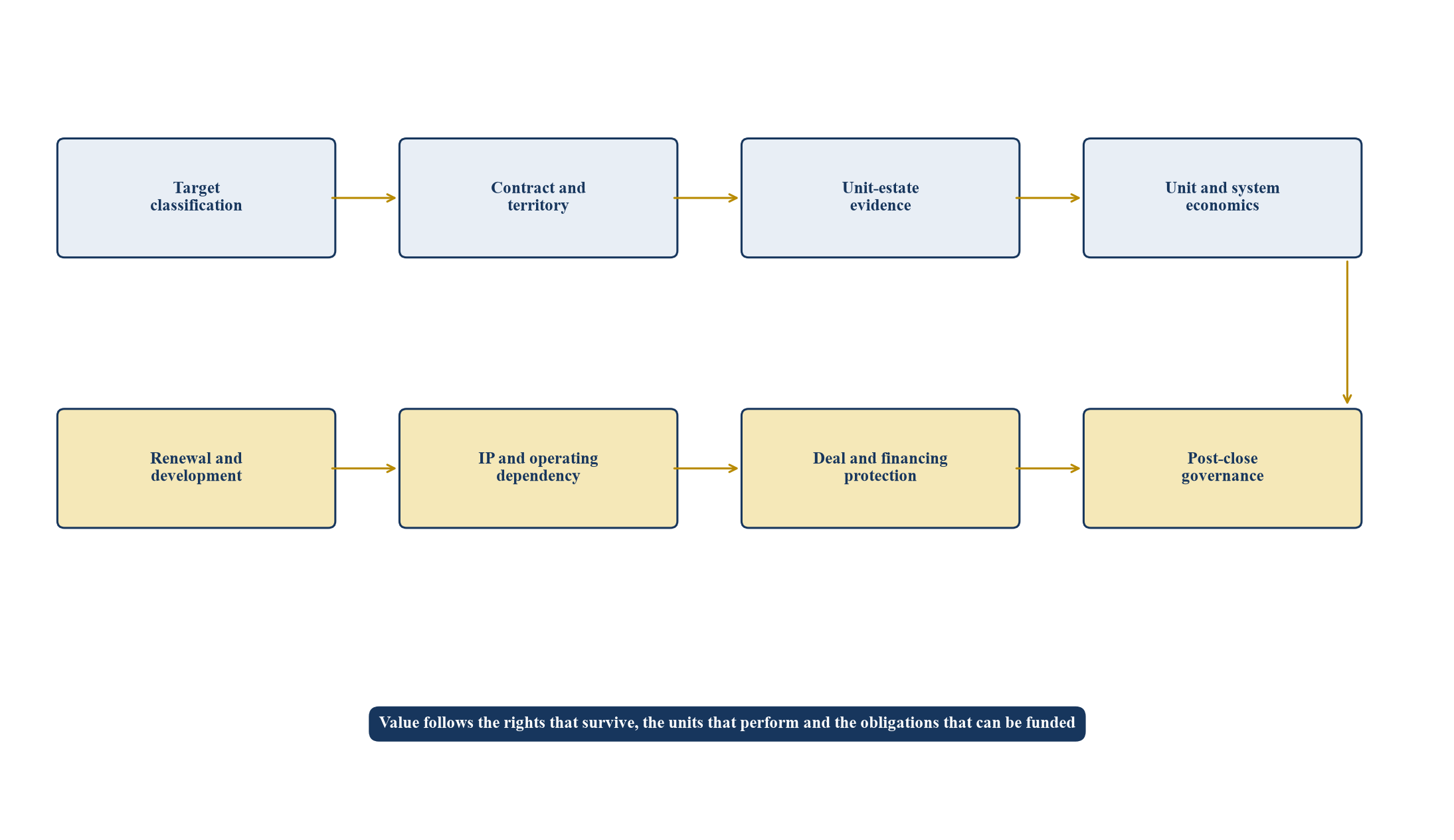
The buyer advances from legal perimeter to value only when each evidence gate supports the next decision.
3. Classify the target before selecting the valuation method
A franchisor, master franchisee and unit operator can report similar brand-level sales while owning different cash-flow rights. The franchisor often has an asset-light royalty stream and obligations to support the system. The master franchisee may hold an exclusive or non-exclusive territory, assume development milestones, operate stores and sublicense units. The unit operator owns or leases local operating assets and pays royalties, rent, marketing contributions and technology fees. A mixed platform may shift economics among related entities.
The classification should be completed by legal entity and cash-flow line. The buyer should map which entity receives customer cash, royalties, rent, supplier rebates, digital-order commissions, advertising contributions and initial or transfer fees. It should identify which entity pays for store labour, leases, equipment, technology, marketing, training, quality control, product sourcing and development. Intercompany agreements should be reconciled to bank and accounting records.
Classification also changes the relevant valuation period. A franchisor that owns durable trademarks may have a longer economic life than an operator whose unit agreements expire in seven years. A master franchisee may appear asset-light while carrying substantial mandatory-opening commitments. The valuation model should therefore follow the enforceable rights and funded obligations, not the presentation used in management accounts.
| Target type | Primary cash flow | Principal right | Main capital burden | Central valuation risk |
|---|---|---|---|---|
| Franchisor | Royalties, fees and system income | Trademark and franchise-system ownership | Brand, support, technology and compliance | Franchisee health and sustainable royalty base |
| Master franchisee | Unit cash flow plus sub-franchise royalties | Territorial development and sublicensing rights | Development obligations, support and selected stores | Term, renewal, milestones and change-of-control consent |
| Multi-unit franchisee | Store-level cash flow | Unit franchise and site rights | Store capex, leases, labour and working capital | Four-wall economics and renewal dependence |
| Mixed system | Combination of system and unit cash flow | Multiple linked agreements | Platform and store investment | Double counting, related-party leakage and perimeter gaps |
The table identifies structural differences; actual rights depend on the executed agreements in each jurisdiction.
4. Reconstruct the legal and economic perimeter
The buyer should build a contract register that links every relevant agreement to a legal entity, territory, site, brand, term, renewal option, assignment rule, change-of-control clause, termination event, cure period and financial obligation. The register should include master development agreements, unit franchise agreements, leases, trademark licences, technology agreements, supply arrangements, advertising-fund terms, guarantees and side letters. Missing amendments and informal waivers should be treated as unresolved evidence gaps.
Territory language deserves exact reading. The FTC consumer guide warns that a stated territory may not protect a franchisee from all competition, including internet sales or alternative channels, and directs readers to the relevant disclosure items [2]. A geographic boundary can coexist with reserved airports, travel hubs, military locations, e-commerce, delivery-only kitchens, wholesale products or national accounts. The commercial model should reflect what the target can actually sell, where it can open, and which channels the franchisor retains.
The economic perimeter should then reconcile contracts to revenue and costs. Royalties shown in accounts should match contractual rates and reported system sales. Occupancy charges should be separated between third-party rent and franchisor rent. Supplier rebates and marketing-fund income should be traced to their contractual basis. The buyer should identify revenue earned through practice rather than an enforceable right and test whether that practice is likely to continue after a transaction.
5. Build a unit-estate data model
Franchise value depends on the quality and age of the unit estate. The buyer should obtain a unit-level register covering openings, closures, transfers, relocations, remodels, ownership, format, site, lease term, franchise term, renewal status, sales, transactions, average ticket, gross margin, labour, occupancy, royalties, marketing contributions, store EBITDA, capex and cash conversion. The register should reconcile to disclosure documents, royalty billing and financial statements.
The estate should be divided into cohorts by opening year, format, geography, ownership type and maturity. New units can depress reported margin during ramp-up; mature units may conceal deferred maintenance; recently transferred units may indicate franchisee distress or a healthy resale market. Closure rates should distinguish planned portfolio optimisation from failed economics. Averages should be accompanied by distributions because a small number of strong stores can mask a weak tail.
The FTC disclosure framework includes outlet and franchisee information that can assist reconciliation, while filed company reports provide examples of the scale and contractual complexity of mature systems. McDonald's reported 45,356 restaurants at year-end 2025, approximately 95 per cent franchised, and described conventional franchise arrangements that generally run for 20 years [5]. Yum reported more than 61,000 franchised units and approximately 1,500 franchisees, with about 40 per cent of its franchised units operating under master-franchise programmes [6]. These public examples illustrate why system-level percentages need to be unpacked into contracts and cohorts before they inform valuation.
| Evidence layer | Required fields | Reconciliation test | Decision use |
|---|---|---|---|
| Contract | Site, entity, term, renewal, transfer, territory | Executed agreement to register | Legal life and consent risk |
| Operating | Format, opening, remodel, ownership, status | Store system to physical estate | Cohort maturity and capacity |
| Commercial | Sales, transactions, ticket, channel mix | Point-of-sale to royalty report | Demand and channel quality |
| Financial | Margin, labour, occupancy, fees, EBITDA, capex | Unit P&L to ledger and cash | Sustainable four-wall cash flow |
| Relationship | Notices, defaults, disputes, transfers | Correspondence to legal register | System health and intervention need |
A unit should not enter the valuation model until contract, operating and financial records reconcile.
6. Define territory rights across physical and digital channels
Territory analysis should translate legal text into a channel map. The buyer should plot protected areas, permitted formats, reserved sites, development zones, delivery radii, e-commerce rights, marketplace rights, national accounts and cross-border sales. It should identify whether the franchisor may open competing corporate or franchised units, sell branded products through retail, appoint another developer or serve customers digitally inside the territory.
Exclusivity should be tested against conditions. A territory may remain protected only while the developer meets opening schedules, minimum sales, quality scores, remodel requirements or payment obligations. Temporary waivers can create false comfort if the underlying default remains capable of enforcement. The buyer should examine whether exclusivity narrows after missed milestones, whether cure restores it, and whether the franchisor has exercised similar rights elsewhere.
Digital ordering can change the economics without changing the map. The model should allocate customer ownership, platform fees, delivery commissions, loyalty liabilities, refunds, data access and sales attribution. A protected store radius does not automatically determine who receives an app order. The investment committee should receive a visual map showing each revenue channel and the contract clause that supports it.
7. Treat contract term and renewal as valuation variables
Renewal should be modelled as a probability-weighted scenario. The buyer should record the remaining term of each master and unit agreement, the form and timing of renewal notice, conditions precedent, renewal fee, required remodel, release language, updated system standards and whether the renewed agreement may contain materially different economics. The FTC guide states that renewals are not automatic and that terms may change [2]. This makes renewal a cash-flow and capital event.
The model should include at least three cases. The contractual-life case values only cash flows within the enforceable remaining term and assumes no renewal. The central case applies a supportable probability of renewal and includes expected fees, capex and revised terms. The downside case assumes delay, partial territory loss, higher royalties or advertising contributions, mandatory remodels, or non-renewal of weaker units. The discount rate alone should not carry these discrete risks.
Renewal negotiations also affect transaction timing. A buyer may seek renewal or franchisor consent before closing, accept a price reduction for residual-term risk, place consideration in escrow, or use contingent payments linked to renewal completion. Where management assumes renewal, the evidence pack should show historical renewal practice, current compliance, franchisee relations, development performance and the franchisor's written position.
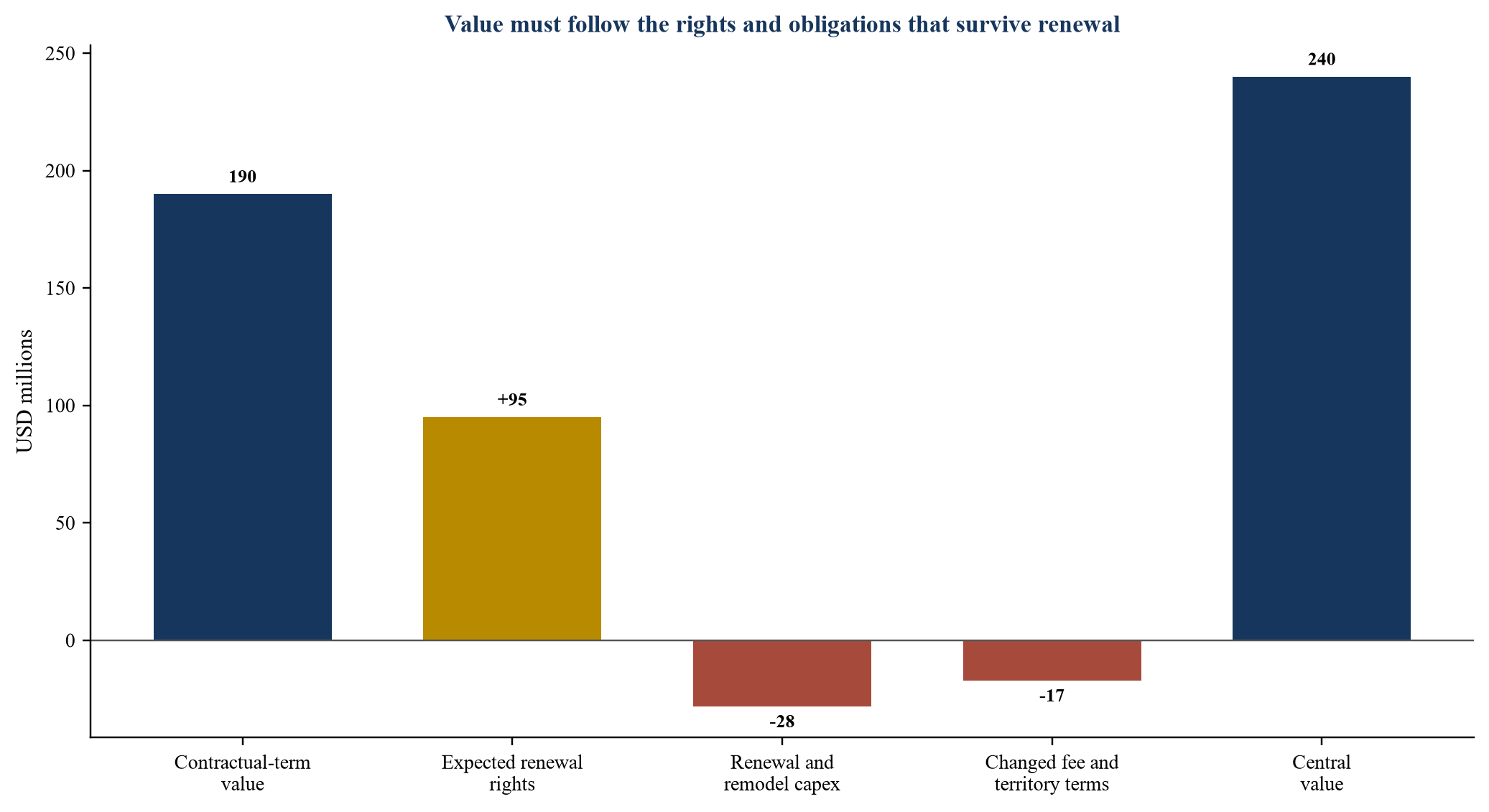
Hypothetical values in USD millions; the bridge shows how enforceable term, renewal probability, capex and changed economics affect value.
8. Test development obligations and whitespace
Master franchise and development agreements often require a minimum number of openings by specified dates. The buyer should distinguish contractual whitespace from economically viable whitespace. A contractual right to open 100 additional units does not establish demand, sites, operators, capital or supply capacity. The model should therefore join the development schedule to a market-by-market pipeline of signed sites, advanced negotiations, screened opportunities and untested areas.
Each planned unit should carry a capital estimate, opening date, ramp profile, required management capacity and probability. The buyer should test whether current cash flow and committed financing can fund the programme while meeting remodel and maintenance needs. Failure to meet milestones may trigger loss of exclusivity, reduction of territory, damages or termination. These consequences should appear in the downside case and transaction documents.
White-space value should be released in stages. Near-term signed sites can enter the base plan once leases, permits and unit economics are supported. Probable sites may enter a risk-adjusted case. Long-dated market potential belongs in an option-value discussion rather than the purchase price unless the seller accepts contingent consideration. This discipline prevents the buyer from paying upfront for openings that it must later finance and execute.
9. Separate system sales from acquirer revenue
System sales measure customer spending across a franchise network. They are useful for scale and demand analysis, but they are not the acquirer's revenue unless the target operates every unit and records the sales under applicable accounting rules. A franchisor may receive a royalty percentage, advertising contribution, technology fee, supply margin or rent. A master franchisee may receive only a portion of royalties collected from sub-franchisees. A unit operator receives store sales and bears operating costs.
The buyer should build a revenue waterfall from customer spending to cash retained by each entity. The waterfall should show discounts, taxes, refunds, delivery commissions, franchisee sales, royalty rates, sub-franchisor sharing, rent, marketing funds and supplier income. It should reconcile stated rates to actual collections and identify exemptions, caps, temporary relief, arrears and related-party offsets.
Marketing funds require separate analysis because contributions may be restricted to specified purposes and should not automatically be treated as discretionary EBITDA. Initial and renewal fees should be matched to the services and rights provided. IFRS 15 contains principles relevant to licensing and sales-based royalties, and the specific accounting should be confirmed from the executed arrangements and applicable reporting framework [10]. Valuation should follow sustainable cash economics after required system support, not an aggressive revenue presentation.
10. Rebuild four-wall unit economics
Four-wall economics measure the cash generation of a unit before central overhead and financing. The buyer should calculate net sales after discounts, returns and delivery fees; product and packaging cost; store labour; occupancy; utilities; local marketing; repairs; royalties; required advertising contributions; technology fees; and recurring maintenance. EBITDA should be accompanied by cash capex and working-capital needs.
Sales should be decomposed into transactions, average ticket, dayparts, product mix and channels. Margin should distinguish price, mix, procurement and waste. Labour should reflect actual staffing and local wage requirements. Occupancy should include base rent, turnover rent, service charges and lease incentives. Delivery channels may add sales while diluting contribution through commissions and packaging. These drivers allow the buyer to test whether reported margin can survive normalisation.
The unit model should show pre-opening investment, ramp time, cash break-even, mature sales, maintenance capex and remodel cycles. A strong mature-unit average does not support rapid development if recent cohorts ramp slowly or cannibalise nearby stores. The buyer should connect unit economics to the development schedule and refuse to credit expansion that destroys cash at the portfolio level.
11. Analyse cohorts, transfers, closures and remodels
Cohort analysis should compare units opened in the same period and format. The buyer should examine sales ramp, transaction growth, margin, labour, occupancy, customer ratings, maintenance and cash payback. It should identify whether newer units outperform because of better sites and formats or underperform because attractive territories are saturated. Store-level distributions should show the median, quartiles and weak tail.
Transfers provide information about franchisee confidence and capital access. Frequent transfers may reflect a liquid, healthy resale market or financial stress. The buyer should review consideration, buyer quality, franchisor consent, defaults cured at transfer and post-transfer performance. Closures should be classified by lease expiry, relocation, underperformance, franchisee failure, regulatory issue or system strategy.
Remodel obligations can create a hidden acquisition liability. The estate register should state last remodel date, required completion date, estimated cost, closure period and expected sales impact. Deferred capex should reduce value or be funded through a seller contribution, holdback or price adjustment. A valuation that capitalises current EBITDA while omitting the capex required to retain renewal rights overstates distributable cash.
12. Normalise fees, rents, supply income and related-party flows
Franchise systems can move economics through several channels. Royalties may be stated as a percentage of gross sales, while rent, product supply, technology, training, marketing, rebates and transfer fees sit elsewhere. The buyer should map each charge to the underlying agreement, payer, recipient, calculation base and service obligation. It should determine which flows are recurring, restricted, discretionary or vulnerable to renegotiation.
Related-party transactions require market testing. A target may purchase products from an affiliate, lease sites from the seller or receive services from a shared centre. Reported EBITDA may include favourable pricing that ends at close or exclude costs absorbed by the parent. The normalisation schedule should show standalone replacements and transitional arrangements. It should also test whether supplier rebates belong to the franchisor, franchisees, advertising fund or another entity.
McDonald's public filing illustrates a model in which conventional franchise arrangements can include rent and royalties, with the company often controlling the underlying real estate or long-term lease [5]. That structure cannot be assumed for another target. It shows why occupancy and royalty economics should be analysed together when the franchisor controls sites. The acquisition model should value contractual cash flows after the support and capital necessary to sustain them.
13. Diligence change-of-control, assignment and consent
A transaction can trigger consent requirements at several levels: the master franchise agreement, unit agreements, leases, licences, financing, supplier contracts and regulatory registrations. The buyer should identify whether a share sale is deemed an assignment, whether indirect ownership changes are captured, and whether consent can be withheld at discretion or only on stated grounds. It should also determine the information, fees, guarantees, training and financial tests required for approval.
Consent should be treated as a closing workstream with a named owner, evidence timetable and fallback. The sale agreement should distinguish conditions precedent from post-close covenants. A buyer should avoid closing into a structure where the key brand or territory right can be terminated because consent was assumed. Seller cooperation, franchisor engagement and disclosure of the buyer's ownership and financing should begin early enough to address conditions without creating a last-minute renegotiation.
The purchase agreement can allocate consent risk through termination rights, long-stop dates, price adjustments, escrow, reverse break fees or carve-outs. If only part of the estate receives consent, the buyer needs a minimum perimeter test. The investment committee should see the enterprise value, debt capacity and integration plan for the consented perimeter rather than the original headline estate.
14. Diligence trademarks, system rights and operating dependency
WIPO describes franchising as a package of intellectual-property rights and business know-how used under the franchisor's supervision and quality control [11][12]. The buyer should therefore verify ownership or valid licensing of trademarks, trade names, designs, software, recipes, manuals, domains, customer-facing content and confidential know-how. It should record territory, permitted use, sublicensing, quality-control duties, infringement responsibility and termination consequences.
Brand recognition does not remove chain-of-title risk. The diligence team should check registrations, renewals, liens, oppositions, coexistence arrangements and local-language marks. It should identify whether the target owns local goodwill or whether all goodwill accrues to the franchisor. It should test whether the target may use marks during a transition after termination and what de-branding costs would arise.
Operating dependency extends beyond formal IP. The target may rely on proprietary point-of-sale systems, loyalty platforms, menu or product development, approved supplier networks, training, site approval and central marketing. The buyer should identify services that cannot readily be replaced, the associated fees, data access, service levels and termination rights. Dependency is acceptable when rights are durable and economics are understood; it becomes a valuation risk when the target lacks control over a capability essential to cash generation.
15. Test supply-chain and approved-supplier economics
The buyer should map every material product, approved supplier, distributor, logistics route and alternative source. Franchise agreements can restrict sourcing to preserve quality and system consistency. The Australian disclosure framework specifically requires information on inventory requirements, sourcing restrictions, supplier interests and obligations to supply [4]. These provisions influence gross margin, resilience and bargaining power.
The diligence model should separate commodity exposure, supplier margin, freight, warehousing, waste, rebates and foreign-exchange effects. It should test whether purchasing benefits are passed to operators, retained by the franchisor or shared through contractual formulas. A target that appears to have attractive store margins may be exposed to a single supplier, imported inputs or a distribution agreement expiring before the franchise term.
The transaction plan should identify consents, continuity stocks, alternative-source qualification and quality-control requirements. Procurement synergy should be credited only when the franchisor permits a supplier change and product specifications remain satisfied. Where the buyer expects volume benefits, the model should include qualification costs, transition timing and any loss of rebates or support from the existing network.
16. Establish data, digital and customer-rights control
Digital channels create value only when the buyer understands which entity controls the customer relationship, data and economics. The diligence team should map point-of-sale data, loyalty accounts, mobile applications, websites, delivery platforms, reservation systems, customer-service records and marketing permissions. It should identify the data controller or equivalent role, permitted uses, retention rules, cross-border transfers, vendor access and the target's rights after termination or non-renewal.
The commercial model should reconcile digital sales to stores and royalty reports. Platform commissions, payment fees, refunds, loyalty redemptions and promotional subsidies can move contribution margin materially. The buyer should test whether digital orders are allocated by customer location, fulfilment store or franchisor policy and whether the franchisor can change that policy. The target may carry service obligations without owning the data required to manage demand.
Technology diligence should cover system ownership, licence term, implementation obligations, cybersecurity incidents, integration interfaces, data quality and replacement cost. A planned technology synergy should enter valuation only after the franchise agreements and system standards permit it. Post-close governance should reserve decisions on customer data, cybersecurity, platform changes and digital pricing for a joint legal, commercial and technology forum.
17. Assess franchisee health and system relationships
A franchisor or master franchisee cannot sustain royalty income when operators lack profitable units, capital or trust. The buyer should measure franchisee concentration, payment arrears, defaults, closures, transfers, disputes, association activity, satisfaction, remodel compliance and development capacity. Interviews should include a representative sample of strong, average and distressed operators, subject to confidentiality and transaction protocols.
Royalty collection can remain high until operator liquidity fails. The buyer should therefore review four-wall cash flow, debt service, owner compensation, tax arrears, lease exposure and upcoming capex. Temporary fee relief should be separated from structural economics. Franchisees with multiple brands may redirect capital when another system offers better returns. The development plan should test operator appetite rather than assume that contractual obligations guarantee funding.
Relationship risk should change the integration plan. Immediate extraction of fees or rapid policy changes can weaken a system whose value depends on franchisee investment. The buyer should establish listening forums, transparent evidence for required investments, escalation channels and fair treatment across corporate and franchised units. The Australian Code's good-faith, disclosure and dispute framework provides a regulatory reminder that franchise relationships carry continuing conduct obligations [3][4].
18. Review litigation, regulation and disclosure integrity
The diligence team should build a jurisdiction-by-jurisdiction register of franchise laws, registration requirements, disclosure rules, cooling-off periods, transfer processes, termination protections, competition rules, consumer obligations, employment exposure and data requirements. California, for example, requires franchisors offering franchises in the state to register or claim an exemption, and requires prescribed pre-sale disclosure [13][14]. Local counsel should confirm the current rules and transaction implications.
The buyer should compare disclosure documents with actual practice. Territory reservations, fees, litigation, outlet movements, supplier interests, financial-performance representations and termination provisions should agree with executed contracts and management conduct. Inconsistency can create regulatory, litigation and relationship risk even when historical financial statements are accurate. Complaints and settlements should be analysed for recurring system weaknesses.
Competition analysis should examine exclusive territories, online restrictions, resale pricing, non-compete provisions, supply restrictions and information sharing. The European Commission maintains block-exemption regulations and guidance relevant to vertical arrangements, while the analysis depends on the specific agreement, market shares and jurisdiction [15]. The transaction timetable should provide for merger control and franchise-specific approvals without treating one as a substitute for the other.
19. Reconstruct working capital and cash conversion
Franchise models can appear cash generative because royalties are collected frequently and system-level capital is limited. The buyer should still reconstruct receivables, deferred revenue, gift cards, loyalty liabilities, marketing funds, inventory, supplier terms, franchisee deposits, tax balances and capex commitments. Restricted or pass-through cash should be separated from funds available for debt service or distribution.
The model should link royalty receivables to unit sales and identify arrears, disputes and relief programmes. Initial fees may be collected before related support is delivered. Marketing contributions may be held for specified campaigns. Unit operators can carry seasonal inventory and lease liabilities that do not appear in an asset-light narrative. The purchase agreement should define normal working capital in a way that respects these structural differences.
Cash conversion should be measured through a monthly bridge from EBITDA to operating cash after maintenance capex, remodels, new-unit investment, taxes and required system expenditure. Financing capacity should be based on this cash bridge. A strong accounting margin with weak cash conversion should reduce leverage, price or development pace.
20. Test management and field-operating capacity
Franchise value depends on people who recruit and support operators, approve sites, open units, enforce standards, manage suppliers, interpret data and resolve disputes. The buyer should map these roles by territory and determine workload, vacancy, turnover, succession and dependence on founders or franchisor personnel. Management capacity should be compared with the required opening, remodel and integration schedule.
Field operations require particular attention. A rapid development plan can dilute inspection, training and launch support. The buyer should review visit frequency, quality scores, remediation, opening readiness and operator feedback. It should establish whether field teams are viewed as commercial partners, auditors or sales agents and whether their incentives balance growth with unit health.
The transaction plan should identify critical retention, recruitment and capability-building actions. Management incentives should connect to sustainable unit cash flow, compliance, franchisee health and development quality. Head-office savings should not remove the roles that protect royalty durability and brand standards. The operating model should specify which decisions sit with the local platform, regional centre and global franchisor.
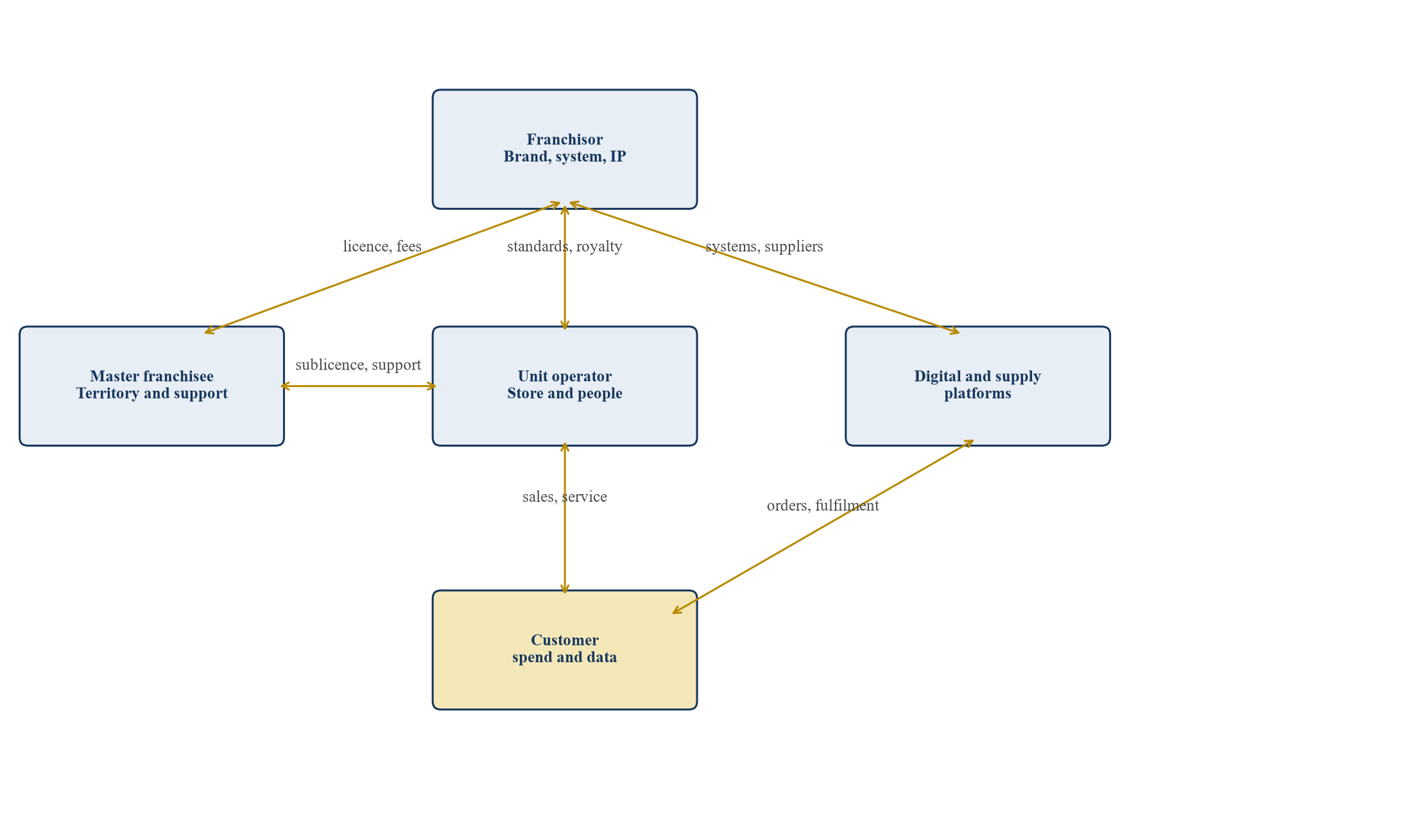
Cash flows and control rights cross the legal entities; each arrow requires contractual and financial evidence.
21. Sequence integration around non-negotiable rights
Integration should begin with a rights-preservation plan. The first priorities are consent effectiveness, payment continuity, quality and safety, data access, customer service, supplier continuity, franchisee communication and compliance with development and remodel obligations. These controls protect the asset while the buyer validates broader synergies.
The buyer should classify decisions as preserve, standardise, combine or defer. Brand proposition, franchisee relationships and approved operating standards may need preservation. Finance controls, cash visibility and risk reporting may be standardised early. Procurement, technology, marketing and shared services may be combined after legal permission and business cases are confirmed. Format changes, fee changes and portfolio restructuring may be deferred until evidence supports them.
Integration gates should be linked to the next capital decision. For example, no accelerated openings until recent cohorts meet cash-payback thresholds; no procurement change until franchisor approval and quality tests; no central-cost removal until service levels are stable. This approach turns the integration plan into a controlled investment programme rather than a list of activities.
22. Convert diligence findings into transaction structure
Diligence should produce transaction terms, not a separate report. A short contract term can be addressed through pre-close renewal, lower upfront price or contingent consideration. Uncertain consent can become a condition precedent. Deferred remodels can be funded by the seller or deducted from value. Royalty arrears and disputed marketing funds can be placed in escrow. Development milestones can support earn-outs tied to profitable openings rather than unit count alone.
Representations and warranties should cover contract completeness, territory rights, compliance, outlet data, financial-performance claims, fees, supplier interests, intellectual property, litigation, data and related-party arrangements. Specific indemnities may be appropriate for identified liabilities. Covenants should preserve ordinary-course operations, franchisee relationships and approvals between signing and closing.
The buyer should avoid structures that create incentives to open weak units or defer necessary capex. Earn-outs should use metrics the parties can measure and govern, such as consented renewals, mature-unit cash contribution, cash collections or completion of agreed remediation. The transaction committee should review each material finding with its proposed economic or legal response.
23. Size financing to contractual and operating cash flow
Debt capacity should be based on cash flow that survives the transaction, not headline system sales. The lender model should distinguish contractual-term cash flow, probability-weighted renewal cash flow and uncommitted development upside. It should deduct maintenance, remodel, development and integration capital, as well as restricted marketing cash and recurring system support.
Covenants should reflect the business model. Measures can include fixed-charge coverage, leverage, minimum liquidity, unit closures, royalty arrears, development compliance, franchisor default, consent status and capex completion. The financing documents should consider cross-default between master and unit agreements and the effect of losing a material territory. Security should be evaluated against assignment restrictions and the practical value of assets after termination.
The buyer should maintain liquidity for downside events. A franchisee rescue, supply disruption, mandatory remodel or delayed opening programme can consume cash before EBITDA deteriorates visibly. A revolving facility, capex line or committed equity reserve may be more useful than maximising term debt at closing. Financing headroom should match the downside scenario and cure timetable.
24. Build a valuation from rights, units and scenarios
The valuation should combine three lenses. The contractual cash-flow model values unit and system cash flows within enforceable terms. The renewal scenario adds probability-weighted continuation after renewal fees, capex and changed economics. The market approach compares relevant transactions and public companies after adjusting for business model, ownership mix, growth, geography, term, capital intensity and system health.
Franchisor royalty streams may support a different multiple from unit-level EBITDA. A master franchisee combines royalty, development and store exposures. The buyer should avoid applying a franchisor multiple to unit economics or crediting system sales as revenue. Sum-of-the-parts analysis can separate royalty cash flow, operated units, real estate and development options before subtracting central cost and obligations.
IFRS 3 requires an acquirer to recognise identifiable assets acquired and liabilities assumed at fair value, with the residual generally recognised as goodwill [8]. Reacquired rights can arise where an acquirer regains a right previously granted, including rights under franchise arrangements, and require specific accounting analysis [9]. Purchase-price allocation does not determine investment value, but it can reveal whether the transaction thesis depends on rights, customer relationships, trademarks, leases or goodwill.
25. Quantify synergy and dis-synergy without double counting
Synergies should be classified by owner, permission, timing, cost and evidence. Revenue opportunities may include better site selection, stronger digital conversion, cross-market products or improved operator recruitment. Cost opportunities may include procurement, shared technology, finance, data and support. Working-capital benefits may arise from billing and collections. Each item should identify whether the franchisor, franchisee or target captures the benefit.
Dis-synergies should be modelled with equal discipline. They may include stand-alone costs, higher franchise fees, loss of seller support, duplicated systems, consent conditions, retention payments, required remodels, procurement transition and tax leakage. A buyer may also lose supplier income or favourable related-party terms. The model should prevent the same benefit from appearing in both unit margin and central-cost savings.
Only contracted or execution-ready synergies should support the base price. Longer-term opportunities can support contingent consideration or remain as buyer upside. The board should receive a bridge from reported EBITDA to normalised EBITDA, stand-alone EBITDA, integration-period cash flow and steady-state cash flow.
26. Model a central and downside acquisition case
The illustrative target operates 180 units across three territories under master-development and unit franchise agreements. The buyer pays USD 240 million and commits USD 35 million for remodels, integration and catch-up investment. These inputs are hypothetical management assumptions. They are designed to show decision logic rather than represent a market benchmark.
The central case assumes continued contractual rights, timely consent, four per cent same-store sales growth, 18 net openings over five years and a 12 per cent mature four-wall EBITDA margin. Year-five platform EBITDA reaches USD 38 million. Applying a hypothetical ten-times multiple produces enterprise value of USD 380 million. After USD 120 million of net debt, illustrative equity value is USD 260 million.
The downside case assumes only six net openings, a two per cent same-store sales decline, a nine per cent mature margin, delayed remodel benefits and less favourable renewal economics. Year-five EBITDA reaches USD 20 million. Applying a hypothetical nine-times multiple produces enterprise value of USD 180 million. After USD 155 million of net debt, illustrative equity value is USD 25 million. The difference shows how renewal, cohort economics and funded obligations can compress equity value before a brand disappears.
| Measure | Central case | Downside case | Decision interpretation |
|---|---|---|---|
| Purchase consideration | 240 | 240 | Same entry price tests downside asymmetry |
| Remodel, integration and catch-up capital | 35 | 45 | Delays and remediation consume more cash |
| Net openings over five years | 18 | 6 | Development option depends on viable sites and capacity |
| Same-store sales assumption | 4% | -2% | Demand and cannibalisation affect unit cash flow |
| Mature four-wall EBITDA margin | 12% | 9% | Fees, labour, occupancy and delivery mix matter |
| Year-five platform EBITDA | 38 | 20 | Sustainable cash base for valuation and debt |
| Exit multiple | 10.0x | 9.0x | Lower rights quality and growth reduce multiple |
| Enterprise value | 380 | 180 | Rights and execution drive the range |
| Net debt | 120 | 155 | Weak cash conversion increases residual debt |
| Equity value | 260 | 25 | Downside protection must address equity compression |
All values are illustrative management scenarios; USD millions except units, percentages and multiples.
27. Set an investment-committee decision matrix
The investment committee should receive a compact decision matrix showing the finding, evidence, value effect, proposed protection, residual risk and accountable owner. Findings should be graded by severity and proximity to cash. A missing consent that can terminate the master right outranks a speculative procurement synergy. A deferred remodel that must be completed within twelve months belongs in purchase-price and liquidity analysis.
The committee should establish non-negotiable conditions: validated legal perimeter; acceptable renewal and consent path; reconciled unit register; supportable unit economics; funded development and remodel plan; protected IP and data access; and financing headroom under downside. Failure of a condition should trigger redesign or rejection, not a vague risk premium.
Approval should specify the maximum price, permitted structure, minimum consented perimeter, required escrow or holdback, financing limits, closing conditions and first one-hundred-day controls. It should also state which assumptions require reapproval if they change before closing. This creates a decision record that survives negotiation pressure.
| Decision area | Required evidence | Protection or control | Stop condition |
|---|---|---|---|
| Territory and term | Executed agreements and clause map | Renewal, price adjustment or contingent payment | Key rights cannot survive closing |
| Unit economics | Reconciled cohort and cash data | Valuation haircut and performance covenant | Sustainable cash flow is unsupported |
| Development | Viable pipeline, capital and people | Phased capital and opening gates | Obligations exceed funded capacity |
| IP and systems | Valid licences and service continuity | Consent, transition services and access rights | Brand or core system use is uncertain |
| Franchisee health | Arrears, disputes, transfers and interviews | Remediation plan and liquidity reserve | System distress threatens royalty base |
| Financing | Downside cash bridge and covenant model | Lower leverage and committed liquidity | Cure capacity is inadequate |
The matrix converts evidence into action; thresholds should be tailored to the target and jurisdiction.
28. Govern the first one hundred days
The first one hundred days should preserve rights and establish reliable control. Day-one actions include confirming consents, payment instructions, system access, supplier continuity, customer service, data protection, incident escalation and franchisee communications. The buyer should avoid announcing operating changes before rights and effects are understood.
Within thirty days, management should validate the unit register, cash collections, defaults, development milestones, remodel schedule and critical people. Within sixty days, it should approve the rights register, cohort baseline, capital plan and integration gates. By day one hundred, the board should receive a refreshed central and downside model supported by post-close data, together with decisions on openings, remediation and synergy pilots.
Governance should include a rights-and-obligations dashboard. It should show renewals, consents, development milestones, quality defaults, franchisee arrears, capex, store openings and closures, digital incidents and litigation. Every red item should have a cure owner, deadline and value at risk.
29. Execute a twenty-four-month value-creation roadmap
Months zero to three focus on control: consent completion, cash visibility, system continuity, unit-data validation, management retention and franchisee engagement. Months four to nine address remediation: weak-unit plans, overdue remodels, supplier continuity, royalty collections, data quality and realistic development sequencing. Months ten to eighteen test selected capability improvements in digital, procurement, field support and site selection.
Months nineteen to twenty-four scale only the initiatives that demonstrate unit-level cash improvement without weakening brand standards or operator economics. New openings should pass site, operator, financing and payback gates. Portfolio actions may include transfers, closures, refranchising, territory renegotiation or selective corporate ownership. Each action should be assessed against contractual rights and stakeholder effects.
The roadmap should remain tied to renewal and financing. Management should begin material renewal work early enough to preserve alternatives. Capex and openings should remain within committed liquidity and covenant headroom. The board should reassess value at each major rights event rather than wait for the annual budget.
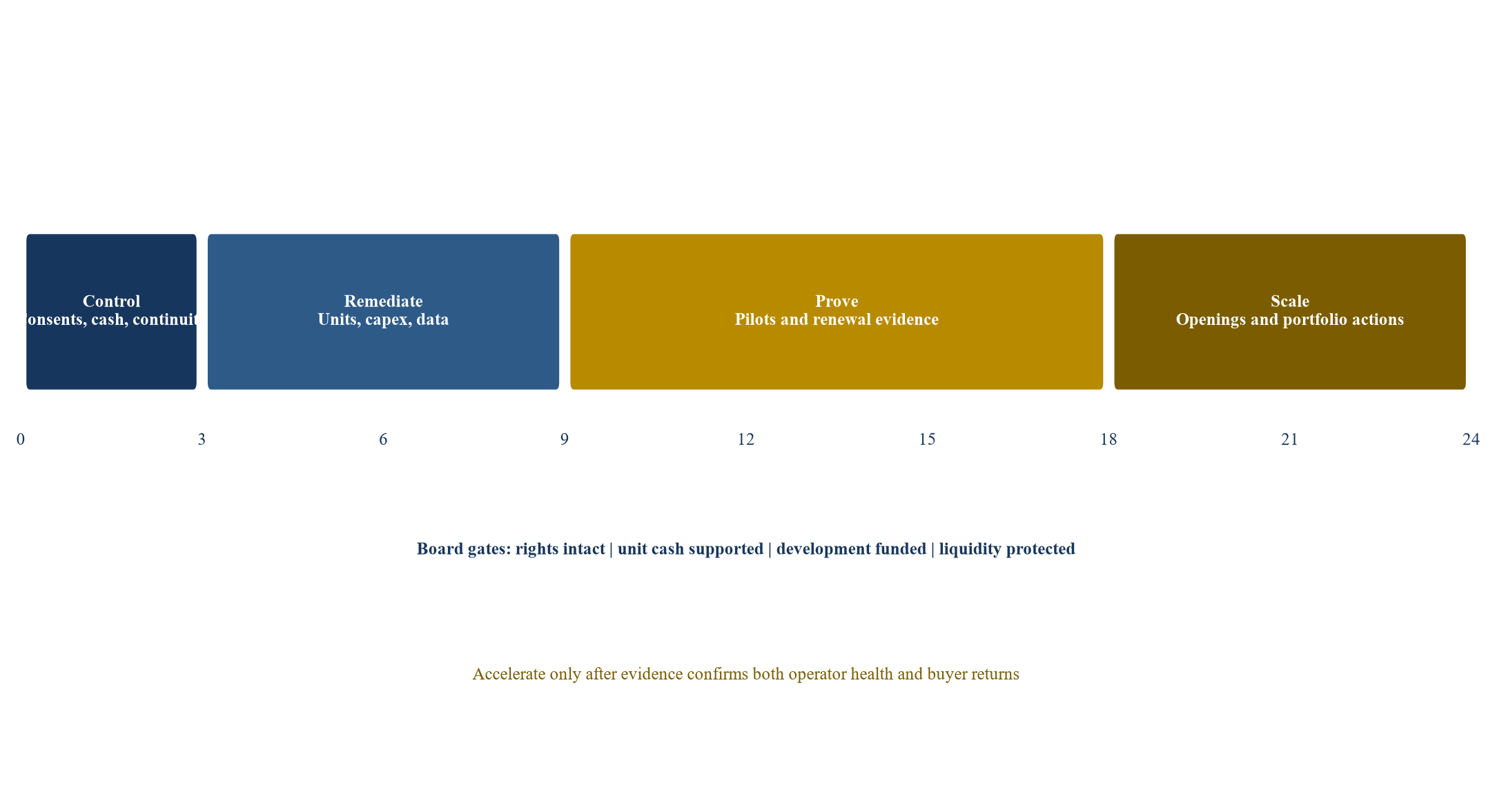
Rights preservation and unit evidence precede acceleration.
30. Conclude with a rights-led acquisition discipline
Franchise M&A requires a disciplined connection between contract rights and operating cash. Territory, term, renewal, consent and development obligations define the opportunity available to the buyer. Unit cohorts, four-wall economics, franchisee health and system capabilities determine whether that opportunity can produce durable cash. Deal structure and governance determine how much of the risk remains with the seller, lender or buyer.
The Rights-to-Cash Framework gives boards and transaction teams a common sequence. Classify the target; reconstruct the perimeter; reconcile the unit estate; test cash economics; model renewal and development; protect IP, data and supply; convert findings into price and terms; finance the downside; and govern value after close. This sequence makes the acquisition case transparent and falsifiable.
A recognisable brand can support a compelling transaction, but brand recognition is not the valuation. The relevant value is the present value of cash flows the buyer has the right, capacity and capital to earn. A buyer that prices those three elements explicitly can negotiate with greater precision and enter integration with a controlled value-creation plan.
Sources
- U.S. Federal Trade Commission. Franchise Rule. Read the primary source
- U.S. Federal Trade Commission. A Consumer's Guide to Buying a Franchise. Read the primary source
- Australian Competition and Consumer Commission. Franchising Code of Conduct. Read the primary source
- Australian Government, Federal Register of Legislation. Competition and Consumer (Industry Codes; Franchising) Regulations 2024, compilation in force from 21 October 2025. Read the primary source
- McDonald's Corporation. Annual Report on Form 10-K for the year ended 31 December 2025. Read the primary source
- Yum! Brands, Inc. Annual Report on Form 10-K for the year ended 31 December 2025. Read the primary source
- Yum China Holdings, Inc. Annual Report on Form 10-K for the year ended 31 December 2025. Read the primary source
- IFRS Foundation. IFRS 3 Business Combinations. Read the primary source
- IFRS Foundation. IFRS 3, definition of a business and reacquired rights, IASB staff paper. Read the primary source
- IFRS Foundation. Clarifications to IFRS 15 Revenue from Contracts with Customers. Read the primary source
- World Intellectual Property Organization. IP Assignment and Licensing. Read the primary source
- World Intellectual Property Organization. In Good Company: Managing Intellectual Property Issues in Franchising. Read the primary source
- California Department of Financial Protection and Innovation. Franchises and Franchise Brokers. Read the primary source
- California Department of Financial Protection and Innovation. About the Franchise Investment Law. Read the primary source
- European Commission. Block Exemption Regulations. Read the primary source
- Australian Competition and Consumer Commission. Guidance on the franchising model disclosure document. Read the primary source
- Australian Competition and Consumer Commission. Ending a franchise agreement. Read the primary source
- U.S. Federal Trade Commission. Amended Franchise Rule FAQs. Read the primary source
- Arcos Dorados Holdings Inc. Annual Report for the year ended 31 December 2024. Read the primary source
- Arcos Dorados Holdings Inc. Description of material agreements, 2024 annual-report exhibit. Read the primary source
