

1. Start with the operating model
A company entering the UAE often receives a list of incorporation packages before it has defined what the local business will do. This reverses the decision sequence. The board should first identify the customer, activity, product or service, delivery location, revenue path, assets, employees, regulated steps and decision rights. The legal footprint should then be designed around that operating reality.
The central question is which entity needs which right. A sales team may need authority to market, negotiate and contract. A distribution business may need importer-of-record capability, customs registration, inventory control and warehousing. A professional-services platform may need an approved activity, qualified personnel and a customer-facing office. A regulated financial business may need authorisation from a financial-services regulator. A regional headquarters may need real management capacity, systems and evidence that decisions occur where profits and risks are attributed. These are different problems even when each company uses the phrase "UAE entry".
Federal company law, local licensing rules and free-zone regulations form overlapping layers. The UAE government states that free-zone companies operate within a legal framework that differs from mainland companies. Goods entering the mainland require customs clearance. Mainland activity generally requires the applicable licence, permit, branch or distribution arrangement. Dubai Executive Council Resolution No. 11 of 2025 and the Free Zone Mainland Operating Permit introduced a structured route for eligible Dubai free-zone companies to conduct approved mainland activities. Abu Dhabi's economic-licensing framework includes a dual licence for establishments registered in Abu Dhabi free zones. These routes expand the design set while preserving the need to test the exact activity and conditions.
Tax should be integrated into this model after the commercial and legal perimeter is clear. The Federal Tax Authority describes a zero corporate-tax rate for a Qualifying Free Zone Person on Qualifying Income when all applicable conditions are satisfied. Other income can be subject to the standard rate, and profits attributable to a domestic permanent establishment outside the free zone can be taxed at 9 percent. Transfer-pricing, substance, audited-financial-statement and de minimis requirements affect the analysis. A free-zone address therefore does not determine the tax result on its own.
The board should ask management for an operating-architecture memorandum before approving incorporation. The memorandum should show the intended activities, customers, contracts, goods, people, assets, data, cash and authority; identify the legal route for each; compare viable structures; quantify total cash to a stable operating state; state the evidence gaps; and set implementation gates. This converts a jurisdiction label into a controlled investment decision.
Table 1. Operating-rights diagnostic before entity selection
| Decision area | Evidence to collect | Question for the footprint | Board consequence |
|---|---|---|---|
| customers | target list, procurement rules, contract templates and government eligibility | which entity must bid, negotiate, contract and invoice? | revenue assumptions depend on lawful access |
| activities | detailed process map, licence classification and regulator view | which entity may perform each step and from which location? | activity mismatch can stop operations |
| goods | product codes, origin, import route, storage and delivery path | who imports, owns inventory, clears customs and delivers? | customs and working capital enter the structure |
| people | roles, work location, employment model, visas and payroll | which entity employs and supervises each role? | duplicated sponsorship or shadow employment creates risk |
| assets | premises, equipment, IP, inventory and security interests | which entity owns, leases, uses and finances each asset? | capital and liability allocation change |
| data | data categories, controller roles, systems, transfers and sector rules | where is data collected, processed, accessed and governed? | privacy and cyber controls follow actual processing |
| cash | price, currency, banking, payment rails and intercompany flows | who earns, pays, funds and bears credit risk? | tax, treasury and transfer pricing must reconcile |
| authority | board, signatories, budgets, pricing, hiring and risk decisions | where do material decisions occur and who can bind each entity? | substance and governance need evidence |
Each answer should be supported by current authority requirements and the company's complete facts.
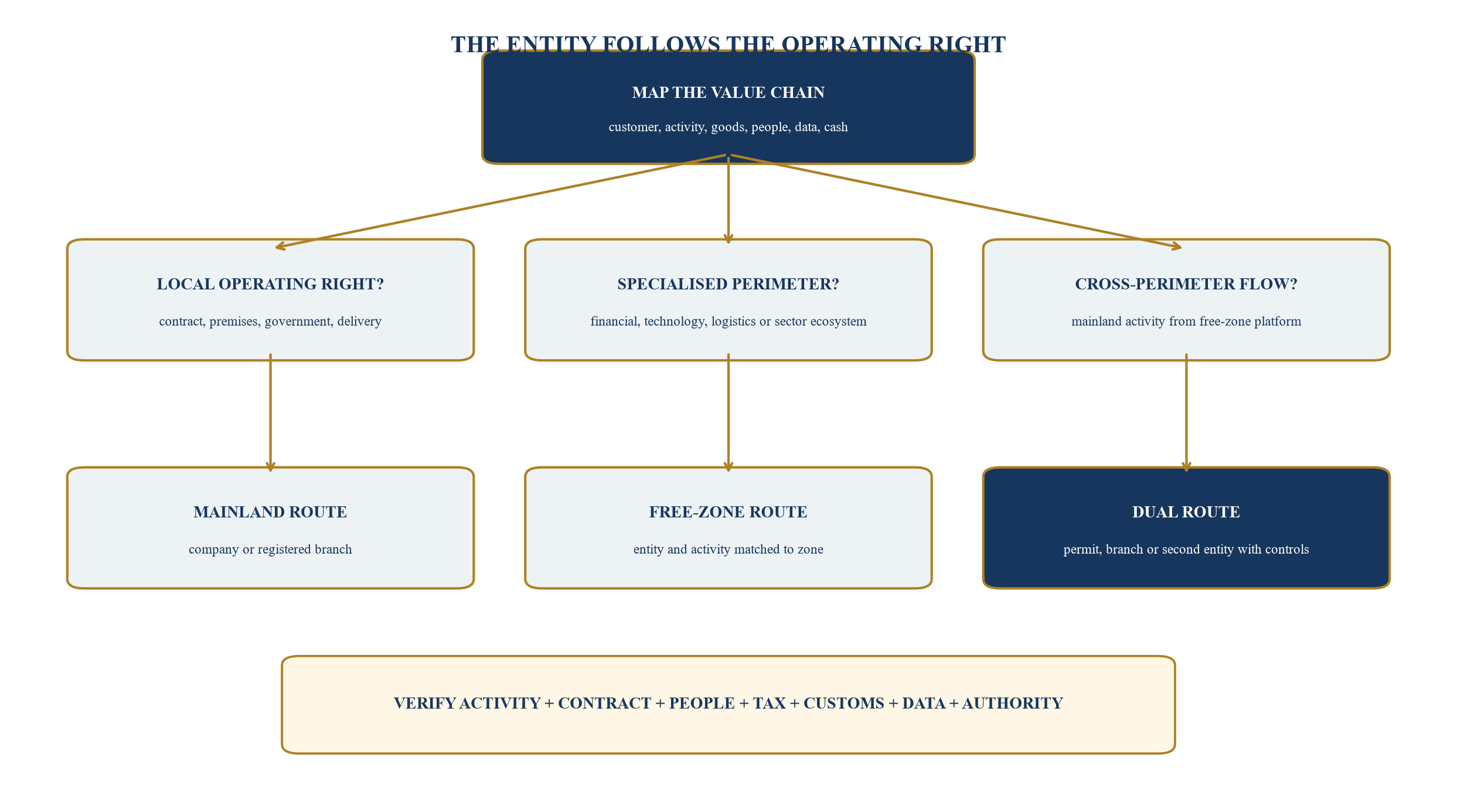
The tree is a management framework. The applicable authority determines the licence and permit outcome.
2. Separate licence, legal form and operating perimeter
Three decisions are frequently compressed into one. The first is legal form: limited-liability company, branch, partnership, holding vehicle or another permitted form. The second is licensing: the activities that the competent authority authorises the entity to conduct. The third is operating perimeter: where and how the business actually contracts, employs, stores goods, processes data and makes decisions. A robust structure aligns all three.
A branch is an extension of its parent rather than a separate shareholder-owned subsidiary. The Federal Tax Authority notes that UAE branches of a domestic juridical person are not separately registered or filed for corporate tax because they are extensions of the parent. A foreign-company branch has federal and local registration requirements. The Ministry of Economy and Tourism's current branch-registration service describes initial approval, local licensing, registration within one month and audit-related requirements. Its published guidance also confirms that a foreign-company branch no longer requires a UAE national agent under the Commercial Companies Law.
A subsidiary creates a distinct legal entity and can ring-fence contracts, employees, assets and liabilities, subject to guarantees, conduct and applicable law. It also creates its own governance, accounting, audit, tax, beneficial-ownership and filing obligations. A holding or special-purpose vehicle can isolate ownership or financing, yet it may not hold the operating licence needed to deliver the product. Boards should avoid asking a passive vehicle to carry operational rights for which it has no people, premises or systems.
Free zones differ materially. ADGM and DIFC are financial free zones with distinct civil and commercial laws and English common-law frameworks. ADGM requires physical presence for operating entities other than specified structures such as certain special-purpose vehicles. Financial activities require regulatory authorisation. DIFC's Registrar of Companies administers incorporation and commercial licensing, while financial activity is regulated by the Dubai Financial Services Authority. Other zones can be designed around logistics, commodities, media, technology, healthcare, industry or general commercial activity. The board should compare the actual rulebooks and permitted activities rather than treating "free zone" as a single product.
A permit is also different from an entity. Dubai's Free Zone Mainland Operating Permit allows eligible companies with a Dubai Unified Licence to apply for approved mainland activity through the Invest in Dubai platform. Executive Council Resolution No. 11 of 2025 provides for a mainland branch, a branch with headquarters in the free zone or permits for specific activities. Separate financial records are required for activity outside the free zone. The resulting architecture can have one legal person and more than one licensed perimeter. Governance and accounting must reflect that reality.
3. Build the activity and contract map
The route decision should begin with the transaction chain from first contact to cash collection. Each step should name the entity that performs it, the required licence, the place of performance, the person with authority, the contract used, the asset or data involved and the accounting entry. If the company cannot draw this map, it cannot demonstrate that the footprint matches its business.
Customer access is often decisive. Government and government-related procurement may require a local economic licence, registration on a supplier platform, activity approval, establishment records or other eligibility. Private customers can impose vendor-onboarding, tax-registration, data-location, insurance, bank-account or local-support requirements. A free-zone company may be commercially acceptable for one customer and operationally unsuitable for another. The entry case should use evidence from target procurement teams and tender documents rather than assumptions based on incorporation marketing.
The contract map should distinguish marketing, solicitation, negotiation, signing, delivery, acceptance, warranty, invoicing and collection. The entity that signs should be capable of performing and carrying the risk. A mainland reseller agreement can provide lawful market access for goods, but it also transfers margin, customer control and credit exposure. A service arrangement between group entities can allocate delivery work, but it needs a defensible scope, price, personnel model and evidence of actual performance. A dual licence can expand the authorised perimeter without solving every tax, customs, labour or regulatory question.
Material contracts should be analysed for assignment, sublicensing, data use, intellectual property, subcontracting, local presence, governing law, dispute resolution, change of control, tax gross-up, permanent-establishment and audit terms. The company should avoid a structure that requires widespread contract transfers after customers have already onboarded the initial entity. The re-papering cost and consent risk belong in the route model.
The board should require a contract-to-ledger trace. For each material revenue stream, the legal entity, licence, contract, invoice, bank receipt, fulfilment team, cost base and tax treatment should reconcile. For each material cost, the contracting and benefiting entities should be clear. A route that appears cheap at incorporation can become expensive when contract migrations, second invoices, intercompany services and customer explanations are added.
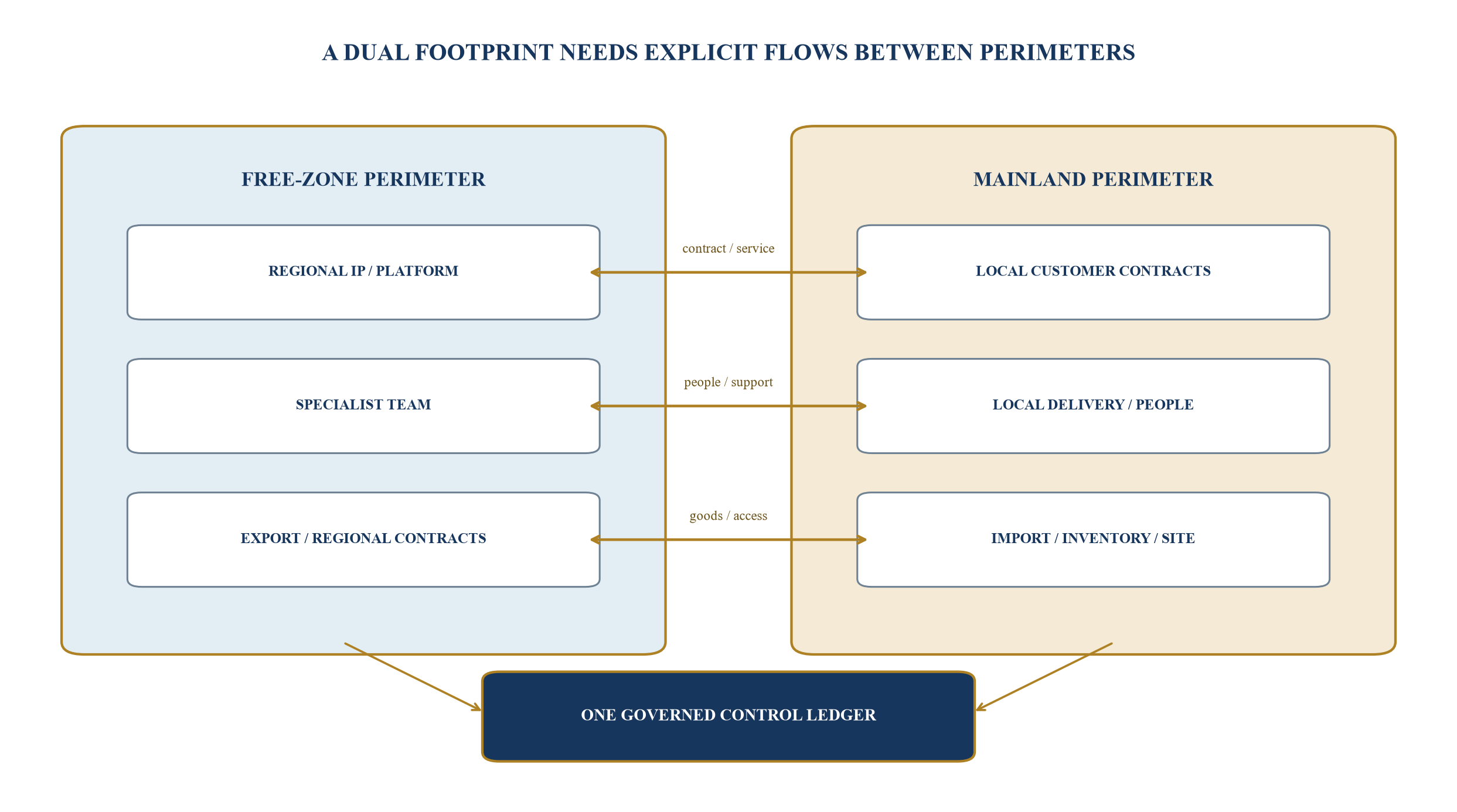
The diagram shows a dual-footprint design pattern. Actual allocation depends on licences, contracts and business facts.
4. Use an entity-allocation ledger
Once the value chain is mapped, management should create an entity-allocation ledger. Each material activity, contract, asset, employee role, data set, bank account and authority is assigned to an entity and licensed location. The ledger records the reason, evidence, dependencies and owner. It becomes the design record for incorporation, tax, banking, systems and operating procedures.
The ledger should expose mismatches. A sales employee sponsored by one entity may spend most working time performing another entity's revenue activity. A customer contract may be signed by a holding company while delivery staff and insurance sit elsewhere. Inventory may be booked in the free zone while title, customs declarations and physical delivery suggest a mainland flow. Intellectual property may be legally owned by one company, developed by another and commercially controlled by a third. Senior executives may approve prices and risks for several entities without documented delegations. Each mismatch requires a lawful operating explanation or a redesign.
Decision rights deserve the same detail as physical assets. The board should allocate authority for strategy, annual budgets, customer pricing, hiring, procurement, financing, treasury, intellectual property, data, risk acceptance and material contracts. Signatory schedules, bank mandates, powers of attorney, committee charters and system permissions should agree. Corporate substance is weakened when minutes describe local authority while routine approvals occur elsewhere.
The ledger should also state what is shared. Group systems, brands, intellectual property, procurement, finance, HR, cybersecurity and management can support multiple entities. Shared service agreements should describe the service, provider, recipient, charging basis, data access, service level, liability, termination and evidence. Transfer-pricing policy should follow the actual functions, assets and risks. The service design should remain operationally usable; a theoretically precise allocation that cannot be recorded or governed will create reconciliation failures.
The board can approve a target allocation and require management to close every gap before launch. After launch, the ledger becomes a change-control instrument. New products, customers, emirates, premises, regulated steps, data uses or employee roles should be assessed against the licensed perimeter before commercial commitment.
Table 2. Entity-allocation ledger
| Element | Free-zone allocation may fit when | Mainland allocation may fit when | Dual-footprint control |
|---|---|---|---|
| regional contracts | customers accept the entity and activity is licensed | local procurement or delivery requires mainland presence | contract policy states which entity may sign |
| local customer delivery | permit or applicable route covers the activity | local premises, field work or customer rule requires it | work orders identify performing entity and people |
| inventory | goods remain in zone, are re-exported or move under approved customs procedures | goods enter domestic circulation and are locally delivered | title, customs, stock ledger and invoice reconcile |
| employees | role is performed within the zone's employment and activity perimeter | work is primarily for mainland licensed operations | time, supervision, payroll and recharge evidence align |
| intellectual property | regional ownership and control have real substance | local operating company develops and controls the asset | licence terms and development ownership are documented |
| customer data | processing fits the zone and applicable data regime | mainland entity determines local purposes and means | controller and processor roles are contractually mapped |
| banking and treasury | cash relates to zone contracts and functions | cash relates to mainland customers and liabilities | no unexplained collection or payment on behalf of another entity |
| management authority | zone executives make and evidence material decisions | mainland management controls local operations | reserved matters and delegation prevent shadow control |
The table is illustrative. Every allocation needs authority and adviser confirmation.
5. Compare routes through total operating value
The route model should use total operating value rather than incorporation price. Total operating value includes addressable revenue, gross margin retained, speed to customer evidence, working capital, setup cash, annual compliance, people, premises, systems, adviser cost, tax, customs, banking, insurance, governance capacity, restructuring cost and downside exit. The board should compare routes over a decision-relevant period, commonly three to five years, with sensitivities for delayed revenue and higher operating cost.
A mainland company can support broad domestic operations and direct customer relationships where the activity is approved. It can also require premises, employment setup, local registrations and sector approvals. A free-zone entity can provide ecosystem benefits, infrastructure, a specialised court or regulator, export and regional capabilities, or a simpler initial platform. Its mainland activities must still follow the applicable route. A dual footprint can combine local access with specialised functions, but it introduces duplicated records and intercompany governance.
Speed should be measured to a stable operating state. Licence issuance is one milestone. The business may still need a bank account, tax registration, customs code, immigration establishment file, work permits, premises, insurance, regulator consent, customer onboarding, vendor registration, payment rails and systems. A route that issues a certificate quickly can reach revenue later if customer or operational dependencies remain unresolved.
The model should value reversibility. A staged route can test demand before committing to a second entity or large premises. A distribution arrangement can prove product-market fit while preserving an option to internalise margin. A free-zone permit can add a bounded mainland activity before a full mainland subsidiary. The value of these options depends on whether the route produces credible commercial evidence and whether later migration is feasible.
Management assumptions should stay visible. If one structure appears superior because it assumes a zero tax rate, immediate banking, full customer acceptance or a short permit period, the board should see the source and sensitivity. The selected route should remain viable under a managed downside, not only under a frictionless launch case.
6. Design the free-zone route around its purpose
A free-zone route is strongest when its characteristics match a genuine operating purpose. A logistics business can value bonded facilities, port access and re-export processes. A financial-services firm can value a specialist regulator, common-law courts, professional ecosystem and market infrastructure. A technology company can value innovation licensing, talent, accelerator access and flexible premises. A regional group can value a headquarters, treasury or holding platform when real functions and authority are located there.
The chosen zone's permitted activities must cover actual conduct. Licence descriptions can be narrower than management's commercial language. "Consulting", "software", "trading", "holding" and "management" may have authority-specific definitions and restrictions. Regulated activities cannot be treated as ordinary commercial services. The application narrative, website, proposals, invoices, employee roles and customer delivery should remain consistent with the licence.
Physical presence and substance should be planned. ADGM's setup guidance states that operating entities require physical presence, with exceptions for specified structures such as special-purpose vehicles. DIFC setup routes include office or coworking requirements depending on the licence. Other zones have flexi-desk, warehouse, industrial, retail or office packages tied to activities and visa allocations. The board should test whether the premises support actual headcount, meetings, records, systems, customer access and regulated requirements.
The free-zone entity's relationship with the mainland must be explicit. The UAE government notes that goods entering the mainland need customs clearance. JAFZA rules state that customers may conduct mainland business subject to applicable law and must comply with customs requirements. Dubai's permit framework can authorise specified mainland activity for eligible free-zone companies. The route should name the permit, branch, distributor, customs or contracting mechanism used for each domestic flow.
The board should require an annual free-zone qualification review across licence, activity, premises, people, income, customers, related-party transactions, permanent establishments, transfer pricing, financial statements and filings. A structure that began with a clear purpose can drift as commercial teams add products and customers. Periodic evidence keeps the legal and tax perimeter aligned with the operating model.
7. Design the mainland route around local execution
A mainland route is appropriate when the business needs direct and recurring operating rights across the domestic value chain. Relevant indicators include local customer contracting, government procurement, field delivery, retail or industrial premises, locally held inventory, domestic importation, a large mainland workforce or an activity regulated by a local or federal authority. The exact licence and approvals depend on the emirate, activity and legal form.
Full foreign ownership is available across many UAE activities. The Ministry of Economy and Tourism confirms that ownership conditions remain subject to the activities designated by competent local authorities and to strategic-impact rules. A board should therefore obtain activity-level confirmation. General statements about foreign ownership cannot replace a review of the proposed licence, sector, regulator, minimum capital, board or ownership conditions.
A mainland subsidiary can own customer contracts, employ the local team, lease premises, register for customs and hold operating assets within one entity. This can simplify customer communication and local accountability. The subsidiary also needs independent governance, financial records, tax compliance, beneficial-ownership records, insurance and internal controls. Parent guarantees, cash pooling, intellectual-property licences, management services and intercompany financing should be designed before the operating company incurs obligations.
A foreign-company branch can preserve a direct legal connection to the parent. The Ministry of Economy and Tourism's current services set out initial approval and registration processes, and its guidance states that a national agent is no longer required. The parent remains exposed to branch obligations, and the branch's permitted activity typically follows the parent and local approval. A branch can also affect financial-statement disclosure, tax attribution, banking, contracting and tender eligibility. The board should compare these effects with a subsidiary rather than treating the branch as a filing shortcut.
Local execution requires operational readiness beyond the licence. The business may need an establishment card, work permits, payroll and Wages Protection System arrangements, lease registration, municipality or civil-defence approvals, product registration, customs code, sector consents and customer-vendor onboarding. MoHRE states that covered private-sector establishments pay wages through the Wages Protection System. The implementation plan should assign every dependency to an accountable owner and include a lawful interim state.
8. Use the dual footprint only where it earns its complexity
A dual footprint can connect specialised free-zone capabilities with mainland operating reach. It can take the form of a permit attached to a free-zone company, a mainland branch, or separate free-zone and mainland entities under common ownership. Each form has different legal personality, accounting, employment, tax and governance consequences. The board should choose the smallest architecture that provides the required rights.
Dubai Executive Council Resolution No. 11 of 2025 allows a qualifying free-zone establishment to operate outside its zone and within Dubai after obtaining the necessary licence or permit from the Department of Economy and Tourism. The resolution contemplates branches and specific-activity permits, requires compliance with federal and local rules and requires separate financial records for activity outside the free zone. The Free Zone Mainland Operating Permit is available digitally to eligible companies holding a Dubai Unified Licence. Eligibility and approved activities require current confirmation.
Abu Dhabi's Department of Economic Development describes a dual licence that allows establishments registered in Abu Dhabi free zones to conduct activities and manage business outside the free-zone area. This creates a route to expanded local activity, subject to the activity, authority and licence conditions. A company operating across more than one emirate may still need licences or permits from each relevant authority. A dual licence in one emirate is not a nationwide operating passport.
Separate entities can be justified when functions and risk genuinely differ. A free-zone regional platform may own technology and serve export customers while a mainland company contracts and delivers locally. This design can protect regulatory, commercial or liability boundaries. It also creates intercompany service, IP, funding, cash, data, people and governance flows. Each flow needs a contract, price, operational evidence and accounting treatment.
The board should approve a complexity hurdle. The estimated annual commercial and regulatory value of the second perimeter should exceed its fully loaded recurring cost and control burden by an approved margin. The case should include duplicated licences, premises, audit, tax, payroll, banking, systems, insurance, professional advice, management time, intercompany administration and future restructuring. A dual structure without a measurable value source can become a permanent overhead.
Table 3. Route comparison through a board lens
| Dimension | Mainland company or branch | Free-zone entity | Permit or dual footprint |
|---|---|---|---|
| domestic customer reach | can be broad when activity is licensed | depends on activity and applicable mainland route | can add approved domestic rights |
| specialised ecosystem | depends on emirate and sector cluster | can provide zone-specific infrastructure, regulator or community | can combine ecosystem with local access |
| legal and regulatory framework | federal and local company and licensing rules | zone-specific rules; financial free zones have distinct frameworks | multiple perimeters must be reconciled |
| goods and customs | direct domestic import and delivery can be structured | free-zone customs treatment; duty applies when goods enter domestic circulation | title, code, declaration and invoice need integrated control |
| people | workforce aligned to mainland entity and MoHRE requirements | zone employment and immigration route may apply | sponsorship, supervision and work location must align |
| tax and accounting | ordinary corporate-tax analysis and entity records | qualifying-income analysis, substance and de minimis controls | allocation, permanent establishment and transfer pricing become central |
| governance | one operating perimeter can simplify authority | one perimeter can simplify specialist or regional functions | duplicate records, approvals and intercompany controls |
| reversibility | exit or migration can require contract and asset steps | staged market test can preserve options | permit can provide a bridge; two entities increase unwind work |
Ratings should be replaced with company-specific evidence. No route is universally superior.
9. Model corporate tax as a flow, not a label
The UAE corporate-tax analysis follows the legal entities, permanent establishments, income streams, functions and transactions. The Federal Tax Authority's Free Zone Persons Guide explains that a Qualifying Free Zone Person can access a zero rate on Qualifying Income when the statutory conditions are satisfied. Conditions include adequate substance, qualifying-income rules, transfer-pricing compliance, audited financial statements and the de minimis requirement. The route model should test every material revenue and cost flow against the current law and guidance.
Mainland income is not automatically excluded from qualifying treatment in every case, and free-zone income is not automatically qualifying. The source and type of income, counterparty, activity and permanent-establishment position matter. The FTA states that profits attributable to a domestic permanent establishment outside the free zone are subject to the 9 percent corporate-tax rate. A permit or branch may therefore expand commercial access while creating an allocation and reporting requirement.
The de minimis rule requires attention to non-qualifying revenue. Current FTA return guidance describes the limit as the lower of 5 percent of total adjusted revenue or AED 5 million. Failure can affect qualifying status for the relevant period and subsequent periods under the applicable rules. Management should build a revenue-classification control at contract creation and invoice coding, then monitor the limit throughout the year.
Related-party transactions must follow the arm's-length principle. The FTA Transfer Pricing Guide requires a functional analysis of economically significant activities, assets and risks. A dual structure should document who develops and controls intellectual property, owns inventory, bears credit risk, employs decision-makers, provides customer service and funds working capital. The intercompany charge should follow actual conduct and remain supported by records.
The tax model should show cash tax, compliance cost and uncertainty under prepared, managed-complexity and stressed cases. It should also assess VAT, withholding implications in foreign markets, customs, employee taxes outside the UAE, double-tax treaties, Pillar Two where relevant and origin-country consequences. Qualified advisers should confirm the treatment before the board relies on it.
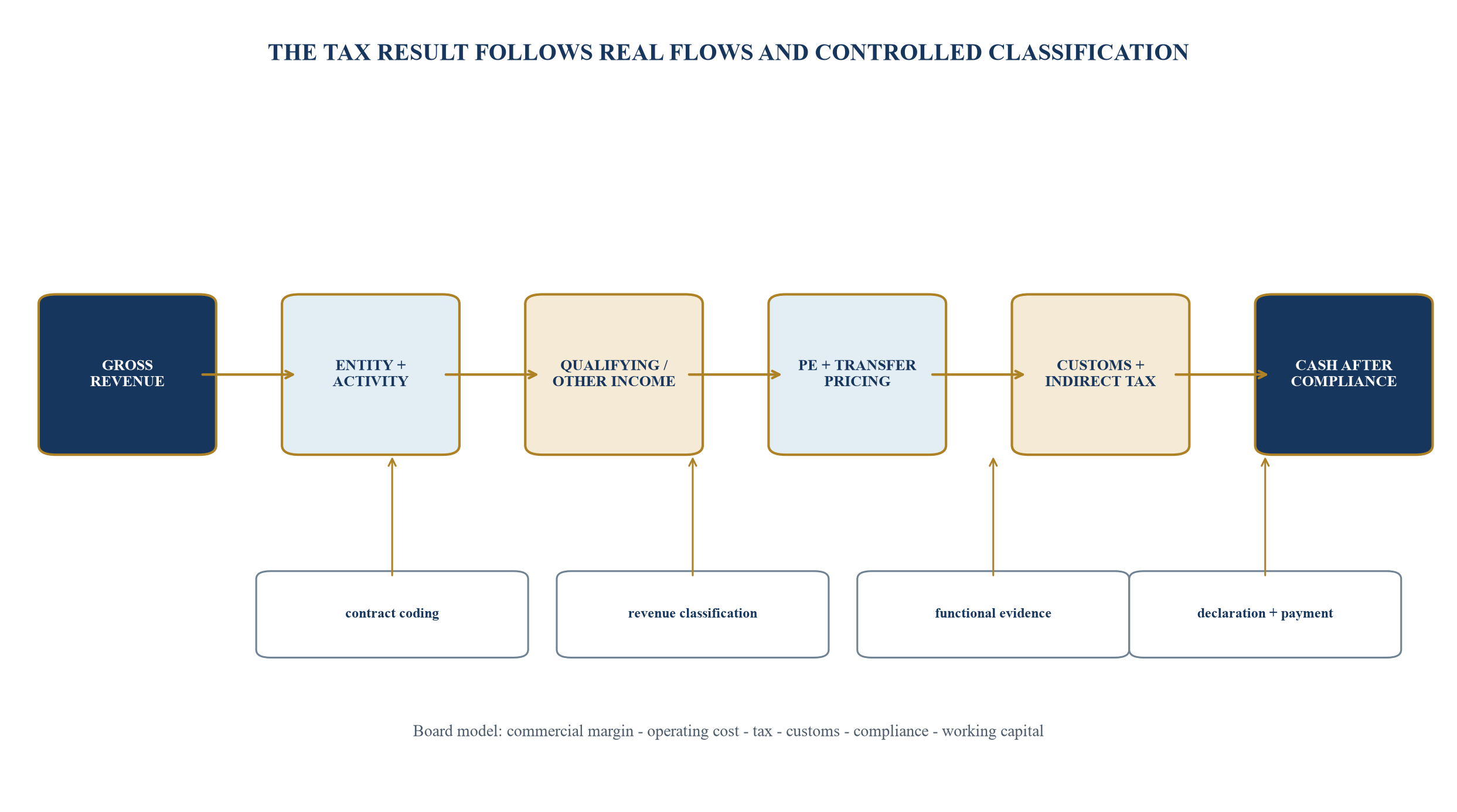
The bridge shows decision components. Amounts and tax outcomes require company-specific modelling.
10. Reconcile customs, inventory and working capital
Goods create a physical test of the structure. The customs declaration, importer, title owner, warehouse record, purchase order, customer invoice, payment and inventory ledger should tell the same story. The UAE's customs framework allows foreign goods to enter free zones and move to another free zone or outside the country under the applicable rules. Goods leaving a free zone for the customs territory are treated as foreign goods. The federal customs authority states that goods imported from free zones are subject to duty upon exit from those zones and describes a common 5 percent tariff on foreign goods, subject to classifications and exemptions.
The company should identify the importer of record, customs code, tariff classification, origin, valuation basis, permits, restricted-goods requirements and duty point for every product family. Free-trade agreements and certificates of origin can change treatment. Temporary admission, warehousing, processing or re-export can provide specific procedures when their requirements are met. Customs advisers should confirm the design before goods move.
Inventory ownership affects cash and risk. A free-zone company may hold regional stock while a mainland distributor buys goods for local sale. An alternative is a mainland operating company that imports and owns domestic inventory. Intercompany sale timing, transfer price, payment terms, insurance, obsolescence, warranty and returns change the working-capital case. The route model should quantify duty, VAT, clearance, storage, transport, credit days, stock days and trapped cash.
Systems must preserve traceability across perimeters. Item master data, legal entity, customs status, location, title, batch, landed cost and customer allocation should be visible. Manual spreadsheet transfers can fail as volume grows. A warehouse or enterprise-resource-planning design should be tested with sample transactions before launch, including returns, damaged goods, inter-emirate delivery and re-export.
The board should receive a customs and working-capital certificate before the first shipment. It should confirm that each movement has a lawful procedure, responsible entity, required registration, tested document pack, accounting treatment, cash funding and exception process. Margin should be reported after landed cost and working capital rather than at the initial intercompany invoice.
11. Align people, payroll and supervision
Employment architecture follows where people work, which entity employs them, who directs them and which activity they perform. A visa or payroll record is one part of the analysis. The role description, reporting line, customer work, premises, system access, cost allocation and decision authority should align with the employing entity and licensed perimeter.
The UAE labour framework and authority-specific free-zone employment regimes can differ. MoHRE governs the federal private-sector employment system outside the relevant free-zone regimes. Its Wages Protection System guidance requires covered establishments to pay agreed wages through approved financial channels. ADGM and DIFC maintain their own employment regulations for entities in those jurisdictions. Immigration and establishment services also depend on the licensing authority and location.
A dual footprint can create shared teams. Finance, HR, technology, legal and executive functions may support both entities. The company should document whether people are seconded, jointly serving, recharged or allocated by time and activity. Employment counsel should assess work-location and supervision rules. Transfer-pricing documentation should reflect the service. Employees should know which entity they can bind and which customer, data and banking systems they may access.
Senior management substance needs particular care. Board minutes, delegations and signatures should reflect actual decisions. A local general manager without budget, pricing, hiring or contract authority provides limited operational control. Conversely, one executive acting across several entities without explicit mandates can create governance confusion. The board should define reserved matters, delegations, conflict handling and evidence standards for each company.
The people plan should include hiring lead time, visas, medical and identity steps, premises capacity, payroll, benefits, pensions for eligible nationals, Emiratisation obligations where applicable, insurance, health and safety, training and termination costs. A route can appear capital-light while depending on roles that cannot lawfully or practically be deployed on the intended timetable.
12. Govern data and technology by actual processing
Data architecture should follow the purposes, systems and people involved in processing. Federal Decree-Law No. 45 of 2021 regulates personal-data processing within its scope and establishes rights and controller and processor duties. ADGM and DIFC have separate data-protection frameworks for entities in those jurisdictions. Sector rules can add requirements in financial services, healthcare, telecommunications and other activities.
The entity-allocation ledger should identify each material data set, data subjects, source, purpose, lawful basis, controller, processor, system, location, user access, retention, transfer and incident owner. Customer data can move between free-zone and mainland teams for sales, delivery, billing and support. The underlying contract and privacy notice should describe the actual roles. A generic group policy cannot cure an inaccurate controller map.
Technology contracts should allocate licences and responsibilities across entities. Enterprise software, cloud services, cybersecurity tools, customer platforms and intellectual property may be contracted centrally. The group should confirm that affiliates are permitted users, data transfers are covered, security obligations are met and costs are allocated. Regulated systems may require approval, local hosting, resilience or outsourcing controls.
The board should treat data access as an authority right. System roles can allow an employee to approve payments, change customer prices, export personal data or view another entity's confidential information. Access should follow job role and legal mandate. Joiner, mover and leaver controls should cover both entities, including contractors and shared services.
Before launch, the company should run a data-flow and incident exercise. The exercise should test whether staff can identify the controller, escalate a breach, preserve logs, notify the right authority and customer, restrict access and continue critical operations. The result should be recorded as evidence of operational readiness.
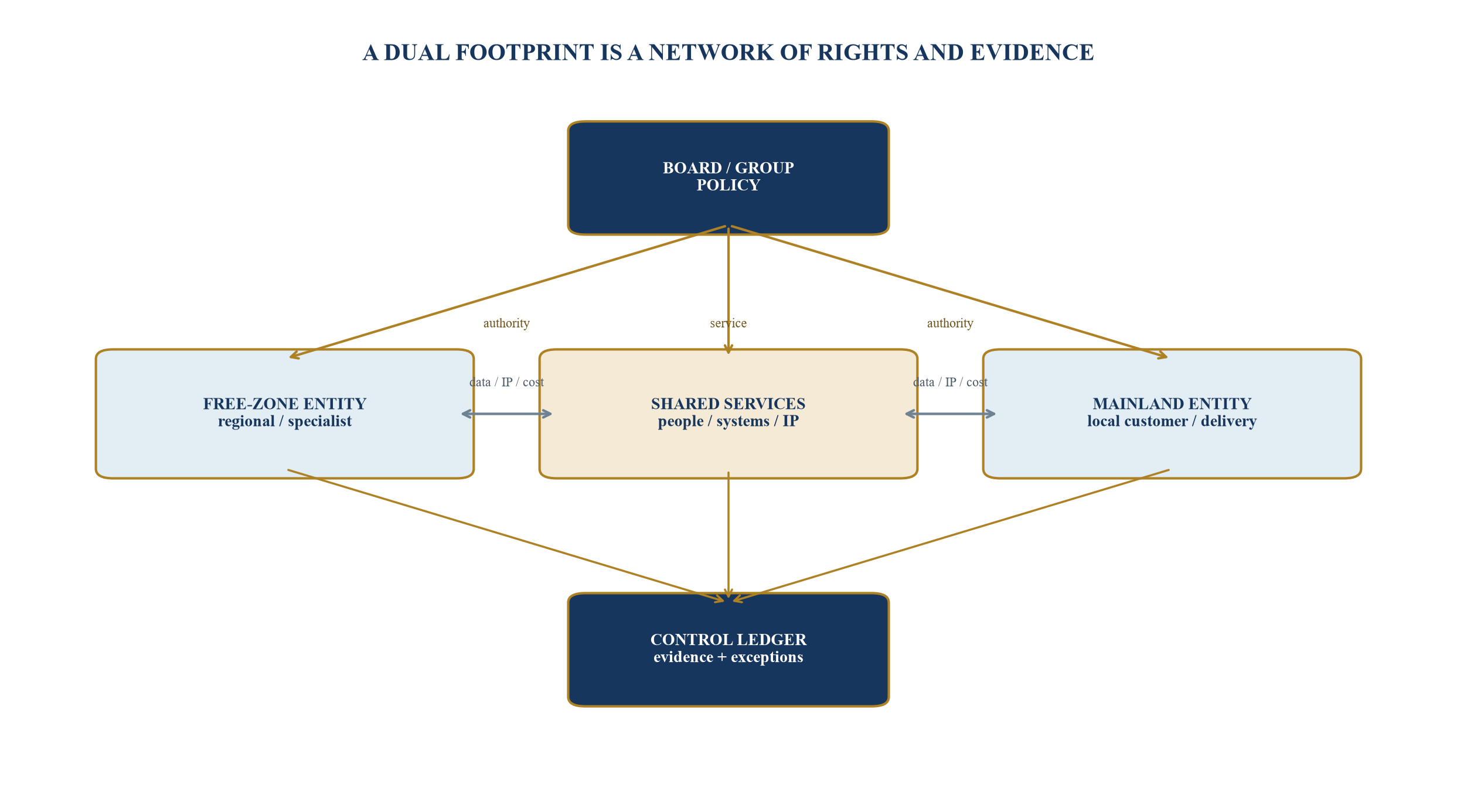
Every line should have a contract, system record, accountable owner and review cadence.
13. Design governance before incorporation
The governance model should exist before the entities begin signing contracts. Each board needs an approved purpose, reserved matters, delegation matrix, meeting calendar, information pack and recordkeeping standard. Parent and subsidiary decisions should be distinguished. Free-zone and mainland boards can share directors while still documenting each company's interests, solvency, obligations and conflicts.
Bank mandates, contract signatories and system permissions should follow the same delegation. A person authorised to negotiate may not be authorised to sign. A business leader may approve price within a band and require finance or board approval outside it. Intercompany agreements should receive the approvals required on both sides. Related-party decisions should record the commercial basis and conflicts process.
The governance calendar should cover licence renewals, tax returns, audited accounts, beneficial-ownership updates, confirmation statements, employee filings, insurance, customs guarantees, sector reports, data-protection obligations and contractual notices. Cabinet Resolution No. 109 of 2023 requires legal persons within scope to maintain real-beneficiary and ownership information and to update relevant records under its procedures. Financial free zones have their own beneficial-ownership regimes. The responsible company secretary or compliance owner should maintain the authority map.
The board should establish a footprint change committee for new activities, products, customer types, emirates, premises, warehouses, data uses, payment flows and management responsibilities. Commercial teams should submit a short impact form before committing to an out-of-perimeter transaction. Legal, tax, customs, HR, data and finance owners can then identify required permits, contracts, coding or approvals.
Internal audit should test conduct against the entity-allocation ledger. A sample can trace contract, licence, invoice, bank receipt, delivery evidence, employee, system access, tax code and accounting entry. Exceptions reveal whether the design is functioning. The board should review repeat exceptions as operating-model defects rather than isolated paperwork errors.
14. Compare branches and subsidiaries with international evidence
The branch-versus-subsidiary choice appears across major investment destinations. The comparison helps a board identify recurring design questions, although each jurisdiction has different law and tax. Singapore's Accounting and Corporate Regulatory Authority states that a foreign-company branch needs a locally resident authorised representative, a Singapore registered office and foreign-company filings. It distinguishes a branch from a subsidiary and requires disclosure of controllers and supporting foreign-company documents.
Companies House requires an overseas company to register a UK establishment when it opens a place of business or usually carries on business from a physical UK location. Current guidance requires registration within one month and ongoing updates. The UK distinguishes registration of the overseas company from incorporation of a UK subsidiary. Tax registration can arise even where Companies House registration does not, so the legal-presence and tax-presence tests need separate analysis.
The Australian Securities and Investments Commission requires a foreign company carrying on business in Australia to register, unless it uses an Australian incorporated subsidiary for that activity. A registered foreign company appoints a local agent and supplies certified corporate documents. The choice changes liability, governance and reporting. Saudi Arabia's investment-services manual likewise includes licences for foreign-company structures and states that a regional headquarters can be formed as a separate Saudi legal person or a registered branch.
The common board questions are transferable. Does the parent want direct liability or ring-fencing? Must the local platform have separate equity or financing? Which entity signs customers and employs people? What disclosures and financial statements become public or filed? Who is locally accountable? How are profits attributed and transactions priced? How easy is a future sale, joint venture or closure? The UAE decision should answer these questions through UAE law and facts, with the international examples used only as procedural comparators.
Table 4. Selected official branch and subsidiary comparators
| Jurisdiction | Official branch feature | Subsidiary alternative | Transferable board lesson |
|---|---|---|---|
| UAE | foreign branch follows federal and local approval and remains connected to parent | separate mainland or free-zone entity subject to its own rules | compare liability, activity, customer and filing effects |
| Singapore | foreign-company branch needs resident representative, office and foreign-company filings | locally incorporated company has separate corporate record | local accountability and disclosure affect route value |
| United Kingdom | physical UK establishment triggers overseas-company registration | UK subsidiary is incorporated separately | legal registration and tax presence are different tests |
| Australia | foreign company carrying on business registers and appoints local agent | Australian subsidiary can conduct local business | parent exposure and local governance should be explicit |
| Saudi Arabia | foreign-company and regional-headquarters routes include branch or company structures | separate legal personality is available for relevant licences | regional design should allocate real functions and authority |
The table identifies recurring design questions. It does not harmonise legal or tax outcomes across jurisdictions.
15. Quantify control burden and leakage
Dual structures can lose value through duplicated work, inconsistent data and unmanaged intercompany flows. Leakage can appear as delayed invoices, rejected customer onboarding, customs demurrage, non-creditable costs, tax adjustments, duplicated licences, idle visas, excess premises, contract re-papering, transfer-pricing disputes, bank restrictions or management time. The route case should include these items before the board approves the second perimeter.
Management should establish a control-cost baseline. Direct cost includes licences, registrations, offices, employees, audit, tax, customs, insurance, systems and advice. Indirect cost includes executive time, month-end reconciliation, policy maintenance, approvals, separate reporting and exception handling. Transition cost includes contract transfers, employee moves, data migration, banking, vendor onboarding and customer communication. Exit cost includes closure, de-registration, employee settlement, asset transfer and retained liabilities.
Control quality can be measured through exceptions. Useful indicators include contracts signed by the wrong entity, invoices reissued, receipts collected by another group company, people working outside their assigned perimeter, unallocated shared-service cost, intercompany balances past due, customs-document mismatch, tax-code override, unreviewed data transfer and expired authority. Each exception should have a root cause and financial or risk consequence.
The board should set a minimum value-to-complexity ratio. Management can estimate incremental gross profit or risk-adjusted strategic value attributable to the second perimeter and divide it by fully loaded incremental cost. This is a management model, not a valuation conclusion. The ratio should be stress-tested for slower revenue, higher headcount, lower margin and delayed permits. A structure that fails the hurdle should be simplified or staged.
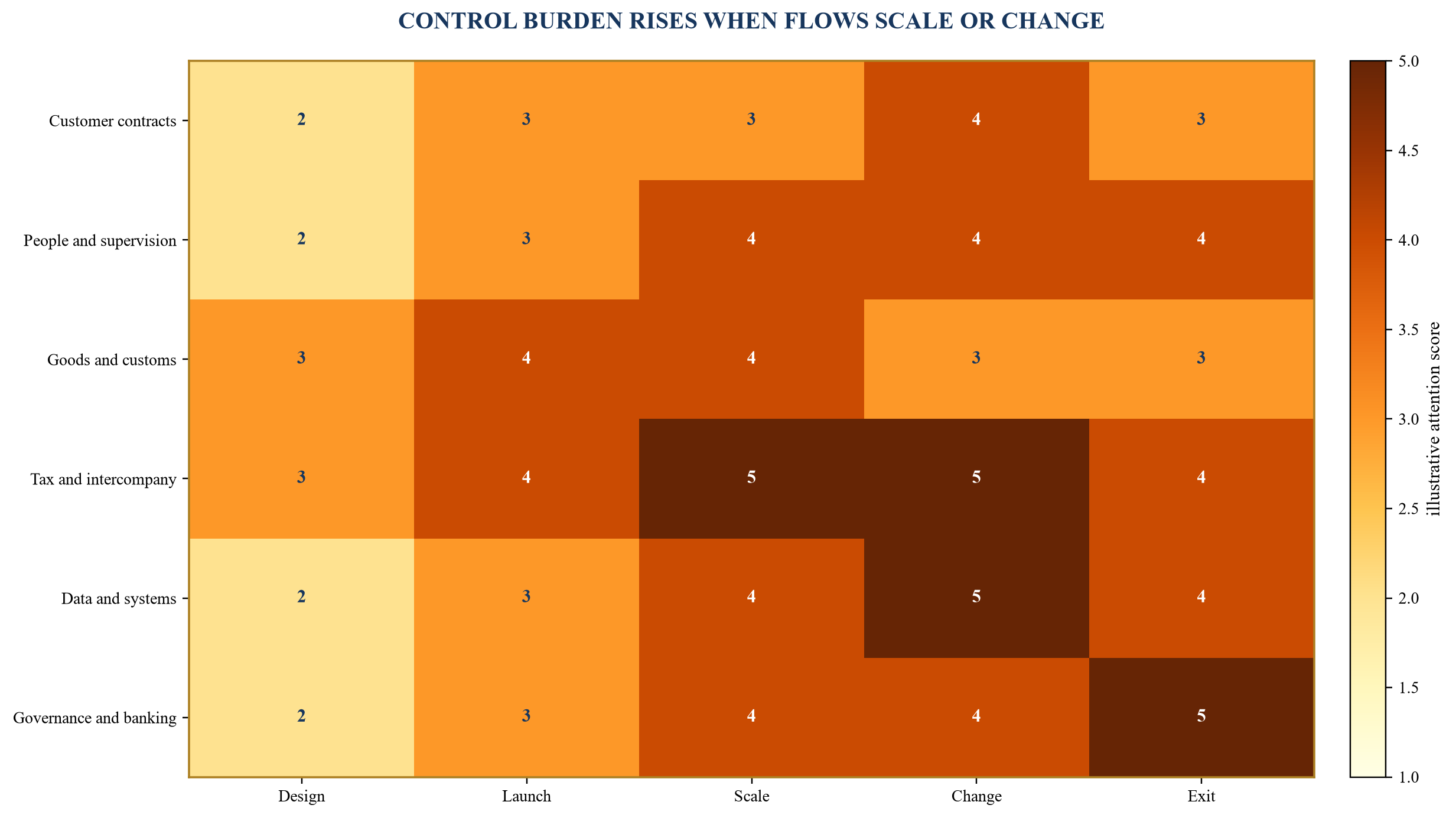
Scores are illustrative management ratings. The board should replace them with evidence from its operating model.
Table 5. Dual-footprint control register
| Control | Evidence | Owner | Review trigger |
|---|---|---|---|
| licence-to-activity check | approved activity map and current licences | legal and compliance | new product, customer or location |
| contract entity check | proposal, contract, delivery and invoice entity agree | commercial operations | every material contract |
| employee perimeter check | sponsor, employer, role, location, supervision and recharge | HR and business owner | hire, transfer or role change |
| customs trace | title, code, declaration, stock and customer invoice reconcile | supply chain and finance | every shipment class and exception |
| revenue classification | contract, counterparty, activity and tax code supported | tax and finance | invoice creation and monthly close |
| intercompany pricing | service, asset, risk, charge and evidence reconcile | tax and controller | quarterly and policy change |
| data-role check | controller, processor, access, transfer and retention documented | privacy and technology | new system, purpose or vendor |
| authority check | board, delegation, signatory and bank mandates align | company secretariat | appointment or limit change |
Frequency should reflect volume, risk, licence conditions and system capability.
16. Stage implementation through evidence gates
A six-month implementation roadmap can move from design to stable operation through explicit gates. The period is an illustrative management assumption. Actual timing depends on activity, emirate, regulator, documentation, banking, premises, people, customer and technology requirements. Management should plan backwards from the first lawful customer transaction.
During days 0 to 30, the team should freeze the value-chain map, customer evidence, activity classification, route shortlist and professional-advice scope. It should identify authorities, premises, people, customs, data and banking dependencies. The board approves the route hypothesis and a bounded design budget.
During days 31 to 60, management should complete legal and tax analysis, entity and branch decisions, licence applications, beneficial-ownership documents, premises selection, contract templates, banking pack, immigration plan and systems design. The gate is a signed architecture memorandum with unresolved items, decision owners and a total-cash model.
During days 61 to 120, the business completes licences and registrations, bank and tax setup, premises, employment, customs, insurance, intercompany agreements, accounting dimensions, data roles and customer onboarding. It should run sample order-to-cash, procure-to-pay, payroll and shipment transactions. The gate is an operating-readiness certificate rather than a certificate of incorporation.
During days 121 to 180, the company launches within a controlled perimeter, monitors exceptions and reconciles the first closes. Internal audit traces sample transactions, and management tests the expansion triggers for any permit, branch or second entity. The board receives actual cost, revenue evidence, compliance status and a recommendation to scale, revise or pause.
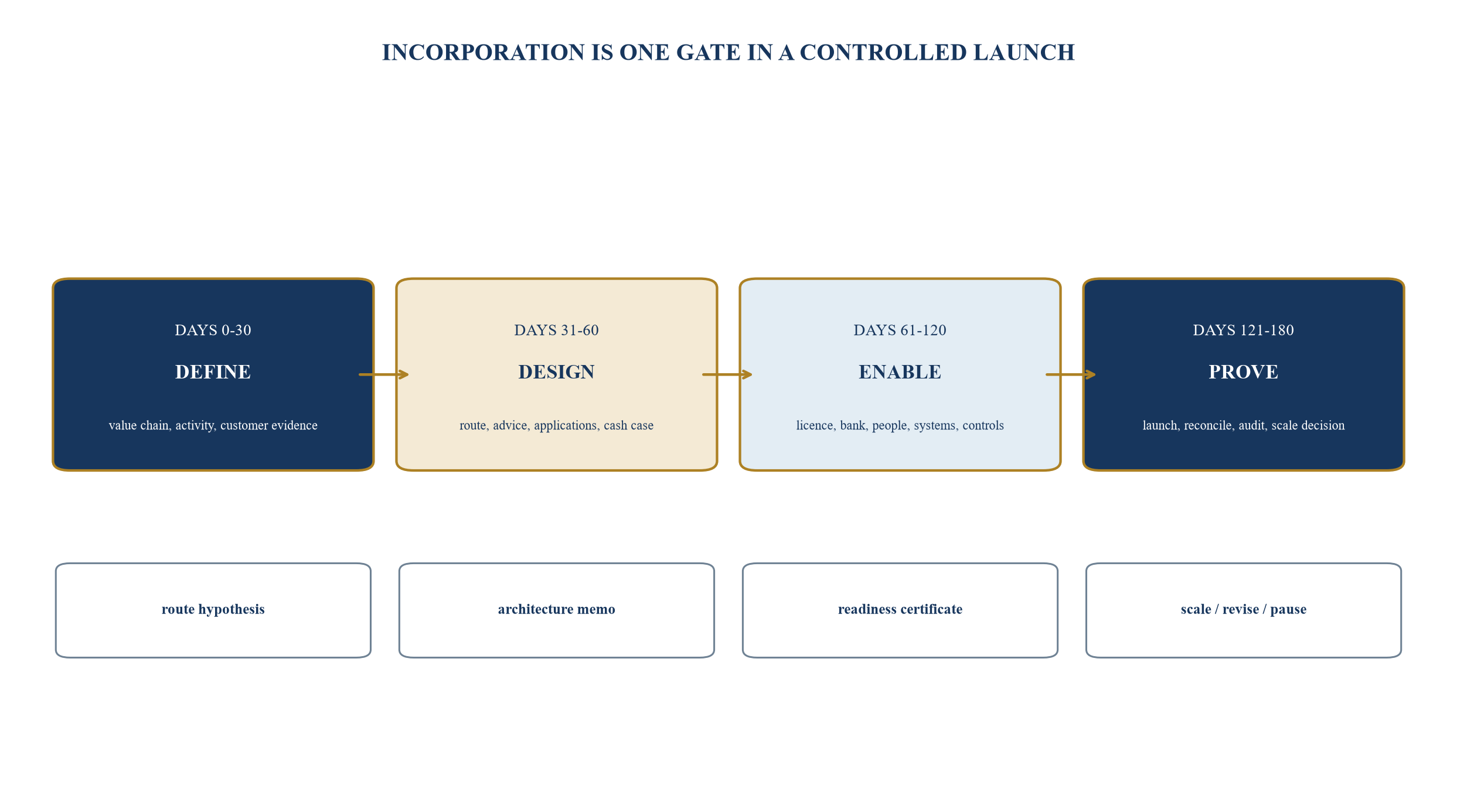
Timing is an illustrative management design. Authority and business dependencies determine the actual sequence.
17. Make the board dashboard source-linked
The board dashboard should report whether the company can lawfully operate, earn, collect and control risk through the selected footprint. It should separate design completion, authority status, operating readiness, commercial proof, cash and exceptions. Every status should link to evidence and have a named owner.
Revenue should be reported by contracting entity, activity, customer type and location. Management should show rejected bids or onboarding caused by the footprint, contracts awaiting permits, revenue booked outside policy and customer concentration. This reveals whether the architecture is creating access or friction.
Cost should include setup cash, recurring direct cost, shared-service allocation, tax, customs, working capital and executive time. Variance to the approved route case should be explained. Intercompany balances, late invoices and unreconciled receipts deserve separate visibility because they can indicate operating and tax-control weaknesses.
Readiness should cover licences, banking, people, premises, customs, data, insurance, systems and governance. A green status means the evidence threshold is met. An unresolved dependency should remain visible even when management expects it to close soon. Expansion should be approved only after the existing perimeter produces reliable operating data.
Table 6. Board operating-architecture dashboard
| Dashboard item | Green evidence | Amber trigger | Red trigger | Board question |
|---|---|---|---|---|
| licence and activity | current licence covers tested activity and place | interpretation or permit open | revenue activity outside approved perimeter | can the business lawfully perform? |
| customer access | target procurement routes verified | material onboarding dependency open | core customer segment rejects route | does the footprint support the thesis? |
| people and authority | roles, employer, location and delegations align | shared role lacks complete evidence | shadow employment or authority mismatch | who controls and binds each entity? |
| tax and intercompany | revenue codes, PE analysis and charges reconciled | limit or documentation headroom narrows | qualifying status or material position unsupported | is after-tax value still credible? |
| customs and inventory | declarations, title and ledgers reconcile | manual exception or delay rising | unregistered or unsupported movement | is landed margin reliable? |
| data and systems | roles, access and transfers approved | remediation open within tolerance | unlawful or uncontrolled processing concern | can operations continue safely? |
| cash and cost | route case reconciles to actuals | cost or working capital above threshold | funding gap or value hurdle failed | scale, redesign or pause? |
| control exceptions | resolved within service level and root cause closed | repeat exception emerges | material breach or systemic failure | what operating-model change is required? |
Thresholds should be approved before launch and supported by dated evidence.
18. Set a route decision rule
The board should select the route that provides the required operating rights with the highest risk-adjusted value and a control burden the organisation can sustain. The decision pack should include the value-chain map, authority and activity evidence, entity-allocation ledger, customer proof, total-cash model, tax and customs analysis, people and data architecture, implementation plan and downside cases.
A mainland route should be approved when direct domestic execution is material and the single perimeter can support the activity, customers, people and assets. A free-zone route should be approved when the zone's specialist purpose, export orientation, legal framework or ecosystem creates measurable value and the intended customer and delivery flows remain lawful. A permit or dual footprint should be approved when the second perimeter unlocks a defined revenue, regulatory or risk benefit that exceeds its recurring and transition burden.
The approval can be conditional. Management may need to obtain a written activity confirmation, validate procurement eligibility, secure premises, complete a tax opinion, test customs flows, agree intercompany contracts, obtain bank approval or close a data-control gap. Each condition should have a named certifier and deadline. Capital should be released in stages tied to evidence.
The route should be reviewed when the business changes. Triggers include a new activity, regulated service, physical product, government customer, emirate, warehouse, data category, senior decision-maker, financing arrangement, acquisition or material revenue mix. The original incorporation decision cannot govern a business that has moved beyond its assumptions.
The final resolution should name the route sponsor, implementation executive, legal and tax advisers, approved capital, evidence gates and reporting cadence. It should also state the activities and commitments management may not undertake before each gate. This creates a usable boundary for commercial teams and gives the board an auditable record of the assumptions that supported its decision.
19. Limitations and professional-use boundary
This paper reflects official sources available in August 2026. UAE federal and local legislation, authority procedures, free-zone rules, activity lists, permit eligibility, fees, corporate-tax decisions, customs procedures, employment rules and data requirements can change. Official English translations and website guidance should be checked against the legally operative text and current authority instructions.
The appropriate footprint depends on complete facts concerning activities, customers, emirates, goods, people, premises, assets, data, contracts, licences, ownership, management, tax residence, related parties and financing. A small factual change can affect the licence, permanent-establishment, customs, employment, data or regulatory result. Financial services and other regulated sectors require specialist analysis.
Illustrative route scores, periods, cost components, value hurdles and control designs are management assumptions for decision architecture. They are not forecasts of authority timing, tax outcomes, customer acceptance, revenue, profit, valuation or investment return. Commercial demand, retainer potential and collected revenue remain uncertain until evidenced by signed contracts, delivered work and cash collection.
The Singapore, United Kingdom, Australia and Saudi Arabia sections are procedural comparators. They do not determine the UAE route or any foreign filing, tax or legal obligation. Local advisers should confirm the position in every relevant jurisdiction.
This paper does not constitute legal, regulatory, tax, customs, accounting, employment, immigration, data-protection, cybersecurity, financing, investment or other professional advice. Boards should obtain current advice based on the complete operating model and retain responsibility for information, approvals, contracts, implementation and compliance.
Sources and further reading
- UAE Government, Running a Business in a Free Zone Official source
- UAE Legislation, Federal Decree-Law No. 32 of 2021 on Commercial Companies Official source
- UAE Legislation, Federal Decree-Law No. 32 of 2021, Official Download Official source
- Ministry of Economy and Tourism, Companies Services Official source
- Ministry of Economy and Tourism, No Requirement for National Agents Official source
- Ministry of Economy and Tourism, Initial Approval for Foreign Company Branch Official source
- Ministry of Economy and Tourism, Register Branch of Foreign Establishment Official source
- Ministry of Economy and Tourism, Ministerial Decision No. 138 of 2024 on Foreign Branch Procedures Official source
- Ministry of Economy and Tourism, 100 Percent Company Ownership Official source
- Dubai Media Office, Executive Council Resolution No. 11 of 2025 Official source
- Dubai Media Office, Free Zone Mainland Operating Permit Official source
- Dubai Media Office, Dubai Unified Licence Official source
- Abu Dhabi Department of Economic Development, Licensing Requirements Official source
- Abu Dhabi Department of Economic Development, Mainland and Free Zones Official source
- Federal Tax Authority, Free Zone Persons Guide Official source
- Federal Tax Authority, Corporate Tax Guide on Free Zone Persons Official source
- Federal Tax Authority, Corporate Tax General Guide Official source
- Federal Tax Authority, Transfer Pricing Guide Official source
- Federal Tax Authority, Tax Returns Guide Official source
- Federal Tax Authority, Corporate Tax Registration Official source
- Federal Authority for Identity, Citizenship, Customs and Port Security, GCC Customs Union Official source
- Federal Authority for Identity, Citizenship, Customs and Port Security, Unified Customs Law Official source
- Ministry of Human Resources and Emiratisation, Wages Protection System Official source
- UAE Legislation, Cabinet Resolution No. 109 of 2023 on Real Beneficiary Procedures Official source
- UAE Legislation, Federal Decree-Law No. 45 of 2021 on Personal Data Protection Official source
- ADGM, Setting Up Official source
- ADGM, Legal Framework Official source
- DIFC, Establish a Business Official source
- DIFC, Registrar of Companies Official source
- Jebel Ali Free Zone, Rules and Regulations Official source
- Singapore ACRA, Registering as a Foreign Company Branch Official source
- UK Companies House, Register as an Overseas Company Official source
- Australian Securities and Investments Commission, Foreign Companies Official source
