

1. Fund-level foreign-exchange risk is a cash-sequencing problem
A private-market fund does not experience currency risk through a continuously tradable portfolio alone. It signs transactions, calls capital, pays consideration, services local debt, funds follow-ons and receives exits on different dates. Commitments may be denominated in the fund's base currency while assets and liabilities sit in currencies that have shallower markets, wider bid-offer spreads or capital controls. A valuation gain in local currency may coexist with a cash shortage in the currency needed to settle a hedge.
This timing distinction matters. A committed acquisition creates a relatively certain near-dated need. A pipeline opportunity is a probability-weighted exposure. A portfolio company's expected dividend may be delayed by performance, governance, tax, regulatory approval or cash preservation. An exit distribution can change in amount and date until closing. Net asset value is a reporting measure that moves with operating performance, valuation inputs and exchange rates. Treating these items as interchangeable encourages over-hedging and unnecessary liquidity risk.
The global foreign-exchange market provides deep liquidity in major currencies, yet stress is uneven. The International Monetary Fund reports that macrofinancial uncertainty can widen bid-offer spreads, increase foreign funding and hedging costs and amplify exchange-rate volatility, with more pronounced effects in emerging-market currencies [1]. The Bank for International Settlements describes FX swaps as collateralised borrowing arrangements and notes that most outstanding contracts are short dated and commonly involve the US dollar [2]. A fund that rolls short hedges against long-lived assets therefore depends on recurring market access and cash at each rollover.
The governing question is not simply how much currency risk to remove. The investment committee needs to know which cash flow requires protection, when its amount becomes sufficiently certain, what happens if the underlying transaction moves, where collateral will come from, which entity can trade and whether the fund can survive a stressed settlement date. The treasury response should preserve the fund's capacity to invest and honour obligations under ordinary and adverse conditions.
The recommended operating model begins with a dated exposure register. Each item records the legal entity, asset or liability, currency, direction, amount, expected date, probability, source evidence, hedge instrument, counterparty, settlement method and accounting treatment. The register feeds a liquidity ladder that covers cash, callable commitments, notice periods, credit facilities, expected distributions, hedge collateral and minimum reserves. Hedge approval follows the ladder rather than preceding it.
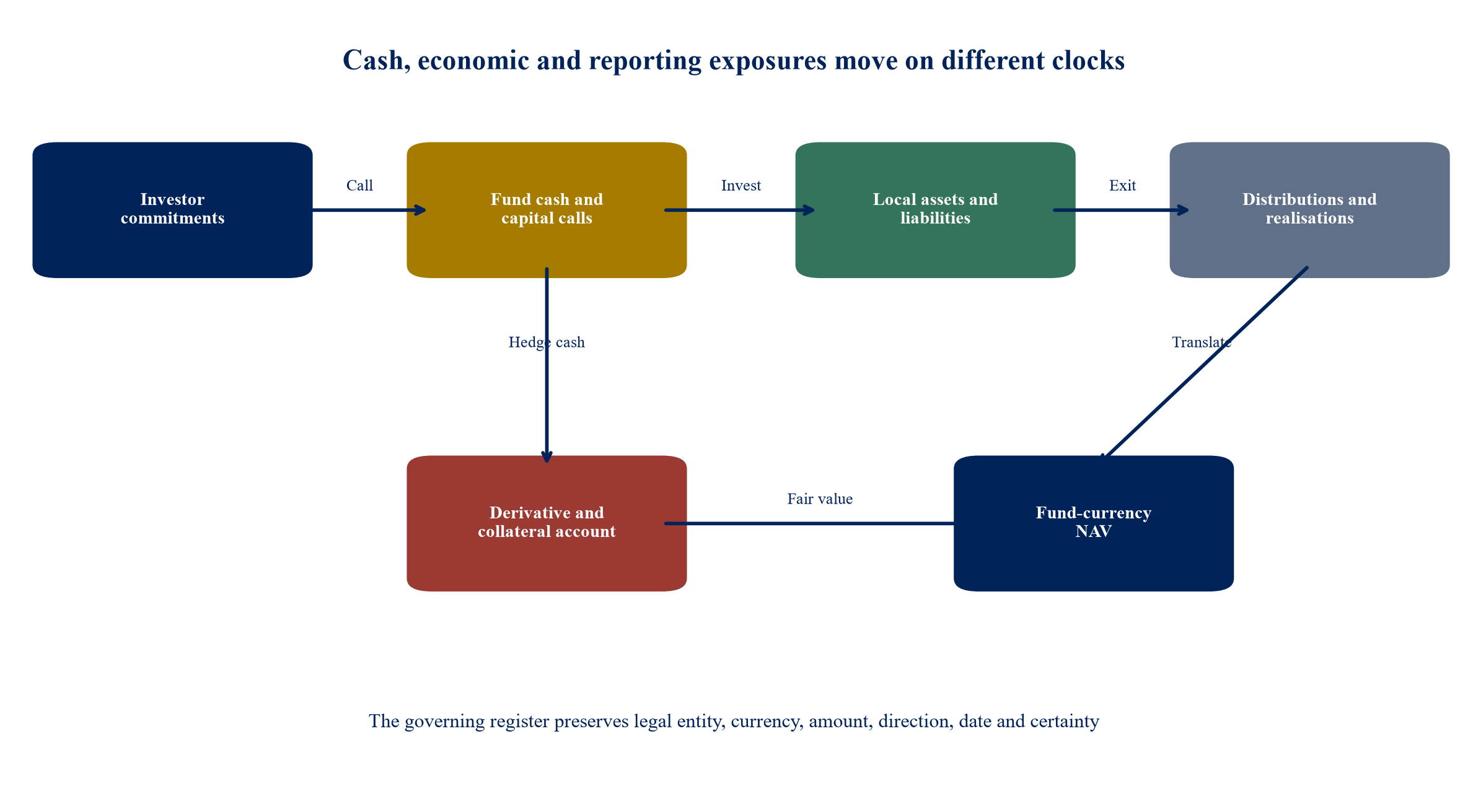
The framework is author-designed. Arrows represent distinct cash, economic and reporting exposures rather than a single net position.
This approach does not eliminate currency volatility. It makes risk ownership and liquidity consequences visible. It also allows the manager to explain why a contracted acquisition may be hedged more fully than a possible exit, why a portfolio NAV may remain partly unhedged and why collateral reserves cannot be counted simultaneously as acquisition cash.
2. Five exposure classes require different decisions
Transaction exposure arises from a contractual or highly probable foreign-currency cash flow. Examples include purchase consideration, deferred consideration, portfolio-company funding, debt service, fees and sale proceeds. Its defining attributes are direction, amount and date. Once these become sufficiently certain, a forward or funded currency position can match the cash flow. Before certainty, an option or staged hedge can reduce the risk of paying for currency that the fund may never need.
Commitment exposure arises because investors commit and fund capital in an agreed currency while the portfolio requires others. The manager can call additional base-currency capital when a local-currency purchase becomes more expensive, subject to remaining commitments, notice periods and concentration limits. This is economic capacity rather than immediate liquidity. An uncalled commitment cannot settle tomorrow's margin call until the call is validly issued, received and paid.
Distribution exposure works in the opposite direction. Local proceeds may eventually repay a base-currency facility, fund another investment or return capital to investors. The date and amount are often less certain than an acquisition payment. Selling the expected currency too early can create a short position if the disposal slips or consideration is reduced. The hedge policy should require milestone evidence, permitted hedge ratios and a cancellation plan.
NAV translation exposure arises when local-currency assets are measured and translated into the fund's reporting currency. A translation loss can reduce reported performance without creating an immediate cash outflow. A derivative that offsets this accounting movement can require real cash. A manager may hedge a portion of NAV to reduce economic or reporting volatility, but the hedge horizon, valuation uncertainty and liquidity cost should be explicit.
Collateral and funding exposure is created by the hedge itself. A bilateral or cleared derivative may require initial or variation margin, independent amount, premium or settlement cash. A deliverable forward requires both currencies at maturity. A non-deliverable forward settles the difference in a specified currency. A swap creates near and far legs. Counterparty thresholds, legal netting and eligible collateral affect the amount and timing. These obligations must sit in the same liquidity model as investments and expenses.
Table 1. Exposure register and decision evidence
| Exposure class | Typical event | Core evidence | Primary risk | Hedge decision |
|---|---|---|---|---|
| Contracted transaction | Acquisition, follow-on or debt payment | Signed agreement, currency, amount, conditions and settlement date | Currency move before payment | Match amount and date, with contingency for delay |
| Probable transaction | Pipeline deal or expected exit | Approval stage, probability, valuation range and timetable | Over-hedge if event fails or changes | Layer or use optional protection |
| Commitment liquidity | Capital called from investors | LPA authority, uncalled balance, notice period and investor concentration | Cash arrives after hedge or acquisition settlement | Treat callable capital by earliest reliable date |
| Distribution liquidity | Dividend, refinancing or disposal proceeds | Board approval, closing conditions, tax and remittance route | Proceeds arrive late or net amount falls | Hedge only evidenced portion and preserve unwind capacity |
| NAV translation | Period-end value of foreign asset | Valuation file, functional currency and reporting policy | Reported volatility and economic currency exposure diverge | Set strategic ratio and rebalance threshold |
| Derivative collateral | Margin, premium or close-out amount | Trade confirmation, CSA, threshold, haircut and settlement terms | Hedge creates same-day cash demand | Reserve collateral separately and stress wrong-way moves |
The classification is author-designed. Legal documents, market convention and governing regulation determine the final treatment.
The register prevents one number from doing several jobs. A USD 20 million translated NAV is not equivalent to a USD 20 million contracted purchase. A USD 20 million expected distribution is not equivalent to USD 20 million of cash. The manager should report gross items before netting because two opposite exposures may have different entities, dates, legal rights and probabilities.
3. The currency map should follow legal entities and settlement paths
Fund-level netting begins with entity-level authority. A master fund, feeder, blocker, acquisition vehicle and portfolio company may each have different bank accounts, derivative permissions, borrowing limits, tax positions and capital-control constraints. Cash that exists elsewhere in the structure may not be transferable on the required date. The currency map should identify ownership, bank, jurisdiction, signing authority and permitted use for every cash balance and facility.
The fund agreement should be read alongside side letters, subscription documents, investment restrictions and borrowing provisions. These documents determine the commitment currency, call mechanics, default remedies, recallability, permitted temporary borrowing and allocation of hedge costs. The Investment Limited Partners Association recommends estimates of quarterly capital calls and distributions and disclosure of fund-level leverage and subscription facilities [3]. Its 2025 capital-call and distribution template improves the reconciliation of notices, commitments and cash movements [4]. A currency programme should use the same source records.
Portfolio-company currency may differ from the holding vehicle's functional currency and the fund's reporting currency. Revenue, costs, debt and exit proceeds can create an economic exposure that is only partly reflected by the denomination of the equity instrument. A business with local-currency revenue and dollar debt has a different risk from one with dollar-linked revenue and local debt. Investment underwriting should state which layer bears each currency mismatch.
Emerging-market restrictions require an executable settlement route. Some currencies are deliverable offshore, some rely on non-deliverable forwards, and some require documentation, purpose codes, local accounts or regulatory approvals. Convertibility, transferability and market depth can change during stress. The hedge memo should identify the actual instrument, settlement currency, fixing source, holiday calendars and fallback provisions rather than assume a generic forward is available.
The map should also show concentration by dealer and settlement bank. A fund with several trades may believe it has diversified market exposure while relying on one counterparty for limits or one bank for payments. Legal netting can reduce exposure within a master agreement, but netting across entities or counterparties may not be available. Treasury should maintain gross settlement capacity where payment-versus-payment protection is absent.
4. Risk appetite should define what is protected and what remains exposed
A policy should state the objective before setting a hedge ratio. Possible objectives include protecting committed purchase prices, preserving minimum return in the fund currency, stabilising distributable cash, controlling reported NAV volatility, limiting covenant exposure or protecting a minimum liquidity reserve. One programme can pursue several objectives, but each trade needs an identified exposure and decision owner.
Near-dated contracted cash flows can justify a high hedge ratio because amount and timing are supported by documents. Pipeline exposures may use lower ratios that increase at signing, regulatory clearance and closing. Exit proceeds may be hedged in layers as buyer financing, approvals and settlement certainty improve. Strategic NAV hedges may use a band around a target rather than continuous rebalancing, reducing turnover when private valuations move slowly.
The policy should set permitted instruments, currencies, maturities, counterparties, credit limits, collateral forms, minimum liquidity, valuation sources, reporting frequency and exception authority. It should prohibit speculative positions and require a traceable link between every trade and an approved exposure. It should also define whether hedges can be executed at fund, feeder, holding-company or portfolio level and how costs and gains are allocated.
Hedge ratios need both a numerator and denominator. A 70 percent hedge can refer to local invested cost, current fair value, committed purchase price, expected proceeds or net economic exposure. The chosen basis should be stated. Rebalancing thresholds should reflect valuation uncertainty and transaction costs. A fund should not trade frequently to chase an imprecise quarterly valuation.
Governance should separate investment conviction, treasury execution, valuation and independent review. The investment team supplies transaction dates and probabilities. Treasury models cash and obtains prices. Risk reviews exposure, counterparty and collateral. Finance records valuations and accounting. The investment committee or delegated risk committee approves material limits and exceptions. Reconciliations should reach the administrator, custodian or depositary where applicable.
5. Instruments allocate timing, optionality and liquidity differently
A deliverable forward fixes the exchange rate for a future purchase or sale of currency. It can match a known cash flow efficiently, yet a delayed transaction may require extension or close-out. The fund can owe cash when the forward has negative value. The forward is therefore appropriate only when the underlying amount, date and deliverability are sufficiently clear and the fund can meet settlement obligations.
An FX swap exchanges currencies now and reverses the exchange later. It can bridge timing between a local payment and a later capital call, distribution or refinancing. The BIS explains that an FX swap is economically similar to collateralised borrowing even though accounting conventions may record it off balance sheet [2]. The fund should include the far-leg obligation in debt and liquidity reporting even where statutory presentation differs.
A non-deliverable forward settles a currency difference in a convertible settlement currency. It can address exposure where physical delivery is restricted or impractical. It does not itself provide the local currency needed for an acquisition. The fund still needs a deliverable funding route, local borrowing or spot conversion. Fixing-source disruption and basis between onshore and offshore prices require specific controls.
An option sets a worst-case exchange rate while preserving favourable movement. The premium is an upfront and certain cost. Options can suit uncertain acquisitions, exits or distribution amounts because failure of the underlying event does not create the same directional obligation as a forward. Collars can reduce premium by surrendering part of the favourable outcome. Their payoff, barriers and settlement terms should be understood without reliance on a headline zero-cost label.
Natural hedging matches inflows and outflows in the same currency. A fund can retain local distributions for follow-ons, borrow locally against local cash flows or sequence acquisitions and exits. This reduces derivative notional while creating asset-liability, duration or credit risk. Cash should remain available to the entity that needs it, and the manager should not retain excessive balances solely to avoid conversion.
Table 2. Hedge and funding instruments by decision need
| Instrument | Best matched exposure | Cash requirement | Main advantage | Main failure mode |
|---|---|---|---|---|
| Deliverable forward | Known purchase or distribution | Currency delivery or close-out at maturity | Rate certainty and direct cash-flow match | Underlying event is delayed, resized or cancelled |
| FX swap | Short timing gap between two currency cash flows | Initial exchange and far-leg repayment | Combines currency conversion and temporary funding | Rollover market tightens or far leg is overlooked |
| Non-deliverable forward | Restricted or non-deliverable currency exposure | Net cash settlement in specified currency | Offshore hedge access | Does not deliver local acquisition cash; fixing basis widens |
| Purchased option | Uncertain transaction or proceeds | Upfront premium | Limits downside while preserving upside and event flexibility | Premium is high or structure is too complex |
| Collar | Exposure with a tolerable range | Premium can be reduced through sold option | Defines a band | Sold option creates obligation and caps favourable outcome |
| Local borrowing | Local asset with local cash generation | Interest, principal and security | Matches currency and operating cash | Refinancing, covenant and trapped-cash risk |
| Natural offset | Recurring same-currency inflows and outflows | Working cash retained locally | Lowers derivative notional | Dates, entities or amounts fail to match |
Pricing and suitability depend on market conditions, legal capacity, accounting, tax and counterparty terms.
Instrument selection should follow a scenario comparison. The manager should model spot outcome, hedge payoff, premium, carry, forward points, basis, transaction costs, collateral, tax, accounting and operational capacity. A cheap-looking instrument can be expensive after rollover and liquidity are included. Optionality has value when the underlying cash flow is uncertain.
6. Commitment pacing must include currency and notice-period risk
Commitment pacing usually estimates acquisitions, follow-ons, fees, distributions and reserves. A cross-border fund adds currency conversion and hedge settlement dates. Each expected use should have a base-currency amount, local-currency amount, probability and earliest and latest date. The model should distinguish cash already held, capital legally callable, capital expected after notice, facility availability and uncommitted financing.
ILPA Principles recommend a reasonable capital-call response window and quarterly forecasts [3]. The legal notice period may still be longer than a margin call or acquisition settlement. Investor concentration also matters. If a small number of investors fund a large portion of a call, administrative delay or default can create a currency shortfall. The liquidity model should haircut callable commitments by timing and concentration rather than treat them as same-day cash.
Subscription facilities can bridge a valid call after commitments have been admitted and lender conditions are met. They can reduce the timing gap between an acquisition and investor receipts. They do not remove currency exposure unless the borrowing and use are matched. A dollar facility funding a rupee purchase still requires conversion or a derivative. A local-currency borrowing may improve the match while increasing cost, security and refinancing risk.
The liquidity ladder should show daily buckets around large transactions and weekly or monthly buckets farther out. Sources should be ranked by certainty. Cash and committed undrawn facilities with satisfied conditions rank above capital calls that have not been issued. Forecast distributions rank below signed sale proceeds with completed conditions. Each source should appear once.
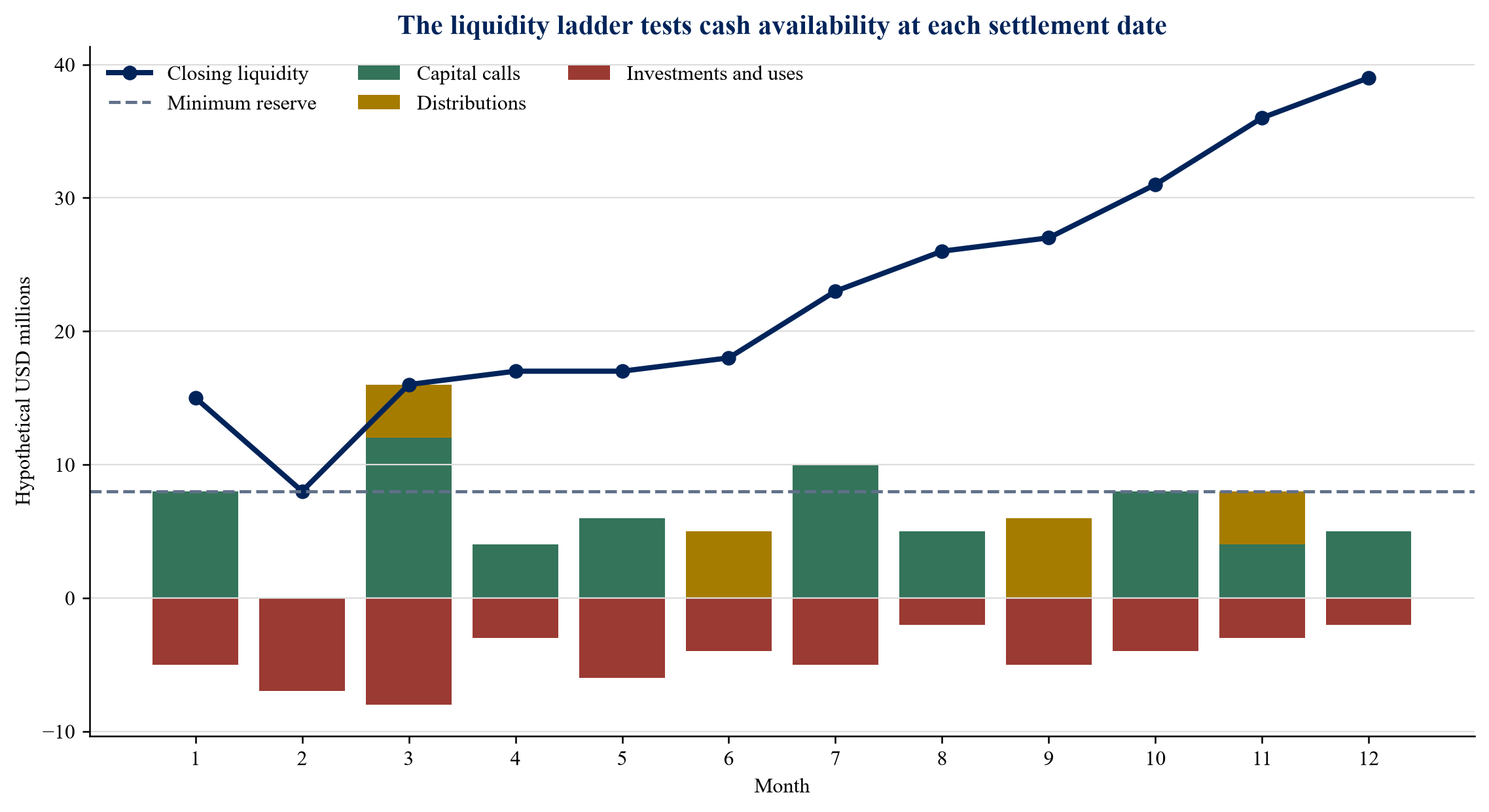
The timing profile is illustrative. The controlling measure is cash available by currency and legal entity on each settlement date.
A minimum reserve should cover operating costs, plausible derivative collateral and transaction disruption. The reserve cannot be simultaneously allocated to a purchase and a hedge. The investment committee should see liquidity after the proposed trade and after a combined shock, including a weaker base currency, late investor receipts and delayed distributions.
7. Distribution hedging should follow closing evidence
Expected distributions can fund capital calls, repay facilities or support investor liquidity. Their uncertainty requires a milestone policy. An ordinary dividend may require board approval and solvency. A refinancing distribution depends on lender diligence and documentation. A sale depends on purchase-price adjustment, regulatory approvals, buyer funding and settlement. Tax leakage, escrow, earn-out and remittance restrictions can reduce immediately available cash.
A layered approach can hedge a small portion after signing, add coverage after material conditions are satisfied and complete the hedge near settlement. The fund should retain unwind capacity for delay or failure. An option may be preferable when date or amount remains wide. A forward may be efficient when settlement is fixed and failure risk is low.
Natural netting should use dated gross flows before aggregation. A local-currency distribution scheduled three months after a same-currency acquisition does not fund the acquisition unless bridge liquidity exists. A distribution to one vehicle may not be transferable to another. Netting is valid only when entity, currency, amount, date and legal use align.
Distribution notices should reconcile gross proceeds, costs, tax, debt repayment, hedge settlement and net cash. Investors should be able to distinguish investment return from currency gain or loss and financing effects. The fund's performance policy should state whether hedge results are allocated to a specific investment, currency sleeve or the fund generally.
8. Collateral can turn a successful hedge into a liquidity failure
A hedge can be economically effective while producing a cash demand before the protected asset generates proceeds. Variation margin reflects market movement. Initial margin or independent amount protects counterparty exposure. Haircuts reduce the collateral value recognised. A derivative close-out can accelerate payment. These requirements are separate from the fund's eventual gain on the underlying asset.
Stress should combine market movement, dealer terms and timing. If the base currency weakens before a foreign-currency acquisition, the hedge may gain value and support the purchase. If the fund hedges foreign asset NAV by selling the local currency and that currency strengthens, the derivative may require cash while the asset's translated value rises. The value increase is illiquid. The margin call is immediate.
The Basel Committee notes that replacement of a failed FX transaction can become a liquidity problem when the required currency cannot be obtained in time [5]. The Financial Stability Board has highlighted leverage and liquidity vulnerabilities in non-bank finance, including the role of margin and collateral calls [6]. A fund should maintain eligible collateral at the correct entity and counterparty, test operational cut-off times and avoid assuming that an uncalled commitment can meet an intraday obligation.
Counterparty agreements should define thresholds, minimum transfer amounts, eligible collateral, haircuts, valuation agents, dispute procedures, interest, netting and termination events. The fund should compare bilateral and cleared requirements where both are available. Legal opinions should support netting and collateral enforceability in relevant jurisdictions.
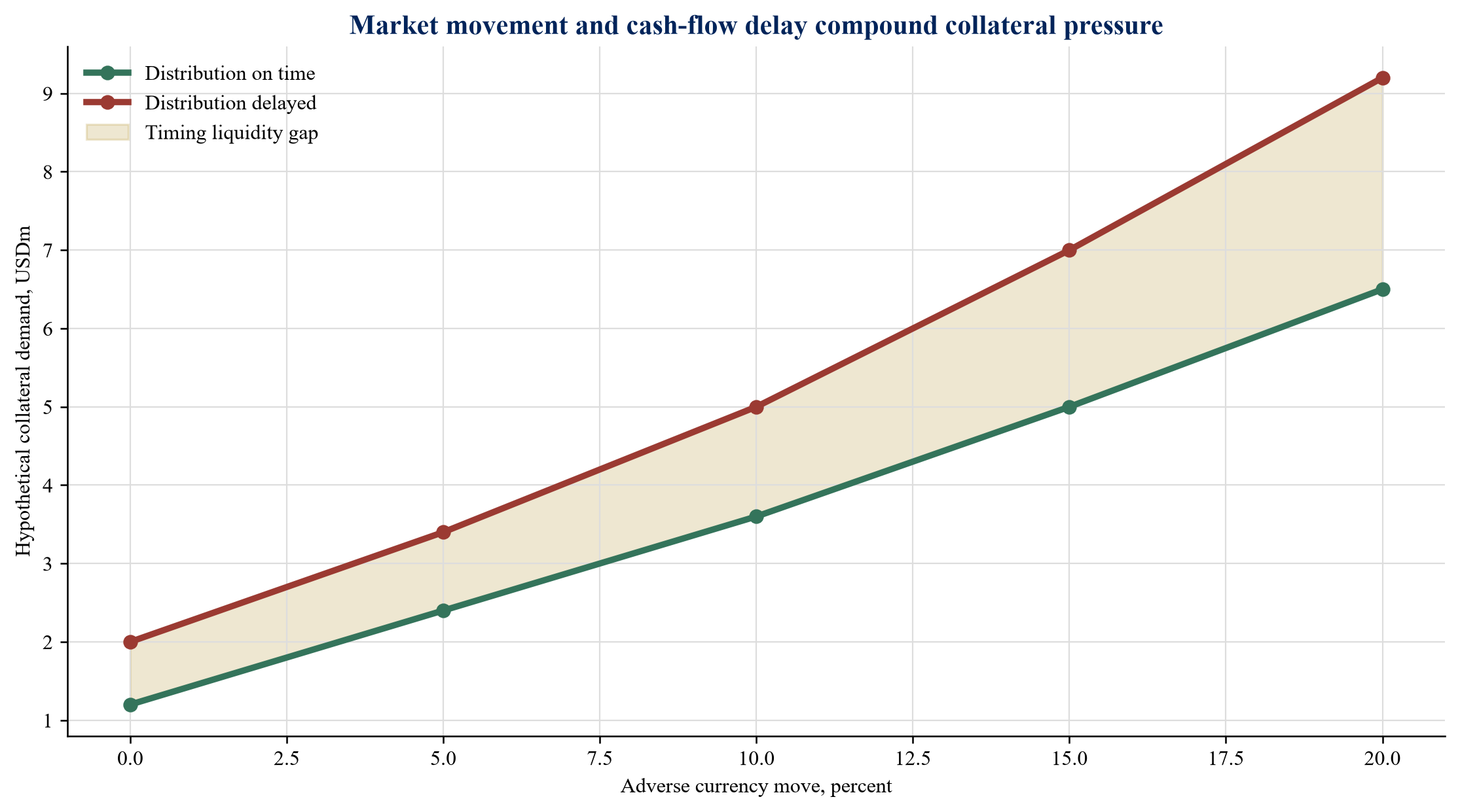
Values are author assumptions. The chart isolates derivative liquidity demand and does not represent a market forecast.
The manager should establish a collateral waterfall. First use unrestricted cash reserved for derivatives. Second use a committed facility if documents permit derivative and margin use. Third issue a capital call within the available notice window. Asset sales should be a remote response for illiquid funds. Escalation should occur before the first source is exhausted.
9. NAV hedging should distinguish economic exposure from translation
NAV translated into the fund currency moves because of local operating performance, valuation multiples, capital structure and exchange rates. A hedge ratio applied mechanically to last quarter's NAV can be stale. The investment may receive new capital, repay debt, distribute cash or change valuation before the next hedge date. The local currency exposure may also differ from the holding company's legal denomination.
The manager should estimate the economic currency sensitivity of each asset. A business with dollar revenue and local costs may benefit when the local currency weakens. A regulated utility may have local revenue and inflation linkage. An exporter may carry a natural hedge. A data-centre asset may have dollar-linked customer contracts and local power costs. The investment case should identify the operating transmission channel before the fund overlays a derivative.
A strategic NAV hedge can use a target band. The manager calculates eligible NAV, applies an approved ratio and rebalances only when exposure leaves the band or a material event occurs. Valuation uncertainty should reduce precision. A 50 percent target with a tolerance band may be more robust than monthly rebalancing to an exact number derived from quarterly private valuations.
Performance reporting should show local-currency asset return, currency translation, hedge result, hedge cost and residual base-currency return. Otherwise investors may misread a hedge gain as operating alpha or fail to see that premium and forward points reduced returns. The IPEV Valuation Guidelines support consistent fair-value methods and documentation for private capital [7]. IFRS 13 provides the fair-value framework where applicable [8].
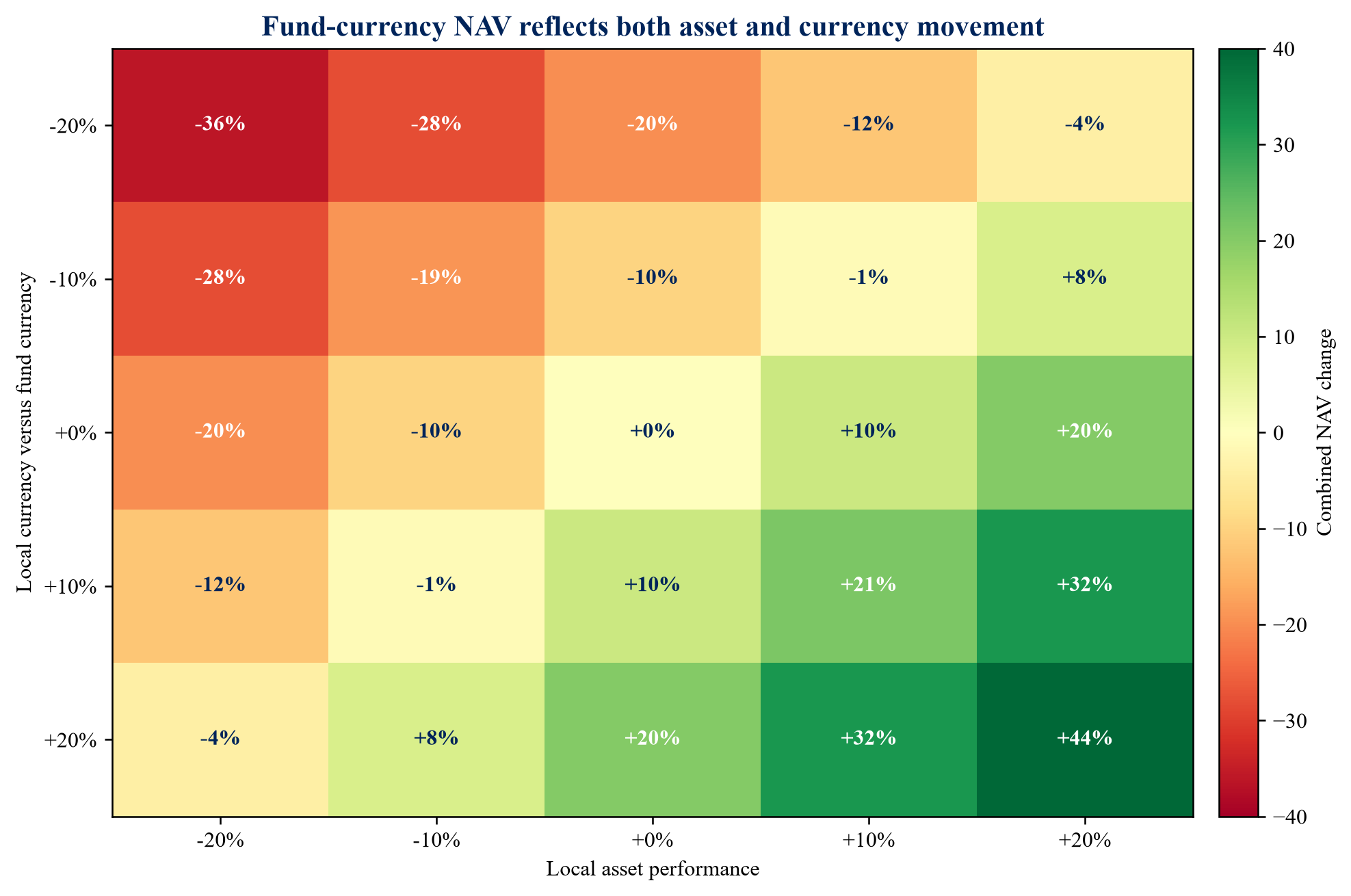
The heat map is a hypothetical sensitivity, before fees, tax, leverage and hedge cost. It is not a forecast or valuation conclusion.
10. A hypothetical fund case connects the exposure register to cash capacity
Consider a USD-denominated private-market fund with USD 120 million of commitments and USD 36 million already drawn. It is evaluating acquisitions and follow-ons whose base-case cash uses over twelve months equal USD 54 million at assumed planning rates. The local-currency exposures include Indian rupee, Brazilian real, sterling and euro. The fund expects USD 19 million equivalent of distributions, but their dates and amounts remain uncertain. It maintains USD 8 million of operating, follow-on and minimum cash reserves.
The base case assumes USD 62 million of capital calls over the year, USD 19 million of distributions and USD 45 million of aggregate hedge notional across contracted and probable transactions. The hedge programme combines deliverable forwards, a non-deliverable forward and purchased options. An assumed collateral stress equal to 8 percent of notional creates USD 3.6 million of liquidity demand. These inputs are illustrative and do not use observed fund, client or market data.
The delayed-distribution case assumes only USD 8 million of distributions arrive within the planning period. Capital calls remain USD 62 million. Hedge collateral rises to USD 5 million because positions remain open longer and market values move. Transaction uses remain USD 54 million. Closing liquidity falls by USD 12.4 million relative to the base case, requiring a facility draw, slower deployment or additional capital-call capacity.
The combined stress assumes local currencies required for acquisitions strengthen by 15 percent against the dollar, raising transaction cash uses to USD 62.1 million before hedge gains. Only USD 5 million of distributions arrives. Investor receipts are delayed, so only USD 52 million of planned calls is available within the horizon. Collateral reaches USD 7 million. The hedge programme is assumed to offset USD 5.5 million of the higher purchase cost after close-out and basis. The fund would finish below its USD 8 million minimum reserve without corrective action.
Table 3. Hypothetical annual fund-level FX liquidity outcomes
| Item | Base case | Distribution delay | Combined stress |
|---|---|---|---|
| Opening unrestricted cash | 12.0 | 12.0 | 12.0 |
| Capital-call receipts within horizon | 62.0 | 62.0 | 52.0 |
| Distributions received | 19.0 | 8.0 | 5.0 |
| Transaction and follow-on uses | (54.0) | (54.0) | (62.1) |
| Operating and formation uses | (6.0) | (6.0) | (6.0) |
| Peak collateral or hedge cash use | (3.6) | (5.0) | (7.0) |
| Hedge offset realised | 0.0 | 0.0 | 5.5 |
| Closing liquidity before reserve test | 29.4 | 17.0 | (0.6) |
| Minimum reserve | 8.0 | 8.0 | 8.0 |
| Headroom or shortfall | 21.4 | 9.0 | (8.6) |
All values are author assumptions in USD millions. Results exclude tax, fees not shown, facility interest and portfolio-company cash flows.
The case shows why hedge effectiveness and fund liquidity must be reviewed together. A hedge offset of USD 5.5 million reduces acquisition-cost pressure in the combined stress, yet delayed calls, low distributions and collateral still create a shortfall. The response should be agreed before execution: reduce or stage an acquisition, increase option use, secure a committed multi-currency facility, call capital earlier, retain distributions or reduce NAV hedge notional.
The model should run by day around known settlements and by month for the longer horizon. It should include separate columns for committed, probable and forecast flows; distinguish gross from net; and identify the entity holding each source. Sensitivities should change exchange rates, close dates, distribution amounts, collateral terms, investor delays and hedge basis simultaneously where they are likely to interact.
11. Accounting and valuation should follow the legal trade and risk objective
IAS 21 governs foreign-currency transactions and translation for entities applying IFRS [9]. The functional currency of each vehicle and portfolio company should be determined from its economic environment rather than selected to reduce volatility. Monetary items, non-monetary items and foreign operations can produce different translation and reclassification effects.
IFRS 9 governs recognition and measurement of derivatives and hedge accounting where elected and qualifying [10]. Formal designation, documentation, eligible hedged items, eligible instruments and effectiveness requirements matter. A cash-flow hedge of a net position has specific conditions, including identification of the reporting period in which forecast transactions affect profit or loss. Hedge accounting should represent an established risk-management relationship; it should not be designed after gains or losses emerge.
IFRS 7 requires disclosures about financial-instrument risks and hedge accounting [11]. IFRS 13 governs fair-value measurement [8]. The fund and administrator should source observable prices where available, apply valuation adjustments, assess counterparty credit and own credit as relevant and reconcile independent valuations to dealer statements. Model reserves may be necessary for illiquid currencies, long dates, optionality or disputed prices.
Fund performance and investor capital accounting can differ from statutory financial statements. The manager should define how hedge gains, losses, premium, carry, collateral interest and transaction costs are allocated. A hedge tied to one investment should not silently redistribute performance among investors or sleeves. Side letters and equalisation mechanics may affect allocation across closings.
The accounting file should link the trade confirmation, exposure designation, valuation, cash settlement, general ledger and investor report. Breaks should be resolved before NAV release. Where hedge accounting is unavailable or uneconomic, the fund should still maintain risk-management documentation and explain income-statement volatility accurately.
12. Regulation and legal capacity shape the programme
An alternative investment fund manager may face risk-management, liquidity, leverage, valuation, conflict and reporting duties under its governing regime. EU AIFMD requires functional and hierarchical separation of risk management where proportionate and systems to identify, measure, manage and monitor relevant risks [12]. Commission Delegated Regulation (EU) No 231/2013 provides detailed requirements on risk measurement, stress testing, liquidity and leverage [13]. ESMA's liquidity stress-testing guidelines support scenarios that reflect fund strategy, liabilities and market conditions [14].
The FCA FUND sourcebook applies related requirements to UK alternative investment fund managers, including risk and liquidity management and investor disclosure [15]. IOSCO's revised 2025 recommendations address liquidity risk management for collective investment schemes and reinforce governance, design, stress testing and contingency planning [16]. Closed-ended private funds differ from open-ended funds, yet collateral and financing obligations can still create liquidity needs before asset realisation.
Managers in the Dubai International Financial Centre or Abu Dhabi Global Market should assess the applicable DFSA or FSRA fund, derivative, custody, valuation, client-asset and prudential requirements [17][18]. Marketing jurisdictions, investor type and fund structure can introduce additional rules. Derivative trading may require representations, reporting, clearing or margin arrangements under relevant regimes.
Legal capacity must be established for the exact entity and instrument. The limited partnership agreement, constitutional documents, investment restrictions, side letters, borrowing limits and delegated authorities should permit the trade. The manager should obtain appropriate master agreements, schedules, credit-support documentation, netting analysis, authorised signatories and settlement instructions before first use.
Counterparty onboarding also requires KYC, beneficial ownership, sanctions and anti-money-laundering controls. The Financial Action Task Force standards provide the international framework [19]. Settlement controls should use verified instructions, dual approval and callback procedures. The CLS system and payment-versus-payment arrangements can reduce principal settlement risk for eligible currencies and counterparties [20].
13. Technology should produce an auditable exposure and cash record
The core data model should connect investment pipeline, legal commitments, treasury, bank accounts, portfolio valuations, derivative confirmations, collateral statements, capital calls and investor distributions. Each exposure needs a stable identifier. The system should retain source document, amount, currency, direction, probability, date range, owner, approval, hedge allocation and settlement status.
Automated feeds can improve speed, but exception handling remains essential. Bank balances, trade repositories, administrator records and dealer statements may use different cut-off times and identifiers. The control process should reconcile cash and positions daily around settlement periods, compare independent prices, identify unmatched trades and escalate stale forecasts.
Forecast changes should be versioned. A revised close date should update the liquidity ladder and alert treasury to a hedge maturity mismatch. A valuation change should test the NAV hedge band. A distribution delay should trigger collateral and facility scenarios. The system should show the source of each change and the person who approved it.
Access should follow legal-entity and role permissions. Investment teams may propose exposure dates. Treasury may execute approved instruments. Operations confirms settlement. Finance records valuation and accounting. Risk monitors limits. No individual should create an exposure, trade against it, confirm the trade and release cash without independent control.
Table 4. Early-warning indicators and required responses
| Indicator | Risk indicated | Immediate response | Escalated response |
|---|---|---|---|
| Transaction date moves beyond hedge maturity | Forward settlement no longer matches cash use | Reconfirm closing range and price extension or unwind | Reduce hedge, add option or defer transaction |
| Forecast distribution falls or slips | Short hedge and liquidity source may fail | Rebuild gross cash ladder and notify risk | Close or resize hedge; draw facility or call capital |
| Collateral use exceeds approved reserve | Market movement or dealer terms consume acquisition cash | Verify valuation, dispute if necessary and deploy reserved collateral | Reduce positions, add liquidity or change counterparty mix |
| NAV hedge leaves target band | Valuation, currency or asset cash flow changed | Recalculate eligible economic exposure | Rebalance after approval and cost review |
| Counterparty limit utilisation rises sharply | Concentration or credit deterioration | Stop new trades and confirm netting exposure | Novate, collateralise or add approved dealers |
| Capital-call receipts miss forecast date | Investor concentration or operational delay | Use committed bridge within authority | Escalate defaults, resize investments and preserve reserve |
| Onshore-offshore basis widens | Convertibility or market stress | Check executable local funding and fixing sources | Reduce reliance on offshore proxy; activate contingency route |
Thresholds require calibration to the fund, documents, currencies, counterparties and operating model.
14. A 100-day implementation plan can establish institutional control
Days 1 to 15 should establish scope. The manager inventories entities, currencies, commitments, bank accounts, facilities, investments, derivatives and service providers. Counsel confirms authority and restrictions. Finance determines functional and reporting currencies. The investment committee approves interim limits and minimum reserves.
Days 16 to 35 should build the exposure register and currency map. The team loads signed and probable cash flows, reconciles investor commitments, records notice periods and identifies settlement routes. Treasury obtains counterparty proposals, master agreements and pricing protocols. Risk defines exposure, counterparty and collateral measures.
Days 36 to 55 should build the liquidity ladder and stress model. Scenarios include currency moves, delayed acquisitions, delayed exits, lower distributions, investor funding delays, higher margin, dealer failure and restricted convertibility. The committee approves the hedge objective, eligible basis, target ratios, maturity limits and escalation thresholds.
Days 56 to 75 should implement execution and accounting controls. The manager establishes independent trade confirmation, cash release, valuation, collateral reconciliation, accounting entries and investor reporting. Each trade receives an exposure identifier. Exceptions are logged with owner, deadline and resolution.
Days 76 to 90 should run a dry simulation using a realistic transaction calendar. The team issues a test capital call, prices alternative instruments, models margin, moves a mock settlement through approval and reconciles the expected NAV effect. Failures should be repaired before live execution.
Days 91 to 100 should approve the operating standard. The board or delegated committee reviews policy, limits, counterparties, liquidity reserve, stress results and contingency funding. The manager should schedule monthly treasury reporting, quarterly scenario review and event-driven recalibration after material acquisitions, exits or market disruption.
15. Conclusion
Fund-level foreign-exchange management in emerging markets is an integrated liquidity discipline. Commitments, capital calls, local-currency investments, distributions, derivatives, collateral and NAV translation move on different clocks. A trade can reduce one exposure and create another. The governing framework should therefore begin with legal entities and dated cash flows, then select instruments that the fund can finance and operate through stress.
The exposure register separates contracted transactions, probable events, commitment capacity, distribution timing, NAV translation and derivative collateral. The currency map tests whether cash is available to the correct entity. The liquidity ladder distinguishes cash from future calls and uncertain proceeds. Governance sets objectives, eligible instruments, hedge bases, counterparty limits, reserves and exceptions.
The hypothetical case demonstrates that a hedge can offset acquisition-cost pressure while the fund still suffers a liquidity shortfall from delayed investor receipts, delayed distributions and collateral. The investment decision should respond to the combined system. Staged transactions, earlier calls, committed facilities, option-based protection, retained distributions and lower hedge notional are possible responses.
An institutional programme produces an auditable chain from approved exposure to trade, cash, valuation, accounting and investor reporting. It also accepts residual risk explicitly. This discipline allows a cross-border fund to pursue emerging-market returns while protecting its ability to settle, invest and report when currency markets become less forgiving.
References
- International Monetary Fund. Global Financial Stability Report, October 2025, Chapter 2: Risk and Resilience in the Global Foreign Exchange Market. https://www.elibrary.imf.org/display/book/9798229023184/CH002.xml
- Bank for International Settlements. Annual Economic Report 2025, Financial Conditions in a Changing Global Financial System. https://www.bis.org/publications/aer-2025/financial-conditions-changing-global-financial-system
- Institutional Limited Partners Association. ILPA Principles 3.0. 2019. https://ilpa.org/wp-content/uploads/2019/06/ILPA-Principles-3.0_2019.pdf
- Institutional Limited Partners Association. Capital Call and Distribution Template, version 2.0. 2025. https://ilpa.org/resources-tools/resource-library/ilpa-capital-call-distribution-template-v-2-0/
- Basel Committee on Banking Supervision. Foreign Exchange Risks. https://www.bis.org/committees/bcbs/basel-consolidated-guidelines/module/rma/20
- Financial Stability Board. Leverage in Non-Bank Financial Intermediation, Final Report. 2025. https://www.fsb.org/2025/07/leverage-in-non-bank-financial-intermediation-final-report/
- International Private Equity and Venture Capital Valuation Board. International Private Equity and Venture Capital Valuation Guidelines. https://www.privateequityvaluation.com/valuation-guidelines
- IFRS Foundation. IFRS 13 Fair Value Measurement. https://www.ifrs.org/issued-standards/list-of-standards/ifrs-13-fair-value-measurement/
- IFRS Foundation. IAS 21 The Effects of Changes in Foreign Exchange Rates. https://www.ifrs.org/issued-standards/list-of-standards/ias-21-the-effects-of-changes-in-foreign-exchange-rates/
- IFRS Foundation. IFRS 9 Financial Instruments. https://www.ifrs.org/issued-standards/list-of-standards/ifrs-9-financial-instruments/
- IFRS Foundation. IFRS 7 Financial Instruments: Disclosures. https://www.ifrs.org/issued-standards/list-of-standards/ifrs-7-financial-instruments-disclosures/
- European Union. Directive 2011/61/EU on Alternative Investment Fund Managers, consolidated version. https://eur-lex.europa.eu/eli/dir/2011/61/oj
- European Union. Commission Delegated Regulation (EU) No 231/2013. https://eur-lex.europa.eu/eli/reg_del/2013/231/oj/eng
- European Securities and Markets Authority. Guidelines on Liquidity Stress Testing in UCITS and AIFs. https://www.esma.europa.eu/document/guidelines-liquidity-stress-testing-in-ucits-and-aifs
- Financial Conduct Authority. FUND 3 Requirements for Alternative Investment Fund Managers. https://handbook.fca.org.uk/handbook/FUND/3/
- International Organization of Securities Commissions. Revised Recommendations for Liquidity Risk Management for Collective Investment Schemes. 2025. https://www.iosco.org/library/pubdocs/pdf/IOSCOPD795.pdf
- Dubai Financial Services Authority. Collective Investment Rules. https://dfsaen.thomsonreuters.com/rulebook/cir
- Abu Dhabi Global Market Financial Services Regulatory Authority. Fund Rules. https://en.adgm.thomsonreuters.com/rulebook/funds
- Financial Action Task Force. International Standards on Combating Money Laundering and the Financing of Terrorism and Proliferation. https://www.fatf-gafi.org/en/publications/Fatfrecommendations/Fatf-recommendations.html
- CLS Group. Principles and Settlement Risk Mitigation. https://www.cls-group.com/about-us/our-principles/
- International Monetary Fund. Global Financial Stability Report, April 2026, Chapter 2: Capital Flows to Emerging Markets, the Role of Global Nonbank Investors. https://www.imf.org/-/media/files/publications/gfsr/2026/april/english/ch2.pdf
- Bank for International Settlements. Triennial Central Bank Survey of Foreign Exchange and Over-the-Counter Derivatives Markets. https://www.bis.org/statistics/rpfx22.htm
