

1. INTRODUCTION
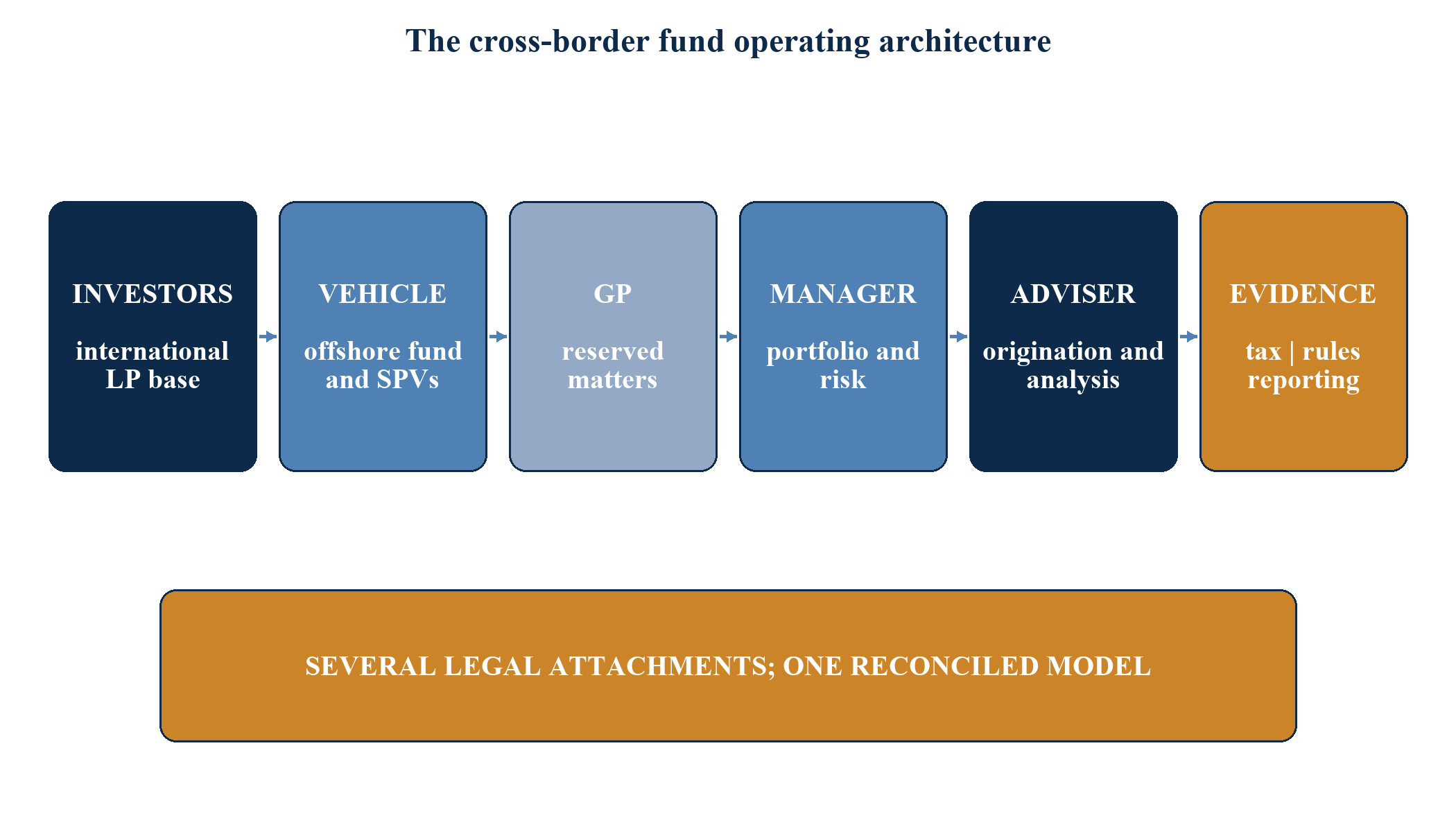
Private funds are often described by the place in which the fund vehicle is established. That shorthand is convenient and incomplete. A limited partnership may be formed in an offshore jurisdiction, its general partner may be incorporated elsewhere, the authorised investment manager may operate from the Dubai International Financial Centre or Abu Dhabi Global Market, an adviser may retain a London team, and limited partners may be distributed across several markets. Each element carries its own tax, regulatory, contractual and reporting attachments.
The operating location of a fund business therefore has to be established function by function. The governing questions include where strategic and investment decisions are made, where contracts are negotiated and concluded, where portfolio and risk management occur, where the people and premises sit, which entity bears risk, which entity earns each fee, and where investors are approached. The answers can differ across the fund vehicle, general partner, manager, adviser, carried-interest vehicle and acquisition structures.
This paper develops a practical framework for a UK-origin private-capital platform that is building a UAE operating presence while using an offshore fund vehicle and raising from international limited partners. It distinguishes vehicle domicile, corporate residence, permanent establishment, regulated activity, fund marketing, tax substance, transfer pricing and investor reporting. It also shows how governance records can make the approved model visible in day-to-day conduct.
The central proposition is straightforward. A fund business always has legal and operating attachments, even when no single jurisdiction describes the whole platform. A durable design makes those attachments explicit, aligns them with commercial reality and maintains evidence that can be tested by regulators, tax authorities, auditors, service providers and limited partners.
2. ONE FUND BUSINESS, SEVERAL LEGAL ATTACHMENTS
2.1 The fund vehicle
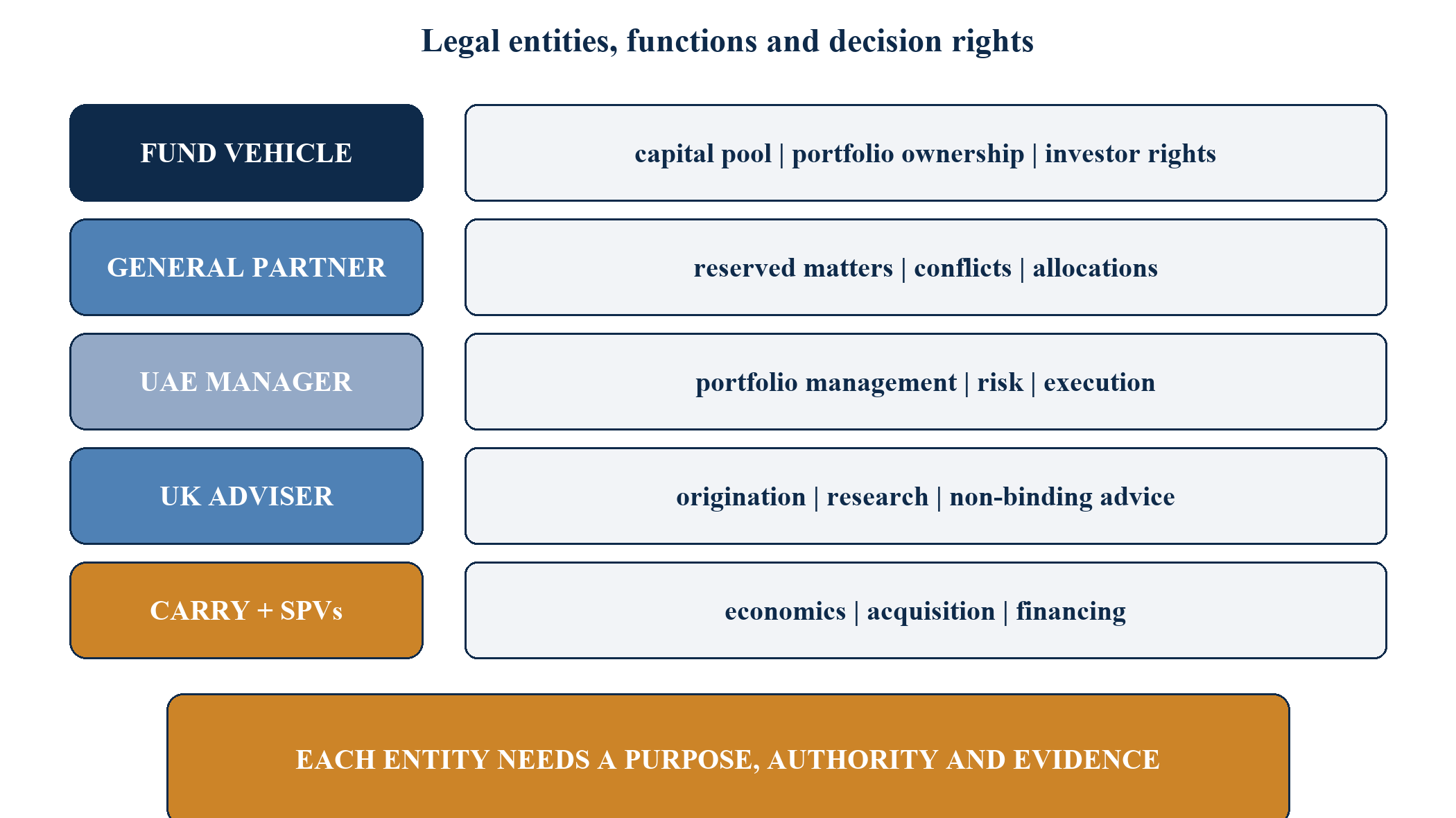
The fund vehicle pools investor commitments and holds, directly or through subsidiaries, the portfolio. Its jurisdiction determines the vehicle law, limited-partner rights, constitutional mechanics, registration obligations, insolvency framework and much of the service-provider architecture. It can also affect tax transparency, treaty access, reporting classification and the expectations of institutional investors.
Vehicle domicile does not automatically determine where the management business operates. A Cayman exempted limited partnership, for example, can have a general partner in one jurisdiction and a regulated manager in another. The partnership agreement and management agreement allocate authority, while actual conduct determines whether those allocations are real.
2.2 The general partner
The general partner normally has formal authority over a limited partnership, subject to the partnership agreement and any delegation to the manager. Its board may approve reserved matters, conflicts, valuations, allocations, extensions and changes to fund documents. The location and substance of those approvals can be relevant to corporate residence, permanent establishment, governance and fiduciary analysis.
A corporate general partner should have a defined board, approved terms of reference, suitable directors, reliable information and a documented escalation route. A board that merely records decisions already taken elsewhere creates a different risk profile from a board that receives papers, considers alternatives and exercises its own authority.
2.3 The investment manager and adviser
The investment manager commonly holds the regulated permission and contractual responsibility for portfolio management and risk management. An investment adviser may originate opportunities, conduct analysis and make non-binding recommendations. The distinction is only credible when decision rights, staffing, committee mandates, communications and remuneration support it.
Delegation does not automatically transfer responsibility. The FCA states that the UK AIFM regime focuses on the manager and broadly covers management, administration and marketing of alternative investment funds [8]. The DFSA Collective Investment Rules and the ADGM FSRA framework similarly attach requirements to fund-management functions carried on in or from their financial centres [10,11].
2.4 Carry, co-investment and acquisition structures
Carried-interest vehicles allocate performance economics to eligible participants. Co-investment vehicles admit selected investors or team members alongside the main fund. Acquisition and holding companies isolate investments, finance and liabilities. These entities can create separate residence, beneficial ownership, reporting and transfer-pricing questions.
The structure chart should state what each entity does, who owns it, who controls it, which contracts it signs, which accounts it uses and where its functions are performed. A legal entity that appears on a chart without an operating purpose or named decision rights needs further examination.
3. THE OPERATING-LOCATION DECISION ARCHITECTURE
3.1 Functions, assets and risks
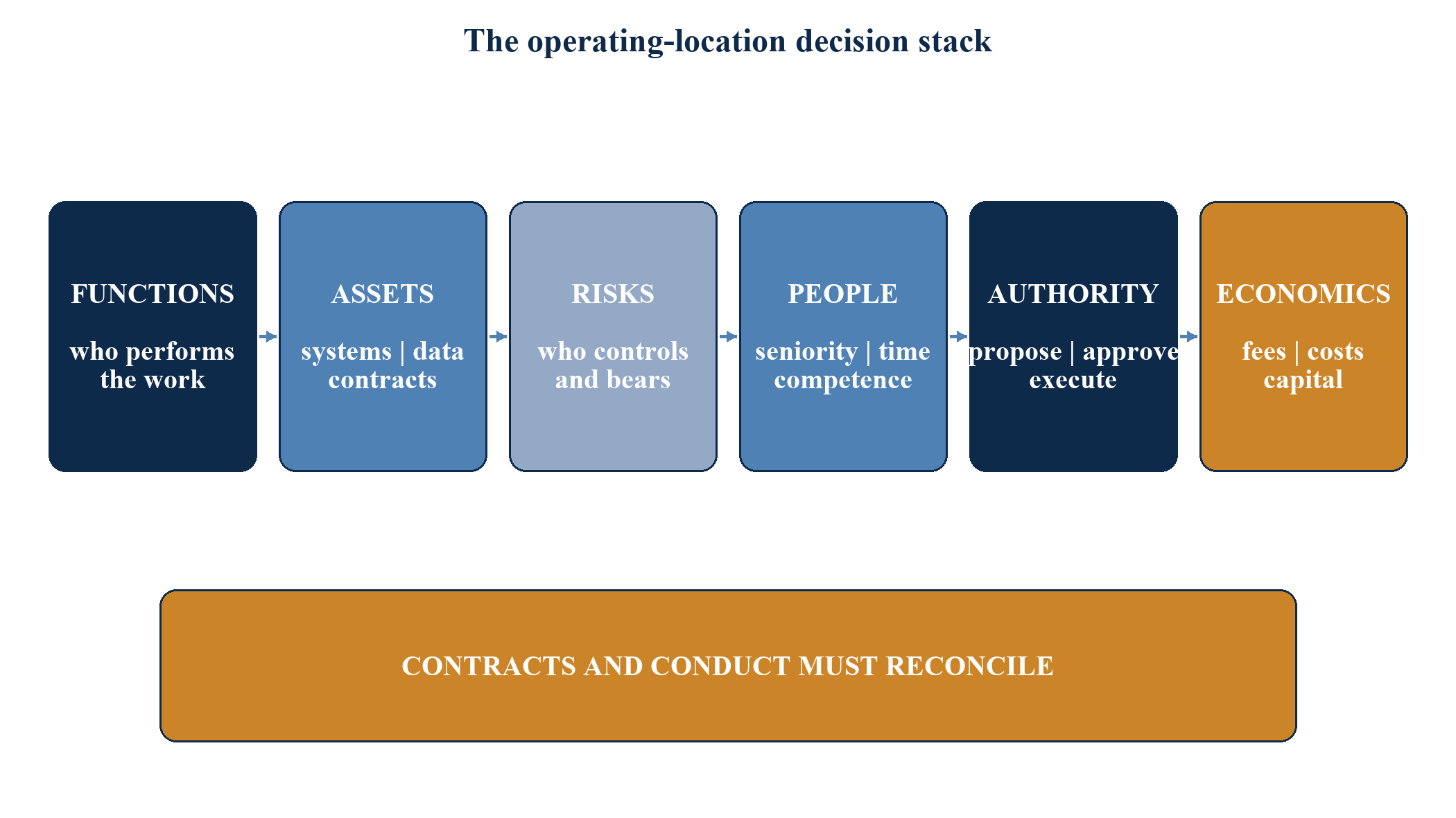
An operating-location analysis begins with functions. Fundraising, portfolio management, risk management, investment execution, valuation, finance, compliance, investor relations, administration and governance should each be mapped. The mapping should identify the people, premises, systems and records used to perform the function.
Assets include contractual rights, proprietary processes, data, brand, licences and business relationships. Risks include investment discretion, key-person exposure, regulatory responsibility, operational error, litigation, cyber risk, financial commitments and reputational consequences. The entity that contractually bears a risk should have the capacity and authority to control it.
3.2 Decision rights
Decision rights are the strongest link between legal design and operating reality. The map should distinguish proposal, review, challenge, approval, execution and monitoring. It should also identify vetoes, reserved matters, quorum, conflicts procedures and emergency authority.
For an investment, the file can show who originated the opportunity, who conducted diligence, who challenged the underwriting, who approved the recommendation, who signed transaction documents and who monitored performance. Similar chains should exist for fundraising materials, valuations, service-provider appointments and investor allocations.
3.3 People and premises
Headcount alone does not establish substance. The relevant questions concern seniority, competence, authority, time commitment and access to information. A location with many analysts and no decision authority has a different role from a smaller location with accountable executives and a functioning investment committee.
Premises should suit the activity. Dedicated space, secure information systems, local payroll, vendor relationships and normal operating expenditure can support the record. The substance file should connect these inputs to the actual functions rather than treating them as a separate compliance exercise.
3.4 Contracts, systems and money flows
Management, advisory, administration, distribution and cost-sharing agreements should reflect the approved allocation of functions. The fee stream should follow the service and risk allocation. Banking authority, invoicing, expense approval, payroll and accounting should be consistent with the contractual model.
Systems evidence can be especially useful. Committee workspaces, access logs, version histories, electronic signatures and finance approvals can show where work occurred and who exercised authority. These records need proportionate retention, privacy safeguards and legal review.
4. UK CORPORATE RESIDENCE AND CENTRAL MANAGEMENT AND CONTROL
4.1 The domestic residence starting point
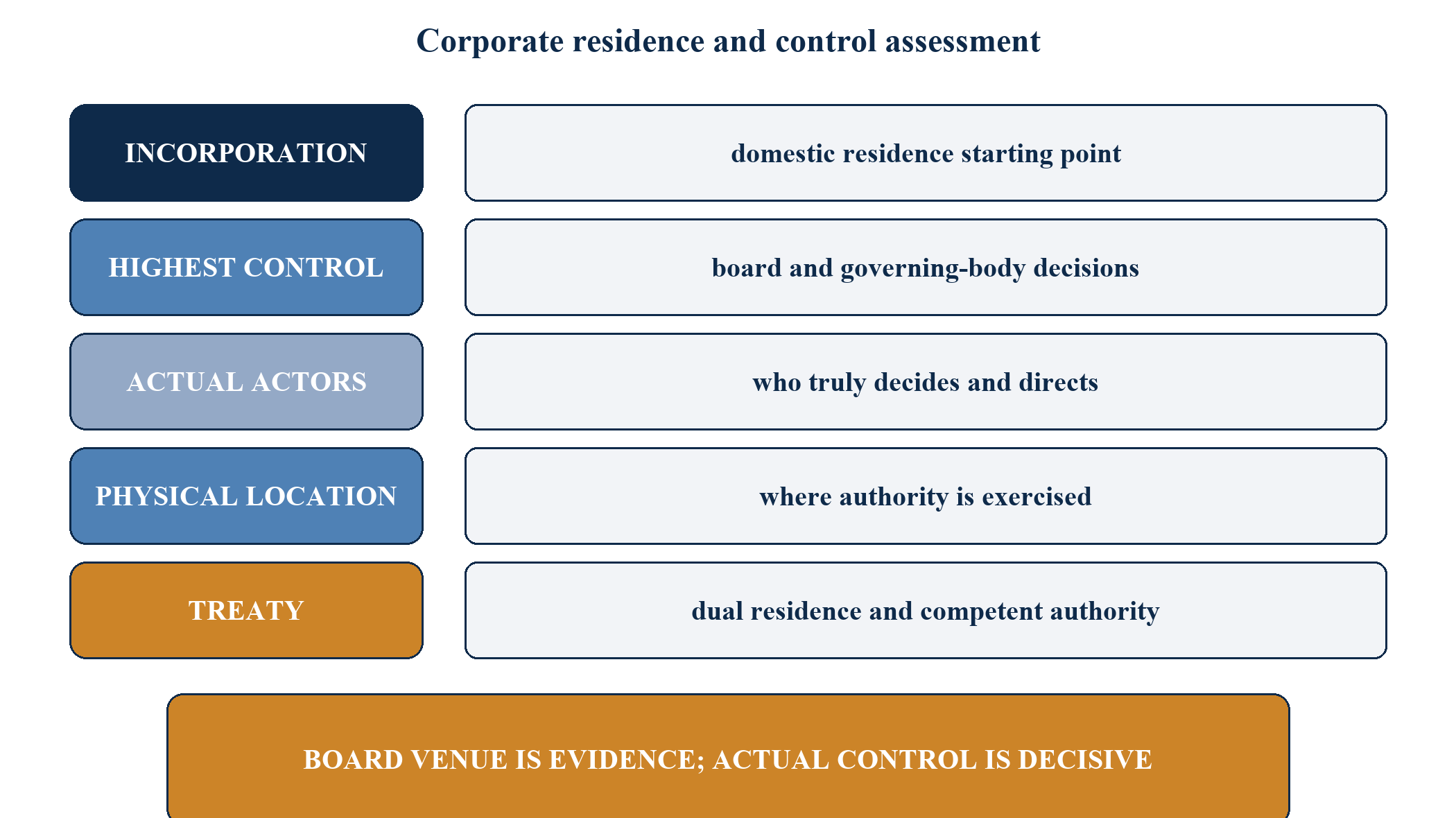
A company incorporated in the United Kingdom is generally UK resident, subject to applicable treaty rules and statutory exceptions. A non-UK incorporated company can also be UK resident under the case-law test when its central management and control is exercised in the United Kingdom. HMRC describes central management and control as the highest level of control of the business and treats the issue as one of fact [2,3].
Board location is relevant and does not conclude the analysis. The inquiry considers who actually makes the highest-level decisions and where that authority is exercised. If directors follow instructions from a UK founder, committee or parent without genuine consideration, the factual location of control may differ from the formal meeting place.
4.2 Applying the test to a fund platform
The relevant decisions depend on the entity. A general partner may decide reserved partnership matters. A management company may decide strategy, budgets, senior appointments, risk appetite and contractual relationships. A carry company may make allocation and distribution decisions. The analysis should not assume that every entity is controlled through the investment committee.
For each company, the platform should maintain a board-responsibility schedule, director biographies, meeting calendar, paper-distribution protocol, minutes standard and reserved-matters register. The schedule should explain what is delegated and how the board supervises the delegate.
4.3 Dual residence and the UK-UAE convention
The UK-UAE double taxation convention addresses dual-resident persons other than individuals through competent-authority agreement. Without such agreement, the person is not treated as resident of either state for most treaty benefits [1]. That provision makes unsupported assumptions about treaty residence particularly hazardous.
Domestic residence and treaty residence should be analysed separately. The file should show the incorporation basis, management-and-control facts, UAE domestic residence analysis, relevant tax registrations and any competent-authority process. Treaty benefits should not be assumed while the residence position is unresolved.
4.4 Board protocol
A workable protocol requires directors to receive complete papers with reasonable notice, understand the decision, challenge assumptions and record their reasoning. The minutes should identify material alternatives, conflicts, recusals and the basis for approval. Written resolutions should be used with the same discipline as meetings.
Travel can disrupt the model. A director making substantive decisions during a London visit may create evidence inconsistent with the intended location. The answer is a pre-agreed travel and decision protocol supported by local counsel, suitable alternates and an escalation process for urgent matters.
5. PERMANENT ESTABLISHMENT AND AGENT RISK
5.1 Fixed-place permanent establishment
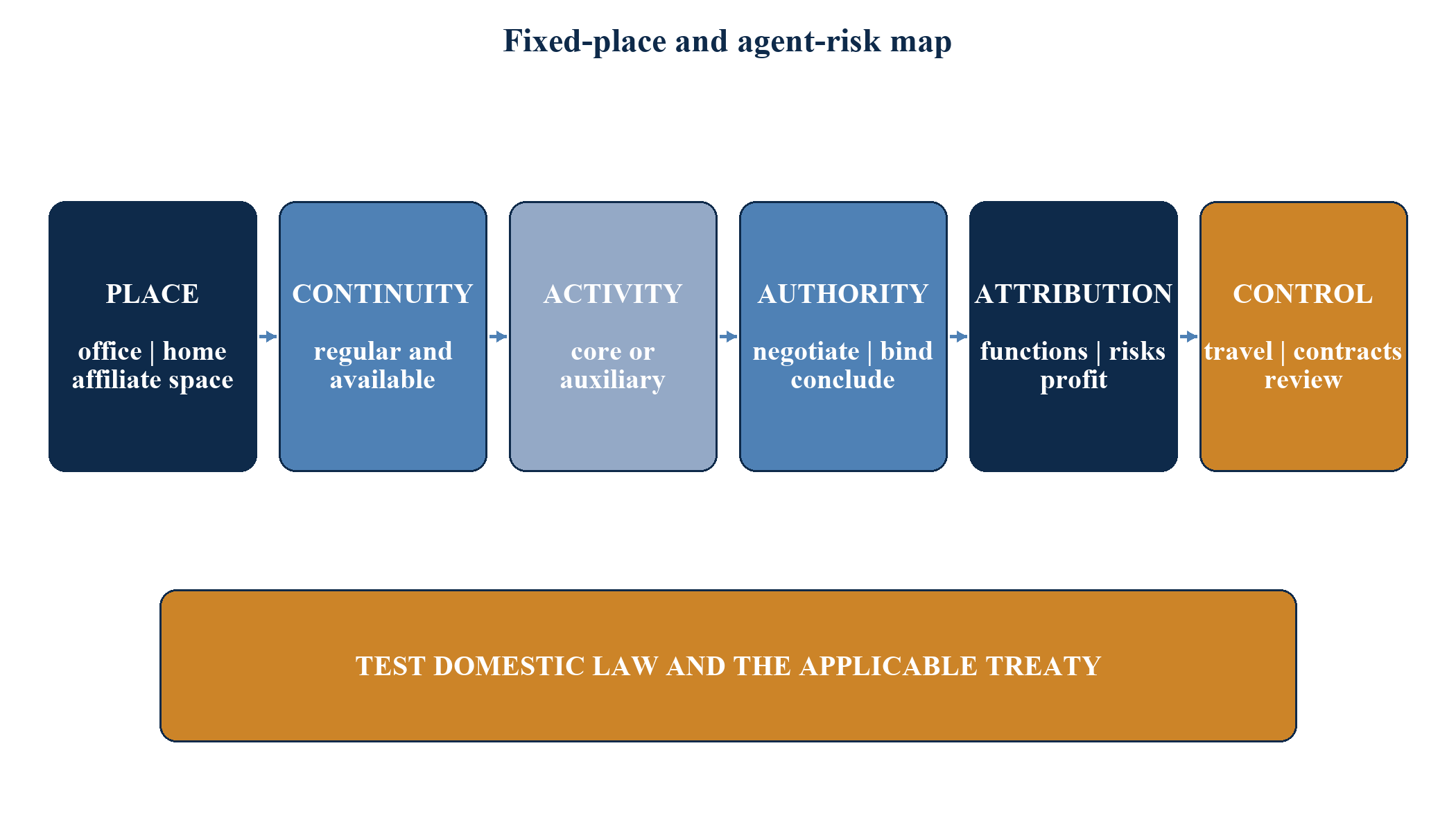
The UK-UAE convention defines a permanent establishment as a fixed place of business through which an enterprise carries on all or part of its business. It specifically includes a place of management, branch and office [1]. Domestic law and the applicable treaty need to be considered together.
A UAE manager can therefore face UK permanent-establishment questions if it uses a UK office or another sufficiently fixed place to carry on core business. The legal ownership of the premises is not the only consideration. Regular access, continuity, business purpose and the activity performed there matter.
5.2 Dependent agents and contract authority
The convention also addresses a person acting for an enterprise who habitually exercises authority to conclude contracts, subject to the independent-agent provision [1]. Modern operating practices require attention to negotiation and practical decision authority as well as signature mechanics. Local advice should apply the current domestic and treaty rules to the actual conduct.
An advisory team that develops terms, negotiates the commercial position and routinely presents agreements for mechanical signature can create a different analysis from a team that supplies research while the manager conducts and controls negotiations. Email, messaging, committee records and counterparties' understanding can reveal the practical allocation.
5.3 Profit attribution
When a permanent establishment exists, the treaty allows the host state to tax profits attributable to it and applies a distinct-and-separate-enterprise principle [1]. The result requires a functional and factual analysis. A fixed percentage of group revenue is not a substitute for that work.
The platform should identify the people functions, assets used and risks controlled by the permanent establishment. Intercompany and interbranch accounts, costs, revenue drivers and capital support should reconcile to the tax analysis. Documentation should be updated when responsibilities change.
5.4 A practical permanent-establishment control
Maintain a location register covering offices, serviced premises, home-working arrangements and recurring use of affiliate space. Maintain a contract register showing negotiator, approver, signatory and signing location. Connect both registers to travel and committee records.
A quarterly review should focus on exceptions: repeated UK work by senior UAE staff, a UK adviser exercising broader authority, urgent decisions taken outside the approved forum, and client or investor descriptions that misstate roles. Exceptions should be investigated and resolved through governance, contracts and operating practice.
6. THE UK INVESTMENT MANAGER EXEMPTION
6.1 Purpose and perimeter
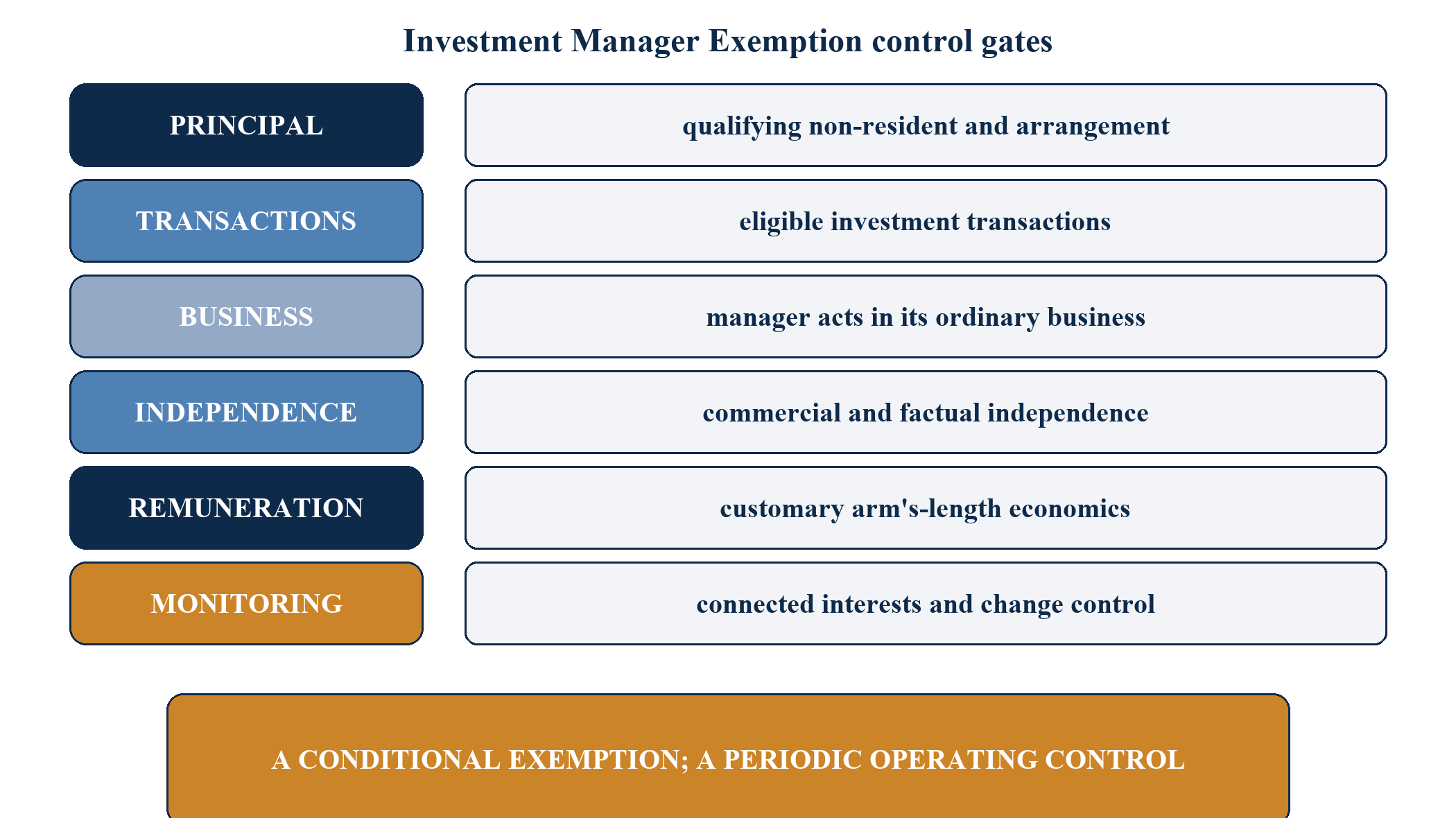
The UK Investment Manager Exemption can allow a non-resident to use a UK investment manager for qualifying investment transactions without treating the manager as its UK permanent establishment, when the statutory conditions are met. HMRC stresses that the exemption is conditional and applies to investment transactions carried out for the non-resident [4].
The exemption should be treated as a legal test and monitored as an operating control. It does not automatically resolve the residence of the manager, the residence of other entities, non-investment activities, transfer pricing, regulation or fund marketing.
6.2 Core conditions
The conditions cover the nature of the transaction, the manager's ordinary business, independent capacity, customary remuneration and limits involving connected persons. Each condition requires current specialist advice and source evidence. The transaction list and fee arrangements should be examined before the fund relies on the exemption.
The manager's relationship with the non-resident fund should also be compared with its wider business. Concentration, exclusivity, ownership, economics and decision processes can affect the analysis. A platform should avoid relying on a generic tax memorandum that does not match the executed agreements and actual investor base.
6.3 Evidence pack
The evidence pack should contain the fund and manager ownership chart, management agreement, investment mandate, qualifying-transaction analysis, client and assets-under-management data, remuneration benchmarking, invoices, transfer-pricing support and periodic compliance sign-off. Any connected-person interest should be documented.
Material changes require refresh. These include a new strategy, new asset class, continuation fund, majority commitment from a connected investor, fee waiver, change in control, relocation of senior decision-makers or a broader UK role. The review should be owned jointly by tax, legal, compliance and finance.
7. UAE FUND-MANAGEMENT OPERATING MODELS
7.1 Selecting the regulated location
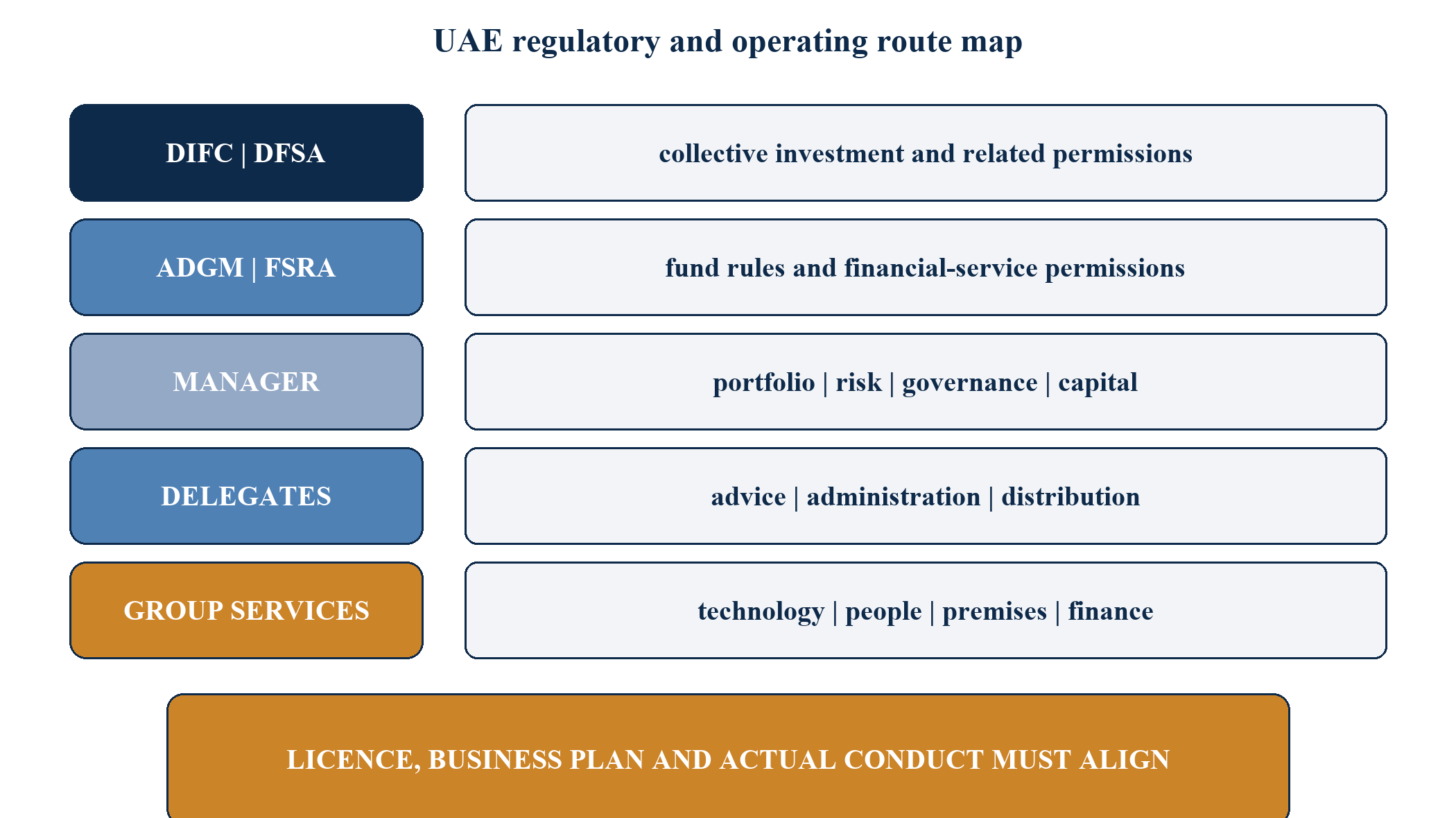
The UAE includes federal and financial-free-zone regulatory frameworks. DIFC financial services are regulated by the DFSA; ADGM financial services are regulated by the FSRA. A platform should select a route based on the proposed activity, fund type, investor category, ownership, staffing, capital, governance and distribution plan.
The licence perimeter matters. Portfolio management, managing a collective investment fund, advising, arranging, dealing and fund administration can be distinct regulated activities. The business plan, legal documents, website, pitch materials and employee titles should use descriptions consistent with approved permissions.
7.2 DIFC considerations
The DFSA Collective Investment Rules apply to persons carrying on relevant collective-investment activities in or from the DIFC and set requirements for operators, governing bodies and service providers [10]. Domestic funds can include public funds, exempt funds and qualified-investor funds, with different requirements. External fund manager and external fund routes have their own conditions.
A DIFC model should identify the licensed entity, responsible individuals, committees, compliance and money-laundering reporting functions, capital, professional indemnity arrangements where relevant, delegation and oversight. The approved business plan should be reconciled to the operating-location map.
7.3 ADGM considerations
The ADGM FSRA Fund Rules define the regulated activity of managing a collective investment fund and provide frameworks for different fund categories and managers [11]. The applicable route depends on the vehicle and investor base. The FSRA's venture-capital manager guidance illustrates the need to read the permission alongside the Fund Rules and General Rulebook [11].
An ADGM model should likewise connect permissions to actual people, systems, committees, financial resources, compliance and service-provider oversight. A foreign or external arrangement requires specific legal analysis under the current rules.
7.4 UAE mainland and group services
Group companies outside the financial free zones may provide technology, research, human resources, premises or other services. Their licences and activities should match the service agreements. Regulated functions should not drift to an unlicensed service company through job titles, secondments or informal delegation.
Secondments need clear reporting lines, supervision, cost allocation, confidentiality and intellectual-property terms. The regulated manager should retain the authority, competence and resources required by its permission and should be able to evidence its oversight.
8. UAE CORPORATE TAX, FREE-ZONE STATUS AND SUBSTANCE
8.1 Corporate tax starting point
UAE corporate tax applies under Federal Decree-Law No. 47 of 2022 and its implementing decisions. Investment funds, investors and investment managers have specific provisions and guidance. The Federal Tax Authority's investment-fund guide explains the conditions for fund exemption and the investment-manager exemption available to certain foreign persons [5].
Each legal entity should be classified separately. The file should determine whether it is a taxable person, exempt person, unincorporated partnership, foreign person, free-zone person or another category. Registration, return and record obligations should be assigned to named owners.
8.2 Qualifying Free Zone Person conditions
A Qualifying Free Zone Person can benefit from a zero percent rate on Qualifying Income when the statutory conditions are met. The FTA guide highlights adequate substance, qualifying income, transfer pricing, audited financial statements and other conditions. Income attributable to a domestic or foreign permanent establishment can be taxed at nine percent [6].
The zero percent rate should not be used as a general description of a free-zone fund manager. Fund management and wealth and investment management can receive different treatment under the qualifying-activity rules, and excluded or non-qualifying income must be analysed. Current advice should address the precise service, recipient and legal form.
8.3 Adequate substance
The FTA free-zone guide links adequate substance to core income-generating activities, assets, qualified employees and operating expenditure in the free zone [6]. Outsourcing can be relevant subject to conditions and supervision. The conclusion should follow the activities that generate the entity's income.
The platform should keep an annual substance memorandum supported by payroll, employment contracts, lease, asset register, service-provider agreements, board and committee records, systems access and expenditure. The memorandum should explain why the evidence is proportionate to the revenue and risk profile.
8.4 Transfer pricing
Related-party transactions must be consistent with the UAE arm's-length principle and applicable documentation requirements. A UK adviser, UAE manager, general partner and group service company should have a coherent allocation of fees and costs. The pricing method should reflect the functions performed, assets used and risks assumed.
Management fees, advisory fees, monitoring fees, deal fees, broken-deal costs, secondee costs and shared technology can each require allocation. The fund documents, side letters, accounting records and tax documentation should use consistent definitions.
9. FUND DOMICILE AND THE OFFSHORE VEHICLE
9.1 Domicile is a design choice
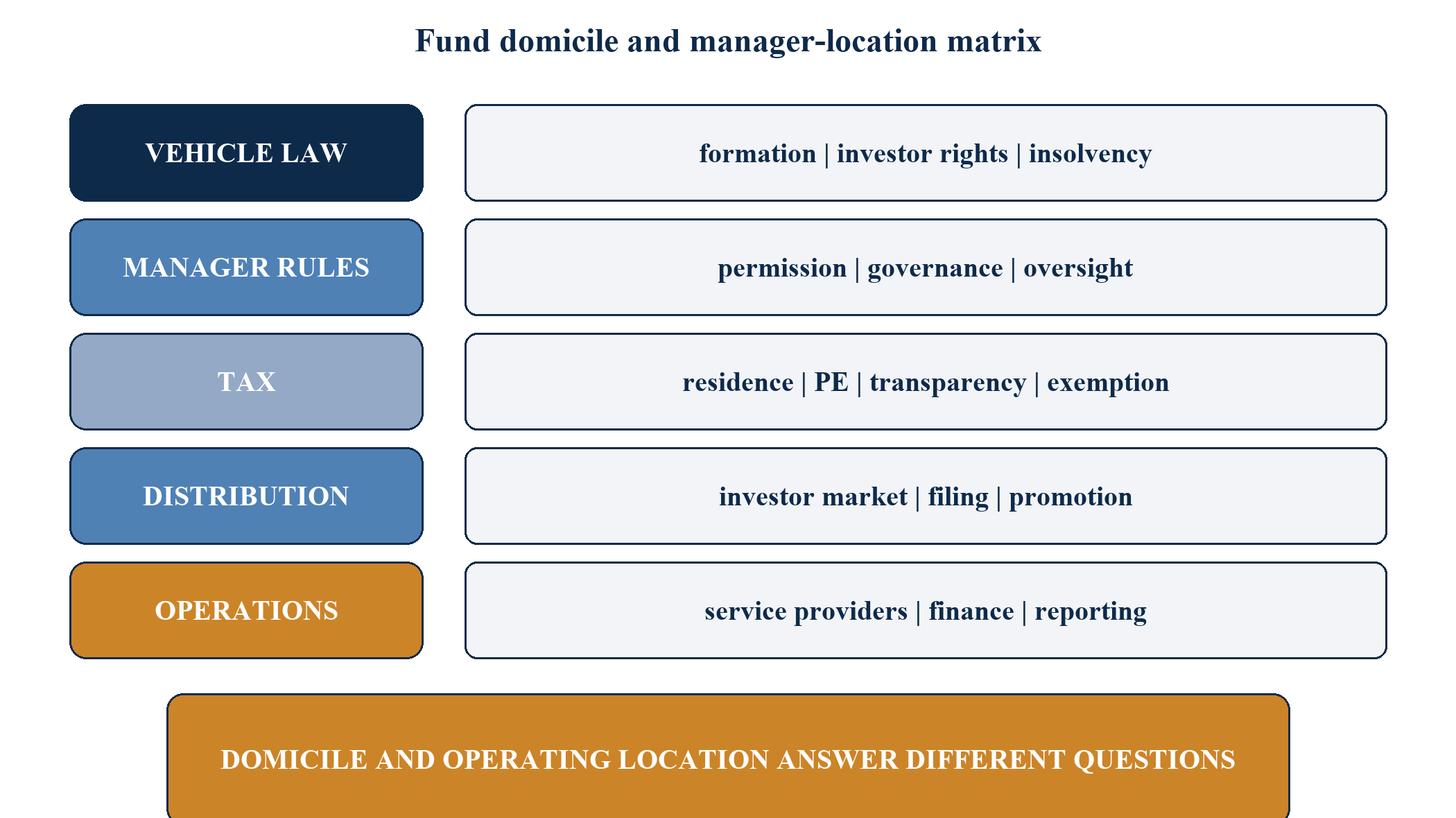
Vehicle selection should start with the strategy, investor base and distribution plan. Legal form, limited liability, capital calls, defaults, transfers, confidentiality, regulatory registration, tax transparency, treaty access, service-provider depth, financing and familiarity all matter.
An offshore vehicle can be commercially appropriate for an international fund. Its use does not remove the need to identify the manager, regulated location, beneficial owners, decision-making process and tax and reporting obligations. Institutional investors increasingly ask for the whole operating model.
9.2 Jurisdiction-neutral comparison
The comparison should be evidence based and refreshed for each fund. The table below provides a diligence structure rather than a jurisdiction ranking.
| Dimension | Questions | Evidence | Owner |
|---|---|---|---|
| legal form | partnership, company or trust; liability and governance | legislation and counsel memorandum | fund counsel |
| regulation | registration, private or public fund, ongoing filings | regulator confirmation and compliance calendar | compliance |
| tax | transparency, exemption, withholding and treaty position | current tax opinions | tax |
| investors | policy eligibility, familiarity and side-letter needs | anchor LP feedback and DDQ | investor relations |
| service providers | administrator, auditor, depositary, custodian and banking | engagement letters | chief operating officer |
| finance | subscription lines, NAV facilities and security | lender term sheets | finance |
| reporting | CRS, FATCA, beneficial ownership and regulatory returns | classifications and registrations | compliance |
| exits | holding structures, tax and transaction acceptance | deal counsel input | investment team |
9.3 Governance of the vehicle
The vehicle should have a governing-body calendar, conflicts process, valuation oversight, financial-statement timetable, cash controls and service-provider review. The general partner and manager should understand which matters require investor or advisory-committee consent.
Side letters can alter reporting, excuse rights, co-investment access, most-favoured-nation treatment and regulatory obligations. A central obligations matrix should connect every side-letter promise to the operational owner and evidence of delivery.
10. INTERNATIONAL LP DISTRIBUTION AND MARKETING
10.1 Marketing is jurisdiction specific
An international limited-partner base creates a distribution perimeter that is distinct from vehicle domicile and manager location. The platform should define where an offer occurs, who communicates, which materials are used, the investor category and the legal route before approaching investors.
The register should distinguish relationship building, pre-marketing, marketing, reverse solicitation and execution under applicable local law. Labels do not control the outcome; the content, timing and conduct matter. Local counsel should approve the route in each jurisdiction.
10.2 United Kingdom
The FCA states that the National Private Placement Regime permits certain AIFMs to market specified AIFs in the United Kingdom under the UK AIFM Regulations [7]. The UK AIFM regime has broad scope and includes management, administration and marketing [8]. Financial-promotion restrictions and investor categorisation also require analysis.
The UK role should be defined. If a UK adviser introduces investors, discusses terms or circulates materials, its permission and appointment should cover the activity. The marketing log should record the individual, entity, jurisdiction, investor classification, approved document version and applicable filing.
10.3 European Union and other markets
EU marketing can involve the Alternative Investment Fund Managers Directive and national private-placement regimes. The route can vary by manager location, fund domicile, investor type and member state. Other markets apply their own placement, licensing and financial-promotion rules.
The platform should maintain a jurisdiction matrix with legal opinion date, permitted audience, pre-marketing rules, filing, legends, local agent or representative, reporting and change notification. Access should be restricted when the route has not been approved.
10.4 Digital communications
Websites, podcasts, social media, webinars, data rooms and email can cross borders instantly. Compliance controls should govern audience filters, legends, invitations, recordings and follow-up. A generic disclaimer may not cure a communication that constitutes an unlawful promotion.
Data-room access should be tied to the approved investor and jurisdiction. The system should preserve invitation, acceptance, version, access and download records. Material changes should trigger an updated investor communication and filing review.
11. GOVERNANCE AND INVESTMENT DECISION CONTROL
11.1 Committee design
The investment committee should have a charter defining membership, quorum, voting, conflicts, reserved matters, delegation and emergency procedures. Its composition should match the regulated and tax operating model. Committee observers and advisers should have clearly defined roles.
Papers should identify the decision sought, investment thesis, diligence, risk, valuation, financing, conflicts, legal terms and post-investment plan. Minutes should record challenge and resolution of material issues. The objective is a reliable decision record, not a transcript.
11.2 Origination and recommendation
A cross-border team can divide origination and analysis across locations. The operating model should state who may contact a target, sign confidentiality agreements, retain advisers, approve diligence spend, submit indications, negotiate terms and recommend investment.
If a UK adviser makes non-binding recommendations, its papers and communications should preserve that status. The UAE manager should receive adequate information, conduct its own review and exercise the decision authority assigned to it.
11.3 Conflicts and allocation
Multiple funds, continuation vehicles, co-investment and personal interests create allocation and conflicts questions. The policy should cover opportunity allocation, cross-fund transactions, warehousing, broken-deal costs, valuation and use of affiliates. Advisory-committee or investor consent should follow the governing documents.
Conflict decisions also reveal operating location. The entity and committee that genuinely evaluates and resolves the conflict should be identifiable from the record. Repeated informal resolution elsewhere can undermine the approved model.
11.4 Travel and remote participation
Remote meetings can obscure where decisions are made. The agenda and minutes should record participant location when relevant. Travel policies should identify restricted activities, approval routes and contingency arrangements.
An urgent decision should follow an approved path. Options can include postponement, participation without voting, use of an alternate or reconvening with proper quorum. Counsel should confirm the approach for the actual entities and rules.
12. SERVICE AGREEMENTS, FEES AND TRANSFER PRICING
12.1 Management and advisory agreements
The management agreement should define the mandate, authority, standard of care, delegation, reporting, fees, expenses, conflicts, liability and termination. An advisory agreement should define the narrower service and preserve the manager's decision authority.
Descriptions should align across agreements, regulatory applications, employee roles, insurance and investor materials. Inconsistent drafting creates operational uncertainty and evidence risk.
12.2 Fee architecture
The economic schedule should trace management fees from the fund to the contracting entity and then allocate advisory, personnel, technology and shared-service costs. Deal fees, monitoring fees and director fees should follow the fund documents and applicable offsets.
The finance team should be able to reconcile each invoice to a contract, service period, calculation and tax treatment. Unsupported management charges can create transfer-pricing, fiduciary and investor-relations concerns.
12.3 Arm's-length support
The transfer-pricing analysis should identify controlled transactions and select methods that fit the facts. Routine research or administrative services may require a different approach from investment-management functions that control economically significant risk.
Benchmarking should use comparable services and account for geography, seniority, capital, risk and contractual terms. The conclusion should be refreshed when assets under management, strategy, staff or authority changes materially.
13. DATA, REPORTING AND EVIDENCE
13.1 CRS and FATCA
The OECD Common Reporting Standard includes investment entities within the financial-institution framework and connects classification to actual activities and discretionary management [12]. FATCA likewise treats investment entities such as hedge funds and private-equity funds as foreign financial institutions, subject to applicable exemptions and intergovernmental arrangements [13].
Each entity should have a documented CRS and FATCA classification, responsible party, registration status, Global Intermediary Identification Number where applicable, account-holder diligence process and reporting calendar. Classifications should be reviewed when ownership, management or activity changes.
13.2 Beneficial ownership and anti-money laundering
The administrator, manager, general partner and other service providers can have overlapping customer-diligence obligations. The group should define who collects, verifies, refreshes and reports information while preserving each regulated entity's responsibility.
The investor file should connect subscription documents, beneficial ownership, source of wealth and funds, sanctions and politically exposed person screening, tax forms, bank verification and ongoing monitoring. Exceptions require documented escalation and approval.
13.3 The operating-location evidence room
The evidence room should contain legal-entity charts, licences, tax registrations, contracts, board and committee records, payroll, premises, systems, banking, fee calculations, transfer pricing, marketing registers and reporting classifications. It should show the model through primary records.
Access should be role based. Investor, regulator, tax authority and auditor requests require different disclosure. Privileged advice and personal data need appropriate protection and retention.
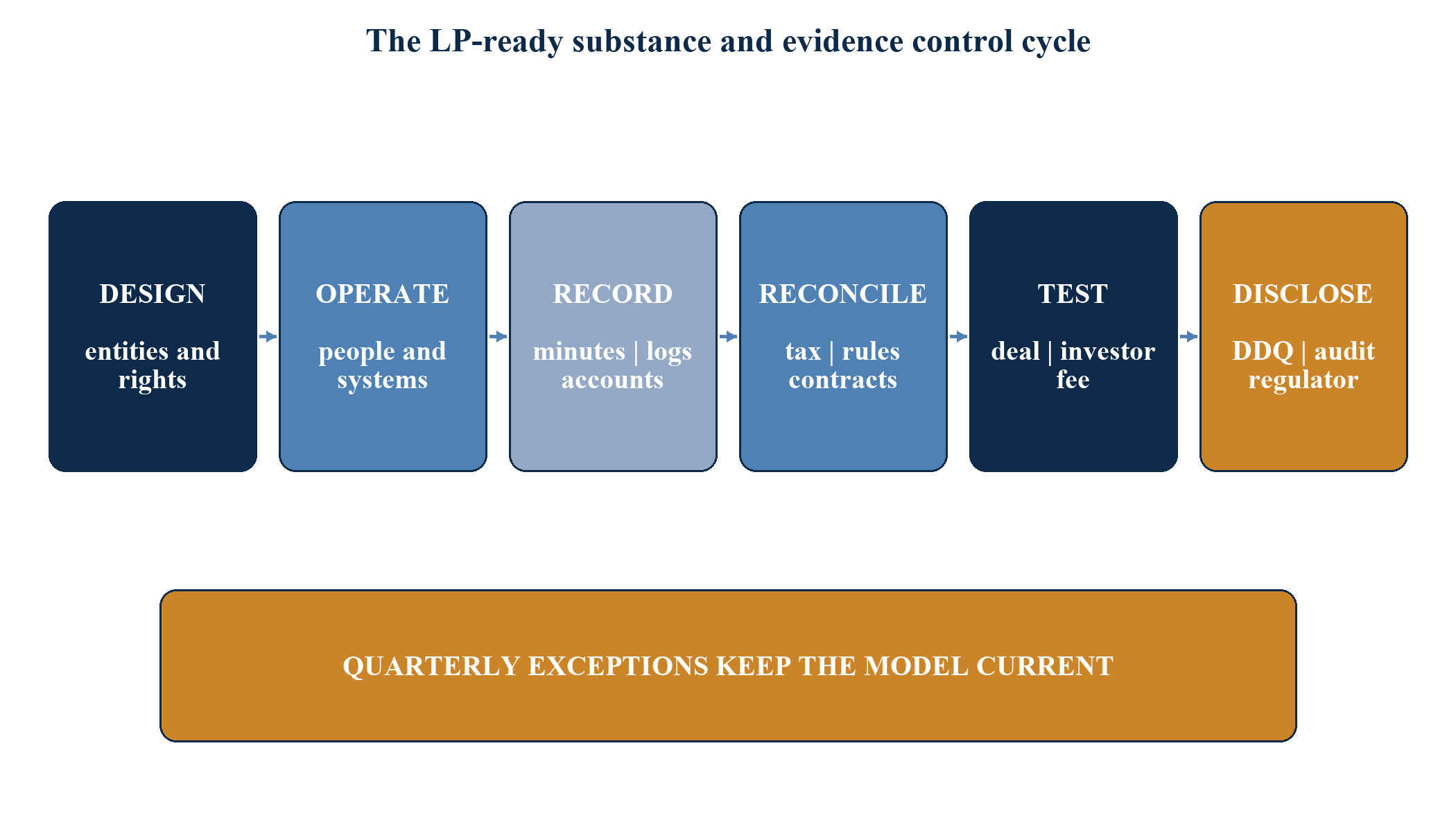
14. WORKED CROSS-BORDER OPERATING CASES
14.1 Case 1: UK-origin sponsor, UAE manager and offshore fund
Assume a sponsor establishes an offshore limited partnership and general partner, authorises a UAE manager and retains a London advisory company. The UAE manager has senior investment professionals, an investment committee, compliance, risk and premises. The London adviser originates and analyses opportunities under a non-binding advisory agreement.
The key controls are genuine UAE investment authority, general-partner governance, a defined UK advisory perimeter, Investment Manager Exemption analysis for relevant non-resident entities, arm's-length fees, marketing permissions and a complete decision record. The conclusion depends on actual conduct and current advice.
14.2 Case 2: UAE manager with a UK fundraising team
Assume the UAE manager appoints a UK-regulated placement firm and also has group employees in London supporting investor relations. The risk is that group employees drift into regulated placement, negotiate terms or create a UK place of business for the UAE manager.
The solution requires role descriptions, permission mapping, appointment terms, communications supervision and a marketing register. Permanent-establishment and profit-attribution advice should use the real activity and premises. The authorised placement firm should own the regulated activity assigned to it.
14.3 Case 3: travelling investment committee
Assume a three-person investment committee is based in the UAE, but two members spend extended periods in London and approve several investments remotely. Meeting invitations continue to identify the UAE as the venue.
The electronic label does not resolve the physical facts. The platform should record participant locations, examine corporate-residence and permanent-establishment implications, and apply its travel protocol. Repeated exceptions may require a redesign of committee membership or the operating model.
14.4 Case 4: offshore general partner with passive directors
Assume the general partner has local professional directors who routinely sign written resolutions drafted after the sponsor has decided the outcome. This weakens the claim that the board exercises its assigned authority.
The governance design should give directors timely papers, suitable expertise, independent judgement and a real ability to approve, reject or seek changes. Reserved matters and delegation should be calibrated to the commercial model.
14.5 Case 5: continuation vehicle
Assume the manager transfers an asset from a mature fund into a continuation vehicle backed by new and existing investors. The transaction creates valuation, conflicts, allocation, marketing, fee and decision-location issues.
The file should identify the approving entities, advisory-committee process, independent valuation or fairness work, disclosure, elections, financing, fee treatment and regulatory route. The operating-location analysis should cover the new vehicle rather than relying on the original fund memorandum.
14.6 Case 6: co-investment across jurisdictions
Assume a co-investment vehicle admits limited partners from the UK, EU, GCC and Asia. The main fund manager controls the investment while a group company helps introduce participants.
The co-investment needs its own vehicle, marketing, AML, tax-reporting and governance analysis. Allocation and economics should comply with the main fund documents and side letters. The introduction role should be checked against local placement and financial-promotion rules.
15. THE LP DUE-DILIGENCE PACK
Institutional limited partners often examine the manager and fund as an integrated operating system. The pack should allow an investor to understand who manages the fund, where the team sits, which regulator supervises which entity, how decisions are made, how conflicts are controlled and how the structure is taxed and reported.
| Module | Core contents | Evidence standard |
|---|---|---|
| structure | vehicle, GP, manager, adviser, carry and SPVs | dated legal chart and ownership register |
| regulation | licences, permissions, fund registrations and filings | regulator records and compliance memorandum |
| governance | boards, committees, delegation and conflicts | charters, calendars and sample minutes |
| substance | people, premises, systems and expenditure | payroll, lease, access and accounts |
| tax | residence, PE, free-zone, fund and transfer pricing | current signed advice and returns |
| operations | administrator, audit, valuation, custody and cash | agreements, controls and service reports |
| distribution | approved jurisdictions, investor classes and filings | counsel matrix and marketing log |
| reporting | CRS, FATCA, AML and beneficial ownership | classifications, registrations and calendar |
| resilience | cyber, business continuity, key person and succession | tested plans and incident process |
The pack should distinguish documents that can be shared broadly from privileged advice and restricted personal information. Claims in the DDQ should be traceable to current evidence. Changes should flow through the DDQ, private-placement memorandum, website and data room.
16. A 120-DAY IMPLEMENTATION ROADMAP
16.1 Days 1 to 30: establish the fact base
Inventory every entity, contract, licence, function, decision right, employee, office, bank account, fee and investor market. Build the current-state structure and operating map. Identify where the written model differs from conduct.
Commission legal and tax scoping for corporate residence, permanent establishment, Investment Manager Exemption, UAE corporate tax, free-zone status, fund exemption, transfer pricing and marketing. Freeze high-risk changes until the relevant path is understood.
16.2 Days 31 to 60: approve the target model
Select the regulated UAE route and fund domicile. Approve the manager, adviser and general-partner mandates, committee architecture, staffing, premises and service providers. Define UK activities and international distribution routes.
Prepare a decision-rights matrix and responsibility schedule. Obtain board approval for the target structure, assumptions, unresolved conditions and implementation budget.
16.3 Days 61 to 90: implement substance and controls
Execute agreements, recruit accountable staff, establish premises and systems, configure banking and finance, and activate compliance. Train employees on regulated boundaries, travel, contracts, investor communications and record keeping.
Build the residence, permanent-establishment, transfer-pricing, Investment Manager Exemption and free-zone evidence packs. Establish the marketing register, side-letter obligations matrix and CRS and FATCA classifications.
16.4 Days 91 to 120: test and launch
Run a mock investment from origination through committee, contract and monitoring. Run a mock investor from first contact through subscription, AML, reporting classification and closing. Trace one management-fee invoice and one intercompany charge through the accounts.
Complete a red-team review involving tax, regulatory, fund, employment and data counsel. Close material gaps, approve controlled exceptions and set the quarterly review calendar.
| Period | Workstream | Deliverable | Approval gate |
|---|---|---|---|
| days 1-30 | facts and advice scope | reconciled current-state map | facts signed off |
| days 31-60 | target design | approved structure and decision rights | boards approve model |
| days 61-90 | people, systems and contracts | operating and evidence controls | compliance readiness |
| days 91-120 | simulations and red team | launch report and issue register | controlled launch |
17. LIMITATIONS AND RISK BOUNDARIES
This paper provides a general research and implementation framework. It does not determine the residence, permanent-establishment, regulatory, fund-marketing, corporate-tax, free-zone, transfer-pricing, reporting or liability position of any entity or person.
The worked cases are hypothetical and simplified. They do not model every fund jurisdiction, legal form, investor market, strategy, ownership arrangement or tax classification. Current law and administrative practice can change, and official guidance may be updated after publication.
The UK Investment Manager Exemption and UAE investment-manager provisions have detailed conditions. A fund or manager should not rely on the summaries in this paper to claim an exemption. The UK-UAE convention must be applied with domestic law and current advice.
Regulatory permissions are entity, activity and fact specific. A licence in one jurisdiction does not authorise activity in every investor market. Fund counsel, regulatory counsel, tax advisers, auditors, administrators and compliance officers should review the final structure and actual conduct.
18. CONCLUSION
The fund without a single flag is still a collection of legal, tax, regulatory and operating attachments. Vehicle domicile, manager location, corporate residence, permanent establishment, distribution permissions and reporting classification answer different questions. Durable structures keep those questions separate and reconcile the answers.
For a UK-origin platform building in the UAE, the control objective is alignment. People, premises, authority, contracts, fees, licences, tax positions and records should describe the same operating model. The UAE manager must genuinely perform the functions assigned to it; the UK role must remain within its approved scope; the offshore vehicle and general partner must have credible governance.
The most useful deliverable is an evidence-backed operating map that can be tested deal by deal and investor by investor. It should show who proposed, decided, signed, earned, reported and supervised. Quarterly exception reviews then keep the model current as the fund, team and investor base evolve.
APPENDIX A. ENTITY AND FUNCTION REGISTER
| Field | Required content | Evidence | Review |
|---|---|---|---|
| legal entity | name, form, jurisdiction and registration | constitutional documents | on change |
| ownership | direct, indirect and beneficial owners | registers and declarations | quarterly |
| purpose | commercial and operating role | board-approved description | annually |
| regulated activity | permission and limitations | regulator record | monthly |
| tax status | residence, registration and exemptions | advice, certificates and returns | annually |
| functions | services performed and outsourced | agreements and process map | quarterly |
| authority | boards, committees, signatories and limits | charters and mandates | quarterly |
| people | employees, secondees and accountable executives | contracts and payroll | monthly |
| premises and systems | operating locations and technology | lease and access records | quarterly |
| revenue and costs | fees, expenses and allocations | ledgers and invoices | monthly |
APPENDIX B. DECISION-RIGHTS MATRIX
| Decision | Propose | Review | Approve | Execute | Monitor |
|---|---|---|---|---|---|
| fund strategy | manager team | risk and GP | manager board or IC | manager | GP and investors |
| new investment | deal team | IC and control functions | authorised IC | signatories | portfolio team |
| valuation | valuation team | administrator and committee | governing body | finance | auditor and LPAC |
| conflict | originator | compliance and counsel | designated body | manager or GP | compliance |
| investor admission | investor relations | compliance and administrator | GP or manager | administrator | compliance |
| side letter | investor relations | counsel and operations | GP or manager | signatory | obligations owner |
| service provider | operations | compliance, tax and legal | board | authorised signatory | operations |
| management fee | finance | administrator | manager or GP | finance | auditor |
APPENDIX C. CORPORATE RESIDENCE AND PE CHECKLIST
- Identify the domestic residence basis for each company.
- Identify the highest-level decisions made by each board or governing body.
- Record who makes those decisions and where they are physically located.
- Test whether directors exercise independent judgement.
- Reconcile reserved matters, delegation and actual conduct.
- Inventory offices, affiliate space, home-working and recurring access.
- Map contract negotiation, approval, signature and performance.
- Identify persons who habitually exercise commercial or contract authority.
- Analyse fixed-place and agent permanent-establishment exposure.
- Prepare a functional and profit-attribution analysis where required.
- Review treaty residence and competent-authority implications.
- Set travel, remote-meeting and urgent-decision controls.
APPENDIX D. INVESTMENT MANAGER EXEMPTION FILE
| Component | Required evidence | Owner |
|---|---|---|
| non-resident principal | formation, residence and tax analysis | tax |
| UK manager | permission, ownership and ordinary business | legal and compliance |
| transactions | current qualifying-transaction analysis | tax counsel |
| independence | client base, assets and commercial conduct | chief operating officer |
| remuneration | agreements, invoices and benchmarking | finance and tax |
| connected interests | ownership and economic-interest schedule | legal |
| controls | periodic conditions checklist | tax and compliance |
| changes | strategy, ownership, fee and people log | company secretary |
APPENDIX E. LP OPERATING-LOCATION DDQ
- Which entity is the AIFM or investment manager?
- Which regulator authorises it and for which activities?
- Where are portfolio and risk management performed?
- Who sits on the investment committee and where do members ordinarily work?
- Which matters are reserved to the general partner or manager board?
- What is delegated to the UK adviser or other affiliates?
- How are delegation and service-provider performance supervised?
- Where is each entity resident for tax purposes?
- What permanent-establishment analyses support the structure?
- How are related-party fees priced and documented?
- Which fund and free-zone tax conditions apply?
- How are marketing jurisdictions approved and monitored?
- How are CRS, FATCA, AML and beneficial-ownership obligations allocated?
- What evidence supports people, premises, systems and decision authority?
- How are travel and remote decisions controlled?
- Which changes trigger investor notice or consent?
APPENDIX F. QUARTERLY GOVERNANCE AGENDA
| Agenda item | Evidence | Decision |
|---|---|---|
| entity and ownership changes | legal registers | approve updates |
| licences and fund filings | compliance dashboard | close exceptions |
| boards and committees | minutes and location record | confirm authority |
| people and premises | payroll, lease and access | confirm substance |
| contracts and fees | register, invoices and benchmark | approve variances |
| UK activity | travel, office and contract log | review residence and PE |
| free-zone conditions | income and substance schedule | confirm tax status |
| distribution | jurisdiction and marketing log | restrict or approve routes |
| CRS, FATCA and AML | classification and reporting calendar | close gaps |
| investor obligations | DDQ and side-letter matrix | certify delivery |
REFERENCES
[1] HM Revenue & Customs. 2016 UK-UAE Double Taxation Convention, including Articles 4, 5, 7 and 9. https://www.gov.uk/government/publications/united-arab-emirates-tax-treaties/2016-uk-uae-double-taxation-convention
[2] HM Revenue & Customs. International Manual INTM120000, Company residence: contents. https://www.gov.uk/hmrc-internal-manuals/international-manual/intm120000
[3] HM Revenue & Customs. International Manual INTM120060, Company residence: the case-law rule and central management and control. https://www.gov.uk/hmrc-internal-manuals/international-manual/intm120060
[4] HM Revenue & Customs. International Manual INTM269060, Investment Manager Exemption: conditions. https://www.gov.uk/hmrc-internal-manuals/international-manual/intm269060
[5] UAE Federal Tax Authority. Corporate Tax Guide: Investment Funds and Investment Managers, CTGIFM1. https://tax.gov.ae/Datafolder/Files/Guides/CT/CT%20Guide%20-%20Investment%20Funds%20and%20Managers%2006%2005%202024.pdf
[6] UAE Federal Tax Authority. Corporate Tax Guide: Free Zone Persons, CTGFZP1. https://tax.gov.ae/Datafolder/Files/Guides/CT/Free%20Zone%20Persons%20-%2020%2005%202024%20final%20for%20GCD.pdf
[7] Financial Conduct Authority. National Private Placement Regime. https://www.fca.org.uk/firms/nppr
[8] Financial Conduct Authority. Alternative Investment Fund Managers Directive in the UK. https://www.fca.org.uk/firms/aifmd-uk
[9] Financial Conduct Authority Handbook. PERG 16, Scope of the Alternative Investment Fund Managers Regime. https://handbook.fca.org.uk/handbook/PERG/16/
[10] Dubai Financial Services Authority. Collective Investment Rules, CIR Module. https://dfsaen.thomsonreuters.com/net_file_store/DFSA_CIR_VER6.pdf
[11] Abu Dhabi Global Market Financial Services Regulatory Authority. Guidance on the regulatory framework for managers of venture-capital funds and the FSRA Fund Rules. https://www.adgm.com/documents/legal-framework/guidance-and-policy/fsra/guidance-regulatory-framework-for-fund-managers-of-venture-capital-funds-20231218.pdf
[12] OECD. Consolidated Text of the Common Reporting Standard, 2025. https://www.oecd.org/en/publications/consolidated-text-of-the-common-reporting-standard-2025_055664b1-en.html
[13] Internal Revenue Service. Information for foreign financial institutions under FATCA. https://www.irs.gov/businesses/corporations/information-for-foreign-financial-institutions
[14] HM Revenue & Customs. International Manual INTM265020, treaty business profits and permanent establishments. https://www.gov.uk/hmrc-internal-manuals/international-manual/intm265020
[15] Financial Conduct Authority Handbook. FUND 3, Requirements for alternative investment fund managers. https://handbook.fca.org.uk/handbook/FUND/3/
[16] UAE Ministry of Finance. Federal Decree-Law No. 47 of 2022 on the Taxation of Corporations and Businesses. https://mof.gov.ae/corporate-tax/
ABOUT THE AUTHOR
Chennakeshav Adya is an Independent Researcher and Managing Partner at Matchpoint Partners. His work examines private-capital markets, cross-border fund structures, capital formation, transaction design, family-office strategy and evidence-led decision systems.
