
1 Define the investment decision
The acquisition decision begins with a named capability and a customer obligation. A buyer should be able to describe the product or service that the acquired business would deliver, the conditions under which the customer would accept it and the resources needed to reach payment. Examples include qualified magnet winding, a batch of traceable material, an integrated remote-handling assembly or a commissioned power-conversion system. Each has a different operating boundary. A transaction mandate should identify which boundary the buyer intends to control and why ownership is necessary for its commercial plan.
This paper proposes a transaction framework for operating suppliers and separable technology businesses. Its recommendations are analytical proposals requiring adaptation to an actual target. Public announcements support the limited factual examples cited in the text. The financial model, diligence classifications, sequencing and negotiated structures are author-developed illustrations. No target company is represented as available for sale. No supplier margin, private purchase price, customer pipeline or probability of fusion deployment is estimated from public programme ambitions. These limits are important because the acquisition case often depends on information available only inside a controlled data room.
An investment committee should commission a concise acquisition thesis before broad diligence. The thesis should specify the capability sought, the relevant customer applications, the assets and people needed, and the earliest commercial commitment the combined business could undertake. It should identify the evidence required to reject the thesis. A target that cannot transfer a critical licence, retain a required manufacturing team or fund its delivery obligations may fail that test even when its technology is attractive. The committee can then decide whether to pursue an acquisition, negotiate a different commercial arrangement or stop.
2 Read the public evidence within its scope
The UK government's 2026 fusion strategy identifies industrial opportunities in high-temperature superconducting magnets, advanced materials, robotics and related technologies. Its discussion includes wider applications and AI for complex dynamic systems [1]. These statements establish policy direction. A specific supplier's revenues require separate evidence of contracts, delivery and collection. The US Department of Energy likewise describes a roadmap supporting fusion development and explicitly states that its milestones depend on future partnerships and appropriations; the roadmap commits to no specific funding levels [2]. Both sources require careful separation of ambition from contracted economics.
Tokamak Energy's April 2026 disclosure reports a GBP 70 million STEP magnet-systems contract covering the period through March 2029, with eight work packages delivered through TE Magnetics. The same disclosure describes its 2025 acquisition of Ridgway Machines and the acquired company's cable-insulation and winding machinery capabilities [3]. Those reported facts offer a concrete example of acquiring manufacturing capability within a broader engineering programme. The disclosure provides no acquisition price or complete post-acquisition cash-flow record. This paper makes no claim about the deal's realised return or the contract's profit margin.
Other public evidence illustrates different commercial relationships. CFS and Type One Energy announced an exclusive licence for specified high-temperature superconducting cable technology in stellarator magnets in February 2025 [4]. Fusion for Energy's July 2026 account describes delivery of an equatorial port-plug assembly tool and the participation of industrial subcontractors [5]. These examples support examining licences, prime contracts and subcontracted capability separately. They do not establish a general acquisition multiple. The transaction team should preserve the original source, date and reporting party beside each factual statement used in its investment memorandum.
3 Draw the transaction perimeter
A transaction perimeter should identify the legal entity or assets being acquired and every external dependency required to deliver the commercial proposition. Begin with shares, equipment, premises, inventory, cash and liabilities. Add the less visible resources: source code, design files, manufacturing instructions, test records, calibration history, licences, employee knowledge and access to customer systems. A buyer should trace an example customer delivery through these resources. An asset that appears in a presentation may belong to a parent, a collaborator or the customer. Ownership and usable access require document-level verification.
The proposed perimeter map links each essential resource to a transfer mechanism. Shares may preserve ownership within an entity while triggering change-of-control provisions in contracts. An asset purchase requires its own transfer documentation and may require assignments or new licences. A carve-out can depend on transitional support from the seller. The legal team should review the actual instruments. The operating team should specify what happens to work in progress when a resource is transferred, shared or withheld. This combined review makes exclusions visible before headline valuation becomes an anchor in negotiations.
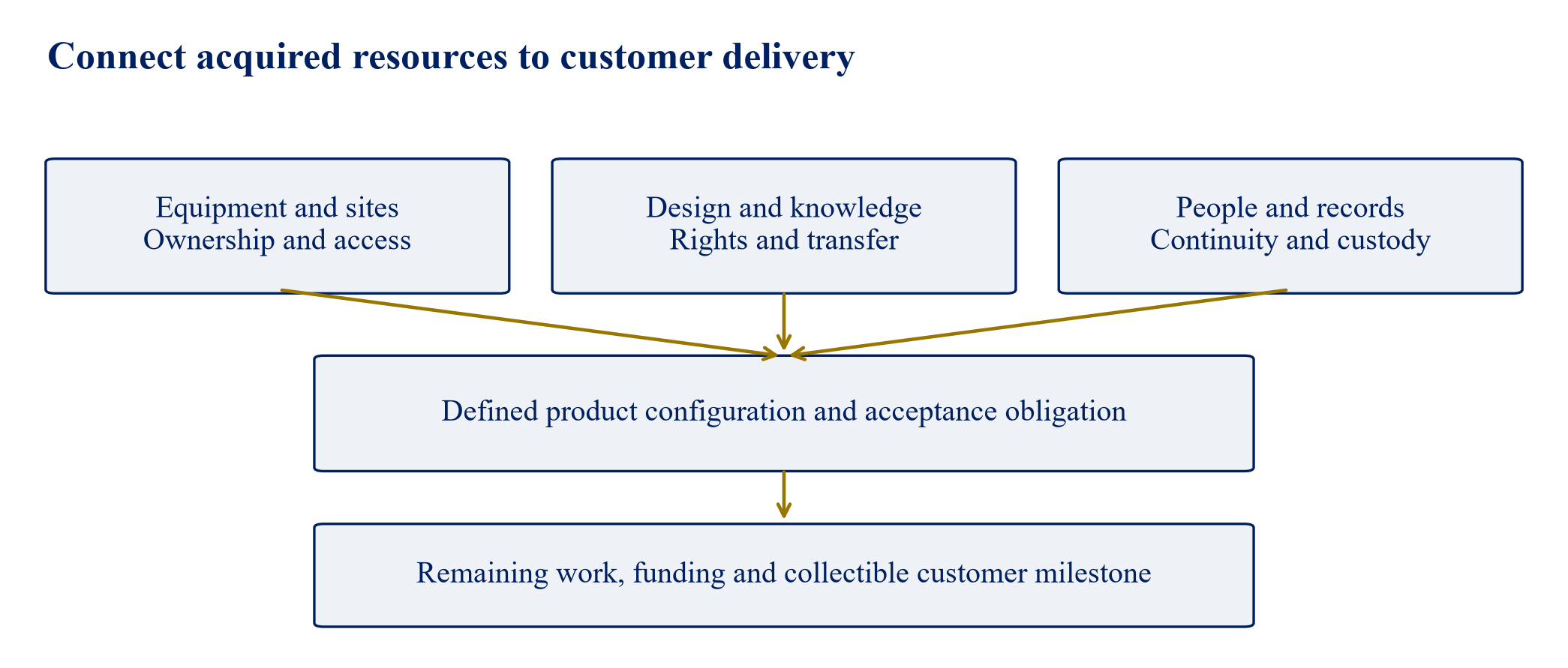
Author-developed decision map. Every box represents a category to verify for an actual transaction; it makes no claim about a named supplier's ownership or readiness.
4 Test the rights that enable production
Intellectual property diligence should connect protected ideas to usable production rights. For each commercial product, identify patents, know-how, design documentation, software and contractual permissions. Record the owner, territory, permitted field of use, duration and transfer conditions. Ask whether the target can manufacture, modify, sell and service the product after the proposed change in ownership. A patent portfolio may cover only part of this operating sequence. A licence may provide manufacturing access while restricting sublicensing, customer sectors or modifications. Each restriction should appear in the acquisition model and operating plan.
The CFS and Type One agreement is useful because the disclosed arrangement concerns licensed cable technology and manufacturing experience [4]. An acquirer of a hypothetical licensee would need to inspect its actual agreement before treating those rights as transferable. The public announcement does not establish assignment permissions, fees or change-of-control treatment. The proposed diligence approach is to obtain the executed licence, amendments, payment record and relevant correspondence. Counsel should distinguish background intellectual property, project-created improvements and the rights required for each customer delivery. Missing evidence should remain an unresolved condition.
Knowledge held by individuals also needs an operating transfer plan. Identify manufacturing steps that depend on undocumented judgement, specialist tooling or a small team. Ask those responsible to demonstrate the process against an existing work instruction and a traceable record. A retention arrangement can support continuity, but it should not substitute for documenting critical knowledge. Employment and invention-assignment terms require jurisdiction-specific review. The buyer should budget training and process capture where appropriate. The resulting rights register should state exactly which commercial benefits can be supported at completion and which depend on later work.
5 Translate technical evidence into customer acceptance
Technical diligence should start with the customer's acceptance requirement. A laboratory result, a factory test and an installed-system acceptance represent different evidence. Establish the intended operating conditions, required interfaces and responsibility for the final test. An investment case should identify whether the target supplies a component, an integrated subsystem or a complete service obligation. The buyer can then ask what additional engineering, testing and documentation stand between today's evidence and the contracted deliverable. This approach requires qualified technical specialists; an acquisition adviser cannot certify performance from a slide deck.
For a proposed magnet acquisition, the evidence request might include design configuration, conductor batch records, winding instructions, test conditions and customer-approved deviations. A robotics acquisition might require interface-control documents, load tests and recovery procedures. These are suggested categories for investigation, not a universal technical specification. The relevant customer contract and engineering standards should determine the actual requirements. The team should preserve version identifiers and the conditions under which tests were performed. A result relating to one configuration should not silently support a valuation for a different product or operating environment.
6 Underwrite a magnet manufacturing business
A magnet business should be examined as a combination of design, materials handling, manufacturing and testing. Map the flow from conductor procurement through winding, assembly, quality review and acceptance. Establish which activities the target performs and which depend on external suppliers or customer facilities. The proposed diligence should examine batch traceability, equipment maintenance, process instructions, test access and contractual responsibility for failures. Any asserted capacity figure needs a defined product, period, staffing pattern and acceptance condition. Equipment floor space alone provides insufficient evidence of deliverable output.
Tokamak Energy's published STEP announcement associates magnet delivery with design, manufacturing and test capability [3]. The acquisition analysis developed here uses that limited description to frame questions for a hypothetical target. It does not extrapolate the company's costs or production rate. A buyer should obtain its own product-level cost records and examine scrap, rework, customer-funded development and unbilled engineering. Where management estimates future improvements, preserve the assumption and the evidence needed to validate it. Separate a repeatable manufacturing margin from one-off development receipts and reimbursed customer expenditure.
A practical diligence exercise is to select an already accepted order and reconcile its bill of materials, labour record, subcontractor invoices and cash receipts. Then select an unfinished order and examine its remaining work. Differences in specification or qualification should be explained before treating the first order as a reliable template for the second. The investment memorandum should identify conductor availability, permitted substitutes and the cost of rejected material. Financing needs should reflect procurement commitments and customer payment milestones. The buyer should be able to explain the effect of delayed acceptance on liquidity.
7 Underwrite materials and qualification records
For a materials supplier, define the product and its permitted application before assigning strategic value. A buyer should identify composition, manufacturing route, inspection evidence, customer qualification and restrictions on reuse of technical data. A supplier may sell material, provide a processing service or participate in development work funded by a customer. Those activities create different rights and economic obligations. The proposed diligence should establish whether qualification attaches to a site, process, individual batch or product configuration. The answer requires actual technical and contractual documents, reviewed by appropriately qualified specialists.
Fusion for Energy's account of Europe's final ITER vacuum-vessel sector describes work by the AMW consortium and a manufacturing chain involving European companies [6]. The account illustrates the relevance of coordinated production and inspection. It provides no sale process, target valuation or transferable qualification certificate. An acquisition team should investigate its own target's custody of material records, weld procedures, inspection results and customer-approved changes. Where records sit with a prime contractor, the buyer should verify access rights and the ability to support future deliveries or warranty investigations.
The materials case should include the cost of reproducing qualification evidence when a facility or process changes. It should also distinguish ordinary inventory from customer-specific material that cannot readily be sold elsewhere. An inventory valuation based on purchase cost needs review against permitted use, condition and obsolescence. A proposed acquisition premium for strategic scarcity should be supported by actual customer requirements and available alternatives. Public interest in advanced materials establishes no scarcity price for a particular supplier. The buyer can make a conditional offer pending evidence of usable records and continuing customer acceptance.
8 Underwrite robotics through task and interface
Remote handling requires analysis of the task performed and the environment in which it operates. ITER describes robotic transporters, manipulators, tooling and support structures operating in constrained spaces and a radiation environment [7]. Those stated requirements concern ITER. They should not be generalised to every commercial robotics supplier. A target review should establish its actual role: mechanical assembly, control software, tooling, integration, testing or maintenance. The commercial case depends on the deliverable for which the target is contractually responsible and the resources needed to support it.
Fusion for Energy reported delivery of an equatorial port-plug assembly tool in July 2026, with Ansaldo Nucleare and subcontractors involved in manufacture and integrated tests [5]. That published example illustrates a distributed supply relationship. For a hypothetical acquisition, inspect whether the target owns the relevant designs and software, can reproduce test conditions and has access to the interfaces needed for service. Verify the division of liability between the prime and subcontractors. Delivery of an assembly tool should not be represented as proof that a nuclear maintenance configuration has already been accepted.
The diligence team should examine recovery from interrupted operations as well as normal operation. Ask what documentation, specialist staff and spares are needed when a tool stops in an inaccessible position. Establish who approves software changes and who controls customer data. Revenue assumptions for recurring service should identify the installed population, contractual entitlement and expected activity, with management estimates labelled. A technically capable team may require substantial support infrastructure to deliver that service. Include those resources in the perimeter and cost model before describing aftercare as an acquisition benefit.
9 Underwrite vacuum systems and power conversion
Vacuum systems diligence should follow the specific contractual boundary: a vessel, a component, pumping equipment, integration work or a service obligation. Identify responsibility for design interfaces, fabrication, inspection, leak testing and installation. The relevant engineering team should determine the tests and conditions applicable to the actual product. An acquisition team should connect each test to documentary evidence and customer acceptance. It should also investigate whether the target has authority to change a material, subcontractor or process after completion. The proposed framework treats required requalification as a costed work package.
Power conversion requires a similarly precise definition. Establish whether the target delivers a component, a packaged converter, control logic, a commissioned system or ongoing support. Review the supplied configuration, electrical interfaces, protection requirements and warranty obligations with qualified specialists. A proposed capacity or reliability claim should carry its test conditions and supporting source. This paper presents no engineering certification or measured failure rate. A buyer should reconcile contracted performance requirements with historical test evidence and budget the remaining work. Any customer-funded development should be distinguished from repeatable product economics.
Combining these suppliers within one acquisition platform creates additional interfaces. A common purchasing team can propose savings, but the product teams must determine whether substitutions remain permissible. Central software management can improve configuration control as a proposed operating measure, while customer access restrictions may limit implementation. Price these activities individually. The combined business should retain responsibility for open orders during integration. A buyer should avoid promising a fully integrated system until the relevant technical and contractual reviews support that commitment. Ownership alone provides no customer acceptance of the new configuration.
10 Use a qualitative diligence matrix
The proposed diligence matrix helps allocate investigation effort. It identifies the unresolved dependency, the evidence required and the decision consequence. Its classifications are qualitative author proposals, not measured probabilities or a scoring system validated against completed transactions. Begin with the risks that can stop delivery or prevent transfer of a core right. Then examine conditions that change cost, timing or consideration. The transaction lead should maintain a named owner and a dated evidence reference for each unresolved item. A colour or label without the underlying record offers limited decision value.
Use distinct categories for legal transfer, technical acceptance and delivery finance. A contract may be legally assignable while its next milestone remains technically incomplete. A completed test may support acceptance while payment depends on another condition. A funded procurement plan may rely on a customer advance that is repayable after termination. Review each dependency on its own terms. The investment committee should see the unresolved evidence alongside its impact on the proposed transaction. The team can then decide which items require pre-signing resolution, completion conditions, indemnities, price changes or post-completion work.
Table 1. Proposed qualitative diligence matrix
| Capability | Priority | Evidence to request | Decision consequence |
|---|---|---|---|
| Magnets | Critical | Licence and conductor records | Condition rights transfer and procurement |
| Materials | Critical | Qualification and batch custody | Budget any required requalification |
| Robotics | Critical | Interfaces and recovery tests | Preserve support and acceptance obligations |
| Vacuum systems | High | Fabrication and inspection records | Price unresolved delivery work |
| Power conversion | High | Configuration and commissioning terms | Cost integration and warranty support |
| Shared functions | High | Site access and seller dependencies | Fund separation and transition services |
Author-developed investigation priorities. The table contains no empirical risk scores or findings about a named target.
11 Analyse customer contracts and concentration
For each material customer relationship, examine the executed contract, amendments, purchase orders and unresolved correspondence. Record what is committed, what remains optional and which events permit termination. Identify change-of-control, assignment and subcontracting provisions for counsel's review. A public programme timetable can help explain context, but revenue requires the target's own evidence. Customer forecasts and letters of interest should remain distinguishable from binding orders. The proposed commercial ledger groups receipts by contractual trigger, currency, expected timing and any condition that can delay or reduce payment.
Concentration should be measured using the relevant denominator. Revenue, gross profit, backlog and cash receipts can produce different pictures of dependence. A target may have several legal customers whose projects share one funding source or technical platform. Investigate that connection before describing the portfolio as diversified. This paper assigns no concentration threshold appropriate to every business. The buyer should identify the failure scenario it can fund and the commercial exposure it is prepared to own. The decision memorandum should explain how customer dependence affects the offer and financing structure.
12 Reconcile backlog to remaining cash
Backlog analysis should establish remaining work and remaining cash together. For each order, start with the current contractual scope and reconcile invoiced amounts, advances, costs incurred, committed purchases and estimated costs to complete. Management's estimates should be identified and challenged against underlying engineering and procurement records. Changes in scope, customer approvals and outstanding claims require separate schedules. The proposed model should show cash needed before the next collectible milestone. It should also explain any advance-payment liability or retention that remains after the buyer takes ownership.
A hypothetical supplier with a large order book can require additional capital if materials must be purchased before acceptance. The acquisition case should therefore include monthly cash timing across unfinished orders. Forecasts should distinguish unconditional payment rights from expected approvals. Where costs are uncertain, show the uncertainty directly through named scenarios and required evidence. A high discount rate alone gives the operating team little guidance about what to do. The buyer needs to understand the procurement commitment, engineering decision or customer action that drives the cash requirement.
Backlog quality should feed both price and completion mechanics. Discuss treatment of cash, debt, advances and working capital with accounting and legal advisers so the offer does not count the same item twice. A customer's advance can support future delivery while carrying a matching performance obligation. A disputed claim may have a different value from an accepted invoice. The buyer should negotiate definitions and evidence standards before signing. It should also retain sufficient liquidity to perform the acquired contracts under a credible delayed-payment scenario. These are proposed safeguards requiring transaction-specific professional review.
13 Choose acquisition licence or partnership
Compare transaction structures against the commercial capability sought. A share acquisition offers ownership of the entity subject to applicable contractual and legal constraints. An asset acquisition can select resources while requiring transfer of each necessary right. A licence can provide a defined use of technology. A joint venture can combine complementary resources under agreed governance. A minority investment can fund development while leaving control elsewhere. Each structure should be assessed through the same delivery example so the team can see which rights, costs and approvals differ.
Compare total committed capital and exit conditions. Include purchase consideration, development funding, access fees, operating losses and the cost of leaving the arrangement. An apparently small initial investment may carry substantial later obligations. A staged structure should state whether later funding is optional, contractually required or necessary to preserve existing value. Explain what information arrives at each stage and who controls the next decision. The parties can then negotiate a structure that allocates uncertainty explicitly. The buyer should retain the ability to decline an unsupported commercial expansion where its contractual obligations permit.
14 Screen cross border permissions early
Cross-border transactions need a jurisdiction-specific permissions review before the parties commit to a timetable. Identify the buyer, ultimate ownership, acquired entity, assets, activities and relevant territories. Counsel should assess investment screening, competition rules, export controls, licences, government contracts and restrictions on technical information. This paper provides no conclusion that a particular hypothetical transaction is permitted. The permission schedule should identify the responsible authority or counterparty, required filing or consent, documentary evidence and the consequence of completion before approval.
The UK government's NSI guidance states that qualifying acquisitions in defined sensitive areas can require approval before completion. A notifiable acquisition completed without approval is void and can carry penalties [8]. Application depends on the legal tests and actual facts. The proposed diligence should examine the target's activities and control changes with specialist counsel. The label fusion does not by itself establish the filing requirement. Review an asset transaction and a share transaction on their respective terms. Preserve the legal opinion and factual assumptions that support the proposed completion sequence.
For transactions spanning the US, UK or continental Europe, coordinate counsel rather than assuming one review covers all territories. Technical data access during diligence may itself need restrictions. Establish who can view design files and how information will be segregated. A clean-team arrangement should have an approved purpose and access rules. The buyer's integration plan should respect permissions throughout the process. Where an approval remains outstanding, the valuation model should identify the cash cost of delay and the negotiated allocation of that cost. Do not convert an uncertain approval into an assumed completion date.
15 Build the stand alone valuation
Start valuation with the target's existing operating boundary. Reconcile historical financial statements to customer contracts, accepted deliveries and cash receipts. Separate development receipts, non-recurring costs, related-party arrangements and management adjustments. The proposed forecast should show revenue, operating costs, tax, capital expenditure and working capital before calculating unlevered free cash flow. These inputs require target evidence. A public fusion funding headline supplies no substitute for those records. State the valuation date, currency and treatment of cash, debt and customer advances so the investment committee can follow the bridge to consideration.
The illustrative model in this paper uses fictional year-end free cash flows of USD 3, 4, 5, 6 and 7 million over five years. It assumes a 12 percent discount rate and 2 percent perpetual growth after year five. These choices are teaching assumptions; they are not market benchmarks, management forecasts or estimates of any named business. Discount each annual cash flow by the relevant power of 1.12. The five-year present value is USD 17.21 million. The terminal cash flow is USD 7.14 million, giving a year-five terminal value of USD 71.40 million.
Discounting that terminal amount to the valuation date produces USD 40.51 million. The illustrative stand-alone enterprise value is therefore USD 57.73 million. Terminal value accounts for approximately 70.18 percent of that result. The reader should recognise how much of this example depends on continuing operations beyond the explicit forecast. Validate reinvestment, product life, customer continuity and rights duration before using such a terminal assumption in a real transaction. A separate finite-horizon case can expose the capital committed when continuing value is unsupported. The calculation demonstrates a method, not a supplier valuation.
16 Bridge buyer benefits and costs
Buyer-specific benefits should have an operational explanation and a cash timetable. Proposed procurement savings require permitted substitutions, supplier quotations and customer approval where applicable. Additional sales require usable rights, technical capacity and actual commercial evidence. The valuation team should identify dependencies for each benefit and the expenditure necessary to achieve it. A buyer can present a separate strategic case without silently adding all projected benefits to the seller's asking price. Decide how much benefit the buyer is prepared to share and which uncertainties require a conditional commercial structure.
The fictional illustration adds incremental year-end free cash flows of USD 0, 1, 2, 2 and 2 million across five years. These are assumed net operating benefits with no terminal continuation. Their present value at 12 percent is USD 4.63 million. The example then deducts USD 4 million of integration expenditure and USD 3 million of qualification expenditure, both assumed payable at completion and excluded from the earlier cash flows. The resulting buyer-specific enterprise value is USD 55.35 million. Adding projected benefit alone would have overstated this example's value.
An assumed USD 8 million of net debt produces illustrative equity value of USD 47.35 million. The example includes no separate cash, debt-like adjustment, earn-out valuation or transaction fee. Those omissions define its scope. The team should expand the model for an actual deal and check for double counting. Every numerical input here is hypothetical. The exercise shows how defined expenditure can exceed the discounted operating benefit. It gives the committee an intelligible question: which integration activities are necessary for the purchase thesis, and what evidence supports their cost and commercial effect?
Table 2. Hypothetical enterprise to equity valuation bridge
| Valuation component | USD m | Timing and scope |
|---|---|---|
| Five year operating cash flows | 17.21 | Present value of 3 4 5 6 and 7 at year ends |
| Continuing value | 40.51 | Present value of year five terminal value 71.40 |
| Stand alone enterprise value | 57.73 | Sum calculated before rounding |
| Buyer operating benefit | 4.63 | Five year cash flows 0 1 2 2 and 2 |
| Integration expenditure | -4.00 | Completion date payment outside operating flows |
| Qualification expenditure | -3.00 | Completion date payment outside operating flows |
| Buyer specific enterprise value | 55.35 | No terminal value for buyer benefit |
| Net debt | -8.00 | Assumed completion amount |
| Illustrative equity value | 47.35 | Transaction fees and other adjustments excluded |
Author-developed illustration in USD millions. Rounded displayed values use full precision underneath. The 12 percent discount rate and 2 percent growth assumption are illustrative inputs; no actual target is valued.
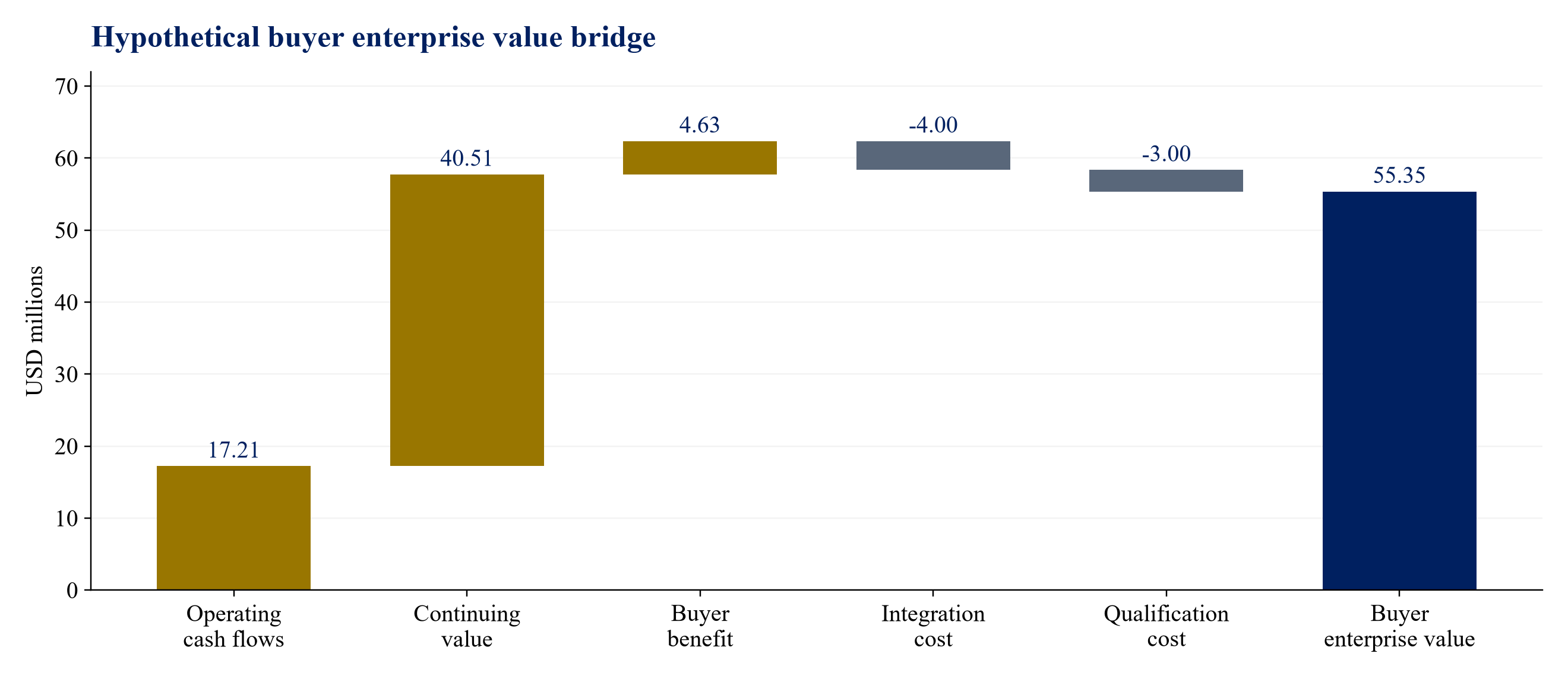
Author-developed financial illustration in USD millions. The chart separates operating cash flows and continuing value from buyer benefit and immediate expenditure. Values are assumptions and calculations, not observed transaction data.
17 Challenge continuing value and delay
The model's dependence on continuing value should be addressed directly. Removing terminal value while retaining the five-year operating cash flows, assumed buyer benefit and immediate expenditure gives buyer-specific enterprise value of USD 14.84 million. After the same USD 8 million net debt, illustrative equity value is USD 6.84 million. This finite-horizon case assumes no recovery value beyond year five. It is deliberately a different scenario. It should not be described as a likely acquisition price. Its purpose is to identify the proposition that supports value beyond the explicit delivery programme.
A separate timing sensitivity can test delayed customer acceptance. Change the affected receipts and associated costs at the order level, then calculate the cash needed to continue delivery. A delay can involve extended staff costs, storage, financing and deferred invoicing. Define those effects rather than applying an unexplained revenue haircut. The scenario should state which customer action or technical condition causes the delay. Avoid assigning a probability without supporting evidence. For actual negotiations, the buyer can compare the capital it must commit under that scenario with available facilities and shareholder funding.
Continuing value also depends on usable capability after existing contracts end. Review licence terms, equipment condition, key people, replacement investment and the target's ability to win orders under its own commercial rights. A technology portfolio may require further development before repeat sales. Include that work in the forecast if supported, or keep it in a separately costed scenario. The investment committee should see which assumptions are evidenced and which remain management estimates. It can then decide whether to pay for continuing value, defer part of consideration or seek another transaction structure.
18 Structure consideration around observable events
Consideration can allocate uncertainty when the parties define the event, evidence and payment obligation precisely. A proposed structure might combine completion consideration with a later payment tied to customer acceptance of a specified order. Another could link payment to consent for a critical licence or transfer of a documented manufacturing capability. These are negotiation examples. This paper assumes no seller agreement, enforceability or accounting treatment. Counsel and accounting advisers should review the actual terms. The commercial team should specify what evidence is available and who is responsible for producing it.
An earn-out based on revenue or profit requires particular attention to control after completion. The buyer's allocation of staff, shared costs and customer opportunities can affect the measure. Define policies, information rights and dispute procedures before signing. A delivery milestone can still create disagreement if the buyer changes the specification or customer approval is outside the seller's control. The proposed structure should identify those situations and their treatment. The goal is an understandable allocation of responsibility. A complex formula that cannot be reconciled to operating records may create uncertainty for both parties.
19 Match acquisition finance to delivery cash
Financing the acquisition requires a view of the target's delivery cash profile. Separate purchase consideration from working capital, capital expenditure, qualification costs and transaction expenses. A lender or equity provider should be able to see which sources fund each use and when repayment is expected. The proposed debt case should use evidenced operating cash and a defined downside scenario. Speculative future fusion deployment should remain outside contracted debt-service assumptions. This paper establishes no generally appropriate leverage ratio or financing margin for a fusion supplier; those require actual underwriting and negotiated terms.
A buyer might consider shareholder equity, acquisition debt, equipment finance or a working-capital facility where permitted and available. Each source can carry security, covenants and restrictions relevant to customer contracts or licensed assets. Counsel should verify that the proposed security and enforcement arrangements are compatible with those rights. A factory may contain customer-owned tooling or assets subject to another party's claim. Identify those exclusions before assuming the entire site is available as collateral. The financing model should preserve adequate liquidity for open orders under the reviewed delivery scenarios.
20 Prepare separation before completion
A carve-out requires a documented separation plan before the parties complete. Identify shared premises, systems, staff, purchasing, engineering tools, insurance and customer access. Establish what transfers and what must be recreated. For each dependency, specify an owner, cost and exit condition. Transitional services should describe the service level, term, payment and arrangements for ending support. The proposed plan should be reviewed by the actual operating teams. The buyer should verify that staff can process orders, access technical records, purchase material and invoice customers on the first operating day.
Technical record separation deserves its own workstream. Design files may include information owned by a customer or another group business. Software tools may rely on enterprise licences that the seller cannot transfer. Calibration records may sit in a shared quality system. Review access and duplication with counsel and technical specialists. Preserve provenance and version control during migration. A copied folder should not be treated as evidence that all operating rights have transferred. The separation ledger should connect each required record to its permitted use and the party responsible for maintaining it.
Test a complete delivery process before declaring readiness. The proposed rehearsal should cover a purchase request, receipt of material, quality record, customer approval, invoice and cash forecast. Use a controlled non-production example where appropriate, avoiding unauthorised customer commitments. Record failures and assign corrective work. Where a service remains with the seller, retain a tested access arrangement until its replacement is ready. The investment committee should see the remaining separation expenditure and dependencies at completion. A signed purchase agreement does not itself demonstrate that the acquired operation can perform its next order.
21 Integrate without disrupting open orders
Integration should preserve delivery obligations while introducing the changes that support the purchase thesis. Begin with a list of open customer commitments and the processes protected until approval for change. A proposed first phase can establish financial control, security access and decision rights. Subsequent phases can address procurement, systems and product interfaces after review. The sequence should reflect the actual business. A buyer should not impose a standard consolidation timetable that ignores customer qualification, licensed software or contractual limits. Each proposed change needs an accountable owner and an evidence-based release decision.
Measure progress through observable operating evidence. Examples include reconciled order costs, access to required technical records, signed permissions and successful use of a replacement system. A proposed synergy should remain separate from achieved savings until its financial effect can be traced. Report spend and benefits on the same perimeter used in valuation. If a programme requires additional qualification, update the operating timetable and cash model. The integration team should retain the authority to pause a change that threatens performance of an existing obligation. Escalation rules should be agreed before completion.
The roadmap in Figure 3 is a proposed sequence rather than a promised timetable. It uses evidence states to show dependencies. Customer delivery continuity precedes changes to a qualified process. A completed permissions review precedes restricted data migration. A funded qualification plan precedes a new product commitment. The sequence can run partly in parallel when actual dependencies allow. Table 3 maps the phases to the evidence the buyer should retain. The combined business should also define who may approve exceptions and how those exceptions are reflected in customer communication, cost and liquidity.
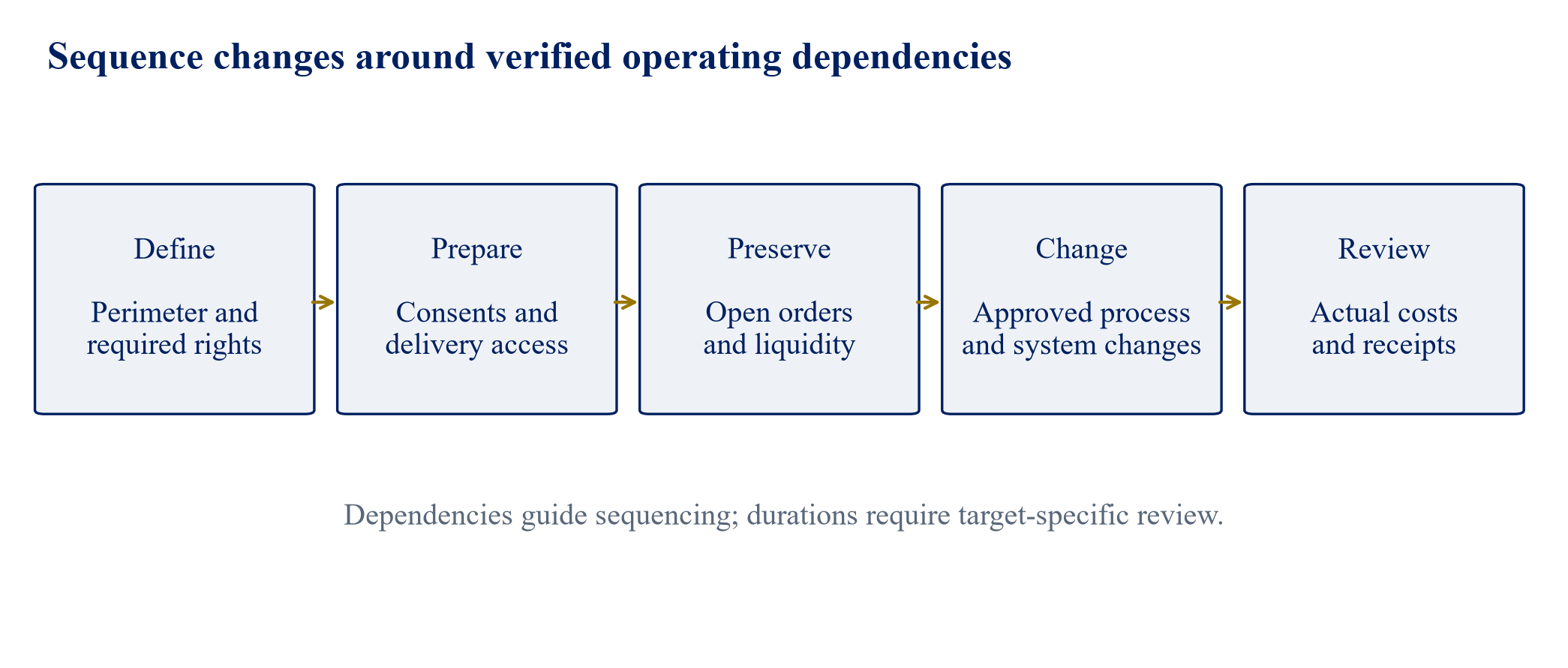
Author-developed sequence with evidence requirements. The phases represent dependencies rather than fixed durations. No completed integration or performance improvement is asserted.
Table 3. Proposed completion and integration evidence
| Phase | Accountable role | Evidence retained |
|---|---|---|
| Before signing | Transaction lead | Perimeter rights and unresolved conditions |
| Before completion | Legal and operations | Required consents and tested delivery access |
| Operating continuity | Delivery manager | Order ledger liquidity and customer permissions |
| Separation | Systems and quality | Reconciled records and service exit tests |
| Integration | Product and finance | Approved changes and qualified configuration |
| Benefit review | Investment committee | Actual receipts costs and updated forecast |
Author-developed operating checklist. Responsibilities and timing require adaptation to the actual target and negotiated documents.
22 Use AI and data with traceable review
AI and data tools can be proposed for extracting contract terms, mapping document references and finding inconsistencies in a controlled diligence collection. Their outputs require review against the original documents. Preserve source location, version and access permissions for each extracted item. A generated summary should not become the sole evidence for a licence-transfer conclusion or a customer acceptance requirement. The proposed workflow should assign legal, financial or technical reviewers according to the question. This paper presents no measured productivity gain, error reduction or valuation uplift from AI use.
A useful proposed data structure connects product configuration, material batch, work instruction, test result, order and invoice. That relationship can support investigation of which evidence belongs to which commercial obligation. It requires reliable source records and agreed identifiers. Where records are missing, the tool should show the gap. Do not generate plausible replacements. For modelling or simulation, qualified engineers should specify the validation boundary and intended use. A model useful for exploring a design question may require additional evidence before supporting acceptance or a contractual representation.
Information governance should be established before uploading restricted files to any tool. Review confidentiality, licence terms, export constraints, customer permissions and the approved processing environment. Keep a human-reviewed trail for substantive conclusions. The investment committee should distinguish the available evidence from machine-produced suggestions. An AI-assisted diligence proposal can have commercial value when it addresses a specific work problem, but its effect should be tested against documented outcomes. The acquisition case should not capitalise an assumed technology benefit merely because the target or buyer intends to use AI.
23 Establish a transaction mandate with decision outputs
A transaction mandate should specify the decision outputs required for each phase. Initial screening should establish the target's capability, ownership and fit with the buyer's defined delivery need. Commercial and technical diligence should produce a perimeter map, evidence ledger, customer-contract review and cost-to-complete model. Valuation should show stand-alone economics, buyer-specific assumptions and the bridge to consideration. Execution planning should identify conditions, funding, separation and integration. These are proposed work products. Their depth and professional responsibilities should be agreed with the client and relevant specialist advisers.
An advisory team should keep verified facts, management representations and analytical proposals distinct in its internal work. Public materials should explain scenario assumptions naturally and retain source citations. The buyer should know which conclusions are ready for investment approval and which require additional evidence. A useful committee paper assigns each unresolved question an action and decision consequence. It should also identify the conditions under which the team recommends ending negotiations. Continuing diligence without a rejection criterion can consume resources while leaving the acquisition thesis unchanged and unsupported.
Fees and staffing should be negotiated for a defined scope with clear delivery responsibilities. This paper establishes no market fee, available mandate or willingness of a buyer to pay a retainer. Commercial demand requires direct evidence from client engagement and agreed terms. The proposed mandate can nevertheless be structured around concrete problems: transferring a critical licence, assessing an unfinished order book, financing acceptance delays or separating technical records. Each problem connects advisory work to an investment decision. That connection gives the client a basis for evaluating scope, cost and the evidence required before proceeding.
24 Conclusion
Fusion supply-chain acquisitions should be approved through an account of transferable capability and delivery economics. Public policy and industrial disclosures provide useful context, while an actual transaction needs its own evidence of rights, customer obligations, operating costs and available funding. The proposed framework connects these items in a perimeter map, a qualitative diligence matrix and a financial bridge. It treats magnets, materials, robotics, vacuum systems and power conversion as distinct operating cases with specific interfaces. The buyer should commission specialist review wherever an engineering or legal conclusion is required.
The hypothetical valuation highlights the importance of continuing value and the cash required to achieve buyer benefits. Its stand-alone enterprise value of USD 57.73 million becomes buyer-specific enterprise value of USD 55.35 million after defined benefit and expenditure adjustments. Those amounts have no status as a market valuation. They show the effect of explicit assumptions and support a disciplined question about consideration. A buyer should trace each material assumption to evidence or a labelled scenario, review alternative horizons and fund the delivery commitments it would acquire.
References
- UK Government. A new energy revolution The UK's plan for delivering fusion energy. UK Fusion Strategy 2026. https://www.gov.uk/government/publications/uk-fusion-strategy-2026/a-new-energy-revolution-the-uks-plan-for-delivering-fusion-energy-accessible-webpage
- US Department of Energy. Fusion Energy. Current official roadmap overview and funding qualifications. https://www.energy.gov/fusion/fusion-energy
- Tokamak Energy. Tokamak Energy named Magnet Systems Partner for STEP Fusion programme. 14 April 2026. Company disclosure of contract and earlier Ridgway Machines acquisition. https://tokamakenergy.com/2026/04/14/tokamak-energy-named-magnet-systems-partner-for-step-fusion-programme/
- Commonwealth Fusion Systems. Commonwealth Fusion Systems and Type One Energy Sign Fusion Magnet Agreement. 11 February 2025. Company licence announcement. https://cfs.energy/news-and-media/commonwealth-fusion-systems-and-type-one-energy-sign-fusion-magnet-agreement/
- Fusion for Energy. Europe's first remote handling tool is in ITER. 6 July 2026. https://fusionforenergy.europa.eu/news/first-iter-remote-handling-tool-port-plug/
- Fusion for Energy. Europe completes the last ITER Vacuum Vessel sector. Official manufacturing account; photograph identified as September 2026. https://fusionforenergy.europa.eu/news/europe-completes-the-last-iter-vacuum-vessel-sector/amp/
- ITER Organization. Remote handling. Official system description. https://www.iter.org/machine/supporting-systems/remote-handling
- UK Government. Check if you need to tell the government about an acquisition that could harm the UK's national security. Current National Security and Investment Act guidance. https://www.gov.uk/guidance/national-security-and-investment-act-guidance-on-acquisitions
About the Author
Chennakeshav (CK) is a corporate finance and investment banking executive with 25+ years of global experience in deal origination, structuring and execution across M&A, growth capital and corporate strategy. He has led value-creation mandates for founders, corporates and funds — bridging the boardroom view to hands-on execution and close.
His career spans Morgan Stanley, HSBC, Lloyds Banking Group, EWEC, ADQ portfolio companies and Emirates Growth Fund, across TMT, real estate, fintech, deeptech, cleantech, infrastructure and energy. He has partnered with C-suite leaders, private equity and venture funds, sovereign wealth funds and family offices to finance complex fund raises and scale-up ventures, and has led M&A due diligence, post-merger integration and business-transformation initiatives to create value.
At Matchpoint Partners he is Managing Partner, leading the firm's corporate finance, M&A and capital-raising practice. He holds an MBA from London Business School, an engineering degree from VTU and a Master of Laws (LLM, in progress) from UCL London.
An active start-up mentor, CK mentors at Techstars, DIFC FinTech Hive, Startup Grind, Founder Institute and IN5, serves as Entrepreneur Mentor in Residence (EMiR) at London Business School, and judges the Entrepreneurship World Cup.
