

1. Treat the purchase-price currency as an acquisition term
The purchase price is commonly negotiated in the seller’s currency while the buyer raises equity, draws debt and reports performance in another. The exchange rate therefore changes the economic consideration even when the contractual number remains fixed. A board approving EUR 420 million may be authorising a materially different sterling outlay depending on the rate at closing.
The exposure begins when the buyer’s commercial decision becomes sensitive to the currency, which can precede signing. A competitive auction may require a firm local-currency bid. An exclusivity period can create a highly probable transaction without a binding sale agreement. Signing makes the obligation more defined, but conditions and termination rights preserve uncertainty.
The Acquisition FX Certainty Test treats currency as part of transaction architecture. The board paper should show the valuation currency, funding currency, functional currency, expected closing window and rate at which the investment case no longer meets its return or leverage threshold. Treasury execution should then be connected to the sale agreement, financing documents and approval timetable.
This approach avoids a misleading separation between deal value and hedging. A hedge can protect an approved value, consume liquidity, alter accounting and create a payment when no acquisition completes. Those outcomes belong in the same decision record as price and financing.
2. Map the exposure before choosing an instrument
The exposure map should begin with the contractual purchase price and include debt assumed, cash acquired, completion accounts, locked-box leakage, earn-outs, transaction fees and refinancing. Each component can have a different currency and settlement date. A headline price is therefore an incomplete hedge notional.
The map should distinguish fixed, variable and contingent components. A fixed euro amount due at closing can be hedged directly. A working-capital adjustment is uncertain. A performance earn-out may arise years later and depends on operating results. Seller rollover equity may reduce the cash requirement while creating a different valuation exposure.
Funding also matters. A buyer can borrow in the purchase-price currency, issue debt in its functional currency and swap the proceeds, or use cash held in another currency. Natural offsets should be recognised before derivatives are added. The residual exposure is the amount that can change the buyer’s economic cost.
The closing calendar should show earliest, expected and latest dates. Regulatory approvals can shift settlement, and a standard forward with a single maturity may require extension or early settlement. The hedge mandate should therefore specify timing tolerance, rollover authority and the evidence that permits treasury to adjust the notional.
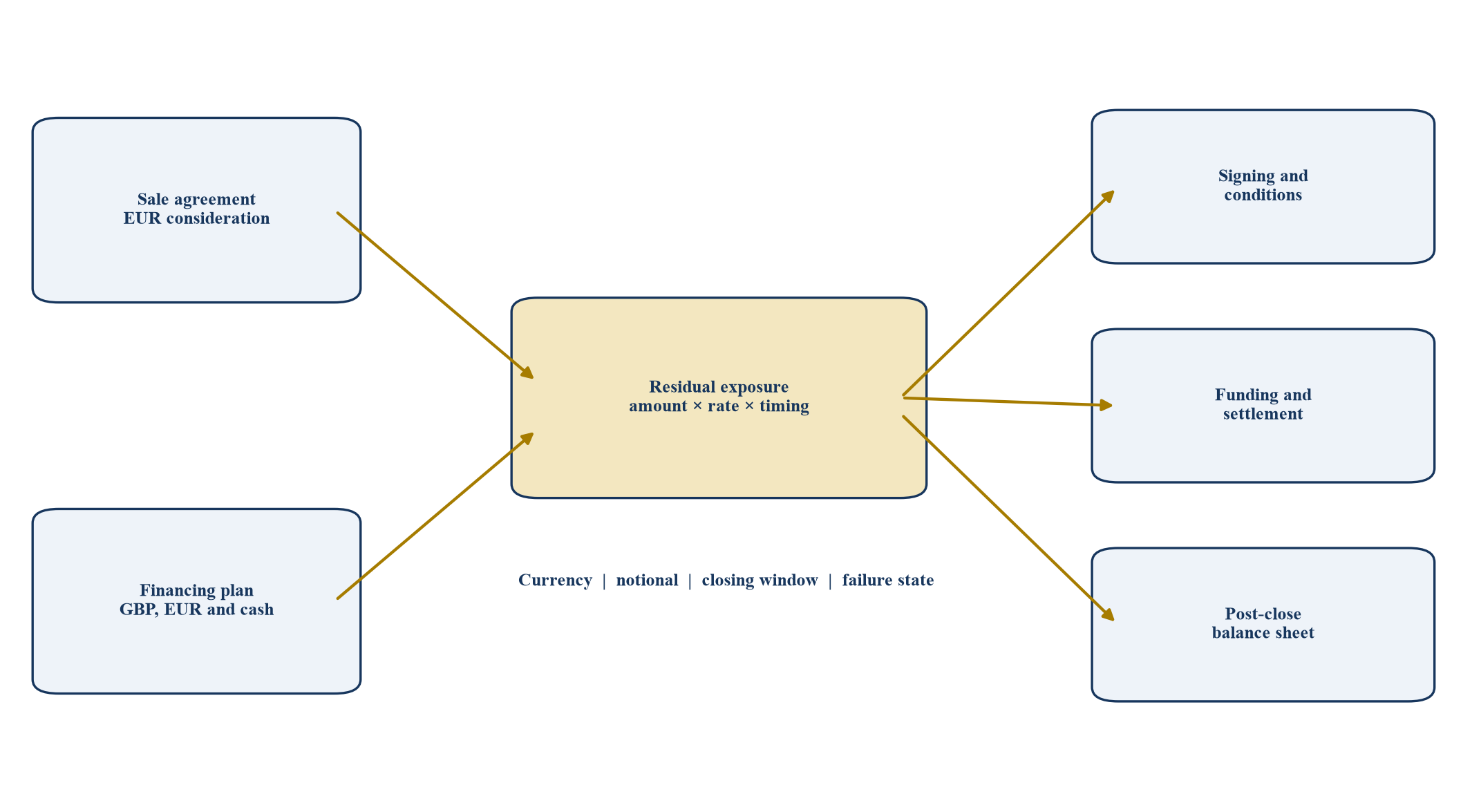
The map separates contractual consideration, funding and residual currency exposure. Amounts and timing require transaction-specific verification.
3. Establish the board’s FX risk appetite
The board should define the loss it is willing to absorb from currency movements before selecting a product. The limit can be expressed as additional purchase-price cash, leverage increase, dilution, reduction in internal rate of return or a combination. The metric should connect to the acquisition’s approved value case.
Risk appetite should distinguish closing and break scenarios. In the closing scenario, the concern is adverse movement in the purchase currency. In the break scenario, the concern is hedge termination cost, trapped cash or an offsetting position that no longer has an underlying transaction. A structure can perform well in one scenario and poorly in the other.
The mandate should identify permitted instruments, counterparties, tenors, collateral terms and delegated authorities. It should state whether treasury can layer hedges as certainty increases and whether the chief financial officer can extend maturity within the approved closing window.
The board should also specify participation. A forward prioritises certainty and gives up favourable movement. An option protects a worst rate while retaining upside for a premium. A collar reduces or eliminates the upfront premium by limiting participation. These are different economic choices rather than technical variations.
4. Measure the unhedged value-at-risk in transaction terms
Statistical value-at-risk can support treasury analysis, but the board needs transaction outcomes. The core schedule should translate exchange rates into functional-currency purchase price, funding need and leverage. It should include breakpoints at which committed facilities, equity capacity or return thresholds are exceeded.
The hypothetical buyer owes EUR 420 million. At GBP 0.86 per euro, the sterling amount is GBP 361.2 million. At GBP 0.94, the cost becomes GBP 394.8 million, an increase of GBP 33.6 million. At GBP 0.80, it falls to GBP 336.0 million. These figures isolate currency and ignore debt, cash and completion adjustments.
The scenario range should come from a documented risk process, not a claim about future rates. Historical movement, implied volatility and stress calibration can inform it. The board should also test discontinuous moves around political, regulatory or financing events.
| Closing rate (GBP per EUR) | Sterling purchase price | Change from GBP 0.86 case |
|---|---|---|
| GBP 0.80 | GBP 336.0m | GBP 25.2m lower |
| GBP 0.84 | GBP 352.8m | GBP 8.4m lower |
| GBP 0.86 | GBP 361.2m | Base case |
| GBP 0.90 | GBP 378.0m | GBP 16.8m higher |
| GBP 0.94 | GBP 394.8m | GBP 33.6m higher |
| GBP 0.96 | GBP 403.2m | GBP 42.0m higher |
Rates and amounts are illustrative scenario inputs. GBP per EUR means the sterling cost of one euro.
5. Use forwards when amount and timing are sufficiently firm
An FX forward fixes the rate for exchanging currencies on a future date. It provides purchase-price certainty and commonly has no upfront premium, although its forward rate includes interest-rate differentials and market pricing. It also creates a mark-to-market exposure before settlement.
For a signed acquisition with high completion certainty, a forward can be efficient. The notional should reflect the cash consideration actually exposed, and the maturity should align with the expected closing window. A flexible or window forward may address limited timing uncertainty, subject to pricing and terms.
The central risk is deal failure. If the acquisition terminates after an adverse market move, the buyer may need to unwind the forward and pay its negative value. The board should model this amount under the same stress rates used for the purchase price. Credit-support terms, close-out provisions and netting documentation affect liquidity.
The hypothetical six-month forward rate is GBP 0.865 per euro. A full EUR 420 million forward would fix GBP 363.3 million. This is not a market quote. It is a worked input used to compare structures.
6. Use vanilla options to separate protection from obligation
A euro call and sterling put gives the buyer the right, without the obligation, to acquire euros at a stated strike. If the euro strengthens beyond the strike, the option protects the purchase price. If the euro weakens, the buyer can let the option expire and buy euros more cheaply in the market.
This asymmetry suits uncertain completion because the buyer does not need to unwind an obligation when the deal fails. The premium is paid regardless of outcome. The board should treat it as the price of conditional protection and include it in transaction economics.
The worked option has a strike of GBP 0.87 and a premium of GBP 12.6 million, equal to 3.5 per cent of the GBP 361.2 million spot-equivalent amount. If the transaction closes at GBP 0.94, exercise limits the currency purchase to GBP 365.4 million before premium. If the rate is GBP 0.80, the buyer lets the option expire and pays GBP 336.0 million plus premium.
Option tenor, volatility, strike and settlement terms determine price. Early termination, closing delay and changes in notional should be addressed at execution rather than assumed away.
7. Use collars to exchange some upside for lower premium
A collar combines a protective option with a sold option. The buyer can establish a worst exchange rate and surrender benefit beyond a favourable rate. A zero-premium label means the option premiums offset at inception under the quoted assumptions; it does not mean the structure has no risk, credit exposure or termination value.
The worked collar protects at GBP 0.91 and caps favourable participation below GBP 0.83. If the euro strengthens to GBP 0.96, the purchase-price rate is limited to GBP 0.91. If the euro weakens to GBP 0.80, the buyer remains required to transact at GBP 0.83. Between the strikes, it uses the market rate.
A collar can fit a board that wants a defined budget and accepts a minimum purchase-price cost. It is less suitable when the buyer wants full benefit from currency improvement or when the sold option creates an unacceptable break exposure.
The term sheet should make the sold leg visible. Governance discussions often focus on the protective option and overlook the obligation. Both legs should be stress-tested on closing, delay and failure.
8. Evaluate deal-contingent hedges as conditional contracts
A deal-contingent hedge is designed to settle if a defined acquisition completes and terminate under specified failure conditions. Pricing can incorporate the hedge provider’s assessment of closing probability, correlation, documentation and recovery. The buyer pays for transferring some break risk to the provider through the contractual rate or premium.
The qualifying deal, conditions, long-stop date, amendments and failure events must be precise. A transaction can fail in ways outside the contingent cancellation terms. A buyer decision to withdraw, a financing failure or a material amendment may produce different consequences from regulatory prohibition.
The worked deal-contingent forward fixes GBP 0.885 per euro and cancels without the standard forward’s mark-to-market payment only when the defined qualifying transaction fails for covered reasons. This is an illustrative term, not a market quote. Its GBP 371.7 million closing cost is higher than the plain forward’s GBP 363.3 million, reflecting the assumed conditionality.
The board should compare this price with the option premium and the tail break cost of a standard forward. Legal review of definitions and evidence is essential because the product’s value resides in the conditions.
9. Layer hedges as completion certainty changes
A layered programme increases protection as the transaction becomes more probable. Before signing, the buyer may hedge a small portion with options. At signing, it can add protection. After key regulatory or financing conditions are satisfied, it can convert or supplement the position with forwards.
Layering reduces the risk of fully hedging a transaction that fails. It also leaves some currency exposure during the early period. The schedule should tie each layer to objective evidence, such as signed documents, shareholder approval, financing commitment or regulatory clearance.
The board should avoid false precision in closing probabilities. A 70 per cent estimate is a management input, not a traded fact. The useful discipline is to identify what changes the probability and how hedge authority responds.
Operational capacity matters. Multiple instruments and dates can create settlement errors, accounting complexity and inconsistent counterparty terms. The programme should remain small enough for the treasury team to control.
10. Compare structures on a common economic basis
The comparison should include purchase-price cash, upfront premium, break exposure, participation, timing flexibility, collateral and accounting. Quoted rates alone are insufficient.
The finance team should calculate a closing-state cost and a failure-state cost for every structure. The closing-state cost includes the amount paid for currency, premiums, financing carry and any settlement adjustment. The failure-state cost includes sunk premium, derivative close-out, released financing fees and transaction expenses. A probability-weighted result can be shown, while the board should retain the separate tail outcomes because expected value can hide a liquidity event.
Terms should be normalised to the same notional and dates. A forward quoted for an exact date should not be compared directly with an option covering a wider window without recognising the difference. A contingent hedge that covers only regulatory failure should not be treated as equivalent to an option that can expire unused following any non-completion.
The comparison should also show counterparty credit and collateral. A favourable derivative receivable is useful only if the counterparty performs. An unfavourable position can require collateral before closing. The board can set a maximum unsecured exposure by bank and require competitive execution across approved counterparties.
Tax and accounting should be included after the economic comparison rather than used to justify an unsuitable risk position. Timing differences can affect earnings, equity and distributable reserves. These effects should be forecast under the same scenarios used for cash.
| Structure | Worked term | Upfront premium | Closing participation | Principal break exposure |
|---|---|---|---|---|
| Unhedged | Market rate | None | Full | No derivative unwind |
| Full forward | GBP 0.865 | None | None | Mark-to-market on termination |
| Vanilla option | Strike GBP 0.87 | GBP 12.6m | Full below strike | Premium is sunk |
| Zero-premium collar | Floor GBP 0.83; cap GBP 0.91 | None at inception | Between strikes | Sold-option value |
| Deal-contingent forward | GBP 0.885 | Embedded in rate | None | Depends on covered failure definition |
All terms are illustrative and exclude counterparty charges, tax, collateral and accounting effects.
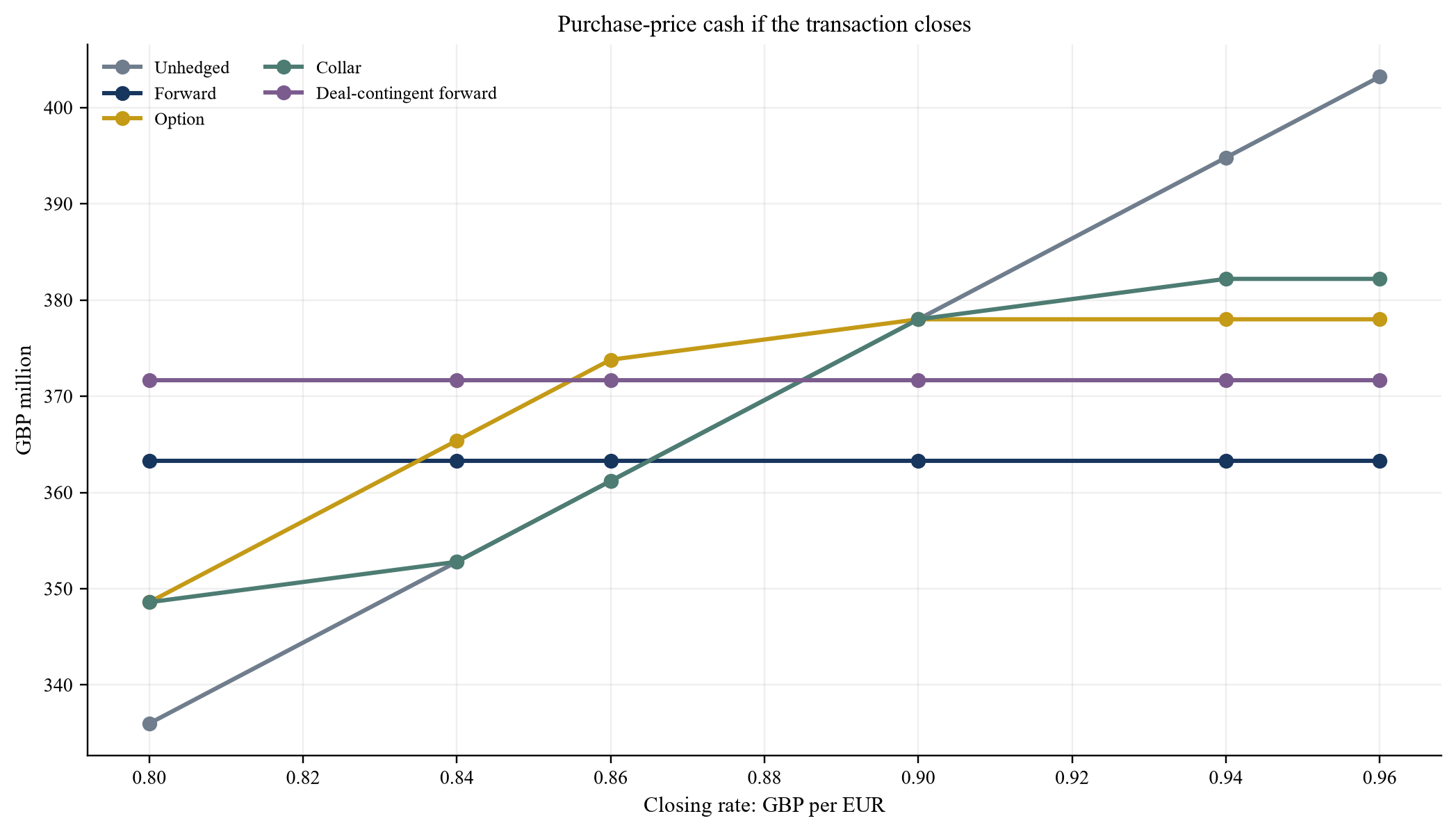
Amounts include the option premium where applicable and assume the qualifying transaction closes. Deal-contingent and forward rates are illustrative.
11. Quantify break costs before signing
Break cost is the amount payable or receivable when a derivative is terminated before maturity. It depends on current market rates, remaining tenor, volatility, credit terms and documentation. A favourable hedge can produce a receipt; an unfavourable hedge can require cash when the buyer is already paying advisory and financing costs for a failed transaction.
The board should model break scenarios separately from closing scenarios. For a forward, the stress should assume the acquisition fails when the purchase currency has weakened, leaving a negative derivative value. For an option, the premium is already paid, while a sold option in a collar may have value against the buyer.
The financing plan should reserve liquidity for plausible termination payments. This reserve should not rely on acquisition facilities that disappear when the deal fails. Counterparty netting and collateral terms can change timing.
Break-fee receipts from the seller should not automatically be treated as an offset. Their availability, currency, timing and collectability differ from the derivative obligation. The transaction model should show both cash flows explicitly.
Break analysis should include the path to failure. A prohibition by a regulator, a shareholder rejection, a buyer financing failure and a voluntary withdrawal can produce different sale-agreement rights and different derivative consequences. Deal-contingent documentation may cover some paths and exclude others. The legal team should build a matrix that pairs each transaction termination right with the hedge outcome.
The mark-to-market should be refreshed as conditions evolve. A large negative value can arise before a formal termination. If the board is considering an amendment or withdrawal, it needs the live derivative consequence as part of that decision. Treasury should not wait for the public announcement to calculate it.
Liquidity timing matters as much as amount. A derivative close-out can be payable shortly after termination, while a contractual break fee may arrive later or become disputed. The buyer should have committed liquidity independent of acquisition funding and should know which entity is the derivative obligor.
Governance should prevent a hedge from influencing the deal decision improperly. Management should evaluate the acquisition on its merits and disclose the hedge consequence. A large termination payment should be visible, but it should not convert a value-destructive acquisition into an apparently unavoidable closing.
12. Define the closing window and extension protocol
Acquisition closing dates move. Regulatory review, shareholder processes, financing conditions and completion accounts can alter timing. A single-date hedge can mature before or after the purchase-price payment.
The protocol should specify earliest, expected and long-stop dates. It should identify who can extend, roll, partially settle or resize the hedge. Treasury should receive transaction updates under a controlled information process that respects confidentiality and market-conduct rules.
An extension is a new economic decision. Forward points, volatility and credit exposure change. The team should record the old mark-to-market, new terms and effect on the approved purchase-price limit.
Settlement instructions, bank accounts, cut-off times and time zones should be tested before closing. Operational failure on the payment date can create overdraft, failed settlement or emergency spot execution even when the hedge design is sound.
13. Integrate acquisition finance and the currency hedge
The hedge notional should reconcile with committed debt, equity, cash and target refinancing. A euro loan can provide a natural hedge for part of the consideration. If the target generates euro cash flows, the post-close debt currency can also affect leverage and net-investment exposure.
Loan drawdown conditions and hedge settlement should use compatible dates. A lender may require hedging while the derivative counterparty requires credit support. The buyer should avoid circular conditions in which neither funding nor hedging can become effective first.
The financing model should stress currency movement in commitment fees, original-issue discounts, interest, debt repayment and covenant ratios. A fixed purchase-price hedge does not cover every financing exposure.
The board should see the combined sources-and-uses schedule. Treasury optimisation cannot repair an acquisition whose economics fail under reasonable funding and currency stresses.
The schedule should identify the currency in which each funding commitment is legally available. A sterling facility described as equivalent to a euro amount still leaves a conversion requirement. A euro bridge can reduce purchase-price exposure while creating refinancing and post-close translation considerations. The buyer should compare these alternatives on all-in cost and risk rather than on the hedge rate alone.
Interest-rate and currency hedges can interact. A cross-currency swap may transform both principal and interest obligations, while separate FX and rate instruments can create different maturity, collateral and close-out profiles. The financing workstream should prevent duplicate or offsetting trades executed by different teams.
Commitment and drawdown conditions should be tested against the sale agreement’s funds-certain obligations. A derivative whose settlement depends on a facility draw can fail operationally if the facility requires evidence available only after the FX payment cut-off. A closing rehearsal should establish the sequence of equity contribution, debt draw, derivative settlement and seller payment.
The buyer should also model a partial closing, deferred consideration and purchase-price adjustment. If only part of the target transfers, the original hedge can exceed the cash need. The mandate should provide for partial termination or redesignation and assign the resulting value between transaction cost and financing outcome.
Every funding source should therefore be traced to the exact currency, entity, date and condition required by the closing funds flow.
14. Apply hedge accounting only after economic design
IFRS 9 permits hedge accounting when qualifying criteria, designation and documentation are met. Its objective is to represent the effect of risk-management activities in financial statements. A firm commitment’s foreign-currency risk can be accounted for through a fair-value hedge or, in specified circumstances, a cash-flow hedge.
Accounting designation should follow the economic risk decision. The finance team should identify the hedged item, hedged risk, instrument, hedge ratio and method for assessing effectiveness. Timing and notional mismatches can create ineffectiveness.
The costs-of-hedging provisions address option time value, forward elements and foreign-currency basis spreads under specified conditions. Acquisition accounting can affect where hedge results are recognised and whether amounts enter the initial cost of a non-financial item.
The worked paper does not determine accounting treatment. The buyer should obtain transaction-specific advice and document the relationship before the relevant designation deadline. A hedge can be economically sensible even when hedge accounting is unavailable, but the earnings and equity effects should be understood.
15. Distinguish transaction exposure from translation exposure
The purchase-price exposure concerns the cash required to acquire the target. After closing, the buyer may have a net investment in a foreign operation, foreign-currency debt, intercompany balances and forecast operating cash flows. These are different exposures.
IAS 21 governs translation of foreign-currency transactions and foreign operations. IFRIC 16 addresses hedges of a net investment and clarifies that the hedged risk arises from differences between functional currencies rather than presentation currency alone.
The acquisition hedge should not be allowed to drift into an undocumented post-close position. At settlement, treasury should close, redesignate or replace instruments according to the approved post-acquisition policy.
The integration plan should also identify the target’s existing derivatives. Duplicate hedges can arise when both buyer and target protect the same economic exposure.
16. Control counterparty and documentation risk
Derivative value depends on the counterparty and contract. The buyer should assess credit quality, capacity, concentration, collateral, netting and termination rights. Competitive quotes help price discovery, while fragmented documentation can complicate close-out.
The governing master agreement, schedule, credit-support terms and confirmations should be executed before reliance on the hedge. ISDA and EMTA published revised 2026 FX Definitions in March 2026, with implementation scheduled for November 2027. Transactions in the interim should identify the definitions and version used.
Documentation should address disruption events, fallback rates, calculation agent, business days, settlement and non-deliverable currencies where relevant. The 2026 definitions update these mechanisms, which is material for future implementation planning.
The legal team should reconcile derivative termination events with sale-agreement amendments and financing defaults. Inconsistent definitions can produce an unintended settlement.
17. Address regulation, reporting and market conduct
The applicable derivatives regime depends on counterparties, jurisdiction, product and execution. Reporting, margin, business-conduct and clearing requirements may apply. The buyer should determine classifications and delegated reporting responsibilities before trade date.
Confidential acquisition information requires controlled handling. Dealers need enough information to price conditionality, while the buyer must manage inside information, wall-crossing and disclosure obligations. A deal-contingent hedge can require more transaction detail than a standard forward.
The board should also consider sanctions, capital controls and currency convertibility. A deliverable hedge can be disrupted when the relevant currency or payment route becomes unavailable. Fallbacks and non-deliverable settlement may change basis risk.
Compliance should be a documented workstream rather than an assumption embedded in treasury execution.
The workstream should identify the legal entity entering the trade, its regulatory classification, the counterparty’s status and the place of execution. It should determine which party reports, what unique identifiers are required, and how lifecycle events such as amendment, compression, partial termination and settlement are captured. Responsibility can be delegated operationally while accountability remains with the buyer.
Margin and clearing analysis should be completed before quote requests. Even where a product is not centrally cleared, bilateral collateral terms can create cash demands. The acquisition model should include initial and variation margin where applicable and should not assume that a relationship bank will provide unlimited unsecured capacity.
Market conduct controls should restrict the transaction team and treasury team to approved channels. Quote requests should disclose only the information required for pricing and should record who received it. If several banks are approached, the company should manage wall-crossing consistently and preserve evidence of confidentiality undertakings.
Post-trade controls should reconcile the confirmation to the mandate and dealer recap. Any difference in currency pair, direction, notional, strike, maturity, disruption fallback or contingent event should be escalated immediately. A small confirmation error can reverse the intended hedge.
18. Test the worked structures across closing rates
| Closing rate | Unhedged | Full forward | Vanilla option | Collar | Deal-contingent forward |
|---|---|---|---|---|---|
| GBP 0.80 | GBP 336.0m | GBP 363.3m | GBP 348.6m | GBP 348.6m | GBP 371.7m |
| GBP 0.86 | GBP 361.2m | GBP 363.3m | GBP 373.8m | GBP 361.2m | GBP 371.7m |
| GBP 0.90 | GBP 378.0m | GBP 363.3m | GBP 378.0m | GBP 378.0m | GBP 371.7m |
| GBP 0.94 | GBP 394.8m | GBP 363.3m | GBP 378.0m | GBP 382.2m | GBP 371.7m |
| GBP 0.96 | GBP 403.2m | GBP 363.3m | GBP 378.0m | GBP 382.2m | GBP 371.7m |
GBP millions, rounded. Option values include GBP 12.6 million premium. The collar transacts at the market rate between GBP 0.83 and GBP 0.91.
The table shows closing outcomes only. It does not rank structures because failure outcomes differ. The option’s premium buys both protection and the ability to walk away from the currency exchange. The forward provides the lowest worked fixed rate but retains unwind risk. The collar limits both adverse and favourable movement. The contingent forward embeds conditionality in the worked rate.
Selection should therefore use expected and stressed cash across closing, delay and failure states. A simple expected-value calculation can supplement the decision, but it should not conceal tail liquidity. The board may prefer a higher expected cost if it removes a payment that could arise after a failed acquisition.
19. Use a decision tree rather than a product preference
The first question is whether the exposure is sufficiently defined. If amount and timing remain highly uncertain, the buyer can use no hedge, a small option layer or a capped risk budget. Once a signed obligation and credible timetable exist, the choice turns to break-cost capacity and participation.
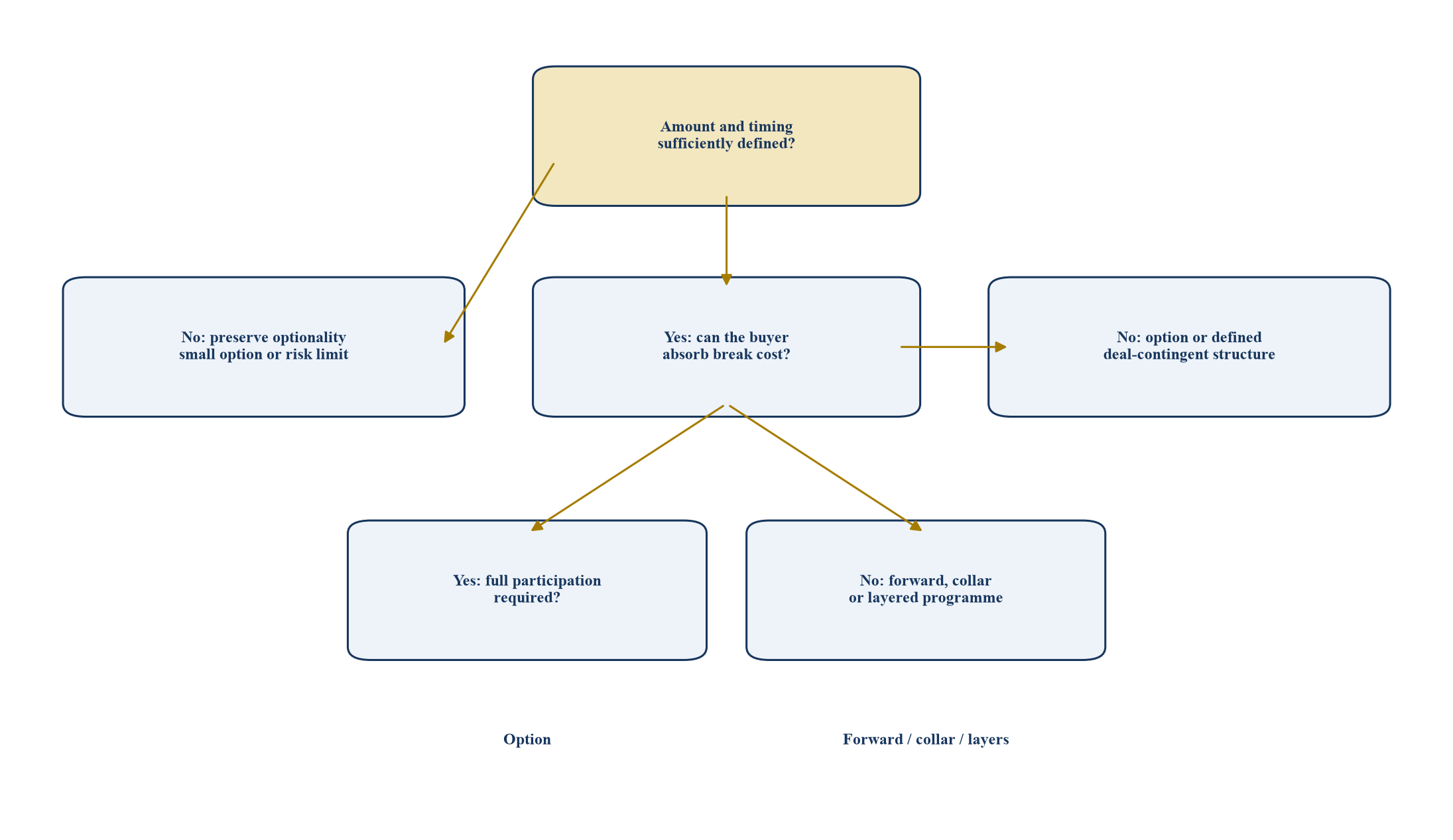
The tree is a governance aid and does not constitute a product recommendation.
20. Use a risk heat map to focus diligence
| Risk | Worked-case rating | Evidence test | Proposed control |
|---|---|---|---|
| Deal failure after forward execution | High | Closing conditions and unwind stress | Option, contingent hedge or staged notional |
| Closing-date slippage | High | Earliest, expected and long-stop dates | Window structure and extension protocol |
| Purchase-price notional mismatch | Medium to high | Sources-and-uses reconciliation | Hedge only verified residual exposure |
| Counterparty termination liquidity | Medium to high | Close-out and collateral model | Limits, netting and liquidity reserve |
| Hedge-accounting ineffectiveness | Medium | Designation and mismatch analysis | Pre-trade accounting memorandum |
| Regulatory or reporting failure | Medium | Classification and responsibility map | Compliance sign-off before execution |
| Operational settlement failure | Medium | Tested funds-flow instructions | Closing rehearsal and dual controls |
| Post-close duplicate hedge | Medium | Target derivative inventory | Integration and redesignation plan |
Ratings illustrate the worked case and require transaction-specific reassessment.
The heat map should have owners, evidence dates and escalation thresholds. Risks can become correlated. A regulatory delay can extend the hedge, increase mark-to-market exposure and strain financing at the same time.
The committee should review the map at signing, after each material condition and before settlement. A change in rating should produce an action rather than a colour update.
Risk ownership should follow control capability. The deal team owns the purchase-price definition and completion conditions. Treasury owns market execution and mark-to-market. Finance owns accounting and liquidity forecasting. Legal owns documentation and regulatory perimeter with specialist advisers. Operations owns settlement instructions. The board committee owns the aggregate risk decision.
The heat map should include a maximum evidence age. A financing commitment verified at signing may no longer support settlement after an extension. Counterparty limits can change, and a regulatory condition can be amended. Each critical item should have an owner, source, timestamp and next review date.
Scenario combinations deserve attention. A delayed closing can coincide with a stronger purchase currency, higher option premiums, weaker buyer credit and reduced facility headroom. Testing these events separately understates the pressure. The severe case should combine market, timing and financing stresses in a coherent narrative.
Controls should be proportionate. A small, liquid currency exposure may need a simple mandate and dual approval. A large conditional acquisition may need a dedicated committee, independent valuation, multiple counterparties, collateral forecasting and daily monitoring. Complexity should respond to material risk.
21. Build a decision-grade hedge mandate
The mandate should state the transaction, exposure, permitted notional, currencies, closing window, maximum adverse closing cost and maximum break liquidity. It should list instruments, counterparties, documentation and delegated authorities.
It should also define quote collection, execution timestamps, independent price verification and confirmation matching. Treasury should record the commercial rationale and relationship to the board-approved acquisition case.
Changes need a protocol. A purchase-price amendment, delay, partial completion or financing revision can alter the exposure. The mandate should specify which changes require board or committee approval and which fall within treasury authority.
The decision record should preserve market data and alternatives at trade date. Later outcomes do not prove that the original decision was good or bad; the relevant question is whether it was informed and within mandate.
The mandate should define direction unambiguously. A buyer that must pay euros with sterling needs protection against a rise in GBP per EUR under the convention used in this paper. Systems and dealer quotations may use the reciprocal convention. The confirmation should state currencies, payer, receiver and quotation basis so that an inversion cannot pass unnoticed.
Notional authority should be gross and net. Gross limits control derivative volume; net limits control the residual economic position after natural hedges. The mandate should prohibit speculative over-hedging and require prompt correction when purchase-price adjustments reduce the exposure.
Counterparty selection should address execution quality and resilience. The lowest quoted rate may come with weaker contingent terms, collateral demands or concentration. A scorecard can compare price, documentation, credit capacity, settlement capability and experience with event-driven transactions.
The board should receive a short execution report after trade date. It should show the executed terms, comparison with approved limits and competing quotes, current exposure, break stress and required next actions. This closes the loop between approval and execution.
22. Execute through a controlled acquisition calendar
The work begins before signing with exposure mapping, risk appetite and counterparty readiness. At signing, the team confirms the notional, conditions and funding. During the conditional period, it monitors approvals, market value, collateral and dates. Before closing, it rehearses settlement.
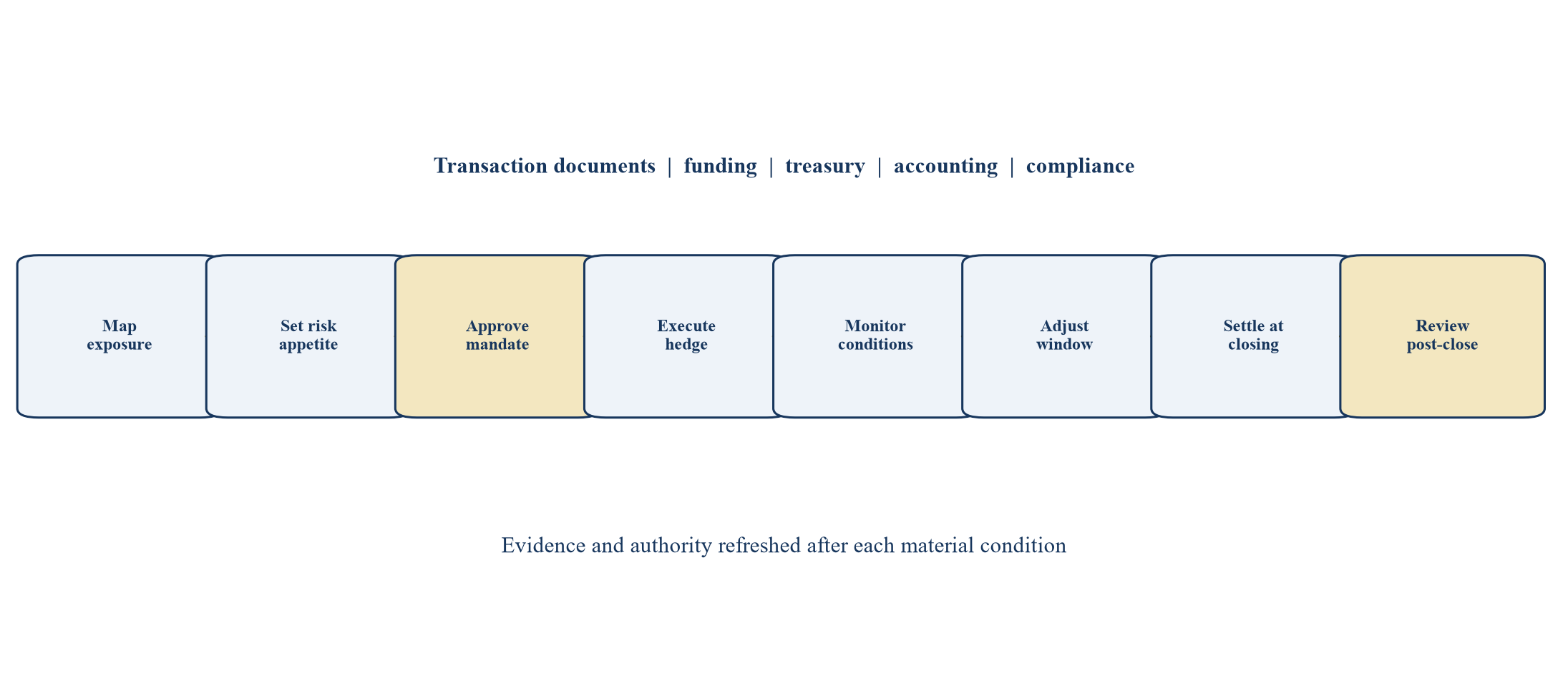
Governance and monitoring continue throughout the conditional period.
23. Monitor effectiveness and liquidity until settlement
The dashboard should show current exposure, hedge notional, blended protected rate, mark-to-market, collateral, remaining conditions and projected closing dates. It should reconcile to the acquisition model and general ledger.
Monitoring should cover both market and transaction risk. A stable exchange rate does not reduce the need to adjust a hedge after a purchase-price change. A rising completion probability can justify a larger hedge even when markets are unchanged.
Counterparty exposures should be aggregated across products and entities. The buyer should understand where netting applies and where cash can be trapped. Stress liquidity should include margin and close-out payments.
At settlement, an independent reviewer should match hedge receipts or payments to the purchase-price funds flow. Post-close review should document outcomes, accounting and lessons for future transactions.
The dashboard should distinguish economic effectiveness from accounting effectiveness. Economic effectiveness asks whether the hedge offsets the purchase-price currency movement within the approved range. Accounting effectiveness follows the designated relationship and applicable standard. Differences require explanation, not automatic correction of the economic position.
Treasury should reconcile dealer valuations with independent or controlled market data. Valuation uncertainty rises for options, collars and contingent products. Material differences should be investigated before collateral or close-out amounts become binding.
The monitoring cadence can accelerate as closing approaches. Monthly review may suit the early conditional period, followed by weekly and then daily review once approvals are obtained. Settlement week should have named decision-makers, tested bank details, cut-off times and backup communication routes.
The post-close review should compare the actual outcome with the approved scenarios without hindsight bias. It should identify process failures, unexpected basis, documentation friction, collateral usage and accounting differences. Lessons should update the treasury policy and next transaction’s mandate.
24. Limitations and conclusion
This paper presents a decision framework rather than legal, tax, accounting, regulatory, treasury or investment advice. Product availability, pricing and enforceability depend on market conditions, counterparties, documentation and jurisdiction. The worked terms are hypothetical and exclude many costs and adjustments.
The purchase-price currency is a core acquisition term. A board should define the residual exposure, closing window, failure states and liquidity limits before selecting an instrument. Forwards, options, collars, layers and deal-contingent hedges solve different combinations of certainty, participation and break risk.
The practical test is the combined cash outcome across closing, delay and failure. A robust programme connects transaction documents, financing, treasury, accounting and compliance; maintains a current mandate; and rehearses settlement. This discipline cannot predict exchange rates or guarantee completion. It can make currency risk visible and keep the acquisition within an approved economic and liquidity envelope.
Sources
- Bank for International Settlements, Triennial Central Bank Survey of foreign exchange and OTC derivatives markets in 2025, final results and data resources, accessed 17 September 2026, Read the primary source
- Bank for International Settlements, OTC foreign exchange turnover in April 2025, accessed 17 September 2026, Read the primary source
- Bank for International Settlements, Triennial Survey data portal, foreign exchange turnover by instrument, accessed 17 September 2026, Read the primary source
- International Swaps and Derivatives Association and EMTA, 2026 FX Definitions, accessed 17 September 2026, Read the primary source
- International Swaps and Derivatives Association and EMTA, revised definitions for the FX derivatives market, 3 March 2026, accessed 17 September 2026, Read the primary source
- International Swaps and Derivatives Association, Global FX Derivatives Market Overview: Size, Structure and Uses, accessed 17 September 2026, Read the primary source
- International Swaps and Derivatives Association, The Value of OTC Derivatives, acquisition and corporate risk-management examples, accessed 17 September 2026, Read the primary source
- International Swaps and Derivatives Association, Foreign Exchange Disclosure Annex, accessed 17 September 2026, Read the primary source
- IFRS Foundation, IFRS 9 Financial Instruments, hedge-accounting requirements, accessed 17 September 2026, Read the primary source
- IFRS Foundation, IFRS 9 Financial Instruments, issued standard text, accessed 17 September 2026, Read the primary source
- IFRS Foundation, Fair Value Hedge of Foreign Currency Risk on Non-Financial Assets, September 2019, accessed 17 September 2026, Read the primary source
- IFRS Foundation, IFRIC 16 Hedges of a Net Investment in a Foreign Operation, accessed 17 September 2026, Read the primary source
- IFRS Foundation, IFRIC Update March 2019, highly probable forecast transactions and specificity, accessed 17 September 2026, Read the primary source
- IFRS Foundation, Post-implementation Review of IFRS 9 Hedge Accounting, current project status, accessed 17 September 2026, Read the primary source
- International Swaps and Derivatives Association, current FX definitions documentation architecture, accessed 17 September 2026, Read the primary source
- International Swaps and Derivatives Association, Annex A to the 1998 FX and Currency Option Definitions, amended July 2025, accessed 17 September 2026, Read the primary source
