

1. The financing decision is a currency decision
A cross-border company can appear well financed while carrying a hidden currency position. Debt may be documented in US dollars because the lender funds in dollars, even though the borrower earns Indian rupees, UAE dirhams and pounds sterling. The contractual coupon then understates the economic cost. Exchange-rate movement, hedge carry, collateral calls, reset dates and cash-flow timing can all alter debt service and covenant headroom.
The board decision is whether each debt obligation can be serviced from cash generated in the same currency and at the same time. A genuine match can arise from debt denomination, operating revenues, cash reserves or a durable hedge. Each route has a different cost and failure mode. This paper provides a transaction framework for choosing among them and for preventing an apparently cheap dollar facility from becoming leveraged exposure to foreign exchange.
2. Define economic matching before selecting an instrument
Economic matching begins with the currency of free cash flow available for debt service. Revenue currency alone is insufficient. Costs, taxes, working-capital movements, dividends, intercompany payments and trapped cash can change the currency that actually reaches the borrower or guarantor. A business with GBP sales and USD input costs may have much less sterling capacity than its revenue mix suggests.
The financing team should map cash generation after operating obligations and before debt service. It should then align interest, principal, fees and hedge cash flows to that map. A loan is economically matched when plausible changes in exchange rates do not create a material unhedged debt-service gap. The threshold for materiality should be approved as part of risk appetite rather than discovered after a covenant breach.
Table 1. Proposed currency-matching decision architecture
| Module | Core question | Evidence | Decision output |
|---|---|---|---|
| Cash-flow map | Which currency reaches each debt-paying entity and when? | Contracts, invoices, cost base, tax and treasury records | Verified debt-service capacity by currency |
| Instrument | Which debt currency and amortisation pattern fit the cash flows? | Term sheets, funding sources and legal constraints | Currency-specific facility design |
| Hedge | Which residual exposure needs protection? | Forward curve, swap terms, collateral and limits | Approved hedge programme |
| Covenants | How should FX effects enter tests and cures? | Base case, stresses and definitions | FX-resilient covenant package |
| Governance | Who monitors and acts before a mismatch grows? | Treasury policy, delegated limits and reporting | Operating control system |
Legal, tax, regulatory and accounting treatment require transaction-specific advice.
3. Build the entity-by-entity cash-flow map
The group model should show the legal entity that earns each currency, the entity that borrows, and the permitted route for moving cash between them. Upstreaming may depend on dividends, service agreements, intercompany loans, regulatory consent, distributable reserves, withholding tax and banking arrangements. A consolidated forecast can conceal that cash exists in the wrong place.
For every currency, the map should identify receipts, operating payments, tax, capital expenditure, minimum liquidity, distributions and debt service. It should show weekly or monthly timing during the first year and quarterly timing thereafter. The model should separate contracted cash flows from forecast sales and management initiatives. Debt sized against cash that cannot legally or operationally move is structurally mismatched.
4. Treat AED as dollar-linked rather than risk-free
The CBUAE maintains a fixed exchange rate between the UAE dirham and the US dollar, with intervention rates around AED 3.672 to AED 3.673 per dollar [1]. This arrangement materially reduces ordinary AED-USD spot volatility. It does not remove basis, liquidity, interest-rate, convertibility, settlement or legal risks in a financing structure.
AED cash flow can provide a strong economic match for USD debt where the peg is relied upon within an approved treasury policy. The credit paper should state that reliance explicitly and test operational access to dollars at payment dates. It should also distinguish the peg from a contractual guarantee of unlimited market liquidity. Funding spreads and hedge costs can move even when the spot rate remains fixed.
5. Treat INR as a distinct balance-sheet exposure
An Indian rupee operating business that borrows in foreign currency can face an increase in local-currency debt service when the rupee depreciates. The RBI's External Commercial Borrowing framework governs eligible borrowers, recognised lenders, maturity, all-in cost, end use, reporting, security and related matters [2]. Applicable rules and authorised dealer requirements must be confirmed for the live transaction.
The financing model should translate every foreign-currency payment into INR under base and stress cases. It should identify natural foreign-currency revenue, permitted derivatives, hedge tenor, rollover dates and cash collateral. A forward contract can stabilise the exchange rate for a period while creating liquidity demands and renewal risk. Currency risk can therefore migrate from earnings volatility into treasury liquidity.
6. Treat GBP exposure as operating and translation risk
Sterling exposure can arise through UK revenue, payroll, acquisitions, property, dividends or a UK borrower. The relevant debt-service capacity is the sterling cash that remains after local obligations. A parent-level dollar loan cannot be described as naturally hedged merely because the group reports UK revenue.
Sterling debt may offer a direct match, subject to availability, pricing and lender appetite. A dollar facility swapped into sterling may replicate fixed or floating GBP obligations, though the swap introduces counterparty, collateral, break-cost and basis risks. The board should compare total cash cost and resilience across both routes over the expected holding period.
7. Separate denomination from lender funding currency
The lender's funding preference need not determine the borrower's economic liability. A private-credit lender can fund in one currency and lend in another, hedge its own exposure, or provide currency-specific tranches. The allocation of hedge execution and cost should be clear. A quoted spread over a benchmark does not reveal the total cost if the borrower must arrange a separate cross-currency swap.
Term sheets should therefore show facility currency, lender funding currency, benchmark, margin, original issue discount, fees, hedge cost, collateral requirements and break costs. Comparison on coupon alone encourages hidden leverage. Comparison on stressed, all-in cash cost creates a common decision basis.
8. Choose among four matching structures
The principal structures are local-currency borrowing, a multi-currency facility, foreign-currency debt with a derivative hedge, and foreign-currency debt supported by natural hedges. A fifth structure can combine them. Each should be evaluated against currency availability, tenor, amortisation, security, entity location, regulation, tax, accounting and refinancing.
Local-currency debt provides the clearest match where cash flows and borrowing entity align. Multi-currency tranches can fit a diversified group. Cross-currency swaps can transform payment obligations but require continuing hedge performance. Natural hedges can be efficient where recurring revenues are durable and accessible. The company should avoid giving the same revenue stream credit in more than one hedge or debt-sizing calculation.
9. Match debt service rather than principal only
A facility can be principal-matched and interest-mismatched. Floating benchmarks, margins, fees and mandatory prepayments determine the actual cash requirement. The currency map should model each scheduled interest payment, amortisation instalment, bullet maturity, commitment fee and hedge settlement.
The timing standard should be strict. Annual currency totals can appear balanced while monthly deficits require spot purchases. Seasonal businesses need liquidity buffers or sculpted amortisation. Acquisition debt may need a grace period until target cash can lawfully move. Matching should be assessed by payment period and legal entity, not only by annual group totals.
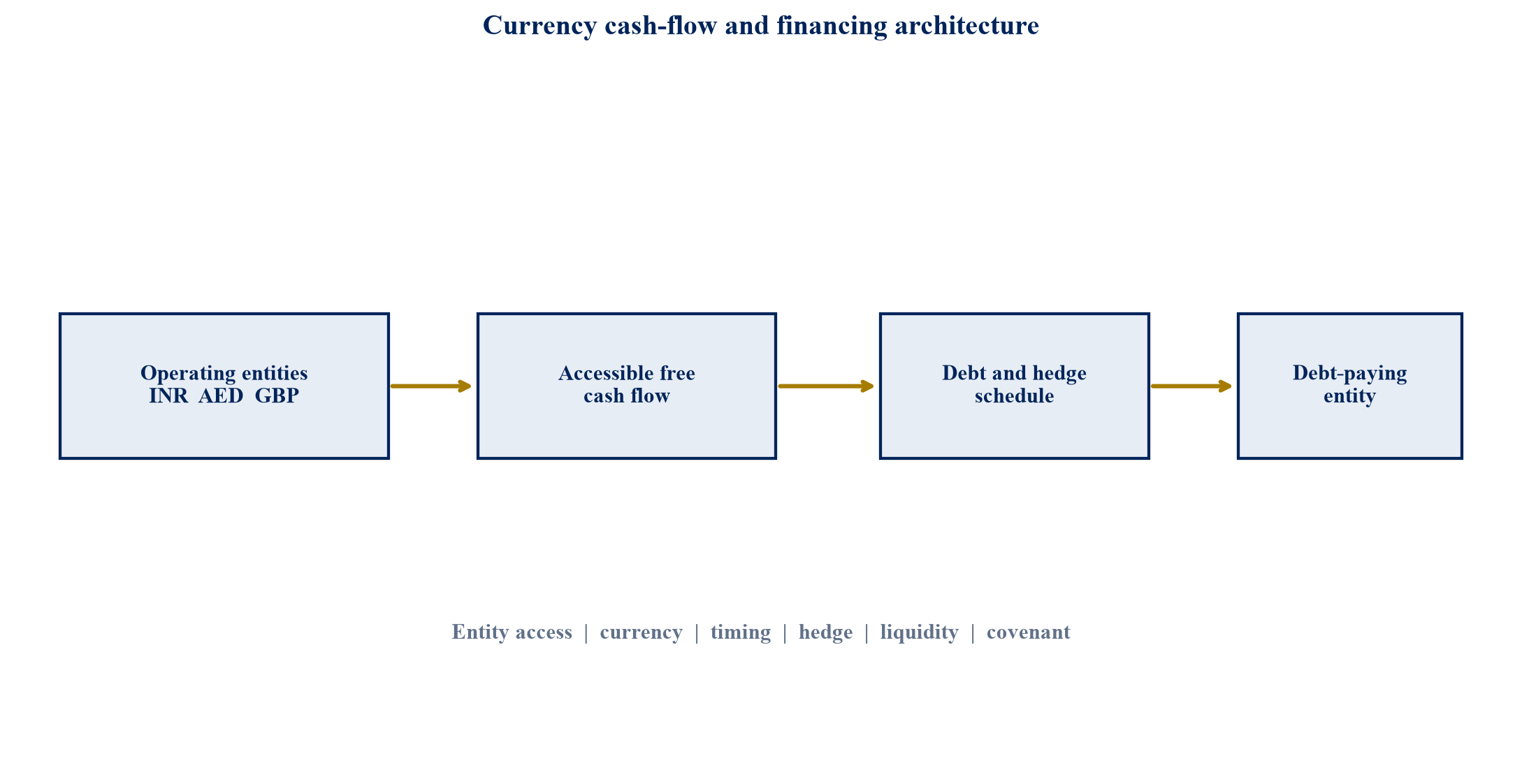
The architecture is illustrative and requires transaction-specific legal, tax and treasury review.
10. Build a hedge-cost bridge
The hedge-cost bridge should begin with the unhedged contractual coupon and add forward points or swap carry, credit charges, collateral funding, execution fees, taxes, documentation costs and expected rollover costs. It should also show the cost of terminating or resizing the hedge after prepayment, refinancing or disposal.
Interest-rate differentials can make currency conversion expensive even when expected spot movements appear modest. BIS analysis shows that FX derivatives support cross-border investment while creating maturity and liquidity considerations [3][4]. A board comparison should therefore use total expected and stressed cash cost over the financing horizon.
11. Recognise that hedging creates liquidity risk
A derivative can reduce the economic effect of exchange-rate movement and still generate cash calls. Collateral agreements may require variation margin when mark-to-market moves. A hedge that is economically effective over five years can fail operationally if the borrower cannot meet a collateral call in month six.
The treasury model should estimate potential collateral, timing, eligible assets, thresholds, minimum transfer amounts and cure periods. It should test the interaction with restricted cash and debt covenants. Available liquidity should be measured after reserving for payroll, tax, working capital and committed capital expenditure. A hedge programme needs its own liquidity line rather than an assumption that operating cash will always be available.
12. Control rollover and tenor mismatch
Short-dated forwards are often more liquid than long-dated hedges. Rolling them against long-term debt creates renewal risk. Spreads, counterparty limits and market liquidity can change at each reset. BIS identifies rollover risk as a key residual exposure when derivatives are used to reduce foreign-currency mismatches [3].
The board should set a minimum hedge tenor, maximum open reset window and pre-funded liquidity requirement. It should model a delayed or costly rollover. A ladder of maturities can reduce cliff risk, provided the company can administer it. Hedge tenor should also reflect expected prepayment and asset-sale dates to reduce break costs.
13. Align hedge notional with amortisation
An over-hedge can become a speculative position after debt amortises or is prepaid. An under-hedge leaves residual FX exposure. The hedge schedule should mirror expected principal and interest, with controlled tolerances for forecast uncertainty.
Mandatory prepayments from asset sales, excess cash flow or insurance proceeds can disrupt the schedule. Loan and hedge documents should coordinate notice, reduction and termination mechanics. Treasury should receive prompt information about changes in debt balance. The model should show mark-to-market and break costs under several prepayment dates.
14. Use a transparent currency allocation policy
Management needs a rule for allocating debt among INR, AED, GBP and any reporting or acquisition currency. The rule can begin with minimum recurring free cash flow in each currency, apply a haircut for volatility and accessibility, then cap debt service at an approved share of that adjusted capacity.
The policy should reserve capacity for operating shocks and avoid relying on peak-period revenue. It should also identify currencies that should remain unlevered because cash flow is too volatile, trapped or strategically needed. Allocation is a recurring treasury decision, not a one-time transaction calculation.
Table 2. Illustrative currency allocation and evidence matrix
| Currency | Illustrative annual free cash flow | Reliability haircut | Adjusted capacity | Primary matching route |
|---|---|---|---|---|
| INR | INR 1,500m | 25% | INR 1,125m | INR tranche or hedged foreign-currency debt |
| AED | AED 42m | 15% | AED 35.7m | AED or USD-linked tranche with liquidity control |
| GBP | GBP 3.0m | 20% | GBP 2.4m | GBP tranche or cross-currency swap |
Values and thresholds are author assumptions without empirical calibration.
15. Model covenants in the right currency
Leverage and debt-service tests can move solely because debt and earnings translate at different rates. Covenant definitions should specify measurement currency, translation rate, average or period-end treatment, hedge recognition, cash netting, exceptional items and treatment of intercompany balances.
The borrower should calculate tests under actual rates and under stress. A covenant that ignores hedge collateral can overstate liquidity. A covenant that translates debt at period end and earnings at an average rate can generate volatility unrelated to operations. The term sheet should resolve these mechanics before documentation.
16. Build FX headroom into the financing quantum
Debt quantum should reflect the worst credible mismatch rather than the base-case translated leverage ratio. The model should calculate headroom after currency shocks, interest-rate changes, hedge carry and working-capital stress. It should identify the shock at which each covenant or liquidity threshold fails.
Headroom is valuable only when management can act before it disappears. Early-warning triggers can sit above formal covenants and require hedging, cash retention, deleveraging or lender engagement. The board should approve both the formal covenant and the internal operating threshold.
17. Distinguish accounting effectiveness from economic resilience
Hedge accounting can reduce reported earnings volatility when its conditions are met. It does not prove that the financing is economically matched or liquid under stress. Conversely, an economically sensible hedge may create accounting volatility if documentation or effectiveness criteria are not satisfied.
Finance, treasury and auditors should agree the accounting analysis before execution. The board pack should show cash economics separately from reported accounting effects. Tax treatment, withholding and deductibility also require jurisdiction-specific advice. Presentation choices cannot substitute for cash available on payment dates.
18. Price cross-currency optionality explicitly
Borrowers often value the ability to draw, repay or switch currencies. This flexibility can be expensive for a lender to fund and hedge. A multi-currency revolving facility may include different margins, utilisation fees, conversion mechanics and availability limits for each currency.
The company should quantify how often it expects to use the option and compare the fee with arranging separate tranches. Conversion should not reset covenant protection or hide realised hedge losses. Drawdown notices, settlement calendars and cut-off times must fit treasury operations in each market.
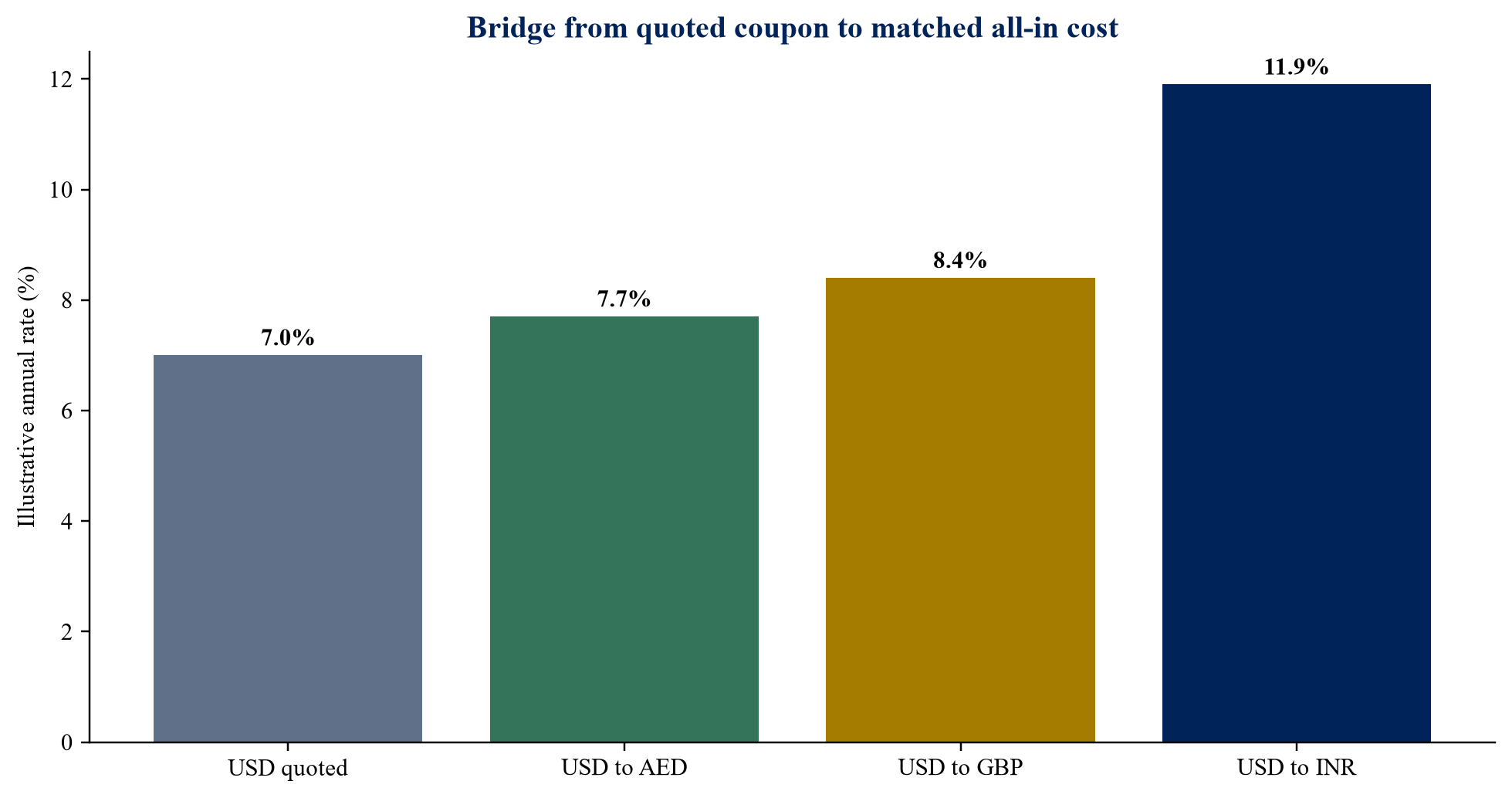
Percentages are author assumptions and do not represent market quotations.
19. The hypothetical financing establishes the mechanics
Consider a group with operating cash flows in INR, AED and GBP. It is evaluating a USD 25 million private-credit facility with a three-year term. The illustrative unhedged coupon is 7.0%. Management can instead allocate equivalent debt across local-currency tranches or hedge the dollar payments.
For the model, annual free cash flow is assumed at INR 1,500 million, AED 42 million and GBP 3 million. Base conversion rates are assumed at INR 83 per USD, AED 3.6725 per USD and GBP 0.76 per USD. These rates, coupons, hedge costs, stress movements and covenant thresholds are author assumptions without empirical calibration. They are not current quotes or forecasts.
20. Compare quoted and matched costs
The unhedged USD facility carries a 7.0% assumed coupon. The illustrative cost of transforming the relevant debt service into INR is 4.5 percentage points, into AED is 0.3 percentage points and into GBP is 1.0 percentage point. An administrative and credit charge of 0.4 percentage points is added to each hedged route.
The resulting illustrative all-in rates are 11.9% for INR-matched USD debt, 7.7% for AED-matched USD debt and 8.4% for GBP-matched USD debt. The apparent 7.0% dollar cost is therefore an incomplete comparison. Local-currency loan pricing and derivative collateral costs must also be assessed before choosing a structure.
Table 3. Hypothetical quoted-to-matched cost bridge
| Route | Contractual coupon | Currency transformation | Other hedge and credit cost | Illustrative matched cost |
|---|---|---|---|---|
| USD to INR | 7.0% | 4.5% | 0.4% | 11.9% |
| USD to AED | 7.0% | 0.3% | 0.4% | 7.7% |
| USD to GBP | 7.0% | 1.0% | 0.4% | 8.4% |
| Unhedged USD | 7.0% | 0.0% | 0.0% | 7.0% plus open FX risk |
Percentages are author assumptions. They exclude tax, upfront fees, commitment fees and break costs.
21. Test exchange-rate stress before credit approval
The stress matrix applies adverse moves of 5%, 10% and 20% to unhedged portions of INR and GBP cash flow relative to the debt currency. AED-USD spot exposure is held constant in the main case because of the peg, while a separate liquidity stress is applied. The model measures incremental local-currency debt service and resulting headroom.
The point is not to forecast a currency. It is to show the sensitivity of contractual obligations to a mismatch. Stress severity should be calibrated to the company's risk appetite, history, market conditions and lender requirements. Reverse stress should identify the movement that exhausts liquidity or breaches covenant.
22. Measure debt-service coverage after hedge cash flows
Debt-service coverage should use cash after operating needs, tax and hedge settlements. If the hedge requires collateral, the liquidity test should deduct the collateral call even if accounting treatment records it as an asset. The model should also include fees on undrawn amounts and any mandatory cash sweep.
A company can have acceptable annual coverage and fail on a quarterly payment date. The minimum period coverage and minimum cash balance should therefore accompany the annual ratio. Cash in a subsidiary should count only when it can reach the debt-paying entity in time.
23. Interpret the hypothetical stress matrix
Assume USD 10 million equivalent of the facility is economically supported by INR cash flow, USD 9 million by AED cash flow and USD 6 million by GBP cash flow. If the INR and GBP components remain unhedged, a 10% adverse move increases their local-currency principal equivalents by 10%. The dollar amount owed remains unchanged, while more local currency is required to buy it.
The model translates this effect into a reduction in covenant headroom. A fully effective hedge fixes the relevant exchange rate for the protected period, subject to counterparty performance, collateral, basis and rollover. A partially hedged structure produces an intermediate result. These outcomes are mechanics, not predicted performance.
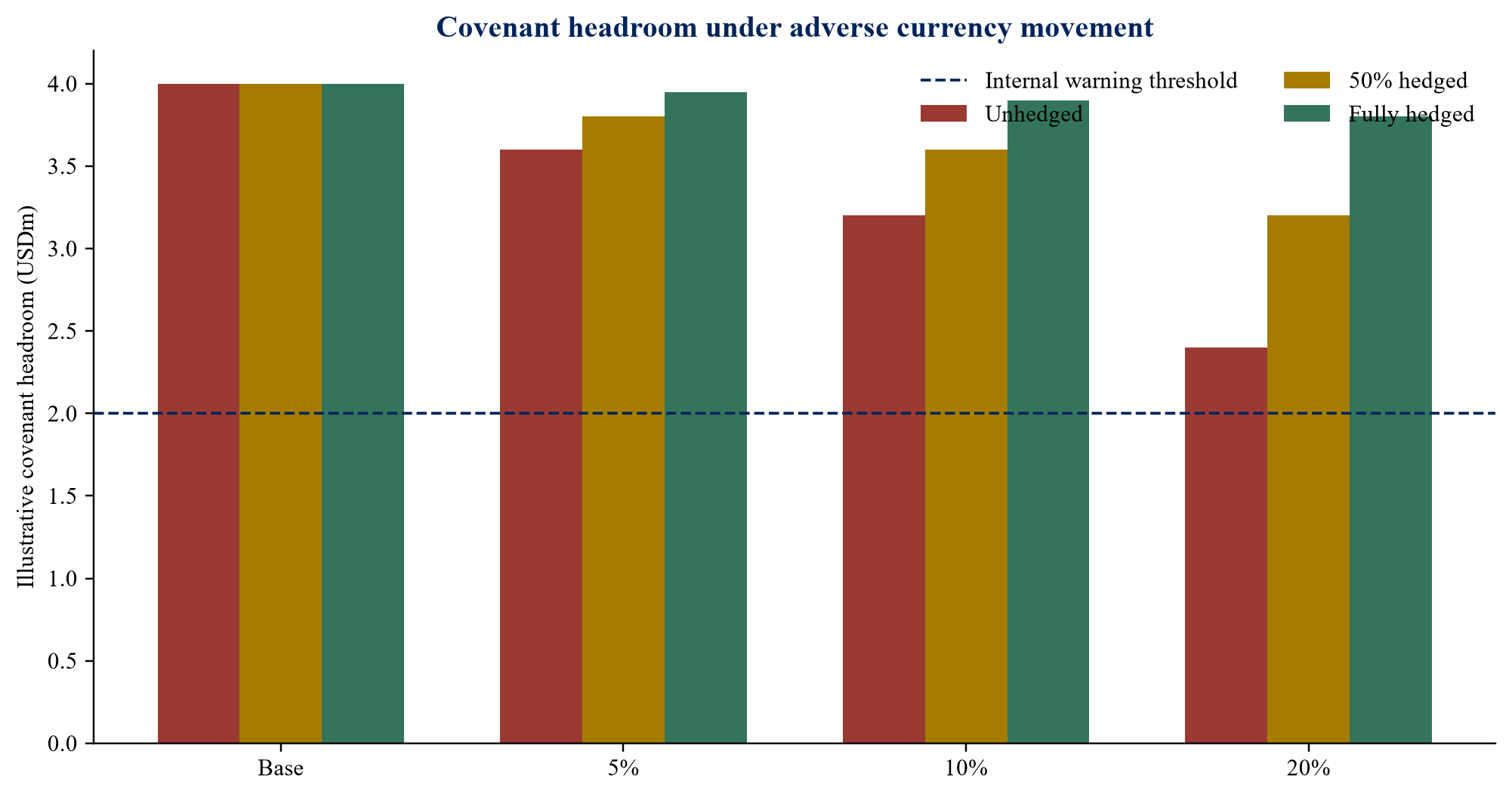
Values are author assumptions without empirical calibration and do not predict covenant performance.
24. Include collateral and break-cost stress
The derivative stress should estimate collateral demand and termination cost under adverse market moves. For illustration, the model assumes potential collateral calls of 0.5%, 2.0% and 5.0% of hedged notional across mild, moderate and severe market conditions. It assumes no threshold benefit and no netting across counterparties.
These values are deliberately simplified. Actual exposure depends on the derivative, mark-to-market, credit support annex, eligible collateral, thresholds, minimum transfer amounts, netting and counterparty credit. A treasury reserve should be based on executed terms and independent valuation.
25. Diversify hedge counterparties without fragmenting control
Counterparty diversification can reduce concentration and capacity risk. It can also complicate netting, collateral, valuation and operations. The company should allocate limits by credit quality, legal agreement, product, tenor and wrong-way risk. It should avoid placing all debt and hedges with one institution merely for administrative convenience.
A central register should show every trade, confirmation, valuation, collateral balance, maturity and dispute. Independent prices and reconciliations reduce dependence on dealer marks. Close-out and replacement mechanics should be reviewed alongside the loan's default and acceleration provisions.
26. Coordinate security, guarantees and cash movement
Cross-border private credit may rely on guarantees, share pledges, account security, receivables, assets and intercompany claims. Currency matching does not cure a weak security path. The lender and borrower need a clear view of where value sits, which entity owes the debt and how enforcement or cash movement operates in each jurisdiction.
RBI rules, UAE law, UK law, exchange-control requirements, corporate benefit, financial assistance, tax and insolvency considerations can affect the structure [2]. Local counsel should confirm the live transaction. The research framework cannot determine legal availability or enforceability.
27. Protect the business from double leverage
Hidden leverage arises when the same operating cash flow supports local working-capital facilities, parent debt and a derivative collateral obligation. Consolidated leverage may omit contingent liquidity demands or treat intercompany cash as freely available. The debt model should allocate each source of cash once.
The group should map seniority and structural subordination by entity. It should include leases, guarantees, supplier finance, receivables programmes and hedge liabilities. Private-credit covenants should capture material additional debt and liens while preserving ordinary operating flexibility.
Table 4. Hypothetical FX stress and liquidity matrix
| Case | Adverse move on unhedged INR and GBP | Hedge coverage | Incremental FX burden | Hedge collateral call | Remaining liquidity headroom |
|---|---|---|---|---|---|
| Base | 0% | 50% | 0.0 | 0.1 | 7.9 |
| Mild | 5% | 50% | 0.4 | 0.3 | 7.3 |
| Moderate | 10% | 50% | 0.8 | 0.8 | 6.4 |
| Severe | 20% | 50% | 1.6 | 2.0 | 4.4 |
USD millions unless stated. All values are author assumptions.
28. Create an operating hedge policy
The hedge policy should define objectives, permitted instruments, counterparties, tenors, minimum and maximum hedge ratios, forecast confidence, collateral limits, accounting coordination, valuation, reporting and escalation. It should prohibit speculative positions and require documented linkage to exposures.
Delegated authority should be proportional to risk. Routine rolls can sit with treasury within limits. New products, long-dated structures, material break costs or exceptions should require higher approval. The policy should state how soon exposures must be hedged after signing a debt or acquisition agreement.
29. Monitor the match through a currency control dashboard
The dashboard should reconcile debt, hedge and cash-flow data at least monthly and more frequently around payment dates. It should show gross and net exposure, hedge ratio, next reset, collateral, counterparty capacity, covenant headroom, liquidity reserve and forecast variance.
Alerts should identify an exposure without an owner, a hedge maturing before debt, a notional mismatch, late confirmation, collateral dispute, trapped cash or declining cash-flow confidence. The dashboard needs named data sources and reconciliation controls. A visually attractive summary without traceable inputs is insufficient for risk management.
30. Use transaction documents to preserve alignment
The facility agreement, intercreditor agreement, security documents and hedge documents should operate as one system. Definitions of debt, permitted hedging, secured obligations, enforcement, mandatory prepayment and cure should be consistent. The hedge provider's rights on loan acceleration and the lender's rights on hedge termination need explicit treatment.
Where the hedge counterparty is also the lender, conflicts and close-out economics still require scrutiny. Where counterparties differ, priority and voting become more complex. Counsel should prepare a document interaction matrix and unresolved-issues list before signing.
31. Design the refinancing route before closing
Cross-border private credit often has a finite term and substantial bullet repayment. The refinancing plan should identify the likely future debt currency, asset sale, equity injection or operating cash accumulation. A hedge ending at maturity does not solve refinancing risk if the company must replace the debt in a different currency.
The company should track market-access milestones, leverage reduction, reporting quality and lender engagement. It should test a six-month refinancing delay and higher hedge cost. Early preparation can reduce forced currency conversion at an adverse time.
32. Set approval gates for the investment committee
The committee should approve the verified currency cash-flow map, legal-entity path, instrument comparison, hedge-cost bridge, stress matrix, covenant definitions, collateral reserve, counterparty limits and operating policy. It should receive a list of assumptions that remain dependent on quotes, counsel or regulatory confirmation.
Approval can be conditional on executed hedges, minimum tenor, maximum all-in cost and minimum liquidity. Conditions should have owners and evidence. The committee should reject a facility whose economics depend on an unowned currency view or inaccessible cash.
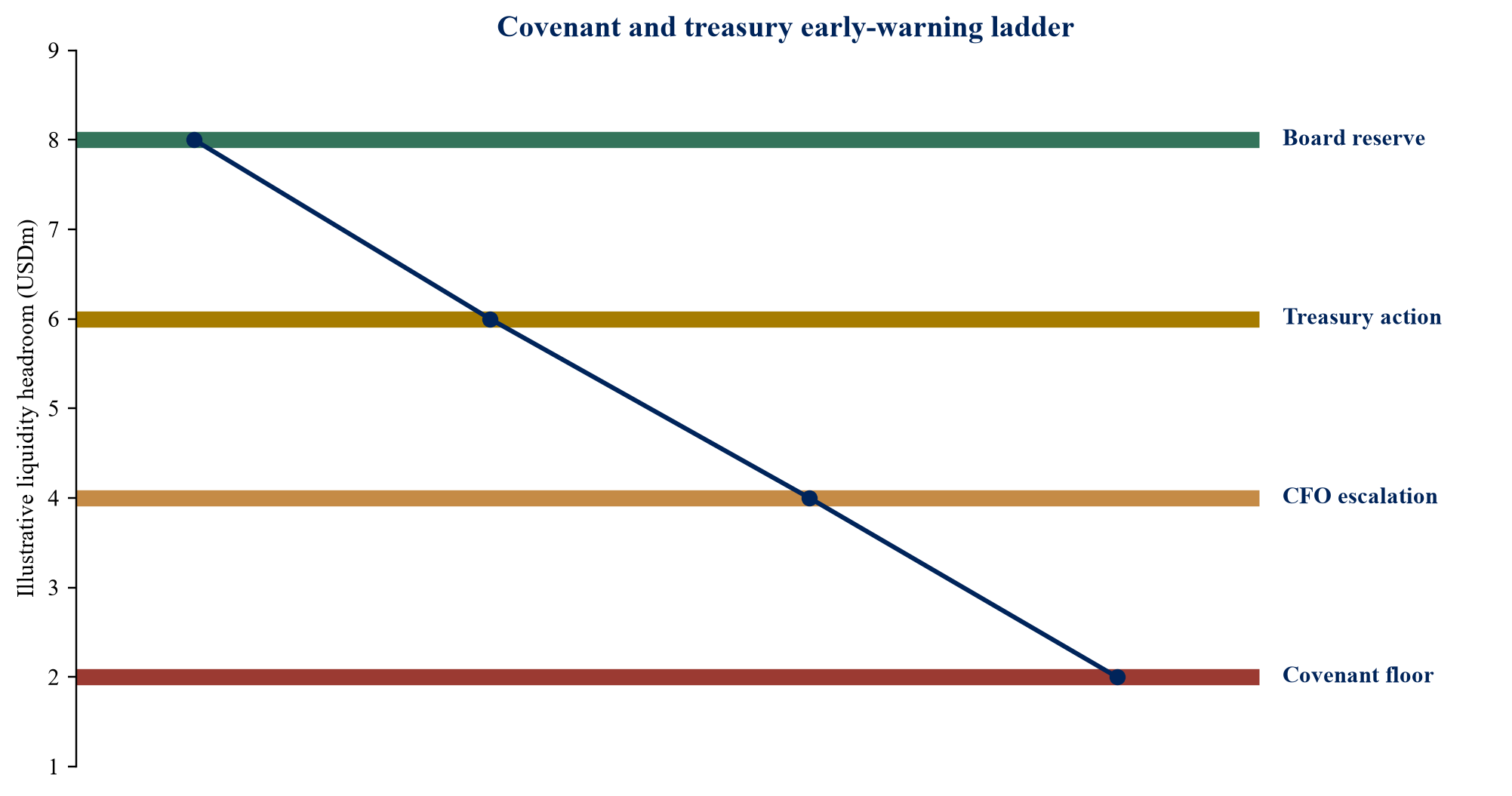
Thresholds are illustrative and should be calibrated to the live financing and board risk appetite.
33. Sequence execution around eight workstreams
Execution should run through cash-flow verification, structure, lender process, regulation, legal documentation, hedging, operations and governance. The workstreams can proceed in parallel once ownership is clear, though the cash-flow map and legal-entity analysis must be sufficiently advanced before final sizing.
The financing adviser should maintain one assumptions register and one issue log. Treasury quotes should share common dates and notionals. Legal terms should be fed back into the model. The closing checklist should include hedge execution, collateral readiness, reporting templates and first-payment testing.
Table 5. Proposed execution and evidence plan
| Workstream | Principal deliverable | Closing evidence | Owner |
|---|---|---|---|
| Cash flows | Entity and currency map | Reconciled forecast and accessibility analysis | CFO and treasury |
| Financing | Currency-specific term comparison | Approved all-in cost and quantum | CFO and adviser |
| Hedging | Hedge strategy and counterparty allocation | Executed confirmations and collateral readiness | Treasurer |
| Legal and regulatory | Structure and enforceability analysis | Counsel opinions and required approvals | General counsel |
| Covenants | FX-resilient definitions and stress tests | Signed terms and calculation model | Finance and lenders |
| Monitoring | Dashboard and escalation protocol | Tested reporting pack | Treasury and risk |
Timing depends on jurisdiction, lender process, documentation and hedge availability.
34. Apply a 100-day post-close control plan
During the first 100 days, the company should reconcile loan and hedge settlements, test covenant calculations, verify collateral processes, refresh cash-flow forecasts and confirm reporting to lenders. Exceptions should be recorded and closed. The first real payment cycle often reveals timing or data issues that transaction models overlook.
The board should receive a concise report on exposure, headroom and unresolved risks. Any acquisition, disposal, dividend or material contract change should trigger a currency review. The hedge should evolve with the exposure under controlled authority.
35. Separate benchmark risk from currency risk
Currency denomination and interest-rate benchmark are separate design choices. A GBP tranche may reference SONIA, an AED tranche may reference an applicable domestic benchmark, and an INR facility may use a local floating or fixed basis. A cross-currency swap can transform both currency and rate, or leave one component open. The model should therefore decompose contractual benchmark, credit spread, currency basis and hedge charges rather than combine them into one unexplained rate.
The company should test parallel and non-parallel movements in the relevant curves. A currency can remain stable while its benchmark rises, or hedge basis can widen while both headline rates fall. Interest periods, observation conventions, floors, fallback language and payment calendars should align across loan and hedge. Residual basis should be quantified and included in debt-service coverage.
36. Allocate currency cost through group transfer pricing
When a parent raises debt and on-lends to subsidiaries, the intercompany instrument determines where currency and interest cost appears. The amount, currency, maturity, margin, repayment and subordination should reflect the financing purpose and applicable legal and tax requirements. A parent that borrows dollars and on-lends rupees has retained a currency position somewhere in the group unless it hedges or passes that exposure through.
Transfer-pricing analysis should be prepared by qualified advisers using current rules and transaction facts. The treasury model should reconcile external debt, intercompany balances and operating cash. Distributions and service payments should not be used as undocumented substitutes for debt service. A clear internal funding map improves both risk control and lender diligence.
37. Test tax and withholding as cash flows
Cross-border interest, guarantee fees, hedge payments and intercompany charges may create withholding tax, deductibility limitations, transfer-pricing requirements or permanent-establishment questions. These issues can change the effective cost and timing of a structure. The model should treat tax as a cash flow supported by jurisdiction-specific advice.
Gross-up clauses can transfer withholding risk to the borrower. Tax indemnities, increased-cost provisions and change-in-law terms require scenario analysis. A hedge may receive different tax treatment from the debt it supports. The committee should require a tax structure memorandum and show any unresolved position as a sensitivity rather than embedding a favourable assumption in the base case.
38. Give lenders a reproducible underwriting package
Private-credit lenders need evidence that currency matching survives beyond the signing date. The underwriting package should include historical and forecast free cash flow by currency, contract concentration, cost currency, entity accessibility, existing hedges, treasury policy, covenant calculations and stress tests. It should reconcile to audited or management accounts and explain forecast uncertainty.
Lenders should be able to reproduce the core ratios from controlled data. The borrower should distinguish committed hedges from intended trades and recurring cash flow from possible transactions. Transparent evidence can improve structure and execution confidence, while unsupported claims of a natural hedge invite conservative sizing or tighter covenants.
39. Conduct independent model and documentation review
The financing model connects operating forecasts, FX assumptions, benchmarks, debt schedules, hedge settlements, collateral and covenants. Errors can arise through sign conventions, duplicated cash, inconsistent dates, hard-coded rates, broken scenario switches or incorrect translation. An independent reviewer should test formulas, data lineage, units and reconciliation before approval.
Documentation review should then compare the model with executed terms. Facility definitions, repayment dates, day counts, floors, margin ratchets, prepayments and hedge mechanics should agree. A signed term sheet is not enough. Final documents and confirmations control cash obligations, so the closing model should be refreshed from them and locked as the operational baseline.
40. Define exceptions and cure mechanics in advance
Currency matching will drift when actual cash flow differs from forecast, an acquisition closes, a customer contract changes, debt prepays or a hedge becomes unavailable. The governance framework should define acceptable tolerances and the actions required when they are exceeded. An exception register should record the exposure, amount, currency, cause, duration, owner, approved response and closure evidence.
Possible cures include adding or reducing a hedge, retaining cash, converting a draw, changing amortisation, obtaining a waiver, injecting equity or disposing of an exposure. Each action has cost, timing and approval consequences. The policy should prevent an open position from becoming permanent through repeated short extensions. Material exceptions should reach the CFO and board risk forum before formal covenant pressure develops.
The lender reporting package should state agreed exceptions accurately. A temporary mismatch can be manageable when quantified and funded. Concealing it through favourable translation or uncommitted forecast revenue weakens credibility and delays action. The company should also document circumstances in which a hedge should remain unchanged, such as a short-lived timing variance where termination cost exceeds risk reduction.
41. Re-underwrite the currency map after an acquisition
An acquisition can change revenue currency, cost currency, entity access and debt service at the same time. Purchase price may be paid in one currency, acquisition debt raised in another and target cash generated in several others. The day-one financing model should show sources and uses by currency and identify every conversion required at signing, completion and refinancing.
Post-close integration should establish a combined treasury policy, bank-account map, cash-pooling design and hedge register. Existing target hedges may include change-of-control, termination or collateral provisions. Legacy debt can restrict distributions or security. The integration team should confirm which exposures remain with each entity and prevent group reporting from obscuring local obligations.
Synergies should not be treated as a natural hedge until they produce recurring, accessible cash in the relevant currency. The board should approve a transition limit for open exposure and a deadline for implementing the target hedge structure. The first combined forecast should reconcile acquisition assumptions to actual invoices, payroll, tax and working capital.
42. Test the durability of natural hedges
A natural hedge depends on operating relationships that can change. Export contracts can expire, customers can renegotiate currency, input costs can reset and margins can compress. The credit model should assess contract tenor, concentration, pricing clauses, cancellation rights and the historical stability of the net currency cash flow.
Only the durable portion should support long-term debt. Forecast or cancellable revenue can support shorter hedges within conservative limits. Treasury should measure forecast error by currency and reduce hedge ratios when uncertainty rises. This avoids converting an expected receipt into an over-hedged position.
The lender may require minimum hedging or evidence of recurring hard-currency revenue. These terms should be calibrated to actual business mechanics. A blanket hedge ratio can force unnecessary trades in one currency while leaving another underprotected. Currency-specific evidence produces a more resilient covenant and operating policy.
43. The decision standard
FX-matched private credit is achieved when debt service, operating cash flow, legal-entity access, hedges and liquidity remain aligned under credible stress. The correct structure may use INR, AED and GBP tranches, a dollar-linked AED component, cross-currency hedges or a deliberate combination. The choice should follow verified cash flows and executable terms.
The board should demand four proofs: a cash-flow map that reaches the debt-paying entity, an all-in cost bridge, a stress test that includes collateral and rollover, and covenant headroom that survives the approved scenario. Those proofs convert currency matching from a term-sheet claim into an operating control system.
The final credit memorandum should state the portion of debt service matched by contractual cash flow, the portion protected by executed hedges and the portion deliberately left open within policy. It should also identify the next hedge maturity, the liquidity reserved for collateral and the person accountable for rebalancing. This concise disclosure gives directors and lenders a shared view of the exposure and prevents a financing label from replacing evidence.
Independent treasury review should confirm that the disclosure remains current after closing.
References
- Central Bank of the UAE. How the Monetary System Works. Accessed 6 September 2026. https://centralbank.ae/en/our-operations/monetary-policy-and-domestic-markets/how-the-monetary-system-works/
- Reserve Bank of India. Master Direction - External Commercial Borrowings, Trade Credits and Structured Obligations. Updated 22 December 2023; accessed 6 September 2026. https://www.rbi.org.in/Scripts/BS_ViewMasDirections.aspx?id=11510
- Committee on the Global Financial System. Foreign currency funding risk and cross-border liquidity. CGFS Papers No 71, 12 March 2026. https://www.bis.org/publications/cgfs-paper-71-foreign-currency-funding-risk-and-cross-border-liquidity
- Bank for International Settlements. Global portfolio investments and FX derivatives. BIS publication No 1273, 2025. https://www.bis.org/publ/work1273.pdf
- Bank for International Settlements. International dimensions of EME corporate debt. 2020. https://www.bis.org/publications/international-dimensions-eme-corporate-debt
- Bank for International Settlements. Risks related to EME corporate balance sheets: the role of leverage and currency mismatch. BIS Quarterly Review, September 2014. https://www.bis.org/publications/risks-related-eme-corporate-balance-sheets-role-leverage-and-currency-mismatch
- Caballero, J. Corporate dollar debt and depreciations: all's well that ends well? BIS publication No 879, 24 August 2020. https://www.bis.org/publ/work879.htm
- Bank for International Settlements. US dollar's slide in April 2025: the role of FX hedging. BIS Bulletin No 105, 2025. https://www.bis.org/publ/bisbull105.pdf
- Bank of England Prudential Regulation Authority. Implementation of the Basel 3.1 standards: credit risk standardised approach. November 2022. https://www.bankofengland.co.uk/prudential-regulation/publication/2022/november/implementation-of-the-basel-3-1-standards/credit-risk-standardised-approach
- Bank of England Prudential Regulation Authority. PS1/26 - Implementation of Basel 3.1: Final rules. January 2026. https://www.bankofengland.co.uk/prudential-regulation/publication/2026/january/implementation-of-the-basel-3-1-final-rules-policy-statement
- International Monetary Fund. Global Financial Stability Report. April 2026. https://www.imf.org/en/publications/gfsr/issues/2026/04/07/global-financial-stability-report-april-2026
- International Monetary Fund. Integrated Policy Framework. Accessed 6 September 2026. https://www.imf.org/en/topics/integrated-policy-framework
- Basel Committee on Banking Supervision. Minimum capital requirements for market risk. January 2019. https://www.bis.org/bcbs/publ/d457.htm
- Bank of England. SONIA interest rate benchmark. Accessed 6 September 2026. https://www.bankofengland.co.uk/markets/sonia-benchmark
- Reserve Bank of India. Foreign Exchange Management Act and foreign exchange directions. Accessed 6 September 2026. https://www.rbi.org.in/scripts/fema.aspx
- International Swaps and Derivatives Association. 2021 ISDA Interest Rate Derivatives Definitions. Accessed 6 September 2026. https://www.isda.org/book/2021-isda-interest-rate-derivatives-definitions/
