

1. Define the financing perimeter
The decision question is which land, power, buildings, systems, equipment, contracts and cash flows sit inside each borrowing vehicle. The evidence file should begin with entity records, land rights, utility documents, project budgets, customer contracts and ownership schedules. Each item should record its source, date, legal owner, responsible party, expiry or review date and relationship to the relevant capacity block. Market demand provides context. Executed project documents determine rights, obligations and cash. [1][2]
The principal failure is that a campus-wide narrative obscures which assets and cash flows support a specific loan. Project finance converts construction advances into funded exposure before the campus produces stable cash. The lender needs an observable chain from the current physical and contractual position to the next milestone, the funding required to reach it and the value preserved if progress stops.
The recommended response is to define a phase-specific legal, physical and cash-flow perimeter before sizing debt. Management estimates may support scenarios when identified as assumptions and reconciled to external evidence. The central case should retain current rights, committed funding and costed obligations. The downside should combine related power, construction, equipment, customer and financing effects.
The credit record should state funded exposure, verified capacity, the next evidence gate, remaining cost, minimum liquidity, cure period and recovery route. It should identify the party able to act, required consent and the last date for value-preserving intervention.
2. Create the campus phase map
The decision question is how site-wide infrastructure and successive powered-capacity blocks become operational. The evidence file should begin with masterplan, phasing schedule, power programme, design basis, customer ramp and capital plan. Each item should record its source, date, legal owner, responsible party, expiry or review date and relationship to the relevant capacity block. Market demand provides context. Executed project documents determine rights, obligations and cash. [2][3]
The principal failure is that future phases are treated as committed value while their power, funding or tenants remain conditional. Project finance converts construction advances into funded exposure before the campus produces stable cash. The lender needs an observable chain from the current physical and contractual position to the next milestone, the funding required to reach it and the value preserved if progress stops.
The recommended response is to separate enabling works, committed phases and optional expansion in every approval and model. Management estimates may support scenarios when identified as assumptions and reconciled to external evidence. The central case should retain current rights, committed funding and costed obligations. The downside should combine related power, construction, equipment, customer and financing effects.
The credit record should state funded exposure, verified capacity, the next evidence gate, remaining cost, minimum liquidity, cure period and recovery route. It should identify the party able to act, required consent and the last date for value-preserving intervention.
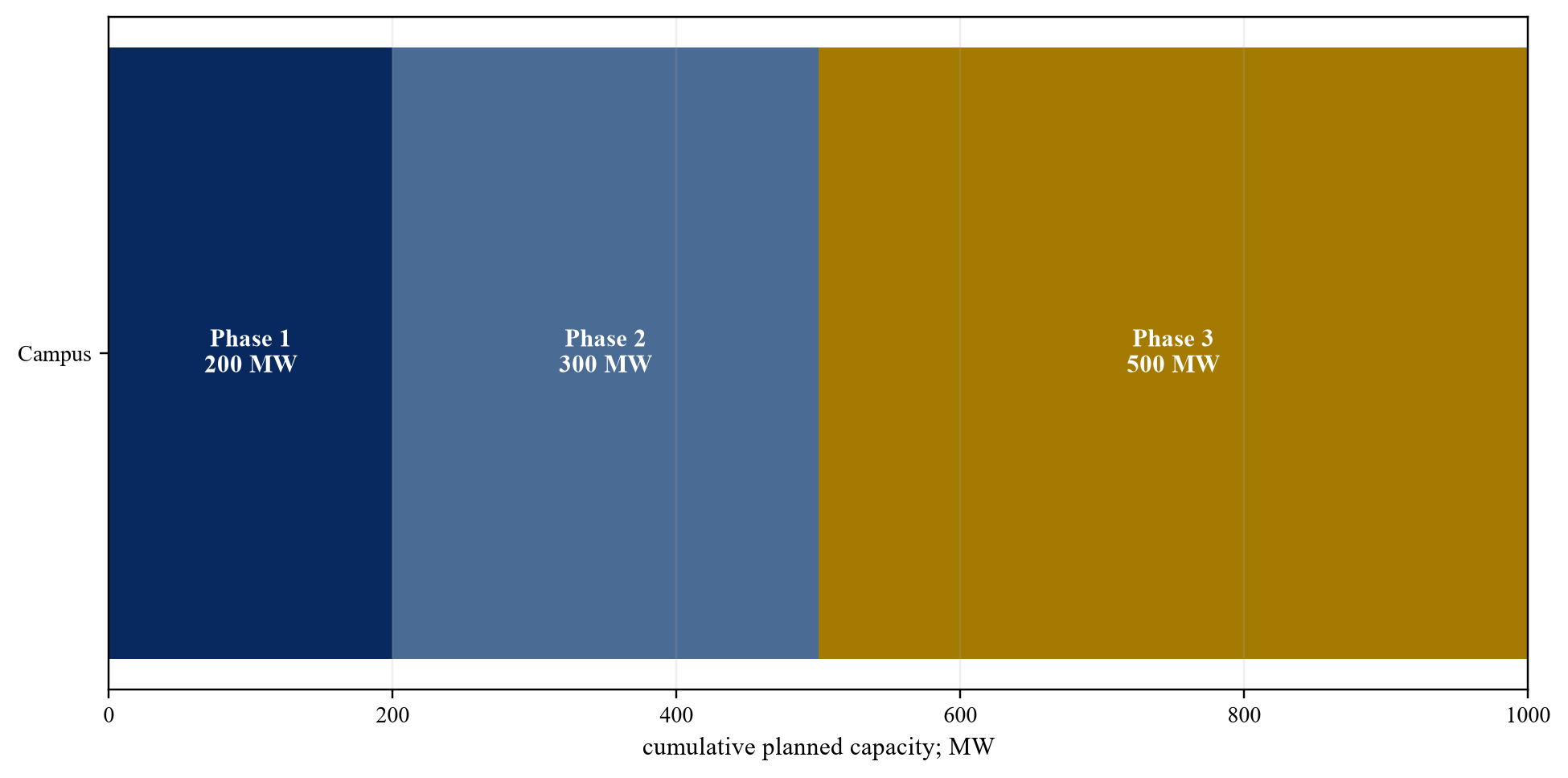
Wholly hypothetical; MW of planned campus capacity.
3. Build a commitment evidence ladder
The decision question is which customer documents create demand evidence, enforceable payment and credit support. The evidence file should begin with letters of intent, reservations, deposits, development agreements, leases, service schedules and guarantees. Each item should record its source, date, legal owner, responsible party, expiry or review date and relationship to the relevant capacity block. Market demand provides context. Executed project documents determine rights, obligations and cash. [5][6]
The principal failure is that headline committed megawatts combine non-binding interest with enforceable obligations. Project finance converts construction advances into funded exposure before the campus produces stable cash. The lender needs an observable chain from the current physical and contractual position to the next milestone, the funding required to reach it and the value preserved if progress stops.
The recommended response is to classify each commitment by enforceability, conditions, term, price, support and remedy. Management estimates may support scenarios when identified as assumptions and reconciled to external evidence. The central case should retain current rights, committed funding and costed obligations. The downside should combine related power, construction, equipment, customer and financing effects.
The credit record should state funded exposure, verified capacity, the next evidence gate, remaining cost, minimum liquidity, cure period and recovery route. It should identify the party able to act, required consent and the last date for value-preserving intervention.
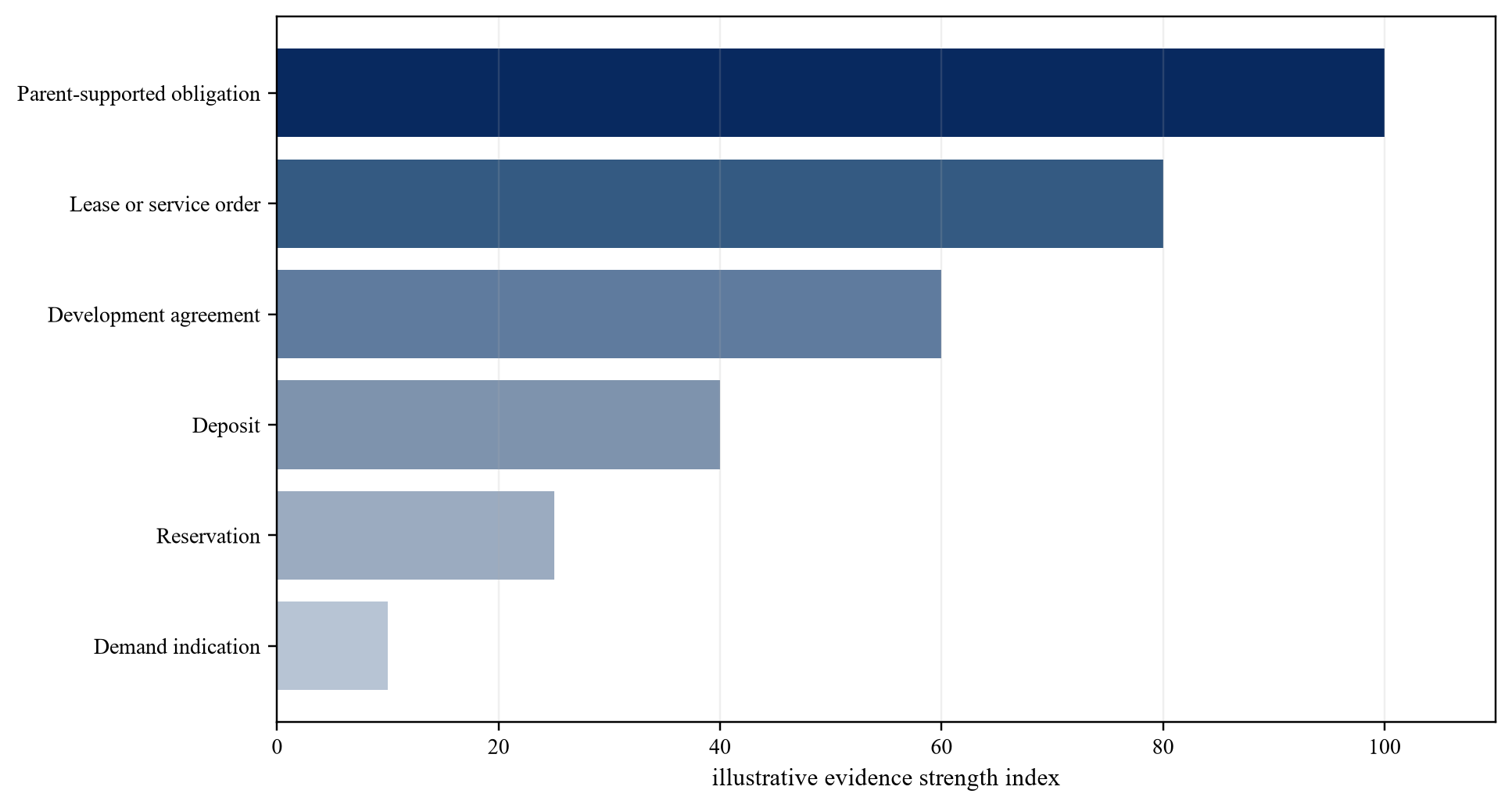
Proposed hierarchy; executed terms and applicable law determine enforceability.
| Commitment form | Evidence | Financing treatment |
|---|---|---|
| demand indication | non-binding correspondence | market context only |
| reservation | capacity, expiry and fee | conditional evidence |
| deposit | funded cash and refund terms | liability-adjusted source |
| development agreement | milestones and remedies | gated value |
| lease or service order | enforceable term, price and acceptance | contracted cash subject to conditions |
| parent-supported obligation | guarantee and obligor capacity | enhanced credit support |
Proposed classification; executed documents and applicable law control treatment.
4. Verify customer credit
The decision question is which entity owes payment and what financial capacity or support stands behind it. The evidence file should begin with executed agreement, group structure, audited accounts, ratings, guarantees and security arrangements. Each item should record its source, date, legal owner, responsible party, expiry or review date and relationship to the relevant capacity block. Market demand provides context. Executed project documents determine rights, obligations and cash. [5][7]
The principal failure is that a recognised hyperscaler brand is treated as equivalent to an obligation of the listed parent. Project finance converts construction advances into funded exposure before the campus produces stable cash. The lender needs an observable chain from the current physical and contractual position to the next milestone, the funding required to reach it and the value preserved if progress stops.
The recommended response is to underwrite the actual obligor and every limit on guarantee, set-off, termination and liability. Management estimates may support scenarios when identified as assumptions and reconciled to external evidence. The central case should retain current rights, committed funding and costed obligations. The downside should combine related power, construction, equipment, customer and financing effects.
The credit record should state funded exposure, verified capacity, the next evidence gate, remaining cost, minimum liquidity, cure period and recovery route. It should identify the party able to act, required consent and the last date for value-preserving intervention.
5. Align capacity blocks and contracts
The decision question is how each customer block maps to a building, power path, cooling system and acceptance test. The evidence file should begin with capacity schedule, design, commissioning plan, customer technical annex and billing provisions. Each item should record its source, date, legal owner, responsible party, expiry or review date and relationship to the relevant capacity block. Market demand provides context. Executed project documents determine rights, obligations and cash. [2][8]
The principal failure is that contracted demand cannot be tied to a deliverable and testable physical block. Project finance converts construction advances into funded exposure before the campus produces stable cash. The lender needs an observable chain from the current physical and contractual position to the next milestone, the funding required to reach it and the value preserved if progress stops.
The recommended response is to maintain a block-level capacity ledger connecting construction evidence to contract rights. Management estimates may support scenarios when identified as assumptions and reconciled to external evidence. The central case should retain current rights, committed funding and costed obligations. The downside should combine related power, construction, equipment, customer and financing effects.
The credit record should state funded exposure, verified capacity, the next evidence gate, remaining cost, minimum liquidity, cure period and recovery route. It should identify the party able to act, required consent and the last date for value-preserving intervention.
| Block | Physical evidence | Customer evidence | Cash status |
|---|---|---|---|
| 50 MW A | powered shell and tested systems | executed order | acceptance pending |
| 50 MW B | equipment installation | development agreement | deposit funded |
| 50 MW C | long-lead procurement | reservation | conditional |
| 50 MW D | design and power allocation | demand indication | uncommitted |
| shared systems | commissioned proportionately | allocation agreement | phase funded |
Proposed control schedule; each project requires contract-specific entries.
6. Prove the power pathway
The decision question is which generation, grid, transmission, substation and backup arrangements support each phase. The evidence file should begin with connection agreements, power purchase terms, network studies, construction plans, permits and tests. Each item should record its source, date, legal owner, responsible party, expiry or review date and relationship to the relevant capacity block. Market demand provides context. Executed project documents determine rights, obligations and cash. [1][4]
The principal failure is that nameplate campus power is assumed available before the relevant network and site systems are ready. Project finance converts construction advances into funded exposure before the campus produces stable cash. The lender needs an observable chain from the current physical and contractual position to the next milestone, the funding required to reach it and the value preserved if progress stops.
The recommended response is to finance only capacity supported by dated rights, works, tests and operating permission. Management estimates may support scenarios when identified as assumptions and reconciled to external evidence. The central case should retain current rights, committed funding and costed obligations. The downside should combine related power, construction, equipment, customer and financing effects.
The credit record should state funded exposure, verified capacity, the next evidence gate, remaining cost, minimum liquidity, cure period and recovery route. It should identify the party able to act, required consent and the last date for value-preserving intervention.
7. Test water and cooling resilience
The decision question is which water sources, cooling designs, operating envelopes and redundancy support high-density compute. The evidence file should begin with design basis, water rights, climate data, equipment curves, commissioning tests and contingency plans. Each item should record its source, date, legal owner, responsible party, expiry or review date and relationship to the relevant capacity block. Market demand provides context. Executed project documents determine rights, obligations and cash. [1][9]
The principal failure is that cooling capacity is sized for average conditions while rack density and peak climate drive failure risk. Project finance converts construction advances into funded exposure before the campus produces stable cash. The lender needs an observable chain from the current physical and contractual position to the next milestone, the funding required to reach it and the value preserved if progress stops.
The recommended response is to model the tested operating envelope and fund the required redundancy and water strategy. Management estimates may support scenarios when identified as assumptions and reconciled to external evidence. The central case should retain current rights, committed funding and costed obligations. The downside should combine related power, construction, equipment, customer and financing effects.
The credit record should state funded exposure, verified capacity, the next evidence gate, remaining cost, minimum liquidity, cure period and recovery route. It should identify the party able to act, required consent and the last date for value-preserving intervention.
8. Rebuild sources and uses
The decision question is how land, shared works, power, buildings, mechanical systems, networks, security, financing and reserves are funded. The evidence file should begin with contracts, cost plans, invoices, utility estimates, procurement terms and sponsor evidence. Each item should record its source, date, legal owner, responsible party, expiry or review date and relationship to the relevant capacity block. Market demand provides context. Executed project documents determine rights, obligations and cash. [10][11]
The principal failure is that site-wide and later-phase costs are allocated to the first financed phase without a transparent rule. Project finance converts construction advances into funded exposure before the campus produces stable cash. The lender needs an observable chain from the current physical and contractual position to the next milestone, the funding required to reach it and the value preserved if progress stops.
The recommended response is to reconcile every use to a phase, beneficiary and committed source of funds. Management estimates may support scenarios when identified as assumptions and reconciled to external evidence. The central case should retain current rights, committed funding and costed obligations. The downside should combine related power, construction, equipment, customer and financing effects.
The credit record should state funded exposure, verified capacity, the next evidence gate, remaining cost, minimum liquidity, cure period and recovery route. It should identify the party able to act, required consent and the last date for value-preserving intervention.
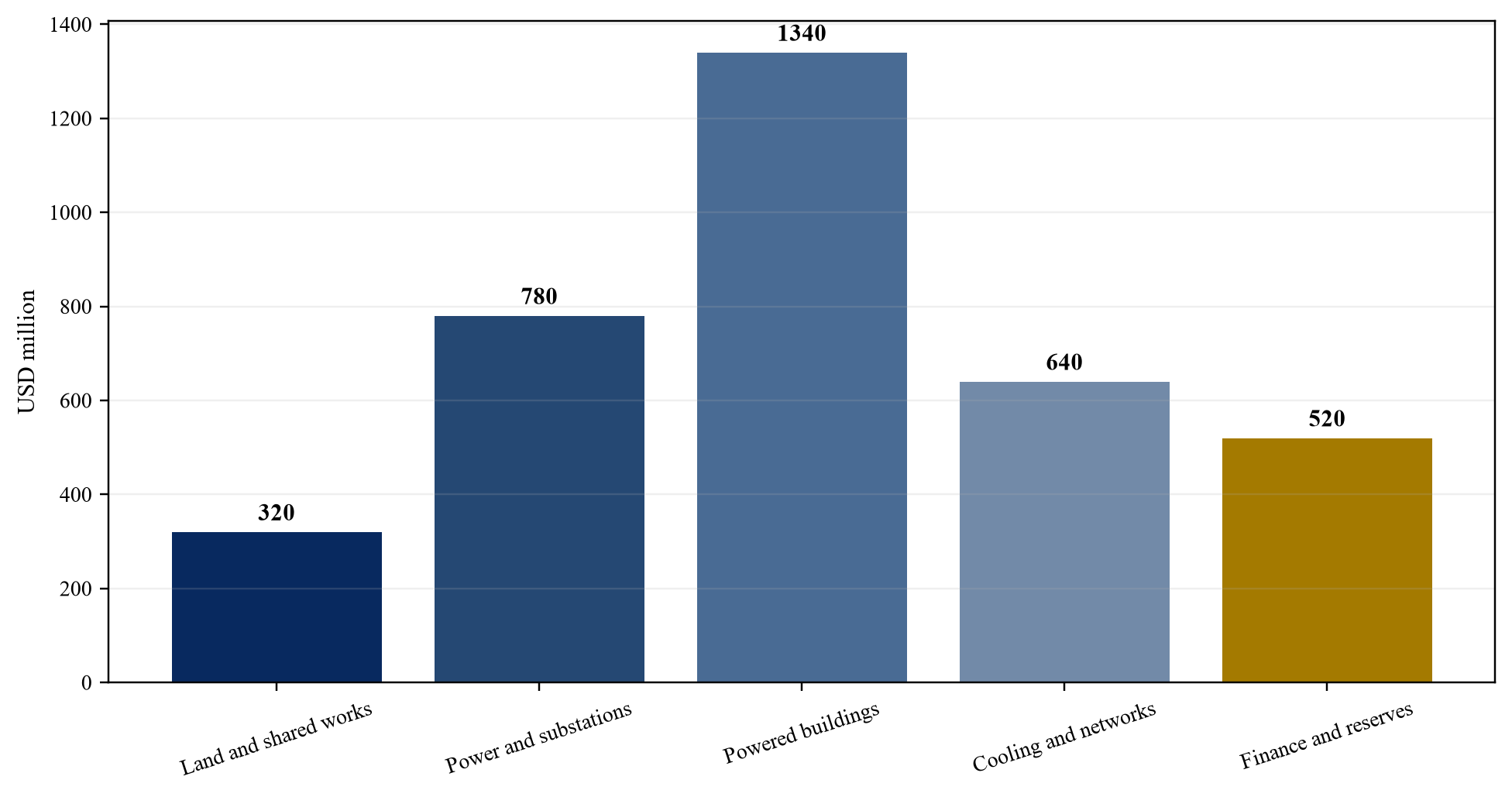
Wholly hypothetical; USD million.
| Use | Required evidence | Principal control |
|---|---|---|
| land and rights | title, lease and permits | security and transfer |
| power and network | executed rights and programme | milestone reserve |
| buildings and systems | contracts and certified progress | supervised draw |
| customer-specific works | approved scope and reimbursement | block allocation |
| financing and reserves | model and invoices | controlled accounts |
| contingency | risk register and approval | restricted release |
Proposed control schedule; transaction documents determine eligibility.
9. Allocate shared infrastructure
The decision question is how roads, substations, network routes, control rooms and central plants are shared across phases. The evidence file should begin with engineering design, capacity allocation, cost ledger, intercompany agreements and expansion plan. Each item should record its source, date, legal owner, responsible party, expiry or review date and relationship to the relevant capacity block. Market demand provides context. Executed project documents determine rights, obligations and cash. [10][12]
The principal failure is that the first borrower funds optional expansion without enforceable reimbursement or priority rights. Project finance converts construction advances into funded exposure before the campus produces stable cash. The lender needs an observable chain from the current physical and contractual position to the next milestone, the funding required to reach it and the value preserved if progress stops.
The recommended response is to apply a documented allocation method and finance later-phase capacity separately. Management estimates may support scenarios when identified as assumptions and reconciled to external evidence. The central case should retain current rights, committed funding and costed obligations. The downside should combine related power, construction, equipment, customer and financing effects.
The credit record should state funded exposure, verified capacity, the next evidence gate, remaining cost, minimum liquidity, cure period and recovery route. It should identify the party able to act, required consent and the last date for value-preserving intervention.
10. Sequence sponsor and customer funding
The decision question is when equity, deposits, subordinated capacity payments and senior debt enter the project. The evidence file should begin with bank evidence, escrow, deposit terms, equity commitments, subordination and draw schedule. Each item should record its source, date, legal owner, responsible party, expiry or review date and relationship to the relevant capacity block. Market demand provides context. Executed project documents determine rights, obligations and cash. [13][16]
The principal failure is that customer cash is treated as permanent equity despite refund, set-off or performance conditions. Project finance converts construction advances into funded exposure before the campus produces stable cash. The lender needs an observable chain from the current physical and contractual position to the next milestone, the funding required to reach it and the value preserved if progress stops.
The recommended response is to classify funding by repayment, priority and conditions and require loss-absorbing cash before debt. Management estimates may support scenarios when identified as assumptions and reconciled to external evidence. The central case should retain current rights, committed funding and costed obligations. The downside should combine related power, construction, equipment, customer and financing effects.
The credit record should state funded exposure, verified capacity, the next evidence gate, remaining cost, minimum liquidity, cure period and recovery route. It should identify the party able to act, required consent and the last date for value-preserving intervention.
11. Design construction draw gates
The decision question is which budget, progress, title, power, procurement and tenant evidence permits each advance. The evidence file should begin with draw request, invoices, engineer report, lien controls, budget certificate and milestone dashboard. Each item should record its source, date, legal owner, responsible party, expiry or review date and relationship to the relevant capacity block. Market demand provides context. Executed project documents determine rights, obligations and cash. [11][14]
The principal failure is that funded exposure increases faster than verified completion and customer readiness. Project finance converts construction advances into funded exposure before the campus produces stable cash. The lender needs an observable chain from the current physical and contractual position to the next milestone, the funding required to reach it and the value preserved if progress stops.
The recommended response is to condition each draw on current evidence, sufficient remaining funds and no unresolved stop event. Management estimates may support scenarios when identified as assumptions and reconciled to external evidence. The central case should retain current rights, committed funding and costed obligations. The downside should combine related power, construction, equipment, customer and financing effects.
The credit record should state funded exposure, verified capacity, the next evidence gate, remaining cost, minimum liquidity, cure period and recovery route. It should identify the party able to act, required consent and the last date for value-preserving intervention.
| Gate | Evidence | Stop-draw trigger |
|---|---|---|
| budget | balanced sources and uses | funding shortfall |
| progress | engineer-certified work | material variance |
| power | current rights, works and tests | delay or scope change |
| customer | aligned commitment and acceptance | termination or downsizing |
| equipment | title, inspection and delivery | restriction or failure |
| liquidity | reserve and sponsor support | minimum cash breach |
Proposed lender control; actual conditions require negotiated finance documents.
12. Control long-lead electrical systems
The decision question is which transformers, switchgear, generators, UPS and cooling components determine the delivery path. The evidence file should begin with purchase orders, designs, manufacturing reports, inspections, logistics, title, warranties and spares. Each item should record its source, date, legal owner, responsible party, expiry or review date and relationship to the relevant capacity block. Market demand provides context. Executed project documents determine rights, obligations and cash. [1][10]
The principal failure is that large deposits are paid before delivery while substitution, delay and ownership remain unclear. Project finance converts construction advances into funded exposure before the campus produces stable cash. The lender needs an observable chain from the current physical and contractual position to the next milestone, the funding required to reach it and the value preserved if progress stops.
The recommended response is to use milestone payments, vesting, inspection, assignment, insurance and delay remedies. Management estimates may support scenarios when identified as assumptions and reconciled to external evidence. The central case should retain current rights, committed funding and costed obligations. The downside should combine related power, construction, equipment, customer and financing effects.
The credit record should state funded exposure, verified capacity, the next evidence gate, remaining cost, minimum liquidity, cure period and recovery route. It should identify the party able to act, required consent and the last date for value-preserving intervention.
13. Separate building and compute risk
The decision question is which party buys, owns, refreshes and insures accelerators, servers and network equipment. The evidence file should begin with customer contract, equipment schedule, procurement terms, title, export approvals and lifecycle plan. Each item should record its source, date, legal owner, responsible party, expiry or review date and relationship to the relevant capacity block. Market demand provides context. Executed project documents determine rights, obligations and cash. [5][15]
The principal failure is that long-lived project debt funds short-lived compute without contracted refresh or residual-value protection. Project finance converts construction advances into funded exposure before the campus produces stable cash. The lender needs an observable chain from the current physical and contractual position to the next milestone, the funding required to reach it and the value preserved if progress stops.
The recommended response is to match asset life, ownership and repayment source and isolate equipment exposure where appropriate. Management estimates may support scenarios when identified as assumptions and reconciled to external evidence. The central case should retain current rights, committed funding and costed obligations. The downside should combine related power, construction, equipment, customer and financing effects.
The credit record should state funded exposure, verified capacity, the next evidence gate, remaining cost, minimum liquidity, cure period and recovery route. It should identify the party able to act, required consent and the last date for value-preserving intervention.
14. Govern export and technology controls
The decision question is which hardware, software, persons and destinations require approval or continuing compliance. The evidence file should begin with applicable rules, licences, end-user evidence, supply contracts, compliance programme and legal advice. Each item should record its source, date, legal owner, responsible party, expiry or review date and relationship to the relevant capacity block. Market demand provides context. Executed project documents determine rights, obligations and cash. [15][21]
The principal failure is that restricted equipment is assumed available because commercial orders have been placed. Project finance converts construction advances into funded exposure before the campus produces stable cash. The lender needs an observable chain from the current physical and contractual position to the next milestone, the funding required to reach it and the value preserved if progress stops.
The recommended response is to make controlled-technology availability and lawful use explicit funding and completion conditions. Management estimates may support scenarios when identified as assumptions and reconciled to external evidence. The central case should retain current rights, committed funding and costed obligations. The downside should combine related power, construction, equipment, customer and financing effects.
The credit record should state funded exposure, verified capacity, the next evidence gate, remaining cost, minimum liquidity, cure period and recovery route. It should identify the party able to act, required consent and the last date for value-preserving intervention.
15. Define data and sovereignty controls
The decision question is how data location, access, cybersecurity and operational control affect customer acceptance. The evidence file should begin with data-protection law, security standards, customer schedules, architecture and accreditation evidence. Each item should record its source, date, legal owner, responsible party, expiry or review date and relationship to the relevant capacity block. Market demand provides context. Executed project documents determine rights, obligations and cash. [21][22]
The principal failure is that a physically complete facility fails contractual or sovereign-control requirements. Project finance converts construction advances into funded exposure before the campus produces stable cash. The lender needs an observable chain from the current physical and contractual position to the next milestone, the funding required to reach it and the value preserved if progress stops.
The recommended response is to integrate data and security acceptance into design, testing, covenants and change control. Management estimates may support scenarios when identified as assumptions and reconciled to external evidence. The central case should retain current rights, committed funding and costed obligations. The downside should combine related power, construction, equipment, customer and financing effects.
The credit record should state funded exposure, verified capacity, the next evidence gate, remaining cost, minimum liquidity, cure period and recovery route. It should identify the party able to act, required consent and the last date for value-preserving intervention.
16. Integrate the construction schedule
The decision question is which civil, power, mechanical, network, security, equipment and customer paths determine delivery. The evidence file should begin with logic-linked programme, critical path, interfaces, float, progress and recovery plans. Each item should record its source, date, legal owner, responsible party, expiry or review date and relationship to the relevant capacity block. Market demand provides context. Executed project documents determine rights, obligations and cash. [10][14]
The principal failure is that separate contractor and customer schedules hide shared dependencies and exhausted float. Project finance converts construction advances into funded exposure before the campus produces stable cash. The lender needs an observable chain from the current physical and contractual position to the next milestone, the funding required to reach it and the value preserved if progress stops.
The recommended response is to maintain one integrated schedule with evidence owners and lender escalation thresholds. Management estimates may support scenarios when identified as assumptions and reconciled to external evidence. The central case should retain current rights, committed funding and costed obligations. The downside should combine related power, construction, equipment, customer and financing effects.
The credit record should state funded exposure, verified capacity, the next evidence gate, remaining cost, minimum liquidity, cure period and recovery route. It should identify the party able to act, required consent and the last date for value-preserving intervention.
17. Define block-level completion
The decision question is which mechanical, power, integrated-system, security and customer tests release each 50 MW block. The evidence file should begin with contract definitions, test scripts, witness plan, results, defects and acceptance certificate. Each item should record its source, date, legal owner, responsible party, expiry or review date and relationship to the relevant capacity block. Market demand provides context. Executed project documents determine rights, obligations and cash. [2][17]
The principal failure is that one campus completion certificate triggers debt treatment while material blocks remain unaccepted. Project finance converts construction advances into funded exposure before the campus produces stable cash. The lender needs an observable chain from the current physical and contractual position to the next milestone, the funding required to reach it and the value preserved if progress stops.
The recommended response is to use separate tests and consequences for every capacity block and site-wide dependency. Management estimates may support scenarios when identified as assumptions and reconciled to external evidence. The central case should retain current rights, committed funding and costed obligations. The downside should combine related power, construction, equipment, customer and financing effects.
The credit record should state funded exposure, verified capacity, the next evidence gate, remaining cost, minimum liquidity, cure period and recovery route. It should identify the party able to act, required consent and the last date for value-preserving intervention.
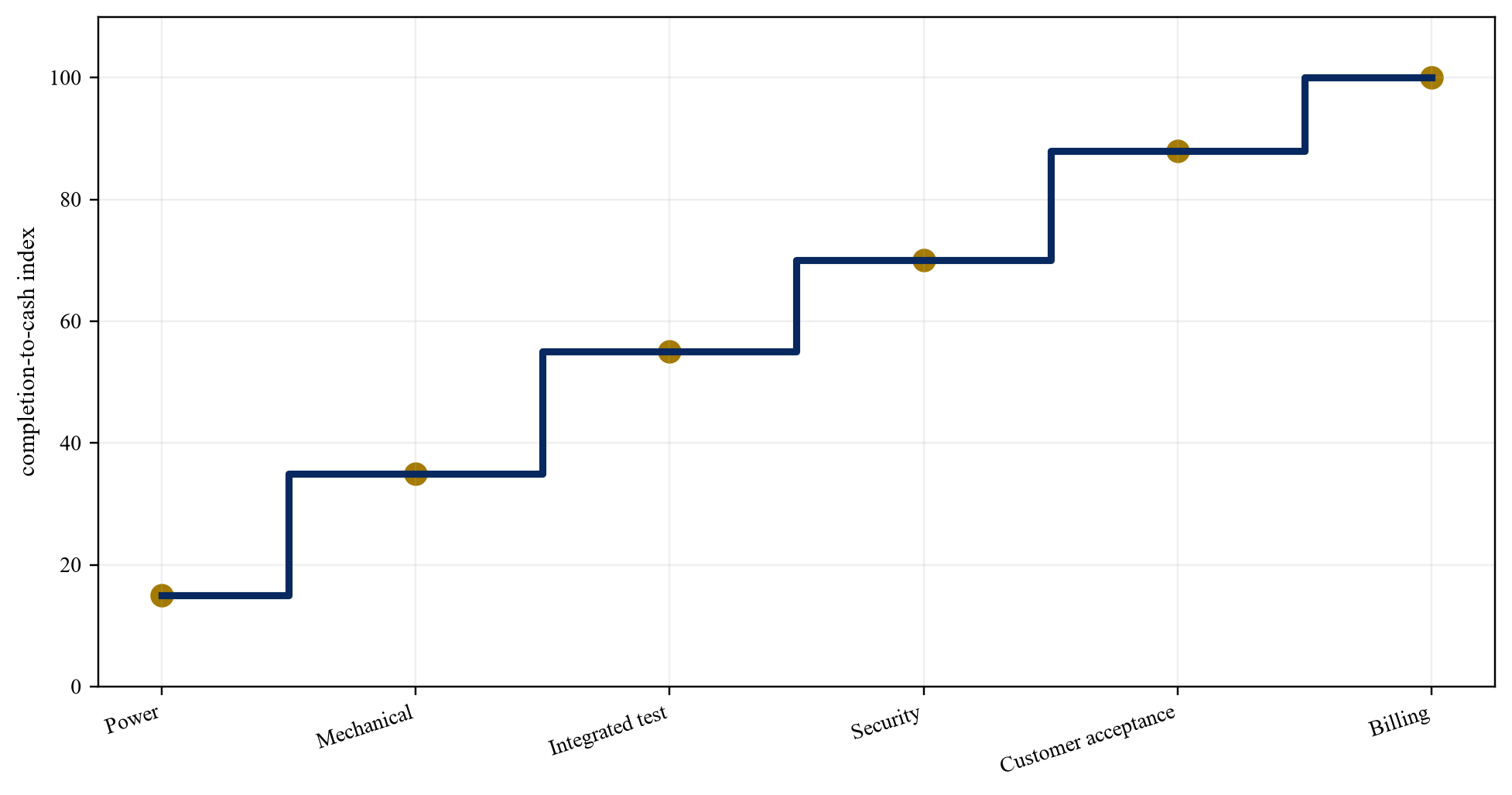
Proposed control sequence; project contracts determine actual tests and cash release.
| Test | Evidence | Typical consequence |
|---|---|---|
| power available | authorised tested capacity | commissioning permitted |
| mechanical completion | installed systems and punch list | integrated testing |
| integrated systems | witnessed load and failover | serviceability established |
| security accreditation | access and control approval | customer systems permitted |
| customer acceptance | contractual sign-off | billing begins |
| financial completion | coverage, reserves and no default | debt conversion |
Proposed hierarchy; project and customer documents control consequences.
18. Translate acceptance into revenue
The decision question is when delivered capacity creates deposits, rent, minimum revenue, usage revenue and service credits. The evidence file should begin with billing schedule, acceptance mechanics, price formula, ramp, credits, termination and collection evidence. Each item should record its source, date, legal owner, responsible party, expiry or review date and relationship to the relevant capacity block. Market demand provides context. Executed project documents determine rights, obligations and cash. [16][17]
The principal failure is that megawatts described as contracted do not produce cash until conditions and ramp thresholds are met. Project finance converts construction advances into funded exposure before the campus produces stable cash. The lender needs an observable chain from the current physical and contractual position to the next milestone, the funding required to reach it and the value preserved if progress stops.
The recommended response is to model cash from enforceable billing events and reconcile it to acceptance evidence. Management estimates may support scenarios when identified as assumptions and reconciled to external evidence. The central case should retain current rights, committed funding and costed obligations. The downside should combine related power, construction, equipment, customer and financing effects.
The credit record should state funded exposure, verified capacity, the next evidence gate, remaining cost, minimum liquidity, cure period and recovery route. It should identify the party able to act, required consent and the last date for value-preserving intervention.
19. Build the construction liquidity case
The decision question is how interest, fees, operations, commissioning, energy and delay costs are funded before stable revenue. The evidence file should begin with monthly draw model, reserves, equity commitments, customer cash and downside actions. Each item should record its source, date, legal owner, responsible party, expiry or review date and relationship to the relevant capacity block. Market demand provides context. Executed project documents determine rights, obligations and cash. [11][18]
The principal failure is that a fully funded construction budget excludes operating burn and delay before tenant ramp. Project finance converts construction advances into funded exposure before the campus produces stable cash. The lender needs an observable chain from the current physical and contractual position to the next milestone, the funding required to reach it and the value preserved if progress stops.
The recommended response is to size interest and operating liquidity to a coherent delay and ramp scenario. Management estimates may support scenarios when identified as assumptions and reconciled to external evidence. The central case should retain current rights, committed funding and costed obligations. The downside should combine related power, construction, equipment, customer and financing effects.
The credit record should state funded exposure, verified capacity, the next evidence gate, remaining cost, minimum liquidity, cure period and recovery route. It should identify the party able to act, required consent and the last date for value-preserving intervention.
20. Set contingency and overrun support
The decision question is how design maturity, procurement, utility scope, interfaces and schedule determine required protection. The evidence file should begin with risk register, cost plan, contracts, bids, changes, insurance and sponsor capacity. Each item should record its source, date, legal owner, responsible party, expiry or review date and relationship to the relevant capacity block. Market demand provides context. Executed project documents determine rights, obligations and cash. [10][11]
The principal failure is that a percentage contingency is consumed by known scope gaps before genuine uncertainty occurs. Project finance converts construction advances into funded exposure before the campus produces stable cash. The lender needs an observable chain from the current physical and contractual position to the next milestone, the funding required to reach it and the value preserved if progress stops.
The recommended response is to separate known allowances from unallocated contingency and define automatic equity cures. Management estimates may support scenarios when identified as assumptions and reconciled to external evidence. The central case should retain current rights, committed funding and costed obligations. The downside should combine related power, construction, equipment, customer and financing effects.
The credit record should state funded exposure, verified capacity, the next evidence gate, remaining cost, minimum liquidity, cure period and recovery route. It should identify the party able to act, required consent and the last date for value-preserving intervention.
21. Design covenants and stop-draw events
The decision question is which cost, power, customer, equipment, schedule and compliance failures require intervention. The evidence file should begin with facility terms, milestone register, reporting, model and cure mechanics. Each item should record its source, date, legal owner, responsible party, expiry or review date and relationship to the relevant capacity block. Market demand provides context. Executed project documents determine rights, obligations and cash. [11][14]
The principal failure is that financial covenants respond after technical and contractual value has deteriorated. Project finance converts construction advances into funded exposure before the campus produces stable cash. The lender needs an observable chain from the current physical and contractual position to the next milestone, the funding required to reach it and the value preserved if progress stops.
The recommended response is to use forward-looking evidence, liquidity, concentration and completion covenants. Management estimates may support scenarios when identified as assumptions and reconciled to external evidence. The central case should retain current rights, committed funding and costed obligations. The downside should combine related power, construction, equipment, customer and financing effects.
The credit record should state funded exposure, verified capacity, the next evidence gate, remaining cost, minimum liquidity, cure period and recovery route. It should identify the party able to act, required consent and the last date for value-preserving intervention.
22. Apply the hypothetical phase-one case
The decision question is how USD 3.60 billion of uses and four customer blocks affect construction exposure. The evidence file should begin with the stated hypothetical cost, funding, reserve, contingency, capacity and timing assumptions. Each item should record its source, date, legal owner, responsible party, expiry or review date and relationship to the relevant capacity block. Market demand provides context. Executed project documents determine rights, obligations and cash. [1][11]
The principal failure is that one aggregate model conceals which capacity blocks support debt and which remain conditional. Project finance converts construction advances into funded exposure before the campus produces stable cash. The lender needs an observable chain from the current physical and contractual position to the next milestone, the funding required to reach it and the value preserved if progress stops.
The recommended response is to show sources, uses, draws, acceptance, billing and debt capacity by block and month. Management estimates may support scenarios when identified as assumptions and reconciled to external evidence. The central case should retain current rights, committed funding and costed obligations. The downside should combine related power, construction, equipment, customer and financing effects.
The credit record should state funded exposure, verified capacity, the next evidence gate, remaining cost, minimum liquidity, cure period and recovery route. It should identify the party able to act, required consent and the last date for value-preserving intervention.
| Metric | Central assumption | Delay or range |
|---|---|---|
| phase-one capacity | 200 MW | 150-200 MW |
| total phase-one cost | USD 3.60bn | USD 3.60bn-4.05bn |
| construction debt | USD 1.60bn | capped at USD 1.60bn |
| sponsor equity | USD 1.40bn | USD 1.40bn plus cures |
| customer deposits and subordinated payments | USD 600m | USD 350m-600m |
| contingency | USD 320m | controlled release |
| interest and operating reserve | USD 260m | USD 260m plus equity |
| forward conversion DSCR | 1.40x | 1.20x-1.40x |
Wholly hypothetical; figures do not describe an identified project or financing.
23. Map draws to verified capacity
The decision question is how debt availability rises as power, buildings, systems and tenant evidence mature. The evidence file should begin with draw schedule, engineer certificates, capacity ledger, customer milestones and remaining funds. Each item should record its source, date, legal owner, responsible party, expiry or review date and relationship to the relevant capacity block. Market demand provides context. Executed project documents determine rights, obligations and cash. [11][17]
The principal failure is that the facility approaches full draw before sufficient capacity is accepted and billable. Project finance converts construction advances into funded exposure before the campus produces stable cash. The lender needs an observable chain from the current physical and contractual position to the next milestone, the funding required to reach it and the value preserved if progress stops.
The recommended response is to cap cumulative debt at the lower of eligible cost, evidence-weighted availability and stressed takeout. Management estimates may support scenarios when identified as assumptions and reconciled to external evidence. The central case should retain current rights, committed funding and costed obligations. The downside should combine related power, construction, equipment, customer and financing effects.
The credit record should state funded exposure, verified capacity, the next evidence gate, remaining cost, minimum liquidity, cure period and recovery route. It should identify the party able to act, required consent and the last date for value-preserving intervention.
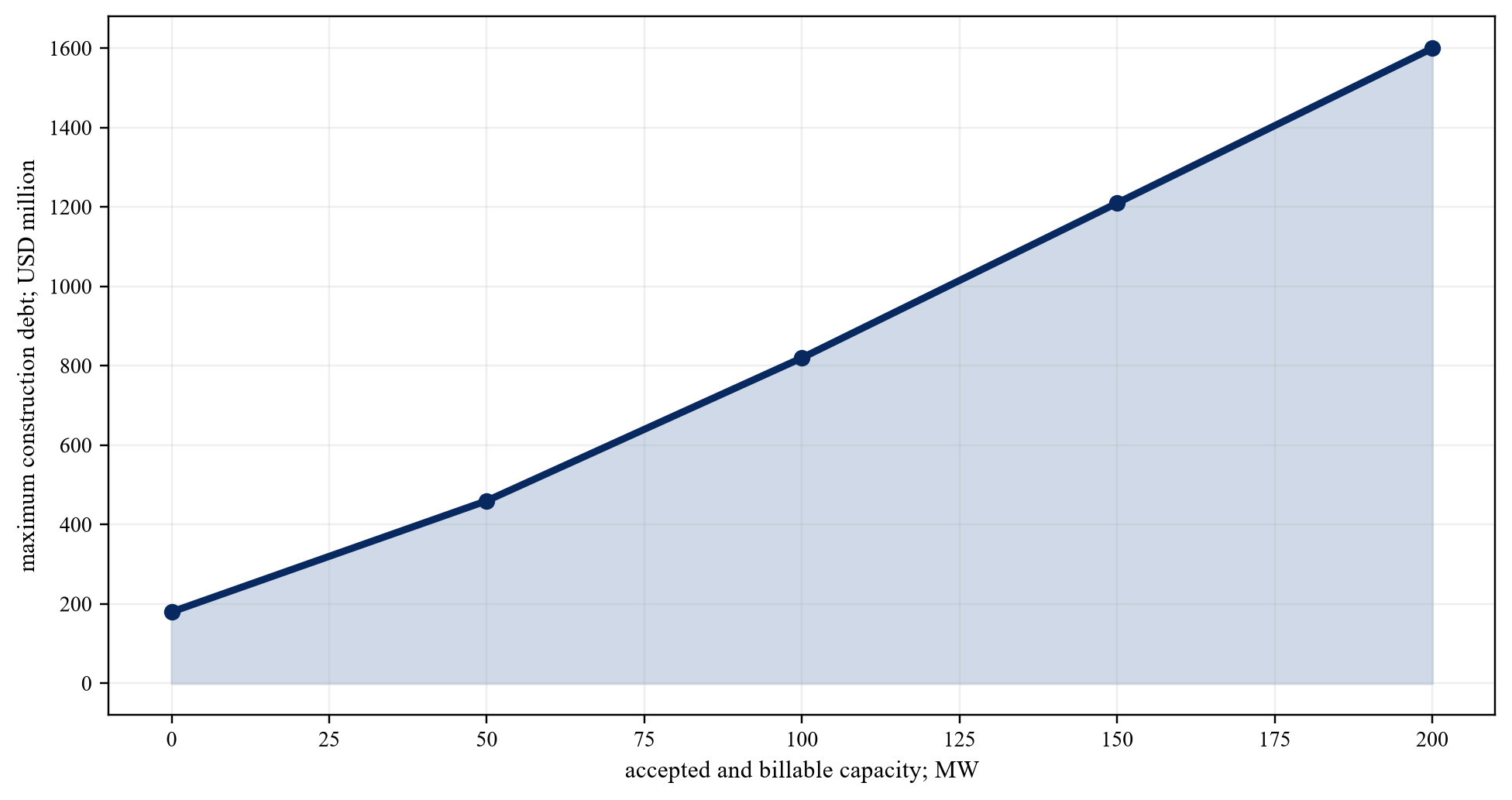
Wholly hypothetical; debt remains subject to all finance-document conditions.
24. Stress power and tenant ramp
The decision question is which combinations of power delay, construction overrun, slower acceptance and higher rates impair repayment. The evidence file should begin with power programme, contracts, cost forecast, liquidity and takeout terms. Each item should record its source, date, legal owner, responsible party, expiry or review date and relationship to the relevant capacity block. Market demand provides context. Executed project documents determine rights, obligations and cash. [1][18]
The principal failure is that single-variable sensitivities miss compounding delay, cost and revenue effects. Project finance converts construction advances into funded exposure before the campus produces stable cash. The lender needs an observable chain from the current physical and contractual position to the next milestone, the funding required to reach it and the value preserved if progress stops.
The recommended response is to run coherent six, twelve and eighteen-month cases with stated management actions. Management estimates may support scenarios when identified as assumptions and reconciled to external evidence. The central case should retain current rights, committed funding and costed obligations. The downside should combine related power, construction, equipment, customer and financing effects.
The credit record should state funded exposure, verified capacity, the next evidence gate, remaining cost, minimum liquidity, cure period and recovery route. It should identify the party able to act, required consent and the last date for value-preserving intervention.
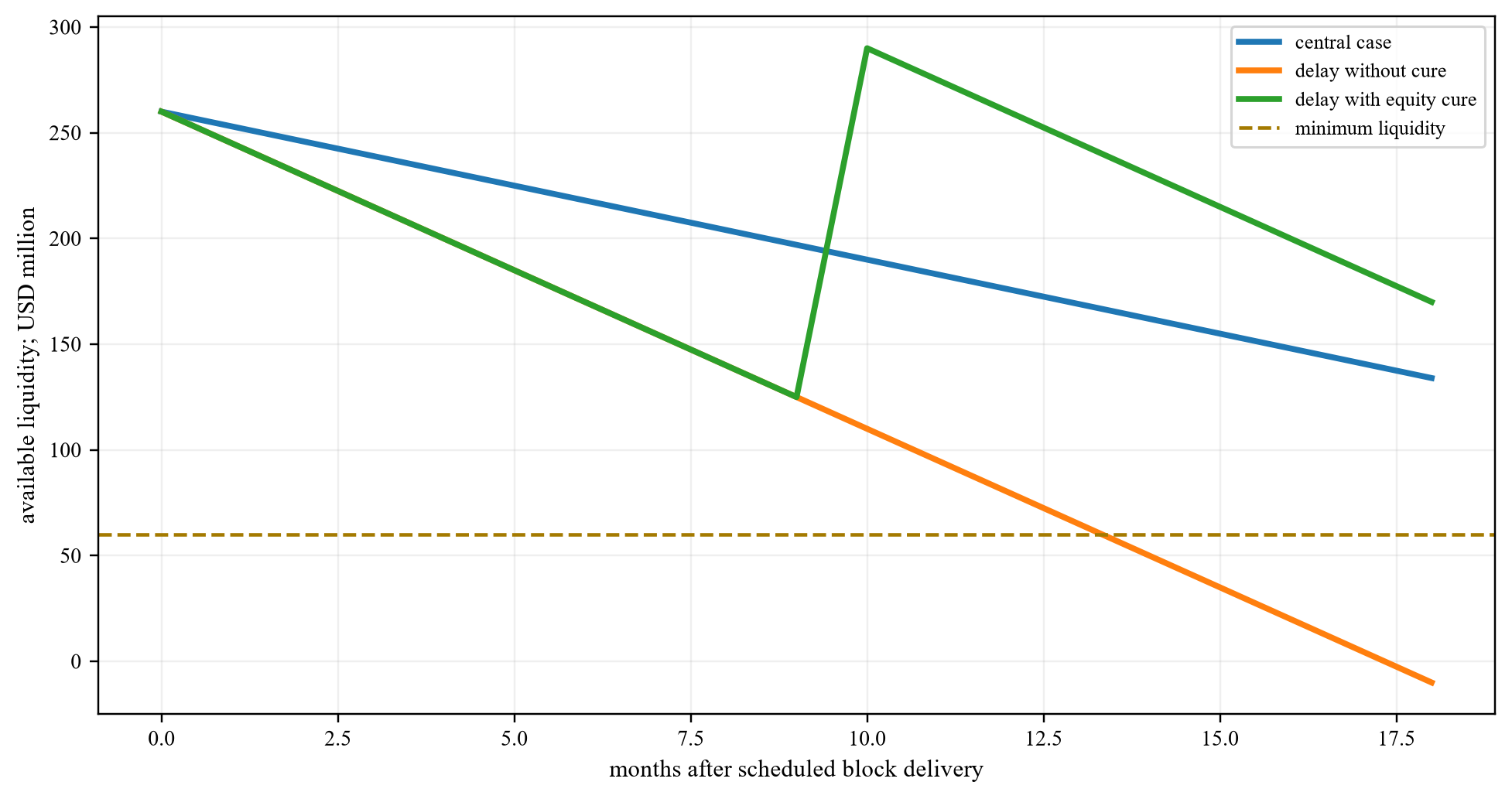
Wholly hypothetical; USD million.
25. Test concentration and substitution
The decision question is whether the project can withstand delay, downsizing or loss of its anchor customer. The evidence file should begin with contract rights, replacement demand, technical specificity, refit cost, timing and market evidence. Each item should record its source, date, legal owner, responsible party, expiry or review date and relationship to the relevant capacity block. Market demand provides context. Executed project documents determine rights, obligations and cash. [5][20]
The principal failure is that a long lease term is treated as diversification despite dependence on one technology and customer group. Project finance converts construction advances into funded exposure before the campus produces stable cash. The lender needs an observable chain from the current physical and contractual position to the next milestone, the funding required to reach it and the value preserved if progress stops.
The recommended response is to quantify concentration, re-letting cost and substitution time at block level. Management estimates may support scenarios when identified as assumptions and reconciled to external evidence. The central case should retain current rights, committed funding and costed obligations. The downside should combine related power, construction, equipment, customer and financing effects.
The credit record should state funded exposure, verified capacity, the next evidence gate, remaining cost, minimum liquidity, cure period and recovery route. It should identify the party able to act, required consent and the last date for value-preserving intervention.
26. Define permanent-debt conversion
The decision question is which power, completion, customer, operating and coverage conditions permit takeout. The evidence file should begin with term sheet, acceptance certificates, operating record, valuation, reserves and covenant certificate. Each item should record its source, date, legal owner, responsible party, expiry or review date and relationship to the relevant capacity block. Market demand provides context. Executed project documents determine rights, obligations and cash. [11][18]
The principal failure is that permanent financing is assumed before its conditions and availability period align with actual ramp. Project finance converts construction advances into funded exposure before the campus produces stable cash. The lender needs an observable chain from the current physical and contractual position to the next milestone, the funding required to reach it and the value preserved if progress stops.
The recommended response is to treat conversion as conditional and retain funded alternatives until every test is met. Management estimates may support scenarios when identified as assumptions and reconciled to external evidence. The central case should retain current rights, committed funding and costed obligations. The downside should combine related power, construction, equipment, customer and financing effects.
The credit record should state funded exposure, verified capacity, the next evidence gate, remaining cost, minimum liquidity, cure period and recovery route. It should identify the party able to act, required consent and the last date for value-preserving intervention.
27. Plan downside recovery
The decision question is whether completion, customer cure, sale, re-letting, phase reduction or enforcement preserves value. The evidence file should begin with collateral, remaining cost, customer rights, marketability, consents, time and specialist advice. Each item should record its source, date, legal owner, responsible party, expiry or review date and relationship to the relevant capacity block. Market demand provides context. Executed project documents determine rights, obligations and cash. [11][20]
The principal failure is that book cost and strategic relevance substitute for executable net recovery. Project finance converts construction advances into funded exposure before the campus produces stable cash. The lender needs an observable chain from the current physical and contractual position to the next milestone, the funding required to reach it and the value preserved if progress stops.
The recommended response is to compare recovery routes after remaining expenditure, delay, liabilities and transaction cost. Management estimates may support scenarios when identified as assumptions and reconciled to external evidence. The central case should retain current rights, committed funding and costed obligations. The downside should combine related power, construction, equipment, customer and financing effects.
The credit record should state funded exposure, verified capacity, the next evidence gate, remaining cost, minimum liquidity, cure period and recovery route. It should identify the party able to act, required consent and the last date for value-preserving intervention.
28. Reach the financing decision
The decision question is whether phased evidence, funded liquidity, enforceable commitments and recovery justify the proposed debt. The evidence file should begin with phase map, commitment ladder, power case, balanced budget, downside model and security package. Each item should record its source, date, legal owner, responsible party, expiry or review date and relationship to the relevant capacity block. Market demand provides context. Executed project documents determine rights, obligations and cash. [1][2]
The principal failure is that the strategic importance of AI displaces project-specific repayment evidence. Project finance converts construction advances into funded exposure before the campus produces stable cash. The lender needs an observable chain from the current physical and contractual position to the next milestone, the funding required to reach it and the value preserved if progress stops.
The recommended response is to approve only the exposure supported by verified capacity, enforceable cash and funded downside actions. Management estimates may support scenarios when identified as assumptions and reconciled to external evidence. The central case should retain current rights, committed funding and costed obligations. The downside should combine related power, construction, equipment, customer and financing effects.
The credit record should state funded exposure, verified capacity, the next evidence gate, remaining cost, minimum liquidity, cure period and recovery route. It should identify the party able to act, required consent and the last date for value-preserving intervention.
| Decision | Evidence required | Possible action |
|---|---|---|
| commitment | phase perimeter and balanced funding | approve or resize |
| each draw | progress, power, tenant and liquidity evidence | fund, defer or stop |
| capacity acceptance | completed tests and customer sign-off | recognise billing |
| delay response | liquidity, cures and recovery | cure or restructure |
| conversion | accepted capacity, cash and coverage | refinance or extend |
| deterioration | quantified legal, technical and cash effect | protect, sell or enforce |
Proposed governance; transaction-specific approvals remain necessary.
Sources
- International Energy Agency, *Energy and AI*. Read the primary source
- OpenAI, *Introducing Stargate UAE*. Read the primary source
- Embassy of the United Arab Emirates in Washington, DC, *UAE-US AI Partnership*. Read the primary source
- International Energy Agency, *Energy Demand from AI*. Read the primary source
- U.S. Securities and Exchange Commission, *Microsoft 2025 Form 10-K*. Read the primary source
- U.S. Securities and Exchange Commission, *Amazon 2025 Form 10-K*. Read the primary source
- U.S. Securities and Exchange Commission, *Alphabet 2025 Form 10-K*. Read the primary source
- U.S. Securities and Exchange Commission, *Meta Platforms 2025 Form 10-K*. Read the primary source
- ASHRAE, *Thermal Guidelines for Data Processing Environments*. Read the primary source
- Infrastructure and Projects Authority, *Project Routemap*. Read the primary source
- Office of the Comptroller of the Currency, *Project Finance*. Read the primary source
- World Bank Group, *Public-Private Partnership Reference Guide*. Read the primary source
- European Banking Authority, *Guidelines on Loan Origination and Monitoring*. Read the primary source
- Basel Committee on Banking Supervision, *Principles for the Management of Credit Risk*. Read the primary source
- U.S. Department of Commerce, Bureau of Industry and Security, *Export Administration Regulations*. Read the primary source
- IFRS Foundation, *IFRS 15 Revenue from Contracts with Customers*. Read the primary source
- IFRS Foundation, *IFRS 16 Leases*. Read the primary source
- IFRS Foundation, *IFRS 9 Financial Instruments*. Read the primary source
- IFRS Foundation, *IAS 37 Provisions, Contingent Liabilities and Contingent Assets*. Read the primary source
- IFRS Foundation, *IFRS 13 Fair Value Measurement*. Read the primary source
- United Arab Emirates, *Federal Decree-Law No. 45 of 2021 Regarding the Protection of Personal Data*. Read the primary source
- Abu Dhabi Global Market, *Data Protection Regulations 2021*. Read the primary source
- Equator Principles Association, *The Equator Principles EP4*. Read the primary source
- International Energy Agency, *AI and Energy Security*. Read the primary source
- U.S. Securities and Exchange Commission, *Cipher Mining 2025 Form 10-K*. Read the primary source
- National Institute of Standards and Technology, *AI Risk Management Framework*. Read the primary source
