

Introduction
Orbital manufacturing covers the production, processing, assembly or repair of materials, biological products, components and infrastructure in space. Some businesses seek to return high-value products to Earth. Others plan to manufacture structures, propellant, replacement parts or satellite components for use in orbit. These models have different capital needs, customer bases and routes to revenue. A GCC investor evaluating them should begin with the purchased economic outcome rather than the general proposition that space is strategically important.
The Gulf has relevant foundations for participation. The region combines patient capital, industrial-policy capacity, airlines and logistics networks, energy and materials expertise, advanced-technology programmes and growing space institutions. The UAE has articulated national objectives for economic diversification, commercial space activity, technology development and international partnership. Saudi Arabia's space institution similarly emphasises localisation, capability and commercialisation. These foundations can support a credible investment programme when capital is tied to specific rights, evidence and operating responsibilities. [1][2][3][4]
The decision problem is how to capture economic and strategic value without paying financial value for benefits that remain aspirational. This paper proposes an investment architecture, a diligence record and a worked hypothetical case. It does not value a named company or recommend a transaction involving a specific issuer.
1 Define the strategic participation thesis
A strategic participation thesis should state the national or institutional outcome being purchased. Possible outcomes include a financial return, access to manufactured product, domestic test and integration capacity, local intellectual property, skilled employment, supply-chain development, launch or return access, participation in international missions, or resilience in a strategically important technology. A single investment may pursue several outcomes, but each should have a separate owner, budget and test.
The thesis should also define the activity boundary. Investing in a company that performs research on a foreign station creates a different capability from operating a production payload, owning a return vehicle, qualifying terrestrial finishing, or controlling the customer contract. The investor should trace the service from feedstock and design through launch, orbital processing, return, testing, finishing and sale. The trace reveals where cash is earned, where knowledge accumulates and where a foreign counterparty can stop the programme.
A useful thesis names the first commercial product, the first qualified customer, the required operating cadence and the capability that will exist in the GCC after each stage. Broad goals such as becoming a global hub should be translated into measurable assets, people, rights and customer outcomes.
2 Separate financial value from strategic value
Financial value arises from cash that the company can earn and retain. Strategic value may arise from skills, resilience, market access, technology options or industrial spillovers. Both can matter to a GCC investor. They should remain separate in the investment memorandum because the evidence, governance and beneficiaries differ.
The financial ledger should include contracted revenue, probability-weighted pipeline, variable cost, launch and return cost, capital expenditure, working capital, tax, financing cost and terminal value. The strategic ledger should include controlled intellectual property, trained personnel, local supplier qualification, facility utilisation, data access, emergency-use rights and independently usable capability. A strategic benefit should be recognised only when a contract, licence, asset, workforce or operational arrangement allows the investor or a designated national entity to capture it.
Combining the ledgers into one headline valuation creates double counting. A company may receive a high growth multiple for future commercial access while also asking the strategic investor to pay a premium for the same access. The investment committee should approve the financial price, the separate strategic budget and the contractual delivery mechanism for each strategic benefit.
3 Use an evidence ladder before capital release
Orbital manufacturing develops through evidence states. Terrestrial process validation shows that the underlying mechanism works in a controlled ground environment. Flight qualification shows that hardware can survive launch and operate safely. An orbital campaign may demonstrate process execution. Return and independent testing show whether output can be recovered and measured. Customer qualification shows whether the result solves a paid problem. Repeat campaigns show whether yield, cadence and cost can become predictable.
NASA uses staged programmes, accepted milestones and commercial-service acquisition to develop private capability. Its In Space Production Applications programme aims to raise technology readiness and stimulate scalable non-NASA demand. ESA commercialisation programmes similarly combine technical support, co-funding, facilities and market access. These models support evidence-linked public participation. They also show that a grant or successful demonstration is an input to commercialisation rather than proof of an investable recurring-revenue business. [5][6][7][8][9]
Each capital draw should identify the evidence expected, the independent reviewer, the acceptance period and the remedy if the evidence is incomplete. The decision record should explain which uncertainty was retired and which remains with the investor.
4 Distinguish science success from commercial success
A space experiment can produce a scientifically interesting result without producing a commercially valuable product. Commercial success requires a customer specification, repeatable quality, usable batch size, reliable return, terrestrial finishing, regulatory acceptance and a delivered cost below the customer's willingness to pay. The gap between a successful experiment and an accepted product is often where the largest funding requirement emerges.
NASA describes applications such as advanced materials, biological products and optical fibres, while emphasising sustainable, scalable and profitable demand. Its optical-fibre work explains the potential microgravity advantage and the need to demonstrate long, high-quality output. ESA's first metal print on the International Space Station established an important technical milestone for in-orbit manufacturing. Neither example, on its own, proves a repeatable commercial market for a particular operator. [5][10][11]
Diligence should therefore obtain raw test data, sample history, failure records, customer protocols and the full cost of qualification. The investment committee should ask whether the next mission tests a scientific hypothesis, a manufacturing process, a customer specification or a production business. These are different objectives and deserve different capital.
5 Select the right participation route
Equity suits residual uncertainty and long-duration option value. A minority stake can provide governance, information and future participation rights, but it does not automatically deliver local capability. A joint venture can allocate regional assets and customers, although it can fail if the foreign partner retains the essential intellectual property, people or licences. Customer development funding can buy a product-specific programme without purchasing the whole enterprise. Project capital can finance a defined facility or production service after contracts and completion tests exist.
Licensing and contract manufacturing may accelerate capability access when the process can be transferred and protected. A regional test, integration or finishing facility can build industrial substance before orbital production is localised. A fund investment provides diversified exposure but limited control over capability outcomes. Acquisition can deliver control when assets, export approvals and key people transfer, though the buyer may inherit technical and mission liabilities.
The route should match the target outcome. Financial exposure can use ordinary investment instruments. Capability acquisition requires licences, services, assets, people, data, decision rights and continuity provisions.
6 Build a staged capital architecture
A staged architecture releases capital only when the programme produces defined evidence. Initial equity can fund diligence, terrestrial validation and interface design. Milestone capital can fund flight qualification and the first orbital campaign. Customer funds can support product-specific qualification. Facility capital can follow once the regional operating model, utilisation and partner responsibilities are documented. Follow-on equity or debt can enter after accepted production and contracted demand.
Each stage should have a maximum loss, a funded work plan and a stop decision. The investor should avoid an architecture in which early capital creates an unfinished asset that can be preserved only through repeated emergency funding. Reserves should cover safe programme suspension, data preservation, customer obligations and asset recovery.
The funding agreement should distinguish committed capital, conditional capital and discretionary follow-on capital. Management plans often show all three as available. The investment model should recognise only funded or legally committed sources that meet their draw conditions.
7 Test process yield and returned mass
Manufacturing capacity should be measured through the entire chain. Prepared feedstock can exceed launched mass. Launched mass can exceed processed mass. Processed mass can exceed returned mass. Returned mass can exceed within-specification output. Customer-accepted output may be smaller again. A revenue model built on payload mass can therefore overstate saleable capacity.
The diligence file should reconcile input mass, samples, telemetry, process time, losses, contamination, return conditions, testing and final customer acceptance for each campaign. Yield should be presented as a distribution rather than a single average when the number of missions is small. Correlated failure should be modelled because launch delay, platform outage, return failure and test rejection can affect several customers together.
The investor should also identify the scarce resource. It may be payload mass, crew time, power, thermal control, return volume, clean-room finishing, qualified feedstock or customer testing capacity. Capital creates value only when it expands the binding constraint or improves accepted yield.
8 Reconcile return mass economics
Earth-return businesses require a complete delivered-cost model. Launch, integration, orbital platform, payload hardware, consumables, operations, return, recovery, transport, laboratory testing, finishing, rejected output, insurance and mission reserves all contribute to cost. The model should also include idle time between campaigns and the capital tied up while product is in orbit or undergoing qualification.
Revenue may be priced per mission, payload slot, processed unit, returned unit or accepted unit. The denominator should match the customer contract. A high price per accepted gram can remain unattractive if accepted yield is low and mission fixed costs are large. A lower-value product can become viable if cadence, shared infrastructure and repeat yield improve.
The investment committee should test delivered cost against an observable customer alternative. The alternative may be terrestrial production, a different material, delayed product development or no purchase. Strategic enthusiasm cannot substitute for willingness to pay.
9 Validate the customer pipeline
Pipeline evidence should be classified by commitment. Research interest, a memorandum of understanding, paid feasibility work, a qualification agreement, reserved capacity, a minimum purchase and collected revenue represent different states. The model should assign revenue only when technical conditions, procurement authority, budget and termination rights are understood.
Customer concentration is especially important in an emerging market. One pharmaceutical, semiconductor, materials or government customer may determine the economics. The investor should review credit quality, internal sponsor strength, regulatory dependencies, product-development timetable and the customer's ability to use the output. A technically successful programme can lose its customer if the terrestrial product roadmap changes before qualification finishes.
NASA's strategy seeks a market in which the agency becomes one customer among many. That objective is useful as a commercial test: a durable company should show how demand survives reduced public procurement. [6][12]
10 Price milestone value rather than expenditure
A milestone should release capital when it creates evidence or a transferable asset. Spending money, completing calendar time or holding a meeting does not necessarily reduce investment risk. The milestone value should reflect the cost and uncertainty retired, the rights delivered and the remaining cost to the next decision point.
Technical milestones can include accepted system requirements, environmental qualification, interface approval, controlled orbital operation, recovered output and independent specification testing. Commercial milestones can include a paid qualification contract, an enforceable reservation, a customer acceptance or repeat order. Capability milestones can include delivery of design data, training completion, local test authority, source-code escrow, supplier qualification and independent operation of a defined process.
Payments should include holdbacks where evidence matures over time. A returned sample may pass initial testing and fail later stability or customer-use tests. The contract should state which evidence is final and which remains subject to a defined warranty or repeat test.
11 Make capability transfer contractible
Capability transfer should be written as a schedule of deliverables. The schedule can cover technical documentation, process recipes, test procedures, software, data schemas, equipment, licences, supplier records, training, certification, security controls and the right to modify or replace critical components. Each item should have an acceptance method and an operating use case.
Training hours are a weak measure when local staff cannot run the system without foreign supervision. A stronger milestone requires a GCC team to execute a defined activity, diagnose a fault, complete a test and produce an accepted record. The transfer should include failure knowledge, configuration history and non-conformance records because operational capability depends on understanding what does not work.
The investor should identify restrictions created by export control, security rules, third-party licences and station or launch-provider agreements. A promised transfer may be legally or technically unavailable. Conditions precedent should cover required approvals and acceptable substitutes.
12 Define local substance
Local substance means that economically important work, decision authority and accountable capability exist in the region. A registered office, distribution agreement or ceremonial partnership provides limited evidence. The operating plan should identify local assets, employees, management authority, laboratories, suppliers, budgets, customer relationships and intellectual-property rights.
The UAE Space Economic Zones programme offers facilities, licensing access, incubation and participation opportunities for space companies. The National Space Fund seeks infrastructure, start-up growth and partnerships with international technology companies. These tools can reduce establishment friction when the investee has a credible operating plan. They should be used to support defined activity rather than to validate an investment merely because it is located in an approved ecosystem. [2][3]
Local substance should be measured annually through operating responsibility, qualified roles, procurement, research output, facility utilisation, customer delivery and independent continuity. Targets should reflect the time required to build safe aerospace capability.
13 Protect intellectual property and data rights
Orbital manufacturing value can reside in material formulation, process control, hardware, software, mission data, test methods, customer specifications and failure history. The investment documents should map background intellectual property, newly created intellectual property, jointly developed work and third-party rights. Ownership alone may be insufficient when the business requires continuing access to updates, people or proprietary equipment.
The GCC investor may require a regional licence, field-of-use rights, source-code escrow, data access, patent participation, improvement rights and a licence that survives partner insolvency or change of control. The licence should cover the territories, products and activities needed by the strategy. It should also address export controls and customer confidentiality.
Data rights need operational detail. The company should define who captures telemetry, where it is stored, who can analyse it, how it supports customer acceptance and whether the investor can use it to continue operations with a replacement provider.
14 Govern export controls and foreign dependencies
Space technology can be subject to export controls, sanctions, national-security review, launch-state regulation and contractual restrictions. A strategic investment should identify the technology, software, technical assistance, hardware and data that cross borders. Counsel and technical specialists should test whether the proposed ownership, board access, employment, facility location and transfer plan are permitted.
The dependency map should include launch, orbital platform, communications, return, insurance, critical components, software, cloud systems, testing laboratories and key personnel. For each dependency, the investor should record jurisdiction, contract term, termination rights, replacement time and required approvals. A regional programme can remain fully dependent on one foreign licence or provider even when local expenditure is substantial.
The downside plan should identify which activities can continue, which assets can be preserved and how long the programme can wait for a replacement. Strategic resilience should be measured through tested alternatives rather than the number of partnership announcements.
15 Design the regional operating vehicle
The operating vehicle should hold the assets, contracts and people required for the regional programme. Its scope may include customer origination, payload engineering, test and integration, terrestrial finishing, data analysis or full mission responsibility. The scope should expand as capability is accepted.
Governance should allocate reserved matters, budget approval, technical authority, security, customer acceptance, intellectual-property licensing, hiring, related-party transactions and follow-on funding. The foreign technology partner may require protection against misuse of its intellectual property. The GCC investor requires protection against value leakage, indefinite dependence and strategic objectives that can be cancelled without remedy.
Service agreements should use measurable performance, transparent pricing and transition assistance. The vehicle should have direct rights to critical contracts where feasible. A joint venture that relies entirely on one shareholder's discretionary services has limited stand-alone value.
16 Align public funding with additionality
Public capital should fund a defined public benefit that private capital will not finance on the same terms. Relevant benefits may include first-of-a-kind demonstration, shared infrastructure, workforce development, standards, research facilities, local supplier qualification or strategic resilience. The award should state the additional activity, evidence, cost share, access rights and treatment of commercial upside.
The UAE National Space Fund's stated objectives include capability, economic contribution, infrastructure, start-ups and partnerships. The investment plan therefore has a basis for supporting defined national outcomes. The programme still needs governance that separates grant-like support, commercial investment and procurement. [2]
Public support should avoid paying twice for the same deliverable. A company should not receive a commercial valuation for an asset whose development is fully funded by the state while the state receives no corresponding rights. Clawbacks, revenue sharing, access rights or pricing protections may be appropriate when public funding creates a valuable private asset.
17 Use procurement to create disciplined demand
Procurement can create an early market when a public body or strategic industry has a genuine need. The purchase should specify the service, acceptance criteria, price, data rights and operational use. A procurement contract is stronger evidence than a general commitment to support the sector because it identifies a budgeted customer and delivered outcome.
Public procurement should remain contestable where policy permits. Open requirements, demonstration phases and performance-based options can encourage multiple providers. The buyer should avoid guaranteeing volumes before the service is usable. A phased purchase can support testing, qualification and operational delivery in sequence.
The investor should treat public demand as concentrated counterparty exposure. The model should test delayed awards, budget changes, mission reprioritisation and the end of a demonstration programme. Commercial customers should be developed alongside public procurement.
18 Structure customer-backed development
A strategic industrial customer can fund product definition, payload adaptation, testing and qualification. The agreement should identify the customer problem, target specification, test method, data access, background rights, newly created intellectual property, confidentiality and the route to a commercial order.
The payment structure should distinguish research services from product acceptance. Research funding may be earned when agreed work and evidence are delivered, even if the result is negative. Product-development payments may depend on performance. Capacity reservations should define refund, credit and reflight rules.
Customer-backed development improves the investment case because it tests willingness to pay and gives the technical programme a market reference. It does not prove recurring demand unless the customer has an enforceable purchase obligation and can use the qualified output.
19 Establish independent technical assurance
The board should appoint an independent technical adviser with access to raw evidence, test facilities and material counterparties. The adviser should assess technology readiness, manufacturing readiness, mission design, yield, quality control, return, scale-up, safety and the credibility of the development schedule.
Technical assurance should continue after investment. Each draw should include a concise evidence certificate, open exceptions and the effect on cost, schedule and commercial claims. The adviser should distinguish a failed test from missing evidence and from an accepted deviation. Management should remain accountable for decisions; the adviser provides evidence and challenge.
Independent testing is particularly important where the investee controls both production and measurement. Customer or accredited laboratory evidence can reduce information asymmetry. Chain of custody should connect orbital output to the tested sample.
20 Create a milestone valuation method
Milestone valuation begins with the value of cash flows supported by the current evidence state. Future value is treated as an option whose probability, funding requirement and dilution are explicit. The investor should avoid applying a mature-company multiple to revenue that depends on uncompleted missions, unqualified products and uncontracted capacity.
The valuation bridge can show current cash-flow value, probability-weighted development options, required future capital, strategic rights and downside obligations. Each milestone can change probability, timing, cost and the range of comparables. The method should prevent the same technical risk from appearing in a probability haircut, discount rate, cost contingency and terminal multiple without reconciliation.
Strategic rights should be valued through the cost and benefit they control. A regional licence may have value when it is legally usable, operationally supported and linked to customers. A non-binding promise of future collaboration should not increase the financial price.
21 Design governance for a minority investment
A minority investor needs information and decision rights proportionate to the programme. Rights can include a board seat, observer access, budgets, milestone approval, related-party controls, new-security consent, intellectual-property restrictions, change-of-control protection and audit access. These rights should preserve management's ability to operate while protecting the evidence-gated funding plan.
Reserved matters should focus on value leakage and strategy changes: transferring core intellectual property, abandoning the GCC programme, changing critical providers, taking senior debt, altering customer priority, selling assets or issuing securities outside an agreed plan. Milestone acceptance should involve technical evidence rather than a purely shareholder vote.
The investor should negotiate information rights that survive missed milestones and allow direct access to advisers, key contracts and test records. Governance loses value if information arrives after capital is irreversibly spent.
22 Secure continuity and downside rights
Downside control should preserve assets, knowledge and customer obligations. The investment documents can include intellectual-property escrow, durable licences, step-in rights, transition assistance, key-person arrangements, equipment title, data copies and direct agreements with critical providers. The regional vehicle may need the right to complete a mission or return customer materials after partner default.
The downside budget should fund safe suspension, storage, cybersecurity, insurance, customer remedies and preservation of regulatory records. A programme can remain technically promising while becoming unfinanceable because it lacks the cash to reach a clean stop point.
Exit rights should address a sale to a restricted buyer, partner insolvency, abandonment of the field and failure to transfer agreed capability. A put option or guarantee has value only when the obligor can perform and the trigger is enforceable.
23 Measure workforce capability
Workforce metrics should connect training to operating responsibility. Useful measures include named qualified roles, tasks performed without foreign supervision, procedures authored locally, anomalies resolved, test authority, safety responsibility, supplier approvals and retained staff after each campaign. Headcount alone does not show capability.
The programme should identify scarce disciplines such as materials science, payload engineering, mission assurance, quality systems, reentry integration, regulatory compliance and customer qualification. Universities, laboratories and industrial partners can support a pipeline, while the operating company remains responsible for role competence and retention.
Capability transfer should include leadership succession. If one foreign programme director or engineer remains indispensable, the localisation milestone is incomplete. The board should review capability depth, replacement time and access to global experts.
24 Develop the local supplier base selectively
Localisation should target components and services where the GCC can build competitive or strategically useful capability. Candidates may include precision machining, advanced materials, test equipment, clean-room services, electronics packaging, thermal systems, logistics, data analysis and terrestrial finishing. Each candidate should be assessed for quality, volume, certification cost and export restrictions.
Forcing local content into safety-critical work before qualification can increase cost and mission risk. A phased supplier programme should begin with transparent requirements, technical assistance, sample production, independent testing and accepted first articles. Procurement should record price, quality, schedule and learning effects.
Supplier development creates value when it produces reusable capability across customers and programmes. A bespoke supplier investment with no market beyond one demonstration may require explicit public support.
25 Build a portfolio rather than one binary bet
A GCC institution can diversify across products, infrastructure and development stages. The portfolio may include returned materials, in-orbit construction, test and integration, software, robotics, logistics, terrestrial finishing and enabling infrastructure. Diversification should be measured by failure drivers rather than company count.
Several companies can depend on the same launch provider, station, return capsule or public budget. Their risks are correlated. The portfolio map should show shared missions, technologies, customers, jurisdictions and capital calls. Follow-on reserves should be allocated before initial commitments so that one delayed programme does not consume the entire strategy.
The institution should define exposure limits, evidence thresholds and conditions for concentrating capital in a winner. Portfolio construction does not excuse weak diligence at the asset level.
26 Establish a decision dashboard
The board dashboard should cover technical evidence, commercial demand, cash, capability transfer, regulatory approvals and downside readiness. Technical measures can include accepted yield, campaign repeatability, return integrity and open non-conformances. Commercial measures can include paid qualification work, contracted capacity, customer acceptance, collections and concentration.
Capability measures should track accepted documentation, independent operations, qualified people, usable rights and local supplier performance. Financial measures should show committed sources, cash runway, cost to the next gate, contingent liabilities and follow-on exposure. Regulatory measures should show current licences, approvals and export conditions.
Each measure needs an owner, source, review date and trigger. A red trigger should cause a defined decision such as stopping a draw, changing scope, adding support or beginning an orderly suspension.
27 Make the investment decision
The investment committee should approve a defined first stage, the maximum exposure through the next decision point and the conditions for later capital. The memorandum should identify the financed entity, security, valuation, use of proceeds, milestone schedule, strategic rights, capability deliverables, governance, regulatory conditions and downside plan.
Approval should require evidence that the product and process claims match the proposed use of capital. The customer pipeline should be classified, the dependency map completed and the regional operating scope documented. Required export, licensing and partner approvals should be conditions precedent or clearly priced risks.
The committee should state which claims remain hypotheses. Capital can rationally fund uncertainty when the amount, learning objective and stop rule are explicit. It should not fund an undefined promise of strategic leadership.
28 Plan follow-on capital and exit
Follow-on capital should be reserved against defined evidence states. The investor should know how much funding is required for a second mission, customer qualification, regional facility, working capital and scale-up. Delayed or failed milestones should change the sequence rather than automatically extend the same plan.
Potential exits include a strategic sale, public offering, sponsor buyback, secondary sale, merger or long-duration ownership of a profitable infrastructure platform. The exit analysis should examine transferability of licences, intellectual property, customer contracts, public funding and regional rights. A buyer may value global technology and regional capability differently.
The investor should preserve the ability to continue the GCC programme after a change of control. Consent rights, durable licences, transition services and data access may be more valuable than a nominal premium when strategic capability is a core objective.
Conclusion
GCC capital can play a substantive role in orbital manufacturing when investment is anchored to evidence, rights and operating capability. Public strategies and programmes in the UAE and Saudi Arabia support commercialisation, investment, partnership and capability development. NASA and ESA programmes demonstrate practical mechanisms for staged technical and market development. These foundations justify disciplined participation; they do not validate every company, technology or valuation. [1][2][3][4][5][7]
The investment architecture should separate financial and strategic value, release capital against accepted evidence, test delivered economics, classify customer demand and make capability transfer contractible. The regional vehicle should hold usable rights, assets, data and operating responsibility. Governance should stop capital when evidence fails and preserve value through a funded downside plan.
The strongest strategic position is a capability that can operate, learn and serve customers through changing partners and technologies. This requires patient capital alongside precise contracts and independent evidence. It is more durable than paying for association with an emerging field.
Appendix A Hypothetical staged investment case
The hypothetical programme requires USD 180 million through two accepted production campaigns and a functioning GCC test and integration capability. The sources comprise USD 45 million of minority equity, USD 35 million of milestone-linked development capital, USD 30 million of strategic-customer qualification funding, USD 25 million for a regional facility, USD 20 million of reserved follow-on equity and USD 25 million of partner and project debt. The first stage funds terrestrial validation, interface design and regulatory planning. Later draws require flight qualification, controlled return, independent testing, customer acceptance and repeat production.
The illustrative process begins with 300 kilograms of prepared feedstock each year. Mission and integration constraints reduce launched material to 210 kilograms. Processing yield produces 150 kilograms of returned output. Independent testing finds 105 kilograms within specification, and customers accept 84 kilograms. Contracted accepted output is 60 kilograms. These values are planning assumptions, not observed performance. The model prices only accepted units and includes the cost of failed or delayed campaigns.
The base financial case applies no premium for general strategic importance. The strategic ledger records a regional licence, test facility, accepted documentation, a trained operations team, local supplier approvals and emergency-use rights. Each item receives value only after contractual delivery and an independent operating test.
Appendix B Investment and capability file
The investment file should include corporate structure, ownership, capitalisation, budgets, contracts, customer pipeline, intellectual-property schedule, export-control analysis, licences, insurance, technical baseline, configuration records, test results, raw data, non-conformances, mission plan, providers, facility plan, workforce plan, supplier plan, cybersecurity, regulatory approvals and downside procedures.
The capability file should map every promised right or skill to an owner, deliverable, acceptance method, due date and continuity test. It should distinguish knowledge received from the ability to operate. Annual review should confirm that licences remain usable, data remains accessible, people remain qualified and critical services can be replaced within the planned period.
Appendix C Red flag tests
Red flags include valuing public-policy ambition as contracted demand; treating grant awards as product-market fit; presenting payload mass as accepted output; relying on a memorandum of understanding as revenue; counting training hours without independent operation; promising intellectual-property transfer without export approval; localising low-value activity while keeping decision authority abroad; using one public customer as evidence of a diversified market; omitting return, qualification and rejected-output costs; assuming every future capital round is available; and describing strategic resilience without a tested replacement path.
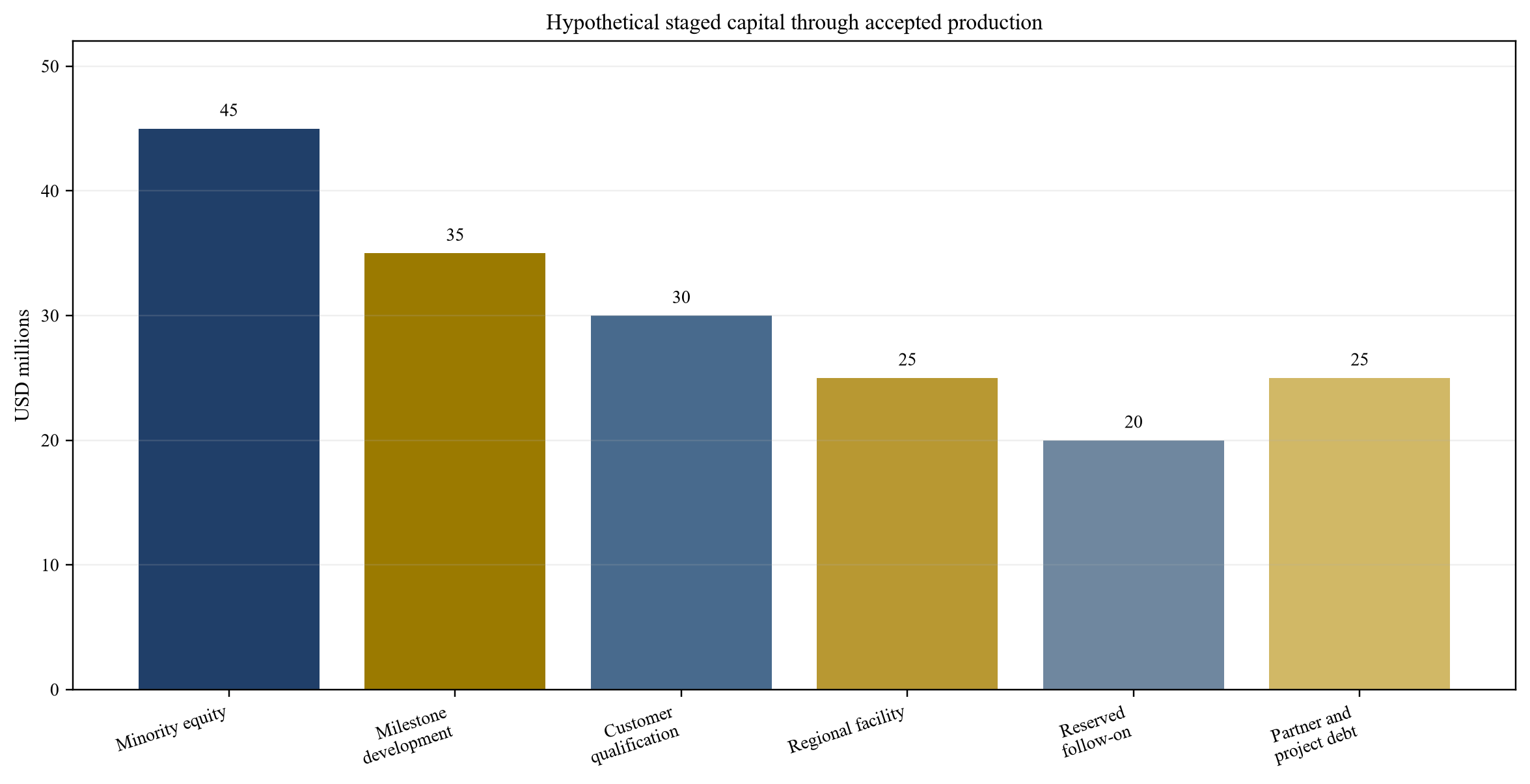
Illustrative USD millions; each source remains subject to its contractual evidence gate.
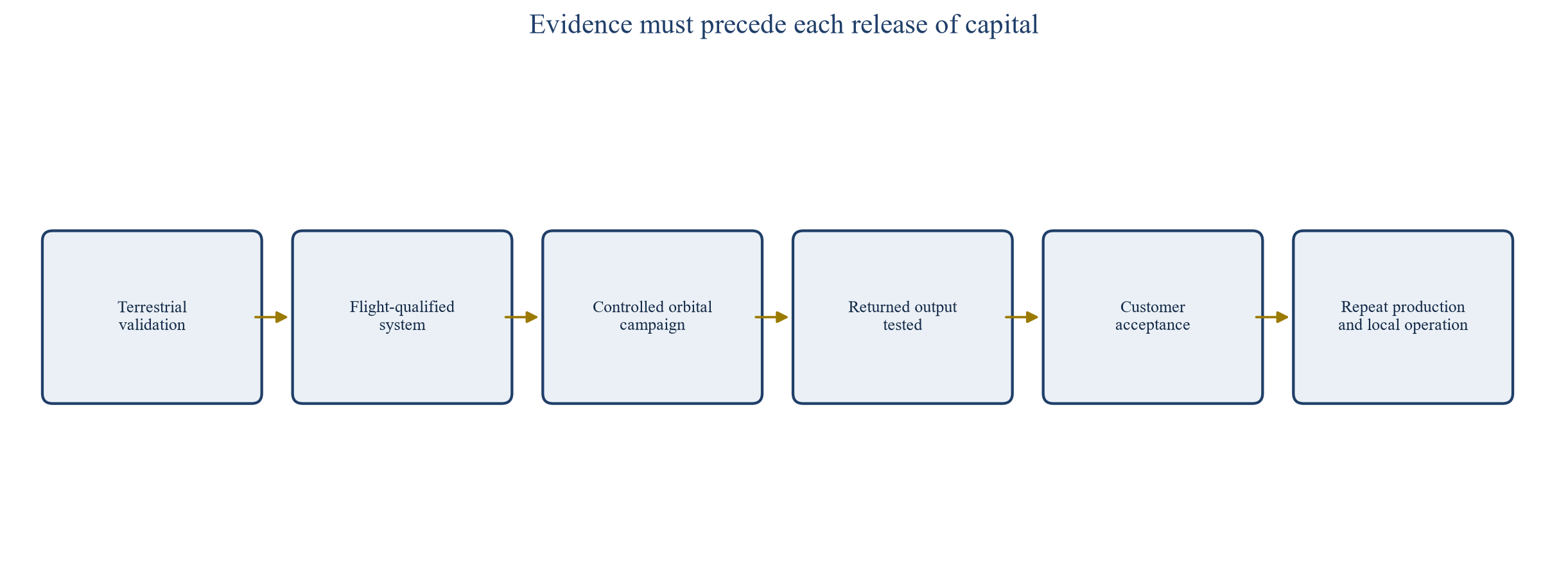
Proposed sequence from technical hypothesis to repeatable commercial and regional capability.
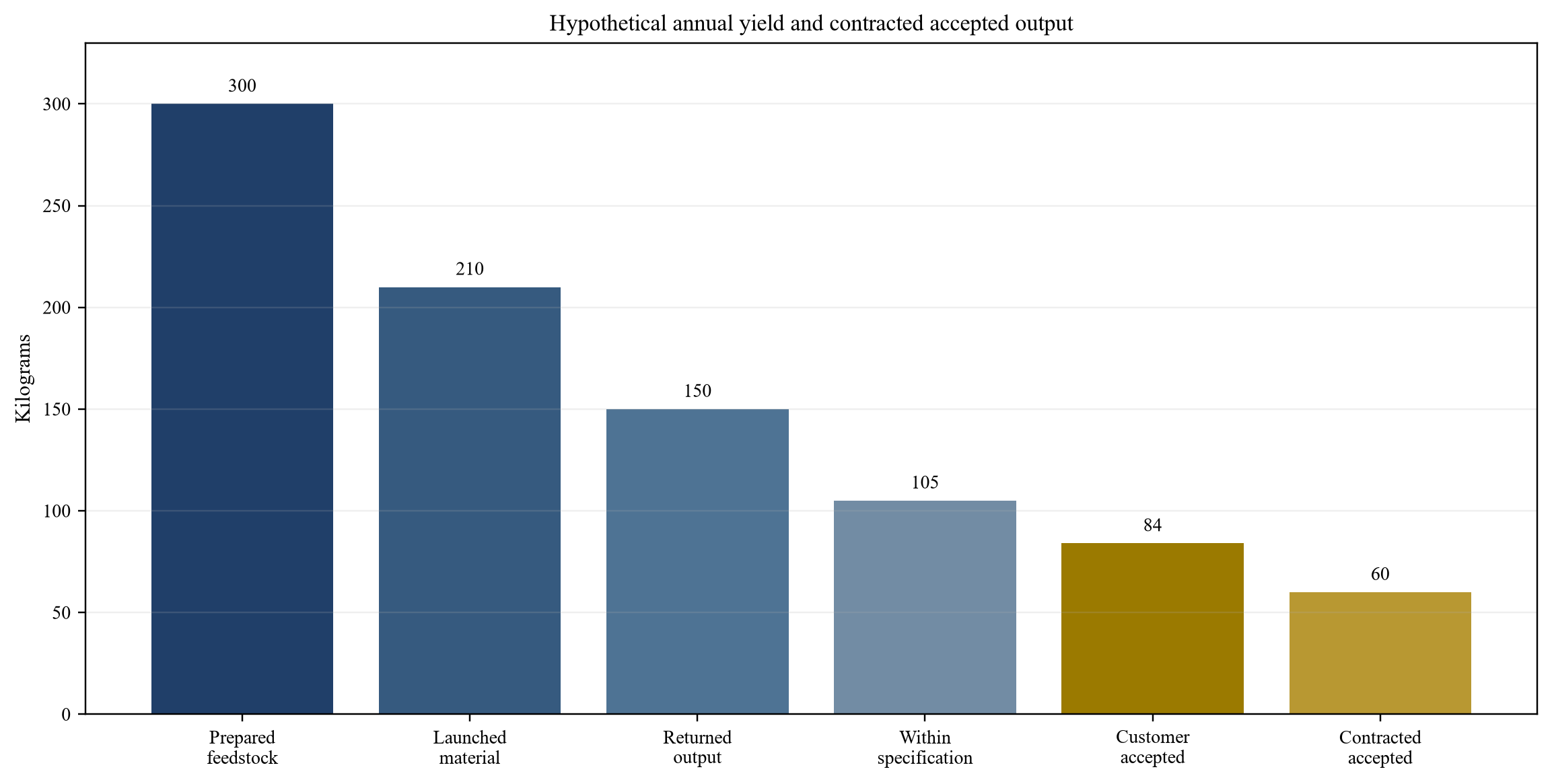
Illustrative annual kilograms after planned campaign cadence; figures are assumptions rather than observed results.
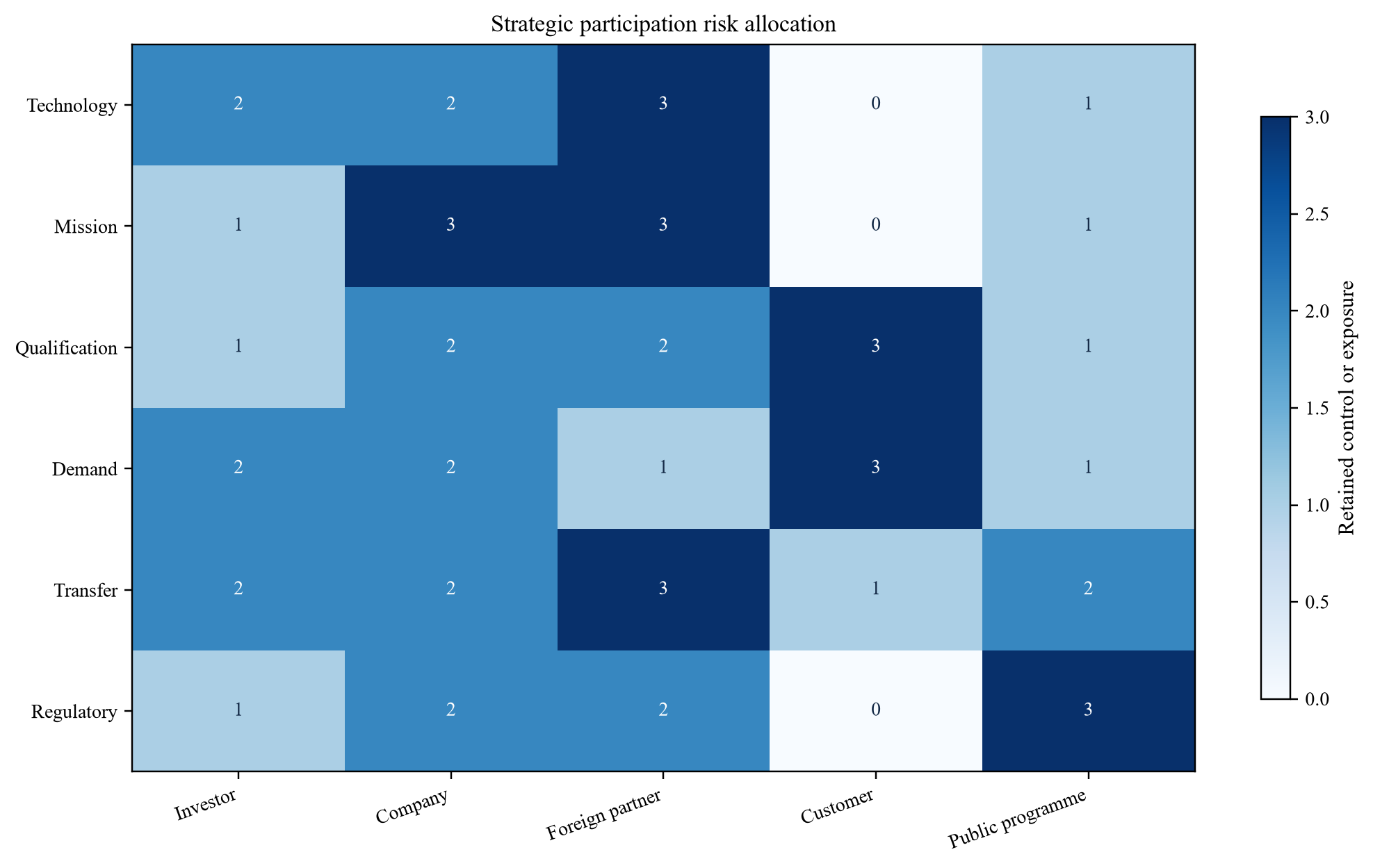
Proposed allocation; higher cells indicate greater retained control or exposure.
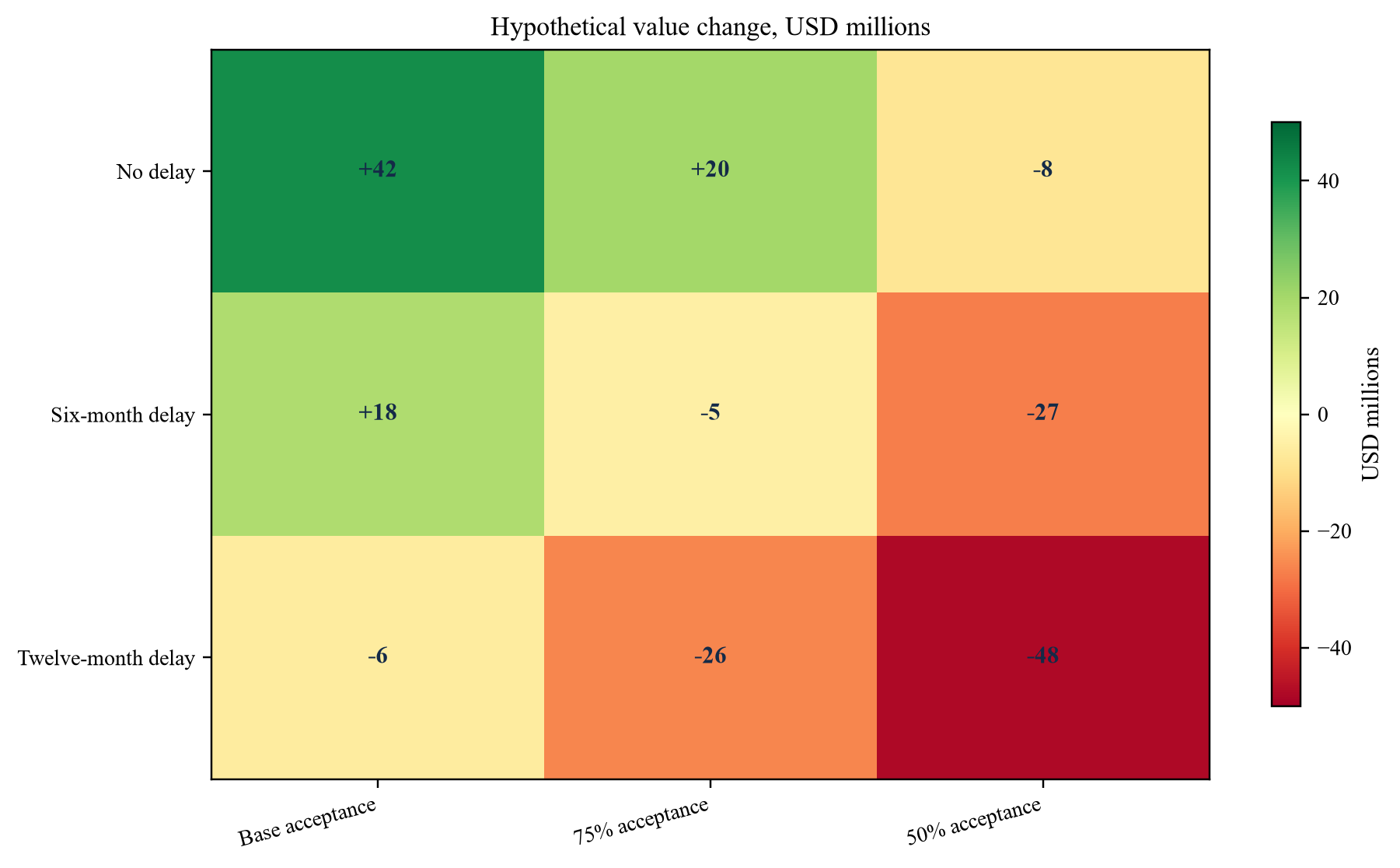
Illustrative USD millions of value change under combined accepted-yield and schedule assumptions.
| Route | Best use | Evidence gate | Principal weakness |
|---|---|---|---|
| Minority equity | Enterprise exposure and governance | Verified technology and financing plan | Limited control of capability transfer |
| Joint venture | Regional operation and customers | Usable rights, assets, people and approvals | Dependence on foreign shareholder |
| Customer development | Product-specific learning | Paid scope, test method and procurement path | Does not establish recurring demand |
| Project capital | Defined facility or repeat service | Completion tests and contracted cash | Unsuitable for early scientific risk |
| Licence and services | Accelerated regional capability | Transferable rights, training and continuity | Licensor dependence |
Proposed route-selection framework.
| Source | USDm | Release basis | Principal risk retained |
|---|---|---|---|
| Minority equity | 45 | Closing and approved first-stage plan | Technology and market uncertainty |
| Milestone development | 35 | Accepted technical and capability gates | Failed or delayed evidence |
| Customer qualification | 30 | Paid work packages and acceptance protocols | Customer scope and procurement |
| Regional facility | 25 | Site plan, utilisation and operating approvals | Underutilisation and fixed cost |
| Reserved follow-on | 20 | Two accepted evidence gates | Future funding timing |
| Partner and project debt | 25 | Contracted cash, security and completion | Repayment and continuity |
Illustrative sources; availability depends on documented conditions.
| State | Minimum evidence | Capital implication | Stop condition |
|---|---|---|---|
| Terrestrial validation | Controlled process data and independent review | Fund first flight qualification | Mechanism not reproducible |
| Flight qualification | Environmental tests, interfaces and approvals | Fund orbital campaign | Unresolved safety or integration gap |
| Returned output | Custody data and independent testing | Fund customer qualification | Output unavailable or contaminated |
| Customer acceptance | Agreed protocol and written acceptance | Fund repeat campaign | Specification or use case fails |
| Repeat production | Two accepted runs and controlled variance | Consider scale capital | Yield, cadence or cost remains unstable |
| Local operation | Accepted regional team, facility, data and rights | Release strategic facility capital | Foreign dependence remains critical |
Proposed evidence-to-capital decision record.
| Capability | Required delivery | Acceptance test | Continuity protection |
|---|---|---|---|
| Process knowledge | Recipes, controls and non-conformance history | Local team executes controlled run | Durable licence and data copy |
| Flight engineering | Interfaces, procedures and configuration records | Local team completes integration review | Transition service and replacement rights |
| Quality system | Test methods, chain of custody and release authority | Independent accepted batch record | Accredited laboratory access |
| Software and data | Source access, schemas, telemetry and audit trail | Restore and analyse a campaign dataset | Escrow, backup and cyber controls |
| Supplier network | Qualified drawings, vendors and alternates | Accepted first article and substitute test | Assignment and reprocurement rights |
| Customer qualification | Specifications, protocols and decision record | Customer signs acceptance | Direct agreement and data access |
Proposed contractual capability fields.
| Component | USDm | Evidence treatment |
|---|---|---|
| Current cash-flow value | 95 | Contracted customer work and evidenced capacity |
| Probability-weighted development options | 55 | Explicit technical and commercial gates |
| Required future capital | -38 | Funding to repeat production and working capital |
| Downside and customer obligations | -17 | Failure, suspension and remedy costs |
| Financial equity value | 95 | Cash-based investment value |
| Delivered strategic rights | 22 | Separate budget after acceptance |
| Unpriced strategic narrative | 0 | Excluded without capture evidence |
Illustrative value bridge; strategic rights remain separate from financial value.
| Dimension | Core measure | Trigger | Required decision |
|---|---|---|---|
| Technical | Accepted yield, repeatability and open failures | Material variance or failed run | Stop draw or redesign |
| Commercial | Paid qualification, contracted accepted output and collections | Customer loss or delayed budget | Resize programme |
| Capability | Independent local operation and usable rights | Continued critical foreign dependence | Withhold transfer payment |
| Financial | Cash runway, cost to next gate and contingent liabilities | Unfunded completion gap | Add support or suspend |
| Regulatory | Licences, export approvals and provider permissions | Approval delay or restriction | Change scope or jurisdiction |
| Downside | Data, assets, customer remedies and safe-suspension funding | Continuity test fails | Remediate before next draw |
Proposed quarterly decision record.
| Gate | Decision question | Minimum evidence | Failure response |
|---|---|---|---|
| Thesis | What financial and strategic outcomes are purchased? | Separate value ledgers and named owners | Reject undefined strategic claims |
| Technology | What works and at which evidence state? | Raw data, independent review and failure history | Limit capital to learning stage |
| Market | Who pays for which accepted unit? | Paid work, qualification protocol and procurement path | Exclude unsupported revenue |
| Transfer | What capability becomes usable in the GCC? | Contracted rights, assets, people and acceptance | Withhold strategic budget |
| Capital | What funds each stage and downside? | Committed sources, reserves and stop plan | Reduce scope or require support |
| Governance | Who can stop value leakage or further funding? | Board rights, information, direct access and covenants | Renegotiate control package |
| Exit | How do value and capability survive ownership change? | Transferable rights, consents and continuity | Price restriction or decline |
Proposed investment-committee minute.
Sources
- UAE Space Agency, National Space Strategy 2030 and National Space Investment Plan, 15 October 2019. Read the primary source
- UAE Space Agency, National Space Fund. Read the primary source
- UAE Space Agency, Space Economic Zones. Read the primary source
- Saudi Space Agency, About the Saudi Space Agency. Read the primary source
- NASA, What is In Space Production Applications?, 1 October 2023. Read the primary source
- NASA, What is the Commercial Low Earth Orbit Economy?, updated 10 January 2025. Read the primary source
- European Space Agency Commercialisation Gateway, ScaleUp. Read the primary source
- European Space Agency Commercialisation Gateway, Commercialisation Services. Read the primary source
- NASA, Commercial Space Frequently Asked Questions, 7 April 2024. Read the primary source
- NASA, Optical Fiber Production. Read the primary source
- European Space Agency, ESA 3D Prints First Metal Part on the International Space Station, 6 September 2024. Read the primary source
- NASA, Commercial Low Earth Orbit Development Program. Read the primary source
- UAE Space Agency, UAE Space Agency Releases Results of 2021 Space Economic Survey, 19 September 2023. Read the primary source
- UAE Space Agency, National Space Sector Policy, 7 September 2016. Read the primary source
- UAE Space Agency, Space Economy Committee Reviews Key Projects, 11 June 2023. Read the primary source
- UAE Space Agency, 90-Day Grace Period to Regularise Status of Entities Operating in the National Space Sector, 27 July 2026. Read the primary source
- United Nations Office for Outer Space Affairs, Treaty on Principles Governing the Activities of States in the Exploration and Use of Outer Space. Read the primary source
- United Nations Office for Outer Space Affairs, Status of International Agreements Relating to Activities in Outer Space. Read the primary source
- Federal Aviation Administration, Part 450 Launch and Reentry Licensing Requirements. Read the primary source
- Federal Aviation Administration, Payload Review. Read the primary source
- UK Civil Aviation Authority, Applying for a Launch or Return Operator Licence. Read the primary source
- NASA Office of Inspector General, NASA's Management of the International Space Station and Efforts to Commercialize Low Earth Orbit, 30 November 2021. Read the primary source
- U.S. Government Accountability Office, NASA Commercial Crew Program Plan Needed to Ensure Uninterrupted Access to the International Space Station, 2018. Read the primary source
- NASA, Commercial Orbital Transportation Services: A New Era in Spaceflight, 2014. Read the primary source
- European Space Agency, ESA Grows Private Investment in Europe's Space Sector, 28 January 2025. Read the primary source
- European Space Agency, Boosting European Leadership in In-Space Operations and Services, 2026. Read the primary source
- European Space Agency, Design 2 Produce. Read the primary source
- European Space Agency, Advanced Manufacturing Initiative. Read the primary source
- NASA, Advanced Manufacturing Technologies. Read the primary source
- NASA, Manufacturing and Materials. Read the primary source
