

Introduction
Construction projects generate abundant data and persistent disagreement. Photographs, drone surveys, schedules, building-information models, daily reports, quantities, variations, payment applications, cost ledgers and correspondence may describe the same work through different structures and dates. AI can help classify, reconcile and interpret these records. Acquisition value arises only when the combined workflow converts them into decisions that owners, contractors, engineers, lenders and dispute forums can examine.
GCC governments and project owners are digitising project delivery. Saudi Arabia's National Projects Platform describes a central capability for collecting reliable government-project data and supporting automated measurement and approved cost calculations [8]. Dubai Municipality has disclosed digital construction-monitoring, BIM and geographic-information initiatives [16-20]. These developments support demand for connected project information. They do not prove the economics or accuracy of any private product.
The transaction market shows strategic interest in construction workflow and field data. Autodesk acquired BuildingConnected for USD 275 million and previously acquired Assemble, PlanGrid and Pype; Procore acquired INDUS.AI and later announced an agreement to acquire DroneDeploy [31-35]. The disclosures show interest in preconstruction networks, project management, computer vision, reality capture and document automation. They are not direct valuation comparables for a GCC roll-up.
This paper is designed for strategic buyers, private-capital investors, lenders, boards and management teams evaluating construction-AI combinations. It focuses on the acquisition decision: what is being bought, which evidence supports value, how integration changes risk and when synergy may enter cash flow. It does not provide legal, engineering, accounting, tax or valuation advice.
1 State the acquisition thesis in evidence terms
The acquisition thesis should identify the project decision expected to improve after closing. Examples include verifying installed quantities, detecting schedule divergence, forecasting cost to complete, substantiating an extension-of-time claim, reconciling variation exposure or accelerating an accepted payment certificate. A label such as construction AI does not define the asset. Each decision uses different records, contractual authority and tolerances.
The thesis should name the target asset, buyer contribution and cash mechanism. The target asset may be a reality-capture network, labelled progress corpus, schedule engine, claims graph, cost-control platform, common data environment, field distribution channel or specialist implementation team. The buyer may contribute installed customers, tender access, project data, integrations, balance-sheet capacity or a larger workflow. Value may arise through retention, cross-sell, reduced rework, lower claims leakage, faster certification or improved forecast reliability.
Every mechanism needs an owner, baseline, timing, continuing cost and failure condition. A claim that the combination will automate progress measurement should specify the work packages, capture method, tolerance, approval route and contractual use. A claim that it will improve claims outcomes should identify which notices, cause-and-effect records, programme analyses and quantum calculations are affected. The buyer should assign no value to an output that cannot be traced to authorised source records and accepted by the responsible decision maker.
| Value claim | Required evidence | Decision question | Principal risk |
|---|---|---|---|
| controlled workflow | process maps telemetry accepted outputs and systems of record | does the target control a complete valuable task | feature use without workflow ownership |
| defensible project evidence | source lineage versions transformations review and retention | can a reviewer reproduce the material conclusion | plausible output without sufficient evidence |
| contractual usefulness | authority notices approvals and customer procedures | can the output support certification or claim decisions | insight lacks contractual standing |
| customer depth | cohorts project use renewal and migration behaviour | will customers remain through integration | contract renewal hides shallow adoption |
| data and model rights | provenance licences purposes locations and change-of-control terms | can the combined group continue each use | rights narrow or terminate after closing |
| sustainable economics | full model data assurance security support and integration cost | what recurring cash remains after control cost | reported margin omits essential operations |
Proposed structure; target-specific legal regulatory engineering technical commercial accounting cyber and project review is required.
2 Map the project evidence chain
The evidence chain starts with a physical event and ends with an authorised commercial outcome. Between those points sit capture, identity, location, time, work-package classification, quantity, quality, schedule status, cost code, contract entitlement, review, approval and retention. The acquisition team should map these stages for every material product and customer cohort.
The map should distinguish observations, management records, derived estimates and authorised decisions. A geotagged image can be an observation. An approved daily report is a management record. A computer-vision completion percentage is a derived estimate. A certified payment is an authorised decision. Combining these layers without lineage can make an efficient product difficult to defend when progress or entitlement is disputed.
Systems of record and systems of action should be identified separately. The common data environment may own documents and models. The scheduling system may own the accepted programme. The ERP system may own commitments and actual cost. The contract-management platform may own notices and variations. An AI layer may orchestrate analysis without controlling any authoritative record. Transferable value depends on durable access, customer trust and contractual rights across these systems.
Telemetry should connect the source event, data version, model or rule, human reviewer, exception, correction, approved output, elapsed time, project result, invoice and renewal. Image counts, prompts and generated text provide weak evidence of value. Accepted measurements, controlled decisions, reduced rework, improved forecast accuracy and collected cash provide stronger evidence.
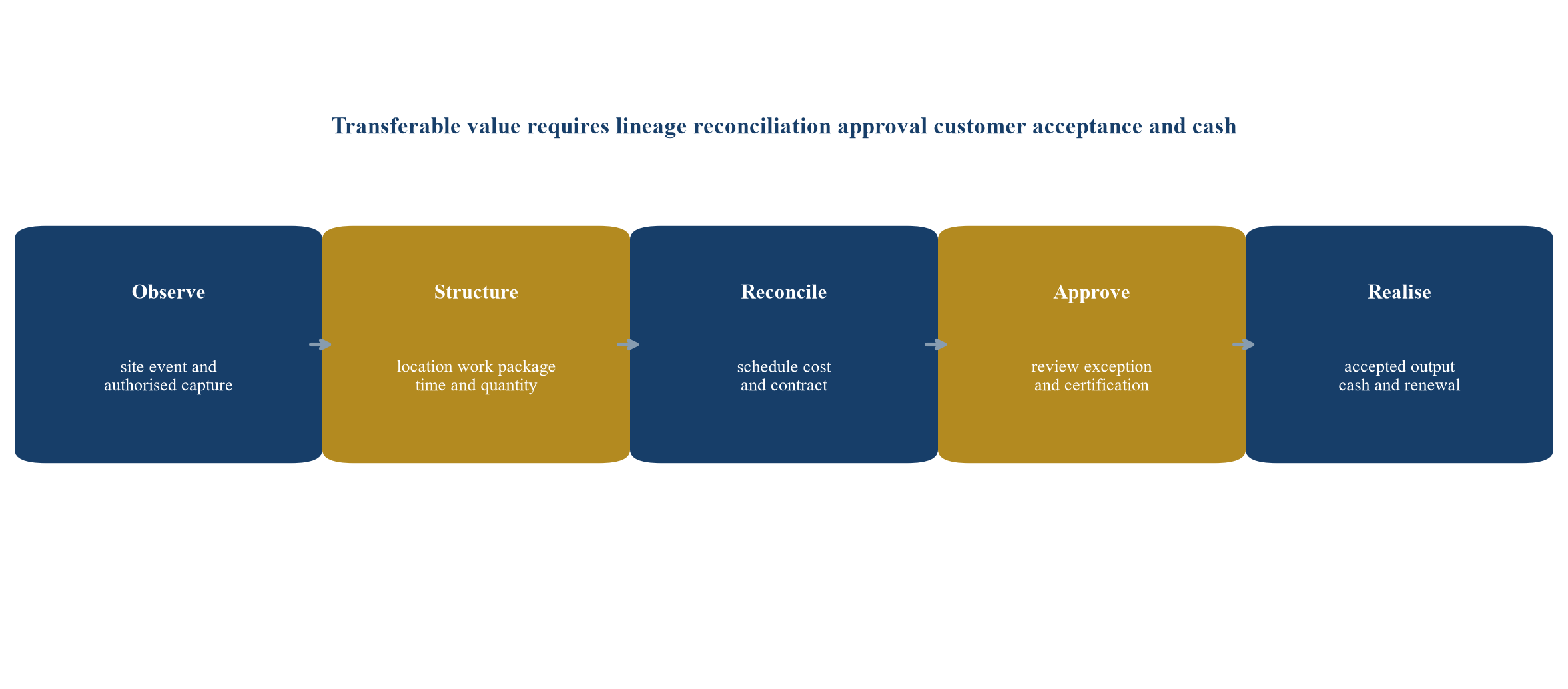
Proposed acquisition map; actual controls should reflect the contract customer systems and approval authority.
3 Test workflow ownership
Workflow ownership means that customers repeatedly enter a valuable process through the product, complete material steps inside it and rely on retained evidence when the process is reviewed. A target can have high user activity without ownership when customers export data to spreadsheets, depend on consultants to finish the work or treat the tool as a narrow drafting assistant.
The buyer should determine which system controls entity identity, work-breakdown and cost-code structure, source documents, project permissions, version history, exception resolution, final approval and record retention. It should trace where users start and finish, which integrations are necessary and what happens if one supplier withdraws an interface. A connector can be commercially valuable, but its bargaining power differs from that of a system of record or a system holding the accepted workpaper.
Workflow depth can be measured through the proportion of eligible entities or projects using the product, share of process steps completed, exception-resolution rate, reviewer intervention, acceptance after review, persistence of retained context and switching effort. These measures should be analysed by customer type, workflow and implementation cohort. Average usage can conceal a small group of embedded customers and a larger group of trials.
The acquisition model should distinguish licensed access from active workflow control. Contracted annual recurring revenue can continue during a period of low use. It can therefore lag deterioration in product acceptance. Cohort evidence should connect depth, renewal, expansion, support cost and collected cash.
4 Define authority and accountability
Authority in construction is distributed. The contractor records and proposes; the engineer or contract administrator may review or certify; the employer decides reserved matters; the lender's technical adviser may test drawdown evidence; and dispute forums may later examine the record. An AI product does not inherit any of these authorities.
The diligence team should create a responsibility map covering the product provider, customer, contractor, consultant, certifier, project director, data owner and outsourced services. For each material action, the map should identify who captures, configures, validates, reviews, approves, overrides, notifies and remediates it. A human-review label has limited value unless the reviewer has the evidence, competence, time and contractual authority to challenge the result.
FIDIC materials emphasise records and contract administration in claims practice [3-5]. ISO 19650 provides a framework for managing information over the asset life cycle, including the common data environment and information requirements [6-7]. These frameworks reinforce a transaction principle: the product should preserve the status, origin and approval of information rather than flatten every record into an undifferentiated data lake.
| Decision | Product provider | Project organisation | Authorised decision maker | Required record |
|---|---|---|---|---|
| approve use case | disclose capability limits and evidence | set process and risk acceptance | confirm contractual suitability | approval scope and conditions |
| validate output | maintain tests versions and monitoring | provide representative project cases | accept tolerance and review method | validation results and exceptions |
| configure workflow | control models rules and permissions | approve data and process configuration | confirm delegated authorities | configuration and change history |
| review result | expose sources limitations and confidence | provide trained review process | exercise judgement and approve outcome | review corrections and sign-off |
| manage change | notify and retest material changes | approve deployment timing | reassess reliance and notice effects | release record and renewed approval |
Proposed allocation; exact responsibilities depend on the contract procurement route governing law and customer procedure.
5 Establish the project-evidence threshold
Project evidence should be sufficient for the decision it supports. A progress dashboard used for internal coordination can tolerate a different error profile from a quantity used in a payment certificate or a record relied upon in a delay claim. Diligence should classify outputs by consequence before testing accuracy.
The buyer should avoid treating a demonstration as proof. Demonstrations often use curated data, known locations and complete records. Diligence should test representative projects, incomplete imagery, changed design, hidden work, night conditions, multiple subcontractors, revised programmes, disputed variations and inconsistent cost codes. The record should preserve inputs, transformations, exceptions, human work and final disposition so that failures can be assigned to capture, data, integration, model, configuration or review.
Evidence quality has several dimensions. Provenance establishes origin. Integrity addresses unauthorised change. Completeness addresses whether the relevant population was captured. Accuracy addresses faithful measurement or transformation. Relevance addresses the contract or management decision. Reproducibility allows an independent reviewer to reach the same material basis. Retention preserves the record for later challenge.
Where a model supports certification, entitlement or forecast, the reviewer needs more than a confidence score. The underlying record, measurement method, version, tolerance, exception logic, reviewer action and approval must remain available. A buyer should treat missing lineage as a control gap and a valuation issue.
6 Validate models in the actual workflow
Model validation should match the consequence of the task. An extraction model that proposes payment certificate fields presents a different risk from an agent that selects project-control procedures or drafts a conclusion. The validation design should cover intended use, excluded use, data representativeness, benchmark performance, error severity, calibration, robustness, security, human review and monitoring.
The target should maintain a controlled inventory of models, prompts, rules, external services and versions. Each entry should have an owner, approved purpose, validation record, data dependency, change threshold, monitoring metric and retirement process. Undocumented experimentation within customer work creates a quality and transaction risk because the buyer cannot establish which system produced which evidence.
Aggregate accuracy can conceal material failure. A model may achieve high overall extraction accuracy while performing poorly on a rare field that controls payment or commercial treatment. The test set should therefore weight errors by financial and professional consequence. False negatives, false positives and abstentions should be reported separately. Performance should be segmented by customer, document type, contract and project context, language, period and workflow stage where relevant.
The buyer should test reproducibility across versions. If the same evidence can yield a materially different output after an unrecorded model update, the workpaper becomes difficult to reperform. Version freezing, retained inputs, source links and documented review can preserve the decision record while the live product continues to evolve.
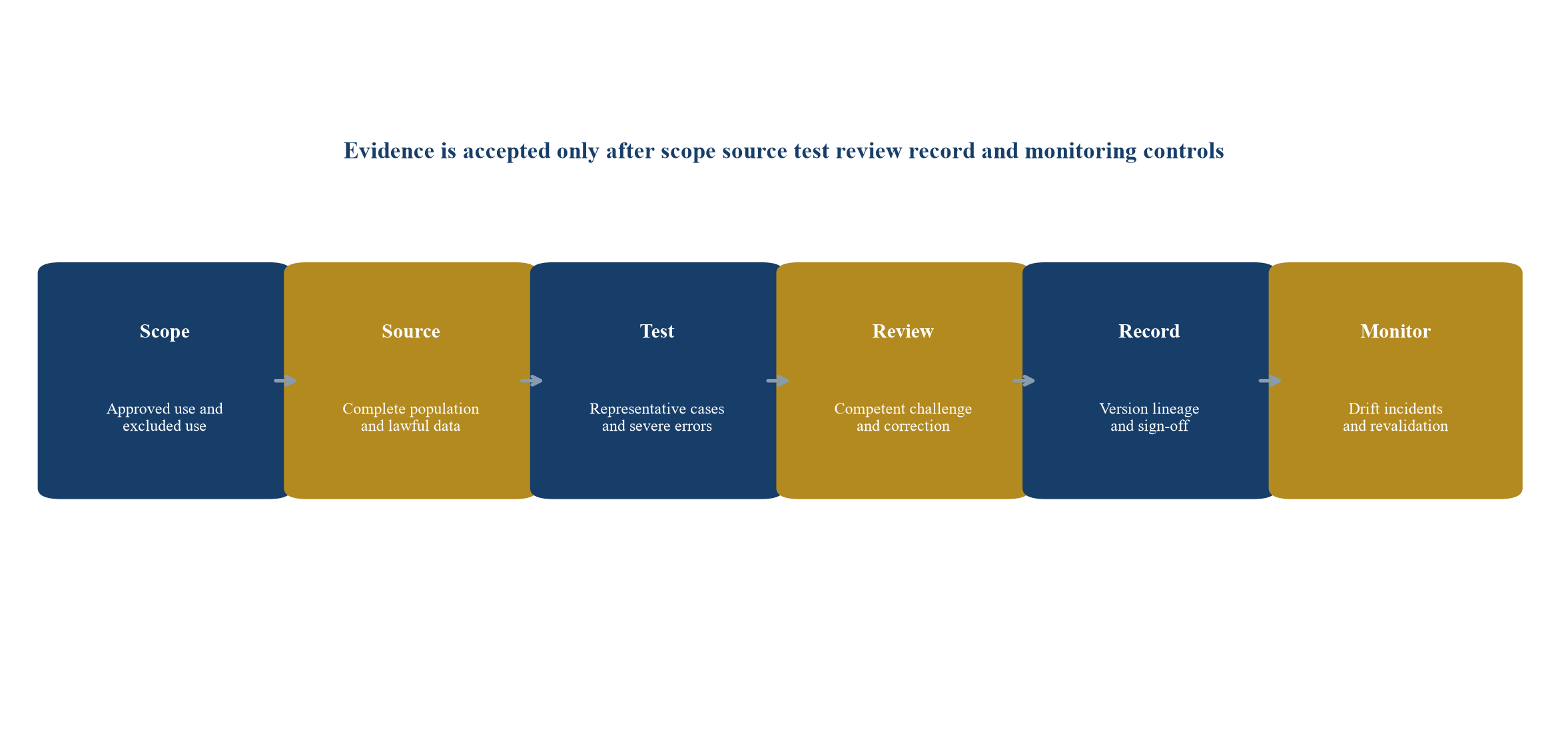
Proposed control sequence; acceptance thresholds should be defined for the specific project decision and contractual use.
7 Preserve contemporary records and reproducibility
Claims and payment disputes are frequently decided through records created during delivery. FIDIC guidance identifies the importance of contemporary records in substantiating claims [3-5]. An acquisition target that organises notices, programme versions, instructions, quantities, resources, photographs and cost effects can occupy a valuable workflow. Its value depends on authenticity, completeness and retrieval under challenge.
Documentation should enable an experienced reviewer to understand the event, source record, transformation, exception, human work and conclusion. The combined system should preserve hashes or equivalent integrity controls, access history, version status, timestamps, location, authorship and approval. It should distinguish a contemporaneous source from a later narrative assembled for a claim.
Reproducibility does not require every probabilistic output to repeat word for word. It requires the material basis of the decision to remain available and understandable. The buyer should select certified progress items, rejected variations and closed claims, then trace each back to source evidence and recreate the calculations that mattered. Failed traces should become quantified remediation items.
8 Secure data rights privacy and confidentiality
Construction data can include site imagery, worker identity, geolocation, security layouts, critical-infrastructure details, design intellectual property, tender pricing, supplier terms and privileged dispute material. The acquisition team should trace each route through capture, storage, training, inference, support, analytics, backup, export and deletion. It should identify the controller or equivalent responsible entity, purpose, location, retention and subprocessor.
Saudi Arabia's Personal Data Protection Law framework and the UAE's federal data-protection regime require current jurisdiction-specific review [12-14]. Critical and government projects can also impose contractual localisation, security-clearance or access constraints beyond general privacy law. The buyer should test whether customer data was used to train shared models, whether licences permit change of control, and whether derived features can be separated when a customer leaves.
Security architecture should be tested at project and group levels. A roll-up can connect previously separated customer environments and create a wider attack surface. Minimum evidence includes tenant separation, privileged-access controls, encryption, secrets management, model and data logging, incident response, supplier assurance, vulnerability management and recoverable backups.
| Data class | Required evidence | Principal risk | Transaction response |
|---|---|---|---|
| site imagery and scans | capture authority location purpose and retention | surveillance or critical-site exposure | restrict purpose location access and model use |
| BIM and design files | ownership licences revisions and export rights | design rights or versions cannot transfer | obtain consents preserve versions and limit use |
| schedules and claims | contract status privilege notices and authorship | draft analysis presented as authoritative fact | preserve status and segregate privileged work |
| cost and supplier data | confidentiality purpose and change-of-control terms | combined use breaches customer or supplier terms | consent ring-fence or exclude from model training |
| telemetry and support logs | minimisation roles tickets analytics and deletion | support access exposes customer information | redesign roles minimise and review access |
Proposed register; current legal contractual cyber and project-specific review is required.
9 Connect project assurance to product operation
A construction-AI product becomes part of the customer's project-control environment. Its operating model should therefore include approved use cases, representative validation, release control, incident handling, monitoring and remediation. Technology can support assurance; customer governance and contractual authority still determine how an output is used.
The buyer should inspect the target's quality loop. Product incidents, rejected outputs, customer complaints, drift, integration failures and disputed uses should feed root-cause analysis, corrective action and retesting. Repeated manual workarounds indicate a workflow-design or data-model problem. A low recorded-incident count can reflect weak detection, so diligence should reconcile tickets, logs, concessions and customer interviews.
Recurring assurance cost belongs in sustainable earnings. It includes data-quality operations, representative test sets, model and rules validation, release evidence, customer-specific configuration review, monitoring, support and incident response. Removing these functions to achieve a synergy target can weaken the evidence chain on which revenue depends.
10 Test customer acceptance and cohort economics
Customer retention should be tested below the contract level. The acquisition team should build cohorts by product, workflow, customer type, implementation period and depth of use. For each cohort it should track contracted revenue, active entities or projects, accepted outputs, seat depth, support hours, implementation cost, renewal, expansion, contraction and cash collection.
A product embedded in monthly progress cycle or final account may show seasonal activity. The analysis should account for workflow frequency rather than treating quiet periods as churn. It should also distinguish use driven by a small internal champion from institutional adoption supported by policy, training and process ownership.
Customer references should address evidence and accountability. Questions should cover which tasks are completed, how outputs are reviewed, where errors occur, what records are retained, which integrations are critical, how updates are approved and what would cause the customer to leave. Reference selection should include recent implementations, mature users, reduced projects and customers that declined expansion.
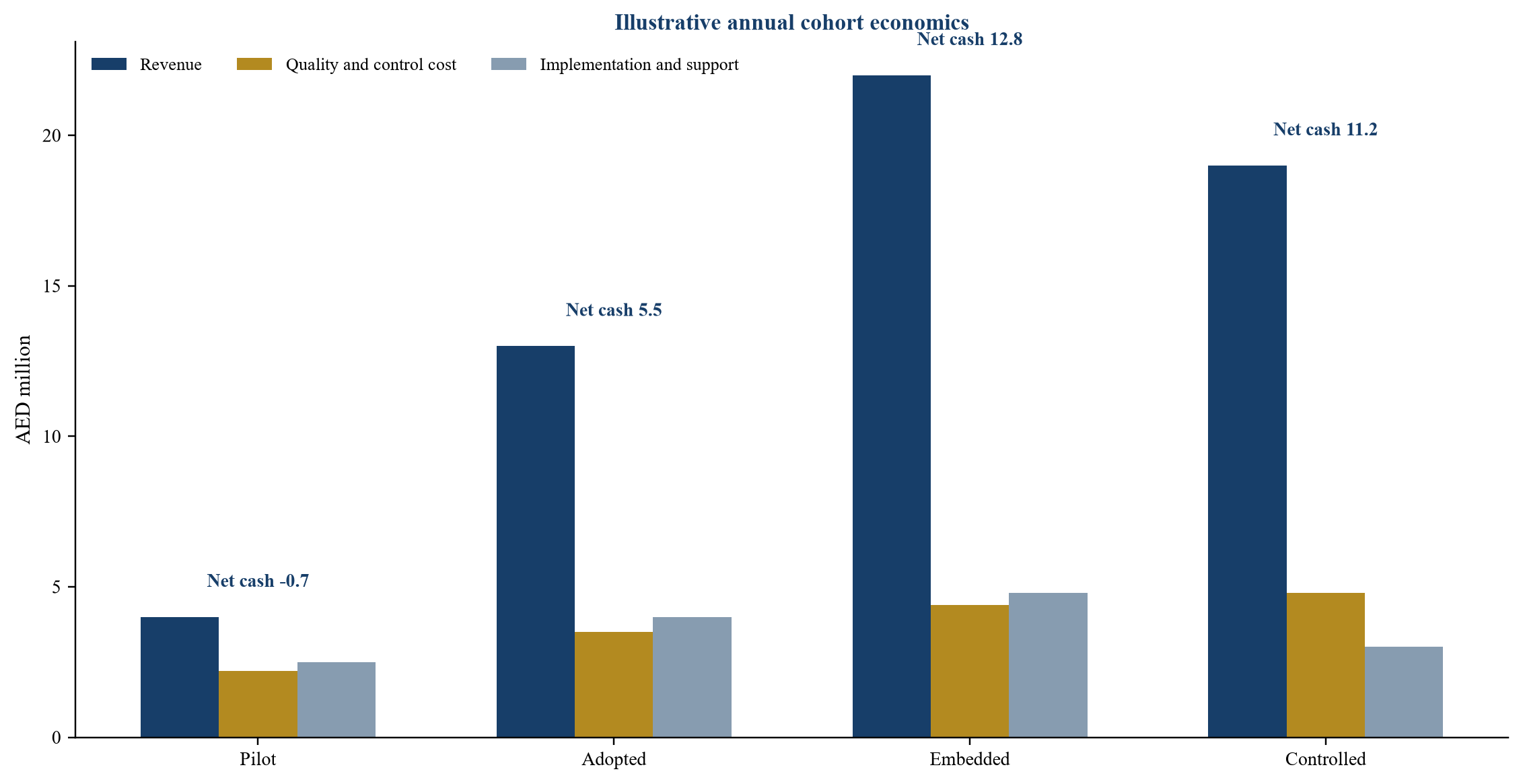
Management assumptions used solely to demonstrate cohort analysis; figures do not describe a company or market.
11 Rebuild sustainable earnings
Reported EBITDA should be rebuilt from the operating requirements of accepted workflows. Adjustments may include capitalised development, founder compensation, data licensing, cloud and model charges, security, validation, customer implementation, specialist support, incident response, regulatory change and product maintenance. The purpose is to identify the recurring cash cost of delivering the product within its intended control environment.
Development accounting needs particular attention. Capitalisation can make a product company appear more profitable while current cash funds continuing development. The buyer should analyse engineering spend by maintenance, control remediation, customer implementation, new capability and research. It should assess useful lives, impairment indicators and whether acquired technology will be replaced during integration.
Revenue quality should be tested against acceptance. Multi-year contracts and upfront billing can support reported recurring revenue while workflow depth weakens. The buyer should connect revenue to active use, accepted output, support burden, renewal decision and cash. Services hidden in software gross margin should be separated where customer-specific work is necessary to make the product function.
| Item | Amount | Diligence treatment |
|---|---|---|
| Reported EBITDA | 15.0 | starting point |
| capitalised development normalisation | -2.0 | recurring cash development required for current product |
| model evaluation and evidence control | -1.2 | recurring regulated-workflow cost |
| data and technical content | -0.8 | sustainable licensing and provenance cost |
| cyber privacy and customer assurance | -0.7 | recurring control operation |
| implementation and specialist support | -1.0 | cost required for accepted customer outcomes |
| key-person and governance normalisation | -0.6 | replacement and oversight capacity |
| Sustainable EBITDA | 8.7 | basis for illustrative valuation |
AED millions; management assumptions used solely to demonstrate the framework.
12 Convert synergy into evidence-weighted cash
Synergy should be traced from commercial claim to recurring cash. Cross-sell requires eligible customers, permission to contact, product fit, integration, trained sales teams, implemented workflow, accepted output, renewal and collection. Cost savings require an activity that can genuinely stop without weakening product quality or customer service.
The buyer should classify synergy as committed, evidenced, contingent or aspirational. Committed synergy is supported by approved actions and enforceable arrangements. Evidenced synergy has representative customer or operating proof. Contingent synergy depends on a defined event such as successful validation. Aspirational synergy lacks sufficient proof and should remain outside the base valuation.
Integration costs should include continuing expenses, not only one-time projects. A combined platform may need additional model evaluation, interface support, data-rights work, security monitoring, customer migration, professional review and release management. Where those activities continue, they reduce recurring synergy.
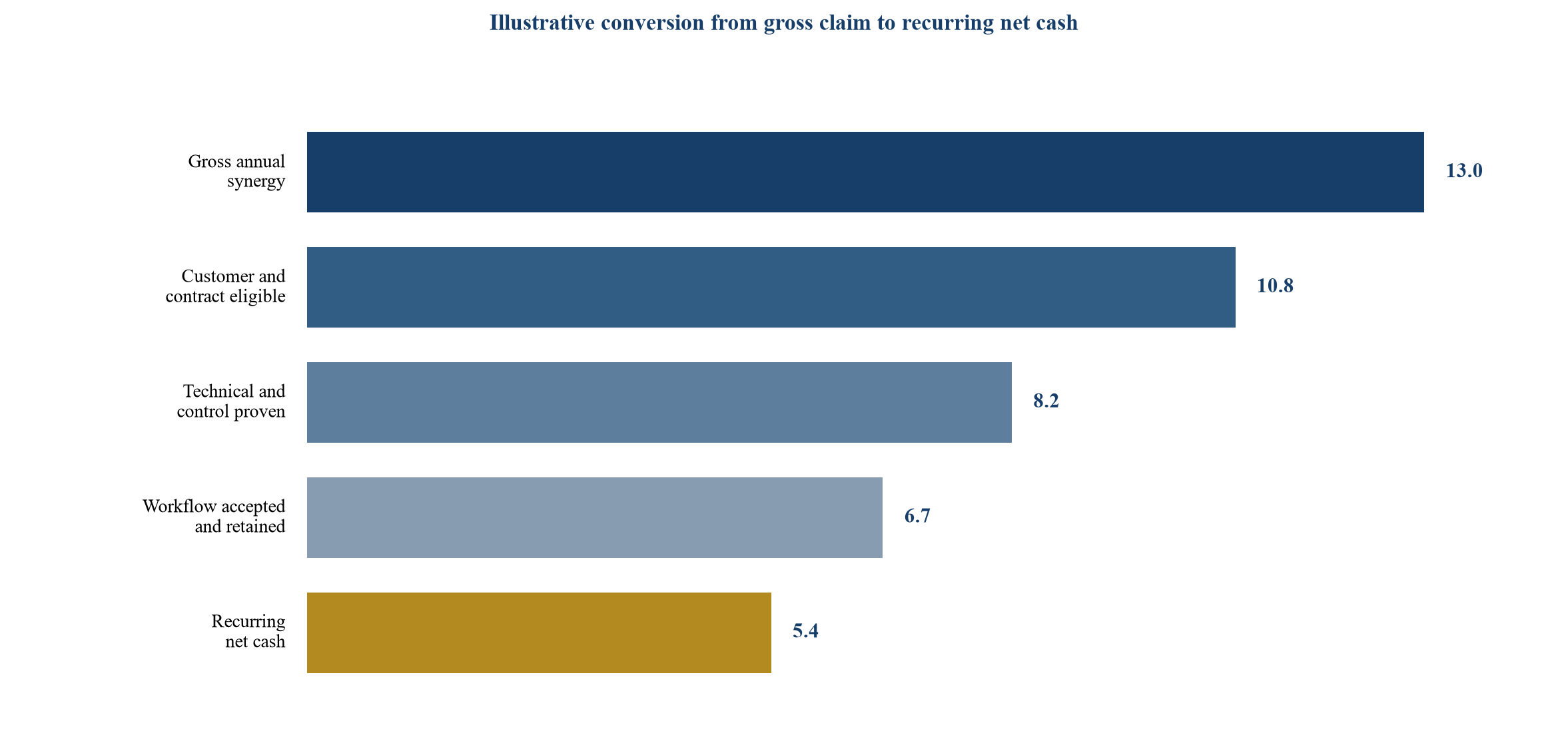
AED millions; management assumptions used solely to demonstrate the framework.
13 Build the valuation bridge
The valuation bridge should begin with sustainable earnings. A multiple should reflect growth, retention, workflow depth, concentration, control maturity, technical dependence and expected capital requirements. A high growth rate does not compensate automatically for weak evidence or customer acceptance.
Synergy value should be probability weighted and discounted for timing, cost and tax. Integration and control risk should be deducted separately so that the investment committee can see which assumptions create the proposed price. Double counting is a recurring danger: the same workflow position can influence the multiple, synergy and terminal value.
The hypothetical case begins with AED 8.7 million of sustainable EBITDA and a thirteen-times multiple, producing AED 113 million. It adds AED 95 million of evidence-weighted synergy present value. It deducts AED 12 million for integration and migration, AED 8 million for control remediation and historical exposure, AED 6 million for customer and interoperability risk, and AED 5 million for key-person and execution risk. The resulting illustrative value is AED 480 million.
| Component | Amount | Evidence requirement |
|---|---|---|
| sustainable EBITDA | 8.7 | rebuilt recurring cash earnings |
| illustrative multiple | 13.0x | cohort quality workflow depth and risk |
| standalone enterprise value | 113.1 | multiplication before transaction adjustments |
| evidence-weighted synergy present value | 18.0 | customer technical acceptance and cash proof |
| integration and migration deduction | -12.0 | executable plan and cost estimate |
| control and historical exposure deduction | -8.0 | validation documentation and remediation evidence |
| customer and interoperability deduction | -6.0 | retention and ecosystem evidence |
| key-person and execution deduction | -5.1 | continuity plan and delivery capacity |
| Illustrative enterprise value | 100.0 | rounded framework output |
AED millions; management assumptions used solely to demonstrate the framework and not an opinion of value.
14 Test competition interoperability and portability
Construction software markets contain switching costs, project-specific history, network effects and integration dependencies. The buyer should assess whether the combination could restrict interfaces, bundle products, degrade export or make it harder for customers to preserve their project record. This analysis matters commercially and may also matter under the relevant GCC competition regimes.
Roll-up strategy can create value by connecting previously fragmented records. It can also destroy value if customers view the buyer as controlling their evidence or forcing migration during delivery. The integration plan should provide usable export, stable interfaces, documented schemas and continuity through project close-out and claims periods. Product retirement should follow objective evidence that the replacement preserves records, functions and contractual status.
The buyer should map overlapping products, complementary datasets, customer segments, alternatives and potential foreclosure mechanisms. Internal documents should describe the commercial thesis accurately. Competition and legal advice should be based on current transaction facts and applicable regimes [15].
15 Assess technical and vendor dependence
An AI product may depend on external models, cloud infrastructure, document-processing services, construction-data providers, identity platforms and customer-system interfaces. The buyer should map each dependency to contractual rights, technical substitutability, cost, concentration, service level, security and change notification.
Model dependence requires more than a supplier list. The team should determine whether performance arises from proprietary data, prompts, orchestration, retrieval, workflow design or the underlying foundation model. It should test the time and cost to substitute the model while preserving accepted outputs. A target whose differentiation disappears when a supplier changes price or policy may have limited durable value.
Software architecture should support evidence isolation. Development, test and production environments should be separated. Customer data should not enter model development without rights and controls. Logging should be sufficient for incident investigation while minimising sensitive data. Release management should identify which customer workflows are affected by a change.
Cyber diligence should cover identity, tenant isolation, encryption, secrets, software supply chain, vulnerability management, incident response, backup, recovery and third-party access. A penetration test is one input. The buyer also needs evidence that the control environment operates over time.
16 Analyse people and project and commercial knowledge
Construction-AI products often depend on a small group who understand both the software and the project workflow. The acquisition team should identify product architects, domain leaders, data stewards, security owners, implementation specialists and customer champions. It should assess responsibilities, decision rights, documented knowledge, succession and retention.
Domain expertise should be tested through product evidence rather than biography alone. The team should inspect how engineering, project-control and contract requirements enter product design, validation cases, release approval, training and customer support. A product that depends on undocumented judgement by one founder may face a larger integration risk than its headcount suggests.
The buyer should also examine organisational incentives. Sales targets can encourage claims beyond validated use. Engineering incentives can favour release speed over evidence. Professional staff may lack authority to stop deployment. A durable operating model gives quality, security and data owners clear escalation and veto rights within defined thresholds.
Retention arrangements should align with evidence transfer, customer continuity and control remediation. Cash or equity retention alone does not document the workflow. The integration plan should require operating manuals, validation assets, customer histories, dependency maps and trained successors.
17 Structure transaction protection
Deal terms should follow identified evidence gaps. Representations can address data rights, model and software ownership, compliance, customer contracts, cyber incidents, accuracy claims, validation records and professional-use limitations. Disclosure should be specific enough to allow the buyer to price known matters.
Closing conditions may be appropriate where a material right, customer consent, technical remediation or regulatory outcome is required for the thesis. A pre-closing covenant can preserve evidence, restrict material model changes and require ordinary-course support. The buyer should avoid a condition that cannot be objectively tested.
Escrow, indemnity or contingent consideration can address historical exposure and uncertain value. Earn-out metrics should follow accepted workflow and cash rather than prompt volume or unreviewed output. Examples include retained controlled customers, accepted workflow volume, validated performance within defined error thresholds and collected recurring revenue after support cost.
| Evidence gap | Value consequence | Potential transaction response | Post-close gate |
|---|---|---|---|
| uncertain data or content rights | workflow cannot lawfully continue | consent condition covenant indemnity or exclusion | verified rights inventory |
| incomplete model validation | reliance and retention uncertain | price deferral and validation milestone | representative test passed |
| weak historical documentation | inspection or claim exposure | escrow indemnity and remediation reserve | affected cohorts remediated |
| customer concentration | cash exposed to limited decisions | retention condition earn-out or price adjustment | named cohort renewal and collection |
| key-person dependence | product and customer continuity risk | retention succession and knowledge-transfer covenant | trained successor operating independently |
| uncertain integration | synergy timing and cost risk | staged consideration and board release gates | accepted parallel migration |
Proposed framework; legal drafting and allocation depend on the transaction and governing law.
18 Integrate by workflow cohort
Integration should proceed by workflow and cohort rather than by legal-entity deadline. The sequence should preserve source data, versions, validation evidence, customer configuration and project records before any system change. Each cohort should move only after technical performance, evidence continuity, authorised approval, customer acceptance and support readiness have been demonstrated.
Parallel operation can compare old and new results for representative cases. Differences should be investigated and classified. A favourable average does not justify migration if severe errors remain in material edge cases. The decision record should state thresholds, exceptions, residual risk and the person authorised to proceed.
Product retirement should be evidence driven. The combined company may seek to reduce duplicate systems. Retirement can create value when workflows are genuinely substitutable and customers accept the replacement. It can destroy value when a product retains unique integrations, evidence history or professional trust.
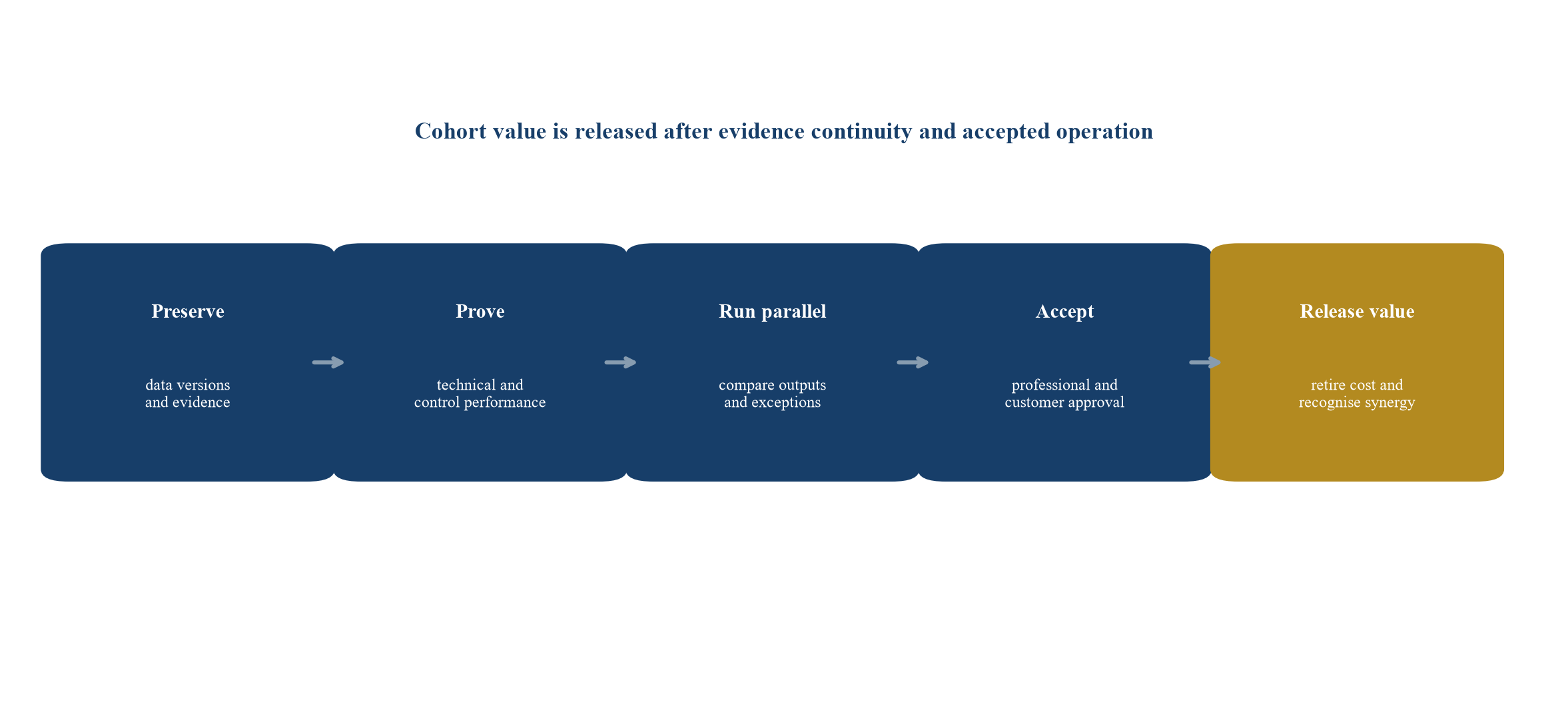
Proposed sequence; gate criteria require target-specific technical professional contractual and customer evidence.
19 Govern the first one hundred days
The first one hundred days should protect evidence and stabilise accountability. The buyer should freeze deletion, unrecorded model changes and uncontrolled data movement at closing. It should confirm system owners, incident routes, customer commitments and release authority. A controlled freeze should still allow necessary security and service fixes through documented approval.
During the first thirty days, the combined group should reconcile the model inventory, data rights, critical dependencies, customer workflows, open incidents and validation records. It should identify gaps that affect active regulated work and assign remediation owners. Customer communication should be accurate and coordinated with contractual obligations.
Days thirty to sixty should focus on representative revalidation, access review, evidence export, continuity testing and integration design. Days sixty to one hundred should complete priority remediation, approve cohort migration pilots and establish the recurring board dashboard. Synergy recognition should follow evidence rather than the passage of time.
| Period | Required action | Evidence gate | Board decision |
|---|---|---|---|
| day 0 to 10 | preserve data models versions contracts and workpapers | verified preservation and ownership | authorise controlled operation |
| day 10 to 30 | reconcile inventories incidents rights and dependencies | complete risk register and accountable owners | set remediation priority and reserve |
| day 30 to 60 | revalidate priority workflows and access controls | representative tests and exception resolution | approve limited pilot scope |
| day 60 to 80 | run parallel cohort migration and customer acceptance | evidence continuity and accepted outcomes | approve staged migration |
| day 80 to 100 | establish monitoring reporting and value gates | dashboard baseline and control assurance | release evidenced synergy only |
Proposed operating sequence; timing should reflect transaction risk and customer commitments.
20 Use a board decision scorecard
The board should receive a compact scorecard linked to source evidence. Suggested dimensions are workflow ownership, evidence reproducibility, project accountability, data rights, customer depth, sustainable earnings, technical resilience and integration readiness. Each score should have an owner, threshold, evidence date and unresolved exception.
The scorecard should separate current condition from planned remediation. A strong roadmap does not change the condition at signing. The board should see the cash, time and dependency required to move from current to target state. It should also see which valuation components depend on that movement.
Traffic-light labels need defined criteria. A green evidence-chain score could require representative end-to-end reproduction, version retention, accepted reviewer output and no unresolved severe exception. An amber score might permit a bounded gap with funded remediation and no active customer impact. Red should identify a condition incompatible with the intended use or transaction thesis.
The final decision record should state the approved price range, downside, funding, conditions, reserved matters, value-release gates and reasons. It should identify which claims remain management assumptions. This record supports disciplined ownership after closing.
21 Assess fraud anomaly and synthetic-evidence risk
Anomaly tools can help identify duplicate invoices, improbable quantities, unusual production rates, changed timestamps, suspicious access or inconsistent progress. Their transaction risk lies in false confidence, weak explainability and incomplete investigation. A model score does not establish fraud or error.
The buyer should test population completeness, features, benchmark cases, false negatives, false positives, override behaviour and escalation. It should determine whether alerts produce documented procedures and resolved outcomes. Commercial evidence should connect alerts to accepted control improvements, recovered value or reduced rework rather than alert volume.
Generative systems create an additional risk: synthetic narratives, altered images or reconstructed records can appear authoritative. The combined platform should preserve original files, provenance, integrity checks and clear status for generated material. Claim drafts should link to sources and remain distinguishable from contemporaneous records.
22 Test portfolio programme and multi-project use
Portfolio workflows can strengthen a target's position because they coordinate projects, contractors, locations, currencies, cost structures and reporting dates. They can also amplify error when a common mapping or model is applied across dissimilar contracts and work packages.
The buyer should test project identity, work-breakdown mapping, schedule calendars, currencies, baselines, change control, consolidation adjustments and access. It should identify where local practices, languages, contract forms or data structures differ. The platform should preserve project-level evidence while supporting portfolio oversight.
Portfolio benchmarking requires comparable definitions. A cost per square metre, production rate or delay indicator can mislead when scope, quality, location, procurement and risk allocation differ. The product should expose normalisation and allow reviewers to inspect the underlying projects.
23 Evaluate payment certification claims and final-account boundaries
Payment and claims workflows combine measurements, contract rules, notices, programme analyses, valuation, signatures and deadlines. The diligence team should separate deterministic calculations from model-generated interpretation. It should verify contractual authority, source ownership, approval and retention.
IFRS 15 requires entities to assess performance obligations, progress and variable consideration under applicable facts [1-2]. Construction AI can provide operational evidence; it does not decide the accounting treatment. The buyer should test how approved quantities, disputed variations, claims probability and cost forecasts pass into customer reporting and whether the product preserves the distinction between submitted, assessed, certified and paid amounts.
Customer value may arise from controlled completion rather than prediction. The buyer should measure accepted certificates, response time, rejected items, claim cycle, support effort and renewal by contract type. It should identify whether the target provides software, managed services, expert opinion or a combination, because each model carries different margin and liability.
24 Stress customer and financing downside
The acquisition model should include downside cases for slower adoption, delayed validation, customer churn, supplier repricing, remediation and product retirement. A lender should receive the same evidence chain used by the investment committee, with additional focus on cash conversion, concentration, covenant headroom and required investment.
Debt capacity should be based on recurring cash after quality and control costs. Synergy dependent on unapproved customer migration should not support near-term debt service. The downside should include the cost and timing of preserving separate products when consolidation cannot proceed.
25 Plan for regulatory and standards change
The combined company needs a controlled process for standards, law and guidance change. The process should identify applicable change, assign interpretation, assess products and customers, approve remediation, test releases and communicate limits. A current control can become insufficient when a workflow or external requirement changes.
The buyer should examine historical response to change. Timely evidence includes tracked requirements, impact assessments, release records, customer notices and post-implementation review. Repeated emergency patches or unsupported interpretations indicate higher recurring cost and execution risk.
26 Define exit and separation readiness
Exit readiness begins at acquisition. The buyer should preserve product-level economics, data rights, intellectual property, customer contracts, evidence repositories and operating knowledge. A future buyer or carve-out team will need to understand which workflows can operate independently and which depend on shared infrastructure or licences.
Separation planning also protects customers if an integration fails. Data portability, evidence export, controlled deletion, transition support and supplier substitution should be tested. These capabilities reduce lock-in risk and can strengthen the credibility of customer commitments.
27 Limitations and conclusion
This paper provides a decision framework rather than an assessment of a named company, product, transaction or project. The hypothetical financial case does not represent market data, a forecast or an opinion of value. Actual outcomes depend on customer contracts, procurement routes, project conditions, data rights, technology, regulation, competition, tax, financing and execution.
The cited standards, laws and official materials should be read in their complete current form. Their application depends on facts, contract terms and professional judgement. AI systems, supplier terms and market practices change quickly. Transaction teams should obtain current specialist advice and perform representative technical, commercial and project testing.
Public transaction disclosures provide limited information about private product economics, controls and integration. They should not be used as direct comparables without adjustment. Public digital-construction initiatives demonstrate policy and operational direction; they do not verify private demand or a target's commercial performance.
GCC construction-AI roll-up value rests on an evidence-bearing workflow. A target creates durable value when it can lawfully access project data, preserve lineage, reconcile progress, schedule, cost and contract, support authorised decisions and retain customers through controlled integration.
The buyer should begin with the project evidence chain, test workflow ownership, map authority, validate models by consequence, rebuild sustainable earnings and convert synergy into accepted recurring cash. Unresolved gaps should become price adjustments, conditions, protections, remediation reserves and post-close gates.
The resulting integration rule is practical: preserve project evidence, prove operation, run parallel where consequences are material, migrate by cohort and recognise value after customer acceptance and cash conversion.
Sources
- IFRS Foundation, IFRS 15 Revenue from Contracts with Customers, Read the primary source
- IFRS Foundation, IFRIC Update March 2019 construction contract progress, Read the primary source
- FIDIC, Dispute Adjudication Boards and contemporary records, Read the primary source
- FIDIC, Claims under FIDIC contracts, Read the primary source
- FIDIC, Conditions of Contract for Works of Civil Engineering Construction, Read the primary source
- ISO, ISO 19650-1 information management using BIM, Read the primary source
- ISO, ISO 19650-5 security-minded information management, Read the primary source
- Saudi Expenditure and Projects Efficiency Authority, National Projects Platform, Read the primary source
- Saudi Infrastructure Fund, programmes including contractor financing, Read the primary source
- Data Saudi, labour and construction indicators, Read the primary source
- Saudi General Authority for Statistics, Construction Cost Index, Read the primary source
- Saudi Data and AI Authority, Regulations and Policies, Read the primary source
- Saudi Data and AI Authority, National Strategy for Data and AI, Read the primary source
- UAE Government, Data protection laws, Read the primary source
- UAE Ministry of Economy, Competition regulation, Read the primary source
- Dubai Municipality, Geographic information systems projects, Read the primary source
- Dubai Municipality, buildingSMART UAE developments, Read the primary source
- Dubai Municipality, digital construction tools at GITEX 2024, Read the primary source
- Dubai Municipality, improved Building Permits application, Read the primary source
- Dubai Municipality, buildingSMART International Dubai branch, Read the primary source
- NIST, Artificial Intelligence Risk Management Framework, Read the primary source
- NIST, Generative Artificial Intelligence Profile, Read the primary source
- ISO, ISO IEC 42001 AI management systems, Read the primary source
- ISO, ISO 31000 risk management guidelines, Read the primary source
- ISO, ISO 21502 project management guidance, Read the primary source
- ISO, ISO 21597 information container for linked document delivery, Read the primary source
- ISO, ISO 16739-1 Industry Foundation Classes, Read the primary source
- ISO, ISO 23387 data templates for construction objects, Read the primary source
- buildingSMART International, openBIM standards and services, Read the primary source
- Autodesk, acquisition of Pype, Read the primary source
- Autodesk, acquisition of BuildingConnected, Read the primary source
- Autodesk, acquisition of PlanGrid, Read the primary source
- Autodesk, acquisition of Assemble Systems, Read the primary source
- Procore, acquisition of INDUS.AI, Read the primary source
- Procore, agreement to acquire DroneDeploy, Read the primary source
- Procore, strategic collaboration with AWS on AI, Read the primary source
- Bentley Systems, infrastructure AI applications and collaboration, Read the primary source
- Bentley Systems, acquisition of Cesium, Read the primary source
- Oracle, acquisition of Aconex, Read the primary source
- Hexagon, construction and building solutions, Read the primary source
- Trimble, annual reports and filings, Read the primary source
- Autodesk, fiscal 2026 fourth-quarter results, Read the primary source
- Procore Technologies, annual reports, Read the primary source
- Oracle, annual reports and SEC filings, Read the primary source
- Bentley Systems, annual reports, Read the primary source
- Project Management Institute, construction resources, Read the primary source
- World Bank, Standard Procurement Documents for Works, Read the primary source
- RICS, construction standards and guidance, Read the primary source
- AACE International, recommended practices, Read the primary source
- CIOB, artificial intelligence and construction resources, Read the primary source
