

1. Define the financing decision before selecting the technology
Construction progress is relevant to several decisions that should remain distinct. A contractor may request an interim payment. A developer may seek a loan drawdown. An escrow account may permit a release after a milestone. A lender may decide whether to fund, defer, impose conditions, use contingency, require additional equity or commission further investigation. Each decision has its own contract, evidence threshold, authority and consequence. A computer-vision system should therefore begin with a decision map rather than a general promise to measure progress.
For each decision, record the applicant, approving party, contractual source, submission deadline, value at risk, required professional certificate, permitted evidence and failure response. The RICS lender's independent monitoring surveyor standard treats drawdown certification and technical-risk reporting as core construction-phase activities and expects procedures to be agreed at the outset.[1] FIDIC conditions similarly connect interim payment to measured or otherwise evidenced work and allow scheduled instalments to be adjusted where actual progress is lower than assumed.[2] The system should support these processes without changing the appointed professional's obligations.
The lender's central question is whether the requested cash is consistent with verified work, contract entitlement and the remaining resources required to complete the project. A visible wall does not prove contractual compliance, title to materials, payment to subcontractors, absence of defects or sufficient funding. Conversely, concealed services, design work, procurement deposits and off-site materials may create value that an image cannot show. The decision architecture must combine visual evidence with certified quantities, documents, cash and professional judgement.
Write explicit non-authority rules. The model cannot issue a payment certificate, interpret a contract as final advice, approve a variation, waive a condition precedent, assess hidden defects, confirm title, release escrow funds or bind the lender. It may collect, classify, compare and flag evidence within an approved scope. A named human owns every consequential conclusion and funding instruction.
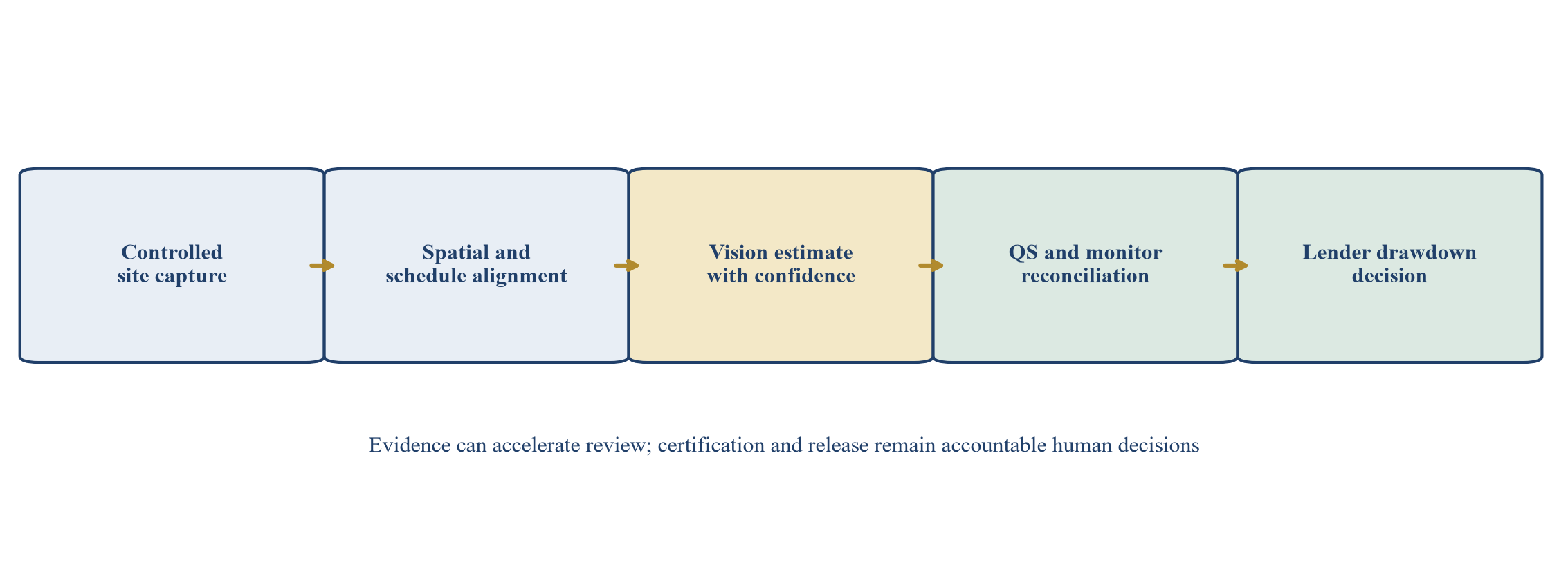
Proposed control architecture. Automated observations enter a professional and credit review rather than directly triggering payment.
| Decision | Computer-vision contribution | Accountable human | Mandatory escalation |
|---|---|---|---|
| accept capture set | test time, location, coverage and file integrity | project information manager | missing permission, broken lineage or insufficient coverage |
| estimate observed progress | classify visible elements or activities and state confidence | model owner with project controls review | class outside approved scope or performance threshold missed |
| certify value | compare observations with quantities and application | appointed engineer or quantity surveyor | hidden work, defect, disputed quantity or unapproved change |
| recommend drawdown | reconcile certificate, cash, budget and cost to complete | monitoring surveyor or lender technical adviser | shortfall, delay, contingency breach or evidence conflict |
| release funds | apply facility, escrow and authority conditions | facility agent, escrow agent or authorised lender officer | condition precedent, authority or compliance failure |
Contract documents and applicable law determine actual authority for each project.
2. Translate the project into a finance evidence model
A useful system needs one controlled representation of scope. The representation should connect the approved design, building information model, work breakdown structure, cost plan, bill of quantities, programme, contract package, location breakdown and facility budget. A model that recognises objects without this mapping may report activity while remaining irrelevant to the drawdown decision.
Define the level of information needed for each funding category. Structural concrete may be assessed by level, zone and pour. Facade may be assessed by elevation, panel type and installation state. Mechanical and electrical work may require room, system, first-fix or second-fix status. Fit-out may need room-level sequencing. The chosen unit must be visible, contractually meaningful and reconcilable to value. ISO 19650 describes information requirements as specifications of what information is produced, when, by whom and for whom; it also defines a common data environment as the operational framework for collaborative information production.[3] That discipline should precede model training.
The project baseline should be versioned. Freeze the approved budget, schedule, design release, work packages, measurement rules and financing sources used for each drawdown cycle. Variations should enter through a controlled change process with effective dates and links to revised drawings, quantities, value, time and funding treatment. Otherwise the model may compare current site conditions with an obsolete plan or allow an unapproved design change to appear as progress.
Each financing line should identify eligible cost, evidence required, drawdown ratio, retention, advance recovery, sponsor-equity condition, tax treatment and cap. A progress percentage only becomes financeable after it is translated into eligible value. The mapping should also identify items that are off-site, concealed, provisional, disputed, subject to vesting evidence or excluded from the facility.
| Information layer | Controlled identifier | Financing use | Common failure |
|---|---|---|---|
| design or BIM object | model, revision, object and location | define expected component and approved state | superseded model or ambiguous object grouping |
| programme activity | baseline, update, activity and logic link | compare observed sequence and time position | progress entered without logic or approved baseline |
| cost and quantity | package, cost code, quantity and rate | translate verified work into potential eligible value | double counting or cost code mismatch |
| contract entitlement | clause, certificate item and variation status | distinguish physical presence from payable amount | work observed before approval or acceptance |
| facility budget | tranche, eligibility, cap and retention | determine available drawdown | certified cost outside lender eligibility |
| cash evidence | invoice, bank reference and payee | test prior-use and downstream payment | certificate does not reconcile to paid cost |
The mapping converts physical observations into reviewable financing evidence without treating them as automatic entitlement.
3. Design a repeatable capture protocol
Computer vision depends on the quality and comparability of its inputs. A capture protocol should specify camera type, calibration, route, position, orientation, overlap, lighting tolerance, frequency, site access, safety controls and permitted storage. Fixed cameras provide continuity but may suffer from occlusion or a changing field of view. Handheld or 360-degree capture can reach interiors but depends on consistent routing. Drones can cover facades, roofs and large sites, subject to aviation, security and privacy requirements. Laser scanning can improve geometry but introduces cost, data volume and processing complexity.
The protocol should distinguish a missed capture from zero progress. Weather, access restrictions, temporary works, stored materials, equipment or people may obscure the relevant area. A model should report coverage and visibility before reporting completion. Research on computer-vision progress monitoring identifies data acquisition, as-built modelling and progress assessment as separate stages, each affected by the intended level of monitoring.[4] Research also records practical constraints from occlusion, camera placement, image quality and model alignment.[5][6]
Preserve original files before compression or transformation. Store capture time, device, operator, coordinates where permitted, route, checksum and chain of custody. A derivative image should link to its original and disclose cropping, enhancement or anonymisation. Synthetic or reconstructed views should never be presented as original site photographs. Access controls should separate operational users, reviewers, vendors and lenders.
Commercial drone use requires project-specific approvals. The UAE General Civil Aviation Authority identifies construction, photography and surveying as aerial work and requires organisational authorisation, operational permission and security clearance where capturing devices are used.[7] Emirate-level requirements and site restrictions may add controls. The project should verify current permissions before each operation and record them with the capture set.
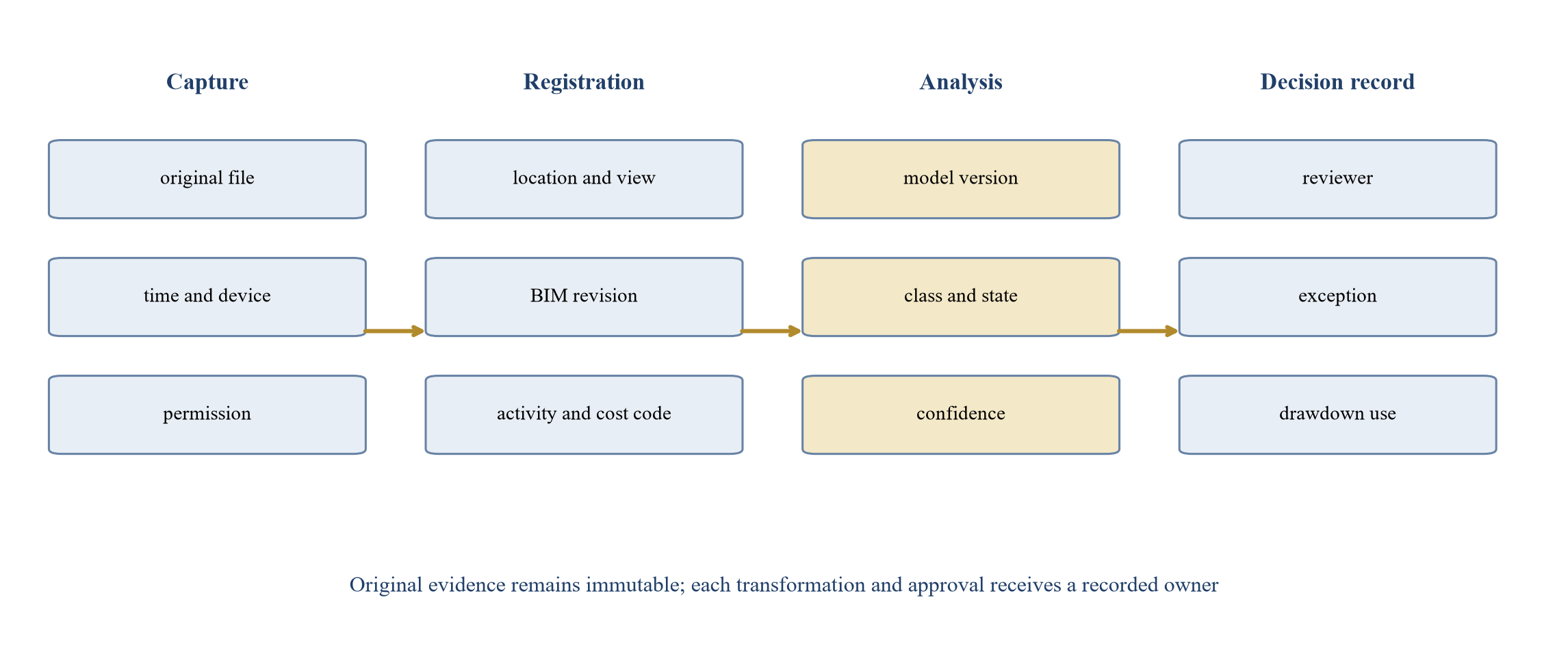
Every analytical observation should remain reproducible from an original permitted capture and the approved project baseline.
4. Register visual evidence to scope schedule and cost
Registration determines whether a detected element belongs to the financed project, correct building, floor, zone, work package and reporting period. Use survey control, camera pose, georeferencing, image features, point-cloud alignment or verified manual placement according to the use case. Record registration error and reject evidence when the error could alter the financial conclusion.
The comparison baseline should use the approved model and planned state at the reporting date. Four-dimensional BIM links geometry with schedule activities, but the link needs validation. One object may require several activities such as formwork, reinforcement, concrete placement and finishing. One activity may cover many objects. Research at activity level shows that element presence alone can miss the state required for schedule control and proposes semantic segmentation and activity-specific measurement.[8] The lender should therefore approve the measurable state for each category.
Link each observation to a cost code only after confirming measurement rules. Installed quantity may not equal certified quantity. Contractual valuation may include preliminaries, materials on site, off-site materials, design, testing, approved variations and retention. It may exclude defective work, unapproved change or quantities above the bill. A reconciliation table should show observed work, contractor claim, professional assessment and lender-eligible amount separately.
Control duplicate evidence across overlapping images and reporting periods. A component previously accepted should not create new value when photographed again. A removed or reworked element should retain its history. The system should treat demolition, correction and replacement as events with their own approvals and cost consequences.
5. Measure model performance for the financing use case
Generic accuracy is insufficient. Test performance by component, activity, location, capture method, weather, lighting, project phase and confidence band. Record false positive cases where the model reports completion that is absent, incomplete or unsuitable. Record false negatives where completed work is missed. In a drawdown context, a false positive may release cash early; a false negative may delay legitimate payment. The testing plan should reflect those asymmetric costs.
Create a labelled benchmark from project-representative captures reviewed by competent professionals. Separate training, validation and holdout sets by time or site where possible, because adjacent images can otherwise leak near-identical information into both training and testing. Preserve labels, adjudication and disagreements. If a vendor supplies the model, require enough evidence to understand the benchmark, known limitations, update process and site-specific calibration.
NIST's AI Risk Management Framework calls for governance, mapping, measurement and management across the lifecycle.[9] Its test, evaluation, verification and validation work emphasises use-case-specific assessment of real-world impacts.[10] Apply that principle to the actual financing question. A model that identifies concrete columns accurately may still fail to distinguish accepted work from shuttering, partial pours, curing, damage or an incorrect location.
Set approval thresholds for automation assistance, mandatory manual review and rejection. Monitor drift as the site changes. Early structural phases, envelope installation and interior fit-out produce different visual distributions. New contractors, materials, cameras or design revisions can reduce performance. A change to model, labels, preprocessing or threshold should require controlled validation before use in a funding cycle.
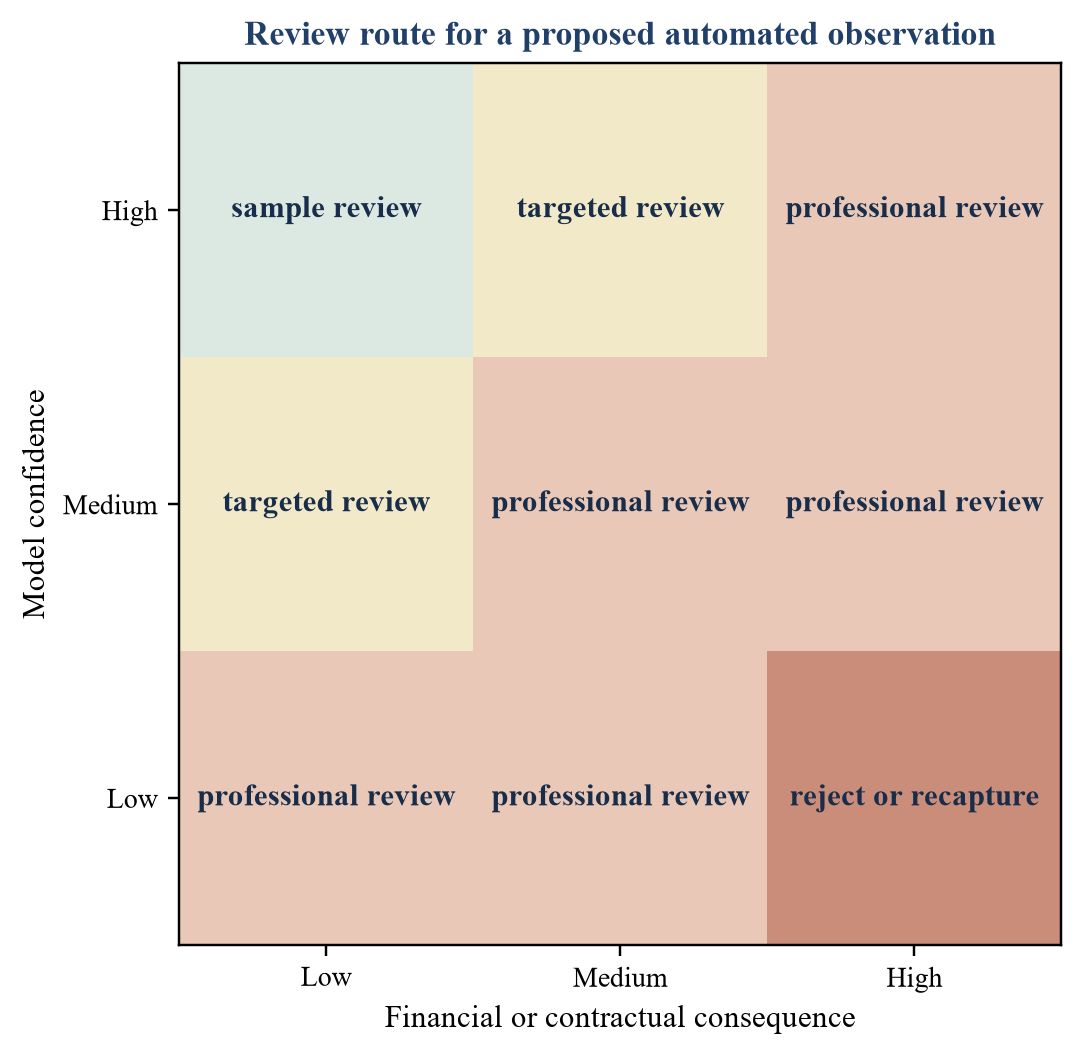
Proposed policy matrix. High financial consequence requires professional review even where model confidence is high.
6. Reconcile physical progress with certified value
Physical progress, earned value, certified value, cost incurred, cost paid and cash drawn are different measures. The monthly control should bridge them explicitly. Start with the prior approved position. Add current-period observations, measured quantities, approved variations and eligible off-site items. Deduct rejected, defective, disputed or duplicated work. Apply contractual rates, retention, advance recovery, taxes and other deductions. Then compare the professional certificate with the facility's eligibility rules.
The computer-vision estimate should be presented by measurable class with confidence and coverage. It should show the contractor claim and professional assessment beside the estimate. Large differences need an explanation linked to evidence. A model may miss concealed work or temporary obstruction. A claim may include off-site procurement. A surveyor may apply contractual measurement rules that differ from visible area. The system should assist the reconciliation rather than select a winner.
The RICS standard expects lender monitoring to consider previous certified funds and, where relevant, evidence that subcontractors and professional fees have been paid and retention money has been handled properly.[11] This requirement prevents a clean visual record from obscuring cash diversion or unpaid supply-chain exposure. Link prior drawdowns to bank statements, payment runs, invoices and payees where the mandate requires it.
Use cumulative controls. Reconcile contract sum, approved variations, forecast final account, certified value, paid value and remaining commitment. Compare project budget, committed cost, incurred cost, lender-eligible cost, sponsor equity and debt drawn. Differences should be visible at package level and in aggregate.
| Measure | Current-period evidence | Cumulative control | Drawdown treatment |
|---|---|---|---|
| observed physical progress | registered captures, scans and confidence | no duplicate component or period | corroborative evidence only |
| contractor application | measured quantity, invoice and entitlement | contract sum and variation bridge | subject to professional assessment |
| certified value | certificate and measurement record | retention and advance recovery | potential eligible cost |
| incurred and paid cost | ledger, invoice, bank reference and payee | sources and uses reconciliation | test prior-use and leakage |
| facility draw | borrowing request and conditions | cap, availability and equity ratio | authorised amount after adjustments |
| remaining requirement | commitments, forecast and risk allowance | cost-to-complete and finance sufficiency | condition, reserve or sponsor cure |
Each line should retain its measurement basis, evidence links, reviewer and exception status.
7. Rebuild cost to complete after every drawdown cycle
Cost to complete is forward looking. It should not be calculated as original budget less spend without considering contract commitments, variations, claims, delay, rework, inflation, procurement gaps, design development, statutory requirements, testing, commissioning, finance costs and contingency. Computer-vision evidence may reveal delay or incomplete work, but the financial consequence requires project-controls and commercial analysis.
Reforecast each package using completed quantity, remaining quantity, committed rates, uncommitted scope, approved and pending change, expected claims and programme effects. Separate known cost, quantified risk and unallocated contingency. Preserve the basis for each estimate and the person who approved it. Compare the reforecast with the remaining funding sources and headroom.
Programme and cost are linked. Delay can extend preliminaries, supervision, insurance, financing and hedging. It can shift revenue receipts or practical completion. Acceleration may reduce time but add labour, logistics or productivity risk. The model should flag sequence variance, but the project team should assess critical path and recovery feasibility.
Run downside cases that combine physical and commercial stress. A useful set may include delayed completion, lower sales collections, higher variation, contractor failure, slower leasing, interest-rate movement and reduced refinancing proceeds. Avoid adding independent percentages without considering correlation. For example, contractor distress may increase delay, replacement cost and defect risk at the same time.
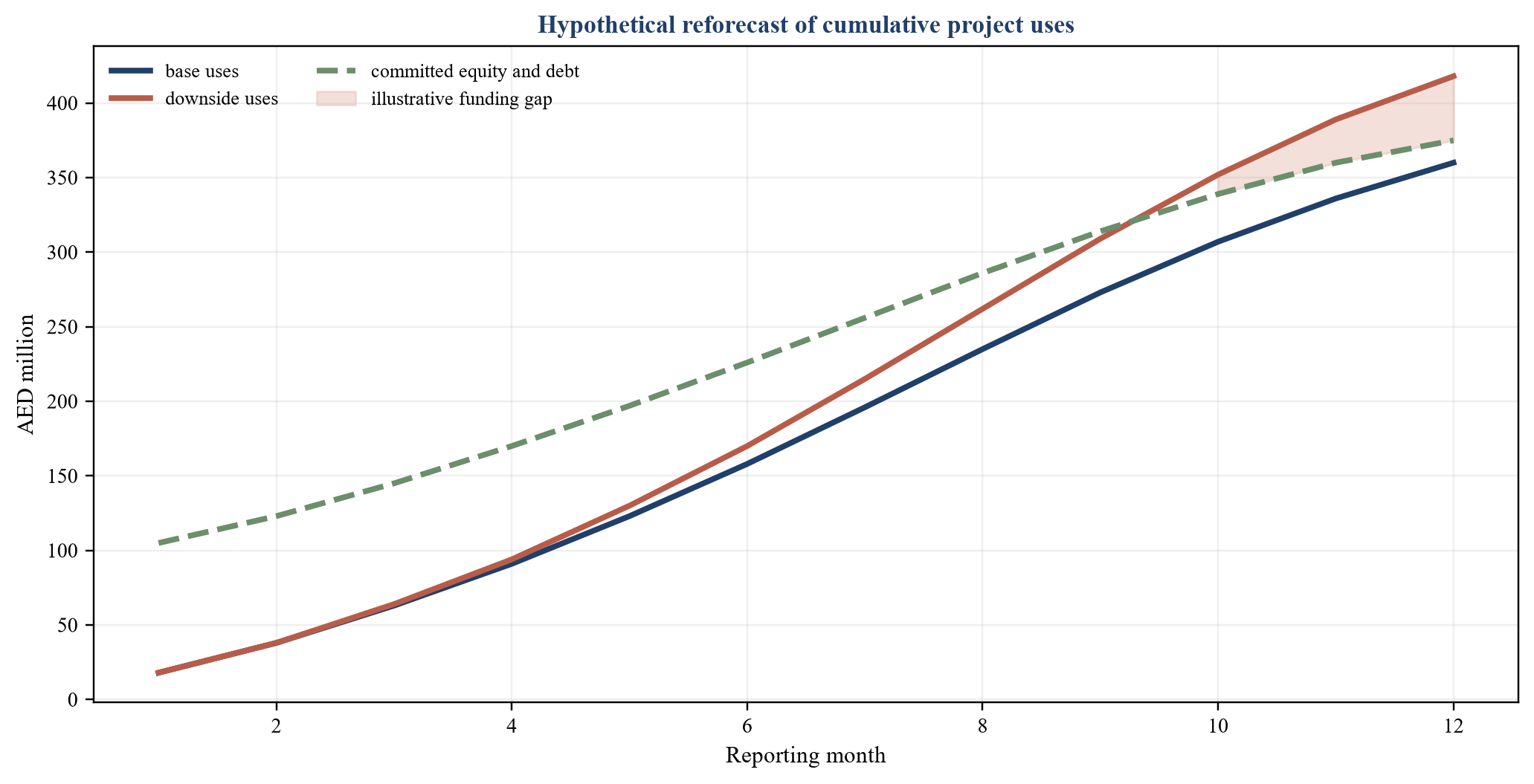
Hypothetical amounts for method illustration. They do not describe an identified project or forecast.
| Visual or schedule signal | Commercial question | Evidence required | Possible financing response |
|---|---|---|---|
| progress below approved curve | is delay critical and recoverable | logic-linked programme, productivity and recovery plan | enhanced monitoring or draw condition |
| repeated rework or removal | who bears cost and time | non-conformance, instruction, insurance and claim record | reserve or sponsor-funded cure |
| incomplete procurement-dependent areas | are long-lead items ordered and funded | purchase order, vesting, shipping and payment evidence | direct payment or controlled account |
| apparent acceleration | does reported output meet quality and safety requirements | inspection, testing and acceptance records | retain normal certification control |
| low capture coverage | is evidence unavailable or work inaccessible | capture log, access record and alternative proof | defer affected amount or inspect |
The lender should connect each visual signal to a commercial test before changing availability or reserves.
8. Connect sales collections and escrow to construction evidence
Off-plan projects can combine purchaser collections, sponsor equity, bank finance and escrow controls. The funding model should reconcile these sources with project uses and applicable release rules. Dubai Law No. 8 of 2007 requires relevant purchaser amounts and project-finance loan amounts to be deposited in the project escrow account and managed under the statutory framework.[12] Abu Dhabi's real-estate framework also links project escrow, construction completion and disbursement controls; official guidance describes milestone verification for tranche release.[13][14]
The legal and contractual position varies by emirate, project and date. The system should record the applicable rule, approved project, account, milestone, independent report and authority. Computer vision may strengthen the evidence pack, but it should not be treated as the statutory completion determination unless the competent authority expressly accepts that use.
Reconcile unit sales, cancellations, collections due, collections received, refunds, escrow receipts and permitted releases. Link construction milestones to the sales payment plan where relevant. A project can show physical progress while collections underperform, creating a funding gap. It can also receive collections ahead of spend, creating restricted cash that is unavailable for other projects.
Create alerts for divergence between physical progress, certified value and customer collections. Test whether unsold inventory, cancellations, incentives, payment-plan extensions or buyer arrears affect remaining liquidity. The credit team should distinguish timing variance from structural shortfall and preserve the assumptions behind any cure plan.
9. Build an early-warning system from exceptions
An early-warning system should combine trend, variance and unresolved exception. Useful indicators include schedule variance, low model confidence, repeated occlusion, quantity disagreement, unapproved variation, contingency draw, cost-to-complete increase, unpaid subcontractor evidence, slow sales collection, expiring permits, contractor concentration and delayed testing. Each indicator needs a definition, owner, threshold, ageing rule and response.
Avoid a single unexplained risk score. A red status can arise from different causes that require different actions. Show source evidence, trend, exposure and remedy. Separate information failure from adverse project performance. Missing capture, missing certificate and low physical progress all affect confidence, but only the last is a direct performance observation.
Escalation should be proportional. A low-value low-confidence observation may be sampled. A material structural milestone may require physical inspection regardless of confidence. A persistent cost-to-complete shortfall may require sponsor equity, reserve, revised facility terms or a draw stop. Contractual notices and reservation of rights should be handled by authorised professionals.
Measure alert quality. Record which alerts led to confirmed issues, false alarms, late discoveries or unnecessary delay. Review thresholds by project phase and work type. A system that produces too many unactionable alerts can reduce attention to genuinely material exceptions.
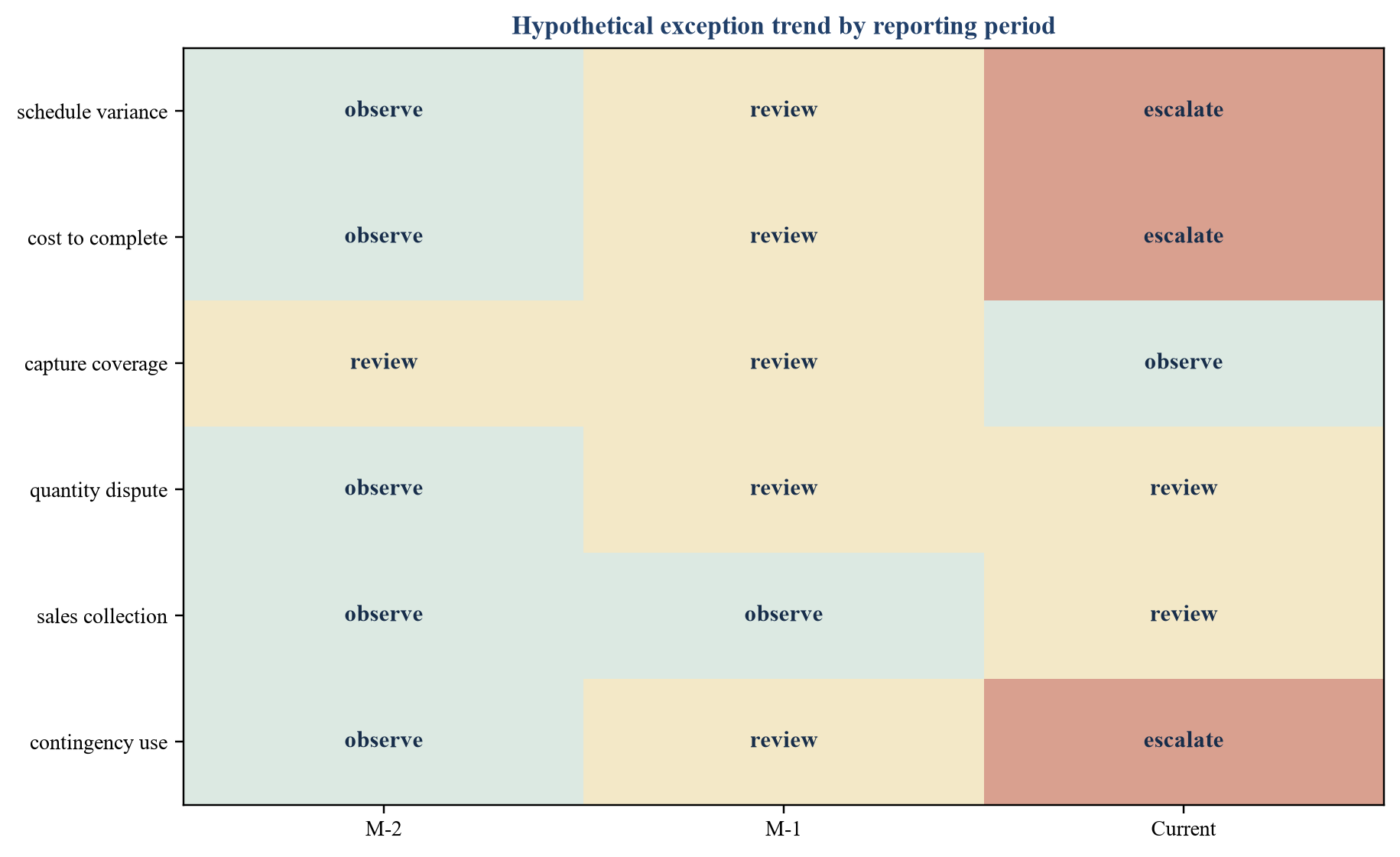
Hypothetical values show how issue severity and ageing can be presented without compressing all risks into one score.
10. Protect data privacy security and evidential integrity
Site imagery can capture workers, visitors, vehicle plates, security arrangements, neighbouring property, proprietary methods and sensitive infrastructure. Establish a lawful purpose, collection notice, access rule, retention period and deletion process. Minimise personal data and apply masking where it does not impair the financing use. The UAE personal-data framework treats facial images used for identification as biometric data and imposes controls on controllers and processors.[15] Obtain jurisdiction-specific advice for each capture and processing arrangement.
Protect the system from substitution, deletion and manipulation. Use signed capture applications or managed devices where proportionate. Hash original files, log transfers, restrict administrative access and preserve immutable decision records. Monitor vendor access and storage location. Test backup, incident response and recovery. A model output without its original evidence, version and processing record should not support a funding decision.
Computer-vision systems can be vulnerable to poor-quality inputs, adversarial changes, data poisoning and silent model updates. Procurement should require security architecture, vulnerability management, model-change notice, data-use restrictions, subcontractor disclosure, deletion rights, service continuity and export of records. Avoid allowing provider terms to use confidential project imagery for unrelated model training without an approved basis.
The lender and project parties should agree privilege and disclosure handling. A monitoring record may later be relevant to dispute, insurance claim, regulatory inquiry or enforcement. Counsel should define retention and legal-hold requirements. Operational teams should not delete inconvenient observations or overwrite prior assessments.
11. Preserve independent professional judgement
The appointed engineer, quantity surveyor, monitoring surveyor, project manager and lender credit team perform different roles. A technology workflow should clarify those boundaries. The person certifying value needs access to relevant evidence and the ability to challenge the model. The lender's adviser needs independence from the borrower and vendor. The credit approver needs visibility of exceptions and conditions.
Require the reviewer to state agreement, adjustment or rejection for material model observations. Record the reason and evidence. Do not treat override frequency alone as poor performance. A high override rate may expose model weakness, changing site conditions or an inappropriate scope. A low override rate may reflect accuracy, weak challenge or excessive deference. Sample both accepted and overridden outputs.
Create an exception route for concealed work, temporary works, off-site materials, testing, commissioning, defects, substitutions and design changes. The reviewer should be able to request alternative evidence or inspection. Contract interpretation and professional liability remain governed by appointments and law.
Govern incentives. A vendor paid by approval volume, a contractor controlling capture, or a sponsor selecting exceptions can bias the evidence. Separate evidence generation, model operation, certification and fund release where practical. Disclose conflicts and give the lender audit rights.
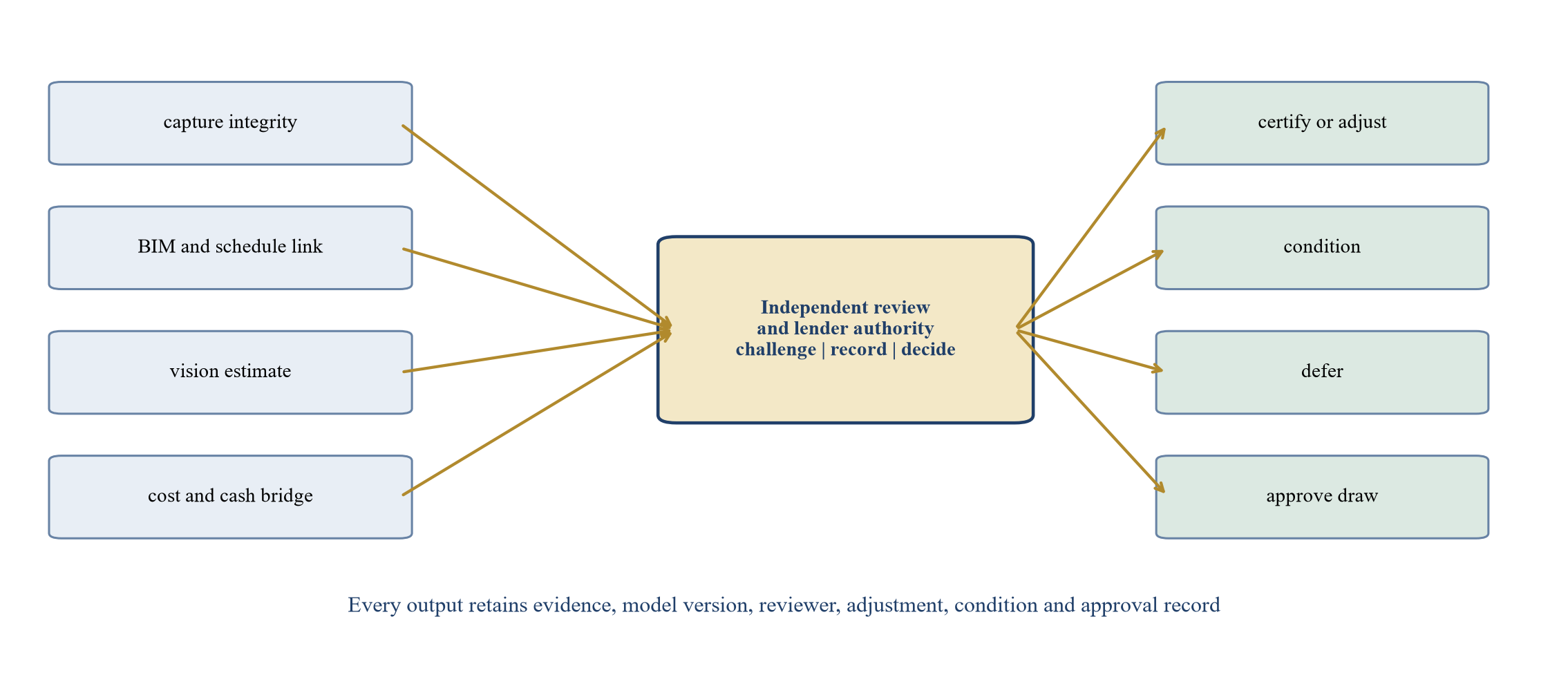
The model prepares observations and exceptions. Contractual certification and lender approval remain with authorised professionals.
| Packet component | Minimum content | Named owner | Challenge question |
|---|---|---|---|
| request and authority | amount, borrower, facility, account and signatories | facility agent | is the request authorised and within availability |
| progress evidence | capture coverage, observed state, confidence and exceptions | project controls lead | what material work is not visible or reliably classified |
| professional assessment | measured work, certificate, defects and variation treatment | appointed professional | which conclusion changes if visual evidence is wrong |
| cost and funding | budget, commitments, paid cost, forecast and headroom | finance reviewer | is remaining finance sufficient under downside |
| programme and revenue | critical path, recovery, sales or leasing and collections | monitoring surveyor | what event triggers the next escalation |
| approval record | conditions, dissent, reservation and expiry | authorised lender officer | are all conditions measurable and owned |
The packet should present evidence conflicts and unresolved risks before the requested decision.
12. Work through a hypothetical GCC construction facility
Consider a hypothetical mixed-use development with an assumed total project cost of AED 420 million. The assumed sources are AED 105 million of sponsor equity, AED 270 million of committed senior construction debt and AED 45 million of expected net purchaser collections available under the modelled structure. The project has two residential buildings, a retail podium and shared infrastructure. These values are created solely to demonstrate the method.
At the sixth reporting month, the contractor claims 41 per cent cumulative progress and AED 164 million of gross value. The approved programme indicates 44 per cent. The computer-vision system covers 86 per cent of the measurable planned areas and estimates 38 per cent observed completion, with high confidence for structure, medium confidence for facade and low confidence for mechanical first fix. The monitoring surveyor measures 39 per cent after site inspection and certifies AED 151 million after excluding unapproved variation, incomplete facade interfaces and defective waterproofing.
The difference is analysed by location and cost code. The model missed concealed services in two zones, which adds AED 4 million after documentary and inspection support. It also classified stored facade panels as installed in one elevation, requiring a reduction of AED 3 million. The contractor's application included AED 7 million of pending variation and AED 3 million of work requiring correction. Retention and advance recovery reduce the potential payment further.
The cash reconciliation shows AED 137 million of eligible cumulative cost paid or payable, AED 18 million of prior certified funds not yet evidenced as paid downstream, and AED 9 million of current requested cost outside the facility definition. The lender requires evidence of prior-use before funding the related amount. The drawdown decision uses the lower eligible position after certificate, facility rules and prior-use adjustments.
The cost-to-complete review increases the forecast final cost from AED 420 million to AED 438 million. Assumed reasons are AED 8 million of approved variation, AED 6 million of delay-related preliminaries and AED 4 million of waterproofing and facade remediation. Remaining committed sources are AED 393 million after collection slippage. The illustrative shortfall is therefore AED 45 million before any further downside. The lender conditions the draw on sponsor equity, a funded contingency reserve, a revised programme and enhanced monthly evidence.
The example shows why a visual percentage cannot decide a drawdown. Its value lies in exposing location-specific differences early, improving the sample for professional review and connecting exceptions to the financial model. The funding decision still depends on contract entitlement, eligible cost, prior-use, remaining finance and authorised approval.
| Item | Contractor position | Reviewed position | Financing treatment |
|---|---|---|---|
| gross cumulative value | 164 | 151 | start from professional certificate |
| unapproved variation | 7 | 0 | excluded pending approval |
| defective or incomplete work | 3 | 0 | excluded pending remedy and acceptance |
| eligible cumulative cost | 151 | 137 | apply facility definitions and evidence |
| prior-use evidence gap | 0 | 18 | defer related amount until reconciled |
| current requested draw | 32 | 14 | illustrative approved amount after conditions |
| forecast final cost | 420 | 438 | test sources, contingency and sponsor cure |
All values are illustrative assumptions in AED millions and do not describe an identified transaction.
13. Implement through a ninety-day controlled pilot
The first thirty days should establish governance. Confirm the financing and certification decisions, contracts, appointments, applicable law, data rights, permissions, project baseline, capture scope, work-package mapping, model owner and approval thresholds. Select a limited use case with visible, repetitive and financially relevant work. Structural elements or facade installation may be more suitable than concealed services. Build the evidence register and preserve historic reports for comparison.
Days thirty-one to sixty should run the system in parallel with the existing process. Capture data using the approved protocol. Register it to the project baseline. Produce observations without allowing them to alter certificates or drawdowns. Compare outputs with surveyor assessments, site records and subsequent evidence. Measure coverage, registration error, false positives, false negatives, confidence calibration and processing time. Investigate differences by class and location.
Days sixty-one to ninety should conduct a controlled committee review. Define which observations may enter the drawdown packet, the mandatory review sample, the exception route and the stop conditions. Test security, data export, vendor failure, model rollback and manual continuity. Train reviewers to challenge source evidence and assumptions. Approve or reject the defined production scope through the existing project and lender authorities.
Production deployment should remain bounded. Each new phase, class, camera, project or model version requires testing. Retain the existing professional process until evidence shows the system performs within approved thresholds. Use release management so a vendor update cannot silently change an active drawdown cycle.
| Control area | First thirty days | Days thirty-one to sixty | Days sixty-one to ninety | Stop example |
|---|---|---|---|---|
| governance | decision map, authority and data rights | role and exception testing | formal scope approval | authority or permission unresolved |
| baseline | freeze model, programme and cost map | test version and variation linkage | approve change protocol | current design cannot be identified |
| capture | route, safety and permission plan | repeated controlled capture | coverage threshold approval | material area consistently obscured |
| model | benchmark and acceptance metrics | shadow comparison and error analysis | controlled production release | false-positive threshold exceeded |
| finance | define reconciliation and eligibility | parallel drawdown bridge | committee dry run | cost-to-complete shortfall uncured |
| resilience | vendor, export and rollback plan | failure and recovery test | manual continuity sign-off | evidence unavailable or corrupted |
Owners and thresholds should be approved before any output affects a financing decision.
14. Recognise technical contractual and commercial limitations
Computer vision observes surfaces available to the sensor. It may not establish structural quality, concealed work, installation testing, commissioning performance, material provenance, ownership, payment, contract entitlement or compliance with every specification. Some categories are unsuitable for visual automation. The paper's framework requires the system to state those boundaries rather than imply complete project knowledge.
Ground truth is partly judgement. Surveyors may disagree about completion state or measurement basis. Labels can embed inconsistent practice. BIM and programme data may be incomplete or outdated. A high-performing model can therefore reproduce a weak baseline precisely. Independent reconciliation remains essential.
Project-specific legal rights govern inspection, certification, payment, escrow and lender remedies. Professional duties cannot be reassigned through a dashboard. Privacy, labour, aviation, security and data-transfer requirements vary. Insurance treatment and evidential admissibility require advice. The technology contract should not promise an outcome outside the provider's control.
Commercial benefit is project dependent. Capture, integration, labelling, review and governance cost may exceed value on small or short projects. Benefits may arise from faster exception detection, broader coverage, stronger records and reduced repeat visits. A pilot should measure those effects without assuming them.
Research continues to improve object detection, semantic segmentation, point-cloud reconstruction, BIM alignment and automated labelling.[5][6][8][16][17] Current evidence also identifies occlusion, data quality, site variability and integration challenges. A prudent financing use should progress by controlled work class and demonstrated performance.
15. Measure decision quality and realised project outcomes
Measure whether the system improves the funding process. Useful operational measures include capture completeness, time from reporting date to evidence pack, number of unresolved exceptions, reviewer hours, recapture rate and percentage of observations with complete lineage. Model measures include performance by class, confidence calibration, drift and override reason.
Finance measures should include drawdown adjustment, prior-use exception, cost-to-complete revision, contingency consumption, sponsor-cure timing and forecast error. Project measures may include delay identification, defect discovery and recovery-plan performance. These measures need context; a high drawdown adjustment may indicate strong control or a deteriorating project.
Compare alerts with later evidence. Record which observations predicted confirmed delay, cost increase or dispute. Preserve false positives and missed events. Review whether conditions were closed and whether the project remained adequately funded. Do not optimise the model solely for faster approval.
Post-completion review should compare the final account, completion date, debt outcome and realised sales or leasing with the approved cases. Attribute differences to evidence, assumption, model, judgement, execution or external event where support exists. Feed approved lessons into future capture and review policies without rewriting historic decisions.
16. Govern contractors vendors and advisers
The project may rely on contractor systems, BIM coordinators, camera providers, drone operators, model vendors, cloud providers, monitoring surveyors and lenders. Define each party's deliverable, access, confidentiality, liability, record-retention and audit obligation. Require disclosure of subcontractors and data locations.
Vendor due diligence should cover financial capacity, security, model governance, training data rights, support, change management, export, business continuity and termination assistance. Avoid dependency on proprietary formats that prevent the lender from preserving the evidence chain. Retain original data and a readable decision record outside the vendor's sole control.
Contractor participation needs controls because the contractor may influence capture timing, route and obstruction. The capture protocol should be independently testable. The reviewer should be able to request additional evidence. A disagreement should enter a defined process without allowing either the model or one party's dashboard to determine contractual entitlement.
Professional appointments should state how automated evidence is used, the review standard, reliance boundary and communication route. Lenders should obtain advice on whether existing terms cover the technology. The goal is a traceable aid to decision making within established authority.
17. Conclusion
Computer vision can make construction-finance monitoring more frequent, spatially specific and reproducible when the project has a controlled information baseline and a disciplined capture process. It can compare visible progress with planned activities, expose location-specific differences and direct professional attention to exceptions.
The financing value arises from reconciliation. Observed progress must be connected to certified quantity, contractual entitlement, eligible cost, paid cost, cost to complete, available contingency, sales or leasing evidence and remaining funding. A percentage from images cannot replace that bridge.
The practical standard is reproducibility. A reviewer should be able to trace a drawdown conclusion to the original permitted capture, approved model and schedule, analytical version, measurement rule, financial adjustment, professional judgement and authorised decision. Uncertainty should trigger review, recapture, inspection or deferment according to consequence.
Lenders and developers should begin with a bounded shadow pilot, measure performance on the actual work classes, preserve independent certification and expand only after governance and evidence demonstrate an appropriate use. The resulting system can strengthen early warning and records while leaving contractual and financial authority with accountable people.
Appendix A. Construction Finance Evidence Request
A1. Authority contract and facility
Executed facility, security, intercreditor, account and escrow documents.
Contract appointments, delegation, signatories, notices and decision calendar.
Facility budget, eligibility, equity-first requirements, retention and conditions.
Current permits, insurance, aviation, privacy and site-access approvals.
A2. Project baseline and capture
Approved drawings, BIM revision, work breakdown, location system and programme.
Cost plan, bill of quantities, package commitments and variation register.
Capture protocol, device register, calibration, route, coverage and source hashes.
Model card, benchmark, thresholds, version, known limitations and change record.
A3. Drawdown and forecast
Contractor application, professional certificate and measurement support.
Ledger, invoices, bank references, payees and prior-use reconciliation.
Budget, commitments, forecast final cost, contingency and funding headroom.
Sales, leasing, collection, escrow, critical path and recovery evidence where relevant.
Appendix B. Drawdown Review Checklist
B1. Before evidence analysis
Confirm request, authority, applicable baseline and reporting cut-off.
Verify capture permission, coverage, integrity, location and model version.
Identify concealed work, off-site items, changes and categories outside scope.
Freeze the evidence set and record unresolved information requests.
B2. Before approval
Reconcile observation, contractor claim, certificate and lender eligibility.
Test prior-use, retention, advance recovery and account movement.
Rebuild cost to complete, programme and remaining sources under downside.
Record conditions, exceptions, dissent, expiry and named owners.
B3. After funding
Reconcile the payment instruction with the approved amount and account.
Track closure of conditions, defects, information gaps and sponsor cures.
Compare alerts and assumptions with subsequent evidence and realised outcomes.
Preserve the approved packet, model version, source evidence and audit trail.
Sources
- Royal Institution of Chartered Surveyors. Lender's Independent Monitoring Surveyor, 1st edition, 2025. Read the primary source
- International Federation of Consulting Engineers. Conditions of Contract for Construction, MDB Harmonised General Conditions. Read the primary source
- International Organization for Standardization. ISO 19650-1:2018, Information management using building information modelling. Read the primary source
- Reja, Varghese and Ha. Computer vision-based construction progress monitoring, Automation in Construction 138, 2022. Read the primary source
- Hsieh, Chen, Chen and Wu. Automated construction progress monitoring and control through AI-based image recognition and BIM integration, Automation in Construction 183, 2026. Read the primary source
- Braun, Tuttas, Borrmann and Stilla. Improving progress monitoring by fusing point clouds, semantic data and computer vision, Automation in Construction 116, 2020. Read the primary source
- UAE General Civil Aviation Authority. UAS Registration and operational requirements. Read the primary source
- Pal, Lin, Hsieh and Golparvar-Fard. Activity-level construction progress monitoring through semantic segmentation of 3D-informed orthographic images, Automation in Construction 157, 2024. Read the primary source
- National Institute of Standards and Technology. Artificial Intelligence Risk Management Framework 1.0, 2023. Read the primary source
- National Institute of Standards and Technology. TEVV-Athlon Framework for Evaluating AI Systems, initial public draft, 2026. Read the primary source
- Royal Institution of Chartered Surveyors. Construction phase progress reporting and drawdown requirements. Read the primary source
- Government of Dubai. Law No. 8 of 2007 Concerning Escrow Accounts for Real Estate Development. Read the primary source
- Abu Dhabi Real Estate Centre. Project Development legal framework and milestone controls. Read the primary source
- Abu Dhabi Real Estate Centre. Real Estate legislation and project escrow account controls. Read the primary source
- United Arab Emirates. Federal Decree-Law No. 45 of 2021 Concerning the Protection of Personal Data. Read the primary source
- Mahami, Nasirzadeh, Ahmadabadian and Nahavandi. Automated Progress Controlling and Monitoring Using Daily Site Images and Building Information Modelling, Buildings 9, 2019. Read the primary source
- Braun and Borrmann. Combining inverse photogrammetry and BIM for automated labelling of construction site images for machine learning, Automation in Construction 106, 2019. Read the primary source
- International Association for Automation and Robotics in Construction. Construction Progress Monitoring and Reporting using Digital Images and Computer Vision Techniques, 2022. Read the primary source
- World Bank. Project Procurement Framework and Standard Procurement Documents. Read the primary source
- World Bank. Standard Bidding Documents for Procurement of Works. Read the primary source
- Financial Stability Board. The Financial Stability Implications of Artificial Intelligence, 2024. Read the primary source
- National Institute of Standards and Technology. Cybersecurity Framework 2.0, 2024. Read the primary source
