

1. Define the sovereign capability decision before structuring the venture
The sponsoring board should begin with a specific capability outcome. Examples include maintaining a platform without external field support, producing a defined component locally, modifying mission software within an authorised boundary, training and certifying local engineers, securing availability of spares, or building an exportable regional support capability. Each outcome needs a date, operational consequence, evidence standard and accountable owner.
The decision record should separate strategic aspiration from the minimum investable outcome. A joint venture can create employment and assembly while remaining dependent on imported design authority, controlled software, specialist tooling, remote diagnostics or foreign approvals. The board should state which dependency is acceptable, which must decline over time and which must remain with the international partner because law, safety or commercial policy requires it.
Alternatives should use the same evidence and cash-flow test. They can include direct procurement, licensed production, maintenance agreement, technical-assistance arrangement, minority investment, joint venture, prime-subcontractor model, government-to-government route or internal development. The joint venture should be selected because its rights, economics, resilience and governance outperform those alternatives under central and downside cases.
The opening gate should identify the intended end user, product and service perimeter, source countries, controlled components, proposed local activities, people requiring access, data locations, AI use cases, funding envelope and walk-away conditions. Qualified counsel and relevant authorities determine the applicable legal position. The transaction team maintains the evidence and decision trail.
2. Use the GCC Defence JV Capability Transfer Framework
The framework links eight questions: what sovereign capability is required; what lawfully transfers; which technical data and services are authorised; where data and compute reside; who holds design and release authority; how local competence is demonstrated; how economics respond to delayed capability; and how the parties separate or exit without disrupting operational support.
A joint-venture agreement should not carry this burden alone. The operating design needs linked schedules for controlled items, permitted activities, territories, end users, sublicensees, data domains, named roles, training, tooling, validation, cybersecurity, audit, reporting, milestones, remedies and transition. Each schedule should reference the governing approval or evidence.
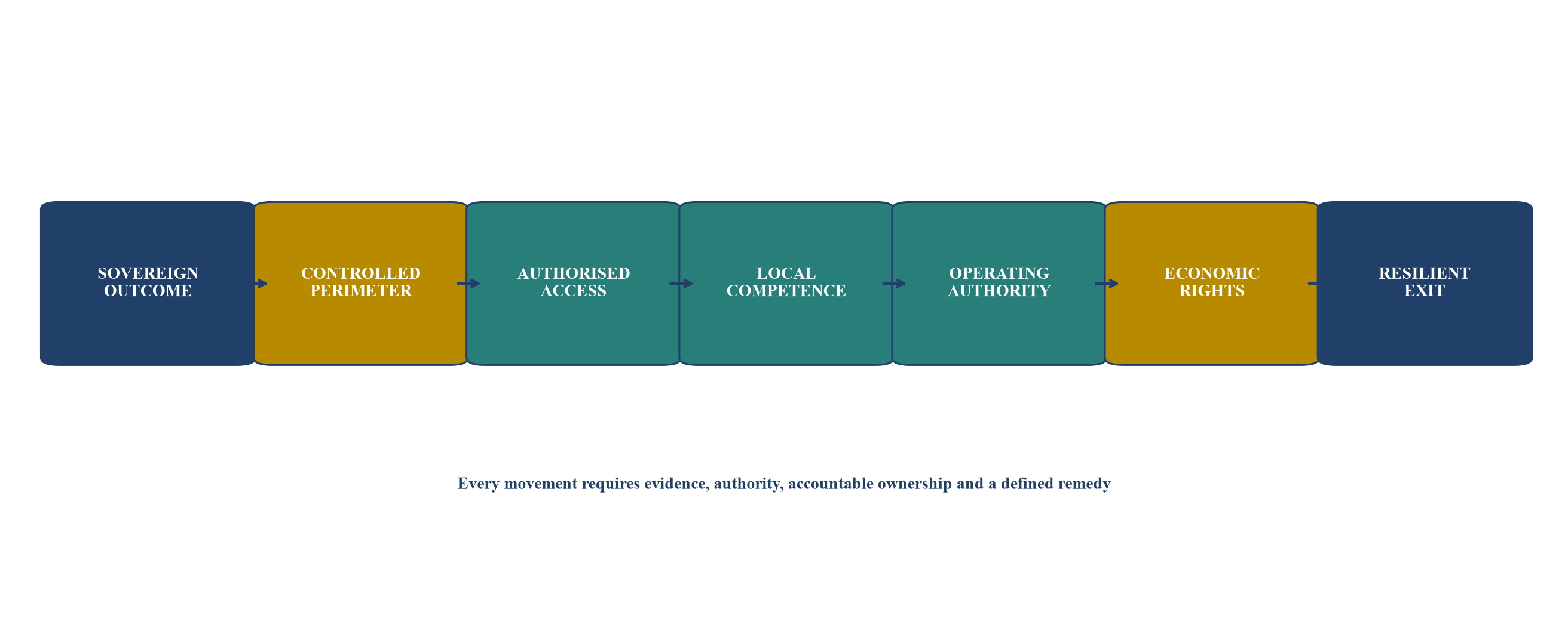
Proposed framework; transaction-specific law, authorisations and security requirements determine the actual design.
3. Separate equity ownership from operational capability
Equity establishes economic and governance rights in the legal entity. It does not by itself transfer export-controlled technology, technical data, defence services, source code, model weights, design authority, certification rights, tooling, know-how or permission to supply another end user. The transaction model should value each capability layer separately.
The capability ledger should describe the current holder, legal basis, classification, source country, permitted recipient, purpose, territory, access method, modification right, derivative-work treatment, update right, support obligation, evidence and expiry. It should also identify dependencies that cannot be transferred and the operating consequence of losing them.
| Layer | Equity ownership provides | Separate evidence required | Board consequence |
|---|---|---|---|
| product and hardware | interest in the venture | item classification, licence and end-use scope | what may be received or made |
| technical data | no automatic access | approved agreement, licence or other lawful basis | who may inspect or use |
| software and source code | no automatic delivery or modification | licence, access boundary and change rights | local support and upgrade resilience |
| AI data and models | no automatic ownership or reuse | data rights, model rights, evaluation and deployment authority | permitted learning and decisions |
| design authority | no automatic delegation | documented engineering and release authority | who approves configuration |
| training and defence services | no automatic service right | authorised scope, people and location | competence transfer timetable |
| export and territory | no automatic onward sale | destination, end-user and retransfer permission | addressable market and exit value |
Proposed diligence structure; qualified advisers should determine the applicable classification and authorisation.
4. Prove sovereign demand and the authorised use case before price
The commercial case should start with an evidenced requirement, procurement path, budget authority, qualification process, expected quantities, acceptance criteria, support obligation and payment route. Strategic importance does not remove demand risk. A local production plan can become uneconomic when volumes, timing, configuration or export opportunity are assumed rather than contracted.
For AI-enabled capability, define the precise function and consequence. Predictive maintenance, visual quality inspection, logistics planning, document search, simulation and decision support can require different data, model assurance, human review and security. The team should avoid a single broad AI label that conceals distinct access and risk profiles.
Customer and authority evidence should identify whether local content, security accreditation, facility clearance, personnel approval, test range, certification, interoperability or sovereign hosting affects award or operation. The investment committee should see the difference between a policy ambition, a funded programme, an awarded contract and accepted recurring revenue.
5. Map the capability-transfer chain as a sequence of authorised states
Capability transfer should be represented as states that can be tested. A venture may begin with imported finished goods, progress to local assembly, then component production, maintenance, software configuration, approved modification and defined design authority. Each transition needs authorisation, facilities, people, tooling, data, quality evidence and customer acceptance.
The chain should expose bottlenecks. Local technicians may complete training while still lacking approved technical data. A secure facility may be accredited while a model update remains accessible only through the partner. Local manufacture may depend on a controlled test fixture or cryptographic key. The board should see the dependency that limits the next state.
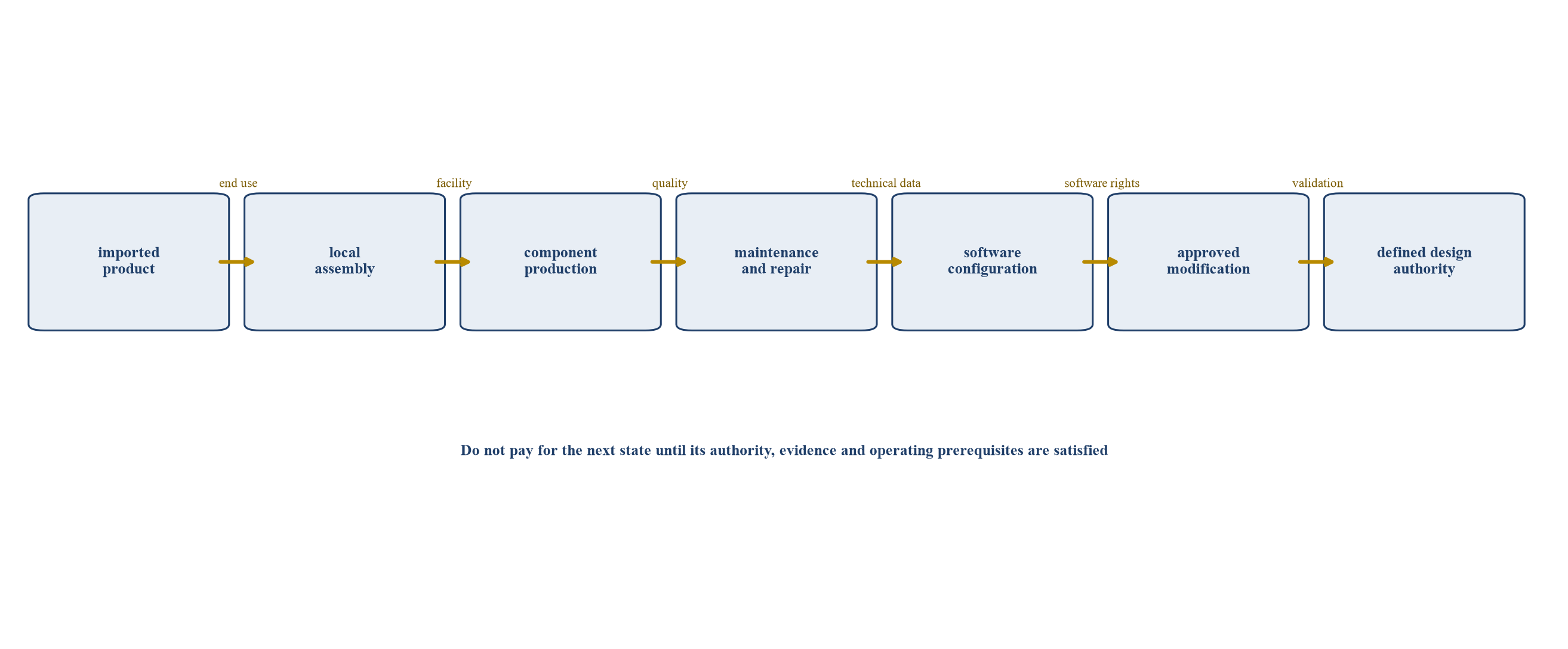
Proposed stage architecture; actual release depends on applicable approvals, security and customer acceptance.
6. Rank partners through a controlled-capability scorecard
Partner selection should reflect capability depth, lawful transferability, sovereign demand, security maturity, training capacity, supply resilience, economics and exit continuity. A high-performing product can rank poorly when the required technical data cannot be released, key personnel cannot access it, or the partner retains an unpriced unilateral right to withdraw support.
Scores should carry evidence confidence and a critical-failure flag. A low-confidence score cannot be averaged away by strong commercial presentation. The committee should see which conclusion comes from an authority, executed document, technical demonstration, customer evidence or management representation.
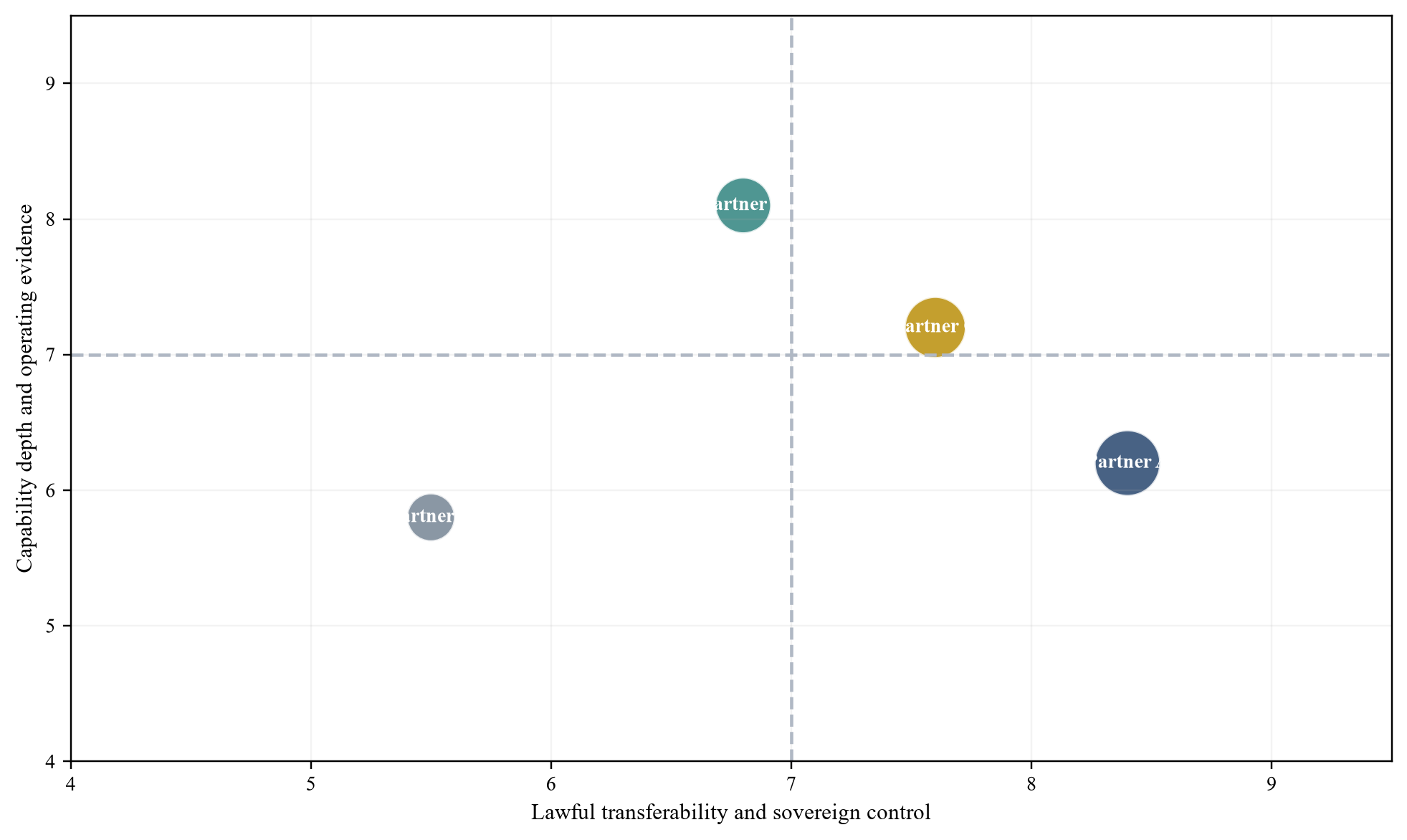
Hypothetical management assumptions; bubble size represents assumed five-year cash commitment.
7. Build one jurisdiction and authorisation matrix
The transaction team should map source-country export controls, reexports and retransfers, destination and end-user restrictions, sanctions, foreign-investment review, competition, procurement, industrial licensing, cybersecurity, privacy, classified information, employment, immigration, tax, customs and intellectual-property rules. The matrix identifies the competent authority, responsible applicant, required evidence, sequencing, conditions, duration, expiry and change events.
U.S. ITAR and EAR questions can arise through origin, item, technology, technical data, defence service, software, person, end use, end user, destination and retransfer. UK and European controls can apply to goods, software, technology, technical assistance and military end use. The exact result is transaction specific. The parties should avoid treating country of incorporation as the only relevant fact.
| Question | Evidence | Owner | Transaction gate |
|---|---|---|---|
| what is controlled | item, software, technology and service classification | originating partner and counsel | before diligence access |
| who may receive it | entities, people, nationalities, end users and sublicensees | compliance and security | before data-room admission |
| what may they do | manufacture, maintain, modify, train, test, integrate or export | programme and counsel | before operating design |
| where may it occur | approved sites, systems, cloud, networks and countries | security and IT | before build commitment |
| what approval applies | licence, agreement, exception, authorisation or prohibition | applicant and authority liaison | condition to signing or closing |
| what changes require action | ownership, control, scope, product, people, place or end use | company secretary and compliance | continuing covenant |
| what happens at expiry | renewal, suspension, return, deletion, transition or stop work | board and programme office | resilience and exit plan |
Illustrative categories only; qualified advisers and competent authorities determine the applicable requirements.
8. Sequence source-country export control and end-use work
Export-control work should begin before the joint venture promises localisation, technical access or a delivery date. The originating partner should identify controlled items and activities, proposed parties, end users, locations, nationalities, technical scope, manufacturing rights, defence services, training and retransfers. The local partner should supply accurate ownership, governance, facilities, security, personnel and intended-use evidence.
An authorisation can be narrower than the commercial term sheet. It can limit products, data, parties, sites, purposes, territories, duration, foreign nationals, subcontractors or onward transfers. The financial model and milestone schedule should use the authorised scope, with explicit treatment for unresolved items. A closing condition should not assume that approval will be granted or granted on the requested terms.
Controls continue after closing. Changes in ownership, board rights, personnel, end use, product configuration, cloud architecture, subcontractors or export destination can require review. The compliance operating model should maintain classifications, approvals, provisos, access lists, training, records, screening, audit and escalation.
9. Design sovereign data and AI architecture before integration
The parties should classify data by legal control, national-security sensitivity, customer restriction, intellectual-property ownership, personal-data status, operational consequence and permitted processing. The architecture can separate public, enterprise, customer-controlled, export-controlled, classified or specially protected domains. Identity, device, network, storage, compute, model, interface and support access should follow the classification.
AI requires additional lineage. Record training and evaluation data, preprocessing, model and weight provenance, code and library versions, prompts, retrieval sources, deployment environment, permissions, human review, performance limits, security tests, updates and retirement. A model hosted locally can still depend on foreign weights, remote telemetry, licence servers, specialists or cloud tooling. Sovereign hosting and sovereign operational control should be tested separately.
| Domain | Typical content | Permitted environment | Decision control |
|---|---|---|---|
| open and commercial | public specifications and ordinary enterprise data | approved enterprise services | business owner |
| customer restricted | programme, configuration and operational records | customer-approved enclave | programme security owner |
| export controlled | technical data, source code or defence-service records | authorised people, systems and sites | export compliance owner |
| classified or specially protected | authority-designated information | accredited environment | designated security authority |
| AI training and evaluation | approved datasets, labels and test results | segregated model-development environment | model owner and validator |
| AI deployment | weights, inference logs, interfaces and updates | authorised operational environment | accountable operational authority |
Proposed control model; actual classification and handling depend on applicable authority and contract requirements.
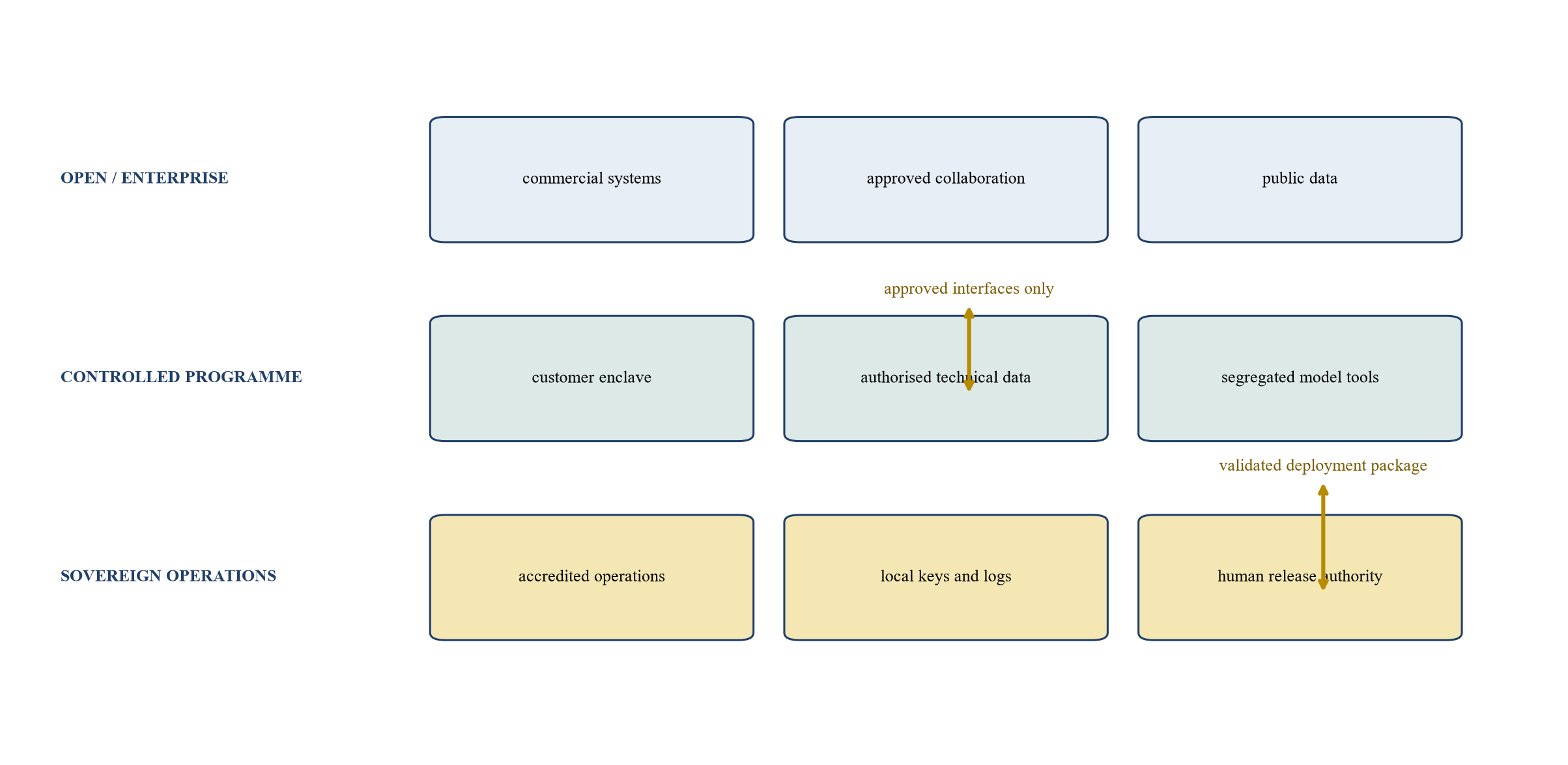
Proposed logical architecture; actual accreditation, connectivity and support design are transaction specific.
10. Protect customer authority and mission confidence
The venture should preserve a clear accountable interface with the government customer, end user and relevant security authorities. The customer may need visibility over ownership, foreign access, subcontractors, locations, system changes, incident response, continuity and exit. These rights should be reconciled with partner confidentiality and controlled-data obligations.
AI-enabled features need an approved concept of use. Define what the system observes, recommends or controls; the human role; performance boundaries; fallback mode; log retention; test evidence; change approval and incident response. Commercial demonstrations should not be treated as operational acceptance.
The board should track acceptance evidence alongside revenue. Contract signature, factory acceptance, site acceptance, operational evaluation, security accreditation and recurring service acceptance can have different cash and risk effects. The valuation should reflect the stage actually achieved.
11. Turn training into demonstrated local authority
Training hours do not prove capability. The transfer plan should identify each role, prerequisite, syllabus, controlled material, instructor authority, supervised task, examination, recertification, access approval and decision right. Competence is demonstrated through accepted work under the defined quality and security system.
Tacit knowledge needs deliberate capture through paired decisions, failure analysis, configuration reviews, maintenance events, customer issues and controlled modifications. The venture should retain evidence of what the local team can perform independently, what requires partner review and what remains prohibited.
| Role | Demonstrated task | Evidence | Authority released |
|---|---|---|---|
| maintainer | diagnose and restore approved equipment | observed task and accepted record | defined maintenance action |
| manufacturing engineer | execute and control approved process | first-article and quality evidence | process release within limits |
| software engineer | configure approved parameters | controlled test and code review | bounded configuration change |
| data or model engineer | prepare approved data and run evaluation | lineage, test and validation record | model-development task |
| configuration authority | assess change and maintain baseline | supervised boards and audit trail | defined configuration approval |
| programme security owner | administer access and incidents | exercise, logs and authority acceptance | security decision within mandate |
Proposed evidence framework; actual roles and release authority depend on product, law, contract and safety case.
12. Reconcile culture with operating design
Cross-border integration risk often reflects incompatible decision rights, incentives and work systems rather than national stereotypes. The buyer should compare how each organisation sells, prices, approves investment, manages risk, develops products, serves customers and escalates problems.
The partner operating model should define which decisions remain local, which move to group functions and which require joint governance. Protecting autonomy can preserve innovation while leaving duplicated controls. Immediate centralisation can damage speed and accountability. The choice should follow the value thesis.
Integration leaders need behavioural evidence from management interviews, employee listening, process observation and historical change. Generic culture scores have limited value unless they connect to specific execution dependencies such as tender approval, engineering sign-off or customer response.
The board should approve cultural and operating design together. Each proposed governance change should state the value enabled, decision owner, transition risk, measurable outcome and reversal plan.
13. Build the joint-venture operating model before signing
The partner operating model should allocate product management, engineering, configuration control, manufacturing, quality, supply chain, software, data, model governance, cybersecurity, programme security, sales, contracting, finance, compliance, audit and customer delivery. Each activity should identify decision owner, partner support, approval dependency, systems and evidence.
Reserved matters should focus on decisions whose consequence justifies joint control. Examples include product perimeter, new end users, export destinations, controlled-data access, material model changes, security architecture, critical subcontractors, intellectual-property licences, capital calls, debt, dividends, joint ventures, related-party contracts and exit. Routine operations need delegated authority so the venture can perform.
The operating model should include denial or delay. If a partner cannot provide an update, specialist or approval, the venture needs a safe operating mode, customer communication, inventory and cash response, cure timetable and escalation. The economics should price this dependency.
14. Underwrite localisation and supply resilience as an operating system
Localisation should distinguish local spend, local assembly, local manufacture, local engineering, local intellectual property, local decision authority and export capability. These outcomes require different investment and create different resilience. A percentage partner without a bill-of-materials and activity map can reward low-consequence spend while critical dependencies remain offshore.
The supply-chain model should identify controlled parts, single sources, long-lead items, test equipment, cryptographic material, approved vendors, obsolescence, repair loops, customs, quality release and minimum inventory. Local substitution requires engineering, qualification, customer and export-control review.
AI can assist demand forecasting, anomaly detection and maintenance planning. The approved operating process should retain source evidence, confidence, human review and fallback. A model forecast should not silently become an order, configuration change or safety decision.
15. Govern the AI and product road map as controlled configuration
The road map should distinguish product baseline, authorised local configuration, planned partner releases, security patches, model updates, data changes, interfaces and customer-specific variants. The venture should know which changes it can propose, develop, test, approve and deploy.
For each AI use case, maintain intended purpose, prohibited uses, data rights, performance measures, uncertainty, failure modes, human oversight, cybersecurity, validation, monitoring and decommissioning. NIST and OECD frameworks provide useful governance concepts; they do not replace defence-specific authority, safety, security or legal requirements.
Model drift and software dependency can change the economics after closing. The financial plan should include secure compute, data preparation, independent testing, red teaming where appropriate, model monitoring, update validation, licence cost, specialist retention and contingency for a partner-controlled component.
16. Preserve certification quality and configuration evidence
The venture should map every certification, approval, quality standard, facility status, personnel approval, test procedure and configuration record required to manufacture, maintain or support the product. Identify the holder, scope, transferability, renewal, audit right, change process and consequence of suspension.
Digital threads can improve traceability across requirement, design, part, process, test, release, field event and modification. Access still follows the applicable authorisation and security boundary. The venture should avoid creating a consolidated data lake that broadens access beyond permitted purpose.
AI-assisted inspection or anomaly detection needs validated inputs, representative evaluation, false-positive and false-negative analysis, human disposition, retained images or measurements, model version and audit trail. The accountable quality authority approves release.
17. Build the commercial synergy bridge
Commercial synergies should start with specific customers, products and channels. The buyer needs to show which relationship opens access, which product meets a known need, who owns the sale, what proof is required and when revenue can begin. Broad cross-selling percentages provide weak governance.
The bridge should separate price, volume, mix, retention, channel, new product and geographic expansion. It should include implementation cost, sales capacity, localisation, working capital, customer concentration and cannibalisation. Gross margin matters because low-margin expansion can inflate revenue without increasing value.
Evidence can include qualified pipeline, customer interviews, framework agreements, tender calendars and reference requirements. Each synergy should have an owner, probability, milestone and warning indicator. The buyer should reconcile the bridge with the partner's stand-alone forecast.
The central case should contain benefits supported by an executable route to market. Additional opportunities can remain in a separately disclosed upside case so that price does not capitalise uncertain demand.
Pipeline governance should distinguish buyer-introduced opportunities, partner-originated opportunities and joint wins. Attribution affects incentive, earn-out and synergy reporting. It also reveals whether the joint venture is genuinely opening access or whether the partner would have won the revenue without the buyer.
18. Build the cost and capability investment bridge
Cost savings can arise from procurement, facilities, systems, professional services, insurance and duplicated corporate functions. Capability joint ventures also require deliberate investment in people, product, localisation, marketing, compliance and delivery capacity. The net bridge should show both sides.
Each initiative should state baseline, owner, action, timing, one-off cost, recurring benefit, customer impact and dependency. Headcount reductions can conflict with capability retention. Platform consolidation can disrupt product development. Procurement changes can damage certified supply chains.
The model should distinguish avoidable cost from allocated accounting cost and should eliminate benefits already included in partner forecasts. Phasing should follow employee consultation, contract termination, migration and operational readiness.
A board-approved reinvestment envelope protects the strategic thesis from a narrow savings programme. Value comes from the capability earning more under the new owner while resilient operations and customer outcomes are preserved.
19. Value the venture through authorised capability states
Valuation should separate contracted cash, probable programme cash, option value and strategic value. Capability that depends on an ungranted approval, untested transfer, unaccredited environment, unavailable people or customer acceptance should not be valued as operating capability. The board can use probability-weighted cases while keeping the gating fact visible.
The model should connect revenue and margin to capability states: import, assembly, production, maintenance, configuration, modification and export. Each state has investment, working capital, approval, volume, price, cost, tax and delay assumptions. Terminal value should reflect continuing rights, support, renewal, obsolescence and exit restrictions.
Valuation lenses can include discounted cash flow, comparable transactions, replacement cost, contract economics and real-option analysis. Strategic value should be presented as identified cash flows, avoided cost, resilience or decision options, with an owner and evidence date. It should not become an unsupported premium.
20. Design financing around licence and milestone risk
Funding should match the staged release of capability. Equity can fund uncertain development and sovereign infrastructure. Working-capital facilities may become appropriate after accepted contracts and controllable receivables. Asset finance can support separable equipment. Project or programme finance requires dependable cash, security and step-in design.
Debt covenants should not force a prohibited disclosure or transfer. Lender diligence, security, enforcement, change of control and information rights need to respect export controls, national-security restrictions, customer consent and classified-information rules. The collateral package may exclude controlled intellectual property or require a pre-agreed transition mechanism.
Capital calls should link to evidence. A tranche for secure infrastructure follows design approval and procurement evidence. A training tranche follows authorised materials, instructors and access. A production tranche follows facility and quality gates. The board should retain liquidity for delay, remediation and customer continuity.
21. Link economic rights to evidence and capability delivery
Upfront equity should pay for rights delivered at closing. Deferred contributions, milestone shares, earn-outs, royalties, service fees or licence payments can respond to later capability. Each mechanism needs an objective definition, evidence, reviewer, dispute process, accounting and tax analysis.
The venture should avoid paying twice for the same contribution through equity valuation, recurring licence fees, mandatory services and transfer pricing. Related-party agreements should specify scope, service levels, benchmarking, audit, change, termination and transition.
A missed milestone can lead to extension, remediation, fee reduction, funding adjustment, restricted dividend, additional support, call or put right, or orderly wind-down. The remedy should fit the cause and preserve customer continuity.
22. Draft definitive documents as one control architecture
The joint-venture agreement, articles, intellectual-property licences, technical-assistance arrangements, supply, services, data, cybersecurity, facilities, employment, financing and customer documents should use consistent definitions and precedence. Capability schedules should tie commercial promises to the governing authorisation and operating evidence.
Key provisions include ownership and board rights, reserved matters, funding, business plan, product and territory, controlled access, personnel, subcontractors, audit, security incidents, model and software changes, data return or deletion, compliance, warranties, indemnities, suspension, force majeure, deadlock, change of control, exit and transition.
The documents should distinguish inability caused by authority decision from partner breach, poor planning or commercial choice. A party should not guarantee an authority outcome it cannot control. It can commit to accurate applications, timely cooperation, compliance, notification and defined contingency actions.
23. Build segregated operations and exit continuity before control changes
Integration should preserve the authorisation perimeter. Identity, networks, devices, repositories, development tools, support channels and physical spaces may need segregation. Shared corporate services should be assessed for data access, administrator privilege, logs, backups, incident response and exit.
The exit plan should identify customer continuity, inventory, spares, warranties, maintenance data, permitted technical records, software escrow where lawful, model access, keys, tooling, people, facilities, licences, records, data return or deletion and authority notifications. A buyout right has limited value when the venture cannot operate after the partner exits.
| Dependency | Operating control | Failure signal | Continuity response |
|---|---|---|---|
| export authorisation | scope and expiry register | proviso breach or renewal risk | stop affected access and activate approved fallback |
| partner technical support | service level and named capability | missed response or unavailable specialist | local triage, inventory and authorised substitute |
| software and model updates | controlled release and validation | delayed patch or failed evaluation | freeze approved baseline and apply contingency |
| secure infrastructure | accredited boundary and monitoring | control failure or incident | isolate, investigate and restore under authority |
| critical supply | qualified source and buffer | delay, obsolescence or quality failure | approved reserve, repair or requalification plan |
| customer programme | acceptance and communication path | performance or security event | accountable notification and recovery plan |
Proposed transaction schedule; enforceability and permitted transition depend on applicable law and authorisations.
24. Demonstrate a hypothetical staged-capability investment case
Assume initial committed funding of USD 180 million. The local partner contributes USD 105 million and facilities. The international partner contributes USD 45 million and defined licences. USD 30 million funds secure infrastructure, training, validation and working capital. The case assumes no value for unapproved technical data or export rights.
Capability is released through six gates: authorised perimeter, accredited environment, trained personnel, accepted assembly, accepted maintenance and approved configuration. Draws and economic rights follow evidence. In the central case the venture reaches USD 92 million of annual revenue and USD 16 million of EBITDA in year five. A licensing-delay and lower-qualification case reaches USD 61 million of revenue and USD 3 million of EBITDA. All amounts are hypothetical.
| Gate | Evidence | Cumulative funding | Capability state | Economic response |
|---|---|---|---|---|
| 1 perimeter | parties, products, end users and activities defined | 15 | application and design | diligence and design spend only |
| 2 secure environment | approved architecture and facility controls | 55 | controlled access available | infrastructure contribution released |
| 3 people | authorised training and demonstrated competence | 80 | supervised local tasks | training milestone recognised |
| 4 production | first article and quality acceptance | 125 | local assembly or production | production capital released |
| 5 support | accepted local maintenance performance | 150 | defined sustainment authority | service economics begin |
| 6 configuration | approved change and validation process | 180 | bounded local configuration | final contribution and option rights |
All amounts and outcomes are illustrative management assumptions in USD millions.
25. Run correlated downside scenarios across authority capability and cash
Downside should combine events that can occur together. A licence delay can defer technical access, training, facility acceptance, customer delivery and revenue while secure-infrastructure and payroll costs continue. A cyber incident can suspend access and create remediation. A partner change of control can trigger review. A customer configuration change can require new approval.
The model should show monthly liquidity, committed cost, revenue, EBITDA, working capital, capital calls and covenant headroom. Operational cases should show which capability remains safe and lawful. The board should understand the time available to cure before customer continuity or solvency is threatened.
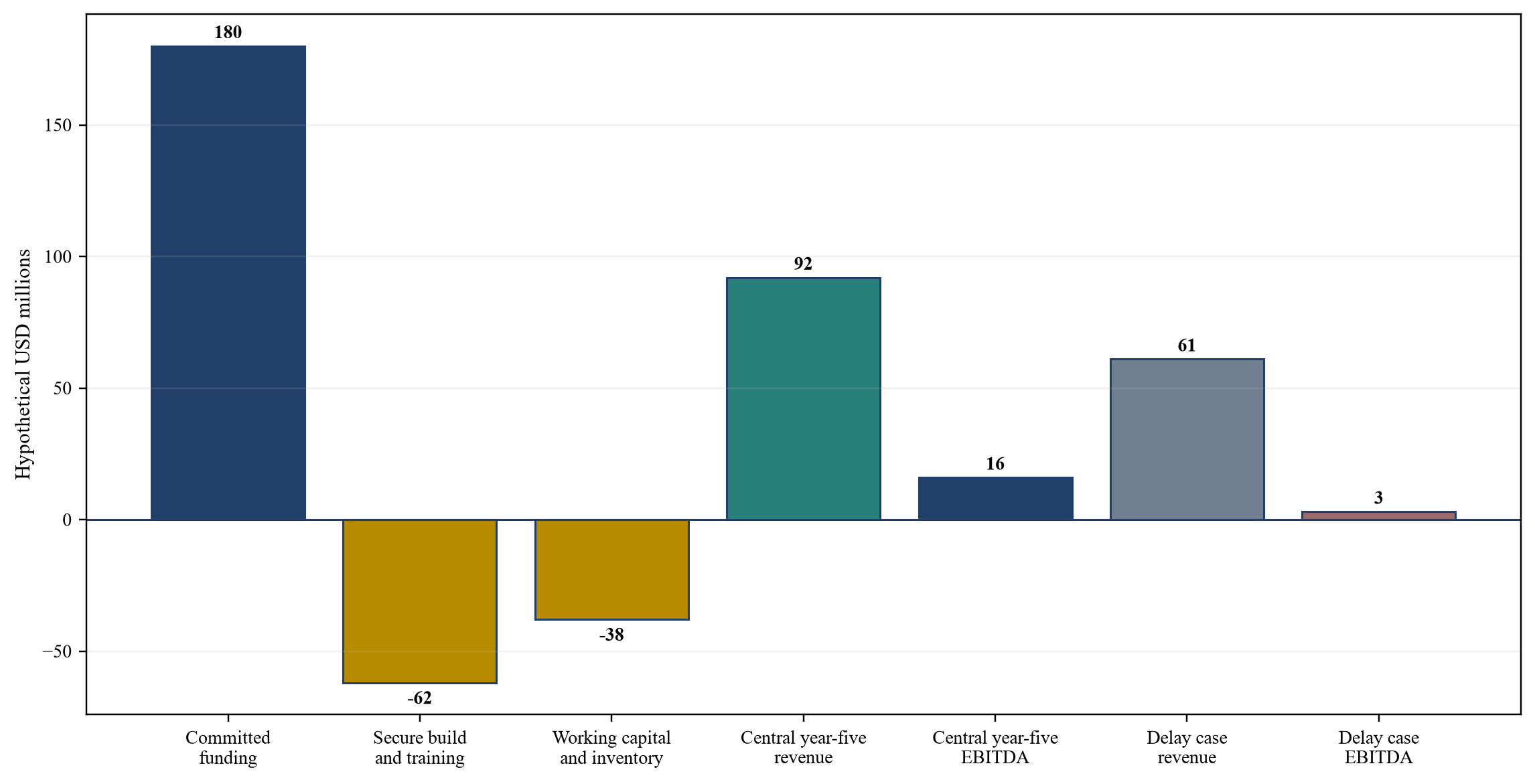
All values are hypothetical management assumptions in USD millions.
26. Establish board governance and accountable AI control
The board should receive a capability ledger, approval status, access exceptions, security events, training authority, customer acceptance, supply resilience, model changes, milestone economics and liquidity. Reserved matters and delegated authority should align with consequence.
AI governance should identify system owner, operational authority, data owner, model developer, validator, cybersecurity owner, user and independent assurance. High-consequence output should reach an authorised person with source evidence, confidence, limitations and fallback. Overrides require reason, evidence, authority and retention.
The venture should maintain internal audit and partner audit rights appropriate to the sensitivity. Reviews can test access, classification, authorisation scope, model lineage, configuration, third parties, records, incident response and corrective action. Findings need owners and due dates. The board information design should separate a legal right from an operating condition. An approval can remain valid while an access-control failure makes continued use unsafe. A model can remain technically available while its evaluation evidence no longer supports the intended purpose. A customer contract can remain in force while a security incident requires suspension. The dashboard should therefore show authority, security, performance, customer acceptance and liquidity as distinct dimensions, together with their interactions.
Committee mandates should follow competence and consequence. The joint-venture board owns strategy, capital, reserved matters and continuity. A programme board owns delivery, acceptance and customer commitments. A security committee owns accredited boundaries, access exceptions and incident response. A configuration or design authority owns approved baselines and bounded changes. A model-governance forum owns AI purpose, validation, monitoring and retirement. Each committee needs a defined escalation path when a decision crosses another mandate.
Change control should cover more than technical configuration. New investors, directors, nationalities, secondees, subcontractors, facilities, cloud services, development tools, data sources, models, interfaces, end users and territories can alter the approved risk position. The company secretary and compliance function should maintain a change trigger register and obtain review before implementation. Emergency action needs a narrow authority, retained evidence and prompt retrospective review.
Metrics should support intervention. Suitable measures can include approvals approaching expiry, access exceptions, overdue security actions, training authority achieved, rejected configuration changes, model-evaluation failures, customer acceptance delay, critical supplier coverage, cash to the next capability gate and time to execute the continuity plan. Targets should be interpreted with source evidence and consequence; a green average should not conceal one critical prohibited or unsafe condition.
27. Build the transaction data room as a controlled evidence system
The data room should separate commercial, corporate, technical, export-controlled, security-restricted and customer-controlled material. Admission should follow identity, nationality where legally relevant, need, authorisation, agreement and device or location controls. Download restrictions do not replace lawful access analysis.
Core records include ownership, products, classifications, licences, agreements, provisos, end users, technical-data registers, intellectual property, software bill of materials, model cards, data provenance, cybersecurity architecture, facility evidence, personnel approvals, training, quality, certifications, supply chain, contracts, finance, tax, insurance and disputes.
Every investment-committee conclusion should link to a dated source, reviewer, confidence and open condition. Management presentations are evidence of representation, not independent verification.
28. Execute a controlled first 100 days
Days 1 to 20 should confirm governance, authorised perimeter, people, sites, systems, customer interfaces and stop-work rules. Days 21 to 50 should establish segmented environments, access administration, records, security monitoring, programme controls and funding gates. Days 51 to 80 should run supervised training, quality and support cycles. Days 81 to 100 should conduct an operating exercise covering a configuration change, cyber event, supply interruption and authority escalation.
The first 100 days should avoid broad system integration or uncontrolled data migration. Each interface needs purpose, classification, approval, owner, logging and exit. Any temporary arrangement needs an expiry and accountable conversion plan.
The board should receive evidence of what is operational, what remains supervised, what is pending authority, which milestone economics have been released and whether liquidity covers the next gate and downside case.
29. Use a thirty-month capability and transaction roadmap
The roadmap should connect transaction, approval, build, competence and customer gates. Months 0 to 3 define outcome, partner perimeter and preliminary classifications. Months 3 to 6 complete diligence, applications, operating design and definitive documents. Months 6 to 12 build the secure environment and begin authorised training. Months 12 to 18 demonstrate production or support capability. Months 18 to 24 expand accepted local authority. Months 24 to 30 test resilience, option rights and export readiness where permitted.
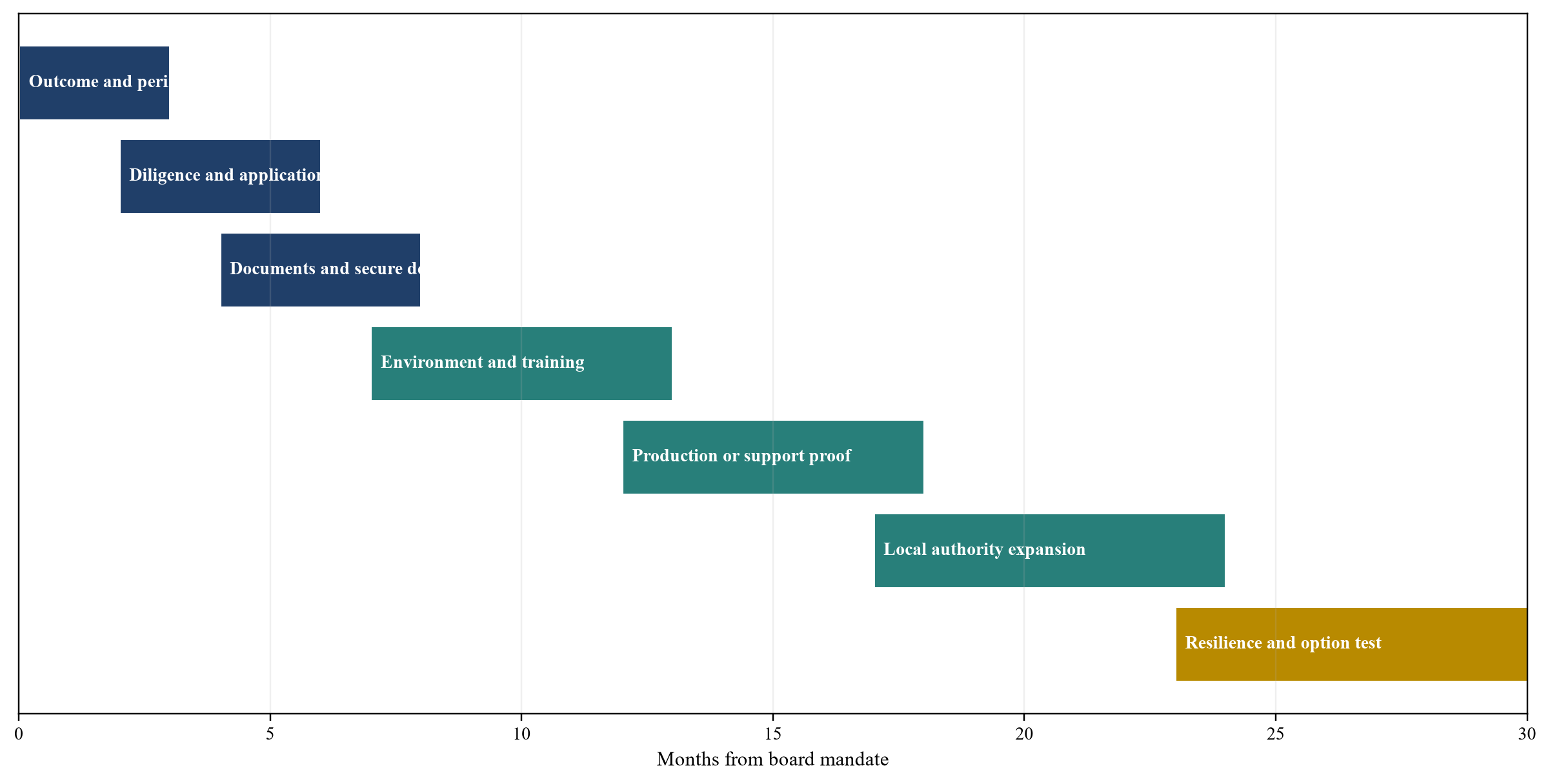
Timing is illustrative; authority, customer, product and security requirements determine the actual programme.
30. Define the investable and executable defence joint venture
A defence joint venture becomes investable when the sovereign outcome, controlled perimeter, partner contribution, approvals, secure architecture, competence pathway, customer acceptance, economics, governance and exit continuity form one evidence chain. The board should avoid paying for capability that is described in a strategy deck but absent from an authorisation, operating design or demonstrated local task.
Proceed when the venture can identify what it may receive, know, do, modify, manufacture, maintain and export at each stage; when customer and authority dependencies are transparent; when AI and data remain within accountable controls; and when funding follows evidence. Defer when critical rights, data boundaries, people, facilities or approvals remain undefined. Reject when the commercial case depends on prohibited access, unsupported authority outcomes or an exit that cannot preserve customer support.
The practical output is a controlled transaction architecture rather than a promise of unrestricted transfer. That architecture can still create valuable local capability, resilient support, industrial learning and aligned economics when each party commits only what it can lawfully and operationally deliver.
| Gate | Required evidence | Approver | Stop condition |
|---|---|---|---|
| sovereign outcome | funded requirement and capability definition | sponsor board | ambition without operating consequence |
| controlled perimeter | classifications, parties, activities and sites | compliance and counsel | unresolved prohibited access |
| operating design | segregated systems, roles and decision authority | JV boards and security owners | architecture cannot meet required controls |
| economics | milestone funding and downside liquidity | investment committee | value depends on ungranted capability |
| customer acceptance | qualification, security and delivery path | customer and programme authority | no executable acceptance route |
| closing | documents, approvals and readiness evidence | authorised boards | material condition remains unsupported |
| continuing operation | renewals, monitoring, audit and exit readiness | JV board | loss of lawful or safe operating basis |
Proposed governance checklist; actual approvals and professional opinions are transaction specific.
Sources
- U.S. Department of State, Directorate of Defense Trade Controls, International Traffic in Arms Regulations. Read the primary source
- U.S. Department of State, Directorate of Defense Trade Controls, Agreement Guidance and DECCS industry resources. Read the primary source
- U.S. Department of State, Directorate of Defense Trade Controls, Manufacturing Licensing Agreement FAQ. Read the primary source
- U.S. Department of Commerce, Bureau of Industry and Security, Export Administration Regulations Part 734. Read the primary source
- U.S. Department of Commerce, Bureau of Industry and Security, Export Administration Regulations Part 744. Read the primary source
- UK Government, Export controls: military goods, software and technology. Read the primary source
- UK Government, Military end-use controls. Read the primary source
- European Union, Regulation (EU) 2021/821 setting up a Union regime for the control of exports, brokering, technical assistance, transit and transfer of dual-use items. Read the primary source
- United Arab Emirates, Federal Decree-Law No. 45 of 2021 Concerning the Protection of Personal Data. Read the primary source
- United Arab Emirates Cybersecurity Council, National Cloud Security Policy. Read the primary source
- Saudi Data and AI Authority, Personal Data Protection Law and implementing resources. Read the primary source
- Saudi Data and AI Authority, Regulation on Personal Data Transfer Outside the Kingdom. Read the primary source
- Saudi National Cybersecurity Authority, Essential Cybersecurity Controls. Read the primary source
- Saudi National Cybersecurity Authority, Cloud Cybersecurity Controls. Read the primary source
- National Institute of Standards and Technology, Artificial Intelligence Risk Management Framework 1.0. Read the primary source
- National Institute of Standards and Technology, Cybersecurity Framework 2.0. Read the primary source
- National Institute of Standards and Technology, Protecting Controlled Unclassified Information in Nonfederal Systems and Organizations, SP 800-171 Rev. 3. Read the primary source
- OECD, AI Principles. Read the primary source
- International Organization for Standardization, ISO/IEC 42001 AI management systems overview. Read the primary source
- Wassenaar Arrangement, Control Lists. Read the primary source
- United Nations Office for Disarmament Affairs, Arms Trade Treaty. Read the primary source
- U.S. Department of Defense, Cybersecurity Maturity Model Certification programme. Read the primary source
