

1. Define the lending decision
The lending decision is whether an engineering borrower can convert evidenced work into cash on a timetable that supports interest, amortisation, bonding and operating liquidity. The question is narrower than whether the business has a large pipeline or recognised revenue. Tender opportunities may never be awarded. Awards may remain unsigned. Backlog may include work that is delayed, margin-dilutive or dependent on unfunded customer decisions. Revenue may be recognised before certification or collection. A contract asset may therefore be economically valuable while remaining unavailable for near-term debt service.
The GCC context increases both opportunity and execution intensity. IMF reporting describes resilient non-hydrocarbon activity supported by investment, construction and reform, while central-bank reports continue to examine corporate credit, financial resilience and sector concentrations [1-3]. Government procurement platforms in the region are increasingly digital, creating richer records from tender through invoice and payment [4]. These developments can improve evidence quality, but they do not remove contract-specific risk. Each lender still needs to understand award authority, scope, payment mechanics, variation rights, retention, guarantees, dispute procedures and customer behaviour.
The proposed system treats bid-to-cash as a causal chain. Every forecast line must connect to a source document, an accountable owner, a probability rule and a defined credit consequence. AI supports evidence classification, exception detection and conditional forecasting. It does not convert an uncertain tender into collateral or override contractual and accounting analysis.
| Stage | Primary evidence | Principal uncertainty | Credit treatment |
|---|---|---|---|
| Tender | Portal record, submission and bid approval | Award probability and timing | Excluded from borrowing base; scenario only |
| Award | Formal notice and authority confirmation | Conditions precedent and cancellation | Discounted until contract execution |
| Backlog | Executed contract and approved scope | Margin, schedule and termination risk | Eligible only after quality tests |
| Progress | Site record, procurement and cost evidence | Completion estimate and rework | Supports forecast subject to certification |
| Certification | Engineer or customer approval | Approval delay and deduction | Eligible after ageing and dispute filters |
| Invoice | Accepted invoice and payment terms | Set-off, retention and administrative delay | Advance rate after concentration limits |
| Collection | Bank receipt reconciled to invoice | Reversal, allocation and currency | Realised cash available for debt service |
Each stage must meet its own evidence threshold before it influences availability or covenant headroom.
2. Establish the regional operating context
Engineering companies in the Gulf operate across public infrastructure, utilities, energy, industrial facilities, buildings, technology systems and specialist services. Their commercial models range from fixed-price engineering, procurement and construction to remeasurement, framework, maintenance and design contracts. The risk profile depends more on contract mechanics and delivery discipline than on the sector label. A well-controlled remeasurement contract can produce stronger cash conversion than a nominally lower-risk fixed-price contract with poorly governed scope.
Public procurement increasingly leaves digital evidence. The UAE Ministry of Finance describes a federal platform that supports tender publication, bid submission, award tracking, purchase orders, invoices, payment processes and electronic contract signing [4]. The World Bank procurement framework likewise emphasises contract-management plans, deliverables, milestones, payment procedures, key performance indicators, variation controls and records [5-7]. These practices provide a useful evidence architecture for lenders even when a project is privately procured.
Credit underwriting should identify the legal employer, contracting entity, funding source, supervising engineer, payment authority and dispute forum. Government ownership alone is not a substitute for an executed payment obligation. A state-related customer may have strong ultimate capacity while operating approvals remain slow. A private developer may pay quickly on one project and defer another. Customer identity, project funding, contract terms and observed payment behaviour should therefore remain separate variables.
3. Map the bid-to-cash control chain
The control chain begins before bid submission. Management approves the opportunity, price, capacity allocation, bond requirement, working-capital demand and contractual exceptions. After award, the signed contract creates the authoritative scope and payment rules. Delivery data then moves through procurement, timesheets, quantities, progress records, certification, invoicing, collection and close-out. Each hand-off creates a possible delay or data break.
A lender-facing model should mirror these stages rather than rely on one aggregate forecast. The model needs dated states, reason codes and transitions. A tender may move from identified to qualified, submitted, preferred bidder, awarded, contracted or lost. A milestone may be planned, achieved, submitted, certified, invoiced, paid or disputed. Variations need instructed, priced, submitted, negotiated, approved and collected states. This event structure makes slippage visible and supports survival or transition models.
The borrower should own a reconciliation between commercial systems, project controls, accounting ledgers and bank receipts. Differences should remain visible until resolved. If the project system reports a certified amount that is absent from receivables, the model should create an exception. If the ledger records a receipt that cannot be matched to an invoice, the cash should remain outside performance analysis until allocation is confirmed.
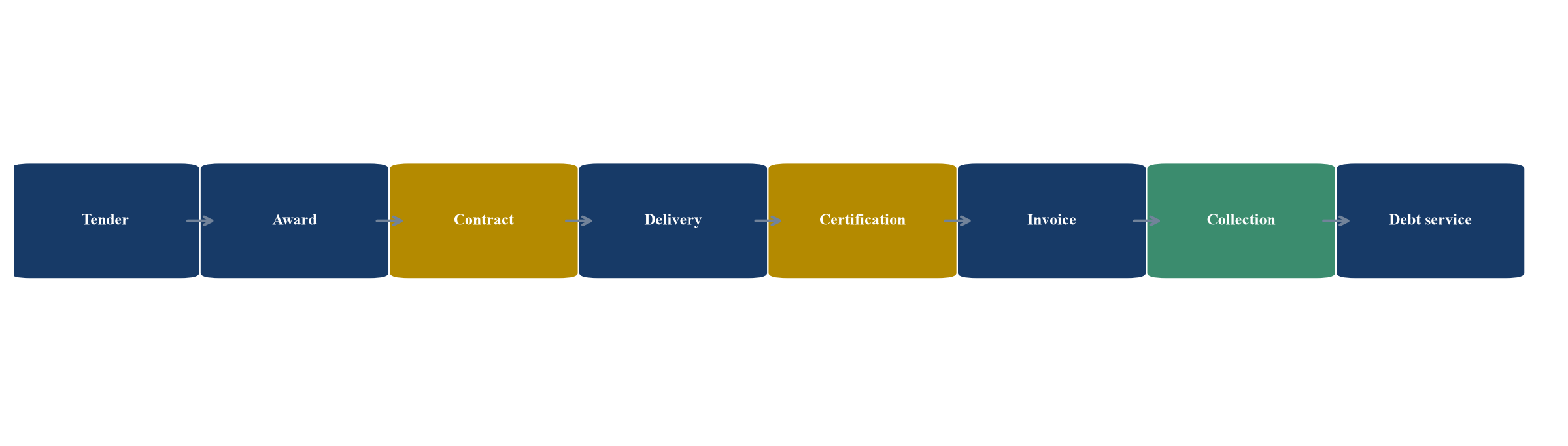
Proposed decision sequence. Forecast outputs affect financing only after contract, accounting and commercial corroboration.
4. Reconcile contract accounting with cash availability
IFRS 15 requires revenue to depict the transfer of promised goods or services and addresses performance obligations, transaction price, variable consideration and measures of progress [8]. For engineering contracts, recognised revenue can differ materially from billing and cash. Contract assets can arise when performance precedes an unconditional right to consideration. Contract liabilities can arise when billing or payment precedes performance. Variable consideration may include incentives, penalties, claims and other uncertain amounts subject to constraint.
The credit model should preserve these accounting distinctions. Revenue is relevant to profitability, yet it is not itself collateral or cash. Unbilled work requires evidence of performance, enforceable entitlement and expected certification. Certified amounts require invoice and collection analysis. Retention may be collectible only after completion, defects correction or expiry of a liability period. Claims may have economic merit without satisfying the eligibility standards of a borrowing base.
IFRS 9 requires expected credit losses to reflect probability-weighted outcomes, time value and reasonable, supportable information about past events, current conditions and forecasts [9]. The accounting allowance and the lender's advance rate serve different purposes. The lender can use accounting evidence while applying stricter eligibility, concentration, ageing and dilution controls. Any difference should be explained rather than hidden inside a single adjustment.
5. Build the data contract
A bid-to-cash model requires a data contract: a documented agreement on fields, definitions, source systems, owners, refresh frequency and quality rules. Core identifiers include legal entity, customer, project, contract, variation, milestone, certificate, invoice, receipt and bank account. Each identifier should survive system migration and reconcile across ledgers. Free-text project names are insufficient because spelling and hierarchy change over time.
The contract register should capture governing law, currency, price basis, payment interval, certification authority, retention, advance recovery, liquidated damages, caps, termination, suspension, variation procedure, claims notice, set-off, bond terms and dispute process. The operating register should capture baseline schedule, current schedule, physical progress, committed cost, forecast cost, procurement status, labour, subcontractors, quality events and safety interruptions. The cash register should link certified values, invoices, credit notes, receipts, deductions and unapplied cash.
Data quality should be reported as a credit metric. Missing contract amendments, late project updates, unreconciled certificates and stale collection promises weaken forecast reliability. A lender may respond with lower eligibility, higher reserves, more frequent reporting or an independent review. The system should never fill a missing field silently. Imputation can support analysis, but the original absence and method must remain visible.
6. Model tender conversion conservatively
Tender forecasting is useful for liquidity planning because bid costs, bonds, mobilisation and capacity commitments occur before or around award. It is dangerous when pipeline is treated as contracted revenue. The appropriate task is to estimate conditional transition probabilities and time to decision for well-defined tender states. Features may include customer, procurement route, project type, bid size, competition, qualification status, submission quality, commercial exceptions, relationship history and prior stage duration.
Historical labels should distinguish lost, withdrawn, cancelled, deferred, awarded and awarded-but-unsigned outcomes. Combining them can inflate apparent win rates. Time-based validation matters because market conditions, customer budgets and bidding strategy change. A model trained on a period of abundant awards may overstate conversion when public spending is reprioritised. Human bid committees should retain authority over pursuit and pricing.
For financing, tender outputs belong in scenario analysis rather than collateral. A base operating case may include a probability-weighted portion of qualified tenders for resource planning. Debt service should remain supportable without speculative wins unless the facility is explicitly designed around acquisition or mobilisation and contains appropriate conditions. Forecast confidence should fall as the horizon extends.
7. Score backlog quality
Backlog is often presented as one number, yet its cash quality varies. A lender should segment backlog by contract status, funding, margin, remaining duration, billing profile, customer, concentration, termination rights, scope clarity, bond exposure, supply-chain dependency and historical performance. Backlog supported by a signed contract and funded purchase order can still be weak if the price is inadequate or the schedule is no longer achievable.
The quality score should remain decomposable. A single black-box score can conceal whether risk arises from customer delay, margin erosion, execution slippage or disputed scope. Each component should map to a control. Margin risk may reduce forecast cash. Customer risk may change the advance rate. Schedule slippage may increase reserve requirements. Contract ambiguity may exclude the asset entirely.
Backlog movement requires a roll-forward: opening balance, new awards, approved variations, revenue conversion, scope reductions, cancellations, foreign-exchange changes and closing balance. The roll-forward should reconcile to project-level records. Unexplained growth can indicate duplicate awards, provisional scope or an inconsistent definition. Lenders should specify which movements require notice or consent.
| Backlog category | Evidence standard | Principal risk | Indicative treatment |
|---|---|---|---|
| Executed and funded | Signed contract, authority and funded order | Delivery and collection | Eligible after margin and concentration tests |
| Awarded but unsigned | Formal award with outstanding conditions | Cancellation or delay | Scenario only or heavily discounted |
| Approved variation | Written instruction and agreed valuation | Certification timing | Eligible subject to ageing and dispute filters |
| Submitted claim | Notice and substantiation without agreement | Entitlement and timing | Excluded from borrowing base |
| Framework ceiling | Maximum potential call-off | No committed volume | Excluded; planning disclosure only |
| Forecast renewal | Commercial expectation | Customer choice | Excluded; downside sensitivity only |
Illustrative tests require adaptation to the facility documents and verified borrower data.
8. Forecast milestone and certification timing
Milestone forecasting should begin with the executed payment schedule and actual approval workflow. The model needs planned achievement, current forecast, evidence completion, submission, engineer review, customer approval and certificate issue dates. Delays should be attributed to a reason that management can act on: physical progress, missing documentation, quality hold, quantity dispute, customer instruction, engineer capacity or administrative processing.
Survival analysis or gradient-boosted duration models can estimate time to certification, provided historical event dates are reliable. The output should be a distribution rather than a single date. A 50th-percentile forecast can support operations, while liquidity and covenant tests should use more conservative percentiles and explicit severe cases. Model performance should be evaluated by calibration and timing error across customers and project types.
Certification is a legal and commercial event, not a purely statistical one. The executed contract determines who certifies, which documents are required, whether deemed approval exists and how deductions are made. Model outputs should trigger document review and follow-up priorities. They should not create an assumed entitlement where contractual evidence is absent.
9. Control variations and claims
Variations can protect margin when scope changes, or destroy liquidity when work proceeds without instruction and valuation. FIDIC materials emphasise notice, records, substantiation, valuation and determination in managing variations and claims [10]. The credit system should track every change from instruction through collection, including notice dates, authority, quotation, cost, time impact, negotiation, approval, certification and payment.
Approved and unapproved amounts must remain separate. Management may hold a strong commercial view of entitlement while the customer disputes causation, notice or valuation. The borrowing base should exclude unapproved claims unless the facility documents deliberately provide a specialised advance against them with independent assessment and substantial reserves. Expected recovery in the operating forecast should use explicit probabilities and timing ranges.
The model can rank variation files by ageing, missing evidence, customer behaviour, contract clause and similarity to historical outcomes. It can detect repeated work descriptions, inconsistent quantities or approvals outside authority. These tools support commercial discipline. Legal interpretation, entitlement and negotiation strategy require qualified human review.
10. Measure customer and approval-chain risk
Customer risk includes capacity to pay, willingness to pay, project funding, approval complexity and observed behaviour. A strong balance sheet does not ensure prompt certification. The model should map the approval chain from site engineer to quantity surveyor, project director, procurement, finance and treasury. Each transition needs an owner, evidence and typical duration.
Payment behaviour should be measured from contractual due date and from operational milestones. Metrics include days to certify, days from certificate to invoice, days sales outstanding, promise-to-pay accuracy, dispute frequency, deduction rate and receipt allocation lag. Analysis should separate borrower-caused delay from customer-caused delay. Poor documentation is a borrower control failure even when the customer ultimately pays.
Concentration should be tested at customer group, government ecosystem, sector, programme, project and certifier levels. Several contracts can share one approval authority or budget source. Apparent diversification may therefore disappear under stress. Limits should reflect correlated delay, not only legal names.
11. Build the collections forecast
The collections forecast should begin with invoice-level states: draft, submitted, accepted, queried, certified, due, promised, partially paid, disputed and settled. The authoritative due date comes from the contract and accepted invoice, adjusted only by documented events. Sales teams may provide useful intelligence, but an unsupported promise should not overwrite contractual ageing.
Machine learning can estimate payment timing from customer, project, invoice type, amount, certification duration, historical deductions, submission completeness and calendar effects. The model should be trained on receipts reconciled to invoices and tested out of time. Partial payments, netting, retention release and multi-invoice receipts require careful labels. An inaccurate reconciliation layer can make a sophisticated model useless.
The lender should receive a collections bridge from opening receivables to cash, credit notes, set-off, write-offs and closing receivables. Exceptions should focus management attention on high-value, high-impact items. Forecast accuracy should be reported by horizon and customer, together with bias. Persistent optimism should lead to recalibration, higher reserves or tighter availability.
12. Convert operating forecasts into cash flow
Project forecasts should roll into a 13-week cash forecast and a longer monthly model. The short-term model covers payroll, suppliers, subcontractors, tax, bonds, rent, debt service and committed capital expenditure. It should link receipts to specific invoices and payments to approved obligations. The monthly model tests margin, working capital, facility use and covenant headroom across the remaining tenor.
Revenue, gross profit and earnings before interest, tax, depreciation and amortisation should reconcile to project economics, yet cash conversion requires separate schedules for contract assets, receivables, retention, payables, advances and accruals. Bond collateral and restricted cash should not be treated as freely available liquidity. Supplier stretch can improve short-term cash while increasing delivery and legal risk.
The model should distinguish observed inputs, contractual inputs and management assumptions. Scenario changes should be traceable to specific drivers. A lender needs to see whether lower cash arises from fewer awards, delayed progress, certification slippage, collection delay, margin loss or supplier acceleration. Each cause implies a different covenant and remedy.
13. Design the borrowing base
A borrowing base converts eligible assets into availability through advance rates, exclusions, concentrations and reserves. For an engineering borrower, potential asset pools include accepted receivables, certified-but-unbilled amounts and selected contract assets. Eligibility should depend on enforceability, evidence, ageing, currency, jurisdiction, customer, dispute status, set-off rights, assignment restrictions and dilution history.
Unsigned tenders, framework ceilings, forecast renewals, unapproved claims, overdue disputed invoices and related-party balances should ordinarily remain outside the base. Retention may require a separate low advance rate or exclusion because collection depends on completion and defects obligations. Certified amounts can still be diluted by penalties, back-charges, tax, retention or reconciliation.
Reserves should address expected dilution, customer concentration, foreign exchange, bond collateral, payroll, tax, supplier criticality and forecast error. The facility documents should define calculations precisely and specify data cut-offs. Availability should never increase solely because a model changes. A verified asset event should support the change, and the calculation should remain reproducible without proprietary inference.
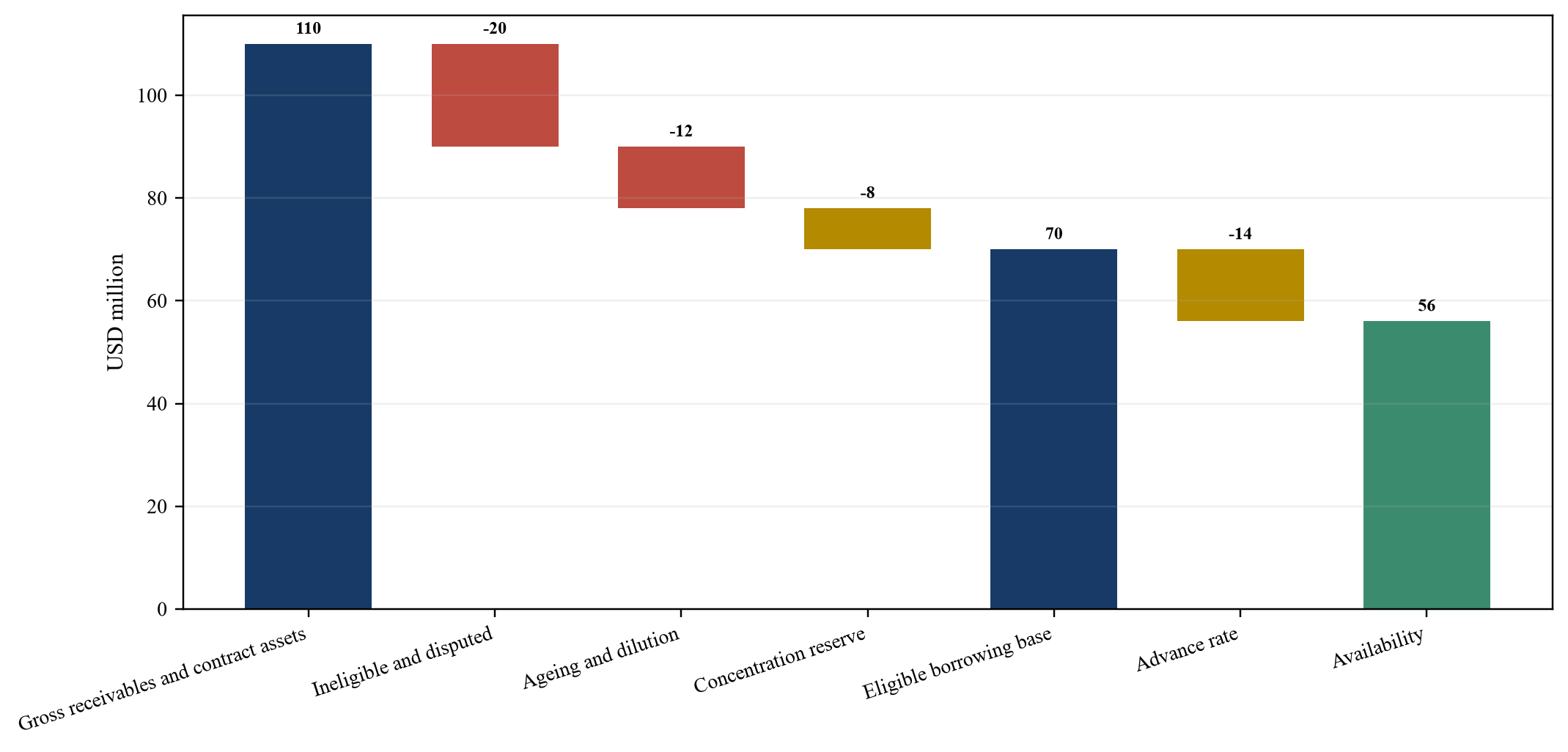
Management assumptions in USD million. Values demonstrate method only and do not represent observed assets or committed financing.
14. Design covenants around causal drivers
Financial covenants should capture debt capacity and liquidity while avoiding dependence on one noisy accounting measure. Appropriate measures may include minimum liquidity, fixed-charge or debt-service coverage, leverage, tangible net worth and borrowing-base availability. Engineering-specific covenants can add backlog quality, overdue receivables, unapproved variation exposure, customer concentration and bonding headroom.
Covenants require definitions that survive accounting and system changes. Cash should exclude restricted balances. Eligible backlog should require executed evidence. Coverage should specify permitted add-backs, working-capital treatment, tax and exceptional items. A forward-looking covenant can use the approved forecast only when inputs, refresh rules, validation and governance are defined.
Early-warning triggers should precede default. Examples include forecast variance, certification ageing, collection promise failure, margin deterioration, bond utilisation and supplier arrears. The response can progress from information and management calls to enhanced reporting, drawstop, reserve build, distribution lock-up, pricing increase or mandatory prepayment. Remedies should match the causal problem.
15. Address concentration and correlation
Customer concentration is only one dimension. Projects may share a programme, ministry, developer, certifier, bank, insurer, subcontractor, commodity, geography or funding decision. A delay in one approval body can affect several contracts simultaneously. The system should maintain a relationship graph that reveals common dependencies.
Concentration limits should use both exposure and cash-flow timing. A customer representing 20 per cent of backlog may represent 45 per cent of near-term collections. A critical supplier may affect several high-margin milestones. A single bond bank can constrain all new awards if capacity is exhausted. Scenario analysis should therefore stress correlated nodes rather than applying independent percentage reductions.
Graph analytics can identify clusters and central dependencies. Results require interpretation because common ownership does not always create common payment risk, and separate legal entities may still share budgets or approval. The documented mechanism determines whether a limit or reserve is appropriate.
16. Integrate guarantees and bonding capacity
Engineering contracts frequently require bid, advance-payment, performance and retention guarantees. These instruments consume bank lines, collateral and liquidity. Winning additional work can therefore weaken the borrower if bond capacity, advance recovery and working capital are not coordinated.
The forecast should link each tender and contract to required instrument type, amount, issue date, expiry, reduction schedule, beneficiary, issuing bank, collateral and counter-guarantee. Expired instruments that remain unreleased should be escalated. The lender should distinguish contingent exposure from funded cash collateral and model calls under severe scenarios.
Bonding headroom can operate as an early-warning metric or covenant. New awards should not be included in the base case when the required instruments cannot be issued on approved terms. A model can forecast utilisation and release dates, but legal terms, original documents and beneficiary behaviour need specialist review.
Advance payments require a separate bridge. They provide early liquidity while creating an obligation that is commonly secured by a guarantee and recovered through later certificates. The cash forecast should show receipt, permitted use, recovery profile, outstanding guarantee and the effect of termination. Treating an advance as unrestricted funding without the corresponding recovery and contingent exposure can materially overstate debt capacity.
The lender should also test concentration by issuing bank and beneficiary. A deterioration in the borrower's credit or a bank's risk appetite can reduce renewal or issuance capacity even when contracts perform. Expiry dates should be linked to contractual release evidence rather than assumed completion. A guarantee that has reached its stated expiry in the internal system may remain economically relevant when an extension request, original-document requirement or unresolved beneficiary claim is outstanding.
17. Select machine-learning tasks conservatively
Machine learning is suitable for bounded tasks with repeatable labels: tender-stage transition, milestone delay, certification duration, collection timing, invoice anomaly, margin drift and forecast residuals. Each task should support a named decision. Ranking overdue invoices for collection effort requires different accuracy and governance from changing a borrowing-base advance rate.
The first benchmark should be transparent. Historical averages, ageing curves, logistic regression and survival models provide useful comparators. More complex models should demonstrate stable improvement out of time and across customers. Calibration, false negatives, economic cost and drift matter more than one aggregate accuracy score.
Small samples and changing regimes are material risks. Engineering portfolios can contain few comparable projects, bespoke contracts and major one-off events. The model should preserve uncertainty, use ranges and abstain when evidence falls outside validated conditions. Expert rules may remain superior for rare contractual events.
18. Prevent leakage and unreliable labels
Leakage occurs when the model uses information unavailable at the forecast date. Final certificate value, later payment promise or resolved dispute outcome can accidentally enter a training feature. The result can appear accurate and fail in live use. Every feature needs an as-of timestamp and reproducible information cutoff.
Labels require economic meaning. A tender marked won before contract signature differs from an executed award. A milestone marked complete by a project manager may still await customer acceptance. An invoice marked paid can include a receipt later reversed or applied elsewhere. The training dataset should reconcile these distinctions and preserve corrections.
Missing data can also become a proxy for process quality. Projects with poor documentation may show weak collections because management control is weak, not because missingness causes non-payment. The model can use the signal while governance documents the mechanism and avoids punitive automated decisions.
19. Validate and govern the model
NIST's AI Risk Management Framework organises activity around govern, map, measure and manage, and emphasises testing, evaluation, verification, validation, documentation and context [11,12]. A lender-facing system should maintain an inventory describing purpose, owner, users, training data, limitations, approved decisions and prohibited uses. Material changes require approval and retesting.
Independent validation should assess conceptual soundness, data lineage, implementation, performance, calibration, stability, sensitivity, bias, security and fallback. Monitoring should compare forecast with actual award, certification and collection outcomes. A statistically stable model can remain economically wrong after a contract, customer process or accounting policy changes.
Human accountability needs named decision rights. Commercial teams own contract facts and collection actions. Finance owns ledger and cash reconciliation. Project controls own progress evidence. Risk owns facility treatment and overrides. Technology owns access, resilience and change control. The credit committee approves limits and exceptions. Every override should record rationale, evidence, owner and expiry.
20. Design the scenario set
The scenario set should isolate causal drivers before combining them. A tender scenario reduces awards and delays mobilisation. A delivery scenario slows progress and raises cost. A certification scenario extends approval times. A collections scenario increases days to cash and deductions. A variation scenario delays approval and reduces recovery. A combined severe case tests correlation.
Scenarios should flow through backlog, revenue, margin, contract assets, receivables, liquidity, facility use and covenants. The model must avoid double counting. A delayed milestone may already reduce revenue and invoice timing; applying an additional generic sales decline to the same work can overstate stress. Each shock needs a defined path and reconciliation.
Reverse stress testing begins with failure: the point at which liquidity, availability or coverage falls below the required level. The analyst then identifies the combination of award, certification, collection and margin conditions that causes the breach. This reveals monitoring thresholds and management actions before a crisis.
21. Demonstrate the hypothetical case
The illustrative borrower is a diversified Gulf engineering group. Management assumptions set annual revenue at USD 300 million, opening backlog at USD 420 million and a proposed revolving facility at USD 60 million. Base cash flow available for debt service is USD 34 million against USD 22 million of debt service, producing 1.55x coverage. These are constructed assumptions used solely to demonstrate the method.
The severe case assumes lower tender conversion, delayed certification, slower collection, partial variation disallowance and margin pressure. Cash flow available for debt service falls to USD 15 million and coverage to 0.68x. The protected case excludes weak assets from availability, adds a USD 12 million liquidity reserve, tightens collection governance and incorporates remedial pricing and procurement actions. Cash flow available for debt service improves to USD 27 million and coverage to 1.23x.
The protected case does not claim that controls create cash automatically. It assumes successful implementation and verified effects. A real transaction would require company data, executed contracts, legal review, accounting reconciliation, lender diligence and approval.
| Item | Base case | Severe case | Protected case |
|---|---|---|---|
| Annual revenue | USD 300 million | USD 258 million | USD 276 million |
| Opening backlog | USD 420 million | Same opening amount; weaker conversion | Same opening amount; eligibility filters applied |
| Revolving facility | USD 60 million | Fully drawn under stress | USD 56 million availability plus reserve |
| CFADS | USD 34 million | USD 15 million | USD 27 million |
| Debt service | USD 22 million | USD 22 million | USD 22 million |
| DSCR | 1.55x | 0.68x | 1.23x |
| Liquidity reserve | USD 4 million | Depleted | USD 12 million |
| Primary response | Normal monitoring | Drawstop, lock-up and remediation | Controlled lending with enhanced evidence |
All financial values and operating positions are management assumptions created solely to demonstrate the framework.
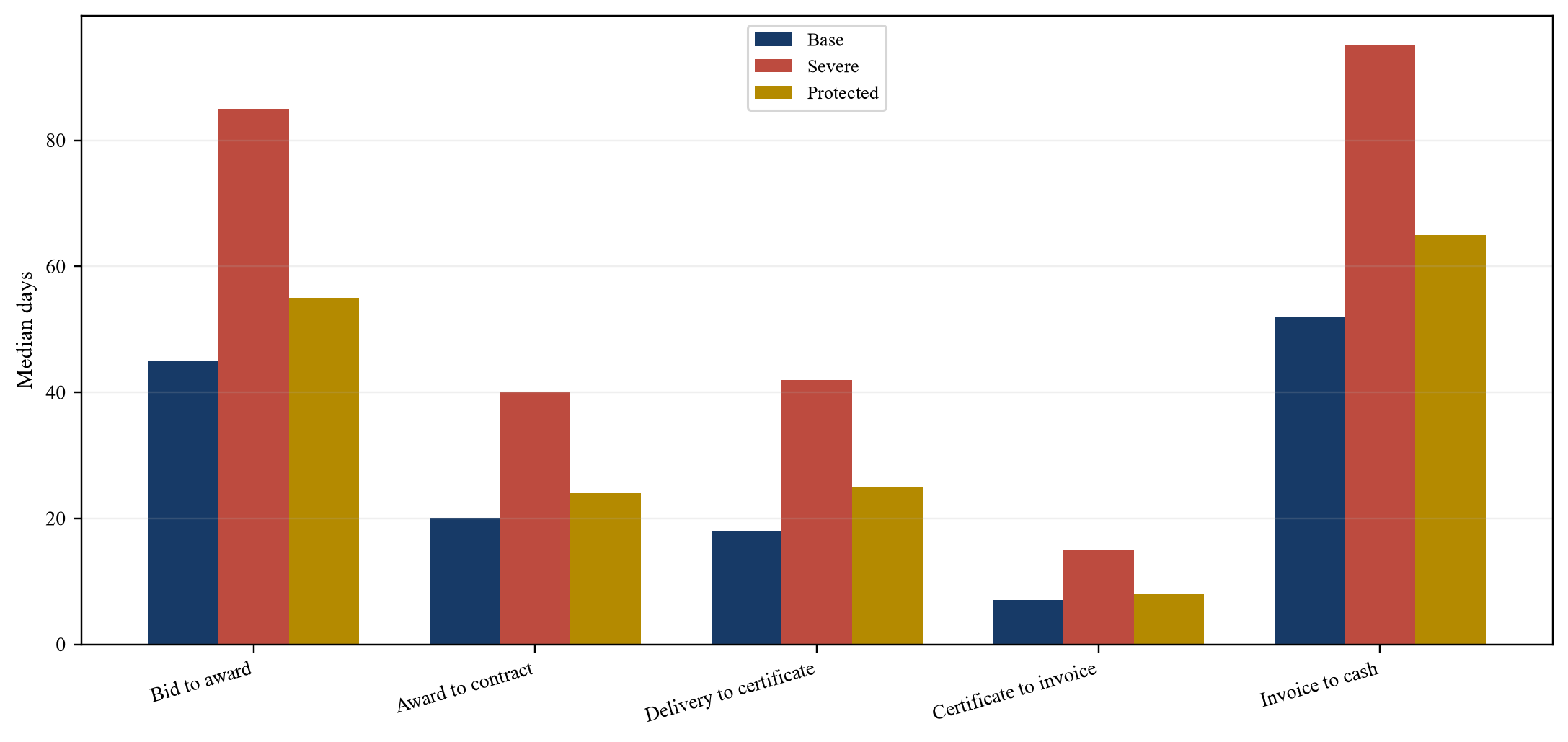
Management assumptions compare median days spent in each stage; they are not observed borrower performance.
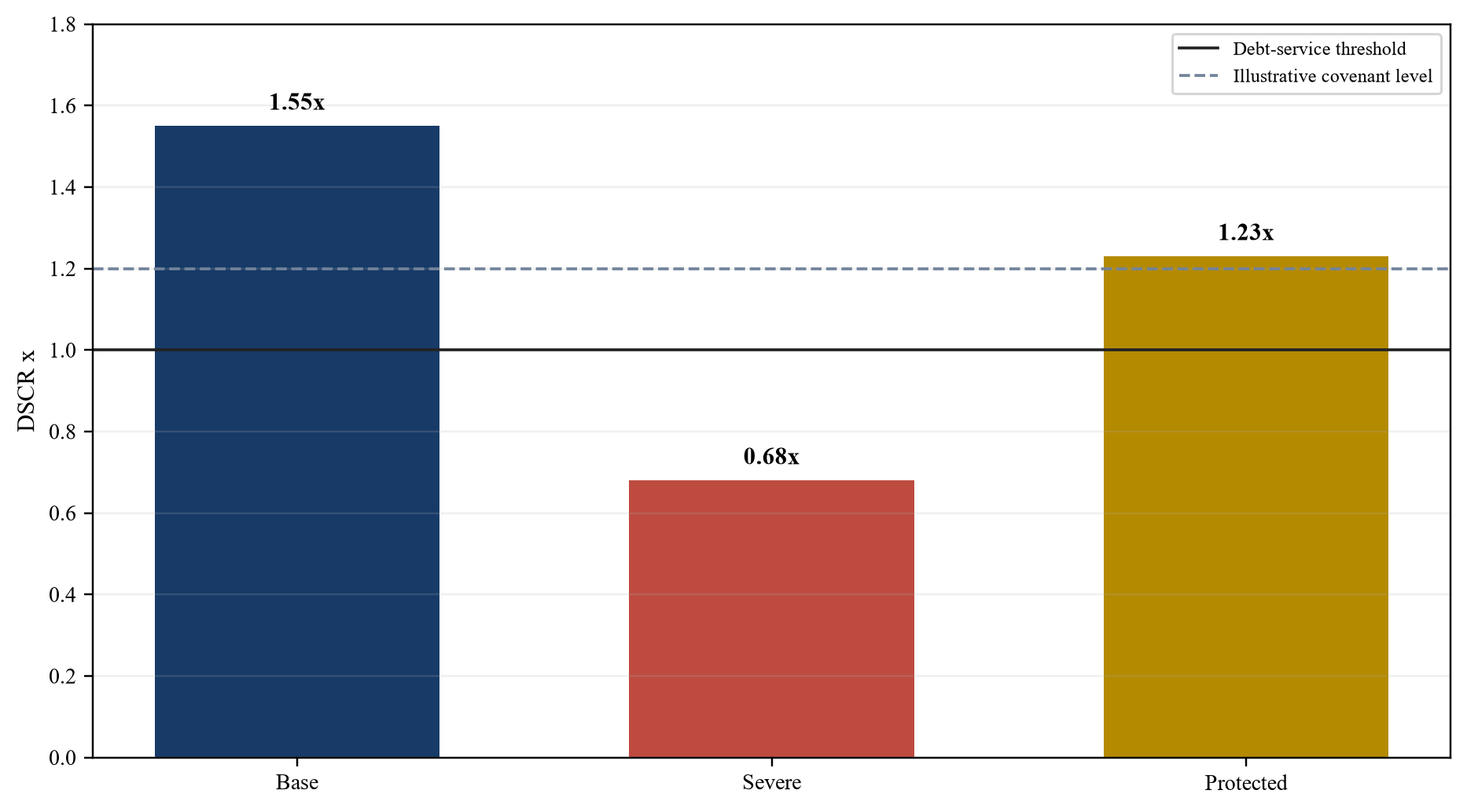
Management assumptions compare the base, severe and protected cases; values do not represent observed performance.
22. Translate results into facility terms
Facility terms should reflect the verified risk mechanism. A weak pipeline does not justify the same remedy as overdue certified receivables. Tender uncertainty may require lower reliance on forecast earnings. Certification delay may require exclusions, ageing reserves and document covenants. Collection weakness may require account control, customer notification or cash dominion. Margin loss may require equity support, drawstop or restructuring.
The information package can include weekly liquidity, monthly borrowing base, project roll-forward, backlog quality, milestone ageing, variations, claims, invoices, collections, bonding and covenant forecasts. Reporting frequency should increase when thresholds are breached. The lender needs direct access to source evidence and audit rights appropriate to the transaction.
Conditions precedent can include contract register completion, bank-account control, model validation, legal assignment review, insurance, bonding confirmation and independent project review. Conditions subsequent should have clear dates and consequences. Vague undertakings create uncertainty when performance deteriorates.
23. Create early-warning and cure rules
Early-warning indicators should combine level, trend and forecast error. Examples include rising uncertified work, certification delay beyond customer norms, overdue concentration, declining tender conversion, margin-at-completion deterioration, unapproved variation growth, supplier arrears and bond headroom below forecast need. Each indicator requires a threshold, owner, response and closure test.
Cures should address evidence and economics. Missing documents require completion and reconciliation. Collection delays require escalation and customer action. Margin erosion may require revised pricing, procurement, scope or capital. A covenant waiver without a causal remediation plan can defer the problem. A technical breach caused by a verified timing issue may justify a tailored cure when liquidity and ultimate collectability remain robust.
The model should produce an exception queue rather than a single risk colour. Credit teams need the projects, invoices and assumptions that drive the warning. Management should be able to challenge errors with evidence. Accepted corrections and overrides should feed back into monitoring without rewriting historical records.
24. Prepare for workout before distress
Workout readiness begins at underwriting. The lender should understand assignment rights, receivable redirection, set-off, step-in, bond calls, termination payments, equipment security, cash-control accounts and insolvency consequences. Legal advice must be jurisdiction-specific. The operating model should identify which projects can be completed profitably, transferred, subcontracted or exited.
Stress reporting should preserve cash and project priorities. Payroll, safety, critical suppliers and high-conversion milestones may require protection. New tender spending should be controlled. Collections teams should focus on certified, high-confidence balances. Management should avoid accelerating low-margin work merely to report revenue.
Data continuity matters during distress. If project knowledge sits in individual spreadsheets or personal email, the lender and restructuring team cannot reproduce the forecast. The bid-to-cash system should therefore maintain governed records, access controls, backups and change history throughout the facility life.
25. Implement the system in 100 days
The first 30 days establish definitions and evidence. The borrower freezes the contract register, maps systems, reconciles project identifiers, defines bid and milestone states, and selects a pilot portfolio. Finance reconciles contract assets, receivables, invoices and receipts. Legal and commercial teams catalogue material clauses, variations, claims and bonding.
Days 31 to 60 build the operating model. The team creates event ledgers, baseline forecasts, ageing curves, backlog quality tests and an initial borrowing-base bridge. Transparent benchmarks are implemented before advanced models. Credit and management agree scenario drivers, covenant definitions, data cut-offs and override rights.
Days 61 to 100 validate and operate. Models are tested out of time, compared with benchmarks and reviewed independently. The borrower runs weekly exception meetings and monthly lender reporting. A parallel run compares old and new forecasts before outputs affect availability. Deployment proceeds only after reconciliation, access, security, fallback and decision rights pass review.
Implementation should begin with a deliberately narrow pilot. A useful pilot covers a small set of material projects across different customers and contract forms, with enough historical certificates and receipts to test the end-to-end reconciliation. The team should record every manual intervention, missing document and definition dispute. These findings determine whether the priority is better data capture, stronger commercial control or additional modelling.
Success measures should be operational and financial. Examples include the percentage of backlog supported by executed evidence, the proportion of certificates reconciled to invoices, invoice-to-receipt matching coverage, forecast bias by horizon, time to resolve exceptions and the number of availability changes supported by independent evidence. A reduction in model error has limited value when the organisation does not act on the resulting warning.
| Finding | Evidence threshold | Financing action | Release or cure test |
|---|---|---|---|
| Unsigned award concentration | Formal awards with conditions outstanding | Exclude from base; scenario reserve | Executed contracts and verified funding |
| Certification ageing | Milestones submitted beyond validated norm | Ageing reserve and enhanced reporting | Certificate issued and ledger reconciled |
| Unapproved variation growth | Instruction or work without agreed valuation | Exclude and require commercial plan | Written approval and accepted valuation |
| Collection forecast bias | Repeated optimistic errors | Recalibration and liquidity reserve | Stable out-of-time performance |
| DSCR below covenant | Approved severe forecast | Drawstop, lock-up and remediation | Forward coverage and liquidity restored |
| Opaque model output | Missing lineage, validation or explanation | Exclude model from credit calculation | Independent validation and governance approval |
Illustrative actions should be tailored to executed contracts, facility documents and verified operating evidence.
26. Define board and lender reporting
The board should receive a concise bridge from opportunity to cash. It should show pipeline by verified stage, backlog movement, forecast margin, milestone and certification ageing, variations and claims, invoicing, collections, liquidity, facility use, bonding and covenant headroom. Each material variance should identify cause, owner, action and date.
The lender package should reconcile to approved management accounts and bank statements. It can contain more granular borrowing-base evidence, eligibility exclusions and model performance. The board and lender should use consistent definitions even when reporting detail differs. Competing versions of backlog, debt or cash undermine control.
Decision minutes should record significant overrides and waivers. A forecast change supported by a newly executed contract is different from a change based on management confidence. The evidence category should remain visible so readers can apply appropriate weight.
27. Recognise limitations
The framework cannot make poor contracts bankable or create enforceable payment rights. Model performance depends on data completeness, stable definitions and sufficient comparable outcomes. Bespoke projects and rare disputes can defeat statistical inference. Regional aggregation can conceal differences in law, procurement, customer practice and banking arrangements across GCC jurisdictions.
Hypothetical figures in this paper are management assumptions. They do not estimate a typical contractor, market default rate or achievable financing terms. A real facility requires borrower-specific diligence, legal and tax advice, accounting review, security analysis, model validation and lender approval. Public sources describe standards and market context; they do not verify any individual company's records.
AI tools can accelerate document classification, reconciliation and forecasting. They can also reproduce historical bias, leak future information, confuse correlation with cause and create false precision. Human review, evidence retention, uncertainty disclosure and override governance remain essential.
28. Conclusion
Engineering private credit becomes more defensible when underwriting follows the actual route from bid to cash. The lender should separate pipeline from award, award from contract, delivery from certification, certification from invoice and invoice from collection. Each transition needs evidence, timing, control and an accountable owner.
The proposed system combines contract architecture, project controls, accounting reconciliation, cash forecasting, borrowing-base design, covenants and bounded machine-learning tasks. It creates an auditable explanation of where debt service comes from, what can delay it, how much liquidity absorbs the delay and which action follows a warning.
The practical standard is reproducibility. A credit committee, board, auditor or successor team should be able to trace every material forecast and eligibility decision to source evidence and approved rules. When that standard is met, AI can improve attention and timing without displacing the legal, commercial and human judgement on which engineering credit depends.
Sources
- International Monetary Fund. Gulf Cooperation Council: Enhancing Resilience to Global Shocks. 2025. Read the primary source
- Central Bank of the UAE. Financial Stability Report for 2025. 2026. Read the primary source
- Saudi Central Bank. Financial Stability Report 2025. 2025. Read the primary source
- UAE Ministry of Finance. Digital Procurement Platform. 2026. Read the primary source
- World Bank. Project Procurement Framework. 2026. Read the primary source
- World Bank. Contract Management User Guide. 2022. Read the primary source
- World Bank. Procurement Regulations for Investment Project Financing Borrowers, seventh edition. 2025. Read the primary source
- IFRS Foundation. IFRS 15 Revenue from Contracts with Customers. 2024. Read the primary source
- IFRS Foundation. IFRS 9 Financial Instruments. 2024. Read the primary source
- FIDIC. Management of Variations and Claims. 2017. Read the primary source
- National Institute of Standards and Technology. AI Risk Management Framework 1.0. 2023. Read the primary source
- National Institute of Standards and Technology. AI RMF Core. 2026. Read the primary source
- OECD. OECD AI Principles. 2024. Read the primary source
- Basel Committee on Banking Supervision. Principles for the Management of Credit Risk. 2025. Read the primary source
- Federal Reserve Board and Office of the Comptroller of the Currency. Supervisory Guidance on Model Risk Management. 2011. Read the primary source
- International Organization of Securities Commissions. Thematic Analysis: Emerging Risks in Private Finance. 2025. Read the primary source
- World Bank. Contract Management General Principles. 2025. Read the primary source
- World Bank. Supply Chain Management Guidance. 2025. Read the primary source
- UAE Ministry of Finance. Federal Supplier Register. 2026. Read the primary source
- Saudi Ministry of Finance. Etimad Platform. 2026. Read the primary source
- International Chamber of Commerce. Uniform Rules for Demand Guarantees URDG 758. Read the primary source
- World Bank. Standard Procurement Documents for Works. 2025. Read the primary source
- Project Management Institute. Earned Value Management. 2026. Read the primary source
- International Organization for Standardization. ISO 19650 Information Management Using Building Information Modelling. Read the primary source
- Committee of Sponsoring Organizations of the Treadway Commission. Internal Control Integrated Framework. Read the primary source
- World Bank Group. Invoicing and Payment. 2026. Read the primary source
