

1. Treat GCC expansion as a portfolio of country options
The board's first decision is the shape of the expansion programme. A company can launch countries in parallel, move serially from one anchor market to the next, or run a controlled hybrid in which one country receives commercial launch capital while the others remain at low-cost evidence stages. The correct choice depends on the product's regulated perimeter, the strength of customer evidence, the degree of product reuse, management bandwidth and the cost of keeping each option alive.
Parallel entry can look faster because entity, licence, hiring and channel workstreams begin together. It also creates simultaneous dependencies. Documents require legalisation and translation. Product teams answer different regulator or customer questions. Finance builds several tax and invoicing processes. Management appoints country leaders before a repeatable sales motion exists. Cash leaves the business before the board can see which market has earned further investment.
Serial entry concentrates learning and capital. The first market can establish reference customers, implementation evidence, security materials, contracting positions and a regional operating rhythm. The weakness is path dependence. The first market may be easiest to enter while another market offers higher strategic value. A strictly serial plan can also delay regulatory work that has long lead times but modest early cost.
The hybrid model treats each country as a real option. Every market begins with a bounded discovery budget. It advances to regulator engagement, entity formation, hiring and launch only after evidence thresholds are met. This protects runway while preserving speed. It also forces management to define what it must learn before spending the next amount.
The board should approve the portfolio, the evidence gates and the maximum exposure at each gate. It should avoid approving six country launches as one undifferentiated budget. A regional ambition is not a capital-control mechanism.
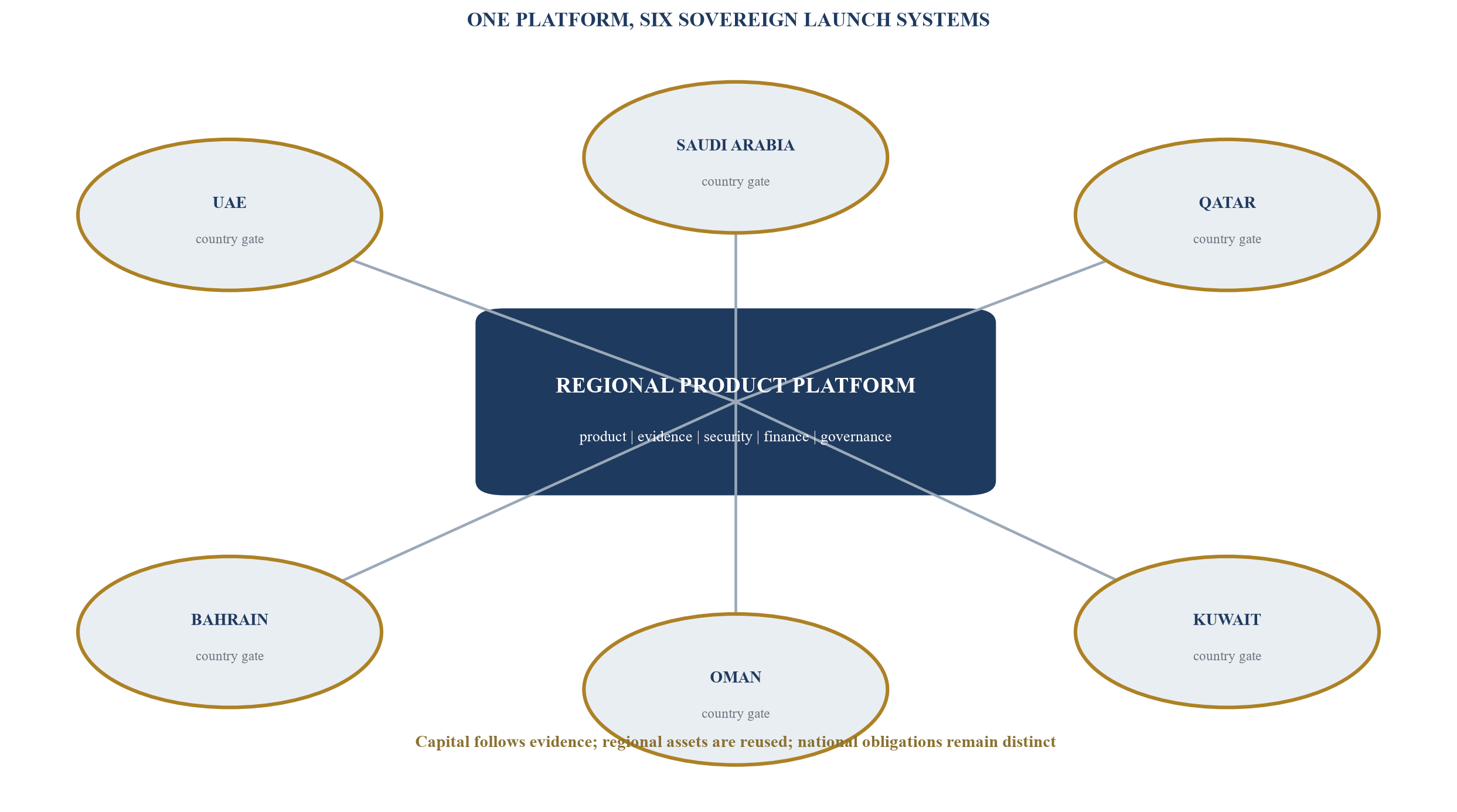
One product platform supports six country options; each option receives capital only after its evidence gate is passed.
2. Define the product before mapping the regulator
"One product" is frequently an incomplete description. The commercial proposition may include software, devices, embedded payments, data processing, advisory services, marketplace intermediation, lending, insurance distribution, health functionality, telecommunications, logistics, education, digital identity or public-sector integration. Each component can change the regulatory perimeter and the entry route.
The product definition should identify the contracting entity, customer, user, functionality, data collected, location of processing, funds flow, revenue model, hardware, claims made in marketing and the party that controls each operational step. Management should also identify optional features that can be disabled for an initial launch. A product with regulated functionality removed may reach market earlier, provided that the reduced proposition still solves a valuable customer problem and is described accurately.
The perimeter memo should be a living control document. It records which features appear in each country version, which authority or professional adviser has reviewed the position, what assumptions support the conclusion, and what event triggers a refresh. A change in payments, data use, customer segment, local hosting, distribution, ownership or pricing can alter the analysis.
The board should require country advice to answer a consistent set of questions. Does the company need an entity, branch, distributor, agent, sponsor, professional licence or sector approval? Can sales begin cross-border? Which activities can the local entity perform? Who may invoice and collect? Are product certification, data transfer, local hosting, cybersecurity, Arabic documentation, consumer protection or record-retention controls relevant? Does the customer require local vendor registration even when law permits cross-border supply?
This discipline avoids two expensive errors. The first is forming an entity before confirming that it can perform the intended activity. The second is accepting a distributor's assurance that its licence covers the product without independent confirmation of the commercial and regulatory boundaries.
Table 1. Product-perimeter evidence register
| Product element | Board question | Required evidence | Gate consequence |
|---|---|---|---|
| contracting party | which entity signs, invoices and carries liability? | proposed contract chain, licence scope and tax review | no commercial launch without confirmed authority |
| regulated functionality | does any feature require a sector licence or approval? | current jurisdiction memo and authority engagement plan | feature disabled or approval obtained |
| funds flow | who receives, holds, converts or remits customer funds? | end-to-end flow diagram and regulated-party analysis | no live transaction until the flow is approved |
| personal and sensitive data | what is collected, where is it processed and transferred? | data map, lawful basis, transfer mechanism and security controls | pilot restricted to approved data set |
| physical product | are standards, conformity, customs or labelling rules relevant? | classification, certificates, importer record and clearance plan | inventory not committed before clearance path |
| customer type | do consumer, government or regulated-customer rules apply? | segment-specific obligations and procurement route | segment remains excluded until ready |
| revenue model | are fees, commissions, subscriptions or interest treated differently? | contract, accounting and tax analysis | pricing and invoice design updated before quote |
The board should maintain this register for each country version and refresh it when functionality, counterparties or funds flows change.
3. Separate regional assets from country obligations
The expansion model becomes more efficient when management identifies what can be built once and what must be local. The regional layer can include core product code, brand, master security controls, reference architecture, investor reporting, product documentation, a standard diligence room, management accounts, a pricing engine and a shared enterprise-sales methodology. These assets should be designed for controlled country variation.
The country layer includes entity and activity registration, sector licence, tax registration, payroll, immigration, local employment requirements, data-transfer implementation, product conformity, invoicing, customer contracting, dispute provisions, channel appointments and government vendor registration. Some work can be coordinated regionally. The final position remains dependent on each country's law, regulator, activity and customer.
The GCC's economic architecture supports the regional thesis. The GCC Economic Agreement describes a Customs Union and common treatment for goods produced in member states, subject to the agreement and national implementation. The GCC Secretariat also records continued work on the Common Market and cross-border trade in services. These mechanisms can reduce friction, yet they do not create a single corporate licence, single data regime, single tax registration or single sector regulator.
Management should build a reusable evidence pack. It can contain incorporation documents, shareholder and beneficial-owner information, audited accounts, bank references, product architecture, information-security policies, intellectual-property ownership, standard contracts, insurance, leadership biographies, source-of-funds evidence and translations. Each country workstream then draws from one controlled source.
Reuse should never become careless copying. A document accepted in one country may need different notarisation, legalisation, Arabic translation, age, format or issuing authority in another. The control tower should record the document owner, current version, expiry, permitted use and country-specific adaptation.
4. Build the six-market entry map
A useful market-entry map does not attempt to state every rule. It identifies the decisions that require current confirmation and the official sources that anchor the work. The regulatory perimeter varies by activity. A technology vendor, healthcare platform, lender, marketplace, industrial product company and professional-services firm will not use the same route.
In the UAE, official government materials state that foreign investors may own up to 100 percent of many mainland businesses, while strategic activities and sector-specific approvals can remain restricted. Corporate tax, VAT, data protection and the phased electronic-invoicing programme form distinct workstreams. Free-zone and mainland routes also have different commercial implications.
Saudi Arabia's updated Investment Law uses an investment-registration framework and requires foreign investors to register before engaging in investment, with separate competent-authority approvals for relevant activities. The MISA investor guide, ZATCA electronic-invoicing requirements, personal-data rules and government-procurement and local-content systems add operational layers. A company selling to government should examine the regional-headquarters and procurement context with current advice.
Qatar's official materials describe foreign ownership up to 100 percent in permitted sectors under Law No. 1 of 2019, with exclusions and approvals depending on activity. The Ministry of Commerce and Industry's Single Window integrates multiple establishment steps. Qatar's General Tax Authority states that VAT has not been applied as at the publication date of its current investor guide.
Bahrain uses the Sijilat system for commercial registration and activity approvals. The National Bureau for Revenue administers VAT, and the Personal Data Protection Authority publishes the national data framework. Oman provides investment materials and the Foreign Capital Investment Law framework through Invest Oman, with separate tax and personal-data requirements. Kuwait's KDIPA route can permit investment entities under its direct-investment framework, while the Ministry of Commerce and Industry, sector authorities, tax rules and CITRA data requirements remain relevant.
Table 2. Six-state market-entry map
| Market | Entry anchor | Early board questions | Operational evidence before launch |
|---|---|---|---|
| United Arab Emirates | relevant emirate authority, mainland or free-zone route, sector regulator where applicable | permitted ownership, activity scope, mainland access, tax, data, e-invoicing and customer procurement | licence, tax registrations, data map, accredited e-invoicing readiness where in scope, bank and contracting controls |
| Saudi Arabia | MISA registration plus competent authorities for the activity | excluded activity, commercial registration, sector approval, data transfer, Fatoorah, local content, RHQ and procurement relevance | registration and licences, invoice integration, local operating owner, employment plan, tender/vendor eligibility |
| Qatar | MOCI and Single Window, or a specialised regime where selected | permitted foreign ownership, excluded sector, entity route, tax, data, labour and customer approval | CR and licences, tax card, authorised signatory, data controls, vendor registration and invoicing |
| Bahrain | MOIC Sijilat plus relevant sector authority | activity preconditions, ownership, UBO, VAT, data, employment and economic-substance requirements | CR and activity approvals, VAT status, data controls, payroll and customer contracting |
| Oman | MOCIIP/Invest Oman plus competent authority | Foreign Capital Investment Law route, activity licence, Omanisation, tax, VAT, data transfer and customs | registrations, licence, tax account, workforce plan, data permit position and importer/customer readiness |
| Kuwait | KDIPA or other lawful establishment route plus MOCI and sector authority | negative list, investment entity, business plan, ownership, tax, data, labour and procurement | licence and entity issuance, sector approvals, privacy controls, banking, workforce and customer route |
This is a board scoping map based on current official sources; activity-specific advice must identify the actual authority, licence, entity and timing.
Six country evidence briefs
The UAE evidence brief should begin with the intended emirate, customer location and activity. Management should compare mainland and relevant free-zone routes using the same commercial facts. The brief should state who contracts, whether the entity can serve the target customer, how people are employed, where data is processed, how corporate tax and VAT are addressed, and how electronic invoicing affects the systems plan. A free-zone registration can be operationally efficient for a particular model, while the selected licence, qualifying conditions, customer route and tax position require current confirmation. Customer procurement can impose mainland, local-office, security or vendor-registration expectations beyond the incorporation question.
The Saudi evidence brief should distinguish investment registration, commercial registration and sector permission. It should identify whether the activity is restricted, whether a competent authority must approve it, and when product, data, tax and people workstreams begin. The commercial plan should map ZATCA invoicing requirements, data governance, employment and localisation, local content, tender eligibility and any regional-headquarters relevance to the intended customer base. Management should test the buying cycle with actual accounts because government, state-linked, regulated and private customers can follow different routes. The budget should include translation, documentation and integration work before a launch date is promised.
The Qatar evidence brief should identify whether the proposed activity is permitted for the selected ownership and establishment route, whether a specialised platform or zone is relevant, and which Ministry or sector approvals apply. The Single Window can coordinate establishment steps, but the company still needs a product-specific view of licence, tax, data, people, bank and customer procurement. Management should verify the current indirect-tax position when pricing. The commercial evidence should identify the economic buyer, vendor-registration steps, budget source, implementation authority and the customer evidence that can support further expansion.
The Bahrain evidence brief should start with the exact Sijilat activity and any preconditions or external approvals. It should cover beneficial ownership, premises, employment, banking, VAT, data and customer contracting. Bahrain can serve as a cost-efficient operating or testing base for some models, but that proposition should be demonstrated using the company's customers, team design and regulated perimeter. A low entity cost cannot compensate for weak demand or an unsuitable activity route. The board should test whether a Bahrain reference and operating team can be reused in the intended regional sequence.
The Oman evidence brief should connect the Foreign Capital Investment Law route with the selected activity, workforce, tax, VAT, data, customs and sector obligations. If physical products are involved, conformity, importer and clearance paths should be evidenced before inventory is committed. If the product is digital or service-led, management should still confirm customer contracting, data transfers, people, invoicing and any regulated feature. The commercial plan should test named customers and procurement timing, together with the role of a distributor, local partner or direct entity.
The Kuwait evidence brief should identify the selected establishment route, any KDIPA application, relevant Ministry and sector approvals, tax, labour, banking and data requirements. The route should be compared with a distributor, agency, branch or acquisition using control, time, economics and reversibility. Management should examine how the proposed partner or entity reaches the intended customer and how cash returns to the group. A market-entry assertion should remain at discovery until the investment and operating route has been confirmed for the actual product.
Each brief should end with the same evidence summary: verified facts, items requiring current advice, management assumptions, customer evidence, maximum permitted spend, next gate and stop condition. Consistency allows the board to compare unlike national systems without pretending that their requirements are identical.
5. Use a gated launch funnel
The board should define a small number of stages that apply to every market. A six-stage model is sufficient: discovery, evidence, regulatory design, establishment, controlled launch and scale. Each stage has a maximum budget, a decision owner, a required evidence pack and a stop condition.
Discovery confirms the problem, buyer, product fit and initial route. Evidence tests named customers, buying authority, price, implementation needs, procurement steps and expected collection. Regulatory design confirms the perimeter, route, approvals and advisers. Establishment covers entity, licence, tax, bank, people and core controls. Controlled launch delivers a bounded set of contracts or pilots. Scale follows only after delivery, collection and unit economics have been demonstrated.
The strongest gate is collectible cash, not a signed memorandum or public announcement. A letter of intent can support a decision to continue diligence. It should not automatically support a country payroll, inventory order or permanent office. A signed contract is stronger, while acceptance, invoicing and collection remain separate risks.
Management should maintain a gate dossier. It records the evidence, source, date, owner, reviewer and expiry. The board can then distinguish between a market that is commercially attractive and a market that is ready for capital. A country may rank highly on long-term opportunity while remaining at discovery because a licensing assumption is unresolved.
Kill criteria should be agreed before optimism and sunk costs accumulate. Examples include failure to identify a qualified buyer, an approval path that exceeds runway, a contribution margin below policy, data obligations that require a product redesign the company cannot fund, or dependence on a channel partner that refuses measurable commitments.
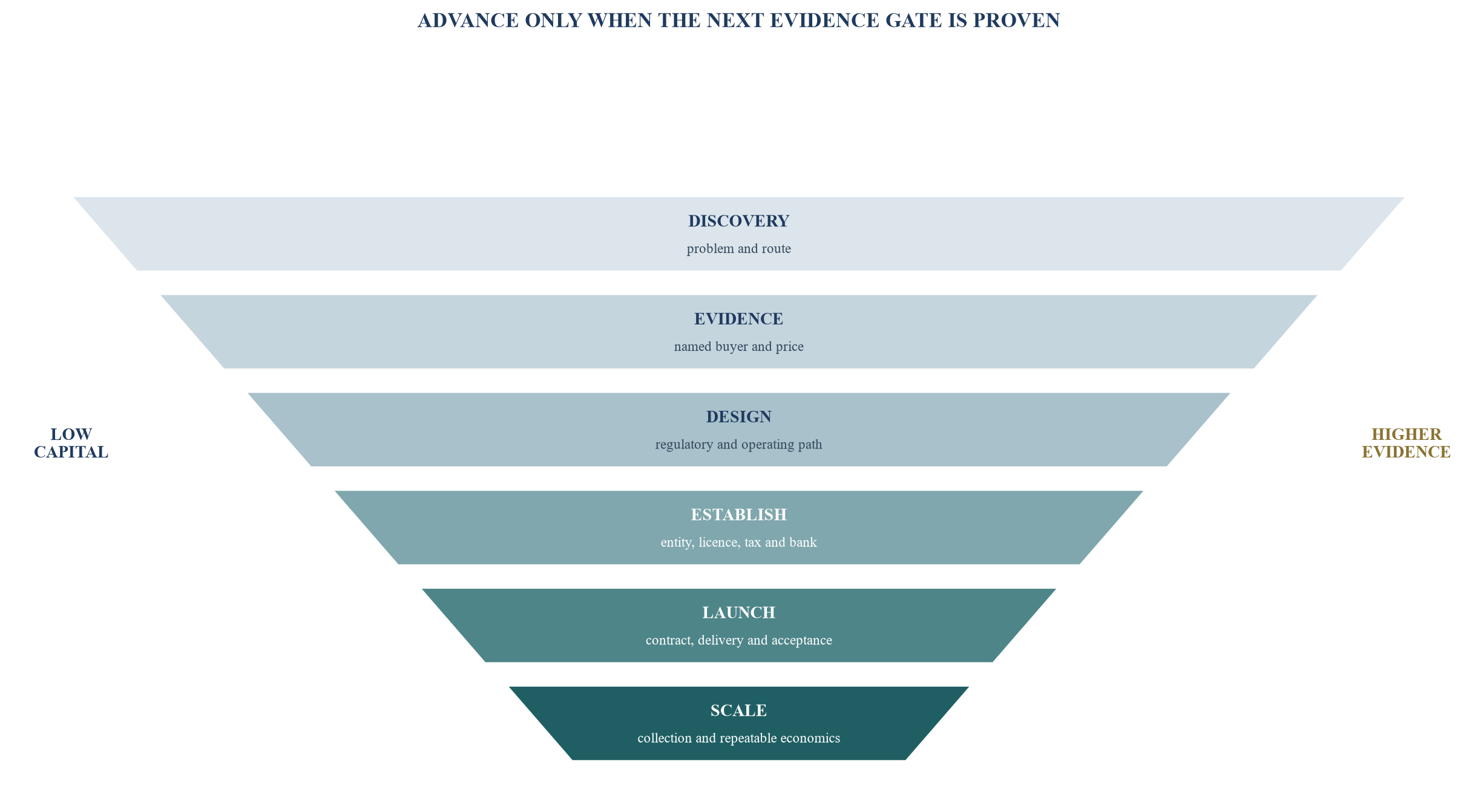
Capital exposure increases only as customer, regulatory, operating and cash evidence strengthens.
6. Score markets on evidence-adjusted value
A market score should change the order of capital deployment, not merely decorate a board presentation. The score therefore needs to combine opportunity with the cost and uncertainty of converting that opportunity into collectible cash. A practical model uses eight dimensions: qualified customer evidence, time to cash, regulatory complexity, localisation burden, contribution economics, capital intensity, strategic option value and reversibility.
Customer evidence should receive the greatest weight. The relevant measure is not the number of conversations. It is the quality of evidence that a named buyer has a recognised problem, an authorised budget, a workable procurement path and a credible implementation window. Evidence strengthens as the company moves from an exploratory conversation to a validated problem, priced proposal, completed diligence, signed contract, accepted delivery and collected cash.
Time to cash should include the whole commercial cycle. A company can underestimate the period between a successful demonstration and cash in the bank. Vendor registration, budget approval, contracting, security review, implementation, acceptance, invoice issuance and payment terms can each extend the cycle. A large headline opportunity with a long, uncertain path may deserve less early capital than a smaller opportunity with stronger evidence and faster cash conversion.
Regulatory complexity should be measured against the product's actual perimeter. The score should consider whether the route is confirmed, whether approval precedes entity formation, whether the product needs adaptation, whether a regulated partner is required and whether a missed assumption could prevent revenue. Localisation burden covers people, hosting, language, contracting, support hours, implementation, local content and customer-specific requirements.
Contribution economics translate commercial enthusiasm into financial value. The board should compare revenue after discounts with direct delivery, partner share, support, sales cost, payment cost, expected credit loss and country overhead. Capital intensity measures cash committed before collection. Strategic option value captures reference customers, product learning, adjacency, partnerships and defensibility. Reversibility measures how much cost and liability can be stopped if the thesis fails.
The score is a structured management judgement. It is not a prediction. Management should record the evidence behind every score, use the same scale across markets and apply a confidence haircut where evidence is weak. The board should see the raw score, confidence level and adjusted result. A high raw score built on weak evidence should not outrank a modest score supported by executable contracts and confirmed approvals.
Table 3. Evidence-adjusted market sequencing scorecard
| Dimension | Illustrative weight | Score of 1 | Score of 5 | Evidence owner |
|---|---|---|---|---|
| qualified customer evidence | 25% | exploratory interest | contract path, buyer authority and implementation window evidenced | commercial lead |
| time to collectible cash | 15% | timing unresolved or beyond runway | acceptance, invoice and collection path fits the capital plan | finance lead |
| regulatory complexity | 15% | route uncertain or highly dependent | perimeter and approval sequence confirmed | legal or compliance lead |
| localisation burden | 10% | major product, people or hosting change | bounded adaptation using regional assets | product and operations leads |
| contribution economics | 15% | contribution unproven or below policy | attractive contribution after country costs | finance lead |
| capital intensity | 10% | large irreversible pre-revenue spend | low staged exposure | chief executive and finance lead |
| strategic option value | 5% | little reuse or reference value | unlocks material customers, learning or adjacency | strategy lead |
| reversibility | 5% | long commitments and exit cost | short, modular commitments | operations lead |
The weights and scores are illustrative management inputs. Each score must link to dated evidence and a named owner.
An illustrative scorecard can reveal why market order differs from market size. Assume the company assigns each dimension a score from one to five, multiplies it by the agreed weight and then applies a confidence factor between 50 and 100 percent. Market A may have a raw score of 4.2 but a confidence factor of 55 percent, producing an adjusted score of 2.31. Market B may have a raw score of 3.6 and a confidence factor of 90 percent, producing 3.24. The second market earns the earlier capital gate because its evidence-adjusted value is higher.
The model should also show constraints that cannot be averaged away. A regulatory stop, unresolved funds flow, unavailable licence, prohibited activity or impossible data architecture is a red gate. The market stays at evidence or design even when other dimensions are attractive. A weighted average cannot legitimise an unavailable route.
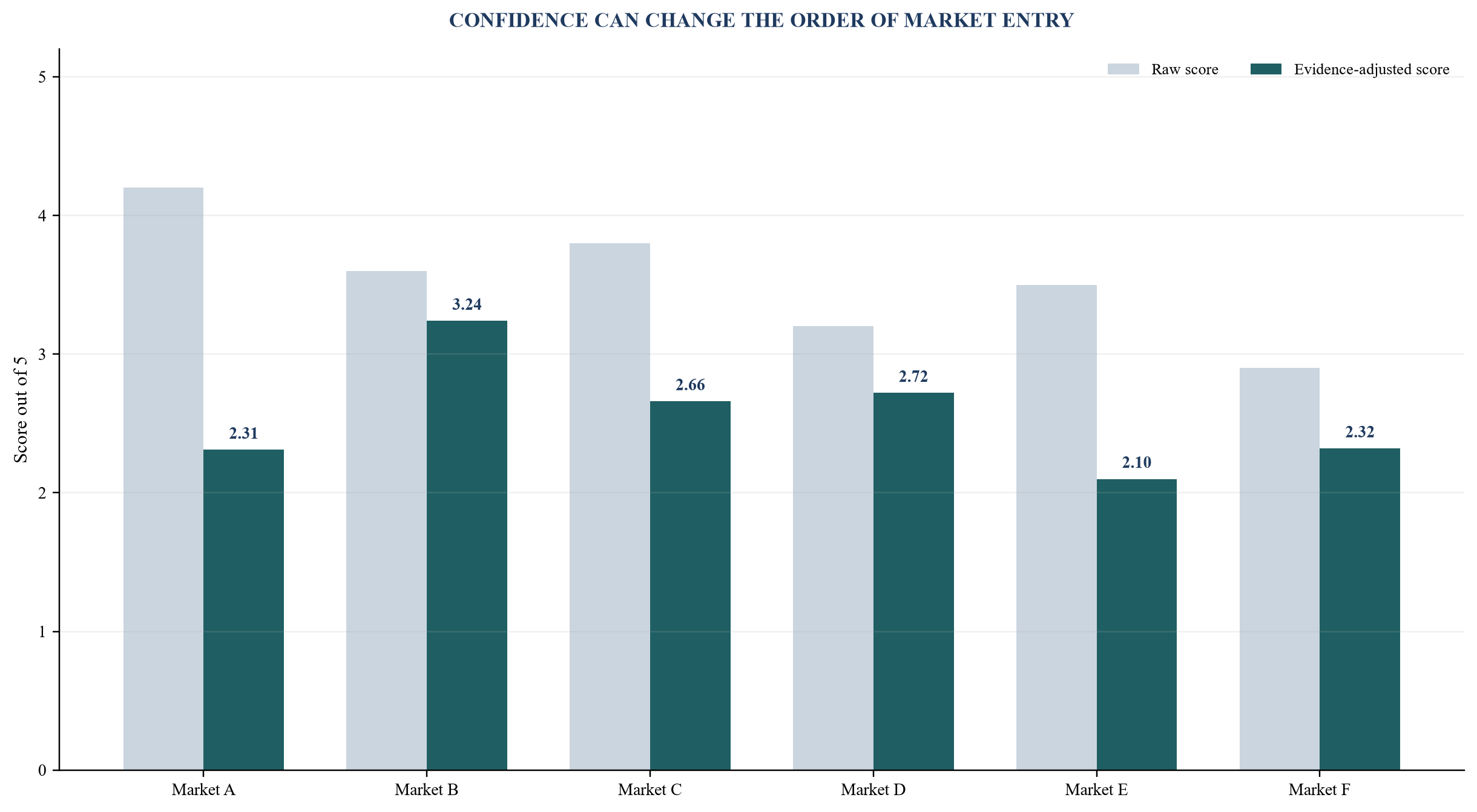
Illustrative scores demonstrate how confidence changes priority. They are not market rankings or forecasts.
7. Choose an anchor market and define what it must prove
The anchor market is the first country funded through controlled launch. It should provide the best combination of evidence, learning, cash conversion and regional reuse. It does not need to be the largest addressable market. The anchor should prove the assumptions that matter for the broader GCC thesis.
The board should state the anchor-market thesis in falsifiable terms. It might require a defined number of qualified customers, a specific price corridor, an implementation period within an agreed range, acceptance of the standard product, a contribution margin above policy and collection within a stated cycle. It should identify which findings can be reused elsewhere and which remain local.
A reference customer has value when other buyers recognise the relevance of the problem, implementation and outcome. The company should agree on reference rights, case-study permissions and data use during contracting. A prestigious customer that prohibits any reference may still be economically valuable, while it may contribute less to regional sales acceleration than expected.
The anchor-market plan should separate launch proof from scale proof. Launch proof shows that the company can contract, deliver, invoice and collect. Scale proof shows repeatable acquisition, implementation capacity, support quality, renewal, expansion revenue and contribution after local overhead. Moving from launch to scale before both sets of evidence are visible can convert one successful project into an oversized cost base.
The other five markets remain active options. Their teams can maintain regulator mapping, customer discovery, partner diligence and document readiness within agreed budgets. This preserves information and relationships without representing every option as an active launch.
8. Bridge quoted revenue to collectible contribution
Revenue in a country plan should progress through four definitions: quoted, contracted, recognised and collected. The board should also see contribution after costs required to win, implement, support and collect the revenue. A quoted annual contract value can conceal discounts, partner commissions, free implementation, payment delays, tax treatment, local staffing and product adaptation.
The unit-economics bridge should begin with the expected consideration under the proposed contract. It then deducts price concessions, channel share, transaction and currency costs, implementation labour, cloud or infrastructure consumption, support, expected credit loss, direct regulatory costs and the allocated country operating layer. Cash timing should be modelled separately. A profitable contract can still create a runway problem if the company pays people and suppliers months before customer collection.
Foreign-currency exposure also needs a policy. Several GCC currencies have long-standing pegs or fixed relationships to the US dollar, while commercial costs and parent-company obligations may be in other currencies. The company should map the currency of contracts, invoices, payroll, vendors, funding and reporting. Treasury decisions should follow the actual exposure and approved risk policy.
Management should model a base case, downside case and stop case. The base case reflects the evidence-backed operating plan. The downside case applies delays, lower price, higher localisation cost and slower collection. The stop case estimates the cash needed to meet obligations and exit responsibly if the launch is discontinued. These are management scenarios, not forecasts of market performance.
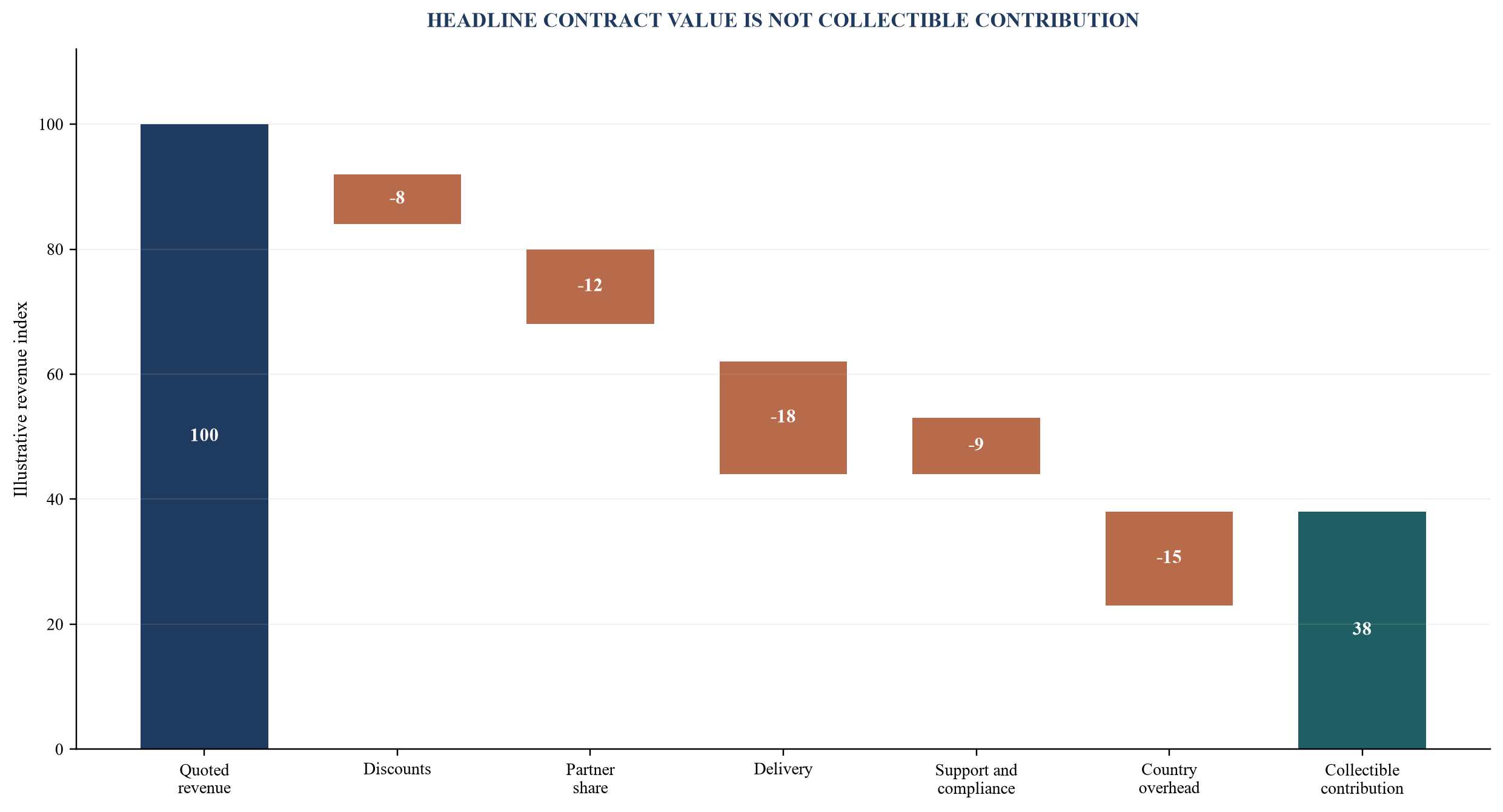
Illustrative index values show how commercial, delivery and cash factors reduce a headline contract. They are not market benchmarks.
9. Allocate runway by evidence stage
The funding roadmap converts strategic priority into maximum cash exposure. It should show opening unrestricted cash, committed operating expenditure, contingency, minimum liquidity, expected collections and the amount available for expansion options. The amount available is then divided among stages, not countries alone.
Discovery and evidence should use small, time-limited budgets. Typical uses include customer interviews, product demos, preliminary legal scoping, travel, translations and partner diligence. Regulatory design can require greater advisory and product cost. Establishment introduces entity, licence, premises, systems, payroll and deposits. Controlled launch funds delivery. Scale capital supports repeatable sales and operations after proof.
Every stage should have a release authority. A country manager should not be able to convert a discovery budget into a lease, hire or systems commitment. Procurement controls should link purchase orders and contracts to the approved gate. Finance should report exposure by country, gate, committed cash, paid cash and cancellable cash.
The runway model should include timing risk. Expected collections should be probability-adjusted and mapped to contractual milestones. An unsigned pipeline should not fund a fixed commitment. Even contracted revenue may be held back by acceptance, disputed milestones, vendor-registration issues or invoice defects.
The board should protect a regional resilience reserve. This covers parent-company obligations, core product continuity, cyber response, legal disputes, tax or regulatory remediation and an orderly exit from a failed market. Deploying the reserve to maintain an underperforming country weakens every option at once.
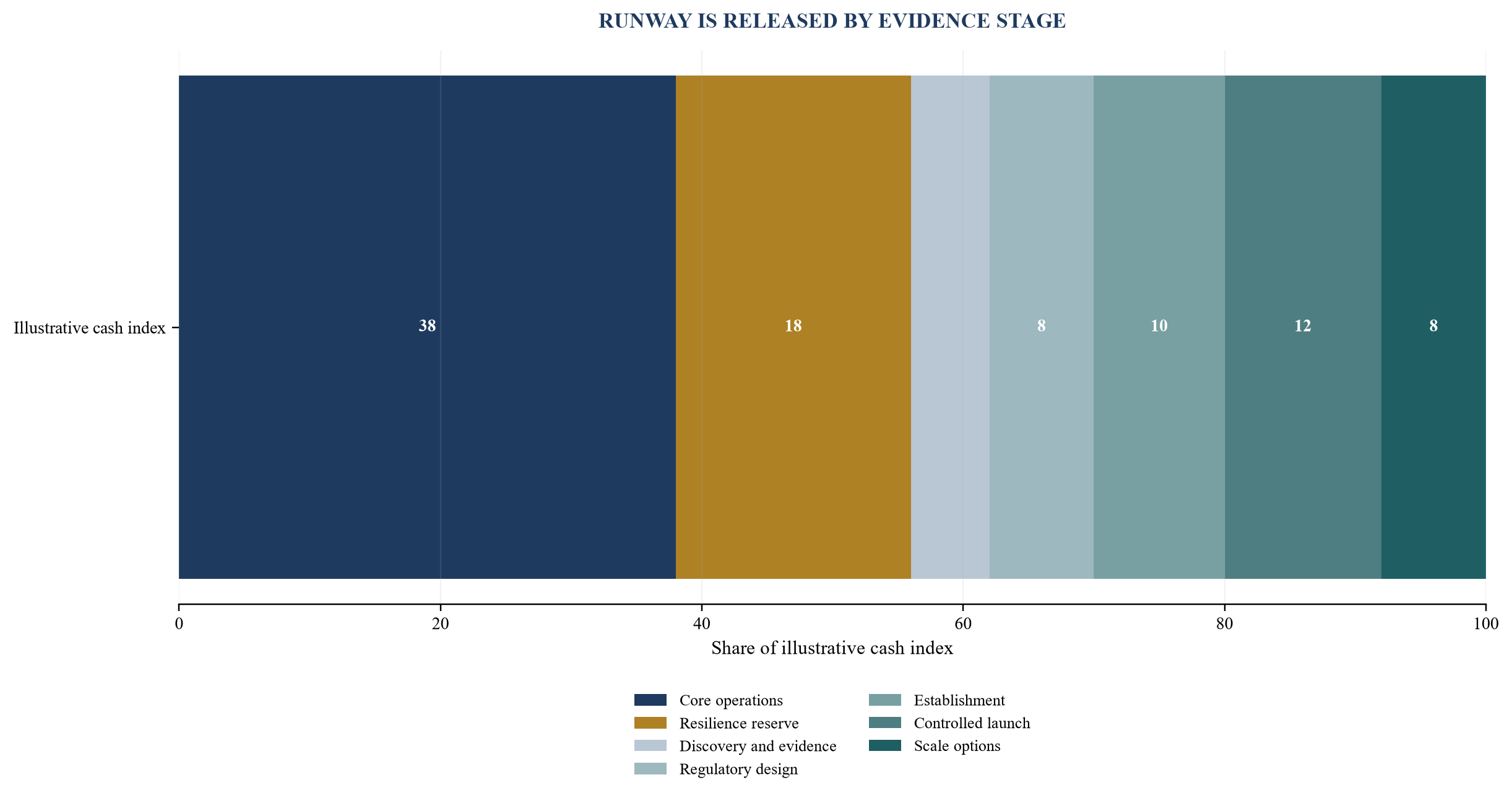
The index allocation demonstrates staged exposure. It is not a recommended budget or forecast.
10. Select the entity and channel architecture after the thesis is clear
Entity design should follow the product, customer and capital sequence. It should not begin with a generic preference for a free-zone company, mainland company, branch, joint venture, distributor or regional holding structure. Each route changes the permitted activity, contracting chain, tax and transfer-pricing position, control, cost, liability, banking, procurement eligibility and exit path.
A cross-border route may suit early discovery or a limited transaction where law, customer and tax analysis support it. A local entity can strengthen contracting, hiring, banking and customer confidence, while adding fixed cost and governance. A branch can preserve direct parent responsibility and may suit certain activities, subject to the relevant jurisdiction. A distributor can provide relationships, logistics or licences, while introducing margin, data, customer-control and termination questions. A joint venture can align a capable local partner and shared investment, while creating governance, valuation and deadlock risk.
The board should require channel diligence equal to customer diligence. The company should verify the partner's licence, ownership, beneficial owners, financial capacity, reputation, sector access, conflicts, sanctions controls, service capability, data handling and actual performance. Agreements should define territory, exclusivity, minimum commitments, pricing authority, customer ownership, intellectual property, audit rights, compliance, reporting, termination and transition.
Exclusivity should be earned through measurable performance and kept narrow in product, customer, territory and time. A broad exclusive appointment granted before evidence can block direct sales, alternative partners or a future investor. The termination plan should preserve customer service, receivables, data, licences and the ability to move to another route.
Table 4. Entity and channel architecture decision menu
| Route | Potential strategic use | Principal evidence required | Board watchpoint |
|---|---|---|---|
| cross-border contract | bounded evidence or permitted early sales | legal permissibility, tax, customer acceptance and collection route | accidental permanent establishment, unlicensed activity or weak collection |
| local subsidiary | repeatable contracting, hiring and operating control | activity licence, ownership, tax, banking, people and governance plan | fixed cost before repeatability |
| branch | direct parent presence where permitted | branch eligibility, liability, tax and licence analysis | parent exposure and limited activity scope |
| distributor or agent | access, regulated capability, logistics or local execution | licence, track record, financial capacity and customer rights | lost margin, data and customer control |
| joint venture | complementary capability and shared market investment | partner diligence, valuation, reserved matters and exit mechanics | deadlock, dilution and strategic lock-in |
| acquisition | immediate capability, customers, licences or people | commercial, financial, legal, tax, technology and regulatory diligence | inherited liabilities and integration cost |
Suitability depends on current law, activity, customer and tax advice in the relevant country.
11. Match the funding instrument to the evidence profile
Expansion can be funded from operating cash, new equity, venture debt, working-capital facilities, strategic capital, customer prepayments or milestone-linked financing. The instrument should match the certainty, duration and downside of the use of funds.
Equity can absorb uncertain timing and fund product adaptation, licences and team formation. Its cost appears through dilution and investor rights. Venture debt can extend runway when the company has institutional equity, predictable cash or a clear next financing event. Debt introduces repayment, covenants, security and refinancing risk. A working-capital facility is better aligned with receivables or inventory supported by verifiable transactions than with open-ended market discovery.
Strategic capital can bring customers, distribution or regulatory capability. The company should price any exclusivity, information rights, product commitments, geographic restrictions and future transaction rights. Customer prepayments can reduce cash conversion risk when the company has strong delivery controls and clear refund, acceptance and liability terms.
The financing plan should compare capital cost with the value of delayed entry and the cost of a failed launch. Raising a large regional round before the sequence is proven can create pressure to establish multiple countries at once. Raising too little can strand the company between entity formation and first collection. Milestone-based tranches can align capital with evidence when the milestones are objective and achievable.
Table 5. Illustrative cap-table and funding waterfall
| Stage | Illustrative pre-money equity value | New capital | Instrument | Illustrative founder ownership after stage | Evidence expected before funding |
|---|---|---|---|---|---|
| regional thesis | USD 12.0m | USD 2.0m | primary equity | 70.0% | product perimeter, anchor-market evidence and controlled budget |
| controlled launch | USD 18.0m | USD 1.5m | milestone equity tranche | 64.6% | licence route, signed contract and funded delivery plan |
| repeatability | not applicable | USD 1.0m | receivables or venture facility | 64.6% before warrants | accepted delivery, collections and covenant capacity |
| second-market option | USD 28.0m | USD 3.0m | equity or strategic capital | 58.3% | repeatable anchor economics and second-market gate dossier |
Percentages and amounts are purely illustrative management scenarios; they exclude instrument-specific rights, taxes, transaction costs and future dilution.
The cap-table analysis should show ownership, voting, liquidation preference, anti-dilution, option-pool change, warrants, conversion, covenants and exit proceeds. A percentage-only view can miss the economic effect of preference and control terms. The board should also test whether expansion creates a financing dependency: if the next market cannot reach a defensible stopping point without another round, the current raise should fund that point or the programme should be resized.
12. Design tax, invoicing and collection before the first quote
Tax and invoicing affect price, contract design, systems, margin and collection. They should be part of market-entry design, rather than a registration task left until the invoice is due. The company should confirm the contracting and invoicing entity, place of supply, indirect-tax treatment, withholding exposure, corporate-tax position, customs where relevant, transfer pricing, payroll obligations and documentation.
The UAE's federal corporate-tax and VAT regimes, Saudi Arabia's tax and electronic-invoicing rules, Bahrain and Oman's VAT systems, and each country's income-tax and withholding framework require country-specific review. Qatar's current General Tax Authority investor guide states that VAT has not been applied. That position should be rechecked before pricing or implementation because tax rules and implementation timetables can change.
Electronic invoicing is also a systems project. Saudi Arabia's Fatoorah programme has a generation phase and an integration phase rolled out in waves. The UAE Ministry of Finance has established a phased eInvoicing framework based on structured invoice data and accredited service providers. The company should confirm whether and when it is in scope, select vendors, map fields, test integration, control credit notes and preserve audit evidence.
Collection design should be explicit. Contracts need authorised signatories, clear milestones, acceptance tests, invoice instructions, dispute periods, payment terms, tax clauses, currency, bank details and consequences of delay. Finance should verify vendor registration, purchase orders and portal access before delivery. Sales commissions should reflect collected or safely collectible value, not headline signatures alone.
The board dashboard should show contracted revenue, delivered value, accepted value, invoiced value, overdue value and cash collected. These categories reveal a stalled process earlier than a single revenue number. They also connect expansion governance with working-capital finance.
13. Make data and cybersecurity part of the market sequence
A shared product can create different data obligations in each country. The expansion team should map the data before it maps hosting vendors. The map should identify data subjects, fields, purposes, lawful basis, controllers, processors, storage, access, transfers, retention, deletion, breach response and customer-specific requirements.
The UAE has a federal personal-data framework and additional rules can apply in financial free zones or regulated sectors. Saudi Arabia's Personal Data Protection Law and implementing regulations include transfer and processing obligations. Qatar, Bahrain, Oman and Kuwait also maintain national privacy or data-protection requirements through their responsible authorities. Sector rules, government cybersecurity requirements and contractual standards can add further controls.
The regional product architecture should therefore support data minimisation, configurable residency, role-based access, logs, encryption, retention controls, deletion, consent where relevant and evidence export. Country configuration should be governed through a change process. A salesperson or implementation team should not enable a new data flow before it has been reviewed.
Customer security reviews can be on the critical path to cash. The reusable diligence room should include security governance, architecture, penetration-testing approach, incident response, business continuity, vendor management, software development controls, access policy, certifications and current evidence. Management should distinguish between controls that exist, controls planned and controls required by a particular customer. Promising an unbuilt control during sales can create delivery, liability and collection risk.
A serious incident in one country can affect regional trust and funding. The board should define regional incident ownership, local notification advice, customer communication, evidence preservation, insurer engagement and decision rights. Cyber resilience is therefore part of the runway reserve and launch gate.
14. Treat government and regulated customers as a distinct route
Government entities, state-owned enterprises, banks, insurers, healthcare institutions, utilities and other regulated customers can offer substantial contracts. Their procurement and operating requirements can also lengthen the path to revenue. The company should model this segment separately from private mid-market sales.
The route may include vendor registration, prequalification, local content, cybersecurity assessment, data residency, product certification, bid bonds, performance guarantees, audited accounts, local references and approved subcontractors. Tender schedules can be fixed and award does not always equal immediate mobilisation. Contracting, purchase orders, security clearance, site access, acceptance and budget release remain separate gates.
Saudi government procurement should be reviewed with the current Etimad, local-content and regional-headquarters context. Other GCC governments and state-linked buyers maintain their own registration and tender systems. The relevant buyer and authority should be confirmed from current official sources for each opportunity.
The company should calculate bid economics before committing. Bid preparation, demonstrations, localisation, legal terms, bonds and long payment cycles consume cash. A large contract can be unattractive if liability is uncapped, acceptance is subjective, implementation is heavily customised or collection follows a long approval chain. Bid qualification should therefore include strategic fit, probability, cash need, delivery capacity, contract risk and reference value.
15. Build a regional operating model with local accountability
The control tower needs one accountable executive, one finance view and local owners for country evidence. A matrix without clear decision rights can create duplicated work and conflicting commitments. The regional team should own the product platform, capital envelope, evidence standards, risk policy, investor reporting and cross-country learning. Country owners should own customer proof, local advisers, approvals, operations and collection.
Shared services can centralise finance operations, security, product, legal coordination, vendor management and data-room control. Local functions should remain where law, licence, customer, language or execution requires them. The design should also respect employment, immigration, tax residency and permanent-establishment advice.
The management-information system should use common definitions across all markets. Qualified pipeline, contracted revenue, accepted value, invoiced value, cash collected, contribution, committed cash, paid cash and runway should mean the same thing. Each record should carry a country, customer, owner, source and date. The board should be able to trace an expansion claim to evidence.
Learning should be recorded after each gate. A pricing objection in one country may change the regional packaging. A security requirement may justify a reusable product control. A failed channel arrangement may improve the partner checklist. Capturing these findings turns the anchor market into an asset for later entry.
16. Run a 180-day evidence programme
The first 180 days should create decisions, rather than six operating companies. The programme can begin with a regional product-perimeter workshop, current official-source scan, customer segmentation and an agreed scoring model. Each country receives a discovery owner and a small evidence budget.
During days 1 to 30, management should define the product and funds flow, map known regulations, identify 10 to 20 priority accounts per market, prepare the reusable diligence room and agree the financial model. Legal and tax advisers should receive the same product description and question set. The board should approve red gates and stop-loss limits.
During days 31 to 60, the commercial team should test problems, authority, budgets, procurement and implementation. The product team should identify the minimum viable country configuration. Finance should build the unit-economics and runway bridges. Management should score each market and challenge the evidence in a gate review.
During days 61 to 90, one anchor market and one reserve option can advance to detailed regulatory and operating design. The other markets remain in bounded discovery. The company should obtain current written advice where material, validate the contracting chain, design tax and invoicing, complete partner diligence and negotiate contract principles with qualified customers.
During days 91 to 120, the anchor can move through entity, licence, banking, people, data and procurement tasks when its gate is approved. Product changes should remain bounded. The launch contract, delivery plan, acceptance, invoice path and cash requirement should be complete.
During days 121 to 180, the company should execute a controlled launch, measure delivery and acceptance, issue compliant invoices and pursue collection. The board then decides whether to scale the anchor, advance the reserve market, redesign the proposition or stop. No outcome should be treated as failure merely because the programme rejects an unsupported market. Preserved capital and validated learning are valuable results.
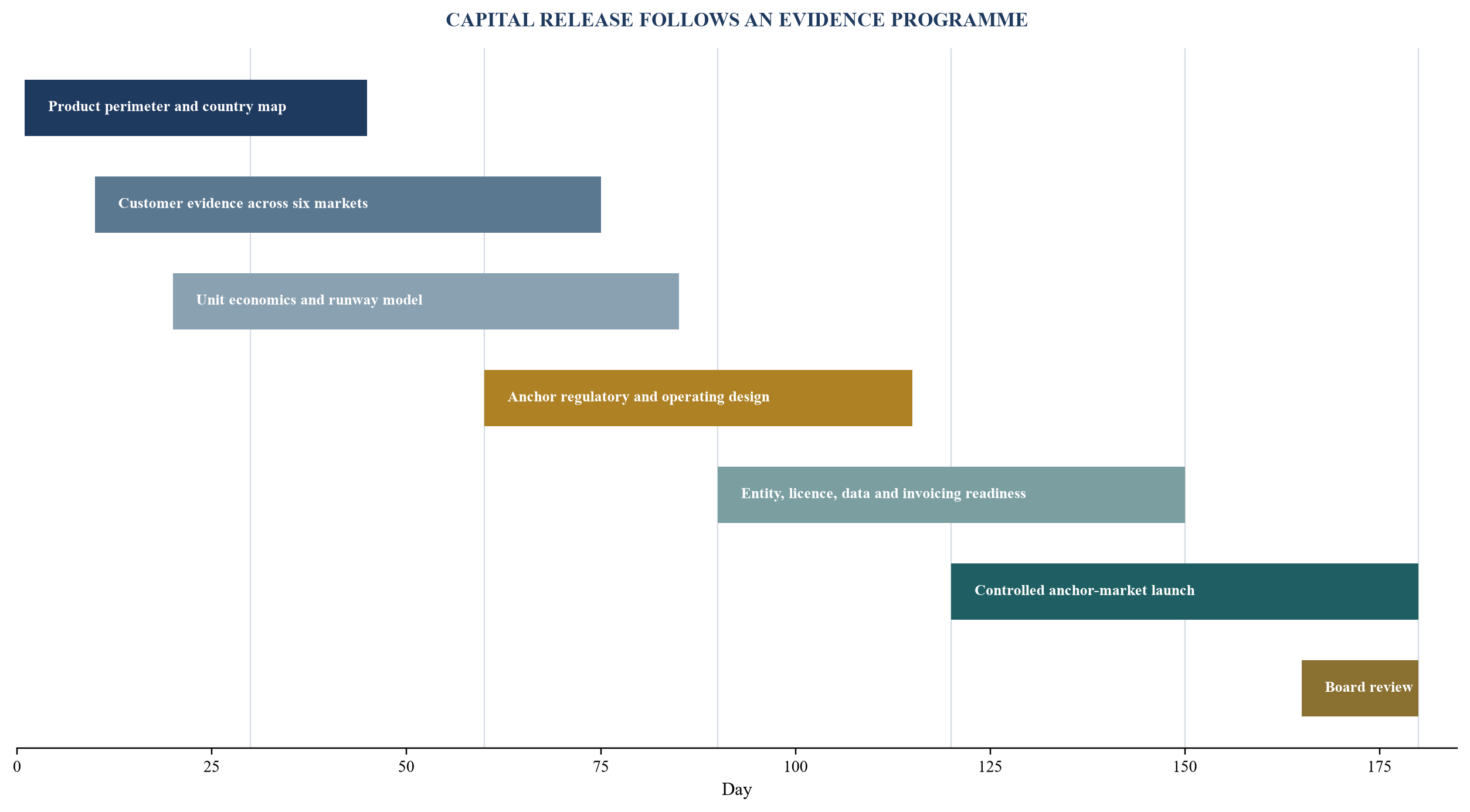
Workstreams overlap, while establishment and launch capital remain subject to formal gates.
17. Govern the sequence through explicit decision rights
Expansion governance should answer four questions: who proposes, who validates, who approves and who can stop? The chief executive can own the regional thesis. Finance validates the cash and economics. Legal, tax, compliance, product and security owners validate their domains. The board approves exposure above delegated limits and any decision that changes the funding, risk or strategic profile.
The board pack should show the sequence score, confidence, unresolved red gates, maximum approved exposure, current commitments, evidence changes, customer progression, approval status, unit economics, collection, runway and requested decision. A narrative progress update without those controls can hide a country that consumes capital while evidence weakens.
Decision minutes should identify assumptions and conditions. If the board approves entity formation subject to a signed anchor contract and confirmed activity scope, the implementation owner should evidence both conditions before spending. Exceptions should be documented with owner, reason, additional exposure and expiry.
Table 6. Board governance and stop-loss checklist
| Control | Evidence required | Decision owner | Stop or escalation trigger |
|---|---|---|---|
| product perimeter | current product and funds-flow memo | product and legal owners | functionality or customer segment changes |
| customer evidence | named buyer, authority, budget, procurement and timing | commercial lead | evidence ages, sponsor leaves or budget disappears |
| regulatory gate | written route, licence sequence and responsible adviser | legal or compliance lead | route unconfirmed or critical approval delayed |
| economics gate | scenario model from quote to collectible contribution | finance lead | contribution below policy or cash peak above envelope |
| capital release | purchase and contract commitments mapped to gate | chief executive or board under delegation | unapproved irreversible commitment |
| data and security | data map, controls, customer requirements and incident plan | security and privacy owners | prohibited flow or unmet critical control |
| launch gate | signed contract, delivery plan, acceptance and invoice path | executive committee | material contract or collection dependency unresolved |
| scale gate | repeatable acquisition, delivery, collection and contribution | board | growth requires unsupported subsidy or control failure |
The checklist should be tailored to the company's constitution, delegations, investor rights and regulatory obligations.
18. Connect market entry with transaction readiness
A disciplined expansion sequence improves financing and strategic-transaction readiness. Investors and lenders can assess a company more readily when market claims link to contracts, approvals, collection data and controlled budgets. The same evidence can support a fundraise, venture-debt process, strategic partnership, joint venture, acquisition or partial exit.
The diligence room should organise the regional thesis by country and gate. It should include official-source and adviser memos, entities and licences, customer evidence, contracts, pipeline definitions, delivery and acceptance, invoices and collections, tax and data controls, employment, intellectual property, channel agreements, board approvals, financial model and risk register.
Management should avoid describing six-country availability when only one country has a working route. A transaction document can state the exact stage of each market: discovery, evidence, design, establishment, controlled launch or scale. This gives investors a clearer view of funded growth options and remaining execution risk.
The expansion model can also support acquisition screening. If a target offers licences, customers, local management or product capability in a priority market, the company should value the time and evidence gained, together with liabilities and integration cost. The comparison is between building, partnering and buying the capability, using the same customer, regulatory, economics, capital and reversibility criteria.
19. Recognise recurring failure modes early
The first failure mode is equating addressable market with obtainable revenue. A market-size estimate does not identify the buyer, route, price, implementation, acceptance or collection. The remedy is to require named-account evidence and a cash path before launch capital.
The second is forming entities as proof of progress. Incorporation can be useful, while it creates obligations and does not prove customer demand or sector permission. The remedy is a regulatory and customer gate that precedes establishment.
The third is relying on an untested partner. Introductions and claims of access can appear valuable before measurable delivery. The remedy is independent diligence, non-exclusive proof stages, defined data and customer rights and a practical termination plan.
The fourth is underpricing localisation. Arabic content, integrations, hosting, security, implementation, support, product certification and contractual deviations can consume margin. The remedy is a country contribution model and change control.
The fifth is treating signed revenue as cash. Acceptance, purchase-order, invoice and payment processes can delay collection. The remedy is a contract-to-cash owner and milestone dashboard.
The sixth is financing permanent cost with temporary enthusiasm. Premises, senior hires and country infrastructure can outlive a weak pipeline. The remedy is modular commitments, maximum gate exposure and a stop case.
The seventh is allowing every market to become the priority. Regional leaders can face pressure from investors, partners and customers to accelerate. The remedy is a single evidence-adjusted ranking, explicit exceptions and board ownership of sequence.
20. Conclusion
GCC expansion is a capital-allocation programme built around six sovereign launch systems and a reusable regional platform. The board should begin with the product's real perimeter, identify what can be shared, map what remains national and rank markets using customer evidence, cash timing, regulatory complexity, localisation, economics, capital intensity, strategic value and reversibility.
The sequence should remain dynamic. A market advances when its evidence strengthens and pauses when a red gate remains unresolved. An anchor market proves contracting, delivery, invoicing, collection and repeatable contribution. Other countries remain controlled options until they earn greater exposure.
The result is a practical operating discipline: capital follows evidence; structure follows the commercial thesis; quoted revenue is bridged to collectible contribution; funding matches the risk profile; and governance makes assumptions, decisions and stop conditions visible. This discipline can preserve runway while building the regulatory, commercial and transaction evidence required for durable regional growth.
Sources and further reading
- Cooperation Council for the Arab States of the Gulf. The Economic Agreement Between the GCC States. Official source
- Cooperation Council for the Arab States of the Gulf. Final Statement of the Forty-Sixth Session of the Supreme Council, December 2025. Official source
- UAE Government. Full foreign ownership of commercial companies. Official source
- UAE Ministry of Finance. Corporate Tax. Official source
- UAE Federal Tax Authority. Value Added Tax. Official source
- UAE Government. Data protection laws. Official source
- UAE Ministry of Finance. eInvoicing. Official source
- UAE Ministry of Finance. Ministry of Finance announces targeted amendments to eInvoicing system decisions. Official source
- UAE Ministry of Economy and Tourism. Regulation of Competition. Official source
- Saudi Ministry of Investment. Updated Investment Law. Official source
- Saudi Ministry of Investment. Investor Guide, 12th edition. Official source
- Saudi Zakat, Tax and Customs Authority. E-Invoicing. Official source
- Saudi Data and Artificial Intelligence Authority. Personal Data Protection Law. Official source
- Saudi Ministry of Finance. Etimad platform. Official source
- Qatar Ministry of Commerce and Industry. Establishing companies. Official source
- Qatar Ministry of Commerce and Industry. Questions relating to foreign investment companies. Official source
- Qatar General Tax Authority. Investor tax guide. Official source
- Qatar National Cyber Security Agency. Personal Data Privacy Protection Law guidance. Official source
- Bahrain Ministry of Industry and Commerce. Sijilat commercial registration portal. Official source
- Bahrain National Bureau for Revenue. Value Added Tax. Official source
- Bahrain Personal Data Protection Authority. Personal Data Protection Law. Official source
- Invest Oman. Essential Investor Resources. Official source
- Oman Tax Authority. VAT Law and Regulations. Official source
- Oman Ministry of Transport, Communications and Information Technology. Personal Data Protection Law. Official source
- Kuwait Direct Investment Promotion Authority. Investment Licensing Procedures. Official source
- Kuwait Direct Investment Promotion Authority. Law and Decisions. Official source
- Kuwait Communication and Information Technology Regulatory Authority. Data Privacy Protection Regulation. Official source
- OECD. FDI Qualities Policy Toolkit. Official source
- World Bank. Business Ready. Official source
- International Finance Corporation. Corporate Governance Methodology Tools. Official source
