

1. Define the food-security acquisition thesis
The diligence question is whether the transaction improves affordable, safe and continuous supply. The buyer should begin with board strategy, demand history, network map and transaction perimeter. The review should use product, site, route and customer detail because a consolidated group average can hide the node that determines continuity. Evidence should be dated, attributable and reconciled to both physical movement and financial records. [1][2]
The principal failure mode is that a broad strategic label can conceal assets that add scale without resilience. Management estimates remain useful for planning when they are identified as estimates and separated from contractual rights, observed performance and independently verified capacity. The investment model should state how an unresolved item changes volume, price, loss, working capital, capital expenditure, timing or probability. That translation prevents a strategic narrative from entering valuation without an auditable cash-flow consequence.
The recommended response is to translate each claimed benefit into a measurable operating capability, owner and timetable. A responsible executive should own the measure, an independent function should challenge it, and the committee should see the evidence required for closure. The response should include a central case, a plausible downside and an operational trigger. If the trigger occurs, the organisation needs a decision, funding source and recovery timetable rather than another diagnostic report. In the hypothetical transaction, unresolved uncertainty is carried through a reserve, lower value, delayed synergy, completion condition or explicit risk acceptance.
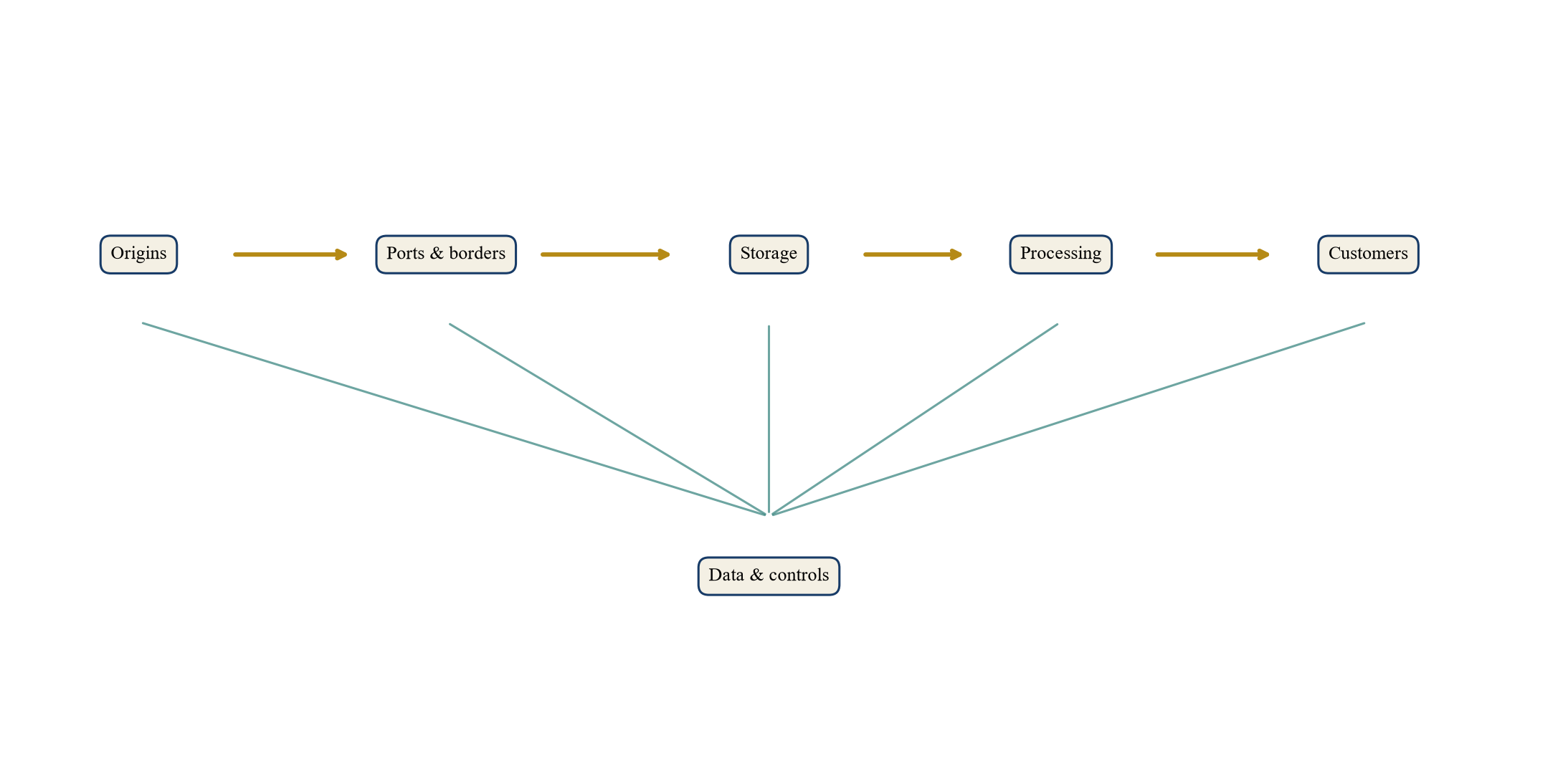
Analytical framework; actual routes, capacities and controls require transaction evidence.
| Network stage | Primary evidence | Hidden dependency | Committee test |
|---|---|---|---|
| origin | contracts, certificates and production history | common farm, processor or input | viable alternate source |
| maritime and border | bookings, customs and transit history | one port, lane or agent | timed reroute |
| storage | site logs, inspection and temperature | nominal versus usable capacity | effective peak capacity |
| processing | recipes, lines, approvals and yields | single line or ingredient | qualified alternate process |
| distribution | routes, vehicles and service history | constrained cold-chain leg | recovery time |
| customer | orders, contracts and allocation rules | concentrated channel | protected critical service |
Proposed diligence hierarchy; actual evidence depends on product and jurisdiction.
2. Map the origin-to-consumer network
The diligence question is where product, information, title and cash move across the combined platform. The buyer should begin with supplier sites, ports, border points, warehouses, plants, routes, customers and bank receipts. The review should use product, site, route and customer detail because a consolidated group average can hide the node that determines continuity. Evidence should be dated, attributable and reconciled to both physical movement and financial records. [3][4]
The principal failure mode is that aggregate procurement data can hide dependence on one origin, route or intermediary. Management estimates remain useful for planning when they are identified as estimates and separated from contractual rights, observed performance and independently verified capacity. The investment model should state how an unresolved item changes volume, price, loss, working capital, capital expenditure, timing or probability. That translation prevents a strategic narrative from entering valuation without an auditable cash-flow consequence.
The recommended response is to build a product-level network map and reconcile physical flows with invoices, inventory and collections. A responsible executive should own the measure, an independent function should challenge it, and the committee should see the evidence required for closure. The response should include a central case, a plausible downside and an operational trigger. If the trigger occurs, the organisation needs a decision, funding source and recovery timetable rather than another diagnostic report. In the hypothetical transaction, unresolved uncertainty is carried through a reserve, lower value, delayed synergy, completion condition or explicit risk acceptance.
3. Set the legal and operating perimeter
The diligence question is which entities, contracts, permits, people, systems and assets transfer at completion. The buyer should begin with share and asset schedules, licences, leases, service agreements and separation plans. The review should use product, site, route and customer detail because a consolidated group average can hide the node that determines continuity. Evidence should be dated, attributable and reconciled to both physical movement and financial records. [5]
The principal failure mode is that a perimeter gap can strand a warehouse, licence, data set or critical employee outside the acquired business. Management estimates remain useful for planning when they are identified as estimates and separated from contractual rights, observed performance and independently verified capacity. The investment model should state how an unresolved item changes volume, price, loss, working capital, capital expenditure, timing or probability. That translation prevents a strategic narrative from entering valuation without an auditable cash-flow consequence.
The recommended response is to tie every operating node to legal ownership, control, transition service or closing condition. A responsible executive should own the measure, an independent function should challenge it, and the committee should see the evidence required for closure. The response should include a central case, a plausible downside and an operational trigger. If the trigger occurs, the organisation needs a decision, funding source and recovery timetable rather than another diagnostic report. In the hypothetical transaction, unresolved uncertainty is carried through a reserve, lower value, delayed synergy, completion condition or explicit risk acceptance.
4. Quantify origin and supplier dependency
The diligence question is how much supply can be lost before service and margin fail. The buyer should begin with purchase orders, supplier contracts, countries of origin, lead times and qualification records. The review should use product, site, route and customer detail because a consolidated group average can hide the node that determines continuity. Evidence should be dated, attributable and reconciled to both physical movement and financial records. [1][3]
The principal failure mode is that nominal supplier counts can overstate diversification when suppliers share the same farm, processor, port or shipping lane. Management estimates remain useful for planning when they are identified as estimates and separated from contractual rights, observed performance and independently verified capacity. The investment model should state how an unresolved item changes volume, price, loss, working capital, capital expenditure, timing or probability. That translation prevents a strategic narrative from entering valuation without an auditable cash-flow consequence.
The recommended response is to measure common dependencies and pre-qualify substitutes by product, quality, regulation and landed cost. A responsible executive should own the measure, an independent function should challenge it, and the committee should see the evidence required for closure. The response should include a central case, a plausible downside and an operational trigger. If the trigger occurs, the organisation needs a decision, funding source and recovery timetable rather than another diagnostic report. In the hypothetical transaction, unresolved uncertainty is carried through a reserve, lower value, delayed synergy, completion condition or explicit risk acceptance.
| Qualification | Evidence | Failure if missing | Closing treatment |
|---|---|---|---|
| product specification | approved sample and test | rejection or reformulation | exclude from resilience credit |
| food safety and SPS | certificates and authority status | blocked import or recall | condition or reserve |
| packaging and label | compliant artwork and line capability | delayed market release | funded conversion plan |
| route and temperature | trial shipment and logger data | spoilage or delay | lower usable volume |
| commercial capacity | supplier commitment and history | unavailable during common shock | contracted option or diversification |
| customer approval | executed approval where required | unsaleable substitute | no synergy recognition |
Proposed control; availability alone does not establish usability.
5. Test substitution and alternate sourcing
The diligence question is whether an alternative can be activated within the disruption window. The buyer should begin with approved supplier lists, product specifications, trials, SPS evidence and customer approvals. The review should use product, site, route and customer detail because a consolidated group average can hide the node that determines continuity. Evidence should be dated, attributable and reconciled to both physical movement and financial records. [6][7]
The principal failure mode is that an alternative source may exist commercially yet remain unusable because specification, certification, packaging or route differs. Management estimates remain useful for planning when they are identified as estimates and separated from contractual rights, observed performance and independently verified capacity. The investment model should state how an unresolved item changes volume, price, loss, working capital, capital expenditure, timing or probability. That translation prevents a strategic narrative from entering valuation without an auditable cash-flow consequence.
The recommended response is to run timed substitution exercises and value only alternatives supported by current evidence. A responsible executive should own the measure, an independent function should challenge it, and the committee should see the evidence required for closure. The response should include a central case, a plausible downside and an operational trigger. If the trigger occurs, the organisation needs a decision, funding source and recovery timetable rather than another diagnostic report. In the hypothetical transaction, unresolved uncertainty is carried through a reserve, lower value, delayed synergy, completion condition or explicit risk acceptance.
6. Reconcile procurement contracts and supplier performance
The diligence question is whether contracted supply, price and remedies support the forecast. The buyer should begin with executed contracts, purchase history, quality claims, rebates, penalties and concentration. The review should use product, site, route and customer detail because a consolidated group average can hide the node that determines continuity. Evidence should be dated, attributable and reconciled to both physical movement and financial records. [8]
The principal failure mode is that headline volumes may be optional, cancellable or subject to force majeure and price reopening. Management estimates remain useful for planning when they are identified as estimates and separated from contractual rights, observed performance and independently verified capacity. The investment model should state how an unresolved item changes volume, price, loss, working capital, capital expenditure, timing or probability. That translation prevents a strategic narrative from entering valuation without an auditable cash-flow consequence.
The recommended response is to classify enforceable volume, variable volume and relationship-based supply separately in the model. A responsible executive should own the measure, an independent function should challenge it, and the committee should see the evidence required for closure. The response should include a central case, a plausible downside and an operational trigger. If the trigger occurs, the organisation needs a decision, funding source and recovery timetable rather than another diagnostic report. In the hypothetical transaction, unresolved uncertainty is carried through a reserve, lower value, delayed synergy, completion condition or explicit risk acceptance.
7. Assess maritime, border and inland routes
The diligence question is how route disruption changes availability, lead time and delivered cost. The buyer should begin with freight contracts, port performance, customs records, route alternatives and transit history. The review should use product, site, route and customer detail because a consolidated group average can hide the node that determines continuity. Evidence should be dated, attributable and reconciled to both physical movement and financial records. [3][9]
The principal failure mode is that a network optimised for normal conditions can fail when rerouting requires different vessels, border processes or temperature controls. Management estimates remain useful for planning when they are identified as estimates and separated from contractual rights, observed performance and independently verified capacity. The investment model should state how an unresolved item changes volume, price, loss, working capital, capital expenditure, timing or probability. That translation prevents a strategic narrative from entering valuation without an auditable cash-flow consequence.
The recommended response is to model route-specific time, capacity, cost and regulatory constraints under concurrent disruption. A responsible executive should own the measure, an independent function should challenge it, and the committee should see the evidence required for closure. The response should include a central case, a plausible downside and an operational trigger. If the trigger occurs, the organisation needs a decision, funding source and recovery timetable rather than another diagnostic report. In the hypothetical transaction, unresolved uncertainty is carried through a reserve, lower value, delayed synergy, completion condition or explicit risk acceptance.
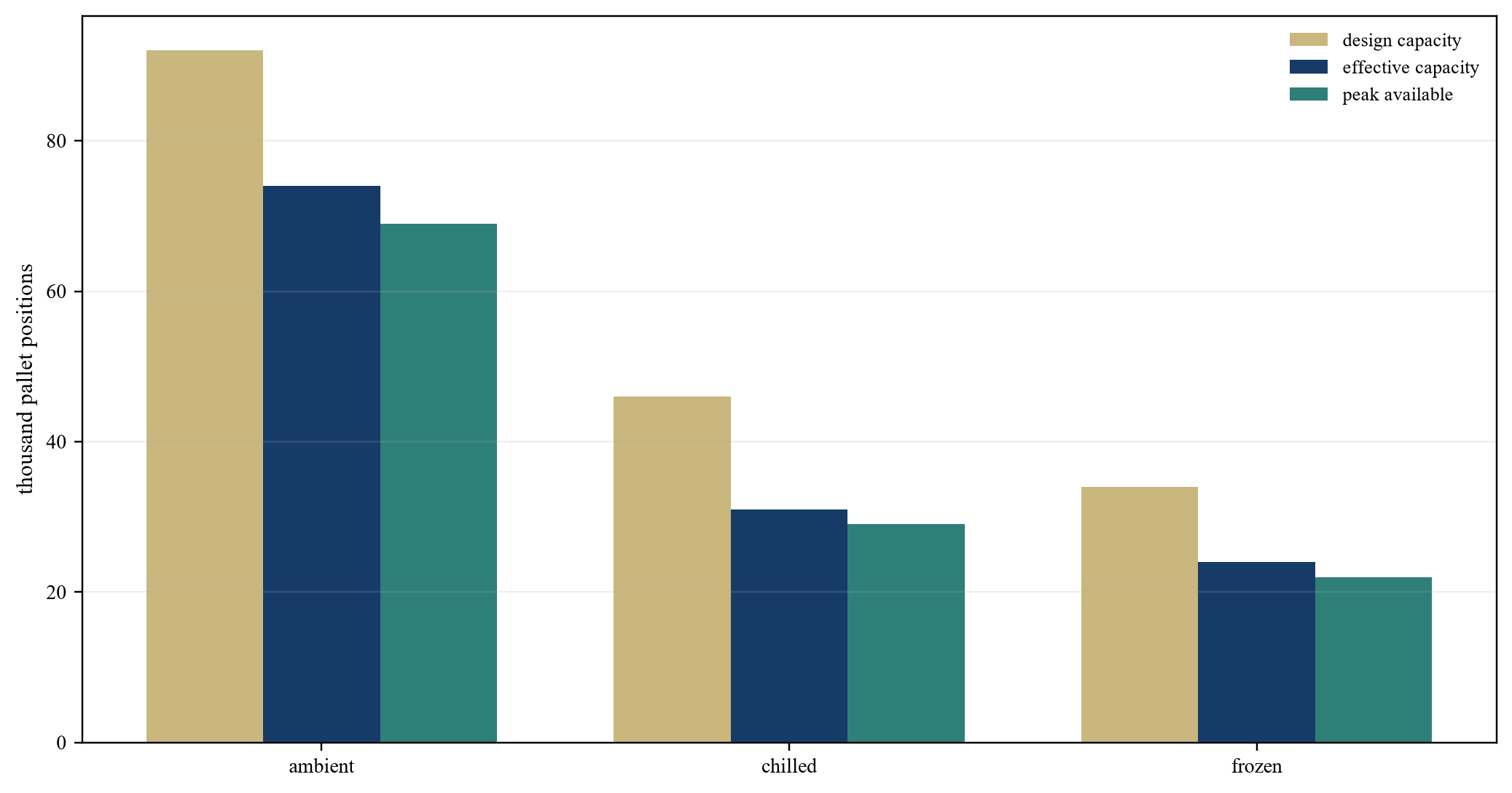
Wholly hypothetical thousand pallet positions; values do not describe an identified company.
8. Verify ambient, chilled and frozen capacity
The diligence question is which capacity is physically available for each product and temperature zone. The buyer should begin with site plans, utilisation logs, refrigeration data, leases, maintenance and independent inspection. The review should use product, site, route and customer detail because a consolidated group average can hide the node that determines continuity. Evidence should be dated, attributable and reconciled to both physical movement and financial records. [10]
The principal failure mode is that licensed or designed capacity can exceed usable capacity after segregation, aisle, dock, maintenance and throughput limits. Management estimates remain useful for planning when they are identified as estimates and separated from contractual rights, observed performance and independently verified capacity. The investment model should state how an unresolved item changes volume, price, loss, working capital, capital expenditure, timing or probability. That translation prevents a strategic narrative from entering valuation without an auditable cash-flow consequence.
The recommended response is to measure effective pallet, tonne and throughput capacity by zone and peak period. A responsible executive should own the measure, an independent function should challenge it, and the committee should see the evidence required for closure. The response should include a central case, a plausible downside and an operational trigger. If the trigger occurs, the organisation needs a decision, funding source and recovery timetable rather than another diagnostic report. In the hypothetical transaction, unresolved uncertainty is carried through a reserve, lower value, delayed synergy, completion condition or explicit risk acceptance.
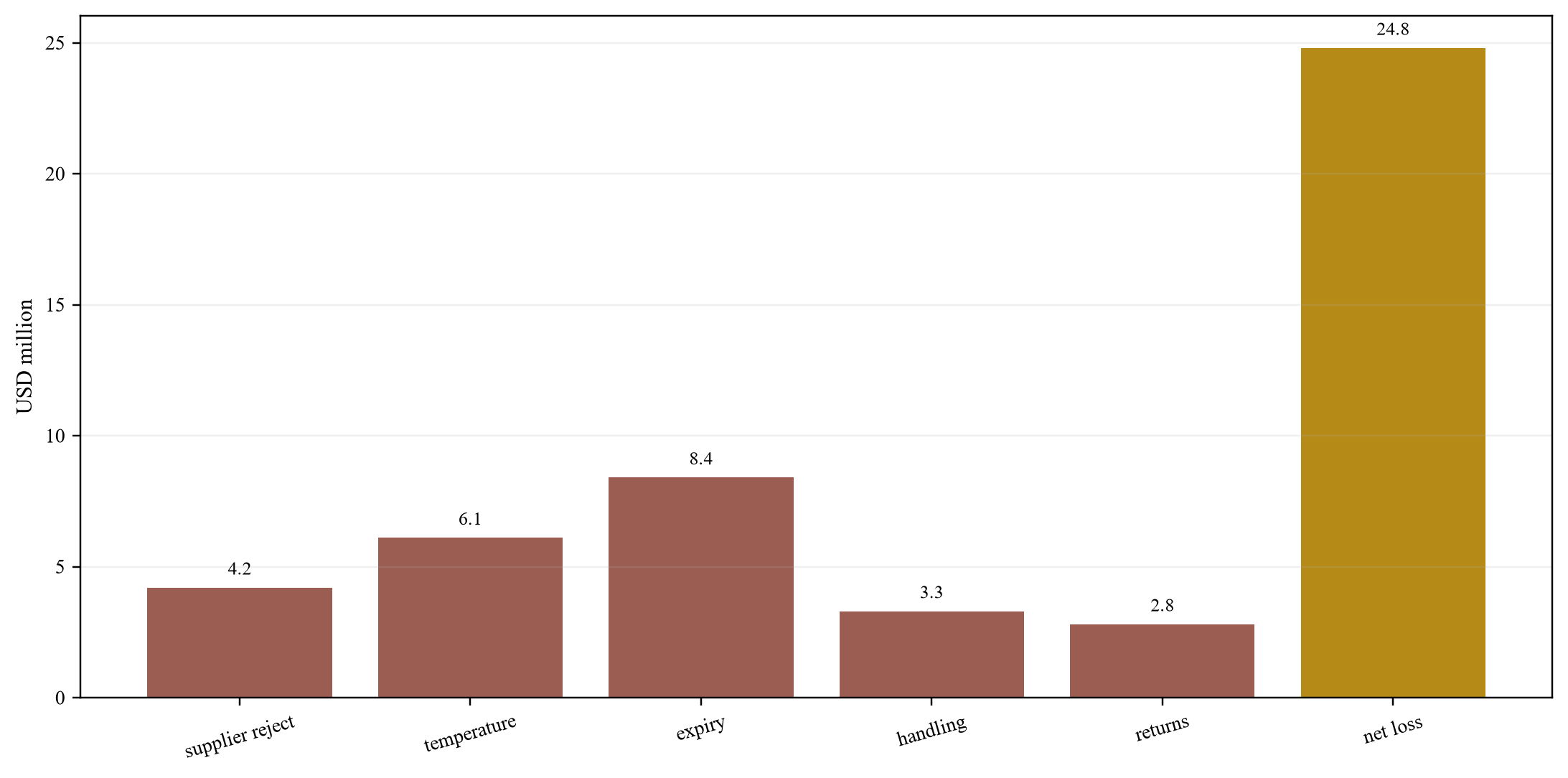
Wholly hypothetical USD millions; the bridge illustrates diligence classification.
| Loss event | Operating evidence | Accounting location | Value response |
|---|---|---|---|
| supplier rejection | inspection and debit note | purchase cost or claim | normalise supplier economics |
| temperature excursion | sensor and incident report | waste, claim or inventory | capex and control reserve |
| expiry | batch age and disposal | write-off or markdown | working-capital reset |
| handling damage | warehouse record | cost of sales or overhead | process synergy only after proof |
| customer return | credit note and reason | net revenue or cost | quality and channel adjustment |
| unrecorded shrinkage | count variance | inventory adjustment | control finding and valuation haircut |
Proposed reconciliation from physical event to financial statement.
9. Measure spoilage, shrinkage and quality loss
The diligence question is where quantity and value disappear between receipt and sale. The buyer should begin with batch records, waste logs, claims, temperature excursions, expiry, markdowns and credits. The review should use product, site, route and customer detail because a consolidated group average can hide the node that determines continuity. Evidence should be dated, attributable and reconciled to both physical movement and financial records. [10][11]
The principal failure mode is that reported waste can omit supplier rejection, rework, markdown, customer return and inventory write-off. Management estimates remain useful for planning when they are identified as estimates and separated from contractual rights, observed performance and independently verified capacity. The investment model should state how an unresolved item changes volume, price, loss, working capital, capital expenditure, timing or probability. That translation prevents a strategic narrative from entering valuation without an auditable cash-flow consequence.
The recommended response is to build a loss waterfall by product, site, cause and accountable process. A responsible executive should own the measure, an independent function should challenge it, and the committee should see the evidence required for closure. The response should include a central case, a plausible downside and an operational trigger. If the trigger occurs, the organisation needs a decision, funding source and recovery timetable rather than another diagnostic report. In the hypothetical transaction, unresolved uncertainty is carried through a reserve, lower value, delayed synergy, completion condition or explicit risk acceptance.
10. Control inventory and working capital
The diligence question is how much cash is required to carry resilience inventory without disguising obsolescence. The buyer should begin with stock ledger, ageing, days on hand, service levels, payables, receivables and cash conversion. The review should use product, site, route and customer detail because a consolidated group average can hide the node that determines continuity. Evidence should be dated, attributable and reconciled to both physical movement and financial records. [11][12]
The principal failure mode is that additional buffer stock can improve continuity while increasing expiry, financing and valuation risk. Management estimates remain useful for planning when they are identified as estimates and separated from contractual rights, observed performance and independently verified capacity. The investment model should state how an unresolved item changes volume, price, loss, working capital, capital expenditure, timing or probability. That translation prevents a strategic narrative from entering valuation without an auditable cash-flow consequence.
The recommended response is to set product-specific service targets, ageing rules and liquidity reserves. A responsible executive should own the measure, an independent function should challenge it, and the committee should see the evidence required for closure. The response should include a central case, a plausible downside and an operational trigger. If the trigger occurs, the organisation needs a decision, funding source and recovery timetable rather than another diagnostic report. In the hypothetical transaction, unresolved uncertainty is carried through a reserve, lower value, delayed synergy, completion condition or explicit risk acceptance.
11. Build an AI supply-chain digital twin
The diligence question is which decisions can be tested before capital is committed. The buyer should begin with clean master data, demand, supply, lead-time, capacity, cost and disruption histories. The review should use product, site, route and customer detail because a consolidated group average can hide the node that determines continuity. Evidence should be dated, attributable and reconciled to both physical movement and financial records. [13][14]
The principal failure mode is that a visually persuasive model can reproduce incomplete identifiers and biased historical behaviour. Management estimates remain useful for planning when they are identified as estimates and separated from contractual rights, observed performance and independently verified capacity. The investment model should state how an unresolved item changes volume, price, loss, working capital, capital expenditure, timing or probability. That translation prevents a strategic narrative from entering valuation without an auditable cash-flow consequence.
The recommended response is to validate each node, constraint and decision rule against observed operations. A responsible executive should own the measure, an independent function should challenge it, and the committee should see the evidence required for closure. The response should include a central case, a plausible downside and an operational trigger. If the trigger occurs, the organisation needs a decision, funding source and recovery timetable rather than another diagnostic report. In the hypothetical transaction, unresolved uncertainty is carried through a reserve, lower value, delayed synergy, completion condition or explicit risk acceptance.
12. Validate forecasts and anomaly models
The diligence question is whether the model performs by product, channel, site and stress regime. The buyer should begin with frozen data sets, back-tests, forecast errors, alert outcomes and override logs. The review should use product, site, route and customer detail because a consolidated group average can hide the node that determines continuity. Evidence should be dated, attributable and reconciled to both physical movement and financial records. [13][15]
The principal failure mode is that average accuracy can conceal systematic misses in perishables, promotions, new products or crisis periods. Management estimates remain useful for planning when they are identified as estimates and separated from contractual rights, observed performance and independently verified capacity. The investment model should state how an unresolved item changes volume, price, loss, working capital, capital expenditure, timing or probability. That translation prevents a strategic narrative from entering valuation without an auditable cash-flow consequence.
The recommended response is to report financial error, service-level error and false-alert burden by decision segment. A responsible executive should own the measure, an independent function should challenge it, and the committee should see the evidence required for closure. The response should include a central case, a plausible downside and an operational trigger. If the trigger occurs, the organisation needs a decision, funding source and recovery timetable rather than another diagnostic report. In the hypothetical transaction, unresolved uncertainty is carried through a reserve, lower value, delayed synergy, completion condition or explicit risk acceptance.
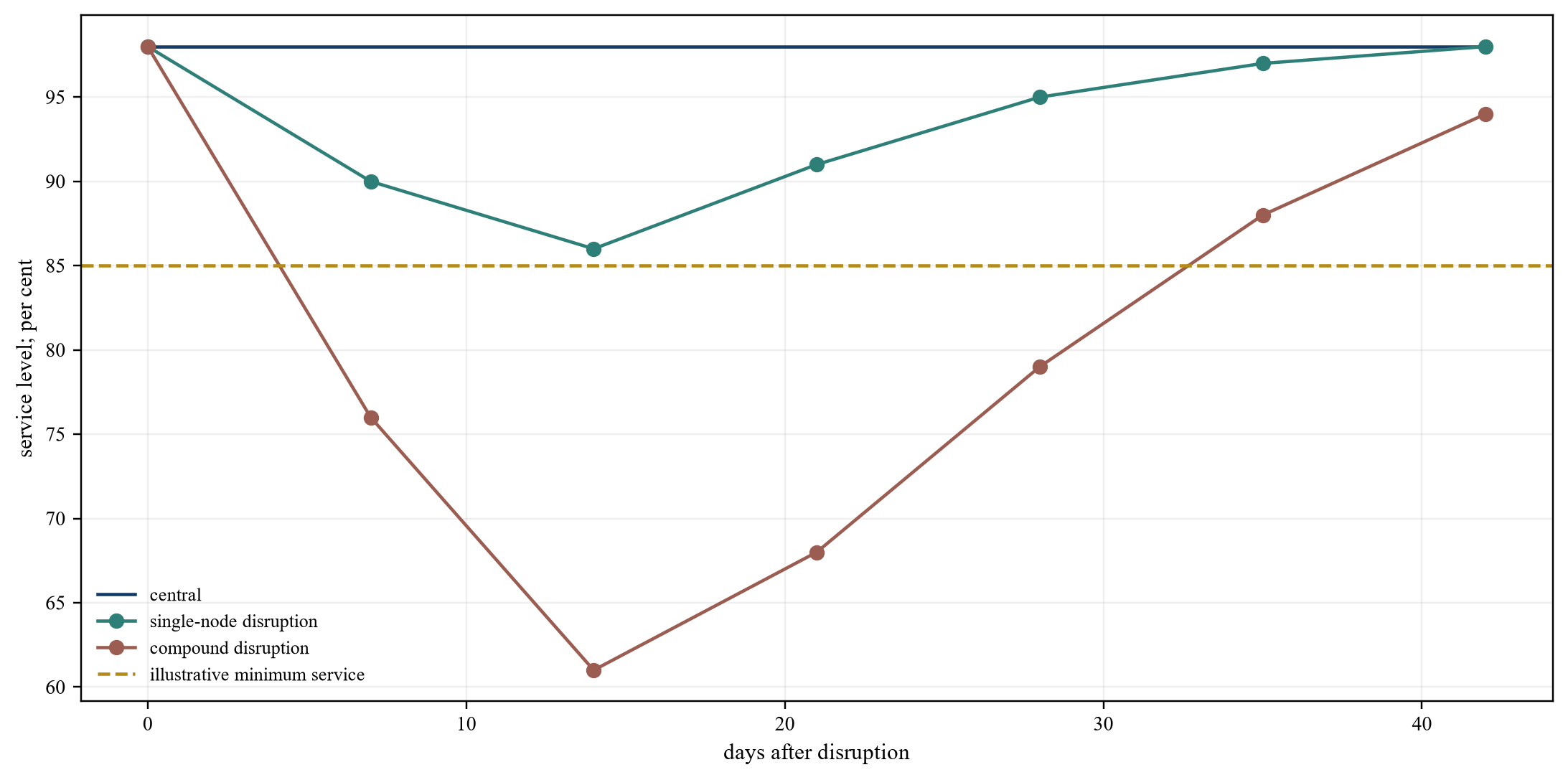
Wholly hypothetical service levels; scenarios are analytical rather than forecasts.
| Scenario | Operating shock | Financial transmission | Required action |
|---|---|---|---|
| origin interruption | 35 per cent of one category delayed | spot premium and lost sales | activate approved substitute |
| route closure | transit extended by 18 days | inventory build and demurrage | reroute and fund working capital |
| cold-store outage | chilled capacity falls 25 per cent | waste and emergency handling | invoke reciprocal capacity |
| supplier plus FX | volume shortfall and currency move | margin compression | reprice, hedge and allocate |
| data outage | forecast and batch visibility reduced | slower decisions and control risk | conservative manual fallback |
| compound event | origin, route and demand stress | service breach and liquidity trough | incident command and committed liquidity |
Wholly hypothetical stresses; they are decision tests rather than forecasts.
13. Run disruption simulations
The diligence question is when the combined platform breaches stock, service, liquidity or covenant thresholds. The buyer should begin with scenario library, recovery times, substitution rules, logistics capacity and cash model. The review should use product, site, route and customer detail because a consolidated group average can hide the node that determines continuity. Evidence should be dated, attributable and reconciled to both physical movement and financial records. [2][3]
The principal failure mode is that single-variable sensitivity misses correlated shocks across origin, freight, energy, currency and demand. Management estimates remain useful for planning when they are identified as estimates and separated from contractual rights, observed performance and independently verified capacity. The investment model should state how an unresolved item changes volume, price, loss, working capital, capital expenditure, timing or probability. That translation prevents a strategic narrative from entering valuation without an auditable cash-flow consequence.
The recommended response is to simulate compound events and record the earliest decision and funding requirement. A responsible executive should own the measure, an independent function should challenge it, and the committee should see the evidence required for closure. The response should include a central case, a plausible downside and an operational trigger. If the trigger occurs, the organisation needs a decision, funding source and recovery timetable rather than another diagnostic report. In the hypothetical transaction, unresolved uncertainty is carried through a reserve, lower value, delayed synergy, completion condition or explicit risk acceptance.
14. Complete competition and regulatory analysis
The diligence question is whether control can transfer and the planned integration can lawfully proceed. The buyer should begin with turnover, market definitions, overlaps, filing thresholds, licences and foreign investment rules. The review should use product, site, route and customer detail because a consolidated group average can hide the node that determines continuity. Evidence should be dated, attributable and reconciled to both physical movement and financial records. [5][16]
The principal failure mode is that food categories can have local competitive dynamics that differ from consolidated corporate segments. Management estimates remain useful for planning when they are identified as estimates and separated from contractual rights, observed performance and independently verified capacity. The investment model should state how an unresolved item changes volume, price, loss, working capital, capital expenditure, timing or probability. That translation prevents a strategic narrative from entering valuation without an auditable cash-flow consequence.
The recommended response is to prepare jurisdiction-specific filings and preserve clean-team controls before approval. A responsible executive should own the measure, an independent function should challenge it, and the committee should see the evidence required for closure. The response should include a central case, a plausible downside and an operational trigger. If the trigger occurs, the organisation needs a decision, funding source and recovery timetable rather than another diagnostic report. In the hypothetical transaction, unresolved uncertainty is carried through a reserve, lower value, delayed synergy, completion condition or explicit risk acceptance.
15. Protect food safety, SPS and traceability
The diligence question is whether products remain safe, approved and traceable after systems and supplier changes. The buyer should begin with HACCP plans, recalls, audits, certificates, lab tests, batch genealogy and regulator records. The review should use product, site, route and customer detail because a consolidated group average can hide the node that determines continuity. Evidence should be dated, attributable and reconciled to both physical movement and financial records. [6][17]
The principal failure mode is that integration can break traceability or introduce unapproved origin, ingredient, label or process changes. Management estimates remain useful for planning when they are identified as estimates and separated from contractual rights, observed performance and independently verified capacity. The investment model should state how an unresolved item changes volume, price, loss, working capital, capital expenditure, timing or probability. That translation prevents a strategic narrative from entering valuation without an auditable cash-flow consequence.
The recommended response is to make product safety and regulatory release a hard constraint in synergy and substitution plans. A responsible executive should own the measure, an independent function should challenge it, and the committee should see the evidence required for closure. The response should include a central case, a plausible downside and an operational trigger. If the trigger occurs, the organisation needs a decision, funding source and recovery timetable rather than another diagnostic report. In the hypothetical transaction, unresolved uncertainty is carried through a reserve, lower value, delayed synergy, completion condition or explicit risk acceptance.
16. Normalise quality of earnings
The diligence question is which earnings survive seasonality, loss, rebates, working-capital policy and ownership change. The buyer should begin with general ledger, contracts, volumes, prices, claims, waste, rebates and related-party transactions. The review should use product, site, route and customer detail because a consolidated group average can hide the node that determines continuity. Evidence should be dated, attributable and reconciled to both physical movement and financial records. [11][18]
The principal failure mode is that reported EBITDA can benefit from under-recorded waste, temporary procurement, channel loading or delayed maintenance. Management estimates remain useful for planning when they are identified as estimates and separated from contractual rights, observed performance and independently verified capacity. The investment model should state how an unresolved item changes volume, price, loss, working capital, capital expenditure, timing or probability. That translation prevents a strategic narrative from entering valuation without an auditable cash-flow consequence.
The recommended response is to bridge revenue and margin to product-level volume, price, loss and cash evidence. A responsible executive should own the measure, an independent function should challenge it, and the committee should see the evidence required for closure. The response should include a central case, a plausible downside and an operational trigger. If the trigger occurs, the organisation needs a decision, funding source and recovery timetable rather than another diagnostic report. In the hypothetical transaction, unresolved uncertainty is carried through a reserve, lower value, delayed synergy, completion condition or explicit risk acceptance.
| Case | EBITDA | Multiple | Enterprise value | Resilience assumption |
|---|---|---|---|---|
| reported reference | 65 | 10.0x | 650 | management plan |
| diligence-adjusted | 58 | 9.5x | 551 | loss and working capital normalised |
| central improvement | 72 | 9.8x | 706 | evidenced synergies phased |
| disruption downside | 47 | 8.5x | 400 | correlated route and origin shock |
| severe integration | 39 | 8.0x | 312 | service failure and delayed recovery |
Wholly hypothetical USD millions; values are illustrative and not a valuation opinion.
17. Value the resilience platform
The diligence question is how operating optionality affects cash flow, risk and capital expenditure. The buyer should begin with base forecasts, scenario cash flows, asset condition, replacement cost and market evidence. The review should use product, site, route and customer detail because a consolidated group average can hide the node that determines continuity. Evidence should be dated, attributable and reconciled to both physical movement and financial records. [18][19]
The principal failure mode is that resilience can be double counted in higher growth, lower margin loss and a lower discount rate. Management estimates remain useful for planning when they are identified as estimates and separated from contractual rights, observed performance and independently verified capacity. The investment model should state how an unresolved item changes volume, price, loss, working capital, capital expenditure, timing or probability. That translation prevents a strategic narrative from entering valuation without an auditable cash-flow consequence.
The recommended response is to value discrete capabilities through evidenced cash effects and probability-weighted scenarios. A responsible executive should own the measure, an independent function should challenge it, and the committee should see the evidence required for closure. The response should include a central case, a plausible downside and an operational trigger. If the trigger occurs, the organisation needs a decision, funding source and recovery timetable rather than another diagnostic report. In the hypothetical transaction, unresolved uncertainty is carried through a reserve, lower value, delayed synergy, completion condition or explicit risk acceptance.
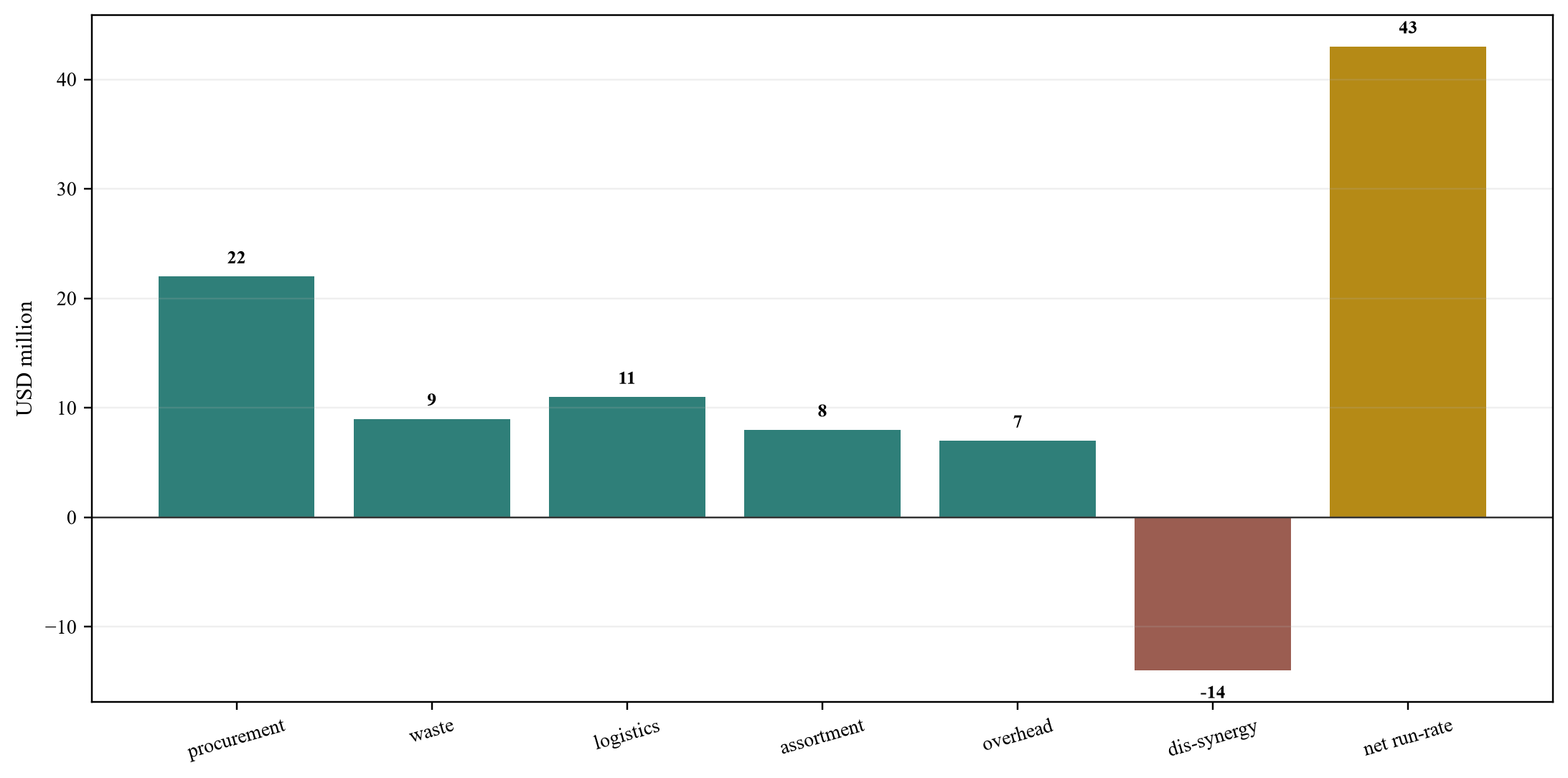
Wholly hypothetical USD millions; values require transaction-specific validation.
18. Build the synergy and margin bridge
The diligence question is which procurement, waste, logistics, assortment and overhead benefits are executable. The buyer should begin with supplier overlap, lane data, capacity, systems, workforce and implementation cost. The review should use product, site, route and customer detail because a consolidated group average can hide the node that determines continuity. Evidence should be dated, attributable and reconciled to both physical movement and financial records. [5][20]
The principal failure mode is that gross synergy estimates can ignore contract constraints, transition losses, tax, capex and working capital. Management estimates remain useful for planning when they are identified as estimates and separated from contractual rights, observed performance and independently verified capacity. The investment model should state how an unresolved item changes volume, price, loss, working capital, capital expenditure, timing or probability. That translation prevents a strategic narrative from entering valuation without an auditable cash-flow consequence.
The recommended response is to state baseline, action, gross benefit, dis-synergy, one-off cost, owner and realisation date. A responsible executive should own the measure, an independent function should challenge it, and the committee should see the evidence required for closure. The response should include a central case, a plausible downside and an operational trigger. If the trigger occurs, the organisation needs a decision, funding source and recovery timetable rather than another diagnostic report. In the hypothetical transaction, unresolved uncertainty is carried through a reserve, lower value, delayed synergy, completion condition or explicit risk acceptance.
19. Allocate risk through transaction terms
The diligence question is which uncertainties remain with seller, buyer, insurer, lender or management. The buyer should begin with representations, indemnities, escrows, earn-outs, locked-box or completion accounts and insurance. The review should use product, site, route and customer detail because a consolidated group average can hide the node that determines continuity. Evidence should be dated, attributable and reconciled to both physical movement and financial records. [5]
The principal failure mode is that price adjustment cannot repair an operational network that fails during transition. Management estimates remain useful for planning when they are identified as estimates and separated from contractual rights, observed performance and independently verified capacity. The investment model should state how an unresolved item changes volume, price, loss, working capital, capital expenditure, timing or probability. That translation prevents a strategic narrative from entering valuation without an auditable cash-flow consequence.
The recommended response is to match contractual protection to evidence gaps and fund operational remediation at closing. A responsible executive should own the measure, an independent function should challenge it, and the committee should see the evidence required for closure. The response should include a central case, a plausible downside and an operational trigger. If the trigger occurs, the organisation needs a decision, funding source and recovery timetable rather than another diagnostic report. In the hypothetical transaction, unresolved uncertainty is carried through a reserve, lower value, delayed synergy, completion condition or explicit risk acceptance.
| Risk | Financing protection | Monitoring signal | Response |
|---|---|---|---|
| seasonal working capital | committed revolving line | cash conversion and stock build | draw within approved base |
| delayed synergy | covenant headroom and equity funding | realised benefit versus plan | defer distributions |
| spoilage and inventory loss | eligibility, insurance and reserves | age, waste and count variance | reduce borrowing base |
| integration capex | funded budget and milestone draw | completion evidence | holdback or sponsor funding |
| FX and commodity movement | hedging policy and liquidity | exposure and margin calls | rebalance and reserve |
| compound disruption | minimum liquidity and cure plan | service and cash thresholds | incident governance |
Proposed structuring map; legal advisers and lenders should confirm transaction terms.
20. Finance the acquisition and resilience plan
The diligence question is whether debt service survives working-capital build, capex and delayed synergies. The buyer should begin with sources and uses, debt terms, liquidity, hedging, capex and monthly cash flows. The review should use product, site, route and customer detail because a consolidated group average can hide the node that determines continuity. Evidence should be dated, attributable and reconciled to both physical movement and financial records. [12][21]
The principal failure mode is that a leverage case based on steady-state EBITDA may omit seasonal inventory and integration cash troughs. Management estimates remain useful for planning when they are identified as estimates and separated from contractual rights, observed performance and independently verified capacity. The investment model should state how an unresolved item changes volume, price, loss, working capital, capital expenditure, timing or probability. That translation prevents a strategic narrative from entering valuation without an auditable cash-flow consequence.
The recommended response is to size debt to downside cash generation and reserve committed liquidity for the resilience plan. A responsible executive should own the measure, an independent function should challenge it, and the committee should see the evidence required for closure. The response should include a central case, a plausible downside and an operational trigger. If the trigger occurs, the organisation needs a decision, funding source and recovery timetable rather than another diagnostic report. In the hypothetical transaction, unresolved uncertainty is carried through a reserve, lower value, delayed synergy, completion condition or explicit risk acceptance.
21. Integrate without interrupting supply
The diligence question is how systems, suppliers, warehouses and customer allocation change while service continues. The buyer should begin with day-one plan, cutover sequence, inventory buffers, dual running and incident command. The review should use product, site, route and customer detail because a consolidated group average can hide the node that determines continuity. Evidence should be dated, attributable and reconciled to both physical movement and financial records. [2][20]
The principal failure mode is that simultaneous system and network consolidation can remove the very redundancy the acquisition was meant to create. Management estimates remain useful for planning when they are identified as estimates and separated from contractual rights, observed performance and independently verified capacity. The investment model should state how an unresolved item changes volume, price, loss, working capital, capital expenditure, timing or probability. That translation prevents a strategic narrative from entering valuation without an auditable cash-flow consequence.
The recommended response is to sequence changes by product criticality and retain tested fallback operations. A responsible executive should own the measure, an independent function should challenge it, and the committee should see the evidence required for closure. The response should include a central case, a plausible downside and an operational trigger. If the trigger occurs, the organisation needs a decision, funding source and recovery timetable rather than another diagnostic report. In the hypothetical transaction, unresolved uncertainty is carried through a reserve, lower value, delayed synergy, completion condition or explicit risk acceptance.
22. Govern AI and human accountability
The diligence question is who approves forecasts, overrides, allocation and emergency sourcing decisions. The buyer should begin with model inventory, access rights, validation, decision logs and board reporting. The review should use product, site, route and customer detail because a consolidated group average can hide the node that determines continuity. Evidence should be dated, attributable and reconciled to both physical movement and financial records. [13][15]
The principal failure mode is that automation can accelerate a poor decision when data, constraints or incentives are wrong. Management estimates remain useful for planning when they are identified as estimates and separated from contractual rights, observed performance and independently verified capacity. The investment model should state how an unresolved item changes volume, price, loss, working capital, capital expenditure, timing or probability. That translation prevents a strategic narrative from entering valuation without an auditable cash-flow consequence.
The recommended response is to assign named human decision rights and independent validation for material models. A responsible executive should own the measure, an independent function should challenge it, and the committee should see the evidence required for closure. The response should include a central case, a plausible downside and an operational trigger. If the trigger occurs, the organisation needs a decision, funding source and recovery timetable rather than another diagnostic report. In the hypothetical transaction, unresolved uncertainty is carried through a reserve, lower value, delayed synergy, completion condition or explicit risk acceptance.
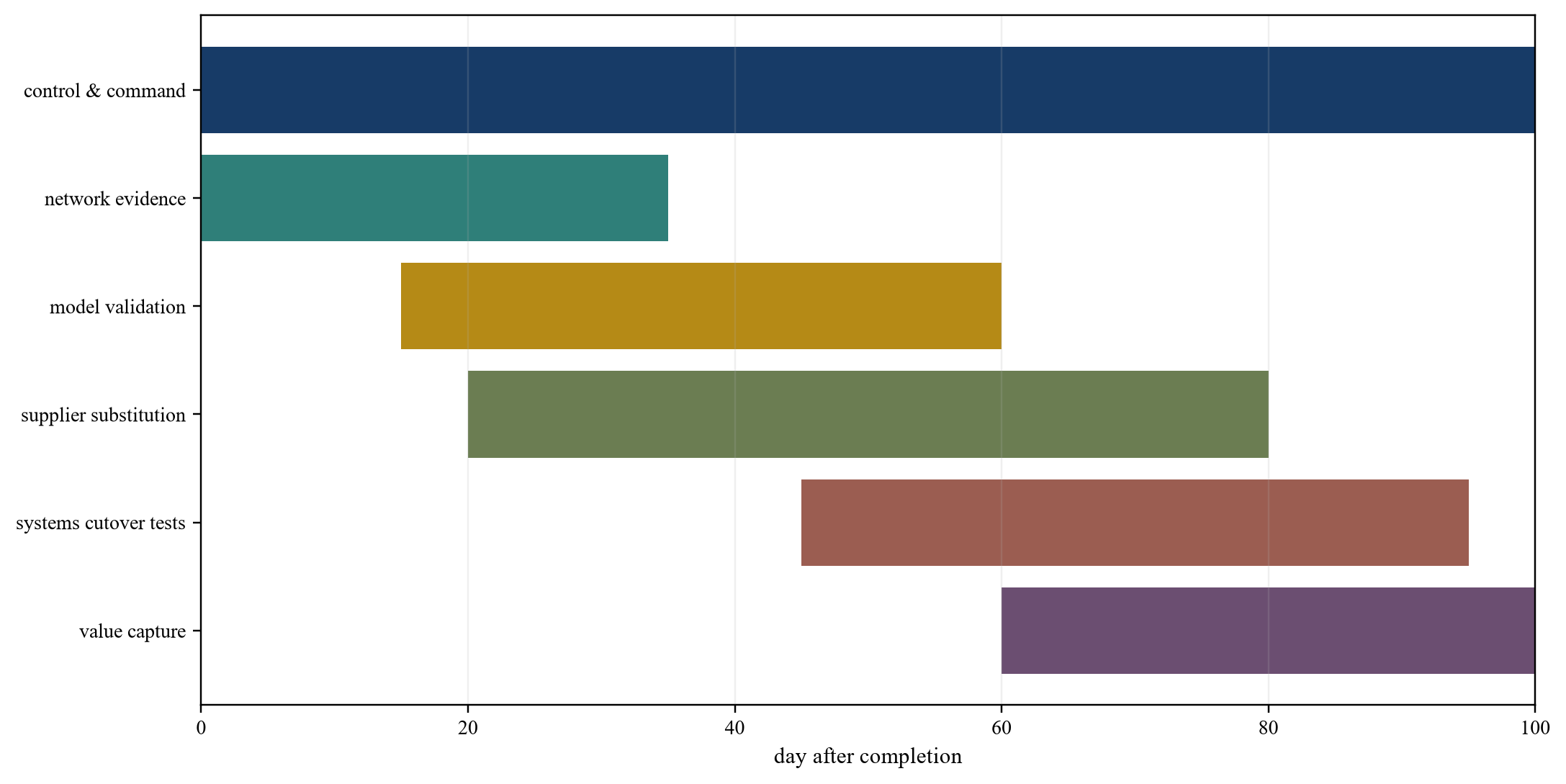
Sequencing framework; actual dates depend on approvals, systems and operating risk.
23. Execute a one-hundred-day resilience programme
The diligence question is which actions establish control and measurable value after completion. The buyer should begin with workstreams, milestones, budgets, risk owners and evidence gates. The review should use product, site, route and customer detail because a consolidated group average can hide the node that determines continuity. Evidence should be dated, attributable and reconciled to both physical movement and financial records. [20]
The principal failure mode is that an integration plan organised only by corporate function can miss cross-network dependencies. Management estimates remain useful for planning when they are identified as estimates and separated from contractual rights, observed performance and independently verified capacity. The investment model should state how an unresolved item changes volume, price, loss, working capital, capital expenditure, timing or probability. That translation prevents a strategic narrative from entering valuation without an auditable cash-flow consequence.
The recommended response is to organise delivery around product flows, critical nodes and cash outcomes. A responsible executive should own the measure, an independent function should challenge it, and the committee should see the evidence required for closure. The response should include a central case, a plausible downside and an operational trigger. If the trigger occurs, the organisation needs a decision, funding source and recovery timetable rather than another diagnostic report. In the hypothetical transaction, unresolved uncertainty is carried through a reserve, lower value, delayed synergy, completion condition or explicit risk acceptance.
Implementation detail: converting acquisition diligence into a resilient operating system
Quality of earnings and integration planning should use the same operating facts. If diligence finds under-recorded spoilage, the forecast, purchase price, inventory opening balance and improvement plan should agree. If storage needs repair, the model should include downtime, capex and contingency. If supplier contracts require consent, synergy timing should reflect it. This reconciliation prevents a problem from reducing price in one workstream while appearing again as a full synergy in another.
Closing conditions should focus on matters that cannot safely remain open. Examples include merger approval, transfer of a critical import or food licence, control of key warehouses, data and system continuity, insurance, committed financing and ownership of essential brands or contracts. Other findings can enter a funded remediation plan, escrow, indemnity or price adjustment. Each treatment should reflect both recoverability and operating urgency.
Integration sequencing should protect product flow. Master-data alignment and visibility can precede physical consolidation. Supplier renegotiation can proceed before closing a warehouse. Systems can run in parallel until batch traceability, temperature data, orders, invoices and cash reconcile. A legacy route should remain available until the new route has completed controlled trials. The roadmap should state the evidence needed to retire each safeguard.
Food safety deserves an independent gate. Commercial pressure should not override product release, recall, traceability or regulatory decisions. The combined organisation should test end-to-end batch genealogy, supplier approval, laboratory results, allergen and ingredient data, temperature records, complaint handling and recall communication. A mock recall can reveal whether integration has broken identifiers or responsibilities.
24. Red-team the combined network
The diligence question is how fraud, outage, disruption and poor data could defeat the investment case. The buyer should begin with adversarial tests, incident simulations, penetration tests and operational drills. The review should use product, site, route and customer detail because a consolidated group average can hide the node that determines continuity. Evidence should be dated, attributable and reconciled to both physical movement and financial records. [13][22]
The principal failure mode is that controls that work in a presentation may fail under incomplete information and time pressure. Management estimates remain useful for planning when they are identified as estimates and separated from contractual rights, observed performance and independently verified capacity. The investment model should state how an unresolved item changes volume, price, loss, working capital, capital expenditure, timing or probability. That translation prevents a strategic narrative from entering valuation without an auditable cash-flow consequence.
The recommended response is to test high-impact failure paths before removing legacy safeguards. A responsible executive should own the measure, an independent function should challenge it, and the committee should see the evidence required for closure. The response should include a central case, a plausible downside and an operational trigger. If the trigger occurs, the organisation needs a decision, funding source and recovery timetable rather than another diagnostic report. In the hypothetical transaction, unresolved uncertainty is carried through a reserve, lower value, delayed synergy, completion condition or explicit risk acceptance.
| Finding | Cash consequence | Deal response | Accountable owner |
|---|---|---|---|
| origin or route concentration lacks a tested substitute | lost volume and spot premium | lower value and closing condition | commercial lead |
| effective storage is below reported capacity | capex, service and waste | capacity reserve | operations lead |
| inventory and loss records do not reconcile | overstated earnings and assets | QoE adjustment and control plan | finance lead |
| AI models lack validation or fallback | forecast and allocation error | exclude benefit until proven | data lead |
| synergies depend on unsafe cutover | service interruption | phase delivery and retain redundancy | integration lead |
| downside cash remains financeable | stronger execution capacity | approve subject to evidence gates | board and lenders |
Proposed committee framework; it is not an investment recommendation.
25. Use an investment-committee decision matrix
The diligence question is whether return, resilience, execution and downside form a coherent approval case. The buyer should begin with evidence register, valuation, financing, integration, regulatory and risk papers. The review should use product, site, route and customer detail because a consolidated group average can hide the node that determines continuity. Evidence should be dated, attributable and reconciled to both physical movement and financial records. [5][18]
The principal failure mode is that a long diligence report can leave the committee without explicit conditions or accountability. Management estimates remain useful for planning when they are identified as estimates and separated from contractual rights, observed performance and independently verified capacity. The investment model should state how an unresolved item changes volume, price, loss, working capital, capital expenditure, timing or probability. That translation prevents a strategic narrative from entering valuation without an auditable cash-flow consequence.
The recommended response is to convert each material finding into cash impact, protection, owner, deadline and approval condition. A responsible executive should own the measure, an independent function should challenge it, and the committee should see the evidence required for closure. The response should include a central case, a plausible downside and an operational trigger. If the trigger occurs, the organisation needs a decision, funding source and recovery timetable rather than another diagnostic report. In the hypothetical transaction, unresolved uncertainty is carried through a reserve, lower value, delayed synergy, completion condition or explicit risk acceptance.
Sources
- Food and Agriculture Organization, FAO Subregional Office for the Gulf Cooperation Council States and Yemen, Read the primary source
- GCC Secretariat, Agriculture and Food Security Ecosystem in GCC States Is a Strategic Priority, 3 September 2026, Read the primary source
- Food and Agriculture Organization, Strait of Hormuz crisis: risks, actions and policy responses, 28 April 2026, Read the primary source
- GCC Secretariat, Agricultural Cooperation and Food Security Committee Extraordinary Meeting, 2 July 2026, Read the primary source
- General Authority for Competition, Saudi Arabia, Economic Concentration Review Guidelines, 2025, Read the primary source
- World Trade Organization, Understanding the Agreement on Sanitary and Phytosanitary Measures, Read the primary source
- GCC Secretariat, Guide to Imported Food Control in GCC Countries, Read the primary source
- UNIDROIT, FAO and IFAD, Legal Guide on Contract Farming, Read the primary source
- United Nations Conference on Trade and Development, Review of Maritime Transport 2025, Read the primary source
- Food and Agriculture Organization, The State of Food and Agriculture 2019: Moving Forward on Food Loss and Waste Reduction, Read the primary source
- IFRS Foundation, IAS 2 Inventories, Read the primary source
- International Finance Corporation, Trade and Supply Chain Finance, Read the primary source
- National Institute of Standards and Technology, Artificial Intelligence Risk Management Framework, Read the primary source
- OECD, OECD Due Diligence Guidance for Responsible AI, Read the primary source
- ISO, ISO/IEC 42001 Artificial Intelligence Management Systems, Read the primary source
- GCC Secretariat, Agricultural Cooperation Committee decisions on quarantine, seeds and animal health, 20 June 2022, Read the primary source
- Codex Alimentarius Commission, General Principles of Food Hygiene CXC 1-1969, Read the primary source
- IFRS Foundation, IFRS 3 Business Combinations, Read the primary source
- IFRS Foundation, IFRS 13 Fair Value Measurement, Read the primary source
- Competition and Markets Authority, Merger Assessment Guidelines, Read the primary source
- Basel Committee on Banking Supervision, Principles for the Management of Credit Risk, Read the primary source
- National Institute of Standards and Technology, Cybersecurity Framework 2.0, Read the primary source
- UAE Ministry of Climate Change and Environment, A Guide to Food Security in the UAE, 2023, Read the primary source
- General Food Security Authority, Saudi Food Loss and Waste Baseline, Read the primary source
