

1. Verified savings are a financing asset only after evidence gates
Industrial efficiency produces value by changing a future cost trajectory. That value is not directly observed because the avoided energy use never occurs. The financier observes actual consumption and must estimate what consumption would have been under comparable production and operating conditions without the project. This counterfactual makes evidence design part of credit design.
The first evidence gate is technical causality. The proposed measure must have a defined mechanism, such as reducing motor losses, recovering waste heat, improving compressed-air control, lowering steam leakage or optimising process set points. The second gate is measurement. Meter boundaries, sampling intervals, calibration, data retention and adjustment variables must be agreed before implementation. The third gate is financial conversion. Measured energy units must be translated through the applicable tariff, demand charge, fuel price, operating cost, tax and maintenance profile. The fourth gate is cash capture. The contract and account structure must determine who receives the benefit and when it can pay debt.
The International Energy Agency identifies multiple efficiency-finance instruments, including credit lines, energy-service-company structures, green loans and sustainability-linked loans.[1] These instruments allocate funding differently, but each depends on credible performance information. ISO 50001 similarly uses energy baselines and energy-performance indicators within a continual-improvement system.[4] The International Performance Measurement and Verification Protocol provides recognised measurement and verification concepts for energy-performance projects.[5]
A lender should therefore underwrite a controlled savings system rather than a single savings number. That system contains the baseline, approved adjustments, post-installation measurement, commissioning evidence, calculation workbook, independent review, dispute process and cash waterfall. Each component needs an owner, timetable, data source and correction route.
The practical credit question is whether the savings system remains operable during underperformance. If production changes, a meter fails or the contractor disputes an adjustment, the parties still need a provisional calculation, reserve and remedy. A project that performs technically can create a financing default when its evidence chain cannot produce a timely and accepted payment amount.
2. Fix the project, site and contract perimeter
An industrial site can contain several legal entities, utility accounts, production lines, leased assets, shared services and third-party operators. A decarbonisation programme may cover only selected equipment while interacting with the wider plant. The financing perimeter should be fixed before the baseline is modelled.
The legal perimeter records the borrower, guarantors, site owner, operator, engineering contractor, equipment suppliers, energy-services provider, independent verifier and utility counterparties. It identifies ownership of installed equipment, access rights, permits, insurance, intellectual property, data and environmental attributes. The technical perimeter identifies every included system, meter, process interface, utility connection and excluded load. The operating perimeter identifies production schedules, maintenance responsibility, shutdown windows, staffing, raw-material conditions and quality requirements. The cash perimeter identifies utility-payment accounts, project accounts, debt-service accounts, reserves and restrictions on cash movement.
Shared utilities require particular care. A central boiler, chiller, compressor or substation may serve both project and non-project loads. Site-level consumption can fall while an included production line deteriorates, or rise because another line expands. Submetering and allocation rules should match the economic boundary. Where direct measurement is impractical, the allocation formula should have a documented rationale, test frequency and error tolerance.
The project boundary should also state what is not financed. Capacity expansion, mandatory maintenance, safety upgrades and product-quality projects can occur at the same time as efficiency work. Their costs and benefits should be separated where practicable. The aim is to prevent unrelated capital expenditure from entering the savings economics or an efficiency measure from claiming benefits created elsewhere.
3. Build an auditable energy and process baseline
The baseline should reconstruct how energy use responds to the variables that actually drive the process. A simple historical average can be suitable for a stable, continuously operated load. A production plant often needs a model that relates energy to output, product mix, operating hours, weather, starts, rejects, pressure, temperature or feedstock conditions.
Data selection begins with a baseline period long enough to capture representative operating states. The modeller should inventory utility invoices, interval meters, supervisory-control data, production records, batch records, maintenance events, shutdowns and tariff schedules. Each data set should have an owner, system of record, time zone, unit, frequency, quality rule and retention period. Missing observations, substitutions and manual overrides should be visible.
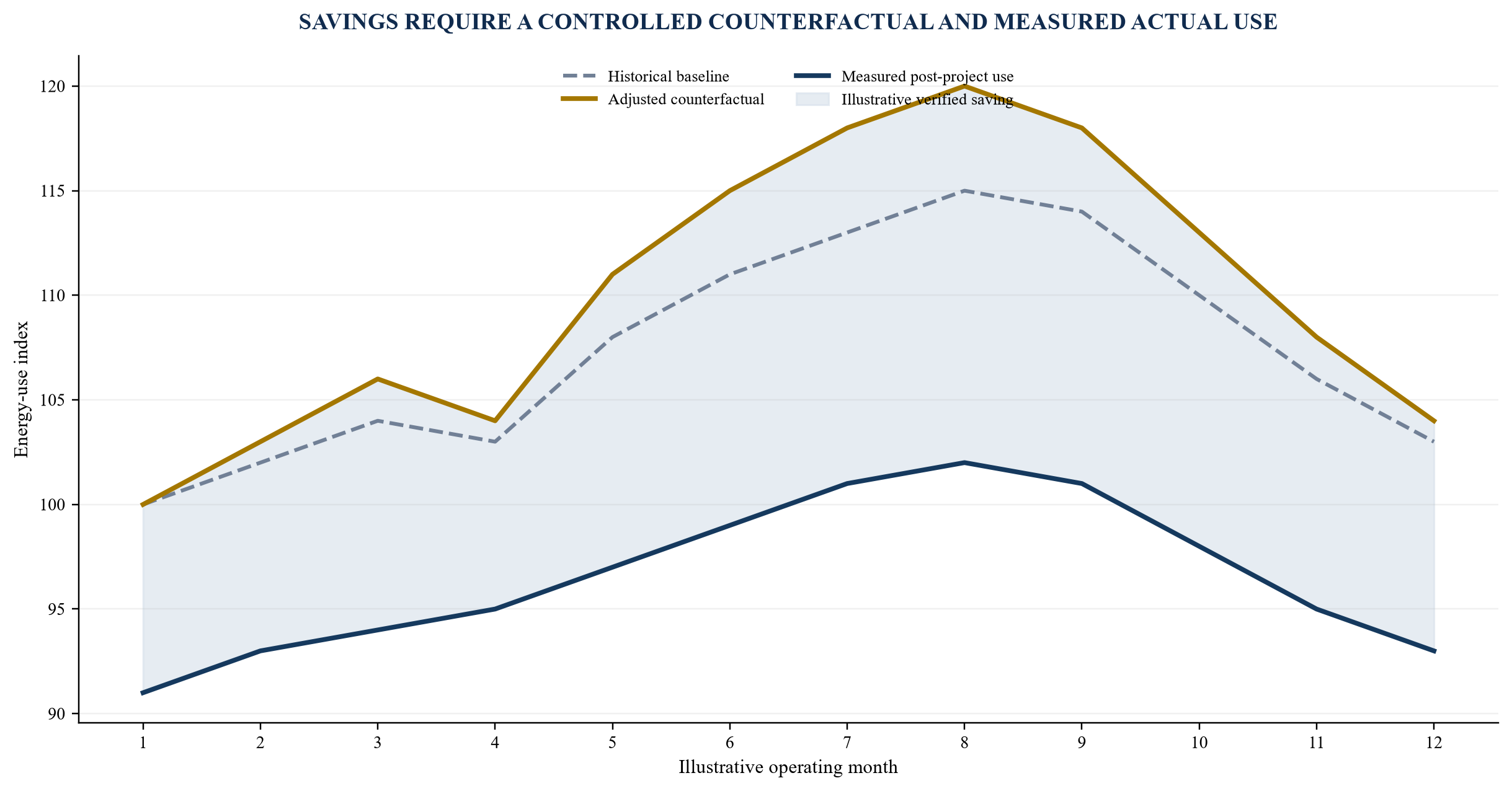
Hypothetical indices illustrate method only; they do not represent an identified industrial site.
The model should be tested for intuitive direction, residual patterns, outliers and stability. A statistically strong fit can still be commercially wrong when it embeds a temporary operating practice. Engineering review should confirm that variables have a plausible causal relationship. Changes in plant configuration, metering or production policy should be documented.
Table 1. Baseline data and control map
| Evidence domain | Minimum controlled record | Common failure | Financing response |
|---|---|---|---|
| Utility and fuel use | invoices, interval data, meter identifiers and tariff | gaps, estimated bills or unit mismatch | validation rule and provisional reserve |
| Production | output, product mix, rejects and operating hours | inconsistent batch definitions | agreed driver hierarchy and reconciliation |
| Equipment state | run status, load, set point and maintenance | manual override or undocumented bypass | exception log and commissioning retest |
| Environment | temperature, humidity or cooling degree data | unsuitable external series | approved source and sensitivity test |
| Configuration | line, meter and control-system change log | baseline boundary altered silently | change-control approval before adjustment |
The required granularity depends on the measure, site and agreed measurement boundary.
Baseline approval should be a formal financing condition. The approved package should contain raw data extracts, cleaning rules, model specification, coefficients, tests, exclusions, adjustment procedure and a reproducible calculation. A summary slide or engineering report without the underlying calculation is insufficient for recurring payment administration.
4. Normalise production, weather, tariff and operating conditions
Normalisation separates project performance from changes that the project did not cause. Industrial output can rise, fall or switch product mix. Ambient conditions can change cooling and process loads. A tariff may introduce a new demand charge. Operators can extend shifts, alter pressure or defer maintenance. Each variable should be classified as routine, non-routine or irrelevant to the measurement boundary.
Routine adjustments use variables already built into the baseline model. If electricity use varies with tonnes produced and cooling degree hours, the counterfactual can be calculated using actual post-project tonnes and weather. Non-routine adjustments address structural changes such as adding a production line, changing a major raw material, moving a meter or replacing unrelated equipment. These changes require a documented engineering and financial assessment.
The contract should define the evidence threshold for an adjustment. Management assertion alone should not change savings. The requesting party should state the event, date, affected system, data, calculation and proposed treatment. The independent verifier should test materiality and approve or reject the adjustment under a timetable. Disputed amounts can enter a reserve while undisputed payments continue.
Tariff normalisation needs its own rule. Energy units and financial savings answer different questions. A technical performance guarantee may use a fixed reference tariff to isolate engineering performance. Debt service depends on actual avoided cash cost. The project can therefore maintain both a unit-savings ledger and a cash-savings ledger. A tariff increase improves cash savings without improving equipment performance; a subsidy or tariff reduction can weaken debt capacity while the equipment meets its guarantee.
Operating discipline also matters. A new control system may be bypassed during a production incident. A heat-recovery unit may be unavailable because the upstream process stops. Rebound can occur when cheaper effective energy use encourages longer operation or higher output. The model should distinguish availability, utilisation and efficiency. This distinction directs remedies toward equipment, operations or commercial structure.
5. Create a savings-confidence ladder
Savings evidence matures through stages. Early engineering estimates help select projects. Vendor guarantees help allocate specified performance. Commissioning tests show that equipment can operate as designed. Stabilised operating data show performance under real production. Independent verification and cash reconciliation show that the benefit can support payment.
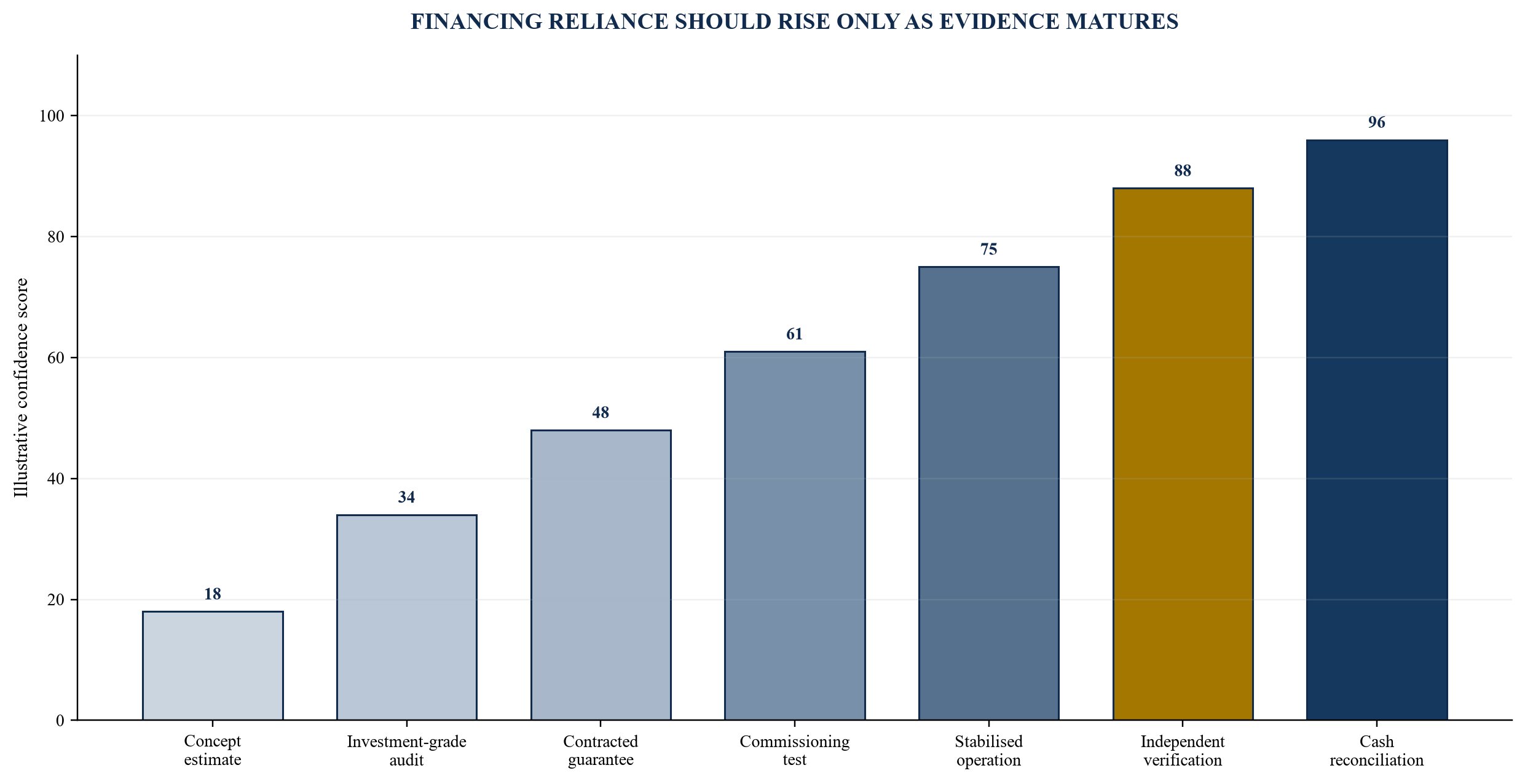
Hypothetical scores show relative evidence maturity; actual reliance requires transaction-specific diligence.
The ladder should control capital release. Development funding can pay for audits, design and permitting. Equipment orders can require approved design, fixed scope and supplier security. Construction draws can require verified progress and cost-to-complete. Retention can remain until commissioning and data acceptance. Term conversion can require stabilised operation, verified savings and a funded reserve.
Confidence should be measure-specific. A standard motor replacement with calibrated metering can reach high confidence quickly. A process-optimisation algorithm operating across changing products may need a longer observation period and model governance. A portfolio can therefore contain different confidence classes and advance limits.
Uncertainty should be quantified rather than hidden. Meter accuracy, sampling, model error, missing data and adjustment judgement can create a confidence interval. The financing model can use a conservative point, reserve or haircut. The protocol should state when uncertainty is absorbed by the contractor, borrower or lender.
6. Define the measurement and verification plan before construction
The measurement and verification plan is a transaction document. It should identify the measure, boundary, baseline period, reporting period, meters, variables, data-quality rules, calculation, adjustments, verifier, reporting dates, dispute procedure and record-retention period. It should be signed or incorporated before equipment is installed because baseline evidence can be lost after implementation.
The IPMVP recognises approaches that range from measuring key parameters to whole-facility analysis and calibrated simulation.[5] Selection should follow the project mechanism and materiality. A lighting or motor measure may suit a retrofit-isolation approach. A portfolio of interacting process controls may require whole-facility analysis. A new or highly modified facility may require calibrated simulation. The label is less important than the documented evidence chain.
Table 2. Measurement method, control and financing use
| Measurement approach | Suitable evidence pattern | Key control | Financing use |
|---|---|---|---|
| Retrofit isolation, key parameters | stable load with selected measured variables | conservative stipulated parameter and periodic test | limited measure-level reliance |
| Retrofit isolation, all parameters | separable equipment with direct metering | calibrated meter and defined operating range | stronger measure-level reliance |
| Whole-facility analysis | interacting measures with reliable site data | robust normalisation and change log | portfolio or site-level reliance |
| Calibrated simulation | new or substantially changed system | model calibration and sensitivity disclosure | reliance after independent model review |
| Operational control test | control logic or set-point optimisation | version control, override log and fallback state | supports availability and causality evidence |
Method selection should follow current professional guidance and project-specific engineering judgement.
Data rights should survive contractor distress and financing enforcement. The borrower and security agent may need access to meter credentials, historian exports, calculation scripts, configuration files and verification reports. Cloud-hosted platforms should have continuity, export and transition provisions. Proprietary calculation logic should be documented enough for an independent party to reproduce payment amounts.
The plan should address bad data before it occurs. It can specify permitted interpolation, hierarchy of substitute meters, maximum gap, conservative fallback and escalation. A prolonged failure should trigger equipment repair, reserve and possibly an event review. Silent data substitution undermines both payment accuracy and lender trust.
7. Separate engineering savings from financial cash flows
Engineering savings are measured in energy or process units. Financial savings depend on price, charges and costs. The cash bridge should begin with verified unit savings, apply the relevant energy and demand tariffs, then deduct incremental operating expenditure, measurement cost, maintenance, insurance, taxes, fees and reserves.
Demand charges can create non-linear results. Lower annual energy use may not reduce the monthly peak if production still reaches the same maximum load. Time-of-use tariffs can make savings during peak periods more valuable. Fuel contracts may include take-or-pay obligations or price floors. Self-generation can change both imported energy and network charges. The financial model should reproduce the actual bill structure.
Maintenance and replacement should be included over the debt term. Efficient equipment can reduce maintenance, but new controls, sensors, software and specialised components can add recurring cost. Warranty expiry can shift risk to the borrower. A measured gross saving that requires substantial maintenance is not equivalent to free cash.
The cash bridge should also treat lost production and quality. Installation may require shutdowns. New controls can affect throughput, reject rates or product specification. Positive productivity benefits can be material, but they should enter the base case only when the measurement method and commercial evidence are dependable. Otherwise they can remain upside or a separate covenant metric.
The lender should reconcile verified savings to the general ledger and bank cash. Utility invoices, fuel purchases, maintenance costs and performance fees should tie to the calculation. This reconciliation reveals whether the project benefit is offset by other site costs or absorbed elsewhere in the group. It also creates evidence for distributions, debt service and reporting.
8. Build the capital-expenditure and implementation curve
Industrial retrofits consume cash before they produce stable savings. Development includes audits, design, permits, procurement and financing work. Equipment deposits can precede delivery. Construction and integration can require shutdowns. Commissioning can expose defects. Retention and warranty obligations can continue after operation begins.
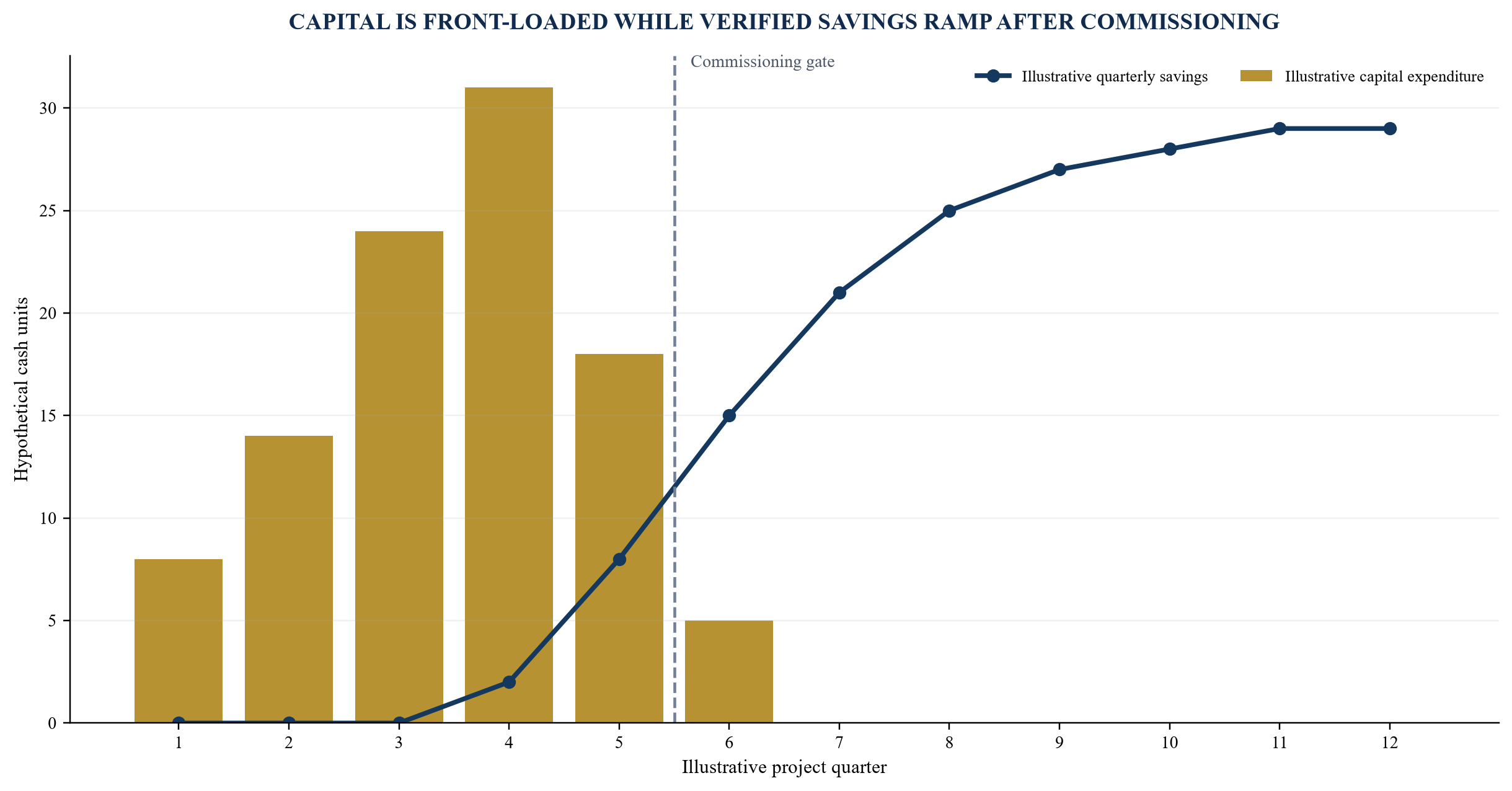
Hypothetical values illustrate timing risk; they do not describe a forecast or project.
The cost schedule should separate fixed-price, provisional, reimbursable and contingency items. It should show currency, tax, freight, duties, installation, owner costs, spares, software, metering and independent verification. Committed costs should reconcile to purchase orders and contracts. Forecast cost-to-complete should reconcile sources and uses at every draw.
Draw conditions should match execution. Equipment payments can require supplier invoices, title evidence, inspection, shipping documents and insurance. Installation draws can require engineer certification and updated cost-to-complete. Commissioning release can require functional tests, safety sign-off, data acceptance and operator training. A retention account can cover punch-list and early-life defects.
Schedule contingency should recognise site access, imports, grid or utility approvals, production shutdowns and integration risk. A delay can create interest during construction and defer savings while fixed costs continue. The base case should show available liquidity through a delayed-completion scenario. Sponsor support should cover defined overruns and delay costs rather than an undefined obligation.
9. Allocate construction, commissioning and integration risk
Construction risk should sit with the party able to control it, supported by a remedy that has value. An engineering contractor can control design coordination, installation and commissioning within an agreed scope. The site operator controls access, production shutdowns, existing-equipment condition and operating procedures. Equipment suppliers control specified performance and warranty. The borrower retains residual interface and financing risk.
The contract map should align scope, schedule, price, acceptance, liquidated damages, warranty, performance testing, exclusions and liability caps. A nominal performance guarantee can be weak when the cap is small, exclusions are broad or the contractor lacks financial capacity. Parent guarantees, letters of credit, performance bonds, retention or insurance can support obligations, subject to legal and commercial review.
Commissioning should test more than equipment start-up. It should verify safety, functional performance, controls, metering, data export, alarms, fallback modes and interaction with production. Acceptance should distinguish mechanical completion, provisional acceptance, performance acceptance and final acceptance. Each stage should release only the capital and risk appropriate to its evidence.
Integration risk is material when new controls interact with legacy operational technology. Vendor access, software versions, communication protocols and cyber controls can affect availability. A rollback plan should allow the site to return to a safe operating state. The financing documents should address critical patches, remote access, credentials and change approval.
10. Design the energy-performance contract around measurable obligations
Energy-performance contracts can use guaranteed-savings, shared-savings or service-payment structures. The World Bank describes energy-savings performance contracts as arrangements in which efficiency services, and sometimes financing, are paid from demonstrated performance.[2][3] The suitable structure depends on credit quality, contractor capacity, asset ownership and local legal treatment.
Under a guaranteed-savings model, the borrower may fund the project and the contractor guarantees a measured performance outcome. A shortfall payment supports the borrower, but the lender must test the guarantee formula, exclusions, cap, security and contractor credit. Under shared savings, an energy-services company can fund or arrange capital and receive an agreed share of verified savings. This shifts financing need but introduces counterparty and long-term contract risk.
The contract should distinguish energy performance, availability and service quality. A project can meet energy intensity when operating but suffer excessive downtime. It can remain available while operators override the efficient mode. Separate measures enable targeted remedies. The contract should also define interaction with production quality and safety; efficiency should not be rewarded at the expense of output specification or safe operation.
Payment should use the same controlled data as financing. The invoice package can include baseline calculation, actual data, adjustments, unit savings, tariff conversion, deductions, prior-period true-up and verifier certificate. The payer should have a defined review period. Undisputed amounts should remain payable while disputed amounts enter a reserve or escrow.
Termination economics require attention. Early termination can create equipment buyout, unamortised cost, break funding, removal and reinstatement obligations. The lender needs step-in, cure, assignment and data rights. A contract that terminates automatically upon borrower distress can destroy the operating mechanism that generates debt-service savings.
11. Construct a transparent payment waterfall
The payment waterfall converts gross benefit into cash available for stakeholders. It should operate through defined accounts and use amounts supported by the verification package. The waterfall begins with avoided energy and demand cost, then applies agreed deductions and priorities.
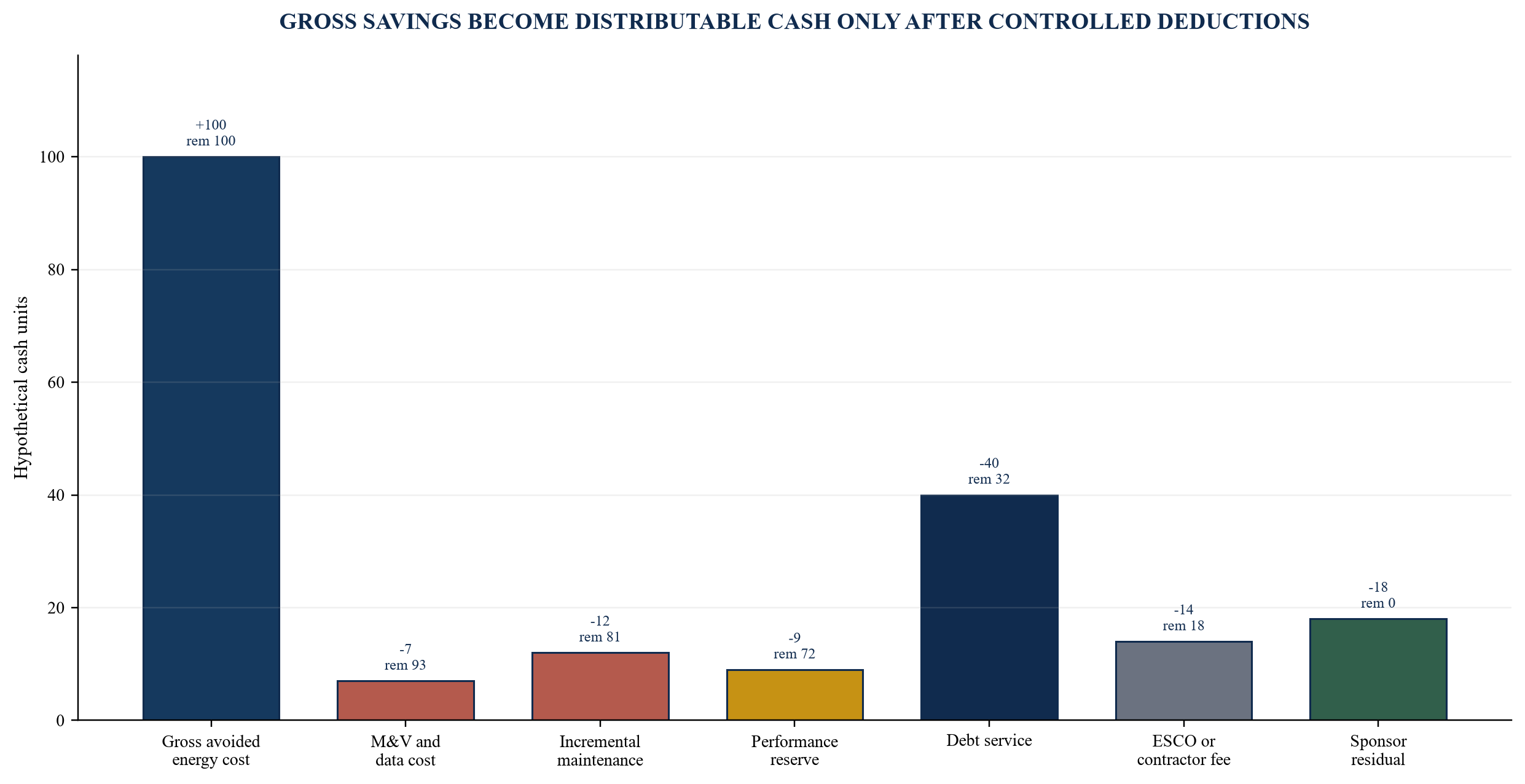
Hypothetical shares illustrate sequencing only; actual payments depend on transaction documents and verified cash.
Measurement and data cost should be paid early enough to preserve the evidence system. Incremental maintenance and lifecycle reserves protect performance. Taxes, insurance and required operating costs should be recognised. Debt service can then receive the agreed priority. Performance fees and sponsor distributions follow only when covenants and reserves are satisfied.
The waterfall should specify timing mismatch. Utility invoices may be monthly, production data daily, independent verification quarterly and debt service monthly. A provisional payment can use the last accepted calculation with a conservative adjustment. Quarterly or annual true-up reconciles actual results. The reserve should absorb timing without creating repeated technical defaults.
Cash control should follow project materiality. A ring-fenced project account may be suitable for a special-purpose vehicle or large site programme. A corporate facility may use a controlled collection account and reporting covenant. The lender needs visibility over the benefit and deductions without disrupting ordinary operations.
Distribution conditions should test debt-service coverage, liquidity, data quality, unresolved disputes, reserve funding and performance trends. If savings fall, cash should first protect operation and debt while the remediation plan proceeds. The waterfall therefore creates both payment priority and behavioural discipline.
12. Match facility architecture to the savings profile
No single instrument fits every industrial-efficiency project. Corporate borrowers with strong balance sheets may use a green term loan or revolving facility for eligible capital expenditure. A dedicated programme can use project finance or an energy-services agreement. Smaller measures can be aggregated through a credit line or leasing platform. Sustainability-linked pricing can complement general corporate funding when key performance indicators and targets meet current market principles.[1][16]
Table 3. Facility architecture and evidence requirements
| Instrument | Primary repayment source | Required evidence | Principal limitation |
|---|---|---|---|
| Corporate green term loan | enterprise cash flow | eligible use of proceeds, project budget and reporting | savings may not be ring-fenced |
| Project or SPV term debt | project payment and savings waterfall | fixed contracts, completion support and controlled accounts | structure and transaction cost |
| Energy-services agreement | verified service output or shared savings | measurement protocol, counterparty capacity and assignment | long-term operating dependency |
| Equipment finance or lease | borrower payment plus equipment value | title, installation, insurance and residual value | limited fit for process integration |
| Sustainability-linked facility | general corporate cash flow | material KPI, ambitious target, verification and reporting | pricing incentive may be modest |
Instrument choice depends on borrower credit, project scale, legal structure and lender policy.
The financing plan should separate development, construction and operation. Early-stage audits and design may require sponsor equity because the project is not yet fixed. Construction debt can fund contracted equipment and works with completion support. Term debt begins after acceptance and evidence conditions. A working-capital line can address timing between utility savings, customer billing and verifier certification where relevant.
Currency should match cost and cash. Imported equipment can create foreign-currency exposure while savings arise in local currency. Interest-rate exposure can matter when the savings margin is narrow. Hedging cost should enter sources, uses and debt service. The structure should also account for withholding tax, value-added tax and customs under current professional advice.
13. Size debt to verified net cash savings
Debt sizing starts with verified net cash savings, not gross engineering savings. The model should show baseline energy units, adjusted counterfactual, actual use, unit saving, tariff conversion, maintenance, measurement cost, taxes, reserves and available cash. Each line should tie to the measurement plan and accounting records.
The lender can apply three layers of conservatism. First, use a lower confidence bound or haircut on measured savings. Second, stress the drivers that affect actual cash, such as production, tariff, availability and maintenance. Third, require coverage and liquidity that absorb normal volatility. These layers should be transparent to avoid double-counting or hidden cushions.
Debt tenor should respect equipment life, contract life, warranty, data availability and savings persistence. An efficiency measure can have a long physical life while the performance contract or site lease is shorter. The enforceable cash-support period is therefore a key constraint. Residual value should be credited only when equipment is separable, owned, insurable and saleable after removal cost.
The model should prevent benefit overlap. Reduced energy cost may already improve enterprise EBITDA used in corporate leverage. The same savings should not support a separate project facility and full corporate leverage without recognising payment priority and restrictions. Consolidated and project debt schedules should reconcile.
Coverage should be calculated from cash after essential operating expenditure and taxes. Performance shortfall payments can support coverage only within the guarantee cap and counterparty capacity. Carbon-credit or renewable-certificate proceeds should remain outside the base case unless ownership, methodology, issuance, price and collection are sufficiently established.
14. Map performance guarantees and sponsor support
A guarantee is useful when its obligation, measurement, trigger, amount, timing and security are enforceable and economically meaningful. The guarantee map should identify each risk, responsible party, remedy, cap, duration, exclusions and credit support. It should reconcile to the measurement plan and financing model.
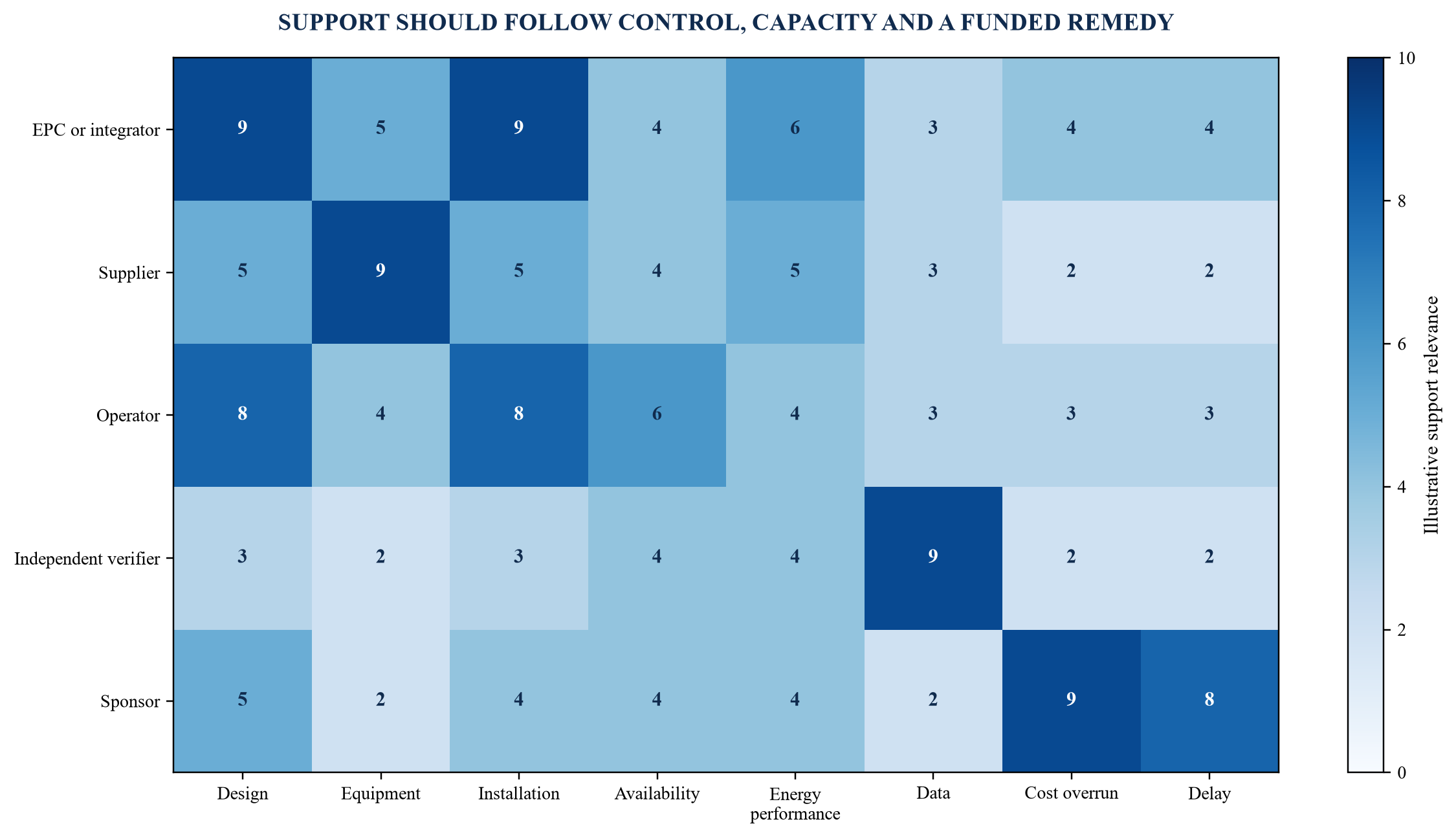
Hypothetical support scores illustrate allocation; legal effectiveness requires transaction-specific advice.
Performance liquidated damages should cover a defined shortfall rather than operate as a penalty. The formula should use the same baseline, adjustment and tariff rules as the savings calculation or state clearly why it differs. Payment timing should support debt service. Liability caps, consequential-loss exclusions and force-majeure provisions should be reviewed against downside exposure.
Credit support can include retention, performance bonds, parent guarantees, letters of credit, warranty insurance or funded reserves. The instrument should remain valid through the relevant testing and remedy period. Expiry dates, claim conditions and governing law matter. A bond that expires before stabilised performance testing provides limited support.
Sponsor support should address risks the sponsor controls or is best placed to absorb, including cost overrun, delay, site access, operator performance and liquidity. It should have a capped or clearly defined amount, funding timeline and termination. Open-ended support can be difficult to approve and enforce; under-sized support can leave the project stranded.
Table 4. Risk allocation, evidence and remedy matrix
| Risk | Primary evidence | Initial risk bearer | Escalated remedy |
|---|---|---|---|
| Design and integration | design review, interface register and test plan | engineering contractor | correction, retention draw and sponsor completion support |
| Equipment performance | factory test, warranty and commissioning | supplier | repair, replacement or warranty claim |
| Operating override | control log, operator procedure and availability record | site operator | remediation plan, reserve and covenant action |
| Savings shortfall | approved M&V calculation and verifier certificate | contractor or borrower by cause | shortfall payment, cash sweep or amortisation reset |
| Data failure | meter health, historian log and fallback calculation | responsible service provider | repair, conservative estimate and verification reserve |
This matrix is an analytical starting point and not legal drafting.
15. Treat carbon, renewable attributes and ESG claims separately
Energy savings, greenhouse-gas reductions, renewable attributes and financed-emissions effects are related but distinct records. A project can reduce grid electricity consumption, but the carbon effect depends on the applicable emissions factor and accounting method. A renewable certificate can represent an attribute with separate ownership. A lender's use-of-proceeds or sustainability claim has its own criteria and reporting obligations.
The GHG Protocol Project Protocol provides a framework for quantifying project greenhouse-gas benefits, and its grid-connected guidance addresses projects that reduce electricity consumption.[13][14] IFRS S2 requires climate-related disclosures and references greenhouse-gas measurement under the GHG Protocol subject to applicable requirements and reliefs.[15][17] These frameworks support disciplined reporting, but the financing calculation should preserve the distinction between technical energy units, cash savings and emissions claims.
The contract should allocate environmental attributes. It should identify renewable certificates, carbon credits, avoided emissions, energy-efficiency certificates and related data. It should state who may register, sell, retire or claim them. Double claiming can arise when the site, contractor, financier and customer each use the same reduction in public statements.
Carbon proceeds should receive conservative treatment. Methodology eligibility, additionality, baseline, monitoring, validation, verification, issuance, registry, buyer and price can all be uncertain. Unless these conditions are established, carbon revenue can remain an upside case. Costs of monitoring and verification should still be budgeted where claims are planned.
Green and sustainability-linked labels should follow the current instrument principles and lender requirements.[16] Use-of-proceeds reporting should reconcile loan allocations to eligible expenditure. Sustainability-linked features should use material indicators, calibrated targets, verification and transparent reporting. A small margin adjustment does not cure a weak project baseline or unsupported public claim.
16. Integrate operational continuity and cybersecurity
Industrial decarbonisation increasingly relies on sensors, networked controls, analytics and remote vendor access. These systems can improve measurement and optimisation while creating operational-technology dependency. A cyber incident, failed software update or lost cloud service can interrupt production and erase savings.
The technical architecture should identify devices, communication paths, historians, cloud services, remote connections, credentials, software versions and data exports. Critical controls should have segmentation, least-privilege access, monitored remote sessions, backups and tested recovery. The project should retain a safe fallback state that preserves essential production and safety.
Change management should connect engineering and measurement. A control-logic revision can improve or weaken performance and invalidate the baseline relationship. Every material change should have approval, version history, test result and effective date. The verifier should receive enough information to determine whether an adjustment is required.
Service continuity should survive supplier distress. Contracts should address source files, configuration, documentation, escrow where suitable, replacement-provider assistance and continued data access. Proprietary equipment can create lock-in; the financing model should include support cost and replacement risk. Insurance should be reviewed for machinery breakdown, business interruption and cyber coverage subject to actual policy terms.
Covenants should measure critical availability, unresolved vulnerabilities, failed backups, unsupported software and prolonged data gaps where material. The response can begin with information and remediation, then reserve or distribution restriction, followed by event review for persistent failures. The objective is to protect safe operation and evidence before cash performance deteriorates.
17. Set covenants and reporting from the savings system
Covenants should translate the project's evidence chain into early action. Financial covenants alone can identify stress after savings have already failed. Operational and data covenants can reveal the cause earlier. The package should remain focused enough for management and lenders to use consistently.
The monthly report can include construction status during implementation, then energy baseline outputs, actual consumption, production drivers, adjustments, unit savings, cash savings, availability, maintenance, data completeness, disputes, reserve balances and liquidity. Quarterly reporting can include verifier review, covenant calculations, guarantee headroom and downside forecast. Annual reporting can refresh tariffs, insurance, lifecycle plan and independent verification.
Table 5. Covenant, trigger and graduated action matrix
| Control domain | Illustrative measure | Early action | Escalated action |
|---|---|---|---|
| Data quality | completeness, calibration and unresolved gap | repair plan and enhanced reporting | conservative savings estimate and reserve |
| Completion | schedule, cost-to-complete and open tests | sponsor funding notice | draw stop or completion-support call |
| Performance | verified unit and cash savings trend | root-cause review | shortfall claim, cash sweep or amortisation reset |
| Liquidity | debt-service coverage and minimum cash | distribution restriction | reserve draw and event review |
| Operations | availability, override and maintenance backlog | corrective-maintenance plan | contractor step-in or independent operator review |
Thresholds require calibration to the specific project and finance documents.
Thresholds should recognise measurement lag and seasonality. A single weak month may reflect a shutdown; a repeated adverse trend can require action. Cure periods should be long enough for engineering correction and short enough to protect cash. The documents should distinguish reporting failure, data failure, performance shortfall and payment default.
Information rights should include access to raw and processed data, models, verifier reports, material contracts, claims and site inspections. Confidentiality and cyber controls should apply. The lender should be able to reproduce material calculations without depending entirely on the party receiving a performance fee.
18. Test downside, underperformance and remedies
The downside case should be a sequence of operating events, not a uniform percentage haircut. Relevant cases include delayed commissioning, lower production, tariff reduction, equipment underperformance, meter failure, contractor distress, higher maintenance, plant shutdown and loss of a key service provider. Each event affects savings, cash and remedies differently.
The model should show how the baseline responds when production falls. Unit savings can persist while total cash savings decline. A minimum-offtake or fixed service payment can shift that risk to the borrower. A shared-savings contractor bears more volume risk unless the contract has a floor. The allocation should be explicit.
Underperformance analysis should identify cause. Design failure may trigger contractor correction or damages. Operator override may remain borrower risk. Unrelated production change may require baseline adjustment. Data failure may use a conservative fallback and reserve. The remedy should follow causality while keeping undisputed debt service and operational payments moving.
Restructuring options can include extending tenor within asset life, increasing cash sweep, using reserves, resetting amortisation, adding sponsor support or replacing the service provider. These options require current legal, tax and accounting advice. The base documents should provide access, assignment and step-in rights that make remediation possible.
19. Build governance and independent verification
The governance model should separate project delivery, savings calculation, approval and payment. Management owns site operation and data. The contractor provides performance information and remedies. The independent verifier tests the agreed method. The financier reviews compliance and cash. The board or investment committee oversees material changes and conflicts.
The verifier's scope, competence, independence, liability, access and timetable should be agreed. The verifier should test raw data, calibration, adjustments, model operation and calculation. It should report exceptions and uncertainty, not only a pass or fail. Rotation or peer review can be considered for long programmes.
Model governance should include a controlled version, locked formulas, input validation, change log, reviewer sign-off and reproducible output. Material manual inputs should have evidence links. The calculation should be backed up and executable without a single employee. This discipline supports finance, audit and dispute resolution.
Conflicts should be visible. A contractor paid from reported savings has an incentive to maximise the calculation. An operator can minimise a shortfall by attributing change to production. A lender can favour a conservative adjustment. The approved methodology, independent verification and reserve process reduce the need to resolve every disagreement through negotiation.
Governance should scale with materiality. A portfolio of small measures may use sampling and centralised analytics. A large process retrofit may require continuous measurement and specialist review. The design objective remains the same: one evidence chain, defined roles, timely decisions and preserved operating continuity.
20. Finance a controlled savings system
Industrial decarbonisation finance becomes repeatable when projects produce evidence that survives changes in production, personnel and counterparties. The lender should be able to trace the baseline, actual data, adjustments, unit savings, tariff conversion, deductions, cash movement and remedies. Management should be able to use the same system to operate the plant and allocate capital.
The sequence begins with perimeter and baseline. It continues through measure selection, measurement design, contracting, cost control, commissioning and stabilised operation. Debt is released as evidence matures. Payments follow verified net cash. Guarantees and sponsor support address defined risks. Covenants trigger graduated action before liquidity is exhausted.
This approach also supports portfolio scale. Standard data dictionaries, baseline templates, commissioning records, verification protocols and waterfalls can reduce transaction cost across sites. Standardisation should preserve measure-specific engineering judgement. A portfolio is strongest when each project can be audited individually and aggregated consistently.
The framework does not turn uncertain savings into certainty. It makes uncertainty explicit, allocates it and connects it to capital. Production, tariffs, equipment, people and policy will change. A well-designed financing can respond through approved adjustments, reserves, support and governance rather than relying on an optimistic original forecast.
For sponsors, the output is a capital-allocation record that compares measures on verified cash and risk. For contractors, it is a measurable performance obligation. For lenders, it is a credit system with observable early indicators and enforceable payment priority. For industrial operators, it is a disciplined route from efficiency opportunity to funded implementation and sustained operating improvement.
References
- International Energy Agency, Financing Energy Efficiency, Energy Efficiency Policy Toolkit, 2026, https://www.iea.org/reports/energy-efficiency-policy-toolkit/financing-energy-efficiency
- World Bank, Public Procurement of Energy Efficiency Services, 2010, https://documents1.worldbank.org/curated/en/987001468138267837/pdf/524560PUB0publ101Official0Use0Only1.pdf
- World Bank, Results-Based Financing in the Energy Sector: An Analytical Guide, 2013, https://documents1.worldbank.org/curated/en/332431468130824081/pdf/958210ESM0P1270e0Studies02012012017.pdf
- International Organization for Standardization, ISO 50001:2018 Energy Management Systems, confirmed 2024, https://www.iso.org/standard/69426.html
- Efficiency Valuation Organization, International Performance Measurement and Verification Protocol, 2022, https://evo-world.org/en/products-services-mainmenu-en/protocols/ipmvp
- International Energy Agency, Scaling Up Transition Finance, 2025, https://www.iea.org/reports/scaling-up-transition-finance
- UAE Government, UAE Energy Strategy 2050, updated 2024, https://u.ae/en/about-the-uae/strategies-initiatives-and-awards/strategies-plans-and-visions/environment-and-energy/uae-energy-strategy-2050
- UAE Government, UAE Net Zero 2050 Strategy, updated 2025, https://u.ae/en/about-the-uae/strategies-initiatives-and-awards/strategies-plans-and-visions/environment-and-energy/the-uae-net-zero-2050-strategy
- UAE Government, National Water and Energy Demand Management Programme, updated 2024, https://u.ae/en/about-the-uae/strategies-initiatives-and-awards/strategies-plans-and-visions/environment-and-energy/national-water-and-energy-demand-management-programme
- Dubai Electricity and Water Authority, Etihad ESCO and energy-performance contracting, https://www.dewa.gov.ae/en/about-us/media-publications/latest-news/2022/09/etihad-esco-signs-several-contracts-and-mous-at-wetex-and-dss-2022
- Saudi Energy Efficiency Center, Energy Management System, https://www.enms.seec.gov.sa/energy-management-system
- Saudi Energy Efficiency Center, Energy Efficiency in the Kingdom of Saudi Arabia, https://www.seec.gov.sa/assets/a5348420-c455-4085-9e78-d5e62e2b09bd
- Greenhouse Gas Protocol, Project Protocol, https://ghgprotocol.org/project-protocol
- Greenhouse Gas Protocol, Guidelines for Grid-Connected Electricity Projects, https://ghgprotocol.org/guidelines-grid-connected-electricity-projects
- IFRS Foundation, IFRS S2 Climate-related Disclosures, https://www.ifrs.org/issued-standards/ifrs-sustainability-standards-navigator/ifrs-s2-climate-related-disclosures/
- Loan Market Association, Green Loan Principles and Sustainability-Linked Loan Principles, March 2025, https://www.lma.eu.com/sustainable-lending/resources
- IFRS Foundation, IFRS S2 implementation materials, https://www.ifrs.org/supporting-implementation/supporting-materials-for-ifrs-sustainability-disclosure-standards/ifrs-s2/
- International Energy Agency, World Energy Investment 2025, https://www.iea.org/reports/world-energy-investment-2025
- International Energy Agency, Energy Efficiency 2025, https://www.iea.org/reports/energy-efficiency-2025
- World Bank, Unlocking Commercial Financing for Clean Energy in East Asia, https://documents.worldbank.org/curated/en/212781468037508882/pdf/Unlocking-commercial-financing-for-clean-energy-in-East-Asia.pdf
