

1. Treat the DDQ as an investment-decision system
An institutional DDQ is a structured request for evidence about a manager, strategy, fund and operating platform. It can support investment, operational, legal, tax, responsible-investment and risk reviews. The completed file is one output. The underlying decision system includes source records, calculations, policies, contracts, interviews, references, committee papers, conditions and post-commitment monitoring.
ILPA DDQ 2.0 provides a broad private-markets baseline. Its topics include firm and fund information, succession, strategy, co-investments, continuation vehicles, credit facilities, investment process, team, alignment, market environment, terms, governance, risk, compliance, track record, accounting, valuation, reporting, legal, technology, third parties, responsible investment and diversity. ILPA describes the questionnaire as a roadmap for further engagement and identifies supporting documents and data.
A manager should therefore begin with the allocator's decision, not a blank template. The request register identifies the institution, mandate, strategy, fund, jurisdiction, stage, deadline, confidentiality level, required format, decision owner and permitted recipients. Each question is mapped to an evidence owner and a review authority.
The system separates four objects:
1. The common evidence core contains facts and controls needed across credible institutional processes. 2. The allocator overlay contains confirmed mandate, jurisdiction, policy and format requirements. 3. The response pack assembles approved answers and evidence for one live process. 4. The monitoring contract identifies information that continues after commitment.
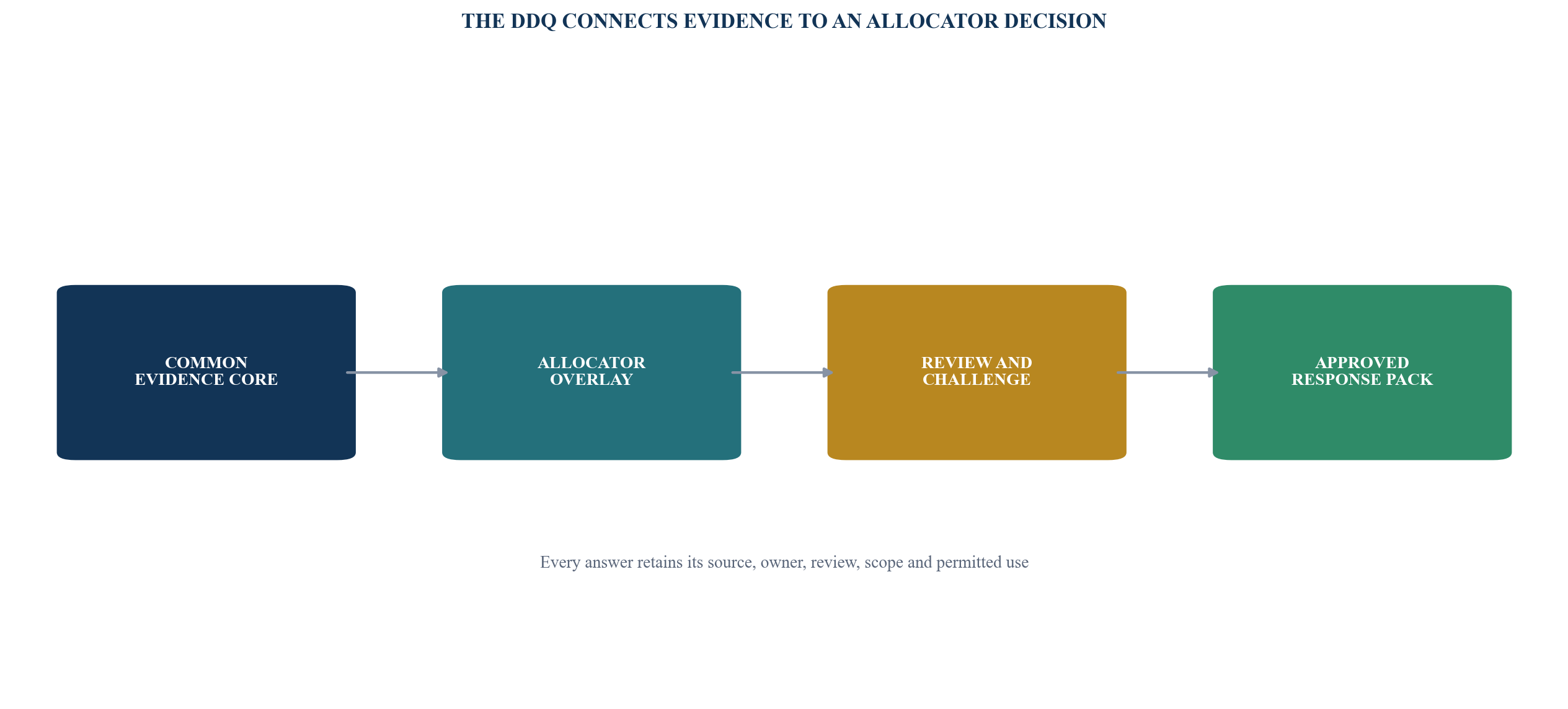
The common core is reused; the allocator overlay and release pack remain process-specific.
2. Establish what the public evidence can support
Published standards reveal common diligence domains and control expectations. They do not reveal every institution's proprietary scoring, risk appetite, political mandate, portfolio constraint, relationship history or committee threshold. A claim that all GCC allocators ask one set of questions and all global allocators ask another would exceed the available evidence.
The paper uses a narrower and more useful distinction. A global common core is supported by published institutional and regulatory material. GCC overlays arise where a live mandate, domicile, fund regime, investor policy, currency, legal form, Shariah requirement, beneficial-ownership process, domestic-development objective or regional operating model makes additional evidence relevant. International overlays arise where an allocator's home-country rules, tax status, responsible-investment policy, reporting system, side-letter policy or cross-border marketing rules create further requirements.
The word local describes an allocator or mandate connected to a GCC jurisdiction. It does not imply a common preference. A sovereign institution, pension arrangement, bank treasury, insurance company, family office and development institution can have different governance, liabilities and public purposes even when located in the same city.
The word global describes an institution investing across markets or operating under a non-GCC home framework. It does not establish a uniform diligence model. The manager should maintain an evidence architecture that supports variation without producing inconsistent facts.
Table 1. Evidence boundary for allocator comparisons
| Evidence state | Example | Permitted conclusion | Required action |
|---|---|---|---|
| published standard | ILPA DDQ 2.0 | common diligence domain | map evidence to the standard |
| current rule or regulator guidance | DFSA or FSRA fund material | requirement within stated scope | confirm entity, activity and effective version |
| public governance principle | Santiago Principles | governance reference for participating sovereign funds | identify applicability and self-assessment |
| allocator-issued request | live DDQ, RFP or data request | confirmed requirement for that process | record owner, deadline and response format |
| meeting statement | documented question or condition | current concern raised by named participant | confirm wording and decision relevance |
| market anecdote | informal adviser or manager view | search lead only | do not present as allocator fact |
| management hypothesis | proposed overlay or scoring | design assumption | test with live processes and label internally |
Allocator-specific requirements require direct confirmation from the live process.
3. Build the common institutional core
The common core should be complete enough to support repeated diligence and modular enough to avoid a single unwieldy file. It can be organised into firm, fund, strategy, people, performance, governance, operations, risk, legal, tax, responsible investment, technology and reporting modules.
Firm evidence covers legal entities, ownership, regulatory status, affiliates, financial resources, litigation, investigations, insurance, conflicts, business continuity and material changes. Fund evidence covers legal form, domicile, target size, commitments, closing history, economics, governance rights, service providers, borrowing, liquidity, valuation, expenses and reporting.
Strategy evidence explains the investable universe, sourcing, underwriting, portfolio construction, ownership model, value creation, risk limits, exit routes and capacity. People evidence connects named roles to employment, time allocation, decision rights, succession, key-person provisions, compensation and retention.
Performance evidence requires a defined population, cash flows, valuation basis, gross-to-net bridge, attribution, currency, benchmark and reconciliation. A list of successful transactions cannot substitute for a complete and reproducible record.
Operational evidence covers governance, segregation, cash controls, administrator and custodian arrangements, valuation, cybersecurity, data, outsourcing, incident management, records and business continuity. SBAI's 2024 operational-diligence survey reports that many responding organisations use bespoke questionnaires and that diligence continues to rely on multiple document sources and digital tools. The survey describes its responding population; it does not establish a universal allocator practice.
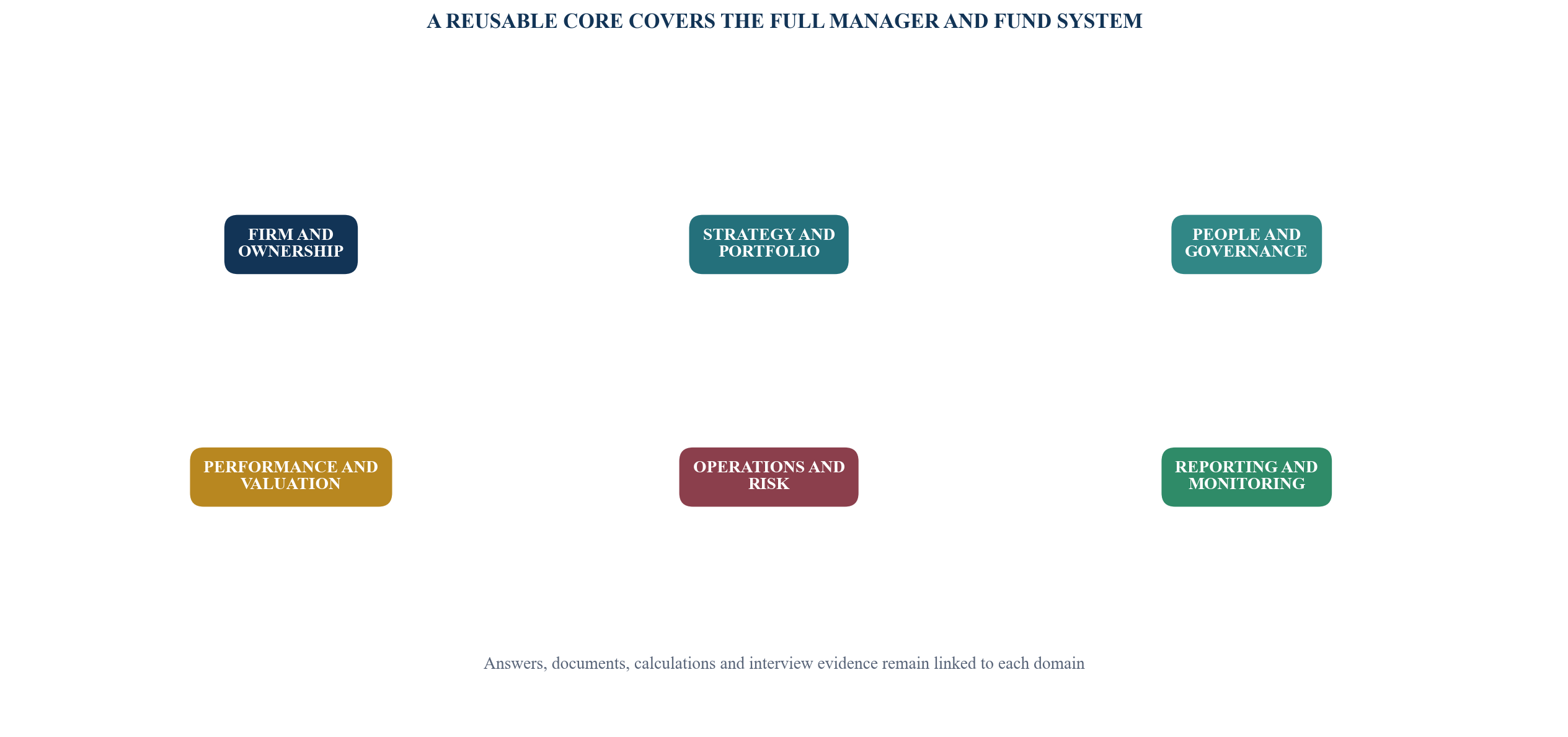
The domains are a management architecture derived from published diligence materials.
4. Add a confirmed GCC mandate overlay
A GCC overlay begins with facts about the live investor and mandate. Relevant questions can include eligible assets, target geography, currency, legal form, domestic allocation, development objective, Shariah status, co-investment, governance participation, local substance, reporting language, tax documentation, sanctions controls and public-accountability requirements. Each item requires confirmation from the allocator's materials or authorised representatives.
Sovereign institutions can use governance and accountability frameworks that differ by institution. The Santiago Principles contain 24 voluntary principles for member sovereign wealth funds covering legal framework, governance, accountability, investment and risk management. They provide a useful governance reference. They do not dictate the DDQ of every sovereign institution or GCC allocator.
A development mandate can require measurement beyond financial return. Employment, local procurement, strategic capability, export development, energy transition or technology transfer may be relevant when the mandate states them. The manager should define each metric, baseline, perimeter, source, frequency and review owner. Marketing language without a measurement contract creates future reporting risk.
Shariah evidence can be relevant when the fund, investor or transaction requires it. The pack can identify governing documents, appointed scholars or supervisory arrangements, screening, purification, leverage and prohibited-activity controls, transaction review and ongoing monitoring. Current specialist advice is required. A manager should avoid implying Shariah compliance from an instrument label alone.
Regional presence can be tested through substance rather than address. Evidence can cover senior decision-makers, investment staff, sourcing, portfolio support, compliance, administrator arrangements, committees, records, data location and continuity. The live allocator determines which elements matter.
Table 2. GCC allocator-overlay register
| Overlay dimension | Evidence to request | Decision question | Owner |
|---|---|---|---|
| mandate and geography | investment policy or RFP | which assets, markets and exclusions are eligible? | fundraising lead |
| currency and liquidity | fund terms, cash-flow model and hedge policy | how do calls, distributions and valuation interact with base currency? | finance and risk |
| governance | side-letter policy, committee rights and reporting | what oversight and escalation rights are required? | legal and governance |
| Shariah | structure, review process and ongoing controls | which instrument, activity and monitoring rules apply? | appointed specialist |
| public purpose | metric dictionary and baseline | which development outcomes are decision-relevant and measurable? | investment and impact owners |
| regional substance | roles, committees, service map and continuity plan | where are decisions made and records controlled? | chief operating officer |
| beneficial ownership and sanctions | ownership evidence, screening and update process | can identity and control be verified and refreshed? | compliance |
The table provides questions to confirm; it does not attribute preferences to all regional allocators.
5. Add the international allocator overlay
An international overlay begins with the allocator's legal identity, home jurisdiction, tax status, mandate, reporting standards and internal systems. Requirements can include private-placement analysis, regulatory representations, tax forms, most-favoured-nation elections, data-transfer terms, responsible-investment reporting, accessibility, cybersecurity, diversity data and specific performance templates.
Cross-border marketing needs a jurisdiction map. A fund permitted in one financial centre is not automatically marketable to every institution in every country. The manager should record who may communicate, to whom, about which fund, under what exemption or permission, with which documents and records. Specialist advice should confirm the current position.
Responsible-investment DDQs are often used as a starting point for dialogue. PRI's venture-capital DDQ covers policy and governance, fundraising, pre-investment, post-investment, reporting and additional information. PRI advises users to consider manager size, experience, resources, stage and influence. The manager should answer within its actual strategy and control environment.
Reporting overlays can include ILPA templates, allocator portals, data taxonomies and bespoke schedules. A field should have one controlled definition, then map into several formats. Recalculating the same concept differently for each template creates reconciliation risk.
Tax and legal requirements can change by investor type. A pension arrangement, sovereign entity, foundation, insurance company and taxable corporate investor can require different representations and documentation. The DDQ workflow should route those questions to authorised specialists rather than reuse generic text.
6. Separate fund-regime evidence from allocator preference
Regulatory compliance and allocator diligence overlap without becoming the same process. A regulator establishes requirements for a manager, fund, activity and investor category within its jurisdiction. An allocator evaluates whether the opportunity fits its mandate, risk appetite and governance obligations.
The DFSA describes Public Fund, Exempt Fund and Qualified Investor Fund regimes with different investor and disclosure characteristics. It also identifies requirements for fund managers, marketing and relevant fund documentation. The exact rules and current forms govern within their scope.
The DFSA published Consultation Paper 173 in July 2026 proposing significant changes to the collective-investment framework. A consultation is a proposal. It should be tracked in a change register and should not be presented as a final rule unless adopted.
ADGM's 2025 Getting Started Guide identifies the Fund Rules as the main reference and describes Public, Exempt and Qualified Investor Fund categories, manager permission and notification or registration routes. Current FSRA rules and forms should be checked for the live structure.
A strong DDQ answer links the current regulatory status to evidence: licence, permissions, conditions, fund registration or notification, approved persons, compliance arrangements, regulatory filings and any material correspondence. The answer should distinguish current approval, pending application and planned future structure.
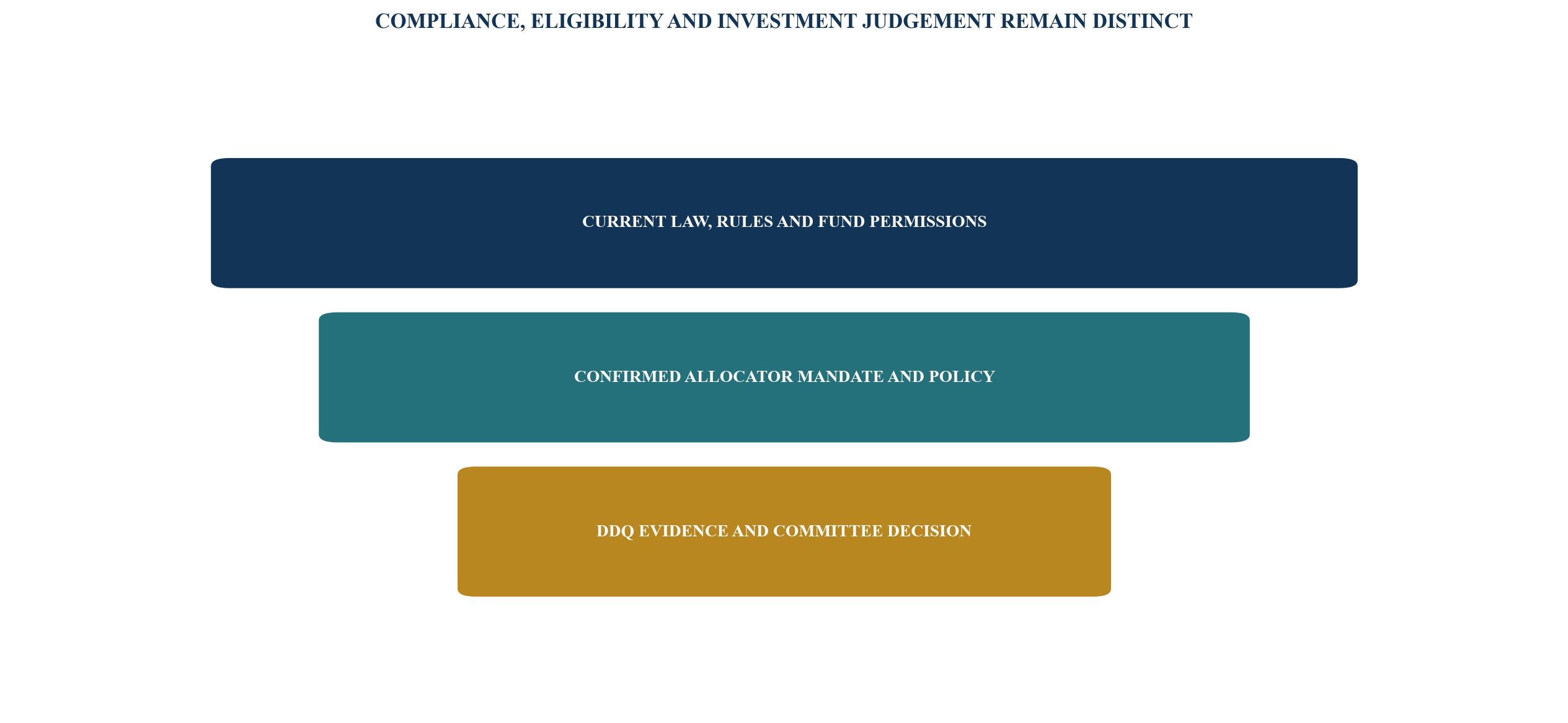
The live response applies the current rules and the confirmed allocator mandate separately.
7. Make ownership and control reviewable
Institutional diligence needs a clear map of the manager, general partner, carried-interest vehicles, advisers, delegates, affiliates, holding companies and ultimate beneficial owners. The map should show legal ownership, voting control, economic participation, reserved matters, related-party relationships and material changes.
FATF's 2023 guidance on beneficial ownership of legal persons supports access to adequate, accurate and up-to-date information about true owners. The precise obligations depend on jurisdiction and entity. A DDQ pack can still use the principles of accuracy, recency and verification as an evidence standard.
The manager should reconcile corporate registers, constitutional documents, shareholder agreements, regulatory filings, identity evidence, organisation charts and disclosures. Nominees, trusts, foundations, partnerships and indirect holdings can require specialist analysis.
Economics should be distinguished from control. A person can hold a minority economic interest and retain significant voting or appointment rights. A carried-interest allocation can differ from ownership of the management company. The response should state the object being described.
Related-party transactions, services and allocations require a conflicts map. The map identifies the relationship, service, pricing, approval, disclosure, allocation method and monitoring control. A generic conflicts policy cannot explain a live arrangement by itself.
Table 3. Ownership and control evidence map
| Object | Minimum evidence | Key reconciliation | Stop condition |
|---|---|---|---|
| manager ownership | registers, agreements and filings | legal and economic percentages | unexplained mismatch |
| voting control | constitutional and shareholder rights | votes, vetoes and appointments | undocumented control right |
| carried interest | governing documents and allocation schedule | participation by vehicle and person | inconsistent disclosure |
| affiliates | group chart and service agreements | ownership, service and fee flows | omitted related party |
| beneficial owners | identity and control evidence | current verified ownership chain | stale or incomplete identity |
| related transactions | contract, pricing and approval | policy, disclosure and actual practice | unapproved conflict |
| regulatory status | register entry and correspondence | permission, entity and activity | pending status stated as approved |
Verification standards and legal conclusions require jurisdiction-specific review.
8. Reconstruct track record and attribution
Track-record diligence should begin with a population definition. The manager identifies every investment within the stated predecessor, firm, fund, strategy, geography and period. Exclusions are documented. Cash flows, values, fees, expenses, currency and dates are reconciled to source records.
The evidence pack distinguishes realised and unrealised investments, gross and net results, fund and deal performance, current and predecessor activity, and audited and unaudited information. The performance presentation follows current legal, regulatory and accounting advice for its audience and jurisdiction.
Individual attribution requires contemporaneous evidence of role. Origination, underwriting, committee approval, execution, board work, operating support, restructuring and exit can be supported by minutes, memoranda, agreements, communications and records. Title alone is weak evidence. A synthetic percentage of credit can create unsupported precision.
The bridge from source data to presented metric should be reproducible. Every number has a population, formula, currency, valuation date, method, owner and review. A selected-deal schedule is labelled as selected and reconciled to the wider population.
IFRS 13 defines fair value as an exit price in an orderly transaction between market participants at the measurement date and sets a measurement framework when another standard requires or permits fair value. Its scope and accounting application require specialist review. The DDQ can use its emphasis on measurement date, market-participant assumptions, observable inputs and disclosure as a reference for valuation evidence.
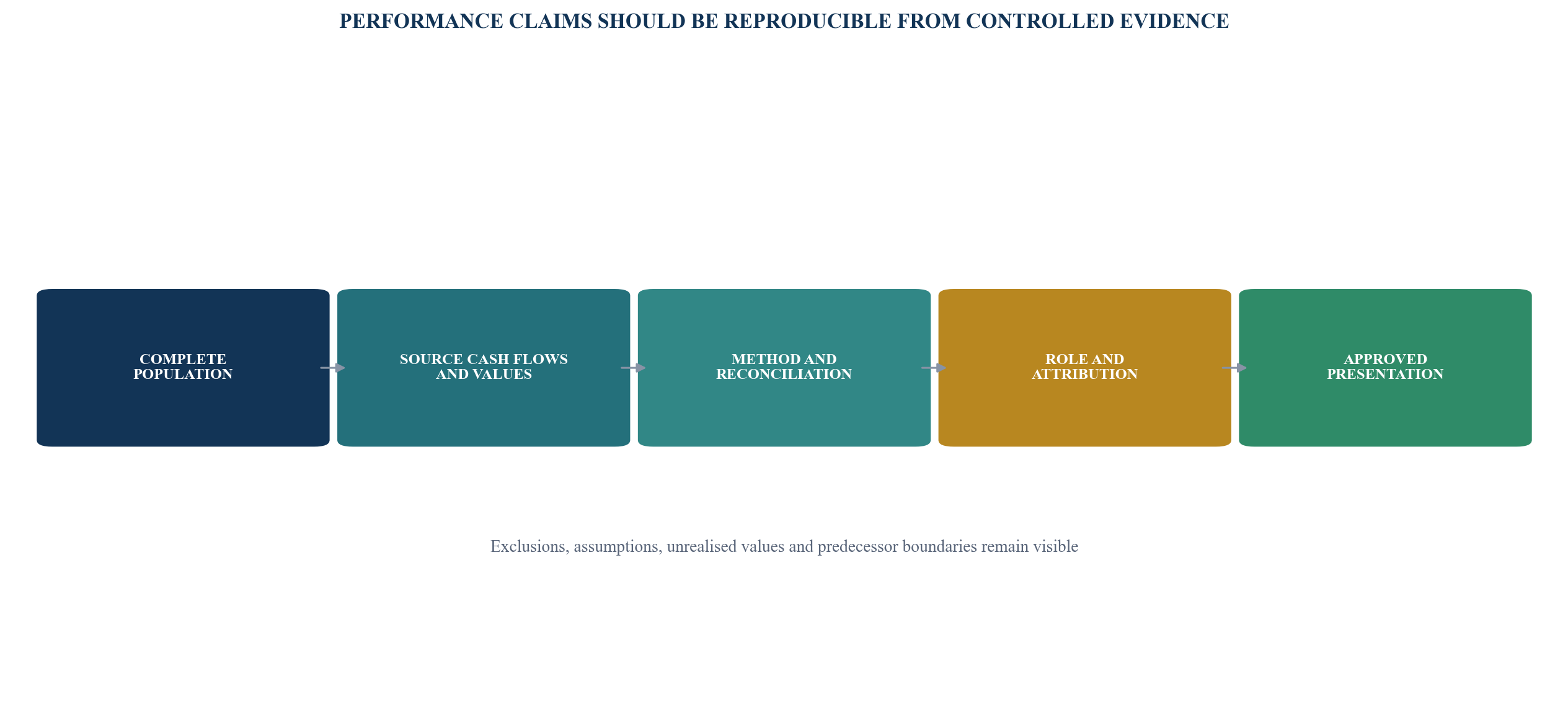
The bridge preserves population, cash flows, valuation and role evidence before presentation.
9. Convert operational diligence into evidence
Operational diligence asks whether the manager can protect assets, control cash, calculate values, maintain records, manage providers, withstand disruption and communicate incidents. The answer should describe actual design and operating evidence.
Governance evidence includes boards, committees, delegated authorities, reserved matters, minutes, conflicts and escalation. Cash-control evidence includes bank mandates, payment workflows, segregation, dual approval, callback or verification procedures, reconciliations and exception logs.
Service-provider evidence includes selection, contract, service levels, reports, assurance, incidents, concentration, exit support and periodic review. Delegation does not remove the manager's oversight responsibility within applicable arrangements.
Cybersecurity evidence includes governance, asset and data inventory, identity, access, logging, vulnerability management, backup, incident response, testing, training, third parties and recovery. A policy document should be supported by operating records.
Business-continuity evidence should connect scenarios to critical services, people, systems, sites, providers, communications, recovery objectives, test results and remediation. A test that records success without exceptions or evidence provides limited assurance.
Table 4. Operational-diligence evidence pack
| Control area | Design evidence | Operating evidence | Interview challenge |
|---|---|---|---|
| governance | charters and authority matrix | minutes, decisions and exceptions | who can stop a transaction or release? |
| cash | bank mandate and payment workflow | reconciliations and approval logs | how is a changed instruction verified? |
| valuation | policy, methods and committee terms | packs, challenges and overrides | when was a method last changed and why? |
| providers | diligence standard and contracts | service reviews and incidents | what happens if the provider fails? |
| cybersecurity | control framework and response plan | access reviews, tests and incidents | which critical data can leave the perimeter? |
| continuity | impact analysis and recovery plan | exercises and remediation | which service cannot meet its objective? |
| records | retention and access policy | archive tests and legal holds | can a released answer be reproduced? |
Evidence requirements depend on the manager, strategy, fund and applicable rules.
10. Make valuation and liquidity coherent
Valuation, liquidity and fund terms should be reviewed together. A closed-ended fund can still face liquidity pressure through expenses, borrowing, follow-on obligations, hedging, delayed exits or distribution expectations. An open-ended or interval structure adds redemption and asset-liquidity considerations.
IOSCO's 2025 revised recommendations address liquidity risk management for collective investment schemes and related guidance for open-ended funds. Applicability depends on the structure and jurisdiction. The broader control lesson is to align product design, asset liquidity, dealing terms, valuation, stress testing and governance.
The DDQ pack should identify valuation methods by asset type, hierarchy of inputs, frequency, responsible parties, independent review, overrides, stale prices, material events and disclosure. It should also identify liquidity terms, notice, gates, suspensions, borrowing, side pockets, distributions, capital calls and stress scenarios where relevant.
The manager should reconcile the liquidity promise with realistic cash conversion. A model can show calls, distributions, expenses, facilities and adverse cases. Every scenario is labelled as an assumption and linked to a decision.
11. Turn policies into tested controls
Institutional questions often request policies for conflicts, allocation, valuation, compliance, cybersecurity, responsible investment, anti-money laundering, sanctions, complaints, personal dealing, gifts, outsourcing and continuity. A policy has limited value when ownership, operating evidence and exceptions are unclear.
Each policy receives an effective date, approval authority, scope, owner, training requirement, control procedure, evidence record, exception route, review cadence and change trigger. The evidence room contains the current approved version and selected operating records.
The DDQ response should distinguish designed, implemented, tested and remediated states. A newly approved policy can be designed without a full operating history. The answer can state the implementation date and available evidence precisely.
Interview preparation should focus on how controls operate. Team members should be able to explain their actual responsibilities, recent exceptions and escalation. Scripted answers that conflict with records weaken credibility.
12. Design a reporting contract before commitment
Fundraising diligence becomes ongoing monitoring after commitment. The reporting contract identifies every recurring deliverable, definition, period, format, source, owner, reviewer, release date, recipient and correction process.
ILPA's Reporting Template and updated 2025 Capital Call and Distribution Template provide standardisation resources. The updated capital-call template has stated implementation timing that differs according to Performance Template adoption. Managers should verify the applicable timetable and map internal data accordingly.
One metric dictionary should serve the DDQ, quarterly report, annual report, capital notice, portfolio data request and investor portal. The dictionary defines entity, fund, currency, period, methodology, gross or net basis, valuation state and source system.
Side letters can create investor-specific reporting obligations. An obligation register connects the clause, trigger, format, owner, due date, approval and evidence of delivery. Most-favoured-nation rights and confidentiality restrictions require legal control.
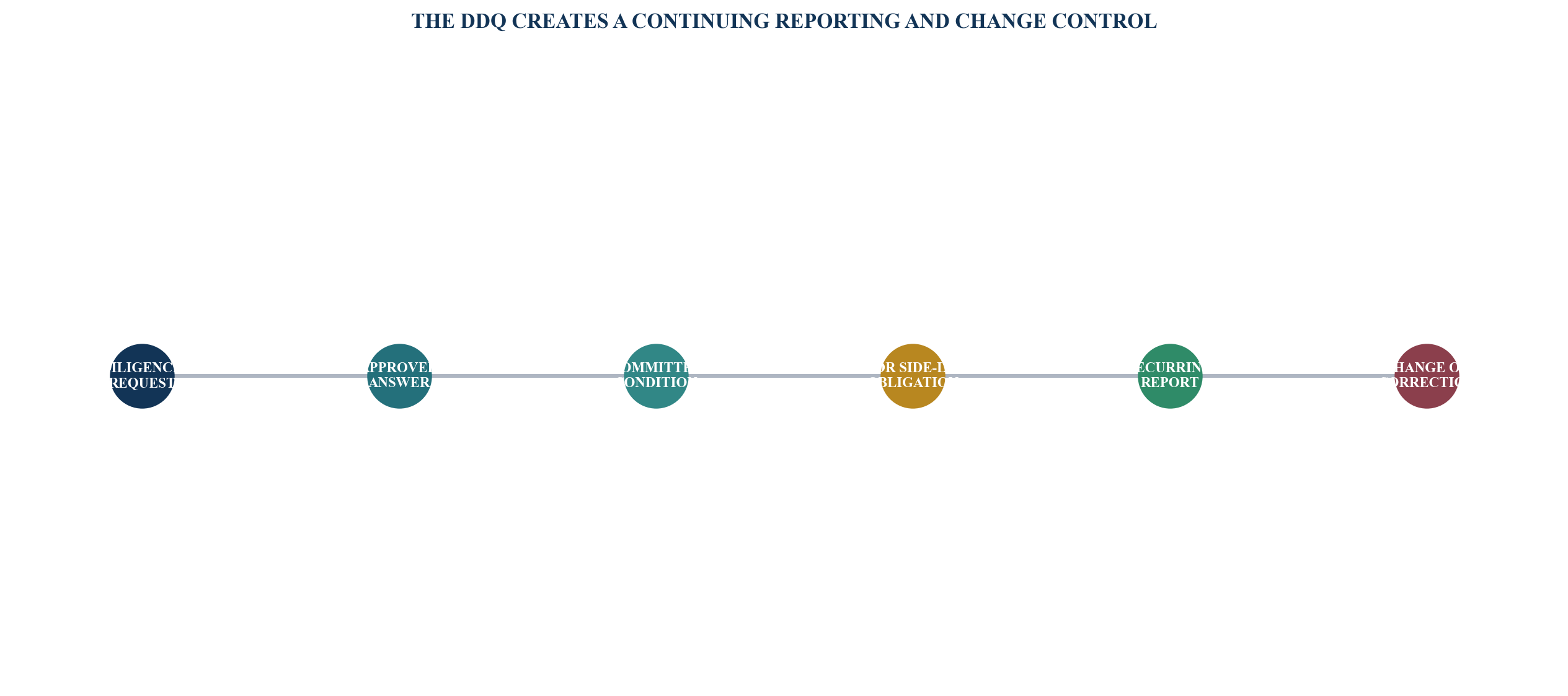
The commitment converts diligence representations into recurring evidence and obligations.
13. Build the evidence room around decisions
The evidence room should mirror the DDQ architecture. A stable index can include corporate, regulatory, fund, strategy, team, performance, portfolio, legal, tax, operations, valuation, responsible investment, technology and reporting folders.
Every file receives an owner, status, date, version, confidentiality class, applicable fund and permitted audience. Superseded documents remain in a controlled archive and do not appear in the active response set.
The question-to-evidence matrix links each answer to exact files, sections and calculations. It records gaps, conflicts, reviewer, approval and permitted reuse. An allocator can receive a tailored subset without changing the underlying facts.
Access should follow least privilege. Sensitive identity, bank, tax, portfolio, employee and side-letter information can require separate rooms or permissions. Downloads, watermarks and logs can support control while respecting the actual system and legal requirements.
The evidence room should be tested from the recipient's perspective. Links, permissions, file names, versions, search, rendering and download behaviour should work. A clean index cannot compensate for a missing source or inaccessible file.
14. Score readiness by evidence strength
A DDQ readiness score should measure evidence, ownership and control rather than the number of answered fields. A proposed model can score completeness, authority, recency, reconciliation, operating evidence and approval. The weights and thresholds are management assumptions until calibrated through actual processes.
The score should retain the underlying exception. An unanswered low-consequence field and an unreconciled track record should not collapse into the same percentage. Red conditions can include missing beneficial-ownership evidence, inconsistent performance, unresolved regulatory status, unapproved valuation methods, missing cash controls or material cyber incidents without closure.
Amber conditions can include recently implemented policies, incomplete operating history, pending service-provider evidence or an allocator-specific format mapping still under review. Green means the evidence meets the defined release gate for that process; it does not promise investment approval.
Table 5. Evidence-strength scorecard
| Dimension | Illustrative test | Example evidence | Release rule |
|---|---|---|---|
| completeness | every required field has an answer or reason | question matrix | no silent blanks |
| authority | answer cites an approved source | signed document or system record | working draft cannot support release alone |
| recency | evidence remains current for its subject | date and refresh trigger | expired item creates hold |
| reconciliation | calculations agree to controlled records | signed bridge and review | unexplained difference creates hold |
| operating evidence | policy is supported by actual records | logs, minutes, tests and exceptions | implementation state disclosed |
| approval | authorised subject owner reviewed the response | named approval record | no release without required authority |
| monitoring fit | representation can be maintained after close | reporting contract and owner | recurring obligation recorded |
Scores and thresholds are management assumptions for implementation design.
15. Run a structured challenge process
The first challenge checks internal consistency. Ownership percentages, team dates, fund terms, portfolio counts, performance, AUM, service providers and policy dates should agree across the PPM, DDQ, pitchbook, data room and interviews.
The second challenge checks boundary. The answer should apply to the stated entity, fund, strategy, period and investor. Predecessor activity, affiliate resources and planned hires remain distinguishable from current manager capability.
The third challenge checks evidence. Every material claim should have a source that supports the exact proposition. A policy proves design; logs and decisions show operation. A service-provider report should match the service and period in question.
The fourth challenge checks implementation. Interviewers can ask for a recent example: a valuation override, cyber incident, allocation conflict, failed payment, key-person absence, provider issue or reporting correction. Confidential information can be protected while the operating process is explained.
The fifth challenge checks change. New fund terms, ownership, personnel, regulation, providers, incidents, performance and valuation can invalidate prior answers. A change register identifies affected responses and recipients.
16. Use a ninety-day institutional readiness plan
Days 1 to 15 establish scope. The manager inventories live funds, target allocators, jurisdictions, current materials, source systems, owners and deadlines. It confirms the common core and creates the overlay register.
Days 16 to 35 build the evidence map. Corporate, regulatory, fund, team, performance, operations, legal, tax and reporting records are collected and indexed. Missing or conflicting evidence becomes an owned issue.
Days 36 to 55 reconstruct high-risk modules. Ownership and control are reconciled. Track record, attribution, valuation and gross-to-net bridges are reproduced. Cash, provider, cyber and continuity controls receive operating evidence.
Days 56 to 70 assemble the response library. Approved answer components are written with scope, sources, owner, review, expiry and permitted use. Standard and allocator-specific templates map to the same metric dictionary.
Days 71 to 82 run challenge. Independent reviewers test consistency, boundaries, calculations, evidence, interviews, access and recipient experience. Red and amber findings receive remediation or explicit disclosure.
Days 83 to 90 approve release and monitoring. The manager signs the live response pack, records conditions, establishes the reporting contract and schedules refresh events.
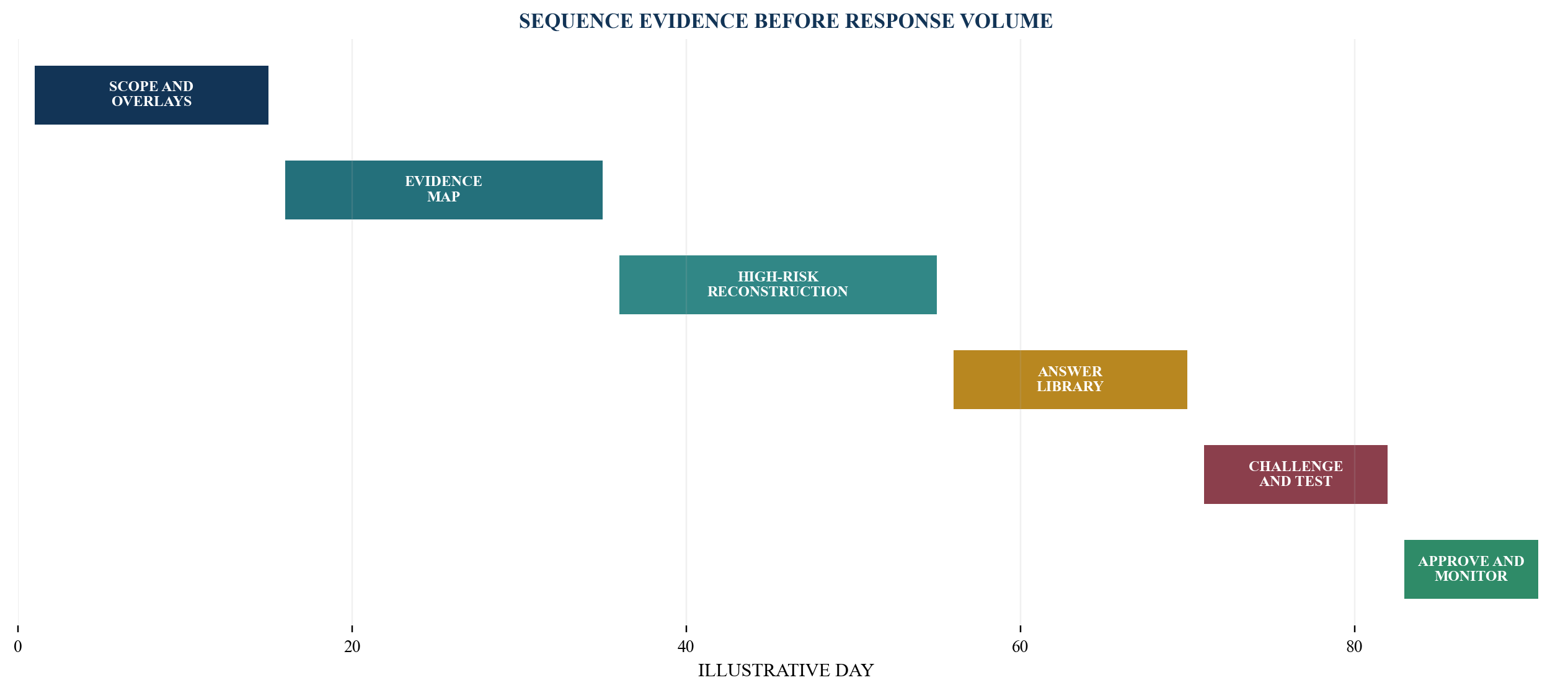
The sequence is a management implementation model; actual duration depends on scope and evidence quality.
17. Operate a recurring allocator-readiness office
Institutional readiness continues after fundraising. A recurring office can maintain evidence, answer libraries, reporting obligations, allocator requests, conditions, side letters, incidents and material changes.
Weekly work can review open requests, due dates, conflicts and expiring evidence. Monthly work can reconcile core metrics, team changes, providers, incidents and policy exceptions. Quarterly work can update performance, valuation, portfolio and reporting modules. Annual work can reapprove the complete evidence architecture.
Event-driven refreshes follow ownership, key-person, regulatory, fund-term, provider, cyber, litigation, valuation, portfolio and strategy changes. The change owner identifies affected responses and determines whether a correction or investor notification is required under current advice.
The operating dashboard can track requests received, first-pass completeness, evidence gaps, reconciliation failures, response cycle time, reviewer load, repeated questions, expired components, conditions and reporting exceptions. These are operating measures. They are not evidence of fundraising success.
Table 6. Recurring allocator-readiness office
| Cadence | Inputs | Controlled output | Decision owner |
|---|---|---|---|
| weekly | requests, deadlines and evidence gaps | routed diligence queue | fundraising operations |
| monthly | ownership, team, provider and incident changes | refreshed core and exceptions | chief operating officer |
| quarterly | performance, valuation, portfolio and reporting | approved institutional update | finance and investment committees |
| annual | full policies, controls and evidence architecture | reapproved DDQ core | board delegate |
| closing event | committee conditions and negotiated terms | reporting and obligation contract | legal and investor relations |
| change event | fund, rule, person, provider or incident | hold, correction or notification decision | designated authority |
Cadence and ownership should match the manager's funds, investors and obligations.
18. Use a ten-day diagnostic
A ten-day diagnostic can establish whether the manager has a reusable institutional system or a collection of one-off documents. The diagnostic should begin with a defined fund and target process.
Day one confirms scope, decision stage and requested outputs. Days two and three inventory the current DDQ, PPM, pitchbook, data room, track record, policies, service evidence and reporting. Days four and five test ownership, performance, valuation and operational controls. Days six and seven map the common core and confirmed overlays. Day eight challenges consistency and access. Day nine ranks gaps by decision consequence. Day ten presents an owned remediation plan.
The output can include a question-to-evidence matrix, contradiction log, missing-evidence register, track-record reconciliation status, operational-control evidence map, allocator-overlay register, reporting-obligation draft and ninety-day plan.
The diagnostic does not predict commitment. It identifies whether the manager can support a credible process with controlled evidence and where work remains.
19. Connect diligence readiness to value
The commercial value of institutional readiness should be measured through approved evidence. Potential operating benefits include reduced duplicate work, fewer contradictions, faster evidence retrieval, clearer ownership, lower reviewer burden and stronger post-commitment reporting. These benefits require baseline and observed results.
Potential fundraising benefits include the ability to enter more complex processes, answer follow-up questions consistently and support committee review. A complete DDQ does not create allocator appetite, guarantee a commitment or replace performance, fit, relationships and terms.
The manager can establish a baseline for response time, questions, gaps, reviewer hours, follow-ups, conditions and corrections. After implementation, it can compare observed results for similar processes while recording differences in scope.
No approved observed Matchpoint or client evidence was supplied for incremental commitments, fee revenue, cost reduction or fundraising conversion attributable to this framework. Attributed monetary value therefore remains USD 0 until supported by signed and paid mandate evidence or approved client records.
20. Board agenda and conclusion
The board or authorised committee should confirm the target allocator processes, common evidence core, owners, overlay method, high-risk reconciliation standards, release authority, evidence-room permissions, reporting contract and refresh cadence.
It should ask which claims cannot currently be reproduced, which controls lack operating evidence, which allocator requirements remain unconfirmed, which regulatory developments are proposals, which reporting obligations begin after commitment and which changes require correction or notification.
The central conclusion is that local and global allocator diligence cannot be reduced to two fixed questionnaires. Published standards support a durable common core. Confirmed mandate, jurisdiction and institutional requirements form controlled overlays. A manager that preserves this separation can answer varied institutional processes without changing the underlying facts, losing evidence or overstating what is known.
References
- Institutional Limited Partners Association. Due Diligence Questionnaire 2.0. https://ilpa.org/resources-tools/resource-library/due-diligence-questionnaire/
- Institutional Limited Partners Association. ILPA DDQ 2.0 PDF. https://ilpa.org/wp-content/uploads/2021/11/ILPA-DDQ-2.0.pdf
- Institutional Limited Partners Association. Reporting Template. https://ilpa.org/reporting-template/
- Institutional Limited Partners Association. Updated Capital Call and Distribution Template, 2025. https://ilpa.org/industry-guidance/templates-standards-model-documents/ilpa-templates-hub/ilpa-capital-call-distribution-template/
- Principles for Responsible Investment. Responsible Investment DDQ for Venture Capital Limited Partners. https://public.unpri.org/responsible-investment-ddq-for-venture-capital-limited-partners/10635.article
- Principles for Responsible Investment. Guide for Limited Partners: Responsible Investment in Private Equity. https://public.unpri.org/guide-for-limited-partners-responsible-investment-in-private-equity/5657.article
- Standards Board for Alternative Investments. Operational Due Diligence Practices Survey, 2024. https://www.sbai.org/static/f03d5f7c-d906-44c2-95e68b62fdec57f6/SBAI-2024-Operational-Due-Diligence-Practices-Survey.pdf
- International Forum of Sovereign Wealth Funds. Santiago Principles. https://ifswf.org/santiago-principles-landing/santiago-principles
- Dubai Financial Services Authority. Collective Investment Funds. https://www.dfsa.ae/what-we-do/collective-investment-funds
- Dubai Financial Services Authority. Consultation Paper 173: Proposed Updates to the Collective Investment Fund Framework, July 2026. https://www.dfsa.ae/news/dfsa-proposes-significant-updates-its-collective-investment-fund-framework
- Abu Dhabi Global Market Financial Services Regulatory Authority. Getting Started Guide, 2025. https://assets.adgm.com/download/assets/Getting%2BStarted%2BGuide%2Bwith%2BFSRA.pdf/a8c5b07a589a11efa1111ed8b674bcd6
- Abu Dhabi Global Market Financial Services Regulatory Authority. Authorisation and Supplementary Forms. https://www.adgm.com/setting-up/authorisation-and-supplementary-forms
- Financial Action Task Force. Guidance on Beneficial Ownership of Legal Persons, 2023. https://www.fatf-gafi.org/content/fatf-gafi/en/publications/Fatfrecommendations/Guidance-Beneficial-Ownership-Legal-Persons.html
- IFRS Foundation. IFRS 13 Fair Value Measurement. https://www.ifrs.org/issued-standards/list-of-standards/ifrs-13-fair-value-measurement/
- International Organization of Securities Commissions. Revised Recommendations for Liquidity Risk Management for Collective Investment Schemes, 2025. https://www.iosco.org/library/pubdocs/pdf/IOSCOPD799.pdf
- International Organization of Securities Commissions. Guidance for Open-ended Funds for Effective Implementation of the Recommendations for Liquidity Risk Management, 2025. https://www.iosco.org/library/pubdocs/pdf/IOSCOPD800.pdf
About the Author
Chennakeshav Adya, Independent Researcher
