

1 Define the acquisition decision before testing reserves
An insurance acquisition is a transfer of licences, distribution, people, systems, investments and obligations. The liabilities matter because the ultimate cost of claims may emerge over years. A target can report attractive earnings while relying on optimistic case reserves, favourable development, changing assumptions or reinsurance recoveries whose timing and collectability are uncertain. The buyer therefore needs to decide how much of reported equity and future earnings is supported by reproducible evidence.
The diligence question should follow the investment thesis. A scale acquisition may depend on expense leverage and distribution. A portfolio acquisition may depend on renewal quality and claims selection. A run-off transaction may depend on the speed and volatility of settlement. A digital-insurance transaction may depend on data and model capability. Each thesis produces a different test, but all require a stable policy-and-claim population, reconciled cash and accounting records, and a clear allocation of model judgement.
Public market evidence provides context. The Central Bank of the United Arab Emirates reported gross written premium of AED 65.1 billion, 17.2 million policies and AED 41.6 billion of gross paid claims for 2024 in its Annual Statistical Report.[1] Its Financial Stability Report reported insurance-sector assets of AED 144.4 billion and an aggregate solvency ratio of 232 per cent at year end.[2] Saudi Arabia's Insurance Authority reported sector net profit of SAR 3.6 billion for 2024 and an insurance contribution of 2.59 per cent to non-oil gross domestic product.[12] These are sector measures. They do not establish the liability quality of any target.
The first deliverable is an acquisition-question register. It states the thesis, evidence, owner, test, decision threshold and transaction consequence. The register keeps actuarial analysis connected to price, capital, protection and integration. It also identifies evidence gaps before a binding bid.
| Acquisition question | Minimum evidence | Failure signal | Possible response |
|---|---|---|---|
| Are recorded liabilities complete | policy, claim, payment, case-reserve and expense ledgers | populations do not reconcile or material late claims remain unexplained | reserve adjustment and price protection |
| Is development stable | accident, report, underwriting and payment cohorts | recent vintages deteriorate after mix and maturity adjustment | forecast revision and capital buffer |
| Are assumptions supportable | methods, parameters, overrides and approval records | changes improve earnings without evidenced experience | independent recalculation and governance condition |
| Are recoveries dependable | treaty, facultative, notification, collection and dispute data | recoveries are concentrated, delayed or disputed | haircut, escrow or collection covenant |
| Can the buyer operate the model | data lineage, code, validation, licences and people | critical process depends on undocumented systems or individuals | closing condition and integration funding |
Each question should have a defined source, owner and transaction consequence.
2 Build a policy-to-claim economic event ledger
The buyer needs one event model that connects underwriting and finance. The chain begins with quotation, policy inception, premium, endorsement and exposure. It continues through occurrence, notification, coverage decision, case estimate, payment, expense, recovery, closure and reopening. Every event needs an effective date, processing date, source system, legal entity, product, channel, currency and status.
Identity resolution is an early control. A claimant can appear under several spellings or identifiers. A corporate policy can contain several insured locations and claimants. A migrated policy can carry a new number. A catastrophe can generate many claims from one event. Matching rules should preserve confidence, competing candidates and human resolution. False joins can conceal duplicates; missed joins can understate frequency and development.
The raw ledger should remain immutable. Transformations, exclusions, currency conversion, inflation adjustment and segmentation should be versioned. Every board metric must trace back to source records. This discipline supports both actuarial review and artificial-intelligence validation because the analyst can distinguish observed events from derived features and predictions.
The ledger must reconcile to controlled totals. Written and earned premium should reconcile to policy administration and financial reporting. Paid claims should reconcile to cash and general-ledger accounts. Case reserves, incurred-but-not-reported estimates, loss adjustment expenses, reinsurance recoveries and discount effects should reconcile to the actuarial and accounting balances. Unresolved differences stay visible.
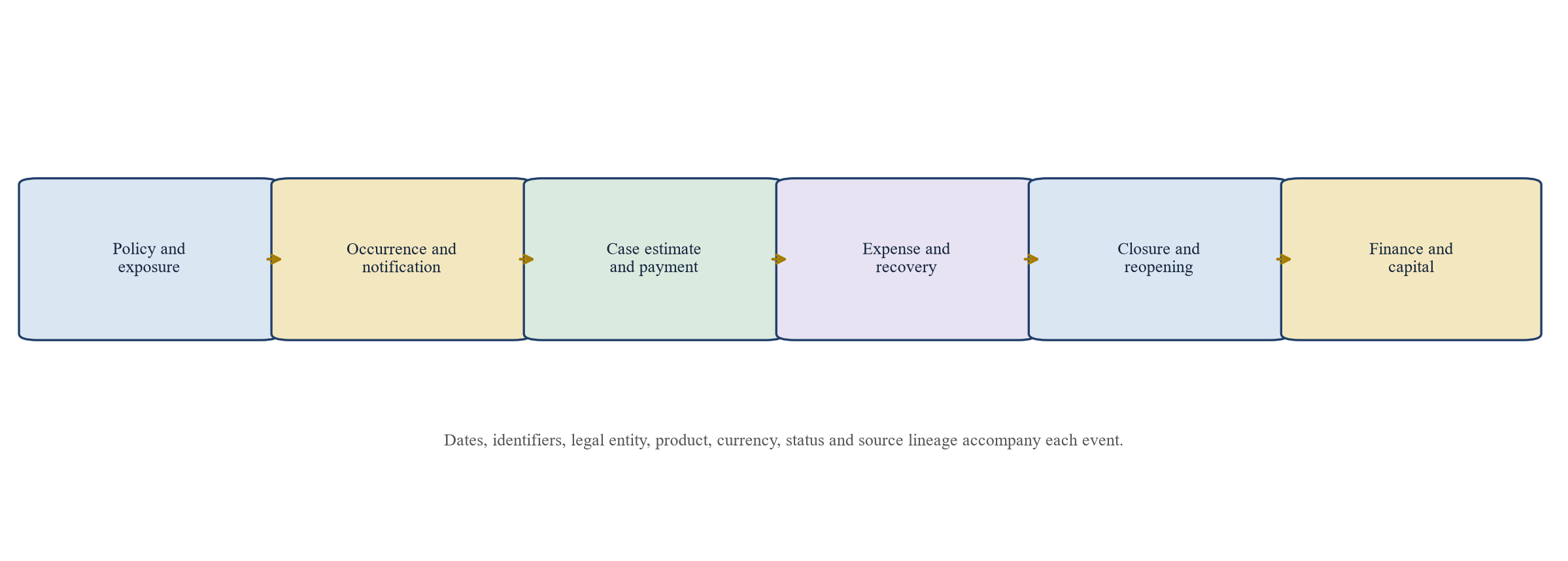
Proposed evidence chain connecting underwriting, claims, cash, reinsurance and finance.
3 Reconstruct claims cohorts and development triangles
Claims triangles organise cumulative or incremental loss by origin period and development period. Accident-year cohorts support occurrence-based analysis. Underwriting-year cohorts connect loss to the written portfolio. Report-year cohorts can reveal notification and operational changes. Payment-year views help cash planning. The buyer should use the cohort that matches the decision and retain bridges between views.
Triangle construction requires stable definitions. Gross, ceded and net losses should be separate. Paid, case incurred, reported count and closed count need consistent treatment. Allocated and unallocated loss adjustment expenses should be identified. Recoveries, salvage, subrogation, reopened claims and negative movements require explicit rules. Currency and inflation treatment should remain reproducible.
Development can change for legitimate reasons. Faster settlement moves paid losses forward. Claims automation can accelerate low-severity closure. Court practice, medical inflation, repair cost, wage cost, exchange rates and catastrophe can change severity. Portfolio mix can alter frequency. A buyer should decompose the pattern before treating favourable or adverse development as a permanent feature.
The most important triangle may be the exception triangle. It tracks late-reported claims, reopened files, large losses, zero-paid open claims, claims without coverage decision, manual overrides and migration exceptions. A small population can carry a large share of uncertainty. Aggregate triangles can hide it.
Maturity should be measured rather than assumed. The buyer can compare paid-to-incurred ratios, closure rates, reporting lag and settlement lag across cohorts, while controlling for product and severity. Recent cohorts should not be forced to resemble older cohorts when claims operations, policy wording or repair networks have changed. Sparse portfolios may require broader grouping, external benchmarks and wider uncertainty ranges. The grouping decision itself should be documented because it determines which experience is allowed to influence the estimate.
Back-testing should reproduce what could have been known at each prior valuation date. A model trained on the complete current history can appear accurate because it has seen later development. A proper historical test freezes the data available at the time, estimates the liability, and compares that estimate with subsequent emergence. The team should report both aggregate error and the distribution of errors across product, severity and origin period. Persistent directional error is more important than an occasional offsetting aggregate result.
| Cohort view | Primary question | Key distortion to test | Transaction use |
|---|---|---|---|
| Accident period | How does ultimate loss emerge after occurrence | event coding and late reporting | reserve adequacy |
| Underwriting period | Which written portfolio created the loss | premium mix and policy changes | pricing and renewal thesis |
| Report period | How do notification and operations affect emergence | backlog and channel change | operational integration |
| Payment period | When does cash leave the insurer | settlement initiatives and large losses | liquidity and capital |
| Catastrophe event | How does one event develop across claims | event definition and aggregation | reinsurance and tail risk |
| Claim-handler cohort | Does process or judgement affect outcomes | allocation and experience | control and people plan |
Several cohort views may be required to explain the same liability.
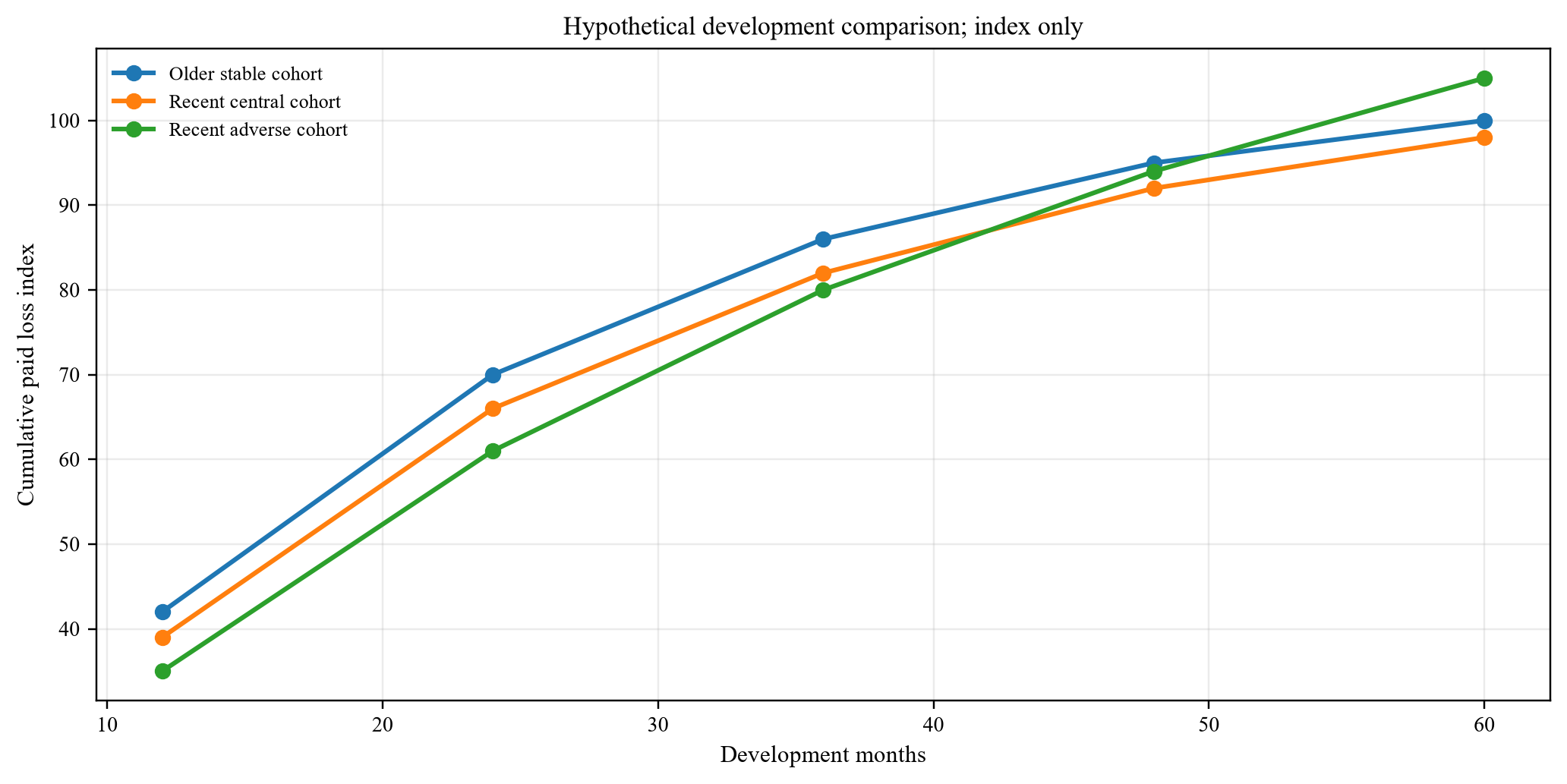
Hypothetical indexed cohorts show how later observations change the apparent maturity of each origin period.
4 Reconcile IFRS 17, actuarial and regulatory views
IFRS 17 establishes principles for recognising, measuring, presenting and disclosing insurance contracts.[15] Its measurement architecture includes estimates of future cash flows, discounting, risk adjustment and, for relevant groups, a contractual service margin. The accounting balance does not remove the need for transaction-specific actuarial diligence. It creates another controlled view that should reconcile to claims, policy and finance evidence.
The buyer should map each portfolio and group of contracts to the method used, including the general measurement model, premium allocation approach or variable fee approach where applicable. It should identify onerous groups, loss components, coverage units, discount curves, risk-adjustment method and changes in estimates. A movement analysis should show how opening balances reach closing balances through service, finance, new business, experience and assumption changes.
The statutory or supervisory reserve view may differ from the accounting presentation. Capital frameworks can apply separate prudence, admissibility, stress or reporting requirements. The buyer should preserve each view and document the bridge. Treating one number as universally authoritative can conceal how a change affects earnings, equity, solvency, distributable cash and purchase price differently.
Saudi Arabia's Insurance Authority reviewed 2024 actuarial reserving reports and highlighted quarterly best-estimate work, annual experience studies and analysis covering loss component, risk adjustment, discounting, reserve adequacy and actuarial function.[11] The CBUAE requires the actuary to review and approve technical provisions and assess the quality of data, while management remains responsible for data accuracy.[5] These expectations reinforce the need for clear ownership and evidence.
| View | Purpose | Key components | Deal question |
|---|---|---|---|
| Claims operational | manage individual files and settlement | case estimates, payments, status, recoveries | are source records complete and controlled |
| Actuarial best estimate | estimate ultimate cash flows | development, frequency, severity, tail, expenses | are methods and assumptions supported |
| IFRS 17 accounting | report insurance-contract performance and position | fulfilment cash flows, risk adjustment, service margin | how do liability changes affect earnings and equity |
| Supervisory | protect policyholders and test solvency | technical provisions, capital, admissibility, stress | what capital and approval consequences arise |
| Transaction | price and protect the acquisition | central, adverse and severe liability views | what adjustment, structure or covenant is needed |
A transaction bridge should preserve purpose, method, owner and consequence.
5 Test data quality before model sophistication
Reserving models inherit the limitations of their inputs. The buyer should profile completeness, uniqueness, validity, consistency, timeliness and reconciliation. It should quantify missing occurrence dates, report dates, cause codes, policy links, claimant identifiers, payment types, reserve movements and reinsurance references. The report should identify which fields were populated retrospectively or migrated.
System history matters. A claims-platform migration can create artificial closure or reopening. A product reclassification can move business between triangles. A chart-of-accounts change can break paid-loss reconciliation. A new case-reserving authority matrix can change incurred development without changing ultimate loss. The diligence team should create a change log for systems, products, methods, people and governance.
Management should not cure a weak population through undocumented adjustments. Every repair should have a rule, volume, value, owner and sensitivity. Where records cannot be resolved, the model should retain an unknown category and test the impact. Exclusion is a decision whose effect must remain visible.
Data rooms also need security and purpose controls. Claims files can contain health, identity, location, financial and litigation information. Access should follow need, approved purpose, minimum data, secure transfer, logging and deletion. The legal basis and cross-border treatment require current advice in each relevant jurisdiction.
6 Separate case-reserving practice from ultimate-loss estimation
Case reserves are operational estimates at individual-claim level. Their adequacy can vary with handler experience, authority, workload, incentive and documentation. Ultimate-loss models use aggregate or granular experience to estimate future development. The two views interact, but they should not be confused.
The buyer should test case-reserve accuracy by handler, team, product, severity, age and closure status. It should compare initial estimates, subsequent changes, settlement and reopened outcomes. Large-loss files require individual review with appropriate actuarial, claims, legal and medical expertise. Bulk statistical analysis cannot replace file evidence where a small number of claims drives value.
Changes in case practice can alter incurred triangles. A reserve-strengthening campaign may make recent cohorts appear adverse before payments change. A settlement drive may accelerate paid development and reduce open counts. A target may also apply management overlays that sit outside the model. Each overlay needs rationale, calculation, approval, release rule and back-test.
Artificial intelligence can identify unusual movement, missing documentation or inconsistent coding. It should produce a prioritised review queue rather than an unsupported liability adjustment. The accountable claims and actuarial functions should decide how evidence affects estimates.
7 Decompose inflation, catastrophe and portfolio-mix effects
Claims inflation includes general prices, medical cost, labour, parts, legal awards and social or behavioural change. Historical development factors can understate future cost when severity changes faster than the past. The buyer should separate exposure growth, frequency, severity and settlement speed. Nominal and real analyses need consistent currency and inflation assumptions.
Catastrophe experience should be event-based. Event definition, affected exposures, gross loss, paid loss, outstanding case estimate, incurred-but-not-reported amount, reinstatement premium and recovery should be linked. The buyer should test whether events below internal thresholds have been dispersed through ordinary triangles and whether climate or urban concentration changes the future distribution.
Portfolio mix can produce Simpson's paradox: aggregate improvement can coexist with deterioration inside important segments. A shift toward lower-frequency commercial business can lower the total loss ratio while motor severity worsens. Cohorts should therefore preserve product, geography, channel, limit, deductible, customer and risk characteristics.
Operational interventions also need separation. A preferred-provider network can lower unit cost while increasing utilisation. A fraud programme can delay settlement before it reduces leakage. A new claims authority can initially increase case estimates. Management should show the mechanism, implementation date, affected population and observed result. The buyer should not capitalise an expected benefit that cannot be distinguished from mix or timing.
Scenario design should combine related stresses. Inflation, catastrophe, reinsurer delay and operational disruption can occur together. Testing them independently can understate peak cash and capital need. The buyer should construct a small set of coherent scenarios whose assumptions are internally consistent, traceable and relevant to the target's exposures. Each scenario should state which management actions are available and how quickly they can operate.
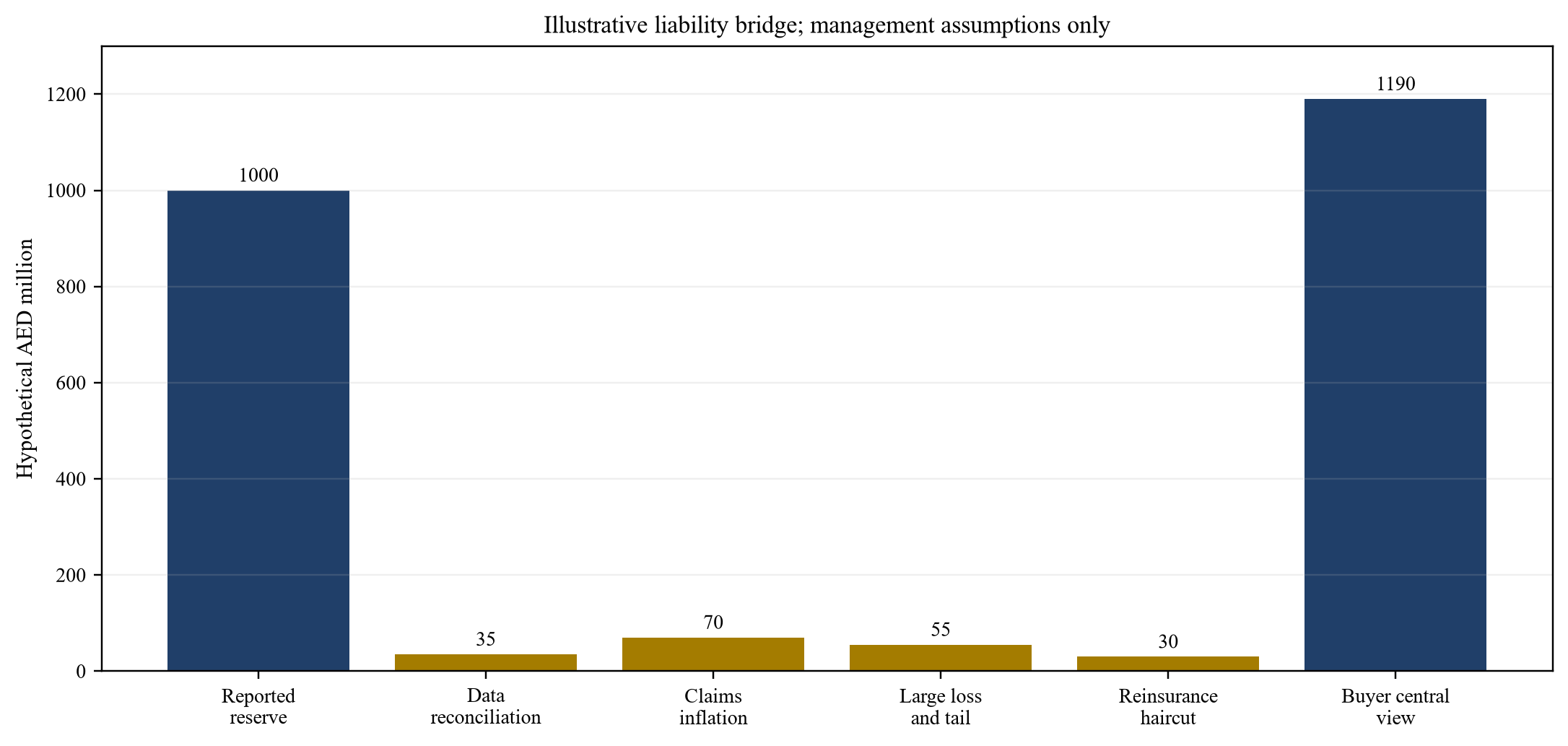
Hypothetical amounts show how evidence-based adjustments can change the central liability estimate.
8 Use a champion-challenger model design
The buyer should begin with transparent actuarial benchmarks. Chain-ladder, expected-loss, Bornhuetter-Ferguson, frequency-severity and individual large-loss methods can provide interpretable anchors. Method choice depends on maturity, volume, stability and data. The purpose is to expose sensitivity rather than select the most favourable answer.
Advanced models can add value when they address a defined limitation. Gradient boosting may model nonlinear severity or propensity. Survival methods may estimate settlement or reporting delay. Natural-language processing may structure adjuster notes. Graph methods may identify connected claims or fraud patterns. Record-linkage models may reconcile migrated identities. Each use requires a decision, population, target, benchmark and accountable owner.
A champion-challenger design compares the incumbent or transparent method with alternatives. Validation should use time-based holdouts so that later observations test earlier estimates. Random splits can leak information from the same claim or event across training and test sets. Evaluation should cover calibration, error distribution, stability, segment performance and financial impact.
The selected reserve remains an actuarial and management judgement under the applicable governance framework. A lower prediction error does not grant a model authority to set liabilities. The model may depend on features that are unavailable after acquisition, encode operational bias or become unstable when products and claims practice change.
Performance metrics should reflect the economic task. Mean absolute error can be useful for ordinary claims, while tail-sensitive measures may be required for large losses. Calibration tests whether predicted ranges contain observed outcomes at the stated frequency. Rank measures can support triage, but they do not establish the amount of a reserve. The model report should translate statistical performance into liability, capital and customer consequences.
The challenger should also survive removal tests. If one feature, vendor score or text embedding drives the result, the buyer should determine whether that input is lawful, stable and available after closing. Sensitivity to seed, sample period or hyperparameter should be reported. A model whose central estimate moves materially under reasonable technical choices deserves a wider uncertainty range and stronger human control.
| Model | Suitable use | Strength | Material limitation | Required control |
|---|---|---|---|---|
| Chain ladder | stable aggregate development | transparent and reproducible | sensitive to pattern change | diagnostics and alternative selections |
| Bornhuetter-Ferguson | immature cohorts | combines prior and emergence | depends on expected-loss prior | document and stress the prior |
| Frequency-severity | changing exposure or mix | separates claim count and cost | needs reliable exposure and severity data | cohort and inflation controls |
| Gradient boosting | nonlinear claim patterns | captures interactions | can be unstable and difficult to explain | time holdout, calibration and feature review |
| Survival model | reporting or settlement time | handles censoring and timing | assumptions may fail across regimes | proportionality and drift tests |
| Natural-language model | coding notes and documents | structures unformatted evidence | hallucination, privacy and version risk | retrieval evidence and human verification |
Accuracy should be assessed alongside stability, interpretability, control and operating fit.
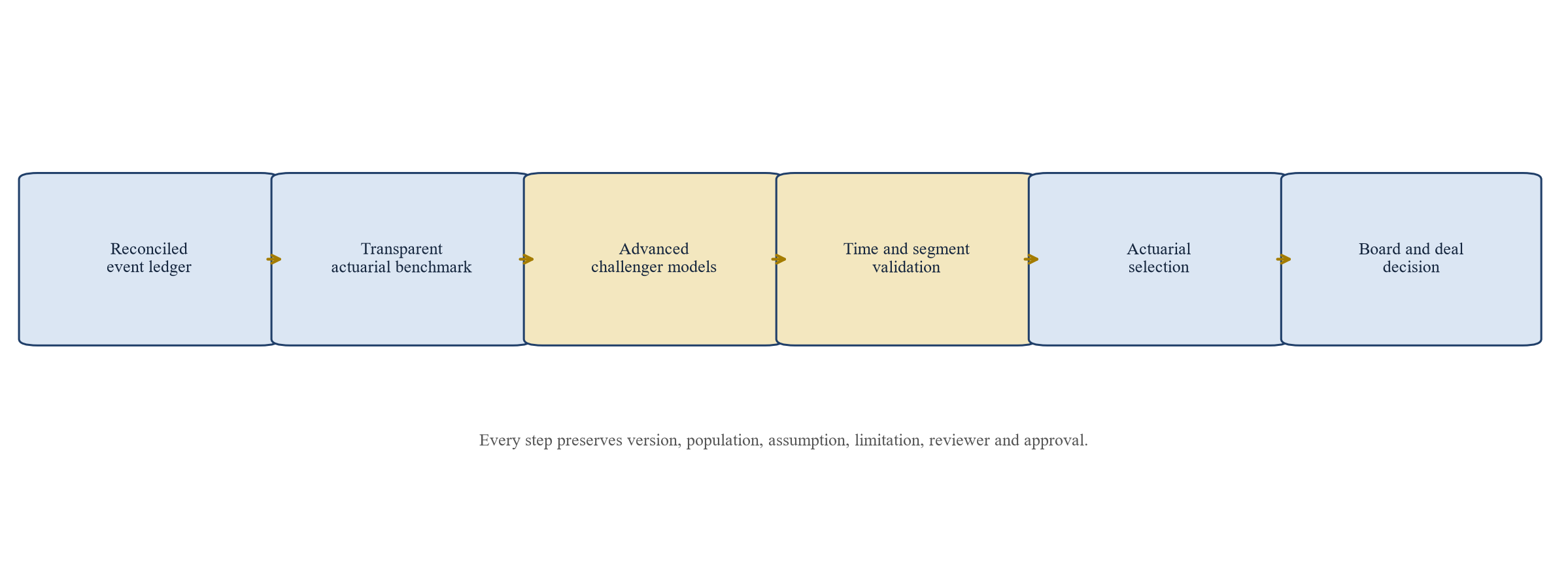
Proposed governance sequence from reconciled data to accountable reserve selection.
9 Govern artificial intelligence and model risk
Model governance begins with inventory. The target should list reserving, pricing, fraud, triage, claims routing, document, underwriting and finance models. Each entry needs purpose, owner, developer, vendor, version, data, validation, limitations, materiality, approval and monitoring. Hidden spreadsheet logic and vendor scores belong in the same inventory when they affect decisions.
The CBUAE issued guidance on artificial intelligence and machine learning for licensed financial institutions in February 2026. The guidance addresses governance, accountability, model inventory, data, validation, explainability and third-party risk; board and senior management remain accountable.[9,10] The IAIS published an application paper on supervision of artificial intelligence in July 2025.[18] EIOPA's August 2025 opinion also emphasises risk-based governance, human oversight, data quality and documentation.[20] These sources support a controlled approach; the applicable obligations require jurisdiction-specific review.
Explainability should match the decision. A claim reviewer may need the event and fields that drove an exception. An actuary may need sensitivity, calibration and cohort stability. A board may need the range of liability outcomes and capital consequences. A regulator may require governance, validation and evidence that customer treatment remains appropriate. One generic explanation cannot serve every audience.
Third-party dependencies require contractual diligence. The buyer should identify model access, source code, configuration, data location, subcontractors, licences, audit rights, service continuity and exit rights. A model that cannot be validated or operated after control changes can reduce transaction value even when current performance appears strong.
Model risk should be linked to materiality. A document classifier that only routes work can have lower approval requirements than a model that changes case reserves or settlement authority. Materiality should consider financial exposure, number and vulnerability of affected people, reversibility, legal effect and dependency on automation. The buyer can then direct independent validation and board attention toward uses whose failure could affect policyholders, financial statements or solvency.
Incident evidence is particularly informative. The diligence team should request model overrides, complaints, drift alerts, outages, vendor changes and internal-audit findings. An absence of recorded incidents may reflect effective operation or weak detection. The buyer should compare the incident record with logs, performance movements and staff interviews. Open issues should be costed and assigned before the transaction team credits an AI capability in valuation.
| Control domain | Diligence evidence | Closing or integration response |
|---|---|---|
| Accountability | board policy, owner, approval and escalation | assign named accountable executives |
| Data | lineage, rights, quality, retention and access | remediate gaps and restrict unsupported uses |
| Development | objective, features, training periods and code | reproduce model in controlled environment |
| Validation | independent testing, benchmarks and limitations | complete pre-close validation for material uses |
| Monitoring | drift, overrides, incidents and performance | agree thresholds and suspension authority |
| Third party | contract, audit, continuity and exit rights | secure rights or fund replacement |
| Human oversight | review workflow, authority and evidence | preserve decision rights and exception logs |
Controls should follow model materiality and the consequences of error.
10 Test reinsurance as an asset and dependency
Reinsurance can reduce gross volatility and capital need, but the recoverable is an asset whose value depends on contract terms, event definition, attachment, limit, reinstatement, allocation, notification, documentation, dispute and counterparty capacity. The buyer should reconcile gross, ceded and net positions claim by claim for material exposures.
Treaty data should include placement, signed lines, endorsements, premium, commission, collateral, broker balance, recoveries billed, cash collected and aged disputes. Facultative cover needs policy and claim linkage. Catastrophe programmes require event aggregation and exhaustion analysis. The buyer should test hours clauses, occurrence definitions and whether several events or causes can be combined.
Timing matters. A recoverable recognised in accounts may not provide cash when claims are paid. The transaction model should test collection delay, collateral, set-off, credit deterioration and commutation. It should also identify whether change of control, portfolio transfer or integration affects coverage or notification.
The reserve bridge should show gross ultimate loss, ceded ultimate loss, collectability adjustment, timing and net liability. A transaction response can include a price adjustment, escrow, seller indemnity, pre-close collection, commutation or specific covenant. The evidence should determine the response.
Counterparty analysis should avoid relying only on external credit ratings. The buyer should examine exposure by reinsurer and group, overdue balances, dispute history, collateral terms, settlement behaviour and concentration across programmes. Wrong-way risk can arise when the same event weakens both the insurer and its reinsurer. The stress should also test broker and operational dependencies that can delay documentation or cash.
Future programme economics matter for valuation. A target may have benefited from expiring terms that cannot be renewed at the same price, limit or attachment. The buyer should obtain current renewal indications and distinguish existing-claim recoveries from future underwriting protection. Expected reinsurance cost and capacity should flow into the forecast, while the opening balance sheet reflects recoverability of incurred claims.
11 Connect reserve evidence to solvency and capital
Reserve strengthening reduces equity and can increase capital requirements, liquidity pressure and management-buffer needs. Its effect depends on accounting, tax, reinsurance and the applicable capital framework. The buyer should model the legal entity, subgroup and group consequences instead of applying one percentage to the purchase price.
The CBUAE Financial Stability Report recorded an aggregate solvency ratio of 232 per cent for UAE insurers at the end of 2024.[2] Its March 2026 Quarterly Economic Review reported 256.9 per cent for the fourth quarter of 2025.[4] Sector strength does not answer whether an individual target can absorb reserve deterioration, transaction costs, integration spend and distribution constraints.
The capital model should include central, adverse and severe liability views. It should identify the resulting eligible own funds, required capital, operating buffer and potential injection. It should also test cash because claims, collateral and reinsurance timing can create liquidity needs before accounting or capital relief arrives.
Management actions belong in the model only when they are specific, lawful, approved, funded and executable within the stress period. A possible future reinsurance placement or portfolio repricing should not automatically offset a closing capital deficit.
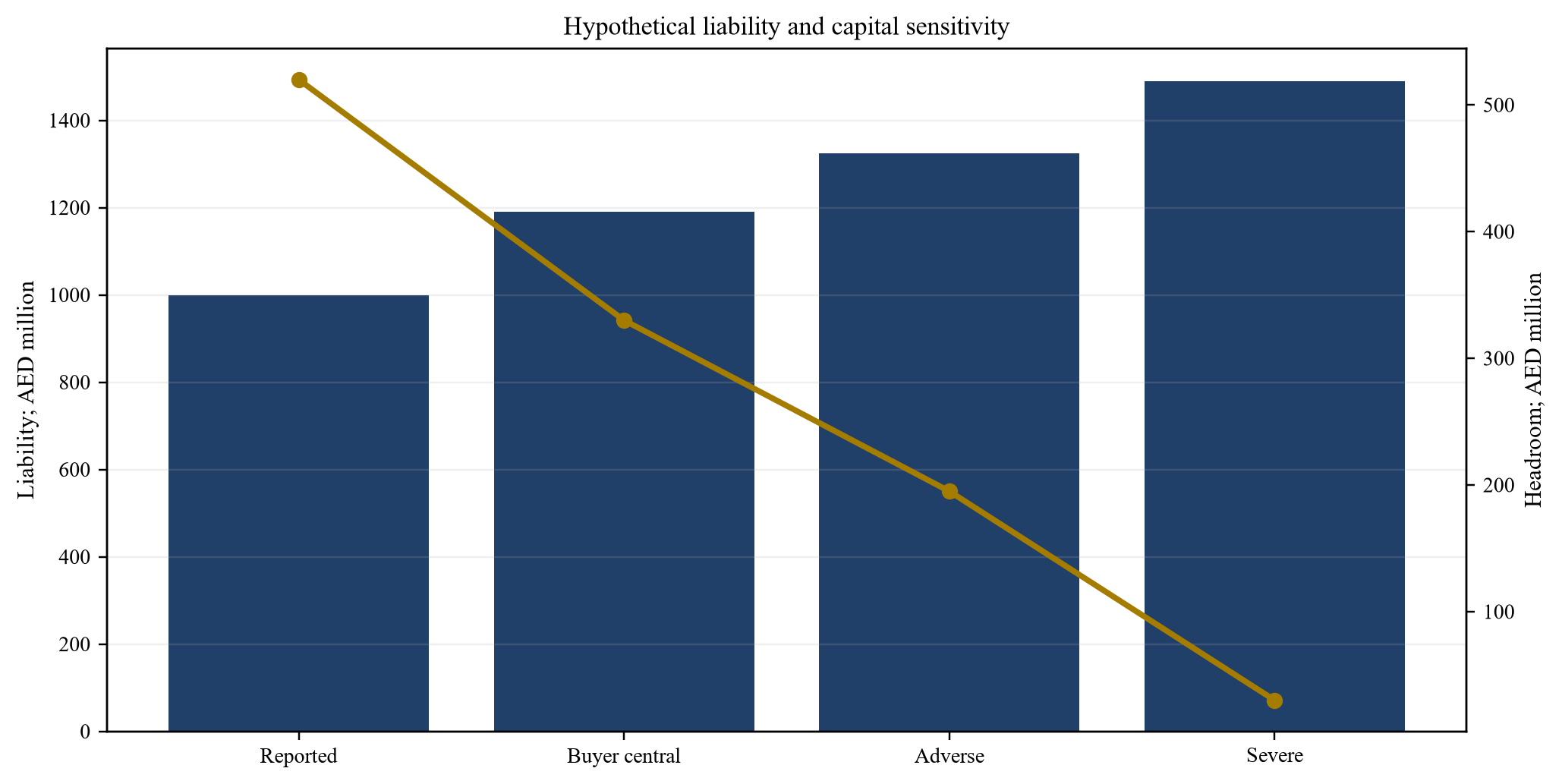
Illustrative figures show how liability strengthening can reduce capital headroom.
12 Work through a hypothetical acquisition case
A regional insurer is assumed to acquire a composite GCC carrier. The target reports a net claims liability of AED 1.00 billion and eligible capital of AED 1.32 billion against a prescribed requirement of AED 800 million, giving AED 520 million of reported headroom. The purchase price is assumed at AED 1.60 billion. These figures are hypothetical management assumptions for demonstrating the framework.
The buyer reconstructs policy and claim records over ten accident years. Reconciliation identifies AED 35 million of missing or misclassified claim movements. Updated severity and inflation assumptions add AED 70 million. Large-loss and tail review adds AED 55 million. Reinsurance collectability and timing analysis adds AED 30 million. The resulting buyer central liability is AED 1.19 billion, an increase of AED 190 million.
Under the simplified case, the reserve increase reduces eligible capital by the same pre-tax amount before any tax effect, while the capital requirement remains AED 800 million. Headroom falls from AED 520 million to AED 330 million. An adverse case raises the liability to AED 1.325 billion and headroom falls to AED 195 million. A severe case raises liability to AED 1.49 billion and headroom falls to AED 30 million. Actual accounting, tax and capital effects can differ.
Model comparison adds decision context. A transparent actuarial benchmark and two advanced challengers agree closely for mature motor cohorts. They diverge for recent medical and liability cohorts. One challenger produces lower error in historical random validation but performs poorly on the latest time period and is sensitive to hospital-network and handler features. The buyer rejects its lower central estimate for pricing and retains it as an analytical challenger.
The buyer proposes a package rather than one price adjustment. The package includes an AED 120 million reduction in equity value, an AED 80 million reserve-specific escrow, a warranty over data completeness and reinsurance disclosure, a closing capital condition, preservation of named actuarial and claims staff, access to model artefacts and a first-100-day reserve review. Amounts are illustrative and do not represent a recommendation for any actual transaction.
| Item | Reported | Buyer central | Adverse | Severe |
|---|---|---|---|---|
| Net claims liability | 1,000 | 1,190 | 1,325 | 1,490 |
| Eligible capital after liability view | 1,320 | 1,130 | 995 | 830 |
| Prescribed capital requirement | 800 | 800 | 800 | 800 |
| Capital headroom | 520 | 330 | 195 | 30 |
| Indicative transaction response | base model | price and escrow | additional capital and covenant | reprice, restructure or withdraw |
All figures are illustrative management assumptions in AED million.
13 Translate evidence into valuation and deal protection
Reserve findings affect value through several channels. A current liability shortfall reduces equity. A recurring difference in loss ratio changes forecast earnings. Greater uncertainty can increase the required capital buffer and cost of capital. Weak data or governance creates integration cost. Reinsurance concerns affect both value and liquidity.
The buyer should avoid double counting. A reserve adjustment included in net assets should not also be capitalised as a permanent earnings shortfall unless the evidence supports both effects. Conversely, a one-time opening adjustment does not cure an underwriting or claims process that will continue to produce adverse development. The valuation bridge should label stock, flow, capital and execution effects separately.
Forecast earnings should be rebuilt on a constant-definition basis. The buyer can start with earned premium, expected ultimate loss, expense, reinsurance and investment income by product. It should remove reserve releases that cannot recur, normalise catastrophe and large-loss experience where supported, and include the operating cost of improved controls. The forecast should reconcile to both the reserve view and the business plan.
Price uncertainty can also affect financing. A lender may apply covenants to solvency, liquidity or dividend capacity. Reserve deterioration can restrict upstream cash while acquisition debt remains payable. The transaction model should therefore connect liability scenarios with legal-entity capital, distribution capacity and holding-company debt service. Any equity cure or committed facility should be documented before it is treated as available.
Contractual protection should match the evidence and survival period. A general warranty may be inadequate for a known reserve issue. Specific indemnities, escrow, retention, price adjustment, completion accounts, locked-box leakage protection or contingent consideration may be considered with legal and tax advice. The agreement should define the population, accounting policy, data access, calculation, review and dispute process.
Some uncertainty remains uninsurable and difficult to allocate. A buyer may reduce price, change structure, require a portfolio transfer, exclude liabilities or decline the transaction. The decision ledger should show why each response follows from the evidence.
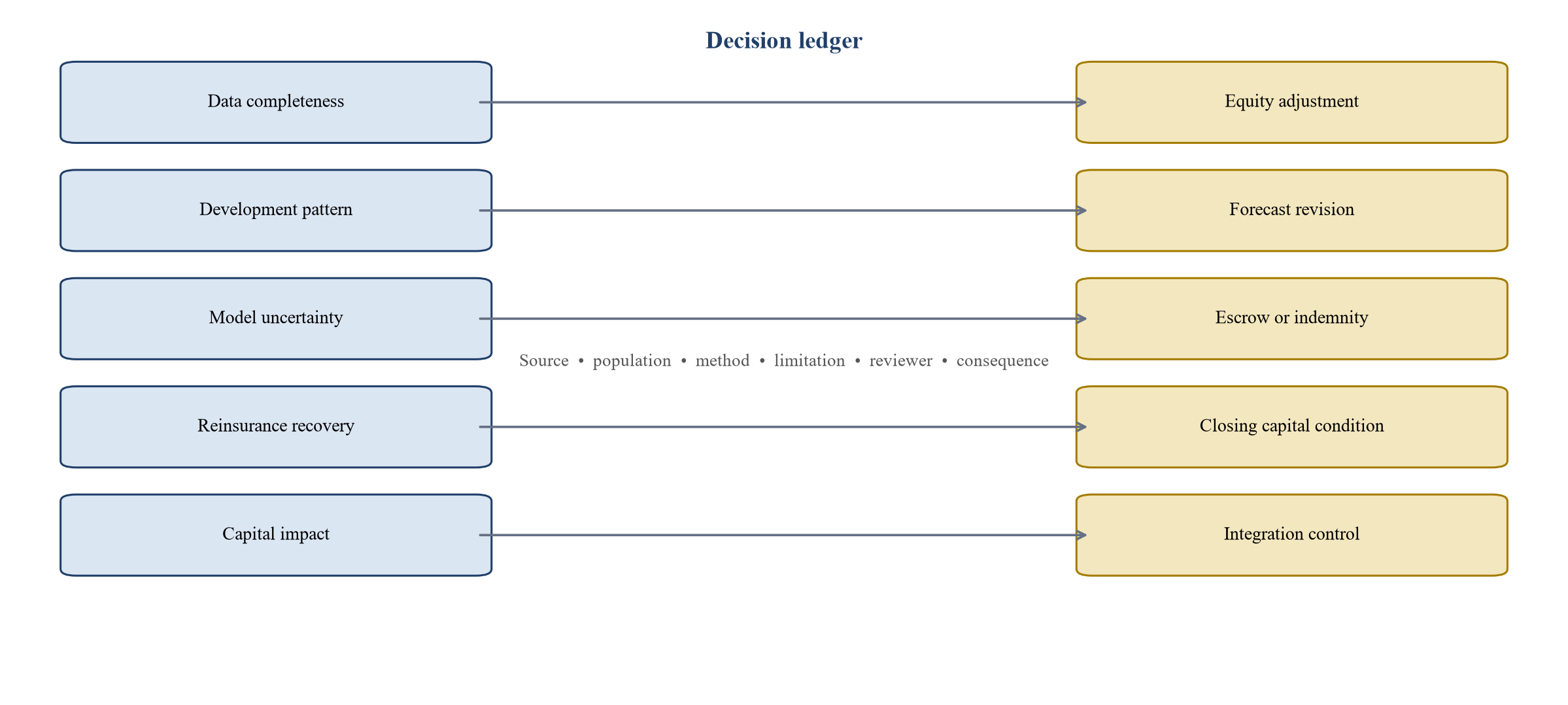
Proposed mapping from reserving evidence to valuation, capital, protection and integration actions.
14 Plan integration before signing
The buyer should identify the minimum viable operating model before signing. Claims must continue to be notified, assessed, paid and recovered. Policyholders and counterparties need continuity. Data and model migrations should follow evidence and control gates rather than an arbitrary system date.
The target operating model should define actuarial, claims, finance, risk, technology, data and reinsurance responsibilities. Critical people, committees, vendors and licences need continuity plans. The buyer should decide which reserve methods continue, which models are suspended, and how parallel runs will work.
Data migration requires population, field and value reconciliation. The team should compare counts and amounts before and after migration, retain exception logs and run old and new reporting in parallel. A migration that preserves totals can still lose claim history, notes or links that affect future decisions.
The first closing balance sheet should use controlled sources and an agreed assumption process. Purchase accounting, IFRS 17, tax, regulatory reporting and solvency analysis require coordinated calendars. Differences should be recorded in one bridge rather than resolved through separate undocumented adjustments.
Integration sequencing should follow risk. Low-risk reference data and reporting can move before complex claim histories and material models. High-severity claims, open litigation, catastrophe events and disputed recoveries may remain on the original platform until their evidence is preserved and controls are proven. The plan should identify rollback, manual continuity and reconciliation capacity.
The buyer should also protect customer outcomes during change. Altered claims routing, provider networks, fraud rules or settlement authority can affect service and fairness. Complaints, declined claims, settlement time and vulnerable-customer indicators should be monitored alongside financial metrics. Integration value should be recognised only where the operating change remains consistent with policy terms and applicable conduct requirements.
| Period | Priority | Evidence | Decision owner |
|---|---|---|---|
| Before closing | preserve data, people, contracts and model access | signed continuity and access plan | deal executive and board |
| Days 1 to 15 | freeze populations and opening balances | reconciled policy, claim, cash and recovery ledgers | finance and actuarial leads |
| Days 16 to 30 | run reserve methods and key reports in parallel | variance and exception register | chief actuary |
| Days 31 to 60 | validate material models and third parties | independent validation and remediation plan | model committee |
| Days 61 to 90 | refresh capital, liquidity and reinsurance views | central and stress bridge | risk and capital committee |
| Days 91 to 100 | approve target method and monitoring | board pack, thresholds and owners | board or delegated committee |
Timing should follow legal closing, reporting cycles and operational risk.
15 Establish post-close reserve governance
Reserve governance should connect operational evidence to accountable approval. Claims teams own file quality and case estimates. Actuarial teams own methods, assumptions, ranges and recommendations. Finance owns accounting reconciliation and reporting. Risk provides independent challenge. Internal audit assesses the control framework. The board or delegated committee approves material judgements under applicable governance.
The CBUAE's risk-management and internal-control regulation requires an integrated framework for licensed insurers.[7] Its actuarial-function regulation addresses independence, responsibilities and reporting.[6] The International Actuarial Association's ISAP 1A concerns governance of models, while ISAP 4 addresses actuarial services in relation to IFRS 17.[21,22] These materials provide governance reference points; the transaction team should confirm the rules applying to the entities and date.
Monitoring should cover data completeness, triangle stability, assumption movement, actual-to-expected experience, large losses, reopened claims, recoveries, model drift, overrides and unresolved exceptions. Thresholds should trigger named actions. A model breach may require investigation, limitation or suspension. A reserve movement may require capital, liquidity or disclosure review.
The buyer should preserve a reserve decision record. It states the population, evidence, method, range, selected amount, alternatives, limitation, review and approval. The same record supports audit, regulatory engagement, transaction disputes and future back-testing.
Quarterly governance should distinguish movement caused by new business, actual experience, model change, assumption change and management judgement. A reserve committee should receive a stable bridge rather than a fresh narrative each period. Material divergence between claims, actuarial and finance views should have an owner and resolution date. Open differences should remain visible to the board.
Independent assurance can be layered. The actuarial function performs and challenges the estimate; model validation tests design and performance; risk challenges material assumptions; internal audit tests the control framework; and external specialists can address transaction-specific issues. Clear scopes prevent duplicated comfort and uncovered gaps. Independence, competence and access should be documented.
16 Conclusion
Insurance M&A requires an evidence chain from policy and claim events to actuarial liabilities, accounting, solvency, valuation and transaction terms. Claims cohorts and development triangles remain central because they reveal how obligations emerge over time. Their conclusions depend on stable definitions, reconciled populations and explicit treatment of operational change.
Artificial intelligence can expand the review. It can reconcile identities, structure documents, identify anomalies, segment claims and compare patterns at scale. Its contribution depends on governed data, transparent benchmarks, time-aware validation, explainability, human authority and reliable third-party arrangements.
The practical output is a reserve decision ledger. Each material finding identifies the source, population, method, limitation, reviewer and transaction consequence. It allows the board to distinguish observed liability from model judgement and to connect uncertainty with price, capital, contractual protection and integration.
The hypothetical case shows why a reported reserve cannot be accepted as one number. Data reconciliation, inflation, tail loss and reinsurance can change the central view and capital headroom. The response can combine valuation, escrow, warranties, capital conditions and operating controls. A disciplined buyer chooses that package before uncertainty becomes an unplanned post-close capital call.
Limitations and further research
This framework does not estimate the value or reserves of an identified insurer. Private policy, claims, actuarial, reinsurance, accounting, tax, legal, capital and technology evidence was unavailable. The worked figures are hypothetical. Public sector data describes market and regulatory context and does not validate a private target's performance.
Future research could compare development and governance across motor, medical, property, liability and takaful portfolios; study natural-language models for claims files; assess privacy-preserving record linkage; and test how reserve evidence affects transaction structures. Such work would require appropriately governed company or transaction data and qualified multidisciplinary review.
Appendices. A1 Minimum reserving-diligence data request
Policy, premium, exposure, endorsement, cancellation and renewal records.
Claim occurrence, report, cause, status, case reserve, payment, expense, closure and reopening events.
Reinsurance treaty, facultative, notification, billed recovery, cash collection, collateral and dispute records.
Actuarial reports, triangles, methods, assumptions, overlays, experience studies and approval minutes.
IFRS 17 portfolios, groups, methods, cash-flow estimates, risk adjustment, discount and movement analyses.
Statutory reserve, solvency, stress, capital, liquidity and regulatory correspondence.
Model inventory, code, features, evaluation, validation, incidents, overrides, licences and vendors.
System, product, organisation, claims-practice and accounting-policy change logs.
Appendices. A2 Reserve reconstruction checks
Freeze populations, definitions, cut-off dates and currency rules before analysis.
Reconcile gross, ceded and net claims to cash, actuarial and finance balances.
Preserve accident, underwriting, report, payment, product and catastrophe cohorts.
Separate observed fields, derived features, actuarial selections and management overlays.
Test maturity, inflation, large loss, reopened claim and late-reporting sensitivity.
Validate models on later periods and material segments against transparent benchmarks.
Record versions, parameters, evidence, limitations, reviewers and approvals.
Appendices. B1 Transaction decision ledger
State the acquisition thesis and decision supported by each analysis.
Record source, population, method, result, limitation and reviewer.
Separate liability stock, recurring earnings, capital and integration effects.
Translate findings into price, escrow, indemnity, condition, covenant or integration action.
Assign an owner and completion date to every unresolved issue.
Appendices. B2 Post-close monitoring pack
Paid, incurred, case-reserve and claim-count development by stable cohort.
Actual-to-expected frequency, severity, settlement and reporting delay.
Large loss, catastrophe, reopened, zero-paid open and manual-override populations.
Gross, ceded, collected and disputed reinsurance movements.
IFRS 17, actuarial, statutory and transaction reserve bridge.
Solvency, liquidity, capital buffer and management-action status.
Model performance, drift, segment results, overrides, incidents and suspended uses.
Sources
- Central Bank of the UAE. Annual Statistical Report for the Insurance Sector of the UAE 2024. Read the primary source
- Central Bank of the UAE. Financial Stability Report 2024. Read the primary source
- Central Bank of the UAE. Annual Report 2024. Read the primary source
- Central Bank of the UAE. Quarterly Economic Review March 2026. Read the primary source
- Central Bank of the UAE. Financial Regulations for Insurance Companies; Article 4, Technical Provisions. Read the primary source
- Central Bank of the UAE. Financial Regulations for Insurance Companies; Article 10, Actuarial Function. Read the primary source
- Central Bank of the UAE. Risk Management and Internal Controls Regulation for Insurance Companies, Circular 25 of 2022. Read the primary source
- Central Bank of the UAE. Insurance company merger and acquisition provisions. Read the primary source
- Central Bank of the UAE. Guidance on Artificial Intelligence and Machine Learning for Licensed Financial Institutions. Read the primary source
- Central Bank of the UAE. Standards for Artificial Intelligence and Machine Learning. Read the primary source
- Insurance Authority of Saudi Arabia. Review of Actuarial Reserving Reports for Year 2024. Read the primary source
- Insurance Authority of Saudi Arabia. Saudi Insurance Market Report 2024. Read the primary source
- Insurance Authority of Saudi Arabia. IFRS 17 Implementation Benchmark Report Q2 2024. Read the primary source
- Insurance Authority of Saudi Arabia. Saudi Insurance Market Report 2025. Read the primary source
- IFRS Foundation. IFRS 17 Insurance Contracts. Read the primary source
- IFRS Foundation. IFRS 17 Insurance Contracts standard. Read the primary source
- IFRS Foundation. IFRS 17 Effects Analysis. Read the primary source
- International Association of Insurance Supervisors. Application Paper on the Supervision of Artificial Intelligence. Read the primary source
- International Association of Insurance Supervisors. Global Insurance Market Report 2024. Read the primary source
- European Insurance and Occupational Pensions Authority. Opinion on Artificial Intelligence Governance and Risk Management. Read the primary source
- International Actuarial Association. ISAP 1A Governance of Models. Read the primary source
- International Actuarial Association. ISAP 4 Actuarial Services in Relation to IFRS 17 Insurance Contracts. Read the primary source
