

1. Introduction
Local-currency fixed income can serve several institutional objectives. It can provide sovereign duration, contractual income, diversification from global hard-currency benchmarks, access to domestic credit, a source of eligible collateral and a way to match liabilities or spending in a Gulf currency. It can also connect an investor to the development of regional capital markets and to Shariah-compliant instruments that are absent from many conventional benchmarks.
The existence of bonds and sukuk does not settle the allocation question. An international institution needs to know which securities it may own, how it opens and funds the account, where assets are held, how trades settle, which prices support valuation, whether a dealer can make a two-way market, whether the instrument can support repo, how distributions and redemptions are processed, and what happens when it needs to sell.
Those questions are becoming more relevant as official local-currency programmes expand. The UAE Ministry of Finance publishes a scheduled 2026 programme for AED-denominated Treasury Bonds and Treasury Sukuk and reported AED 26.85 billion of outstanding institutional domestic debt at 31 December 2025.[1] Saudi Arabia's National Debt Management Center operates a monthly Saudi-riyal domestic sukuk programme, while Saudi Exchange reported SAR 713.46 billion of total sukuk and bond issuance size at the end of 2025.[2][3] Qatar, Bahrain and Oman operate domestic government-security frameworks through their central banks, and Kuwait resumed a broader tenor programme for Treasury Bonds and Public Debt Tawarruq.[4][5][6][7]
The official evidence shows development, activity and differing operating models. It does not establish that every issue is continuously liquid or equally accessible. An investability decision requires security-level evidence and an operating test. This paper provides the framework for that test.
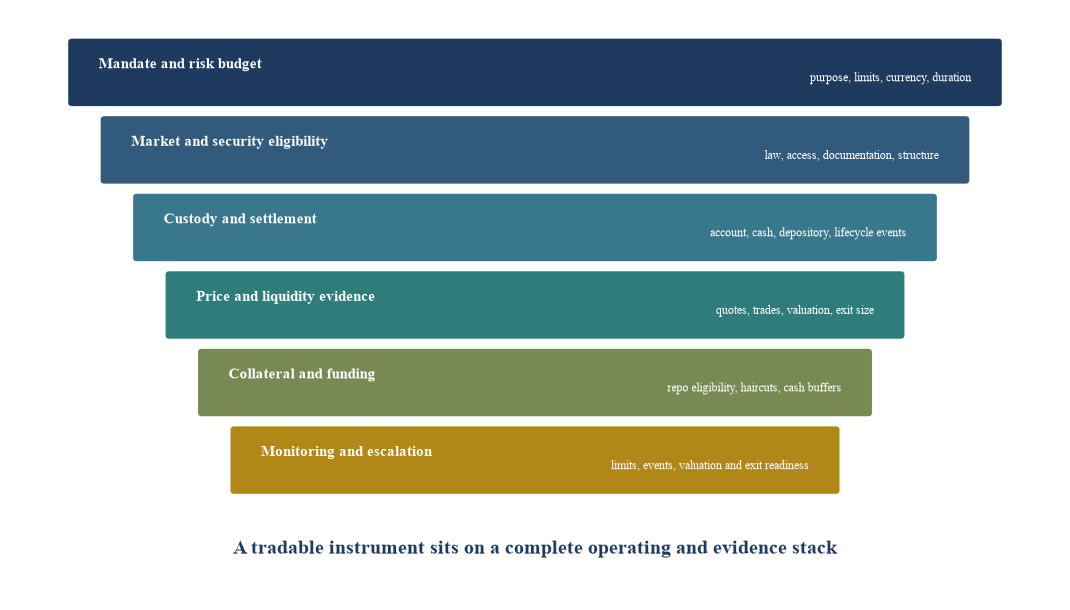
Author framework. Each layer requires evidence before a security can enter an institutional approved universe.
2. Treat the GCC as six connected markets
The GCC is a useful regional frame for strategy and reporting. The investable universe remains country-specific. Each sovereign has its own debt-management authority or issuing process, central-bank arrangements, exchange and depository infrastructure, dealer network, currency regime, tax and investor-access rules. Issue frequency and benchmark depth also differ.
The UAE federal programme uses scheduled auctions and re-openings of AED Treasury Bonds and Treasury Sukuk. Auction results disclose allotment, cut-off yield, clean price and bid-to-cover information. In January 2026, the Ministry of Finance reported AED 1.1 billion of aggregate T-Bond and T-Sukuk issuance against AED 5.15 billion of bids and described the new bond tranche as supporting the AED yield curve and secondary-market depth.[1][8]
Saudi Arabia's domestic sukuk programme began in 2017 and uses monthly issuance. The National Debt Management Center identifies benchmark securities across maturities, and Saudi Exchange supplies market statistics, listed lines, traded value and index data.[2][3] Saudi Arabia also opened direct Main Market access to all categories of foreign investors from 1 February 2026 by removing the former qualification concept, subject to the applicable rules and ownership restrictions.[9] The operational effect for a fixed-income investor still depends on account, custodian, depository and security eligibility.
Qatar Central Bank coordinates an annual plan for government bonds, sukuk and treasury bills, manages subscription and allocation, supports repurchase operations and coordinates listing and trading information with Qatar Exchange.[4] The Central Bank of Bahrain issues conventional and Islamic government securities through its scripless settlement system, with different investor-participation routes and collateral treatment.[5] The Central Bank of Oman issues Government Development Bonds through auction, permits resident and non-resident participation and identifies exchange trading and repo facilities.[6] Kuwait's central bank acts for the Ministry of Finance and has published competitive Treasury Bond and Public Debt Tawarruq auctions across two- to seven-year tenors during 2026.[7]
These programmes cannot be reduced to one market-capitalisation number. The allocation team should maintain a country operating memorandum and a security master. The memorandum records law, access, trading venue, depository, settlement convention, cash account, tax, collateral, reporting and escalation. The security master records instrument terms, structure, credit, price sources, trading evidence, position limits and lifecycle events.
Table 1. Six-market operating map
| Market | Official issuance channel | Instrument examples | Institutional diligence focus |
|---|---|---|---|
| United Arab Emirates | Ministry of Finance with the Central Bank as issuing and payment agent | AED Treasury Bonds and Treasury Sukuk | auction access, primary dealer route, listing, settlement, re-openings, price evidence |
| Saudi Arabia | Ministry of Finance and National Debt Management Center | SAR domestic sovereign sukuk and listed corporate sukuk or bonds | foreign-investor route, depository, benchmark lines, dealer liquidity, index and collateral treatment |
| Qatar | Qatar Central Bank with Ministry of Finance coordination | government bonds, sukuk and treasury bills | subscription eligibility, repo, listing, price reporting and cash operations |
| Kuwait | Central Bank of Kuwait for the Ministry of Finance | Treasury Bonds and Public Debt Tawarruq | auction eligibility, tenor programme, settlement, secondary transfer and valuation |
| Bahrain | Central Bank of Bahrain | Treasury Bills, Development Bonds, Al Salam Sukuk and Ijara Sukuk | participant route, scripless settlement, collateral eligibility, Shariah approval and liquidity |
| Oman | Central Bank of Oman | Treasury Bills and Government Development Bonds | resident and non-resident access, bank bidding route, exchange trading, repo and price evidence |
Official arrangements can change. The investment team should verify current rules, eligible participants and operational routes before trading.
3. Define the job of the allocation
A local-currency sleeve needs a written purpose. A broad instruction to add GCC fixed income is insufficient because different instruments can satisfy different jobs. A short sovereign bill can provide cash management. A long sovereign sukuk can provide duration. A bank sukuk can add spread and structural complexity. A corporate bond can provide sector exposure. A security held for local liability matching has a different currency policy from a security held to earn total return in the institution's base currency.
The mandate should identify the base currency, reporting currency, eligible local currencies, sovereign and corporate limits, conventional and Islamic instrument eligibility, rating and internal-credit requirements, duration range, maximum maturity, issue-size threshold, minimum price evidence, concentration, liquidity bucket, derivatives, hedging, repo, securities lending and treatment of unrated instruments.
The institution should also define whether it is prepared to hold through periods of weak liquidity. A strategic allocation can accept less frequent trading when cash-flow needs and governance support it. A liquidity reserve requires observable same-day or short-horizon monetisation. These are different mandates even when they hold the same issuer.
An investment belief should connect the sleeve to an expected source of return or risk reduction. Possible sources include term premium, credit spread, structural premium in a sukuk, benchmark development, liability alignment or diversification. Each belief requires a test. The team should separate expected contractual cash flow from price appreciation, currency outcome, liquidity compensation and active-management value.
Table 2. Mandate design questions
| Mandate field | Decision question | Evidence | Control output |
|---|---|---|---|
| Allocation purpose | What portfolio job must the sleeve perform? | liability profile, strategic allocation, liquidity plan and return objective | ranked objectives and prohibited substitutions |
| Currency | Is exposure local, hedged, partially hedged or base-currency translated? | currency regime, hedge market, counterparty capacity and accounting | currency policy and hedge limits |
| Credit | Which sovereign, bank, corporate and structured risks are eligible? | ratings, internal analysis, financial statements and legal review | approved issuers and security limits |
| Structure | Which conventional and sukuk forms are permitted? | terms, cash-flow waterfall, legal opinions and Shariah materials | structure taxonomy and approval route |
| Liquidity | How quickly and at what cost must exposure be realisable? | quotes, trades, issue size, dealer depth and collateral status | liquidity buckets and position caps |
| Operations | Can the institution own, settle, value and service the instrument? | custodian, depository, tax, cash and lifecycle test | market-operating memorandum |
| Governance | Who approves additions, breaches and exceptions? | delegation, committee charter and escalation policy | approved-universe and exception workflow |
Limits should be approved by the authorised investment and risk bodies before the universe is built.
4. Distinguish issuance from investable capacity
Outstanding issuance is a necessary market statistic. It is not an estimate of the amount an institution can buy or sell. A large programme may be concentrated in hold-to-maturity domestic institutions. Several small tranches may have limited free float. A security can be listed while trading infrequently. A quote can represent a dealer indication rather than firm executable size.
Investable capacity develops through a chain. Predictable issuance allows investors to plan. Re-openings consolidate supply in benchmark lines. A primary-dealer network distributes securities and supports price discovery. A diverse investor base creates two-way activity. Settlement infrastructure reduces operational friction. Repo or collateral eligibility can support financing and dealer balance sheets. Reliable evaluated prices and completed trades improve valuation confidence. Index inclusion can broaden demand, while transparent methodology helps the investor understand what the index actually captures.
The UAE's 2026 calendar illustrates how scheduled issuance and re-openings can support a curve.[1] Saudi Arabia's monthly programme and identified benchmark securities illustrate a deliberate domestic sukuk framework.[2] Saudi Exchange's 2025 report provides a useful distinction between total issuance size and annual trading: it reported SAR 713.46 billion of total issue size and SAR 31.41 billion of traded value during the year.[3] Those figures describe the exchange's reported market and do not determine the liquidity of a particular line.
The institution should therefore measure free float, holder concentration, recent trade frequency, quote count, bid-offer range, executable size, time to liquidate, dealer inventory, settlement fails and stressed price dispersion where evidence is available. The absence of data is itself a risk input. It should lower the permitted position size or prevent approval until an adequate route is demonstrated.
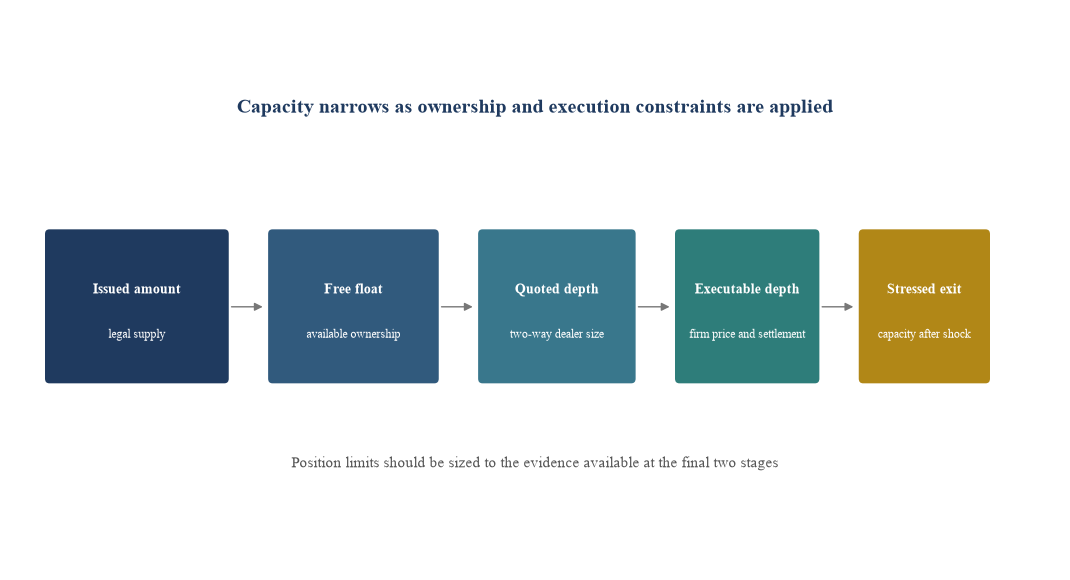
Author framework. Published issue size and executable exit size are different measures.
5. Build the complete access and settlement route
Market access should be proven through an end-to-end operating walkthrough. The institution identifies the legal investor, investment manager, executing broker, local custodian, global custodian, cash bank, central securities depository or nominee structure, tax-status record and authorised signatories. It then maps order placement, affirmation, funding, settlement, safekeeping, income collection, corporate actions, redemption and reporting.
Foreign-investor reforms can reduce a legal barrier while leaving operational work. Saudi Arabia's 2026 change allows all categories of foreign investors to access the Main Market directly without the former qualification requirement.[9] The actual account-opening process, documentation, applicable ownership restrictions and service-provider readiness should still be confirmed. In another GCC market, primary auction access may be limited to banks or selected participants, requiring an institution to use an approved intermediary.
Settlement risk includes cash timing, holiday calendars, failed trades, pre-funding, currency cut-offs and mismatches between global and local books. Income events can involve profit distributions, coupon payments, withholding or tax documentation, purchase undertakings, partial redemption or early dissolution. The custodian test should use an actual eligible security and should reconcile the front-office order, custodian instruction, cash movement, depository record, accounting entry and performance record.
The institution also needs a valuation route before purchase. Exchange close, dealer composite, evaluated price, model price and last trade are not interchangeable. The valuation policy should rank sources, define stale-price thresholds, specify challenge and override procedures, and state what happens when a quote cannot be validated.
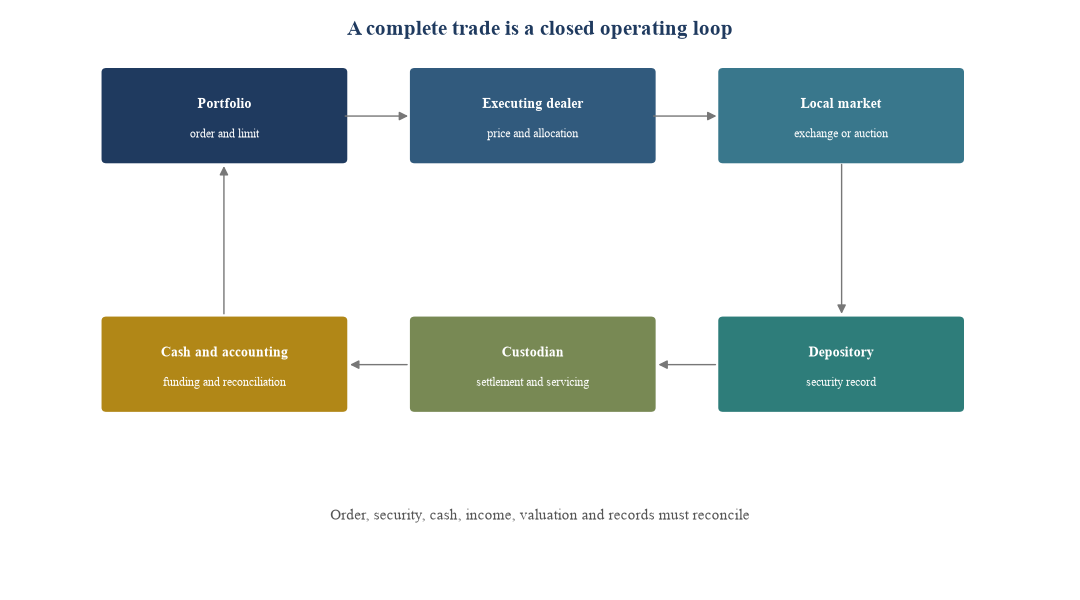
Author framework. Every handoff is tested before the first funded trade.
6. Underwrite bonds and sukuk through related but distinct lenses
Conventional bonds and sukuk can expose investors to the credit of the same sovereign or corporate group. They may have similar maturity, distribution frequency and market sensitivity. Their legal structures and cash-flow mechanisms can differ materially.
A conventional bond analysis normally begins with the issuer's obligation to pay interest and principal under the governing documents. The investor examines seniority, security, guarantees, covenants, events of default, acceleration, ranking, negative pledge, tax gross-up, governing law and enforcement.
A sukuk analysis begins with the certificate and follows the complete transaction structure. The investor identifies the trustee or special-purpose vehicle, obligor, originator, seller, lessee, servicing agent, investment manager or purchaser as applicable. It maps how subscription proceeds are used, which assets or transactions support periodic distributions, how the dissolution amount is generated, which purchase undertakings apply, and what happens after a shortfall, asset loss, illegality, total-loss event or default.
The UAE federal T-Sukuk information identifies Shariah-compliant AED instruments, while final terms disclose roles such as trustee, lessor, seller, obligor, lessee and servicing agent for the relevant issuance.[10] Bahrain uses several Islamic structures and states that its Centralised Shariah Board reviews issuance procedures for Islamic leasing securities.[5] These examples show why the label sukuk is a starting point rather than a complete structure description.
Shariah governance should be evidenced through the applicable pronouncements, approvals and ongoing responsibilities. The investor should know which board or advisers approved the structure, whether the approval covers the issued series, which assets and contractual steps are required, and how a change or non-compliance event is handled. Qualified legal, tax and Shariah advisers should assess the actual instrument. The investment team should not convert a religious or legal conclusion into an unsupported portfolio assumption.
Table 3. Bond and sukuk diligence bridge
| Diligence subject | Conventional bond focus | Sukuk focus | Common control output |
|---|---|---|---|
| Credit | issuer and guarantor payment capacity | obligor and relevant transaction-party payment capacity | internal credit case and downside |
| Cash flow | coupon and principal obligations | periodic distributions, asset or transaction cash flows and dissolution amount | dated cash-flow map |
| Legal ranking | seniority, security, guarantee and subordination | certificateholder rights, asset interests, undertakings, priority and limited recourse | legal structure memorandum |
| Default | non-payment, covenant breach, cross-default and acceleration | dissolution events, non-payment, undertaking and structure events | event and remedy matrix |
| Assets | collateral where secured | identified assets, usufruct, commodities or investment arrangements | asset and perfection review |
| Governance | trustee, fiscal agent and bondholder decisions | trustee, delegate, agents, Shariah approval and certificateholder decisions | authority and consent map |
| Tradability | securities-law and market eligibility | securities-law, market and applicable Shariah tradability analysis | approved trading conditions |
The precise analysis follows the instrument documents, governing law and current facts.
7. Separate currency regime from currency risk
Several GCC currencies operate with a fixed relationship to the U.S. dollar, while currency arrangements and policy frameworks differ across the region. A peg can reduce short-term bilateral volatility. It does not remove all currency, funding or convertibility considerations for an international investor.
The institution reports performance in a base currency. A local-currency security therefore combines local rates, credit spread, price movement, cash income and the translation or hedge result. Even when the spot relationship is stable, the investor may face forward points, hedge collateral, counterparty limits, roll timing, settlement cut-offs and basis risk. A base currency other than the U.S. dollar adds another conversion.
The policy decision should be explicit. An unhedged allocation accepts currency translation as part of return. A fully hedged allocation treats the instrument as local rates and credit exposure subject to hedge cost and basis. A partial hedge creates a controlled currency budget. A liability-matching allocation may retain the local currency because the institution expects to spend in that currency.
The currency memorandum should document the official regime, instruments available to the investor, dealing counterparties, tenor and liquidity, collateral, valuation, accounting, stress assumptions and contingency routes. Any claim about convertibility, transferability or hedge availability requires current evidence from service providers and official rules.
8. Measure liquidity at the security level
Liquidity is the ability to transact an intended size, within an intended time, at an acceptable and observable cost. It changes with security, size, market conditions and dealer capacity. A yearly traded-value statistic cannot supply that answer for one position.
The scorecard should combine market evidence and operational evidence. Market evidence includes days traded, number of trades, bid and offer quotes, quote dispersion, firm size, turnover, issue size, age since issuance, benchmark status, dealer count and completed transactions. Operational evidence includes settlement success, depository route, cash readiness, collateral eligibility, custody support and the time required to instruct and reconcile a sale.
A portfolio can use four liquidity buckets. Bucket one contains instruments with repeated two-way evidence and a tested settlement route. Bucket two contains securities with observable dealer support but less frequent trades or smaller size. Bucket three contains securities expected to be held through maturity or sold only over a longer horizon. Bucket four contains restricted, stale or operationally incomplete exposures and should be excluded from ordinary liquidity claims.
Position limits should follow the lower of credit capacity, market capacity and liquidity need. A high-quality sovereign instrument can still require a small position if free float or executable depth is limited. A lower-rated but actively traded security can still face a strict credit limit. The control system needs both lenses.
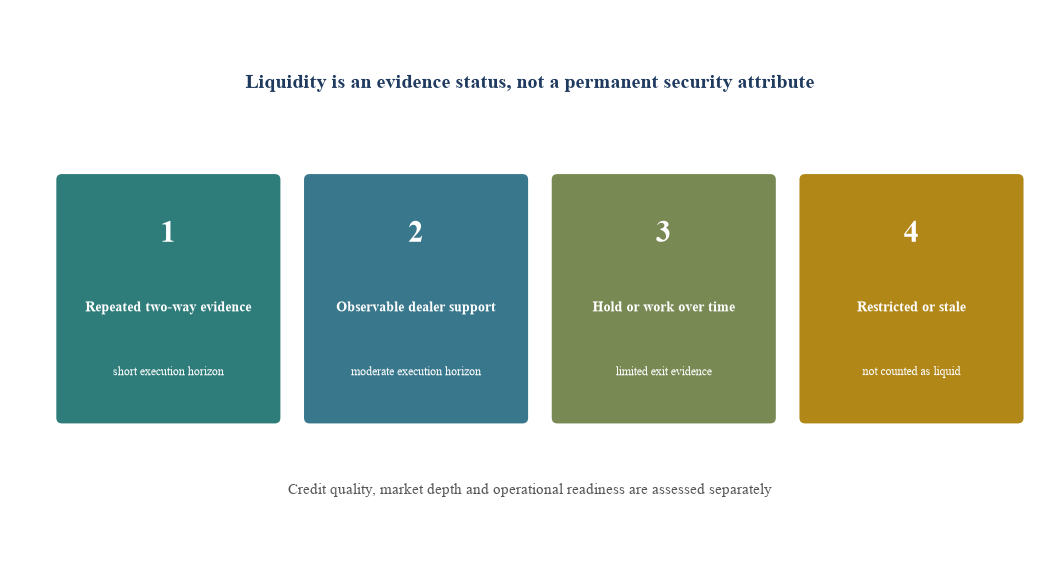
Author framework. A security moves between buckets when evidence changes.
9. Build curves, benchmarks and valuation evidence carefully
A sovereign curve can improve pricing across government, bank and corporate issuers. Curve quality depends on repeat issuance, benchmark maturities, fungible lines, observable transactions and a method for addressing gaps. An interpolated curve is a model. It should not be presented as directly observed at every maturity.
The investor should maintain three records. The first is the official issuance and security record. The second is a market-observation record containing trades, quotes and evaluated prices. The third is the institution's analytical curve, with its method, exclusions and confidence. This separation prevents a model output from becoming an undocumented market fact.
Benchmark selection also requires care. A regional index may contain mostly hard-currency debt, while the mandate seeks local currency. A domestic index may be dominated by sovereign securities and have limited corporate representation. Market-value weights may allocate most capital to the largest borrowers. Sukuk eligibility rules can change the universe. The investment committee should approve the benchmark's currency, constituents, rebalancing, valuation source and treatment of inaccessible securities.
Performance attribution should separate local yield movement, credit spread, carry and roll, currency translation, hedge result, fees and trading cost. Where a security lacks reliable transaction evidence, the valuation confidence and liquidity status should be shown alongside its reported return.
Table 4. Minimum liquidity and valuation scorecard
| Evidence field | Measure | Warning condition | Governance response |
|---|---|---|---|
| Issue and free float | outstanding amount, reopenings and holder concentration | small free float or concentrated holders | reduce position cap or require maturity funding plan |
| Trading | days traded, trade count, turnover and last trade | extended inactivity or one-sided activity | reclassify liquidity bucket |
| Quotes | dealer count, firm size, bid-offer and dispersion | indicative-only or wide disagreement | seek independent challenge and smaller size |
| Valuation | ranked sources, stale days and override history | model-only price or repeated override | valuation committee review |
| Settlement | fails, pre-funding, cut-offs and reconciliation | failed test or unresolved break | suspend new trading until remediated |
| Collateral | repo eligibility, lender, haircut and tenor | eligibility removed or haircut rises | update liquidity value and funding plan |
| Exit | tested sale size, time and net proceeds | capacity below position or mandate need | resize, hedge or adopt controlled exit plan |
Thresholds are set by the institution and reviewed when market conditions change.
10. Construct the sleeve through risk budgets
Portfolio construction begins after the operating and security universe is approved. The team sets budgets for sovereign, credit, duration, currency, liquidity, structure and concentration. It should avoid using country weights as the only risk measure because the same country can contain sovereign, bank, corporate, conventional and Islamic exposures with different sensitivities.
A useful construction record maps every position to issuer, ultimate obligor, sector, currency, maturity, duration, rating and internal grade, structure, governing law, liquidity bucket, collateral eligibility, benchmark membership and hedge treatment. The portfolio is then tested for rate shifts, spread widening, downgrade, currency basis, delayed settlement, reduced dealer capacity and loss of collateral eligibility.
The hypothetical programme below uses 100 monetary units. It demonstrates governance and does not recommend country or security weights. Fifty-five units are assigned to sovereign and quasi-sovereign exposure, twenty-five to financial institutions, ten to corporates and ten to cash or collateral capacity. Sixty units are sukuk and thirty are conventional bonds; the remaining ten are cash or repo resources. The portfolio retains thirty units in liquidity bucket one, forty in bucket two, twenty in bucket three and ten as controlled cash capacity.
The key question is whether the portfolio's declared liquidity matches its evidence. If forty units must be available within five business days, the institution cannot count a bucket-three position at full market value. It should apply its liquidity policy, haircuts and tested execution assumptions.
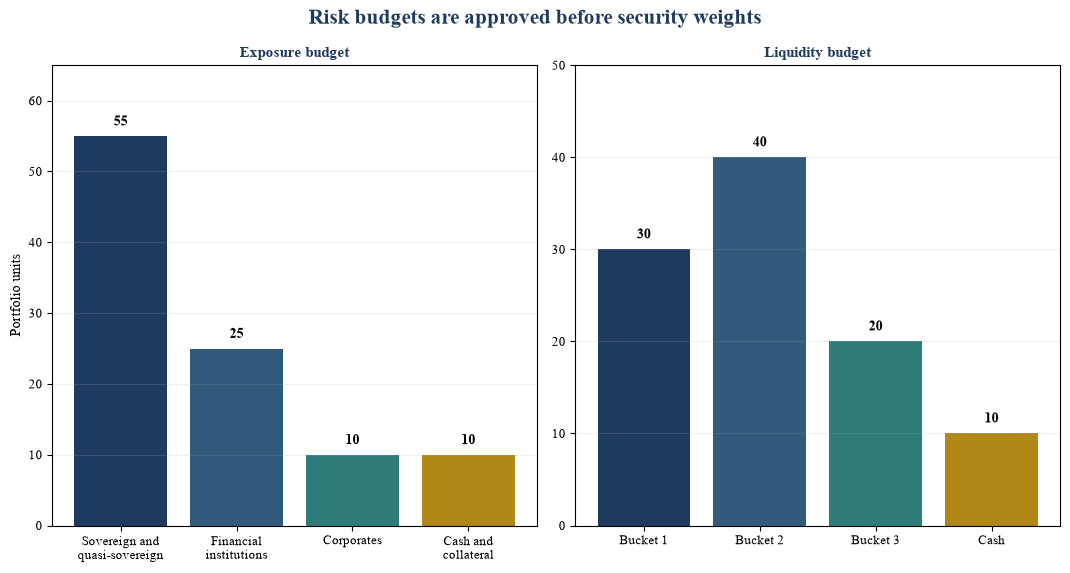
Management assumptions for illustrating governance. The weights are not a recommendation, client portfolio or forecast.
11. Govern execution and transaction cost
Execution should begin with a pre-trade record. It states the security, desired size, mandate fit, available cash, limit, valuation range, dealer panel, settlement route, expected charges and fallback. The trader records firm and indicative quotes separately, quote time, size, yield or price convention and settlement date.
Primary auctions require a bidding rule. The institution should define who sets the maximum yield or price, how allocation uncertainty is handled and how an awarded amount affects liquidity and concentration limits. A dealer-led secondary purchase requires best-execution evidence proportionate to market structure. A single quote may be necessary in a constrained market, but the reason and independent valuation evidence should be retained.
Transaction cost includes visible spread, commission, custody, exchange or depository charges, funding, currency conversion, hedge cost and operational cash drag. It also includes market impact and the cost of exiting a position that is larger than observable depth. The team should measure implementation shortfall against the approved decision price and explain the sources.
The trade should not proceed when the account, cash, settlement instruction, legal eligibility, limit or valuation route is incomplete. A relationship with an issuer or dealer cannot substitute for those controls.
12. Apply a controlled liquidation test
The hypothetical liquidation analysis starts with 100 units of reported market value. The base case assumes 0.4 units of bid-offer and market impact, 0.1 of settlement and fees, a 2.0 liquidity haircut for time and depth, and 0.3 of hedge close-out cost. Net realisable value is 97.2.
The stressed case assumes 1.5 units of bid-offer and market impact, 0.2 of settlement and fees, a 6.0 liquidity haircut and 0.8 of hedge close-out cost. Net realisable value is 91.5. These are stated management assumptions. They are not estimates of current GCC market liquidity or prices.
The exercise demonstrates that accounting value, quoted value and cash available under stress can differ. Each security should have its own inputs, time horizon and evidence. The portfolio-level result should recognise that positions may become correlated through dealers, funding, currency and investor flows.
Table 5. Hypothetical liquidation bridge
| Bridge item | Base case | Stressed case | Evidence required in a live portfolio |
|---|---|---|---|
| Reported market value | 100.0 | 100.0 | approved price source and timestamp |
| Bid-offer and market impact | (0.4) | (1.5) | firm quotes, recent trades and intended size |
| Settlement and fees | (0.1) | (0.2) | custodian, exchange, depository and dealer schedule |
| Liquidity and time haircut | (2.0) | (6.0) | free float, depth, dealer capacity and exit horizon |
| Hedge close-out and currency cost | (0.3) | (0.8) | executable hedge quotes, collateral and counterparty terms |
| Net realisable value | 97.2 | 91.5 | controlled liquidation estimate and approval |
Portfolio units. All inputs are management assumptions for demonstrating the method; they are not current market estimates.
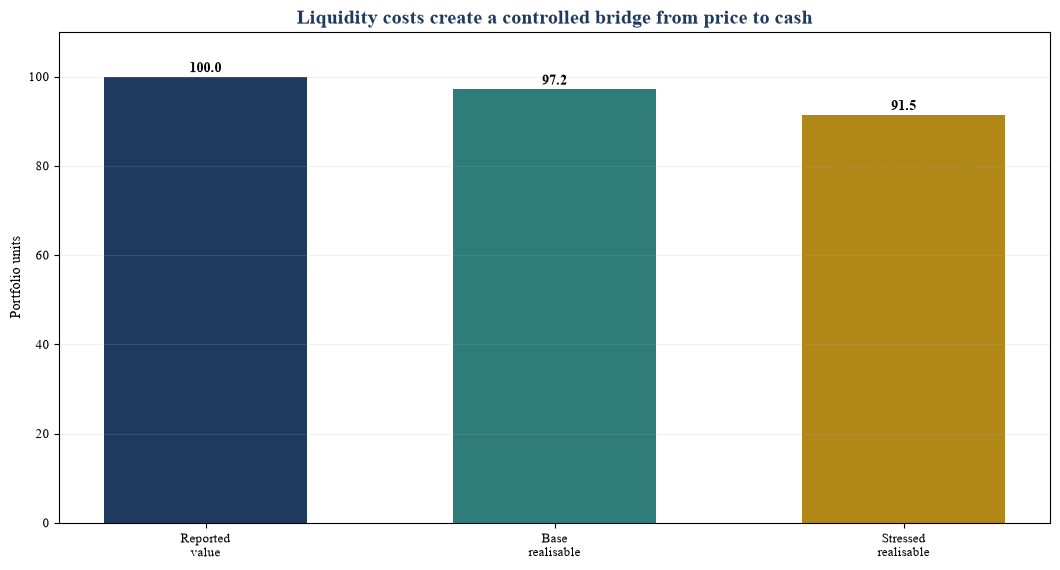
Portfolio units. The assumptions illustrate governance and are not forecasts or executable market quotes.
13. Implement through twelve controlled weeks
A first allocation can be organised through a twelve-week programme when counterparties, data and approvals are available. The timetable is a management framework rather than a promise to fund. Account opening, legal review, tax, service-provider onboarding, documentation or market conditions can extend the work.
Weeks one and two define the allocation purpose, risk budget, currencies, permitted instruments, liquidity need and governance. Weeks two to four produce six country operating memoranda and a preliminary market universe. Weeks three to six complete custodian, broker, cash and settlement diligence in parallel with credit, legal and sukuk-structure work.
Weeks five to seven build the approved security master, valuation hierarchy, liquidity scorecard, hedge policy and counterparty panel. Weeks seven and eight perform dry-run orders, cash movements, settlement and lifecycle-event tests without assuming a funded trade. Weeks eight to ten construct the proposed portfolio, run scenarios and prepare the investment-committee pack.
Weeks ten to twelve complete approvals, fund the controlled cash route, execute within limits and reconcile every trade. The monitoring pack begins immediately. A market or security is held at a gate when eligibility, legal analysis, valuation, liquidity, settlement or authority is incomplete.
Table 6. Twelve-week programme gates
| Gate | Indicative weeks | Required evidence | Decision |
|---|---|---|---|
| Mandate | 1-2 | purpose, risk budget, limits, currency and liquidity policy | approve scope or revise |
| Market map | 2-4 | six country memoranda, issuance and access records | approve markets for diligence |
| Access and structure | 3-6 | custody, settlement, legal, tax, credit and sukuk review | approve operating routes and structures |
| Universe | 5-7 | security master, valuation hierarchy and liquidity buckets | approve securities and caps |
| Operational test | 7-8 | dry-run order, cash, settlement and reconciliation evidence | accept readiness or remediate |
| Portfolio decision | 8-10 | construction, scenarios, benchmark and funding plan | approve, resize or decline |
| Execution and handover | 10-12 | live limits, trade evidence, reconciliation and monitoring pack | fund and monitor |
The programme advances only when the accountable owner accepts the required evidence.
14. Monitor the complete system
Monitoring combines credit, market, currency, structure, liquidity and operations. Daily or appropriate-frequency controls cover limits, prices, cash, settlement, breaches and material news. Monthly packs can include performance attribution, duration, spread, currency, hedge, liquidity bucket, stale prices, dealer evidence, issue events and collateral. Quarterly review can refresh credit, legal structure, Shariah documentation, service providers and exit capacity.
Events require named actions. A downgrade, covenant issue, missed distribution, dissolution event, sanctions change, tax change, Shariah concern, depository disruption, failed settlement, dealer withdrawal, stale valuation or currency-market dislocation should trigger the relevant owner and decision route. The response may include review, reduced limit, trading suspension, hedge, sale, maturity funding or formal exception.
The approved universe is a living control record. A security can enter only after the required evidence is accepted and can move to restricted status when evidence deteriorates. Historical approval does not preserve eligibility after a material change.
An annual programme review asks whether the allocation still performs its stated job. It reassesses the benchmark, operating providers, market depth, risk budget, portfolio construction, transaction cost and governance capacity. Market development can support a larger programme. Weakening evidence can require a smaller one.
15. Limitations
This paper provides a governance and implementation framework. It does not provide investment, legal, tax, accounting, regulatory or Shariah advice. Qualified advisers should assess each institution, market, account and security under current rules and documents.
Official issuance totals, market statistics and access statements can change. Published outstanding amounts do not establish free float, firm executable depth or future liquidity. Exchange-traded value may omit activity outside the reported venue and should be interpreted within the source methodology.
The hypothetical portfolio, risk budgets, liquidity buckets, liquidation deductions and timetable are management assumptions created for illustration. They do not represent client data, target weights, current market prices, expected returns or recommended trades.
Currency arrangements can be stable for long periods while funding, forward, basis, convertibility or operational risks remain. The institution should use current official information and executable counterparty evidence for any currency decision.
16. Conclusion
The GCC local-currency opportunity is expanding through scheduled sovereign issuance, domestic sukuk programmes, market-access reform and improved trading and settlement infrastructure. An institution still needs to convert those developments into a security-level and operating decision.
The practical framework begins with the job of the allocation. It treats the GCC as six markets, separates issuance from investable capacity, proves access and settlement, underwrites bonds and sukuk through the correct structures, sets currency policy, measures liquidity at security level and sizes positions through risk budgets.
A disciplined programme preserves the evidence from mandate to exit. Country operating memoranda explain how the market works. The security master records what the institution owns. The valuation hierarchy explains the reported price. The liquidity scorecard explains the position limit. The execution file explains the transaction. The monitoring pack explains whether the original approval still holds.
That evidence system allows the institution to participate in market development while preserving its own mandate, liquidity needs and accountability.
References
- United Arab Emirates Ministry of Finance, Issuance Programme, 2026 calendar and outstanding domestic debt. https://mof.gov.ae/en/public-finance/public-debt/issuance-programme/
- Saudi Arabia National Debt Management Center, Local Saudi Sukuk Issuance Program in Saudi Riyal. https://ndmc.gov.sa/issuanceprograms/pages/sukuk_issuance_program_in_saudi_riyal.aspx
- Saudi Exchange, Sukuk and Bonds Annual Report, market date 31 December 2025. https://www.saudiexchange.sa/Resources/Reports-v2/FI_Annually_en.html
- Qatar Central Bank, Financial Markets Instruments. https://www.qcb.gov.qa/en/FinancialInstrumentsAndPaymentSystems/pages/financialmarketsinstruments.aspx
- Central Bank of Bahrain, Government Securities. https://www.cbb.gov.bh/govt_securities/103839/
- Central Bank of Oman, Government Development Bonds. https://cbo.gov.om/Pages/GDB.aspx
- Central Bank of Kuwait, Public Debt Issuance announcement, 24 June 2026. https://www.cbk.gov.kw/en/cbk-news/announcements-and-press-releases/announcements/2026/06/202606240800-public-debt-issuance
- United Arab Emirates Ministry of Finance, Treasury Sukuk and Bonds Attract AED 5.15 Billion in Bids, 31 January 2026. https://mof.gov.ae/en/news/treasury-sukuk-bonds-attracts-aed-5-15-billion-in-bids/
- Saudi Exchange, CMA Opens the Capital Market to All Categories of Foreign Investors, effective 1 February 2026. https://www.saudiexchange.sa/wps/portal/saudiexchange/newsandreports/issuer-news/news-detail-wcm/?locale=en&newsId=9228
- United Arab Emirates Ministry of Finance, T-Sukuk programme. https://mof.gov.ae/en/public-finance/public-debt/t-sukuk/
- Islamic Financial Services Board, Islamic Financial Services Industry Stability Report 2025. https://www.ifsb.org/wp-content/uploads/2025/05/IFSI-Stability-Report-2025.pdf
- Bank for International Settlements, Local Currency Bond Markets and the Asian Bond Fund 2 Initiative. https://www.bis.org/publ/othp15.htm
- Central Bank of Oman, Liquidity Management. https://cbo.gov.om/Pages/LiquidityManagement.aspx
- Central Bank of Bahrain, Government Securities and Shariah governance arrangements. https://www.cbb.gov.bh/govt_securities/103711/
- United Arab Emirates Ministry of Finance, Treasury Sukuk final terms, 30 October 2025. https://mof.gov.ae/wp-content/uploads/2025/11/Tsukuk-22May-2030-en-5.11.25.pdf
- Saudi Arabia National Debt Management Center, 2025 Annual Borrowing Plan and domestic sukuk calendar. https://ndmc.gov.sa/en/IssuancePrograms/Documents/EN_2025_ABP_final%20.pdf
- Central Bank of Oman, Government Treasury Bills tender results and repo availability, 27 January 2026. https://cbo.gov.om/news/722
About the Author
# About the Author
Chennakeshav Adya, Independent Researcher
Chennakeshav Adya writes on institutional capital, private markets, fixed income, corporate finance, transaction execution and governance. This paper is independent research for general information. It is not investment, legal, tax, accounting, regulatory or Shariah advice.
Appendix A. Controlled Artefacts: Appendix A. Controlled artefacts
1. Allocation mandate and ranked portfolio objectives. 2. Six country operating memoranda. 3. Market-access, custody, settlement and tax map. 4. Approved issuer and security master. 5. Conventional bond and sukuk structure diligence templates. 6. Currency and hedge policy. 7. Valuation-source hierarchy and challenge process. 8. Security-level liquidity scorecard. 9. Dealer and counterparty panel with limits. 10. Pre-trade and best-execution record. 11. Settlement and lifecycle-event test file. 12. Portfolio risk-budget and scenario pack. 13. Liquidation bridge and contingency funding plan. 14. Monitoring dashboard and escalation log.
Appendix B. Committee Questions: Appendix B. Questions before funding
1. Which portfolio job does the local-currency sleeve perform? 2. Which GCC markets and investor routes have been independently verified? 3. Can every proposed security be owned, settled, valued and serviced through the approved operating chain? 4. Which cash flows and legal obligations support each bond or sukuk? 5. Which prices are observed, evaluated or modelled? 6. What firm size can be executed under ordinary and stressed conditions? 7. How does currency and hedge policy change expected cash flow and liquidity? 8. Which securities qualify as collateral and under what haircuts? 9. What event moves a security to restricted status? 10. Does declared portfolio liquidity match tested exit capacity?
