

1. Introduction
The UAE Domestic Minimum Top-up Tax, or DMTT, has moved from policy design into the operating environment for large multinational groups. Cabinet Decision No. 142 of 2024 imposes the tax for fiscal years beginning on or after 1 January 2025.[1] The Ministry of Finance states that the regime applies to UAE constituent entities in multinational enterprise groups with annual global revenue of at least EUR 750 million in the consolidated financial statements of the ultimate parent entity in at least two of the four immediately preceding fiscal years.[2]
The investment consequence begins with perimeter. A target may be a modest business while its seller, buyer or controlling group is above the threshold. A portfolio company may enter scope after an acquisition or remain outside scope because the relevant consolidation, ownership or exclusion conditions differ. A joint venture or minority holding can require separate analysis. An entity that appears to be an investment vehicle can have a different result from an operating subsidiary, depending on the legal facts and the definitions in the regime.
The calculation also differs from a conventional tax-rate assumption. The OECD Global Anti-Base Erosion rules calculate an effective tax rate on a jurisdictional basis using adjusted financial-accounting income and adjusted covered taxes.[3] Temporary differences, deferred tax, losses, tax credits, ownership changes, transfers, exclusions and elections can affect the result. A model that simply applies 15 per cent to taxable profit can misstate timing and amount.
Private capital therefore needs a coordinated underwriting response. Deal teams need a scoping conclusion. Finance teams need a data and calculation bridge. Tax advisers need access to the group facts. Legal teams need appropriate information rights and risk allocation. Credit teams need cash-flow and covenant effects. Portfolio teams need a reporting cadence. The investment committee needs a concise decision record showing what is known, what remains conditional and what downside treatment is embedded in price and structure.
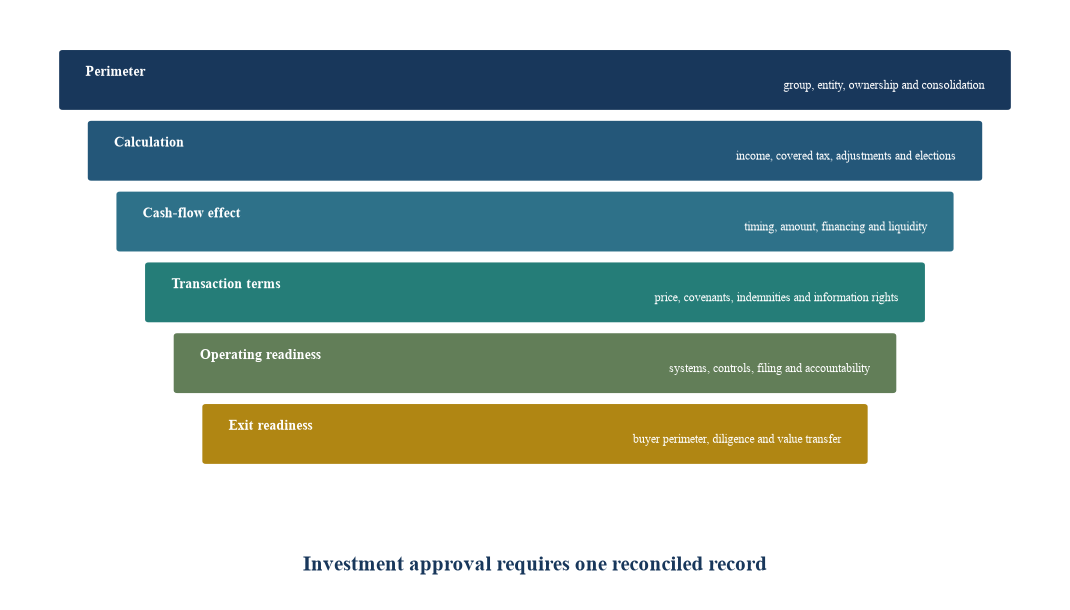
Author framework. Each layer should be evidenced before investment approval; qualified tax advice remains necessary.
2. Establish the current rule base
The UAE regime sits within the OECD Pillar Two architecture. The Ministry of Finance describes the UAE DMTT as closely aligned with the GloBE Model Rules, Administrative Guidance and Commentary.[2] The OECD describes the GloBE rules as a coordinated system that imposes top-up tax when the jurisdictional effective tax rate is below the agreed minimum rate.[3]
Several current facts have direct underwriting relevance. The UAE threshold is based on the consolidated revenue of the ultimate parent entity and a two-out-of-four-year test.[2] The regime applies to fiscal years starting on or after 1 January 2025.[1][2] The Ministry states that the UAE has not implemented an Income Inclusion Rule at this stage.[2] It also states that non-wholly owned constituent entities are not excluded merely because of their ownership profile.[2]
The Ministry identifies two variations relevant to early screening. Constituent entities that meet the requirements to be classified as investment entities are outside the UAE DMTT rules. MNE groups in the initial phase of international activity may also be excluded when the specified conditions are met and no Income Inclusion Rule is applied to a UAE constituent entity in the group.[2] These are technical classifications. An investor should avoid assigning them from a label or legal form alone.
In August 2025, the Ministry announced that the OECD had placed the UAE DMTT on its central record with transitional qualified status and recognised it for the Pillar Two safe harbour.[4] The OECD central record explains that qualified status matters to the rule order and that qualified status applies from the effective date of the relevant legislation.[5] This recognition reduces duplicative calculation exposure in other jurisdictions where the conditions of the safe harbour are satisfied. It does not remove domestic compliance, data or transaction work.
Ministerial Decision No. 96 of 2026 adopts the OECD 2026 consolidated commentary, the agreed administrative guidance central record and the January 2025 GloBE Information Return for purposes of the UAE Cabinet Decision.[6] It applies to fiscal years starting on or after 1 January 2025 and repeals Ministerial Decision No. 88 of 2025.[6] An underwriting memorandum prepared in 2026 should therefore use the current 2026 materials and confirm any later amendment before signing or closing.
Table 1. Current rule facts and the corresponding underwriting questions
| Official rule fact | Underwriting question | Required evidence |
|---|---|---|
| UAE constituent entities of qualifying MNE groups can be in scope | which entity, branch or permanent establishment sits inside the calculation? | legal-entity chart, tax residence, branch list and consolidation perimeter |
| Consolidated revenue threshold is EUR 750 million in at least two of four preceding years | does seller, buyer or target group meet the test at signing, closing and forecast exit? | audited consolidated statements, revenue bridge and ownership history |
| Effective date is fiscal years beginning on or after 1 January 2025 | which accounting periods and stub periods enter the transaction model? | fiscal calendars, completion accounts and tax-period schedule |
| UAE DMTT follows the GloBE architecture | how do accounting income and covered taxes reconcile to jurisdictional ETR? | trial balance, tax provision, deferred-tax schedule and GloBE calculation |
| Investment entities may be excluded when the technical requirements are met | does the vehicle satisfy the definition and remain classified through the hold? | constitutional documents, ownership, activities, accounting and adviser opinion |
| UAE has transitional qualified status and QDMTT safe-harbour recognition | which foreign calculations remain and which domestic obligations persist? | group country matrix, central-record check and filing responsibility map |
Official rule facts are summarised from UAE Ministry of Finance and OECD sources. Application to a transaction requires qualified advice.
3. Begin with the group and entity perimeter
Perimeter is the first gate because every later number depends on it. The investor should map the ultimate parent, intermediate parents, operating subsidiaries, permanent establishments, transparent entities, joint ventures, minority-owned entities and excluded entities. The map should distinguish legal ownership, voting control, accounting consolidation and tax residence. Those concepts can produce different answers.
Acquisition structures create time-dependent questions. A target can leave the seller group and join the buyer group during a fiscal year. The deal may involve a share purchase, asset transfer, merger, demerger or new holding company. The OECD consolidated commentary contains dedicated rules for entities joining and leaving MNE groups, transfers of assets and liabilities, joint ventures, and multi-parented groups.[3] The tax conclusion should therefore state the applicable periods, not only the post-closing chart.
Fund structures require careful separation. The fund, general partner, manager, aggregator, co-investment vehicle, bid vehicle and operating company may not share one classification. An entity described commercially as a fund vehicle may not satisfy the technical investment-entity requirements. The Ministry's statement that qualifying investment entities are outside the UAE DMTT provides a screening route, followed by evidence and qualified advice.[2]
Minority and joint-venture investments also deserve full diligence. The investor may lack control over accounting systems while still carrying economic exposure to top-up tax, covenant pressure or exit friction. Information rights, calculation responsibility, tax distributions and dispute procedures become part of the investment structure.
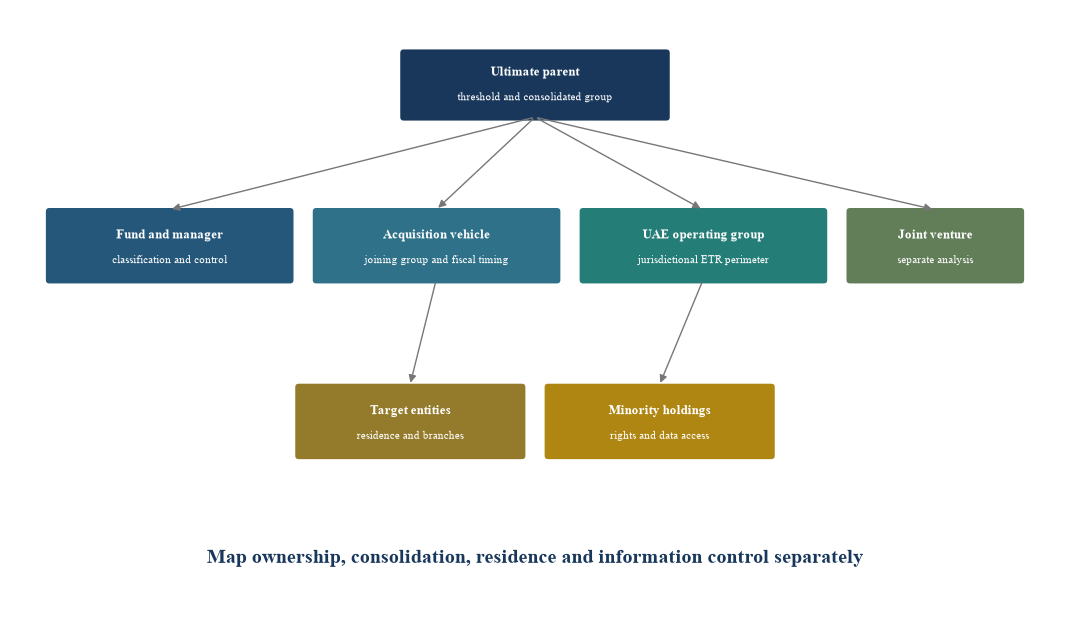
Author framework. Classification labels are diligence prompts; tax counsel should confirm the legal application.
4. Build a diligence request that can support the calculation
A conventional tax data room may contain corporate-tax returns, assessments and correspondence. DMTT underwriting needs those materials plus group, accounting and systems evidence. The request should identify the data owner and the period covered by each item.
The group file should contain the legal and consolidation structure, audited consolidated revenue history, ultimate-parent conclusion, country-by-country reporting perimeter, acquisitions, disposals and fiscal calendars. The entity file should contain tax residence, permanent establishments, ownership, business activities, constitutional documents and any claimed excluded-entity status.
The calculation file should include entity trial balances, financial-accounting standards, consolidation packages, tax provisions, current and deferred tax, losses, credits, uncertain tax positions, intragroup payments, equity compensation, pensions, asset transfers and relevant elections. The investor should understand whether the seller already operates a GloBE data model, who owns it and whether it can be separated for the target.
The compliance file should identify registrations, filing obligations, notifications, advisers, controls, exchange arrangements and deadlines. The OECD GloBE Information Return is a standardised return intended to support compliance and administration.[7] Ministerial Decision No. 96 of 2026 adopts the January 2025 GIR for UAE purposes.[6] Transaction teams should therefore treat GIR data as a continuing operating requirement, not a one-off closing calculation.
Table 2. DMTT transaction diligence request
| Workstream | Core evidence | Acceptance question | Deal output |
|---|---|---|---|
| Group perimeter | ownership chart, consolidation entities, revenue history and fiscal years | can the group and threshold conclusion be reproduced? | signed perimeter memorandum |
| Entity classification | residence, branch, activity, accounts and constitutional documents | is each UAE entity classified consistently with the rules? | entity-status schedule |
| GloBE income | trial balance, consolidation adjustments and accounting-policy map | can financial-accounting income be traced to source ledgers? | income bridge and control record |
| Covered taxes | current tax, deferred tax, credits, allocations and uncertain positions | can taxes be attributed to the correct entity, income and period? | covered-tax bridge |
| Exclusions and elections | payroll, tangible assets, de minimis data, losses and elections | are assumptions supported and elections controlled? | election and exclusion register |
| Compliance and systems | GIR fields, owners, systems, adviser reports and filing calendar | can the buyer obtain complete data after closing? | transition-services and readiness plan |
| Transaction history | acquisitions, disposals, asset transfers and restructurings | do historic events affect attributes or current calculation? | transaction adjustment schedule |
| Disputes and assurance | authority correspondence, controls testing and external review | are exposures, uncertainty and remediation visible? | risk register and price treatment |
The request should be tailored for materiality, transaction type and confirmed scope.
5. Reconcile accounting income, covered taxes and top-up tax
The calculation should be built as a bridge. The starting point is financial-accounting net income or loss for each constituent entity, followed by the adjustments required under the relevant rules. Adjusted covered taxes are then associated with the jurisdictional income. The jurisdictional effective tax rate is determined from those amounts. The top-up tax percentage and jurisdictional excess profits are calculated after the applicable mechanisms, including the substance-based income exclusion and de minimis provisions where relevant.[3]
This architecture matters because book, taxable and cash amounts differ. A corporate-tax expense can include current and deferred components. Taxes may be allocated between entities or income streams. Temporary differences can reverse after closing. Losses can affect future periods. A tax incentive may support cash flow while reducing the jurisdictional effective tax rate. The treatment of a credit can depend on its design. The investor should obtain a tax-adviser bridge that can be mapped into the acquisition model without reinterpreting the technical rules.
The model should distinguish three views. The accounting view supports earnings and deferred-tax analysis. The GloBE view supports jurisdictional ETR and top-up-tax analysis. The cash view supports debt service, distributions and liquidity. Reconciliation between the three prevents a tax rate from being applied to the wrong base or period.
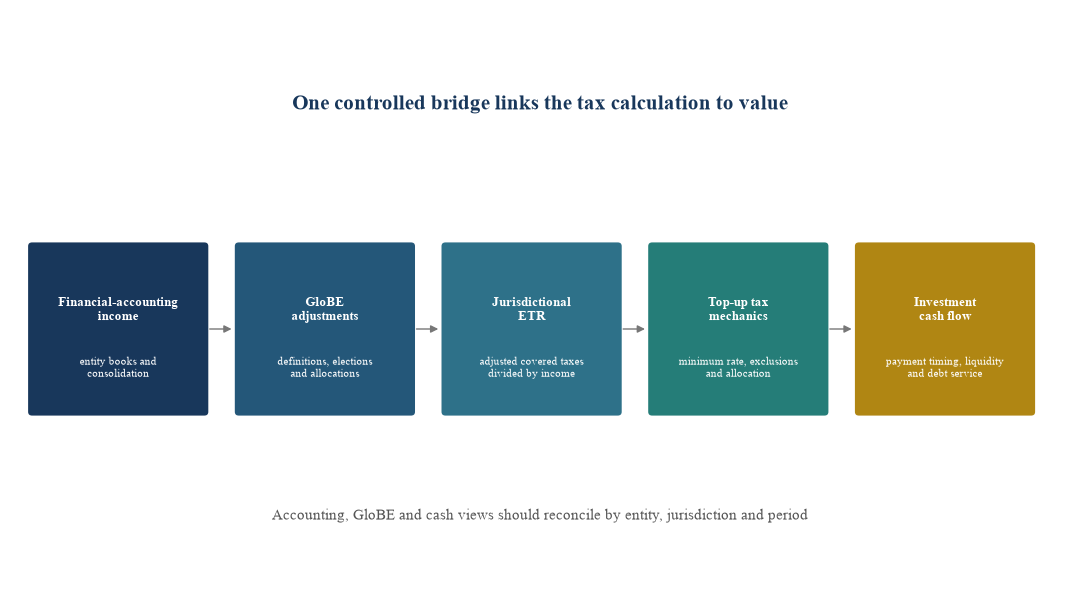
Author framework. The sequence is conceptual; qualified advisers should determine the actual adjustments and amounts.
6. Put the exposure into the acquisition model
The acquisition model should begin with a scope switch supported by the perimeter memorandum. The switch should identify the first expected in-scope fiscal year and the relevant group. It should then import the adviser-reviewed tax bridge by jurisdiction and period.
The model should separate recurring and transitional effects. A recurring DMTT amount affects unlevered cash flow and may affect covenant headroom, distributions and valuation. A transition amount can arise from pre-closing attributes, accounting changes, entity movement, asset transfers, historic credits or incomplete data. Compliance costs may be smaller than the tax amount, yet they can still matter for a carve-out or platform without mature systems.
Debt capacity should be tested against tax-payment timing. A business can report adequate annual earnings while facing a concentrated payment or delayed information requirement. Revolvers, restricted payments, cash sweeps and tax-distribution provisions should use the same calendar as the tax model. The credit case should also consider whether a disputed or late calculation can constrain distributions.
Terminal value requires a buyer-perimeter scenario. A future buyer above the threshold may value the business differently from a smaller strategic or financial buyer. The seller should have a defensible historic data pack even when the current owner has concluded that no payment is due. Readiness can expand the buyer universe and shorten diligence.
Table 3. DMTT schedule in the private-market model
| Model line | Required input | Downside test | Decision use |
|---|---|---|---|
| Scope and timing | group threshold, entity perimeter and fiscal years | acquisition changes group membership or scope | first affected period and diligence condition |
| GloBE income | adviser-reviewed jurisdictional income bridge | accounting adjustment or loss reversal | tax base and forecast sensitivity |
| Covered taxes | current tax, deferred tax, allocation and credits | lower recognised covered tax or timing mismatch | ETR and payment sensitivity |
| Exclusions and elections | payroll, tangible assets, de minimis and elections | reduced availability or lost evidence | top-up-tax range |
| Cash payment | filing and payment calendar | earlier payment or delayed recovery | liquidity and debt service |
| Compliance cost | people, systems, advisers and assurance | carve-out requires standalone build | operating budget and transition services |
| Transaction protection | indemnity, escrow, covenant and price mechanism | seller data unavailable or claim disputed | price, structure and approval conditions |
| Exit effect | buyer scenarios and diligence readiness | narrower buyer universe or unresolved exposure | terminal value and exit workplan |
All cells should be linked to evidence, adviser conclusions or clearly identified management assumptions.
7. Use a hypothetical 100-unit bridge to test process
Consider a hypothetical UAE acquisition with 100 units of financial-accounting profit before the specific adjustments used in the example. Management assumes 6 units of net GloBE adjustments, producing 94 units of illustrative GloBE income. Management also assumes 11 units of adjusted covered taxes. The resulting illustrative jurisdictional effective tax rate is 11.7 per cent. These values are created solely to demonstrate model governance.
Management then assumes 14 units of substance-based income exclusion and no de minimis relief for this example. Illustrative excess profit is therefore 80 units. A 3.3 percentage-point illustrative top-up rate applied to 80 units produces approximately 2.6 units of illustrative top-up tax before any further allocation, adjustment or transaction-specific issue.
The committee should not treat 2.6 units as the conclusion. It should ask which rule and evidence support each bridge item; whether the tax base, taxes and exclusion refer to the same jurisdiction and period; whether deferred tax is correctly treated; who bears a pre-closing change; when cash is paid; and how the value moves under downside assumptions.
In a downside case, management assumes adjusted covered taxes of 9 units, a substance-based income exclusion of 10 units and no change to the 94-unit illustrative GloBE income. The illustrative effective tax rate becomes 9.6 per cent. Excess profit becomes 84 units, and the illustrative top-up tax rises to approximately 4.5 units before further adjustments. The difference of approximately 1.9 units is a model sensitivity, not a tax forecast.
The investment decision can respond through price, an escrow, a specific indemnity, a completion-account adjustment, a tax covenant, additional cash headroom or a closing condition requiring adviser sign-off. The appropriate response depends on control, evidence and enforceability.
8. Structure transaction documents around control and evidence
DMTT provisions should match the transaction facts. A broad reference to taxes may not resolve which party controls a group-level calculation, supplies data or makes an election. The drafting team should define the relevant periods, entities, returns, elections, information, cooperation and dispute process with qualified legal and tax advice.
Pre-closing covenants can restrict restructurings, accounting-policy changes, elections or settlements that materially affect the exposure. Information covenants can require timely delivery of trial balances, tax provisions, GIR fields and adviser calculations. Conduct covenants should remain proportionate and compatible with ordinary business operation.
The risk-allocation tools include price adjustments, tax covenants, indemnities, escrows, retention, warranty insurance and specific closing conditions. Their value depends on scope, duration, exclusions, claim mechanics, credit support and access to evidence. A seller indemnity provides limited protection when the buyer cannot reconstruct the calculation or the seller lacks credit.
Carve-outs need a transition-services plan. The target may have relied on group consolidation systems, tax engines, central advisers and shared staff. The buyer should identify which data and services survive closing, for how long, at what standard and with what audit rights. A standalone build can affect the first-year budget and closing timetable.
Table 4. Transaction-document checklist
| Document area | Issue to address | Evidence link | Approval question |
|---|---|---|---|
| Definitions and perimeter | covered entities, periods, group membership and relevant returns | perimeter memorandum and fiscal calendar | does the wording follow the actual calculation boundary? |
| Conduct before closing | restructurings, elections, accounting policies and settlements | tax workplan and seller covenant schedule | can material changes occur without buyer consent? |
| Information and cooperation | ledgers, GIR fields, calculations, filings and authority contact | data-room index and responsibility matrix | can the buyer meet its obligations after closing? |
| Price and completion accounts | tax accruals, debt-like treatment and cut-off | model bridge and completion-account policies | is value allocated to the correct economic period? |
| Covenant and indemnity | historic exposure, control, claims, caps and duration | exposure register and adviser analysis | is protection collectible and evidence-backed? |
| Escrow or retention | amount, release event and dispute process | downside model and claim timetable | does security cover the identified risk window? |
| Transition services | systems, people, advisers, data format and duration | standalone-readiness plan | can the target operate and file independently? |
| Exit and disclosure | historic calculations, elections and unresolved matters | portfolio data pack | can a future buyer reproduce the conclusion? |
Drafting and enforceability require transaction-specific legal and tax advice.
9. Integrate DMTT through the deal lifecycle
The screening phase requires a preliminary group and threshold check. This prevents the team from discovering a material information request late in confirmatory diligence. The output can be a one-page perimeter hypothesis with the supporting audited revenue data and open questions.
The indicative-offer phase needs a model range and diligence condition. The investor may use a low, base and high case tied to named data gaps. A single tax-rate assumption creates false precision. The offer letter can reserve the right to address scope, historic periods, standalone systems and seller cooperation.
Confirmatory diligence produces the adviser-reviewed perimeter memorandum, calculation bridge, compliance map and transaction recommendations. The signing phase aligns the model with the documents. The closing phase confirms fiscal cut-off, group membership, data handover, elections and responsibility.
The first 100 days establish the portfolio-company owner, reporting calendar, systems map, controls and board dashboard. The exit-readiness phase begins well before sale. Historic calculations, underlying ledgers, elections, adviser conclusions and authority correspondence should be indexed and reproducible.
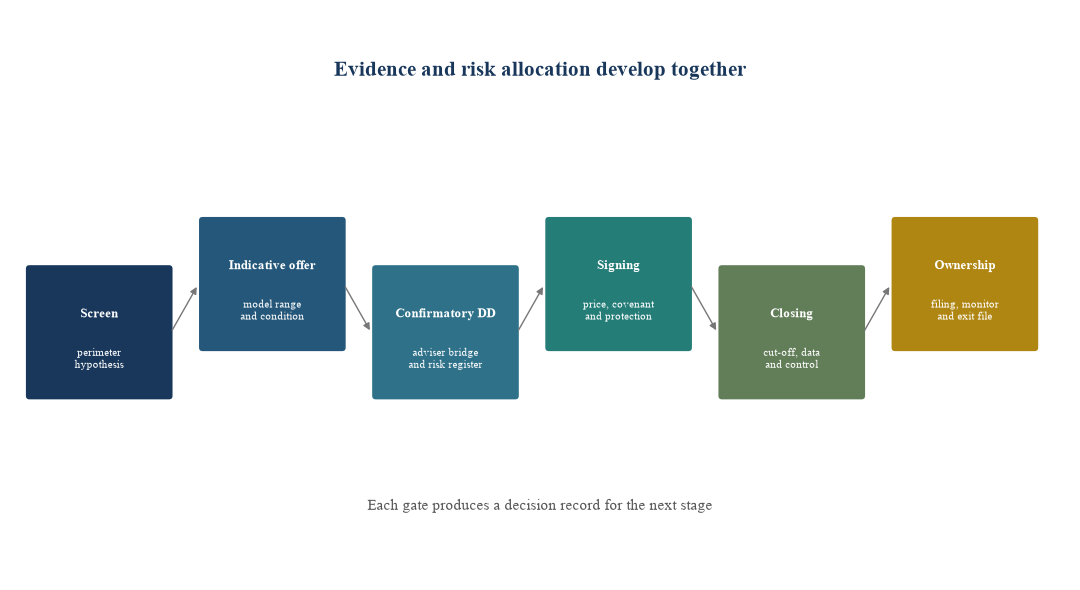
Author framework. The process connects evidence gates with investment and legal decisions.
10. Design the portfolio-company data architecture
The GIR and underlying calculation draw information from legal, consolidation, tax, payroll, fixed-asset and transaction systems. A portfolio company should identify source systems, field definitions, owners, controls and retention periods. Manual spreadsheets can support an interim process when inputs, formulae, review and version control are explicit.
The data model should preserve entity and jurisdiction identifiers. It should reconcile local ledgers to the consolidation package and the calculation. It should record accounting standards, currencies, fiscal periods, acquisitions, disposals, permanent establishments, intercompany balances, tax attributes and elections. Each transformation should have an owner and review control.
Data rights can become an investment issue. A minority investor may receive management accounts without the fields required for a jurisdictional calculation. A carve-out may lose access to the seller's historic ledger or tax engine. A joint venture may depend on an operator. The shareholder agreement, acquisition agreement or financing documents may need information provisions that reflect the actual reporting requirement.
The board dashboard should remain concise. It can show scope status, estimated ETR range, current exposure range, filing timetable, unresolved data items, adviser conclusion, control exceptions and cash forecast. Technical schedules should remain accessible to the responsible finance and tax teams.
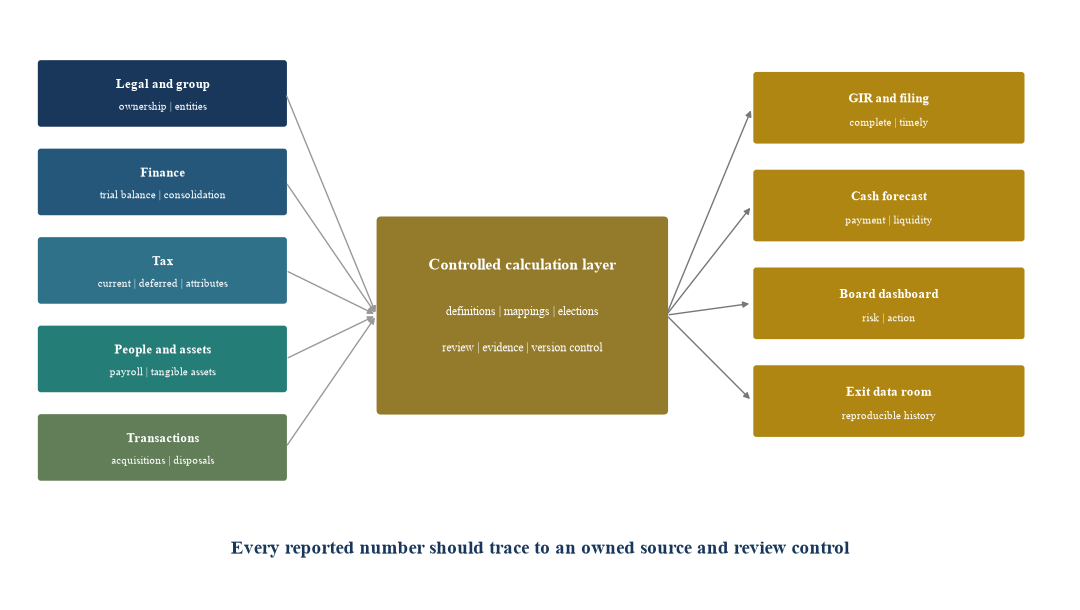
Author framework. Field requirements and filing responsibilities should be confirmed for the relevant group and jurisdiction.
11. Monitor the exposure as an investment variable
DMTT monitoring should follow material changes in the portfolio and group. Acquisitions, disposals, mergers, demarcation of branches, changes in accounting policy, new tax incentives, loss utilisation, financing structures and changes in ownership can affect scope or calculation. The board should receive an event-driven update when such changes occur.
The quarterly process can reconcile forecast GloBE income, covered taxes, expected exclusions and estimated payment. The annual process completes the calculation, review, filing and payment calendar. The investment team should also track whether the company can provide the information requested by lenders, insurers, co-investors and a future buyer.
The monitoring range should be linked to liquidity. A low and high case can show available cash, restricted-payment capacity, covenant headroom and required reserves. An unexplained change in the range should trigger review of underlying data rather than a management overlay.
Table 5. Portfolio monitoring and governance pack
| Record | Minimum content | Owner | Escalation trigger |
|---|---|---|---|
| Perimeter register | group, entities, branches, ownership and fiscal periods | general counsel and tax lead | acquisition, disposal, restructuring or ownership change |
| Calculation bridge | GloBE income, covered taxes, adjustments, exclusions and elections | CFO and tax lead | ETR or exposure moves beyond approved range |
| Data-control log | source, mapping, reviewer, evidence and exceptions | finance controller | missing, late or unreconciled material field |
| Compliance calendar | notifications, returns, payments and adviser reviews | tax lead | deadline risk or filing-responsibility dispute |
| Cash and covenant view | payment timing, liquidity, debt service and distributions | CFO and treasury | headroom falls below committee threshold |
| Transaction register | acquisitions, disposals, asset transfers and integrations | corporate development | event could change group or jurisdictional treatment |
| Exit-readiness file | historic calculations, elections, opinions and correspondence | investment director | evidence cannot be reproduced for diligence |
Frequency should reflect materiality, scope and fiscal deadlines.
12. Apply a portfolio heatmap without creating false precision
A sponsor can use a heatmap to allocate diligence and operating resources. The relevant dimensions include threshold and perimeter uncertainty, expected ETR sensitivity, data maturity, transaction complexity, cash-flow materiality and exit dependence. Scores should direct work rather than substitute for a technical conclusion.
Consider a hypothetical five-company portfolio. Company A is a wholly owned UAE platform inside a large multinational group with mature reporting. Company B is a recent carve-out with weak standalone systems. Company C is a minority investment with limited data rights. Company D is a joint venture with an experienced operator. Company E is a smaller stand-alone group currently below the revenue threshold. These descriptions are management assumptions for illustration.
The heatmap assigns the greatest immediate work to the carve-out and minority investment because data and control are weak. The stand-alone business receives a threshold-monitoring plan because acquisition growth can change its position. The mature platform receives routine calculation and cash monitoring. The joint venture receives a contract and information-rights review.
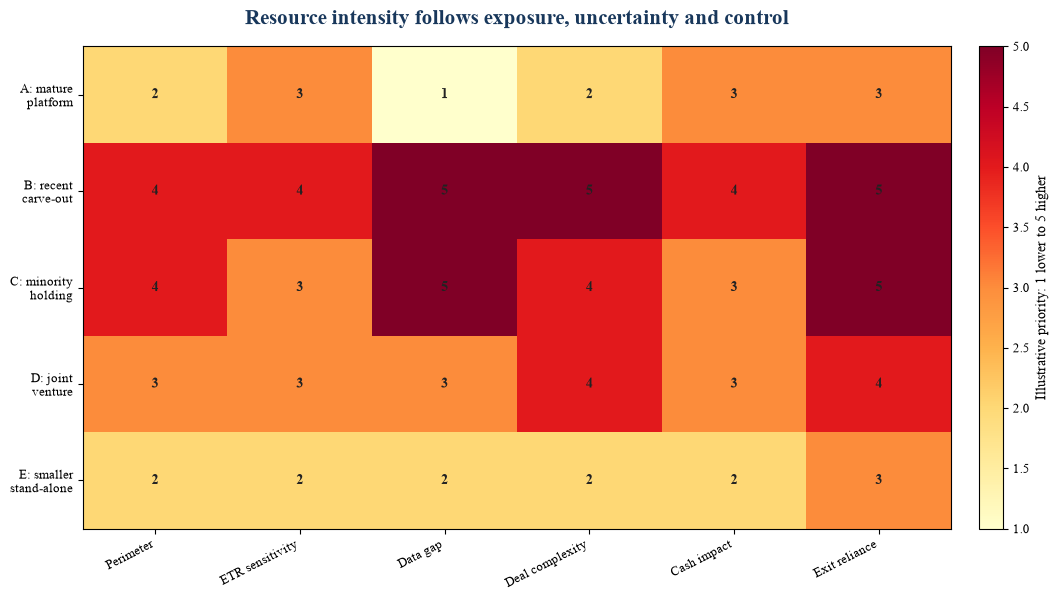
All scores are management assumptions for method demonstration. They do not represent actual taxpayers or exposures.
13. Connect DMTT to valuation, financing and exit
Valuation should reflect the expected cash tax and the quality of evidence. A recurring, well-supported amount can be placed in forecast cash flow. An uncertain historic exposure may be addressed through price or protection. A weak data environment can justify additional downside or a condition because uncertainty has economic value.
The discount rate is a blunt tool for a discrete exposure. Direct cash-flow modelling, scenario probabilities and structural protections create a more transparent decision record. The committee should avoid double counting a tax amount in cash flow, net debt and the discount rate.
Financing documents may define taxes, permitted payments, restricted distributions and events of default broadly. The borrower and lender should understand whether DMTT payments sit within the forecast, whether tax-sharing payments move between group entities and whether information covenants capture the relevant calculation. A material payment can affect fixed-charge coverage or cash sweep even when EBITDA is unchanged.
Exit value depends on transferability of evidence. A buyer will want the perimeter conclusion, revenue tests, entity schedule, calculation bridges, elections, filings, payments and authority correspondence. Missing seller-group data can create negotiation delay and a purchase-price holdback. A portfolio company that maintains an indexed file can reduce that friction.
14. Use committee gates that can be enforced
Gate one is perimeter. The committee receives the group and entity map, threshold history, transaction timeline and adviser conclusion. An unresolved material perimeter issue becomes a condition, price sensitivity or approval exception.
Gate two is calculation. The team reconciles financial-accounting income, covered taxes, exclusions, elections and payment timing. The output is a base and downside range connected to the model.
Gate three is data readiness. The buyer demonstrates access to source systems, owners, controls and historic records. A carve-out includes a transition-services and standalone-build budget. A minority investment includes information rights.
Gate four is documentation. The legal terms allocate historic and transitional exposure, decision control, cooperation, elections and evidence. Security should match the identified risk.
Gate five is financing. The cash calendar, debt service, distributions and covenant definitions are reconciled. Required reserves or headroom become explicit.
Gate six is ownership and exit. The board dashboard, compliance calendar and exit data room have named owners. The investment committee receives exception reporting through the hold.
15. Execute a twelve-week readiness programme
Weeks one and two establish governance. The sponsor appoints an executive owner, tax lead, finance lead, legal lead and investment-team sponsor. It confirms the portfolio inventory, fiscal calendars and adviser scope.
Weeks three and four complete the perimeter review. The team maps ultimate parents, constituent entities, branches, joint ventures and possible excluded entities. It verifies consolidated revenue history and transaction changes.
Weeks five and six build the calculation bridge. Finance maps ledgers, accounting policies, tax provisions, deferred tax, attributes, payroll and tangible assets. Tax advisers confirm the applicable rules and calculations.
Weeks seven and eight rebuild the investment model. The team connects base and downside exposures to cash flow, debt service, distributions and valuation. It identifies historic, transitional and recurring items.
Weeks nine and ten close data and documentation gaps. The company creates source-field ownership, review controls, compliance calendars and document retention. Transaction teams draft or amend information rights, covenants and protections where relevant.
Weeks eleven and twelve present the committee pack. It includes the perimeter memorandum, calculation bridge, cash forecast, risk register, action plan and exit-readiness index. The committee assigns residual risks and reporting thresholds.
Table 6. Twelve-week DMTT underwriting and readiness plan
| Weeks | Workstream | Deliverable | Approval gate |
|---|---|---|---|
| 1 to 2 | governance and inventory | owner matrix, adviser scope and portfolio list | mandate and materiality approved |
| 3 to 4 | perimeter and threshold | group map, revenue test and entity schedule | scope conclusion accepted |
| 5 to 6 | calculation architecture | income, covered-tax and exclusion bridges | base and downside range accepted |
| 7 to 8 | model and financing | cash, covenant, distribution and value sensitivities | economic treatment approved |
| 9 to 10 | systems and documents | controls, calendar, rights, covenants and protection | execution conditions approved |
| 11 to 12 | committee and ownership | final memorandum, dashboard and exit index | residual risk assigned and monitored |
The plan should be scaled to transaction timing, materiality and current operating maturity.
16. Recognise limitations and seek qualified advice
The UAE DMTT and OECD materials are detailed and continue to develop. The official materials cited in this paper were checked for this publication in August 2026. A transaction team should verify the current legislation, guidance, central-record status, administrative practice and filing requirements at the relevant decision date.
The outcome depends on group structure, accounting consolidation, entity classification, fiscal periods, income, taxes, deferred-tax treatment, elections, historic transactions and other facts. A commercial label such as fund, platform, joint venture or family office does not determine the technical classification.
The hypothetical figures in this paper are management assumptions for process demonstration. They do not estimate a current taxpayer's liability, a market-wide effect, a transaction value or an expected return. The heatmap scores also demonstrate prioritisation and do not provide a tax conclusion.
This paper provides an investment-underwriting framework. It does not provide tax, legal, accounting, regulatory or investment advice. Qualified advisers should confirm applicability, calculation, reporting, documentation and any transaction action.
17. Conclusion
DMTT belongs in private-market underwriting whenever a transaction touches a potentially in-scope multinational group. The work begins with the group and entity perimeter, then moves through the calculation, cash-flow effect, transaction terms, operating data and exit readiness.
The strongest investment process uses one evidence chain. Audited revenue supports the threshold test. Legal and consolidation records support the perimeter. Ledgers and tax schedules support the calculation. The model translates the result into cash and value. The transaction documents allocate control and exposure. The portfolio dashboard preserves compliance and exit evidence.
This approach keeps a technical tax regime connected to the investment decision. It allows the committee to see the source of risk, the range of economic effects, the available protections and the residual work after closing. It also makes the portfolio company more prepared for lenders, co-investors and a future buyer.
References
- [1] United Arab Emirates Ministry of Finance, Cabinet Decision No. 142 of 2024 on the Imposition of Top-up Tax on Multinational Enterprises, effective for fiscal years beginning on or after 1 January 2025. https://mof.gov.ae/wp-content/uploads/2025/02/English-Cabinet-Decision-142-of-2024-on-Top-up-Tax-on-MNEs-1.pdf
- [2] United Arab Emirates Ministry of Finance, Top-up Tax: Applying Top-up Tax in the UAE, accessed 12 August 2026. https://mof.gov.ae/en/public-finance/tax/top-up-tax/
- [3] OECD, Tax Challenges Arising from the Digitalisation of the Economy: Consolidated Commentary to the Global Anti-Base Erosion Model Rules (2026), 28 May 2026. https://doi.org/10.1787/4377e89f-en
- [4] United Arab Emirates Ministry of Finance, Ministry of Finance Announces OECD Transitional Qualified Status for its Domestic Minimum Top-up Tax, 25 August 2025. https://mof.gov.ae/en/news/ministry-of-finance-announces-oecd-transitional-qualified-status-for-its-domestic-minium-top-up-tax-dmtt/
- [5] OECD, Central Record for Purposes of the Global Minimum Tax, qualified domestic minimum top-up tax rules and safe harbours, accessed 12 August 2026. https://www.oecd.org/en/topics/sub-issues/global-minimum-tax/central-record-of-legislation-with-transitional-qualified-status.html
- [6] United Arab Emirates Ministry of Finance, Ministerial Decision No. 96 of 2026 on the Commentary and Agreed Administrative Guidance for the Purposes of Cabinet Decision No. 142 of 2024, 22 June 2026. https://mof.gov.ae/wp-content/uploads/2026/06/Ministerial-Decision-No.-96-of-2026-on-the-Commentary-and-Agreed-Administrative-Guidance-for-the-Purposes-of-Cabinet-Decision-No.-142-of-2024-on-the-Imposition-of-Top-Up-Tax-on-Multinational-Enterprises-en.pdf
- [7] OECD, Tax Challenges Arising from the Digitalisation of the Economy: GloBE Information Return, January 2025. https://doi.org/10.1787/a05ec99a-en
- [8] United Arab Emirates Ministry of Finance, Ministry of Finance Announces Issuance of a Cabinet Decision on the Introduction of Top-up Tax for Multinational Enterprises, 6 February 2025. https://mof.gov.ae/en/news/ministry-of-finance-announces-issuance-of-a-cabinet-decision-on-the-introduction-of-top-up-tax-for-multinational-enterprises/
- [9] OECD, Global Minimum Tax: Release of Compilation of Qualified Legislation and Information Filing and Exchange Tools, 15 January 2025. https://www.oecd.org/en/about/news/announcements/2025/01/global-minimum-tax-release-of-compilation-of-qualified-legislation-and-information-filing-and-exchange-tools.html
- [10] OECD, Global Minimum Tax: Release of a Common Understanding of Implementing Jurisdictions and Further Administrative Guidance to Support Compliance, 18 May 2026. https://www.oecd.org/en/about/news/announcements/2026/05/global-minimum-tax-release-of-a-common-understanding-of-implementing-jurisdictions-and-further-administrative-guidance-to-support-compliance.html
- [11] OECD, The Global Minimum Tax Implementation Toolkit, 30 April 2026. https://doi.org/10.1787/0ee66d84-en
- [12] OECD, Qualified Status under the Global Minimum Tax: Questions and Answers, updated January 2025. https://www.oecd.org/content/dam/oecd/en/topics/policy-sub-issues/global-minimum-tax/qualified-status-under-the-global-minimum-tax-questions-and-answers.pdf
