

1. Price the obligations that travel with the platform
A developer acquisition is a portfolio of projects, contracts, accounts, licences, relationships and obligations. The legal shares may transfer in one step, yet the economic perimeter contains items at different stages of completion and control. A buyer should therefore begin with a project-level model before relying on consolidated enterprise value.
The first discipline is to distinguish ownership from access to cash. Project escrow, retention, deposits, blocked accounts, debt-service reserves and purchaser receipts can be assets of the target while remaining unavailable for dividends, acquisition debt service or general corporate expenditure. The second discipline is to distinguish book inventory from net cash conversion. Land, work in progress, completed units and receivables have different completion needs, permissions, selling costs, cancellation risks and timelines. The third is to distinguish reported liabilities from the full burden required to deliver what has been sold and preserve what remains unsold.
The transaction thesis should state what the buyer is acquiring. It may seek a regulated development platform, land bank, project pipeline, contracted margin, operating team, brand, distribution capability or access to future sites. Each thesis depends on different assets and controls. A land-led thesis should not pay platform goodwill for staff and systems that will be replaced. A platform thesis should test whether the key people, approvals, escrow relationships, master-developer consents, contractor arrangements and sales channels remain after a change of control.
The governing equation is project value plus platform value, less completion capital, debt-like obligations, leakage and execution cost, adjusted for restricted cash and working capital. Every term should reconcile to a project, legal right, account, contract, evidence date and owner. The acquisition model becomes reliable when a reviewer can move from the consolidated price to the unit, contract, bank account and obligation supporting it.
Table 1. Transaction-perimeter evidence hierarchy
| Perimeter item | Minimum evidence | Pricing question | Closing control |
|---|---|---|---|
| land and title | current deed, registry extract, encumbrance and development right | what right transfers and what restricts it? | consent, release, registration or specific condition |
| project escrow | executed account agreement, statements, project register and withdrawal rules | how much is legally usable, when and for what purpose? | account confirmation, control continuity and agreed classification |
| sold units | registered contract, collection ledger, unit status and buyer conduct | what cash remains and what must still be delivered? | contract reconciliation, customer claims and completion reserve |
| unsold inventory | unit register, construction stage, cost, title and market evidence | what is the net cash conversion by cohort? | agreed inventory schedule and post-closing measurement |
| completion burden | cost report, programme, permits, guarantees, claims and handover list | what capital and capability are required to finish? | funded plan, holdback, support and objective release test |
| platform capability | licences, people, systems, data, relationships and change-of-control terms | which capabilities survive ownership change? | retention, consent, transition plan and operating covenant |
The live perimeter depends on transaction structure, jurisdiction, title, contracts and required approvals.
2. Establish the legal and economic transaction perimeter
The legal structure can be a share acquisition, asset acquisition, project-company acquisition, joint venture, merger, contribution or staged transfer. The structure affects which liabilities, licences, contracts, tax attributes, title rights and historical exposures move. The economic perimeter may also differ from the legal perimeter when the seller retains land, debt, a contractor claim, a master-development right or a project that shares infrastructure and employees with the acquired group.
The project perimeter should identify every entity, plot, project, phase, escrow account, facility, guarantee, sale contract, development agreement, contractor, consultant, employee and shared service. A receivable from an excluded seller entity can be weak consideration if recovery depends on proceeds released only after completion. A payable to the seller can be debt-like, deferred consideration, cost reimbursement or an operating balance.
Change-of-control clauses deserve early review. Development agreements, master-developer arrangements, bank facilities, account agreements, project licences, land rights, joint ventures, contractor appointments, insurance and key commercial contracts may require notice, consent or re-papering. A consent that is commercially expected remains a closing dependency until the competent party gives it in the required form. The model should assign probability and timing only for scenario planning; the sale agreement should use objective evidence.
The perimeter should also cover excluded and shared obligations. Common infrastructure, district cooling, roads, utility connections, community facilities, marketing platforms, sales offices and central employees can support several projects. The separation plan states ownership, cost allocation, service standard, term, exit and failure remedy. Without it, the buyer can acquire projects whose value depends on a seller-controlled capability outside the perimeter.
3. Build a project portfolio map before consolidating value
Each project should occupy one row in the transaction model and one position on a portfolio map. Useful dimensions include completion percentage, presale percentage, remaining cost, escrow coverage, buyer collection quality, title readiness, permit status, contractor concentration, unsold inventory, debt, claims and expected cash-release date. The map exposes projects that look small in gross development value while dominating downside capital.
Projects should be grouped by economic state rather than marketing name. A useful state ladder is land and approval, early works, active construction, near completion, completed and handing over, completed with unsold stock, and post-completion warranty. A phase with its own account, purchaser contracts and completion burden should be modelled separately even if it shares a brand with the broader project.
The portfolio map becomes the bridge between diligence and price. High-value, low-risk projects support base value. Projects with restricted cash and well-funded completion can contribute value later through a timed release. Projects with uncertain title, unfunded completion or material purchaser claims may require a holdback, exclusion, seller support or zero value until a condition is met.
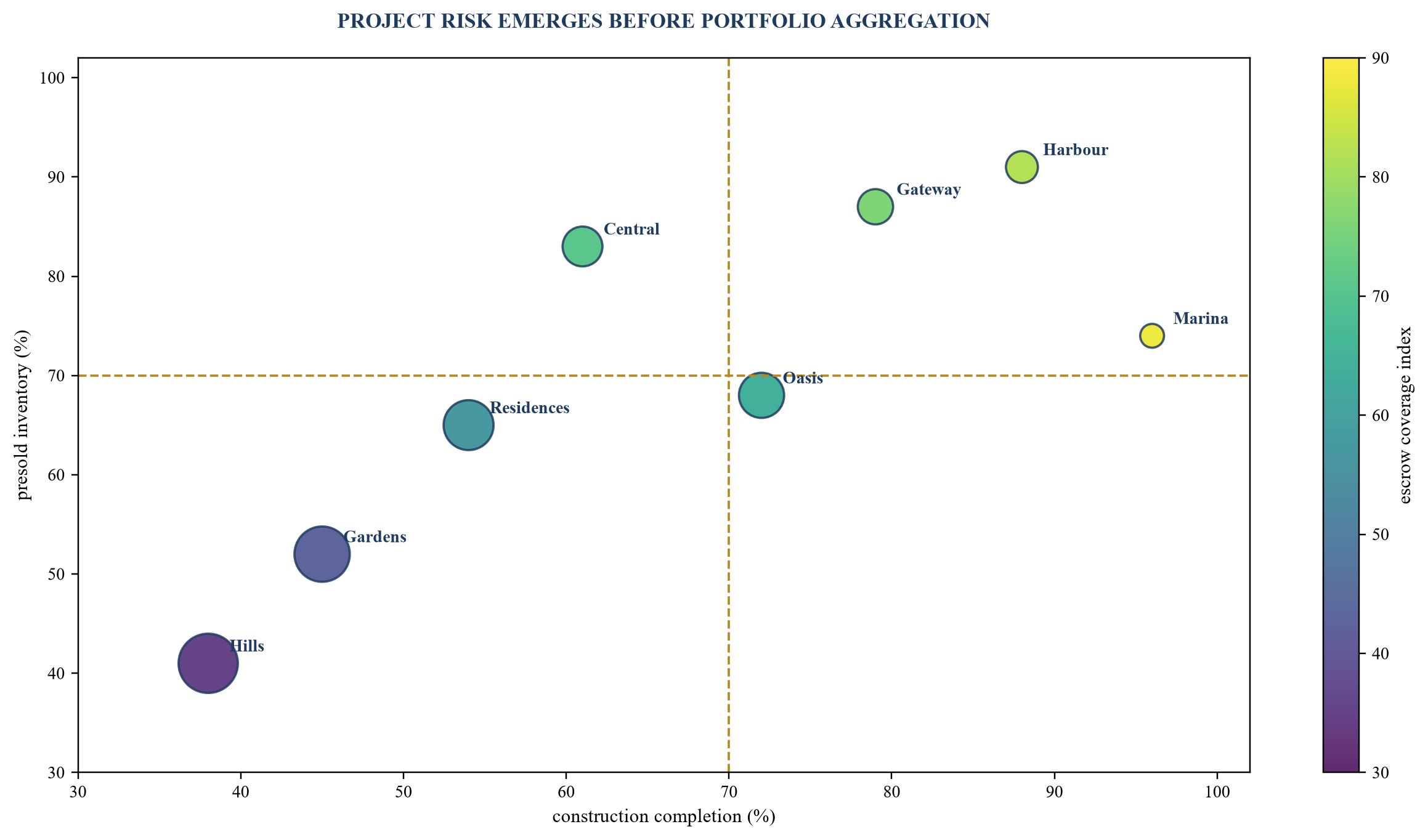
Values and positions are hypothetical; bubble size represents remaining completion capital rather than project market value.
4. Treat escrow as a regulated operating system
Escrow is not synonymous with surplus cash. It is a project-level operating system connecting purchaser receipts, financier funds, approved project expenditure, construction progress, professional certification, regulator procedures and retained balances. The buyer should obtain the executed agreement, account statements, project registration, signatory rules, withdrawal history, technical reports, accountant reports, regulator correspondence and reconciliation to every sold unit.
Dubai's escrow law requires a separate account for each project and dedicates the account to project construction; it also prevents attachment for the developer's general creditors and requires protection measures when exceptional circumstances prevent completion.[1] Dubai Land Department's current registration process links project registration, title, permits, plans, development arrangements and a qualifying guarantee route to escrow opening.[2] Abu Dhabi's current framework also links off-plan buyer payments to regulated project accounts and construction milestones.[4][5] Saudi rules require a separate project account, unit-level deposit references and certified withdrawal instructions.[8][9]
The diligence reconciliation starts with opening balance, receipts, permitted financing, refunds, approved withdrawals, bank charges, interest if applicable and closing balance. It then classifies the closing balance into construction funding, retained amount, purchaser protection, approved profit available for withdrawal, disputed amount and unexplained variance. The classification should follow current law, regulator practice, account agreement and project status; the transaction model should not assume that accounting ownership equals immediate distributability.
Escrow continuity is a closing workstream. The buyer needs written confirmation of balances, liens, signatories, account status and treatment following change of control. The sale agreement should specify who completes pre-closing withdrawal requests, how receipts and payments are operated between signing and closing, whether profit withdrawal is permitted, how unusual payments are approved and how the buyer receives system access and historical data.
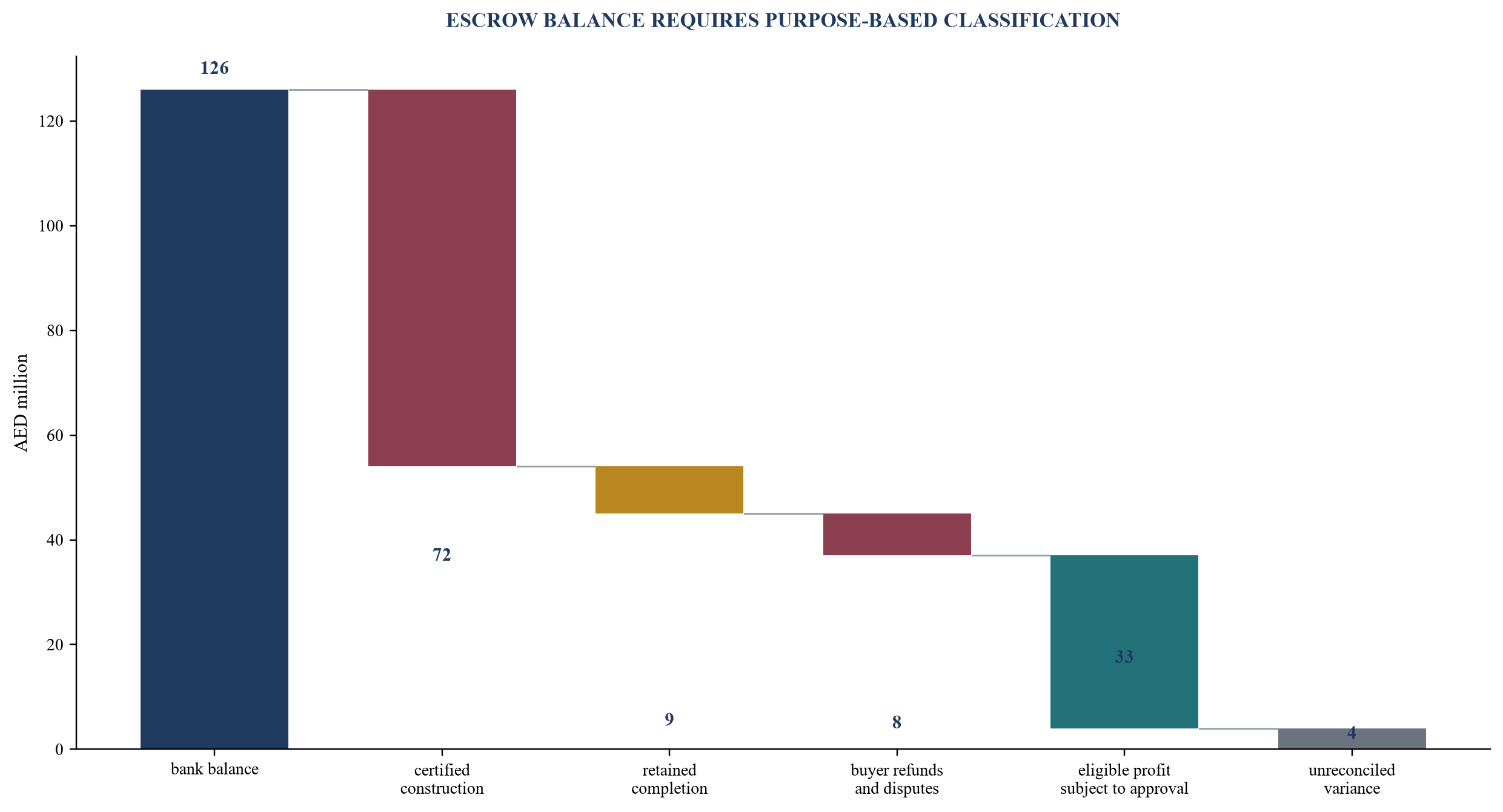
Amounts are hypothetical AED millions and show economic classification rather than a legal conclusion.
5. Convert completion obligations into a funded matrix
Completion obligations extend beyond remaining construction. The matrix should include physical works, design completion, permits, authority inspections, utilities, infrastructure, common areas, landscape, testing, commissioning, handover, title, purchaser documentation, defect correction, warranties, retentions, bank guarantees, contractor claims, community obligations and project close-out. Each item needs a legal source, amount or range, due date, evidence, funding source, responsible party and release event.
The cost report is one input rather than the whole answer. A contract cost-to-complete can omit developer obligations, internal staff, sales support, authority charges, legal work, customer compensation, finance carry and tax timing. The construction programme can stop at practical completion while the acquisition model depends on title, handover and unrestricted cash. The completion standard used in valuation, financing and the sale agreement should therefore be explicit.
The matrix should separate certain, probable and contingent obligations without using those categories as accounting conclusions. A certain cash need has an executed or unavoidable basis. A probable range reflects current professional evidence and defined uncertainty. A contingent exposure depends on an event such as delay, claim, cancellation, authority decision or contractor failure. The buyer prices the base plan, tests the downside and decides which exposure should be funded, retained, indemnified or left with the seller.
Cross-project obligations require special care. A master-development agreement may require roads, utilities or community assets that benefit sold and unsold phases. If the acquired group owns only some phases, cost allocation and enforcement should be documented. A seller covenant without security can leave the buyer dependent on future willingness and credit quality.
Table 2. Completion-obligation matrix
| Obligation | Evidence | Base-case treatment | Downside protection |
|---|---|---|---|
| remaining construction | certified cost report, contracts and programme | include measured completion cost and contingency | funded reserve, sponsor support or price retention |
| infrastructure and utilities | development agreement, NOCs, authority and provider terms | allocate project share and timing | specific covenant, security and step-in route |
| buyer delivery and delay | registered contracts, promised date, amendments and complaints | model delivery cost and expected remedies | claim reserve, indemnity and conduct control |
| title and handover | registry status, completion certificate, unit plans and buyer ledger | fund documents, fees and operational team | holdback until verified transfer milestone |
| defects and warranties | snag list, contractor warranty, bonds, retention and insurance | recognise expected close-out resources | retained cash, assignment and contractor security |
| guarantees and claims | bank instruments, claims register and correspondence | classify amount, expiry and recourse | replacement, extension, escrow or specific indemnity |
Professional advisers should determine enforceability, measurement and required treatment for each live obligation.
6. Segment unsold inventory by legal and economic state
Inventory should be analysed unit by unit and then grouped into cohorts with the same route to cash. Relevant states include unapproved land, approved land, work in progress, launched unsold units, reserved units, contracted units awaiting registration, registered presales, cancelled units, completed unhanded units, handed-over unsold units, bulk inventory and units subject to dispute or restriction.
Book cost provides an accounting anchor. IAS 2 states that inventories within its scope are measured at the lower of cost and net realisable value, with net realisable value based on estimated selling price less completion and selling cost.[15] Acquisition pricing asks additional questions: what a market participant would pay for the cohort, what capital remains, when cash can be realised, what discounts and commissions apply, whether buyer deposits or refunds attach, and what approvals or titles are required. The purchase price should not simply add a premium to book cost.
The unit schedule should reconcile unit identifier, type, area, view, floor, title status, construction status, list price, achieved comparable, incentive, commission, reservation, contract, registration, collection, cancellation, refund, mortgage, handover and remaining cost. Duplicate reservations, internal sales, related-party purchases, swaps, bulk allocations and side letters require separate flags. A sales dashboard without contract and cash lineage is insufficient for transaction pricing.
Ageing matters because stale inventory can carry service charges, finance cost, maintenance, warranty decay, brokerage cost and price pressure. Early-stage inventory has completion and market risk; completed inventory has carrying and absorption risk. A buyer should use a cohort-specific discount and a cash-conversion date, with downside cases for price, pace, cancellation and cost.
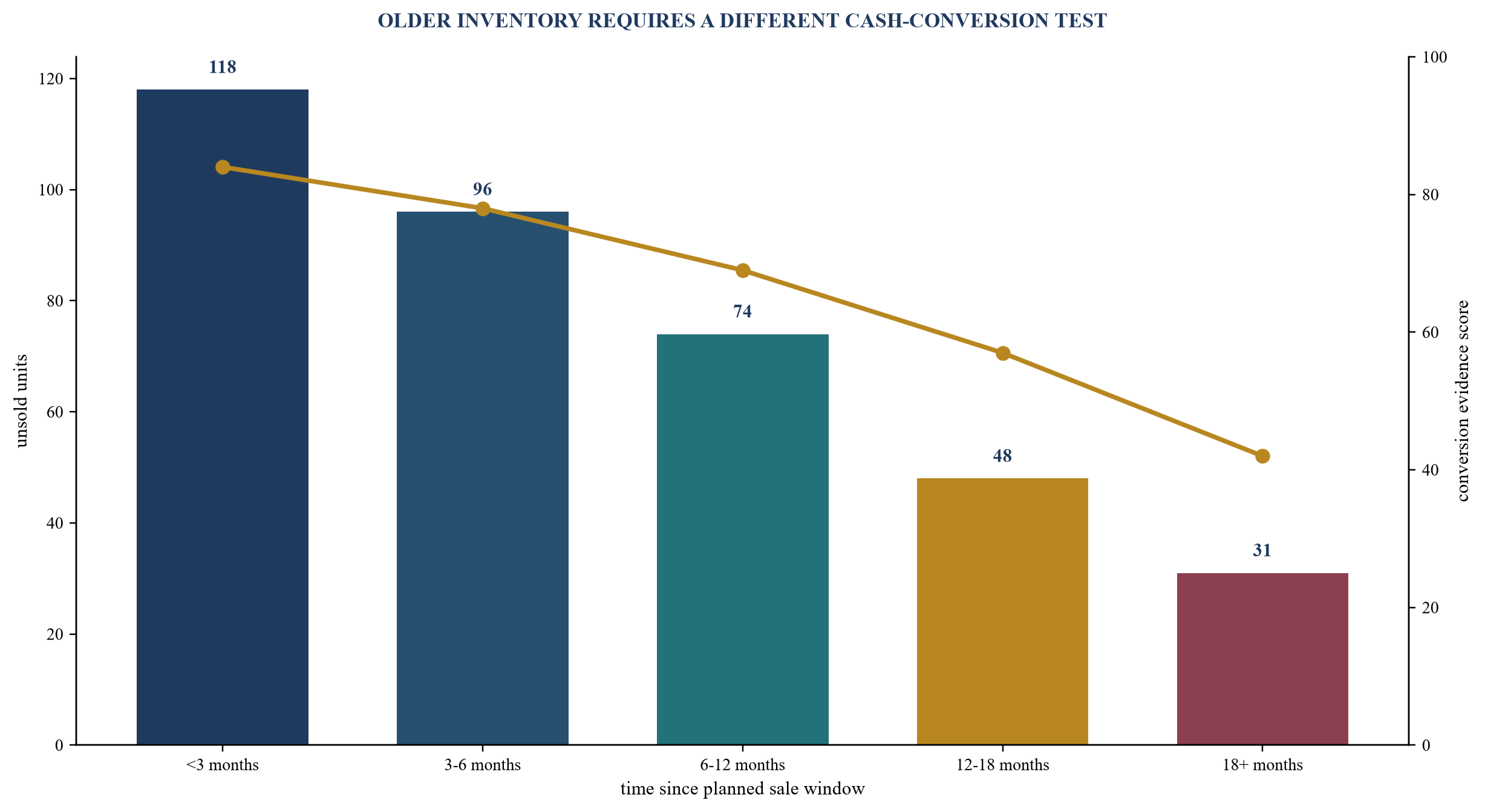
Values are hypothetical unit counts; the quality score combines title, completion, contract, collection and market evidence for demonstration only.
7. Rebuild cost-to-complete and contracted margin
The buyer should reconstruct cost-to-complete independently for every active phase. The bridge begins with remaining committed cost, adds unawarded work, variations, design development, prolongation, professional fees, utilities, authority costs, finance carry, close-out and risk allowances, and deducts only supported recoveries. The output should reconcile to the project programme and to the cash forecast.
Contracted margin is not sale price less historic book cost. It is remaining contracted collections plus eligible ancillary income, less the cost and cash required to complete, sell, hand over and satisfy buyer obligations. Contract cancellations, late payments, mortgage dependency, incentives, broker commission, refunds and price guarantees can affect the result. A project with strong reported margin can still require substantial interim capital.
Cost, sales and escrow should share one evidence date. A current cost report combined with an old sales ledger and a later bank balance creates false precision. Every data refresh should preserve the prior position and explain movement through construction, new sales, collections, cancellations, cost change, claims, withdrawals and release.
Completion funding should be tested before the buyer allocates acquisition debt or distributes cash. Where regulated accounts can fund only permitted project uses, the corporate sources-and-uses model should show separate project pools. Surplus from one project may not be available to cure another. The acquisition facility should reflect the timing and legal route of expected releases.
8. Translate project evidence into enterprise and equity value
The enterprise-value bridge should begin with a valuation methodology suited to the acquired perimeter. Project net asset value, discounted cash flow, sum of the parts, earnings multiples and land or inventory valuation can each be relevant. The model should avoid counting the same project margin in both net asset value and platform earnings.
Cash classification comes next. Unrestricted corporate cash can increase equity value subject to leakage and required liquidity. Escrow cash should be classified by permitted purpose and expected release. Restricted cash needed to finish a project is paired with the completion obligation rather than added as free cash. Debt includes drawn facilities, accrued interest and relevant break costs. Debt-like items can include unpaid land, contractor settlements, buyer refunds, overdue authority obligations, related-party balances and unfunded completion support depending on the agreed definitions.
Working capital should be defined around the developer model. Purchaser receivables can be linked to future performance and regulated collection routes. Contractor payables can be part of cost-to-complete. Accrued sales commissions, retention, VAT, deposits and intercompany balances can cross the boundary between debt-like and working capital. Each item should be placed once, with a written rationale and a rule that prevents double counting.
The final equity value is a decision output rather than a plug. It should show the base value, escrow classification, inventory adjustment, completion obligation, debt, working capital, transaction cost, tax items subject to advice and any contingent consideration. A buyer should be able to explain how a change in one project flows to the closing price.
9. Design completion accounts around project economics
A locked-box structure can work when historical accounts, leakage control, project reporting and cash classification are reliable. Completion accounts can work when balances move materially between signing and closing. A hybrid can lock stable platform items while trueing up project cash, inventory, debt and completion obligations. The chosen mechanism should fit the data and elapsed signing period.
Definitions require specificity. Cash should address escrow, blocked balances, cheques in transit, customer receipts, interest and overdraft netting. Debt should address project facilities, accrued interest, guarantees, seller financing and break cost. Working capital should state whether purchaser receivables, contractor payables, retentions, deposits and tax balances are included. Inventory should state the unit schedule, measurement basis and treatment of sales, cancellations and cost movement after the reference date.
The completion-obligation adjustment can use an agreed schedule updated to closing by defined evidence. The parties should decide whether a movement is ordinary project performance, leakage, debt-like cost, inventory adjustment or a change in base value. An independent expert process should have access to the project model, contracts and technical evidence rather than only the statutory ledger.
Table 3. Purchase-price definition map
| Item | Candidate treatment | Key definition issue | Anti-double-count rule |
|---|---|---|---|
| unrestricted cash | cash adjustment | minimum operating liquidity and cleared funds | exclude amounts already reflected in working capital |
| project escrow | restricted, completion funding or eligible release | legal purpose, release gate and timing | pair with the obligation it funds |
| unsold units | base value plus cohort adjustment | stage, title, cost, net selling price and ageing | exclude margin already captured in earnings value |
| sold-unit receivables | project cash-flow item or working capital | enforceability, registration, collection and performance | match remaining collections with remaining delivery cost |
| contractor and land payables | debt-like, completion cost or working capital | relation to historic delivery and future completion | include once in the project bridge |
| buyer refunds and claims | provision, debt-like item, holdback or indemnity | event, evidence, cap, timing and insurance | coordinate accounting reserve and contractual protection |
The agreement should define each item once and include examples for material developer-specific balances.
10. Distinguish a business combination from an asset acquisition
The accounting analysis can influence reported goodwill, acquisition cost, deferred tax and subsequent earnings. IFRS 3 applies to a transaction that meets the definition of a business combination and requires the acquirer to identify and measure acquired assets and liabilities under the acquisition method.[14] An acquisition of a group of assets that does not constitute a business follows different requirements. Real-estate transactions can sit close to this boundary when a project company contains land, contracts and outsourced activities but limited substantive processes.
The transaction team should involve accounting advisers before signing. The legal share form does not determine accounting classification. The analysis considers the acquired inputs, processes, workforce, contracts and capacity to produce outputs. The optional concentration test and the detailed facts require professional judgement under the applicable standard.
Purchase-price allocation should not be confused with the commercial price bridge. The commercial bridge decides what the buyer pays and how risk is allocated. Acquisition accounting determines recognition and measurement in the buyer's financial statements. The two should reconcile while preserving their distinct purposes. A commercial holdback can remain part of consideration even when its accounting treatment differs from the parties' label.
11. Test commercial and operational continuity
The buyer is acquiring the capacity to finish, sell, hand over and manage projects. Key-person diligence should cover development directors, project managers, commercial teams, sales leaders, finance, escrow administrators, customer-care teams and regulatory relationships. The retention plan should identify critical roles, authority, incentives, handover and replacement depth.
Contractor and consultant continuity is equally important. The buyer should map assignment and change-of-control provisions, unpaid certificates, variations, extensions of time, bonds, guarantees, insurance, intellectual property, design responsibility and dispute status. A low cost-to-complete assumes counterparties will perform at current terms. The downside case should test replacement cost and programme impact.
Sales quality should be tested by cohort and channel. Broker concentration, related-party buyers, payment plans, mortgage approvals, cancellations, incentives and side letters affect cash conversion. Customer-care capacity matters because a transaction can increase uncertainty among purchasers. Signing and closing communications should be coordinated with legal obligations and project continuity.
Systems diligence should trace unit master data, contracts, collections, escrow, construction progress, procurement, cost, sales, customer cases and registry status. Reconciliations performed manually by a small number of employees create integration risk. The buyer should preserve read access, audit trails and daily operating controls from signing through the first post-closing cycle.
12. Allocate risk through specific transaction protections
Representations and warranties provide information and recourse; they do not fund completion by themselves. The protection package should match each material exposure to a control. A known cost-to-complete deficit may require a price adjustment or funded reserve. A disputed purchaser claim may require a specific indemnity and conduct provisions. A release-dependent escrow balance may require a holdback that moves only when the regulator, bank and project evidence confirm the relevant milestone.
Conditions precedent should cover items that must exist before ownership changes: competition clearance where required, project and lender consents, title or registry steps, escrow-bank continuity, material permit status, release or replacement of guarantees, financing and an agreed minimum completion-funding position. A vague obligation to use reasonable efforts can be inadequate where the buyer cannot operate lawfully or preserve value without the item.
Interim covenants should restrict unusual withdrawals, new sales outside approved parameters, material contract changes, related-party transactions, asset disposals, new debt, guarantee changes, settlement of material claims and deviation from approved project budgets. The seller still needs operational flexibility, so thresholds and consent response times should be practical.
Indemnities, holdbacks, warranties, insurance and contingent consideration should have coordinated caps, baskets, periods, control rights and recovery order. Double recovery should be prevented while preserving recourse for distinct losses. Security for seller obligations matters where the seller distributes proceeds or sits outside the jurisdiction.
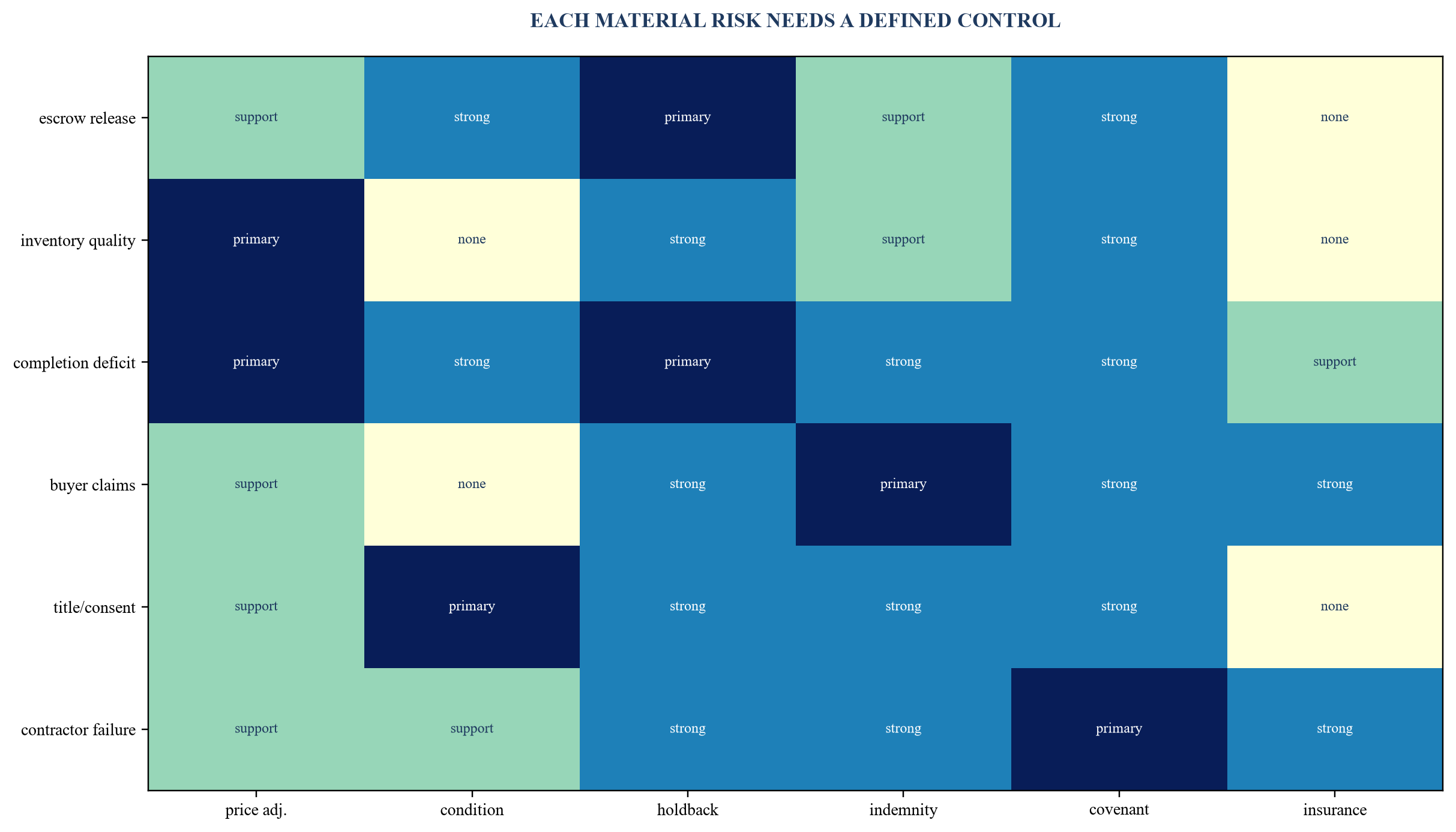
The matrix is a transaction-design example; live protections depend on negotiation, law, enforceability and evidence.
13. Sequence competition, real-estate and financing approvals
Regulatory analysis should begin before the timetable is announced. UAE competition law defines economic concentration to include transfers that create direct or indirect control and requires qualifying applications before completion.[12] The 2025 threshold decision identifies an AED 300 million relevant-market sales threshold or a 40 per cent relevant-market share threshold.[13] The relevant market, parties, exemptions, local coordination and current executive procedures require transaction-specific legal advice.
Saudi competition guidance addresses mergers, acquisitions and joint ventures that produce a change of control and describes the review process and sales analysis.[11] The buyer should confirm current notification thresholds, calculation rules and timing with Saudi counsel and the competent authority for the actual parties. Cross-border groups may trigger filings in more than one jurisdiction even when the target projects are local.
Real-estate approvals can include developer registration, project registration, land or development-right transfer, master-developer consent, account-bank confirmation, off-plan sales licences, registry updates, foreign-ownership requirements, lender consent, guarantee replacement and authority notifications. A share acquisition can still trigger contractual or regulatory steps despite no direct land transfer.
The signing-to-closing plan should state filing owner, information source, draft date, submission date, statutory timetable, stop-the-clock risk, remedy authority and long-stop date. The project operating plan should continue during the review period. Construction, sales, collections and customer obligations cannot be allowed to drift while corporate approvals are pending.
14. Value each project through timed cash conversion
Project valuation should connect gross receipts to net cash available to the acquired group. The model begins with remaining collections from sold units, expected net receipts from unsold units and other supported project income. It deducts completion cost, selling cost, refunds, buyer remedies, finance, tax cash flows subject to advice, authority and registration cost, handover, close-out and reserves. It then applies timing, risk and account restrictions.
The discount rate cannot solve a missing cash-flow item. Completion cost, delay, cancellation and escrow release should be modelled directly before applying a rate. Scenario analysis should combine related stresses: slower sales can reduce construction funding, delay can increase finance and buyer claims, contractor failure can increase both cost and time, and title delay can postpone cash release.
The base case should use current executable evidence. The downside case should identify a coherent event path. A severe case can test project preservation, alternative contractor, bulk sale, additional capital or controlled exit. The buyer should decide which case drives price and which drives protection. Paying the base case while securing only an average indemnity can leave the buyer funding the tail.
Table 4. Illustrative project valuation cases
| Case | Remaining project receipts | Completion and close-out uses | Net project cash before discount | Primary transaction response |
|---|---|---|---|---|
| current evidence | 420 | 286 | 134 | base value subject to account and timing classification |
| slower absorption | 401 | 298 | 103 | inventory adjustment and larger liquidity reserve |
| six-month delay | 414 | 317 | 97 | finance and buyer-remedy reserve plus long-stop review |
| contractor replacement | 420 | 333 | 87 | funded completion holdback and step-in plan |
| combined downside | 382 | 348 | 34 | price reset, seller support or perimeter change |
All values are hypothetical AED millions and are used solely to demonstrate the framework.
15. Apply a worked acquisition scenario
Consider a hypothetical acquisition of a GCC developer with six active projects and a corporate platform. Headline enterprise value is AED 1.25 billion. The seller presents AED 210 million of consolidated cash, AED 760 million of inventory, AED 1.05 billion of remaining contracted collections and AED 430 million of drawn debt. The buyer does not accept those balances without project classification.
The account review identifies AED 162 million in project escrow. AED 96 million is required for certified construction and approved project uses, AED 12 million is retained for completion and buyer protection, AED 8 million relates to refunds and disputes, AED 39 million may become eligible for profit withdrawal after evidence and approval, and AED 7 million remains unreconciled. The buyer treats only AED 48 million of corporate cash as unrestricted at closing. The possible AED 39 million release is placed in contingent consideration rather than immediate cash value.
The inventory review reduces headline value by AED 74 million. The adjustment comprises updated completion and selling cost, ageing, incentives, cancellation exposure and title or handover timing. The completion matrix identifies AED 58 million beyond the seller's latest project budgets, including infrastructure, utilities, finance carry, customer remedies and close-out. Debt and debt-like items total AED 486 million after accrued interest, overdue land consideration and agreed project liabilities.
The parties agree a base equity value of AED 638 million before completion accounts. AED 55 million is retained in a project completion holdback, AED 24 million supports identified purchaser and title matters, and up to AED 39 million is payable as contingent consideration when specified escrow profit is lawfully released and received. These values are illustrative. A live result depends on evidence, negotiation, legal structure, tax and accounting treatment.
16. Build a closing funds flow that preserves project liquidity
The funds flow should separate acquisition consideration from project funding. Sources include buyer equity, acquisition debt, refinanced project facilities and seller proceeds. Uses include cash consideration, debt repayment, fees, tax payments subject to advice, completion reserves, account top-ups, guarantee replacement and minimum operating liquidity. Each payment needs an account, authorised signatory, condition and evidence.
Project escrow should remain operational through closing. Purchaser receipts and permitted construction payments may continue on the closing date. The parties should avoid sweeping or freezing accounts in a way that delays contractors, violates project rules or creates buyer concern. Bank and regulator coordination should be completed before ownership changes.
Holdback mechanics should state custodian, permitted investments, claims process, release dates, objective evidence, partial release, dispute procedure, interest and insolvency protection. A seller-controlled promise to return cash later provides weaker protection than a funded and enforceable mechanism. The buyer should also confirm that the holdback itself does not prevent the target from meeting project obligations.
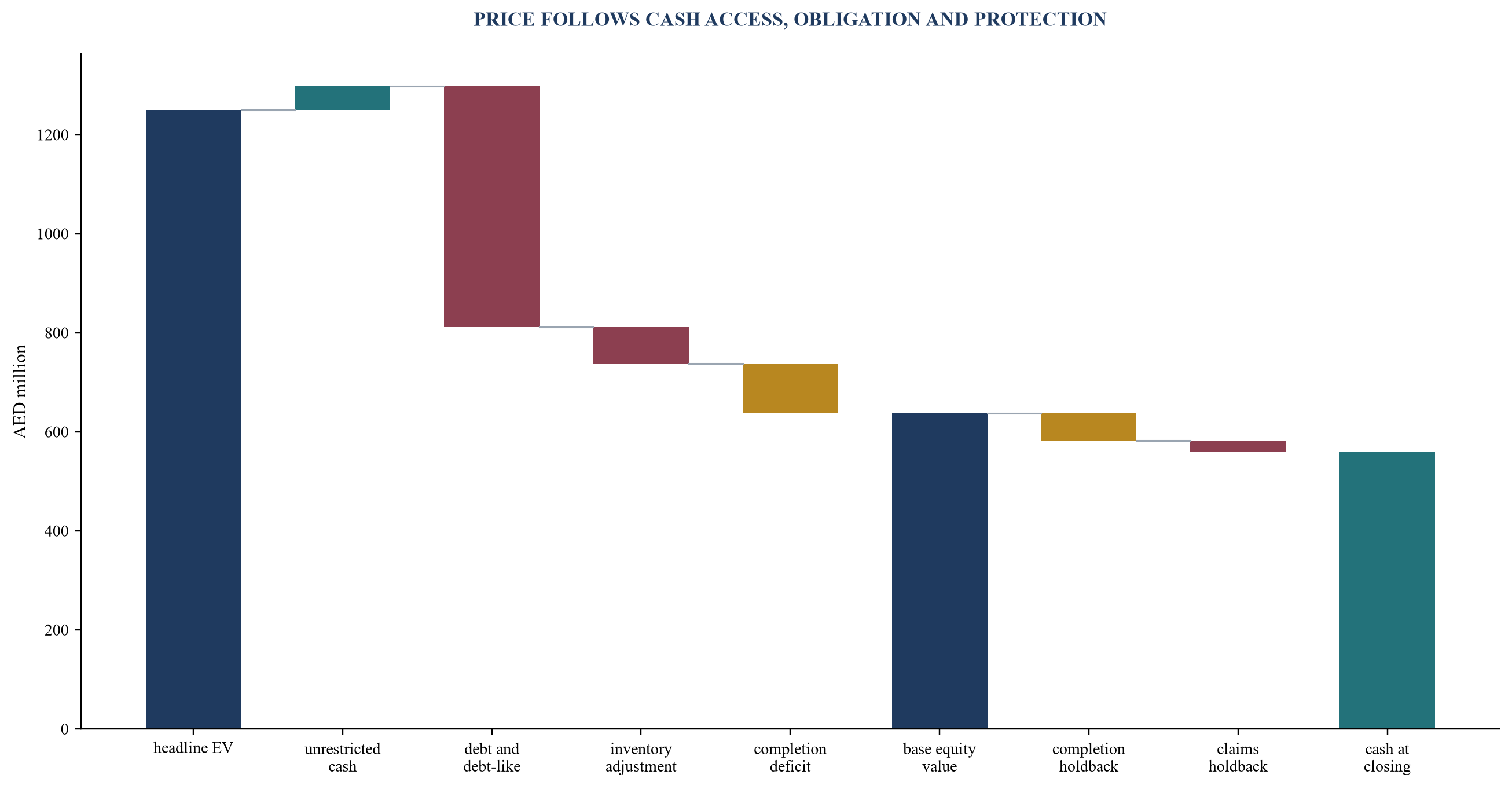
Values are hypothetical AED millions; legal, tax, accounting and financing advisers should determine live treatment.
17. Operate the first hundred days through project controls
The first hundred days should preserve completion, customer confidence and regulatory control. Day one priorities include bank authority, project-account access, payment approvals, construction continuity, critical staff, insurance, guarantees, regulator contacts, customer communications and a verified project dashboard. The buyer should avoid replacing core systems before data lineage and operating dependencies are understood.
The project control room should report cost-to-complete, programme, escrow, sales, collections, cancellations, buyer cases, title, permits, contractor claims, guarantees and funding headroom. Each project has a named executive, development lead, commercial lead, finance owner and legal or regulatory owner. Common risks should roll up to the portfolio without erasing project detail.
The purchase agreement and integration plan should share the same release evidence. If a completion holdback requires title, handover and a minimum escrow balance, the control room should produce those records in the agreed form. This reduces disputes and ensures that transaction protections reinforce operating discipline.
Table 5. First hundred-day control plan
| Period | Priority | Required evidence | Decision output |
|---|---|---|---|
| day 1 to 10 | preserve authority, accounts, sites, people and customer service | bank confirmations, signatories, access, payment calendar and contact tree | continuity certificate and critical exceptions |
| day 11 to 30 | refresh every project baseline | cost, programme, escrow, inventory, sales, claims and funding reconciliation | approved project control budgets |
| day 31 to 60 | close transaction conditions and stabilise counterparties | consents, guarantees, contractor and customer plans | risk closure and holdback evidence pack |
| day 61 to 100 | implement selected value levers | quantified business cases and project impact assessments | board-approved integration roadmap |
| recurring | monitor common portfolio risks | common contractor, bank, approval, sales and liquidity dashboard | escalation, capital allocation and intervention decisions |
Timing should be adapted to the actual closing, project calendar and regulatory requirements.
18. Implement the transaction framework before signing
The first week establishes perimeter and evidence. Build the entity and project map, freeze the evidence date, collect title and registry records, account agreements, bank statements, unit ledgers, contracts, cost reports, programmes, permits, guarantees, facilities, claims and financial records. Reconcile project identifiers across legal, bank, construction, sales and accounting systems.
The second week produces the operating and valuation bridges. Classify escrow by purpose and release, segment inventory, rebuild cost-to-complete, test presale quality, map completion obligations and create project base and downside cash flows. Specialist advisers identify legal, regulatory, tax, accounting, technical and valuation conclusions within their scope.
The third week converts evidence into transaction terms. Agree the enterprise-value bridge, cash, debt, working capital and inventory definitions, completion adjustment, locked-box or completion-account mechanism, interim covenants, conditions, holdbacks, indemnities, contingent consideration and closing funds flow. Drafting examples should be tested against actual project data so the mechanism produces the intended result.
The fourth week proves execution. Confirm filing and consent plans, acquisition and project funding, escrow continuity, guarantee replacement, critical staff, customer communications, system access and the first hundred-day control room. The board receives a decision pack showing value, capital need, downside, protection, unresolved conditions and authority.
The durable transaction is one where the project facts, price mechanism, legal documents, funding and integration controls describe the same economic reality. Escrow, inventory and completion obligations then become measurable components of value and protection rather than surprises that appear after ownership has changed.
References
- Government of Dubai, Dubai Legislation Portal. Law No. 8 of 2007 Concerning Escrow Accounts for Real Estate Development in the Emirate of Dubai. https://dlp.dubai.gov.ae/Legislation%20Reference/2007/Law%20No.%20%288%29%20of%202007.html
- Dubai Land Department. Register Project. Accessed 30 August 2026. https://dubailand.gov.ae/en/eservices/register-project/
- Dubai Land Department. Withdrawal of Project Profits. Accessed 30 August 2026. https://dubailand.gov.ae/en/eservices/request-for-withdrawal-of-a-projects-profits/
- Abu Dhabi Real Estate Centre. Frequently Asked Questions: project escrow accounts. Accessed 30 August 2026. https://adrec.gov.ae/en/faqs
- Abu Dhabi Real Estate Centre. Project Development. Accessed 30 August 2026. https://adrec.gov.ae/en/sectors/regulatory-services/project-development
- Abu Dhabi Real Estate Centre. Regulations: Administrative Decision No. 250/2015 and related real-estate regulations. https://adrec.gov.ae/en/rules_and_regulations/regulations
- Abu Dhabi Department of Municipalities and Transport. Regulatory decisions to enhance transparency and governance in the real-estate sector. 2026. https://www.dmt.gov.ae/en/Media-Centre/News/DMT-Issues-Regulatory-Decisions-to-Enhance-Transparency-and-Governance-in-Real-Estate-Sector
- Saudi Real Estate General Authority. Law of Selling and Leasing Off-Plan Real Estate Projects. https://rega.gov.sa/en/laws-and-decisions/regulations-and-by-laws/rules/law-of-selling-and-leasing-off-plan-real-estate-projects/
- Saudi Real Estate General Authority. Implementing Regulations of the Off-Plan Sale and Lease of Real Estate Projects Law. https://rega.gov.sa/en/laws-and-decisions/regulations-and-by-laws/regulations/implementing-regulations-of-the-off-plan-sale-and-lease-of-real-estate-projects-law/
- Saudi Real Estate General Authority. Law of Real Estate Registration. https://rega.gov.sa/en/laws-and-decisions/regulations-and-by-laws/rules/law-of-real-estate-registration/
- Saudi General Authority for Competition. Economic Concentration Review Guidelines. https://gacbep.gac.gov.sa/cms/b9376edc-79a1-4573-a36d-4f3effaba838.pdf
- UAE Ministry of Economy and Tourism. Federal Decree-Law No. 36 of 2023 Regulating Competition. https://www.moet.gov.ae/documents/20121/0/Federal%2BDecree-Law%2BNo.%2B%2836%29%2Bof%2B2023%2BRegulating%2BCompetition.pdf/d5f2b12d-7688-5180-e63b-44a8dbe878d6
- UAE Ministry of Economy and Tourism. Cabinet Decision No. 3 of 2025 on thresholds related to Federal Decree-Law No. 36 of 2023. https://www.moet.gov.ae/documents/20121/0/Cabinet%2BDecision%2BNo.%2B%283%29%2Bof%2B2025%2BOn%2Bthe%2BThresholds%2BRelated%2Bto%2Bthe%2BImplementation%2Bof%2BFederal%2BDecree-Law%2BNo.%2B%2836%29%2Bof%2B2023%2BRegulati.pdf/0f228724-8dd5-9b9c-0ed8-0b94d5ae0873
- IFRS Foundation. IFRS 3 Business Combinations. https://www.ifrs.org/issued-standards/list-of-standards/ifrs-3-business-combinations/
- IFRS Foundation. IAS 2 Inventories. https://www.ifrs.org/issued-standards/list-of-standards/ias-2-inventories/
- IFRS Foundation. IAS 37 Provisions, Contingent Liabilities and Contingent Assets. https://www.ifrs.org/issued-standards/list-of-standards/ias-37-provisions-contingent-liabilities-and-contingent-assets/
- IFRS Foundation. IFRS 13 Fair Value Measurement. https://www.ifrs.org/issued-standards/list-of-standards/ifrs-13-fair-value-measurement/
