

1. Start with the value-inflection plan
Venture debt should fund a defined period in which capital is expected to create observable evidence. A GCC technology company may need to deliver a government platform, complete regulated integrations, convert a pilot into a multi-year deployment, expand into another Gulf market, finance hardware embedded in a software contract, or bridge to a priced equity round. Each use has a different cash profile, execution risk and lender-control requirement. The board should define the milestone, cost, timing, evidence standard and fallback before discussing facility size.
The financing question should state how debt creates more strategic value than immediate equity. Preserving ownership is a legitimate objective, but dilution avoided today has value only when the company can service the fixed claim and reach a stronger financing position. The analysis should compare debt with equity, customer prepayment, milestone billing, supplier terms, invoice discounting, revenue-based finance and a smaller operating plan. Fees, cash interest, profit participation, warrants, security, reporting, covenants and refinancing risk belong in the comparison.
A uses-and-outcomes schedule should allocate every draw to a controlled purpose. Product development should connect to a release and customer acceptance test. Sales expansion should connect to a documented account plan and conversion assumption. Working capital should connect to named invoices and collection dates. Regional expansion should include licensing, hiring, localisation, data, tax and customer onboarding. The schedule should identify the executive owner, evidence source, decision date and action if the milestone slips.
Debt becomes fragile when it funds open-ended experimentation, recurring losses without a financing plan, unresolved customer concentration or commitments whose cash timing is unknown. A company can still pursue those strategies, but the appropriate capital may be risk-bearing equity. The board should document why the chosen instrument matches the uncertainty being financed and why the minimum liquidity reserve remains adequate after the draw.
The market context supports a disciplined approach. The IMF reported that lending to SMEs represented about 4 per cent of GCC commercial-bank loans, compared with 33.5 per cent across emerging markets, and identified perceived risk, limited credit information and limited collateral as constraints.[1] The OECD's 2026 review documented the continuing importance of diversified debt, equity and asset-based finance for innovative SMEs.[2] In the UAE, receivables can fall within the movable-security and factoring frameworks, while CBUAE's in-force credit-risk standards require robust underwriting, documentation, collateral management and forward-looking repayment analysis.[3][4][5][6][7] These rules and market practices define evidence and control tests; financeability remains specific to the contract, borrower and facility.
All company figures, advance rates, reserves, pricing terms, covenant thresholds, forecasts and transaction scenarios in this paper are illustrative management assumptions. They do not describe a particular borrower, customer, lender or financing offer. Readers should obtain current investment, credit, legal, accounting, tax and regulatory advice in each relevant jurisdiction and review the actual customer and financing documents before assigning receivables, granting security, drawing debt or changing collection arrangements.
2. Apply six gates to the financing decision
The six gates are sequential and connected. Gate one tests purpose and milestone timing. Gate two tests the quality of customer contracts. Gate three determines which receivables and contracted cash flows are eligible for financing. Gate four converts eligible assets into a monthly borrowing base and integrated cash forecast. Gate five tests covenants, reporting and downside decision rights. Gate six establishes repayment, refinancing and stakeholder support.
A failure at one gate changes the structure at the others. A strong customer name cannot cure an unaccepted deliverable. A valid invoice may remain ineligible when it is disputed, overdue, already pledged, denominated in an unsupported currency or subject to set-off. A large borrowing base cannot support the requested facility when collections arrive after debt service and minimum cash would be breached. A credible repayment path can justify delayed amortisation, but only when the milestone and evidence are controlled.
Every gate should close through an evidence register. Each material number needs a definition, source, owner, cut-off date and reconciliation status. The register should distinguish executed contracts, purchase orders, invoices, cash receipts, management forecasts and legal conclusions. Model vintages should be retained so changes in contract status, eligibility, collection timing and headroom remain visible to the board and lender.
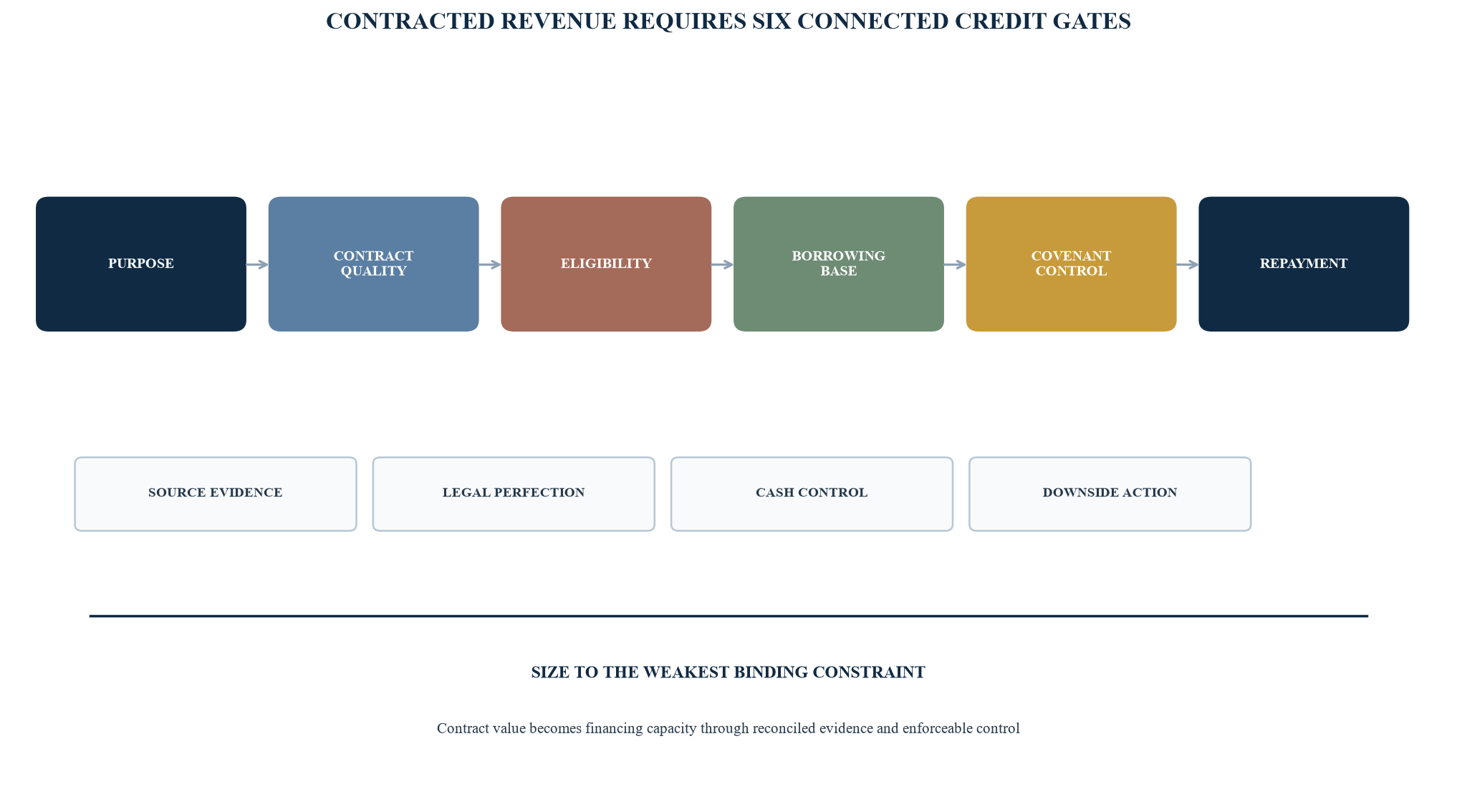
The framework should be adapted to the borrower, lender, jurisdictions and transaction documents.
Table 1. Six-gate decision matrix
| Gate | Core evidence | Decision test | Failure response |
|---|---|---|---|
| purpose | uses, milestone, timing and ownership | Does debt finance a bounded value-inflection plan? | redefine the plan or select another instrument |
| contract quality | executed agreement, order, delivery and customer rights | Is contracted value enforceable, deliverable and economically durable? | exclude weak value and repair delivery or terms |
| eligibility | invoice, acceptance, assignment, set-off and prior liens | Can the cash flow enter the borrowing base? | reserve, cure or exclude the asset |
| borrowing base | eligible ledger, advance rates, reserves and collections | Does controlled collateral support the draw each month? | reduce availability or add eligible assets |
| covenant control | definitions, headroom, reporting, cures and consent rights | Do triggers create timely decisions without avoidable default? | redesign thresholds and escalation mechanics |
| repayment | operating cash, equity support, refinance, prepayment and exit | Is there a credible route to discharge the claim? | change tenor, amortisation, size or instrument |
Lenders may use different terminology and require additional tests.
3. Separate contract value from financing value
Contract value is a commercial measure. Financing value is the portion of contracted cash that remains after delivery, legal, customer, timing, concentration and control risks have been tested. A multi-year master services agreement may establish a relationship while committing no minimum spend. A purchase order may authorise work while remaining conditional on budget, acceptance or a valid invoice. An invoice may evidence a claim while still being subject to dispute, set-off, retention or assignment restrictions.
The contract register should therefore capture more than face value and expiry. It should identify the contracting entities, governing law, statement of work, performance obligations, committed minimums, pricing basis, service commencement, billing events, acceptance procedures, service levels, credits, termination rights, change control, liability, set-off, retention, assignment, confidentiality, data residency, intellectual property and dispute mechanism. Side letters and portal terms should be linked to the same record.
IFRS 15 provides a useful accounting discipline because it requires identification of the contract, performance obligations, transaction price, allocation and recognition when obligations are satisfied.[14] Financing analysis still serves a different purpose. Recognised revenue may precede invoicing, and invoicing may precede unconditional collection. A contract asset, trade receivable, deferred-revenue balance and cash receipt represent different points in the cycle. The lender schedule should reconcile these balances without treating them as interchangeable.
The commercial team should classify every contracted amount as live recurring, usage-dependent, milestone-based, implementation, hardware, reimbursable, optional or forecast. It should show which amounts are signed, budgeted, ordered, delivered, accepted, invoiced, due and collected. This creates a contract-to-cash chain that can be independently tested and updated.
4. Score contract quality before applying an advance rate
Contract quality should be assessed across six dimensions: obligor quality, enforceability, delivery certainty, billing certainty, collection behaviour and concentration. A high-quality obligor can reduce expected loss while internal procurement or acceptance processes still delay cash. A legally assignable receivable can remain operationally weak when delivery evidence is incomplete. A consistently paying customer can still create concentration risk when one renewal controls the company's liquidity.
The scorecard should rely on source evidence. Obligor quality can use public accounts, credit information, ownership and payment history. Enforceability requires qualified legal review of actual documents. Delivery certainty uses project plans, acceptance records, service performance and open issues. Billing certainty uses purchase orders, portal status, invoice validation and deductions. Collection behaviour uses ageing, historical days-to-pay, disputes and credits. Concentration uses customer, sector, geography, contract-expiry and collection shares.
Scores should drive eligibility and reserves rather than produce decorative precision. A green contract may enter the base at the standard advance rate. An amber contract may require a lower rate, specific reserve or documentary cure. A red contract should remain outside availability. Overrides should be documented, approved and time-bound. The scorecard should also identify operational actions that can improve financing value, such as obtaining a purchase order, clarifying acceptance, shortening invoice approval, resolving a dispute or diversifying the customer base.
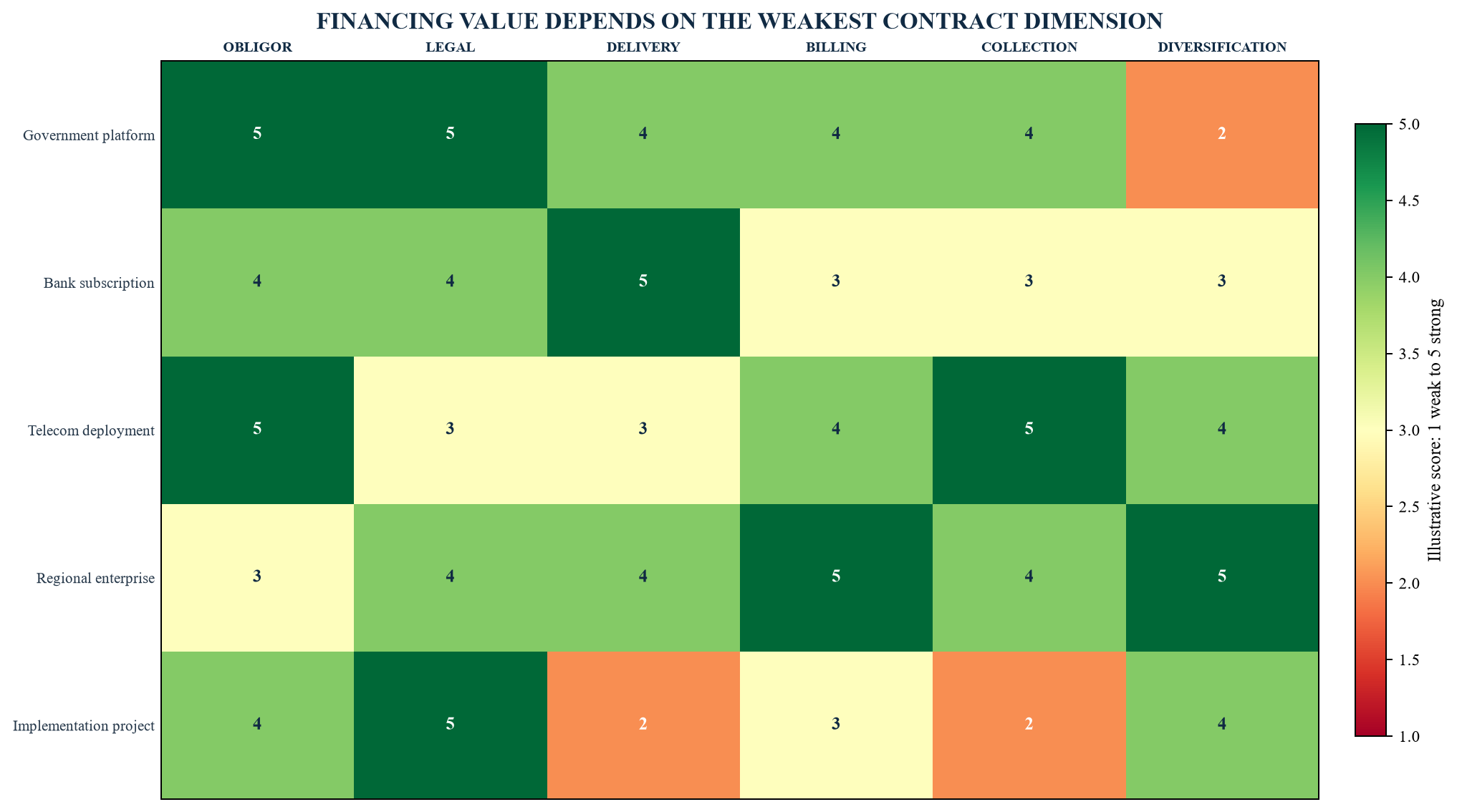
Scores are illustrative management assumptions and require evidence from actual contracts and customer performance.
Table 2. Contract-quality evidence architecture
| Dimension | Minimum evidence | Financing question | Control response |
|---|---|---|---|
| obligor | identity, ownership, accounts, credit data and payment history | Who ultimately pays and how strong is the payment source? | obligor limit, guarantee or exclusion |
| enforceability | executed documents, authority, governing law and legal review | Is the payment claim valid and enforceable? | legal condition, reserve or exclusion |
| delivery | project plan, service data, milestone and acceptance record | Has the company earned the right to bill and collect? | milestone evidence and delivery reserve |
| billing | order, invoice, portal validation, tax and deduction status | Is the invoice complete, approved and free of known dispute? | documentary cure and invoice reserve |
| collection | ageing, receipts, credits, disputes and days-to-pay | How reliably does billed value become unrestricted cash? | ageing limit and dilution reserve |
| concentration | top customers, expiry, sector, geography and cash share | Could one customer event impair debt service? | concentration limit and excess reserve |
Legal conclusions should be provided by qualified counsel in the relevant jurisdiction.
5. Map government and government-related receivables precisely
Government and government-related customers require precise entity mapping. A ministry, authority, municipality, state-owned enterprise and government-owned commercial company may have different procurement rules, budget processes, legal capacity, payment systems and credit characteristics. A lender should not treat a commercial company's receivable as a sovereign obligation solely because the state owns shares. The contract, obligor and payment source should be identified exactly.
The operating file should include tender or award evidence, executed agreement, purchase order, budget or funding confirmation where available, delivery milestone, acceptance certificate, invoice submission, portal status, payment approval and receipt history. The company should identify whether acceptance is deemed after a period or requires a signed certificate, whether invoices can be rejected for administrative defects, whether deductions can be applied, and whether the customer can set off other claims.
Assignment and notice deserve early attention. Some contracts restrict transfer, require consent, distinguish receivables assignment from contract novation, or impose confidentiality limits on disclosure to a lender. The UAE's movable-security and receivables-transfer frameworks recognise security interests and transfers in receivables, including current and future receivables, subject to their terms and applicable requirements.[5][6][7] Actual effectiveness, priority, perfection and enforcement depend on the documents, parties and jurisdiction. Counsel should address them before the facility assumes availability.
Payment timing should be based on observed process rather than stated terms alone. A 30-day term may produce a 75-day cash cycle when acceptance, portal validation and payment runs are included. The base should use the later of contractual due date and evidence-based expected collection, with a downside case for delay. Government quality can reduce credit risk while operational delay still consumes liquidity.
6. Define receivables eligibility as a controlled policy
Eligibility is the rule set that determines whether an asset supports borrowing. It should be written in the facility documents and implemented in the company's ledger and certificate process. Typical tests include valid origination, completed performance, unconditional payment, correct invoice, permitted obligor and jurisdiction, acceptable currency, absence of dispute or set-off, age within limit, no prior assignment, compliant security, and delivery of required evidence.
SAMA's capital framework provides a useful reference point by defining eligible financial receivables as short-dated claims arising from commercial flows, including amounts owed by buyers, suppliers, renters and governmental authorities, while requiring legal certainty and the necessary steps to make the security interest enforceable.[8] A private venture-debt facility may use different definitions and advance rates, but the same disciplines remain relevant: identify the claim, establish rights over proceeds and maintain controls over collection.
Ineligible assets should remain visible. Excluding a receivable from availability does not remove it from cash forecasting or operational attention. The certificate should show gross receivables, each exclusion category, eligible receivables, concentration excesses, reserves and net borrowing base. Changes from the prior period should be explained. A growing ineligible balance can reveal delivery, billing or collection problems before they appear in statutory results.
Eligibility should be tested at asset level and aggregated by obligor, group, currency, jurisdiction, contract type and age. Automated rules can improve speed, but document status and disputes often require controlled human judgement. Overrides should have an owner, evidence, approval, expiry and subsequent review.
7. Construct the borrowing base from gross value to availability
The borrowing-base bridge begins with a defined ledger population at a stated cut-off. It removes contract assets or unbilled value unless the facility expressly admits them. It excludes invoices that fail eligibility, deducts concentration excesses, applies dilution and other reserves, and multiplies the residual by an advance rate. The result is capped by the committed facility and reduced by outstanding principal, accrued amounts and any blocked availability.
Advance rates should reflect loss, delay and control risk rather than customer prestige alone. A short-dated, accepted invoice payable by a diversified investment-grade customer may support a higher rate than a milestone receivable with open acceptance. The rate should be applied consistently within each eligible class. Specific reserves should address known risks that a general haircut cannot capture, such as credits, disputed scope, tax deductions, currency mismatch, retention and collection-account leakage.
Concentration is usually the binding adjustment for a young technology company. A facility can permit a standard percentage for each obligor and admit excess only with lender approval or stronger evidence. Concentration can also be measured by obligor group, public-sector cluster, industry, jurisdiction or contract expiry. The purpose is to prevent one payment event from controlling availability and debt service.
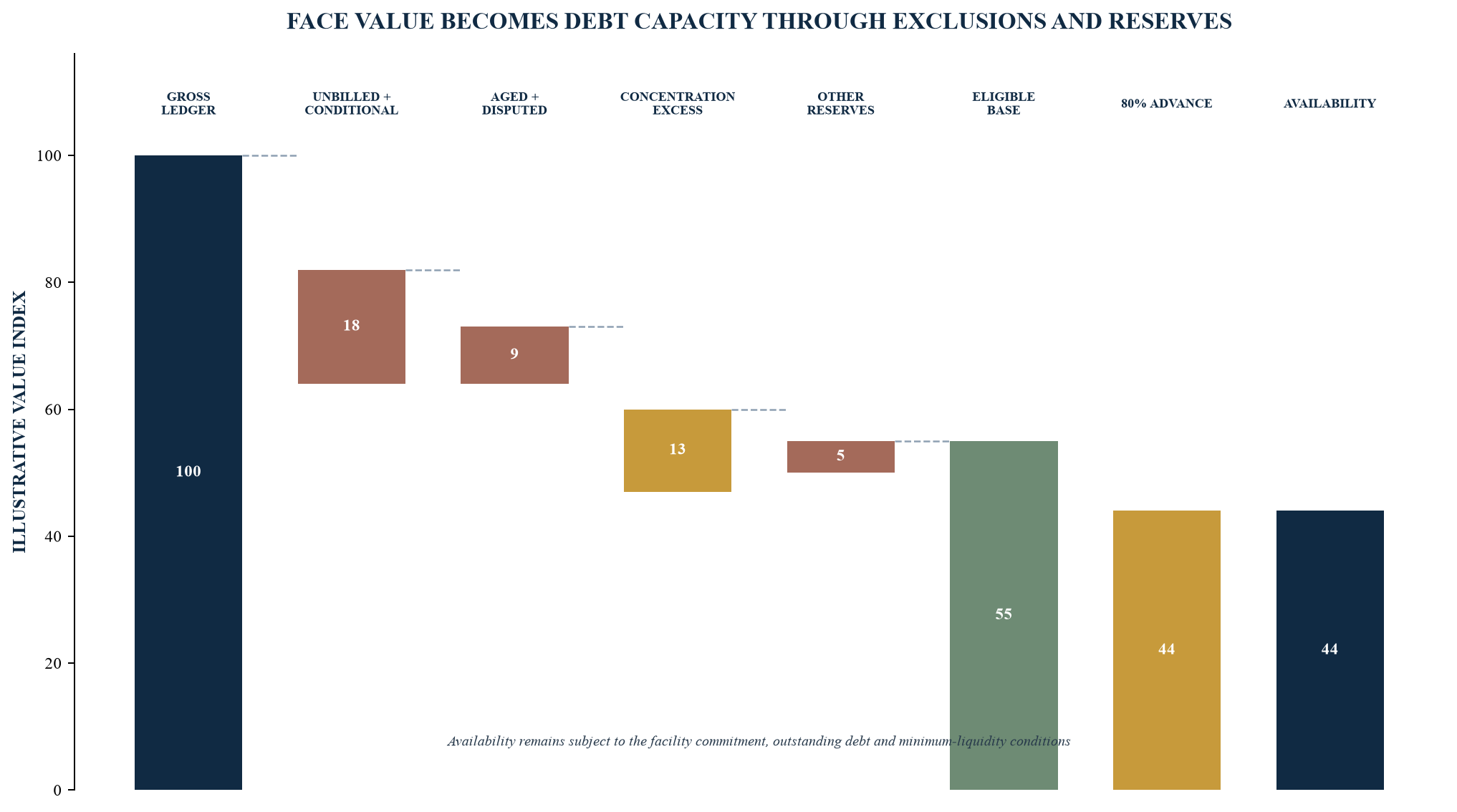
Values and advance rates are illustrative management assumptions and do not describe a financing offer.
Table 3. Illustrative borrowing-base policy
| Component | Illustrative treatment | Evidence | Review frequency |
|---|---|---|---|
| accepted enterprise invoice | eligible within age and concentration limits | contract, order, acceptance, invoice and portal validation | each certificate |
| government-related invoice | eligible after exact obligor and process review | authority, budget or order, acceptance and submission | each certificate |
| unbilled contract value | excluded unless a specific milestone class is approved | enforceable payment right and delivery evidence | milestone event |
| disputed, credited or offset amount | excluded or specifically reserved | correspondence, credit note and resolution plan | weekly |
| aged receivable | excluded after the documented ageing limit | ledger, due date, receipt history and collection action | each certificate |
| concentration excess | deducted above the approved obligor or group limit | obligor grouping and eligible balance | each certificate |
| dilution reserve | trailing credits, deductions, disputes and write-offs | reconciled historical data | monthly or quarterly |
| foreign-currency asset | admitted with approved conversion and reserve | invoice currency, hedge and collection account | each certificate |
Final definitions, rates and reserves require lender approval and legal documentation.
8. Reconcile contract, invoice, ledger and cash evidence
A borrowing base is only as reliable as its reconciliation chain. The company should link the executed contract and order to delivery, acceptance, invoice, accounting entry, customer balance and bank receipt. Unique identifiers should persist across the customer relationship management system, project tool, billing platform, enterprise resource planning system and bank reconciliation. Manual bridges should be controlled and reviewed.
The monthly certificate should reconcile opening gross receivables, new invoices, cash receipts, credits, write-offs, foreign-exchange movements, reclassifications and closing gross receivables. It should then show all eligibility adjustments and the resulting base. The same closing balance should reconcile to the general ledger and statutory reporting pack. Differences should be resolved before availability is certified.
IFRS 9 requires expected credit losses to reflect probability-weighted outcomes and permits a provision-matrix practical expedient for trade receivables.[15] The accounting allowance and borrowing-base reserve have different purposes, but they should be reconcilable. A lender may exclude an asset before accounting impairment is recognised because the facility needs immediate collateral control. Management should explain the relationship among ECL, overdue status, eligibility, specific reserves and write-offs.
Cash evidence should identify the payer, amount, currency, value date, invoice allocation and collection account. Unapplied cash and net settlements require investigation. A customer payment into an uncontrolled operating account may reduce debt in theory while failing to deliver the agreed cash control. The finance process should define how collections are swept, released and reported.
9. Model collection timing as a distribution
Contractual payment terms are one input to liquidity. Actual timing includes completion, acceptance, invoice preparation, portal submission, rejection and resubmission, internal approval, payment run, banking and allocation. The company should measure invoice-to-cash by customer and contract type, using median, upper-quartile and severe-delay outcomes. Small samples should be disclosed and treated cautiously.
A 13-week cash view should use invoice-level expected receipts for the immediate horizon. The monthly model should extend through facility maturity and include contract delivery, billing, collection, operating spend, taxes, capital expenditure, interest, fees, amortisation and minimum liquidity. The central case should be built from controlled assumptions; downside cases should delay or remove named receipts rather than applying a single percentage to total revenue.
Collections should be stress-tested for late acceptance, budget rollover, administrative rejection, customer dispute, concentration loss and cross-border transfer delay. The model should also test whether a receipt arrives before or after an interest, payroll, supplier or tax date. Timing can create a default even when the company ultimately collects every invoice.
The board should approve a liquidity response ladder. Early actions can include accelerated documentation, customer escalation, invoice correction, discretionary-spend control, supplier negotiation, delayed hiring and use of undrawn availability. Later actions can include equity support, waiver, amendment, asset sale or formal restructuring advice. Each action needs a trigger, owner, lead time and cash effect.
10. Size debt to the lowest supported amount
Debt capacity should be calculated through several independent constraints. The eligible-asset constraint applies the borrowing-base policy. The liquidity constraint preserves minimum cash in the central and approved downside cases. The debt-service constraint tests interest and amortisation against available cash. The milestone constraint limits debt to the amount required before the next evidence point. The concentration constraint prevents a single obligor from controlling repayment. The refinancing constraint tests the credible amount a future investor or lender could support.
The lowest supported amount should guide the initial facility. A larger commitment can still be negotiated when draws are delayed and conditioned on new eligible assets, milestones or equity support. This preserves optionality without placing excess cash and interest burden on the company. An accordion should remain unfunded until objective conditions are met.
The model should separate committed amount, drawn principal, gross availability, net availability and usable cash. Undrawn commitment may be unavailable after a default, borrowing-base shortfall or condition failure. It should not be counted as cash without testing the draw conditions. Minimum cash should exclude restricted balances and amounts needed for taxes, customer funds or other obligations.
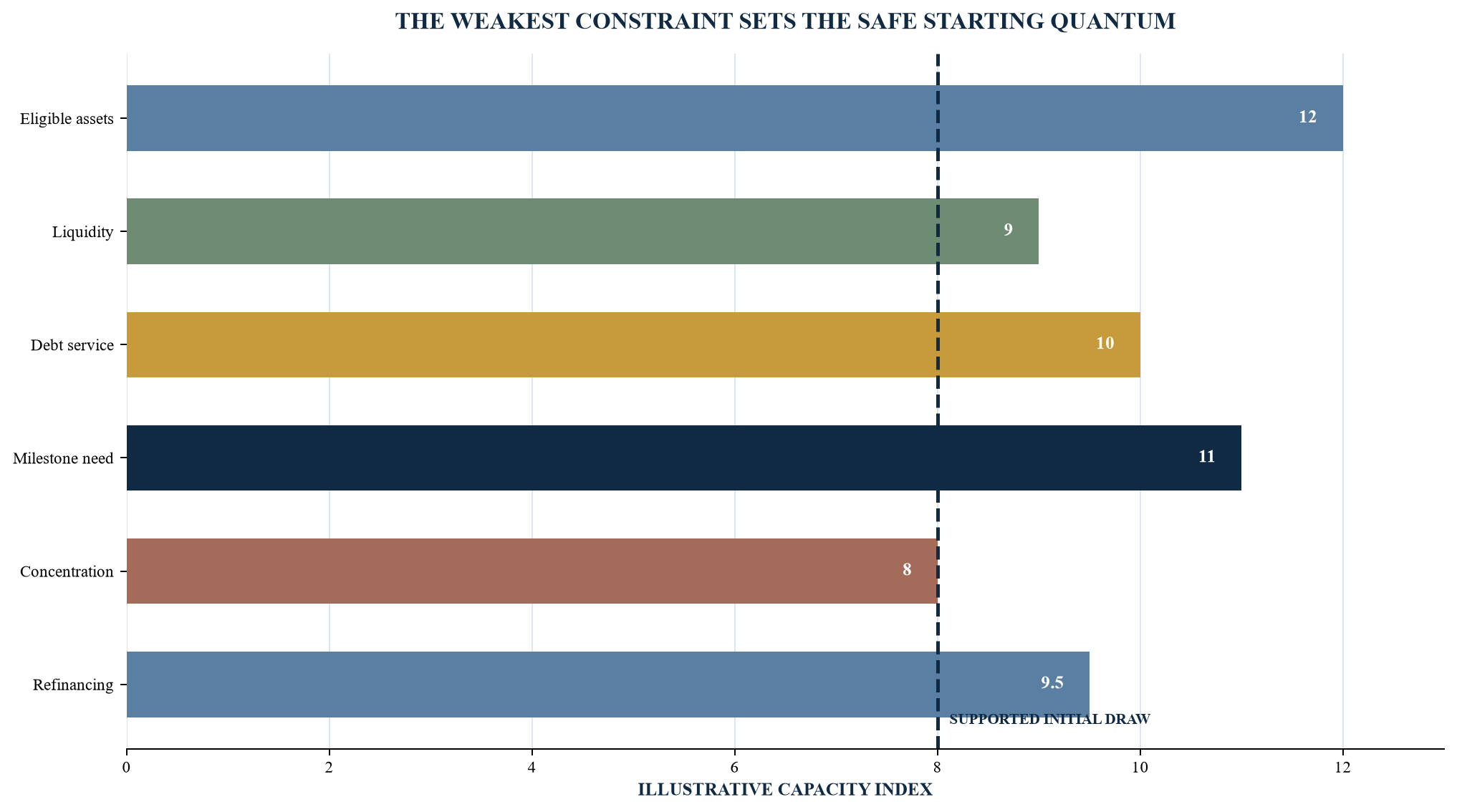
Indexed values are illustrative; the weakest constraint sets the initial supported amount.
Table 4. Debt-capacity constraints and decisions
| Constraint | Core calculation | Decision question | Structuring response |
|---|---|---|---|
| eligible assets | advance rate times eligible assets less reserves | What collateral supports the draw today? | borrowing-base cap and certificate |
| liquidity | lowest unrestricted cash across approved cases | Can the company operate above minimum cash? | smaller draw, reserve or delayed commitments |
| debt service | cash available for interest and amortisation | Can fixed payments be met on time? | interest-only period, staged amortisation or lower debt |
| milestone | cash required to reach defined evidence | Is the draw matched to a bounded value-inflection plan? | tranche by use and milestone |
| concentration | availability after customer and group limits | Can one obligor impair repayment? | excess reserve, guarantee or diversification condition |
| refinancing | supportable debt or equity at maturity | Is takeout credible under downside conditions? | tenor, prepayment, equity covenant or smaller facility |
Illustrative tests should be replaced with the approved facility definitions and company model.
11. Use tranches and delayed draws to match execution
A single fully funded term loan can create unnecessary interest and control risk when the company needs capital in stages. A tranche structure can align availability with contract acceptance, new eligible receivables, customer diversification, product delivery or an equity milestone. Each condition should be objective, measurable and capable of verification within the required timetable.
The first tranche should fund the critical near-term plan while preserving minimum liquidity. A second tranche can become available after named contracts reach acceptance or eligible invoices. A third can depend on diversification, recurring-revenue quality or a capital event. The conditions should avoid circularity; a company should not need the tranche to achieve a condition that must already be satisfied before drawing it unless the first tranche adequately funds that path.
Delayed-draw periods should reflect the implementation calendar and customer cash cycle. Commitment fees, expiry, material-adverse-change provisions, default conditions and documentary requirements affect whether delayed capital is genuinely available. Management should maintain a draw-readiness checklist and forecast the earliest and latest draw dates.
The structure can also include an invoice sublimit within a venture-debt facility. Short-dated receivables can support a revolving component, while the milestone plan supports a term component. Clear allocation, security, priority and repayment mechanics are essential, especially where multiple lenders, factoring providers or bank facilities may claim the same proceeds.
12. Design covenants around evidence and early action
Covenants should identify deterioration early enough for a controlled response. A minimum-liquidity covenant protects immediate solvency. A borrowing-base covenant limits drawings to eligible support. Contract and customer concentration tests protect asset quality. Reporting covenants preserve evidence. Additional-debt, lien, disposal and acquisition restrictions protect priority and enterprise value. Milestone covenants can govern later tranches without turning every operating variance into default.
Definitions determine economic effect. Cash should distinguish unrestricted and restricted balances. Eligible receivables should address age, dispute, set-off, currency, location, assignment and prior liens. Concentration should define related obligors and government entities. Debt should address leases, guarantees, factoring, deferred consideration and intercompany claims. Reporting dates should match the company's close capacity.
Headroom should be tested against volatility and cure time. A threshold set close to the central case can create frequent waiver requests and distract management. A threshold with excessive room can fail to trigger action. Early-warning levels, board escalation, formal covenant tests, cure rights and default consequences should form a deliberate ladder. Equity cure, cash collateral, prepayment and exclusion of assets have different effects and should be negotiated explicitly.
CBUAE's credit-risk standards emphasise forward-looking repayment analysis, documentation, covenants, collateral, legal enforceability and ongoing monitoring.[4] These principles support a practical operating calendar: controlled monthly close, borrowing-base certificate, rolling forecast, covenant certificate, customer exceptions, delivery status and board actions. The facility should be manageable through evidence that the business can produce reliably.
13. Perfect security and control collections
Security value depends on valid creation, perfection, priority and enforcement. In the UAE, Federal Law No. 4 of 2020 covers security rights in movable property and expressly includes accounts receivable, while its executive regulations address registration and priority mechanics.[5][6] Federal Decree-Law No. 16 of 2021 addresses factoring and transfer of receivables.[7] Other GCC jurisdictions have their own frameworks. The company and lender need jurisdiction-specific legal advice covering the borrower, obligor, governing law, receivable, account and enforcement route.
The security review should identify existing bank security, shareholder loans, venture facilities, factoring arrangements, equipment finance, guarantees and negative pledges. A lien search and debt register should be reconciled to the accounts and board records. Intercreditor or release arrangements may be required before the new lender obtains the intended priority.
Collection control can use a designated account, notice to customers, acknowledgement, lockbox, sweep or springing control after a trigger. The structure must consider customer procurement requirements, confidentiality, tax, foreign exchange and operational continuity. A notice process that causes customer concern can damage the commercial relationship; a silent assignment can reduce practical control. The parties should balance enforceability, disclosure and customer experience through actual legal advice and transaction design.
Security documents should not substitute for cash-flow underwriting. CBUAE standards require realistic recovery assumptions, legal enforceability and documented collateral management.[4] Technology-company recoveries can be uncertain when value depends on people, software, data rights, customer continuity and ongoing service. Contract proceeds are most valuable when the company remains able to perform and collect.
14. Build a lender data room that proves the chain
The data room should allow a lender to trace the financing thesis from contract to cash. The core pack includes corporate authority, capitalisation, debt and security, statutory accounts, management accounts, cash, tax, forecasts, customer contracts, orders, delivery, acceptance, invoices, ageing, collections, disputes, credits, concentration, intellectual property, data protection, cyber security, material suppliers, litigation and insurance. Each schedule needs a cut-off date, owner and reconciliation status.
The contract index should link every material customer to the executed document set and summarise the financing fields. The receivables index should link invoices to acceptance and portal evidence. The cash index should allocate receipts to invoices. The security index should show registrations, releases and priority. A question log should record lender requests, responsible owner, approved response and source document.
Confidentiality and data minimisation matter. Customer contracts can contain restrictions, personal data, security information and pricing. Access should be role-based, logged and staged. Redactions should preserve the lender's ability to verify material terms. Where disclosure requires consent, the timetable should include that dependency.
Consistency is a central diligence test. Revenue, contracts, invoices, receivables, cash, forecasts and board materials should use stable definitions. Differences should be explained openly. A controlled reconciliation is stronger than a superficially perfect pack whose numbers cannot be traced.
Table 5. Lender-ready evidence pack
| Workstream | Core items | Reconciliation gate | Owner |
|---|---|---|---|
| corporate and capital | group chart, authority, cap table, options and shareholder rights | legal entities agree across records | company secretary and legal |
| debt and security | facilities, guarantees, liens, leases, factoring and intercompany claims | debt register agrees to accounts and searches | finance and legal |
| financial | statutory accounts, management accounts, cash, tax and forecast | opening balances and cash reconcile | chief financial officer |
| contracts | agreements, orders, amendments, acceptance and customer rights | contract register agrees to commercial systems | commercial and legal |
| receivables | invoices, ageing, disputes, credits and expected losses | subledger agrees to general ledger | finance controller |
| collections | bank receipts, allocation, days-to-pay and deductions | cash agrees to bank and invoice allocation | treasury |
| delivery and technology | implementation, service levels, security, data and suppliers | delivery status agrees to billing assumptions | product and technology |
| governance | board approvals, model versions, certificates and exceptions | decisions agree to current financing case | board and chief financial officer |
Scope should be tailored to the borrower, facility and jurisdictions.
15. Integrate dilution, pricing and founder-control analysis
Non-dilutive capital does not mean costless capital. The company should compare the facility with an equity round at several valuation outcomes. The analysis should include interest, fees, warrants or participation, legal and diligence cost, prepayment, reporting burden, restricted flexibility, downside equity needs and the value of delayed dilution. It should also show founder and investor ownership after each scenario.
Debt can improve founder outcomes when it bridges to credible value evidence. For example, completing a contracted deployment and collecting the first invoices may reduce commercial uncertainty before an equity round. Debt can worsen outcomes when a milestone slips and the company raises equity under covenant pressure with less runway. The decision therefore depends on probability, timing and downside, not a single valuation forecast.
Pricing should be compared on an all-in basis. Cash coupon, profit rate, original-issue discount, arrangement fee, commitment fee, monitoring fee, exit fee, warrants and legal costs should be translated into cash and ownership effects. The analysis should also value undrawn flexibility and prepayment rights. A lower headline coupon can be more expensive when warrants, fees or rigid covenants are included.
The board should approve a capital-path matrix with central, delay, contract-loss and stronger-conversion cases. Each case should show liquidity, debt, covenant status, equity timing, ownership and decision dates. This prevents the non-dilution narrative from obscuring the fixed-claim risk.
16. Run downside cases through a cash waterfall
Downside analysis should be specific to the contract portfolio. A delayed acceptance case moves the invoice and collection date while delivery cost continues. A disputed-scope case reduces eligibility and adds remediation cost. A concentration-loss case removes a named customer and tests stranded staff or infrastructure. A budget-delay case shifts a government-related receipt across a financial period. A currency case changes both collections and costs.
The waterfall should begin with opening unrestricted cash and add controlled receipts. It should deduct delivery cost, operating expenditure, tax, capital expenditure, debt service and minimum cash. Mitigations should be shown separately with realistic lead times. The model should identify the first decision date, first covenant warning, first formal breach and minimum liquidity point.
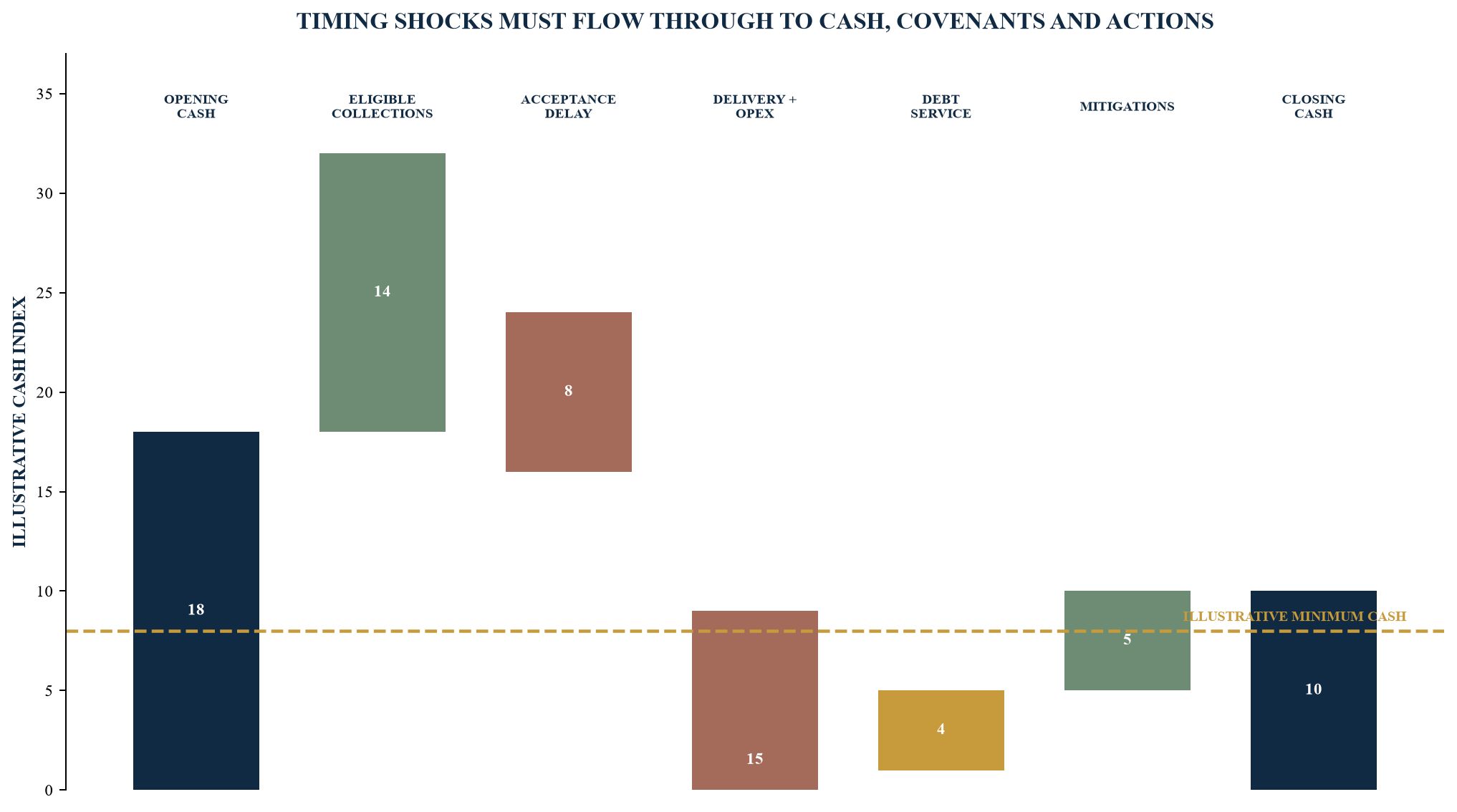
Values are illustrative management assumptions; mitigation effects require owner, timing and execution evidence.
Table 6. Downside cases and financing responses
| Case | Contract event | Borrowing-base effect | Liquidity response | Financing decision |
|---|---|---|---|---|
| central | delivery, acceptance and collection on controlled dates | standard eligibility and reserves | planned draw and minimum cash | proceed within approved parameters |
| acceptance delay | milestone approval moves by 60 days | unbilled value remains excluded | accelerate evidence, defer discretionary spend | delay next tranche and escalate |
| invoice dispute | customer contests scope or deduction | disputed amount excluded and reserve raised | resolve issue and reforecast receipts | reduce availability until cure |
| concentration loss | largest customer terminates or does not renew | obligor assets fall out and excess changes | cut cost, preserve cash and seek equity support | amendment or restructuring before breach |
| government budget delay | approved invoice moves to later payment cycle | asset may age toward ineligibility | extend cash plan and use only verified availability | waiver or reserve if timing breaches tests |
| stronger conversion | new contracts reach acceptance and diversify base | eligible assets and headroom increase | preserve liquidity and draw only as needed | consider delayed draw or early prepayment |
Cases are illustrative and should be rebuilt from the company's actual contract portfolio.
17. Execute through a 100-day financing process
The first 15 days establish mandate, purpose, evidence owners and the current contract-to-cash fact base. Management should reconcile cash, debt, security, contracts, receivables and collections, then record gaps. The board should approve the financing question, minimum cash and communication protocol.
Days 16 to 30 build the contract scorecard, eligibility policy, borrowing base, 13-week cash view, monthly model and downside cases. Legal advisers should begin assignment, security, priority and customer-consent analysis. The output is an approved financing brief with a target structure and fallback.
Days 31 to 50 prepare the lender universe, information memorandum, model, data room and management presentation. Lenders should be selected for product fit, jurisdiction, cheque size, speed, sector understanding and ability to support later growth. Outreach should be controlled through approved materials and confidentiality.
Days 51 to 75 cover lender meetings, diligence, customer and legal questions, and proposal comparison. Every proposal should be normalised for amount, availability, pricing, warrants, security, covenants, reporting, conditions, prepayment, default and execution certainty. The model should be updated for actual terms.
Days 76 to 100 cover term-sheet approval, documentation, conditions precedent, security, collection arrangements, draw readiness and reporting mobilisation. The company should dry-run the borrowing-base and covenant certificates before closing. Post-close owners, calendars and escalation paths should be active before the first draw.
18. Govern the facility as a monthly operating system
Closing is the start of credit management. The monthly operating cycle should reconcile contracts, delivery, invoices, receivables, collections, cash, debt, borrowing base, covenants and milestones. Finance, commercial, delivery, legal and treasury owners should meet before the board pack is finalised. Exceptions should be recorded with actions and dates.
The board dashboard should show eligible and ineligible assets, availability, drawn debt, unrestricted cash, minimum-cash headroom, top obligors, ageing, disputes, dilution, forecast receipts, covenant headroom, milestone status and the next decision date. It should distinguish observed results from management assumptions. Trends should remain visible across periods.
Certificates should be produced from controlled data and reviewed before submission. The company should preserve source files, calculations, approvals and lender correspondence. Any error should be corrected promptly under the transaction documents. A recurring dry run can identify definition or system problems before a formal test date.
The financing strategy should be revisited when the contract portfolio, customer mix, jurisdiction, facility usage or equity plan changes. Stronger collections may support a larger revolving base or early prepayment. Weaker delivery or concentration may require lower debt and more equity. The governing principle remains stable: debt should expand strategic options while the evidence and control system protects liquidity.
References
- International Monetary Fund. (2025). GCC: Enhancing Resilience to Global Shocks, Economic Prospects and Policy Challenges. https://www.elibrary.imf.org/view/journals/007/2025/043/article-A001-en.xml
- OECD. (2026). Financing SMEs and Entrepreneurs 2026: An OECD Scoreboard. https://www.oecd.org/en/publications/financing-smes-and-entrepreneurs-2026_075d8058-en/full-report.html
- Central Bank of the UAE. (2024). Credit Risk Management Regulation, effective 30 November 2024. https://rulebook.centralbank.ae/en/rulebook/credit-risk-management-regulation
- Central Bank of the UAE. (2024). Credit Risk Management Standards, effective 30 November 2024. https://rulebook.centralbank.ae/en/rulebook/credit-risk-management-standards
- United Arab Emirates. (2020). Federal Law No. 4 of 2020 on Securing the Rights in Movables. https://www.uaelegislation.gov.ae/en/legislations/1446/download
- United Arab Emirates. (2021). Cabinet Resolution No. 29 of 2021 concerning the Executive Regulations of Federal Law No. 4 of 2020. https://www.uaelegislation.gov.ae/en/legislations/1487/download
- United Arab Emirates. (2021). Federal Decree-Law No. 16 of 2021 on Factoring and Transfer of Receivables. https://uaelegislation.gov.ae/en/legislations/1515/download
- Saudi Central Bank. (2023). Supervisory LGD and EAD Estimates: Eligible Financial Receivables and Legal Certainty. https://www.rulebook.sama.gov.sa/en/section-9-supervisory-lgd-and-ead-estimates
- Saudi Central Bank. (2024). Updated Rules for Engaging in Debt-Based Crowdfunding. https://sama.gov.sa/en-US/MediaCenter/News/pages/news-1047.aspx
- Emirates Development Bank. (2020). National Supply Chain Finance Platform. https://www.edb.gov.ae/index.php/posts/emirates-development-bank-launches-national-supply-chain-finance-platform
- Emirates Development Bank. (2024). EDB and KLAIM Unveil Working Capital Solutions for Healthcare Providers. https://edb.gov.ae/posts/emirates-development-bank-and-klaim-unveil-working-capital-solutions-improving-cash-flows-for-healthcare-providers
- International Finance Corporation. (2026). Global Supply Chain Finance Program. https://www.ifc.org/en/what-we-do/sector-expertise/trade-and-supply-chain-finance/global-supply-chain-finance
- World Bank. (2015). Secured Transactions and Collateral Registries. https://www.worldbank.org/en/topic/financialsector/brief/collateral-registries
- IFRS Foundation. IFRS 15 Revenue from Contracts with Customers. https://www.ifrs.org/issued-standards/list-of-standards/ifrs-15-revenue-from-contracts-with-customers/
- IFRS Foundation. IFRS 9 Financial Instruments. https://www.ifrs.org/content/dam/ifrs/publications/pdf-standards/english/2022/issued/part-a/ifrs-9-financial-instruments.pdf
- IFRS Foundation. IAS 7 Statement of Cash Flows. https://www.ifrs.org/issued-standards/list-of-standards/ias-7-statement-of-cash-flows/
- Central Bank of the UAE. (2020). UAE MSME Business Survey Report. https://www.centralbank.ae/media/rtdlng34/cbuae-msme-survey-report-2020-en.pdf
- OECD. (2025). Financing SMEs and Entrepreneurs Scoreboard: 2025 Highlights. https://doi.org/10.1787/64c9063c-en
About the Author
Chennakeshav Adya is an independent researcher and Managing Partner of Matchpoint Partners. His work focuses on corporate finance, transactions, private capital, strategic execution and the operating systems required to convert financing into measurable enterprise value.
Appendix: Appendix A. Contract-to-cash control checklist
Commercial evidence
Confirm the contracting and paying entities, executed agreement, statement of work, order, committed value, pricing, term, renewal, termination, service levels, credits and change-control status. Classify each amount as fixed, usage-based, milestone, implementation, hardware, reimbursable, optional or forecast. Reconcile the contract register to customer systems and the approved forecast.
Delivery and acceptance
Confirm delivery owner, implementation plan, dependencies, milestone evidence, customer acceptance, open issues, service performance and right to payment. Link acceptance to billing events and identify any retention, deduction or rejection process. Record expected completion and downside dates as management assumptions.
Invoice and receivable
Confirm purchase order, invoice details, tax requirements, portal submission, validation, due date, dispute, set-off, credit, retention, currency and ageing. Reconcile the receivables subledger to the general ledger and expected-credit-loss schedule. Identify prior assignments and security interests.
Collection and control
Confirm payer, collection account, notice or acknowledgement, payment history, days-to-pay, unapplied cash and sweep mechanics. Reconcile bank receipts to invoices. Escalate deviations from expected timing through the approved liquidity ladder.
Facility and governance
Confirm eligibility, advance rate, concentration, reserves, availability, debt, interest, fees, minimum cash, covenants, reporting, draw conditions and repayment. Retain certificate calculations, approvals and source evidence. Record exceptions with owners, actions and expiry dates.
Appendix B. Board decision record
The board record should state the financing purpose, approved uses, milestone, requested and supported quantum, instrument comparison, minimum liquidity, downside cases, customer concentration, contract and legal risks, security, collection control, covenant headroom, repayment path, delegated authorities and reporting calendar. It should identify professional advice received and unresolved conditions. The record should distinguish verified evidence from management assumptions and should be refreshed if the financing case changes materially.
