
1. The financing problem
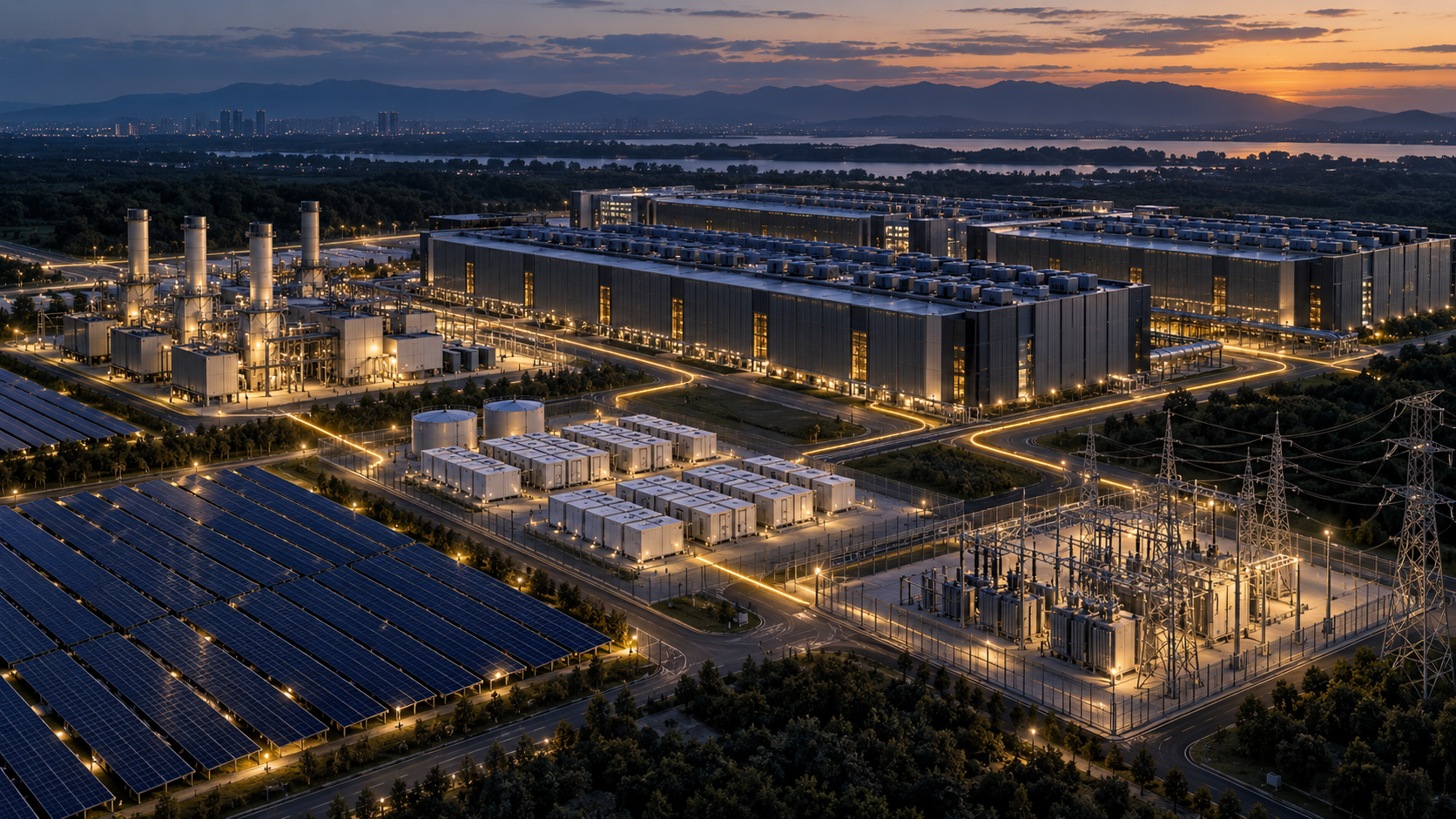
AI computing campuses require unusually large, reliable and rapidly deployable electrical capacity. The International Energy Agency expects data-centre electricity demand to increase materially through 2030 and identifies renewables, natural gas, nuclear power, storage and the wider grid as parts of the emerging supply mix.[1][2] Data-centre construction can proceed faster than major transmission, generation and interconnection programmes. The resulting timing mismatch can turn power delivery into the critical path for the campus.
Behind-the-fence generation is one response. A campus can combine onsite dispatchable generation, renewable supply, batteries, uninterruptible power systems and a grid connection under an integrated control architecture. The system can provide primary supply, bridge supply, resilience, peak management or a pathway to a later low-carbon configuration. Its commercial purpose must be defined before capital is structured.
This paper addresses the capital stack for that hybrid system. It focuses on the relationship among technical architecture, contracts, permits, asset ownership, cash flow and risk. It does not recommend a technology, jurisdiction or financing product for a named development.
2. Define “behind the fence” precisely
The phrase can refer to assets electrically located on the customer side of a utility meter, assets physically located on the same campus, or generation contractually dedicated to a customer. These meanings are not interchangeable. Ownership, dispatch, tariff, export rights, reliability obligations and regulatory status can change with the point of connection and applicable market rules.
The transaction team should draw the electrical single-line boundary, the land boundary and the legal ownership boundary. It should identify the meter, grid point, generation buses, storage, backup equipment, campus distribution, cooling load, computing load and any export path. A contract map should show who owns, operates, fuels, maintains and dispatches each component.
Financing depends on those boundaries. A lender secured on generation assets may have limited rights over the campus network. A data-centre lender may rely on power supplied by an entity outside its collateral perimeter. A public utility may impose conditions that affect both entities. Ambiguity at the perimeter can become a completion and enforcement risk.
3. Start with the service requirement
The system should be designed and financed against a dated service requirement rather than a single headline megawatt number. The load profile should state initial demand, ramp, hourly variability, power quality, redundancy, ride-through, maintenance, black-start, fuel duration and expansion. AI training and inference workloads can have different utilisation and flexibility characteristics.
The service requirement also identifies which resources create value. Dispatchable generation can provide firm energy. Batteries can manage rapid changes, power quality and short-duration interruptions. Renewable generation can reduce fuel consumption and emissions when available. The grid can provide energy, balancing, redundancy or export, subject to the connection agreement.
A system that meets peak nameplate capacity but fails the required availability or power quality cannot support the intended compute service. The financing model should therefore translate technical service into customer revenue and contractual performance tests.
4. Separate four asset perimeters
The first perimeter is the data-centre CampusCo: land, buildings, computing halls, cooling, internal distribution and customer contracts. The second is PowerCo: dispatchable generation, batteries, renewable equipment, controls and operating contracts. The third is GridCo or the regulated-network interface: substation, interconnection works, protection, metering and shared upgrades. The fourth is FuelCo or the fuel-supply interface: pipeline, storage, transport, pressure regulation and commodity arrangements.
The same sponsor can own all four, but the economic risks remain different. Campus demand and customer concentration sit primarily in CampusCo. Construction, heat rate, availability and maintenance sit in PowerCo. Queue, system studies and network works sit at the grid interface. Commodity, transport and interruption sit at the fuel interface.
Separate perimeters make capital allocation auditable. They also expose intercompany dependencies. A consolidated model can conceal whether one asset is subsidising another or whether the same cash flow supports two debt facilities.
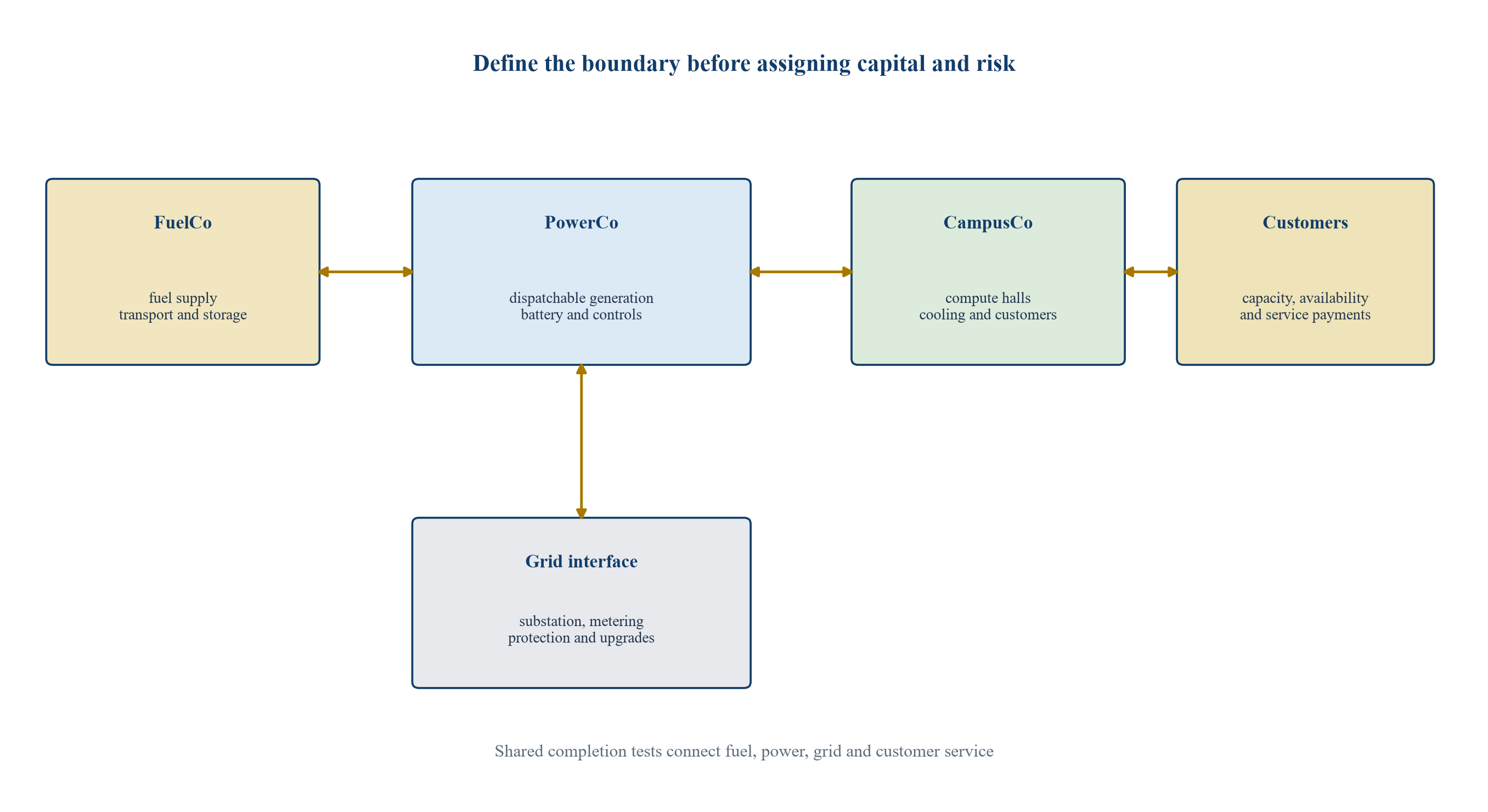
Generic architecture; legal and electrical boundaries depend on the applicable jurisdiction and project documents.
5. Choose the commercial role of onsite generation
Onsite generation can serve as a temporary bridge until grid delivery, a permanent primary source, a resilience layer, a peak resource or part of a flexible microgrid. Each role creates a different revenue duration and financing profile. A bridge asset can lose utilisation when the grid arrives. A permanent asset depends on long-term fuel economics, permits and operating performance. A resilience asset can have low energy output but high avoided-outage value.
The role should appear consistently in technical specifications, permits, customer contracts, the financial model and financing documents. If the base case assumes permanent operation while the permit supports emergency use only, projected energy revenue is unsupported. If customers pay for high availability, the model must fund redundancy, maintenance and fuel security.
The sponsor should also define the transition path. A system can begin with gas and storage, then add renewable supply, efficiency measures or other low-emission resources as technology and grid conditions evolve. The financing should preserve that option without capitalising assets that do not yet have approvals or contracts.
6. Build the capital stack by risk stage
Development capital funds site control, studies, permits, fuel routes, interconnection, concept engineering and customer engagement. This stage has binary and redesign risk; sponsor equity or specialised development capital normally bears it. Construction capital enters after scope, contracts and permits become sufficiently mature. It can include sponsor equity, strategic equity, equipment finance, construction debt and vendor support.
Operating project finance becomes more plausible after completion tests and stable contracted cash flow. Refinancing can release expensive development and construction capital. The precise transition depends on jurisdiction, technology, counterparties and lender requirements.
Capital should be released against evidence gates. Funding all phases at financial close can create negative carry and weaken discipline. Underfunding interface works can strand generation or campus assets. A sources-and-uses schedule should include contingencies, reserves, restricted security and the cost of delay.
Table 1. Capital sources matched to development stage
| Stage | Principal expenditure | Suitable risk capital | Key evidence gate | Principal protection |
|---|---|---|---|---|
| Origination | site, studies, applications and options | sponsor and development equity | viable site, load case and routes | staged option payments and stop rights |
| Definition | engineering, permits, fuel and grid studies | sponsor, strategic and specialist capital | defined scope and credible approvals path | milestone budgets and reserved matters |
| Construction | equipment, civil works, electrical works and network works | equity, construction debt, equipment and vendor finance | executable contracts, permits and funded contingency | completion support, tests and draw controls |
| Commissioning | fuel, testing, ramp and customer acceptance | remaining equity, working-capital and liquidity facilities | integrated performance tests | retention, liquidated damages and reserves |
| Operations | stable power service and maintenance | project debt, institutional debt and long-term equity | dependable contracted cash flow | covenants, direct agreements and reserve accounts |
| Expansion | additional generation, storage or grid capacity | retained cash, incremental debt and new equity | demonstrated demand and interface capacity | ring-fenced phase tests and no-harm covenants |
Illustrative financing roles; availability and terms require project-specific market testing.
7. Ring-fence PowerCo cash flow
A dedicated PowerCo can contract with CampusCo under a power, capacity, availability or energy-services agreement. The contract can separate fixed capacity payments from variable energy charges and fuel pass-through. That separation helps lenders understand which cash pays fixed capital and which cash covers dispatch-dependent cost.
Ring-fencing also creates governance obligations. CampusCo and PowerCo may share ownership, so related-party pricing and enforcement require discipline. Lenders need a clear payment waterfall, restrictions on distributions, reserve requirements, information rights and direct agreements. The project must avoid counting the same customer revenue as full support for both data-centre debt and power debt.
PowerCo is useful only when the boundaries are real. It requires enforceable land rights, equipment ownership, permits, fuel, access, interconnection rights and operating control. A special-purpose vehicle without those rights does not create bankability.
8. Design the revenue model
Capacity or availability payments can support fixed capital where PowerCo makes tested capacity available under defined conditions. Energy payments can recover variable operation and maintenance, fuel and consumables. A fuel pass-through can reduce commodity exposure, subject to efficiency standards and procurement controls. Performance incentives and deductions can align availability, heat rate, emissions and response.
The tariff should distinguish force majeure, grid events, customer-caused outages and PowerCo failure. It should define dispatch instructions, planned maintenance, testing, metering, losses, taxes, change in law and termination compensation. The term should align with debt tenor and asset life.
Merchant revenue from exports or grid services should enter the base case only where the connection, market rules, licences, metering and operating strategy support it. Otherwise it belongs in a separately identified scenario.
9. Match generation technology to financeability
Reciprocating engines, aeroderivative turbines, larger gas turbines, fuel cells and other technologies have different efficiency, modularity, start time, maintenance, emissions and construction profiles. The choice should follow the service requirement, site conditions, fuel, permits and lifecycle cost. Technology selection also affects contract structure and lender diligence.
Modular units can support phased commissioning and redundancy. Larger units can create scale benefits while increasing single-unit outage and construction concentration. Newer technologies can offer strategic advantages but may have limited operating history, supplier depth or residual-value evidence.
Financing should use verified manufacturer data, independent engineering review, warranties, long-term service arrangements and realistic degradation. A vendor proposal is evidence of offered terms; it is not proof of delivered campus performance.
10. Give batteries a defined economic job
Battery storage can provide ride-through, ramp management, reserve, peak reduction, renewable integration and, where permitted, grid services. These functions can compete for the same stored energy and power capacity. The model should define priority, state-of-charge policy, cycle limits, degradation and replacement.
Battery value should be allocated between CampusCo and PowerCo. A system primarily protecting computing equipment can sit within campus infrastructure. A system optimising generation or providing market services can sit in PowerCo. Shared use requires dispatch rules and an economic allocation.
Debt sizing should include degradation, augmentation, warranty conditions, fire safety, insurance and replacement reserves. A nominal initial capacity should not be treated as constant over the financing term.
11. Treat renewable supply as a portfolio component
Onsite solar or contracted renewable supply can reduce fuel use and emissions. Its output varies by resource, season and time. The value to a continuous AI load depends on coincidence, storage, curtailment, contract terms and the rest of the power portfolio.
The model should separate physical supply, contractual environmental attributes and accounting claims. A renewable power purchase agreement can affect cost and emissions reporting without creating the same operational resilience as onsite dispatchable generation. The paper makes no claim about a particular project's environmental status.
Renewable assets can be financed in a separate SPV when their cash flows and rights are separable. Interface agreements should govern forecasting, curtailment, metering and priority. The campus financing should avoid counting the same renewable benefit in PowerCo economics and a separate asset valuation.
12. Make the grid a contracted component
A behind-the-fence system rarely makes the grid irrelevant. The grid may provide backup, balancing, black-start support, imports during maintenance and a later pathway to larger capacity. It can also impose protection, telemetry, operating and export requirements.
FERC proceedings on co-located large loads and NERC's large-load work show that load, generation and system interaction require transparent rules, modelling and coordination.[3][4] Regulatory treatment is jurisdiction-specific. The transaction team should verify whether the campus remains a network load, how onsite generation changes that status, and which costs or obligations apply.
The model should include connection capital, demand charges, standby tariffs, network security, metering and continuing compliance. A grid connection with low expected energy volume can still carry material fixed cost and strategic value.
13. Secure fuel as infrastructure
Fuel supply is part of the completion system. The project should verify commodity availability, transport capacity, pressure, quality, interruption rights, storage, balancing, credit support and force majeure. A long-term commodity contract cannot substitute for absent pipeline or transport capacity.
Fuel price exposure can sit with PowerCo, CampusCo or the customer. A pass-through reduces price risk but can weaken incentives unless heat rate and procurement are governed. Hedging can reduce volatility for a defined period; it creates collateral, credit and basis risks that require modelling.
Dual-fuel or stored-fuel capability can improve resilience where permitted and technically suitable. It also adds capital, logistics, environmental and working-capital requirements. The base case should include only infrastructure and rights supported by evidence.
14. Put permits on the critical path
Onsite generation can require air, water, noise, land, construction, fuel, safety and operating approvals. The exact regime varies by technology and jurisdiction. In the United States, environmental permitting responsibilities can involve federal, state and local authorities.[5] The sponsor should obtain project-specific advice and maintain a permit register.
Permits should align with operating assumptions: hours, fuel, emissions, starts, testing and emergency status. A permit path designed for backup use may not support continuous primary generation. The financial model should reflect required controls, monitoring, offsets, fees and compliance staffing.
Debt draw conditions should distinguish permits needed before construction, installation, commissioning and operations. Long-lead equipment should not be ordered on an unsupported assumption that operating permission will follow.
15. Integrate construction schedules
Campus buildings, generation, fuel, batteries, substations, grid works and computing equipment have separate supply chains and contractors. Commercial operation requires their schedules to converge. The integrated schedule should identify shared civil works, energisation sequence, temporary power, commissioning loads and customer acceptance.
Interface delay can arise even when each contractor meets its own contract. An owner's engineer or integration manager should control boundary specifications and testing. Contract notices and change procedures should be consistent across packages.
The finance model should use the integrated critical path. It should include delay carry, standing time, rework, equipment storage, warranty start and customer consequences. Schedule contingency should reflect identified risks rather than a generic percentage alone.
16. Use one completion definition
Mechanical completion, first fire, energisation, synchronisation, substantial completion and commercial operation describe different events. Financing documents, construction contracts, customer agreements and the PowerCo service agreement should use a coordinated completion framework.
The final test should demonstrate the service required by the campus. It can include net usable power, duration, availability, transitions between resources, islanding where permitted, black start, load steps, power quality, emissions and communications. Test conditions and correction factors should be agreed in advance.
Debt conversion and equity release should occur only when the relevant tests and documentation are satisfied or expressly waived by authorised parties. A waiver should preserve a record of residual risk and funding.
17. Allocate EPC and interface risk
A single turnkey contract can simplify responsibility but may carry a premium and still exclude grid, fuel or campus interfaces. Multiple packages can improve specialist selection and transparency while leaving the sponsor with integration risk. The contracting strategy should match sponsor capability and the availability of creditworthy contractors.
Liquidated damages should relate to realistic loss and enforceability. Caps, exclusions and relief events determine their value. Parent guarantees, bonds, retention and warranties add protection but do not fund unlimited delay.
The financing base case should not assume full recovery of every loss from contractors. It should include contingency and liquidity for exposures outside contractual recovery, disputed claims and the timing gap before payment.
18. Map the contractual risk allocation
Table 2. Contract and risk allocation matrix
| Risk | Evidence required | Potential bearer | Financing response |
|---|---|---|---|
| Customer ramp | executed service commitments and credit review | CampusCo, customer or sponsor | phased draws, minimum payments and liquidity |
| Fuel availability | transport and commodity agreements | supplier, PowerCo or sponsor | firm capacity, storage, reserves and step-in rights |
| Fuel price | index and pass-through provisions | CampusCo, customer or PowerCo | pass-through, collars, hedging and covenant headroom |
| Construction delay | integrated schedule and package interfaces | contractor, sponsor or shared | completion support, contingency and long-stop rights |
| Performance | tests, warranties and service agreement | vendor, operator or PowerCo | retention, damages, reserve and debt sizing haircut |
| Grid interaction | connection agreement and operating protocol | network, PowerCo or CampusCo | conservative base case, curtailment rules and direct agreement |
| Permitting | permit register and authority correspondence | sponsor or PowerCo | staged commitment and stop conditions |
| Change in law | jurisdiction-specific contractual clause | shared according to control | tariff reopeners, reserve and termination regime |
| Technology transition | approved transition plan | sponsor, investors or customers | modularity, refinancing gates and no assumed future value |
The preferred bearer is project-specific and must be tested against actual control, credit and applicable law.
19. Build a hypothetical staged case
Consider a hypothetical campus targeting 300 MW of net usable power in three 100 MW phases. The illustrative portfolio contains dispatchable generation, batteries, renewable supply and a grid connection. Phase one uses onsite generation and storage while network capacity ramps. Later phases combine larger grid supply with continuing onsite resilience. These assumptions are designed solely to demonstrate the method.
The capital plan separates early development, generation packages, fuel and electrical interfaces, batteries, renewable assets and reserves. It does not state market cost. Each amount should be replaced by current bids, independent estimates and contract terms in a live transaction.
The investment committee first funds development evidence. It then authorises equipment deposits after permits and fuel routes reach defined maturity. Full construction debt follows executable contracts, equity commitment and an integrated completion case. Operating debt follows performance and customer tests.
20. Stage sources and uses
The hypothetical plan allocates sponsor and strategic equity to development, deposits, contingency and subordinated interface risk. Construction debt funds eligible installed assets after conditions precedent. Equipment finance is limited to assets with identifiable title and lender rights. Working-capital and liquidity facilities cover fuel, ramp and timing rather than permanent cost overruns.
Each source has a permitted use. Restricted connection security, debt-service reserves and maintenance reserves are not available for general construction. Vendor finance should be recognised with its repayment, security and cross-default terms.
An unfunded future refinancing should not fill the sources-and-uses gap. Refinancing is an exit assumption contingent on completion, cash flow and market conditions.
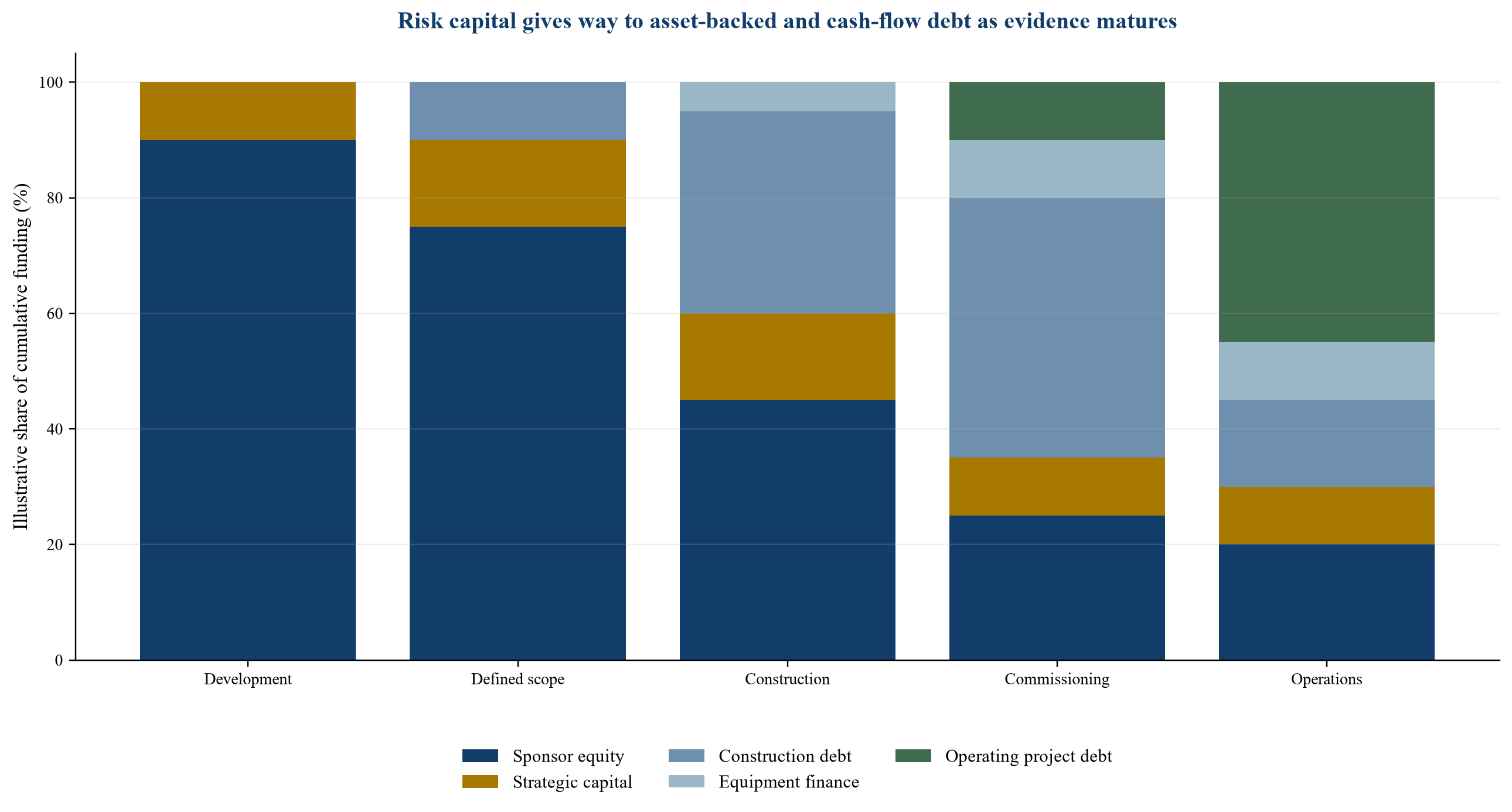
Relative proportions are illustrative; they do not represent a market financing or named project.
21. Size debt to dependable cash
Debt capacity should follow cash available for debt service under tested downside conditions. Fixed capacity payments can support debt when they are enforceable, creditworthy and aligned with availability. Variable energy margins are less dependable when dispatch, fuel or customer utilisation is uncertain.
The lender should test customer concentration, affiliate payments, termination, set-off, performance deductions, fuel pass-through, maintenance, taxes and lifecycle capital. It should verify that PowerCo cash remains available after any senior claims at CampusCo or other project entities.
Coverage ratios alone cannot resolve missing completion rights. Security, direct agreements, cure, step-in, insurance, reserve accounts and a funded recovery plan are part of debt capacity.
22. Prevent double leverage
CampusCo may finance its buildings and customer cash while PowerCo finances the generation supported by payments from CampusCo. This structure can be sound when obligations and priorities are explicit. It becomes fragile when both lenders assume first reliance on the same residual cash.
The consolidated model should reconcile customer receipts to operating costs, PowerCo payments, campus debt service, power debt service and distributions. Intercreditor arrangements should govern payment blocks, cure, enforcement, shared collateral and service continuity.
Stress testing should examine whether CampusCo can continue paying PowerCo during slower customer ramp and whether PowerCo can continue service during a CampusCo restructuring. Essential-service status does not create cash by itself.
23. Protect lenders through direct agreements
PowerCo lenders can require direct agreements with CampusCo, key fuel suppliers, operators, land providers and major contractors. These agreements can provide notices, cure periods, step-in and restrictions on termination. Their value depends on applicable law, counterparty consent and practical ability to operate the asset.
CampusCo lenders also need continuity of power. They should understand whether enforcement against the campus leaves the power contract in place and whether a replacement owner can assume it. Cross-defaults should be designed deliberately.
The security package should match the asset perimeter: shares, equipment, accounts, receivables, contracts, insurance and land rights. A broad security description does not prove control over regulated or non-transferable rights.
24. Fund liquidity explicitly
Hybrid power systems require liquidity for fuel inventories, collateral, imbalance, maintenance, spare parts, testing, warranty disputes and delayed customer receipts. Restricted cash and guarantees reduce usable liquidity. The working-capital model should show daily and monthly peaks, not only annual averages.
A debt-service reserve protects scheduled debt payment for a defined period. A maintenance reserve funds planned major work. A fuel or collateral facility addresses commodity needs. These instruments serve different purposes and should not be counted twice.
Liquidity triggers can restrict distributions, require equity cure or initiate remedial plans before service fails. The minimum should reflect the operating and contractual risk case, supported by current project evidence.
25. Value flexibility without inventing revenue
Flexibility can arise from modular generation, storage, workload scheduling, grid imports and exports, and phased customer demand. It can reduce cost or delay capital. It can also support system services where rules and contracts permit.
The base case should include only flexibility controlled by the project and accepted by customers. Workload relocation or interruption may affect service commitments. Exporting power may require additional rights. Battery use for grid services may reduce resilience headroom.
An option analysis can describe future choices without treating them as committed revenue. Exercise cost, timing, approvals, customer consent and technical constraints should remain visible.
26. Test fuel price and utilisation together
Fuel economics depend on heat rate, commodity price, transport, operating hours and pass-through. Utilisation depends on grid availability, customer ramp, dispatch and maintenance. These variables interact. Low utilisation can weaken fixed-cost recovery even when fuel expense falls. High utilisation can increase margin or increase exposure, depending on tariff design.
The hypothetical sensitivity in Figure 3 uses an indexed margin after fuel rather than an asserted market price. It shows how a fixed-capital case can move when utilisation and unpassed fuel cost change. Every cell is a modelling assumption.
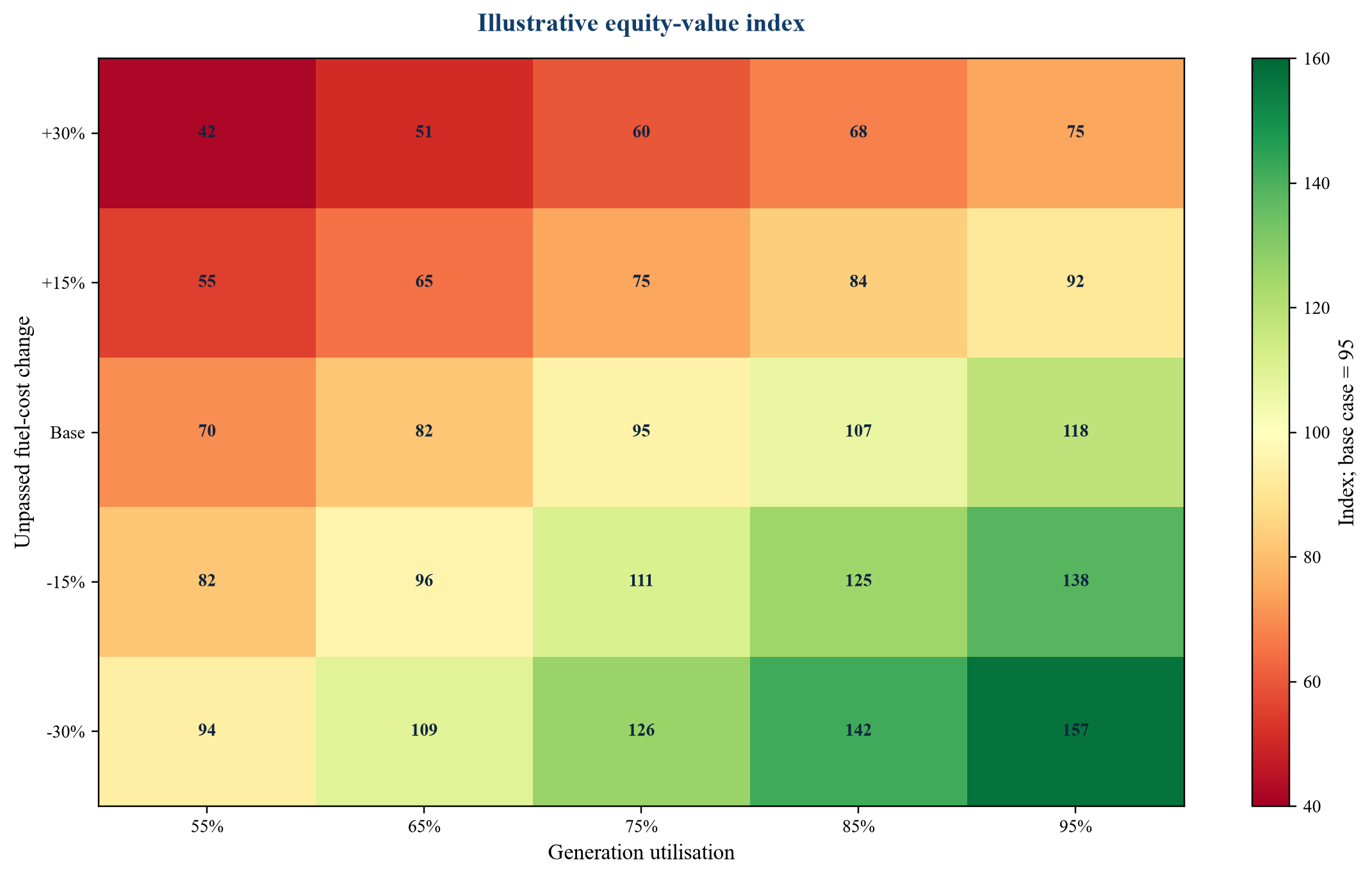
Index values are illustrative and do not represent market forecasts, transaction values or a named project.
27. Model the grid-arrival downside
A bridge-generation case can face lower utilisation when grid capacity arrives earlier than expected. That outcome can be beneficial for CampusCo and adverse for PowerCo if fixed capital is recovered through energy margin. The service agreement should align incentives.
Possible structures include a minimum availability payment, a defined bridge term, termination compensation, relocation rights or a transition to resilience service. Each has accounting, tax, legal and commercial consequences that require project-specific review.
The downside case should examine early grid arrival, late grid arrival and partial delivery. It should also test whether equipment can be redeployed, sold or retained economically. Residual value should be supported by market and technical evidence rather than book value alone.
28. Model the grid-delay downside
Late grid delivery can increase onsite utilisation and fuel cost. It can also require more maintenance, emissions permissions, fuel capacity and lifecycle capital. A temporary system designed for limited hours may not support prolonged primary operation.
The model should test the longest credible bridge period, including major overhauls and permit constraints. Customer pricing should address extended onsite operation. Liquidity should cover fuel collateral and maintenance.
If the system cannot operate for the downside period, the campus model should show curtailed customer ramp or alternative supply. Hiding this constraint in a high-level availability assumption misstates both entities.
29. Price carbon and environmental obligations carefully
Carbon price, emissions limits, environmental attributes and disclosure requirements vary by jurisdiction and can change. A live model should use the applicable legal and contractual framework with current professional advice. This paper does not assign a universal carbon price.
Where costs are expected, the model should identify payer, pass-through, escalation and compliance capital. Environmental attributes should be counted only once and linked to ownership and retirement rights.
Transition investment can reduce exposure, but its timing and performance require evidence. The financing should include decision gates for upgrades rather than assume an unspecified future technology solves the obligation.
30. Use a staged capital plan
Table 3. Hypothetical staged capital plan and approval gates
| Gate | Decision | Minimum evidence | Capital released | Reassessment trigger |
|---|---|---|---|---|
| 1 | secure development position | site control, load brief and initial routes | studies, options and concept work | infeasible fuel, grid or permitting route |
| 2 | commit long-lead deposits | defined design, vendor terms and credible permit path | deposits and detailed engineering | material specification, price or schedule change |
| 3 | start construction | permits, executable contracts, fuel and grid arrangements, committed equity | construction debt and remaining equity | failed condition, interface delay or funding gap |
| 4 | energise and commission | installed systems, safe fuel and electrical readiness | commissioning and working capital | failed performance or environmental test |
| 5 | convert to operating finance | integrated completion, customer acceptance and stable service | project debt refinancing | service deduction, customer or fuel deterioration |
| 6 | expand or transition | verified demand, interface capacity and approved technology case | incremental debt and equity | lower demand, changed regulation or superior alternative |
The table is a governance template; all amounts, timing and conditions require transaction-specific evidence.
31. Establish a decision model
The investment committee should receive an integrated model with a base case and explicit alternatives. The base case should identify the approved architecture and current evidence. Alternatives can test grid-only, onsite-primary, bridge, smaller phase, later phase and different fuel or storage configurations.
Each case should show customer service, power output, fuel, grid imports, losses, maintenance, emissions cost, capital, financing and cash. The model should reconcile net usable power to contracted customer capacity.
Decision metrics can include project value, equity return, debt coverage, funding peak, time to service, emissions intensity and loss under delay. No single metric should substitute for completion and service risk.
32. Govern assumptions and evidence
Every material input should have a source, date, owner and status. Contracted values, engineer estimates, vendor offers and management scenarios should remain distinguishable. Superseded evidence should be retained with version control.
The model should not silently convert a target into a commitment. An expected permit date remains an estimate until the competent authority acts. A customer forecast remains distinct from an executed minimum payment.
Monthly governance should review changes in load, fuel, grid, permits, schedule, equipment, customers and financing. A material change should update all affected entities and the consolidated case.
33. Build the data room around interfaces
The data room should contain corporate, land, electrical, fuel, grid, environmental, engineering, construction, equipment, customer, operating, insurance, financial and tax sections. An interface index should connect documents that jointly support a single assumption.
For example, available power can depend on the generator specification, ambient conditions, fuel pressure, auxiliary load, battery policy, substation rating and campus demand. The evidence should allow an independent reviewer to reproduce the net figure.
Open items should have an owner, action, due date and consequence. Missing evidence should remain visible in the financing case and conditions precedent.
34. Protect the transaction price
An acquisition or joint venture can transfer a development before every risk is resolved. Consideration should distinguish verified present value from contingent future value. Deferred consideration, milestone payments, retention, escrow and earn-outs can connect price to permits, fuel, completion and customer service.
Representations should identify the evidence actually provided. Indemnities can address defined breaches but depend on credit, caps, exclusions and claims procedures. A price mechanism can be more reliable for measurable future events.
The buyer should fund the remaining capital plan as part of transaction underwriting. Paying for projected completion without reserving the required completion capital can destroy the very value acquired.
35. Structure a joint venture
A utility, data-centre sponsor, fuel supplier, technology provider and infrastructure investor can contribute different assets and capabilities. The joint venture should value each contribution on a consistent date and evidence basis. Development rights, equipment, land, contracts and cash should not be treated as equivalent without analysis.
Governance should allocate budgets, procurement, dispatch, customer contracting, financing, hedging, distributions, expansion and transition. Reserved matters should reflect which decisions can change the risk borne by each investor.
Default, dilution, deadlock and exit provisions should address failure to fund, loss of permits, missed service dates and technology change. The venture should also preserve lender step-in and operating continuity.
36. Consider accounting separately
Commercial structuring can create leases, service arrangements, embedded derivatives, financial instruments, assets and obligations that require analysis under the applicable accounting framework. IFRS 13 provides principles for fair-value measurement when fair value is required.[6] It does not determine the commercial value of an unverified development assumption.
Purchase-price allocation, asset recognition, impairment, consolidation and lease treatment require qualified advice and complete facts. The transaction model should preserve evidence so accounting conclusions can be made independently.
The parties should avoid redesigning economic terms solely to obtain a desired presentation without considering legal, tax, credit and cash consequences.
37. Apply valuation standards
The International Valuation Standards Council publishes standards for valuation practice.[7] A valuation of PowerCo or a contributed asset should define purpose, basis, valuation date, scope, information and assumptions. The valuer should understand the legal and technical asset being valued.
Income, market and cost methods can provide complementary evidence. Income value depends on supportable cash. Market evidence requires comparability in technology, contracts, fuel, grid, permits and stage. Cost does not by itself establish economic value.
Scenario and probability methods can reflect unresolved development outcomes. Probabilities should be supported by project evidence and updated as conditions change.
38. Plan insurance around residual risk
Construction, property, machinery breakdown, business interruption, liability, environmental and cyber policies can address defined exposures. Coverage terms, exclusions, deductibles, limits and insured entities require specialist review.
Insurance does not create an absent permit, fuel route or customer payment. Delay cover can depend on insured physical damage and may not respond to regulatory or grid delay. The model should show remaining uninsured risk.
Lender and project insurance requirements should be coordinated before financial close. Claims proceeds, reinstatement and debt prepayment rules belong in the financing documents.
39. Create a 100-day financing programme
Days one to twenty define the service requirement, asset perimeters, electrical architecture, commercial role and evidence register. The team confirms current site, fuel, grid and permit pathways.
Days twenty-one to forty develop engineering, contracting and integrated schedule options. Finance builds separate CampusCo, PowerCo and consolidated models. Legal advisers map rights, licences and transfer.
Days forty-one to sixty obtain market-tested equipment, construction, fuel, operating and capital terms. The team selects a preferred structure and identifies conditions precedent.
Days sixty-one to eighty negotiate customer and intercompany service arrangements, direct agreements, security, reserves and completion tests. Downside cases are funded.
Days eighty-one to one hundred finalise investment authority, transaction documents and the staged draw plan. The actual timetable depends on project maturity and third-party response.
40. Investment-committee checklist
Service. What net power, availability, quality, ramp and transition must be delivered?
Boundary. Which entity owns each asset and right?
Evidence. Which documents support capacity, fuel, permits, grid, customers and schedule?
Capital. Which source funds each stage and contingency?
Revenue. Which payment covers fixed capital, fuel and performance?
Completion. Which integrated tests release debt and equity?
Downside. What happens if grid delivery, customer ramp, fuel cost or permits change?
Security. Can lenders preserve essential service through enforcement?
Transition. How can the portfolio change without relying on unsupported future value?
Governance. Who can approve dispatch, funding, contracts, expansion and distributions?
41. Limitations
Power markets, technologies, fuel, environmental rules, customer demand and financing conditions vary by location and can change. Official system-level evidence does not establish the rights, cost, emissions, schedule or performance of a particular development.
FERC and NERC materials apply within their stated United States purposes. DOE materials describe policy and technical resources rather than financing approval for a project. IEA analysis is global and scenario-based. Accounting and valuation standards require application within their formal scope by qualified professionals.
Every capacity, percentage and index in the exhibits is hypothetical. No customer contract, utility commitment, financing offer, permit, transaction value or realised outcome is claimed.
42. Conclusion
Behind-the-fence generation can accelerate and protect an AI campus when its technical role, permits, fuel, grid interaction and customer service are coherent. Its bankability arises from defined rights and dependable cash rather than nameplate megawatts.
The capital stack should change as evidence matures. Sponsor and strategic capital absorb development and interface risk. Construction and equipment finance enter after scope and contracts become executable. Operating project debt follows integrated completion and stable service cash.
Separate CampusCo, PowerCo, grid and fuel perimeters make risk visible. A consolidated model prevents double counting. Staged funding, direct agreements, performance tests, reserves and contingent consideration connect capital to delivered capability.
Frequently asked questions
Why separate PowerCo from the data-centre company?
Separation can make asset ownership, contracts, costs, performance and lender security clearer. It is useful only when PowerCo holds enforceable rights and its cash flow is reconciled with CampusCo obligations.
Can onsite generation be financed before the grid connection is complete?
Financing can proceed in stages where permits, fuel, land, construction, customer service and grid-interaction requirements are sufficiently defined. Early unresolved risks generally require equity, contingency and completion support.
Which revenues can support project debt?
Dependable capacity, availability or service payments can support debt when contracts, counterparties and performance assumptions are creditworthy. Merchant exports and uncontracted utilisation require conservative treatment.
How should fuel-price risk be allocated?
Allocation depends on control and commercial terms. Pass-through, efficiency standards, hedging and collars can be combined. The model should include collateral, basis and residual exposure.
What happens when full grid power arrives?
The contract should define whether onsite generation remains primary, becomes resilience capacity, reduces dispatch, relocates or receives termination compensation. The financing case should test early, late and partial grid delivery.
What is the most important completion test?
The integrated test should demonstrate net usable power and the service required by the campus across generation, storage, grid, controls and customer load. Equipment-level completion alone is insufficient.
About the Author
Authored by Chennakeshav Adya Independent Researcher
Chennakeshav (CK) is a corporate finance and investment banking executive with 25+ years of global experience in deal origination, structuring and execution across M&A, growth capital and corporate strategy. He has led value-creation mandates for founders, corporates and funds — bridging the boardroom view to hands-on execution and close.
His career spans Morgan Stanley, HSBC, Lloyds Banking Group, EWEC, ADQ portfolio companies and Emirates Growth Fund, across TMT, real estate, fintech, deeptech, cleantech, infrastructure and energy. He has partnered with C-suite leaders, private equity and venture funds, sovereign wealth funds and family offices to finance complex fund raises and scale-up ventures, and has led M&A due diligence, post-merger integration and business-transformation initiatives to create value.
At Matchpoint Partners he is Managing Partner, leading the firm's corporate finance, M&A and capital-raising practice. He holds an MBA from London Business School, an engineering degree from VTU and a Master of Laws (LLM, in progress) from UCL London.
An active start-up mentor, CK mentors at Techstars, DIFC FinTech Hive, Startup Grind, Founder Institute and IN5, serves as Entrepreneur Mentor in Residence (EMiR) at London Business School, and judges the Entrepreneurship World Cup.
Matchpoint profile: https://www.matchpoint-partners.com/team/ck-adya.html LinkedIn: https://www.linkedin.com/in/ckadya/
