

1. Define the asset being priced
A data-centre power connection is not a commodity detached from place, time and obligation. It is a bundle of rights, infrastructure, service conditions and continuing duties linked to a defined legal entity and site. The bundle can include capacity, voltage, point of connection, energisation date, ramp, firmness, curtailment, tariff, network upgrades, security, operating protocols, telemetry, milestones and expansion rights.
The valuation question is the incremental economic benefit created by that bundle. A premium can arise where secured power allows a project to begin service earlier, operate at larger scale, offer stronger reliability, avoid alternative-supply cost or preserve expansion. The same headline megawatts can have different value when dates, costs, service conditions or customer requirements differ.
This paper provides a transaction framework for pricing secured capacity. It does not estimate the price of a named connection or site. Each application requires current utility, legal, engineering, customer and market evidence.
2. Why the premium needs a separate method
Land, building, electrical systems, customer contracts and grid rights can be sold together. A headline transaction multiple can therefore conceal the value attributed to power. Comparable transactions can also differ in connection maturity, utilisation, tariffs, location and development scope.
A separate method makes the pricing logic visible. It identifies the counterfactual without the secured connection, calculates incremental dated cash flow, deducts the capital and obligations required to preserve delivery, and applies an evidence adjustment to unresolved risk.
The result is a decision range rather than a universal price per megawatt. It can support acquisition price, deferred consideration, joint-venture contributions, financing, internal transfer pricing and impairment review. It also reveals where the premium depends on assumptions that cannot yet be verified.
3. Electricity demand is increasing the value of time
The International Energy Agency reports rapid growth in data-centre electricity use and identifies grid connection, generation, transmission and equipment constraints as material development issues.[1][2] Its Energy and AI analysis also shows that the power mix and grid conditions vary by geography.[1]
The United States Department of Energy has published data-centre resource, transmission and resource-adequacy material responding to large-load growth.[3][4] FERC and NERC have developed proceedings and work programmes focused on large computational loads and reliability.[5][6]
The commercial significance is the value of a credible energisation date. Capacity available earlier can accelerate customer cash and reduce carry. Capacity delivered after the relevant technology or customer window can have less value even where the ultimate megawatt amount is unchanged.
4. Separate five capacity measures
Requested capacity is the load stated in an application. Contracted capacity is the amount stated in an accepted offer or agreement. Energised capacity is physically connected and available under the applicable operating arrangements. Usable capacity is what the facility can safely draw after losses, redundancy, cooling and internal constraints. Sellable capacity is the customer service that can be committed after resilience, maintenance and ramp are considered.
Pricing should use the measure that supports the relevant cash flow. A seller may cite requested or contracted megawatts. A buyer's revenue case may depend on tested usable capacity. A lender may focus on capacity supporting contracted customer cash under enforceable service conditions.
The data room and model should retain all five measures. Reconciliation prevents the transaction from paying a premium on capacity that does not reach customers.
5. Use an evidence-to-value ladder
Connection evidence progresses from request to screening, study, offer, executed agreement, network construction, energisation and testing. Each stage resolves some uncertainty and creates new obligations. A queue position and an operating connection should not receive the same valuation reliance.
Great Britain's 2026 proposals concerning speculative data-centre applications, commitment fees and milestones illustrate why queue evidence can change under reform.[7][8] NERC's large-load work also emphasises interconnection, modelling, commissioning and operational evidence.[6]
Figure 1 maps evidence maturity to valuation release. The premium remains highly contingent while capacity, date, cost and transfer are unresolved. Contract and construction evidence can support greater reliance. Tested capacity supports operating valuation, subject to continuing obligations.
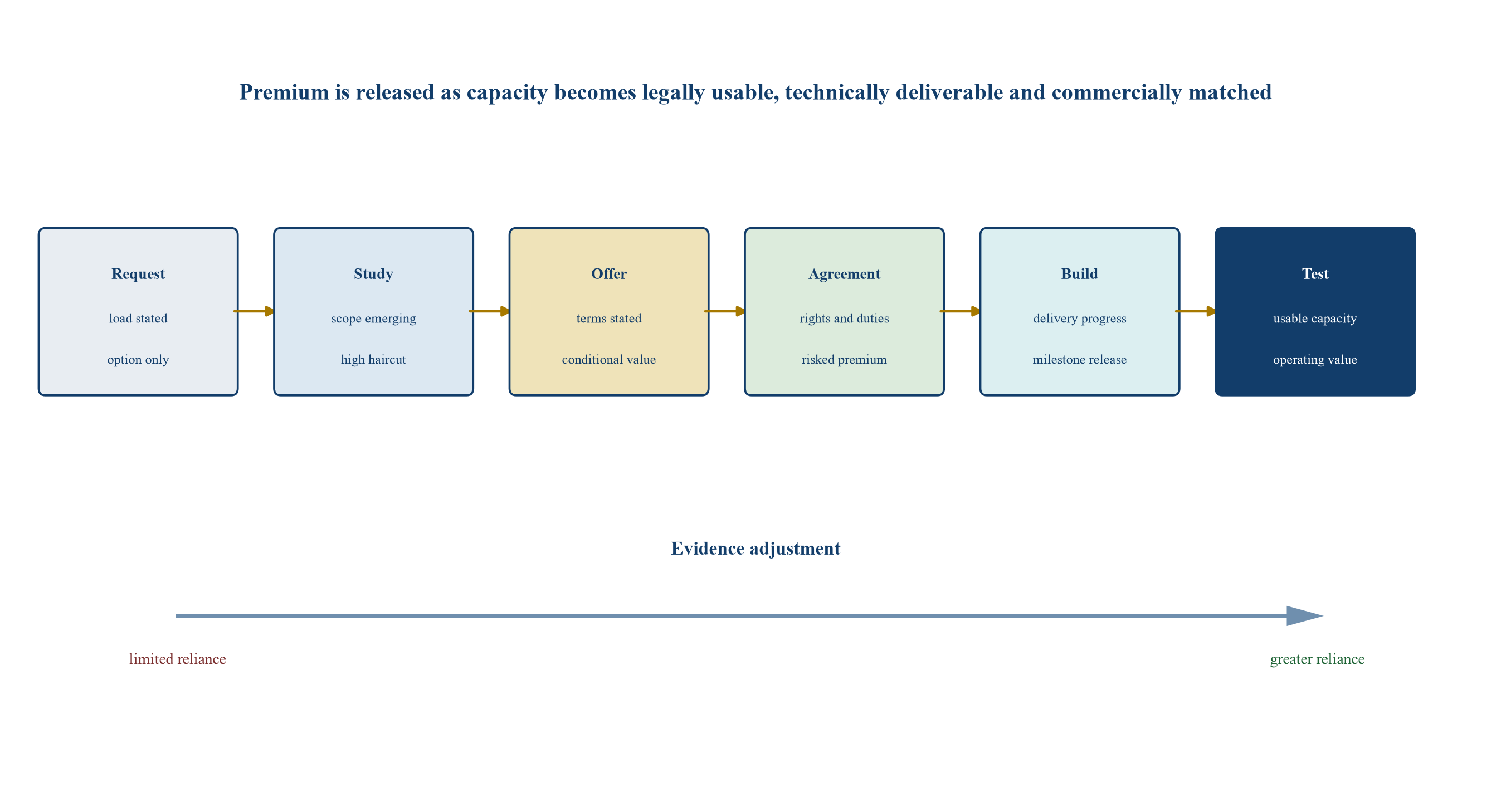
Generic framework; each stage requires current project-specific technical, legal and commercial verification.
6. Build the counterfactual first
The premium is measured against the best feasible alternative available to the same investor. The counterfactual can be an unpowered site, a later connection, smaller capacity, flexible service, onsite generation, a different geography or a combination of sites.
The alternative should be technically and commercially feasible. A hypothetical low-cost grid connection with no route or date is not a valid comparator. The comparison must use the same computing service, customer ramp, reliability, financing and terminal horizon.
The model should document why the alternative was selected and when it was observable. A transaction premium based on a counterfactual that became known after the valuation date can distort the decision.
7. Calculate incremental cash rather than headline capacity
Secured power can change revenue start, customer capacity, pricing, utilisation, construction sequence, equipment deployment, operating cost, financing carry and expansion. The model should calculate those differences by period.
Incremental revenue should be linked to sellable capacity and customer assumptions. Incremental cost should include connection capital, network charges, security, tariff, losses, resilience, maintenance, compliance and ongoing obligations. Timing affects discounting and cash burn.
The difference between powered and counterfactual project cash flows produces an initial premium before evidence adjustment. The calculation remains conditional on the assumptions used in both cases.
8. Decompose the premium
The connection premium can be divided into time, scale, firmness, cost, transfer and expansion components. Time value reflects earlier cash. Scale value reflects additional customer-serving capacity. Firmness value reflects reduced curtailment or interruption exposure. Cost value reflects avoided alternative-supply or upgrade expenditure. Transfer value reflects legal portability in the transaction. Expansion value reflects credible future phases.
The components are not fully additive. Earlier power can enable scale. Firmness can support price. Expansion can depend on the same network work funded by the first phase. The model should calculate total incremental cash and use component analysis as explanation rather than independent valuation sums.
Table 1. Components of a secured-power premium
| Component | Primary evidence | Cash-flow effect | Common overstatement |
|---|---|---|---|
| Time to power | executed dates, works and milestones | earlier customer cash and lower carry | treating an indicative date as committed |
| Usable scale | studies, facility design and testing | more sellable capacity and fixed-cost absorption | pricing requested rather than usable megawatts |
| Firmness and quality | agreement, tariff and operating protocol | service reliability, pricing and resilience cost | ignoring curtailment and power-quality conditions |
| Connection cost | study, offer, invoices and scope allocation | upgrade capital, deposits and network charges | excluding owner works and escalation |
| Transferability | agreement, consent and legal opinion | ability to retain value through the transaction | assuming rights follow land or shares automatically |
| Expansion | reserved capacity, future studies and rights | later phases and strategic option value | capitalising aspirational future load |
Component analysis explains value drivers; avoid double counting overlapping cash-flow effects.
9. Price time to power
Time value begins with the difference in customer cash between the secured path and the feasible alternative. The model should include the construction sequence and confirm that earlier electricity can actually be converted into service. Power arriving before the building, cooling or equipment is ready does not create the same benefit.
Delay cost includes financing carry, staff, land, security, equipment storage, redesign, customer consequences and lost option term. It can also reduce the commercial life of installed technology.
The time premium should be capped by the amount of economic benefit created. A buyer should not pay more for earlier power than the discounted value of earlier and more dependable cash after all incremental costs.
10. Price usable capacity
Capacity value should use the project's tested or supportable facility load, not a headline network figure. Internal electrical losses, redundancy, cooling and operating reserves reduce the amount available for IT service.
The model should map each megawatt tranche to facility phase, equipment and customer ramp. Capacity that arrives after the customer window or requires uneconomic construction can have limited present value.
A marginal megawatt can have different value at different points. Early capacity can unlock the first operating phase. Later capacity can expand a platform. Capacity beyond realistic customer and financing capability can create carrying cost without immediate revenue.
11. Price firmness and curtailment
Firm capacity, flexible capacity and interruptible service support different products. The agreement should define when the network can constrain load, how much, for how long, with what notice and compensation, and how restoration occurs.
The buyer should model the customer and resilience consequences. Storage and generation can cover some events, subject to duration, fuel, emissions, permits and cost. Workload shifting can help where service and data constraints allow it.
The firmness premium is the reduction in expected service loss and resilience cost relative to the counterfactual. It should reflect actual contractual conditions rather than a general label.
12. Price power quality and operating behaviour
Voltage, frequency, harmonics, ramping, ride-through and protection can affect facility systems and grid reliability. NERC's work on computational loads reflects the need for modelling, commissioning and operational coordination.[6]
The premium model should include equipment and controls required to comply with operating conditions. A connection can be large and timely while still requiring material mitigation. Those costs reduce the net premium.
Customer service design should remain aligned with power conditions. A facility cannot sell a service standard that its supply and resilience architecture cannot support.
13. Include all connection capital
Connection cost can include network studies, utility contributions, security, substations, transformers, switchgear, cables, routes, owner works, land, permits, professional fees, taxes, escalation, contingency and financing. Payment dates affect liquidity.
The model should identify ownership and refundability. A utility-owned asset funded by the customer can have different recovery and security implications from a customer-owned substation. Deposits can be forfeitable if milestones are missed.
The secured-power premium is net of these costs. Quoting gross incremental project value without the enabling capital overstates what the buyer should pay.
14. Reflect tariff and demand charges
Tariffs can include energy, demand, network, fixed, reactive-power, standby, capacity and other charges under the applicable regime. The cost can vary with load factor, peak demand, power factor and service class.
The buyer should model the tariff applicable to the specific connection and operating profile. A favourable energy price can be offset by high fixed or demand charges. A connection contribution can affect the negotiated tariff or minimum payments.
Tariff assumptions should be dated and sensitivity-tested. A long-term customer contract can expose the operator where power cost moves while customer pricing remains fixed.
15. Transferability is a value condition
Connection value belongs to the legal rights that survive the transaction. The buyer should verify the named party, site, term, change-of-control provisions, assignment, novation, security and continuing obligations.
A connection agreement held by the acquired project company can still contain consent or termination rights. An asset transaction can require novation. A land purchase may not include the application or deposits.
Premium should remain contingent until the transfer mechanism is evidenced. Retention or deferred consideration can protect the buyer where consent occurs after signing.
16. Expansion is a real option
Future capacity can create option value when the project holds a credible right, sufficient term and feasible path to exercise it. A general expectation that a utility will provide more capacity does not establish an option.
The model should identify reservation, study, milestone, cost, date and expiry. It should also test whether land, planning, water, fibre, facility design and customer demand can support the expansion.
Option value is bounded by the capital required to preserve and exercise the right. It should not be added as if future capacity were already operating.
17. Use an evidence adjustment
The initial counterfactual value reflects model assumptions. The evidence adjustment addresses whether the secured path is sufficiently supported. It can be implemented through scenario probabilities, milestone-weighted release or explicit risk deductions.
The adjustment should trace to unresolved items. Capacity, date, cost, transfer, permits, works, equipment, commissioning and operating conditions can each affect the outcome. A single unexplained discount hides the decision logic.
The investment committee should approve the evidence and the adjustment separately. This makes later changes auditable when a study, agreement or construction milestone is completed.
Table 2. Evidence adjustment for connection pricing
| Evidence field | Stronger evidence | Residual risk | Pricing response |
|---|---|---|---|
| Capacity | executed amount reconciled to facility design | usable capacity and testing | release value by tested tranche |
| Date | contractual schedule with funded works | construction and commissioning | model delay cases and milestone retention |
| Cost | defined scope and capped contribution | escalation and owner works | deduct full funded cost and contingency |
| Firmness | clear curtailment and service terms | operational events | value expected customer and resilience effects |
| Transfer | consent path and legal confirmation | third-party discretion | defer premium until effective transfer |
| Infrastructure | design, permits, orders and physical progress | delivery and integration | release price against verified milestones |
| Expansion | reserved right with term and study path | demand, capital and later approval | treat as a bounded real option |
Illustrative framework; weights and treatment require project-specific judgement and support.
18. Avoid arbitrary price per megawatt
A price-per-megawatt metric can help compare transactions only after capacity definition, timing, cost, firmness, transfer and development scope are normalised. Otherwise it combines different assets.
The numerator should state what is included: land, buildings, connection rights, deposits, infrastructure, customer contracts and development expenditure. The denominator should state whether capacity is requested, contracted, energised, usable or sellable.
The metric should therefore follow valuation, not replace it. A seemingly high price per megawatt can be rational where power is earlier, firmer and less capital-intensive. A low metric can conceal late or conditional capacity.
19. Use replacement cost carefully
Replacement cost estimates what it would take to recreate the power pathway, including studies, security, infrastructure, land rights, equipment, time and development capability. It can provide a useful cross-check.
Replacement cost does not automatically equal value. The replacement may take longer, serve a different location or fail to secure the same customer opportunity. Some expenditure may be sunk or inefficient.
The analyst should compare replacement cost with incremental income and alternative-site evidence. A premium supported only by historical spend requires careful review of economic benefit.
20. Use market evidence with adjustment
Comparable powered-site or data-centre transactions can inform pricing where the evidence identifies capacity state, date, infrastructure, location, customer profile and development scope. Public transaction disclosures often lack those details.
The analyst should document every adjustment and the limits of the comparison. Market evidence should not be reverse engineered from an announced enterprise value where the connection component cannot be isolated.
IFRS 13 and international valuation standards emphasise market-participant assumptions, valuation techniques and appropriate inputs within their respective purposes.[11][12] Their application requires qualified judgement and does not remove the need for project evidence.
21. Build a reconciliation bridge
The valuation should bridge from the counterfactual project value to the secured-power case. The bridge includes earlier cash, additional capacity, avoided alternative-supply cost and expansion value, then deducts connection capital, tariff differences, resilience cost, carrying cost and evidence adjustment.
Figure 2 shows a hypothetical bridge. The amounts are invented to demonstrate method. They do not represent a market price or a project.
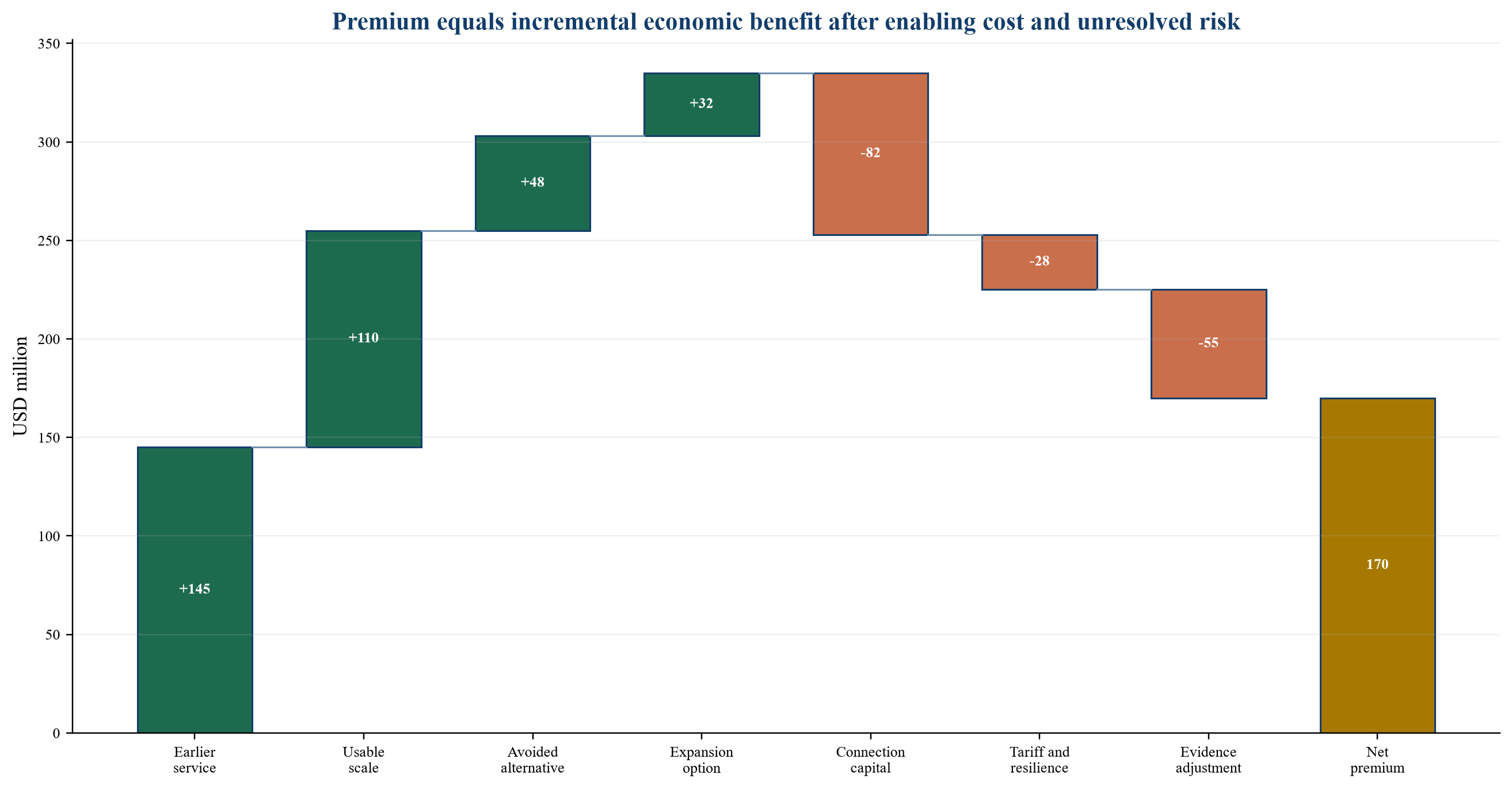
Illustrative USD million values; all amounts are assumptions created solely to demonstrate valuation logic.
22. A hypothetical pricing case
Assume an investor compares two sites capable of supporting the same customer proposition. Site S has an executed connection agreement, funded network scope and an earlier target date. Site A has lower land cost but a later and less mature power pathway. The investor must decide the maximum premium supportable for Site S.
The model estimates incremental cash from earlier service, larger initial usable capacity and reduced reliance on temporary generation. It deducts additional connection capital, tariff and resilience differences, then applies an evidence adjustment for remaining construction and commissioning risk.
Every value in the example is a hypothetical management assumption. The method requires replacement with current project evidence before any transaction decision.
23. Model time and firmness together
An early flexible connection can compete with a later firm connection. The correct result depends on workload, customer commitments, resilience and curtailment. Time and firmness should therefore be tested together.
The secured path can support a smaller first phase under flexible terms, followed by firm capacity. The alternative can preserve lower cost but delay revenue. A combined schedule makes the trade visible.
The model should avoid treating all megawatt-hours as equivalent. Customer service loss during constrained periods can have a different economic effect from the average energy cost.
24. Model capacity and delivery-date sensitivity
Figure 3 shows a hypothetical premium range across tested usable capacity and dependable delivery dates. Value falls as capacity decreases or delivery moves later. A no-delivery case retains only recoverable deposits, land and alternative-use value assumed elsewhere in the model.
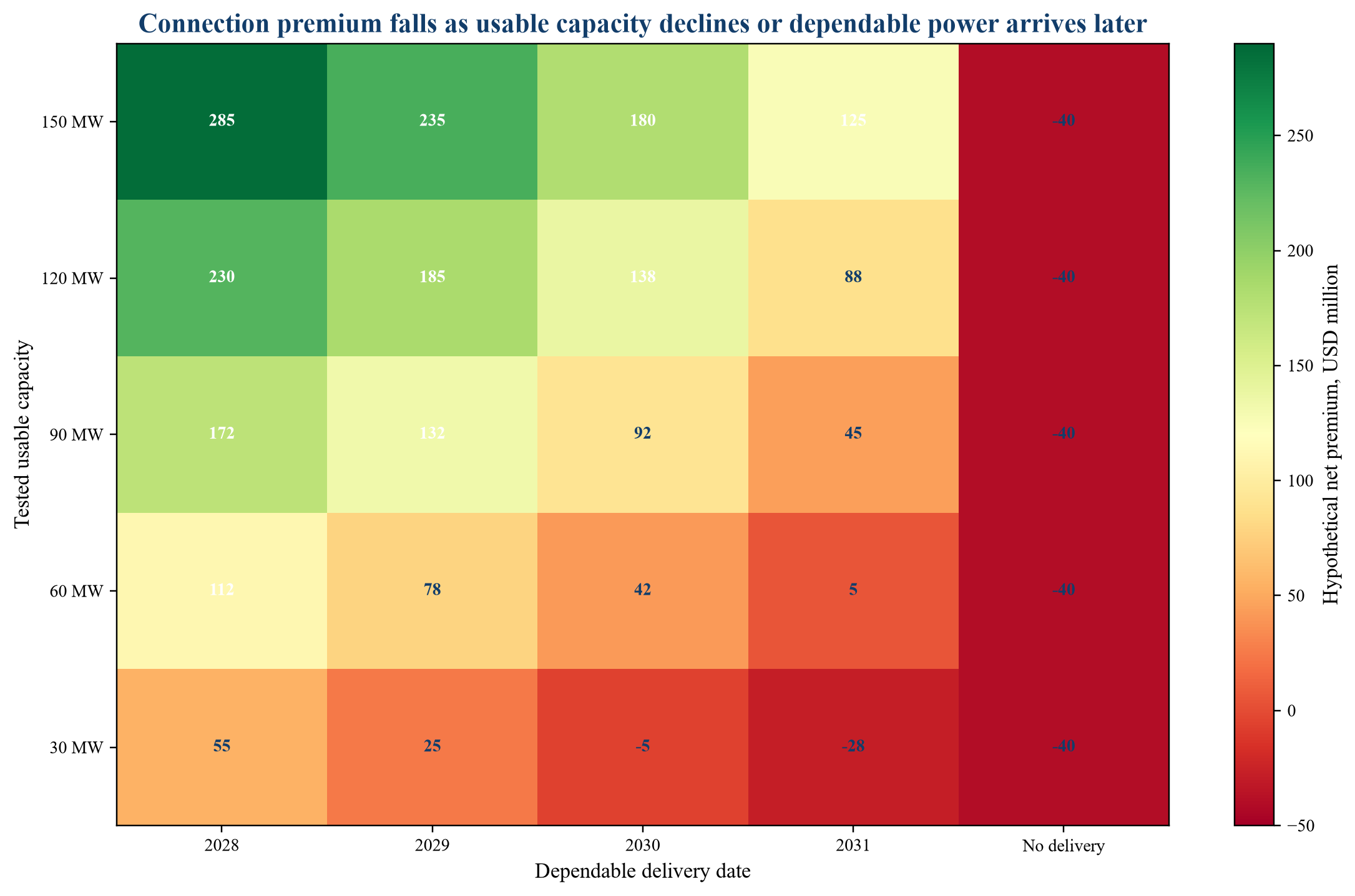
Illustrative USD million values; capacity, dates and premiums are assumptions rather than forecasts or market evidence.
25. Use transaction structure to protect the premium
The buyer can pay the supported base-site value at closing and connect the power premium to evidence. Retention can secure transfer or milestone obligations. Deferred consideration can release value when capacity is energised and tested. Earn-outs can reflect usable capacity or customer service, subject to careful control and dispute provisions.
Price adjustment can address upgrade-cost changes. Escrow can secure specific obligations. A phased acquisition can match land and capacity tranches. A joint venture can share development risk where governance and funding are clear.
The structure should follow the risk source. A general indemnity is a weak substitute for a condition or deferred payment where the connection is fundamental to the acquisition.
Table 3. Transaction mechanisms for secured-power value
| Risk or evidence gap | Transaction mechanism | Release test | Principal drafting issue |
|---|---|---|---|
| Transfer consent | condition precedent or retention | effective assignment or change-of-control consent | third-party discretion and long-stop date |
| Capacity amount | deferred consideration by tested tranche | defined measurement at agreed point | test method, losses and partial delivery |
| Delivery date | time-based price adjustment | dependable energisation by milestone date | buyer-caused delay and extensions |
| Upgrade cost | collar, cap or seller contribution | final approved and funded scope | cost definition and change control |
| Firmness | service-condition adjustment | executed curtailment and operating terms | event measurement and customer impact |
| Infrastructure completion | milestone escrow | certified physical and commissioning progress | independent verification and defects |
| Expansion | option or contingent value right | reserved capacity becomes exercisable | term, exercise cost and control |
Illustrative allocation tools; legal, tax, accounting and financing advice is required for a specific transaction.
26. Define the capacity test before signing
A capacity payment should identify the measurement point, duration, operating conditions, permitted outages, facility configuration and independent verifier. It should state whether the test measures grid delivery, facility intake, IT load or customer-sellable service.
The test should account for staged ramp. A connection can be energised while the full capacity remains unavailable. Partial delivery should produce a clear result rather than a binary dispute.
The agreement should also address later restrictions, test failure, cure, retest and the treatment of capacity that is available under conditions outside the approved service case.
27. Align the seller's incentives
The seller may control utility engagement, land rights, applications and construction interfaces before closing. The buyer may control design, procurement and customer work. The agreement should allocate actions and information according to control.
Deferred consideration can maintain seller support. It can also create disputes if the buyer controls the outcome and has no clear conduct obligation. Objective milestones, reporting, access and dispute procedures are therefore important.
The buyer should avoid overpaying at signing in exchange for broad cooperation promises. The amount at risk should remain connected to evidence that can be verified.
28. Protect the premium in a share acquisition
A share acquisition can preserve connection contracts within the target entity. It can also acquire historical compliance, tax, environmental and contractual liabilities. Change-of-control provisions still require review.
The buyer should confirm that connection security, deposits and work-in-progress belong to the target and are correctly recorded. Related-party arrangements can affect land, routes, operations or funding.
The purchase-price allocation and accounting treatment should be reviewed by qualified advisers. The commercial model should remain separate from accounting conclusions.
29. Protect the premium in an asset acquisition
An asset acquisition can select land, connection rights, equipment and studies. Each asset needs an effective transfer mechanism. Utility consent, permit transfer and novation can become closing dependencies.
The buyer should ensure that the acquired perimeter includes data, design rights, warranties, deposits and claims required to finish the project. A connection right without its supporting route or security can lose value.
The transition plan should maintain milestone compliance between signing and transfer. The agreement should state who bears cost and risk during that period.
30. Lenders should underwrite the same evidence
Debt capacity depends on the cash that the connection supports and the lender's ability to preserve that value through enforcement. The lender should review transfer, cure, step-in, milestone and termination provisions.
Security over land or shares does not guarantee continuation of a connection. Direct agreements, notices, cure rights and consent may be needed under the applicable framework. The lender also needs a funded completion plan.
The financing model should not count uncommitted future debt as available liquidity. It should show the capital required to protect connection milestones before operating cash begins.
31. Treat deposits and security as restricted cash
Connection applications and agreements can require deposits, guarantees or other security. These amounts may be refundable, releasable, applied to works or forfeitable under stated conditions.
The model should distinguish unrestricted cash from restricted or contingent amounts. A deposit supporting the connection cannot simultaneously fund construction. Guarantee utilisation can affect banking capacity.
Transaction diligence should confirm payer, beneficiary, expiry, release, transfer and default. The purchase agreement should specify how those instruments pass or are replaced.
32. Consider concentration and network dependencies
A secured site can still depend on a congested substation, transmission project, generation resource or equipment supply chain. Several data-centre projects can rely on the same upstream works.
The buyer should map dependencies beyond the site boundary. It should identify shared infrastructure, delivery responsibility, sequencing, cost allocation and competing demand.
Concentration can affect delay probability and resilience. The premium should reflect the complete power pathway rather than the final connection agreement alone.
33. Geography changes the pricing framework
Connection rules, queue reform, tariffs, planning, water, environmental policy and grid structure vary by jurisdiction. Great Britain is developing strategic-demand and speculative-application reforms.[7][8] Singapore's Green Data Centre Roadmap links continued capacity growth to energy efficiency and green energy.[9] United States policy and regulatory materials address large-load integration, transmission and generation.[3][4][5][6]
These examples show that capacity evidence must be interpreted within the applicable system. A metric transferred across jurisdictions without adjustment can mislead.
The investment committee should receive a jurisdiction summary covering legal rights, regulator, network entities, process, tariff, security, transfer, milestones, planning and enforcement.
34. Efficiency can alter capacity value
Facility and IT efficiency determine how much computing service a given connection can support. Singapore's roadmap targets improved data-centre efficiency and green energy as part of capacity growth.[9] IEA analysis also considers efficiency in electricity-demand scenarios.[1]
An efficiency improvement can increase sellable compute within a fixed electrical envelope. It can also require capital, technology change and customer acceptance. The premium model should use the approved design and avoid assuming future efficiency without evidence.
Where customer pricing is based on service rather than power, the economic value of a megawatt depends on hardware, software and utilisation as well as the connection.
35. Data-room architecture should reproduce the premium
The data room should allow an independent reviewer to reproduce capacity, date, cost, transfer and cash-flow assumptions. It should contain the load brief, applications, studies, offers, agreements, security, invoices, route rights, design, equipment, permits, schedules, customer evidence and model.
Each key input should link to a dated source. Superseded documents should remain identifiable. Oral utility or seller statements should be confirmed in writing or labelled as unverified management statements.
The model should reconcile requested, contracted, energised, usable and sellable capacity. Differences should be explained rather than silently overwritten.
36. Governance should release value by gate
The investment committee should approve the counterfactual, evidence state, premium range, transaction protection and capital required to reach the next gate. It should identify the conditions that trigger reprice, defer or exit.
Engineering, legal, commercial and finance teams should use one connection register. A change in date or capacity should update the model, customer plan and transaction position.
Past expenditure should not determine the next decision. Current evidence, remaining benefit, remaining cost and alternatives should govern capital release.
37. Build a premium dashboard
The dashboard should show requested, contracted, energised, usable and sellable capacity; connection stage; target and evidence dates; upgrade scope; security; tariff; firmness; transfer; infrastructure progress; customer ramp; model premium; evidence adjustment; capital committed; and next decision.
Every metric needs a definition, source, date and owner. Utility commitment, contractor forecast and management estimate should be distinguishable.
The dashboard should focus on exceptions. A changed network date should show premium, liquidity and transaction consequences. A failed milestone should identify cure and long-stop effects.
38. A 100-day pricing programme
Days one to twenty define the service, valuation date, transaction perimeter, feasible alternatives and evidence register. The team reconciles capacity definitions and identifies the rights being priced.
Days twenty-one to forty verify connection, route, cost, tariff, transfer and development evidence. Engineering and legal work resolve the relationship between the agreement, site and facility design.
Days forty-one to sixty build counterfactual cash flows, component analysis, evidence adjustment and sensitivities. Finance tests the result against replacement cost and observable market evidence where sufficiently comparable.
Days sixty-one to eighty design conditions, retention, deferred consideration, price adjustment and capacity tests. Funding and lender requirements are integrated.
Days eighty-one to one hundred resolve exceptions, obtain investment authority and negotiate the supported premium range. Timing depends on project maturity and third-party response.
39. Investment-committee checklist
Asset. What exact capacity bundle, entity, site and term are being acquired?
Evidence. Which documents establish amount, date, cost, firmness, transfer, routes and continuing obligations?
Counterfactual. What feasible alternative would the investor pursue without this connection?
Cash. Which incremental customer and project cash flows arise, and when?
Cost. Which connection, tariff, resilience, security and compliance costs reduce value?
Risk. Which unresolved conditions support the evidence adjustment?
Structure. Which part of the premium is paid at closing, retained or deferred?
Test. How will energised, usable and sellable capacity be measured?
Funding. Is the remaining delivery plan fully funded after restricted security and deposits?
Exit. Can the buyer reprice, defer or terminate if evidence changes?
40. Allocate premium in a joint venture
A landowner, power developer, data-centre operator and capital provider can contribute different elements to a joint venture. The connection premium should not automatically belong to the party that first submitted the application. Value may also depend on funded network works, land routes, facility design, customer demand, development management and balance-sheet support.
The parties should identify each contribution and the conditions attached to it. A connection contribution can be credited when the right is transferable to the venture and its obligations are disclosed. Future capacity can be treated as contingent value until it becomes exercisable. Cash contributions should reflect the remaining delivery plan and liquidity reserve.
Governance should prevent one party from controlling evidence on which its own value depends. Independent technical and legal verification can support contribution valuation. Deadlock, default, dilution and exit provisions should address the possibility that power arrives late, at reduced capacity or with changed conditions.
The joint-venture model should also identify who funds security, network works, equipment and customer acquisition. An agreed connection premium does not remove the need to fund the capital that makes the premium real.
41. Distinguish commercial value from accounting treatment
The transaction team can calculate a commercial connection premium for negotiation and capital allocation. Accounting recognition, asset classification, useful life, impairment and purchase-price allocation require analysis under the applicable reporting framework by qualified professionals.
The commercial model should preserve its evidence and assumptions so that accounting advisers can assess the acquired rights and obligations. The team should avoid changing the transaction thesis merely to produce a desired accounting result. It should also avoid describing a modelled premium as a recognised asset before the relevant analysis is complete.
Subsequent evidence can change value. A connection delay, cost increase, loss of transferability or customer change can affect the commercial outlook. Governance should define how such events trigger model updates and formal accounting review where required.
The same separation applies to tax. The legal form, jurisdiction, asset perimeter and consideration mechanics can affect tax consequences. Those consequences should be included only when supported by current professional advice.
42. Insure the risks that can be transferred
Insurance can address selected construction, property, equipment, delay, liability and cyber exposures. It cannot replace an absent connection right or eliminate the commercial effect of an unfinanceable delay. Policy terms, exclusions, deductibles, limits, insured parties and claim triggers require detailed review.
The premium model should include insurance cost and remaining uninsured exposure. Delay-in-start-up cover can depend on insured physical damage and may not respond to a utility or regulatory delay. Political-risk or credit products can address specific risks under stated conditions without guaranteeing technical delivery.
The transaction agreement should allocate responsibility for maintaining required policies before and after closing. Evidence of cover should identify the project entity, site, period and relevant assets. The lender's requirements should align with the construction and operating programme.
Insurance is therefore one layer in the risk architecture. Contract conditions, technical design, contingency, liquidity and decision rights remain necessary.
43. Negotiate from a shared evidence register
Buyer and seller can spend substantial time debating a price per megawatt while using different definitions. A shared evidence register can narrow the dispute. It records capacity state, date, cost, service conditions, transfer, infrastructure, remaining action and supporting document.
The parties can then identify which value is supported at closing and which value depends on later performance. Base consideration can reflect verified rights. Deferred consideration can reflect capacity and date. Price adjustment can address cost. Retention can protect consent or milestone exposure.
This approach does not require the parties to share the same forecast. It requires each payment to have a defined basis and evidence test. The negotiation becomes a structured allocation of risk and upside.
Where evidence remains unavailable, the issue should remain visible. An unsupported management estimate can inform a scenario, subject to clear labelling. It should not be converted into a contractual fact or public claim.
44. Limitations
Electricity demand, grid rules, connection queues, tariffs, equipment, planning, customer designs and AI hardware can change. System-level official sources do not establish a particular project's capacity, timing, cost or legal rights.
FERC and NERC materials apply within their stated United States purposes. United Kingdom materials reflect an evolving reform programme. Singapore policy reflects its national infrastructure context. IFRS and valuation standards require application within their formal scope by appropriately qualified professionals.
Every amount, date, capacity and premium in the worked exhibits is a hypothetical assumption. No market quotation, utility commitment, transaction price, customer contract or realised result is claimed.
45. Conclusion
Secured power can create a material data-centre premium when it delivers earlier, larger or more dependable customer-serving capacity than a feasible alternative. The premium belongs to a complete bundle of rights, infrastructure, timing, service conditions and obligations.
A reproducible valuation begins with the counterfactual, calculates incremental dated cash, deducts enabling cost and applies an evidence adjustment. Requested, contracted, energised, usable and sellable capacity remain separate throughout.
Transaction structure should protect unresolved value. Retention, deferred consideration, price adjustment and capacity tests can connect payment to delivered capability. The resulting premium becomes an evidence-led negotiation range rather than an unsupported price per megawatt.
Frequently asked questions
What is the connection premium?
It is the incremental value created by a legally usable, technically deliverable and commercially matched power pathway relative to the best feasible alternative, net of enabling cost and risk.
Which capacity measure should be priced?
Use the measure supporting the relevant cash flow. Customer revenue usually depends on usable or sellable capacity rather than requested capacity.
Can price per megawatt be used?
It can be a comparison metric after capacity state, date, firmness, cost, transfer, location and development scope are normalised. It should not replace a cash-flow and evidence analysis.
How should delivery risk affect payment?
Use scenario adjustment and transaction protection. Retention, deferred consideration, milestone escrow and capacity tests can connect payment to evidence.
Does an executed connection agreement establish full value?
It establishes defined rights and obligations. Infrastructure, permits, transfer, commissioning, usable capacity and continuing compliance can remain unresolved.
When can lenders rely on the premium?
Reliance becomes stronger when rights survive enforcement, delivery is sufficiently mature, customer cash supports repayment and the completion plan is fully funded.
About the Author
Authored by Chennakeshav Adya Independent Researcher
Chennakeshav (CK) is a corporate finance and investment banking executive with 25+ years of global experience in deal origination, structuring and execution across M&A, growth capital and corporate strategy. He has led value-creation mandates for founders, corporates and funds — bridging the boardroom view to hands-on execution and close.
His career spans Morgan Stanley, HSBC, Lloyds Banking Group, EWEC, ADQ portfolio companies and Emirates Growth Fund, across TMT, real estate, fintech, deeptech, cleantech, infrastructure and energy. He has partnered with C-suite leaders, private equity and venture funds, sovereign wealth funds and family offices to finance complex fund raises and scale-up ventures, and has led M&A due diligence, post-merger integration and business-transformation initiatives to create value.
At Matchpoint Partners he is Managing Partner, leading the firm's corporate finance, M&A and capital-raising practice. He holds an MBA from London Business School, an engineering degree from VTU and a Master of Laws (LLM, in progress) from UCL London.
An active start-up mentor, CK mentors at Techstars, DIFC FinTech Hive, Startup Grind, Founder Institute and IN5, serves as Entrepreneur Mentor in Residence (EMiR) at London Business School, and judges the Entrepreneurship World Cup.
Matchpoint profile: https://www.matchpoint-partners.com/team/ck-adya.html LinkedIn: https://www.linkedin.com/in/ckadya/
