
1. The cavern and the market form one asset
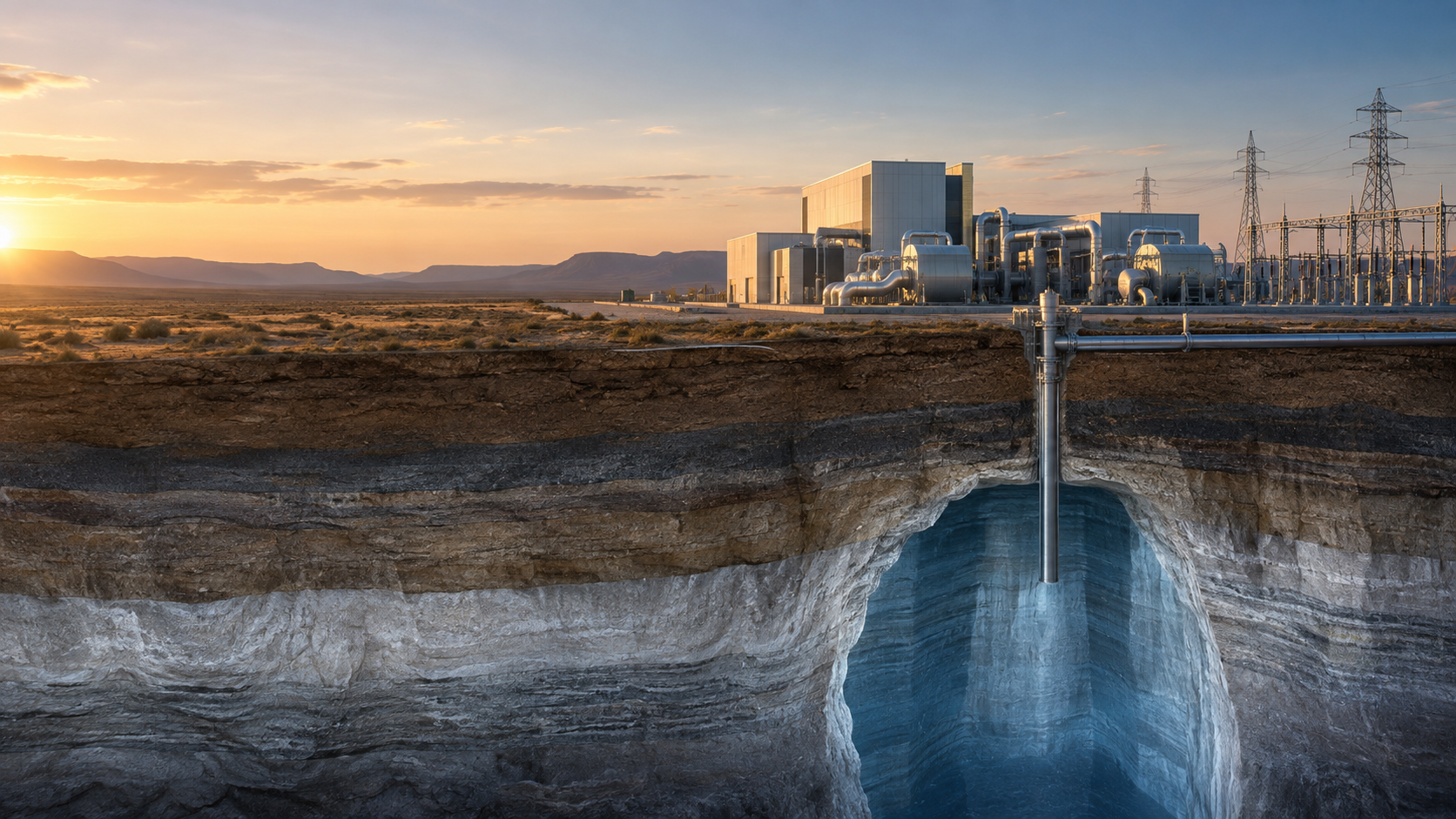
Compressed-air energy storage converts electricity into pressure, holds that pressure in a vessel, and later expands the air to produce electricity. At grid scale, the vessel is commonly underground. The commercial asset therefore joins a power plant, a subsurface storage system, a grid connection and a revenue contract.
These parts cannot be valued independently. A cavern with excellent containment has little value without a grid service that pays for its duration and availability. A lucrative capacity mechanism cannot compensate for air leakage, unstable rock, inadequate wells or uncertain thermal performance. Development should prove both the physical store and the economic service.
The investment question is specific: where does geology reduce the cost of storing another hour, and where does market design convert that physical duration into financeable cash flow? The answer determines site selection, development sequence, capital structure and acquisition value.
2. Long duration is a system service
The United States Department of Energy describes compressed-air storage as a mechanical long-duration option. Its 2023 commercial-liftoff report places typical compressed-air duration in an inter-day range and identifies geological constraint as a material deployment factor. The exact economic duration remains system-specific.
Duration is useful only when the power system needs energy across the same interval. A region dominated by short price spikes may favour batteries. A region facing multi-hour renewable shortfalls, transmission constraints or capacity scarcity may value ten, twenty or more hours. The project should define the stressed system event it is designed to cover.
Capacity, energy shifting, reserves, black-start capability and congestion relief have different qualification rules. The design must preserve enough pressure, thermal condition and equipment availability to perform the contracted service when called.
3. The process choice changes the commercial perimeter
Diabatic compressed-air systems reject heat during compression and add heat, historically from fuel, during expansion. Adiabatic systems seek to capture and reuse compression heat. Isothermal concepts try to manage heat during compression and expansion so that temperature remains closer to ambient. Hydrostatic arrangements can use water to maintain pressure.
Each process changes equipment, efficiency, emissions, water use, operating complexity and qualification. A project that burns fuel during discharge carries fuel-price, supply and emissions exposure. A project that stores heat needs a thermal store, insulation, heat exchangers and integrated performance evidence. A water-compensated system adds reservoirs, water balance and hydraulic controls.
Technology labels do not prove project performance. The diligence package should define the complete thermodynamic cycle, all auxiliary loads, operating envelope, start sequence, ramping capability and performance degradation.
4. Geology determines the storage vessel
The United States Geological Survey identifies several settings for geologic energy storage, including solution-mined salt caverns, hard-rock mines or purpose-mined caverns, depleted hydrocarbon reservoirs and nonpotable aquifers. These settings offer different combinations of volume, pressure, permeability, construction method and monitoring access.
The correct comparison is functional. The store must contain compressed air across repeated cycles, remain within safe pressure and temperature limits, protect groundwater, support required flow rates and allow inspection or monitoring. Gross subsurface volume is not usable storage capacity.
Resource maps are screening tools. They do not establish land rights, pore-space ownership, caprock integrity, well condition, grid capacity or permitting. Each candidate site requires a project-scale evidence programme.
5. Salt caverns offer engineered containment
Solution mining can create caverns within suitable salt formations. Salt has low permeability and can deform in a way that closes small fractures. Decades of hydrocarbon storage provide methods for cavern design, leaching, mechanical-integrity testing and monitoring.
Salt also moves under stress. Cavern convergence changes volume over time. Pressure limits must protect the roof, walls and casing. Insoluble layers, nearby caverns, boundary distance and leaching geometry affect stability. Brine creation and disposal can dominate the environmental and commercial programme.
An investable salt-cavern case therefore requires a three-dimensional geological model, leach plan, pressure envelope, subsidence assessment, brine route, well design and life-cycle convergence model. A salt map alone is insufficient.
6. Hard rock widens geography and increases civil scope
Hard-rock caverns can be mined where salt is absent. Existing mines may provide shafts, access or voids, while purpose-mined caverns allow geometry to be designed around pressure and flow. The approach can place storage nearer to load or renewable generation.
Rock mass is not naturally equivalent to a pressure vessel. Jointing, faults, in-situ stress and excavation damage affect leakage and stability. Liners, water curtains, grouting or other containment systems may be needed. Repeated pressure and temperature cycles create fatigue and interface questions.
The cost model should separate excavation, support, lining, access, ventilation, drainage and monitoring. Existing voids should receive no value until geometry, condition, ownership and adaptability are verified.
7. Porous formations require reservoir engineering
Porous media, including saline aquifers and depleted gas reservoirs, can offer large volumes without mining a cavern. Wells inject and withdraw air from pore space. The opportunity can be attractive where subsurface data and energy infrastructure already exist.
The storage boundary becomes distributed rather than visible. Capacity depends on porosity, permeability, thickness, pressure, cushion gas, caprock and well deliverability. Air can interact with residual fluids, minerals or hydrocarbons. Sand production, water movement, oxidation and microbial or geochemical effects can alter performance.
Reservoir value should follow a dynamic model calibrated by pressure, production, petrophysical and fluid data. Investors should require uncertainty ranges, monitoring plans and a demonstration that cycle rates can be delivered without compromising containment.
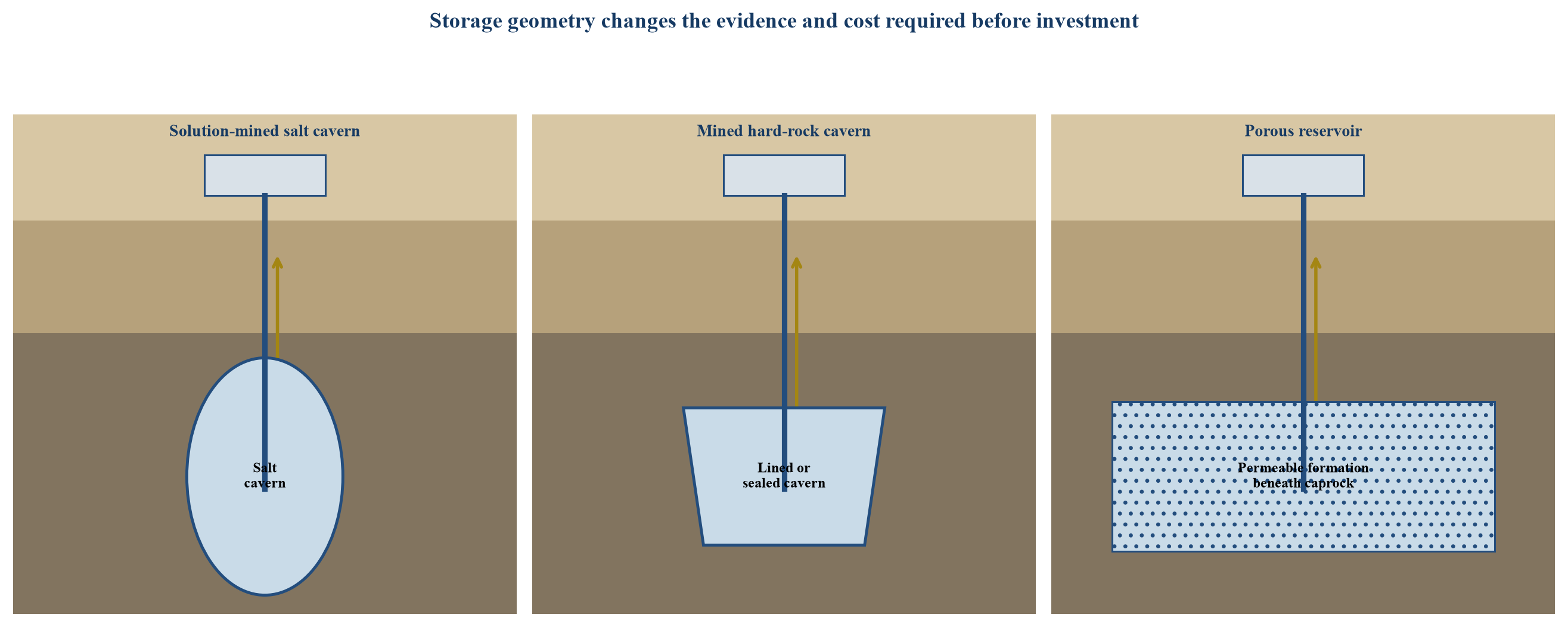
The diagrams are conceptual. Site design requires project-specific geological, geomechanical, reservoir and environmental evidence.
8. Depth sets pressure and cost
Greater depth can support higher pressure, increase stored mass and reduce surface footprint. It also increases drilling, shaft, casing and access cost. Pressure cannot exceed the safe operating limit of the formation, cavern, well and surface equipment.
The economic model should translate depth and pressure into usable energy rather than headline cavern volume. It should include minimum operating pressure, residual air, pressure losses and the energy needed to move air through wells and pipelines.
An optimal depth balances storage density with construction and integrity. A deeper resource is not automatically more valuable.
9. Cushion inventory is tied-up capital
Many underground gas-storage configurations require a minimum pressure or cushion inventory. That inventory may remain in the reservoir throughout operation. It can represent capital that does not generate discharge energy.
The financial model should distinguish working air from permanent or semi-permanent inventory. It should include procurement, compression, losses and recovery value. If another gas or water provides pressure support, its operating and environmental implications require separate treatment.
Acquisition models sometimes capitalise gross capacity while ignoring cushion requirements. The investment committee should value only deliverable energy within the verified operating envelope.
10. Thermal management determines efficiency
Compression creates heat; expansion creates cooling. Rejecting compression heat and later reheating air reduces round-trip efficiency or introduces fuel. Capturing and reusing heat can improve the cycle while adding equipment, storage media and integration risk.
The United States Department of Energy's 2022 technology assessment identifies heat management, efficiency and siting as material CAES challenges. Performance should be measured at the grid boundary, including compressors, pumps, cooling, heating, controls and standby loads.
The model should use efficiency curves across pressure, temperature and load. A single nameplate efficiency can overstate value when actual dispatch includes partial load, frequent starts or long standby periods.
11. Flow deliverability limits power
Stored mass determines energy potential; wells, pipes, valves and turbomachinery determine power. A large porous reservoir can still have weak deliverability. A cavern can experience pressure decline that changes compressor and expander performance.
Design should model injection and withdrawal rates for the required duty cycle. It should test pressure transients, temperature, erosion, vibration and acoustic effects. Multiple wells may improve reliability while increasing cost and surface footprint.
Completion tests should demonstrate sustained power and energy, not a short peak. The acceptance regime should cover repeat cycles and recovery after outages.
12. Cycling integrity is a bankability threshold
The storage system experiences repeated pressure and temperature changes. Salt creep, rock fatigue, casing movement, seal degradation and reservoir-fluid movement can accumulate across the asset life.
A geomechanical model should define maximum and minimum pressure, ramp rate, cycle count and rest conditions. Monitoring should include pressure, temperature, deformation, microseismicity or other indicators appropriate to the setting.
Debt should not assume unrestricted cycling until tests and qualified engineering establish the safe envelope. Contracted dispatch must remain inside that envelope.
13. Legacy wells can create leakage paths
Depleted reservoirs may contain historic wells drilled to different standards. Records can be incomplete. Cement, casing and plugs deteriorate. A well outside the project boundary can still connect to the pressure plume.
Diligence should inventory every penetrating well, verify status and model pressure communication. Remediation cost and access rights should be included. Responsibility for undocumented or orphan wells needs contractual allocation.
The project company should maintain monitoring and response capability across the full area of influence. A perimeter drawn around surface land may not capture subsurface risk.
14. Brine and water can control the schedule
Solution mining creates brine that requires storage, beneficial use, pipeline transport, discharge or disposal. Water may also support pressure compensation, cooling or thermal management. Permits and infrastructure can take longer than cavern construction.
The development schedule should state water source, quality, volume, treatment, disposal route and stakeholder rights. Brine revenue should remain outside the base case unless a binding offtake and specification exist.
Water constraints can be fatal in arid regions or near protected aquifers. Early hydrogeological and disposal work can therefore create more value than additional surface engineering.
15. Surface equipment is a conventional project with novel interfaces
Compressors, expanders, generators, motors, heat exchangers, thermal stores, piping and electrical systems use established industrial components. The challenge lies in integrating them with a variable-pressure geological store and the market dispatch profile.
The engineering package should define batteries limits, control philosophy, transient behaviour and responsibility for system efficiency. Vendors may guarantee equipment while excluding cavern behaviour. Cavern contractors may exclude power-block performance.
An integrator must own the interfaces. Completion security should respond to failures that arise between equipment packages, not only inside individual warranties.
16. Operating history must be interpreted carefully
The United States Energy Information Administration identifies the McIntosh facility in Alabama as the only operating compressed-air storage system in the United States. DOE assessments also cite Huntorf in Germany as a long-running utility-scale installation. Both are valuable references for cavern operation and grid service.
Earlier plants use diabatic cycles and salt caverns. Their performance cannot be transferred automatically to adiabatic, isothermal, hard-rock or porous-media projects. New configurations require evidence for their own pressure, heat-management and control systems.
Reference diligence should compare the same process, geology, scale and operating duty. A technology family name is too broad for warranty or financing decisions.
17. Demonstration evidence should follow a hierarchy
The strongest evidence comes from operating assets at relevant scale and duty. Integrated pilot operation is stronger than component testing. Factory tests prove manufacturing and component performance but not cavern interaction. Simulations support design and need calibration.
The evidence register should record duration, pressure, temperature, cycle count, availability, efficiency, maintenance and failures. Results should be witnessed where they support contractual guarantees.
Scaling assumptions require explicit margins. A larger cavern, higher pressure or new thermal system can change failure modes even when individual components are familiar.
18. Public support is conditional evidence
In January 2025, the United States Department of Energy announced a conditional commitment for a loan guarantee for the proposed Willow Rock advanced compressed-air project in California. The announcement described a 500 MW, 4,000 MWh concept and stated that final financing remained subject to conditions.
Such an announcement demonstrates policy interest and a diligence pathway. It is not evidence that construction, financing or operating performance has been completed. Investors should check the current status, conditions precedent and any later authoritative update before relying on it.
Public support can reduce financing risk only after award terms, draw conditions, milestones and remedies are understood.
19. Resource screening should be two-dimensional
The first dimension is geological: storage setting, depth, containment, pressure, water, wells and constructability. The second is commercial: grid access, system need, market rules, support eligibility and dispatch value.
A site should fail early if either dimension is weak. Excellent geology far from the right grid node can destroy value. A high-value grid node without a financeable store can consume years of development capital.
Screening should therefore rank joint fit rather than produce separate geology and market lists. Data quality and control rights should influence the score.
20. Evidence gates protect development capital
Gate one confirms system need and a candidate storage setting. Gate two secures data, land, mineral or pore-space rights. Gate three proves preliminary containment and grid feasibility. Gate four completes site investigation and front-end engineering. Gate five secures permits, market eligibility and cost evidence. Gate six fixes contracts, support and financing. Construction begins only after residual risk is funded.
Each gate should specify tests, budget, decision rights and stop conditions. Development value rises when evidence reduces the probability and cost of failure.
The same structure supports transactions. Buyers can pay for completed evidence and use milestone consideration for remaining permits, support awards or financing.
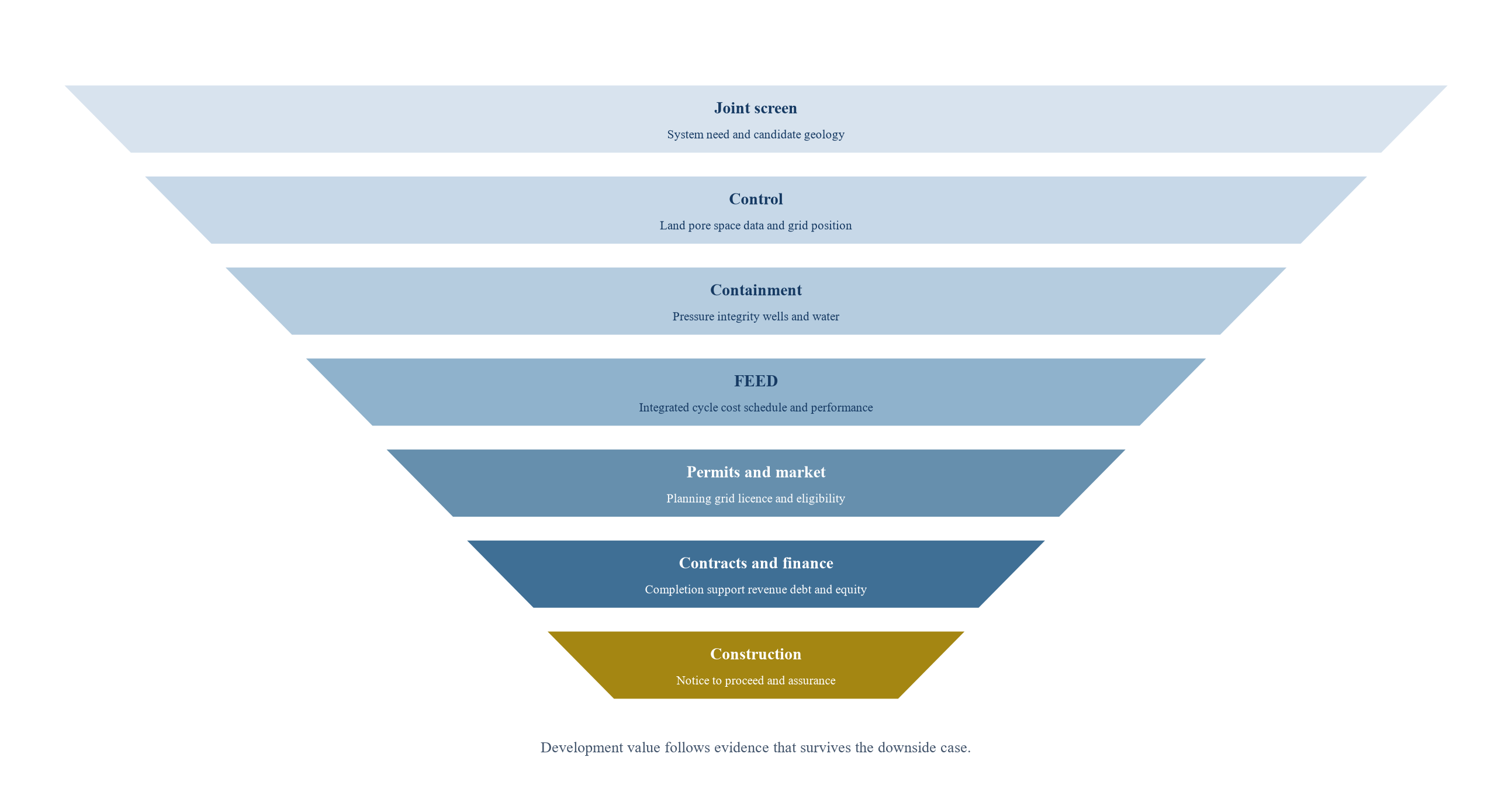
Capital commitment increases only as subsurface, engineering, grid and revenue evidence becomes specific and enforceable.
21. Configuration comparison should expose the hidden constraint
Salt, hard rock and porous formations solve the storage problem differently. Salt caverns rely on solution mining and salt integrity. Hard-rock caverns rely on excavation, support and engineered containment. Porous reservoirs rely on wells, caprock and reservoir behaviour.
The comparison should use common fields: deliverable air mass, pressure range, injection and withdrawal rate, cycle limit, thermal boundary, construction method, water and brine, wells, monitoring, permit route and grid distance. Qualitative labels should be supported by measurements.
The least expensive cavern is not necessarily the lowest-cost project. A remote salt resource can require major transmission. A nearby hard-rock site can justify higher cavern cost through better market access. A porous reservoir can offer scale while requiring more monitoring and cushion inventory.
Table 1. Geological configuration screen for compressed-air storage
| Storage setting | Principal advantage | Critical evidence | Common hidden cost | Operating constraint | Commercial fit |
|---|---|---|---|---|---|
| Solution-mined salt cavern | Engineered geometry and low salt permeability | Salt thickness and quality, cavern spacing, pressure envelope, leach model and well integrity | Brine handling, convergence, subsidence, solution-mining water and remote grid connection | Minimum pressure, creep and cycling limits | Large repeatable projects where salt, brine route and grid value coincide |
| Purpose-mined hard-rock cavern | Geographic flexibility and designed access | Rock mass, joints, in-situ stress, liner or water-curtain performance and excavation plan | Mining, lining, support, ventilation, drainage and interface complexity | Fatigue, leakage and maintenance access | Sites near strong grid nodes where proximity offsets higher civil cost |
| Existing mine or cavern | Potential reuse of voids, shafts and industrial land | Verified geometry, ownership, stability, sealing, contamination and adaptable access | Rehabilitation, unknown workings, permanent safety systems and legacy liabilities | Irregular geometry and uncertain integrity | Select brownfield sites with exceptional evidence and clear control |
| Porous aquifer | Large potential volume without cavern excavation | Porosity, permeability, caprock, water chemistry, pressure response and well deliverability | Cushion inventory, wells, monitoring, fluid treatment and plume management | Variable deliverability and distributed containment | Large-scale storage where reservoir data and rights are strong |
| Depleted gas reservoir | Existing subsurface data and energy infrastructure | Residual gas, well inventory, caprock, pressure history, geochemistry and pore-space rights | Legacy-well remediation, gas interactions and wide monitoring area | Historic wells and residual fluids | Locations with extensive data, strong grid need and manageable legacy exposure |
This is a decision framework. Every site requires project-specific geological, engineering, environmental and commercial evidence.
22. Cost must be separated into power and energy components
The power block includes compressors, expanders, generators, heat exchangers, controls and grid equipment. Cavern or reservoir volume principally supports energy duration. This creates the potential for lower marginal cost per additional hour once a suitable store is established.
That principle is not universal. Additional volume can require another cavern, well, liner, leaching campaign or pressure-management system. Flow equipment may also need expansion. The cost curve should be built from physical quantities rather than a constant dollars-per-kilowatt-hour assumption.
Investors should review cost by work package, owner, evidence grade and contingency. Surface plant, subsurface store, wells, grid connection, water, land, development, financing and reserves should remain visible.
23. Market design determines whether duration earns revenue
Energy arbitrage captures price differences between charging and discharge. Capacity mechanisms pay for availability during scarcity. Ancillary-service markets may pay for response, reserves or system support. Regulated or contracted structures can provide a revenue floor.
The project may be physically able to provide several services, but operating constraints prevent all revenues from being earned simultaneously. Capacity reserved for a call cannot always be sold into the energy market. Frequent ancillary dispatch can consume pressure or change thermal condition before a long-duration event.
The base case should include only compatible services for which the project has technical qualification and market access. Upside should remain outside debt sizing until supported by contracts or repeat evidence.
24. Chronological dispatch is essential
Annual average prices cannot value storage. The model should simulate charging, pressure, temperature, efficiency, minimum inventory, outages and discharge across hourly or finer chronology. It should include multiple weather years and stressed periods.
Charging can be constrained by transmission congestion, renewable availability or high prices. Discharge can be constrained by connection rights, minimum run, ramping or service obligations. Long standby periods can create heat loss or auxiliary consumption.
The economic result should be tested against competing storage, renewable build-out, fuel prices, carbon prices and market reform. Historical spreads are evidence of the past, not a guaranteed forward revenue stream.
25. Capacity value depends on accreditation
Capacity remuneration can support fixed cost, but qualification depends on rules. Accreditation may reflect duration, forced outage, derating, seasonal capability and performance during stress events. Penalties can be material.
The project model should use the capacity value that the applicable market recognises, not nameplate power multiplied by duration. It should include testing, notice, dispatch obligations and non-performance exposure.
Engineering and commercial teams must use the same duty cycle. A cavern designed around infrequent long discharge may experience a different cycle pattern if market incentives reward frequent operation.
26. A cap-and-floor regime changes the financeable case
The United Kingdom introduced a cap-and-floor regime for long-duration electricity storage. Ofgem describes a floor that can top up revenue below a defined level and a cap through which excess revenue is shared with consumers. Project assessment includes deliverability, cost, system benefit and other criteria.
Compressed-air projects were represented in the first-window application pool, according to Ofgem's eligibility outcome. Eligibility does not establish award, final cost allowance or financing. A project must still pass assessment, licence, delivery and cost-review requirements.
The financial model should calculate the floor, cap, sharing, allowed costs, tax and return using the final project-specific terms. Debt should rely only on the portion of the floor that remains available after operating, availability and compliance assumptions.
27. Procurement can value long lead time
The Independent Electricity System Operator in Ontario has developed long lead-time procurement for resources including compressed-air storage. Procurement can align contract duration with assets that require substantial development and construction time.
An eligible technology still needs a compliant bid, connection, schedule, performance security and price. Bid value depends on contract indexation, curtailment, availability, penalties and change-in-law treatment.
Developers should design the project around the procurement product and preserve alternatives if timing slips. A single auction window can create option value and concentration risk at the same time.
28. Three hypothetical cases show the interaction
The illustrative cases compare a salt-cavern project, a purpose-mined hard-rock project and a porous-reservoir project. All numerical values are modelling assumptions. They are not quotations, forecasts or observed projects.
Each case provides 300 MW and ten hours of deliverable storage. The common output isolates differences in investigation, storage construction, efficiency, schedule, contingency and revenue support. Real projects require qualified designs, bids, contracts, market studies and permits.
The cases show why geology cannot be valued without a revenue route. The lowest illustrative capital cost still produces weak debt capacity under a merchant-only case. A higher-cost project can support more debt when completion and revenue are contracted.
Table 2. Hypothetical 300 MW compressed-air storage cases
| Input or outcome | Salt cavern | Purpose-mined hard rock | Porous reservoir |
|---|---|---|---|
| Rated discharge | 300 MW | 300 MW | 300 MW |
| Deliverable duration | 10 hours | 10 hours | 10 hours |
| Illustrative round-trip efficiency | 61% | 68% | 58% |
| Illustrative total capital cost | USD 1,050 million | USD 1,420 million | USD 1,180 million |
| Illustrative development-to-operation period | 6 years | 8 years | 7 years |
| Illustrative construction contingency | 18% | 27% | 24% |
| Principal storage evidence | Cavern leach and integrity programme | Rock model, lining and excavation design | Reservoir simulation, wells and caprock evidence |
| Illustrative revenue case | Capacity contract plus merchant energy | Regulated floor plus shared upside | Merchant energy plus partial tolling |
| Financing implication | Project debt after cavern, EPC and capacity conditions are fixed | Lower initial leverage until civil scope and regulated allowance mature | Debt constrained by reservoir deliverability, legacy wells and merchant exposure |
Every numerical value is an illustrative modelling assumption and is not a quotation, forecast or investment recommendation.
29. The valuation should move with evidence
Development value equals the risk-adjusted present value of the operating project less remaining development cost. Probability should follow evidence. A geological desktop study does not justify the same probability as successful test wells, front-end engineering, permits and fixed contracts.
Each gate changes expected cost, schedule, revenue and financing. A negative test can destroy a site thesis while preventing a much larger construction loss. A successful integrity test can create value before final investment decision.
The model should show value before and after every gate. This creates a transparent basis for option payments, farm-downs, joint ventures and acquisition earn-outs.
30. A combined value bridge reveals the decisive variables
A geological resource can reduce storage-vessel cost relative to an above-ground pressure system. Grid proximity can reduce connection cost. Long duration can increase system value. These benefits are offset by investigation, cavern works, thermal integration, schedule, market qualification and uncertainty.
The figure uses hypothetical percentage adjustments to a common reference cost-and-value index. It is explanatory and does not estimate a named project.
The correct project bridge should use measured quantities and expected cash flows. Benefits that depend on an unsigned support award or an untested reservoir remain probability weighted.
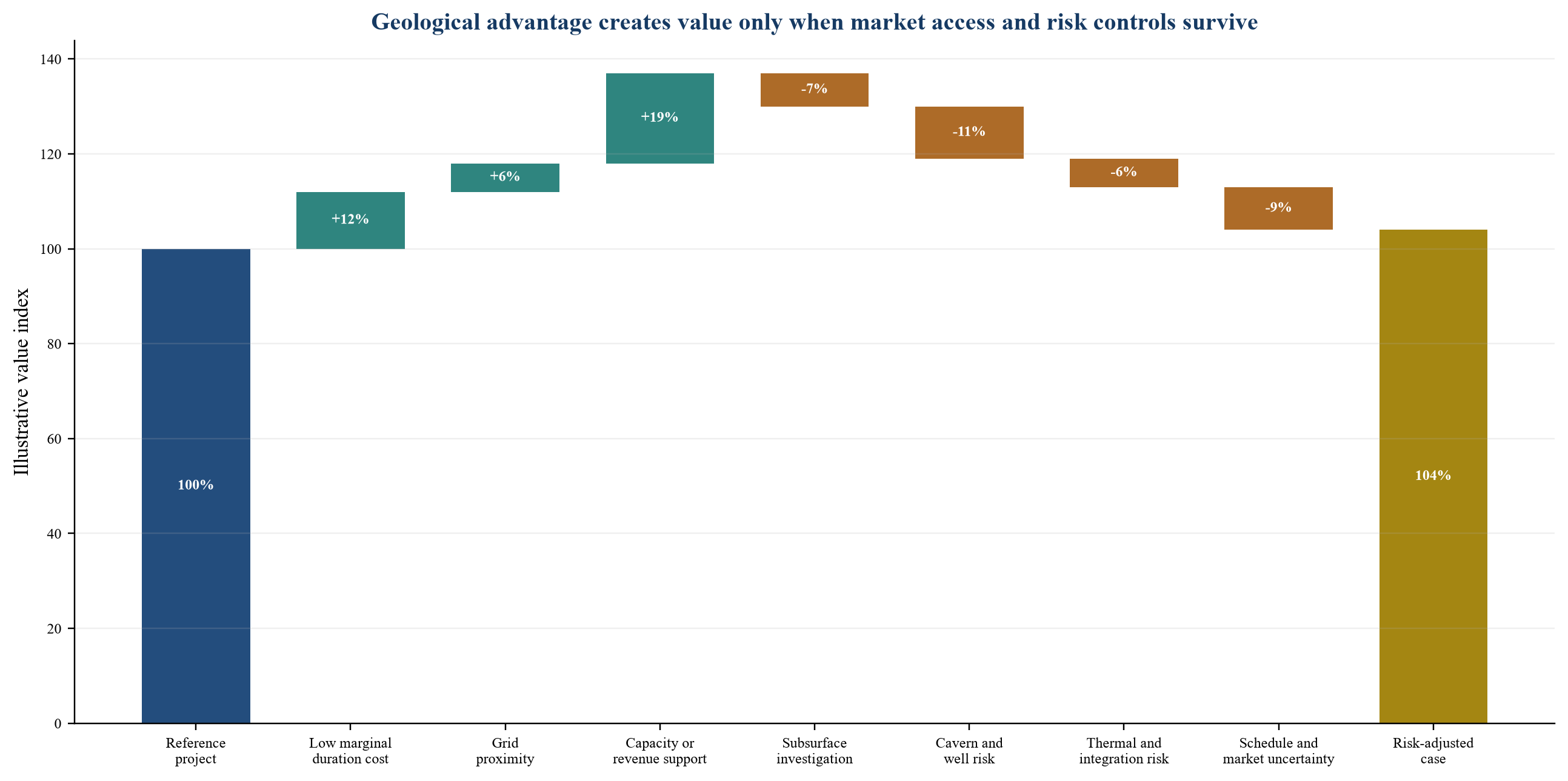
Values are hypothetical percentage adjustments to a common reference index. They are not observed project economics or forecasts.
31. Construction contracts need a geological baseline
Contractors cannot price unknown subsurface conditions without qualification or large contingency. An aggressive fixed-price request can produce exclusions, high bids or later disputes. The owner should investigate enough to define a credible baseline.
A geotechnical or reservoir baseline report can separate documented conditions from contractor-controlled method. Differing-site rules should define notice, investigation, schedule relief and compensation. Data provided to bidders should be complete and consistent.
The contract structure should preserve one party responsible for integrated completion. Separate cavern and power-block packages require interface schedules, shared tests and security that responds to combined failure.
32. Completion testing must cover the whole cycle
Mechanical completion does not prove storage performance. The project should demonstrate charging power, stored energy, sustained discharge, efficiency, ramp, minimum inventory, pressure limits, thermal behaviour, auxiliary load and grid compliance.
Tests should include repeat cycles and agreed ambient or subsurface conditions. A test at favourable pressure cannot establish performance across the full operating range. Availability should begin only after the integrated system meets acceptance criteria.
Performance damages should reflect lost capacity, energy and revenue. Remedies need to remain credible relative to contractor and supplier balance sheets.
33. Environmental and safety cases are site-specific
Compressed air is not combustible, but high-pressure systems store substantial mechanical energy. Wells, caverns, pipes and vessels require pressure safety, isolation, emergency response and exclusion planning. Fuelled cycles add combustion and emissions systems.
Subsurface projects can affect groundwater, brine, land, subsidence, noise and habitat. Porous reservoirs can interact with residual hydrocarbons or formation fluids. Hard-rock excavation creates spoil and construction traffic.
The environmental thesis should compare the complete project with a defined alternative. Claims of low surface footprint should include wells, pipelines, substations, thermal systems, water facilities and grid works.
34. Rights must match the pressure footprint
Land ownership may not include mineral, salt or pore-space rights. A storage plume or pressure influence can extend beyond the surface facility. Existing leases, wells and resource rights can conflict with project operation.
The project company needs durable rights to build, inject, withdraw, monitor, remediate and decommission. It also needs access to off-site monitoring locations and rights to protect the cavern or reservoir from incompatible activity.
Title diligence should map surface, subsurface and access interests across the full operating and closure period. Unresolved ownership can prevent financing even when engineering is strong.
35. Data rights create transaction value
Geological logs, cores, pressure data, seismic surveys, well files, models and operating tests are core project assets. Buyers and lenders need usable data, assumptions, calibration and version history.
Consultants and technology vendors may retain proprietary methods while providing the project company with measurements and decision outputs. Contracts should preserve data access after termination and transfer it on a change of control.
A structured data room can reduce repeat investigation and support refinancing. Unsupported summaries and inaccessible vendor systems will be discounted.
36. Insurance follows disclosed risk
Construction insurance can cover defined physical events; it does not replace investigation. Geological uncertainty, gradual leakage, performance shortfall and market loss may be excluded or subject to high deductibles.
The insurance programme should be built from the risk register and contract allocation. Coverage, exclusions, limits, waiting periods and counterparty strength should be reviewed together. Lenders may require additional reserves for risks that cannot be transferred.
Insurance evidence should be obtained before final leverage is fixed. An assumed policy that the market will not write is not a financing solution.
37. Debt should follow contracted cash flow and proven integrity
Early development requires risk-bearing equity. Public grants or concessional funding can support investigation and first-of-a-kind integration. Construction debt becomes more plausible after containment, permits, grid, cost, schedule, completion security and revenue support are sufficiently fixed.
Merchant revenue should receive conservative leverage. A capacity contract, toll or regulated floor can improve debt service coverage, subject to performance and termination terms. Debt tenor should reflect contract life, major maintenance and closure obligations.
The capital structure should include cost-overrun support, liquidity, debt-service reserves and decommissioning provision. Draw conditions should track the actual evidence gates.
38. Risk allocation should follow control
The subsurface owner controls historic data and rights. The developer controls investigations and permits. Designers control specifications. Contractors control means and methods within the baseline. Equipment suppliers control machinery performance. Market and grid bodies control qualification and connection within their authority.
Risk should sit with the party able to manage it and should remain visible when it cannot be transferred. Contingency, reserves, insurance and lower leverage are valid responses. Disappearing risk inside an optimistic base case is not.
Table 3. Risk allocation and financing response for compressed-air storage
| Risk | Evidence before commitment | Natural risk bearer | Contractual response | Financing implication |
|---|---|---|---|---|
| Containment and geomechanics | Boreholes, cavern or reservoir model, pressure tests and monitoring design | Owner for disclosed baseline; contractor for method | Baseline conditions, integrity standard, differing-site process and contingency | Debt follows successful tests; reserves for retained subsurface conditions |
| Wells and deliverability | Well logs, integrity tests, flow tests and full inventory of penetrations | Project company and well contractors | Completion standards, remediation plan, flow guarantee and access rights | Draw conditions tied to verified injection and withdrawal rates |
| Thermal-cycle performance | Integrated design, component tests and relevant operating evidence | Technology supplier and system integrator | Efficiency, power, duration and auxiliary-load guarantees | Performance damages and conservative base-case efficiency |
| Brine and water | Water balance, permits, disposal route and binding third-party arrangements | Project company and specialist contractors | Volume, quality, schedule, treatment and disposal obligations | Dedicated contingency and completion condition for disposal route |
| Grid connection | Executed agreement, studies, works scope and energisation plan | Project company and network party within roles | Milestones, delay allocation, curtailment rules and long-stop date | Drawdown and revenue start depend on connection certainty |
| Market eligibility | Applicable rules, qualification plan and accepted application or contract | Project company subject to market body | Compliance plan, testing, reporting and change controls | Debt recognises only confirmed and durable remuneration |
| Construction integration | FEED, interface matrix, baseline data and qualified bids | EPC integrator within defined scope | Single-point completion, interface schedule, security and relief rules | Contingency follows exclusions and contractor strength |
| Merchant revenue | Chronological dispatch and downside market study | Equity investors | Hedging, tolling, capacity contract or regulated support | Lower merchant leverage, cash sweeps and distribution lock-up |
| Closure and long-tail monitoring | Closure plan, regulator requirements and cost estimate | Project company and subsurface owner as allocated | Funded reserve, handback standard and surviving obligations | Decommissioning security and lender tail protection |
Final allocation depends on project contracts, evidence, counterparties and applicable law.
39. The downside case must combine correlated risks
Subsurface failure rarely affects one line item. Weak containment can require more wells, delay schedule, increase cost and reduce deliverable energy. Grid delay can miss a procurement window while interest and commitment fees continue. Lower efficiency can reduce arbitrage and increase charging exposure.
The downside model should combine plausible correlations. It should show maximum additional equity, minimum liquidity, covenant headroom and recovery value after a failed gate.
An investment committee should see the stop-loss decision as clearly as the upside case. A project is not financeable because a deterministic model produces an attractive return.
40. Acquisition structures can share development risk
A buyer can acquire the project company, purchase selected rights, fund a joint venture or take an option. Consideration can combine upfront payment with milestones tied to containment tests, permits, market awards, fixed contracts and financial close.
Earn-outs should use objective evidence and clear governance. Sellers should not receive full value for untested storage capacity. Buyers should not control decisions that determine a seller's milestone without defined standards.
Representations should cover data, models, title, wells, permits, environmental matters, grid position and applications. Indemnities need credit support where legacy subsurface liabilities are material.
41. A first hundred days should narrow the joint thesis
The first programme should secure data and rights, define the target system service, confirm candidate geology, commission an independent subsurface review and open grid discussions. The team should create a fatal-flaw register and costed investigation plan.
Market work should identify current qualification, contract or support routes. Engineering should define the operating duty that those routes require. Financial work should map evidence to probability and development capital.
At day one hundred, the sponsor should decide whether to stop, option the site, drill or test, enter procurement, or move to prefeasibility. Continued spend should follow evidence.
42. Portfolio replication requires standard decisions
Geology is site-specific, but the decision process can be standardised. Common data schemas, screening metrics, investigation scopes, cost breakdowns and gate criteria allow projects to be compared consistently.
Standardisation should reveal differences rather than force one design. A salt cavern and porous reservoir should answer the same investment questions with different evidence.
A portfolio developer can allocate capital toward sites with the strongest combination of storage integrity, grid value, market access, control rights and delivery probability.
43. Limits and further research
Public sources establish technology principles, geological settings, regulatory frameworks and selected project disclosures. They do not establish the current cost, construction status or bankability of an unidentified site. Confidential surveys, bids, contracts, test data and approvals are required for an investment decision.
The hypothetical cases illustrate method only. Further research should compare realised cavern and well cost, cycling integrity, efficiency, availability, maintenance and dispatch revenue across operating configurations. It should also test how capacity accreditation and regulated floors change operating behaviour.
Engineering, geological, environmental, legal, tax, accounting and regulatory conclusions require qualified advisers in the relevant jurisdiction.
44. Conclusion
Compressed-air storage becomes investable where a proven storage formation meets a power system that pays for long duration. Geology determines containment, pressure, deliverability and construction. Market design determines whether the service produces durable cash flow.
Salt caverns offer an established route with brine and location constraints. Hard rock broadens siting and raises civil and containment questions. Porous formations offer scale and require reservoir, well and fluid evidence. Every configuration needs integrated thermodynamic performance and grid access.
A disciplined sponsor screens geology and market together, releases capital through evidence gates, values only deliverable capacity, contracts around a documented baseline and sizes debt against cash flow that survives the downside case. The cavern pays when containment, system need and contractual remuneration are proven as one asset.
References
- United States Department of Energy, Technology Strategy Assessment: Compressed Air Energy Storage, July 2023. https://www.energy.gov/sites/default/files/2023-07/Technology%20Strategy%20Assessment%20-%20Compressed%20Air%20Energy%20Storage_0.pdf
- United States Department of Energy, Pathways to Commercial Liftoff: Long Duration Energy Storage, September 2023. https://www.energy.gov/sites/default/files/2023-09/Pathways%20to%20Commercial%20Liftoff%20Long%20Duration%20Energy%20Storage%20Opportunities_508.pdf
- United States Department of Energy, Achieving the Promise of Low-Cost Long Duration Energy Storage, August 2024. https://www.energy.gov/sites/default/files/2024-08/Achieving%20the%20Promise%20of%20Low-Cost%20Long%20Duration%20Energy%20Storage_FINAL_08052024.pdf
- Sandia National Laboratories and Pacific Northwest National Laboratory, Energy Storage Grand Challenge Cost and Performance Assessment 2022, August 2022. https://www.sandia.gov/app/uploads/sites/256/2024/02/ESGC-Cost-Performance-Report-2022-PNNL-33283.pdf
- United States Geological Survey, Geologic Energy Storage, Fact Sheet 2022-3082, 2023. https://pubs.usgs.gov/publication/fs20223082/full
- United States Geological Survey, Geologic Energy Storage programme, accessed September 2026. https://www.usgs.gov/centers/geology-energy-and-minerals-science-center/science/geologic-energy-storage
- United States Geological Survey, A Probabilistic Assessment Methodology for the Evaluation of Geologic Energy Storage Capacity, 2025. https://pubs.usgs.gov/publication/sir20255108/full
- United States Energy Information Administration, Energy Storage for Electricity Generation, accessed September 2026. https://www.eia.gov/energyexplained/electricity/energy-storage-for-electricity-generation.php
- United States Department of Energy, Potential Benefits of High-Power, High-Capacity Batteries, January 2020. https://www.energy.gov/oe/articles/potential-benefits-high-power-high-capacity-batteries-january-2020
- United States Department of Energy, LPO Announces Conditional Commitment for Long Duration Compressed Air Energy Storage, January 2025. https://www.energy.gov/edf/articles/lpo-announces-conditional-commitment-long-duration-compressed-air-energy-storage
- New York State Electric and Gas, Seneca Compressed Air Energy Storage Demonstration Project Final Report, September 2012. https://www.osti.gov/biblio/1088675
- Department for Energy Security and Net Zero and Ofgem, Long Duration Electricity Storage: Technical Decision, March 2025. https://www.gov.uk/government/publications/long-duration-electricity-storage-technical-details-of-the-scheme-and-its-operation
- Ofgem, Long Duration Electricity Storage, updated July 2026. https://www.ofgem.gov.uk/energy-regulation/low-carbon/long-duration-electricity-storage
- Ofgem, Long Duration Electricity Storage Window 1 Eligibility Assessment Outcome, September 2025. https://www.ofgem.gov.uk/sites/default/files/2025-09/LDES%20Eligibility%20Assessment%20Outcome.pdf
- Ofgem, Long Duration Electricity Storage Multi-Criteria Assessment Framework, September 2025. https://www.ofgem.gov.uk/guidance/ldes-project-assessment-multi-criteria-assessment-mca-framework
- Ofgem, Long Duration Electricity Storage Cap and Floor Financial Model and Handbook, October 2025. https://www.ofgem.gov.uk/guidance/long-duration-electricity-storage-ldes-cap-and-floor-financial-model-and-handbook
- Independent Electricity System Operator, Long Lead Time Request for Proposals Presentation, January 2026. https://www.ieso.ca/-/media/Files/IESO/Document-Library/engage/llt/llt-rfp-20260128-presentation.pdf
- United Kingdom Department for Business, Energy and Industrial Strategy, Longer Duration Energy Storage Demonstration Programme Projects, accessed September 2026. https://www.gov.uk/government/publications/longer-duration-energy-storage-demonstration-programme-successful-projects/longer-duration-energy-storage-demonstration-programme-stream-2-phase-1-details-of-successful-projects
About the Author
Chennakeshav (CK) is a corporate finance and investment banking executive with 25+ years of global experience in deal origination, structuring and execution across M&A, growth capital and corporate strategy. He has led value-creation mandates for founders, corporates and funds — bridging the boardroom view to hands-on execution and close.
His career spans Morgan Stanley, HSBC, Lloyds Banking Group, EWEC, ADQ portfolio companies and Emirates Growth Fund, across TMT, real estate, fintech, deeptech, cleantech, infrastructure and energy. He has partnered with C-suite leaders, private equity and venture funds, sovereign wealth funds and family offices to finance complex fund raises and scale-up ventures, and has led M&A due diligence, post-merger integration and business-transformation initiatives to create value.
At Matchpoint Partners he is Managing Partner, leading the firm's corporate finance, M&A and capital-raising practice. He holds an MBA from London Business School, an engineering degree from VTU and a Master of Laws (LLM, in progress) from UCL London.
An active start-up mentor, CK mentors at Techstars, DIFC FinTech Hive, Startup Grind, Founder Institute and IN5, serves as Entrepreneur Mentor in Residence (EMiR) at London Business School, and judges the Entrepreneurship World Cup.
LinkedIn: https://www.linkedin.com/in/ckadya/
Profile: https://www.matchpoint-partners.com/team/ck-adya.html
