

1. Define liquidity as usable capacity
A family can own cash, listed securities, private funds, operating companies, property and claims across several countries and still face a short-term liquidity failure. The failure begins when the entity that owes money cannot access an eligible asset, convert it into the required currency and complete payment before the deadline. Consolidated net worth does not settle payroll, margin calls, tax, debt service, insurance, medical costs or essential household commitments.
The geopolitical liquidity buffer should therefore be measured at the legal-owner level. Its purpose is to preserve lawful payment capacity during a defined disruption window. It is distinct from a return-seeking cash allocation, a market-timing position and an attempt to move around regulatory restrictions. The buffer connects four facts: who owes the obligation, when it is due, in which currency and jurisdiction it must be paid, and which assets can become final funds in that entity's account before the deadline.
This definition changes the family-office question. The board no longer asks only how much cash exists. It asks how much is available after entity, custody, currency, documentation, settlement and control constraints. An asset counts only to the extent that its path to the obligation is legal, operational and tested.
The International Monetary Fund's reserve-management guidance gives liquidity the highest priority when assets must remain available through external stress. The guidance concerns official reserves, yet its sequencing is useful for private capital: define the obligations, control liquidity, market and credit risks, then seek reasonable earnings within those constraints. A family should adapt the principle to its own legal owners, governance and risk appetite.
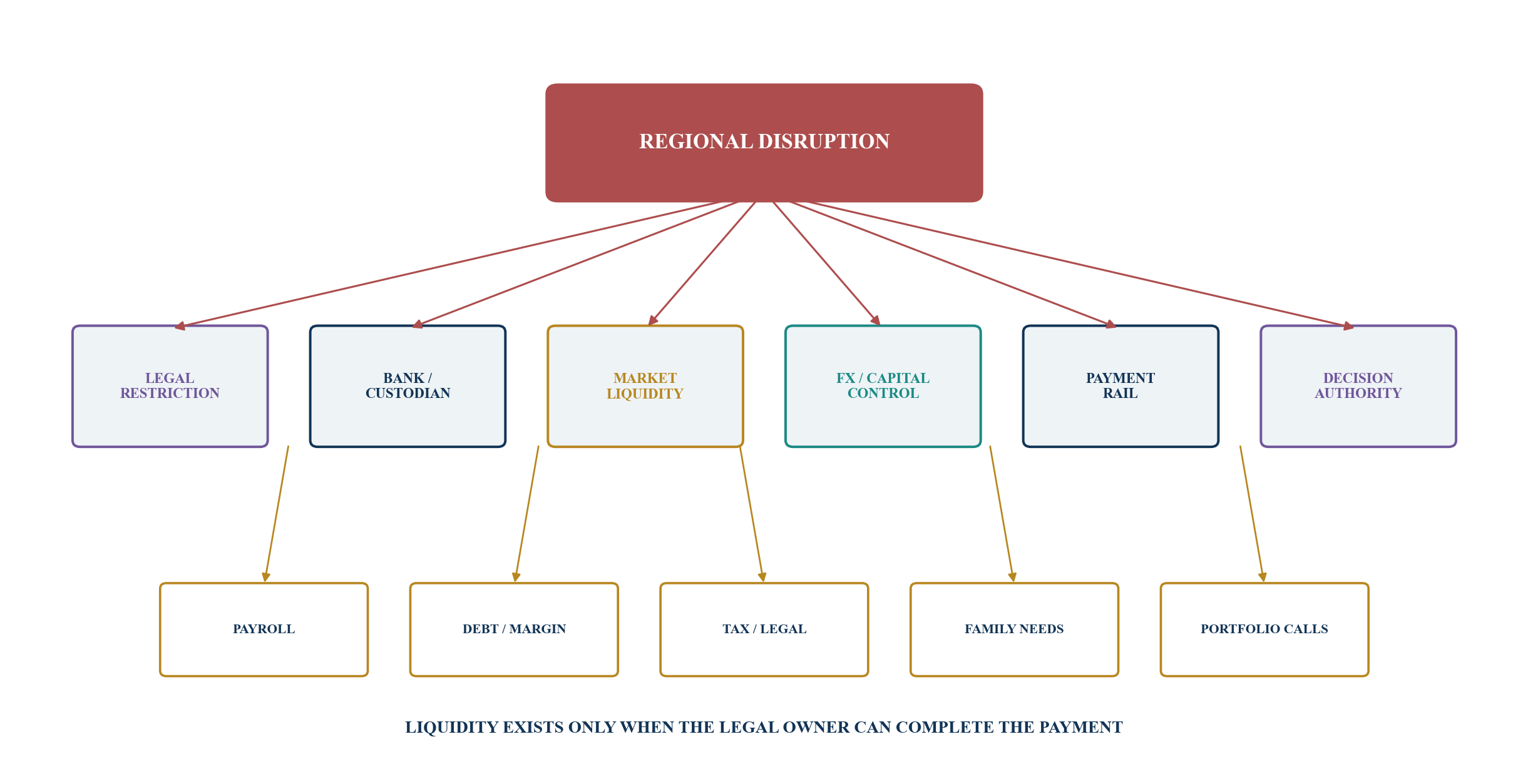
A shock becomes a liquidity event when it interrupts legal access, conversion, settlement or authority.
2. Map legal owners before aggregating wealth
The first control is a legal-owner map. It should include holding companies, operating businesses, investment vehicles, trusts, foundations, partnerships, personal accounts and any entity that can incur a payment obligation. Each record should show jurisdiction, beneficial ownership, directors or trustees, authorised signatories, banking relationships, custody arrangements, guarantees, tax status and restrictions on transfers.
Aggregation can conceal traps. Cash in an operating subsidiary may be subject to corporate-law limits, lender covenants, minority rights, local exchange controls or tax consequences. Trust assets may be governed by trustee duties and distribution rules. A fund vehicle can have capital-call obligations that cannot be met from a sibling entity without documentation. A personal account may be inaccessible to the company that owes payroll. A guarantee can create a contingent obligation in a legal owner that has little cash of its own.
The map should distinguish legal ownership from economic exposure. It should also distinguish an account balance from a verified claim against an institution. Cash, money-market funds, securities and deposits carry different ownership, segregation, redemption and settlement mechanics. IOSCO's client-asset recommendations emphasise records, segregation, custody arrangements, disclosure, reconciliation and independent assurance. These principles support the family office's due diligence on how assets are held and what happens if an intermediary fails.
The board should require evidence dates. Banking mandates, signatory lists, trust instruments, guarantees and custody agreements become stale. A register without current documentation can create false confidence at the moment of stress.
Table 1. Minimum legal-owner and obligation register
| Register field | Required evidence | Liquidity question |
|---|---|---|
| legal owner | constitutional record, trust deed or partnership agreement | which entity owns the asset and which body controls it? |
| beneficial ownership and control | current ownership chart and control analysis | can sanctions or regulatory rules extend through direct or indirect control? |
| authority | board mandate, power of attorney, signatory and trustee records | who can instruct, approve and replace an unavailable decision-maker? |
| account or custody chain | institution, booking centre, account title, sub-custodian and asset treatment | where is the legal claim and how is it protected or segregated? |
| obligation | contract, tax record, payroll, capital call, guarantee or family policy | who owes what, to whom, when and in which currency? |
| transfer path | lawful distribution, loan, capital contribution or payment route | can another entity fund the obligation lawfully and on time? |
| restriction | covenant, lock-up, notice period, exchange control or court order | what can delay, condition or prevent access? |
| evidence age | last verification, test and owner | is the record current enough for a crisis decision? |
Every material obligation should be linked to the entity that must legally discharge it.
3. Build an obligation calendar before setting a buffer
The buffer starts with cash needs, not an arbitrary percentage of assets. The family office should build a 24-month calendar that combines predictable commitments with contingent drains. The calendar should cover household and philanthropic commitments, operating-company payroll and suppliers, taxes, debt service, insurance, professional fees, fund capital calls, committed acquisitions, guarantees, derivatives, collateral and expected restructuring costs.
Obligations should be grouped by criticality and timing. Tier one comprises payments whose failure could threaten people, licences, solvency, collateral, legal standing or control of assets. Tier two covers commitments where delay causes material economic or reputational damage. Tier three includes discretionary deployments that can be cancelled or deferred. The board should approve the classification and revisit it after transactions, relocations, new borrowing and succession events.
Forecasts need variability. A capital-call estimate should reflect commitment schedules, manager behaviour and concentration. Debt facilities should include interest, amortisation, margin and covenant remedies. Operating companies need downside working-capital cases. Personal and family budgets should capture emergency travel, medical, security and relocation costs where relevant and lawful. The goal is a credible range, with the assumptions approved by management.
The calendar should identify payment-location constraints. An obligation in one jurisdiction may require funds in a named domestic account. A tax payment may reject a foreign payer. A capital call may require same-day receipt in a specific currency. A family office that models only base-currency value can miss these execution details.
4. Separate the buffer into time and purpose layers
A single cash number creates weak governance. The buffer should be divided into layers with distinct purposes, eligible assets and release rules. A practical architecture uses immediate operating cash, a near-term contingency reserve and strategic liquidity.
Immediate operating cash covers the first days and weeks. It belongs with the legal owner that owes the payment, in currencies and institutions that can settle its essential obligations. Eligible assets should have same-day or reliably short access without dependence on market sale. The amount should reflect payroll, debt, tax, family necessities and incident costs.
The contingency reserve supports a disruption lasting several months. It can include highly liquid, high-quality instruments after haircuts for price, redemption, settlement, currency and institution risk. Its release may require two authorised decision-makers. The strategic layer supports longer dislocation, portfolio rebalancing and opportunistic commitments after essential needs are secured. It can tolerate more duration and market exposure.
The layers should not be funded by the same failure point. If all three rely on one bank, one custodian, one money-market fund, one booking centre or one family decision-maker, the labels provide little resilience. Each layer needs access tests and concentration limits.
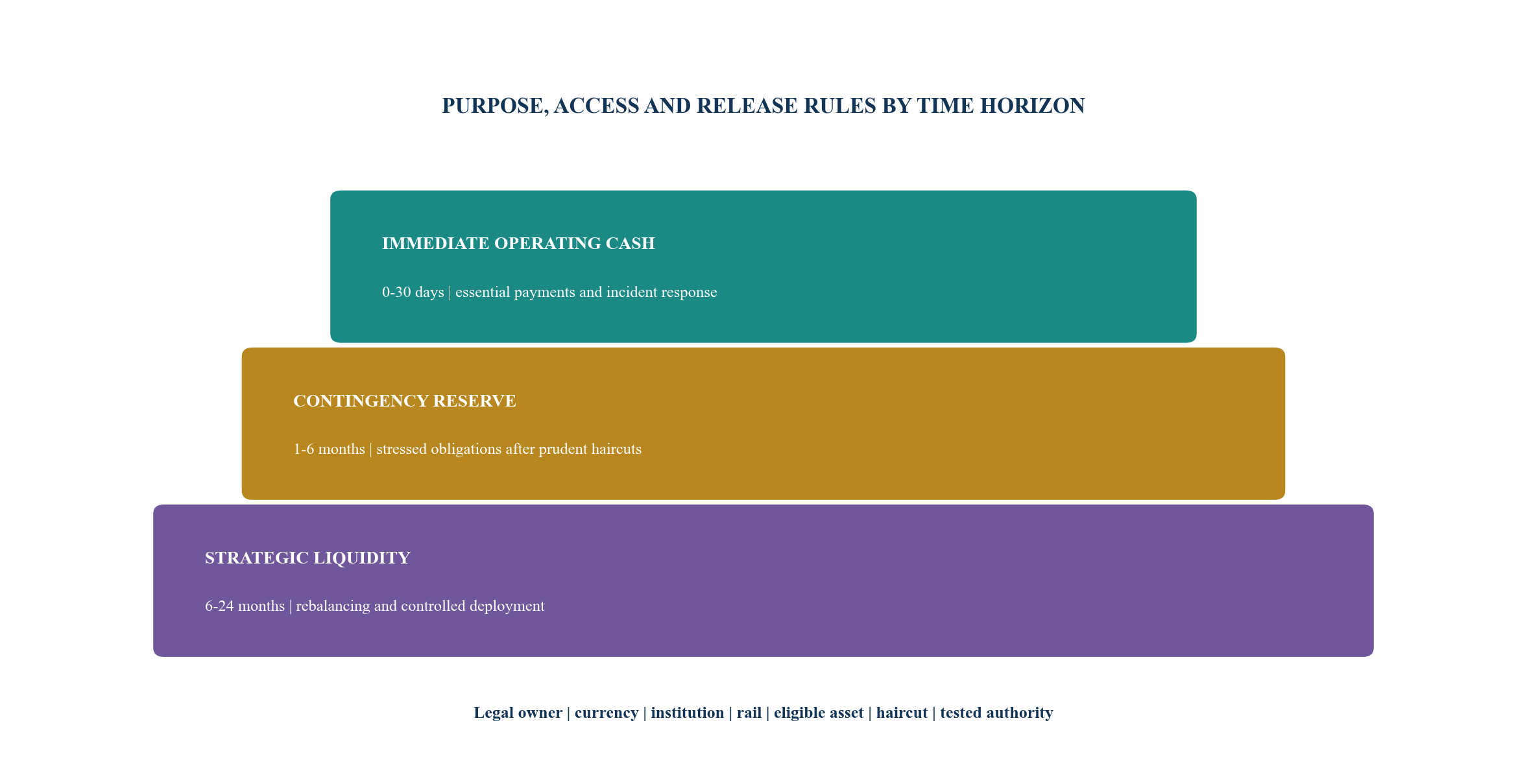
Eligible assets become broader as the decision horizon lengthens; every layer remains linked to a legal owner.
Table 2. Buffer layers and eligibility rules
| Layer | Primary purpose | Illustrative eligible capacity | Key exclusion or haircut |
|---|---|---|---|
| immediate operating cash | critical payments through the first 30 days | cleared deposits and immediately available balances in required currencies | trapped entity cash, unverified mandates, uncleared receipts and restricted accounts |
| contingency reserve | obligations through a multi-month interruption | short-duration liquid instruments and committed facilities after access testing | market-price loss, redemption gates, settlement delay, drawing conditions and currency conversion |
| strategic liquidity | longer dislocation, portfolio defence and selected deployment | diversified high-quality liquid assets with board-approved risk | duration, credit, market depth, collateral encumbrance and stressed correlations |
| contingent sources | additional capacity under defined events | documented family or entity facilities, asset sales and insured recoveries | discretion of third parties, material-adverse-change clauses, transfer restrictions and execution time |
Horizons and instruments are management choices; legal and investment review remains necessary.
5. Measure cash availability through a waterfall
The family office should convert gross liquid assets into available capacity through a conservative waterfall. Begin with assets legally owned by the relevant entity. Remove restricted, pledged, locked, disputed or operationally inaccessible amounts. Apply institution, market, currency and settlement haircuts. Deduct obligations that rank ahead of the proposed use. The remainder is the tested buffer.
Haircuts should reflect the mechanism of failure. A listed security can suffer a price decline, bid-ask widening, market closure or settlement delay. A fund can impose a notice period or gate. A deposit can exceed protection arrangements or sit with a concentrated institution. A credit line can contain conditions, draw stops or cancellation rights. A receivable can be delayed by the same disruption that creates the need for cash.
The family office should report both value and time. Two assets with the same stressed value can have different usefulness when one converts today and the other in ten business days. The dashboard should show capacity by day 0, day 2, day 10, day 30, month 3, month 6 and month 12 for each legal owner and currency.
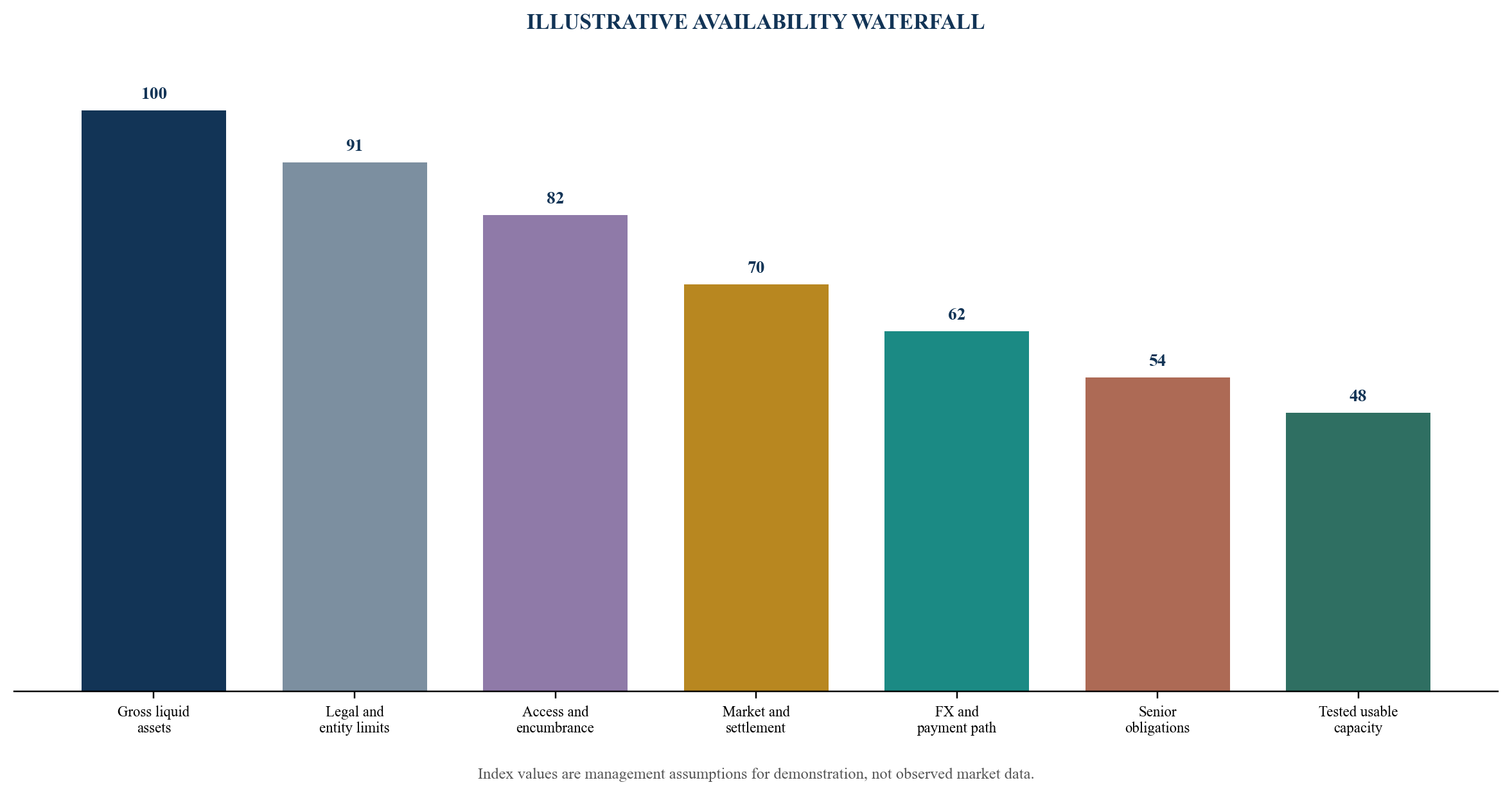
Availability is reduced by legal, operational, market, currency and priority constraints.
6. Diversify institutions, booking centres and custody chains
Diversification should follow failure modes rather than brand counts. Two accounts at different brands may share a correspondent bank, payment processor, booking centre, sub-custodian, cloud provider or local clearing system. Several portfolios can also depend on one relationship manager or one physical token.
The institution map should record the regulated entity, country, booking centre, product, cash treatment, custody chain, correspondent relationships, payment rails, access methods, operating hours and escalation contacts. It should identify balances that are deposits, client money, fund units or securities. Contractual terms and local rules determine rights; the family should obtain current legal advice for material exposures.
Concentration limits should cover institution, country, currency, custodian, sub-custodian, payment rail and technology. Limits can be expressed as the share of essential obligations that remains payable if one node is unavailable. This avoids a superficial allocation target. The relevant result is continuity under the failed-node scenario.
Account opening alone does not create resilience. Each route should hold an appropriate, governed balance, have current know-your-customer records, tested users, clear signatories and a documented funding mechanism. Dormant accounts can fail when they are needed because documents, limits or authentication have expired.
Table 3. Institution and custody decision matrix
| Dimension | Board control question | Evidence and test |
|---|---|---|
| regulated counterparty | which legal institution owes the deposit, custody or payment duty? | licence, contract, account title and current regulatory record |
| asset treatment | is the holding a deposit, security, fund interest or segregated client asset? | legal terms, custody statement, segregation and insolvency analysis |
| dependency chain | which correspondents, sub-custodians, processors and systems sit underneath? | service map, material outsourcing disclosure and contingency route |
| jurisdiction | which courts, resolution rules, controls and sanctions duties apply? | current legal advice and jurisdiction schedule |
| access | can authorised people instruct securely from expected locations? | role matrix, authentication inventory and successful test |
| concentration | what share of essential obligations fails with this node? | single-node outage scenario and approved limit |
| exit | how can cash and securities move if risk appetite changes? | transfer process, notice, fees, destination readiness and test evidence |
Due diligence should verify the legal entity and actual dependency chain behind each service.
7. Match currency capacity to obligations
Base-currency reporting can conceal a currency mismatch. A family may measure wealth in dollars while owing salaries in sterling, taxes in euros, debt in Swiss francs and family commitments in several domestic currencies. During disruption, exchange rates, spreads, market hours, settlement and controls can change together.
The currency plan should start with contractual and essential obligations. It should identify natural inflows, cash balances, hedges, conversion venues, settlement accounts and legal restrictions. The buffer should include an approved amount of pre-positioned currency where conversion delay would create unacceptable harm. Excessive pre-positioning can introduce negative carry, credit concentration and unnecessary operational complexity, so the decision belongs in a documented cost-risk analysis.
Hedges require liquidity planning of their own. Variation margin, collateral calls, close-out terms and settlement currencies can create cash demands when markets move sharply. The family office should model gross calls and collateral timing rather than relying only on the hedge's economic offset.
Currency convertibility should be assessed separately from exchange-rate risk. An apparently favourable rate is irrelevant when conversion or transfer requires approval, documentation or a closed market. The legal and treasury teams should maintain current jurisdiction schedules.
8. Treat payment rails and cut-offs as part of liquidity
Cross-border payments pass through multiple institutions, rules, message formats, compliance checks, time zones and settlement systems. The Financial Stability Board reports that global improvements have not yet produced satisfactory end-user outcomes across all targets. The Committee on Payments and Market Infrastructures has also examined operating hours and the governance of interlinked fast-payment systems. These findings support a practical conclusion: a family should not assume that a balance can move instantly because an interface appears available around the clock.
The payment map should show initiation channel, debiting institution, correspondent chain, foreign-exchange leg, beneficiary institution, cut-off, value date, information requirements and exception process. Critical payments should have a lawful secondary route that does not depend on the same failed nodes. The route should be tested with modest real transactions, subject to applicable rules and cost controls.
Extended hours can reduce delay and settlement risk, while they also require staffing, liquidity and operational controls. A family-office treasury should know when each route actually reaches final settlement and who can resolve a screening or data exception outside normal office hours.
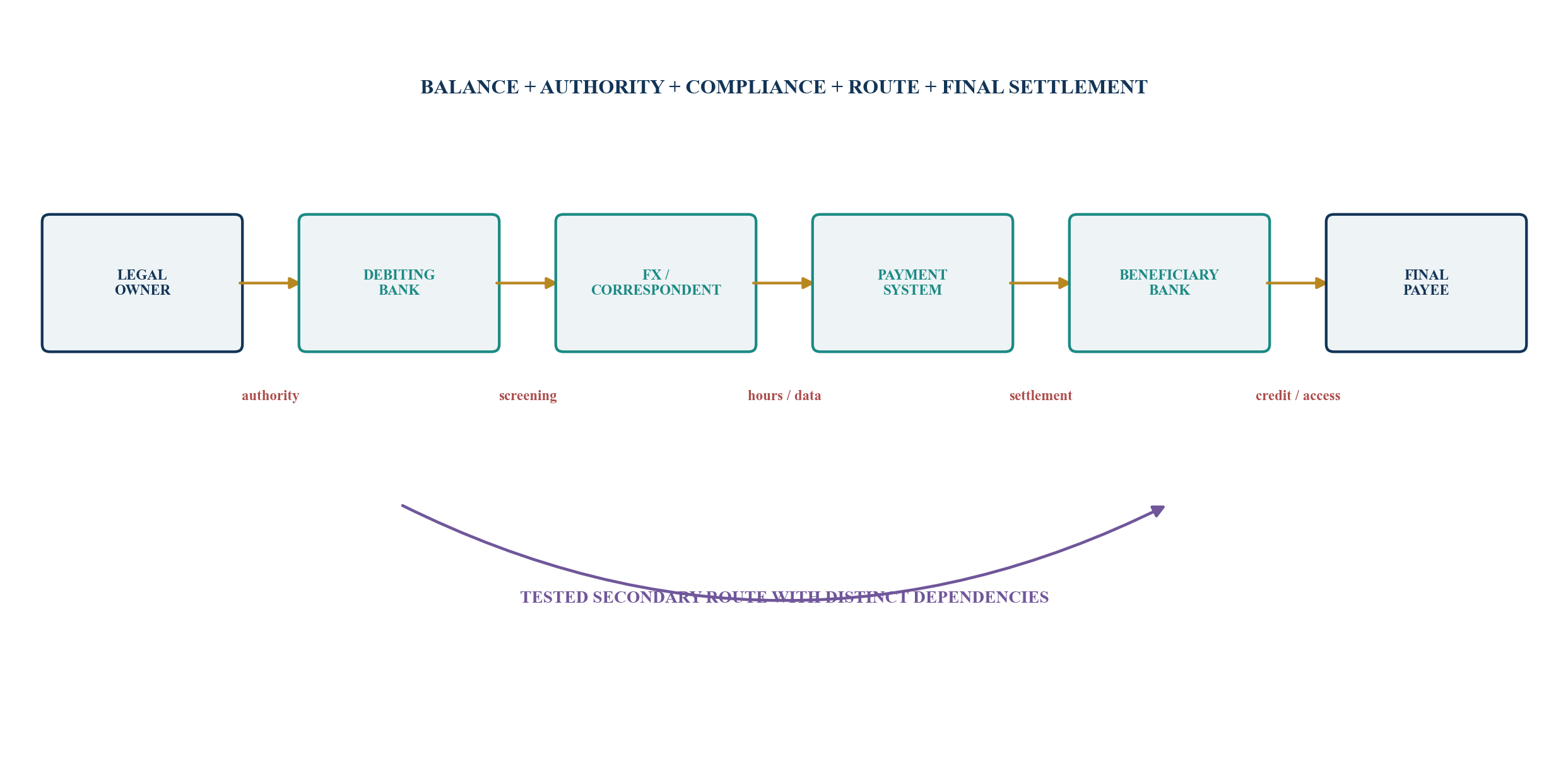
A second route adds resilience only when it avoids material common points of failure.
9. Build compliance into access design
Sanctions and financial-crime controls can lawfully delay or prohibit transactions. The buffer must be designed inside those rules. It must never rely on concealing ownership, misdescribing purpose, splitting transactions, using nominees, routing through intermediaries to avoid controls or moving assets after a prohibition applies.
The United Kingdom Office of Financial Sanctions Implementation explains that ownership and control can extend beyond a named person, including direct or indirect ownership and the ability to control an entity. Its enforcement guidance emphasises proportionate, risk-based due diligence and ongoing monitoring. The United States Office of Foreign Assets Control publishes a framework for sanctions-compliance commitments. The European Commission maintains official sanctions resources and a consolidated list based on adopted legal texts. Applicability depends on jurisdiction, nationality, presence, currency, persons involved, ownership, control and the particular measure.
The family office should maintain verified ownership charts, source-of-wealth and source-of-funds records, transaction purpose, counterparties, countries, goods or services, and adviser contacts. It should use current official lists and qualified advice. Escalation procedures should prevent a rushed treasury decision from becoming a sanctions breach.
Licences, exceptions and reporting duties are specific. A general framework cannot determine whether a transaction is permitted. When a restriction may apply, the legal owner should pause, preserve evidence and obtain advice from competent counsel and relevant authorities.
10. Plan for capital controls, closures and convertibility limits
Regional disruption can lead to market holidays, withdrawal limits, foreign-exchange restrictions, capital controls, settlement changes or emergency regulation. The timing and scope cannot be predicted reliably. The family office can prepare by identifying where essential obligations depend on convertibility or outbound transfer and by maintaining current legal-owner funding plans.
Pre-positioning decisions should be made before a crisis and documented for legitimate obligations. The board should consider the carrying cost, counterparty exposure, tax and reporting consequences, governance burden and the risk that rules change. Any movement must comply with applicable law and required reporting.
The stress test should distinguish a price shock from an access shock. In a price shock, assets can be sold at a loss. In an access shock, sale or transfer is unavailable. The latter requires funding already held by the correct owner or another lawful contingency established in advance.
The family should avoid treating digital assets or informal value-transfer mechanisms as an automatic solution. They introduce legal, custody, technology, volatility, financial-crime and convertibility risks. Any use requires jurisdiction-specific approval, documented purpose and professional advice.
11. Integrate collateral, leverage and contingent calls
Leverage can turn market volatility into a cash deadline. Margin loans, derivatives, secured facilities, guarantees and private-market financing may require additional collateral when asset values fall or ratings change. These calls can coincide with reduced market liquidity and operational disruption.
The treasury register should record collateral eligibility, valuation frequency, thresholds, minimum-transfer amounts, cure periods, substitution rights, cross-defaults and lender discretion. Assets counted in the buffer should be marked as unencumbered and monitored for automatic pledges or liens. The family office should reconcile collateral across custodians and legal owners.
Stress tests should combine shocks. A fall in securities, wider currency moves, higher initial margin, delayed distributions and a bank outage can occur together. The output should show cash required by time and currency, the assets available to meet it, and which discretionary commitments must stop.
Committed facilities can support resilience when their terms, conditions and operational draw process are understood. They should not be treated as cash before documentation, covenants, material-adverse-change provisions, collateral and draw mechanics are tested.
Table 4. Combined geopolitical liquidity stress matrix
| Stress element | Transmission to cash | Required management evidence |
|---|---|---|
| market repricing | sale proceeds fall and collateral demands rise | position-level sensitivity, liquidity horizon and margin schedule |
| distribution delay | private-fund and business cash inflows arrive later | commitment calendar, downside cash forecast and manager evidence |
| currency move | obligations and collateral change in reporting-currency value | currency ladder, hedge terms and settlement-currency needs |
| institution outage | balances or securities cannot be instructed temporarily | alternative institution, tested users and distinct dependency path |
| payment interruption | transfer misses cut-off, screening or settlement | route map, payment test and exception contact |
| legal restriction | transaction is delayed, licensed, reported or prohibited | current legal schedule, ownership evidence and escalation decision |
| key-person loss | instruction or approval cannot be completed | delegated authority, alternate signatories and tested continuity pack |
Shocks should be calibrated by management with advisers; the table defines the mechanism rather than a forecast.
12. Protect operating companies and household continuity
Family capital often supports operating businesses directly or through guarantees. The group should identify which companies are expected to stand alone, which can receive support, and what approvals and limits apply. An undefined expectation can drain family liquidity while failing to rescue the business.
Each material operating company should maintain its own minimum cash policy, 13-week forecast, banking map and crisis authorities. The family-office buffer should include only approved contingent support, with trigger, cap, security, documentation and decision rights. Minority shareholders, directors' duties, lender terms and insolvency rules require attention.
Household continuity deserves disciplined treatment. Essential housing, education, medical, security, insurance and care obligations may span jurisdictions and currencies. The family should decide which expenses are critical, which can be deferred and who can authorise emergency payments. Sensitive personal data and physical-security details should be kept in a restricted continuity pack.
Philanthropic and foundation commitments also have legal owners and governance. Boards or trustees should classify grant obligations, operating costs and discretionary commitments, then maintain appropriate reserves under their own duties.
13. Create crisis decision rights before the event
Liquidity can fail through governance even when cash is available. One person may hold the token, know the relationship manager or possess the authority required by a trust or company. Travel restrictions, illness, cyber compromise or conflict can remove that person.
The crisis authority matrix should name the board chair, treasury lead, legal lead, operations lead, security lead and alternates. It should define who can declare a liquidity event, suspend investments, draw a facility, convert currency, move funds, replace a signatory, communicate with banks and engage advisers. Limits and dual controls should remain proportionate to fraud and coercion risk.
The continuity pack should contain current entities, authorities, institutions, obligations, contacts, policies and evidence locations. Passwords, keys and authentication secrets should remain in secure systems with governed recovery. A printable index can help when technology is unavailable, while sensitive details require physical security.
The board should test decisions through exercises. A tabletop can assume a regional banking outage, market closure, sanctions alert, cyber incident and unavailable principal. The measure is whether the team can identify legal owners, meet the most critical obligations and document its decisions within the required time.
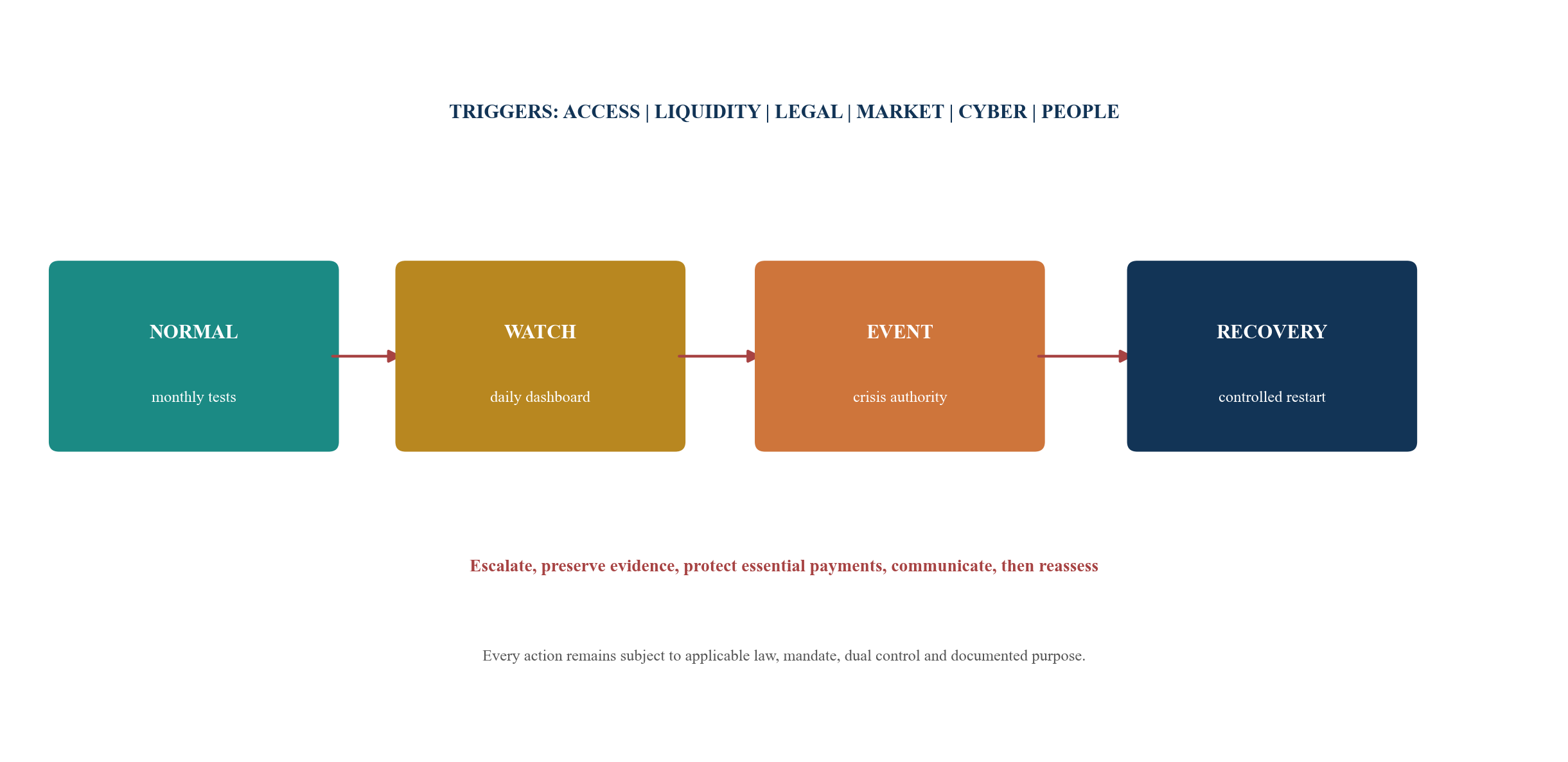
Escalation changes authorities, eligible actions and reporting frequency as conditions deteriorate.
14. Use a trigger dashboard rather than headlines
Headlines are too broad for treasury action. The dashboard should connect observable conditions to pre-agreed decisions. It can cover account access, payment rejection, settlement delay, bid-ask spreads, fund notices, collateral utilisation, currency convertibility, regulatory change, sanctions exposure, cyber events, travel constraints and key-person availability.
Each indicator needs an owner, source, update frequency, threshold and action. A watch threshold may increase reporting and test secondary routes. An event threshold may freeze discretionary deployments, increase operating cash, activate advisers and move governance to crisis cadence. Recovery should require evidence that routes, authorities and controls operate normally.
The dashboard should report data quality. A green indicator based on a stale bank mandate or untested facility is misleading. Evidence age, reconciliation status and unresolved exceptions belong beside the risk metric.
Board reporting should focus on capacity against obligations by legal owner, currency and time. It should show the effect of losing each major institution, custodian, rail, market and decision-maker. It should also show how long the family can meet critical commitments without asset sales or new borrowing.
15. Worked hypothetical case: a globally distributed family
Consider a hypothetical family with a management-estimated USD 2.0 billion consolidated balance sheet. Assets sit across a family holding company, two operating groups, an investment partnership, a foundation, trusts and personal accounts. The family reports in US dollars and has material obligations in dollars, euros, sterling, Swiss francs and Singapore dollars.
Management estimates 24-month gross obligations of USD 180 million equivalent. Within the next 30 days, essential obligations are USD 18 million equivalent. The existing consolidated cash figure is USD 92 million, yet only USD 31 million is held by the legal owners responsible for the first 30 days. A further USD 19 million can move through documented intra-group routes within ten business days, subject to tax and legal confirmation. The remainder sits in other entities or products with settlement, redemption or authority constraints.
The family sets a management target of USD 65 million equivalent for immediate and contingency capacity after haircuts. It moves from one dominant global bank to a controlled multi-institution design, establishes currency sub-limits, tests two payment paths for essential obligations, removes stale signatories, documents facility draws and separates pledged assets from the buffer. It also caps new private commitments until the 12-month ladder remains above the approved threshold.
These amounts are management assumptions created solely to demonstrate the method. They are not observed client data, forecasts or recommendations. Actual levels depend on obligations, entity law, portfolio structure, institutions, risk appetite, tax, regulation and family governance.
Table 5. Hypothetical family liquidity redesign
| Measure | Initial view | Tested view | Board response |
|---|---|---|---|
| consolidated cash and near-cash | 92 | 92 | retain as context, not the control metric |
| available to owners with 30-day essential obligations | 92 | 31 | pre-position lawful operating cash by entity and currency |
| additional capacity within ten business days | not measured | 19 | document transfer routes and complete legal and tax review |
| contingency assets after market, access and settlement haircuts | not measured | 27 | diversify custody and specify eligibility and release rules |
| less overlapping capacity and senior calls | not measured | (12) | remove double counting and reserve collateral capacity |
| tested immediate and contingency capacity | not measured | 65 | compare with approved obligation ladder and stress cases |
| largest single-institution dependency | 71% of cash | 38% of tested capacity | set outage-based concentration limit and test secondary route |
All values are management assumptions in USD millions equivalent and serve only as a worked example.
16. Implement the framework in 100 days
The first 20 days establish facts. The family office should appoint an accountable executive, freeze unverified data changes, enumerate legal owners, collect mandates and agreements, build the obligation calendar, identify custodians and payment routes, and reconcile balances. Material unknowns should be visible to the board.
Days 21 to 45 convert facts into risk decisions. Management should classify obligations, define horizons, apply eligibility and haircut rules, identify single points of failure, review sanctions and jurisdiction schedules, test authorities and quantify capacity by owner, currency and day. The board should approve criticality, risk appetite and escalation thresholds.
Days 46 to 75 execute priority changes. These can include updating mandates, establishing secondary routes, reallocating eligible liquidity, documenting intra-group funding, clarifying facility terms, correcting collateral records, improving custody evidence and implementing a dashboard. Every movement requires legal, tax, sanctions, regulatory and investment review appropriate to the action.
Days 76 to 100 validate the system. The family should conduct payment tests, access tests, a crisis tabletop and reconciliation. It should close material gaps or document accepted residual risks with owners and dates. Internal audit or qualified independent assurance can assess design and selected evidence without assuming management responsibility.
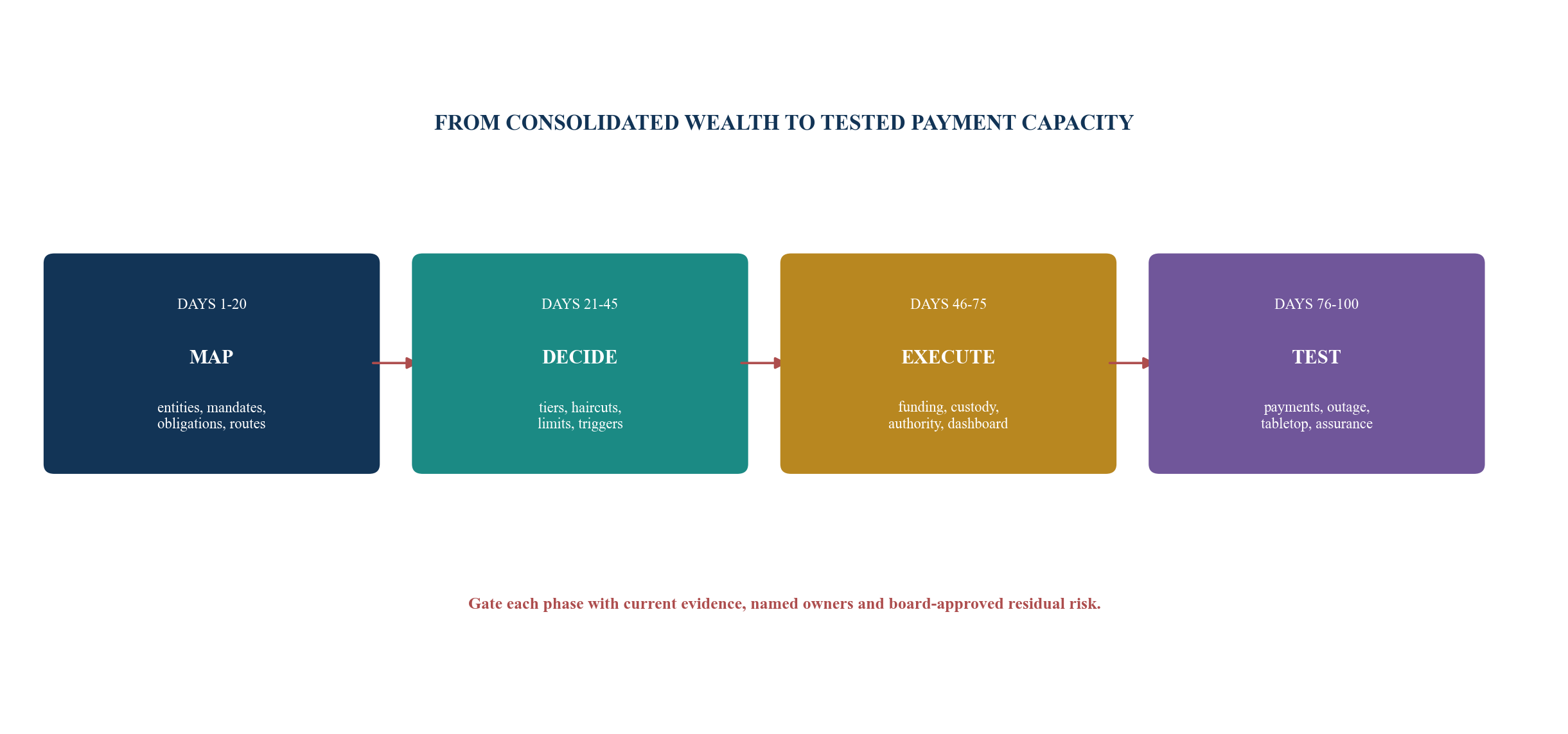
The programme advances from evidence to decisions, implementation and tested readiness.
17. Give the board a closed-loop liquidity scorecard
The completed system should let the board trace every critical obligation to a legal owner, currency, due date, source of funds, institution, route, authority and test. The scorecard should show both available capacity and unresolved conditions.
Table 6. Board-ready geopolitical liquidity scorecard
| Domain | Governing question | Acceptance evidence |
|---|---|---|
| legal owners | does each asset and obligation have the correct owner and authority? | reconciled entity, ownership, mandate and guarantee registers |
| obligation ladder | can critical payments be identified by day, currency and jurisdiction? | approved 24-month calendar with downside and contingent cases |
| eligibility | is capacity adjusted for restriction, encumbrance, market, currency and settlement risk? | documented waterfall, haircuts and double-counting controls |
| institutions and custody | can a material node fail without stopping essential obligations? | dependency map, concentration limits and successful secondary-route tests |
| compliance | are ownership, purpose, counterparties and restrictions assessed before movement? | current legal schedules, screening evidence and escalation protocol |
| collateral | can the family meet stressed margin and secured-funding demands? | collateral register, combined stress test and unencumbered capacity |
| decision rights | can authorised alternates act securely when key people are unavailable? | authority matrix, recovery controls and crisis exercise |
| monitoring | do triggers change reporting, deployment and crisis actions? | live dashboard, evidence age, exceptions and documented decisions |
| recovery | does normal operation resume only after controls are retested? | reconciliation, access verification, incident closure and board sign-off |
Acceptance requires current evidence and a named owner for every material exception.
The scorecard should avoid a false assurance ratio. A high buffer percentage can coexist with a fatal legal-owner mismatch or an untested payment route. Board attention belongs on the smallest number of failure points capable of stopping essential obligations.
A geopolitical liquidity buffer becomes credible through governance and proof. The entity map establishes ownership. The obligation calendar defines need. Layering and haircuts define eligible capacity. Diversified custody and payment routes reduce single-node dependency. Compliance protects lawful access. Decision rights and testing show that the family can act. Reconciliation keeps the system current as markets, rules, institutions and family circumstances change.
References
- International Monetary Fund, Guidelines for Foreign Exchange Reserve Management, https://www.imf.org/external/np/mae/ferm/eng/index.htm
- International Monetary Fund, Foreign Reserves Management, Technical Assistance Handbook Chapter, June 2026, https://www.imf.org/-/media/files/publications/miscellaneous/english/2026/ta-handbook-chapter-2026-jun-foreign-reserves-management-part-i.pdf
- European Central Bank, Financial Stability Implications of Geopolitical and Geoeconomic Risks, May 2026, https://www.ecb.europa.eu/press/financial-stability-publications/fsr/focus/2026/html/ecb.fsrbox202605_01~34d57dfca8.en.html
- European Central Bank, Turbulent Times: Geopolitical Risk and Its Impact on Euro Area Financial Stability, May 2024, https://www.ecb.europa.eu/press/financial-stability-publications/fsr/special/html/ecb.fsrart202405_01~4e4e30f01f.en.html
- Financial Stability Board, G20 Roadmap for Cross-border Payments: Consolidated Progress Report for 2025, 9 October 2025, https://www.fsb.org/2025/10/g20-roadmap-for-cross-border-payments-consolidated-progress-report-for-2025/
- Financial Stability Board, Recommendations for Regulating and Supervising Bank and Non-bank Payment Service Providers Offering Cross-border Payment Services, 12 December 2024, https://www.fsb.org/2024/12/recommendations-for-regulating-and-supervising-bank-and-non-bank-payment-service-providers-offering-cross-border-payment-services-final-report/
- Committee on Payments and Market Infrastructures, Linking Fast Payment Systems across Borders: Governance and Oversight, October 2024, https://www.bis.org/cpmi/publ/d223.htm
- Committee on Payments and Market Infrastructures, Extending and Aligning Payment System Operating Hours for Cross-border Payments, May 2023, https://www.bis.org/cpmi/publ/d214.htm
- International Organization of Securities Commissions, Recommendations Regarding the Protection of Client Assets, Final Report, January 2014, https://www.iosco.org/library/pubdocs/pdf/IOSCOPD436.pdf
- United Kingdom Office of Financial Sanctions Implementation, UK Financial Sanctions General Guidance, updated 12 May 2026, https://www.gov.uk/government/publications/financial-sanctions-general-guidance/uk-financial-sanctions-general-guidance
- United Kingdom Office of Financial Sanctions Implementation, Financial Sanctions Enforcement and Monetary Penalties Guidance, https://www.gov.uk/government/publications/financial-sanctions-enforcement-and-monetary-penalties-guidance/financial-sanctions-enforcement-and-monetary-penalties-guidance
- United States Department of the Treasury, Office of Foreign Assets Control, A Framework for OFAC Compliance Commitments, 2 May 2019, https://ofac.treasury.gov/recent-actions/20190502_33
- United States Department of the Treasury, Office of Foreign Assets Control, Civil Penalties and Enforcement Information, https://ofac.treasury.gov/civil-penalties-and-enforcement-information
- European Commission, Overview of Sanctions and Related Resources, https://finance.ec.europa.eu/eu-and-world/sanctions-restrictive-measures/overview-sanctions-and-related-resources_en
About the Author
Chennakeshav Adya is an independent researcher and Managing Partner of Matchpoint Partners. His work examines strategy, capital formation, valuation, transactions and operating execution across private and public markets.
