

Introduction
Geospatial AI businesses sit across a chain that begins with observations and ends with a customer decision. Observations may come from optical or radar satellites, aerial systems, ground sensors, public missions, maps, mobile devices or customer systems. Models convert those inputs into features, classifications, forecasts or alerts. Software embeds the output into planning, intelligence, engineering, insurance, agriculture, logistics or asset-management workflows. Distribution determines whether the product reaches a budget owner and remains in production.
A roll-up can create value when each acquired layer strengthens the others. More suitable data can improve model performance; stronger models can make data easier to use; workflow access can generate feedback and renewal; distribution can spread fixed product and compliance costs across more customers. The same combination can produce duplicated archives, incompatible schemas, conflicting licences, fragile models, rising cloud cost, customer churn and an operating system that is harder to control.
This paper values the combined platform through verified customer outcomes and sustainable free cash flow. It preserves separate data, model, workflow and distribution ledgers until evidence supports a combination benefit. It also funds integration, security, model monitoring and data refresh before assigning terminal value.
1. Define the transaction decision
The decision question concerns the acquisition objective, valuation date, perimeter, buyer capabilities and intended customer outcome. The team should define the customer outcome, unit of analysis, period, product perimeter and accountable owner. Evidence should begin with board mandate, process materials, target structure, financial statements and product architecture. Records should be dated and reconciled across legal, commercial, technical, security and financial workstreams. Tests should cover successes, failures, customer use and renewal. Management estimates may support planning when identified as assumptions and separated from observed performance, executed rights and collected cash.
The model converts the verified record into one approved decision and evidence cut-off. Each component should show revenue, direct cost, operating investment, integration expenditure, tax and retention. Shared data, cross-sell and cost savings should be measured after cannibalisation, overlap, channel conflict and incremental compute or support. The investment committee should set the value question before building a platform narrative. Missing evidence remains a visible exception with an owner, deadline and price or protection consequence.
2. Map the geospatial value chain
The decision question concerns observations, archives, processing, labels, models, APIs, applications, channels and end-user decisions. The team should define the customer outcome, unit of analysis, period, product perimeter and accountable owner. Evidence should begin with system maps, data catalogues, model inventories, customer journeys and supplier agreements. Records should be dated and reconciled across legal, commercial, technical, security and financial workstreams. Tests should cover successes, failures, customer use and renewal. Management estimates may support planning when identified as assumptions and separated from observed performance, executed rights and collected cash.
The model converts the verified record into a traceable source-to-decision architecture. Each component should show revenue, direct cost, operating investment, integration expenditure, tax and retention. Shared data, cross-sell and cost savings should be measured after cannibalisation, overlap, channel conflict and incremental compute or support. The investment committee should identify every owned, licensed and externally dependent layer. Missing evidence remains a visible exception with an owner, deadline and price or protection consequence.
3. Separate the five cash ledgers
The decision question concerns source data, derived products, model outputs, workflow software and distribution-supported revenue. The team should define the customer outcome, unit of analysis, period, product perimeter and accountable owner. Evidence should begin with contracts, invoices, usage, collections, serving cost and product entitlements. Records should be dated and reconciled across legal, commercial, technical, security and financial workstreams. Tests should cover successes, failures, customer use and renewal. Management estimates may support planning when identified as assumptions and separated from observed performance, executed rights and collected cash.
The model converts the verified record into contribution and duration by ledger. Each component should show revenue, direct cost, operating investment, integration expenditure, tax and retention. Shared data, cross-sell and cost savings should be measured after cannibalisation, overlap, channel conflict and incremental compute or support. The investment committee should prevent one customer payment from supporting several valuation components. Missing evidence remains a visible exception with an owner, deadline and price or protection consequence.
4. Establish legal rights to source data
The decision question concerns ownership, licences, field of use, territories, retention, derivative rights, training rights and change of control. The team should define the customer outcome, unit of analysis, period, product perimeter and accountable owner. Evidence should begin with executed licences, public-data terms, customer contracts, consent schedules and legal opinions. Records should be dated and reconciled across legal, commercial, technical, security and financial workstreams. Tests should cover successes, failures, customer use and renewal. Management estimates may support planning when identified as assumptions and separated from observed performance, executed rights and collected cash.
The model converts the verified record into cash that can lawfully continue after closing. Each component should show revenue, direct cost, operating investment, integration expenditure, tax and retention. Shared data, cross-sell and cost savings should be measured after cannibalisation, overlap, channel conflict and incremental compute or support. The investment committee should condition value on transferable rights. Missing evidence remains a visible exception with an owner, deadline and price or protection consequence.
5. Reconstruct data provenance
The decision question concerns sensor, collection time, location, processing level, transformations, labels and quality lineage. The team should define the customer outcome, unit of analysis, period, product perimeter and accountable owner. Evidence should begin with catalogues, metadata, processing logs, version histories and sample-level lineage. Records should be dated and reconciled across legal, commercial, technical, security and financial workstreams. Tests should cover successes, failures, customer use and renewal. Management estimates may support planning when identified as assumptions and separated from observed performance, executed rights and collected cash.
The model converts the verified record into reproducible inputs for products and models. Each component should show revenue, direct cost, operating investment, integration expenditure, tax and retention. Shared data, cross-sell and cost savings should be measured after cannibalisation, overlap, channel conflict and incremental compute or support. The investment committee should treat missing provenance as a performance and liability risk. Missing evidence remains a visible exception with an owner, deadline and price or protection consequence.
6. Test archive distinctiveness
The decision question concerns coverage, temporal depth, cadence, resolution, modality, scarcity and observed customer use. The team should define the customer outcome, unit of analysis, period, product perimeter and accountable owner. Evidence should begin with archive inventories, query logs, downloads, model use, licence history and public substitutes. Records should be dated and reconciled across legal, commercial, technical, security and financial workstreams. Tests should cover successes, failures, customer use and renewal. Management estimates may support planning when identified as assumptions and separated from observed performance, executed rights and collected cash.
The model converts the verified record into archive contribution supported by demand. Each component should show revenue, direct cost, operating investment, integration expenditure, tax and retention. Shared data, cross-sell and cost savings should be measured after cannibalisation, overlap, channel conflict and incremental compute or support. The investment committee should avoid assigning value to stored volume without evidence of use. Missing evidence remains a visible exception with an owner, deadline and price or protection consequence.
7. Test refresh economics
The decision question concerns the rate and cost at which the archive must be updated to remain useful. The team should define the customer outcome, unit of analysis, period, product perimeter and accountable owner. Evidence should begin with collection plans, supplier terms, ingestion cost, latency, customer service levels and churn. Records should be dated and reconciled across legal, commercial, technical, security and financial workstreams. Tests should cover successes, failures, customer use and renewal. Management estimates may support planning when identified as assumptions and separated from observed performance, executed rights and collected cash.
The model converts the verified record into sustainable data freshness by workflow. Each component should show revenue, direct cost, operating investment, integration expenditure, tax and retention. Shared data, cross-sell and cost savings should be measured after cannibalisation, overlap, channel conflict and incremental compute or support. The investment committee should fund refresh before capitalising recurring cash. Missing evidence remains a visible exception with an owner, deadline and price or protection consequence.
8. Measure interoperability
The decision question concerns whether data from different sensors, formats, coordinate systems and taxonomies can be combined reliably. The team should define the customer outcome, unit of analysis, period, product perimeter and accountable owner. Evidence should begin with schema maps, OGC interfaces, calibration records, transformation tests and exception logs. Records should be dated and reconciled across legal, commercial, technical, security and financial workstreams. Tests should cover successes, failures, customer use and renewal. Management estimates may support planning when identified as assumptions and separated from observed performance, executed rights and collected cash.
The model converts the verified record into usable shared data after harmonisation. Each component should show revenue, direct cost, operating investment, integration expenditure, tax and retention. Shared data, cross-sell and cost savings should be measured after cannibalisation, overlap, channel conflict and incremental compute or support. The investment committee should price the engineering burden required to create a common layer. Missing evidence remains a visible exception with an owner, deadline and price or protection consequence.
9. Reconcile spatial and temporal resolution
The decision question concerns fitness of each input for the customer's object, event, geography and decision window. The team should define the customer outcome, unit of analysis, period, product perimeter and accountable owner. Evidence should begin with product specifications, validation samples, customer requirements and substitution tests. Records should be dated and reconciled across legal, commercial, technical, security and financial workstreams. Tests should cover successes, failures, customer use and renewal. Management estimates may support planning when identified as assumptions and separated from observed performance, executed rights and collected cash.
The model converts the verified record into fit-for-purpose capacity rather than nominal data breadth. Each component should show revenue, direct cost, operating investment, integration expenditure, tax and retention. Shared data, cross-sell and cost savings should be measured after cannibalisation, overlap, channel conflict and incremental compute or support. The investment committee should exclude inputs that cannot support the purchased decision. Missing evidence remains a visible exception with an owner, deadline and price or protection consequence.
10. Define model inventory and ownership
The decision question concerns training pipelines, weights, features, code, dependencies, open-source components and third-party services. The team should define the customer outcome, unit of analysis, period, product perimeter and accountable owner. Evidence should begin with model cards, repositories, bills of materials, employment agreements and licences. Records should be dated and reconciled across legal, commercial, technical, security and financial workstreams. Tests should cover successes, failures, customer use and renewal. Management estimates may support planning when identified as assumptions and separated from observed performance, executed rights and collected cash.
The model converts the verified record into models that the buyer can operate and improve. Each component should show revenue, direct cost, operating investment, integration expenditure, tax and retention. Shared data, cross-sell and cost savings should be measured after cannibalisation, overlap, channel conflict and incremental compute or support. The investment committee should map ownership and operational dependencies before valuing IP. Missing evidence remains a visible exception with an owner, deadline and price or protection consequence.
11. Test model performance by cohort
The decision question concerns accuracy, recall, precision, calibration, false alarms, uncertainty and economic loss. The team should define the customer outcome, unit of analysis, period, product perimeter and accountable owner. Evidence should begin with held-out tests, production outcomes, geography splits, sensor splits and customer feedback. Records should be dated and reconciled across legal, commercial, technical, security and financial workstreams. Tests should cover successes, failures, customer use and renewal. Management estimates may support planning when identified as assumptions and separated from observed performance, executed rights and collected cash.
The model converts the verified record into performance linked to each paid use case. Each component should show revenue, direct cost, operating investment, integration expenditure, tax and retention. Shared data, cross-sell and cost savings should be measured after cannibalisation, overlap, channel conflict and incremental compute or support. The investment committee should reject blended accuracy that hides weak segments. Missing evidence remains a visible exception with an owner, deadline and price or protection consequence.
12. Test transfer across sensors and geography
The decision question concerns whether a model trained on one modality, climate, city or operating regime generalises elsewhere. The team should define the customer outcome, unit of analysis, period, product perimeter and accountable owner. Evidence should begin with out-of-domain tests, drift records, re-training history and local ground truth. Records should be dated and reconciled across legal, commercial, technical, security and financial workstreams. Tests should cover successes, failures, customer use and renewal. Management estimates may support planning when identified as assumptions and separated from observed performance, executed rights and collected cash.
The model converts the verified record into portable model cash after adaptation cost. Each component should show revenue, direct cost, operating investment, integration expenditure, tax and retention. Shared data, cross-sell and cost savings should be measured after cannibalisation, overlap, channel conflict and incremental compute or support. The investment committee should retain deductions where transfer has not been demonstrated. Missing evidence remains a visible exception with an owner, deadline and price or protection consequence.
13. Measure label and ground-truth economics
The decision question concerns availability, ownership, quality, timeliness and cost of labels or field observations. The team should define the customer outcome, unit of analysis, period, product perimeter and accountable owner. Evidence should begin with annotation contracts, quality audits, provenance, customer feedback and rework. Records should be dated and reconciled across legal, commercial, technical, security and financial workstreams. Tests should cover successes, failures, customer use and renewal. Management estimates may support planning when identified as assumptions and separated from observed performance, executed rights and collected cash.
The model converts the verified record into the recurring cost of maintaining model performance. Each component should show revenue, direct cost, operating investment, integration expenditure, tax and retention. Shared data, cross-sell and cost savings should be measured after cannibalisation, overlap, channel conflict and incremental compute or support. The investment committee should include scarce labels in both valuation and operating plans. Missing evidence remains a visible exception with an owner, deadline and price or protection consequence.
14. Test model-data complementarities
The decision question concerns whether adding an acquired dataset improves a defined model outcome beyond either asset alone. The team should define the customer outcome, unit of analysis, period, product perimeter and accountable owner. Evidence should begin with controlled experiments, baseline models, ablation tests, cost records and customer acceptance. Records should be dated and reconciled across legal, commercial, technical, security and financial workstreams. Tests should cover successes, failures, customer use and renewal. Management estimates may support planning when identified as assumptions and separated from observed performance, executed rights and collected cash.
The model converts the verified record into incremental benefit attributable to combination. Each component should show revenue, direct cost, operating investment, integration expenditure, tax and retention. Shared data, cross-sell and cost savings should be measured after cannibalisation, overlap, channel conflict and incremental compute or support. The investment committee should admit shared-data uplift only after independent measurement. Missing evidence remains a visible exception with an owner, deadline and price or protection consequence.
15. Test inference and serving cost
The decision question concerns compute, storage, egress, preprocessing, human review, monitoring and support per decision. The team should define the customer outcome, unit of analysis, period, product perimeter and accountable owner. Evidence should begin with cloud bills, workload telemetry, product volumes, service queues and staffing. Records should be dated and reconciled across legal, commercial, technical, security and financial workstreams. Tests should cover successes, failures, customer use and renewal. Management estimates may support planning when identified as assumptions and separated from observed performance, executed rights and collected cash.
The model converts the verified record into gross margin by model and customer workflow. Each component should show revenue, direct cost, operating investment, integration expenditure, tax and retention. Shared data, cross-sell and cost savings should be measured after cannibalisation, overlap, channel conflict and incremental compute or support. The investment committee should stress usage growth before assuming software-like margins. Missing evidence remains a visible exception with an owner, deadline and price or protection consequence.
16. Reconstruct product packaging
The decision question concerns how raw data, APIs, alerts, dashboards, reports and managed services are bundled and priced. The team should define the customer outcome, unit of analysis, period, product perimeter and accountable owner. Evidence should begin with catalogues, order forms, entitlements, discounts, usage and renewals. Records should be dated and reconciled across legal, commercial, technical, security and financial workstreams. Tests should cover successes, failures, customer use and renewal. Management estimates may support planning when identified as assumptions and separated from observed performance, executed rights and collected cash.
The model converts the verified record into price and contribution by product unit. Each component should show revenue, direct cost, operating investment, integration expenditure, tax and retention. Shared data, cross-sell and cost savings should be measured after cannibalisation, overlap, channel conflict and incremental compute or support. The investment committee should separate genuine platform adoption from bundled access. Missing evidence remains a visible exception with an owner, deadline and price or protection consequence.
17. Map workflow integration
The decision question concerns where outputs enter customer systems, approvals and operational decisions. The team should define the customer outcome, unit of analysis, period, product perimeter and accountable owner. Evidence should begin with API logs, active users, integrations, decision records, support cases and switching evidence. Records should be dated and reconciled across legal, commercial, technical, security and financial workstreams. Tests should cover successes, failures, customer use and renewal. Management estimates may support planning when identified as assumptions and separated from observed performance, executed rights and collected cash.
The model converts the verified record into embedded workflow cash and switching cost. Each component should show revenue, direct cost, operating investment, integration expenditure, tax and retention. Shared data, cross-sell and cost savings should be measured after cannibalisation, overlap, channel conflict and incremental compute or support. The investment committee should value usage that changes a production decision. Missing evidence remains a visible exception with an owner, deadline and price or protection consequence.
18. Measure time-to-decision
The decision question concerns elapsed time from observation request or event to an accepted action. The team should define the customer outcome, unit of analysis, period, product perimeter and accountable owner. Evidence should begin with timestamped collection, processing, inference, delivery and customer-response records. Records should be dated and reconciled across legal, commercial, technical, security and financial workstreams. Tests should cover successes, failures, customer use and renewal. Management estimates may support planning when identified as assumptions and separated from observed performance, executed rights and collected cash.
The model converts the verified record into latency value by use case. Each component should show revenue, direct cost, operating investment, integration expenditure, tax and retention. Shared data, cross-sell and cost savings should be measured after cannibalisation, overlap, channel conflict and incremental compute or support. The investment committee should prioritise the bottleneck that governs the customer outcome. Missing evidence remains a visible exception with an owner, deadline and price or protection consequence.
19. Reconstruct customer cohorts
The decision question concerns government, defence, infrastructure, agriculture, insurance, energy, logistics, finance and developer customers. The team should define the customer outcome, unit of analysis, period, product perimeter and accountable owner. Evidence should begin with contracts, usage, renewal, expansion, gross margin, collections and concentration. Records should be dated and reconciled across legal, commercial, technical, security and financial workstreams. Tests should cover successes, failures, customer use and renewal. Management estimates may support planning when identified as assumptions and separated from observed performance, executed rights and collected cash.
The model converts the verified record into cohort cash and risk. Each component should show revenue, direct cost, operating investment, integration expenditure, tax and retention. Shared data, cross-sell and cost savings should be measured after cannibalisation, overlap, channel conflict and incremental compute or support. The investment committee should avoid extrapolating one mission or procurement route across the platform. Missing evidence remains a visible exception with an owner, deadline and price or protection consequence.
20. Test distribution channels
The decision question concerns direct enterprise sales, government frameworks, cloud marketplaces, developer ecosystems, partners and self-service. The team should define the customer outcome, unit of analysis, period, product perimeter and accountable owner. Evidence should begin with pipeline, conversions, sales cycles, commissions, marketplace data and collections. Records should be dated and reconciled across legal, commercial, technical, security and financial workstreams. Tests should cover successes, failures, customer use and renewal. Management estimates may support planning when identified as assumptions and separated from observed performance, executed rights and collected cash.
The model converts the verified record into customer acquisition cost and payback by channel. Each component should show revenue, direct cost, operating investment, integration expenditure, tax and retention. Shared data, cross-sell and cost savings should be measured after cannibalisation, overlap, channel conflict and incremental compute or support. The investment committee should value distribution through verified conversion rather than reach. Missing evidence remains a visible exception with an owner, deadline and price or protection consequence.
21. Test cross-sell feasibility
The decision question concerns whether one customer can buy another data, model or workflow product under its budget, security and procurement rules. The team should define the customer outcome, unit of analysis, period, product perimeter and accountable owner. Evidence should begin with account maps, product trials, contracts, approvals, win-loss records and renewal. Records should be dated and reconciled across legal, commercial, technical, security and financial workstreams. Tests should cover successes, failures, customer use and renewal. Management estimates may support planning when identified as assumptions and separated from observed performance, executed rights and collected cash.
The model converts the verified record into incremental collected contribution from identified cohorts. Each component should show revenue, direct cost, operating investment, integration expenditure, tax and retention. Shared data, cross-sell and cost savings should be measured after cannibalisation, overlap, channel conflict and incremental compute or support. The investment committee should cap synergy by addressable customers and delivery capacity. Missing evidence remains a visible exception with an owner, deadline and price or protection consequence.
22. Test open-platform economics
The decision question concerns the relationship between open standards, open-source adoption, developer reach and monetised services. The team should define the customer outcome, unit of analysis, period, product perimeter and accountable owner. Evidence should begin with downloads, active deployments, hosted usage, support contracts, conversion and churn. Records should be dated and reconciled across legal, commercial, technical, security and financial workstreams. Tests should cover successes, failures, customer use and renewal. Management estimates may support planning when identified as assumptions and separated from observed performance, executed rights and collected cash.
The model converts the verified record into cash created by the open ecosystem. Each component should show revenue, direct cost, operating investment, integration expenditure, tax and retention. Shared data, cross-sell and cost savings should be measured after cannibalisation, overlap, channel conflict and incremental compute or support. The investment committee should distinguish community adoption from buyer-captured revenue. Missing evidence remains a visible exception with an owner, deadline and price or protection consequence.
23. Benchmark public-data substitution
The decision question concerns free public imagery, mapping, elevation, weather and environmental datasets that can serve the same decision. The team should define the customer outcome, unit of analysis, period, product perimeter and accountable owner. Evidence should begin with mission catalogues, access terms, cadence, latency, quality and customer interviews. Records should be dated and reconciled across legal, commercial, technical, security and financial workstreams. Tests should cover successes, failures, customer use and renewal. Management estimates may support planning when identified as assumptions and separated from observed performance, executed rights and collected cash.
The model converts the verified record into the premium for scarcity, service and workflow. Each component should show revenue, direct cost, operating investment, integration expenditure, tax and retention. Shared data, cross-sell and cost savings should be measured after cannibalisation, overlap, channel conflict and incremental compute or support. The investment committee should stress price where public supply is fit for purpose. Missing evidence remains a visible exception with an owner, deadline and price or protection consequence.
24. Test customer-data rights
The decision question concerns rights to ingest, retain, combine, train on and commercialise customer-provided data. The team should define the customer outcome, unit of analysis, period, product perimeter and accountable owner. Evidence should begin with contracts, privacy assessments, security terms, deletion duties and audit trails. Records should be dated and reconciled across legal, commercial, technical, security and financial workstreams. Tests should cover successes, failures, customer use and renewal. Management estimates may support planning when identified as assumptions and separated from observed performance, executed rights and collected cash.
The model converts the verified record into lawful feedback-loop value. Each component should show revenue, direct cost, operating investment, integration expenditure, tax and retention. Shared data, cross-sell and cost savings should be measured after cannibalisation, overlap, channel conflict and incremental compute or support. The investment committee should exclude feedback data that cannot be reused after closing. Missing evidence remains a visible exception with an owner, deadline and price or protection consequence.
25. Evaluate AI governance
The decision question concerns accountability, validation, human review, monitoring, explainability, incident response and change control. The team should define the customer outcome, unit of analysis, period, product perimeter and accountable owner. Evidence should begin with policies, model cards, test results, review logs, incidents and remediation. Records should be dated and reconciled across legal, commercial, technical, security and financial workstreams. Tests should cover successes, failures, customer use and renewal. Management estimates may support planning when identified as assumptions and separated from observed performance, executed rights and collected cash.
The model converts the verified record into risk-adjusted model cash. Each component should show revenue, direct cost, operating investment, integration expenditure, tax and retention. Shared data, cross-sell and cost savings should be measured after cannibalisation, overlap, channel conflict and incremental compute or support. The investment committee should fund governance for consequential customer uses. Missing evidence remains a visible exception with an owner, deadline and price or protection consequence.
26. Evaluate cybersecurity and sovereignty
The decision question concerns data residency, classified or controlled environments, access control, supply chain, resilience and export restrictions. The team should define the customer outcome, unit of analysis, period, product perimeter and accountable owner. Evidence should begin with architectures, certifications, penetration tests, contracts, licences and incident history. Records should be dated and reconciled across legal, commercial, technical, security and financial workstreams. Tests should cover successes, failures, customer use and renewal. Management estimates may support planning when identified as assumptions and separated from observed performance, executed rights and collected cash.
The model converts the verified record into cash available within lawful operating boundaries. Each component should show revenue, direct cost, operating investment, integration expenditure, tax and retention. Shared data, cross-sell and cost savings should be measured after cannibalisation, overlap, channel conflict and incremental compute or support. The investment committee should use closing conditions for material permissions and remediation. Missing evidence remains a visible exception with an owner, deadline and price or protection consequence.
27. Build the integration architecture
The decision question concerns identity, catalogues, storage, processing, model operations, APIs, billing, support and observability. The team should define the customer outcome, unit of analysis, period, product perimeter and accountable owner. Evidence should begin with target-state design, dependency map, migration plan, test criteria and accountable owners. Records should be dated and reconciled across legal, commercial, technical, security and financial workstreams. Tests should cover successes, failures, customer use and renewal. Management estimates may support planning when identified as assumptions and separated from observed performance, executed rights and collected cash.
The model converts the verified record into costed path to one operating platform. Each component should show revenue, direct cost, operating investment, integration expenditure, tax and retention. Shared data, cross-sell and cost savings should be measured after cannibalisation, overlap, channel conflict and incremental compute or support. The investment committee should preserve customer service during migration. Missing evidence remains a visible exception with an owner, deadline and price or protection consequence.
28. Quantify migration and technical debt
The decision question concerns duplicated pipelines, obsolete components, unsupported code, inconsistent schemas and manual operations. The team should define the customer outcome, unit of analysis, period, product perimeter and accountable owner. Evidence should begin with code review, architecture assessment, backlog, incident history and engineering estimates. Records should be dated and reconciled across legal, commercial, technical, security and financial workstreams. Tests should cover successes, failures, customer use and renewal. Management estimates may support planning when identified as assumptions and separated from observed performance, executed rights and collected cash.
The model converts the verified record into funded integration cost and schedule. Each component should show revenue, direct cost, operating investment, integration expenditure, tax and retention. Shared data, cross-sell and cost savings should be measured after cannibalisation, overlap, channel conflict and incremental compute or support. The investment committee should deduct unavoidable remediation before admitting synergy. Missing evidence remains a visible exception with an owner, deadline and price or protection consequence.
29. Reconstruct revenue quality
The decision question concerns contracted, usage-based, project, mission, professional-service and reseller revenue. The team should define the customer outcome, unit of analysis, period, product perimeter and accountable owner. Evidence should begin with executed agreements, performance obligations, invoices, collections and delivery records. Records should be dated and reconciled across legal, commercial, technical, security and financial workstreams. Tests should cover successes, failures, customer use and renewal. Management estimates may support planning when identified as assumptions and separated from observed performance, executed rights and collected cash.
The model converts the verified record into recurring and non-recurring cash by ledger. Each component should show revenue, direct cost, operating investment, integration expenditure, tax and retention. Shared data, cross-sell and cost savings should be measured after cannibalisation, overlap, channel conflict and incremental compute or support. The investment committee should align valuation with enforceable performance and payment. Missing evidence remains a visible exception with an owner, deadline and price or protection consequence.
30. Construct sustainable free cash flow
The decision question concerns cash after data acquisition, compute, people, integration, security, refresh, tax and working capital. The team should define the customer outcome, unit of analysis, period, product perimeter and accountable owner. Evidence should begin with reconciled accounts, unit economics, product roadmap and downside case. Records should be dated and reconciled across legal, commercial, technical, security and financial workstreams. Tests should cover successes, failures, customer use and renewal. Management estimates may support planning when identified as assumptions and separated from observed performance, executed rights and collected cash.
The model converts the verified record into free cash flow supported by one coherent operating state. Each component should show revenue, direct cost, operating investment, integration expenditure, tax and retention. Shared data, cross-sell and cost savings should be measured after cannibalisation, overlap, channel conflict and incremental compute or support. The investment committee should use the same architecture and costs through terminal value. Missing evidence remains a visible exception with an owner, deadline and price or protection consequence.
31. Build the hypothetical roll-up case
The decision question concerns USD 1.57 billion of admitted standalone component value. The team should define the customer outcome, unit of analysis, period, product perimeter and accountable owner. Evidence should begin with illustrative inputs kept separate from public evidence. Records should be dated and reconciled across legal, commercial, technical, security and financial workstreams. Tests should cover successes, failures, customer use and renewal. Management estimates may support planning when identified as assumptions and separated from observed performance, executed rights and collected cash.
The model converts the verified record into a ledger-based value sum before combination benefits and deductions. Each component should show revenue, direct cost, operating investment, integration expenditure, tax and retention. Shared data, cross-sell and cost savings should be measured after cannibalisation, overlap, channel conflict and incremental compute or support. The investment committee should use the case to show mechanics rather than represent a company. Missing evidence remains a visible exception with an owner, deadline and price or protection consequence.
32. Deduct overlap and stranded assets
The decision question concerns duplicated archives, products, models, channels and systems that cannot earn independent cash. The team should define the customer outcome, unit of analysis, period, product perimeter and accountable owner. Evidence should begin with customer overlap, product maps, usage, rights and retirement plans. Records should be dated and reconciled across legal, commercial, technical, security and financial workstreams. Tests should cover successes, failures, customer use and renewal. Management estimates may support planning when identified as assumptions and separated from observed performance, executed rights and collected cash.
The model converts the verified record into USD 0.16 billion deduction in the worked case. Each component should show revenue, direct cost, operating investment, integration expenditure, tax and retention. Shared data, cross-sell and cost savings should be measured after cannibalisation, overlap, channel conflict and incremental compute or support. The investment committee should remove double counting before synergy. Missing evidence remains a visible exception with an owner, deadline and price or protection consequence.
33. Deduct rights and transfer risk
The decision question concerns restricted data, non-transferable licences, geography-specific models and unproven adaptation. The team should define the customer outcome, unit of analysis, period, product perimeter and accountable owner. Evidence should begin with consent schedules, legal review, transfer tests and remediation budgets. Records should be dated and reconciled across legal, commercial, technical, security and financial workstreams. Tests should cover successes, failures, customer use and renewal. Management estimates may support planning when identified as assumptions and separated from observed performance, executed rights and collected cash.
The model converts the verified record into USD 0.14 billion deduction in the worked case. Each component should show revenue, direct cost, operating investment, integration expenditure, tax and retention. Shared data, cross-sell and cost savings should be measured after cannibalisation, overlap, channel conflict and incremental compute or support. The investment committee should retain the deduction until rights and performance transfer. Missing evidence remains a visible exception with an owner, deadline and price or protection consequence.
34. Admit verified combination value
The decision question concerns measured model improvement, faster decisions, attributable cross-sell and avoided cost. The team should define the customer outcome, unit of analysis, period, product perimeter and accountable owner. Evidence should begin with controlled tests, accepted customer outcomes, signed orders and executable integration. Records should be dated and reconciled across legal, commercial, technical, security and financial workstreams. Tests should cover successes, failures, customer use and renewal. Management estimates may support planning when identified as assumptions and separated from observed performance, executed rights and collected cash.
The model converts the verified record into USD 0.18 billion addition in the worked case. Each component should show revenue, direct cost, operating investment, integration expenditure, tax and retention. Shared data, cross-sell and cost savings should be measured after cannibalisation, overlap, channel conflict and incremental compute or support. The investment committee should limit value to buyer-captured net cash. Missing evidence remains a visible exception with an owner, deadline and price or protection consequence.
35. Structure price and protections
The decision question concerns cash, shares, earn-outs, holdbacks, retention, rights consents, performance milestones and indemnities. The team should define the customer outcome, unit of analysis, period, product perimeter and accountable owner. Evidence should begin with term sheet, financing, consent map, model tests and integration gates. Records should be dated and reconciled across legal, commercial, technical, security and financial workstreams. Tests should cover successes, failures, customer use and renewal. Management estimates may support planning when identified as assumptions and separated from observed performance, executed rights and collected cash.
The model converts the verified record into risk allocation that follows unresolved evidence. Each component should show revenue, direct cost, operating investment, integration expenditure, tax and retention. Shared data, cross-sell and cost savings should be measured after cannibalisation, overlap, channel conflict and incremental compute or support. The investment committee should tie contingent value to collected customer and performance outcomes. Missing evidence remains a visible exception with an owner, deadline and price or protection consequence.
36. Establish post-close governance
The decision question concerns authority over data, models, security, product, customers, capital and integration. The team should define the customer outcome, unit of analysis, period, product perimeter and accountable owner. Evidence should begin with board mandates, dashboards, assurance, decision logs and escalation rules. Records should be dated and reconciled across legal, commercial, technical, security and financial workstreams. Tests should cover successes, failures, customer use and renewal. Management estimates may support planning when identified as assumptions and separated from observed performance, executed rights and collected cash.
The model converts the verified record into accountable value delivery and early warning. Each component should show revenue, direct cost, operating investment, integration expenditure, tax and retention. Shared data, cross-sell and cost savings should be measured after cannibalisation, overlap, channel conflict and incremental compute or support. The investment committee should refresh valuation when rights, performance, renewal or integration changes. Missing evidence remains a visible exception with an owner, deadline and price or protection consequence.
Conclusion
Geospatial AI roll-ups create value when source data, models, workflows and distribution reinforce a paid customer decision. The transaction case should demonstrate this reinforcement at cohort level. It should also show the data rights, model performance, serving cost, integration work and customer behaviour required to preserve the benefit after closing.
The framework separates five cash ledgers, tests their legal and technical foundations and admits combination value only after measured improvement or collected cross-sell. It funds data refresh, model monitoring, security and platform migration before terminal value. This discipline makes overlap, stranded assets and integration risk visible before they are embedded in price.
For a board or investment committee, the final decision is whether the combined platform can deliver a stronger outcome with sustainable unit economics and accountable control. That answer determines price, structure, financing, conditions, post-close priorities and the evidence required before contingent value is released.
Appendix A. Source-to-decision evidence register
The minimum register records source identifier, rights, collection time, geography, processing level, label lineage, model version, inference, uncertainty, customer workflow, decision, price, serving cost, reviewer and exception. Each item should connect to the applicable contract and cash ledger.
Appendix B. Model-transfer register
For each model, record training cohorts, input modalities, geographies, target classes, validation design, out-of-domain tests, drift thresholds, human review, re-training cost, serving cost and approved uses. Transfer to a new sensor or geography should require a defined acceptance test.
Appendix C. Transaction approval checklist
The approval file should contain the product perimeter, data-rights map, provenance audit, archive demand, refresh plan, interoperability tests, model inventory, cohort performance, customer workflows, channel conversion, unit economics, integration architecture, migration budget, security and sovereignty review, consent plan, downside liquidity and post-close governance.
Appendix D. Worked-case figures and tables
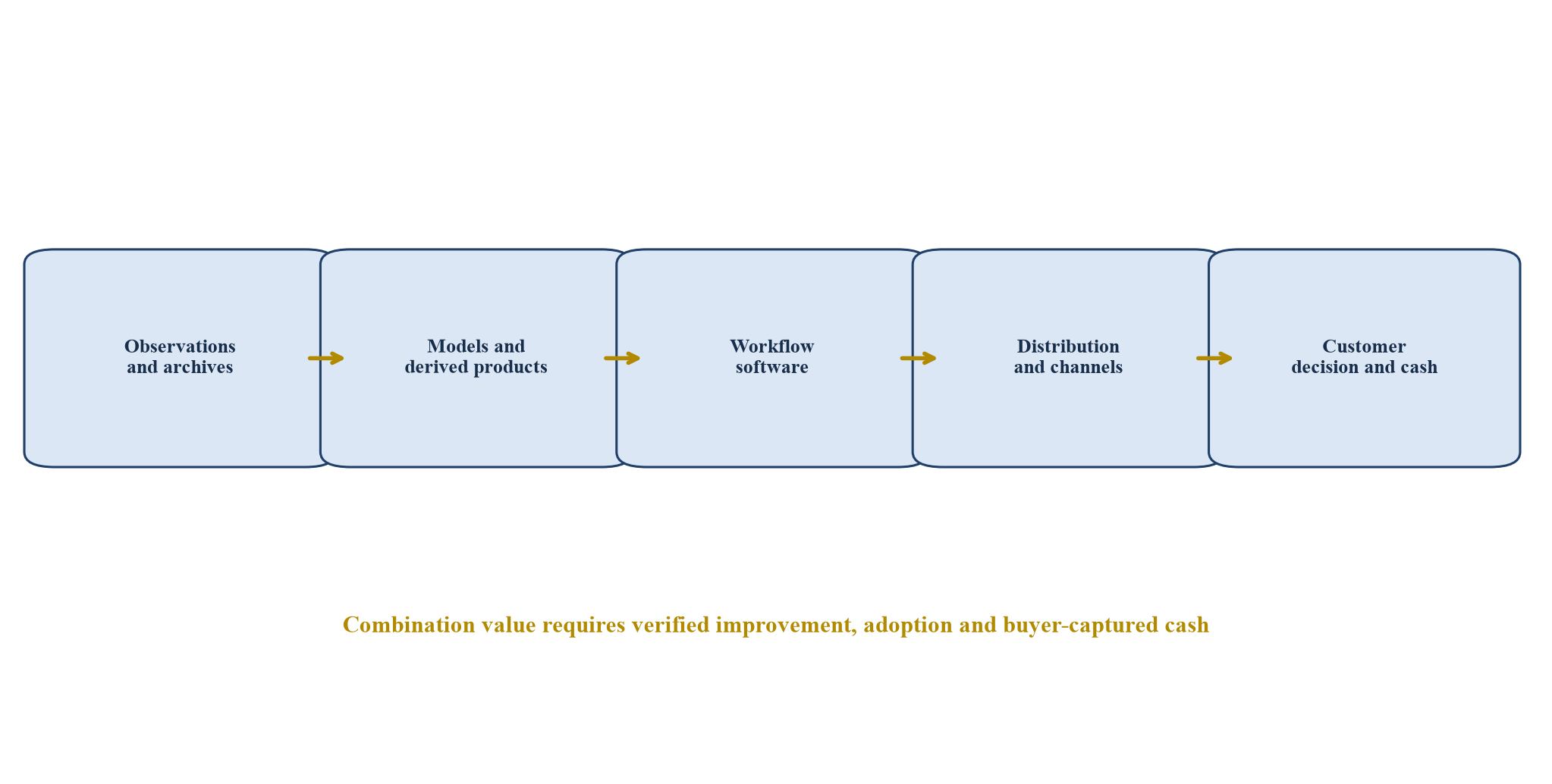
Proposed architecture separating observations, models, workflows, distribution and customer cash.
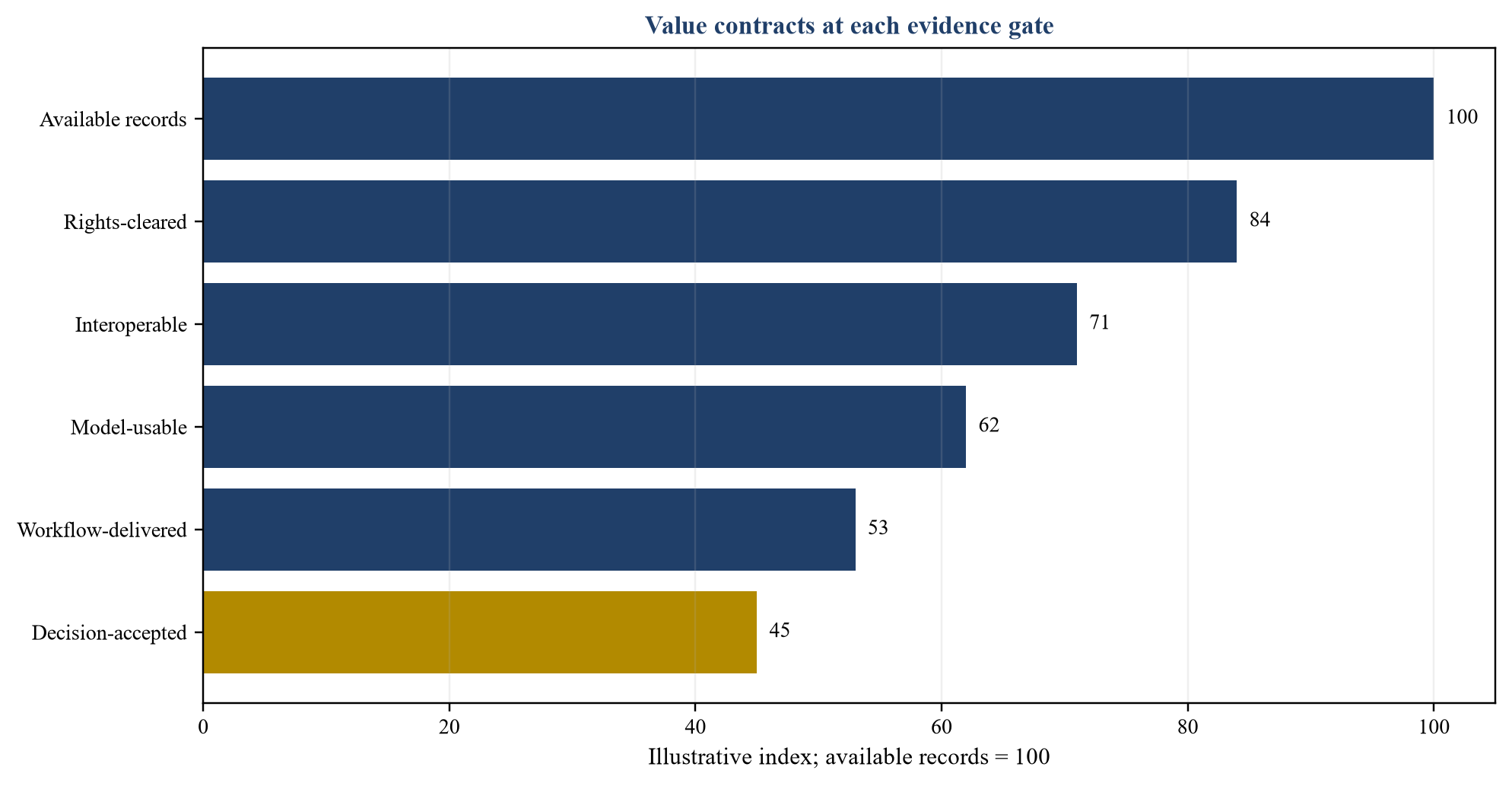
Illustrative conversion of available records into accepted customer decisions.
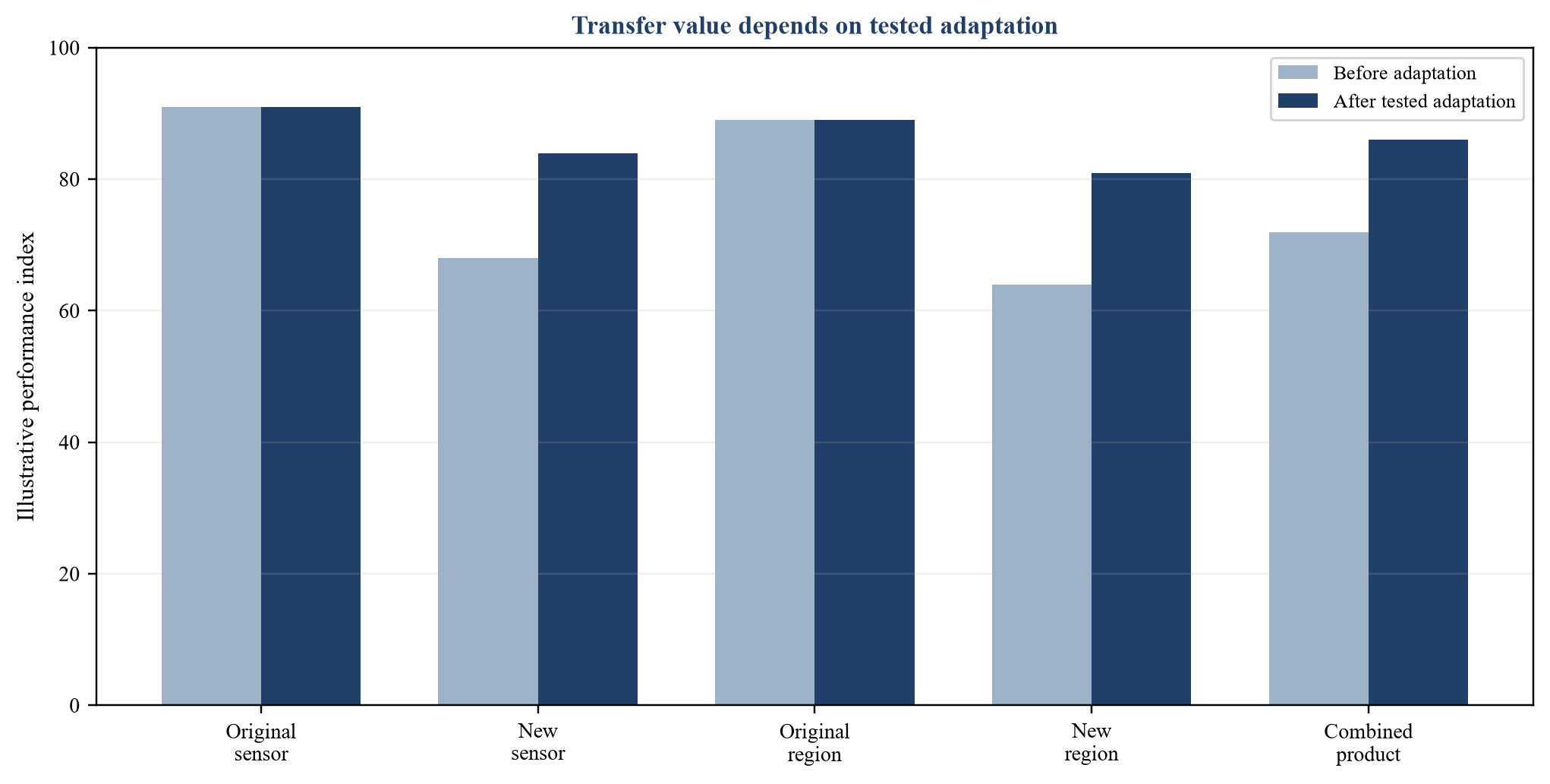
Illustrative performance before and after adaptation across operating cohorts.
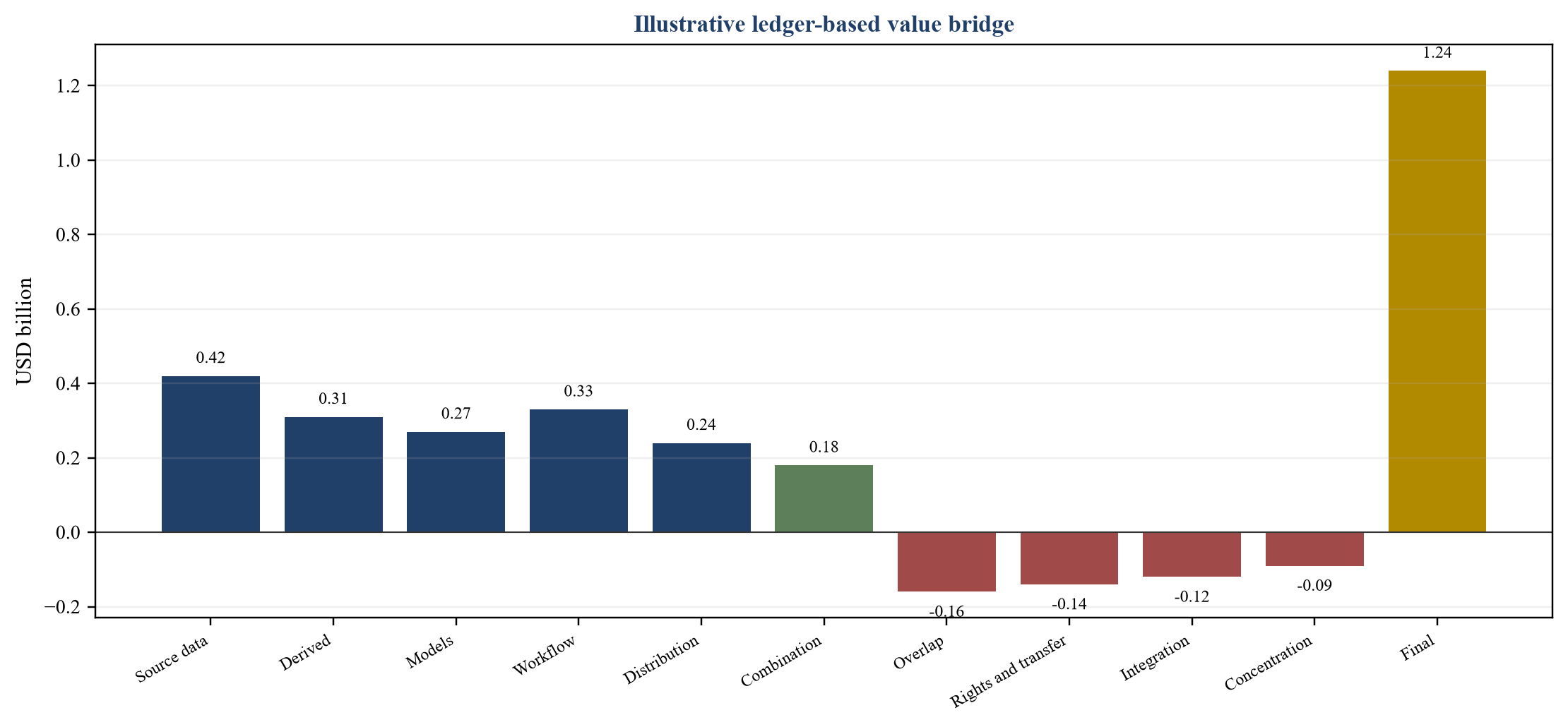
Illustrative bridge from component values through combination benefits and deductions.
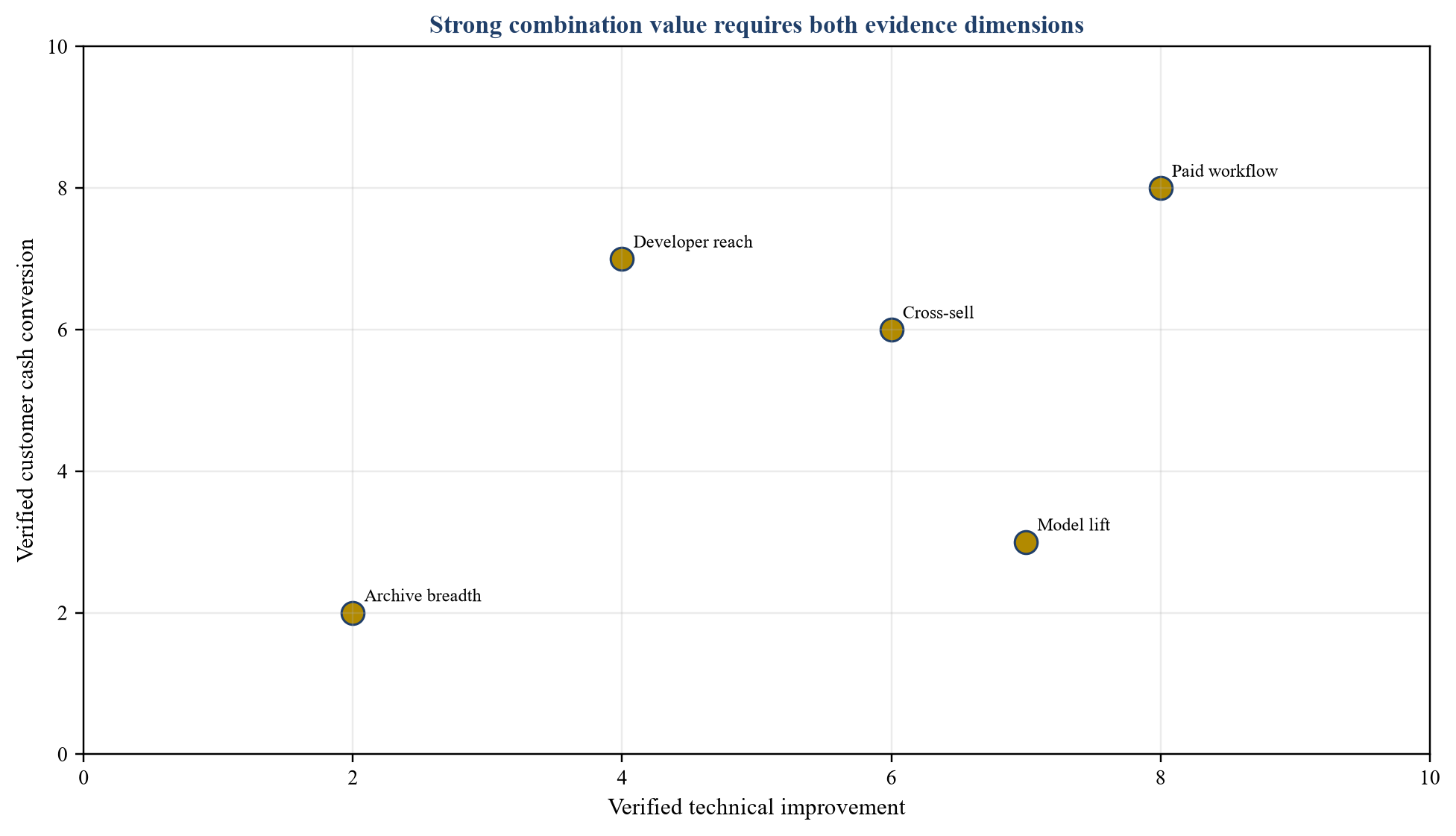
Proposed matrix linking technical improvement and customer conversion to admissible value.
| Ledger | Minimum evidence | Primary cash mechanism |
|---|---|---|
| Source data | transferable rights, provenance, refresh and demand | licence or access contribution |
| Derived products | reproducible transformation and customer use | product contribution |
| Models | cohort performance, ownership and serving cost | inference or analytics cash |
| Workflow software | production integration, renewal and support | subscription contribution |
| Distribution | conversion, acquisition cost and payback | attributable channel cash |
Proposed separation of transaction value.
| Stage | Index | Primary loss driver |
|---|---|---|
| Available records | 100 | nominal catalogue volume |
| Rights-cleared | 84 | licence and customer restrictions |
| Interoperable | 71 | formats, schemas and calibration |
| Model-usable | 62 | quality, labels and domain fit |
| Workflow-delivered | 53 | latency, integration and reliability |
| Decision-accepted | 45 | customer trust and fitness for use |
Illustrative conversion of available records.
| Claim | Required test | Admissible value |
|---|---|---|
| Shared data improves models | controlled baseline and ablation | incremental net customer cash |
| Models improve data sales | cohort adoption and renewal | collected contribution |
| Distribution expands reach | channel conversion and payback | buyer-captured lifetime value |
| One platform reduces cost | costed target state and migration | realised net saving |
| Workflow creates retention | production dependency and renewal | risk-adjusted recurring cash |
Proposed diligence controls.
| Step | Amount | Evidence required |
|---|---|---|
| Source-data cash | 0.42 | rights, usage, refresh and contribution |
| Derived products | 0.31 | reproducibility, adoption and margin |
| Model outputs | 0.27 | cohort performance and serving cost |
| Workflow software | 0.33 | production usage and renewal |
| Distribution-supported cash | 0.24 | conversion, payback and retention |
| Verified combination benefit | plus 0.18 | measured improvement and buyer capture |
| Overlap and stranded assets | minus 0.16 | product and customer mapping |
| Rights and model-transfer risk | minus 0.14 | legal and technical remediation |
| Integration and migration | minus 0.12 | costed target state |
| Customer concentration | minus 0.09 | cohort downside |
| Final illustrative value | 1.24 | integrated evidence set |
All amounts are illustrative USD billions.
| Gate | Approval evidence | Stop condition |
|---|---|---|
| Rights | transferable data, software and model rights | unresolved material restriction |
| Performance | independent cohort validation | headline metric only |
| Customer | production use, renewal and collected cash | demonstration activity only |
| Integration | executable architecture, budget and owners | uncosted migration |
| Security | remediated controls and sovereign compliance | material unresolved exposure |
| Combination | measured uplift or signed cross-sell | duplicated or aspirational synergy |
Proposed board control.
| Risk | Potential protection | Release evidence |
|---|---|---|
| Data rights | closing condition or holdback | consent and transfer confirmation |
| Model transfer | performance earn-out | accepted cohort test |
| Customer retention | revenue earn-out | collected retained contribution |
| Integration | milestone payment | tested migration and service continuity |
| Security | remediation covenant | independent closure evidence |
| Cross-sell | staged consideration | paid adoption from identified accounts |
Proposed allocation of transaction risk.
| Dimension | Core measure | Trigger |
|---|---|---|
| Data | rights-cleared, current and used records | deterioration or restriction |
| Models | cohort performance, drift and cost | threshold breach |
| Workflow | active production decisions and renewal | adoption decline |
| Distribution | conversion, acquisition cost and payback | channel underperformance |
| Integration | migrated products and stable service | milestone delay |
| Customers | retention, expansion and concentration | cohort below case |
| Capital | cash, integration spend and liquidity | funding shortfall |
Proposed monthly decision record.
Sources
- Planet Labs PBC, Annual Report for the year ended 31 January 2026. Read the primary source
- Planet Labs PBC, 2023 Investor Day Presentation. Read the primary source
- Planet, Acquisition of Sinergise and Sentinel Hub. Read the primary source
- Planet, Agreement to Acquire VanderSat. Read the primary source
- Bentley Systems, Acquisition of Cesium, 6 September 2024. Read the primary source
- Maxar Technologies, 2022 Annual Report. Read the primary source
- Maxar Technologies, Vricon Transaction Presentation. Read the primary source
- BlackSky Technology, 2025 Annual Report. Read the primary source
- BlackSky Technology, Second Quarter 2026 Results. Read the primary source
- Open Geospatial Consortium, Artificial Intelligence in Geoinformatics Domain Working Group. Read the primary source
- Open Geospatial Consortium, OGC Standards Overview. Read the primary source
- Open Geospatial Consortium, OGC API Standards. Read the primary source
- Open Geospatial Consortium, Building Blocks for Interoperable, AI-Ready Geospatial Data. Read the primary source
- NASA, Commercial Satellite Data Acquisition Programme. Read the primary source
- European Space Agency, Sentinel-1 Mission. Read the primary source
- Copernicus Data Space Ecosystem, Sentinel Data Collections. Read the primary source
- U.S. National Institute of Standards and Technology, Artificial Intelligence Risk Management Framework 1.0. Read the primary source
- U.S. National Institute of Standards and Technology, AI RMF Playbook. Read the primary source
- U.S. National Institute of Standards and Technology, Cybersecurity Framework 2.0. Read the primary source
- IFRS Foundation, IFRS 3 Business Combinations. Read the primary source
- IFRS Foundation, IAS 36 Impairment of Assets. Read the primary source
- IFRS Foundation, IFRS 13 Fair Value Measurement. Read the primary source
- IFRS Foundation, IFRS 15 Revenue from Contracts with Customers. Read the primary source
- International Valuation Standards Council, International Valuation Standards. Read the primary source
- European Union, Regulation (EU) 2024/1689 laying down harmonised rules on artificial intelligence. Read the primary source
