

1. Define the perimeter decision
The board's decision is which combination of entities, assets, contracts, people and liabilities should be offered together, separated or retained to maximise executable cash for the relevant stakeholders. The decision should be made before buyer outreach fixes an untested perimeter in the market. A distressed process has limited time to correct an offer that buyers cannot finance, diligence or transfer.
The route should answer five questions. What can operate as an economic unit? What can legally and operationally transfer? What cash must remain in or be added to the perimeter? Which liabilities travel with the business or remain with the seller? What amount is expected to be available for distribution after time, costs and implementation?
A whole-company bid may preserve customer contracts, trained people, licences, systems, supplier terms and working-capital velocity. It may also require the buyer to accept weak subsidiaries, legacy liabilities, complex guarantees or jurisdictions outside its mandate. An asset sale may remove unwanted liabilities while losing contracts, permits, data, employees or tax attributes that support the operating value. A hybrid perimeter can isolate a viable core and monetise non-core assets, while creating separation costs and stranded obligations.
The board should approve the valuation date, latest safe launch date, liquidity floor, routes to be tested, evidence standard, decision owners and credible alternative. It should identify which conclusions are valuation judgements, which are legal advice, which depend on buyer confirmation and which remain management assumptions. The output should be a route decision supported by reconciled cash, not an enterprise-value slogan.
2. Separate the meanings of value
The word value can conceal incompatible measures. Accounting carrying amount records an asset or liability under the applicable financial-reporting framework. Value in use reflects discounted cash flows expected from an asset or cash-generating unit under the relevant accounting requirements. Fair value under IFRS 13 is an exit price in an orderly transaction between market participants at the measurement date. IFRS 13 expressly distinguishes an orderly transaction from a forced liquidation or distress sale. [5]
IAS 36 defines recoverable amount as the higher of value in use and fair value less costs of disposal. It also recognises that an individual asset may not generate independent cash flows and may need to be assessed within a cash-generating unit. [6] That accounting test is informative, yet it does not determine the cash outcome of a specific distressed transaction.
The International Valuation Standards identify bases of value, premises of value, valuation approaches, data, models and reporting requirements. The IVSC glossary describes liquidation value as the amount realised when assets are sold piecemeal and identifies forced-sale circumstances where compulsion and an inadequate marketing period constrain the outcome. [3] [4] The current IVS became effective on 31 January 2025 and includes specific standards for businesses, intangible assets, inventory, plant and equipment, real property and financial instruments. [3]
Going-concern transaction value is the price a buyer attributes to an operating perimeter that can continue producing goods or services. It can include assembled workforce, customer relationships, operating systems, permits, data, supplier access, time-to-market and the ability to avoid shutdown and restart. Break-up value is the recoverable amount from assets, claims or business units sold separately after route-specific costs and time. Headline price is neither measure unless the scope and deductions are identical.
The board should maintain a value dictionary in the decision paper. Every number should state its basis, perimeter, date, currency, gross or net status, marketing assumption, costs included, liabilities included, evidence source and accountable owner.
3. Build one perimeter architecture
The analysis should connect five maps. The legal-entity map identifies ownership, employment, contracting, licences, tax registrations, guarantees and security. The operating map identifies products, sites, people, systems, suppliers, customers, permits, data and shared services. The financial map identifies revenue, contribution, working capital, capital expenditure, cash, debt and liabilities. The transfer map identifies consent, novation, filing, permit, employee and data requirements. The route model converts each proposed perimeter into time, gross proceeds, cash costs and distributable value.
These maps should use the same identifiers and cut-off date. An asset described as part of the core in the valuation model should appear in the legal-ownership record, operational dependency map, security schedule and transaction perimeter. A shared enterprise-resource-planning instance should connect to the entities, contracts, licences and employees that depend on it. A receivable should connect to the legal creditor, customer contract, invoice status, collection history, security interest and proposed route.
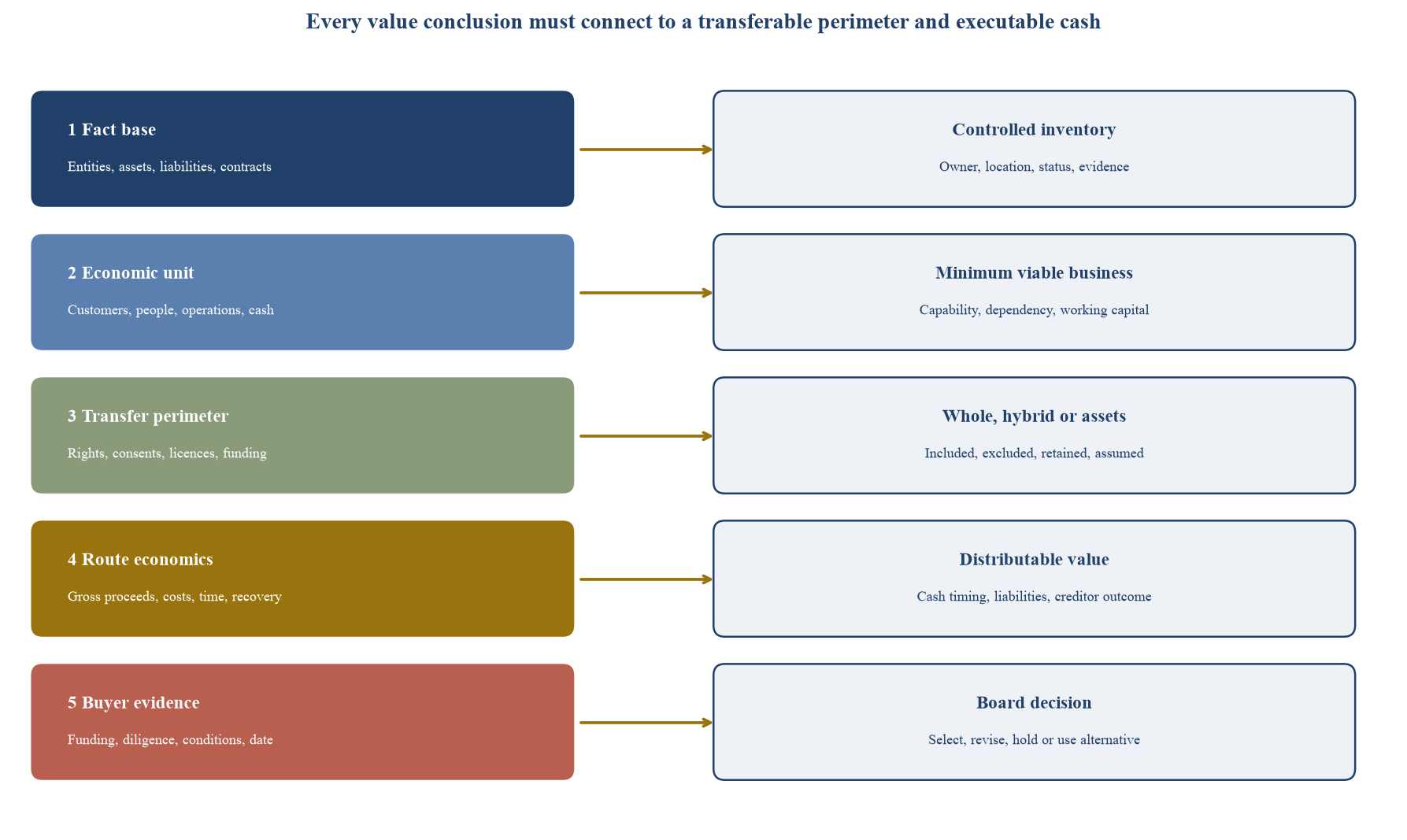
Original framework. A live transaction requires current instrument-specific and jurisdiction-specific verification.
The architecture prevents value from being counted without its enabling obligations. A customer contract may support a revenue multiple while requiring a cure payment, consent or service capability. A plant may have appraised property value while depending on an environmental permit, grid connection, specialist workforce and maintenance records. Intellectual property may be registered in one entity while the developers, data rights and customer licences sit elsewhere.
The board pack should show the proposed whole-business, hybrid and piecemeal perimeters side by side. Each perimeter should state what transfers, what remains, what must be funded, what must be released and what can cause failure.
4. Define the economic unit before valuing it
A going concern is an operating system rather than a list of assets. The analysis should identify the minimum viable combination of customer demand, people, equipment, technology, licences, suppliers, working capital and management required to continue trading. Removing one component can destroy value in the rest.
The unit may differ from the legal group. Several subsidiaries can form one integrated business through shared manufacturing, treasury, sales, intellectual property and management. One legal entity can contain multiple businesses with different customers, margins, permits and buyers. The sale perimeter should follow economic dependencies while recognising that the transaction must still transfer legal rights and obligations.
Contribution analysis should begin with controlled transaction-level or product-level data. It should reconcile revenue, direct cost, variable overhead, customer rebates, warranty, returns, working-capital consumption, maintenance capital expenditure and cash conversion. Corporate allocations should be replaced with the capability and cost required by the proposed perimeter. A profitable segment can become unviable after adding the people, systems, insurance, compliance and facilities previously supplied by the group.
The minimum viable unit should have a documented service blueprint. It should show the order-to-cash, procure-to-pay, production, quality, regulatory, safety, data and financial-control processes that must operate on day one. The blueprint reveals assets that appear non-core in the ledger while remaining essential to delivery.
5. Reconcile the asset and liability perimeter
The asset register should cover property, plant, equipment, inventory, receivables, cash, deposits, intellectual property, software, data, licences, contracts, claims, tax attributes and investments. Each item should have an owner, location, condition, restriction, security status, valuation basis, evidence date and proposed route.
Liabilities should be mapped with equal discipline. Employee amounts, pensions, tax, environmental obligations, leases, supplier arrears, customer deposits, warranties, product liabilities, litigation, guarantees, letters of credit, deferred revenue and closure costs can change the route outcome. The analysis should state whether each liability transfers, is assumed, is discharged from proceeds, is retained, is insured or remains disputed.
The hypothetical group has three operating subsidiaries, one property company and a shared-services entity. The customer base requires certified engineering staff, calibrated equipment, maintenance records and a quality-management system. The property company owns the principal plant. The shared-services company employs finance, procurement, information-technology and human-resources teams. Customer deposits fund part of work in progress. These dependencies make a simple asset list inadequate.
| Component | Current location | Going-concern role | Transfer dependency | Break-up consideration |
|---|---|---|---|---|
| Customer contracts | Three operating subsidiaries | Revenue backlog and repeat demand | Consent, cure, service continuity and licence | Assignment limits and collection risk |
| Main plant | Property company | Production, testing and customer qualification | Lease or property transfer, permits and utilities | Marketing period, environmental work and vacancy |
| Specialist equipment | Operating subsidiaries | Certified production and maintenance capability | Calibration, records, software and trained staff | Removal cost and limited buyer universe |
| Inventory | Operating subsidiaries | Delivery continuity and backlog conversion | Quality, title, customer specification and working capital | Obsolescence, completion and selling cost |
| Receivables | Operating subsidiaries | Liquidity and route funding | Valid invoice, acceptance, set-off and security release | Collection delay, dispute and dilution |
| Intellectual property and data | Shared-services and operating entities | Process knowledge, customer delivery and differentiation | Ownership, licence, privacy and employee rights | Limited stand-alone utility without team and data |
| Employees | Five entities | Technical authority, relationships and execution | Transfer law, retention, consultation and immigration | Severance, claims and loss of tacit knowledge |
| Shared systems | Shared-services entity | Finance, procurement, quality and operational control | Licence, separation, data migration and cyber control | Exit cost and stranded contracts |
All positions are hypothetical. Legal ownership, transfer and liability treatment require current advice and verified evidence.
The register should also identify assets excluded from the sale. Exclusion can reduce buyer concerns while removing cash flow or operational capability. The board should test the remaining entity after every exclusion. A seller may retain liabilities without retaining the cash, systems or people needed to manage them.
6. Model going-concern proceeds from the buyer backwards
The going-concern model should start with what the buyer will fund and close, then reconcile to the seller's distributable cash. The buyer case should identify enterprise value, cash, debt, assumed liabilities, working-capital target, capital expenditure, cure funding, retention, separation support, financing conditions and completion adjustments.
Headline purchase price should be bridged to cash at closing. Deductions can include debt-like items, leases, customer deposits, deferred revenue, employee obligations, transaction costs, taxes, cure payments, retention arrangements, escrow and minimum cash left in the business. Additions may include usable company cash or buyer-funded cure and working capital where the documents support them.
The hypothetical full-group bid is USD 92.0 million in cash. The seller expects USD 3.0 million of usable company cash to enter the closing funds flow. Stated deductions are USD 4.0 million of transaction and tax costs, USD 5.0 million of employee, supplier and customer cure requirements, USD 4.0 million of debt-like and lease settlement and USD 3.0 million of release, escrow and residual-liability reserves. Estimated distributable value is therefore USD 79.0 million. The calculation is a scenario, not a valuation opinion.
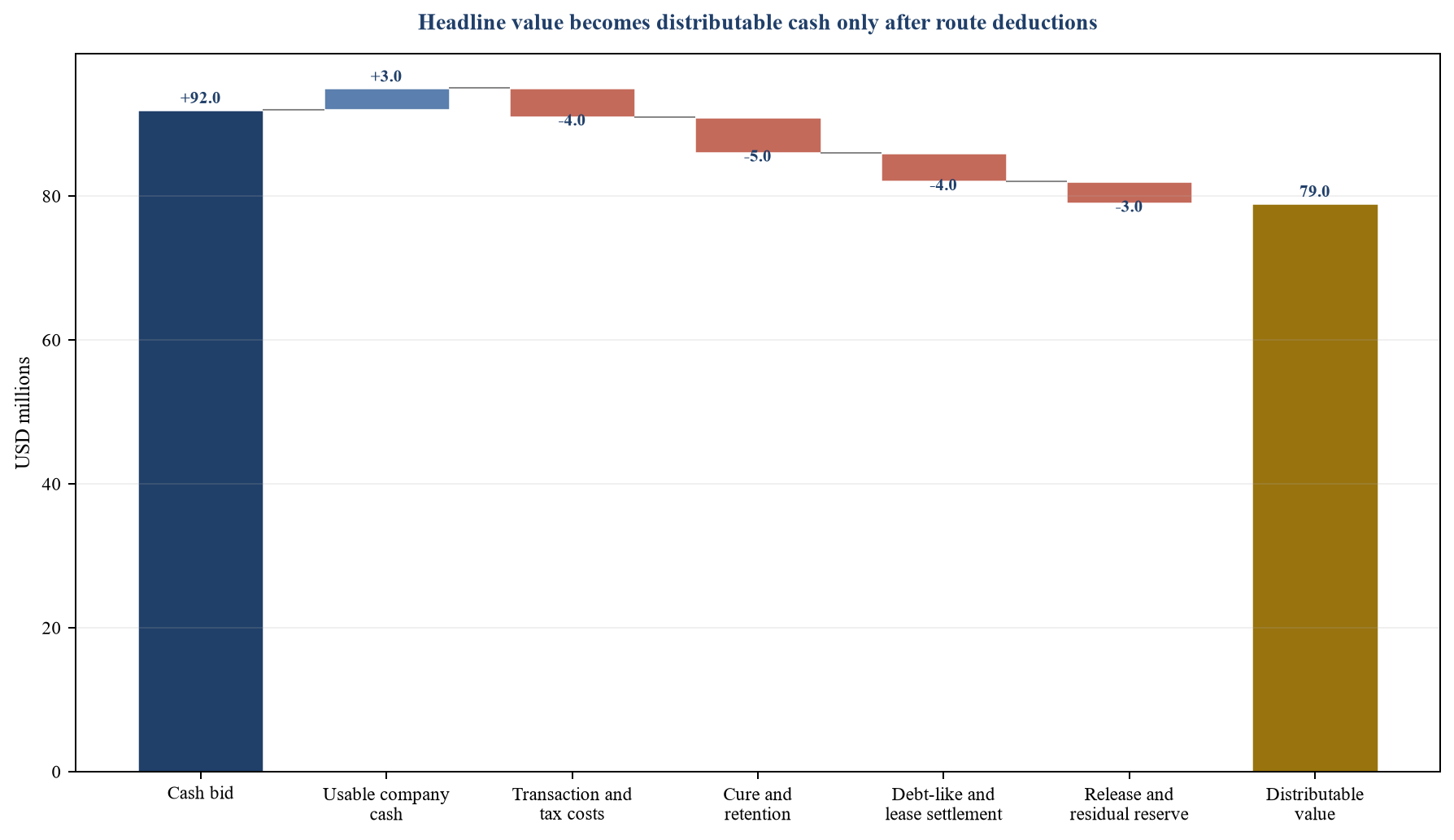
Original analysis using hypothetical amounts. Actual cash depends on verified documents, liabilities, adjustments, timing and closing evidence.
The buyer's funding evidence should be tested alongside value. A fully funded lower bid can exceed the expected outcome of a conditional higher bid after delay, operating losses and a failed process. The model should avoid invented closing probabilities. It should use observable conditions, dated evidence, required actions and scenario consequences.
7. Build the break-up case asset by asset
Piecemeal recovery should use asset-specific markets, timing and costs. Real property, specialist equipment, inventory, receivables, intellectual property and legal claims have different buyers and evidence requirements. A single percentage haircut applied to book value hides those differences.
Property analysis should address title, tenancy, permitted use, environmental status, utilities, vacancy, maintenance, transaction costs and marketing period. Equipment analysis should address condition, calibration, software, removal, export, installation, warranties and the pool of qualified buyers. Inventory analysis should distinguish finished goods, work in progress, raw materials, customer-specific items, consigned stock, title and obsolescence. Receivables should be segmented by acceptance, dispute, age, concentration, set-off, security, jurisdiction and collection cost.
Intangible assets require particular care. A brand, customer list, process or software code may have limited stand-alone utility without people, data, contracts or rights. The value attributed to an intangible in a going-concern valuation cannot be assumed to survive a piecemeal sale. The buyer pool, legal ownership and ability to transfer should be evidenced.
The hypothetical piecemeal route produces USD 96.0 million of gross recoveries: USD 25.0 million property, USD 32.0 million plant and equipment, USD 13.0 million inventory, USD 16.0 million receivables, USD 6.0 million intellectual property and contracts, and USD 4.0 million other assets and claims. Deductions total USD 40.0 million, including USD 14.0 million employee and closure costs, USD 8.0 million contract and customer obligations, USD 6.0 million realisation and removal costs, USD 4.0 million environmental and site work, USD 4.0 million collection and working-capital leakage, and USD 4.0 million tax and professional costs. Estimated distributable value is USD 56.0 million.
The model should show the recovery date for every asset and the cash required before receipt. A positive gross recovery in month twelve cannot fund payroll in week three. The route may require interim finance or an earlier sale of liquid assets, which can change security and priority outcomes.
8. Construct the hybrid route without double counting
A hybrid route sells an operating core and realises selected assets separately. It can broaden the buyer universe, remove unwanted liabilities and capture property or equipment value that an operating buyer will not pay for. It also creates interfaces, duplicated costs, transition requirements and stranded liabilities.
The core perimeter should be valued after removing the assets and cash flows allocated to separate sales. If the core buyer leases a property that will be sold to another investor, the operating model should include market rent and the property model should include lease terms, fit-out obligations and credit risk. If receivables remain with the seller, the purchase-price adjustment and working-capital target should exclude them consistently.
Every interface needs an owner and cost. These interfaces may include property leases, utilities, intellectual-property licences, supply agreements, transition services, data access, employee secondment, inventory supply and customer novation. The buyer cases should state which interfaces are conditions to closing and which can be completed later.
The hypothetical hybrid route generates USD 72.0 million from the operating core, USD 21.0 million from the separately sold property and USD 5.0 million from excluded residual assets and claims. Gross proceeds are USD 98.0 million. Deductions are USD 7.0 million of separation and transition costs, USD 5.0 million of stranded and closure costs, USD 4.0 million of cure and retention funding, USD 4.0 million of transaction and tax costs and USD 3.0 million of reserves. Estimated distributable value is USD 75.0 million.
The hybrid headline exceeds the whole-group headline, while the net value is lower in the central case. The difference is driven by route costs rather than a universal discount. A live process should update each line as buyer, landlord, employee, creditor and tax evidence develops.
9. Compare routes on one cash and time basis
The three routes should use the same valuation date, exchange rates, tax assumptions, liability cut-off and cash horizon. They should show gross proceeds, cash required before closing, completion deductions, post-closing costs, timing, residual liabilities and distributable value. A route that takes longer should include the associated trading cash, deterioration, holding cost and financing requirement.
| Measure | Whole group | Hybrid core and property | Piecemeal assets |
|---|---|---|---|
| Gross or headline proceeds | 95.0 including usable cash | 98.0 | 96.0 |
| Completion and route deductions | 16.0 | 23.0 | 40.0 |
| Estimated distributable value | 79.0 | 75.0 | 56.0 |
| Earliest credible completion | Week 10 | Week 14 | Month 3 to month 15 |
| Principal value source | Operating continuity | Core continuity plus property | Individual asset markets |
| Principal dependency | Buyer funding, contracts and group transfer | Separation, lease and two coordinated closings | Asset access, buyers, collections and wind-down |
| Principal residual risk | Retained reserves and excluded claims | Stranded services and seller liabilities | Long-tail claims, closure and delayed receipts |
Amounts are USD millions and hypothetical. Timing and outcomes require live evidence and current professional advice.
The table should not be reduced to a single net figure. The board needs to understand who receives cash, when it arrives, whether it is secured, what must be funded and which liabilities survive. A higher net present estimate can remain inferior if the company lacks liquidity to reach it or if the route cannot release the required assets.
UNCITRAL recognises that continued trading can be relevant in liquidation to maximise value, including where a business is sold as a going concern or operated temporarily before piecemeal sales. [1] The World Bank Principles support stays and insolvency tools that can preserve assets and enable higher recoveries through a sale of the business or productive units. [2] The transaction model should identify the legal mechanism required to preserve the proposed perimeter.
10. Test the counterfactual and creditor outcome
Each route should be compared with the next credible alternative. The counterfactual is not automatically immediate liquidation. It can be a delayed sale, enforcement, administration, pre-pack, restructuring, refinancing, shutdown or another route supported by the facts and law.
The EU preventive-restructuring directive uses liquidation and next-best-alternative concepts to protect dissenting stakeholders and distinguishes going-concern value from liquidation value. [7] The 2026 EU insolvency directive requires the monitor in a pre-pack framework to assess whether piecemeal liquidation would recover more than the market price from the proposed going-concern sale. It also addresses competitive, transparent and fair sale processes and additional scrutiny for closely related buyers. [8]
The counterfactual should use the same perimeter and claim date as the proposed route. It should include professional costs, trading losses, working-capital needs, employee claims, cure costs, asset deterioration, enforcement expense and time. It should identify which creditors control the alternative and how security, priority and guarantees affect distribution.
The board should distinguish enterprise preservation from creditor recovery. Preserving jobs, customers and productive capacity can support value, while the governing route may prioritise creditor outcomes and statutory tests. The decision paper should identify the relevant legal objective and record any public-interest or stakeholder considerations separately.
11. Model working capital as a route asset and funding need
Working capital creates value only when the perimeter can convert it into cash. Inventory requires suppliers, people, production, quality, logistics and customers. Receivables require valid performance, acceptance, invoices, collection and freedom from set-off. Customer deposits can fund work while creating an obligation to deliver or refund.
The whole-company route should model cash from launch to closing. It should include collections, payroll, suppliers, tax, rent, utilities, insurance, capital expenditure, customer deposits, cure payments and professional fees. The buyer's working-capital target should reconcile to the liquidity model. A purchase-price adjustment that extracts cash before closing can leave the business unable to complete orders or meet the target.
The break-up route should show what happens when the operating cycle stops. Raw materials and work in progress may lose value without completion. Customers can exercise set-off or warranty rights. Supplier retention-of-title claims can remove inventory from the estate. Collections can slow when account managers and service teams leave. The model should use evidence from contracts, aging, disputes, order status and collection history.
The hypothetical company needs a minimum USD 4.0 million operating cash floor. The whole-group route requires USD 6.0 million of cumulative bridge funding before week ten, of which USD 3.0 million is expected to remain usable at closing under the stated case. The hybrid route requires USD 9.0 million because separation work and two closings overlap. The piecemeal route requires USD 12.0 million before sufficient asset receipts arrive. These amounts are scenario assumptions and do not establish financing availability.
12. Determine transferability before pricing continuity
Going-concern value depends on the ability to transfer the operating system. The transaction team should build a transfer matrix for contracts, licences, permits, employees, property, equipment, data, intellectual property, insurance, bank accounts and regulated approvals. Each item should identify the current holder, proposed recipient, legal mechanism, consent, notice, cure, lead time, evidence and consequence of failure.
Contracts should be classified by assignment, change-of-control, termination, insolvency, set-off and cure provisions. Licences and permits should be assessed for transfer, re-issue or fresh application. Employees should be assessed under the applicable transfer, consultation, immigration, pension and benefit rules. Data transfer should address controller and processor roles, legal basis, security and customer commitments.
The United States Bankruptcy Code permits sales free and clear of interests under specified conditions in section 363. [11] The UAE Financial Restructuring and Bankruptcy Law provides its own court, trustee, restructuring, sale and liquidation framework. [12] UK administration seeks rescue as a going concern where reasonably practicable, then a better result for creditors as a whole than winding up, followed by realisation for secured or preferential creditors where the earlier objectives are not reasonably practicable. [9] These routes are not interchangeable.
The board should obtain current advice before assuming that a formal process cures a transfer problem. A court order can address defined interests while licences, regulatory approvals, customer relationships, employee continuity and foreign-law assets can require separate action.
13. Allocate shared services and stranded obligations
Shared services can determine whether a perimeter is executable. Finance, treasury, tax, procurement, information technology, cybersecurity, human resources, legal, quality, safety, compliance and facilities often sit outside the operating entities. A buyer may require these capabilities at closing while refusing the employees, systems or contracts that currently provide them.
The standalone model should identify the day-one service, current provider, buyer requirement, transfer or replacement route, one-time cost, recurring cost, transition period, data dependency and exit condition. A transition-services agreement should not become an indefinite substitute for an operating model. Its pricing, service levels, liability, access, security, change control and exit plan should be documented.
The seller model should quantify stranded obligations. Retained software, property, insurance, people and supplier contracts can remain after the revenue-generating business transfers. Termination payments and sublease recoveries should be evidenced. The hybrid route can create more stranded cost than the whole-group route even where the gross sale proceeds are higher.
The hypothetical hybrid case includes USD 5.0 million of stranded and closure cost and USD 7.0 million of separation and transition work. Those amounts should be replaced with bottom-up evidence in a live matter. The board should see who bears each cost under the transaction documents and when the cash leaves.
14. Integrate tax, employment and environmental consequences
Route taxes can differ by share sale, asset sale, property sale, debt release, cross-border transfer and liquidation. The analysis should identify transaction taxes, gains, losses, withholding, value-added tax, transfer pricing, tax attributes and timing. Tax outcomes require jurisdiction-specific advice and should not be inferred from accounting book values.
Employment consequences can include transfer, consultation, retention, redundancy, accrued leave, pensions, incentives, immigration, collective agreements and claims. The whole-group route can preserve more roles while still requiring entity transfers or changes in terms. The hybrid and piecemeal routes can trigger duplicated consultation, retention and closure work.
Environmental liabilities can attach to property, operations, permits or responsible persons under the relevant law. A property appraisal that ignores remediation, decommissioning, contamination, waste, permit surrender and monitoring can overstate net recovery. The sale model should identify surveys, orders, reserves, insurance and buyer allocation without assuming that contractual allocation removes statutory exposure.
The board should receive a route-specific schedule of cash taxes, employee payments and environmental cash. Each line should identify whether it is included in the price, deducted at closing, funded before closing, retained as a reserve or paid after completion.
15. Use buyer evidence to revise the perimeter
Buyer feedback is evidence about the perimeter when it is controlled and comparable. Bid instructions should require buyers to state the entities and assets acquired, liabilities assumed, working-capital target, required contracts, excluded items, funding sources, approvals, conditions, diligence gaps, transition services and earliest credible closing date.
The transaction team should reconcile bids to one perimeter. A USD 100 million share-sale indication cannot be compared directly with a USD 90 million asset bid that excludes debt, working capital and liabilities. Each bid should be converted to seller cash and creditor outcome using the same cut-off date and stated assumptions.
The team should identify whether the buyer is paying for continuity or optionality. A bidder can include a high headline value while retaining broad rights to remove contracts, reduce the perimeter or adjust for working capital. A lower bid with completed diligence, committed funding and controlled conditions can produce a stronger executable outcome.
The process should permit perimeter refinement without disclosing one bidder's confidential information to another. The board should approve any material change to scope and document how it affects value, competition, creditors, employees and the alternative route.
16. Apply the hypothetical precision-engineering case
The hypothetical group manufactures precision components and provides inspection and maintenance services across three jurisdictions. Its customer contracts include delivery, quality, warranty and certification obligations. The principal plant is owned by a separate group company. Specialist equipment is distributed across two operating subsidiaries. Shared services hold group software and employ the finance, procurement and information-technology teams.
The group has enough liquidity for a controlled ten-week sale if collections track the central case and the bridge facility remains available. A delay beyond week ten requires additional funding. The full-group buyer has completed commercial and operational diligence, produced a signed equity commitment and identified its debt provider. Customer, regulatory and property-transfer work remains outstanding.
The full-group bid produces USD 79.0 million of estimated distributable value under the stated assumptions. The hybrid route produces USD 75.0 million after separation and stranded costs. Piecemeal sales produce USD 56.0 million after the stated costs and leakage. The central ranking therefore favours the whole-group sale.
The ranking changes under some scenarios. If the full-group buyer delays by six weeks, operating cash reduces by USD 5.0 million and customer or contract deterioration reduces proceeds by USD 7.0 million, the route falls to USD 67.0 million. If the hybrid route completes on its central timetable and controls separation costs, its USD 75.0 million outcome becomes higher. If the property sale in the hybrid route falls by USD 6.0 million and separation cost rises by USD 3.0 million, the hybrid outcome falls to USD 66.0 million.
The piecemeal route remains the lowest central outcome, while individual secured creditors can have different preferences depending on collateral and priority. Under the stated downside scenario, its estimated distributable value falls to USD 42.4 million. The board's route decision should use the applicable duties and legal objective rather than assuming that the route with the highest enterprise preservation also maximises every stakeholder's recovery.
| Scenario | Whole group | Hybrid | Piecemeal | Decision implication |
|---|---|---|---|---|
| Central evidence case | 79.0 | 75.0 | 56.0 | Whole-group route leads |
| Six-week whole-group delay and customer deterioration | 67.0 | 75.0 | 53.0 | Hybrid route leads if executable |
| Hybrid property shortfall and separation overrun | 79.0 | 66.0 | 56.0 | Whole-group route widens its lead |
| Ten per cent lower asset recoveries and higher closure cost | 79.0 | 72.0 | 42.4 | Piecemeal downside increases materially |
| Whole-group transfer failure after additional process cost | 61.0 | 70.0 | 49.0 | Prepared hybrid alternative becomes essential |
Values are USD millions and hypothetical. Scenarios are deterministic sensitivities, not probability-weighted forecasts.
The model should be refreshed when bids, contracts, collections, payoffs, costs or timing change. It should show the version and evidence date. A route should not retain an early value after its assumptions have been contradicted.
17. Use scenarios to identify the route crossover
Scenario analysis should focus on variables that can change the route ranking: closing delay, customer retention, working-capital funding, property price, asset recovery, separation cost, employee retention, contract cure and tax. The analysis should avoid arbitrary probabilities where evidence does not support them.
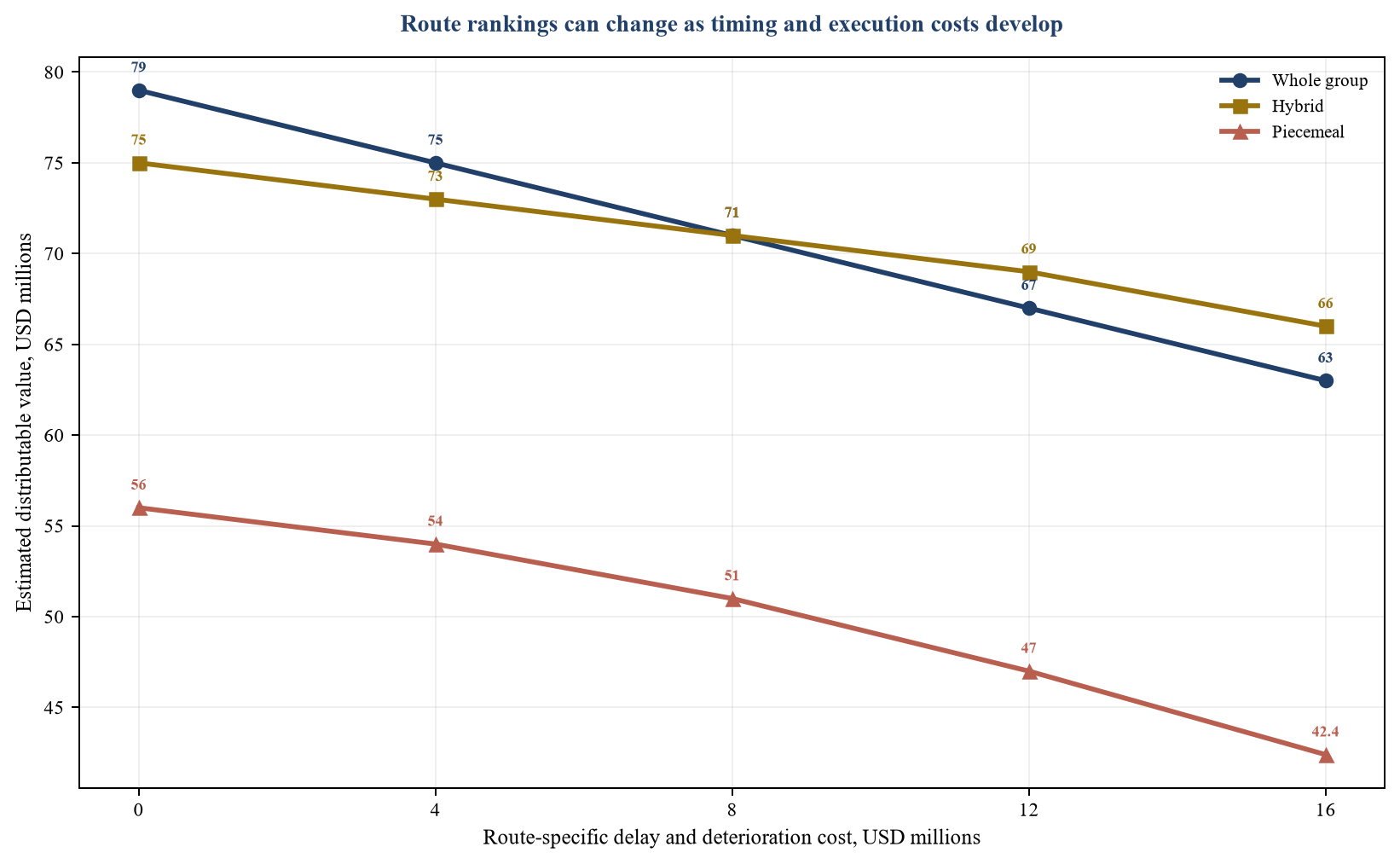
Original analysis using hypothetical amounts. The chart does not estimate closing probability.
The route crossover should become a management trigger. If the full-group buyer has not delivered required funding evidence by a stated date, the company can advance the hybrid buyer or launch selected asset work. If property diligence identifies a material remediation cost, the hybrid model should be updated before exclusivity. If customer attrition crosses a defined revenue or cash threshold, the whole-group price and working-capital case should be reopened.
Triggers should have dates, owners, evidence and actions. They should connect to the liquidity model. A trigger after the cash runway expires has no practical value. The alternative route should be prepared far enough to protect competition and time without compromising the principal process.
18. Build a risk heat map around value destruction
The risk register should connect each issue to gross proceeds, cash cost, timing, transferability and closing. A generic red, amber or green label is insufficient. Each issue should state the affected route, current evidence, financial exposure, latest safe date, owner, action and alternative.
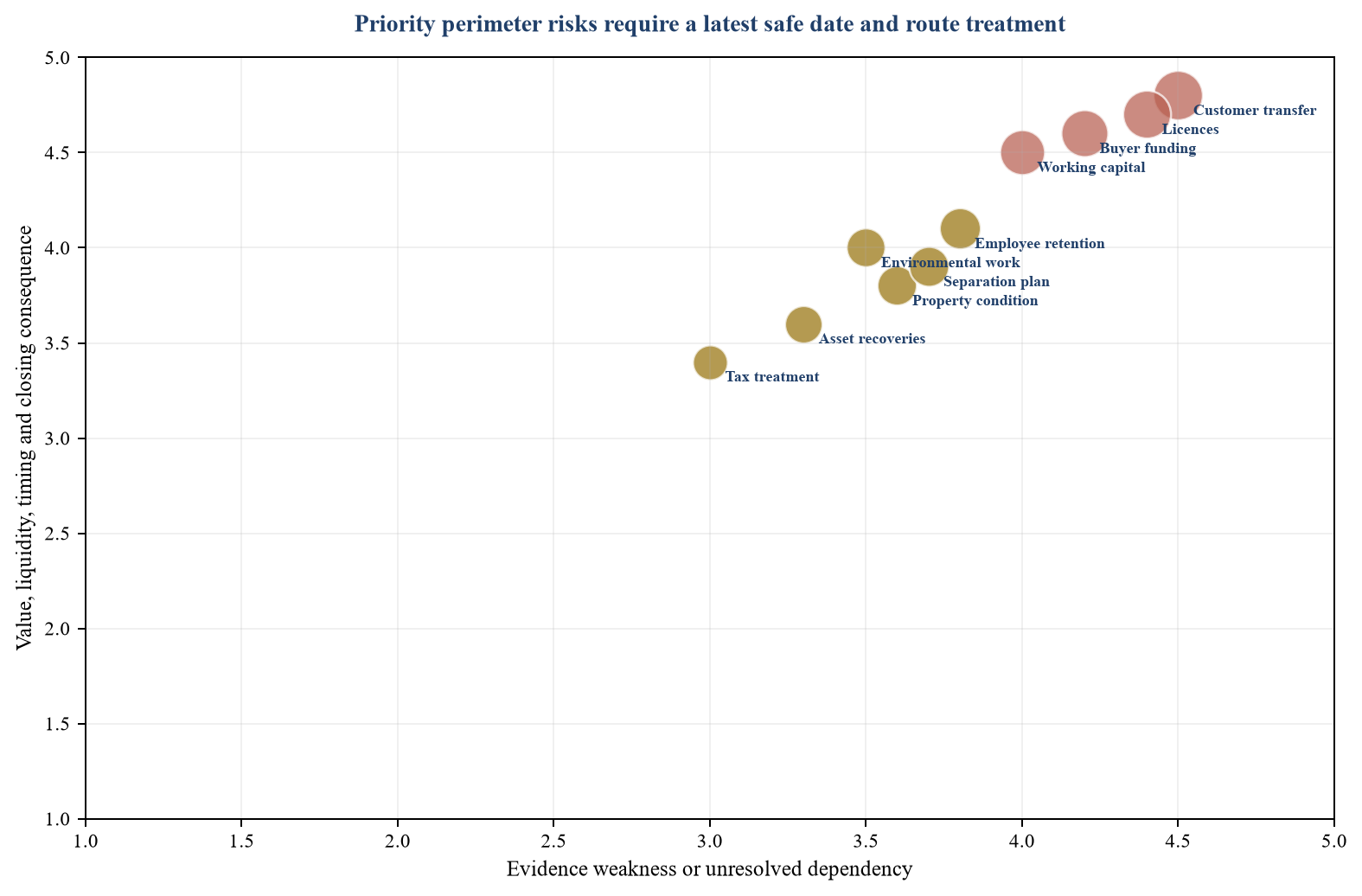
Original framework using hypothetical positions. Ratings require documented evidence and accountable review.
High-consequence, weak-evidence items should determine the diligence sequence. A critical licence, customer contract or funding condition can destroy the whole-company route. Property title or environmental issues can destroy the hybrid premium. Missing asset records, access rights or condition evidence can reduce piecemeal recovery.
The risk map should distinguish correlated risks. Customer attrition can reduce revenue, receivables, inventory recovery and buyer financing simultaneously. Employee departures can affect production, contract compliance, collections and the transfer of tacit knowledge. A simple sum of individual exposures can overstate or understate the combined effect. The board should review connected scenarios.
19. Govern conflicts, information and valuation evidence
The board should retain authority over the sale perimeter, route, bidder selection, material exclusions, related-party participation, minimum cash, exclusivity and final approval. A transaction committee may manage detailed work within documented reserved matters.
Valuers, insolvency practitioners, advisers, creditors, management and buyers have different roles. The valuation scope should state the client, purpose, basis, premise, date, perimeter, information, assumptions, approaches, limitations and reporting. Transaction advisers should convert bids into route outcomes. Legal advisers should address authority, transfer and process. Finance should own reconciled cash and claim data.
Conflicts should be disclosed and managed. Management can favour a route that preserves roles. A secured creditor can prefer collateral realisation over group value. A sponsor can favour a related buyer. An adviser can have contingent compensation. Independent valuation, creditor consultation, court oversight or external scrutiny may be appropriate under the documents, law and circumstances.
The UK connected-person disposal rules require independent scrutiny in defined administration sales. [10] The 2026 EU directive imposes enhanced protections for closely related bidders within its pre-pack framework. [8] A live process should apply the current law and avoid treating these examples as universal rules.
The information set should remain controlled. Buyer materials, valuation data, creditor materials and board papers should reconcile. Changes should be version controlled. Unsupported recovery statements can damage trust and expose the decision process to challenge.
20. Implement the framework in five phases
Phase one controls the facts. The company stabilises cash, confirms decision authority, maps legal entities and operations, reconciles assets and liabilities, and identifies the minimum viable operating unit.
Phase two builds route economics. Finance and advisers prepare whole-group, hybrid and piecemeal proceeds bridges, working-capital requirements, timing, tax, employee, environmental, separation and closure schedules. Valuation scopes and evidence dates are approved.
Phase three tests transfer and market evidence. The company builds the consent and transfer matrix, prepares data for buyers, obtains appraisals or specialist evidence where needed, and requests comparable bids with funding and conditions.
Phase four selects and protects the route. The board compares seller cash, creditor outcomes, timing, liquidity, transfer readiness and alternatives. Trigger-based work continues on the secondary route. Exclusivity includes evidence milestones and termination rights.
Phase five documents, closes and validates. The parties finalise the purchase agreement, working-capital mechanism, cure schedule, employee and regulatory actions, funding, releases, transition services, funds flow and residual-liability plan. Finance reconciles actual cash and remaining obligations after completion.
| Phase | Indicative timing | Core outputs | Board gate | Escalation if incomplete |
|---|---|---|---|---|
| Fact control | Days 1 to 10 | Cash, entities, operating unit, assets, liabilities and dependencies | Is the evidence base controlled? | Stabilise liquidity and narrow claims |
| Route economics | Days 5 to 25 | Three proceeds bridges, timing and cash requirements | Are routes comparable on a net cash basis? | Repair models and obtain specialist evidence |
| Transfer and market test | Days 15 to 45 | Transfer matrix, buyer bids, funding and appraisals | Which perimeters can transfer and close? | Redesign perimeter or route |
| Selection and alternatives | Days 35 to 60 | Bid reconciliation, creditor outcome and trigger plan | Which route maximises executable distributable value? | Advance the prepared secondary route |
| Documentation and close | Day 50 onward | Agreements, approvals, funding, releases and funds flow | Will value and documents move together? | Hold closing or activate alternative |
| Post-close validation | Closing onward | Cash reconciliation, residual register and evidence archive | Did the route deliver the approved outcome? | Correct filings, reserves or control failures |
Timing is indicative and should follow verified liquidity, governing documents, law, buyer evidence and transaction complexity.
Each phase should have a dated exception report. The report should state missing evidence, affected value, liquidity consequence, latest safe date, owner and action. Green status should require evidence. Amber status should have a dated resolution plan. Red status should produce a route, perimeter, timetable or board decision.
21. Conclusion
The distressed-sale perimeter is a transaction decision about executable cash, time and obligations. A going-concern sale can preserve customer, employee, supplier and operating relationships while requiring funding, transfers and liability solutions. A break-up can expose stand-alone asset value while incurring closure, employee, contract, environmental, collection and time costs. A hybrid can capture both sources while adding separation and stranded obligations.
The hypothetical case shows why the headline comparison is insufficient. The whole-group route converts USD 95.0 million of headline and usable cash into USD 79.0 million of estimated distributable value. The hybrid route converts USD 98.0 million of gross proceeds into USD 75.0 million. Piecemeal realisation converts USD 96.0 million of gross recoveries into USD 56.0 million. Delay, customer deterioration, property shortfall, separation overruns or transfer failure can change that ranking.
The reusable discipline is direct. Define the economic unit, map the legal perimeter, separate the bases of value, reconcile every asset and liability, fund the route, test transferability, compare net cash on one date, preserve a credible alternative and revise the decision when evidence changes. That process gives the board a defensible route from valuation to closing.
Sources
- UNCITRAL, Legislative Guide on Insolvency Law, Read the primary source
- World Bank, Principles for Effective Insolvency and Creditor/Debtor Regimes, revised 2021 and current ICR standard page, Read the primary source
- International Valuation Standards Council, International Valuation Standards effective 31 January 2025, Read the primary source
- International Valuation Standards Council, Standards glossary, including liquidation value and forced sale, Read the primary source
- IFRS Foundation, IFRS 13 Fair Value Measurement, Read the primary source
- IFRS Foundation, IAS 36 Impairment of Assets, Read the primary source
- European Union, Directive EU 2019/1023 on restructuring and insolvency, Read the primary source
- European Union, Directive EU 2026/799 harmonising certain aspects of insolvency law, Read the primary source
- UK Government, Practice guide 36: administration and receivership, Read the primary source
- UK Insolvency Service, Requirements for independent scrutiny of disposals in administration, Read the primary source
- United States Code, Title 11 Section 363, use, sale or lease of property, Read the primary source
- United Arab Emirates, Federal Decree-Law No. 51 of 2023 Promulgating the Financial Restructuring and Bankruptcy Law, Read the primary source
- United Arab Emirates, Cabinet Resolution No. 94 of 2024 concerning the Executive Regulations, Read the primary source
- United States Courts, Chapter 11 Bankruptcy Basics, Read the primary source
