

1. Treat government revenue as a financing system
A public-sector opportunity should be managed as a sequence of evidence, obligations and cash movements. The commercial headline may be an attractive contract value. The finance question is when the supplier becomes entitled to invoice, when the buyer accepts the deliverable, when payment becomes due, which deductions or disputes can arise and which funding source can bridge the gap without creating disproportionate dilution or default risk.
The board should distinguish demand evidence from payment evidence. A policy priority can indicate strategic relevance. A funded programme can indicate budget capacity. A pilot can establish technical feasibility. A preferred-bidder notice can indicate competitive success. A signed contract can establish enforceable obligations. A purchase order can authorise work within defined limits. Acceptance evidence can support an invoice. A proper, undisputed invoice can establish a payment claim. Collected cash remains the final operating proof.
Each transition can consume time and money. The company may need certifications, security testing, local registration, bid support, legal review, insurance, bank guarantees, inventory, implementation staff, subcontractors and customer-specific development before it receives cash. Management should model these commitments against the exact state reached and should avoid treating an anticipated award as available liquidity.
Government customers also differ. A federal ministry, municipal authority, state-owned enterprise, public hospital, defence buyer, university and prime contractor can operate under different procurement rules, budget cycles, approval chains and payment systems. The company should identify the legal buyer, economic user, technical sponsor, contracting authority, acceptance authority and payment office. A strong sponsor may support the solution while lacking authority to commit budget or approve invoices.
The financing system has three linked designs. The contract design determines milestones, acceptance and payment rights. The operating design determines delivery cost, evidence and control. The capital design determines which cash source funds each stage. These designs should be built together before the company accepts a price, timetable or liability profile.
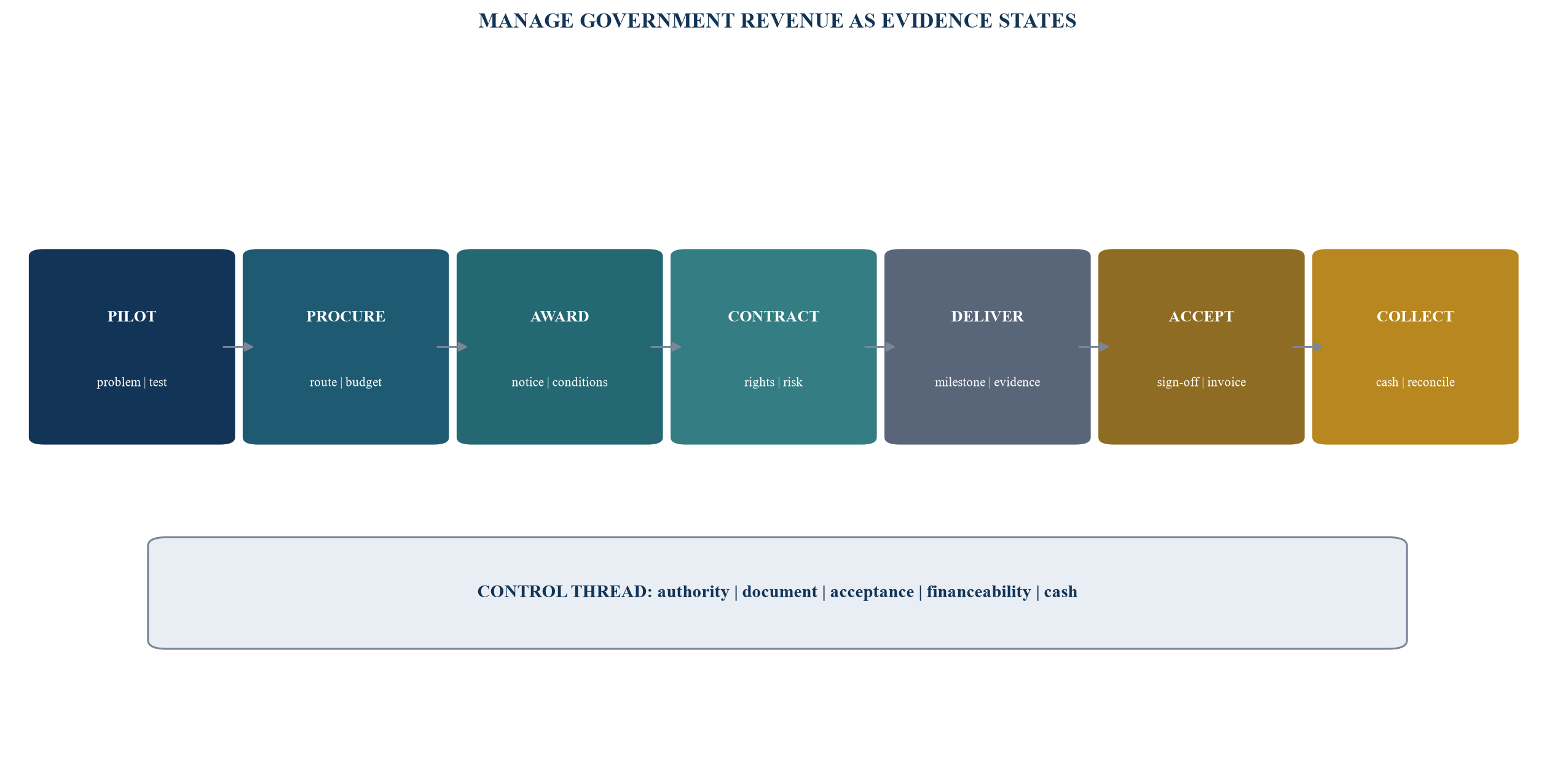
Capital commitments rise only when the company has the evidence required for the next controlled state.
2. Map the route from problem statement to procurement
The financing plan begins with the procurement route. A government customer may use a challenge, innovation partnership, framework, catalogue, quotation, tender, direct award, grant, research contract, concession, public-private partnership or a call-off under an existing vehicle. The route determines competition, timetable, documentation, contracting authority, scope flexibility and the point at which the company can reasonably commit delivery capital.
A pilot should have an explicit commercial hypothesis. It should identify the problem, user, baseline, outcome, evaluation method, data, access, responsibilities, cost, intellectual-property position and decision after completion. The decision can be a new competitive procurement, a permitted scale-up, a framework call-off, a separate budget request or no further purchase. A successful technical result does not by itself establish a right to a production contract.
The European Commission describes pre-commercial procurement as an approach for buying research and development services while sharing risk and benefit and allowing industry sufficient rights to reuse successful results. Singapore's Innovative Procurement Partnership provides participating businesses an opportunity to scale after a successful pilot and removes security deposits and liquidated damages by default during the pilot phase. These structures show why the pilot instrument matters. The financing plan should capture the actual rights created by the applicable programme rather than assume that every pilot carries a scale commitment.
Management should build a route memo before incurring material bid cost. The memo should identify the official notice, legal basis, buyer, value range, funding source, procurement timetable, bidder eligibility, evaluation criteria, bid security, performance security, insurance, localisation, data location, intellectual property, contract form, acceptance process, payment terms, assignment rights, termination rights and challenge period. It should state which items are confirmed in official documents and which remain open.
The route memo should also connect stakeholders to authority. A technical champion can define the problem and support evaluation. Procurement controls the compliant route. Finance confirms budget and payment. Legal controls terms. Information security and privacy teams control data access. The operational owner accepts delivery. The contracting officer signs or administers the contract. A sponsor map that omits these roles can produce a pilot that nobody is authorised to scale or pay.
Table 1. Procurement evidence and commitment register
| Evidence state | Required proof | Permitted management action | Capital discipline |
|---|---|---|---|
| problem and sponsor | documented need, named user, baseline and accountable sponsor | fund limited discovery and solution qualification | cap spend as business development; no contract revenue assumption |
| pilot authority | approved scope, budget, evaluation, data access, rights and post-pilot route | commit the bounded pilot team and agreed third-party cost | use pilot payment, grant or tightly capped risk capital |
| procurement launched | official notice, route, timetable, criteria and contract documents | price the bid and prepare compliance evidence | approve bid budget separately from delivery funding |
| award or preferred bidder | formal notice, standstill or conditions and outstanding approvals | prepare closing, guarantee and mobilisation plan | avoid irreversible delivery until conditions are resolved |
| signed contract and order | executed agreement, authority, purchase order and funded scope | activate controlled mobilisation and suppliers | match funding to enforceable milestones and termination rights |
| accepted milestone | deliverable evidence and authorised acceptance record | issue a compliant invoice and update forecast | consider receivables finance only after eligibility checks |
| collected cash | bank receipt, remittance detail and invoice reconciliation | release next-stage capacity and measure realised economics | separate collections from billed and recognised revenue |
Documentary evidence should be verified against the applicable process, contract and buyer authority.
3. Define the contracting authority, budget and acceptance chain
The legal buyer and the operational user may be different entities. A ministry can sponsor a programme while a central procurement unit runs the tender. A hospital network can use the service while a shared-services entity processes invoices. A state-owned enterprise can operate under commercial law with internal procurement rules. A prime contractor can hold the government contract and place a subcontract with the startup. The credit and contract analysis should follow the entity that owes payment under the executed document.
Budget evidence should be specific. The team should identify the appropriation, programme budget, purchase request, purchase order or other authorised funding record used in the relevant system. It should understand whether funding is annual, multi-year, conditional, subject to release or capable of being reallocated. The board should treat sponsor enthusiasm, policy announcements and tender publication as different from confirmed contract funding.
Acceptance is often the practical gate to payment. The contract should identify the deliverable, acceptance criteria, test method, responsible official, review period, deemed-acceptance mechanism if permitted, defect process, cure rights and escalation. Vague acceptance language can turn a 30-day payment term into a much longer cash cycle because the clock may depend on a proper invoice and an undisputed or accepted milestone.
United States federal prompt-payment rules demonstrate the documentary chain. Payment generally requires a proper invoice, satisfactory contract performance and a receiving report or other government documentation authorising payment. The rule specifies invoice content and requires receiving documentation to identify delivery and acceptance. The board lesson applies broadly: documentary completeness and acceptance ownership are financing controls.
The company should maintain an authority matrix. It should list who can approve scope, change the timetable, accept a deliverable, confirm a service entry, approve an invoice, resolve a dispute and authorise payment. Communications should be stored with the contract record. A verbal approval from someone outside the delegated chain may not create a financeable claim.
4. Price the full procurement-to-cash cycle
Contract pricing should include the cash cost of winning, mobilising, delivering and collecting. Bid labour, local registration, certifications, legal review, performance security, insurance, travel, customer-specific development, hosting, data preparation, hardware, subcontractors, implementation, training, support, warranty and collection effort all belong in the economics. The model should also include the cost of capital needed to bridge the cycle.
The company should separate fixed readiness cost from contract-specific cost and volume-dependent delivery cost. Readiness can include security controls, quality systems and standard contract evidence that support several customers. Contract-specific cost can include a local deployment, integration or bond. Variable cost can include cloud consumption, field service, licences, units or transaction processing. This separation helps the board decide whether one contract funds a reusable capability or a bespoke commitment.
Pricing should also reflect risk allocation. Unlimited liability, broad indemnities, liquidated damages, long warranty, termination for convenience, uncompensated transition support, customer ownership of improvements or inflexible fixed prices can reduce the economic value of a headline award. Management should model the credible downside under the proposed terms and define approval thresholds for risk that cannot be priced or insured.
Cash timing matters independently of accounting revenue. A company can report contract progress while funding payroll and suppliers before collection. Finance should build a weekly cash schedule across bid, mobilisation, delivery, acceptance, invoice and payment. The schedule should include value-added tax or sales tax timing where relevant, retention, disputed amounts, bond collateral, currency conversion and the release date of guarantees.
The maximum funding need is the most negative cumulative cash position before collections and financing. It should be measured under base, delayed-acceptance, delayed-payment, cost-overrun and termination scenarios. A forecast that assumes every milestone is accepted on its planned date understates the capital requirement.
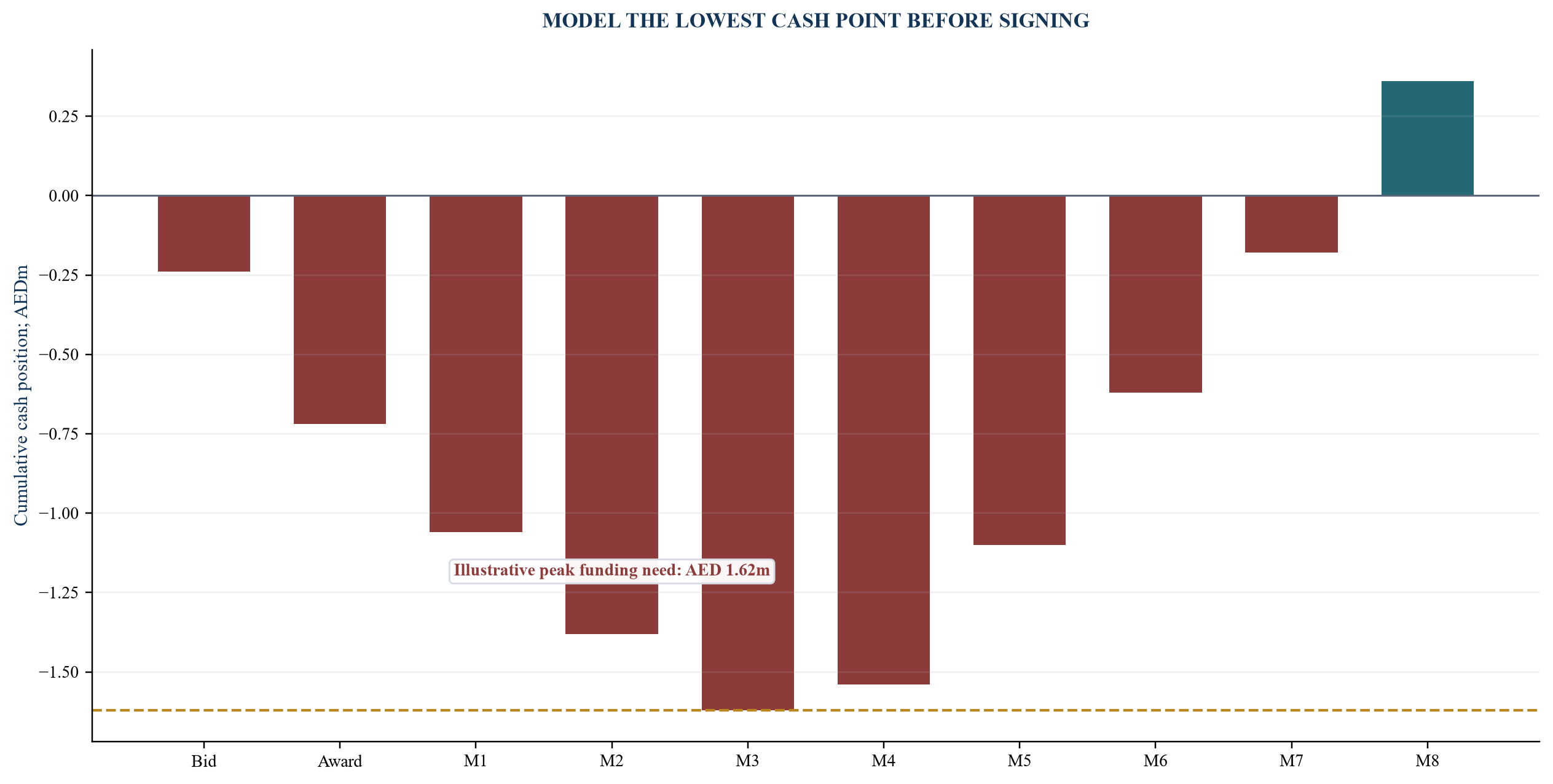
Values are illustrative management assumptions in AED millions; replace them with verified contract, cost, tax and collection data.
5. Build a unit-economics bridge that includes procurement friction
Unit economics should measure the contribution from an accepted and collected customer outcome. Revenue should be reconciled to scope, milestone, invoice and cash. Costs should include the full delivery system. The company should avoid using software gross-margin expectations when the contract depends on implementation, integration, field service, customer-specific controls or substantial human review.
The bridge can begin with contracted revenue and deduct direct technology, licences, hardware, subcontractors, implementation labour, support, warranty, service credits, expected rework and contract-specific compliance. Bid and capital costs can be shown separately so management sees both contribution and return on the cash committed. Reusable product development should be distinguished from bespoke work through a consistent accounting policy confirmed by advisers.
Customer-specific development creates an intellectual-property question. If the buyer owns all deliverables and improvements, the cost may support one contract. If the supplier retains reusable platform rights and grants an appropriate licence, the same investment may support additional markets. The contract and valuation case should state the rights precisely. Legal advice is required for ownership, licensing, government-purpose rights, data rights and background intellectual property.
The model should include sales probability and cycle. A large public-sector pipeline can look valuable while requiring repeated bids, long lead times and customer concentration. Finance should measure qualified opportunities, compliant bids, preferred-bidder outcomes, signed contracts, accepted milestones, invoices and collections. Each conversion rate should use observed company data when available. Management estimates should remain clearly identified until the cohort matures.
The illustrative bridge in Figure 4 assumes AED 4.8 million of contract revenue. It deducts direct delivery, implementation, contract compliance, support and capital cost to show AED 1.20 million of contribution before corporate overhead and tax. The example demonstrates the method and does not represent an expected margin.
Table 2. Government-contract unit-economics register
| Economic item | Evidence source | Decision question | Sensitivity to test |
|---|---|---|---|
| contract revenue | executed scope, price schedule, variations and acceptance terms | which amount is enforceable, deliverable and collectible? | scope reduction, disputed acceptance and termination |
| bid and readiness cost | time records, advisers, certifications, travel and registrations | how much cash is at risk before award? | rebid, delay, failed qualification and localisation |
| direct delivery cost | staff plan, cloud, licences, hardware, logistics and subcontractors | what cost moves with the accepted outcome? | usage, wage, supplier, currency and schedule variance |
| contract risk cost | guarantees, insurance, retention, warranty, service credits and rework | which cash remains restricted or exposed after delivery? | defect, delay, claim and guarantee extension |
| financing cost | facility terms, discount, fees, collateral and utilisation | what is the all-in cost of bridging the cash cycle? | delayed acceptance, delayed payment and higher utilisation |
| reusable asset value | product roadmap, rights, code, data and multi-customer evidence | which spending strengthens future revenue capacity? | customer ownership, exclusivity and integration dependency |
| realised contribution | collections less attributable cash cost | did the contract create cash and repeatable evidence? | collection loss, support tail and renewal outcome |
Every value should reconcile to a contract, invoice, payroll record, supplier commitment or documented management scenario.
6. Match each evidence state to the right capital
Capital should follow the certainty and duration of the asset it funds. Discovery, product development and uncertain pilots generally require equity, grants or customer-funded innovation budgets because repayment is not supported by an enforceable receivable. A signed contract can support a working-capital discussion if the scope, termination, assignment and payment mechanics are acceptable. An accepted invoice may support receivables finance if it is valid, undisputed, assignable and free from disqualifying set-off or performance exposure.
The capital ladder can include customer mobilisation payments, milestone redesign, vendor credit, grants, shareholder capital, venture capital, venture debt, overdraft, purchase-order finance, performance-guarantee facilities, inventory finance, contract-backed working capital, receivables discounting and supply-chain finance. Availability and terms vary by jurisdiction, lender, company stage, contract and collateral. The board should obtain actual term sheets before relying on an instrument.
Customer terms are often the cheapest source of liquidity. A paid discovery, mobilisation advance, shorter milestones, payment for accepted partial deliverables, direct payment for hardware, reimbursable third-party cost or separately priced change request can reduce the funding gap. The commercial team should negotiate cash mechanics with the same discipline applied to price and liability.
Vendor terms can align outflows with customer milestones. Cloud providers, equipment suppliers and subcontractors may offer credit based on the company or contract. Management should avoid creating a maturity wall before acceptance or collection. Supplier obligations, title, cancellation rights and currency should be included in the downside model.
Equity remains appropriate for reusable capability, uncertain market development and losses that debt cannot safely bear. It becomes expensive when used to finance a short-duration, low-risk receivable after acceptance. Debt becomes dangerous when used against a forecast award, cancellable order or disputed milestone. The capital committee should document why the selected instrument matches the asset and cash-flow state.
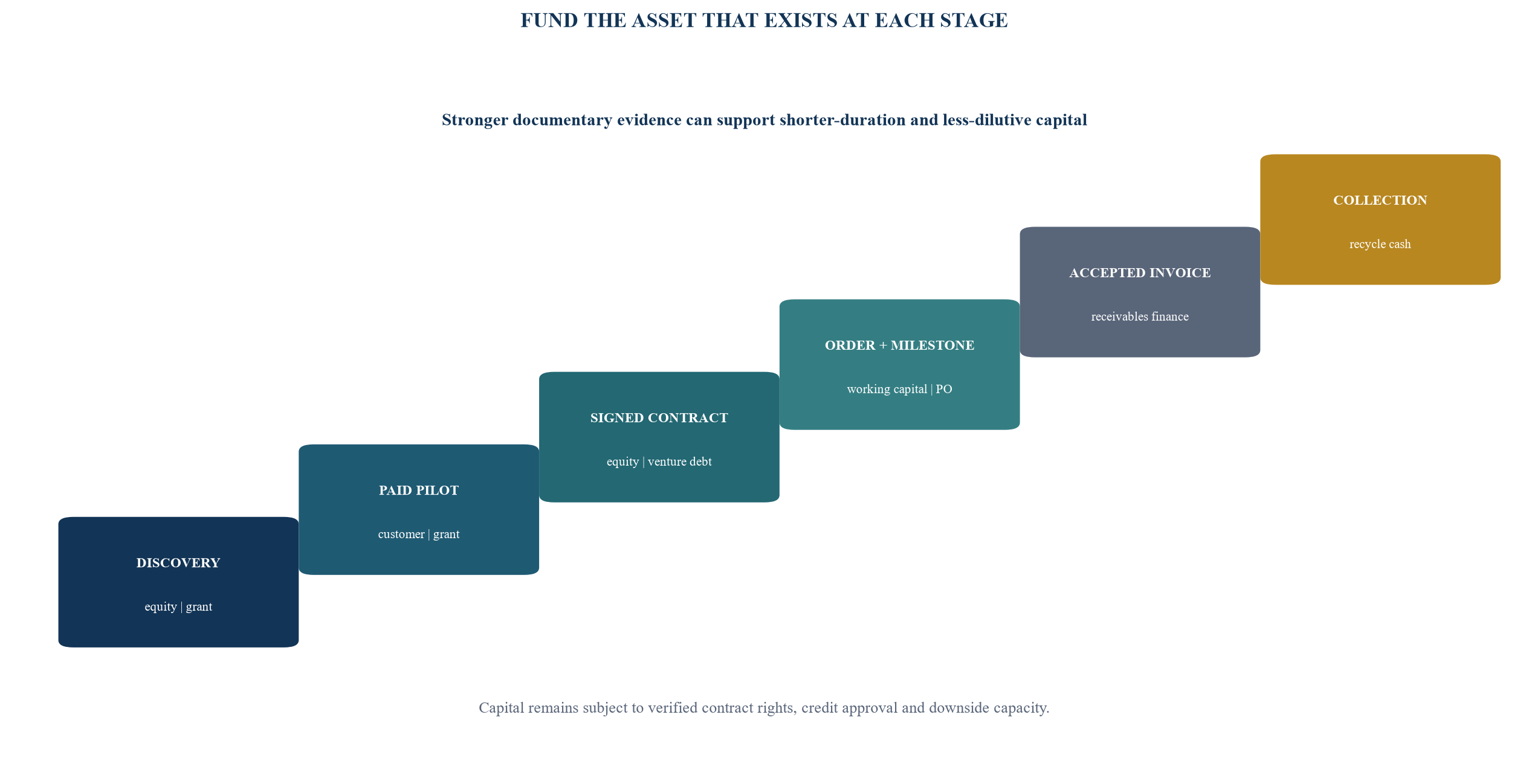
Instrument availability depends on executed terms, company credit, jurisdiction, collateral and financier approval.
7. Make the contract and receivable financeable
A financier analyses the payment right, the borrower and the operating path that produces cash. The review can cover the executed contract, buyer identity, budget, purchase order, scope, milestone, acceptance, invoice, payment history, assignment, set-off, dispute, termination, liability, insurance, guarantee, subcontractors, tax, sanctions, governing law and account-control arrangements. A strong public-sector counterparty does not remove defects in the supplier's own claim.
Assignment language should be reviewed before signing. Some contracts prohibit assignment of the contract, receivables or both without consent. Others permit assignment of payment but preserve buyer rights of set-off or recoupment. Federal Law No. 11 of 2023 in the UAE restricts assignment of the procurement contract or subcontracting without prior written approval, subject to implementing rules. The exact executed contract and applicable law should be assessed by qualified counsel before any financing relies on assignment.
Acceptance should be objective and evidenced. The financier needs confidence that the milestone has been delivered and that the authorised buyer has accepted it or that the applicable mechanism has otherwise made payment due. A service-entry record, goods-receipt note, signed acceptance certificate, approved timesheet or system confirmation may be relevant. The company should know which document controls under the contract.
Set-off and dispute rights can affect advance rates. The buyer may retain rights for defects, service credits, taxes, previous overpayments or other claims. A lender may exclude invoices that remain subject to material performance obligations or cross-contract set-off. The company should disclose open issues and avoid financing the same receivable twice.
The invoice must be proper under the contract and payment system. It should include the correct legal entity, tax details, contract and purchase-order references, line item, milestone, acceptance evidence, amount, currency, payment instructions and supporting documents. The invoice date, system submission and receipt confirmation should be recorded. Rejection reasons should be resolved through an accountable owner.
India's TReDS framework illustrates a structured route. Qualifying MSME receivables from corporates, government departments and public-sector undertakings can be uploaded as factoring units, accepted by the counterparty and bid on by multiple financiers. RBI states that transactions processed through TReDS are without recourse to the MSME seller. Eligibility, onboarding and transaction requirements remain specific to the platform and company.
Table 3. Contract and receivable financeability checklist
| Financeability factor | Stronger evidence | Warning condition | Management action |
|---|---|---|---|
| buyer and authority | identified legal obligor, authorised signatory and payment office | sponsor or user differs from contracting and payment entity | reconcile entity, authority and account before mobilisation |
| funded obligation | executed contract, valid order and verified budget path | award notice, unsigned order or conditional funding | hold irreversible commitments or obtain approved protection |
| milestone and acceptance | objective deliverable, named approver, time limit and signed evidence | subjective satisfaction, no approver or open-ended review | negotiate criteria, evidence and escalation before delivery |
| assignment | permitted receivable assignment or documented consent | prohibition, broad discretion or unclear distinction from contract assignment | obtain legal analysis and required written consent |
| dispute and set-off | accepted invoice, no dispute and bounded set-off | open defect, service credit, cross-contract claim or tax mismatch | cure, document resolution and exclude impaired amount |
| invoice integrity | proper invoice, submission receipt and complete support | wrong entity, order, tax, line item or missing acceptance record | use a pre-submission checklist and same-day rejection response |
| payment history | observed buyer and programme payment data | no comparable history or repeated unexplained ageing | apply conservative tenor, concentration and liquidity reserve |
| financier control | clear borrowing base, notice, account and reconciliation | double financing, commingled collections or incomplete reporting | establish ledger controls, covenants and receivable-level audit trail |
A positive public-sector credit profile does not replace documentary, legal and performance diligence on the receivable.
8. Negotiate milestones, security and working-capital protections
Milestones should align payment with measurable value and cash cost. A large final payment creates supplier financing and acceptance concentration. More frequent milestones can reduce the maximum cash gap and provide earlier evidence of performance. Singapore's Ministry of Finance states that agencies receive templates and guidance on increasing payment milestones where appropriate to ease cash flow. This supports a practical negotiation principle: milestone design can be part of procurement accessibility and delivery resilience.
Mobilisation payments can fund project setup, hardware orders, local staffing or security deposits. The buyer may require an advance-payment guarantee. The company should compare the liquidity benefit with guarantee fees, collateral and documentary conditions. A nominal advance can provide little liquidity if the bank requires full cash cover.
Performance security should be modelled as a cash asset with a release date and downside trigger. A guarantee facility may preserve cash if the bank accepts the company's credit and counter-indemnity. A cash-backed guarantee increases the funding gap. The contract should state the amount, form, issuer, expiry, reduction, claim procedure and return. Management should monitor expiry and release with the same discipline as an invoice.
Retention, liquidated damages and service credits can extend exposure beyond delivery. The pricing model should show the maximum retained amount and the evidence required for release. Liability caps should be tested against insurance and cash. Termination for convenience should specify payment for accepted work, committed third-party cost, demobilisation and transfer. Legal advisers should assess enforceability and jurisdiction-specific rights.
Change control protects both margin and acceptance. The company should require a written change request identifying scope, price, timetable, acceptance, payment and authorisation. Employees should know that a technical request from a user is not automatically a funded variation. Unpriced change can consume the exact working capital intended to deliver the original contract.
Subcontracts should mirror the rights and obligations the prime can safely pass down. Payment terms, acceptance, intellectual property, data, security, insurance, liability, termination and audit should be reconciled. A startup acting as subcontractor should understand whether the prime's payment obligation is conditional on government payment, whether 30-day terms flow through and whether the government can pay the subcontractor directly under the applicable regime.
9. Use public procurement data as a financing input
Digital procurement systems can create structured evidence around opportunities, awards, contracts, orders, invoices, payments and supplier performance. The UAE Digital Procurement Platform covers the cycle from tender announcement through award, purchase order, invoice and payment processes. The United Kingdom's 2026 transparency measures include payments-compliance notices, contract-payment information for defined public contracts and performance notices. These data can improve qualification and monitoring when used carefully.
The company can build a buyer evidence profile. It can record the authority, procurement route, published pipeline, award volume, contract modifications, payment-compliance metrics, invoice instructions, dispute processes and comparable supplier experience. Official published data should be dated and linked. Missing data should remain missing rather than replaced with an assumed payment period.
A financier can use verified digital evidence to support onboarding, fraud controls and monitoring. Purchase orders, acceptance records and invoices can be reconciled to the buyer platform. Payment notices can support a view of observed behaviour. This does not make every receivable financeable. Platform data, contract rights and company delivery evidence must still agree.
The United Kingdom's regime demonstrates how transparency can change underwriting. Section 69 payment-compliance notices report average payment time and distributions across payment periods. Section 70 introduces quarterly publication of defined payments above a stated threshold for covered procurements commencing from April 2026. A lender or supplier can use the published record as one input, subject to coverage limits and data maturity.
The board should define a data hierarchy. Executed contracts, orders, acceptance evidence, invoices and bank receipts provide transaction evidence. Official procurement platforms provide process evidence. Government publications provide policy and rule evidence. Customer communications can explain an issue while requiring confirmation. Market commentary and sales claims should not override the primary record.
Data controls also support valuation. A company that can show qualified opportunities, procurement stages, acceptance records, collections, renewal and contribution by customer gives investors a measurable revenue system. A pipeline described only by headline tender value leaves probability, timing and capital need unresolved.
10. Compare the financing architecture across jurisdictions
Public procurement rules vary by jurisdiction and buyer. The board should use a consistent analytical template while confirming local details. The template can cover supplier registration, procurement route, pilot-to-scale mechanism, payment clock, invoice validity, assignment, receivables finance, security, dispute, localisation, data, tax and enforcement.
In the UAE, the federal Digital Procurement Platform connects registered suppliers and federal entities and supports electronic tendering, purchase orders, invoices and payment processes. Federal Law No. 11 of 2023 states that federal entities pay suppliers according to contractual provisions and deadlines. The law addresses assignment, subcontracting and direct payment to subcontractors. Cabinet Resolution No. 122 of 2024 contains implementing regulations. Emirates, free zones, state-owned entities and sector buyers can operate under additional or different regimes, so the exact buyer and contract remain decisive.
In Saudi Arabia, official SME materials describe government-procurement priority and initiatives intended to improve access to finance and expedite reimbursement in relevant programmes. The Etimad ecosystem digitises government financial and procurement processes. A supplier should confirm the tender, contract, guarantee, acceptance and payment mechanics for the specific authority and should assess local-content and registration requirements.
In the United Kingdom, the Procurement Act 2023 regime implies 30-day payment terms into many public contracts and relevant subcontracts. A valid or proper invoice and dispute status remain important. Payment-compliance and contract-payment publication can provide additional evidence. The applicable date, covered procurement, exemptions and contractual detail should be checked for each opportunity.
In the European Union, innovation procurement can include pre-commercial procurement and public procurement of innovative solutions. The European Commission emphasises risk and benefit sharing in pre-commercial R&D procurement. Payment law, public-procurement directives and financing products operate through EU and member-state layers. A supplier should obtain country-specific advice.
In India, TReDS provides an electronic route for financing qualifying MSME trade receivables from participating buyers, including government departments and public-sector undertakings. Acceptance of a factoring unit and platform eligibility are essential steps. The system offers a useful example of buyer-confirmed invoice finance rather than pre-award funding.
In Singapore, Tender Lite and quotation routes simplify conditions across much of government procurement. The Innovative Procurement Partnership supports testing and a scale opportunity after success, while pilot-stage security deposits and liquidated damages are removed by default. Progressive payment guidance can reduce supplier cash strain. The precise opportunity and contract determine the rights available.
In the United States, federal acquisition rules can permit progress payments, partial-delivery payments and assignment of payments in defined circumstances. Prompt-payment rules depend on a proper invoice and acceptance documentation. Small-business programmes and set-asides can improve market access while retaining compliance and performance obligations. Agency supplements and contract clauses require specific review.
Table 4. Cross-jurisdiction procurement financing map
| Market | Official operating signal | Potential financing implication | Verification priority |
|---|---|---|---|
| UAE federal | digital end-to-end procurement; payment deadlines follow the contract | platform evidence can support controls; contract wording remains central | buyer authority, order, guarantee, acceptance, assignment and payment terms |
| Saudi Arabia | digital procurement and SME support initiatives | structured process may improve visibility; programme eligibility varies | authority, local content, guarantee, invoice approval and reimbursement route |
| United Kingdom | implied 30-day terms for covered contracts plus payment transparency | payment data and flowed-down terms can inform underwriting | procurement commencement, exemption, invoice validity, dispute and subcontract coverage |
| European Union | innovation procurement and pre-commercial R&D structures | paid stages and risk sharing may reduce early capital strain | member-state procedure, rights, payment law and scale-up route |
| India | TReDS financing for eligible accepted MSME receivables, including public buyers | competitive invoice discounting can fund post-acceptance cash | MSME status, buyer onboarding, factoring-unit acceptance and platform rules |
| Singapore | Tender Lite, progressive milestones and innovation partnership | simpler terms and more milestones can reduce peak cash need | eligible route, scale opportunity, security, acceptance and payment schedule |
| United States | proper-invoice, acceptance, progress-payment and assignment mechanisms | contract structure can support staged or assigned cash flow | FAR clause set, agency supplement, receiving report, assignment and financing approval |
This comparison is a decision map; local rules, buyer type and executed terms require current professional review.
11. Protect intellectual property, data and product optionality
Government customers may require rights to use, modify, disclose or control deliverables. The supplier should separate background intellectual property, customer-specific deliverables, data, models, improvements, documentation and third-party components. The tender and contract should state ownership and licences for each category. Federal procurement law in the UAE requires tender documentation to specify the intended treatment when new intellectual-property rights are created for the federal entity's benefit.
A company seeking equity finance needs a coherent rights case. Investors will examine whether the core product, code, models, data rights and customer relationships remain available after the contract. A contract can create strategic value through validation and market access while reducing optionality through broad ownership, exclusivity, most-favoured pricing, localisation or change-of-control restrictions. These trade-offs should reach the board before signature.
Data access should be scoped to the approved purpose. The company should map personal, confidential, classified, regulated and operational data; identify location and access requirements; and establish deletion, return and incident processes. The delivery budget should include required hosting, security, personnel clearance, audit and evidence. A data obligation that cannot be implemented within price and timetable is a financing problem as well as a compliance problem.
Product customisation should pass a reuse test. Management should state which feature belongs on the core roadmap, which is customer configuration and which is bespoke work. The price and rights should reflect that classification. Repeated unpriced customisation can reduce product velocity and gross margin while increasing dependence on one public customer.
Open-source and third-party terms should be reconciled with the government grant. The supplier cannot promise ownership or rights it does not hold. It should maintain a software and data bill of materials, licence review and approval process. Qualified counsel should confirm whether the intended licence, disclosure and distribution terms are compatible.
The exit and continuity plan should address customer needs without transferring unnecessary rights. Source-code escrow, transition assistance, data export, documentation and step-in arrangements can be considered according to consequence and bargaining position. Their cost and operational impact belong in the pricing and downside model.
12. Control pipeline probability, concentration and valuation claims
Government pipelines should be measured through verified stages. An identified problem, published opportunity, submitted bid, shortlisted bidder, preferred bidder, executed contract, accepted milestone, invoice and collection have different probabilities and capital implications. Finance should define each stage, require minimum evidence and report movement, ageing and loss reasons.
The board should avoid applying a single probability to headline value. Probability can be separated into procurement win, contract execution, mobilisation, acceptance, invoicing and collection. Expected value should also account for delivery margin, time and cash commitment. A lower-value framework call-off with verified ordering and acceptance can be more valuable than a large uncertain programme requiring substantial pre-award spend.
Customer concentration can create cash and valuation risk. One authority may represent a large share of revenue, receivables or product roadmap. The board should model termination, delayed renewal, budget reallocation, leadership change, security incident and adverse performance notice. Mitigation can include multiple authorities, commercial customers, geographic diversification, reusable intellectual property, modular delivery and a liquidity reserve.
Reference value should be governed. The company should obtain permission before using the buyer's name, logo, data or performance result. It should distinguish a pilot, contract, deployment and endorsement. A government customer can support credibility, yet an unsupported claim can damage procurement trust and investor diligence.
Valuation should follow durable evidence. Relevant indicators can include contracted and collected revenue, renewal, backlog quality, contribution, procurement conversion, acceptance performance, rights, customer concentration and the capital needed to scale. No fixed valuation premium follows from having government as a customer. The effect depends on results, rights, risk, market conditions and transaction terms.
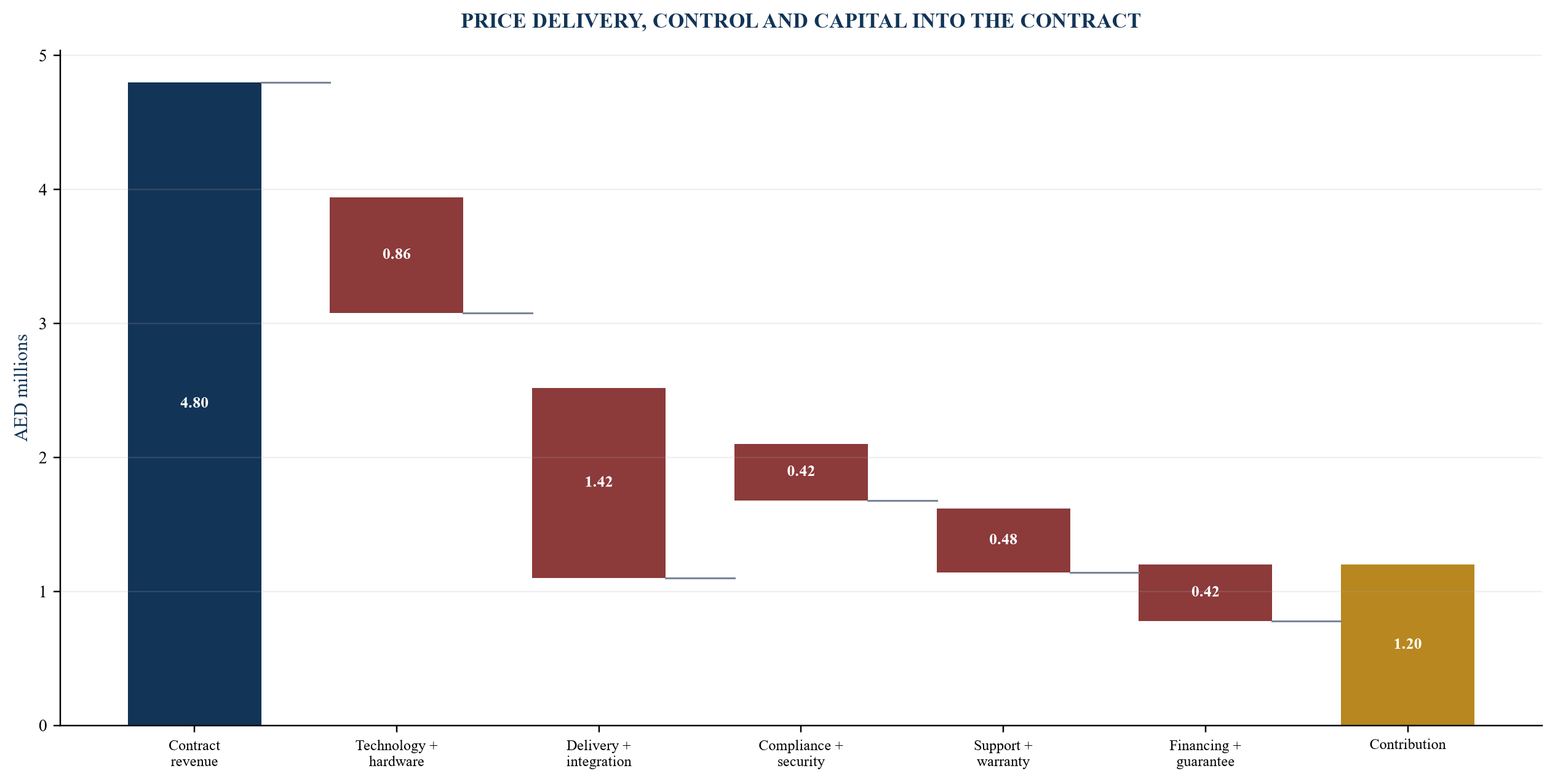
Values are illustrative management assumptions in AED millions and exclude corporate overhead, tax and transaction-specific accounting adjustments.
13. Model the cash gap before choosing debt or equity
The financing model should use a weekly or monthly timeline beginning with bid approval and ending after guarantee release and final collection. It should map every cash inflow, payroll commitment, supplier payment, tax payment, restricted cash item and financing draw. The model should also state the evidence required before each inflow occurs.
An illustrative base case can use a twelve-month AED 4.8 million technology deployment. The example assumes a paid mobilisation milestone, several delivery milestones, direct and implementation cost, a performance guarantee, a collection period after accepted invoices and a defined support tail. The model produces a peak funding need of AED 1.62 million. The number is a management scenario created to demonstrate method; it is not a forecast for any company.
The downside case should combine risks rather than move one variable at a time. Acceptance can be delayed while delivery staff remain committed. A customer change can add cost while the variation remains unsigned. A bond can remain outstanding after the planned release. A supplier may require earlier payment. The combined case can be the practical liquidity requirement.
Management should design responses before a breach. Options can include reducing the mobilisation scope, splitting milestones, obtaining customer payment for hardware, extending vendor terms, using a guarantee facility, deferring non-project hiring, drawing a committed working-capital line or raising equity earlier. Each response has feasibility, cost and stakeholder requirements.
Debt capacity should be tested against delayed cash and covenant headroom. A facility should remain serviceable under a credible delay. The company should understand availability conditions, borrowing base, advance rate, concentration limit, recourse, reserves, fees, collateral, reporting, default, cross-default and personal-guarantee requirements. An undrawn facility with conditions that cannot be satisfied does not provide liquidity.
Equity should be sized around the reusable growth plan and downside runway. Raising equity solely because the contract's payment mechanics were not negotiated can create avoidable dilution. Raising too little can leave the company unable to perform a valuable award. The board should compare contract redesign, debt, equity and a blended solution using actual term sheets and cap-table records.
Table 5. Illustrative procurement-gap scenarios and responses
| Scenario | Illustrative assumptions | Peak funding need | Board response to test |
|---|---|---|---|
| improved structure | 20% mobilisation; monthly acceptance; guarantee facility; 45-day vendor terms | AED 0.92m | confirm customer and bank terms before treating the reduction as available |
| base case | 10% mobilisation; staged acceptance; 45-day collection; partial cash support for guarantee | AED 1.62m | fund with customer cash, equity reserve and committed working-capital capacity |
| delayed acceptance | one major milestone accepted 45 days late; delivery team retained | AED 2.05m | use escalation, liquidity reserve and controlled hiring trigger |
| delivery overrun | direct delivery cost rises 15%; change order remains pending | AED 2.18m | enforce change control, vendor caps and margin approval |
| combined downside | delayed acceptance, higher delivery cost and extended guarantee | AED 2.37m | secure contingency capital or reduce scope before contract commitment |
| termination case | convenience termination after mobilisation; payment limited to accepted work and defined commitments | contract-specific | test recovery rights, demobilisation cost and survivable cash loss |
Values are illustrative management assumptions; company decisions require verified contracts, costs, facilities and board-approved downside cases.
14. Protect the cap table while funding a strategic contract
The cap-table decision should compare the capital needed, evidence available and durable value created. A company may raise before a government contract because it needs product, compliance and market-entry capital. It may raise after a signed contract because the evidence supports a stronger investment case. It may use a working-capital facility after acceptance because short-duration receivables should not automatically consume long-duration equity.
The board should model the fully diluted cap table, including ordinary and preferred shares, options, warrants, convertible instruments, liquidation preferences, anti-dilution rights, pro rata rights, consent rights and any strategic restrictions. The model should show ownership and proceeds under several financing terms and exits. Legal records and the financial model should reconcile before investor discussions.
Figure 5 illustrates a simple comparison. Raising AED 4 million at an assumed AED 30 million pre-money valuation gives the new investor approximately 11.8% of the post-money company. Raising the same amount at an assumed AED 45 million pre-money valuation gives approximately 8.2%. The example does not establish that a public contract will increase valuation or that waiting is preferable. Market conditions, cash runway, execution risk and investor terms can outweigh the mathematical dilution difference.
The board should account for financing optionality. A signed contract may support a larger or more credible round, a venture-debt discussion or a customer-backed facility. It can also create concentration, liability and delivery exposure that reduces investor appetite. A data room should present both the strategic proof and the cash obligation.
Use of proceeds should state which amount funds reusable product, which funds contract delivery, which remains as contingency and which supports broader distribution. The financing should not rely on a government receivable that the contract makes non-assignable or that remains subject to unbounded acceptance. Investors and lenders should see the same reconciled cash model.
The company should avoid granting strategic rights that impair future procurement or financing. Investor, customer and partner documents can each contain exclusivity, information, consent, intellectual-property, pricing, data or change-of-control terms. These agreements should be reviewed together before signature.
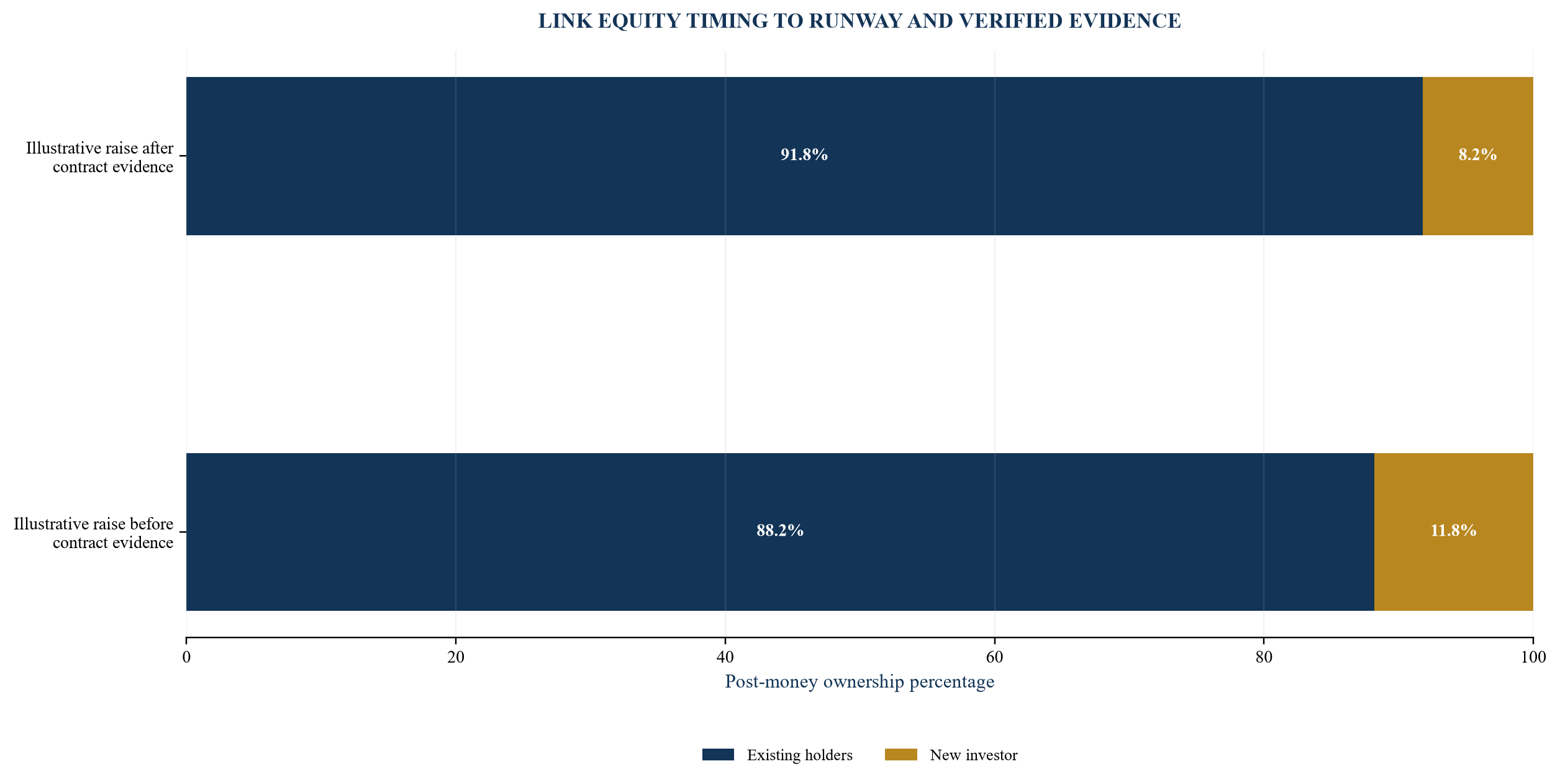
Valuations and ownership percentages are illustrative management assumptions; they do not predict a financing outcome or recommend delaying capital.
15. Build the procurement finance control room
Execution requires one reconciled record across commercial, legal, delivery and finance teams. The control room should contain the opportunity record, official documents, stakeholder and authority map, contract, order, budget evidence, guarantee, insurance, delivery plan, acceptance criteria, change log, invoice, collection, facility and risk register. Each item should have an owner, status, date and source.
The commercial owner manages sponsor, route and negotiation. The contract owner manages obligations, notices and variations. The delivery owner manages scope, evidence and acceptance. Finance manages cash, invoice integrity, facilities and collections. Security, data, tax, legal and insurance specialists manage their domains. An executive sponsor resolves conflicts and approves risk within delegated authority.
Weekly reporting should focus on evidence transitions and cash. The pack can show procurement stage, next authority decision, bid spend, contract conditions, mobilisation readiness, deliverable status, acceptance ageing, invoice status, collection date, guarantee exposure, facility availability, forecast cash and downside trigger. Every figure should reconcile to a document or explicitly identified management scenario.
The company should use a red-line gate before irreversible commitments. The gate can require an executed contract and order, confirmed scope, acceptable liability, current insurance, guarantee capacity, approved data and security design, supplier commitments, staffed delivery, acceptance owner, invoice route, funding plan and downside reserve. Any exception should state the owner, expiry and board impact.
Collections should begin during contracting. Finance should validate supplier registration, bank details, tax status, invoice format, electronic portal, purchase-order fields and payment contacts before the first milestone. The team should schedule acceptance and invoice preparation in the delivery plan. A complete invoice submitted on the acceptance date can reduce avoidable ageing.
Lessons should feed the next bid. The company should measure bid conversion, cycle time, cost to bid, margin, acceptance delay, invoice rejection, payment delay, change leakage, guarantee duration and realised contribution. Standard terms, evidence packs, pricing and delivery modules can then improve. A government segment becomes more financeable when the process itself is repeatable.
16. Run a 120-day procurement-finance programme
Days one to twenty establish the evidence map. Management identifies the problem, official procurement route, legal buyer, sponsor, budget path, pilot decision, eligibility, tender documents and expected contract. Finance creates the first cash-gap model. The board approves the opportunity thesis, bid budget and stop conditions.
Days twenty-one to forty-five establish contract and delivery design. The company defines scope, milestones, acceptance, intellectual property, data, security, guarantees, insurance, subcontractors, payment, assignment and termination. It prepares the implementation plan and verifies which conditions require customer, bank or adviser approval. The second gate requires a price and risk position the company can fund.
Days forty-six to seventy establish the capital stack. Management obtains indicative or committed terms for guarantees, working capital, receivables finance, vendor credit and any equity requirement. Finance runs base and combined downside cases. The commercial team seeks mobilisation and progressive milestones. The third gate confirms capital availability against the actual contract state.
Days seventy-one to ninety-five establish the control room. Delivery evidence, acceptance templates, invoice checklist, change control, collections and reporting are tested. The team rehearses a milestone from completion through acceptance and invoice submission. The fourth gate requires documentary readiness and named authority at every handoff.
Days ninety-six to one hundred and twenty prepare delivery and financing approval. Management reconciles the contract, cash model, facility, cap table, data room, customer concentration and board paper. It closes priority exceptions and documents residual risk. The fifth gate authorises a bounded commitment, funding envelope, reporting cadence and contingency action.
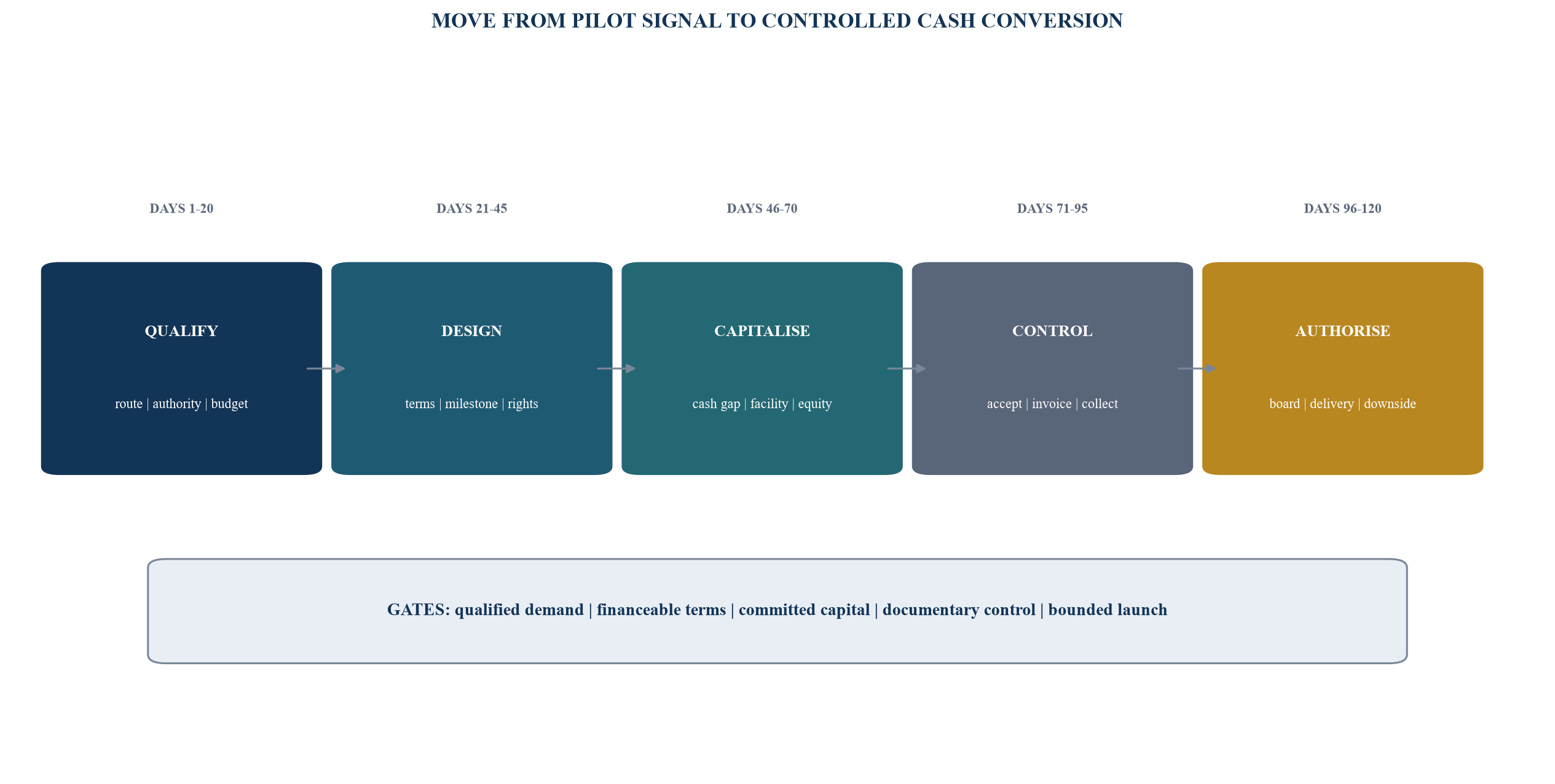
Every phase ends with a documentary, operating and capital decision.
17. Make the board decision explicit
The final board pack should state the customer problem, procurement route, legal buyer, sponsor, budget, contract status, scope, price, milestone, acceptance, payment, assignment, intellectual property, data, security, liability, guarantee, delivery plan, cash gap, capital stack, cap table, concentration and downside case. Each item should identify its source, owner, date and open condition.
The decision should be bounded. The board can approve a maximum bid spend, contract value, delivery commitment, guarantee exposure, cash funding, facility draw, customer concentration and exception list. It can require specified customer documents, legal advice, bank approvals, insurance or acceptance language before mobilisation. It can reserve approval for variations or new jurisdictions.
Management should state uncertainty plainly. A tender outcome, contract signature, milestone acceptance, payment date, facility approval, equity round or valuation remains uncertain until supported by its relevant evidence. Forecast revenue should be separated from contracted, delivered, accepted, invoiced and collected amounts. The board should receive changes promptly.
The board should also define stop rules. The company may pause or narrow commitment if the order is missing, budget changes, liability exceeds approval, guarantee capacity is unavailable, acceptance remains unresolved, a critical data or security condition fails, the financing gap exceeds the envelope or customer concentration breaches the limit. The response should preserve contractual rights and customer communication.
The transaction decision should connect public-sector growth to broader company strategy. A government contract can create product evidence, reference value, distribution and cash. It can also consume scarce engineering, restrict rights and delay commercial diversification. The board should approve the opportunity because the risk-adjusted and financeable value supports the company's strategy.
Table 6. Board government-customer decision checklist
| Gate | Required evidence | Accountable owner | Board decision |
|---|---|---|---|
| opportunity and route | official need, procurement vehicle, buyer, sponsor, budget path, criteria and timetable | commercial lead and executive sponsor | approve bid scope, budget, probability method and stop rules |
| contract and rights | executed terms, order, scope, acceptance, payment, assignment, liability, IP, data and termination | contract owner with qualified advisers | approve terms or require changes before commitment |
| delivery and evidence | staffed plan, suppliers, security, quality, milestone proof, change control and acceptance owner | delivery and operating leads | approve bounded mobilisation and delivery envelope |
| liquidity and finance | weekly cash model, guarantee, vendor terms, facility, borrowing base, downside and reserve | CFO | approve capital stack, draw limits, covenants and contingency actions |
| equity and strategic value | cap table, use of proceeds, reusable rights, concentration, reference permissions and diversification plan | CEO and CFO | approve financing timing and investor disclosure position |
| collection and learning | proper invoice, acceptance, payment office, ageing, escalation, realised margin and lessons | CFO and commercial lead | recycle cash, remediate process and set the next-bid standard |
Approval requires current evidence, named owners and recorded conditions rather than a headline award value.
18. Convert a public-sector win into repeatable enterprise value
The first objective is controlled delivery and collection. The second is converting that proof into a repeatable market system. The company should identify which evidence, product capability, security control, procurement vehicle, implementation module and customer outcome can support additional buyers. It should protect the rights needed to reuse them.
Reference architecture can shorten the next sale. A current evidence pack can include company registration, ownership, tax, insurance, financial statements, security, privacy, quality, product, architecture, service levels, disaster recovery, data locations, subcontractors, intellectual property, implementation, support and pricing. Each document should reflect the actual product and entity.
Frameworks and catalogues can reduce repeated procurement effort when the company remains eligible and the buyer can use them. Prime-contractor relationships can provide market access while changing margin, payment priority, customer ownership and concentration. Direct and partner channels should be compared through realised contribution and cash cycle.
Geographic expansion should follow verified portability. A contract won in one jurisdiction does not establish eligibility or enforceability in another. The company should recheck entity, registration, tax, data, employment, sanctions, export controls, security, intellectual property, procurement and dispute requirements. Local partners should be diligenced and governed.
Investors should see an operating engine. The data room can show procurement stage conversion, contract quality, acceptance performance, collection, contribution, working-capital intensity, customer concentration, rights and repeatability. This evidence supports a more disciplined capital discussion than a pipeline total.
The board should keep the system active after the first collection. New bids, contract changes, facilities, investors, partners and markets should enter the same controls. Public-sector revenue becomes scalable when demand, rights, delivery, cash and capital remain reconciled.
Implementation conclusion
Financing government as customer begins with evidence states. The company separates pilot, procurement, award, contract, order, delivery, acceptance, invoice and collection. It prices the full cash-conversion cycle and releases commitments only when documentary evidence supports the next step.
The 120-day programme produces five decisions: qualify the route and authority; design financeable terms and rights; commit a capital stack against the cash gap; establish acceptance, invoice and collection control; and authorise a bounded delivery and financing envelope. The framework can be applied across federal, state, municipal, public-enterprise and prime-contractor opportunities, subject to the relevant rules and executed documents.
Financial outputs in this paper are illustrative management assumptions. Contract rights, payment, assignment, tax, accounting, data, security, intellectual property, procurement compliance, financing availability and valuation require transaction-specific evidence and qualified advice.
References
- Organisation for Economic Co-operation and Development. Public Procurement for Public Sector Innovation, 2024. https://www.oecd.org/content/dam/oecd/en/publications/reports/2024/12/public-procurement-for-public-sector-innovation_93d920fc/9aad76b7-en.pdf
- European Commission. Innovation Procurement. https://commission.europa.eu/funding-tenders/tools-public-buyers/innovation-procurement_en
- Ministry of Finance, United Arab Emirates. Digital Procurement Platform. https://mof.gov.ae/en/public-finance/government-procurement/digital-procurement-platform/
- United Arab Emirates. Federal Law No. 11 of 2023 on Procurement in the Federal Government. https://mof.gov.ae/wp-content/uploads/2024/01/Federal-Law-No.-11-of-2023-on-Procurements-in-the-Federal-Government.pdf
- United Arab Emirates. Cabinet Resolution No. 122 of 2024 regarding the Implementing Regulations of Federal Law No. 11 of 2023. https://www.mof.gov.ae/wp-content/uploads/2024/12/MoF-English-Procurement-Bylaws-11.12.2024.pdf
- Ministry of Finance, United Arab Emirates. Ministry of Finance launches the third phase of the Digital Procurement Platform, 2023. https://mof.gov.ae/en/news/ministry-of-finance-launches-the-third-phase-of-the-digital-procurement-platform/
- Ministry of Finance, United Arab Emirates. Arab and Local Entities Explore the Digital Procurement Platform, 2024. https://mof.gov.ae/en/news/arab-and-local-entities-explore-ministry-of-finances-digital-procurement-platform/
- Government of the United Kingdom. Procurement Act 2023, sections 67 to 73. https://www.legislation.gov.uk/ukpga/2023/54
- Cabinet Office, United Kingdom. New Legislative Requirements under the Procurement Act 2023, 2026. https://www.gov.uk/government/publications/procurement-act-2023-short-guides/new-legislative-requirements-under-the-procurement-act-2023-html
- Cabinet Office, United Kingdom. Electronic Invoicing and Payment Guidance. https://www.gov.uk/government/publications/procurement-act-2023-guidance-documents-manage-phase/guidance-electronic-invoicing-and-payment-html
- Ministry of Finance, Singapore. FY2026 Committee of Supply Debate Speech: Making Procurement Opportunities More Accessible for Businesses, 26 February 2026. https://www.mof.gov.sg/news-resources/newsroom/fy2026-mof-committee-of-supply-debate-speech-by-senior-parliamentary-secretary-for-finance-mr-shawn-huang/
- Reserve Bank of India. Trade Receivables Discounting System Frequently Asked Questions. https://www.rbi.org.in/scripts/FAQView.aspx?Id=132
- U.S. Federal Acquisition Regulation. Subpart 32.9, Prompt Payment. https://www.acquisition.gov/far/subpart-32.9
- U.S. Small Business Administration. Governing Rules and Responsibilities for Federal Contracting. https://www.sba.gov/federal-contracting/contracting-guide/governing-rules-and-responsibilities
- Small and Medium Enterprises General Authority, Saudi Arabia. SME Monitor: Government Procurement and Financing Initiatives. https://www.monshaat.gov.sa/sites/default/files/2023-11/EN%20Monsha%27at%20Q3%20SME%20Monitor_0.pdf
