

1. Treat public-sector growth as a contract-access system
A government-sales strategy should begin with the contract path rather than the size of public expenditure. The board needs to know which legal entity buys, which budget owns the requirement, which procurement regime applies, which portal carries the opportunity, which supplier can sign, and which evidence will be tested before award. These questions determine whether a commercial idea can become a valid bid and an enforceable contract. They also identify the work that must precede sales activity.
The UAE contains several procurement environments. Federal entities use the Ministry of Finance's Digital Procurement Platform and Federal Supplier Register. The official federal process covers participation in tenders, negotiation, purchase-order acknowledgement, invoicing and status tracking. Abu Dhabi Government entities use a central procurement gate; its supplier guidance states that registration and qualification do not amount to tender shortlisting. Dubai's eSupply platform provides an online route to opportunities published by participating entities, while some authorities and government-related enterprises maintain their own supplier and tender systems. A supplier therefore needs a customer-by-customer route map rather than one generic government-registration workstream.
The contract-access system has five connected layers. Market access identifies the buyer, budget, procurement route and permissible bidder. Competitive access converts the customer's requirement into a compliant, differentiated and priced offer. Delivery access establishes technical acceptance, resources, security, continuity and subcontractor readiness. Financial access supplies bid bonds, performance security, insurance and working capital. Evidence access retains approvals, declarations, tests, milestones, acceptance records and invoices. A gap in one layer can neutralise work completed in the others.
Management should maintain one dated evidence ledger for every target contract family. Each assertion is supported by a current portal instruction, law, procurement document, clarification response, customer communication or verified operating record. A portal registration is recorded as registration. A customer discussion is recorded as discovery. A tender requirement is recorded only when the applicable document supports it. This discipline prevents a board from confusing access, interest, eligibility, qualification and award.
Table 1. Public-sector contract-access diagnostic
| Gate | Board question | Minimum evidence | Common failure | Decision response |
|---|---|---|---|---|
| customer authority | who owns the need, budget and approval? | entity map, budget owner, procurement contact and delegated authority | senior interest is treated as budget authority | validate sponsor, owner and approval chain |
| supplier eligibility | which entity may register, bid, contract and invoice? | licence, register status, ownership disclosures, tax and bank records | an affiliate with the wrong scope leads the pursuit | change bidder, licence or route |
| procurement route | open tender, framework, catalogue, direct route or partnership? | published notice, policy, tender document or formal clarification | management designs a bid for a route the buyer cannot use | reframe timing, channel or offer |
| technical acceptance | what specification, test and delivery proof applies? | compliance matrix, certifications, reference evidence and acceptance plan | marketing claims replace demonstrable capability | qualify, partner, redesign or decline |
| integrity and security | which ownership, conflict, sanctions, data and cyber controls apply? | declarations, diligence files, security architecture and incident process | disclosures are assembled after bid submission | remediate before bid approval |
| commercial security | what bonds, insurance, liability and payment terms consume capacity? | draft contract, bank lines, insurance terms and cash model | award creates an unfinanced liquidity requirement | reprice, finance, negotiate or decline |
| performance evidence | how are milestones accepted and invoices approved? | responsibility map, acceptance forms, document schedule and invoice workflow | delivery is complete but evidence is insufficient for payment | redesign mobilisation and records |
Requirements vary by entity, procurement route, sector and contract. Management should retain dated evidence for every conclusion.
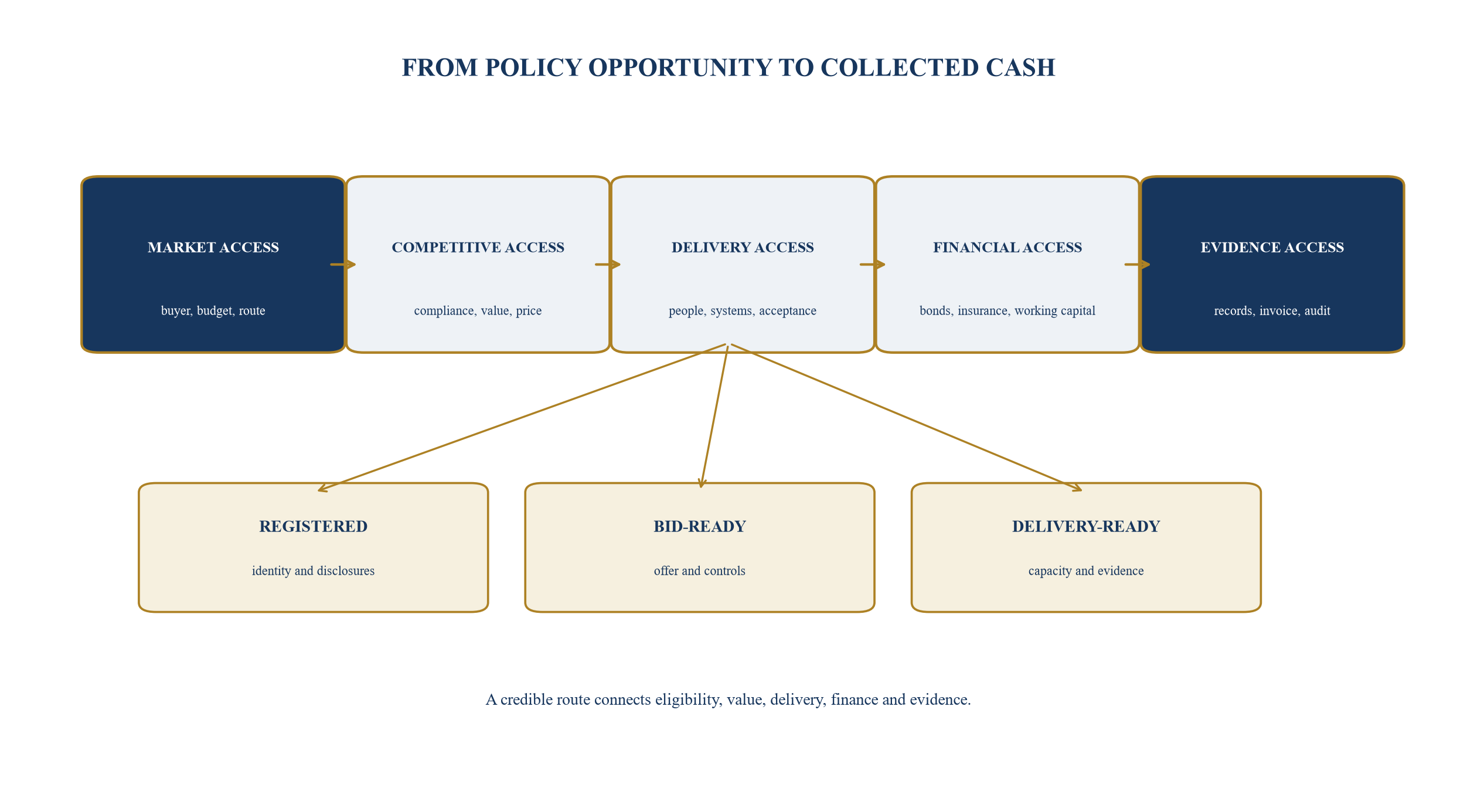
Each layer requires dated evidence. The system is only as strong as its weakest contract-critical gate.
2. Segment the public customer before selecting the route
The label public sector covers buyers with different mandates, funding sources and procurement powers. A federal ministry purchasing common goods through a catalogue creates a different selling problem from an emirate authority procuring a complex technology platform, a government-related enterprise prequalifying specialist equipment, or a public-private partnership procuring a long-term service. The board should segment opportunities by buyer architecture before comparing pipeline values.
The first distinction concerns the legal buyer and its applicable rules. Federal procurement law and its implementing regulations govern covered federal entities and define procurement institutions, processes and controls. Emirate governments maintain their own legislation and platforms. Government-related enterprises may use corporate procurement policies, approved-vendor systems and sector-specific integrity reviews. Public-private partnerships allocate development, financing, construction, operational and performance responsibilities through a project agreement and related contracts. Each route creates a different timetable, decision process, risk allocation and financing requirement.
The second distinction concerns what the buyer is purchasing. Standard products can fit catalogues, framework agreements or repeated calls. Bespoke professional services require a clear scope, evaluation model and evidence of personnel. Critical infrastructure and technology can demand prequalification, data controls, testing, local service, continuity and long-term performance support. Outsourced public services add citizen outcomes, service levels, channels, public-revenue handling and oversight. A supplier should build contract-family playbooks around these differences.
The third distinction concerns the customer's basis of value. Lowest initial price may matter for commoditised goods. Lifecycle cost, service continuity, local economic contribution, knowledge transfer, cyber assurance, sustainability, innovation, schedule certainty and contract-management capability can matter in other procurements. The tender document and published policy establish the formal basis. Early market engagement helps management understand the problem, while bid governance ensures that informal discovery does not become an unsupported statement about award criteria.
Opportunity segmentation should produce a finite pursuit universe. Each account receives a route, contract family, value thesis, evidence burden, partner requirement, cash profile and board owner. Management can then invest selectively in registrations, certifications, reference projects and alliances that serve several contracts rather than accumulating disconnected portal profiles.
3. Build an account map that follows authority and evidence
An account map should explain how a requirement becomes an approved purchase. It records the policy sponsor, service owner, technical authority, procurement function, finance approver, security reviewer, legal team, contract administrator and end-user. It also identifies any central procurement unit, framework owner or regulator that constrains the process. The purpose is institutional clarity. The map must never be used to bypass formal procurement controls or create inappropriate influence.
Management begins with public information: strategies, budgets, procurement plans, open tenders, framework notices, supplier guides, annual reports, policy announcements and technical standards. It then records direct customer discovery in a controlled contact log. Every meeting has a stated purpose, participants, topics, actions and conflict review. Gifts, hospitality, introducer arrangements and third-party interactions follow a documented policy. Sensitive information received during discovery is restricted and never inserted into a bid unless it is authorised and equally available under the process.
The map should distinguish four evidence classes. Published evidence includes laws, platform instructions and tender documents. Customer-confirmed evidence includes written clarifications and formal process communications. Operating evidence includes registrations, certifications, personnel records, tests, reference contracts and financial statements. Management assumptions include timing, win probability, mobilisation cost and collection date. Assumptions are visible in the model and subject to approval; they are never presented as customer commitments.
This classification improves decision quality. A company may know the technical sponsor and still lack a valid route to contract. A registered supplier may lack category prequalification. A prime contractor may express interest while the proposed subcontract has no approved role. A government-related buyer may accept the product concept while its data or security architecture remains unsuitable. The account map turns these gaps into explicit work rather than optimistic pipeline notes.
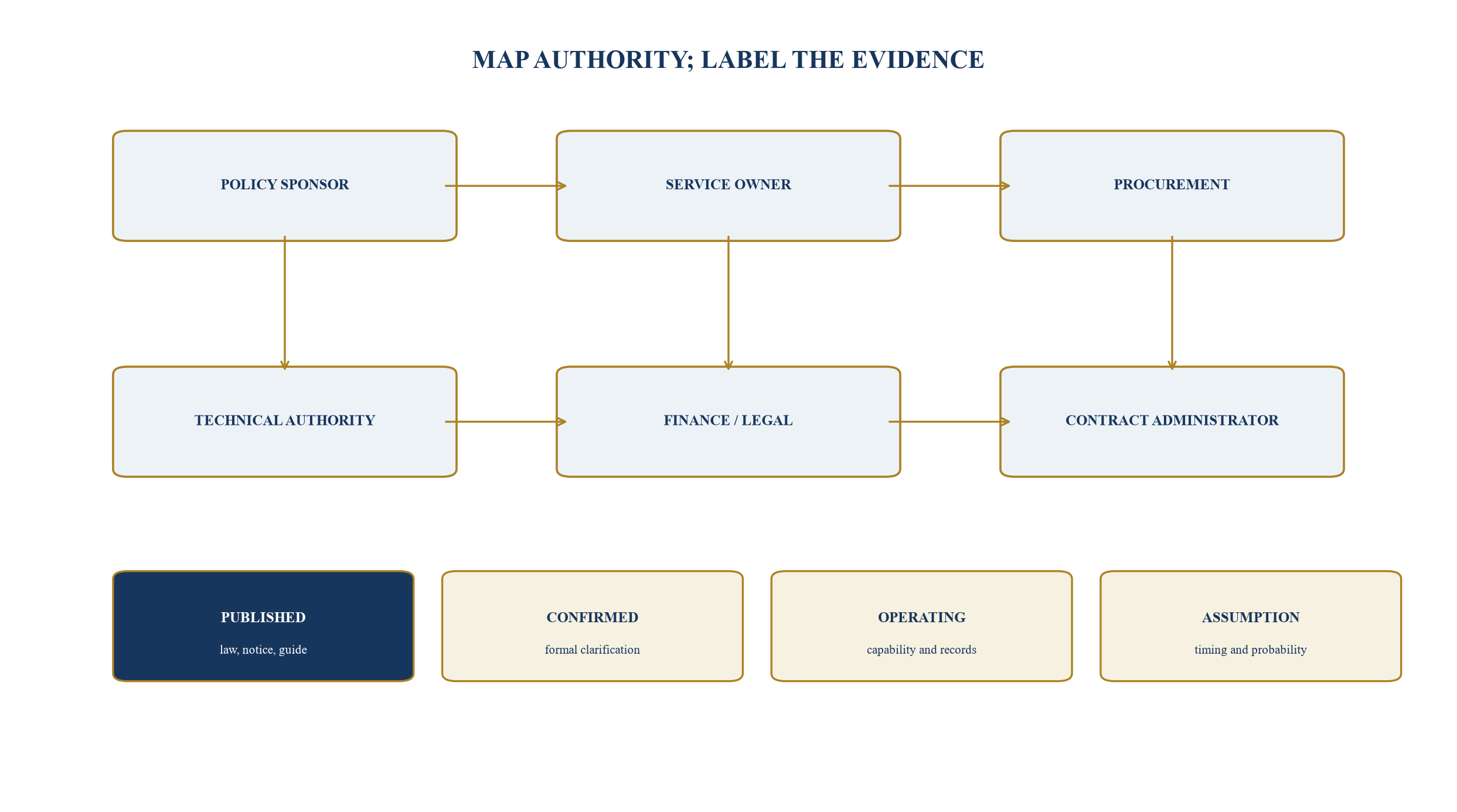
The map separates institutional roles from evidence classes. Actual authority and tender procedures depend on the buyer.
4. Register the entity that can carry the full contract
Supplier registration is an identity and eligibility control. The bidder should be the entity that can lawfully perform the scope, make required disclosures, provide financial evidence, issue invoices, receive payment and support remedies. Registering a convenient affiliate and planning to move performance later can create tender, tax, licensing, data, guarantee and acceptance problems.
The Federal Supplier Register recognises domestic, free-zone and foreign suppliers among its categories and specifies supporting information by type. The relevant category establishes access to the platform; tender documents govern the contract-specific requirements. Abu Dhabi's procurement gate requires registration information and supporting records such as licence, tax registration, authorised contact and bank confirmation. Its published guidance also makes clear that registration qualification is not the same as being shortlisted. ADNOC's supplier process combines registration, product or service prequalification and integrity due diligence. These examples show why a board needs a registration architecture rather than a checklist copied between customers.
The architecture records the legal name, ownership, authorised signatory, licence activities, tax status, bank account, insurance, audited accounts, category codes, products and services, certifications, references, sanctions screening, conflicts, beneficial ownership, subcontractors and renewal dates. It identifies where information must be consistent across portals. A mismatch in legal name, account details, ownership or product scope can delay approval or create an inaccurate declaration.
The company should also decide when local establishment creates a commercial advantage. A foreign company may be eligible for some routes, yet a local entity can improve service coverage, employment, local spend, banking, guarantees and customer confidence. The decision depends on the target contracts and operating model. It should be tested against cost, licence scope, substance, tax, transfer pricing, ownership, data, employment and exit implications. Registration follows that design; it does not substitute for it.
Renewal discipline matters because expiring evidence can make a prepared bidder ineligible at the submission date. One control owner should maintain a calendar covering registrations, licences, certificates, insurances, bank facilities, audited statements and authorised users. A quarterly portal reconciliation confirms that the displayed profile matches the legal and operating reality.
Table 2. Supplier-registration and evidence control register
| Evidence domain | Core record | Validation test | Renewal trigger | Contract consequence |
|---|---|---|---|---|
| legal identity | licence, constitutional documents, legal name and signatory | bidder, invoice issuer and contracting entity agree | licence or authority change | eligibility or enforceability risk |
| ownership and integrity | beneficial ownership, conflicts, sanctions and conduct declarations | current parties and connected persons screened | ownership, director or partner change | exclusion, delay or remediation |
| financial standing | audited accounts, tax records, bank confirmation and facilities | period, entity and figures reconcile | new reporting period or bank change | qualification and guarantee capacity |
| technical capability | category codes, product scope, personnel, certifications and references | tender scope maps to verified capability | certification, product or team change | technical rejection or delivery gap |
| local contribution | ICV certificate, local spend, assets and employment evidence where applicable | legal entity and evidence period agree | certificate expiry or operating-model change | scoring or commercial disadvantage |
| data and cyber | policies, architecture, assurance reports, incident process and subcontractors | contract data flow matches control evidence | system, provider or regulation change | security rejection or contract breach |
| portal administration | user roles, profile, alerts and renewal calendar | two-person review of submitted profile | personnel or portal change | missed opportunity or invalid submission |
The register should be tailored to each buyer and portal. A record is complete only when the responsible owner has validated the current document.
5. Convert early engagement into a compliant value proposition
Early engagement is valuable when it helps a buyer and the market define an outcome, understand feasible delivery models and identify constraints. It becomes dangerous when access is treated as entitlement, confidential information is mishandled, or a supplier shapes a requirement in a way that undermines fair competition. A credible company establishes an engagement protocol before senior executives begin meetings.
The protocol starts with a problem statement. It describes the public outcome, current process, affected users, operational constraints, measurable baseline and evidence gaps. It avoids writing a product brochure in the language of public policy. Management then develops options: retain the current model, buy a service, build capability, outsource a function, create a partnership, or conduct a pilot. Each option states benefits, dependencies, lifecycle cost, data implications, implementation risk and an evaluation method.
A value proposition should be auditable. Claims about savings require a baseline, measurement period, attribution method and independent acceptance. Claims about service improvement require service levels, data sources and escalation rules. Claims about local economic contribution require the evidence recognised by the applicable programme. Claims about knowledge transfer require curriculum, participants, assessment and handover artefacts. Claims about resilience require capacity, continuity testing and recovery commitments. This level of definition helps a buyer evaluate value and helps the supplier price what it can deliver.
The company should maintain a clean-team boundary between market development and formal bid work when circumstances require it. Information available through the procurement process is logged separately from general discovery. Tender communications use the designated channel. Clarification questions are reviewed for accuracy and fairness. Partners and advisers follow the same protocol. The compliance function can then demonstrate that the pursuit used legitimate, documented engagement.
The strongest early engagement often creates reusable public value. A neutral diagnostic, reference architecture, pilot design or outcome model can help an entity plan without locking it to one supplier. The company earns credibility through technical clarity and implementation realism. Its eventual offer can then be differentiated by verified capability, not by dependence on privileged access.
6. Apply a hard bid/no-bid gate before mobilisation
A public tender can consume senior attention, technical resources, legal review, pricing effort and bank capacity. The board should approve a bid only when the opportunity passes an evidence-based gate. Pipeline value alone is a poor basis because a large opportunity with weak access, impossible terms or an unfinanceable delivery profile can destroy more value than a smaller contract with repeatability.
The bid/no-bid gate evaluates strategic fit, formal eligibility, customer need, evaluation visibility, technical compliance, reference strength, partner readiness, data and cyber feasibility, integrity risk, contract terms, guarantee capacity, cash conversion, delivery resources, probability range and option value. Each score has an evidence reference. A low score cannot be lifted through optimism; management either closes the gap, changes the route, or declines.
Three thresholds should be mandatory. First, no bid proceeds without a named accountable executive and a signed compliance matrix. Second, no price is approved without a contract cash model that includes bonds, retention, tax, mobilisation, milestone acceptance, delays and downside sensitivity. Third, no consortium bid proceeds without agreed roles, economics, liabilities, intellectual-property treatment, information boundaries and exit provisions. These thresholds protect the company from winning a contract it cannot govern.
The decision process should also recognise portfolio capacity. Two individually attractive tenders can compete for the same specialists, guarantee line or working-capital headroom. A central pursuit committee views all live bids together. It allocates scarce resources, sets walk-away positions and records conditions. Conditional approval can be used when a bank line, certification, partner agreement or clarification is outstanding, provided the condition is closed before the relevant commitment.
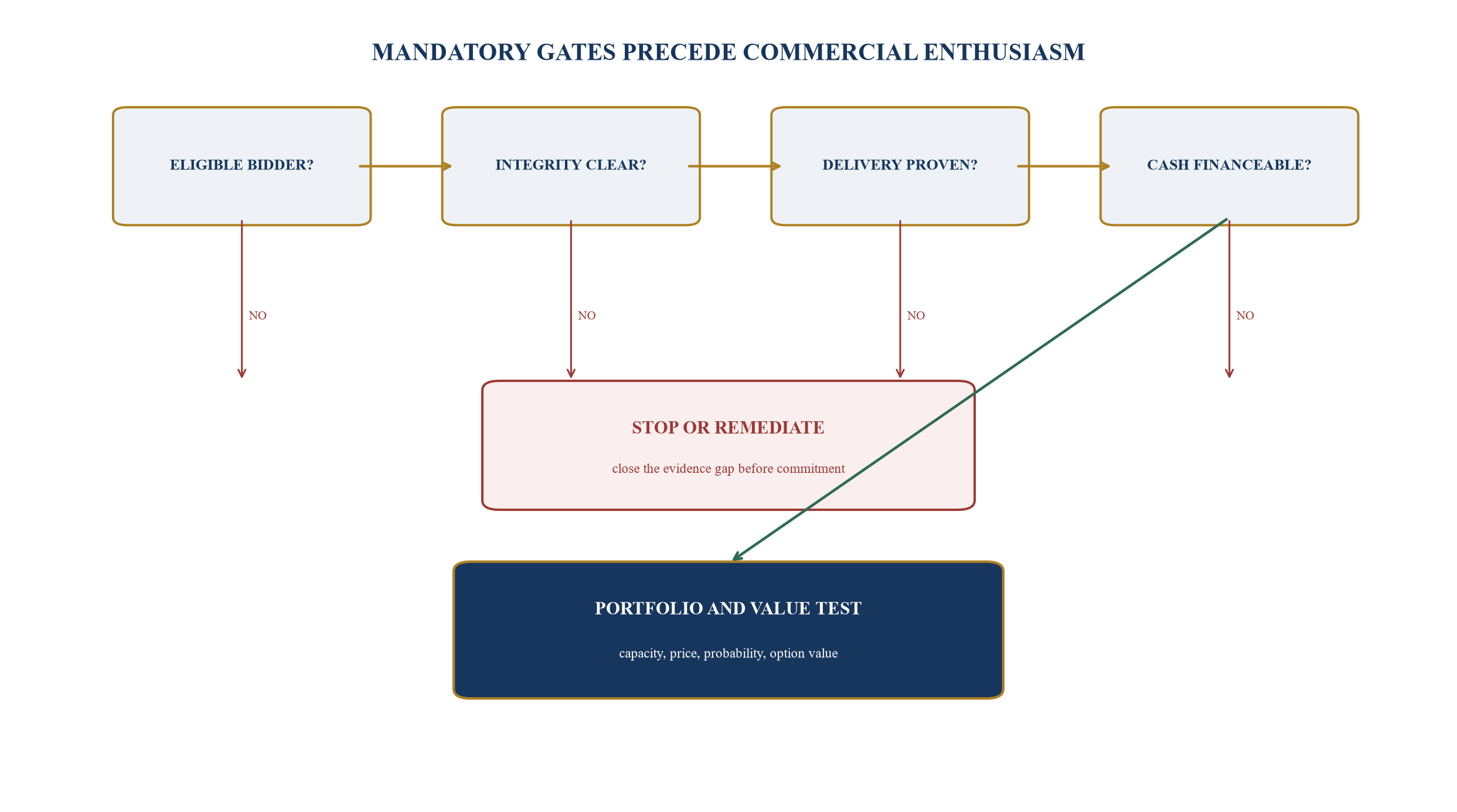
A failed mandatory gate stops the pursuit until evidence closes the gap. Commercial scoring follows eligibility and integrity review.
7. Design the tender response around evaluation logic
A compliant response should make the evaluator's work easier. The bid team converts every instruction, specification, criterion, declaration and contract condition into a controlled requirements matrix. Each item has an owner, response location, evidence file, reviewer and status. The final submission is checked against the issued documents and formal clarifications, including file formats, signatures, language, validity periods, securities and portal steps.
The technical narrative should follow the customer's evaluation logic. It begins with the required outcome and proposed operating model. It then covers mobilisation, solution design, people, subcontractors, quality, security, continuity, local contribution, governance, reporting, acceptance and transition. Evidence follows claims: certifications, test reports, named personnel, reference work, audited capacity, implementation schedules and signed partner commitments. Generic credentials are used only when they support a criterion.
The commercial response needs an internal price-to-risk bridge. The price model records volumes, indexation, foreign exchange, tax, customs, bonding cost, insurance, mobilisation, inventory, payment timing, retention, service levels, penalties, warranties, change control and termination exposure. The contract review identifies deviations and places them in a board-approved negotiation hierarchy. The bid team should not hide a required exception in narrative language. It should state the issue, proposed wording, commercial effect and fallback position.
Writing quality is an execution control. Every promise becomes a potential contract obligation or evaluation expectation. Terms such as real-time, guaranteed, seamless, sovereign, compliant and fully integrated require defined boundaries and evidence. The response should distinguish existing capability, committed mobilisation and optional enhancement. Dates align with resource and supply-chain reality. Named subcontractors have approved roles. Performance measures have data sources and acceptance owners.
The red-team review tests the submission from three perspectives. The evaluator checks traceability and scoreability. The contract administrator checks whether delivery and acceptance can be managed. The chief financial officer checks whether the cash, liability and security package fit capacity. The bid goes forward only when all three views reconcile.
Table 3. Bid/no-bid scorecard with mandatory gates
| Dimension | Weight | Evidence required | Red condition | Approval response |
|---|---|---|---|---|
| eligibility and procurement route | 15% | register status, category, tender instructions and bidder authority | bidder cannot contract or submit validly | stop or change bidder |
| customer outcome and evaluation fit | 15% | needs evidence, criteria map and value thesis | problem or scoring logic remains unclear | seek clarification or decline |
| technical and delivery readiness | 20% | compliance matrix, resources, tests and mobilisation plan | critical requirement lacks a credible solution | partner, redesign or decline |
| integrity, data and security | 15% | diligence, declarations, data map and assurance evidence | unresolved conflict, disclosure or security gap | remediate before bid |
| contract and liability | 10% | marked contract, deviations and insurance position | uncapped or unmanageable exposure | negotiate or decline |
| cash and guarantees | 15% | bank terms, working-capital model and downside case | award exceeds facilities or liquidity appetite | finance, reprice or decline |
| strategic repeatability | 10% | reference value, reusable capability and follow-on map | one-off complexity has no compensating value | require higher return or decline |
Weights are management choices. Scores must link to evidence, and mandatory gates cannot be offset by a high commercial total.
8. Build the consortium before presenting one front door
Many public-sector opportunities require capabilities that one company does not possess. A consortium can combine local establishment, technical intellectual property, installation, operations, finance, cybersecurity and stakeholder knowledge. It can also create ambiguity over who promises, performs, invoices, owns data, accepts risk and responds when delivery fails. The customer should see one coherent operating model backed by explicit internal governance.
The structure begins with route choice. A prime-subcontract model gives the customer one contracting counterparty and concentrates responsibility. A joint bid can allocate specific scopes while preserving separate contracts. A contractual consortium creates shared pursuit obligations without a new entity. A joint venture or project company may suit long-term infrastructure or public-private partnership arrangements. The tender rules and customer's preferred risk allocation define what is permissible.
Partner diligence covers ownership, sanctions, integrity, litigation, financial capacity, licence scope, technical evidence, delivery history, insurance, data practices, cyber controls, labour standards, subcontractor chain and conflicts. Commercial diligence tests whether each partner can fund mobilisation and wait for payment. Reference calls verify the behaviour that documents cannot show: issue escalation, record quality, claims discipline and willingness to support acceptance.
The consortium agreement then allocates work, bid cost, pricing authority, customer communications, intellectual property, data access, personnel, securities, warranties, indemnities, caps, delays, change control, records, audit, insurance, payment, claims, step-in, default, termination and dispute resolution. Back-to-back drafting is useful only when the underlying obligation can actually be transferred. The prime retains a residual governance duty even when performance is subcontracted.
A joint control room should operate from bid through close-out. It keeps one requirements matrix, integrated schedule, risk register, document repository, decision log and payment waterfall. Partners see the information they need under controlled access. The customer receives consistent reporting. This governance is a source of competitive credibility because it shows how a multi-party offer will behave after award.
9. Make integrity and conflicts part of commercial design
Public procurement combines public money, discretion and interaction between government and suppliers. OECD guidance identifies integrity risks across pre-tender, tender and post-award phases and links effective procurement to transparency, controls, accountability, risk management and capable institutions. A supplier's integrity system should cover the same lifecycle.
Before pursuit approval, the company screens the customer context, agents, introducers, partners, subcontractors, beneficial owners and key personnel. It records government affiliations, conflicts, sanctions, adverse findings and tender restrictions. Any intermediary agreement states a legitimate scope, reasonable compensation, documented activity, audit rights and termination protections. Success payments, vague advisory services, cash expenses and unverified access claims receive enhanced scrutiny or are prohibited under policy.
During engagement, the team follows rules on gifts, hospitality, confidential information, lobbying, post-employment restrictions and communications. Meeting records identify participants and topics. Formal procurement questions use the designated channel. The bid contains accurate disclosures. Subcontractors and suppliers sign applicable conduct requirements and provide evidence. A speak-up route allows concerns to be raised without relying on the deal team.
After award, integrity controls continue through change orders, acceptance, claims, invoicing, subcontractor replacement and contract renewal. These points can create pressure to alter evidence or use informal influence. The contract-management plan separates preparation, approval and submission of commercial claims. Material interactions and decisions remain in the evidence ledger. Internal audit can sample payments, third parties, variations and supporting records.
Integrity is commercially relevant because an exclusion, investigation or disputed award can impair access across customers and jurisdictions. The United Kingdom's Procurement Act regime illustrates the direction of travel through central supplier information, expanded exclusion grounds and a published debarment framework. The United States SAM.gov system combines registration, opportunity search and exclusion information. Boards selling to sovereign customers should assume that conduct, connected parties and performance records can travel across procurement systems.
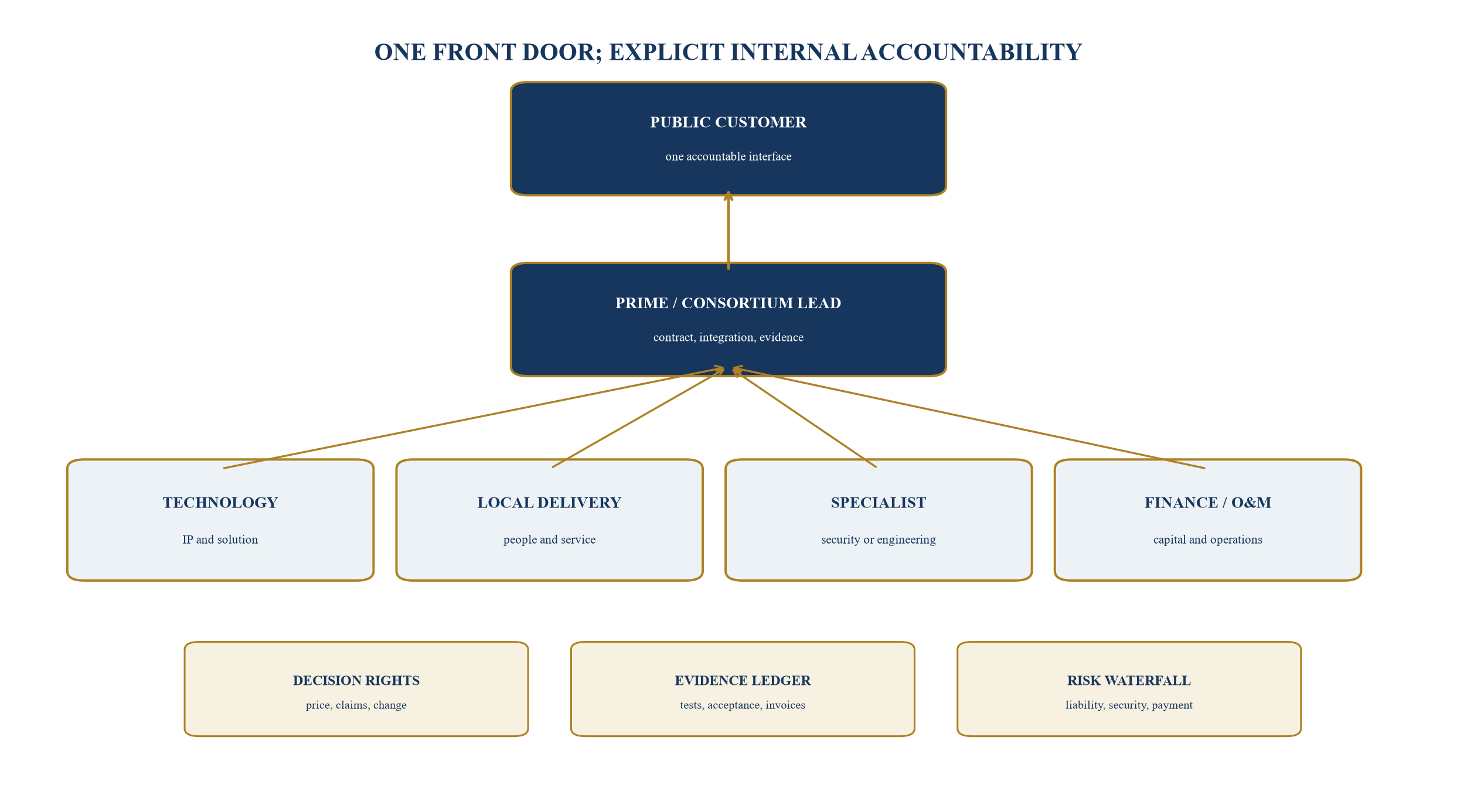
The customer-facing model depends on explicit internal roles, controlled information and back-to-back evidence.
10. Translate local value into an operating plan
Local value should be designed around the customer and applicable programme. The National In-Country Value programme is intended to redirect procurement expenditure towards contribution within the UAE. MoIAT's supplier certification guidance links the score to inputs such as local products and services, investment, and employment and development of Emiratis. ADNOC states that suppliers can submit their certificate in commercial bids and that higher scores can create a competitive advantage. These mechanisms require auditable operating choices, not a slogan about local presence.
The board starts with the relevant legal entity and certificate period. Each licence is assessed under the current certification guidance. Audited financial statements, supplier data, payroll, assets, investment and other evidence are prepared with the authorised certifying process. Management then identifies the practical levers that also improve delivery: local technical staff, service capacity, inventory, training, approved local suppliers, manufacturing or assembly, and durable investment.
The commercial model should test both score and economics. A local supplier can raise measured contribution and shorten response time while charging more or introducing concentration risk. Local inventory can improve continuity and acceptance while consuming cash. Local hiring can create customer and service value while requiring recruitment, training and utilisation. Investment can support long-term capacity while reducing flexibility. The winning design combines procurement competitiveness with customer outcomes and enterprise value.
Local-value commitments in a bid should become a delivery schedule with owners, costs, evidence and consequences. A promised training programme has named cohorts and completion records. A supplier-development commitment has qualification milestones and purchase records. A manufacturing commitment has assets, approvals, quality controls and production dates. The contract team tracks performance against these commitments because an unsupported bid statement can create reputational or contractual exposure.
The company should preserve optionality. Contract-specific investment can be staged through milestones, partner capacity, leased facilities, shared infrastructure or acquisition options. A repeatable platform earns preference over a one-contract structure when it can serve multiple customers without weakening control. The board approves permanent capital only after the evidence ledger supports demand, route, capability and cash conversion.
11. Design data, cyber and sovereignty controls into the offer
Public-sector technology and service contracts can involve citizen, employee, operational, financial or critical-infrastructure data. The commercial team should not promise a hosting location or security label before the data architecture is understood. A data-control design begins with the specific information handled by the proposed service, its owner, classification, collection purpose, legal basis, location, users, interfaces, retention period, subcontractors and deletion route.
The UAE Information Assurance Regulation provides a control framework that includes cloud due diligence, risk assessment, governance, incident communication, audit rights and attention to restrictions on processing, storage and retention. UAE government guidance also identifies policies for third-party security, cloud security, data exchange, encryption, artificial intelligence and critical information infrastructure. The applicable requirements depend on the customer, information, sector and contract. The supplier should map the exact tender and customer controls rather than claim universal compliance.
The architecture should separate data planes. Public customer data, supplier operating data, telemetry, support records and model inputs may require different storage, access and retention. Privileged access is named and logged. Remote support is designed, approved and monitored. Encryption, key management, identity, vulnerability management, backup, recovery and incident response have accountable owners. Software bills of materials, component provenance and patch processes may be required for technology products. Subcontractors cannot receive broader access than the prime can justify.
Artificial intelligence introduces additional questions. The supplier should document training data, model purpose, human oversight, error handling, bias testing, output retention, intellectual property and third-party model providers. A pilot uses controlled data and defined success criteria. Production deployment requires an approved risk classification and monitoring plan. Where an AI system influences a public decision, traceability, contestability and accountable human review become design requirements, subject to the customer's framework.
Security evidence should be assembled before the bid deadline. It can include policies, architecture diagrams, certifications, penetration-test summaries, incident exercises, personnel screening, secure-development records, supplier assurance and data-processing terms. Evidence has a currency date and scope. A certification for one entity or system is not presented as proof for another. This precision improves evaluation credibility and reduces post-award surprises.
Table 4. Data, cyber and sovereignty assurance schedule
| Control domain | Bid evidence | Delivery control | Acceptance evidence | Escalation trigger |
|---|---|---|---|---|
| data inventory and classification | data-flow map, purpose and ownership | approved collection, access and retention rules | reconciled inventory and owner sign-off | new data class, purpose or interface |
| hosting and location | architecture, providers and processing locations | configuration baselines and change control | environment record and customer approval | provider, region or architecture change |
| identity and privileged access | role model, screening and access design | least privilege, logging and periodic review | access review and exception closure | unauthorised access or overdue review |
| product and application security | secure-development evidence and test plan | vulnerability, patch and release process | test report and remediation record | critical vulnerability or unsupported component |
| incident and continuity | response, notification, backup and recovery plans | exercises, monitoring and evidence preservation | exercise result and recovery test | material incident or recovery failure |
| AI governance where used | model card, data basis, human oversight and limitations | monitored use, exception handling and approval | validation, performance and decision logs | material drift, harmful output or scope change |
| third parties | supplier map, due diligence and contract controls | onboarding, access boundaries and monitoring | current assurance file | subcontractor or service change |
The applicable controls depend on the customer, sector, data classification, solution and contract. Qualified advisers should validate legal and regulatory treatment.
12. Price the contract around obligations and acceptance
Public-sector pricing should reflect the cost of producing an accepted outcome under the contract. The price model therefore begins with the statement of work, service levels, milestones, volumes, technical standards, warranty, local-value commitments, reporting, security, knowledge transfer, transition and close-out. It adds the cost of bid and performance security, insurance, financing, tax, customs, foreign exchange, retention and delayed acceptance.
The company should distinguish fixed, variable and contingent cost. Fixed mobilisation includes people, systems, certification, integration and project setup. Variable cost follows units, usage, sites or transactions. Contingent cost arises from delay, service-level failure, replacement, rework, claim defence, index movement or customer change. A contingency is supported by identified risk and not used to hide uncertainty. Management sees the gross margin before and after financing, risk and central overhead.
Acceptance design is central to price. A milestone should identify the deliverable, evidence, test, approver, review period, rejection process and deemed-acceptance position where permissible. Ambiguous acceptance allows completed work to remain unbilled. Overly broad service-level obligations can turn minor events into disproportionate credits. The contract team translates each acceptance and service rule into an operating control and a model assumption.
Indexation and foreign exchange require explicit treatment for multi-year or imported-input contracts. The supplier identifies the cost base exposed to labour, commodities, equipment or currency. It proposes an objective index, base date, adjustment frequency, cap or collar and evidence process. Where the buyer requires a fixed price, management prices the risk or hedges it. A low initial price that relies on later variation is a weak route to market and an integrity risk.
The pricing committee should approve a value case as well as a cost case. It records the customer outcome, lifecycle saving, risk reduction, local contribution, service improvement and knowledge transfer supported by the offer. It then sets the negotiation range, non-price trade-offs and walk-away point. This makes the commercial position defensible and reduces last-minute discounting that ignores delivery economics.
13. Finance the guarantee and working-capital cycle
A contract award can create an immediate call on liquidity. Tender bonds, performance guarantees, advance-payment guarantees, retention, mobilisation, imported equipment, inventory, payroll and subcontractor deposits may all precede customer cash. The board should model this cycle before approving the bid and reserve bank capacity before the submission commits the company.
The cash model follows the contract month by month. It records the bid-validity period, security issuance, advance payment, mobilisation, procurement, delivery, testing, acceptance, invoice submission, certification, payment term, retention release and warranty expiry. It includes tax and foreign exchange timing. A downside case shifts acceptance and payment, assumes rework, applies performance credits and tests guarantee extension. The peak funding requirement is compared with committed facilities and minimum liquidity.
Guarantees consume both bank lines and collateral. The company should obtain indicative bank terms covering wording, amount, expiry, auto-extension, claim mechanics, counter-indemnity, cash margin, fees and release. It should reconcile the beneficiary name and contract entity. Open-ended or customer-controlled extensions require explicit approval. A partner's guarantee contribution is enforceable under the consortium agreement and reflected in the payment waterfall.
Financing can be aligned to evidence. An advance-payment facility can fund mobilisation when the contract supports it. Supply-chain finance can support approved suppliers. Receivables finance may become available after delivery and valid acceptance, subject to assignment and obligor rules. Inventory or equipment finance can match asset life. A government or sovereign customer may improve perceived credit quality, while operational documentation still determines whether a lender can advance against the receivable.
The treasury team should operate a security register. It records instrument, bank, beneficiary, contract, amount, collateral, issue date, expiry, extension notice, release condition, owner and original document location. The contract team links each instrument to the corresponding obligation and acceptance evidence. This prevents guarantees from remaining open after performance is complete and allows the board to allocate scarce line capacity across bids.
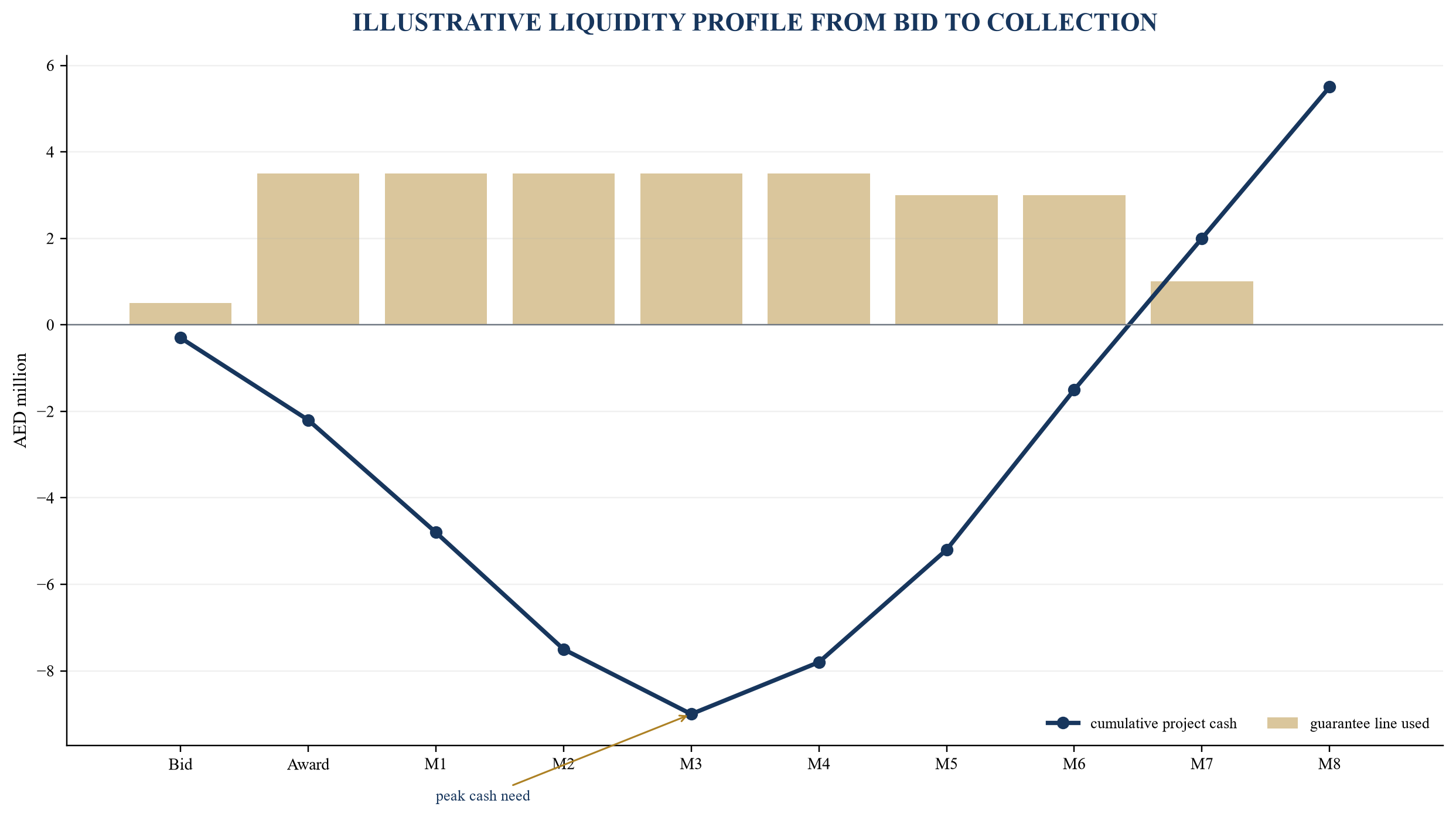
Values are illustrative management planning assumptions in AED millions. They are not a forecast, quotation or description of a particular tender.
14. Turn contract management into revenue operations
The handover from bid team to delivery team is a control point. The final tender, clarifications, negotiated departures, contract, programme, pricing assumptions, partner commitments and risk register are reviewed together. The delivery team signs that it understands the obligations. Any gap between the sold solution and executable plan is escalated before mobilisation.
The contract obligations register converts legal text into owners, dates, evidence and consequences. It covers deliverables, milestones, notices, service levels, reporting, security, insurance, local value, training, subcontractors, change control, invoicing, claims, audit, confidentiality, intellectual property, retention, warranty and close-out. Each obligation has a source clause and a proof file. The register sits alongside the programme rather than in the legal archive.
Document control drives cash conversion. The team agrees templates for delivery notes, test results, acceptance certificates, timesheets, service reports, change requests and invoices. It identifies who can sign and how electronic approvals work. Completed work is reviewed against the payment evidence before the billing date. Exceptions are resolved through the contract channel and recorded.
Change control protects both public value and supplier economics. A requested change is defined, costed, risk-assessed and approved by authorised parties before work begins, except where the contract provides an emergency route. The team does not rely on informal instructions for material scope. A change log shows requested, approved, rejected and pending items with schedule and cash impact. This supports transparent governance and reduces disputes.
Performance reporting should connect operational measures to contract and outcome. It includes service levels, incidents, corrective actions, customer decisions, local-value commitments, security, resource capacity, acceptance, invoices, receivables, claims and forecast completion. Metrics use agreed data sources. The board sees leading indicators such as unresolved acceptance evidence and guarantee expiry, not only reported revenue.
15. Evaluate public-private partnerships as a distinct route
A public-private partnership is a project and risk-allocation model, not a long tender with deferred payment. UAE Federal Law No. 12 of 2023 defines a partnership project as a contractual arrangement between government and private-sector parties to provide a public service or operate a public facility. Its objectives include value for money, private-sector capability, knowledge transfer, service quality and allocation of financial and operational risk. A supplier considering this route needs investment, financing and lifecycle capability alongside procurement readiness.
The project thesis begins with the public need, output specification, demand basis, affordability, legal authority, land or asset rights, permits, interfaces and payment mechanism. It identifies which risks can be managed by the private party: design, construction, technology, operations, maintenance, availability, demand, utilities and lifecycle replacement. Risks that neither party controls should have defined relief or sharing mechanisms. The financial model follows the risk allocation.
The consortium is usually broader than a conventional supply bid. It may include sponsor, developer, contractor, operator, technology provider, lender, insurer and equity investor. The project company sits within a web of construction, operations, supply, financing, direct, insurance and government agreements. Each interface needs back-to-back obligations, cure rights, information and step-in. A weak interface can impair bankability even when the underlying service is valuable.
The bid cost and timetable can be substantial. Management should define stage gates for feasibility, qualification, bid, preferred-bidder negotiation, financing and close. It should fund development expenditure within a portfolio limit and test recovery assumptions. Exclusivity, bid reimbursement, intellectual property and ownership of studies are reviewed. The board approves a clear point at which sunk cost will not justify further commitment.
The public-sector route-to-market team should therefore treat partnership projects as a specialised vertical. The generic supplier register, integrity, security and evidence controls still apply, while project-finance, technical, legal and operating work expands. A company can also participate as a subcontractor or technology provider to a qualified consortium when it lacks the balance sheet or risk appetite to sponsor the project.
16. Use international systems as design comparators
International procurement systems provide useful operating patterns. They should inform questions rather than be transplanted into a UAE bid. The applicable UAE law, customer rules and tender documents remain the authority for the contract.
The United Kingdom's central digital platform stores core supplier information, publishes notices and supports lifecycle transparency under the Procurement Act framework. Its exclusion and debarment guidance illustrates the importance of connected persons, improper behaviour, performance and self-cleaning evidence. A company can respond by keeping consistent supplier data, documented remediation and an accurate conduct record across markets.
The United States SAM.gov platform combines entity registration, unique identifiers, opportunities, award data and exclusion information. Its annual renewal discipline shows why registration operations need a calendar and designated owner. Singapore's GeBIZ publishes opportunities and supplier guidance within a decentralised buying system governed by central principles. Its guidance distinguishes purchasing routes and supplier registration requirements, reinforcing the need to match the pursuit to the applicable route and value.
The World Bank Procurement Framework links procurement strategy to value for money, risk and development objectives, and its regulations and standard documents structure market approaches for financed projects. OECD recommendations emphasise integrity, access, e-procurement, capacity, evaluation, risk management and accountability across the lifecycle. The WTO Agreement on Government Procurement illustrates international disciplines for covered procurement among parties. These systems demonstrate that route-to-market credibility comes from verified identity, transparent process, evidence, contract capability and performance.
The company should maintain a comparator library by contract family. Each entry extracts a practical control: supplier information, tender alerts, early engagement, rated criteria, conflicts, exclusions, subcontractor disclosures, performance notices, prompt payment, complaints or contract management. The library is reviewed against the target customer's current process. Its purpose is better preparation and questions, not a claim that the customer must follow foreign practice.
Table 5. Illustrative contract economics under three public-sector pursuit paths
| Assumption | Direct specialist bid | Prime-led consortium | Long-term partnership role |
|---|---|---|---|
| potential contract value | 18.0 | 42.0 | 85.0 |
| supplier-delivered revenue | 18.0 | 24.0 | 31.0 |
| bid and qualification cost | 0.45 | 0.85 | 2.40 |
| mobilisation and peak working capital | 3.20 | 5.60 | 9.50 |
| guarantee and collateral capacity | 1.80 | 3.40 | 6.80 |
| modelled gross margin before financing | 24% | 21% | 26% |
| planning win probability | 28% | 38% | 22% |
| expected bid-cost recovery through contribution | 1.21x | 1.79x | 0.74x |
| first cash after bid submission | 11 months | 14 months | 26 months |
| principal sensitivity | technical acceptance | partner and interface | close, financing and lifecycle risk |
All values are management planning assumptions in AED millions. Probabilities, timing and margins are illustrative and are not forecasts or customer data.
17. Build a 180-day implementation sequence
The first 180 days should create a repeatable route rather than chase every visible tender. The programme begins with a portfolio decision: target customer segments, contract families, geographic scope, bidder entity, service proposition and risk appetite. Management selects a limited set of anchor accounts and identifies the registrations, certifications, references, partners and financing needed across them.
During days 1 to 30, the company builds the buyer and procurement-route map. It reconciles legal entities, ownership, licences, tax, banking, audited evidence and authorised signatories. It creates the integrity protocol, evidence taxonomy, data-control baseline and pursuit governance. Treasury assesses guarantee and liquidity capacity. The board approves target contract families and exclusions.
During days 31 to 60, the team submits priority registrations, starts necessary prequalification and assembles the reusable evidence library. It maps technical requirements and gaps, conducts partner diligence and negotiates pursuit principles. It prepares the value model, reference architecture, outcome measures and bid/no-bid scorecard. Customer discovery follows the approved engagement protocol.
During days 61 to 100, the company tests the model through one or two qualified pursuits, a formal request for information, or a controlled pilot where the customer route permits it. It rehearses portal submission, response governance, security evidence, pricing, contract review and cash modelling. It closes documentation gaps and validates whether the proposed bidder, partners and delivery resources can support the promise.
During days 101 to 140, management industrialises the process. It completes framework content, compliance libraries, standard consortium terms, guarantee templates, mobilisation packs, acceptance records and board reporting. It creates contract-family playbooks and trains account, bid, legal, security, finance and delivery owners. A red-team review challenges one pursuit end to end.
During days 141 to 180, the board reviews evidence and economics. It decides which registrations and capabilities to expand, which partners to retain, where local investment is justified, and which customer segments to stop pursuing. The next six-month plan is funded against qualified opportunities, facility capacity and delivery bandwidth. The output is a controlled growth system with measurable readiness.
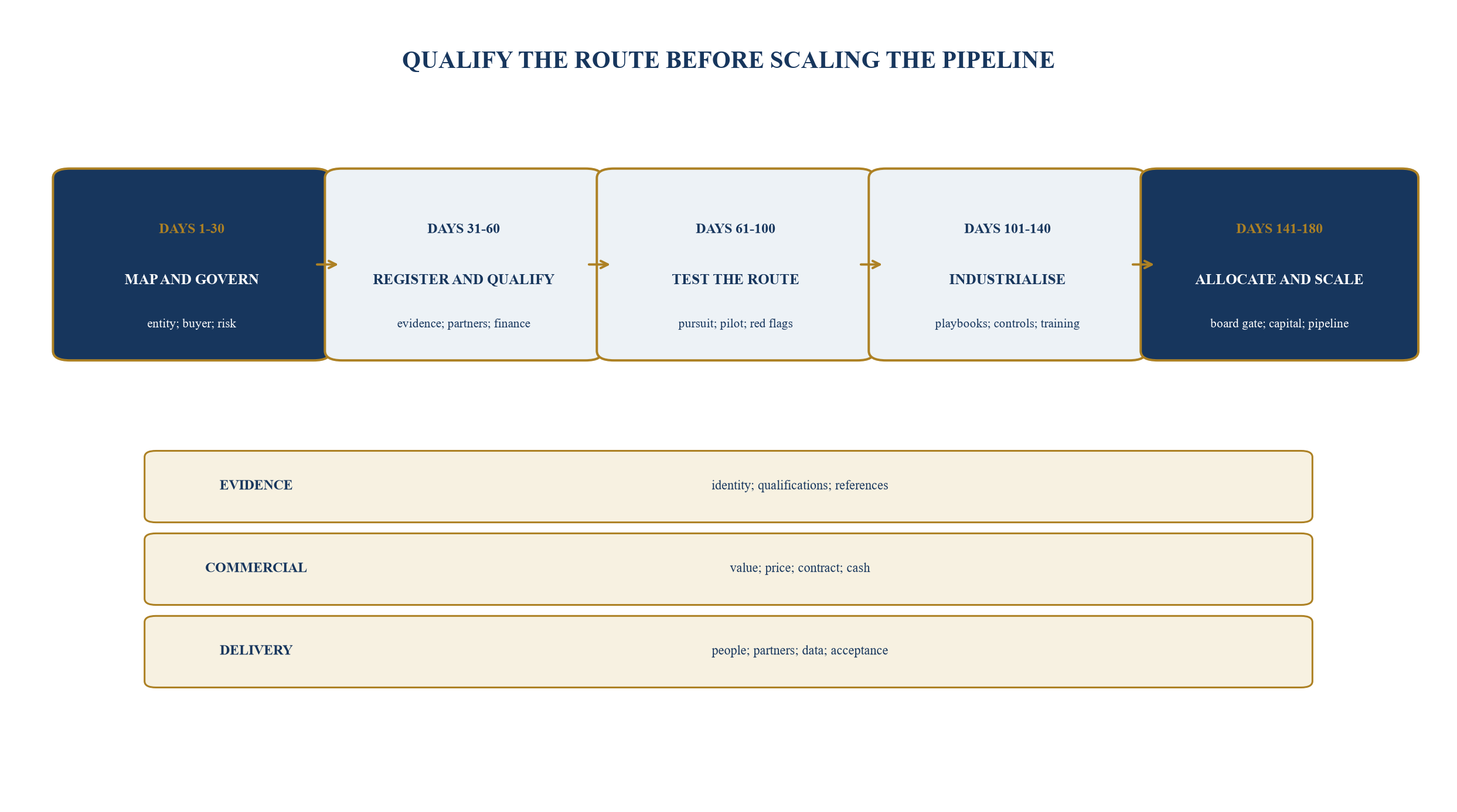
Timing is a management planning framework. Registration, qualification, procurement and customer timelines can require longer.
18. Govern the route through one evidence ledger
The evidence ledger is the operational memory of the public-sector route. It links every material claim, registration, bid response, contract obligation, acceptance event, invoice and management assumption to a source, owner and review date. It reduces dependence on individual relationships and makes the company easier to govern, finance and diligence.
The ledger has controlled domains. Corporate evidence covers legal identity, ownership, authority, tax, bank and financial standing. Commercial evidence covers opportunity source, customer need, procurement route, clarifications, value and price. Technical evidence covers specifications, tests, certifications, references and delivery resources. Integrity evidence covers due diligence, conflicts, declarations and third parties. Security evidence covers data flows, systems, assurance and incidents. Contract evidence covers obligations, notices, changes, acceptance, invoices and claims.
Each record has provenance and status. A published document stores its URL, date and version. A customer communication records sender, recipient, authority and permitted use. A certification records entity, scope, issuer and expiry. A management estimate records owner, basis, sensitivity and approval. Superseded evidence remains available but cannot be used in a current submission. Access follows role and confidentiality.
The ledger should support a tender data room without becoming a dumping ground. Reusable records sit in a controlled library. Tender-specific copies are frozen at submission. The final bid has a manifest and hash or equivalent integrity record. After award, the contract repository inherits the accepted submission and negotiated documents. The delivery team can therefore trace a promise to its origin.
Board reporting draws directly from this system. Registration, qualification, compliance, partner, guarantee, acceptance and collection status are supported by records. A disputed judgement is visible as an assumption or exception. This makes pipeline governance more credible and gives lenders, insurers, partners and transaction counterparties a clearer view of execution capability.
19. Measure readiness, value and cash at board level
A board dashboard should focus on the conversion system rather than headline pipeline. The first group of measures covers access: target accounts with a verified procurement route, current registrations, required prequalifications, active frameworks and expiring evidence. The second covers pursuit quality: mandatory-gate pass rate, compliance completeness, partner readiness, red-team findings and bid cost. The third covers delivery and cash: mobilisation readiness, guarantees, peak funding, acceptance, invoicing, overdue receivables and margin at risk.
The dashboard should distinguish value stages. Identified opportunities are published or evidenced needs. Qualified opportunities have a verified buyer, route, timing and fit. Bid-approved opportunities pass mandatory controls and capacity review. Submitted bids have complete manifests. Preferred or awarded opportunities have documentary evidence. Contracted value is supported by an executed agreement. Delivered and accepted value is supported by contract records. Invoiced and collected cash are reported separately.
Probability is a management estimate. It should be presented as a range supported by stage and evidence, not a precise percentage that creates false confidence. The board can use scenario-weighted exposure for resource planning, while liquidity decisions are based on committed contracts and downside timing. Commercial demand and retainer potential remain unverified until supported by signed and paid mandate evidence.
The dashboard also monitors concentration. It shows exposure by customer, procurement regime, contract family, partner, key person, guarantee bank, data provider and supplier. A pipeline concentrated in one slow route or one scarce facility can create hidden fragility. Capacity thresholds trigger a pause in new bids or a decision to add resources.
The review ends with decisions. The board approves, conditions, defers or stops pursuits; allocates bid budget; reserves guarantee and liquidity capacity; authorises partners; funds qualifications; and directs remediation. Every decision has an owner and date. The dashboard becomes a capital-allocation tool rather than a sales presentation.
Table 6. Board dashboard for a public-sector route to market
| Measure | Green evidence | Amber trigger | Red trigger | Board action |
|---|---|---|---|---|
| procurement-route coverage | every priority account has current route and owner | route incomplete or ageing | no lawful or workable route | close gap or remove account |
| registration and qualification | all bid-critical records current | renewal or category gap within 60 days | expired or wrong bidder profile | pause submission and remediate |
| mandatory bid gates | all passed with evidence | one conditional close item | integrity, eligibility, delivery or cash failure | stop bid |
| bid economics | approved price-risk bridge and downside case | margin or timing near threshold | downside breaches risk appetite | reprice, finance or decline |
| guarantee capacity | committed headroom above portfolio need | concentration or expiry pressure | award cannot be secured | reprioritise bids or add facilities |
| delivery readiness | resources, partners and acceptance plan committed | dependency lacks final evidence | critical capacity unavailable | delay mobilisation or restructure |
| acceptance and invoicing | milestones evidenced and billed on time | ageing approval or documentation gap | material delivered value cannot be invoiced | executive recovery plan |
| cash collection | receipts within approved range | ageing beyond base case | covenant or liquidity stress | treasury and customer escalation |
Thresholds should reflect the company's risk appetite, facilities, contract portfolio and delivery model.
20. Board decisions and limitations
A credible public-sector route to market requires a series of explicit board decisions. The board selects the buyer segments and contract families that fit the company's capabilities. It approves the bidder entity, investment in registration and qualification, local operating footprint, partner model, integrity protocol, data and security baseline, bid budget, guarantee capacity, liquidity limits and contract risk appetite. It also defines which routes and terms the company will decline.
The framework should be applied to a specific customer and procurement. Federal, emirate, government-related and partnership regimes differ. Sector regulations, ownership, security, data, local value, technical standards and contracting authority can change the analysis. Published portals and regulations should be checked at the time of action. Tender documents and formal clarifications govern the live process.
The numerical examples illustrate method. They are management planning assumptions and do not predict win rates, margins, timelines, funding availability or customer payment. A sovereign or government affiliation does not remove contract, performance, acceptance, documentation, dispute or collection risk. A registered supplier has access to a process; registration does not create an award. A relationship can support discovery; it does not replace competition, authority or evidence.
Qualified legal, procurement, tax, regulatory, competition, integrity, data-protection, cybersecurity, technical, insurance and financing advisers should validate decisions in their fields. Banks and insurers determine facility and security terms. Customers determine qualification, evaluation, award, acceptance and payment under the applicable process. Management remains responsible for the accuracy of its declarations, proposals, delivery and records.
The practical conclusion is a sequence. Map the buyer and route. Confirm the bidder and evidence. Design a measurable value proposition. Pass the integrity, delivery, contract and cash gates. Build the partner and control model. Price the accepted outcome. Finance the guarantee and working-capital cycle. Deliver through an obligations register and evidence ledger. Scale only when collected cash and reusable capability support the next commitment.
Sources and further reading
- UAE Ministry of Finance, Register Suppliers in the Federal Supplier Register Official source
- UAE Ministry of Finance, Federal Supplier Register Official source
- UAE Ministry of Finance, Digital Procurement Platform Official source
- UAE Ministry of Finance, Government Procurement Official source
- UAE Official Portal, Government Tendering and Awarding Official source
- UAE Official Portal, Digital Procurement Policy Official source
- UAE Ministry of Finance, Federal Law No. 11 of 2023 on Procurement in the Federal Government Official source
- UAE Ministry of Finance, Cabinet Resolution No. 122 of 2024 Implementing Regulations Official source
- UAE Legislation, Federal Law No. 11 of 2023 Concerning Procurement in the Federal Government Official source
- Abu Dhabi Government Procurement Gate, Becoming a Registered Supplier Official source
- Abu Dhabi Government Procurement Gate, Documents and Forms Official source
- Abu Dhabi Government Procurement Gate, Procurement Framework Frequently Asked Questions Official source
- Dubai Government eSupply, Official Procurement Portal Official source
- Dubai Legislation, Law No. 12 of 2020 Concerning Contracts and Warehouse Management Official source
- Dubai Legislation, Law No. 5 of 2026 Regulating Outsourcing of Government Services Official source
- UAE Ministry of Industry and Advanced Technology, National In-Country Value Program Official source
- UAE Ministry of Industry and Advanced Technology, Issuing an ICV Certification Official source
- UAE Ministry of Industry and Advanced Technology, National ICV Data Official source
- UAE Ministry of Industry and Advanced Technology, ICV Supplier Certification Guidelines, September 2025 Official source
- ADNOC Supplier Hub, Registration Official source
- ADNOC Supplier Hub, In-Country Value Program Official source
- ADNOC Supplier Hub, Approved Vendors and Supplier Registration Official source
- UAE Ministry of Finance, Federal Law No. 12 of 2023 Regulating Public-Private Partnership Official source
- UAE Telecommunications and Digital Government Regulatory Authority, UAE Information Assurance Regulation Official source
- UAE Official Portal, Cybersecurity Policies Official source
- UAE Official Portal, Data Operability Official source
- UAE Telecommunications and Digital Government Regulatory Authority, Cloud Service Providers Official source
- UAE Telecommunications and Digital Government Regulatory Authority, UAE Trusted List Official source
- UAE Legislation, Federal Decree-Law No. 45 of 2021 Concerning the Protection of Personal Data Official source
- UAE Legislation, Federal Decree-Law No. 46 of 2021 on Electronic Transactions and Trust Services Official source
- UAE Legislation, Federal Decree-Law No. 50 of 2022 Promulgating the Commercial Transactions Law Official source
- UAE Federal Tax Authority, Corporate Tax General Guide Official source
- UAE Federal Tax Authority, Transfer Pricing Guide Official source
- UAE Federal Tax Authority, Corporate Tax Frequently Asked Questions Official source
- UAE Central Bank Rulebook, Background of International Trade and Trade Finance Official source
- Emirates Development Bank, Supply Chain Finance Official source
- OECD, Recommendation of the Council on Public Procurement Official source
- OECD, Integrity in Public Procurement Official source
- OECD, Fighting Bid Rigging in Public Procurement Official source
- OECD, Linking Integrity, Business Conduct and Public Procurement Official source
- World Bank, Project Procurement Framework Official source
- World Bank, Procurement Regulations for IPF Borrowers, Seventh Edition, September 2025 Official source
- World Bank, Sanctions System Key Documents Official source
- World Trade Organization, Agreement on Government Procurement Official source
- United Kingdom Legislation, Procurement Act 2023 Official source
- United Kingdom Government, Central Digital Platform and Publication of Information Official source
- United Kingdom Government, Guidance on Debarment Official source
- United States Government, SAM.gov Entity Registration Official source
- United States Government, SAM.gov Contract Opportunities Official source
- Singapore Government, GeBIZ Guide to Singapore Procurement Official source
- Singapore Government, Government Procurement Guide for Suppliers Official source
- Saudi Arabia Ministry of Finance, Etimad Government Procurement Portal Official source
- Saudi Aramco, In-Kingdom Total Value Add Official source
- Government of India, Government e-Marketplace Official source
