

Introduction
GPU infrastructure combines technology operations with structured credit. A financing vehicle can own accelerator systems, related servers and networking, contract with one or more compute customers, and grant lenders security over equipment and cash flows. The commercial claim may be a fixed reservation fee, take-or-pay payment, dedicated-capacity charge or service revenue. The physical asset may be movable and identifiable, yet its value depends on configuration, power, cooling, software, support, location, export permissions and the ability to serve another workload.
Recent filings provide concrete evidence of this financing model. CoreWeave states that it primarily finances infrastructure development through asset-level debt supported by take-or-pay customer contracts [1]. A March 2026 filing describes an USD 8.5 billion delayed-draw term facility used primarily to finance GPU servers and related infrastructure needed for a customer contract [2]. A filed CoreWeave credit agreement requires rack serial numbers after borrowing and restricts dispositions of GPU servers [4]. IREN's 2026 annual report describes a USD 3.6 billion financing programme secured by GPUs, associated assets and customer-contract cash flows, with debt-service coverage requirements, mandatory prepayment triggers, restricted cash and limited guarantees [6]. These are company disclosures about secured financing. They are not evidence that a public GPU asset-backed security has achieved a particular rating or recovery outcome.
This paper addresses a narrower decision than equipment finance or project finance. It asks how an originator could define, monitor and govern a pool in which scheduled payments depend on compute contracts and downside recovery depends partly on hardware. The framework is designed for AI-cloud operators, data-centre sponsors, banks, private-credit funds, institutional investors, rating and valuation advisers, trustees, account banks and transaction counsel. It does not provide legal, securities, regulatory, accounting, tax, technology, appraisal, rating or investment advice.
1 Define the securitised exposure before choosing the notes
The first decision is what the issuing vehicle owns or has legally enforceable rights to receive. A pool can contain receivables, payment rights under service contracts, loans secured by equipment, leases, title to hardware, beneficial interests in equipment-owning entities, or a combination. These alternatives create different legal, accounting, tax, perfection, servicing and insolvency questions. Transaction counsel should determine the structure and the applicable regime in each jurisdiction.
The asset perimeter should be expressed as a linked record. Each contract obligation should connect to the customer, guarantor, service unit, site, equipment cohort, invoice rule, collection account and relevant security. Each hardware record should connect to owner, invoice, serial number, location, configuration, acceptance, warranty, licence status, customer allocation and disposition route. A contract without deliverable equipment can become a liability. Equipment without a financeable cash-flow route can be collateral with uncertain carrying cost and sale timing.
The board should approve the financing objective before selecting the issuance form. Objectives can include refinancing expensive warehouse debt, diversifying lenders, extending duration, releasing capital for new systems or establishing a repeat-issuance programme. The approval should state the proposed pool, excluded risks, target term, maximum leverage, required reserve, retained exposure, investor reporting and conditions for replenishment.
The perimeter should also distinguish the issuer's assets from services supplied by affiliates. Compute delivery can depend on an affiliate that employs engineers, holds software licences, purchases power or contracts with the data-centre operator. If the issuer owns receivables and hardware while the affiliate controls the operating capability, investors remain exposed to an executory service chain. The structure should document service agreements, payment priority, step-in rights, intellectual-property access, information rights and transition support. Fees paid to affiliates should be benchmarked, capped or governed through an approved budget so that value cannot migrate outside the collateral pool after issuance.
| Test | Required evidence | Exclusion trigger | Control response |
|---|---|---|---|
| contract | executed payment obligation and assignment analysis | cancellable, disputed or delivery condition unresolved | exclude or haircut cash flow |
| customer | identified obligor, support and current credit evidence | unsupported entity or material deterioration | cap, reserve or remove exposure |
| system | verified owner, invoice, serial record and acceptance | title gap, duplicate serial or unaccepted system | zero hardware eligibility |
| site | enforceable access, power, cooling and removal rights | access or operating dependency unresolved | exclude recovery value |
| service | measured availability, credits and incident record | chronic failure or acceptance dispute | trap cash and cure |
| cash | controlled account and reconciled collections | leakage, set-off or unreconciled receipts | suspend distributions |
| transfer | consent, data sanitisation and lawful disposition route | non-transferable right or restricted destination | exclude residual reliance |
Eligibility depends on executed documents, governing law and current operating evidence.
The eligible pool should contain only exposures that pass every threshold test. A high contract value should not compensate for missing title. A strong asset appraisal should not compensate for a customer payment that depends on unresolved acceptance.
2 Build one contract and hardware data tape
The data tape is the foundation of surveillance. It should preserve both current values and event history. Contract fields should cover legal customer, parent group, guarantee, contract date, service term, capacity unit, start date, acceptance, fixed and variable charges, power treatment, escalation, service levels, credits, termination, renewal, assignment, set-off, dispute, invoice and collection. Hardware fields should cover manufacturer, model, serial number, system configuration, delivery, commissioning, owner, lien, site, rack, condition, firmware, warranty, support, export classification, customer use and latest supported value.
The tape should reconcile to source systems. Contract records should point to signed documents, amendments and notices. Equipment records should reconcile purchase orders, invoices, receiving documents, commissioning certificates, fixed-asset ledgers, insurance and physical inspection. Cash records should reconcile invoices, credit notes, receivables, controlled bank statements and waterfall calculations. Every change should record time, source, authorisation and previous value.
The tape should maintain identities across substitutions. Replacing a system can change the performance obligation, customer consent, value cohort, depreciation profile and security schedule. A substitution should never be implemented as a silent row replacement. The old asset should retain its history, disposition and proceeds. The new asset should enter only after it satisfies the eligibility gate.
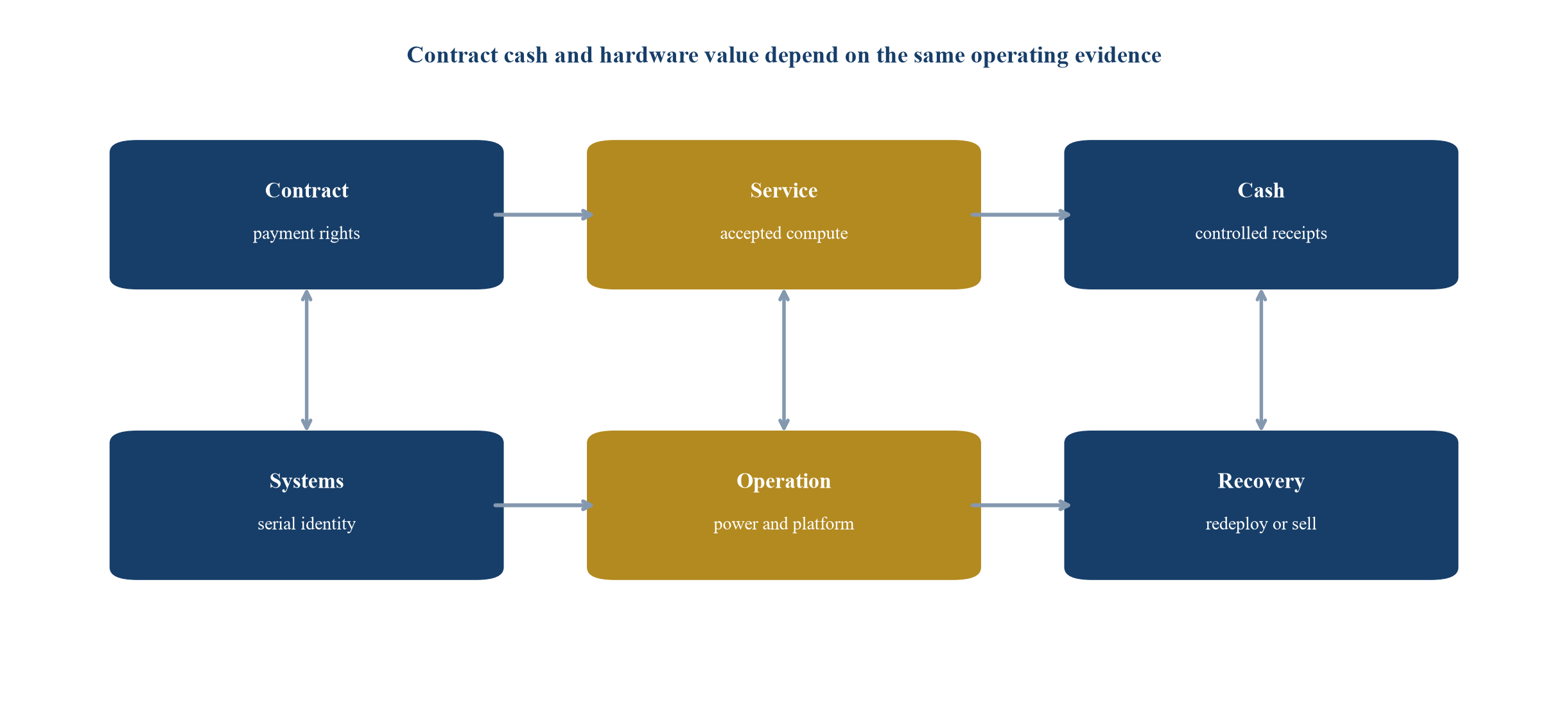
Proposed pool architecture; each arrow requires reconciled legal, operating and cash evidence.
Investors should receive a stable field dictionary and reporting taxonomy. Changes to definitions can alter reported concentration, delinquency, utilisation or coverage without changing the underlying pool. Governance should require approved versioning and restatement where a material definition changes.
Data quality should be tested through exception reports rather than a closing-date sample alone. Useful exceptions include one serial number linked to multiple owners, equipment with no accepted contract, contract cash with no controlled account, site records that disagree with telemetry, appraisal values older than the policy permits, customer groups split across aliases and invoices collected outside the waterfall. Each exception should have an owner, age, financial effect and cure date. Eligibility should reduce automatically where the required evidence expires, even when the commercial relationship continues. This discipline converts the data tape from a transaction appendix into a live collateral-control system.
3 Convert contracts into eligible net cash
A pool should begin with enforceable net payment obligations rather than total contract value, backlog or remaining performance obligations. Remaining performance obligations can inform the analysis, but accounting disclosure does not determine assignment, collection or lender rights. The contract model should identify the payment that becomes due in each period after delivery, acceptance, service credits, taxes, power pass-throughs, offsets and permitted termination.
The contract should be divided into fixed reservation cash, variable usage cash, reimbursed operating cost, implementation fees, prepayments and termination amounts. Fixed cash can still be conditional. Usage cash can have observable persistence and remain unsuitable for base eligibility. Power reimbursement can improve gross revenue while adding little debt-service margin. Prepayments can improve construction liquidity and create refund or future-service obligations.
The pool should recognise net contribution cash after direct delivery costs. Those costs include data-centre rent or hosting, power, network, platform software, hardware support, operations, maintenance, insurance, taxes and required lifecycle expenditure. Debt sizing against gross invoices can overstate support when pass-through items or variable power costs are material.
| Cash component | Eligibility evidence | Required deduction | Pool treatment |
|---|---|---|---|
| fixed reservation | accepted service and enforceable minimum | credits, tax, pass-through and delivery cost | eligible within remaining term |
| variable usage | invoiced and collected history | volatility and cost margin | limited or excluded from base |
| power reimbursement | measured cost and contract right | matched power expense and timing | net margin only |
| prepayment | receipt, permitted use and refund analysis | future service or refund obligation | liquidity treatment, no double count |
| termination amount | enforceable formula and credit support | dispute, mitigation and collection delay | downside scenario only |
| renewal option | executed extension or current exercise evidence | repricing, competition and migration cost | excluded until effective |
Proposed analytical treatment; contract interpretation requires qualified counsel.
Customer credit should alter both eligibility and concentration. The model should identify the legal obligor and any parent or guarantee. Multiple contracts with entities in one group should be aggregated. A customer that also supplies hardware, invests in the originator or provides prepayments can create circular support. The pool should remove duplicate value and document the ultimate source of each payment.
Cash eligibility should be calculated at invoice-line and service-period level where the contract contains several products. A single agreement may combine reserved accelerators, elastic usage, storage, networking, support, implementation and power. These components can have different margins, acceptance points, cancellation rights and offset exposure. Pool reporting should show billed, earned, collected, disputed and credited amounts separately. The model should also reconcile deferred revenue and customer prepayments to remaining service obligations. Treating all contracted revenue as one receivable balance can mask refund exposure, delivery conditions and the timing gap between cash receipt and debt-service availability.
4 Measure hardware value without counting contract value twice
Hardware value is a secondary recovery source. It should not be added mechanically to the present value of contract cash because both depend on the same systems. Strong contract performance can support continued use and reduce near-term sale relevance. Customer loss can release the hardware and simultaneously weaken revenue, increase removal cost and place more similar systems on the market.
The valuation should separate replacement cost, book value, tax basis, fair value, orderly-liquidation value and stressed net recovery. These measures answer different questions. A pool advance rate should use the measure required by the documents and should reconcile every appraisal adjustment. Original invoice cost can verify acquisition and ownership while providing limited evidence of current recovery.
The recovery analysis should consider architecture, memory, networking, rack configuration, cooling interface, firmware, workload compatibility, vendor support, age, hours, condition, location, removal, testing, data sanitisation, export permissions, buyer demand, sale period and carrying cost. A complete rack or cluster can have greater operating value and lower portability than separable components. The valuation should state the assumed sale unit and the work required to deliver it.
| Dimension | Evidence | Value effect | Surveillance response |
|---|---|---|---|
| generation and age | model, delivery and commission date | competitive life and buyer set | cohort-specific curve |
| configuration | rack, network, memory and cooling design | portability and reconfiguration cost | configuration haircut |
| condition | telemetry, incidents, maintenance and inspection | failure risk and refurbishment | reserve or exclusion |
| location | facility access, jurisdiction and removal route | enforcement time and transport cost | site-specific deduction |
| software and support | licences, firmware and vendor rights | lawful use and reliability | exclude unsupported value |
| export status | classification, customer and destination checks | permitted buyer universe | destination control |
| market evidence | comparable sales, bids and appraisals | price and liquidity | refresh value and confidence |
Proposed valuation record; values require independent current evidence.
An appraisal should disclose evidence date, scope, assumptions, conflicts, excluded costs, buyer market and valuation confidence. Surveillance should shorten when architectures change, observed sale prices move or disposition periods lengthen.
The valuation committee should reconcile three independent views. The operating view estimates cash that the systems can generate in the current configuration. The market view estimates proceeds from an orderly sale or re-lease using observable bids and transactions where available. The recovery view deducts shutdown, removal, testing, sanitisation, transport, brokerage, tax, legal and carrying costs and applies a time discount. Divergence between the views is itself a risk signal. A high operating value paired with weak external bids indicates dependence on the current operator or contract. A high appraisal paired with long disposition time can provide nominal coverage while failing to supply liquidity when a principal sweep is required.
5 Create contract and hardware cohorts
Pooling can reduce idiosyncratic exposure when the pool contains real diversity. Counting contracts, customers or systems is insufficient. Exposures can share the same parent customer, model sponsor, data-centre operator, power route, GPU generation, cooling design, network fabric, software stack, vendor, jurisdiction or renewal date. A single event can affect several apparently separate assets.
Contract cohorts should group exposures by obligor, credit profile, payment type, remaining term, acceptance state, service-level regime and renewal period. Hardware cohorts should group systems by generation, configuration, age, site, customer use and recovery route. The transaction should then map cross-cohort dependencies. A contract pool concentrated in one customer and a hardware pool concentrated in one configuration represent one correlated risk even when the note data tape shows many rows.
The illustrative pool uses twelve hardware cohorts and eight customer contracts. Management assumes the largest customer represents 31 per cent of eligible contract cash, the top three represent 68 per cent, the largest site contains 29 per cent of systems and one accelerator generation represents 44 per cent of stressed hardware value. These values are design assumptions. They do not describe a market portfolio.
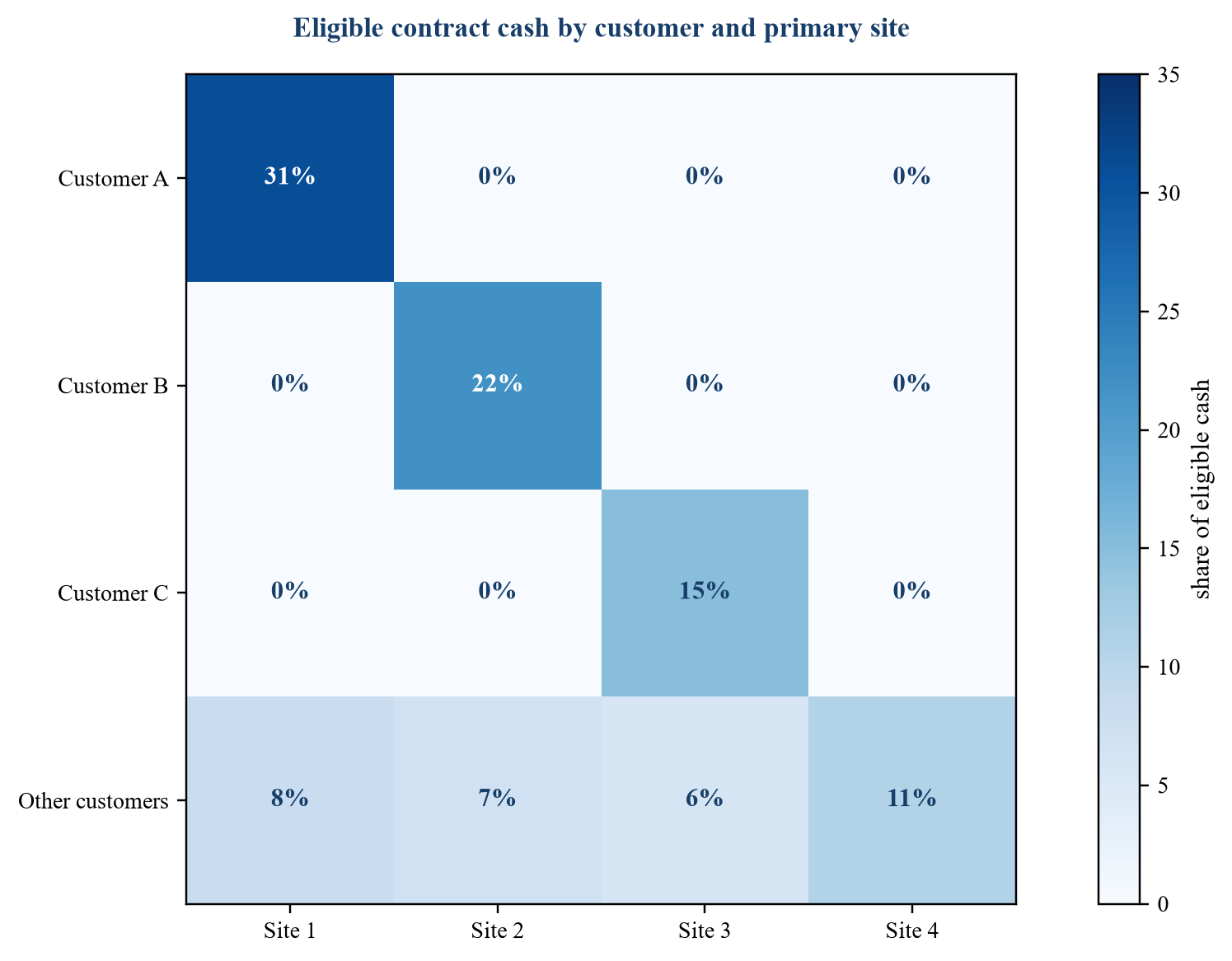
All shares are management assumptions; darker cells indicate greater shared exposure.
Concentration limits should apply at origination and after substitutions, renewals and customer amendments. Breach should stop replenishment and distributions before it becomes a payment default. A cure can involve adding eligible exposures, paying down notes, building reserves or reducing eligibility.
The correlation review should extend beyond the labels in the data tape. Several customers may rely on the same foundation-model provider, cloud orchestration layer, end market or financing source. Several sites may share a utility corridor, network route, technical operator or jurisdictional permission. Hardware cohorts may share a manufacturing batch, cooling dependency or firmware vulnerability. Scenario design should shock these common drivers directly and then recalculate eligible cash, operating cost, customer concentration and recovery value together. Applying separate percentage haircuts to each field can understate the loss when one event affects contract performance, asset mobility and sale demand at the same time.
6 Design the capital structure around the lower support
Debt capacity should be constrained by both cash-flow support and hardware recovery. The model should not add the maximum cash-flow advance to the maximum hardware advance. A practical structure can size scheduled notes from stressed contract cash, then require minimum hardware coverage as a secondary protection. Another structure can use a borrowing base that recognises the lower of contract value and hardware value for each linked cohort.
The illustrative case assumes annual gross contracted cash of USD 360 million and direct delivery and operating cost of USD 164 million. Central-case cash available before financing costs is USD 196 million. Management assumes USD 420 million of senior notes, USD 80 million of subordinated notes and a USD 32 million liquidity reserve. Annual senior and subordinated debt service is USD 132 million, producing central coverage of 1.48 times. The proposed amounts do not represent a financing quote or rating case.
Hardware support is tested separately. Management assumes USD 864 million of original installed cost, current independently supported orderly-liquidation value of USD 372 million and stressed net recovery of USD 286 million after removal, testing, remarketing, legal, tax, carrying and sale costs. That recovery does not cover all note principal. The pool therefore relies on ongoing contract cash and early amortisation while systems retain operating value.
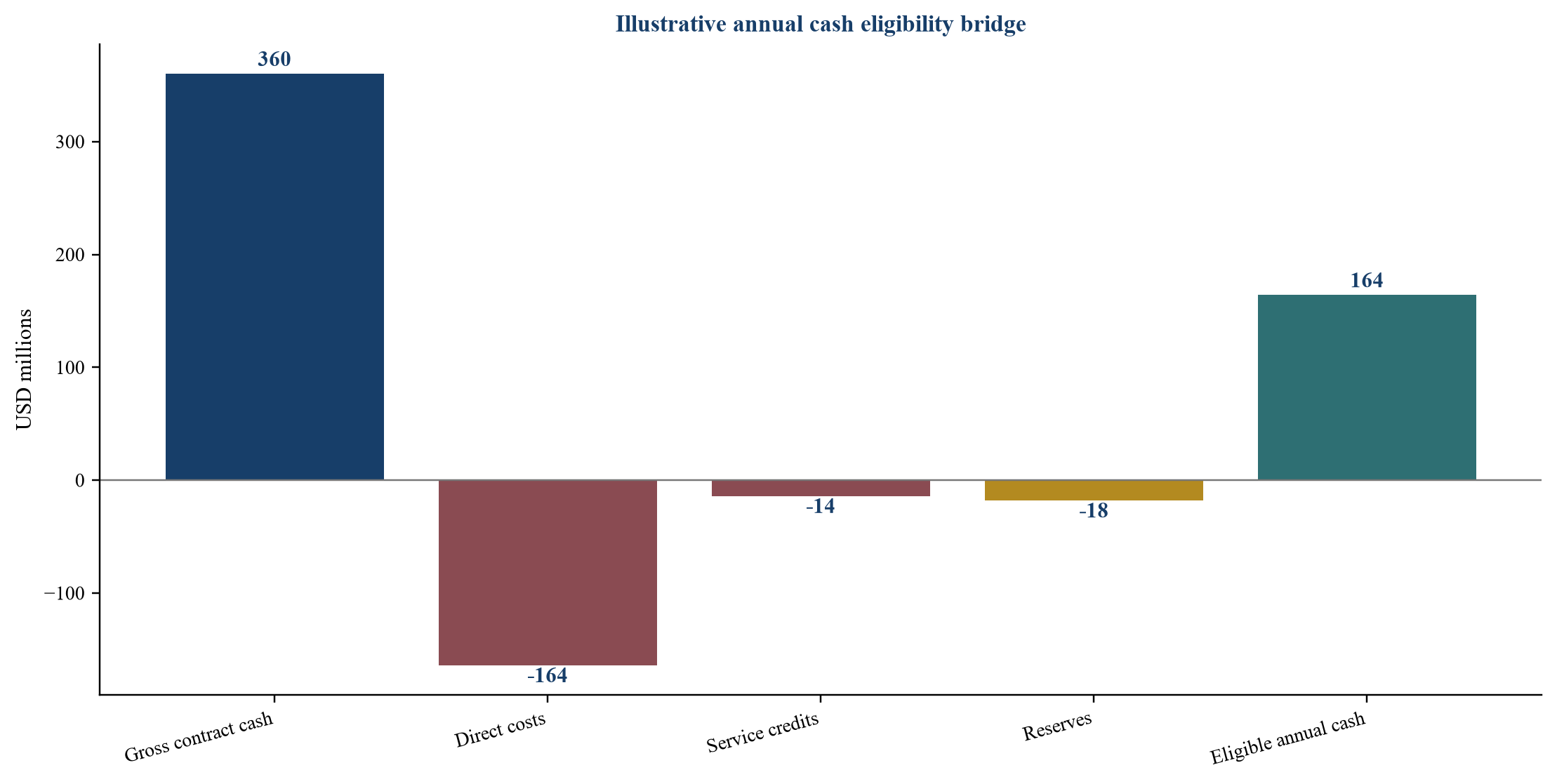
Every value is a management assumption and does not describe an identified transaction.
The note term should fit inside the shorter of the supported contract period and conservative economic life. Tail reliance on renewals or resale should be transparent. Scheduled amortisation should reduce principal before a large customer expiry, hardware refresh cliff or site lease termination.
Sizing should be solved iteratively because leverage changes the response to deterioration. Higher principal increases scheduled debt service, accelerates the point at which coverage triggers, and can force asset sales when the market is weak. The central case should therefore be accompanied by timing shocks, customer failures, service-credit events, power-cost shocks, delayed deployment and residual-value declines. Each scenario should show monthly cash, reserve draws, trigger dates, principal sweeps and ending collateral. The governing advance rate should be the one that remains supportable after these interactions and any required minimum rating or investor return, subject to legal and commercial terms.
7 Control replenishment substitutions and releases
A revolving period can finance new systems and contracts while preserving a stable note platform. It also allows the originator to change the pool after investors commit. Documents should therefore define permitted additions, substitutions and releases through objective eligibility, concentration and value tests.
An addition should require executed contract evidence, accepted service, verified title, perfected security, current appraisal support, insurance, site access and data-tape completion. A substitution should preserve or improve expected net cash, remaining term, customer quality, generation mix, hardware coverage and concentration. It should not cure a deteriorating pool by removing weak assets for less visible affiliated exposures.
Asset releases should require receipt of sale proceeds, compliance with borrowing-base and coverage tests, absence of a trigger, updated serial and lien records, secure data sanitisation and lawful transfer. Proceeds should follow the waterfall. Release prices below the applicable collateral value should require additional principal paydown or investor consent according to the documents.
| Pool change | Entry condition | Ongoing test | Failure response |
|---|---|---|---|
| new contract | executed, accepted and eligible payment | collection, credits and customer status | suspend addition |
| new system | title, serial, acceptance and current value | location, condition and support | exclude system |
| substitution | equal or better cash, term and recovery profile | concentration and cohort quality | require paydown |
| contract amendment | no material weakening without approval | revised cash and remedy model | haircut or trap cash |
| system upgrade | funded cost and customer compatibility | acceptance and value evidence | retain old support until complete |
| asset sale | permitted buyer, price and release conditions | proceeds received and liens released | block release |
Proposed transaction controls; legal implementation depends on structure and jurisdiction.
The transaction should maintain an audit trail of all pool changes. Investor reports should show additions, removals, substitutions, amendments and their effect on eligibility, concentration and coverage.
Replenishment should use a documented before-and-after test. The calculation should freeze the pool immediately before the change, apply the proposed transaction, and compare cash coverage, hardware coverage, weighted remaining contract term, weighted hardware age and every concentration limit. The originator should provide the evidence package before the asset enters the pool. A trustee or calculation agent should retain the test and the underlying records. Where an addition cures a prior breach, the report should show whether the cure comes from genuine diversification, extra collateral, lower principal or a changed valuation assumption. This prevents the revolving pool from appearing stable while its underlying composition deteriorates.
8 Make servicing and operating continuity part of credit
GPU contracts require more than invoice collection. The operator must allocate capacity, manage clusters, maintain power and cooling, monitor performance, apply service credits, protect customer data, issue invoices and collect cash. These activities can be distributed across the originator, data-centre operator, cloud platform, billing provider, trustee, account bank and collateral agent.
The servicing map should identify each function, responsible entity, source system, control, backup and replacement path. SEC Regulation AB guidance treats parties involved in managing or collecting pool assets and calculating distributions as part of the servicing analysis in specified circumstances [10-12]. Even where a private transaction is outside registered Regulation AB reporting, its criteria offer a useful control reference. Counsel should determine actual applicability.
Backup servicing for compute contracts is difficult because a financial servicer cannot operate a GPU cloud. The structure may require two continuity plans. A backup financial servicer should preserve billing, collections, records and investor reporting. A replacement technical operator should preserve facility access, cluster management, security, customer support, vendor relationships and service performance. Direct agreements and transition licences can connect these functions.
Operating continuity should be tested before closing. The exercise should follow one contract from service telemetry through invoice and controlled cash, then simulate originator distress, account-control activation, technical-operator transition and investor reporting. Unresolved dependencies should affect eligibility and reserves.
The continuity plan should specify the minimum viable operating state. It should identify the people, credentials, licences, vendor support, data-centre access, customer communications and working capital needed to keep contracted capacity available during transition. The plan should distinguish a short stabilisation period from a longer replacement or sale process. Investor liquidity should cover the period during which essential operating costs continue and distributions stop. Tests should include the failure of a key affiliate, loss of access to a management platform, a cyber incident and the departure of specialist staff. Results should change reserve sizing and contractual remedies rather than remain a separate operational report.
9 Build the controlled cash waterfall
Collections should enter accounts subject to enforceable control. The waterfall should distinguish customer prepayments, service receipts, power reimbursements, sale proceeds, insurance, vendor refunds and recoveries. Each category can have different permitted uses and priorities.
The operating account needs sufficient liquidity to preserve service. Starving the platform can destroy contract cash and hardware value. The waterfall should therefore fund verified power, site, network, essential staff, support and maintenance before scheduled note service, within approved budgets and controls. Excess costs or unapproved capital expenditure should not erode collateral without visibility.
| Priority | Payment | Control purpose | Trigger treatment |
|---|---|---|---|
| 1 | taxes, trustee and essential administration | preserve vehicle and reporting | paid within documented caps |
| 2 | verified power and critical operating cost | maintain accepted service | controlled operating budget |
| 3 | senior interest and scheduled principal | contractual note service | priority payment |
| 4 | liquidity and maintenance reserve top-up | absorb timing and asset deterioration | accelerated replenishment |
| 5 | subordinated interest and principal | junior financing service | blocked during trigger |
| 6 | permitted upgrade expenditure | preserve pool competitiveness | approved cohort plan |
| 7 | residual distribution | return excess cash | released only after all tests |
Priority and amounts are management design assumptions and require transaction-specific advice.
Sale and insurance proceeds should be matched to the affected cohort. Proceeds may prepay notes, fund a permitted substitution or restore damaged systems according to documented conditions. The same receipt should not fund both replacement equipment and principal reduction.
Waterfall calculations should be reproducible from bank statements and approved source records. The report should show opening cash, receipts by category, permitted deductions, reserve movements, interest, principal, fees and closing cash for every controlled account. It should also reconcile amounts due but uncollected and cash received for services not yet delivered. An independent calculation check should test priority, caps, trigger logic and rounding. Account-control agreements should cover the operational reality of sweeps, payment cut-off times, currency conversion, permitted investments and bank replacement. A correct formula provides limited protection when cash can remain outside the controlled accounts or operational payments cannot be made during a transition.
10 Design rapid amortisation before performance declines
Rapid amortisation redirects excess cash from replenishment and distributions to note principal. It should activate while the pool still generates cash and before hardware value falls materially. A trigger that waits for payment default can arrive after contract and equipment support have already weakened.
Triggers should reflect the causal risk. Relevant measures include rolling debt-service coverage, eligible contract cash, customer concentration, service credits, delinquency, disputes, collection variance, utilisation, accepted capacity, system availability, residual-value coverage, unsupported hardware, site concentration, power interruption, servicer failure, reporting failure and account leakage.
The response should match severity. Early deterioration can stop new additions, increase reporting, build reserves or block distributions. A material breach can end the revolving period and sweep all excess cash. Continued deterioration can activate replacement servicing, mandatory sale, enforcement or restructuring. Cure rights should have objective evidence, time limits and authority.
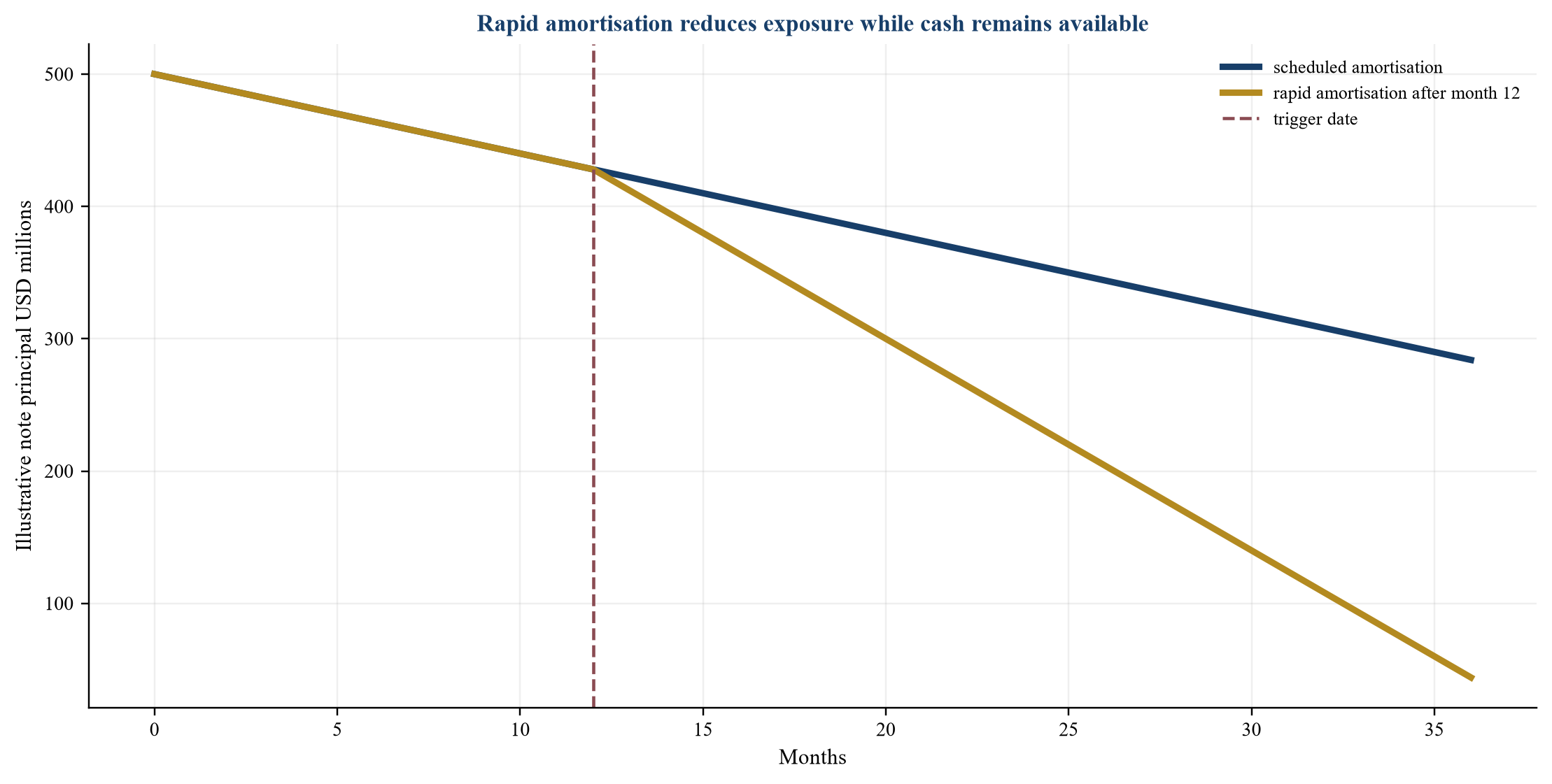
Principal and timing are management assumptions; the chart demonstrates structure only.
In the illustrative downside, a six-month customer delay, service credits, higher power cost and weaker hardware values reduce annual available cash to USD 109 million. Annual debt service of USD 132 million would produce coverage of 0.83 times. The transaction should trap cash before this combined state occurs. Early contract, service and residual-value indicators are therefore more useful than a single backward-looking coverage test.
Trigger governance should define measurement frequency, data cut-off, calculation agent, challenge process and effective time. A monthly trigger can be too slow when a material customer terminates, a site loses power or export controls change the permitted buyer universe. Event-driven notices should complement periodic tests. The transaction should also prevent a trigger from switching off after one favourable period when the underlying problem remains. Reinstatement can require several compliant periods, restored reserves, current appraisals and evidence that the causal breach has been cured. These rules make rapid amortisation a pre-agreed credit mechanism rather than an improvised response during distress.
11 Calibrate the trigger matrix to pool failure pathways
Trigger design should avoid arbitrary thresholds. The credit model should identify the point at which a change affects scheduled debt service, refinancing, operating continuity or recovery. The threshold should leave enough time and liquidity to implement a response.
Customer concentration can increase after one contract expires even when the largest customer is unchanged. Hardware concentration can increase when older cohorts are removed. Residual-value coverage can deteriorate after a new architecture announcement, weaker bids or longer sale periods. A rolling test should capture both numerator and denominator changes.
| Signal | Illustrative warning | Illustrative trigger | Required response |
|---|---|---|---|
| rolling DSCR | below 1.35 times | below 1.20 times | trap cash and amortise |
| largest customer | above 30 per cent | above 35 per cent | stop additions and diversify or pay down |
| service credits | above 3 per cent of billings | above 5 per cent | reserve and remediation plan |
| residual-value coverage | below 1.25 times | below 1.10 times | appraisal refresh and principal sweep |
| unsupported systems | above 5 per cent of pool | above 10 per cent | exclude cohort and cure title or support |
| collection variance | more than 10 days | more than 20 days | enhanced control and customer review |
| reporting failure | one late report | repeated or material failure | replacement-servicer readiness |
Thresholds are illustrative management assumptions and require transaction calibration.
Triggers should be calculated from controlled data and independently checked. Waivers should state evidence, duration, compensation, revised threshold and exit conditions. Repeated waivers can conceal structural deterioration and should be visible to investors.
12 Address legal accounting tax and regulatory boundaries
The proposed structure raises questions that cannot be resolved through financial modelling. Counsel should determine whether the transferred assets are financial assets or secured claims, whether transfer restrictions or customer consents apply, how security is perfected, whether the issuer is bankruptcy remote, how collections and hardware proceeds are isolated, and what law governs enforcement. A true-sale conclusion for receivables does not by itself transfer equipment or operating rights.
US registered ABS requirements depend on the assets and offering structure. SEC Regulation AB addresses disclosure, servicing, static-pool information and ongoing reporting for covered transactions [10-13]. Rule 192 addresses material conflicts of interest for defined securitisation participants and extends to specified registered and unregistered structures [13]. US credit-risk-retention rules, securities law and bank requirements require transaction-specific analysis [14-18].
The European Union Securitisation Regulation and current UK Securitisation Sourcebook include due-diligence, transparency and risk-retention requirements, including a material net economic interest of at least 5 per cent under specified conditions [19-25]. The UK's 2026 reform consultations remained proposals at the research date; current rules and final policy should be checked at execution [24-25]. STS eligibility, homogeneity and disclosure should never be assumed for a novel GPU pool.
Accounting analysis should address transfer and control, consolidation, servicing rights, retained interests, expected credit loss, revenue, leases, impairment and fair-value disclosures [26-34]. Tax analysis should address asset ownership, depreciation, transfer pricing, withholding, jurisdiction, interest limitation, sale proceeds and vehicle treatment. IRS depreciation guidance provides tax information and does not establish economic life or collateral value [35].
Cross-border pools need a jurisdiction matrix rather than one global legal conclusion. The matrix should identify the seller, issuer, obligor, account bank, equipment location, governing law, perfection method, enforcement forum, insolvency treatment, tax leakage and transfer restriction for every exposure. A receivable may be assigned under one law while the equipment lien, site access and operating licence depend on others. Investor disclosure should explain which rights have local opinions, which depend on consent, and which remain contractual claims against the originator. Eligibility and advance rates should reflect the weakest link in the relevant cohort rather than an average legal assessment.
13 Preserve title transferability and lawful recovery
The security package should identify every system and the entity that owns it. Purchase orders, invoices, delivery receipts, serial numbers, acceptance, payment, fixed-asset records, UCC filings and lien searches should reconcile. Systems acquired through lease, consignment, vendor finance or customer contribution require separate treatment.
Location controls matter because equipment can move within a site or between facilities. The collateral agent should receive timely notice of permitted moves and evidence of access, insurance and security perfection. Landlord, data-centre operator and customer agreements should address lender access, cure, continued operation and removal where appropriate.
Software rights can constrain recovery. Firmware, management tools, vendor support, licences and cloud-platform components may be non-transferable or tied to the operator. The recovery plan should identify the minimum rights and personnel required to test, sanitise, operate, redeploy or sell the systems. Data sanitisation should be documented and auditable.
Export controls can limit the buyer universe, destination, end user or use of advanced computing items. US Bureau of Industry and Security rules and guidance should be applied by qualified specialists to the actual equipment and transaction [36-39]. A model should not treat a restricted sale route as eligible recovery.
14 Use technology surveillance without inventing a price curve
GPU economic life changes with performance, memory, interconnect, power efficiency, software support, workload demand and total cost of ownership. NVIDIA's fiscal 2026 filing describes product-transition, inventory-obsolescence, infrastructure and demand risks [9]. These disclosures establish mechanisms. They do not establish the remaining value of a system in a financing pool.
Surveillance should track vendor roadmaps, software compatibility, workload performance, power cost, observed lease rates, capacity prices, bids, completed sales, refurbishment, support and disposition time. The appraisal model should show which evidence is observed, which is contract-specific and which is a management assumption. Confidence should decline when market evidence is thin.
The pool should test several disposition states. Continued operation under the current contract can preserve highest value. Re-leasing at the same site can require customer acquisition and configuration changes. Redeployment can require removal, transport, installation and acceptance. Component sale can expand the buyer universe and sacrifice cluster value. Liquidation can be faster and produce lower net proceeds.
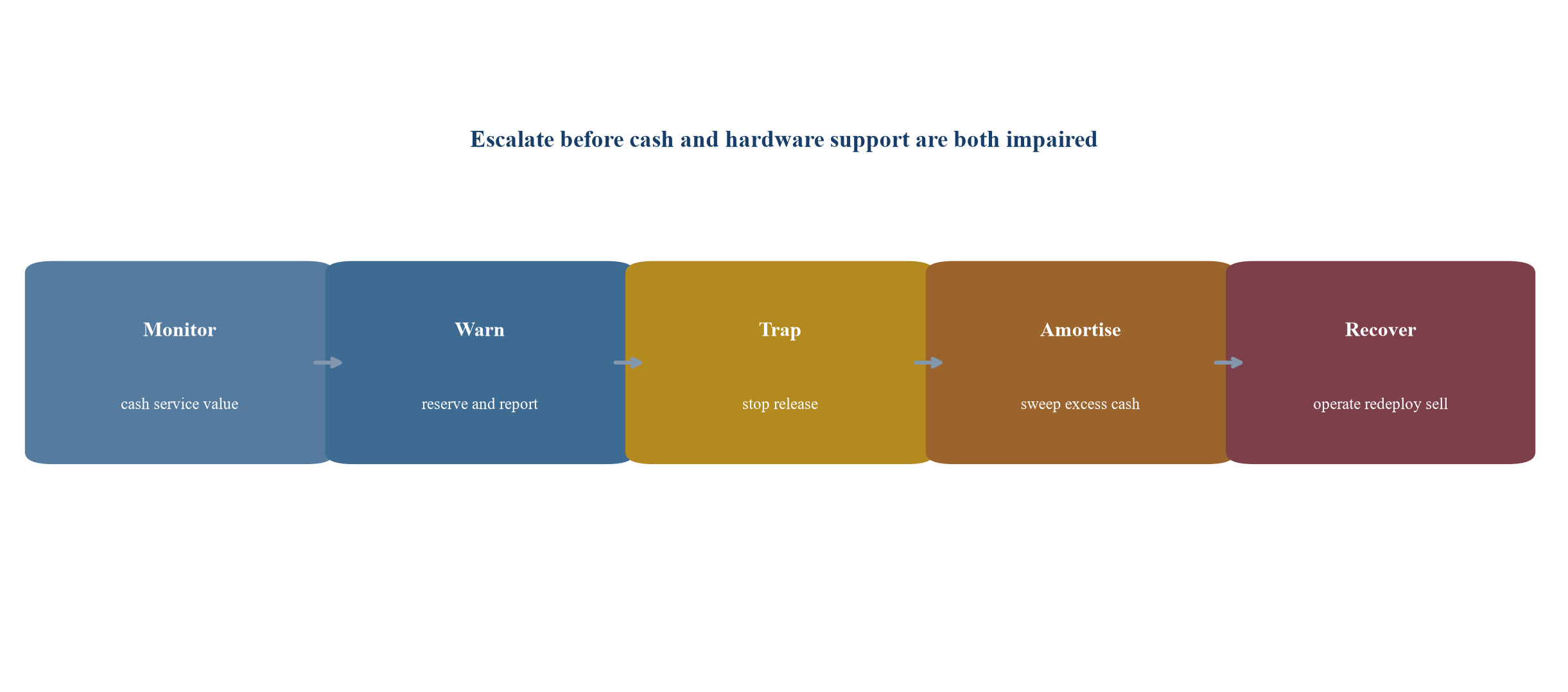
Governance sequence; actual remedies depend on transaction documents and law.
Technology surveillance should inform eligibility, haircuts and amortisation. It should not create an apparently precise value curve where market evidence is absent.
15 Apply the board and investor decision framework
The approval paper should present one reconciled pool model. It should identify the legal perimeter, eligible contracts, hardware cohorts, collection accounts, servicing functions, operating dependencies, note structure, reserves, triggers, rapid-amortisation waterfall and recovery routes. It should distinguish verified facts, specialist conclusions, management assumptions and unresolved matters.
The investment decision should answer five questions. First, which payments can be assigned or pledged and collected after satisfying service obligations? Second, which systems are owned, controlled, transferable and linked to those payments? Third, where does concentration create correlated contract and hardware exposure? Fourth, how quickly does principal reduce before customer expiry and technology decline? Fifth, can the structure preserve service or recover assets if the originator fails?
| Gate | Required evidence | Approval decision | Failure response |
|---|---|---|---|
| perimeter | legal assets, entities, accounts and security | define eligible pool | exclude unsupported rights |
| contract | payment, acceptance, remedies and collection | recognise eligible net cash | haircut or reject exposure |
| hardware | title, serial, condition, location and value | recognise secondary recovery | zero unsupported value |
| concentration | customer, site, generation and dependency map | set caps and reserves | diversify or reduce notes |
| servicing | billing, operation, backup and reporting capability | approve continuity plan | require replacement support |
| structure | waterfall, retention, triggers and rapid amortisation | approve note terms | resize or restructure |
| recovery | access, licences, transfer and disposition evidence | approve residual reliance | shorten tenor and increase paydown |
Proposed approval record; every gate requires transaction-specific evidence.
Implementation should proceed through controlled gates. The originator should establish the data tape and exception register before marketing. Counsel, accountants, tax advisers, engineers, appraisers and cybersecurity specialists should complete their scoped work before final eligibility. Investor data should reconcile to the operating systems and transaction documents. A dry run should produce one reporting period, waterfall, trigger calculation and asset-recovery exception report before closing.
The illustrative pool shows why early controls matter. Central cash produces 1.48 times annual coverage under management assumptions. The correlated downside produces 0.83 times before rapid amortisation. Stressed net hardware recovery of USD 286 million does not repay USD 500 million of assumed notes. The structure therefore cannot rely on a single terminal appraisal. It needs contract cash, declining principal, current value evidence, liquidity, concentration limits and timely remedies.
A financeable GPU pool connects every payment to accepted compute and every recovery assumption to controlled hardware. The notes should amortise before the evidence weakens. The pool should stop revolving when contract, service, concentration or value tests deteriorate. Investors should receive enough information to understand the change and the available response. This discipline turns a collection of fast-ageing systems and customer commitments into an auditable structured-credit proposition.
Sources
- CoreWeave, Annual Report on Form 10-K for 2025, Read the primary source
- CoreWeave, Current Report describing the DDTL 4.0 Facility, 30 March 2026, Read the primary source
- CoreWeave, Quarterly Report for the quarter ended 31 March 2026, Read the primary source
- CoreWeave, filed term-loan agreement including serial-number and GPU-disposition provisions, Read the primary source
- CoreWeave, Current Report exhibit describing an August 2026 loan facility, Read the primary source
- IREN, Annual Report on Form 10-K for the year ended 30 June 2026, Read the primary source
- IREN, Quarterly Report for the quarter ended 31 March 2026, Read the primary source
- IREN, Fiscal 2026 results exhibit, Read the primary source
- NVIDIA, Annual Report on Form 10-K for fiscal 2026, Read the primary source
- US Securities and Exchange Commission, Asset-Backed Securities interpretations, updated 23 March 2026, Read the primary source
- US Securities and Exchange Commission, Asset-Backed Securities Disclosure and Registration, Read the primary source
- US Securities and Exchange Commission, Regulation AB adopting release, Read the primary source
- US Securities and Exchange Commission, Prohibition Against Conflicts of Interest in Certain Securitizations, Read the primary source
- US Securities and Exchange Commission and federal banking agencies, Credit Risk Retention final rule, Read the primary source
- Office of the Comptroller of the Currency, Comptroller's Handbook Asset Securitization, Read the primary source
- Office of the Comptroller of the Currency, Comptroller's Handbook Project Finance, Read the primary source
- US Securities and Exchange Commission and federal banking agencies, Interagency Statement on Sound Practices Concerning Complex Structured Finance Activities, Read the primary source
- Federal Reserve, Supervisory Guidance on Model Risk Management, Read the primary source
- European Union, Regulation 2017/2402 laying down a general framework for securitisation, Read the primary source
- European Securities and Markets Authority, Securitisation policy activities and reporting, Read the primary source
- European Banking Authority, Securitisation and covered bonds, Read the primary source
- Financial Conduct Authority, Securitisation Sourcebook, Read the primary source
- Financial Conduct Authority, SECN 5 Requirements on risk retention, Read the primary source
- Financial Conduct Authority, CP26/6 Rules for reforming the UK Securitisation Framework, Read the primary source
- Prudential Regulation Authority, Securitisation policy and rules, Read the primary source
- Basel Committee on Banking Supervision, Criteria for identifying simple transparent and comparable securitisations, Read the primary source
- Basel Committee on Banking Supervision, Capital treatment for simple transparent and comparable securitisations, Read the primary source
- Financial Accounting Standards Board, Summary of Statement 140 on transfers and servicing of financial assets, Read the primary source
- Financial Accounting Standards Board, Accounting Standards Codification Topic 860 Transfers and Servicing, Read the primary source
- IFRS Foundation, IFRS 9 Financial Instruments, Read the primary source
- IFRS Foundation, IFRS 10 Consolidated Financial Statements, Read the primary source
- IFRS Foundation, IFRS 12 Disclosure of Interests in Other Entities, Read the primary source
- IFRS Foundation, IFRS 15 Revenue from Contracts with Customers, Read the primary source
- IFRS Foundation, IAS 36 Impairment of Assets, Read the primary source
- Internal Revenue Service, Publication 946 How To Depreciate Property for 2025, Read the primary source
- US Bureau of Industry and Security, Advanced Computing and Semiconductor Manufacturing Items Controls, Read the primary source
- US Bureau of Industry and Security, Export Administration Regulations, Read the primary source
- US Bureau of Industry and Security, Guidance on advanced computing items, Read the primary source
- US Department of Commerce, Consolidated Screening List, Read the primary source
- Uniform Law Commission, Uniform Commercial Code Article 9 Secured Transactions, Read the primary source
- Uniform Law Commission, 2022 Amendments to the Uniform Commercial Code, Read the primary source
- NIST, Cybersecurity Framework 2.0, Read the primary source
- NIST, Asset Management as a Foundation for Operational Technology Cybersecurity, Read the primary source
- NIST, IT Asset Management Practice Guide SP 1800-5, Read the primary source
- NIST, Validating the Integrity of Computing Devices SP 1800-34, Read the primary source
- NIST, AI Risk Management Framework, Read the primary source
- Cybersecurity and Infrastructure Security Agency, Cross-Sector Cybersecurity Performance Goals, Read the primary source
- International Energy Agency, Energy and AI, Read the primary source
- US Department of Energy, 2024 United States Data Center Energy Usage Report, Read the primary source
- International Capital Market Association, Principles and structured-finance guidance, Read the primary source
