
1. Grid access has become a capital constraint
Power availability now determines whether many industrial and digital projects can proceed on schedule. The International Energy Agency estimates that global data-centre electricity consumption was about 415 terawatt-hours in 2024 and could more than double to about 945 terawatt-hours by 2030 [1]. Data centres are geographically concentrated, so their local network effect can be much larger than their global share of electricity demand. A site may have land, permits, fibre, customers and committed construction capital while remaining unable to secure the firm electrical capacity required for commercial operation.
The constraint also affects renewable generation. A project that cannot export power, or can export only under uncertain curtailment, faces delayed revenue and a weaker credit case. Industry, electric transport, heat pumps and new manufacturing loads compete for network access in several markets. The IEA describes inadequate transmission as a constraint on secure energy transitions and argues that optimisation and digital technologies can make better use of existing infrastructure while long-term expansion continues [2].
Transmission development cannot be compressed into a software timetable. Network studies, route selection, land rights, environmental assessment, public consultation, equipment procurement and construction create a multi-year chain. Grid-enhancing technologies, or GETs, can alter the near-term problem by revealing or redirecting capability that static assumptions leave unused. The United States Department of Energy groups dynamic line rating, advanced power-flow control and analytical tools among the principal GET categories [3]. Battery storage and flexible demand can complement them by managing constrained hours.
The investment question is narrower than whether these technologies work in principle. It asks whether a specific package can deliver a defined quantity and quality of network service at a particular node, over a contracted period, under observable conditions. A financeable answer requires evidence about network topology, thermal limits, stability, protection, contingencies, weather, control authority, communications, load shape and reinforcement plans. Without that evidence, a capacity claim remains an engineering possibility.
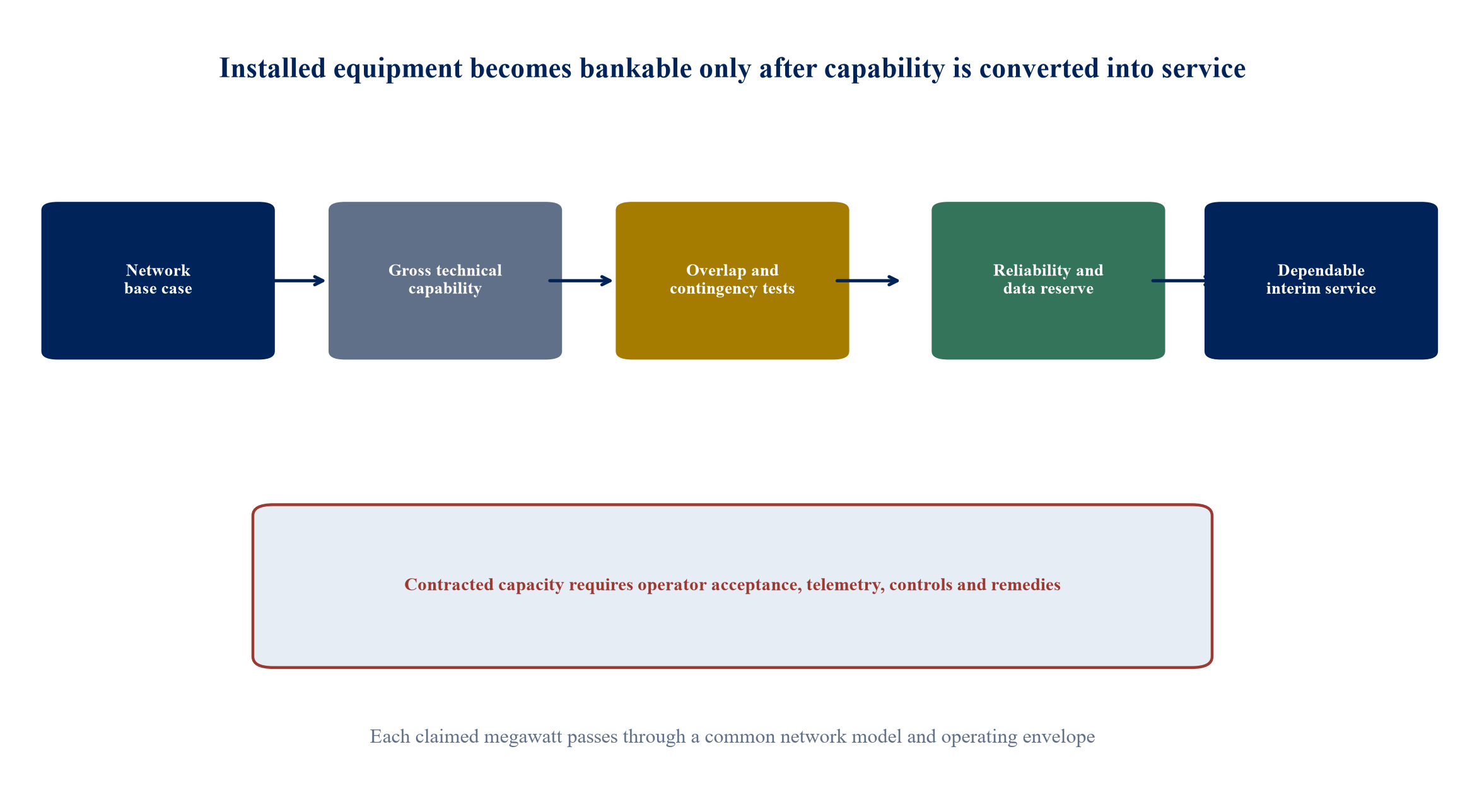
Author-designed framework. Capacity is discounted for overlap, contingencies, forecast error, operational limits and reliability reserve before it is treated as dependable.
2. Define the service before selecting the technology
The sponsor should begin with a service specification. A connection requirement expressed only as megawatts omits the characteristics that determine technical and financial value. The specification should state import or export, minimum and maximum capacity, voltage, ramp rate, load factor, duration, seasonal pattern, contingency standard, power quality, restoration priority and the date on which service is required. A data-centre campus may need high availability and controlled ramping. An electrolyser may accept interruption. A battery can change direction and speed. These profiles create different network solutions.
The service must also distinguish firm, non-firm and conditional capacity. Firm capacity is available subject to the network code and ordinary outage provisions. A non-firm connection can be curtailed under defined constraints. Conditional capacity may be available only when sensors, weather, system state, battery state of charge or other criteria are satisfied. Each category needs an enforceable operating envelope and a method for measuring compliance. Commercial documents should use the same definitions as the network study and dispatch system.
Timing deserves equal precision. The sponsor may require a construction supply, an initial energisation block and later operating phases. A phased requirement can create more options than an immediate request for ultimate demand. The network operator can assess whether a smaller initial tranche is available, whether flexible operation can bridge a defined period and when permanent reinforcement will replace the interim arrangement. The financing plan can then match capital draws and customer commitments to each energisation gate.
The service specification becomes the control document for technology selection. Dynamic ratings help where thermal assumptions are conservative and weather creates usable headroom. Power-flow control helps where flows are uneven across parallel paths. Topology optimisation helps where switching configurations can relieve constraints without undermining security. Storage helps where constraints occur during identifiable periods and sufficient charging opportunities exist. Flexible load helps where the customer can reduce, shift or sequence demand. None of these tools repairs an unrelated voltage, fault-level, protection or stability limit unless the design directly addresses it.
3. Understand what each grid-enhancing technology can prove
Dynamic line rating estimates the current or forecast current-carrying capability of a conductor using weather, conductor temperature, sag, tension and related inputs. Static ratings use conservative seasonal or fixed assumptions. Ambient-adjusted ratings vary with ambient temperature, while full dynamic ratings can incorporate wind, solar heating and conductor conditions. The Federal Energy Regulatory Commission's Order No. 881 requires ambient-adjusted ratings for specified transmission-service and market processes in the United States, reflecting the link between more accurate ratings and market efficiency [4].
Dynamic ratings create value only when the limiting element is observable, the model is validated and the operating system can use the result. Sensor placement, calibration, communications, forecast horizon, data availability and fallback ratings matter. A windy period may create substantial headroom, while a hot still period may not. The lender should therefore receive a distribution of capability across relevant hours and contingencies rather than one attractive maximum.
Advanced power-flow control devices change impedance, phase angle or voltage to direct flows across available circuits. They can relieve overload on a constrained path and use spare capacity elsewhere. The commercial case depends on network configuration, dispatch patterns and the ability to operate the device within protection and stability limits. The benefit can change as generation, load or topology changes. Network studies should include the expected transition state and credible future cases.
Topology optimisation uses software and operating procedures to identify switching configurations that improve network utilisation while preserving security. Its asset requirement may be lower than a major construction project, yet implementation demands validated models, operator confidence, protection review and clear decision rights. The Department of Energy's innovative-grid-deployment work presents dynamic ratings, power-flow control and topology optimisation as a portfolio that can complement conventional expansion [5]. The finance case should preserve that portfolio logic and identify dependencies among tools.
Table 1. Technology capability, evidence requirement and financing implication
| Intervention | Principal capability | Minimum evidence | Financing concern |
|---|---|---|---|
| Dynamic or ambient-adjusted rating | Reveals temperature- and weather-dependent thermal headroom | Sensor design, rating method, validation, forecast error and fallback rating | Revenue or capacity may vary with conditions and data availability |
| Advanced power-flow control | Redirects flow from constrained to underused paths | Power-flow studies, contingency analysis, control range and protection review | Benefit depends on system configuration and operator dispatch |
| Topology optimisation | Identifies secure switching configurations | Validated network model, operating procedures and security assessment | Software value depends on adoption, model quality and change control |
| Battery energy storage | Charges and discharges across constrained periods | Duration study, state-of-charge policy, degradation model and dispatch rights | Energy-limited resource can be depleted when needed most |
| Flexible connection or demand | Curtails, shifts or stages import or export | Load profile, controllable blocks, notice period, rebound and customer consent | Service interruption can impair customer revenue and credit quality |
The matrix is an author-designed diligence aid. Site-specific network, engineering, legal and cyber assessments remain necessary.
4. Treat a flexible connection as a commercial contract
A flexible connection is a set of rights and obligations. Its value depends on who can curtail, under what trigger, with what notice, to what level, for how long and with what compensation. A broad right to curtail at the network operator's discretion may enable energisation while remaining difficult to finance. A narrower arrangement tied to specified monitored constraints can create a more measurable risk. The contract should also address planned outages, emergency actions, restoration sequence and communications failure.
European policy is moving toward more transparent use of flexible and non-firm connections. The European Commission has identified dynamic ratings, advanced energy management and power-flow control as tools that can improve use of existing network capacity and potentially defer reinforcement [6]. Great Britain's connection reform seeks to prioritise viable and strategically aligned projects within a queue that had grown far beyond near-term system needs [7]. These initiatives show that connection management is becoming an allocation and governance problem as well as an engineering exercise.
The customer needs a curtailment budget. It can be stated as annual hours, energy not served, number of events, maximum event duration and minimum notice. Each measure captures a different operational effect. Ten one-hour events can be easier to manage than one ten-hour event, or the reverse. A data centre may shift non-urgent compute, use storage or alter commissioning phases, while preserving critical workloads. The operating plan should map curtailment blocks to business services and customer commitments.
Compensation can take several forms: lower connection charge, availability payment, curtailment payment, energy-market revenue, avoided network cost sharing or an earlier energisation date. Earlier energisation creates real economic value when it advances contracted cash flow, but that value does not pay debt service unless customer revenue is committed and the connection remains available. The finance model should separate contracted compensation, customer revenue, possible market revenue and avoided delay.
5. Build a bankable data-centre power proposition
Data centres illustrate the tension between large, concentrated demand and high reliability requirements. The IEA reports that a hyperscale AI-focused facility can require 100 megawatts or more, with the largest projects much larger [1]. AI workloads can also create rapid power swings, increasing the importance of storage and power-management systems [8]. A connection package must therefore address capacity, quality, ramping, redundancy and restoration.
The campus should disaggregate critical and flexible load. Critical load supports safety, network equipment, storage, core computing and customer obligations. Flexible load may include deferrable training, staged server deployment, thermal pre-cooling, non-critical support systems or workloads that can move across sites. The allocation should be supported by operating data and customer contracts. A marketing claim that a workload is flexible is insufficient if service-level agreements require continuous availability.
On-site generation may provide resilience or bridge capacity, subject to permits, fuel, emissions, noise, water, network protection and customer sustainability requirements. Storage can provide ride-through, peak reduction, ancillary services and congestion response, but the same battery cannot provide its full capacity to every use simultaneously. State-of-charge policy should reserve energy for the contracted network service and critical load. Merchant optimisation belongs behind that priority.
The power proposition should also recognise efficiency. Power-usage effectiveness, cooling design, server utilisation and workload scheduling can reduce the required grid block. Efficiency is often faster to implement than network construction. The IEA notes that demand response and efficiency can deploy rapidly and reduce congestion and peak stress [9]. The financing benefit comes through a smaller connection requirement, lower energy cost and reduced exposure to curtailment, provided savings are measured against a controlled baseline.
6. Create a network-capacity evidence room
The evidence room should begin with the network study. It must identify the limiting elements, base case, contingency standard, seasonal and hourly conditions, relevant planned outages, generation and demand assumptions, and the reinforcement required for firm service. Study files and model versions should be controlled. A change in nearby generation, load or transmission can alter the result, so the sponsor needs a defined update process.
Technology evidence should link each intervention to the identified constraint. Dynamic rating files include sensor locations, conductor characteristics, weather history, calculation methodology, validation, forecast error, communications design and fallback rules. Power-flow evidence includes device range, network cases, contingency analysis, harmonics, protection and failure modes. Storage evidence includes duration, round-trip efficiency, degradation, warranty, augmentation, fire safety, interconnection and dispatch simulation.
Commercial evidence includes the connection agreement, flexibility schedule, curtailment methodology, compensation, reinforcement milestone, cost allocation and termination rights. The sponsor's customer contracts should be reconciled to the connection terms. If the network can curtail to 30 megawatts with short notice, a contract promising 60 megawatts continuously creates a mismatch. Insurance, permits, land rights, equipment contracts and cyber responsibilities belong in the same diligence map.
The evidence room should record uncertainty instead of compressing it into a single capacity figure. Relevant ranges include weather-driven ratings, load forecast, queue changes, construction cost, battery degradation and curtailment. The credit committee can then decide which variables are covered by contract, reserve, sponsor support, performance guarantee or conservative debt sizing.
7. Prevent double counting through a capacity-attribution waterfall
The gross technical contribution from several interventions cannot be added mechanically. Dynamic ratings and topology optimisation may relieve the same overload. A battery may support a flexible-connection limit during constrained hours, while load curtailment addresses the same event. Summing every maximum output would overstate available capacity. The model needs a common network base case and simultaneous dispatch simulation.
The waterfall begins with verified conventional capacity. Each intervention then contributes incremental capability relative to the preceding case. The modeller tests normal operation, required contingencies, credible outages and extreme conditions. Overlap is removed, forecast error is discounted and a reliability reserve is retained. The result is a dependable interim service, not the sum of vendor ratings.
Capacity should be stated across time. A dynamic rating can have high median headroom and a low lower-tail value. A four-hour battery can support a four-hour constraint and becomes less effective if the event lasts longer or repeats before recharge. Flexible demand may rebound after curtailment. The output should therefore include megawatts, megawatt-hours, event duration, probability or frequency bands, and service availability.
Independent engineering review should confirm the attribution method and the boundary between technical capability and contractual capacity. The network operator ultimately determines what can be connected and dispatched under its rules. The financier should avoid treating a consultant's model as a connection right.
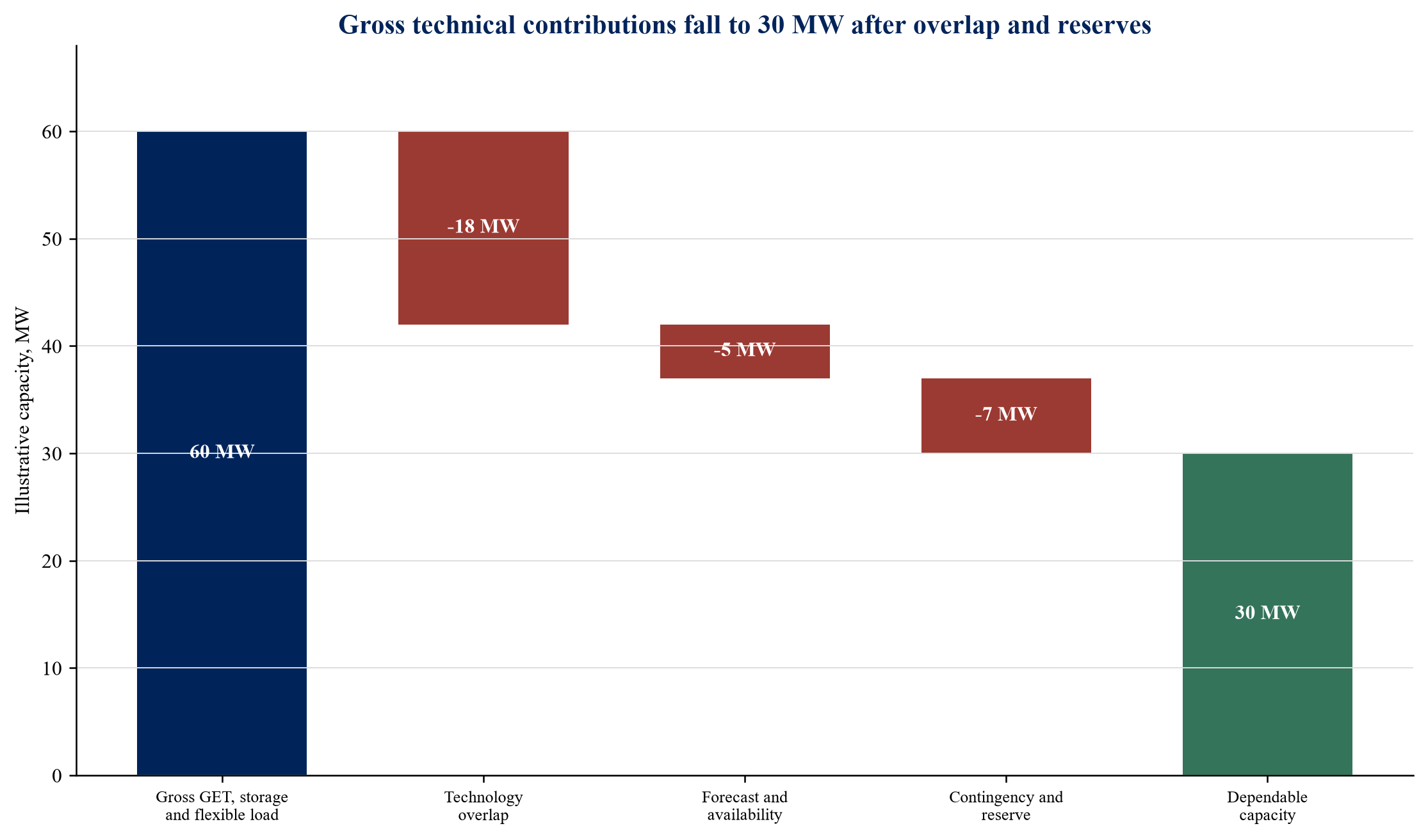
All capacities are author assumptions. Gross contributions are reduced for overlap, forecast error, contingencies and reliability reserve before dependable capacity is recognised.
8. Apply the framework to a hypothetical 100 megawatt campus
Consider a 100 megawatt data-centre campus planned in three phases of 30, 30 and 40 megawatts. Conventional firm capacity can support the first 30 megawatts in 2028. Full firm capacity requires transmission reinforcement expected in 2031. The sponsor wants to energise the second 30 megawatt phase in 2028 through a temporary package, while leaving the final 40 megawatts for the reinforced network. All figures in this example are author assumptions.
The technical package contains dynamic ratings and sensors, advanced power-flow and topology controls, a 40 megawatt and 160 megawatt-hour battery, and 20 megawatts of controllable load. Stand-alone studies indicate gross contributions of 12, 8, 20 and 20 megawatts respectively. The gross total is 60 megawatts. Simultaneous modelling identifies 10 megawatts of overlap between ratings and power-flow actions, 8 megawatts of overlap between storage and flexible load, 5 megawatts of forecast and availability discount, and 7 megawatts of contingency and reliability reserve. Dependable attributed capacity is therefore 30 megawatts.
The USD 42 million illustrative cost includes USD 4 million for ratings, sensors and communications; USD 8 million for power-flow, topology and control integration; USD 26 million for the battery and interconnection; and USD 4 million for telemetry, cyber security, commissioning and contingency. The model excludes land already controlled by the sponsor and the long-term transmission reinforcement. A real budget would require vendor quotations, owner costs, taxes, escalation and an independent cost review.
The operating envelope permits the network operator to reduce the second phase from 30 megawatts to 10 megawatts during a defined constraint. The battery and flexible load preserve the most valuable services. The annual curtailment budget is modelled at 120 hours in the base case, 300 hours in the downside case and 600 hours in the severe case. These are scenario assumptions, not forecasts. Customer contracting and debt sizing should remain viable in the downside case and survive the severe case through reserves, sponsor support or workload mobility.
Table 2. Hypothetical capacity-attribution waterfall for the second campus phase
| Attribution step | Capacity effect | Cumulative interim capacity | Evidence or control |
|---|---|---|---|
| Conventional firm connection | 30 MW | 30 MW | Executed connection right and network study |
| Gross GET, storage and flexible-load contribution | 60 MW | 90 MW | Technology studies and simultaneous dispatch model |
| Less technology overlap | (18 MW) | 72 MW | Common network model and co-optimised simulation |
| Less forecast and availability discount | (5 MW) | 67 MW | Sensor history, forecasting error and fallback rules |
| Less contingency and reliability reserve | (7 MW) | 60 MW | Network security standard and operator approval |
| Dependable second-phase capacity | 30 MW | 60 MW total campus | Conditional connection agreement and acceptance tests |
Every value is an author assumption. The example illustrates disciplined attribution and does not indicate available capacity at any real network location.
9. Value acceleration without turning it into fictional revenue
Earlier energisation can improve project economics by advancing customer revenue, avoiding idle construction capital and preserving a market window. The value should be derived from signed or highly evidenced commercial commitments. A headline estimate of annual revenue per megawatt can mislead because occupancy, pricing, power cost, fit-out, service mix and customer incentives vary. The base model should use contracted capacity, expected ramp, contribution margin and termination rights.
The example assumes the second 30 megawatt phase begins eighteen months before the firm reinforcement would otherwise permit. It reaches 70 percent contracted utilisation over twelve months and produces an illustrative annual contribution before financing of USD 18 million at stabilisation. After probability weighting, ramp, curtailment and operating contingency, the model recognises USD 13 million of expected contribution during the acceleration period. These values are author assumptions and should not be used as market benchmarks.
Avoided delay is an economic benefit rather than a separate cash flow when it represents the same advanced customer revenue. The model should not count accelerated contribution, avoided idle cost and a generic delay value if they overlap. It can identify discrete avoided costs such as cancelled contractor standby charges, contractual delay damages or lease carrying costs when supported by documents.
Net present value should include the GET package, operating cost, battery augmentation, insurance, network charges, curtailment, taxes and residual value. The terminal value of interim equipment depends on whether it continues to serve the network after reinforcement, moves to another constraint or is stranded. A robust case remains acceptable when merchant revenues and speculative residual value are set to zero.
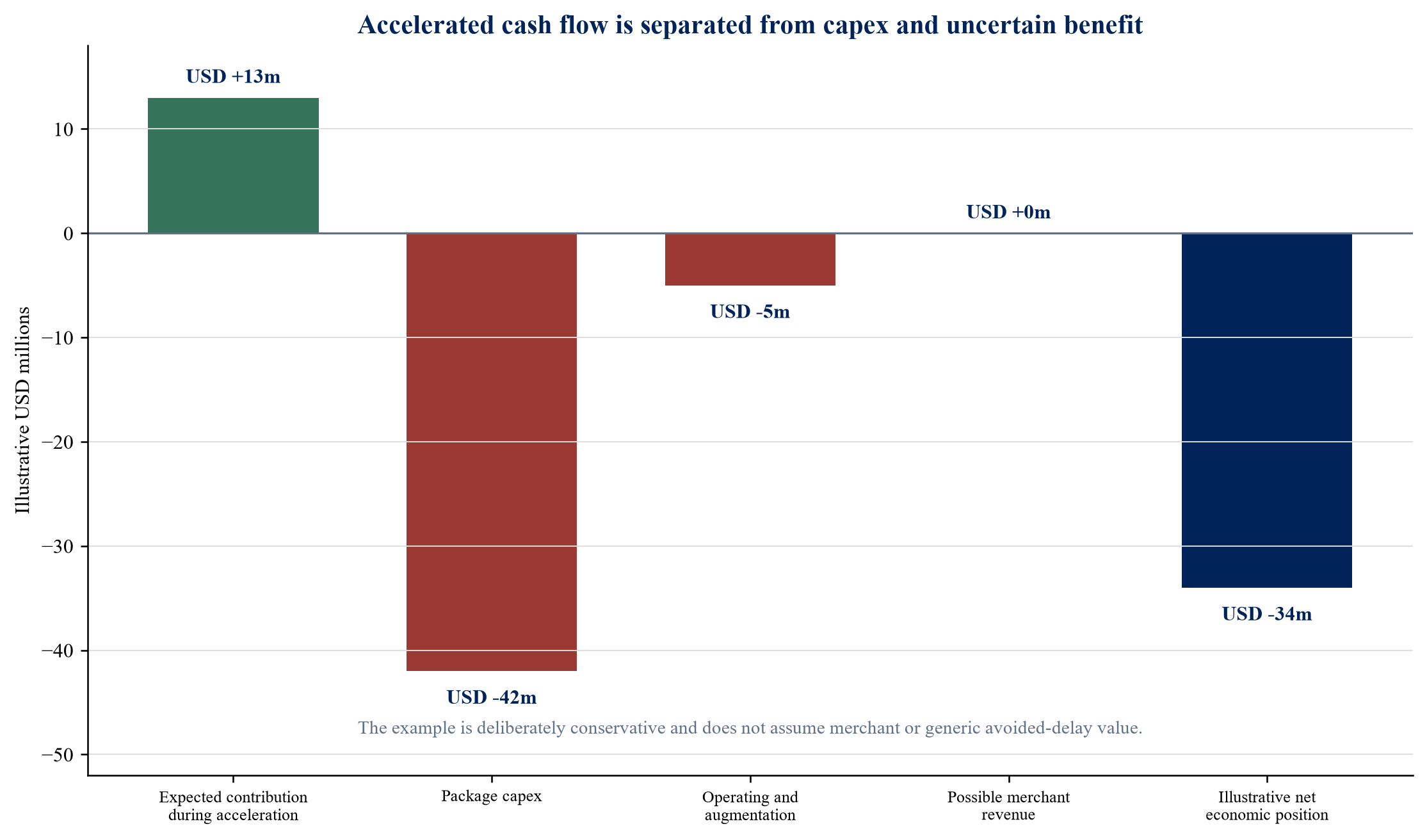
All values are author assumptions. Contracted customer contribution is separated from avoided delay, merchant revenue and other non-contractual benefits.
10. Separate the revenue and benefit stack
The most bankable cash flow is a fixed or availability-based payment from a creditworthy counterparty for a defined service. A utility or network company may pay for congestion relief, capacity availability or deferred reinforcement under a procurement or regulated mechanism. A project sponsor may pay for earlier connection through a service agreement. The contract should specify performance, deductions, change in law, network events and termination compensation.
Equipment-level savings can support the case when measurable. A battery may reduce demand charges or shift energy purchases, while control systems reduce losses or curtailment. These benefits depend on tariff design and operating priority. If the battery must preserve state of charge for network support, it cannot simultaneously maximise energy arbitrage. The dispatch hierarchy should be reflected in the model and revenue contracts.
Ancillary-service and wholesale-market revenues can supplement contracted cash flow where rules allow participation. They are exposed to price, competition, qualification, dispatch and market-design changes. Debt sizing should use conservative cases, floors or contracted routes to market. The lender should test whether network-service obligations restrict market participation during the most valuable periods.
The wider system may benefit from reduced congestion, fewer redispatch costs, deferred construction and faster connection of generation or load. Regulatory arrangements determine who captures those benefits. A project can be socially valuable while lacking sufficient private cash flow. Cost-sharing, grants, regulated allowances, guarantees or network ownership may close that gap. The appraisal should show private, network and public benefits separately.
11. Match financing instruments to risk ownership
Sponsor equity should fund early studies, integration risk and uncertain benefits. The sponsor controls site development and receives the value of accelerated operations, so it should retain meaningful exposure. Equity also provides a buffer for cost overruns, commissioning delay and curtailment beyond the base case. A contingent commitment can support defined risks without funding the entire programme on day one.
Equipment finance can suit sensors, communications, power-flow devices and storage where assets are identifiable, warranties are credible and useful life extends beyond the contract. Security, step-in rights and removal rights must be reconciled with the network operator and site owner. Software licences, data services and integration costs may need different treatment because their value is operational rather than readily recoverable.
A contracted-availability facility can finance the portion supported by a creditworthy service payment or committed customer cash flow. Draws should follow equipment delivery, installation, commissioning and network acceptance. Debt service reserves can cover seasonal or short-term performance variation. The lender should size to downside curtailment and avoid relying on merchant value for core repayment.
Utility, public or risk-sharing capital may be appropriate when the package produces network-wide benefits, demonstrates a new deployment model or avoids inefficient social cost. The Department of Energy has supported GET demonstration projects, showing the role of public funding in evidence creation [3]. Public participation should have explicit additionality, procurement, state-aid or subsidy compliance, reporting and ownership terms.
Table 3. Illustrative USD 42 million financing stack and risk allocation
| Funding source | Illustrative share | Principal repayment or support | Primary risk retained |
|---|---|---|---|
| Sponsor equity | 20%, USD 8.4m | Residual project cash flow | Development, integration, overrun and residual curtailment |
| Equipment finance | 30%, USD 12.6m | Sponsor credit and equipment value | Equipment performance, useful life and security enforceability |
| Contracted-availability facility | 35%, USD 14.7m | Availability payment or committed customer contribution | Counterparty, performance deductions and operating availability |
| Utility or public support | 15%, USD 6.3m | Network benefit, grant or risk-sharing mandate | Eligibility, public-value evidence and programme compliance |
Amounts and percentages are author assumptions. They illustrate instrument matching and are not available financing terms.
12. Allocate responsibilities across the counterparty map
The network operator controls connection, dispatch and system security. It should define the limiting constraints, operating envelope, telemetry, control interface, fallback state and reinforcement plan. The project company owns or contracts the equipment, integrates vendors, maintains performance and provides reporting. The large-load customer manages flexible demand and aligns its commercial commitments with the connection conditions.
Technology vendors should provide design responsibility, performance guarantees, availability commitments, cyber documentation, warranties, spares and change management. An independent engineer can validate studies, construction, testing and ongoing performance, while remaining clear about the scope of reliance. The market operator or aggregator may control ancillary-service participation. Insurers and lenders require access to relevant evidence without taking operational control.
Cost allocation should follow benefit and control. Network-owned equipment may enter a regulated asset base or an approved investment programme. Customer-specific assets may be funded through connection charges or sponsor capital. Shared assets can require a special-purpose vehicle, co-investment agreement or service tariff. The documents should avoid a gap in which one party pays while another can change the service without compensation.
Data rights belong in the transaction structure. Sensor and control data may contain network-security, customer and vendor information. The parties should define ownership, permitted use, retention, access for verification, cyber incident response and rights after termination. A lender needs performance evidence, while unrestricted access to operational systems would create unacceptable risk.
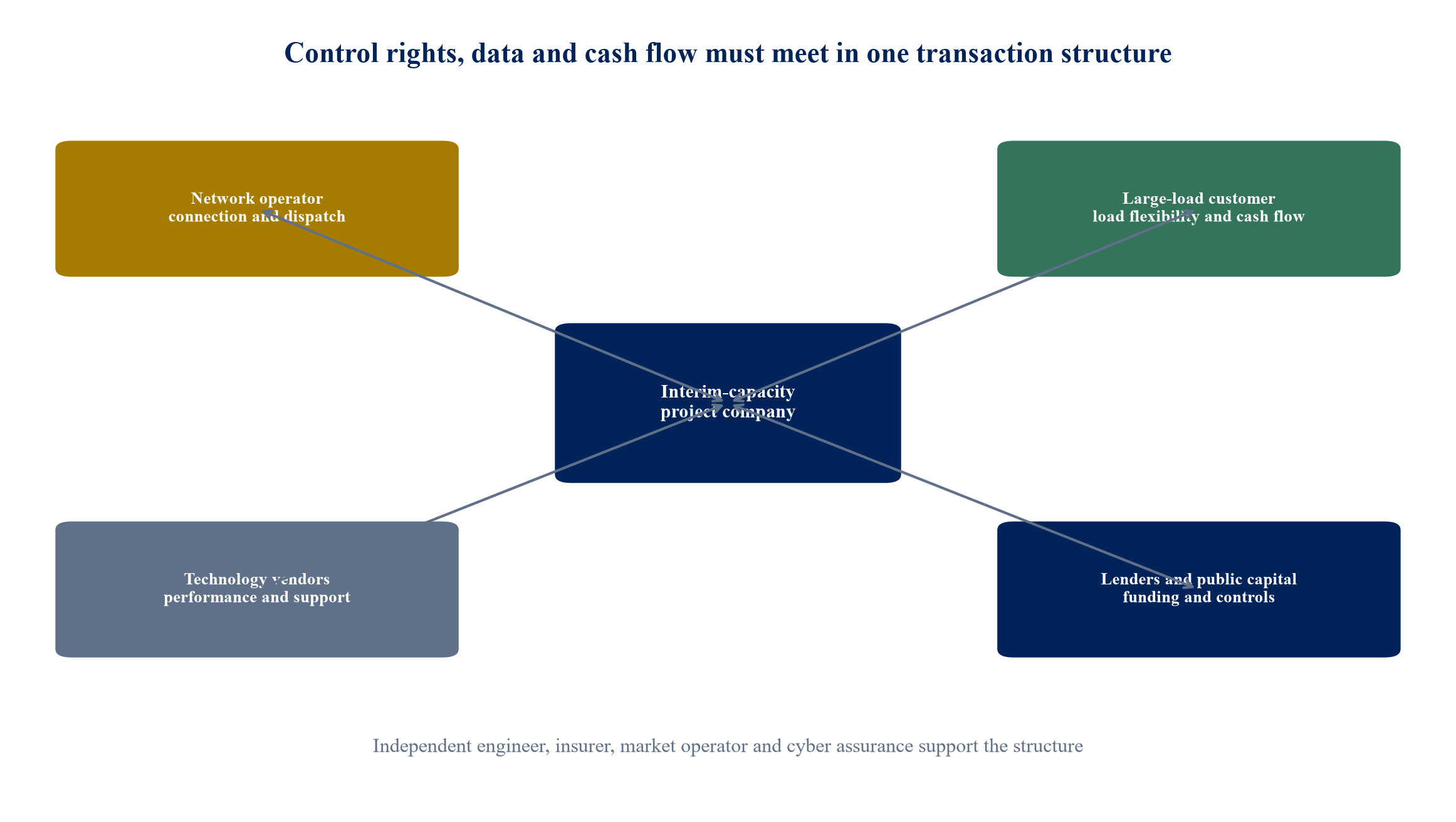
Author-designed structure. Actual ownership, regulatory treatment and contractual rights depend on the jurisdiction and network model.
13. Contract for performance, change and failure
The connection agreement is the foundation. It should state the interim capacity, effective date, technical conditions, curtailment process, data requirements, charges, breach consequences and path to firm service. The permanent reinforcement milestone should identify the responsible party, scope, target date, dependencies and remedies for delay. A vague expectation of future capacity is not equivalent to a contractual obligation.
The engineering, procurement and construction package should allocate integration responsibility. Individual vendors can meet their specifications while the combined system fails. A lead integrator should own interfaces across sensors, ratings, power-flow equipment, battery controls, protection, telecommunications and the network control room. Acceptance testing should include ordinary operation, constrained conditions, loss of communications, sensor failure, equipment outage and cyber-response scenarios.
Performance guarantees need service-level measures. Relevant metrics include available capacity, response time, accuracy, device availability, telemetry uptime, state of charge, duration, curtailment response and restoration. Liquidated damages may address delay or shortfall, subject to enforceability and caps. Warranty and service agreements should cover the expected interim period and the post-reinforcement role.
Change clauses should address network reconfiguration, new connections, code changes, market rules, technology obsolescence and reinforcement delay. The parties need a process for updated studies and cost allocation. Termination compensation should distinguish sponsor default, operator default, prolonged force majeure, regulatory change and early arrival of firm capacity. Equipment redeployment rights can preserve value when the interim need ends.
14. Use covenants and triggers that protect the service
Financial covenants should reflect the cash source. Where debt relies on customer contribution, the lender should monitor contracted capacity, customer credit, utilisation and termination. Where an availability payment supports debt, the lender should monitor deductions, disputes and counterparty exposure. Minimum liquidity, debt-service coverage and restricted payments remain relevant.
Operational covenants should preserve the capacity package. They can require maintenance, calibration, software support, cyber controls, spare parts, insurance and qualified operators. The borrower should not change dispatch priority, customer load blocks or market participation in a way that reduces contracted availability. Material network changes should trigger a new study and lender consultation.
Triggers should escalate in proportion to risk. A short telemetry outage can require a fallback rating and incident report. Repeated forecast error can require recalibration, reserve increase or reduced attributed capacity. Battery degradation beyond plan can require augmentation. Curtailed hours above the base threshold can block distributions; a higher threshold can require sponsor support or mandatory prepayment. Delay to permanent reinforcement can extend warranties, reserves and service contracts.
The cure should address the failed function. Withholding distributions, topping up reserves, adding equity, replacing equipment, increasing maintenance or revising the operating envelope can restore credit quality. Acceleration is a final remedy when the project can no longer provide the service or repay debt.
Table 4. Performance, covenant and trigger framework
| Control | Measurement | Illustrative trigger | Response |
|---|---|---|---|
| Dependable interim capacity | Accepted MW available under defined conditions | Capacity below contracted level in two test periods | Cure plan, reduced draw or equipment augmentation |
| Dynamic-rating data quality | Valid sensor and forecast coverage | Data availability below agreed threshold | Fallback rating, vendor cure and reserve review |
| Battery readiness | Usable MW, MWh and state of charge | Degradation or state of charge outside operating band | Augmentation, dispatch restriction or sponsor support |
| Curtailment exposure | Hours, MWh and event duration | Downside-case budget exceeded | Distribution lock-up and liquidity top-up |
| Telemetry and cyber availability | Secure control-channel uptime and incident record | Repeated outage or material cyber incident | Safe mode, notification, forensic review and remediation |
| Permanent reinforcement | Milestone evidence and critical path | Forecast delay beyond long-stop buffer | Extend contracts and reserves; rebase downside case |
| Contracted cash flow | Availability payment or customer contribution | Material deduction, dispute or customer termination | Cash sweep, replacement contract or mandatory prepayment |
Thresholds should be calibrated to verified studies, contracts and lender requirements. The examples do not constitute recommended commercial terms.
15. Manage operational, safety and cyber risk as credit risk
Grid-enhancing systems depend on data and controls. A failed sensor, corrupted model or unavailable communications link can produce an unsafe rating or force a conservative fallback. The design should fail safely. It should define redundant data, plausibility checks, operator override, fallback ratings and alarm management. Model changes require testing, approval and an auditable record.
Cyber security spans operational technology, information technology, vendors, cloud services and remote maintenance. Asset inventory, access control, multi-factor authentication, network segmentation, secure updates, logging, incident response and recovery testing should follow applicable grid and critical-infrastructure requirements. The financing documents should require compliance evidence and timely notification while avoiding prescriptive controls that rapidly become obsolete.
Storage adds electrical, thermal and fire risk. The project needs applicable standards, hazard analysis, detection, suppression, separation, emergency response and first-responder coordination. Warranty conditions, cycling limits and environmental controls affect both safety and available capacity. Insurance coverage should reflect property, business interruption, equipment breakdown, cyber and liability exposure as applicable.
Human factors remain material. Operators need procedures for constrained dispatch, communications loss, manual override, maintenance and incident escalation. The network operator and customer should conduct joint exercises before commercial operation and periodically thereafter. A technically sound package can fail when decision rights are unclear during an event.
16. Design the bridge to permanent transmission
An interim solution needs an exit from the first day. The permanent reinforcement plan should identify scope, permits, procurement, construction, commissioning and responsible parties. The sponsor should receive evidence of progress and update its downside case when the critical path changes. The long-stop date should reflect uncertainty rather than the earliest possible completion.
Equipment can have three post-reinforcement roles. It may remain at the site to provide resilience, market services or further capacity. It may transfer to the network operator or another customer. It may be removed and redeployed. Ownership, residual value, warranties, licences and decommissioning should support the intended route. Software and data arrangements need continuity after a change in ownership.
The contract should avoid incentives to delay efficient reinforcement. If an interim provider earns attractive availability revenue, it may prefer extension. If a network operator bears all interim cost, it may prefer early termination without compensating stranded capital. A declining payment profile, defined buyout formula or residual-value sharing mechanism can align behaviour.
The permanent connection should not erase lessons from the interim period. Real-world ratings, congestion, load flexibility and storage performance can improve network planning. Data can support a larger firm connection or reveal that some flexibility remains economic. The transition review should determine which controls and services continue.
17. Execute a ninety-day financing-readiness programme
During days one to thirty, the sponsor should confirm the service requirement, phase plan and customer commitments. The network operator should identify limiting elements and provide the current study basis. A joint team should assemble load profiles, network cases, equipment options, flexibility blocks, regulatory routes and data requirements. The board should approve an evidence budget and named decision owners.
During days thirty-one to sixty, engineers should run simultaneous network and dispatch studies. Vendors should provide indicative designs, guarantees, cyber architecture, delivery schedules and budgets. Commercial teams should draft connection, availability and customer terms. The financial model should separate contracted, operating, merchant and public benefits. The sponsor should identify the downside case that debt must survive.
During days sixty-one to ninety, the parties should select the preferred package and agree a term sheet. An independent engineer should review attribution, costs, acceptance tests and operating assumptions. Lenders should assess counterparty, construction, technology, curtailment and reinforcement risk. Legal advisers should map licences, security, step-in rights, data, land, regulation and termination. The investment committee should approve conditions precedent and a bounded development budget.
The output is a financeable proposition rather than a completed financing. It consists of a controlled network model, capacity-attribution waterfall, technology scope, counterparty map, contract heads, cost plan, financial cases, risk register, diligence index and execution schedule. Gaps remain explicit with owners and deadlines.
18. Conclude with a disciplined capacity proposition
Grid-enhancing technologies can release valuable capacity before new transmission arrives, particularly where the constraint is observable and the system can act on better information or control. Their usefulness depends on the specific limiting element and operating conditions. Storage and flexible demand broaden the solution set, while also introducing energy limits, customer-service trade-offs and dispatch complexity.
Finance follows evidence and contract. A credible package defines the service, models technologies together, discounts overlap, reserves for uncertainty, allocates control rights, protects data and cyber security, and establishes a route to permanent reinforcement. Contracted availability or customer cash flow can support debt. Merchant revenue, avoided delay and system benefit should remain separate and conservatively treated.
The central discipline is to distinguish installed equipment from dependable capacity. Sensors, software, batteries and control devices become financeable when their combined performance is accepted by the network operator, measured under a controlled methodology and supported by enforceable rights. A well-designed interim solution accelerates productive investment while preserving system security and the long-term grid build.
Frequently asked questions
Can grid-enhancing technologies replace new transmission?
They can improve utilisation of existing assets and sometimes defer or reduce a specific reinforcement. They do not remove the need for new transmission where demand, generation, resilience or network-security requirements exceed the capability of the existing system. The financing case should include the permanent reinforcement path.
What makes dynamic line rating bankable?
Bankability requires a validated rating method, reliable sensors and forecasts, secure communications, operator acceptance, clear fallback ratings, performance testing and a contract that converts measured capability into a defined service or cash flow.
How should a lender treat non-firm capacity?
The lender should model curtailment by hours, energy, duration and notice, reconcile it to customer obligations, and size debt to a conservative case. Reserves, sponsor support, workload flexibility and compensation can mitigate exposure.
Can storage provide both network support and merchant revenue?
It can where market rules and contracts permit. Dispatch priority, state-of-charge reserves, degradation and simultaneous obligations must be modelled. The same capacity cannot be committed to conflicting services at the same time.
Who should own grid-enhancing equipment?
Ownership depends on control, regulation, benefit and procurement. A network operator, customer, project company or shared vehicle may own it. Security, step-in, data, maintenance, residual value and post-reinforcement use should align with that ownership.
How is double counting avoided?
All interventions are tested in one network and dispatch model. Each contribution is measured incrementally, overlap is removed, forecast and availability discounts are applied, and a contingency reserve is retained before capacity is attributed.
What happens if permanent reinforcement is delayed?
The contract should extend equipment support, warranties, reserves and operating obligations or provide a defined compensation and refinancing route. The financial model should include a delay case and a long-stop mechanism.
What should be completed before approaching lenders?
The sponsor should have a network study, service specification, capacity waterfall, technology scope, cost plan, term sheets, customer-load evidence, downside cases, risk register, acceptance plan, cyber design and credible reinforcement schedule.
References
- International Energy Agency. Energy and AI: Executive Summary. 2025. https://www.iea.org/reports/energy-and-ai/executive-summary
- International Energy Agency. Building the Future Transmission Grid: Executive Summary. 2025. https://www.iea.org/reports/building-the-future-transmission-grid/executive-summary
- United States Department of Energy, Office of Electricity. Grid-Enhancing Technologies Improve Existing Power Lines. 2023. https://www.energy.gov/oe/grid-enhancing-technologies-improve-existing-power-lines
- Federal Energy Regulatory Commission. Order No. 881 and ambient-adjusted transmission line ratings. 2021. https://www.ferc.gov/sites/default/files/2024-07/FERC%202024%20v1_0.pdf
- United States Department of Energy. Pathways to Commercial Liftoff: Innovative Grid Deployment. 2025. https://www.energy.gov/sites/default/files/2025-07/LIFTOFF_DOE_Innovative-Grid-Deployment.pdf
- European Commission. Notice on guidance for efficient and timely grid connections. 2025. https://eur-lex.europa.eu/legal-content/EN/TXT/PDF/?uri=CELEX%3A52025XC06703
- National Energy System Operator. Connections Reform Results. 2026. https://www.neso.energy/industry-information/connections-reform/connections-reform-results
- International Energy Agency. Key Questions on Energy and AI: Executive Summary. 2026. https://www.iea.org/reports/key-questions-on-energy-and-ai/executive-summary
- International Energy Agency. Grid Investments. 2023. https://www.iea.org/reports/grid-investments
- International Energy Agency. Electricity Grids and Secure Energy Transitions. 2023. https://www.iea.org/reports/electricity-grids-and-secure-energy-transitions
- United States Department of Energy. The Future of Resource Adequacy. 2024. https://www.energy.gov/sites/default/files/2024-04/2024%20The%20Future%20of%20Resource%20Adequacy%20Report.pdf
- United States Department of Energy. Advanced Transmission Technologies: Report to Congress. 2020. https://www.energy.gov/sites/prod/files/2021/01/f82/AdvancedTransmissionTechnologiesReport508.pdf
- United States Department of Energy. Advanced Conductor Scan Report. 2023. https://www.energy.gov/sites/default/files/2024-08/Advanced%20Conductor%20Report%20December%202023.pdf
- Federal Energy Regulatory Commission. FERC Takes on Long-Term Planning with Historic Transmission Rule. 2024. https://www.ferc.gov/news-events/news/ferc-takes-long-term-planning-historic-transmission-rule
- Federal Energy Regulatory Commission. Improving Transmission Planning and Cost Allocation: Technical Conference Materials. 2026. https://www.ferc.gov/sites/default/files/2026-06/AD10-12-017%20Tech%20Conf.pdf
- European Commission. Staff Working Document on Smart and Digital Grid Solutions. 2026. https://eur-lex.europa.eu/legal-content/EN/TXT/?uri=CELEX%3A52026SC0600
- Office of Gas and Electricity Markets. Demand Connections Reform. 2026. https://www.ofgem.gov.uk/policy/connect-update-demand-connections-reform
- Office of Gas and Electricity Markets. Connections Reform Guidance on Offer Ambition and Clean Power 2030. 2025. https://www.ofgem.gov.uk/guidance/connections-reform-guidance-offer-ambition-clean-power-2030
- Office of Gas and Electricity Markets. Summary Decision on the TMO4+ Connections Reform Package. 2025. https://www.ofgem.gov.uk/sites/default/files/2025-04/Summary-Decision-Document-TMO4-package.pdf
- National Energy System Operator. Connections Reform Design Documents and Methodologies. 2026. https://www.neso.energy/industry-information/connections-reform/connections-reform-design-documents-and-methodologies
- Office of Gas and Electricity Markets. Reformed Regulatory Framework for Connections. 2024. https://www.ofgem.gov.uk/policy/reformed-regulatory-framework-connections
- International Energy Agency. Secure Energy Transitions in the Power Sector. 2021. https://www.iea.org/reports/secure-energy-transitions-in-the-power-sector
- International Energy Agency. Power Systems in Transition. 2020. https://www.iea.org/reports/power-systems-in-transition
- International Energy Agency. Energy Supply for AI. 2025. https://www.iea.org/reports/energy-and-ai/energy-supply-for-ai
