

1. A queue position is an option whose value must be earned
Electricity access has become a binding development constraint for data centres, generation, storage and electrified industry. A project can control attractive land and still lack a credible route to energisation. It can also hold a connection application or offer that appears scarce while remaining exposed to study changes, upgrade costs, permitting failure, milestone tests and cancellation. Financing that position requires a staged view of value.
The investment decision is whether each increment of development capital buys evidence that increases the probability, speed or economic capacity of connection. A queue reference alone does not answer that question. The financier needs to understand the legal instrument, the responsible network, the project's readiness, the cost-allocation regime, the conditions for retention and the route from paper capacity to usable power. This paper develops a gate-based framework for that decision.
2. Define the asset before assigning value
The phrase grid rights can refer to very different things: an application, a study position, a connection offer, an executed agreement, reserved import or export capacity, network-upgrade rights, land easements, a supply contract or a permitted project capable of using the connection. These instruments do not carry the same certainty, transferability or economic value. Their treatment also varies by jurisdiction and network level.
The diligence team should prepare a rights schedule that names the contracting entity, network counterparty, point of connection, capacity, technology, connection date, security posted, milestones, modification rights, termination events and transfer restrictions. Counsel should classify what can be assigned, charged or transferred on enforcement. The valuation should follow that legal and operational evidence. It should never treat a place in an administrative process as equivalent to commissioned capacity.
Table 1. Proposed grid-position evidence ladder
| Stage | Evidence held | Principal uncertainty | Financing implication |
|---|---|---|---|
| Search | Network data and site hypothesis | Capacity, timing and route remain open | Sponsor-funded screening |
| Application | Valid submission and required deposit | Study result and cost allocation | Limited at-risk development capital |
| Studied position | Defined point, capacity and upgrade scope | Cost, milestones and deliverability may change | Milestone-linked preferred or bridge capital |
| Executed agreement | Contracted terms, security and timetable | Conditions precedent, delay and performance | Structured development facility |
| Energised capacity | Tested connection available to the project | Ramp, utilisation and operating reliability | Construction or operating finance |
Legal effect and terminology differ by jurisdiction and require transaction-specific review.
3. Separate scarcity from bankability
Scarcity can create strategic value because a connection at the right place and time may unlock a scarce development pathway. Bankability requires more. A lender must be able to identify the borrower, collateral, cash source, repayment route, downside controls and enforceable rights. The lender must also know what happens when the expected connection date moves or an upgrade cost rises.
The distinction matters in active queues. Berkeley Lab reported about 10,300 US projects seeking transmission interconnection at the end of 2024, representing roughly 1,400 GW of generation and 890 GW of storage [4]. More than 70% of interconnection requests in its historical dataset were withdrawn [5]. Those figures demonstrate the scale and attrition of the process; they do not establish the value of any individual position. Project value depends on evidence of readiness and execution.
4. Start with the investment or credit decision
The core decision should be expressed in operational terms: how much capital can be released today, for which deliverable, with what downside protection, and what evidence permits the next draw. This formulation prevents a general belief in power scarcity from becoming a substitute for underwriting. It also creates a common language for the sponsor, utility, landowner, offtaker and financier.
For an equity investor, the question is whether the probability-weighted increase in project value exceeds the required development spend and dilution. For a lender, the question is whether repayment survives delay or whether collateral can be realised before value decays. For the board, the question includes strategic alternatives: continue, partner, resize, relocate, preserve the position at minimum cost or stop. The gate design should support each of these decisions.
5. Map the whole connection pathway
The project schedule should integrate network application, studies, land, planning, environmental approval, equipment procurement, customer contracting, generation or storage, construction and commissioning. A connection date detached from these dependencies can create false precision. The critical path may sit in a substation, transformer, transmission reinforcement, permit, land crossing, customer ramp or equipment slot.
Each workstream should carry an owner, governing document, planned date, evidence date, dependency and confidence rating. The model should distinguish dates controlled by the project from dates controlled by third parties. It should also distinguish a contractual target from an operating forecast. Delay scenarios should begin with this integrated schedule rather than a uniform percentage contingency.
6. Queue reform changes the economic contract
Connection regimes increasingly seek to distinguish viable projects from speculative reservations. FERC Order No. 2023 introduced a first-ready, first-served cluster approach, financial deposits and site-control conditions for projects entering and remaining in US transmission queues [1]. The US Department of Energy roadmap likewise identifies stronger commercial-readiness requirements, financial commitments, withdrawal penalties and time limits as queue-management tools [6].
Great Britain's reform moved toward a gated process. Ofgem approved the relevant reform package in April 2025, and NESO implemented gated application and offer processes from June 2025 [7][8]. The direction is commercially important: a valuable position increasingly depends on continuing proof. Financing documents must therefore track the live regime and its periodic updates. Historic queue status can become obsolete when methodology, milestones or evidence tests change.
7. Underwrite the jurisdiction, network and connection type
A transmission-connected generator, a distribution-connected battery and a large demand customer face different processes. So do a UK data centre, a US renewable project and an EU industrial load. The project should identify the applicable code, tariff, licence framework, system operator, utility, study methodology and dispute process. It should also confirm whether capacity is firm, flexible, interruptible or contingent on specified upgrades.
The financing model should state which regulatory proposition it assumes. It should not import a US generator-queue concept into a European demand connection or treat a preliminary utility indication as an executed obligation. Local counsel and technical advisers should verify the live position. The research framework provides a decision architecture; it does not determine project-specific legal rights.
8. Build a gate structure that releases capital for evidence
A practical structure can use five gates. Gate zero funds search and site screening. Gate one follows a valid application and defined study path. Gate two requires demonstrable land control, planning progress and technical readiness. Gate three requires a connection offer or agreement with a bounded upgrade scope, credible timetable and funded security. Gate four requires energisation or a construction-ready package whose remaining risks can support conventional project finance.
Each gate should specify objective evidence, permitted uses, maximum exposure, stop conditions and approval authority. Capital released at an early stage should be sized for the next evidence milestone rather than the full development budget. This approach preserves the sponsor's option while limiting the financier's exposure to unproven assumptions.
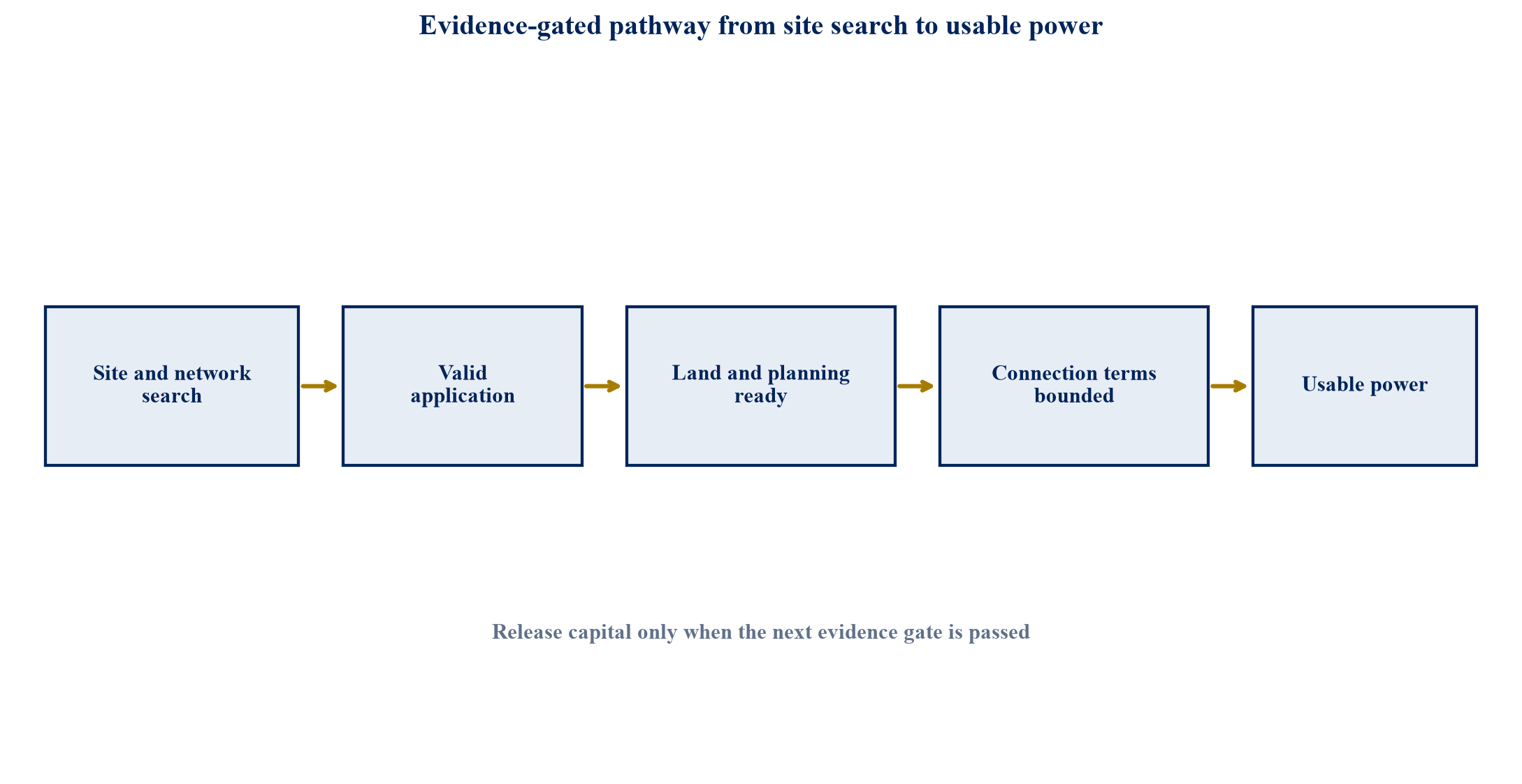
The sequence is illustrative. Actual gates depend on the applicable connection regime and project structure.
9. Treat land control as necessary but insufficient
Land must be suitable for the physical project, connection route, access, cooling, environmental requirements and future expansion. Its tenure must also survive the development period. An option, lease or conditional purchase can reduce early capital consumption, provided its term, extensions and conditions align with the connection schedule.
Financiers should verify title, permitted use, easements, access rights, wayleaves, zoning and termination provisions. They should identify whether network infrastructure must cross third-party land and who bears that risk. A long queue position on land that cannot host or connect the project has little development value. Conversely, strategically located land can retain value even if the original configuration changes, provided alternative uses are real and evidenced.
10. Test site control against readiness rules
Readiness regimes often require more than a commercial understanding with a landowner. FERC's reforms include site-control conditions, while NESO's Gate 2 process uses defined readiness criteria and methodologies [1][9]. The financing team should compare the project's documents with the precise current test. A document that supports commercial negotiation may still fail the network's formal requirement.
The sponsor should maintain a compliance file containing executed land instruments, cadastral information, rights duration, planning status, authorised signatures and submission evidence. The lender should receive notice of any challenge, expiry or modification. Funding conditions can require extensions before the remaining land term falls below the expected connection and construction period.
11. Value deliverable capacity rather than headline megawatts
A connection offer may state a capacity that is phased, non-firm, subject to curtailment, dependent on reinforcement or available only under operating limits. Data-centre economics also depend on the relationship between grid import, IT load, cooling, redundancy, onsite generation and contracted customer capacity. Headline megawatts can therefore overstate revenue-producing capability.
The technical model should translate connection terms into net critical load or export capacity by date. It should show ramp, losses, redundancy assumptions, outage standards and any flexible-connection restrictions. Valuation should use the capacity that can be commissioned and contracted under the relevant operating envelope. Later expansion should be treated as a separate option until supported by evidence.
12. Analyse network-upgrade exposure as a contingent liability
Interconnection studies can allocate network-upgrade costs to the project or cluster. Estimates may change through restudies, withdrawals, design revisions or affected-system analysis. FERC's reforms seek greater process discipline, though project-level cost exposure remains specific to the applicable tariff and agreement [1][2].
The budget should separate application fees, study deposits, securities, direct-connection assets, network upgrades, taxes, escalation and contingency. It should show which amounts are refundable, creditable or at risk. A financing cap should be linked to a verified base estimate and an approved overrun mechanism. The project should retain enough liquidity to preserve the position while a cost dispute or restudy is resolved.
13. Build a probability tree rather than one success case
Early-stage value can be modelled as a decision tree. Each gate has a probability of success, time to decision, incremental spend and value if achieved. A failed branch can have residual land value, recoverable deposits or sale value, though each residual should be separately evidenced. The tree helps the board compare continuing investment with stopping or partnering.
Probabilities in a live decision should be grounded in technical, legal and commercial diligence. The hypothetical model in this paper uses author assumptions solely to demonstrate mechanics. It does not estimate the success rate, value or timing of a real project. The output should be read as a sensitivity tool rather than a forecast.
Table 2. Hypothetical development-gate assumptions for a 120 MW campus
| Gate | Incremental spend | Conditional success probability | Time from prior gate | Evidence obtained |
|---|---|---|---|---|
| Application accepted | USD 2m | 85% | 6 months | Valid process position and study scope |
| Land and planning ready | USD 6m | 70% | 12 months | Durable site control and planning pathway |
| Connection terms bounded | USD 12m | 60% | 18 months | Capacity, upgrade scope and timetable |
| Construction-ready package | USD 20m | 75% | 12 months | Executable power, land, permits and offtake plan |
| Energisation | USD 140m | 90% | 24 months | Tested usable power capacity |
All amounts, probabilities and dates are author assumptions without empirical calibration.
14. Use option value carefully
An option framework recognises that management can stop after adverse evidence, expand after favourable evidence or alter configuration when the network position changes. This flexibility has value. It also requires discipline. A project can destroy value by repeatedly paying to extend an option whose probability-weighted outcome no longer covers the next funding requirement.
The investment paper should show the value before and after each gate, incremental capital, dilution, time decay and abandonment value. It should state whether the connection position can be sold or transferred. Where assignment requires consent or the rights attach to a particular site and entity, an assumed liquid secondary value would be inappropriate. The model should use zero sale value unless credible evidence supports another amount.
15. Discount for time as well as failure
Delay reduces value through discounting, lost revenue, escalation, customer attrition, equipment carrying cost and option expiry. A one-year delay can also change the competitive market, power price, financing spread or technology configuration. The sensitivity should therefore distinguish the cost of time from the probability of ultimate failure.
The hypothetical model assumes a construction-ready project value of USD 210 million at the relevant gate and a 12% annual discount rate. Both are author assumptions. A one-year delay reduces the present value of that future amount by approximately USD 22.5 million before considering additional carrying cost or commercial effects. The result illustrates the mechanics of delay; it is not a valuation benchmark.
16. Model development cost as committed and contingent tranches
The funding plan should separate sunk expenditure, currently committed expenditure and contingent future draws. Each tranche should link to a budget, procurement plan and gate. The board should see cumulative capital at risk if the project stops at every stage. This prevents later spend from being treated as inevitable merely because earlier money has been invested.
An early tranche may fund deposits, technical studies, land-option payments and planning. A later tranche may fund connection security, long-lead equipment and enabling works. Construction capital should generally follow a more mature package. The structure should avoid using short-dated debt for expenditure whose repayment depends on an uncertain multi-year connection event.
17. Match capital type to evidence maturity
Sponsor equity is usually best placed to absorb search and application risk. Preferred equity or a development joint venture can fund later milestones where the upside is material and downside remains difficult to secure. A structured bridge can become appropriate when there is a bounded route to a connection agreement, identifiable collateral and a credible takeout. Construction or project debt requires a stronger package of permits, contracts, budget certainty and completion support.
The financing committee should ask whether the instrument's maturity, cash coupon, security and control rights match the uncertainty. A high cash coupon during a long queue period can force repeated refinancing. Payment-in-kind interest preserves liquidity while increasing the amount that must ultimately be supported. Conversion or participation can align risk, though it dilutes the sponsor and complicates control.
18. Design the borrowing base around eligible development value
A development facility can advance against a conservative measure of eligible cost or independently assessed value after defined gates. Eligible cost should exclude unsupported related-party charges, speculative future value and expenditure outside the approved budget. The advance rate can increase as evidence improves.
Collateral may include project-company shares, bank accounts, contractual rights, land interests, equipment and sponsor support, subject to law and consent. Security over an application or connection agreement may be restricted or commercially weak. Counsel should confirm enforceability and transfer mechanics. The lender should underwrite both cooperative refinancing and enforcement outcomes.
19. Link draws to evidence, not calendar dates
Time-based availability can release money while the underlying project remains stalled. Evidence-based conditions are more precise. A draw could require a current land instrument, accepted technical submission, verified study invoice, planning milestone, updated cost report, no termination notice and an approved sources-and-uses schedule.
Conditions should remain achievable and proportionate. Excessive discretion can make committed capital unreliable, while weak conditions expose the financier to unbounded development risk. The parties should agree cure periods, permitted waivers and evidence standards before signing. The facility agent should maintain a draw-condition register that records documents, reviewers and approval dates.
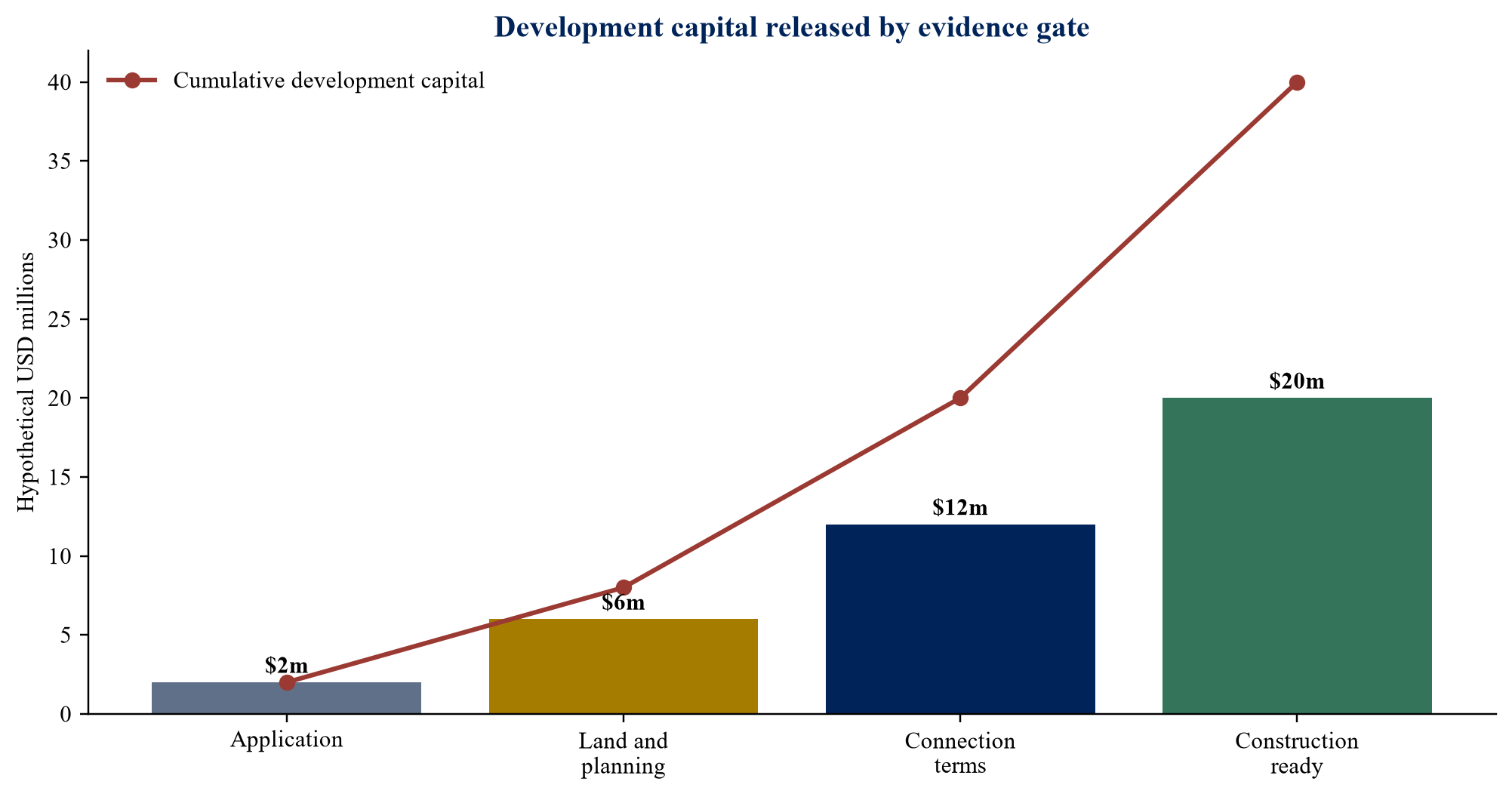
Amounts are author assumptions and do not indicate financing availability or market terms.
20. Use a delay sensitivity that identifies action points
The model should test connection delays of six, twelve, twenty-four and thirty-six months. It should include land-option extension cost, team cost, security renewal, equipment storage, financing carry, inflation, customer impact and value discount. It should also show the latest date at which the project can preserve its permits, land and commercial commitments.
A useful sensitivity names management actions at each threshold. A six-month delay may require schedule and liquidity updates. A twelve-month delay may trigger customer and equipment renegotiation. A twenty-four-month delay may require a revised site strategy or capital restructure. A thirty-six-month delay may justify abandonment unless alternative connection or site value is supported.
21. Quantify the cost of queue preservation
Maintaining a position can require deposits, securities, milestones, technical work, land payments and internal resources. These costs should be shown separately from construction expenditure. The board should understand the monthly or quarterly cash burn required to keep the option alive and the consequences of missing a payment or evidence deadline.
Queue-preservation funding should be ring-fenced where a missed milestone would destroy disproportionate value. The liquidity plan should include a buffer for restudies and security calls. It should also contain an explicit stop rule. Scarcity can encourage open-ended spending; a pre-agreed decision threshold helps management exit when the evidence deteriorates.
22. Treat connection security as liquidity at risk
Letters of credit, cash deposits, parent guarantees and performance security can consume financial capacity even when they are not recognised as funded project cost. The model should state the amount, beneficiary, expiry, reduction schedule, draw conditions and replacement process for each instrument. It should also show interaction with group banking covenants and contingent-liability limits.
Security should remain valid beyond the relevant milestone without creating an avoidable long tail. A lender financing the security needs direct information rights and cure rights where available. The sponsor should test a scenario in which the network calls security while project refinancing is delayed. This is a liquidity event, regardless of the eventual accounting or legal recovery.
23. Underwrite the construction interface early
Connection assets, substation equipment, transformers, switchgear and transmission works can have long lead times. The IEA reported in 2026 that tight supply chains for gas turbines, transformers and other electrical equipment were constraining data-centre expansion alongside grid and approval bottlenecks [10]. The procurement plan should therefore begin before the project reaches conventional construction finance, while preserving cancellation and redesign flexibility.
Technical advisers should allocate scope among the network, developer and contractors. Interfaces, testing, energisation, warranties and delay responsibility should be documented. An equipment order that precedes final connection design can create stranded inventory. A late order can miss the connection window. The gate plan should identify which long-lead commitments are justified by current evidence.
24. Make the offtake case specific
For a data centre, offtake may mean customer leases, capacity reservations, minimum revenue commitments or a credible sales pipeline. For generation it may mean a PPA, merchant strategy or regulated revenue. Each form has different credit, tenor, termination and ramp characteristics. A letter of intent should not be valued as contracted cash flow.
The financing model should connect customer capacity and commencement dates to usable power. It should test delay rights, liquidated damages, deposits and walk-away provisions. An anchor customer can improve confidence and also create concentration or bespoke-design risk. The project should avoid promising capacity before the connection pathway supports the date.
25. Finance demand flexibility as an alternative pathway
Flexible connection agreements can allow earlier access subject to curtailment or operational limits. The European Commission's 2026 grids package identified flexible agreements, PPAs, additional clean generation and demand flexibility among measures for integrating data centres [12]. These tools can reduce time to initial operation when technical and commercial conditions align.
The value model should use expected usable hours, curtailment rules, notification, compensation, backup cost and customer service levels. A flexible connection can be valuable for phased ramp or interruptible workloads. It may be unsuitable for a fully contracted high-availability load. The financier should underwrite the specific operating model rather than assume that nominal capacity is continuously available.
26. Assess onsite generation and storage as complements
Onsite generation, batteries and other flexible resources can support resilience, manage peaks or accelerate a phased connection. They introduce fuel, permitting, emissions, maintenance, technology, interconnection and operating risks. They should be evaluated as part of the power architecture rather than as a generic substitute for the grid.
The model should compare capital cost, operating cost, availability, duration, ramp, emissions and customer requirements. Storage can address short power swings and support flexibility; it cannot replace sustained energy supply without adequate duration and recharge. The IEA notes that AI workloads can create large and rapid power swings, increasing the importance of storage and grid optimisation [11].
Table 3. Proposed alternative power-pathway assessment
| Pathway | Potential benefit | Principal constraint | Evidence needed |
|---|---|---|---|
| Firm grid connection | Stable long-term capacity | Queue, upgrade and timing exposure | Executed terms and delivery plan |
| Flexible connection | Earlier phased access | Curtailment and operating limits | Dispatch rules and customer fit |
| Onsite generation | Resilience and bridging | Fuel, permits, emissions and cost | Plant design and supply contracts |
| Battery storage | Peak management and fast response | Duration and recharge dependency | Duty cycle and degradation model |
| Additional clean supply | Energy matching and sustainability | Deliverability and intermittency | PPA, network and shaping analysis |
Project-specific technical, environmental and regulatory review is required.
27. Separate energy procurement from physical deliverability
A PPA can support renewable procurement and price management. It does not automatically create network capacity at the data-centre site. Contractual energy matching, certificates and physical connection should be shown as separate layers. The project must still prove that the network can deliver the required import profile.
The power strategy should reconcile site demand, grid connection, onsite resources, PPA volume, shaping, imbalance and certificates. It should identify which party bears profile and basis risk. Financing documentation should avoid describing a renewable contract as a connection solution unless the physical and contractual pathways support that conclusion.
28. Create a grid-rights value tree
The value tree should begin with usable capacity and energisation date. It should then adjust for firmness, phasing, upgrade cost, development spend, customer ramp, operating cost, delay, probability of achieving each gate and residual value. Transferability and consent should be separate adjustments rather than assumed characteristics.
This structure makes disagreements visible. A sponsor may assign a high probability to connection delivery, while a lender may use a lower probability or higher discount rate. A technical adviser may reduce usable capacity. A customer may require a firmer date. The model should preserve these inputs so the committee can see which assumption drives value.
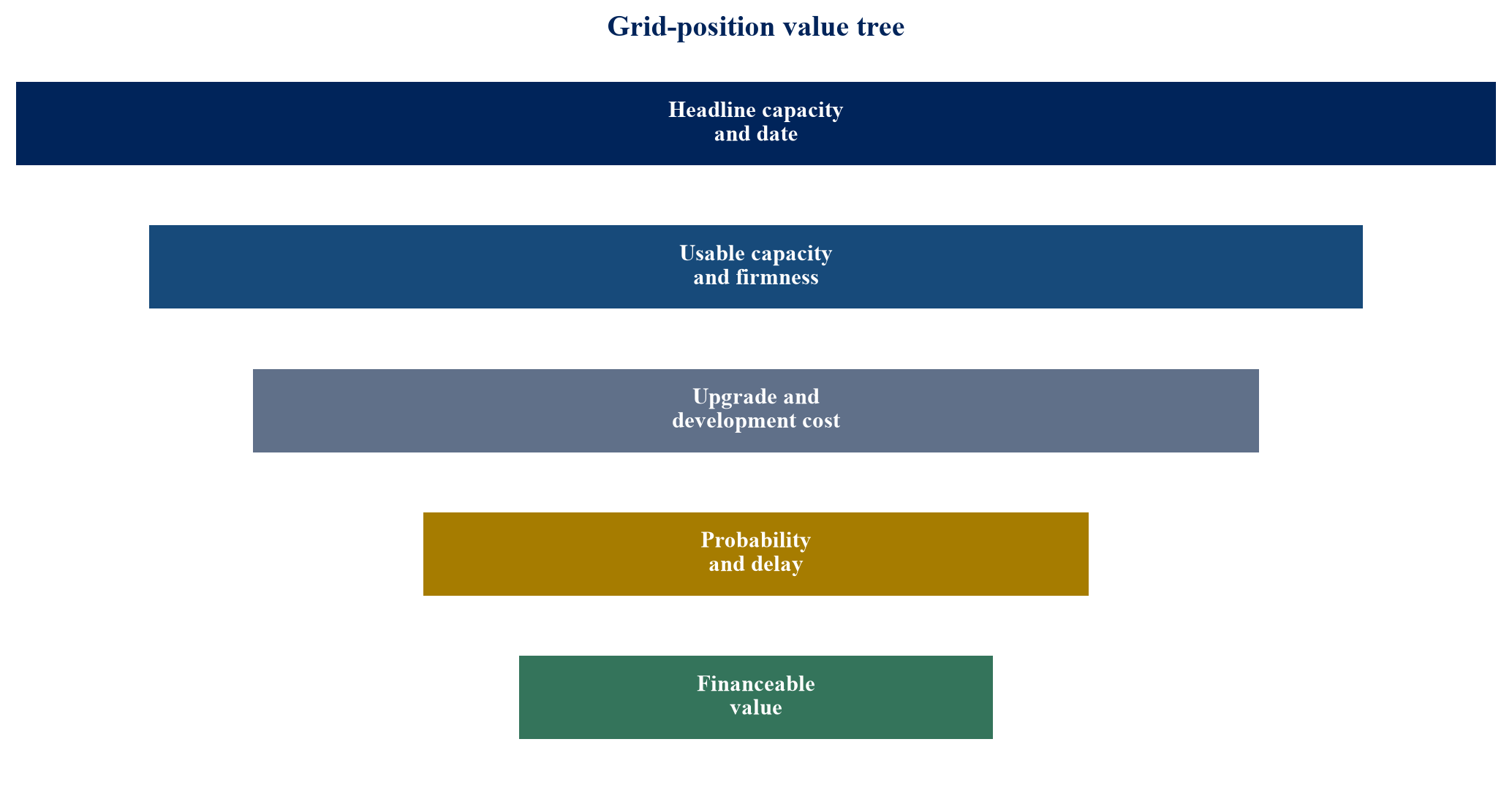
The framework separates legal, technical, timing, cost and commercial adjustments.
29. Apply the hypothetical value bridge
Assume a 120 MW campus has a hypothetical construction-ready value of USD 210 million before remaining development cost. Assume the probability of reaching that state from the current gate is 45%, the expected time is three years and the discount rate is 12%. Assume another USD 18 million of risked development spend and no transferable residual value for the queue position.
The discounted success value is approximately USD 67.3 million before the additional spend. Subtracting USD 18 million produces an illustrative risk-adjusted value of USD 49.3 million. Every input is an author assumption without empirical calibration. A real valuation would require project cash flows, legal rights, technical findings, current costs, comparable evidence and market-supported discount assumptions.
30. Interpret the hypothetical model as a decision tool
The result changes materially when probability, delay or cost changes. At a 35% success probability, the discounted success value falls to approximately USD 52.4 million before development spend. A two-year delay beyond the assumed three years reduces the present value further. A higher construction-ready value cannot compensate automatically for an unfunded or expiring connection pathway.
The committee should use a matrix rather than one point estimate. It should identify the combination of success probability and delay at which the next tranche ceases to create value. That threshold becomes an approval and stop condition. It also helps structure contingent consideration when a sponsor sells or partners the project.
Table 4. Hypothetical risk-adjusted grid-position value sensitivity
| Conditional success probability | Three-year delivery | Four-year delivery | Five-year delivery |
|---|---|---|---|
| 35% | 34.3 | 28.7 | 23.7 |
| 45% | 49.3 | 42.1 | 35.6 |
| 55% | 64.2 | 55.4 | 47.5 |
| 65% | 79.2 | 68.7 | 59.5 |
USD millions. All inputs and outputs are author assumptions and do not represent a market valuation.
31. Design covenant headroom around milestone risk
Traditional leverage covenants may provide little protection before revenue begins. A development facility needs covenants tied to liquidity, budget, milestone timing, land duration, security, permitted changes and concentration of exposure. The borrower should maintain enough cash or committed capital to reach the next decisive gate.
Milestone covenants should allow sensible technical iteration while preventing a material change in site, capacity, technology or timetable without approval. The agreement should distinguish a remediable delay from loss of the connection pathway. Early-warning dates should sit ahead of formal default so the parties can resize, extend, partner or stop before value collapses.
32. Protect against modification risk
Projects evolve. A change in capacity, technology, point of connection, site or operating profile may trigger restudy, new evidence or loss of position. NESO's gated modification guidance sets out which changes enter application windows and how modifications interact with the reformed process [8]. US regimes also address material modifications within their applicable procedures [1].
The project should maintain a change-control protocol. Technical, commercial and legal teams should assess a proposed modification before it is promised to a customer or contractor. Financing documents should require notice and approval for changes that could affect connection status, cost or timing. The model should preserve a baseline configuration and quantify the consequence of each approved change.
33. Control use-it-or-lose-it exposure
Use-it-or-lose-it principles seek to release capacity held by projects that do not progress. The European Commission has identified such measures as a way to reduce speculative queue reservation [12]. This increases the importance of milestone evidence and timely funding. It also means that a dormant position can lose value rapidly.
The operating calendar should track every payment, submission, construction milestone and long-stop date. Named owners need advance alerts and backup authority. The financier should receive direct copies where permitted and have cure rights where practicable. A missed administrative deadline should not become the unmodelled cause of investment loss.
34. Establish a rights and obligations register
The register should consolidate agreements, notices, deposits, securities, milestones, consents, reporting duties, change restrictions, termination rights and dispute steps. It should link each item to the source document and responsible person. The register should distinguish the network's obligation, the project's obligation and a non-binding expectation.
This is essential during a transaction. Data-room summaries can omit conditions or rely on outdated correspondence. Diligence should trace the claimed capacity and date to the current executed instrument and latest official record. NESO's TEC Register, for example, now includes gate information for relevant agreements and is updated regularly [13]. Equivalent official registers should be used where available.
35. Structure transfer and enforcement before relying on collateral
A financier may assume that it can sell the project company or transfer the connection position after default. The relevant agreement may require network consent, site continuity, technical capability or payment of outstanding amounts. A change of control can also trigger customer, land or permit consequences.
Counsel should prepare an enforcement map that covers share security, contractual assignments, direct agreements, cure periods, replacement operators and transfer consents. The downside valuation should reflect the time and cost of enforcement. Where transferability cannot be established, repayment must rely more heavily on sponsor support, committed takeout or other collateral.
36. Coordinate equipment finance with connection evidence
Long-lead electrical equipment can support schedule certainty and provide identifiable collateral. Its value may be highly configuration-specific, location-dependent and subject to cancellation or storage charges. The lender should verify title, specification, payment milestones, warranties, delivery, storage, insurance and resale alternatives.
Equipment finance should be released only when the connection design is mature enough to reduce stranding risk. The project should test whether design changes after a network study would make the equipment unusable. Supplier step-in or novation rights can help, subject to contract and law. The financing maturity should extend through expected delivery and takeout with a realistic delay buffer.
37. Prepare a reproducible lender diligence pack
The pack should contain the rights schedule, official queue or register evidence, network correspondence, studies, land instruments, planning record, technical design, upgrade budget, integrated schedule, security schedule, customer evidence, value model and downside plan. Every material assumption should identify its source, owner and date.
The lender should be able to reproduce the probability-weighted value and verify the capital required to reach the next gate. Management estimates should be clearly identified in the pack. Independent advisers should address legal, technical, insurance, tax and valuation questions within their competence. A glossy project narrative cannot replace traceable evidence.
38. Use a development control dashboard
The board and financier need a short dashboard that shows current gate, capacity, target energisation date, critical path, land term, permit status, upgrade estimate, security posted, liquidity to next gate, customer commitments, key conditions and stop thresholds. Each item should link to underlying evidence.
Status should reflect the weakest critical dependency. A project cannot be described as construction-ready when its grid date, land right or planning route remains conditional. Variance reporting should explain what changed, financial impact, responsible owner and required decision. The dashboard should support action rather than provide general reassurance.
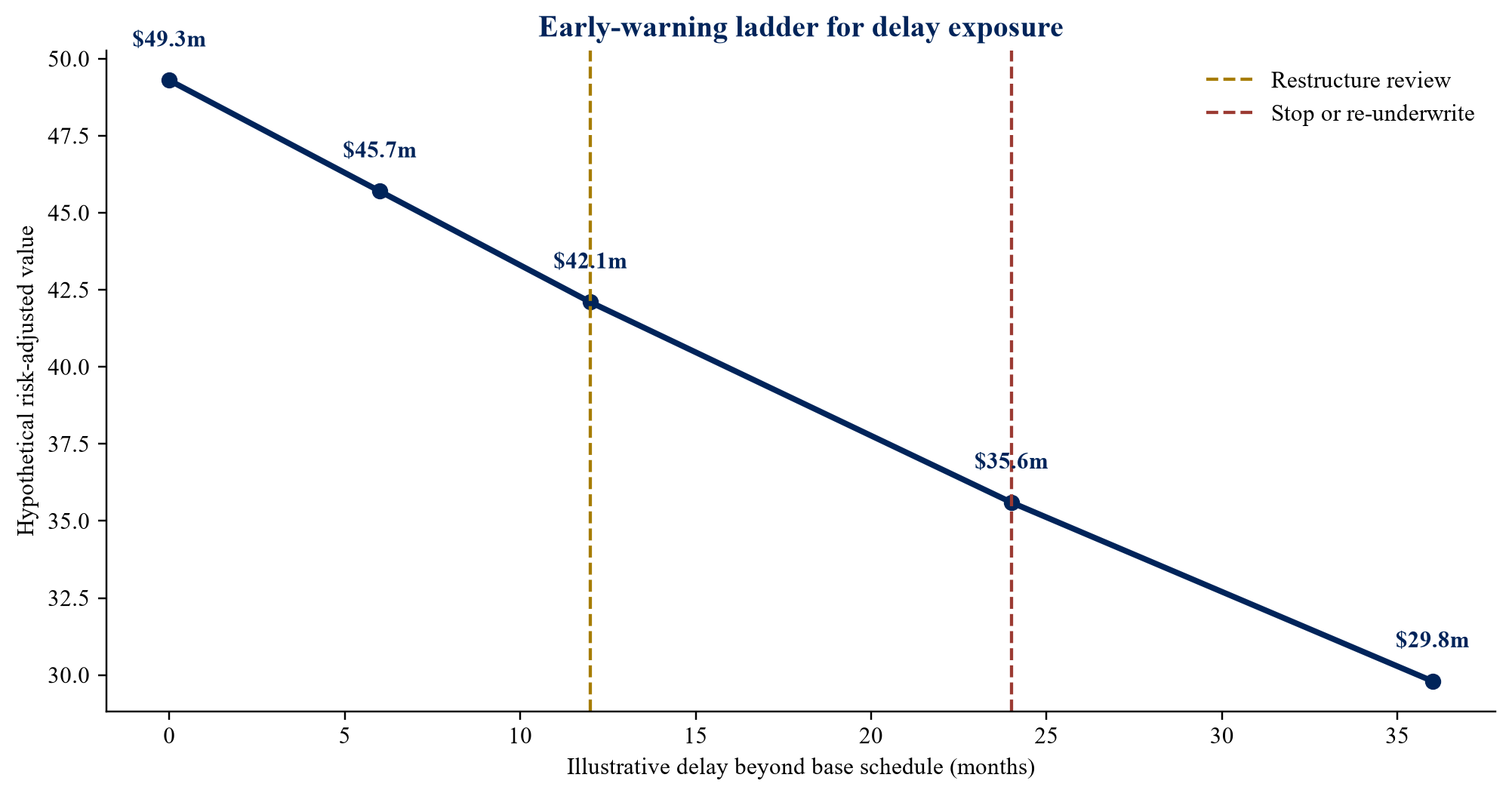
Thresholds are illustrative and should be calibrated to project documents and risk appetite.
39. Sequence the transaction through eight workstreams
Execution can be organised around network, land, planning, technical design, customer, financing, legal documentation and governance. These workstreams should share one integrated schedule, assumptions register, issue log and decision calendar. Changes in one stream must flow into the others. A revised connection date can alter land options, customer commitments, equipment orders and financing maturity at once.
The adviser should maintain a data-room index and closing-evidence list. The technical model, valuation and financing terms should use the same capacity and timetable. Legal documents should reflect the approved gate conditions. The board should receive unresolved matters before commitment rather than after documents are substantially agreed.
Table 5. Proposed execution and closing-evidence plan
| Workstream | Principal deliverable | Financing evidence | Owner |
|---|---|---|---|
| Network | Rights schedule and connection pathway | Current agreements, studies and notices | Development director |
| Land and permits | Durable site and consent plan | Executed rights and application record | Legal and planning leads |
| Technical | Integrated power and construction design | Independent technical report | Engineering lead |
| Commercial | Capacity and customer ramp plan | Executed or diligence-ready contracts | Commercial director |
| Finance | Gate budget and value sensitivity | Approved model and committed capital | CFO |
| Governance | Dashboard, limits and escalation | Board approvals and reporting protocol | Project board |
Timing and evidence depend on jurisdiction, network process and transaction structure.
40. Apply a 100-day post-financing control plan
During the first 100 days after financing, the project should confirm all security, notices, draw conditions, reporting dates and milestone owners. It should reconcile actual spend to the gate budget, refresh the critical path and test the next draw package. Network correspondence and official registers should be checked for changes.
The board should review delay, cost and success-probability sensitivities after any material event. Customer promises, equipment orders and land commitments should pass through change control. Early deviations are often cheaper to resolve than late defaults. The operating discipline used after funding protects the option that the capital was intended to buy.
41. Re-underwrite at every gate
Passing a gate is a new information event. The project should update capacity, timing, cost, probability, residual value and capital requirement rather than carry forward the previous valuation. A favourable study can increase value while exposing a larger upgrade bill. Planning progress can reduce one risk while a land extension creates another.
The next tranche should be approved against the refreshed case. Sunk cost should not determine the decision. The committee should compare continuing, resizing, partnering, relocating and stopping. It should record why the chosen action creates the best risk-adjusted outcome using the evidence available at that date.
42. The decision standard
A financeable grid position is a documented and maintainable route to usable power whose next value-creating milestone can be funded within a bounded downside. The position must be understood in its jurisdiction, network process, land setting, technical design and commercial plan. Value comes from verified progress and controlled optionality.
The board should require five proofs: a current rights schedule, an integrated connection pathway, a probability and delay sensitivity, committed liquidity to the next gate, and enforceable financing controls. These proofs convert scarce grid access from a narrative into an investable development programme.
The final approval paper should state what right exists today, what evidence is still required, how much capital is at risk before the next decision, what event destroys or preserves value, and who owns each action. This disclosure gives sponsors and financiers a shared basis for disciplined execution.
References
- Federal Energy Regulatory Commission. Fact Sheet: Improvements to Generator Interconnection Procedures and Agreements, Order No. 2023. 27 July 2023. https://www.ferc.gov/news-events/news/fact-sheet-improvements-generator-interconnection-procedures-and-agreements
- Federal Energy Regulatory Commission. Explainer on the Interconnection Final Rule. Updated 2024. https://www.ferc.gov/explainer-interconnection-final-rule
- Federal Energy Regulatory Commission. Explainer on Order No. 2023-A. 21 March 2024. https://www.ferc.gov/explainer-interconnection-final-rule-2023-A
- Lawrence Berkeley National Laboratory. Queued Up: 2025 Edition, Characteristics of Power Plants Seeking Transmission Interconnection as of the End of 2024. December 2025. https://emp.lbl.gov/publications/queued-2025-edition-characteristics
- Lawrence Berkeley National Laboratory. Queued Up 2025 Edition presentation. December 2025. https://emp.lbl.gov/sites/default/files/2025-12/Queued%20Up%202025%20Edition%20-%2012.15.2025.pdf
- United States Department of Energy. Transmission Interconnection Roadmap. April 2024. https://www.energy.gov/sites/default/files/2024-04/i2X%20Transmission%20Interconnection%20Roadmap.pdf
- National Energy System Operator. Transition to Connections Reform. Accessed 6 September 2026. https://www.neso.energy/industry-information/connections/transition-connections-reform
- National Energy System Operator. Gated Modification Guidance. Updated June 2025; accessed 6 September 2026. https://www.neso.energy/industry-information/connections-reform/gated-modification-guidance
- National Energy System Operator. Connections Reform design documents and methodologies. Accessed 6 September 2026. https://www.neso.energy/industry-information/connections-reform/connections-reform-design-documents-and-methodologies
- International Energy Agency. Key Questions on Energy and AI. 16 April 2026. https://www.iea.org/reports/key-questions-on-energy-and-ai
- International Energy Agency. Energy and AI. 10 April 2025. https://www.iea.org/reports/energy-and-ai
- European Commission. European Grids Package. 3 June 2026. https://energy.ec.europa.eu/document/download/fbe97b7a-20ff-4361-a8b2-9a4055695f3a_en?filename=COM_2026_501_1_EN_ACT_part1_v9.pdf
- National Energy System Operator. Transmission Entry Capacity Register. Accessed 6 September 2026. https://www.neso.energy/data-portal/transmission-entry-capacity-tec-register/tec_register
- European Commission. Guidance on tackling grid connection queues. 2025. https://energy.ec.europa.eu/document/download/62c46b3d-0df9-42a1-a5fe-c3c71ed5f18c_en?filename=C_2025_8473_1_EN_ACT_part1_v4.pdf
- International Energy Agency. Energy supply for AI. 2025. https://www.iea.org/reports/energy-and-ai/energy-supply-for-ai
- National Energy System Operator. Connections Reform Results. Accessed 6 September 2026. https://www.neso.energy/industry-information/connections-reform/connections-reform-results
