
1. Underwrite a powered operating system
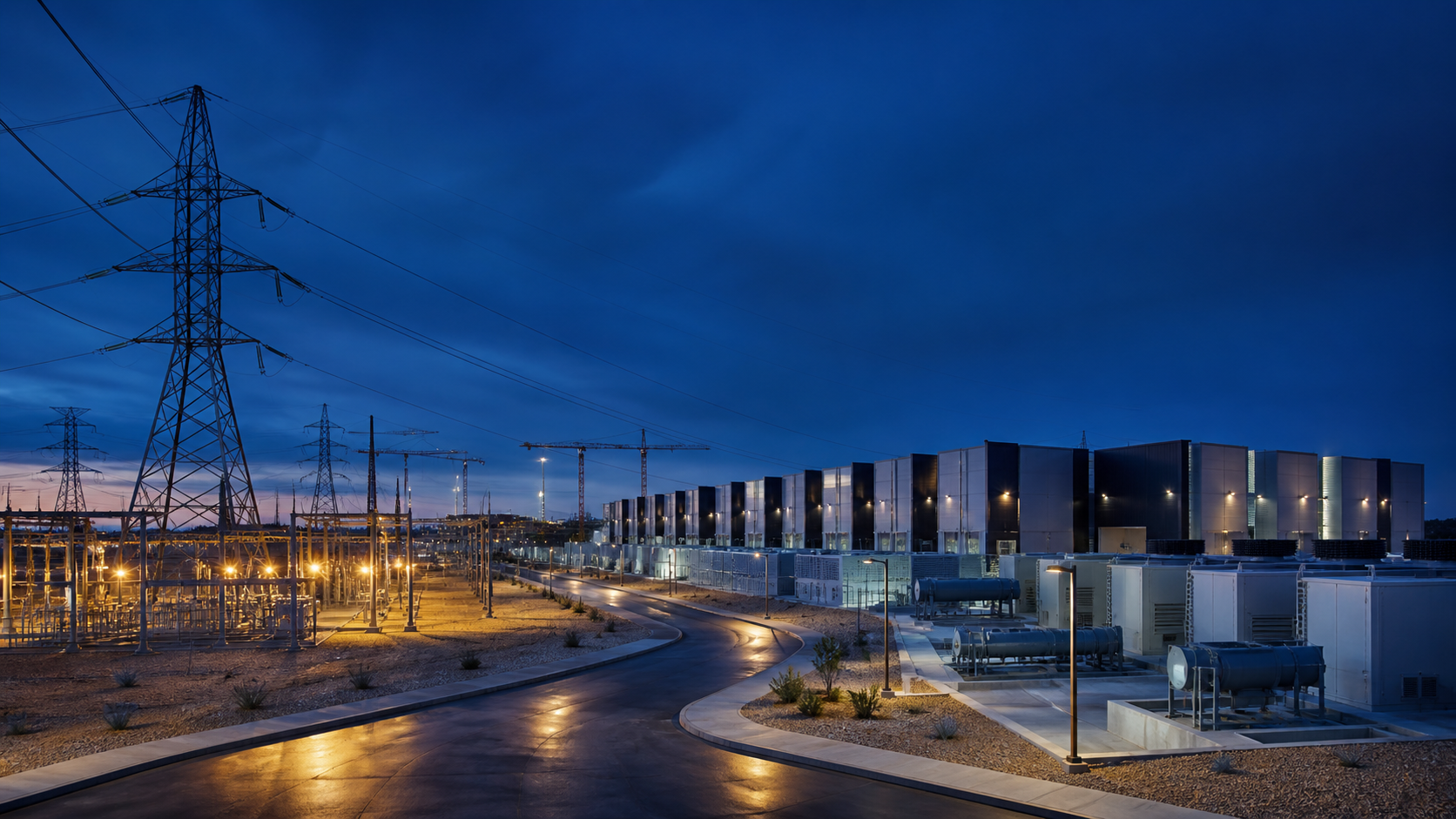
A data centre becomes useful when land, electricity, cooling, connectivity, security and customer equipment operate together. The building shell has limited value when the site cannot receive and distribute the contracted electrical load. Electrical capacity has limited value when the project lacks an executable facility, permits or a customer able to use the capacity. A lease has limited credit value when the project cannot deliver its technical specification on time.
Construction lenders should therefore underwrite a powered operating system. The initial diligence map should connect the land parcel, zoning, utility delivery point, substation and transmission dependencies, generation and backup strategy, building phases, mechanical and electrical design, fibre routes, customer halls, lease obligations, commissioning tests, rent commencement and controlled cash accounts.
The map should distinguish nameplate, utility-reserved, contracted, construction-ready, energised, commissioned and revenue-producing megawatts. These categories are not interchangeable. A large headline pipeline can include capacity held for future development, capacity awaiting network work, capacity subject to customer milestones and capacity that has not entered construction.
The lender should also identify the legal owner of each critical right. Land, utility agreements, interconnection studies, network easements, equipment purchase orders, permits, customer contracts and operating licences can sit in different entities. The collateral and direct-agreement package should follow the operating chain.
The result is a molecule-to-cash equivalent for digital infrastructure: grid and generation capacity becomes usable electrical output, usable output becomes commissioned IT load, commissioned load becomes billable customer capacity, and customer payments become debt service. Every link requires evidence, control and a remedy.
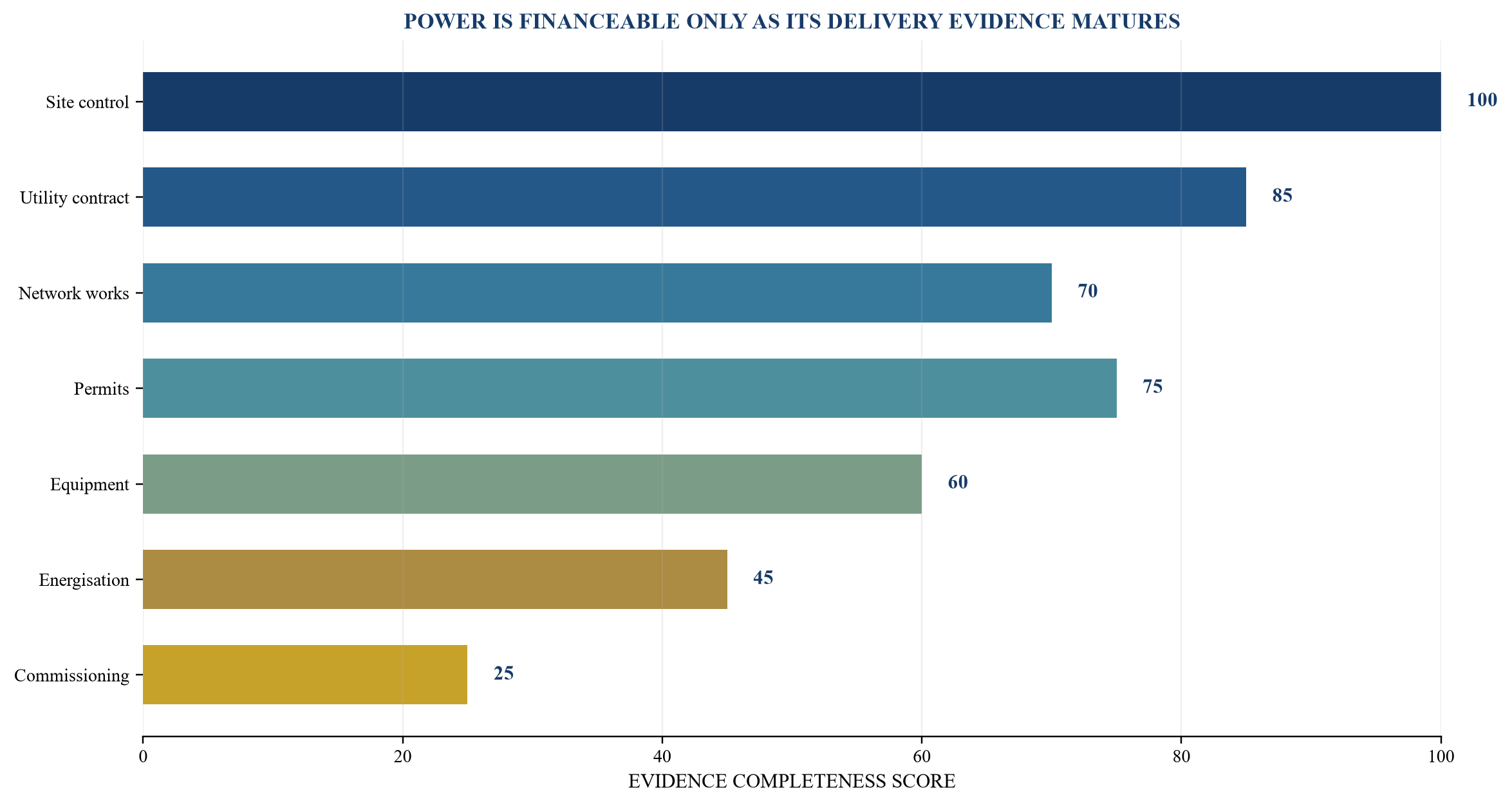
The score measures the evidence supporting delivered, usable and financeable capacity rather than the size of a requested load.
2. Separate market demand from project demand
National demand supports the sector thesis. It does not prove that one site will receive power, complete on time or attract a durable customer. DOE and LBNL describe rapid US electricity growth associated with data centres.[1][2] NERC reports that load forecasts increasingly depend on data-centre and other large-load proposals whose timing and probability require adjustment.[3] The lender should translate the macro trend into project-specific evidence.
Project demand begins with named capacity requirements, technical specifications, credible customer procurement, executed reservation or lease documents and a deliverable schedule. Broker commentary, expressions of interest and aggregate market absorption can support market diligence. They should not carry the same weight as a binding customer obligation.
The analysis should distinguish demand for powered land, powered shell, wholesale turnkey capacity, retail colocation and specialised high-density AI deployments. These products have different construction scopes, capital intensity, lease structures and re-leasing prospects. A powered shell may transfer fit-out expenditure to a customer but can still require substantial base electrical and mechanical infrastructure. A turnkey build creates higher capital exposure and a more complete revenue product.
Geography matters through utility territory, interconnection timing, resource adequacy, tax, labour, fibre density, natural hazards and proximity to customer networks. PJM's planning work links substantial projected demand growth to data centres and highlights the importance of accurate large-load forecasting.[5][6] A project in a constrained market may enjoy scarcity value and face a longer, more expensive route to energisation.
The lender should maintain a demand evidence ledger. Each item should state counterparty, product, capacity, location, start date, commitment level, expiry, security, conditions and duplication risk. One customer request can appear across several developers. Capacity should be counted once and probability weighted only through documented milestones.
3. Define a power-right hierarchy
Power underwriting begins with terminology. A feasibility response, service study, system-impact study, facilities study, executed service agreement, construction payment and energised delivery point represent different stages. The legal form varies by utility, transmission region and state. The credit file should reproduce the exact rights and obligations rather than rely on a generic description.
The hierarchy should identify requested load, study load, reserved load, contracted load, firm and interruptible components, phased delivery, minimum charges, deposits, network-upgrade responsibility, customer-built facilities, utility-built facilities, milestones, cancellation, assignment and curtailment. It should state what must occur before construction starts and before permanent service becomes available.
FERC's December 2025 action directed PJM to create clearer transmission pathways for certain large co-located loads and to address reliability and cost allocation.[4] This illustrates why regulatory design can change the meaning, cost and timing of a power strategy. Co-location with generation can reduce some network dependence and can introduce fuel, generation availability, minimum-grid-service and curtailment obligations.
On-site generation, storage and backup systems should be treated as defined operating assets. Fuel supply, air permits, noise, emissions, maintenance, start reliability and operating restrictions affect their value. A conceptual generator layout is not a substitute for permitted, contracted and tested capacity.
The lender should obtain a legal and technical memorandum that reconciles the commercial description with the executed utility and grid documents. The memorandum should identify surviving conditions, termination triggers, cure periods, transferable rights and the consequences of construction or customer delay.
Table 1. Power evidence and credit treatment
| Stage | Evidence | Residual uncertainty | Construction-debt treatment | Required control |
|---|---|---|---|---|
| Requested | utility application | capacity, route and timing | no debt value | application register |
| Studied | completed study and scope | cost allocation and approvals | limited enabling advance | study conditions |
| Reserved | reservation and deposits | milestone survival | capped advance | deposit and milestone control |
| Contracted | executed service agreement | network delivery and completion | phased debt recognition | direct agreement and cost tracking |
| Energised | accepted delivery point | usable internal distribution | substantial credit | metering and test evidence |
| Commissioned | integrated load test | operating reliability | full operating recognition | performance certificate |
Credit value increases with enforceability, funded delivery and completed testing.
4. Convert the power schedule into conditions precedent
A power schedule should connect external and internal work. External work can include transmission reinforcement, distribution feeders, substation construction, transformers, easements and utility commissioning. Internal work can include medium-voltage distribution, switchgear, uninterruptible power systems, generators, cooling and building-management controls.
Each milestone should have an owner, predecessor, evidence, cost, float and consequence. A utility target date should be reconciled with land rights, procurement and contractor schedules. Long-lead transformers, switchgear, generators and cooling equipment should have approved specifications, manufacturing slots, vesting, inspection, transport and storage arrangements.
The initial loan draw should fund only activities supported by the current power stage. Land and enabling works can be financed against site control and a credible utility path. Vertical construction should require stronger evidence that external network work, permits and long-lead equipment can meet the delivery date. Customer-specific fit-out should require an effective customer obligation or additional equity protection.
Every draw should retest the current cost to complete and the current energisation critical path. A power delay can extend interest, general conditions, equipment storage, customer liquidated damages and lease commencement. The model should translate schedule movement into liquidity requirements.
The lender should reserve rights to redirect funds when one workstream advances faster than another. A completed shell without power is not an efficient use of senior debt. A power system without a permitted building also traps capital. Balanced progress protects completion value.
5. Underwrite pre-leasing as a conditional credit instrument
Pre-leasing can reduce lease-up risk and define the facility. It can also transfer design and schedule obligations to the developer before rent begins. The lender should analyse the full agreement, technical schedules, amendments, side letters, credit support and termination rights.
The core questions are commitment, capacity, price, term, commencement, conditions, customer credit, design responsibility, change rights, delay remedies, expansion, renewal and termination. A reservation fee can be refundable. A capacity commitment can be phased. A lease can become binding only after permits, power or board approval. Rent can begin after customer acceptance rather than substantial completion.
The technical schedule deserves equal weight. Power density, cooling architecture, redundancy, rack configuration, security, fibre, sustainability and reporting can change during development. The agreement should allocate design changes, cost, schedule and acceptance. A large customer can negotiate changes that preserve its termination right while increasing the developer's expenditure.
Credit support should match the pre-rent exposure. A parent guarantee, letter of credit, cash deposit, milestone payments or termination payment can protect design and procurement spend. The lender should understand caps, expiry, reduction and set-off.
Digital Realty's 2025 Form 10-K reported 769 megawatts of projects underway and 64 percent pre-leased, while also describing the risk that speculative development, delays, cost increases or lower rents could impair debt service.[8] The disclosure shows both the scale of pre-leasing and the continuing importance of contract detail.
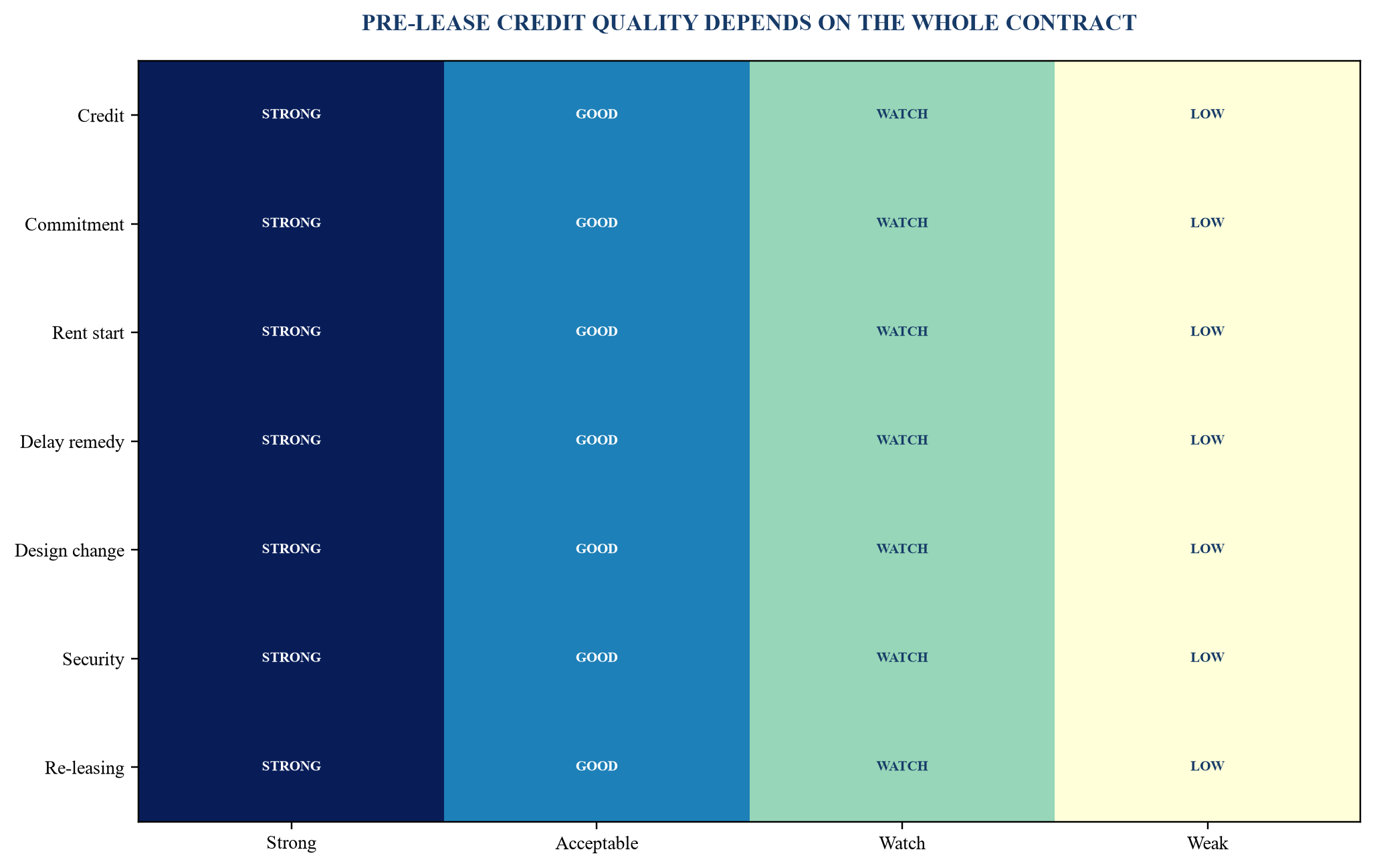
A strong customer name cannot compensate for weak commitment, late rent commencement or broad termination rights.
6. Score the lease before sizing debt
The pre-lease score should separate economic value from credit protection. Economic value includes rent, escalation, term, operating-cost recovery, expansion and renewal. Credit protection includes enforceability, security, commencement certainty, termination payments and remedies.
Customer credit should be assessed at the obligated entity. A recognised brand may contract through a special-purpose subsidiary. The guarantee can exclude certain obligations or expire after commencement. Financial statements, ratings, structural subordination and concentration should be reviewed at the legal counterparty.
Committed capacity should be reconciled with the construction phase. A customer can reserve a campus while committing to one building. Expansion options can improve future value and block capacity without supporting current debt. Rights of first offer, most-favoured terms and exclusivity can affect residual leasing.
Rent commencement should be tied to objective deliverables. Conditions involving customer equipment, network carriers or discretionary acceptance should have long-stop mechanics. Delay damages should be compared with actual interest, overhead and lost rent. A capped credit may leave the lender exposed to a longer delay.
Re-leasing value should be assessed before customer-specific expenditure is funded. Standardised power and cooling can support alternative users. Bespoke density, liquid cooling, security zones or proprietary fit-out can increase conversion cost and time. The underwriting case should state the alternative customer, required modifications and achievable rent.
Table 2. Pre-lease quality scorecard
| Dimension | Strong evidence | Watch condition | Weak condition | Credit response |
|---|---|---|---|---|
| obligor | rated parent is directly liable | limited guarantee | thin project subsidiary | require enhanced security |
| capacity | firm phased commitment | option-heavy schedule | cancellable reservation | exclude optional capacity |
| commencement | objective facility tests | joint acceptance | customer discretion | equity funds exposure |
| delay | meaningful payment and long-stop | capped rent credit | broad termination without payment | reserve and lower advance |
| changes | customer funds time and cost | negotiated sharing | developer absorbs change | change-control covenant |
| term | term supports amortisation and take-out | early break | short or conditional term | shorten debt |
| re-leasing | standard product and market depth | moderate conversion | highly bespoke facility | concentration haircut |
Scores should be supported by executed clauses and independent diligence.
7. Establish a current cost-to-complete certificate
The construction budget should reconcile original budget, approved changes, commitments, invoices, payments, remaining commitments, forecast final cost, contingency, financing costs and available funds. It should cover external power works, deposits, owner-furnished equipment, tenant improvements, testing, spares, taxes, insurance and start-up.
Data-centre budgets can move through customer changes, equipment escalation, tariffs, redesign and schedule compression. The independent engineer should distinguish earned construction progress from deposits and stored equipment. Equipment should be identified, insured, vested and accessible.
The cost-to-complete certificate should include the interest and carry created by delay. Construction interest, commitment fees, hedging, utility minimum charges, security, insurance, property tax and operating staff can continue before rent commences. A technically complete project can remain cash negative during customer installation and acceptance.
Sources should be committed and available. Undrawn senior debt, sponsor equity, customer contributions, contractor recovery and insurance should be separately stated. Claims should not be treated as cash until collectability and timing are supported.
Contingency should follow residual risk. A project with unfinalised customer design, unsigned utility scope and unplaced switchgear needs more contingency than a project with frozen design and delivered equipment. Contingency release should require evidence rather than elapsed time.
Table 3. Cost-to-complete certificate
| Component | Approved budget | Committed | Paid | Forecast remaining | Risk reserve |
|---|---|---|---|---|---|
| utility and substation | management input | verified contracts | certified payments | current forecast | delivery contingency |
| shell and structure | management input | awarded scope | certified payments | current forecast | change reserve |
| electrical systems | management input | purchase orders | vested value | current forecast | escalation and logistics |
| mechanical and cooling | management input | purchase orders | vested value | current forecast | redesign reserve |
| customer fit-out | management input | approved scope | certified payments | current forecast | change-control reserve |
| interest and carry | financing model | committed terms | accrued amount | delay-adjusted forecast | schedule reserve |
The certificate should be refreshed before every draw and after every material schedule or design change.
8. Shape a construction funding curve
Debt should follow verified value creation. The funding curve begins with equity for site control, diligence, design, deposits and early permits. Senior debt can enter as land, power rights, contracts and permits mature. Advances increase when construction is measurable and customer obligations become effective.
The facility should use objective draw conditions. These can include current title, permits, utility milestones, executed contracts, lien waivers, insurance, engineer certification, sponsor equity, budget compliance, schedule compliance and no default. Customer-specific expenditure can have separate conditions.
The advance rate should reflect residual value. Land and transferable equipment can retain value before completion. Installed bespoke systems can be difficult to recover. A lender should avoid equating cost with collateral value.
Funding should retain sufficient undrawn commitments and equity for the remaining critical path. Front-loaded debt can leave the lender with an unfinished facility and limited sponsor exposure. A minimum equity-first or pari passu rule should be calibrated to project risk and not merely a percentage convention.
The model should show cumulative construction, debt, equity and pre-rent carry by month. It should also show the effect of a six-month energisation delay and a customer design change. The lender can then size the liquidity reserve and long-stop date from cash need rather than headline contingency.
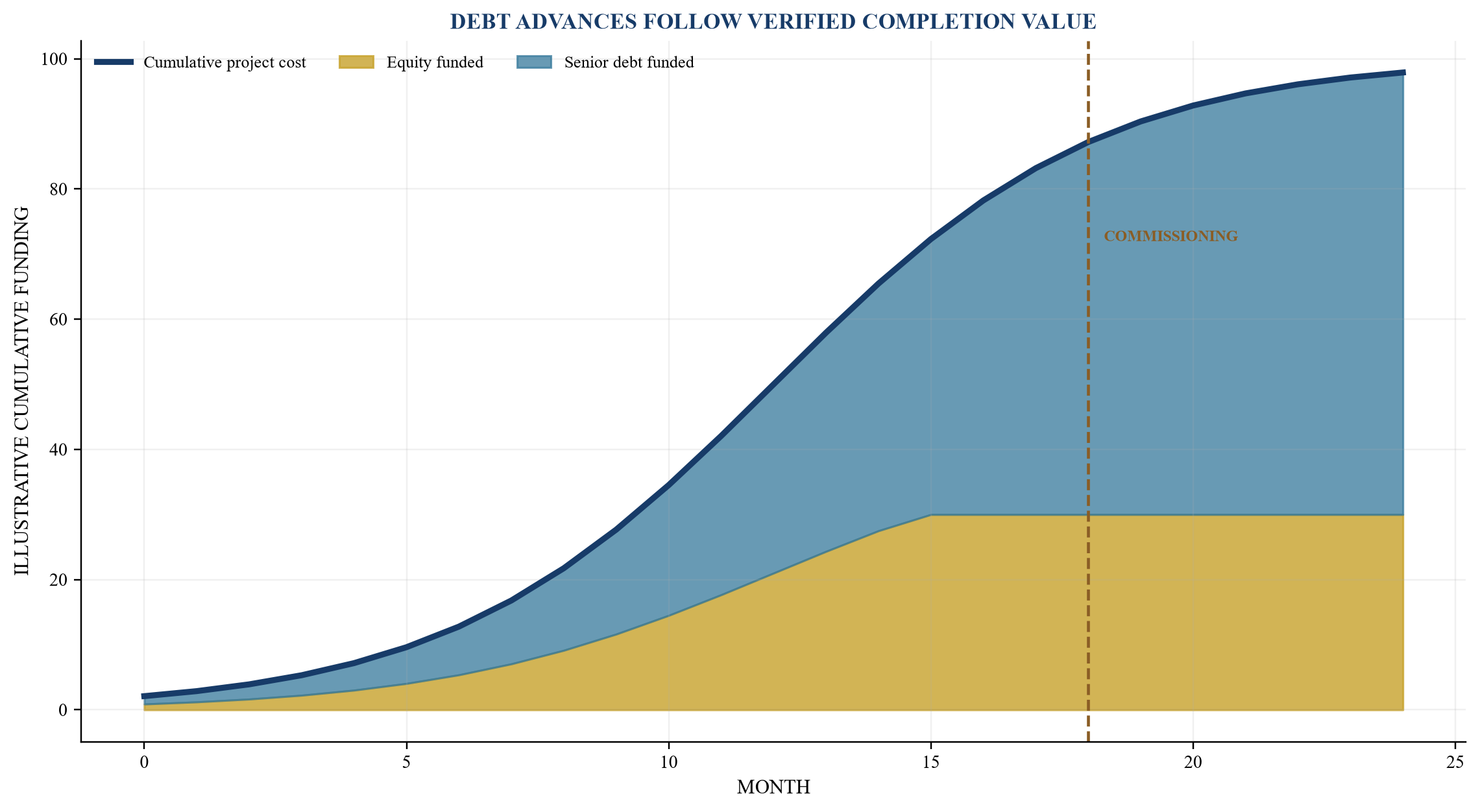
The facility preserves equity exposure and undrawn liquidity through commissioning and rent commencement.
9. Build a funded overrun and delay waterfall
The financing documents should define the order in which a shortfall is funded. Remaining contingency is used first for eligible cost. Contractor, vendor, utility or insurance recovery follows when timing and collectability are credible. Committed sponsor equity and standby support cover the next layer. Additional senior debt should require fresh underwriting.
Customer contributions should be treated according to their legal terms. A milestone payment can be delayed by a dispute. A termination payment can be capped or offset. The model should show the cash date and not merely the accounting receivable.
The support package should address cost and time. A sponsor can fund additional capex and fail to fund extended interest, utility charges or lease damages. The obligation should cover the defined cost-to-complete amount until financial completion.
Long-stop dates should preserve enough time for remedy. A customer long-stop can occur before the loan long-stop, leaving a completed project without a tenant. A utility long-stop can outlast equipment warranties. The integrated schedule should show these relationships.
Distribution lockout should continue until all completion tests, reserves and first collections are satisfied. Early release of sponsor support weakens the final commissioning period when technical, customer and cash risks converge.
10. Define technical and financial completion
Mechanical completion states that construction scope is installed. Technical completion should require successful integrated systems testing at defined load, redundancy, thermal conditions, controls, security and safety. It should also close material punch-list items and confirm permits and insurance.
Power completion should require the contracted delivery point, internal distribution, backup and switching to operate under test. A temporary feed or generator arrangement should be separately underwritten. Utility energisation without full internal testing does not establish customer-ready capacity.
Lease completion should require delivery under the customer agreement, acceptance or deemed acceptance, satisfaction of conditions and commencement of enforceable rent. The lender should identify customer installation and carrier dependencies between building completion and rent.
Financial completion should require a current final-cost forecast, funded remaining costs, replenished reserves, no material default, effective security, first collections and a forward coverage test. Stabilisation can require several months of collections and operating evidence.
The independent engineer, legal adviser and account bank should each certify their domain. One global completion certificate should reference the underlying evidence and unresolved exceptions. Waivers should state financial impact and compensating protection.
Table 4. Completion evidence matrix
| Gate | Primary evidence | Remaining risk | Lender test | Release consequence |
|---|---|---|---|---|
| mechanical | engineer certificate | punch list | no material operating constraint | limited contingency release |
| power | energisation and integrated load test | curtailment and ramp | contracted usable capacity | power reserve recalibration |
| customer | acceptance and effective rent | installation and disputes | enforceable billing | lease reserve release |
| operating | stable systems and service levels | early failure | defined test period | operating handover |
| financial | final cost, reserves and collections | refinance and concentration | forward coverage and no default | construction support release |
Financial completion follows physical, contractual and cash completion.
11. Treat concentration as a multi-dimensional risk
Tenant concentration is more than percentage of rent. It includes capacity, credit, term, renewal date, technology, fit-out, building, campus, utility node and end market. Two affiliates can represent one economic exposure. Several customers can depend on one cloud platform or one network route.
A single strong tenant can improve initial occupancy and simplify design. It can also create a binary rent commencement, a concentrated termination risk and a future renewal cliff. The customer may have negotiating power over expansions, service credits and modifications.
Digital Realty reported that its largest customer represented approximately 12 percent of total revenue at year-end 2025.[8] A project-level facility can be considerably more concentrated than a diversified public portfolio. Portfolio statistics should not be imported into a single-asset loan.
The lender should stress default, downgrade, delay, contraction and non-renewal. It should estimate downtime, conversion capex, broker fees, rent-free periods and market rent. The recovery period should reflect the amount of power released to the market and the technical specificity of the hall.
Concentration protection can include lower leverage, longer interest reserve, customer security, cash sweep, amortisation, renewal milestones, re-leasing reserve and sponsor support. The protection should begin before the event. A covenant triggered only after termination provides limited time to act.
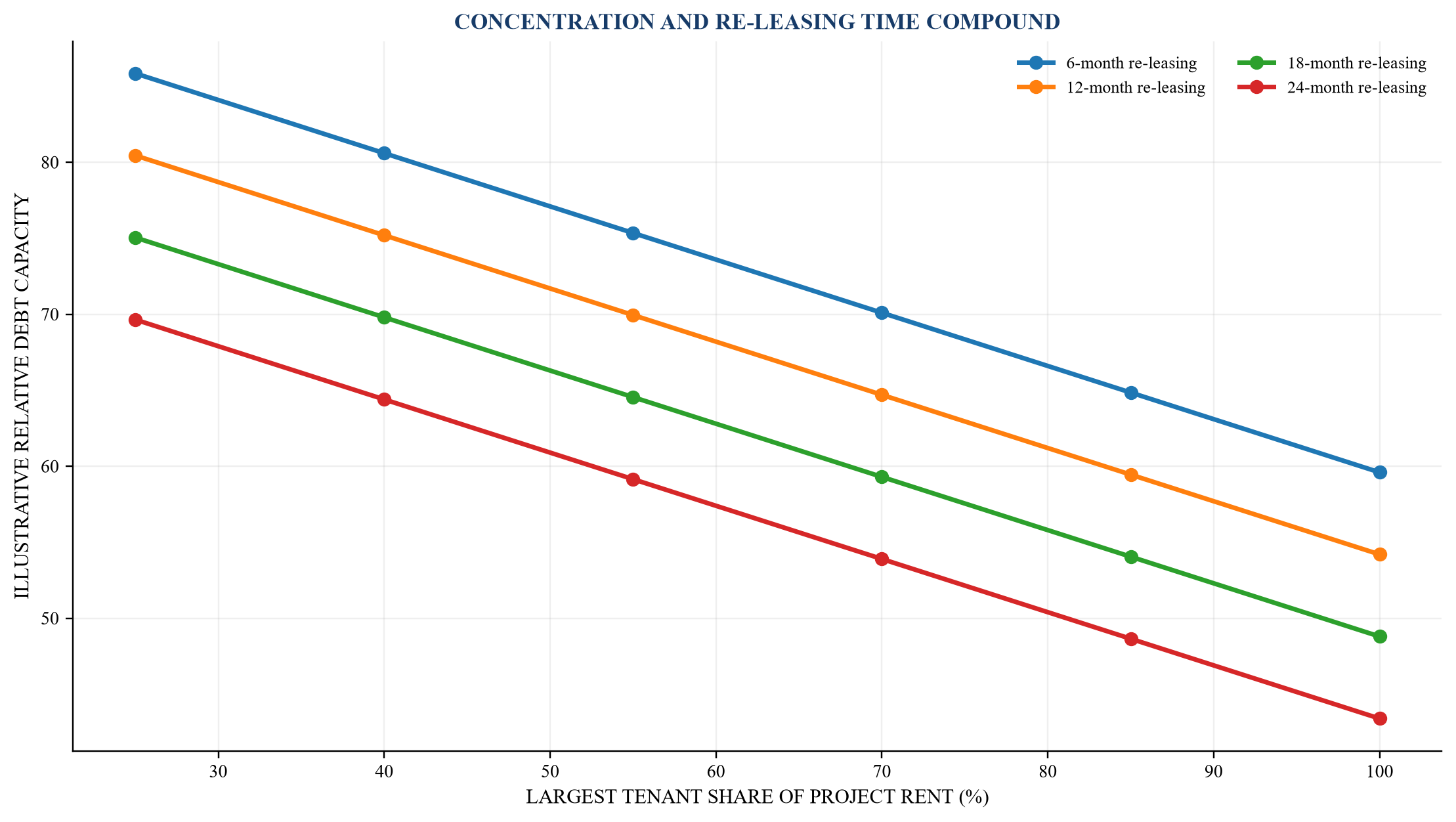
Illustrative debt capacity falls as tenant exposure and re-leasing delay rise.
12. Reconcile rent, power and operating cost
The operating model should begin with billable capacity by phase and customer. It should state contracted kilowatts or megawatts, commencement, ramp, base rent, escalation, metered power, operating-cost recovery, service credits and customer contributions.
Power revenue and cost can be passed through, marked up, fixed, indexed or embedded in rent. The model should reproduce the lease. A mismatch between customer pricing and utility tariff can create margin volatility. Demand charges and minimum utility payments can arise before customer utilisation.
The model should also include maintenance, staffing, security, insurance, property tax, network, water, fuel and capital replacement. Redundancy creates capacity that supports service and does not always produce rent. Efficiency assumptions should be reconciled with design and expected load.
Service-level credits and outages should be stressed. The financial effect can include rent credit, customer claim, reputational harm and termination. Insurance may exclude contract penalties. Reserve sizing should reflect contractual exposure.
Operating margins should be tested at lower utilisation and slower customer ramp. A fully pre-leased building can still experience delayed billing, fit-out overlap and utility charges. Debt service should rely on collected cash after operating requirements.
Table 5. Lease-to-cash reconciliation
| Item | Contract source | Model driver | Downside test | Control |
|---|---|---|---|---|
| base rent | executed lease | billable capacity and start date | delayed commencement | acceptance certificate |
| escalation | rent schedule | contractual index or step | capped increase | lease abstraction |
| power recovery | tariff and lease | consumption and pass-through | tariff mismatch | monthly reconciliation |
| operating recovery | lease schedule | recoverable cost | exclusion and cap | annual true-up |
| service credit | service levels | outage and performance | repeated incident | incident register |
| collections | invoices and bank data | payment timing | dispute or delay | controlled account |
Every revenue line should connect contractual capacity to billed and collected cash.
13. Size reserves around the actual risk periods
Construction contingency funds unknown construction cost. An interest reserve funds debt carry. A power-delay reserve funds the interval between building progress and energisation. A lease-commencement reserve funds the interval between technical completion and enforceable rent. A debt-service reserve protects the early operating period.
These reserves should not be combined without allocation rules. A shared reserve can be consumed by construction change and leave no liquidity for delayed billing. The documents should state purpose, size, funding, draw, replenishment and release.
Maintenance and capital reserves may be required after operation. Generators, batteries, cooling equipment, uninterruptible power systems and controls have service and replacement cycles. Customer density and technology change can accelerate capex.
The reserve model should incorporate the integrated schedule. If utility completion has a three-month range and customer acceptance can take two months, liquidity should cover their possible sequence. Correlated delays should be tested.
Letters of credit or guarantees can substitute for cash only when drawable, durable and matched to the obligation. Expiry and reduction should be controlled. A customer letter of credit that expires before rent commencement provides weak construction protection.
14. Control accounts and project cash
The construction account should receive senior debt and required equity and pay certified project cost. Customer deposits and contributions should enter controlled accounts where the lease permits. Insurance and contractor recovery should be applied to restoration or debt according to the documents.
After operations, customer collections should enter a lockbox. The waterfall should pay taxes and critical operating cost, required utility and network amounts, debt service, reserve top-ups, approved capital expenditure and distributions. Affiliate fees should be documented and subordinated where appropriate.
The lender should monitor billed capacity, cash collections, utility invoices and service credits. Accounting revenue can precede or differ from collected cash. Debt service depends on cash timing.
Cash traps should activate before payment default. Power milestone failure, budget shortfall, customer downgrade, delayed commencement, concentration breach, low coverage and refinancing shortfall can each retain cash. The cure should address the underlying cause.
An operating account map should include every bank, owner, currency, signatory, sweep and permitted withdrawal. A lease payment to an uncontrolled affiliate account weakens the project security package.
15. Build security around continuity
Security can include project-company equity, land or leasehold rights, buildings, equipment, receivables, accounts, insurance, material contracts and permits, subject to law and existing claims. The lender should confirm attachment, perfection, priority and enforcement requirements in the relevant state.
Direct agreements can support continuity with the utility, ground lessor, key contractors, operator and material customers. They can provide notice, cure, consent to assignment and replacement rights. The availability of direct agreements varies and should be established early.
Equipment title requires attention. Customer-owned servers and fit-out are not lender collateral. Utility-owned substations and lines may sit on project land. Leased equipment can have competing rights. The asset register should identify owner, location, serial number, vesting and lien status.
Step-in value depends on operating capability. Data centres require specialist staff, software, vendor support, security and customer relationships. An operator continuity plan, licences and records can matter more than a theoretical foreclosure right.
Recovery analysis should state the likely path: complete and lease, operate through a manager, sell the project, transfer the customer contract or sell powered land. Each path has time, cost, consent and market constraints.
16. Design covenants from physical causes
Construction covenants should track budget, schedule, power, procurement, permits, lease conditions and sponsor support. Operating covenants should track capacity, utilisation, service levels, customer credit, collections, coverage, liquidity and capital maintenance.
The dashboard should have watch, distribution-lock, mandatory-cure and default levels. A declining schedule float can trigger enhanced reporting. A missed utility milestone can require a recovery plan and reserve. A customer downgrade can trap cash or require replacement security.
Coverage ratios should use collected project cash and the correct period. A forward test can capture lease expiry and known power cost changes. A historical test can confirm operating performance. Both can be useful.
Concentration covenants should recognise the project's approved structure. A single-tenant build should not be in default on day one. It should have tailored renewal, credit and re-leasing protections. A multi-tenant project can use maximum exposure and correlated-affiliate limits.
Reporting frequency should follow risk. Construction and power milestones can require monthly reports. Budget or customer events require prompt notice. Operating power, billing and service metrics can be monthly, with audited annual information.
Table 6. Covenant and remedy ladder
| Indicator | Watch | Distribution lock | Mandatory cure | Default |
|---|---|---|---|---|
| power delivery | milestone float narrows | critical date at risk | funded recovery plan | service right terminated |
| cost to complete | contingency declines | minimum headroom breached | sponsor funds shortfall | uncured funding gap |
| construction | minor delay | long-stop buffer breached | schedule recovery | long-stop failure |
| pre-lease | condition delayed | rent commencement at risk | security or reserve | material termination |
| concentration | credit weakens | downgrade or renewal threshold | cash sweep and re-leasing plan | uncured payment default |
| coverage | forecast approaches buffer | threshold breached | equity, reserve or prepayment | debt-service default |
Remedies intervene while time, liquidity and sponsor support remain available.
17. Stress combined construction and leasing events
Stress tests should reflect causal sequences. A network delay postpones energisation, extends construction interest and can trigger customer remedies. A customer design change increases equipment cost and can delay acceptance. A tenant downgrade reduces take-out proceeds and can increase required equity.
At minimum, the lender should test utility delay, substation cost increase, equipment delay, construction overrun, failed integrated test, customer change, delayed acceptance, tenant termination, lower market rent, longer re-leasing, higher power cost, interest-rate increase and wider exit yield.
Combined scenarios matter. A six-month power delay plus a customer termination can leave a nearly complete bespoke building without cash. A lower valuation plus remaining capex can create a refinancing gap even when operations are sound.
Reverse stress should identify the event combination that exhausts liquidity or breaches maturity. It should show how much time remains for sponsor equity, re-leasing or sale. A maturity covenant triggered twelve months before expiry can create an actionable runway.
Management actions should be separated by control. The project can defer later phases, redesign standard capacity, slow discretionary spend and begin re-leasing. Utility acceleration, customer waiver, regulatory approval and lender extension require third parties.
18. Prove the take-out before construction closes
Construction debt often expects repayment from term debt, sale, portfolio finance or capital markets. The take-out should be modelled as a separate underwriting event. It depends on completed capacity, effective rent, customer credit, remaining term, concentration, operating evidence and valuation.
The model should bridge total project cost to stabilised value and available term debt. It should deduct remaining capex, leasing cost, reserve requirements, transaction cost and concentration haircut. It should then compare proceeds with construction debt and accrued amounts.
Exit yield and leverage should be stressed together. A wider yield reduces value. A concentrated or partially stabilised project may also receive a lower loan-to-value ratio and stronger debt-service requirement. Applying only one stress understates the gap.
Digital Realty's 2025 filing described more than $3 billion of equity commitments capable of supporting approximately $10 billion of data-centre investment through one fund structure.[8] Institutional capital can support development at scale, while each project still requires a credible route from construction exposure to stabilised investment.
The lender should require a take-out update at defined milestones. It should refresh market debt terms, hedging, value, customer status, completion and proceeds. A minimum refinancing-coverage test can trigger equity, cash retention, asset sale or amortisation before maturity.
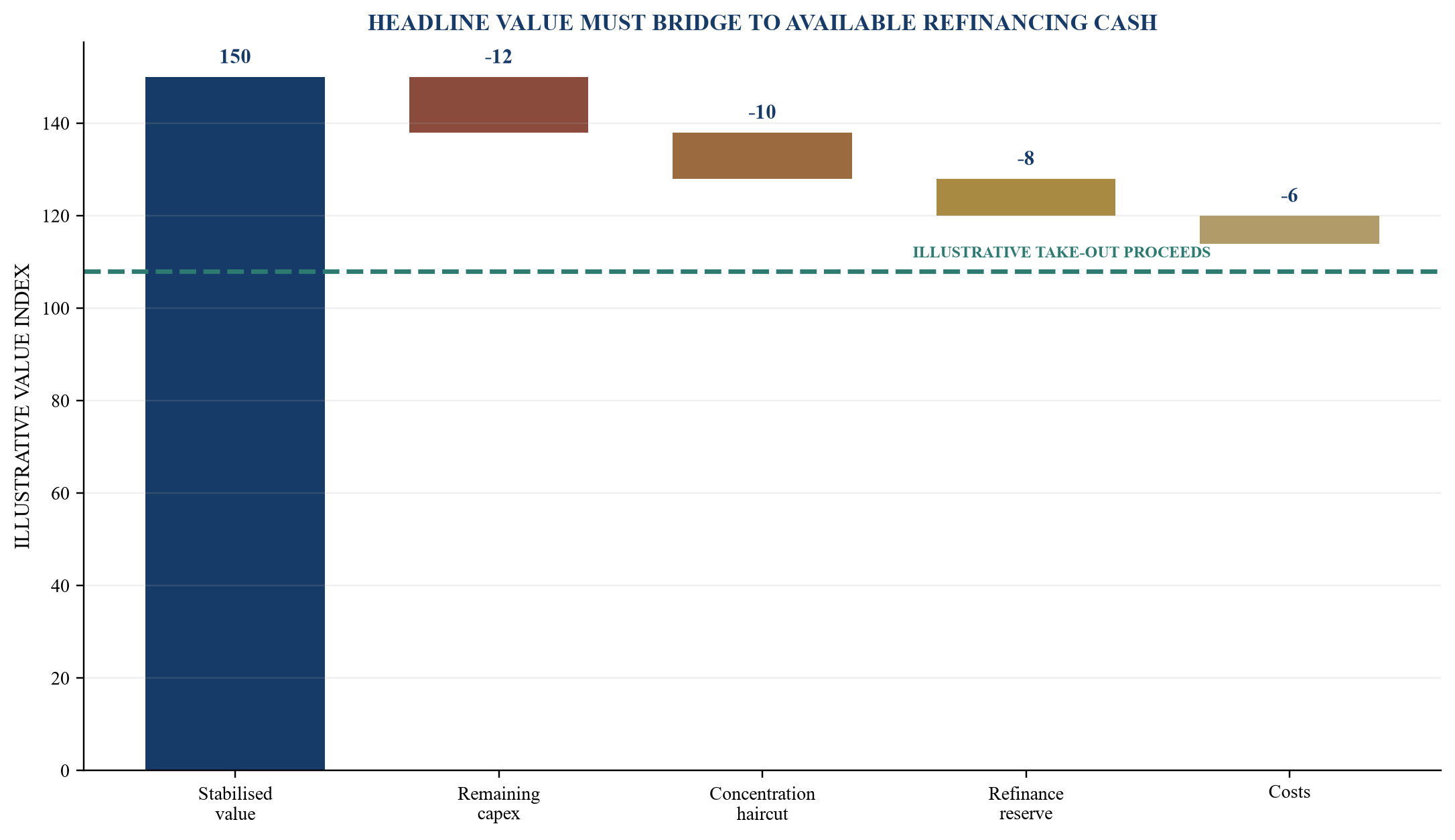
Remaining capex, concentration and refinancing terms can create a gap between headline value and repayable construction debt.
19. Run a 15-day construction-credit diagnostic
Day one confirms entities, land and the financing perimeter. Day two maps zoning, permits and environmental matters. Day three maps utility, grid and generation rights. Day four reconciles external and internal power schedules. Day five reviews long-lead procurement.
Day six reviews design, customer specification and change control. Day seven abstracts every pre-lease and credit-support document. Day eight reconciles budget, commitments and cost to complete. Day nine tests commissioning and acceptance. Day ten builds the lease-to-cash model.
Day eleven analyses concentration and re-leasing. Day twelve maps security, accounts and continuity. Day thirteen runs combined downside cases. Day fourteen constructs the take-out bridge. Day fifteen produces the credit memo, issue ledger, condition list and 120-day execution plan.
Issues should be classified as missing evidence, curable weakness, structural constraint and value opportunity. An unsigned utility amendment is missing evidence. An expiring customer letter of credit is curable. A non-transferable power right can be structural. A standardised fit-out can create residual value.
Every issue should change the financing. It can alter advance, equity, reserve, condition, covenant, support, maturity, price, security or the decision to stop. This converts diligence into construction-credit design.
20. Execute through a 120-day financing plan
Days one to twenty establish governance, advisers, data room, asset register, baseline budget and integrated schedule. The sponsor confirms equity, support, target leverage and decision rights. Utility and customer documents are frozen for diligence.
Days twenty-one to fifty complete technical, utility, market, lease, legal, environmental, insurance, tax and financial diligence. The independent engineer verifies design, procurement, progress, cost to complete and commissioning. Customer credit and concentration are assessed.
Days fifty-one to eighty negotiate term sheet, draw mechanics, reserves, completion, security, account control, covenants and take-out tests. Loan and project documents use consistent definitions for power, capacity, completion and rent commencement.
Days eighty-one to one hundred and ten close conditions, direct agreements, permits, insurance, hedging, equity funding, reserves, security and account control. The first draw is simulated against invoices, evidence and funds flow.
Days one hundred and eleven to one hundred and twenty execute funding and begin live reporting. The schedule, budget, power dashboard, customer conditions and take-out bridge are updated from current evidence. Residual issues receive named owners and dates.
21. Conclusion
US data-centre demand creates a substantial development and financing opportunity. It also concentrates several difficult risks inside one construction period: scarce power, network timing, long-lead equipment, customer-specific design, conditional leases, large counterparties and a refinancing market that values stable cash.
The credit sequence is disciplined. Define the powered operating system. Separate market demand from project demand. Establish the legal maturity of power rights. Convert the power schedule into draw conditions. Score the pre-lease. Maintain a current cost-to-complete certificate. Fund through a controlled curve and overrun waterfall. Define technical, customer and financial completion. Stress concentration. Prove the take-out.
Power, pre-leasing and concentration should be analysed together. Strong power without a durable customer can produce stranded capacity. A strong customer without delivered power can create termination and damages. A fully leased single-tenant asset without refinancing headroom can create a maturity gap.
Construction debt becomes defensible when the lender can trace every advance to durable completion value and can identify the cash, support and remedy available when the schedule changes. That evidence-led structure gives sponsors a clearer financing path and gives lenders an earlier route to intervention.
References
- US Department of Energy, “DOE Releases New Report Evaluating Increase in Electricity Demand from Data Centers,” 20 December 2024, https://www.energy.gov/articles/doe-releases-new-report-evaluating-increase-electricity-demand-data-centers.
- Lawrence Berkeley National Laboratory, “2024 United States Data Center Energy Usage Report,” December 2024, https://eta-publications.lbl.gov/sites/default/files/2024-12/lbnl-2024-united-states-data-center-energy-usage-report.pdf.
- North American Electric Reliability Corporation, “2025 Long-Term Reliability Assessment,” https://www.nerc.com/globalassets/our-work/assessments/nerc_ltra_2025.pdf.
- Federal Energy Regulatory Commission, “FERC Directs Nation's Largest Grid Operator to Create New Rules to Embrace Innovation and Protect Consumers,” 18 December 2025, https://ferc.gov/news-events/news/fact-sheet-ferc-directs-nations-largest-grid-operator-create-new-rules-embrace.
- PJM Interconnection, “2025 Regional Transmission Expansion Plan,” https://www.pjm.com/library/reports-notices/rtep-documents.
- PJM Interconnection, “2025 Year in Review: Planning Prepares for Burgeoning Electricity Demand,” 8 January 2026, https://insidelines.pjm.com/2025-year-in-review-planning-prepares-for-burgeoning-electricity-demand/.
- Dominion Energy Virginia, “2025 Integrated Resource Plan Update,” https://www.dominionenergy.com/about/our-company/irp.
- Digital Realty Trust, Inc., “Annual Report on Form 10-K for the year ended 31 December 2025,” US Securities and Exchange Commission, https://www.sec.gov/Archives/edgar/data/1297996/000110465926015365/dlr-20251231x10k.htm.
- Digital Realty Trust, Inc., “Second Quarter 2026 Supplemental Operating and Financial Data,” US Securities and Exchange Commission, https://www.sec.gov/Archives/edgar/data/1297996/000110465926086270/dlr-20260723xex99d1.htm.
- Equinix, Inc., “Annual Report on Form 10-K for the year ended 31 December 2025,” US Securities and Exchange Commission, https://www.sec.gov/Archives/edgar/data/1101239/000110123926000032/eqix-20251231.htm.
- Iron Mountain Incorporated, “Fourth Quarter 2025 Supplemental Financial Information,” US Securities and Exchange Commission, https://www.sec.gov/Archives/edgar/data/1020569/000102056926000009/q42025_final.htm.
- US Department of Energy, Federal Energy Management Program, “Data Center Energy Efficiency,” August 2025, https://www.energy.gov/sites/default/files/2025-08/femp-data-centers-fact-sheet-2025.pdf.
- US Department of Energy, Office of Electricity, “Clean Energy Resources to Meet Data Center Electricity Demand,” https://www.energy.gov/oe/clean-energy-resources-meet-data-center-electricity-demand.
- Office of the Comptroller of the Currency, “Commercial Real Estate Lending,” Comptroller's Handbook, https://www.occ.treas.gov/publications-and-resources/publications/comptrollers-handbook/files/commercial-real-estate-lending/index-commercial-real-estate-lending.html.
- Federal Deposit Insurance Corporation, “Commercial Real Estate Lending,” Risk Management Manual of Examination Policies, https://www.fdic.gov/resources/supervision-and-examinations/examination-policies-manual/section3-2.pdf.
- Board of Governors of the Federal Reserve System, FDIC and OCC, “Policy Statement on Prudent Commercial Real Estate Loan Accommodations and Workouts,” June 2023, https://www.federalreserve.gov/newsevents/pressreleases/files/bcreg20230629a1.pdf.
- US Environmental Protection Agency, ENERGY STAR, “Data Centers,” https://www.energystar.gov/buildings/resources-audience/data-center-owners-and-operators.
- National Institute of Standards and Technology, “Contingency Planning Guide for Federal Information Systems,” Special Publication 800-34 Rev. 1, https://csrc.nist.gov/pubs/sp/800/34/r1/upd1/final.
