

Introduction
Satellites create value only when commands, telemetry and payload data move reliably between orbit and users on Earth. A ground-station network provides the physical antennas, radio-frequency chain, control software, terrestrial backhaul, security controls and operational staff required for that exchange. For low-Earth-orbit missions, each site sees a spacecraft for a limited portion of each orbit. Geography, antenna capability and scheduling therefore determine how quickly data can be delivered and how frequently operators can command a mission.
The market has moved from mission-specific infrastructure toward shared networks and managed services. Commercial providers aggregate their own sites with partner antennas, expose scheduling through software and connect data directly to cloud environments. This can reduce a satellite operator's capital requirement and shorten deployment time. It also creates a fragmented acquisition field in which local operators, specialist antenna assets, mission-software companies and cloud-connected networks may be combined.
This paper addresses acquisitions, add-ons, joint ventures and platform investments involving ground-station operators. It asks how a buyer should value global coverage, software-defined operations, customer switching costs and regulatory access. It does not value a named company or recommend a security. Every financial quantity in the worked case is illustrative and must be replaced by verified transaction evidence.
1 Define the acquisition perimeter
A ground-station company can contain several businesses that look similar in a presentation and behave differently in cash flow. The perimeter may include owned land, leased sites, antennas, radomes, radio-frequency equipment, modems, software-defined radios, network operations centres, scheduling software, mission-control services, cloud connectivity, partner capacity, licences, security accreditations and customer contracts. The buyer should identify which assets are owned, leased, licensed or accessed through a revocable partner arrangement.
Site ownership does not automatically convey spectrum authority, planning permission, backhaul, export approvals or customer accreditation. An antenna may sit on third-party land under a lease that terminates on change of control. A network map may include partner sites governed by non-exclusive agreements. Software may depend on open-source components, third-party modem licences or customer-furnished interfaces. The transaction perimeter must reconcile these dependencies before value is assigned.
The buyer should prepare a legal and operating map for every node. It should identify the site entity, property right, regulatory authorisation, frequency bands, antenna capability, network connection, security level, operating responsibility, partner restrictions and customer use. Value should attach to the package that remains executable after closing. Assets that cannot transfer, operate or serve the intended customer should remain outside the base valuation.
2 Define global coverage as an executable service
Global coverage is often represented by points on a map. A useful valuation definition is stricter. Coverage exists when a specific satellite can establish an authorised contact at the required frequency, elevation, data rate and time; the station is available; the data path is configured; the customer has completed onboarding; and the resulting service satisfies acceptance and security requirements. The executable contact is the atomic unit of network value.
The buyer should calculate coverage by mission profile rather than by site count. A polar Earth-observation constellation may value high-latitude locations because they create frequent passes. An equatorial mission requires a different geometry. A launch-and-early-orbit campaign needs rapid command access and operational staffing. A high-rate payload may require X-band or Ka-band capability, wide bandwidth, strong backhaul and weather diversity. A network that is valuable to one mission can be weak for another.
Coverage should therefore be modelled as feasible contact opportunities, available minutes, delivered data and command resilience. The model should show owned, contracted-partner and opportunistic capacity separately. It should also record restrictions arising from local licences, customer authorisations, site masks, interference, weather, maintenance and security rules. This converts a marketing map into a serviceable network schedule.
3 Separate antenna inventory from saleable capacity
Antenna count is an incomplete operating metric. Two antennas can differ materially in aperture, mount speed, frequency support, polarisation, bandwidth, tracking accuracy, transmit power, modem capability, redundancy and maintenance state. An antenna that cannot support a target waveform or data rate does not contribute capacity for that customer. A site with one feed chain may also be unable to serve concurrent missions even when several dishes are present.
The buyer should create a capability register for every antenna. It should capture physical specifications, approved frequency ranges, transmit and receive status, modem and software-defined-radio support, calibration history, mean time between failures, spares, maintenance windows and usable backhaul. Capacity should then be measured in feasible contact minutes by mission class. The denominator should remove blocked time, maintenance, regulatory exclusions and operational reserves.
Saleable capacity must reconcile to schedules and invoices. The buyer should compare theoretical visibility with requested contacts, scheduled contacts, completed contacts, accepted contacts and billed contacts. It should identify why opportunities were lost: geometry, customer choice, lack of compatible equipment, conflict, outage, weather, licensing or staffing. The gap between physical inventory and accepted service is the central utilisation bridge in a ground-station valuation.
4 Test the software-defined network claim
Software-defined ground infrastructure can move modulation, demodulation, decoding, routing and mission configuration from dedicated hardware into software running on common compute. A control plane can abstract antenna capability, automate scheduling, configure signal chains and deliver data to cloud storage or processing. This architecture can reduce onboarding effort and allow one network to support more missions, but the buyer must test which functions are genuinely software-defined and which remain constrained by hardware.
The diligence team should trace a customer request through the complete operating path. It should review application programming interfaces, mission profiles, ephemeris ingestion, conflict resolution, antenna configuration, radio control, data processing, encryption, delivery and billing. It should identify manual interventions, customer-specific code, unsupported legacy systems and single points of failure. Automated screenshots and architecture diagrams provide context; production logs and repeated service outcomes provide evidence.
Software value depends on repeatability. A platform that onboards a standard mission in days, schedules contacts without manual conflict resolution and delivers data through common interfaces can release operating leverage. A portal sitting above separate site systems can preserve fragmentation. The acquisition model should value verified automation, portable configurations, observability and low marginal onboarding effort rather than the label attached to the technology stack.
5 Treat regulatory access as a site-specific right
Ground stations operate within national and international spectrum frameworks. In the United States, satellite and earth-station transmissions generally require Federal Communications Commission authority under Part 25. In the United Kingdom, Ofcom authorises permanent and non-geostationary gateway earth stations and requires coordination to control harmful interference. International Telecommunication Union filings, satellite licences and national approvals interact, although one approval does not substitute for another. [2][3][4][11]
The buyer should review each authorisation against actual operations. It should compare licensee, coordinates, equipment, frequency, emission, power, antenna pattern, elevation limits and authorised services. It should identify renewal dates, pending modifications, conditions, fees, coordination agreements, reporting obligations and historic non-compliance. Customer-specific missions can require additional approvals even when the station itself is licensed.
Regulatory value is durable only when rights survive control change and match the intended service plan. A roll-up may create a stronger licensing function and reusable application process, but it also concentrates compliance exposure. The transaction model should deduct costs and delays for modifications, new bands, site moves and customer onboarding. Consideration tied to a site can be deferred until the necessary authority is effective and a representative contact has been completed.
6 Model network geometry and contact probability
LEO satellite visibility is governed by orbital parameters, station location, elevation constraints and antenna performance. A station's contribution is therefore time-dependent. The buyer should run orbit propagation for representative customer missions and compute visible passes, duration, elevation and timing. These opportunities should be adjusted for site masks, antenna capability, licensing and schedule availability.
The model should distinguish average coverage from critical coverage. A remote-sensing customer may value the earliest downlink after an image is captured. A communications constellation may value continuous gateway diversity. A launch customer may require command opportunities during specific early orbits. A government customer may require sovereign or geographically separated routes. Network value can therefore arise from reducing maximum latency, improving contact frequency or providing a credible backup rather than increasing aggregate minutes alone.
Acquisition synergies should be calculated at the customer-mission level. Adding a site that duplicates existing visibility can create limited incremental value. Adding a high-latitude or strategically located node can materially improve service. The model should compare pre-deal and post-deal contact probability, latency and resilience for contracted and target missions. This prevents a roll-up from valuing geographic breadth that does not improve customer outcomes.
7 Price scheduling priority and congestion
Ground-station capacity is perishable. An unused pass cannot be stored, while two satellites seeking the same antenna at the same time create a conflict. The economic value of an additional node depends on the distribution of demand across time, location, band and mission priority. Average utilisation can conceal peak congestion that causes failed requests and customer dissatisfaction.
The buyer should obtain request-level scheduling data. It should measure requested minutes, offered windows, scheduled minutes, reschedules, cancellations, conflicts and completed contacts. The analysis should segment standard service, reserved capacity, launch support, emergency command and dedicated antenna arrangements. Pricing and service levels should reflect the degree of priority and flexibility provided.
Congestion value can be tested through simulation. The combined network should replay historical requests using common scheduling rules and show which conflicts are resolved, which contacts move and how much accepted service increases. This evidence supports a synergy claim more credibly than adding nominal antenna hours. The buyer should also test customer behaviour: some users can move a pass by several minutes or accept another site; others require a specific geometry and cannot substitute.
8 Measure pass success and data delivery
Operational quality begins with contact completion and ends with accepted delivery. A scheduled pass can fail because of ephemeris error, antenna fault, configuration error, interference, weather, backhaul, customer spacecraft state or software. The buyer should distinguish causes that the network controls from external causes and apply the contract's service definition.
The operating ledger should include acquisition success, completed contact duration, data volume, packet or frame quality, command confirmation, delivery latency, incident severity and customer acceptance. It should retain the original schedule and every change. A network can report high availability while repeatedly failing the high-value contacts a customer needs. Service metrics should therefore be weighted by mission criticality, revenue and contractual consequence.
Pass-success improvement is a post-close value lever. Standard configuration, automated validation, predictive maintenance and cross-site failover can reduce avoidable failures. The model should recognise this value when root causes are observable, the integration plan is funded and performance can be independently measured. Performance consideration can use accepted-contact success and data-delivery metrics, provided the purchase agreement defines exclusions and customer-caused events precisely.
9 Test customer onboarding and switching costs
Ground-service relationships can be sticky because onboarding requires technical integration, frequency coordination, licensing, testing, security review and operational rehearsal. A customer may embed the provider's application programming interfaces and mission procedures in its flight operations. This creates potential switching costs, though it does not guarantee retention. Customers can multi-source, build dedicated sites or migrate to cloud-linked competitors.
The buyer should map the onboarding process for every significant customer. It should record elapsed time, engineering effort, non-recurring revenue, licences, test contacts, custom software and security accreditation. It should identify which work is reusable across missions and which depends on the customer's spacecraft. Retention analysis should separate ongoing operational missions from launch-only, demonstration and funded development work.
Switching value should be evidenced through renewals, expansion, share of customer passes and behaviour after price or service changes. A contract with short termination rights and little minimum commitment offers limited protection. A multi-year reservation with integrated workflows and high service performance offers stronger evidence. The model should probability-weight renewal and avoid treating technical inconvenience as an enforceable customer asset.
10 Reconcile revenue to the operating event
Ground-station revenue can arise from antenna minutes, passes, data volume, dedicated capacity, network management, mission operations, integration, engineering and hardware. Each stream has different margin, recurrence and working-capital characteristics. The buyer should map revenue to the operating event that creates the invoice and customer acceptance.
Usage revenue should reconcile from request and contact logs to billing records, invoices and cash receipts. Reserved-capacity revenue should be tested against minimum commitments, make-up rights, service credits and termination provisions. Dedicated-site contracts should separate pass-through capital, managed-service margin and residual asset ownership. Integration revenue may repeat with each spacecraft, but it should not be treated as subscription revenue unless the contract supports that conclusion.
The model should calculate contribution by customer, site, band and service. Terrestrial backhaul, partner fees, operator labour, cloud processing, spectrum costs, maintenance and service credits can materially reduce gross margin. Revenue growth that consumes scarce peak capacity at weak contribution can destroy value. The central metric is collected contribution from accepted service, supported by a traceable operating ledger.
11 Distinguish owned network from partner coverage
Many networks extend geographic reach through partner antennas. This can be capital-efficient and valuable, especially where licensing, land or security constraints make ownership difficult. Partner coverage also introduces dependencies in availability, pricing, performance, data handling and customer control. A buyer should not value a partner point like an owned and transferable station.
Every partner location should be classified by contract term, exclusivity, committed capacity, service level, termination rights, change-of-control provisions, pricing, data rights and direct-customer restrictions. The buyer should verify whether the partner relationship permits resale to the target customer and whether local approvals cover that use. It should reconcile partner invoices to completed contacts and customer revenue.
The roll-up model should separate owned gross capacity, contracted partner capacity and best-efforts marketplace access. Durable partner rights can support network value when they fill geographic gaps and integrate into the common control plane. Short, non-exclusive or revocable access should be valued through current contribution and renewal probability. Consideration should not include permanent coverage for capacity that can disappear on notice.
12 Evaluate cloud and terrestrial integration
Ground networks increasingly deliver data directly into cloud compute and storage. AWS describes a managed service in which customers schedule antenna time, configure mission profiles and route data to computing or object storage. Microsoft has described integrations with partner ground networks and cloud services. These architectures can shorten time to insight and reduce separate data-transfer steps. [5][6][7][12][13]
The buyer should inspect the full data path. It should measure antenna-to-edge, edge processing, terrestrial backhaul, cloud ingress, customer delivery, redundancy and observed latency. It should review who pays cloud, egress and private-connectivity costs; where data is decrypted; and which regions or sovereign environments are supported. Cloud adjacency has little value when the service still depends on slow, fragile or expensive links from the antenna site.
Integration value can arise from common interfaces, lower deployment friction and access to adjacent analytics. It can also create concentration in a cloud provider and expose margin to pricing changes. The valuation should separate customer willingness to pay for the managed outcome from the provider's infrastructure cost. Portability, multi-cloud support and contractual control of data pathways should be part of the synergy and risk analysis.
13 Value mission software and interoperability
A software layer can integrate heterogeneous antennas when it normalises capability descriptions, mission profiles, scheduling, command controls, data formats and operational telemetry. The relevant evidence is the number and diversity of sites and missions that run through the same maintained code path. Separate adapters and manual procedures may still be required, but the buyer should know where complexity resides.
The diligence team should inventory protocols, radio interfaces, application programming interfaces, data formats, timing systems and security boundaries. It should examine version control, deployment automation, test coverage, incident history, configuration management and customer-specific forks. Industry standards such as Consultative Committee for Space Data Systems service interfaces and VITA Radio Transport can improve portability, though implementation and conformance still require testing. [14][15]
Software platform value should be tied to measurable outcomes: onboarding time, configuration reuse, operator-to-contact ratio, automated recovery, release frequency and incident reduction. Intellectual-property ownership, open-source obligations and source-code continuity must be established. A roll-up that acquires incompatible stacks can face years of integration expense. The model should deduct this cost before recognising software-driven operating leverage.
14 Test cyber security and mission assurance
Ground systems are part of a mission's command and data chain. Compromise can expose payload data, disrupt operations or create unauthorised command paths. The buyer should treat cyber security as an operating capability and transaction condition rather than a generic information-technology checklist. Government and critical missions can impose additional accreditation, personnel, location and supply-chain requirements.
The review should map identity, privileged access, network segmentation, cryptographic boundaries, key management, software supply chain, remote maintenance, logging, incident response and recovery. It should test whether customer environments are isolated and whether partner sites meet equivalent controls. NIST zero-trust guidance and CISA performance goals provide useful control references, but compliance statements require evidence from architecture, configuration and testing. [16][17]
Cyber findings can affect value through remediation cost, delayed accreditation, restricted customers, contractual liability and service interruption. The transaction should preserve incident-response capability during integration. High-risk system changes can be sequenced after access controls and monitoring are stabilised. Earnout metrics should never encourage throughput at the expense of security controls or regulatory obligations.
15 Assess sovereign and defence requirements
Government and defence customers may require sovereign data handling, cleared personnel, domestic ownership, export-controlled technology, protected facilities and assured access during conflict or emergency. A global commercial network can be attractive because it adds resilience, although some nodes or partner arrangements may be unusable for sensitive missions.
The buyer should classify each contract and site by security domain, nationality restriction, data residency, personnel clearance and foreign-ownership conditions. It should identify whether network software can segregate missions and whether control functions can be operated from an approved location. A change of control may require customer consent, foreign-investment review or mitigation agreements.
Sovereign capability can support premium value when it is evidenced by transferable accreditation, operating performance and contracted demand. It can also increase fixed cost and limit integration. The valuation should model secure and commercial operations separately where necessary. Synergies that would combine infrastructure or staff across restricted boundaries should remain outside the base case until the relevant authority approves the operating design.
16 Model site economics and replication cost
A station's economics include land or lease cost, civil works, antenna and radio-frequency equipment, radome, power, cooling, backhaul, security, maintenance, spares, licensing and staff. Replacement cost provides a useful cross-check, but it does not equal economic value. A newly built site still needs approvals, integration, customers and operating history.
The buyer should build a site-level profit and loss statement. Revenue and partner allocations should be matched to actual contacts. Shared network software, network-operations-centre cost and commercial overhead should be allocated transparently. Maintenance capital should reflect asset age, duty cycle, environmental exposure and obsolescence. Sites with low current utilisation can be strategic if they create unique coverage, but the value claim should identify the customers and service outcomes they enable.
Replication analysis should estimate elapsed time as well as cash. Land, planning, frequency coordination, equipment lead times, construction, testing, customer approval and accreditation can create a multi-year path. This supports scarcity value only when the existing site rights and capability transfer. The model should avoid paying replacement cost for redundant or commercially irrelevant equipment.
17 Analyse environment, interference and resilience
Ground-station performance depends on physical environment. Terrain and buildings create elevation masks. Radio-frequency interference can reduce usable bands or require coordination. Rain can impair higher-frequency links. Power, cooling, fibre and road access can fail. Natural hazards and political events can interrupt a location. AWS documents site masks that reflect terrain, interference and legal authorisations, illustrating why nominal visibility differs from usable service. [18]
The diligence team should review spectrum surveys, interference logs, weather history, link budgets, outage records, power redundancy, backhaul diversity, physical security and disaster recovery. It should test whether network scheduling can move service to another station without breaching customer requirements. Backup value depends on technical compatibility and available capacity during the same disruption.
Resilience should be quantified through scenario analysis. The model can remove a site, backhaul provider, cloud region or critical supplier and recalculate accepted contacts, latency and revenue. A roll-up creates value when geographic and technical diversity reduces concentrated failure. It creates hidden risk when apparently diverse nodes share one network-operations centre, software dependency, fibre provider or equipment vendor.
18 Test workforce and operating control
Ground networks combine specialist engineering with continuous operations. Key skills include radio-frequency engineering, satellite dynamics, mission integration, network software, licensing, cyber security and incident response. Automation can reduce routine labour, but expert intervention remains important during anomalies, launches and new-mission onboarding.
The buyer should map critical roles, shifts, clearances, location requirements, contractor dependence and succession. It should review operating procedures, escalation paths, training records, change control and incident post-mortems. A founder or chief engineer may carry undocumented knowledge about licences, customer configurations or partner relationships. Retention should focus on transferable capability and defined transition work.
Operating leverage should be measured carefully. The combined network may support more contacts per controller through common tooling, although integration initially increases workload. The model should phase productivity benefits after systems, procedures and training are implemented. Retention consideration can be linked to documented knowledge transfer, platform migration and service continuity rather than continued employment alone.
19 Conduct customer-level commercial diligence
Ground-service demand depends on satellite deployment, mission funding, launch success, spacecraft health and customer financing. A contract can be signed while the constellation remains unfunded or delayed. The buyer should therefore connect every material revenue forecast to a verified mission schedule and customer capacity to pay.
Customer diligence should cover spacecraft in orbit, funded satellites, launch manifests, frequency approvals, expected data volumes, ground architecture, alternative providers and internal-build plans. It should reconcile pipeline stages to evidence and remove duplicate opportunities across the acquired companies. Customer concentration should be measured by revenue, contribution, peak capacity, receivables and strategic dependence.
Reference calls should test service quality, renewal intent, integration effort, procurement plans and reaction to the transaction. The buyer should avoid leading questions and document conditions attached to positive statements. A customer may value broader coverage while resisting migration to a new portal or pricing model. Commercial synergies should enter the base case only when the combined offer solves a verified requirement and an accountable customer process exists.
20 Build a clean stand-alone forecast
A credible roll-up begins with stand-alone forecasts for each target. Revenue should be built from contracted commitments, expected contacts, capacity availability and customer mission schedules. Costs should include site operations, partner fees, backhaul, cloud, staff, maintenance, licensing, insurance and central overhead. Working capital should reflect customer prepayments, receivables, partner settlement and capital spares.
Forecasts should use common definitions. Completed contacts, accepted contacts, minutes, data volume, utilisation, recurring revenue and contribution must mean the same across companies. Historic results should be restated where necessary. The buyer should separate organic improvement already funded by the seller from integration benefits created by the transaction.
Downside cases should model launch delay, satellite failure, contract termination, site outage, regulatory delay, integration slippage and price pressure. Capacity and cost should respond consistently. If a constellation slips, reserved revenue, partner commitments and staffing may not move together. The financing plan should cover the cash trough under the downside case and preserve critical maintenance and security work.
21 Value the software and network as separate layers
A combined ground-station company can be valued in three layers. The first is evidenced site and service cash flow. The second is software and operating leverage supported by repeatable automation and customer adoption. The third is strategic option value from new geographies, bands, customers or adjacent services. Each layer requires different evidence and discounting.
Site cash flow can be valued through discounted cash flow and transaction multiples, adjusted for maintenance capital and licence durability. Software value should reflect recurring economics, gross retention, development cost, concentration and the extent to which the platform is separable from physical operations. Strategic options should be probability-weighted and reduced by the capital and time required to exercise them.
The buyer should avoid applying a software multiple to the whole company because scheduling is delivered through a portal. It should also avoid valuing physical assets only at replacement cost when they support scarce licensed coverage and recurring customers. A sum-of-the-parts model, reconciled to the consolidated forecast, makes these distinctions visible and reduces the risk of paying twice for the same growth.
22 Quantify integration synergies
A ground-station roll-up can create revenue and cost synergies. Revenue can arise from broader coverage, better latency, cross-selling, reserved capacity, launch support and higher customer share. Cost can arise from common software, consolidated operations, shared licensing, purchasing, backhaul, cloud and reduced duplicate corporate functions. Each synergy should identify an operating mechanism, owner, cost, timing and evidence source.
The strongest network synergy is released capacity. If common scheduling shifts flexible contacts across sites, the combined network may accept requests previously rejected at peak times. This should be demonstrated by replaying historical demand against the combined capability map. Cross-selling should be supported by named customer requirements and procurement routes. Generic access to a larger market is insufficient.
Integration costs include adapters, data migration, customer testing, security accreditation, licence changes, retention, rebranding and parallel operations. These costs often arrive before synergies. The valuation model should show gross synergy, implementation cost, tax, timing and execution probability. Seller consideration should not include the full value of synergies funded and delivered by the buyer.
23 Manage technology and integration architecture
The integration plan should choose a target operating architecture before systems are retired. Options include migrating all sites to one platform, preserving local systems behind a common orchestration layer, or separating high-security environments. The correct choice depends on mission criticality, customer obligations, software quality and change risk.
The buyer should establish interface contracts for scheduling, antenna control, mission configuration, telemetry, billing and incident management. It should create a canonical capability model so every antenna and service can be described consistently. Migration should begin with lower-risk customers and representative sites, while critical missions retain validated fallback paths. Parallel running should have defined exit tests and cost.
Architecture value is realised when customers can request service across the combined network with consistent performance, observability and accountability. A single logo and portal do not establish integration. The board should require evidence of migrated missions, retired duplicate systems, lower onboarding effort, released operator capacity and stable incident rates before recognising the full synergy.
24 Address competition, investment and export controls
A roll-up can require merger review, foreign-investment approval, export-control analysis and customer consent. Relevant issues include concentration in specialised bands or geographies, access to sensitive government missions, control of licensed infrastructure, transfer of technical data and ownership restrictions. The analysis must be transaction-specific and supported by legal advice.
Competition review should define the service market carefully. Customers may substitute among commercial ground networks, dedicated sites, constellation-owned gateways and government infrastructure, but substitution can be limited by band, security, geography and integration. The buyer should analyse capacity shares and customer alternatives in the segments where overlap is strongest. US and European merger guidance provides the general framework; it does not decide a specific case. [19][20]
Approval risk should shape structure and timing. The agreement can include information barriers, operating covenants, long-stop dates, mitigation limits and site-specific carve-outs. Value that depends on restricted data, personnel or customer access should be contingent until approval. The integration team should avoid pre-closing coordination that transfers competitively sensitive information or operational control prematurely.
25 Structure consideration around retained evidence
Transaction structure can allocate uncertainty between buyer and seller. Cash at completion can pay for transferable licences, operating assets, intellectual property, customer contracts and working capital that satisfy agreed conditions. Deferred consideration can address customer retention, network integration, pass success, revenue contribution and collected cash. Seller rollover can align long-term value while preserving a clear funding plan.
Milestones should use auditable definitions. Customer retention should specify the customers, minimum contribution and measurement period. Network integration should require named sites and missions to operate through the target platform. Pass success should define planned exclusions and service acceptance. Revenue milestones should use third-party cash and contribution rather than unsigned pipeline or gross bookings.
The buyer should resist technical milestones that can be met without commercial value. Connecting an antenna to a portal is weaker than completing accepted contacts for retained customers. Consideration should also account for integration capital and maintenance obligations. Escrow, holdback, warranty insurance and specific indemnities can address identified legal, tax, cyber and regulatory risks, subject to applicable advice.
26 Hypothetical roll-up case
The illustrative case combines three regional operators. Together they have 31 owned antennas, access to 24 partner antennas, 46 active customers and USD 82 million of last-twelve-month revenue. The businesses use three scheduling systems and two network-operations centres. Historic contact logs show 64 per cent average saleable utilisation at constrained peak windows and 31 per cent across all available minutes. Accepted-contact success is 97.6 per cent, with material variation by site.
The central forecast assumes that 38 customers renew, six expand and eight remain at risk or roll off. It credits cross-sell only where customer requirements match added geography or bands. Common scheduling releases 8 per cent of previously conflicted peak minutes after migration. Integration requires USD 29 million across software, adapters, security, retention and parallel operations. Site maintenance and committed upgrades require USD 21 million over three years.
The illustrative enterprise value is USD 392 million. Evidenced stand-alone cash flow contributes USD 286 million. Probability-weighted network and software synergies add USD 122 million. Integration, maintenance and execution adjustments deduct USD 48 million. Scarce-site and strategic option value adds USD 32 million. These numbers describe no company and serve only to demonstrate an evidence-linked valuation bridge.
27 Valuation methods and cross-checks
Discounted cash flow should use customer and site-level drivers, with explicit maintenance capital, partner costs and working capital. Comparable-company and precedent-transaction multiples can provide a market cross-check, but differences in owned assets, software content, government exposure, growth and capital intensity require adjustment. Replacement cost can test physical-site value and elapsed-time scarcity.
Unit economics should be cross-checked through enterprise value per accepted revenue dollar, accepted contact, owned antenna, active customer and constrained capacity minute. None of these metrics should be used alone. A high value per antenna may be reasonable for scarce licensed coverage with strong contracts and software leverage. A low value per antenna can still be expensive when equipment is obsolete or customers are leaving.
The buyer should reconcile the sum of the parts to the consolidated cash flow. Network synergies should not also appear in an elevated terminal multiple. Software value should not duplicate customer relationships included in forecast cash flow. The model should identify the evidence, probability, capital and owner for every value component so the investment committee can remove unsupported items without rebuilding the case.
28 Diligence workplan and data room
The data room should be organised around the executable-contact definition. The legal lane should include site rights, licences, partner contracts, customer contracts, intellectual property, data rights, employment, security and litigation. The commercial lane should include customers, mission schedules, pipeline evidence, pricing, renewals and competition. The technical lane should include antenna capability, architecture, software, cyber controls, incidents and integration estimates.
The operating lane should provide request, schedule, contact, delivery and billing data at event level. Finance should reconcile those records to revenue, costs, invoices, cash, deferred revenue, capital expenditure and maintenance. The buyer should select samples across sites, bands, customer types and failure outcomes. Management presentations should be tested against source records.
Red flags should have defined responses. Missing licences can delay closing or remove a site from value. Incomplete contact logs can reduce confidence in utilisation and service claims. Customer-specific software can increase migration cost. Partner rights that terminate on control change can reduce coverage. The diligence output should be an evidence ledger linked directly to valuation, structure, conditions and the first hundred-day plan.
29 Post-close value creation and governance
The first hundred days should protect service continuity, customer trust and regulatory compliance. The buyer should establish one network-performance ledger, preserve customer escalation paths, retain critical staff and freeze unnecessary changes to mission-critical systems. It should validate every site, licence, partner path and high-value customer configuration before beginning migration.
Value creation can then proceed through waves. The first wave standardises capability data, incident definitions and financial reporting. The second connects sites to the common orchestration layer and migrates representative customers. The third optimises scheduling, retires duplicate systems and renegotiates infrastructure and partner costs. The fourth develops new products using the combined network, subject to customer evidence and funding gates.
Board reporting should include accepted-contact success, constrained utilisation, delivered-data latency, customer gross retention, contribution, onboarding time, security incidents, licence status, migration progress and cash. Every synergy should retain its original baseline. If integration harms reliability or customer retention, the board should pause migration, preserve fallback systems and reset the valuation case.
30 Decision record and limitations
The investment committee should preserve a decision record that separates observed facts, contractual rights, management plans and hypothetical scenarios in plain language. The record should state which sites and customers support base value, which synergies require integration, which approvals remain outstanding and how much capital is needed before each value gate. Assumptions should have named owners and expiry dates.
Public information cannot establish the confidential capacity, contract, cyber, licence or customer position of a specific ground-station operator. Network maps, promotional service descriptions and announced partnerships do not prove availability, transferability or cash generation. Regulatory treatment, foreign-investment review and export controls depend on the actual parties, assets and jurisdictions.
The hypothetical case is a framework rather than a forecast. A live mandate requires verified contracts, licences, contact logs, customer confirmation, technical testing, legal advice and an independent financial model. The framework is designed to value the operating evidence that turns sites, antennas and software into accepted global service, and to keep unsupported coverage claims outside the base case.
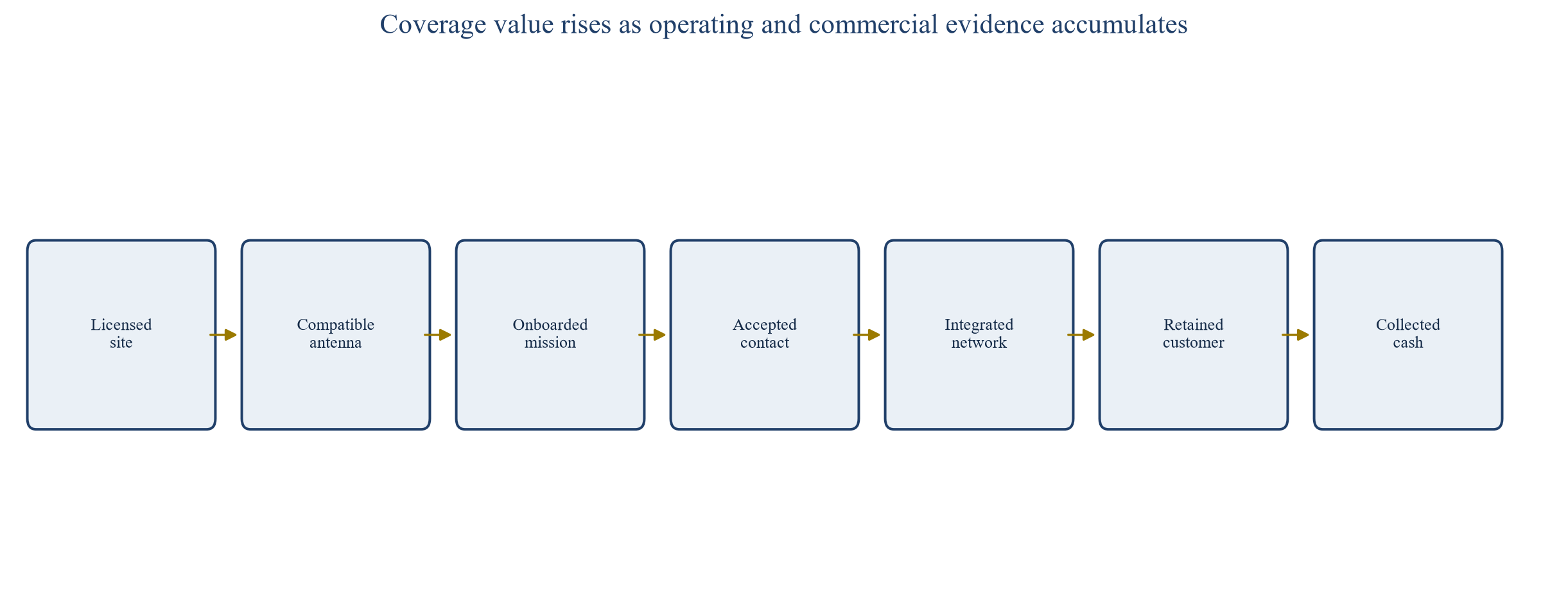
Proposed progression from licensed site to retained network cash flow.
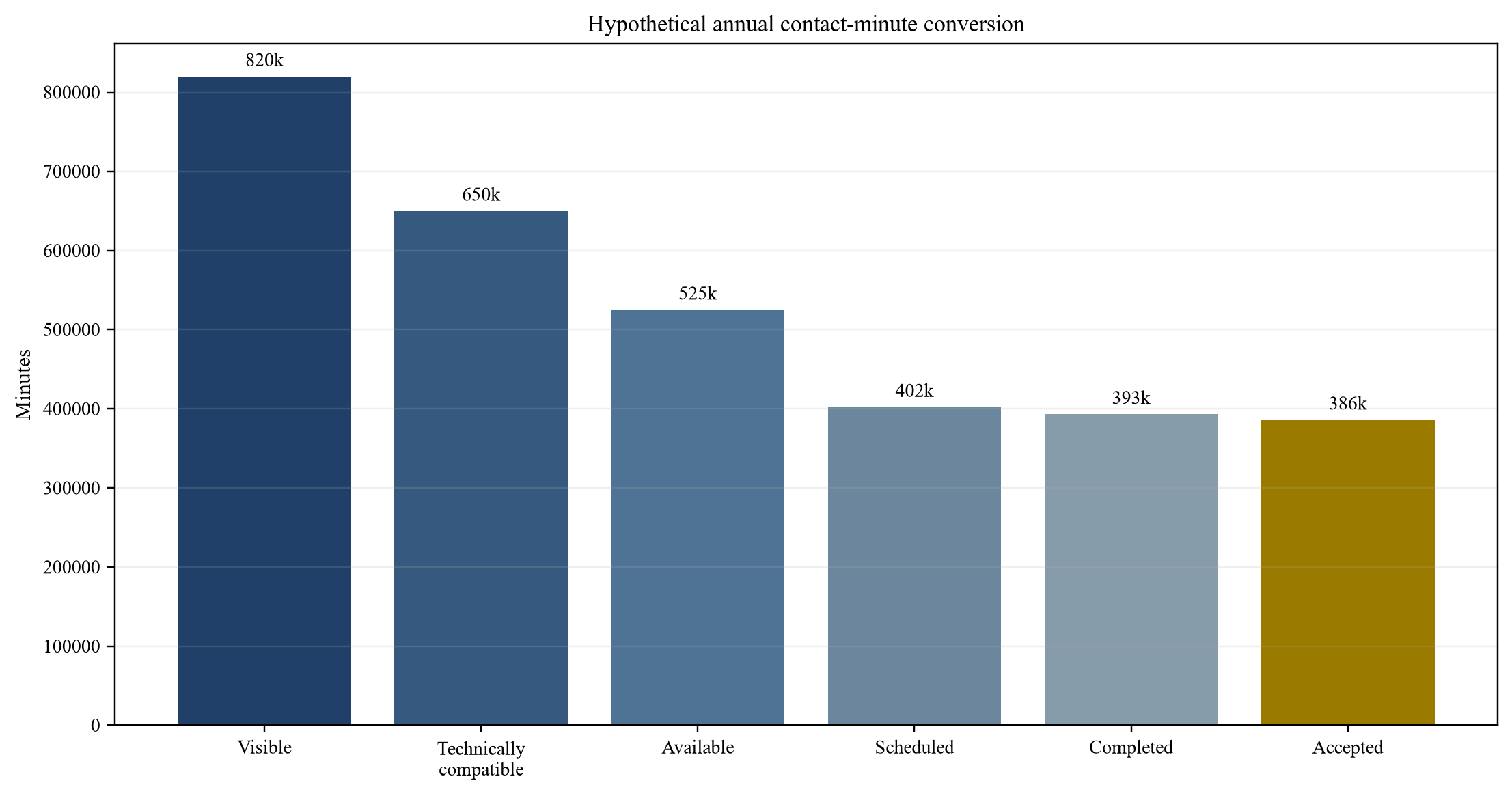
Illustrative annual minutes from theoretical visibility through accepted billing.
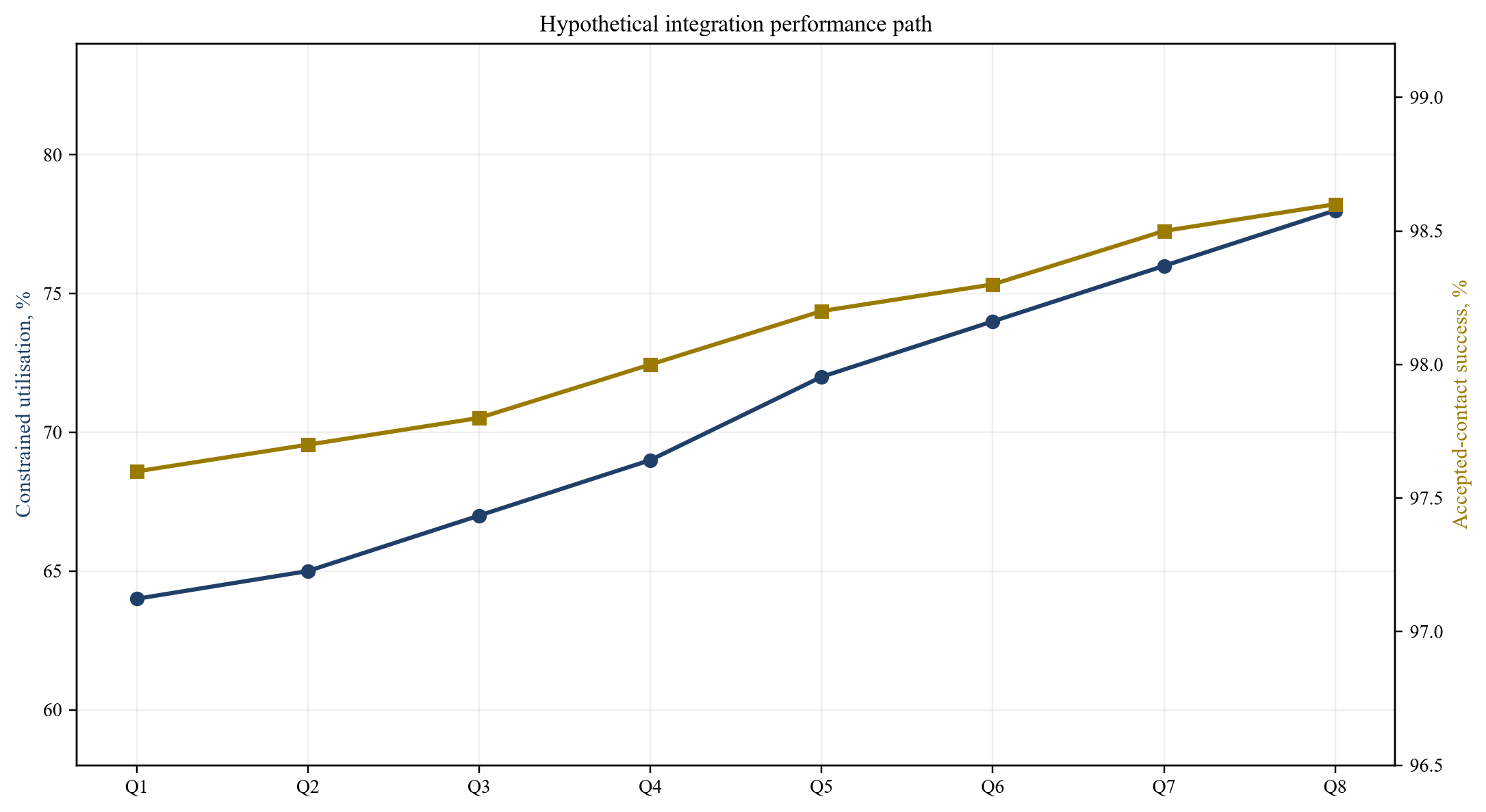
Illustrative constrained utilisation and accepted-contact success over eight quarters.
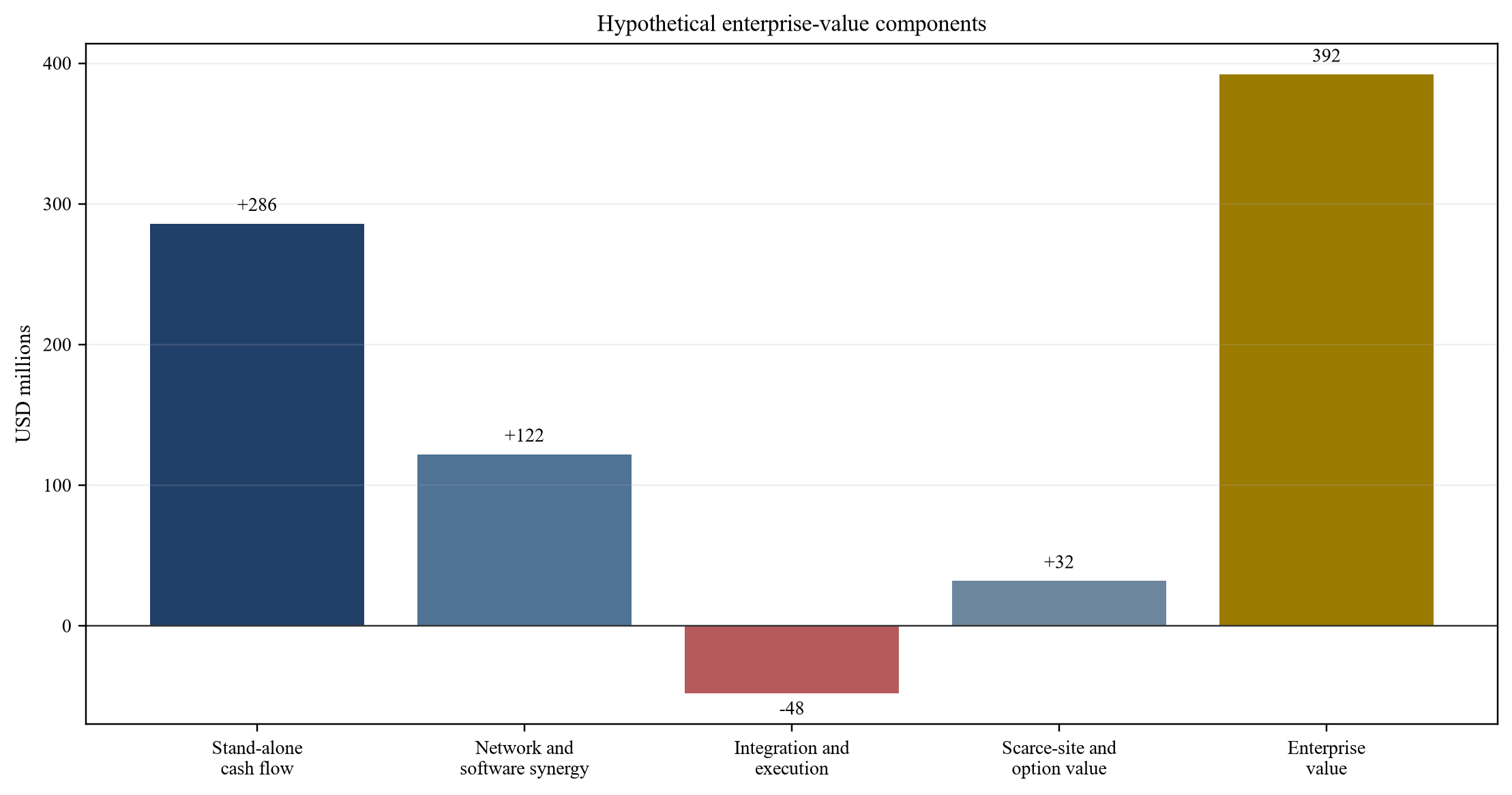
Illustrative USD millions; no named company is represented.
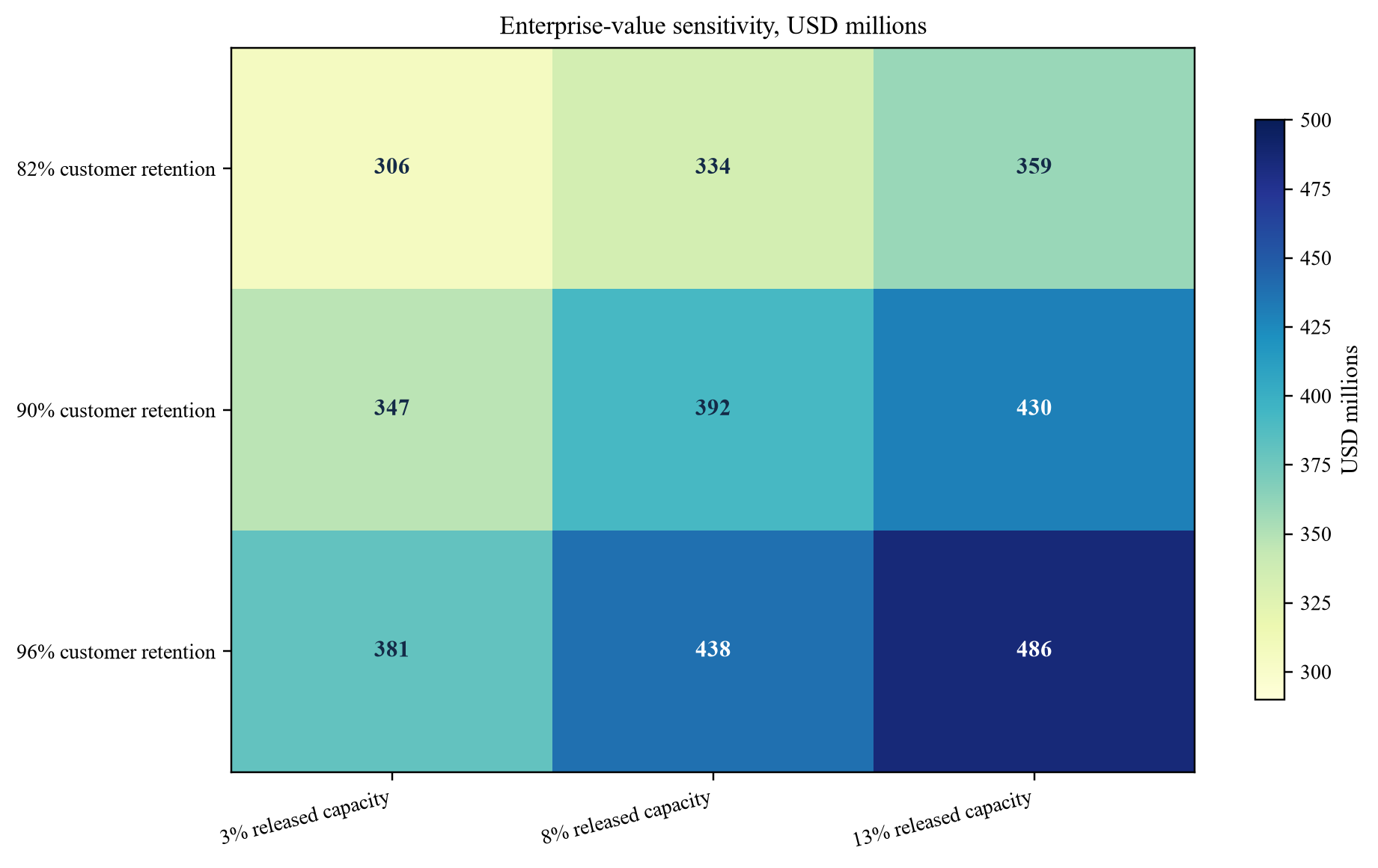
Illustrative enterprise value in USD millions.
| Evidence state | Minimum record | Valuation treatment | Principal residual risk |
|---|---|---|---|
| Licensed site | Effective authority matching equipment and service | Site option and operating right | Renewal or control-change risk |
| Compatible antenna | Capability test and current maintenance record | Available technical capacity | Mission-specific incompatibility |
| Onboarded mission | Approved configuration and test contact | Customer-specific service option | Launch or spacecraft delay |
| Accepted contact | Completed log and customer acceptance | Evidenced service cash flow | Intermittent demand |
| Integrated network | Common control path across representative sites | Operating-leverage value | Migration and outage risk |
| Retained customer | Renewal and continued usage | Franchise and relationship value | Multi-sourcing and price pressure |
| Collected cash | Reconciled invoice and receipt | Base cash-flow value | Concentration and working capital |
Proposed minimum record for each value state.
| Stage | Minutes | Conversion from visible | Required evidence |
|---|---|---|---|
| Theoretically visible | 820,000 | 100% | Orbit geometry and elevation mask |
| Technically compatible | 650,000 | 79% | Band, waveform, data rate and equipment |
| Available capacity | 525,000 | 64% | Schedule, maintenance and licence |
| Scheduled | 402,000 | 49% | Customer request and confirmed reservation |
| Completed | 393,000 | 48% | Contact and incident logs |
| Customer accepted | 386,000 | 47% | Service acceptance and billing record |
Every figure is an assumption and describes no company.
| Partner right | Evidence | Base-case treatment | Key protection |
|---|---|---|---|
| Committed exclusive capacity | Multi-year contract and reserved schedule | Contracted contribution | Change-of-control consent |
| Committed non-exclusive capacity | Minimum access and service levels | Probability-weighted contribution | Price and availability caps |
| Framework access | Rate card without minimum availability | Current usage only | Renewal and customer ownership |
| Marketplace access | Best-efforts transaction terms | No permanent coverage value | Per-contact quality control |
| Informal cooperation | Correspondence or memorandum | Exclude from base value | Execute definitive agreement |
Proposed treatment of third-party coverage.
| Revenue stream | Operating evidence | Cost evidence | Valuation use |
|---|---|---|---|
| On-demand contacts | Accepted contact logs | Site, partner and cloud cost | Usage cash flow |
| Reserved capacity | Commitment and availability | Reserved operating capacity | Recurring contracted value |
| Dedicated antenna | Service contract and asset schedule | Capital and maintenance | Managed-infrastructure cash flow |
| Mission operations | Staffing and service records | Labour and tooling | Specialist recurring service |
| Integration | Accepted milestones | Engineering effort | Project contribution |
| Data processing | Delivered data and workflow | Compute, storage and egress | Adjacent service margin |
Proposed reconciliation from operating event to cash.
| Component | USDm | Evidence treatment |
|---|---|---|
| Evidenced stand-alone cash flow | 286 | Accepted service and retained contracts |
| Network and software synergies | 122 | Probability-weighted operating mechanisms |
| Integration, maintenance and execution | -48 | Cash and disruption before value release |
| Scarce-site and strategic options | 32 | Transferable rights and funded paths |
| Enterprise value | 392 | Illustrative transaction value |
Illustrative USD millions; no named company is represented.
| Consideration | USDm | Release evidence | Protection |
|---|---|---|---|
| Cash at completion | 270 | Rights, assets, contracts and consents | Warranties and escrow |
| Customer-retention milestone | 28 | Defined retained contribution | Named-customer schedule |
| Network-integration milestone | 24 | Accepted contacts through target platform | Independent operating test |
| Service-performance milestone | 20 | Pass success and delivery measures | Agreed exclusions and audit |
| Collected-cash milestone | 15 | Third-party receipts | Reconciliation and clawback |
| Seller rollover | 35 | Continuing equity | Funding and governance agreement |
Illustrative allocation tied to observable outcomes.
| Gate | Decision question | Minimum evidence | Failure response |
|---|---|---|---|
| Perimeter | Which rights and assets transfer? | Site, licence, partner, IP and contract map | Exclude unsupported items |
| Coverage | Which missions gain executable contacts? | Mission-level geometry and capability model | Remove nominal map value |
| Operations | Can service repeat at target quality? | Request-to-cash and incident records | Reduce utilisation and margin |
| Customers | Which relationships persist? | Contracts, usage, references and renewals | Probability-weight revenue |
| Integration | Can one operating layer be delivered safely? | Architecture, migration and funded plan | Deduct cost and defer synergy |
| Regulation | Can ownership and operation continue? | Legal and regulatory approvals | Condition, carve out or stop |
| Valuation | What evidence supports each value component? | Cash flow, option and capital ledger | Reprice or restructure |
Proposed decisions and failure responses.
Sources
- NASA Small Spacecraft Systems Virtual Institute, Ground Data Systems and Mission Operations, 2026. Read the primary source
- Federal Communications Commission, Space and Earth Station Licensing and Operating Rules, 47 CFR Part 25. Read the primary source
- Federal Communications Commission, FCC 25-69, Further Streamlining Satellite and Earth Station Licensing, 2025. Read the primary source
- Ofcom, Statement on revising the NGSO licensing process, 2026. Read the primary source
- Amazon Web Services, AWS Ground Station FAQs, accessed 2026. Read the primary source
- Amazon Web Services, AWS Ground Station locations, accessed 2026. Read the primary source
- Amazon Web Services, How AWS Ground Station works, accessed 2026. Read the primary source
- RBC Signals, acquisition of ten antennas from Microsoft, 12 March 2025. Read the primary source
- KSAT, Ground network enabling Pixxel take-off, 2022. Read the primary source
- US Government Accountability Office, DOD Satellite Communications: Reporting on Progress Needed to Provide Insight on New Approach, GAO-25-107034, 2025. Read the primary source
- Ofcom, NGSO satellite earth station authorisations: updated guidance, 2026. Read the primary source
- Microsoft Azure, Introducing Azure Orbital: Process satellite data at cloud scale, 2020. Read the primary source
- Microsoft Azure, New Azure Space products enable digital resiliency and empower the industry, 2022. Read the primary source
- Consultative Committee for Space Data Systems, Space Link Extension Service Management specifications. Read the primary source
- VITA, Radio Transport standard VITA 49 overview. Read the primary source
- National Institute of Standards and Technology, Zero Trust Architecture, SP 800-207, 2020. Read the primary source
- Cybersecurity and Infrastructure Security Agency, Cross-Sector Cybersecurity Performance Goals. Read the primary source
- Amazon Web Services, AWS Ground Station site masks, accessed 2026. Read the primary source
- US Department of Justice and Federal Trade Commission, Merger Guidelines, 2023. Read the primary source
- European Commission, EU merger control. Read the primary source
- European Space Agency, ESTRACK ground-station network. Read the primary source
- Swedish Space Corporation, Annual and Sustainability Report 2024. Read the primary source
- Swedish Space Corporation, Interim Report January to March 2025. Read the primary source
- Amazon Web Services, AWS Ground Station Dedicated Antennas, accessed 2026. Read the primary source
- Amazon Web Services, Ground Station pricing, accessed 2026. Read the primary source
- Ofcom, Amazon Kuiper NGSO licence and spectrum decision, 3 February 2025. Read the primary source
- International Telecommunication Union, Radio Regulations and space services. Read the primary source
- IFRS Foundation, IFRS 3 Business Combinations. Read the primary source
- IFRS Foundation, IFRS 13 Fair Value Measurement. Read the primary source
- Amazon Web Services, AWS Ground Station site capabilities, accessed 2026. Read the primary source
