

1. Prove a repeatable format before financing a platform
A successful property proves that one location can work under one combination of site, ownership, design, demand, team and market timing. A platform investment requires stronger evidence. It should show that the essential proposition can be transferred to additional sites, that the organisation can open and operate them, and that capital can be recovered or redeployed without relying on an indefinite sequence of new equity rounds. The investment memorandum should therefore begin with a format thesis rather than a portfolio aspiration.
The format thesis should identify the target guest, trip purpose, price band, room or unit type, service level, ancillary offer, booking channels, asset configuration and ownership model. It should state which elements are standardised and which adapt to the catchment. A business hotel near an industrial cluster, an urban hostel, a pilgrimage property, a resort and an extended-stay product have different demand rhythms and cost structures. Combining them under one platform may diversify revenue, but it can also obscure whether any one format is repeatable.
Evidence should progress from property performance to cohort performance. The first property can validate guest demand and basic economics. The next two or three sites test transferability across catchments. A larger cohort tests opening discipline, central systems and management bandwidth. Investors should ask which variables remained stable, which moved, why they moved and whether management changed the format or merely explained a miss after the event.
Growth capital should purchase defined operating capability and a sequenced site pipeline. Uses can include deposits, pre-opening costs, technology, central talent, working capital and equity contributions to approved properties. Capital allocated to unidentified sites, loosely defined brand building or unsupported corporate overhead should be subject to tighter controls. The result is an investment case that can be falsified and improved as evidence arrives.
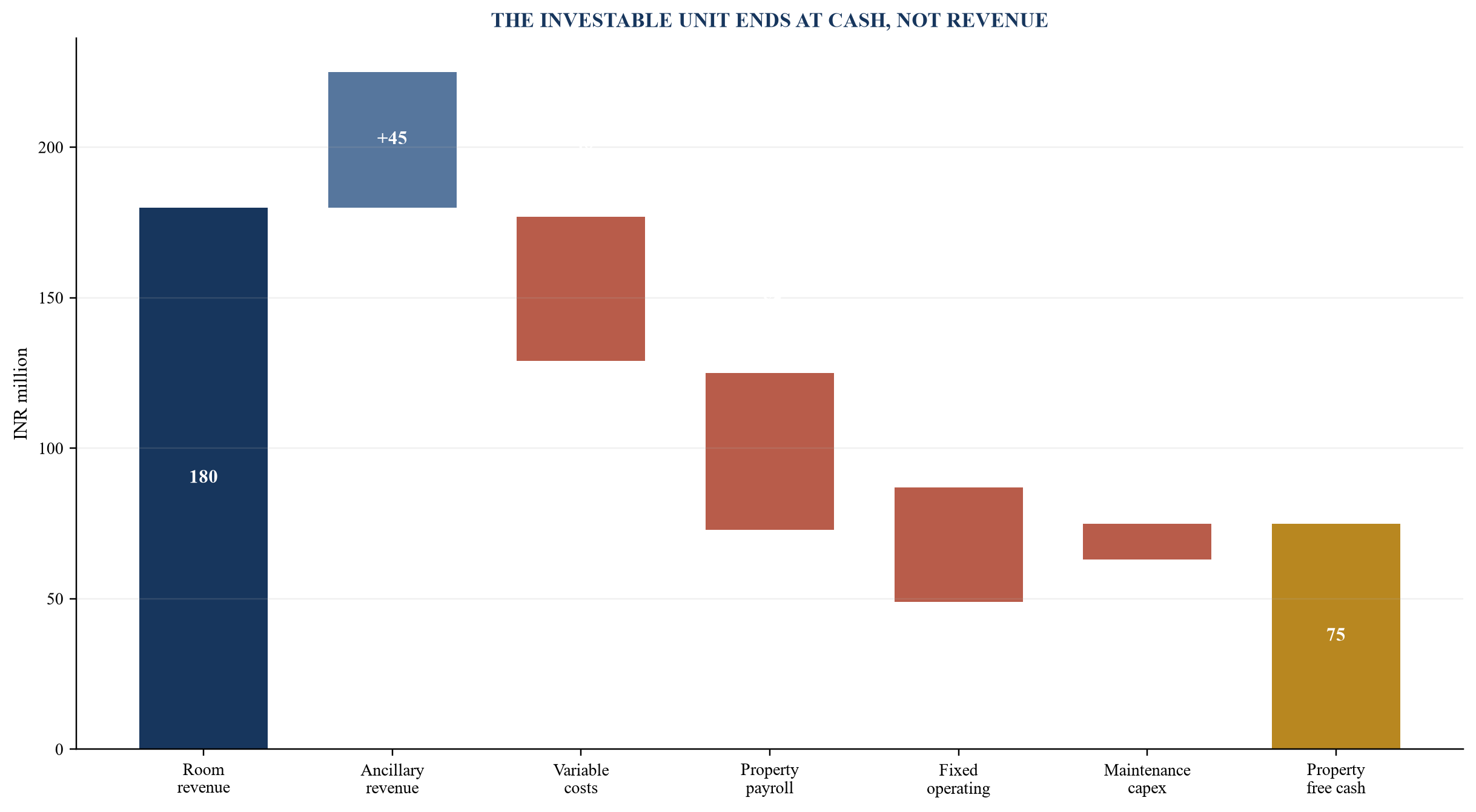
Values are hypothetical INR millions for a mature 100-room property and demonstrate the economic-unit bridge.
2. Define the economic unit and reporting perimeter
The economic unit should be the smallest repeatable component whose revenue, cost, capital and cash can be measured consistently. Depending on the model, it may be a property, available room, occupied room, bed, apartment, management contract or franchise key. The unit chosen for commercial storytelling should reconcile to the unit used in budgets, board reporting and draw requests. A platform cannot establish repeatability if each site is measured with a different denominator.
Property-level reporting should bridge gross room revenue, food and beverage, events, other ancillary revenue, channel commissions, direct operating costs, property payroll, utilities, maintenance, rent or management fees, property contribution, maintenance capital expenditure and cash generated. Central costs should sit separately. This prevents a profitable property from appearing weak because it carries growth investment, and prevents a weak property from appearing profitable because costs are held at head office.
Ownership and operating boundaries also matter. An owned hotel combines real estate and operating risk. A lease adds fixed or variable rent. A management agreement earns fees while the property owner funds most capital. A franchise model earns brand and system fees while the franchisee carries site economics. A platform may use several structures, but the investment case should show returns on each type and the capital required to add one unit.
The reporting perimeter should match legal cash paths. Investors should know which entity holds leases, employs people, contracts with booking channels, owns trademarks, receives fees, borrows money and holds minority interests. Intercompany charges and guarantees should be documented. Cash attributed to the group may not be available to the funded entity because of minority protections, debt covenants, tax, reserve requirements or contractual restrictions.
Table 1. Economic-unit architecture by hospitality format
| Format | Primary economic unit | Core revenue measures | Capital measure | Principal repeatability test |
|---|---|---|---|---|
| owned or leased hotel | property and available room | occupancy, average room rate, RevPAR and ancillary spend | development or leasehold capital per key | mature property cash return after maintenance capex |
| managed hotel | management contract and managed key | base fee, incentive fee and reimbursed services | signing, pre-opening and support cost | fee contribution after central support |
| franchised hotel | franchise agreement and franchised key | royalty, reservation and system fees | conversion and brand-support cost | net recurring fee and retention |
| hostel or co-living | available bed | bed occupancy, rate and ancillary spend | fit-out capital per bed | cash contribution across cohorts |
| serviced apartment | available apartment night | occupancy, length of stay and apartment rate | capital per unit | demand stability and housekeeping productivity |
The selected unit should reconcile operating performance, invested capital and cash.
3. Translate India's demand base into addressable catchments
National travel volumes provide context, not a site forecast. The Ministry of Tourism's 2025 dashboard reports large domestic and international travel activity.[1] A proposed property depends on the portion of demand that can reach its catchment, needs the proposed format, can pay the target rate and is not already served by effective supply. The addressable-demand analysis should therefore move from national totals to local trip generators and booking behaviour.
Catchment work should distinguish business, leisure, visiting-friends-and-relatives, medical, education, pilgrimage, wedding, meeting and transit demand. Each segment has different booking windows, weekday patterns, room-sharing behaviour, cancellation rates and sensitivity to price. The site model should identify the institutions, industrial estates, airports, stations, hospitals, universities, attractions and event venues that generate room nights, then test travel time under normal and peak conditions.
Historical demand should be rebuilt from more than one source. Property management data, channel searches, competitive rates, airport and rail activity, event calendars, corporate interviews and government statistics can be triangulated. Management should preserve the difference between observed transactions and management estimates. A high search volume may indicate interest without conversion. A corporate travel manager's stated demand should be reconciled to actual room-night commitments where possible.
Supply analysis should include branded and independent properties, planned openings, informal accommodation and format substitutes. Effective supply changes when a property renovates, converts brand, exits an online channel or changes rate. A catchment may support a new hotel while a specific price band remains overcrowded. The investment case should describe how the platform wins share, whether by location, product, distribution, operating consistency or cost advantage, and how quickly competitors could respond.
4. Select a segment whose operating logic can travel
Repeatability is easier when the guest promise and operating model are precise. A platform should define the minimum viable room, public-area, food, technology and staffing specification for each segment. Standardisation should reduce design time, procurement variation, training burden and opening risk. Local adaptation should remain available where climate, building, cultural, regulatory or demand conditions require it.
The segment decision should link revenue ambition to cost reality. A higher average rate may require larger rooms, premium finishes, more staff, food and beverage breadth and higher distribution spend. A focused-service product can reduce staffing and complexity but may sacrifice ancillary revenue or corporate eligibility. Investors should compare contribution and cash return rather than conclude that the highest rate is the strongest model.
Brand architecture also affects capital efficiency. One brand across divergent sites can dilute the proposition. Multiple brands can improve fit while increasing central marketing, technology and training costs. A house of formats should therefore share systems only where the benefit exceeds the complexity. Common revenue management, procurement and finance may scale well. Distinct guest-facing standards may remain necessary.
Management should document the non-negotiables that preserve format economics. Examples include room count range, minimum demand density, maximum rent-to-revenue ratio, target staffing per occupied room, maximum development cost per key, essential digital systems and minimum liquidity at opening. Exceptions should require an investment-committee decision supported by a specific value thesis.
5. Score sites through one documented decision system
Site selection converts strategy into committed capital. The scorecard should combine commercial potential, physical feasibility, capital burden and execution risk. A high demand score cannot compensate automatically for a poor lease, excessive development cost or uncertain approvals. Each category should have a minimum threshold and a weighted score, with evidence attached to every input.
Commercial criteria can include demand depth, weekday and weekend balance, rate potential, seasonality, competitive supply and access. Physical criteria can include room efficiency, visibility, services, parking, fire and life-safety feasibility, construction complexity and conversion constraints. Financial criteria can include rent, escalation, deposit, capex, owner contribution, expected cash return and downside liquidity. Execution criteria can include title or lease diligence, approvals, contractor depth, staffing and opening lead time.
A scorecard supports comparability, but it does not replace judgement. Correlated weaknesses can be hidden by an average. A site with weak demand, high rent and construction uncertainty should not pass because several minor operational criteria score well. Investment committees should therefore apply hard gates alongside the weighted total. Failed gates should lead to rejection or explicit mitigation before capital is reserved.
Post-opening review completes the system. Forecast scores should be compared with actual ramp, rate, contribution and capital performance. If a criterion repeatedly fails to predict outcomes, its definition or weight should change. The scorecard becomes intellectual property only when the platform learns from realised sites and records that learning consistently.
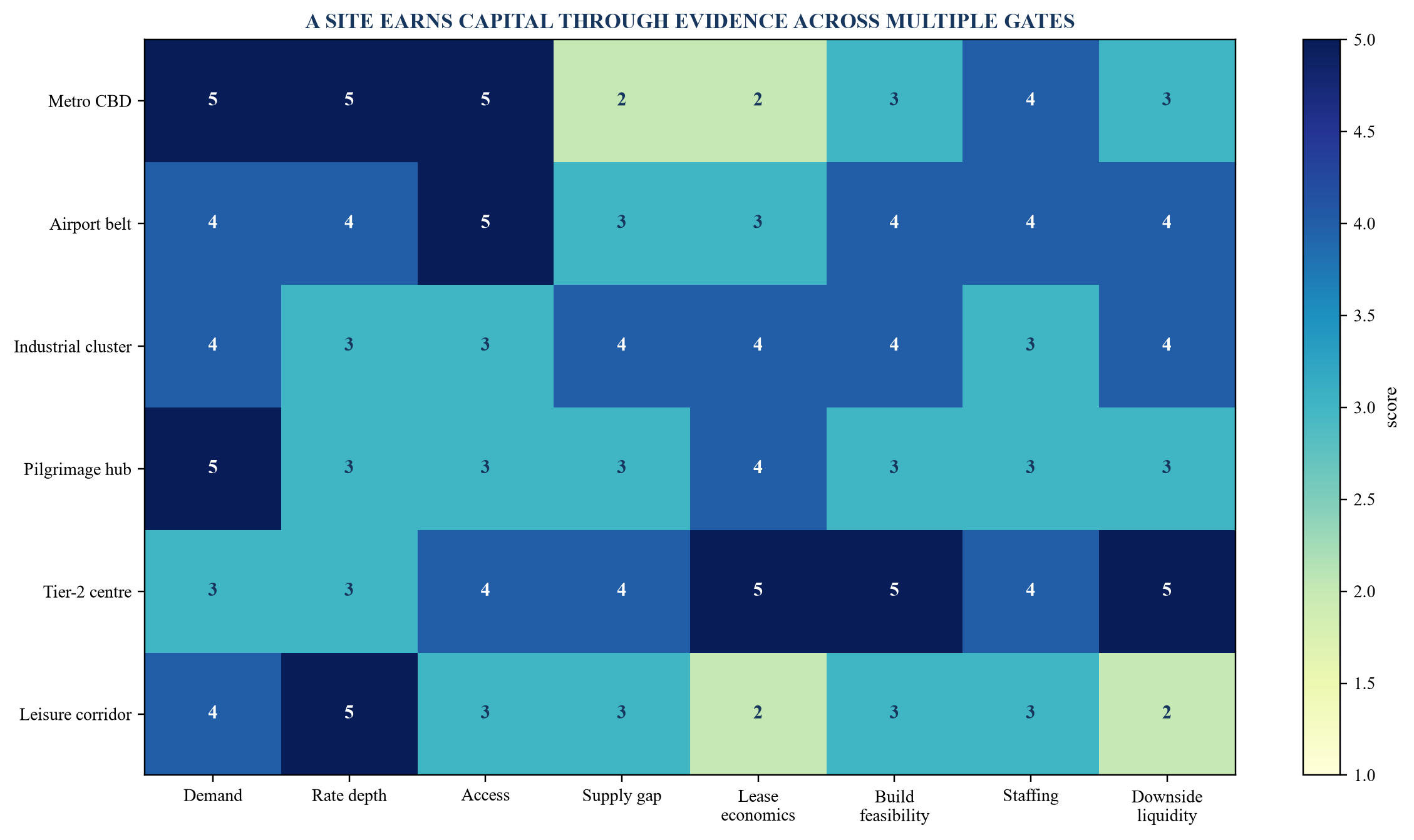
Scores are hypothetical on a one-to-five scale and demonstrate comparative diligence, not actual city rankings.
Table 2. Site-scorecard governance
| Category | Evidence | Example gate | Decision response |
|---|---|---|---|
| demand | room-night build, interviews, channel and event data | sufficient base demand under downside rate | reject or resize if unsupported |
| site and access | measured plans, travel times and technical survey | efficient room layout and safe access | redesign before exclusivity |
| commercial terms | lease, rent, escalation, owner works and deposits | rent and capex within approved thresholds | renegotiate or change structure |
| approvals and build | diligence, programme, contractor and contingency | credible approval and cost-to-complete path | condition capital and draw rights |
| operating readiness | staffing, supply chain, systems and opening plan | accountable general manager and opening team | delay opening draw |
Weighted scoring should operate together with non-negotiable gates.
6. Reconstruct the property-level revenue engine
The revenue model should start with available inventory by day, then apply occupied inventory and rate by customer segment. Monthly occupancy multiplied by an annual average rate can hide weekday gaps, event dependence, maintenance closures and discounting. Daily or weekly analysis is preferable during the opening period and peak or weak seasons. The model should reconcile room nights to the property management system once a site is operating.
Average room rate should be decomposed into public direct, corporate negotiated, online travel agency, wholesale, group, crew, long-stay and promotional business. Each channel has different commission, payment timing, cancellation and ancillary behaviour. Gross rate growth can therefore coincide with lower net room contribution if commission or discount cost rises. The unit model should report net revenue after channel cost as well as the standard headline metrics.
Ancillary revenue should be built from operational drivers. Breakfast depends on occupied rooms and capture. Events depend on space, enquiries, conversion and calendar. Food and beverage depends on covers, spend and cost of sales. Transport, laundry, co-working and experiences require their own capacity and margin assumptions. New revenue lines should not be inserted as a percentage of room revenue without evidence.
The platform case should state how central revenue management creates value. Shared pricing tools and account sales may improve rate and occupancy, but the benefit should be measured against system, people and commission costs. Investors should examine whether the first property succeeded because the founder personally sold every room. Repeatability requires an institutional process that can operate across a broader estate.
7. Measure mature unit economics after all recurring costs
Mature unit economics should describe a property after its opening discounts, unusual launch costs and temporary owner support have ended. Revenue per available room is a useful operating measure, and current listed-company disclosures show Indian hotel groups reporting average room rate, occupancy and RevPAR.[3][4] These metrics do not by themselves measure cash return. The bridge must continue through payroll, utilities, repairs, property charges, rent, management costs, central allocation and maintenance capital expenditure.
Contribution should be calculated consistently across sites. Management should state whether rent, brand fees, central reservations, insurance and owner-funded expenditure are included. A lease model can show strong earnings before rent while producing weak cash after rent and escalation. A management contract can show high margin on fee revenue while requiring central support that is omitted from the contract account. The platform view needs both site and fully loaded economics.
Maintenance capital expenditure should reflect the format's renewal cycle. Rooms, bathrooms, air conditioning, kitchens, lifts, fire systems and technology require periodic spend. Deferring this work can inflate short-term cash while weakening guest experience and asset condition. The investment model should include annual maintenance and a longer-cycle reserve, with responsibility allocated between owner and operator.
Return on invested capital should use the cash genuinely committed to the unit. Deposits, pre-opening payroll, training, systems, launch marketing and operating losses are part of the capital required to create a functioning property. Owner contributions and debt should be shown separately. Investors should be able to see the group's equity at risk, the time to stabilisation and the cash returned after sustaining the asset.
8. Build the cost-to-open from a controlled uses schedule
Growth capital is often consumed before the first guest arrives. The uses schedule should connect site acquisition or lease deposits, design, professional fees, approvals, construction, furniture, fixtures and equipment, operating supplies, technology, recruitment, training, marketing, pre-opening payroll, interest, contingency and opening liquidity. Each line should have a budget owner, procurement route, payment timing and evidence requirement.
Development cost per key is useful for comparison, but it can conceal common-area, food and beverage, infrastructure and site-specific work. Investors should compare the same scope across sites. Reuse of an existing building may reduce structural cost while increasing discovery risk. A new build may offer efficient design while requiring more approvals and a longer period before revenue. The budget should distinguish known scope, provisional sums and uncertainty.
Contingency should follow the risk register rather than a fixed convention. Design maturity, hidden conditions, imported equipment, approval timing, contractor concentration and opening deadlines influence the reserve needed. Use of contingency should require documented cause and approval. An exhausted contingency early in construction is a warning that the base budget or scope control is weak.
Draw controls should reconcile invoices, certified work, remaining cost-to-complete and liquidity. An investor should not release the next tranche solely because the prior tranche was spent. The test is whether completed work and remaining sources can deliver a compliant, equipped and liquid property. A shortfall should trigger scope reduction, sponsor support, restructuring or stop, before the business commits further irreversible cost.
9. Separate opening liquidity from construction capital
A completed hotel can still fail during opening if payroll, supplier, deposit, utility, commission and marketing cash is insufficient. Construction capital creates the asset; opening liquidity supports the ramp from zero revenue to stable collections. Combining the two can leave an apparently completed project unable to operate effectively.
The liquidity model should be monthly and weekly around opening. It should include the timing of corporate receipts, online-channel settlements, card reserves, indirect taxes, payroll, rent, utilities and advance guest deposits. Cash received before the stay can carry cancellation or performance obligations. It should not automatically be treated as free working capital.
Opening liquidity should be sized to a downside ramp, not the budget case alone. Delayed approvals, slower recruitment, a soft launch, lower rate, channel dependence or operating defects can extend the cash trough. Management should state the minimum cash needed to protect service and compliance. Falling below that amount can damage reviews and employee retention, making recovery harder.
Release conditions for unused liquidity should be objective. A property might need to achieve several months of minimum occupancy, net rate, contribution, guest-satisfaction and cash-conversion performance before reserves can be distributed or redeployed. A single strong festival or event month should not establish stabilisation.
10. Analyse ramp through comparable opening cohorts
Ramp is a path, not a date. Each property should be assigned to an opening cohort and tracked from pre-opening through launch, early operation and stabilisation. Cohort reporting separates the effect of asset age from calendar conditions. Without it, a rapidly expanding platform can report weak consolidated margins because new sites are mixed with mature sites, or can hide poor new-site performance behind established properties.
The core cohort measures should include available inventory, occupancy, average room rate, net RevPAR after channel costs, guest scores, payroll per occupied room, property contribution, cash burn and cumulative capital. The plan should state the expected month for each threshold. Actual performance should be compared with both budget and prior cohorts.
Differences should be explained through operational drivers. A site may ramp occupancy quickly through discounts but lag on net rate. Another may achieve rate but need longer to build weekday demand. A third may have strong revenue and poor contribution because staffing or utilities exceed the format standard. These are different investment problems and require different interventions.
The cohort model should also identify survivor bias. Management may showcase the first successful property and omit a closed, delayed or restructured site. Investors should include all committed sites in the cohort table, with capital spent and current status. Repeatability is supported by the distribution of outcomes, not the best case.
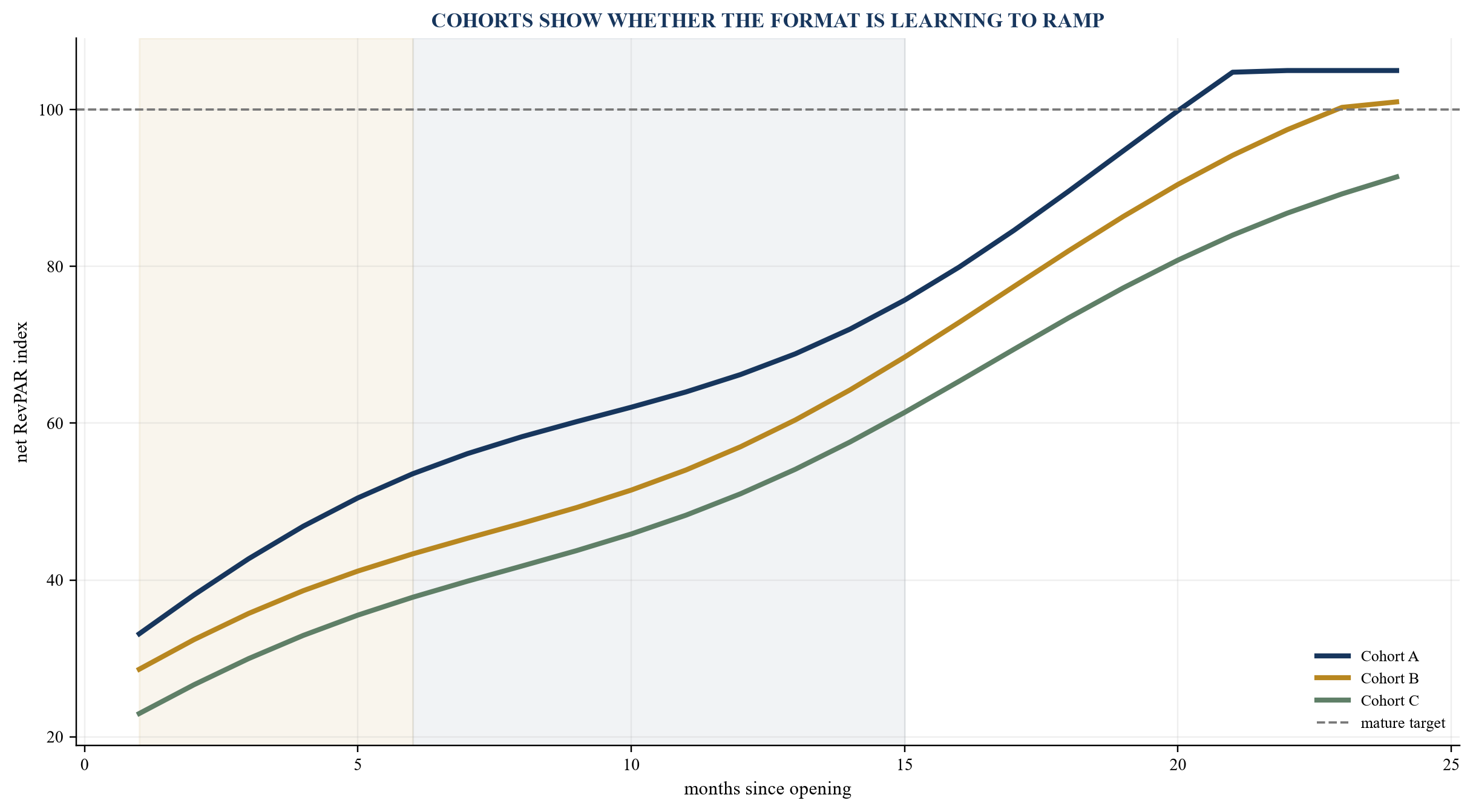
RevPAR indices are hypothetical and set each format's mature target at 100.
Table 3. Ramp-cohort operating dashboard
| Stage | Revenue evidence | Cost evidence | Cash evidence | Governance response |
|---|---|---|---|---|
| pre-opening | contracted accounts and booking pace | staffed plan and supplier readiness | funded opening reserve | confirm or delay launch |
| months 1-3 | pickup, cancellations, net rate and guest mix | launch payroll and defect cost | weekly burn and minimum cash | intensive operating review |
| months 4-9 | repeat demand and weekday depth | productivity and channel cost | declining burn or cash break-even | release next-site diligence only |
| months 10-18 | stable net RevPAR and ancillary capture | mature property contribution | positive cash after maintenance | permit measured replication |
| post-stabilisation | through-cycle demand and retention | recurring cost standard | return on invested capital | recycle capital subject to gates |
Thresholds should be set for the specific format and catchment.
11. Control pricing and distribution quality
Occupancy bought through deep discounting can fill rooms without validating the intended format. The investment case should show average room rate and occupancy together, then deduct commissions, loyalty cost, promotion and payment charges. Net RevPAR and contribution per available room reveal whether demand quality is improving.
Direct booking can strengthen economics, but its cost is not zero. Search, performance marketing, brand campaigns, call centres, loyalty benefits and technology should be attributed. Online travel agencies can provide reach and launch demand; the platform should measure whether guests shift into lower-cost repeat channels over time. Corporate accounts should be assessed for volume, rate, payment terms, cancellation and concentration.
Revenue management should use constraints consistent with the guest proposition. Excessive price variation can damage trust. Selling low-rate inventory too early can displace higher-rate demand. Holding too much inventory can leave rooms empty. The platform should record override decisions and evaluate them after the stay date, creating a learning loop across properties.
Investors should also test data quality. Rate and occupancy may be reported before taxes, meals, packages or complimentary rooms are treated consistently. Channel data should reconcile to the property management system, general ledger and cash settlements. A credible platform can explain the path from booking to stay, revenue recognition, commission, collection and refund.
12. Make labour productivity a format variable
Hospitality service depends on people, and labour is both a value driver and a major operating cost. A repeatable format needs a staffing model by department, shift, occupancy and service promise. Headcount per room can be misleading when food, events, public areas and outsourcing differ. Labour hours and cost per occupied room provide a more comparable measure.
The operating plan should distinguish fixed leadership and minimum coverage from variable staffing. It should include recruitment lead time, accommodation or transport where relevant, training, attrition, overtime, outsourced services and statutory obligations. A site can meet its payroll budget while weakening service because vacancies are hidden through excessive overtime or delayed maintenance.
Centralisation may improve productivity in reservations, finance, procurement, human resources and revenue management. The saving should be evaluated alongside responsiveness, control and technology cost. Central services should be charged transparently to sites so that property contribution remains comparable and the central organisation is not funded through unexplained allocations.
Opening cohorts should track time to fill critical roles, training completion, productivity and guest outcomes. Growth should pause where management depth does not support the pipeline. Capital cannot replace an experienced general manager, engineer, revenue leader or finance controller at short notice. Organisational capacity is therefore an investment milestone, not a general management aspiration.
13. Use technology to standardise controls and learning
Technology should connect reservations, property operations, pricing, procurement, finance, guest relationships and investor reporting. The objective is a reliable operating record and faster decisions. A platform with fragmented property systems may grow room count while losing the ability to compare sites or detect leakage.
The data model should define rooms available, rooms sold, rate, cancellations, no-shows, complimentary use, channel cost, ancillary revenue, labour, utilities, inventory, maintenance and cash consistently. Interfaces should reconcile to the general ledger and bank. Manual adjustments need ownership and audit trails. Investors should receive a controlled extract rather than a slide assembled from unrelated systems.
Automation can support pricing, guest messaging, invoice capture, workforce scheduling and maintenance. Each use should have a business case, data owner, human control and exception process. Forecast accuracy and realised savings should be measured. A technology initiative that cannot be linked to net revenue, cost, cash, control or guest experience should compete for capital like any other project.
Cybersecurity, privacy, uptime and vendor dependence should sit in diligence. Hospitality systems process identity, payment and travel information and support continuous operations. Contracts should address data access, portability, service levels and termination. Expansion across multiple owners or franchisees may require rights to receive data without assuming rights that the platform does not legally hold.
14. Distinguish owned, leased, managed and franchised growth
Indian hospitality groups commonly combine owned or leased properties with managed and franchised rooms, as current listed-company disclosures illustrate.[2][3][4] Each route creates a different combination of capital need, control, earnings and risk. A single blended multiple or margin can therefore misstate platform economics.
Owned growth provides property exposure and operating control but requires substantial capital and can slow expansion. Leases reduce acquisition capital but create fixed or indexed obligations and renewal risk. Management contracts can expand the network with lower property capital, while income depends on owner-funded assets, contract tenure and operating performance. Franchising can be capital-light but requires brand standards, distribution capability and monitoring.
The choice should follow the site's economics and the platform's capability. A flagship may justify ownership because the property and operating value are strategic. A conversion in a deep market may suit management or franchise. A lease can work where rent, owner contribution and downside flexibility align. Management should explain why each structure is the best use of scarce equity rather than a way to report faster unit growth.
Investors should see separate pipelines and returns by structure. Fee income from management and franchise contracts should deduct signing, pre-opening, field support, technology and central costs. Lease returns should include deposits, pre-opening losses and maintenance obligations. Owned returns should distinguish property appreciation from operating cash. This allows growth capital to be allocated to the format and structure with the strongest evidence-adjusted return.
15. Size growth capital to milestones and liquidity
The capital requirement should be built from approved site uses, central capability and liquidity, then reduced by owner contributions, debt, operating cash and realistic recycling. The model should show sources and uses by month and legal entity. A headline request such as funding ten hotels provides little control if the sites, structures and timing differ.
Site capital can include deposits, equity contributions, fit-out, pre-opening and ramp liquidity. Central capital can include systems, people, brand, pipeline diligence and governance. Investors should distinguish one-time platform build from recurring central cost. A credible plan explains when scale reduces central cost per unit and what happens if openings are delayed.
Capital should be staged. The first commitment can fund diligence and defined sites. Later tranches can depend on site control, cost certainty, opening performance, liquidity, management capacity and reporting. Milestones should be measurable and within management influence. A condition based entirely on market valuation may create conflict; a condition based on executed sites and verified cash outcomes is more operational.
The investment case should include a no-new-capital scenario. This tests whether the existing estate can reach self-sufficiency, what commitments can be stopped and how much liquidity remains. Growth capital is more defensible when it accelerates a viable system rather than prevents an overcommitted pipeline from failing.
16. Design capital recycling before committing expansion
Capital recycling reduces dependence on repeated primary equity. It can arise from retained property cash, refinancing after stabilisation, sale of an owned asset with continued management, property-owner contributions, joint ventures, conversion to management or franchise, or selective disposal of mature investments. Each route has timing, valuation, tax, control and execution risk.
The platform should define which capital is intended to remain permanent and which is bridge capital. Equity used for a pre-opening lease deposit may remain locked for the lease term. Equity in an owned asset may be refinanced only after valuation and debt capacity are established. Management fees may become recurring cash but take time to cover central costs. The recycling model should reflect these differences.
Recycled proceeds should be tested after transaction cost, debt repayment, taxes, required reserves and minority rights. Gross sale value is not deployable capital. A sale-and-manage structure may preserve brand and fees, but contract terms and owner quality determine whether the fee stream is durable. A refinance can return equity while increasing fixed obligations and reducing downside capacity.
Governance should specify where recycled cash goes. It may repay investor capital, fund approved sites, build reserves or support central capability. Automatic reinvestment can encourage growth after conditions have changed. A board approval based on current pipeline quality and liquidity preserves discipline.
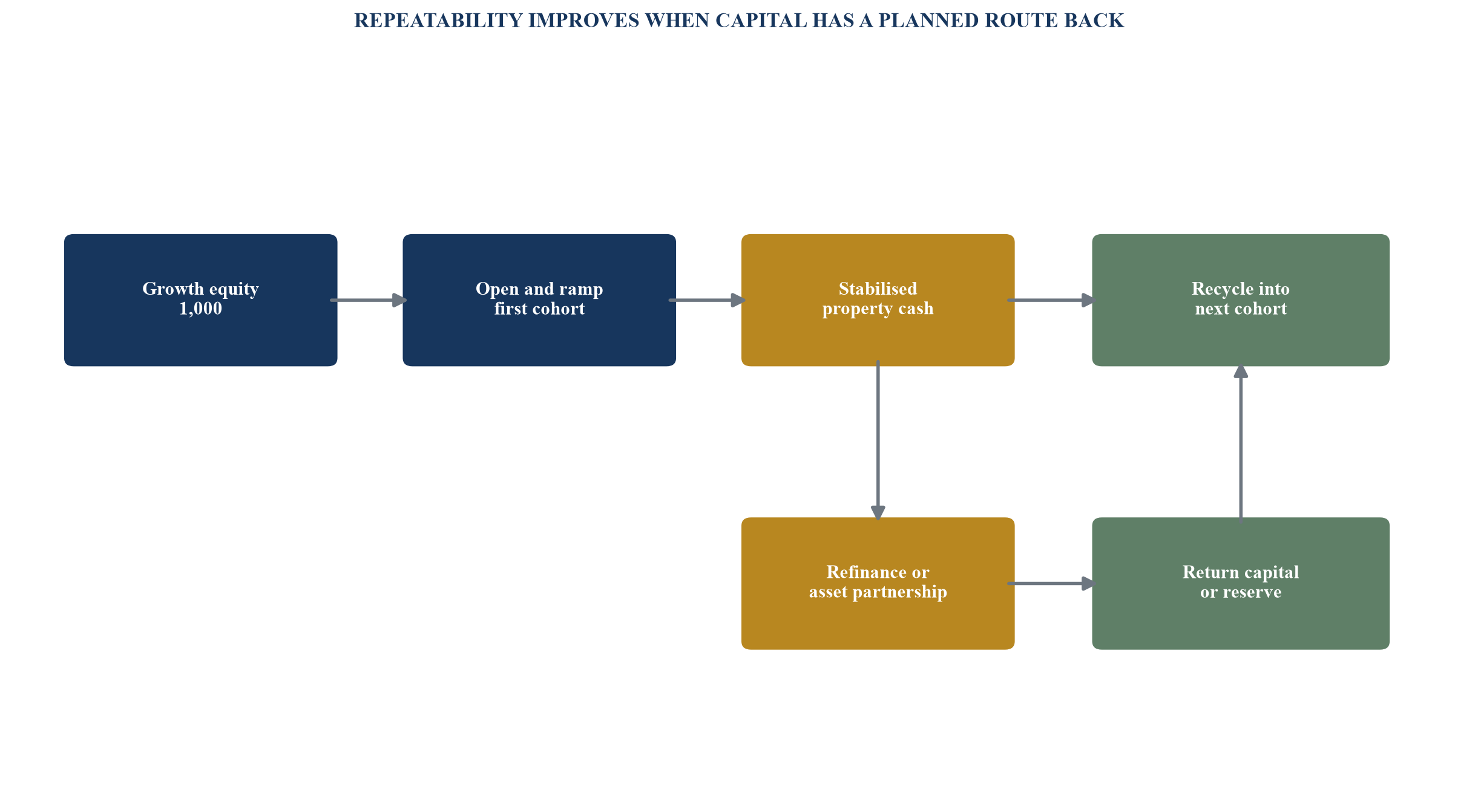
Amounts are hypothetical INR millions and show potential sources and uses after stabilisation.
17. Structure investor rights around the growth mechanism
Investor protections should address how value is created and how capital can be lost. Information rights should cover site pipeline, contracts, construction, openings, property performance, central costs, cash, related parties and compliance. Approval rights should focus on material new sites, debt, leases, acquisitions, disposals, brand changes, budgets and deviations from the agreed format.
Reserved matters should not become a substitute for operating management. Thresholds need sufficient precision for the board to act without repeated interpretation. A site approval can require a completed scorecard, diligence, base and downside economics, accountable sponsor and sources-and-uses schedule. Once approved, management can execute within defined cost, timing and scope tolerances.
Economic terms should match the risk and holding period. Instruments may include ordinary equity, preference shares, convertible securities or a mix. Liquidation preference, anti-dilution, dividends, conversion, redemption, transfer, drag, tag and exit rights require transaction-specific legal and tax advice. The model should show outcomes across value and timing cases, including where preference economics absorb most of the proceeds.
Related-party arrangements deserve explicit review. Property leases, procurement, management companies, founder loans and brand licences can shift economics outside the funded entity. Investors should receive disclosure, independent review where appropriate and approval rights for material changes. The aim is a platform whose reported unit economics reflect the cash available to all shareholders.
Table 4. Growth-capital protection linked to operating risk
| Risk | Evidence monitored | Illustrative protection | Release or cure condition |
|---|---|---|---|
| pipeline quality | site scorecards, diligence and approved budgets | board approval for material site commitments | complete evidence pack within thresholds |
| cost overrun | certified spend and cost-to-complete | tranche condition, contingency control and sponsor support | funded completion and minimum liquidity |
| weak ramp | cohort KPIs and weekly cash | pause rights for new sites | sustained operating and cash milestones |
| leakage | related parties, distributions and intercompany cash | restricted payments and approval rights | compliance and agreed liquidity |
| reporting failure | systems, accounts and reconciliations | information covenant and remediation plan | reliable reporting for agreed period |
Terms require transaction-specific legal, tax and regulatory advice.
18. Use debt only where the repayment source is visible
Growth equity can be combined with debt, but each facility should have a credible repayment source. Property debt may rely on asset value and stabilised cash. Leasehold fit-out debt may rely on site cash over the remaining lease term. A working-capital line may support predictable collection timing. Debt used to fund unresolved operating losses can shorten the time available to establish the format.
The model should separate development, term and revolving facilities. Interest during construction, fees, amortisation, cash sweeps, reserves and covenants should be included in monthly liquidity. Debt service should be tested against downside property cash after maintenance capital expenditure and central charges. Refinancing should be a scenario, not an assumed certainty.
Security and structural position matter. Lenders may take security over property, leases, bank accounts, shares, receivables or material contracts, subject to law and consent. Property owners, franchisors, managers and minority partners may have competing rights. Equity investors should understand how enforcement could affect the operating network, brand and management contracts.
Additional debt should require board approval and compliance with leverage, liquidity and purpose tests. A rapidly growing platform can accumulate property-level obligations that are not visible in a consolidated headline. The board should receive an entity-by-entity debt, lease, guarantee and security schedule together with maturity and covenant dates.
19. Apply current capital-market and foreign-investment rules carefully
Indian growth-capital structures operate within corporate, securities, foreign-investment, tax and sector-specific rules. SEBI maintains the Alternative Investment Funds Regulations and current master circulars, and the ICDR framework governs relevant public capital-market activity.[5][6][7][8] The applicable route depends on the investor, issuer, instrument, listing status, transaction and use of proceeds. Current counsel should confirm the position at execution.
DPIIT's public portal hosts the Consolidated FDI Policy and states the framework for foreign direct investment, while RBI's foreign-investment directions address payment, reporting and investment conditions.[9][10] Hospitality projects can also involve land, construction, leases and development arrangements whose treatment depends on facts. A general sector statement should not replace review of the specific entity, asset, instrument and contractual rights.
The diligence plan should identify beneficial ownership, pricing, instrument terms, downstream investment, reporting, approvals and exit mechanics. Fund investors should verify their own mandate, concentration and valuation requirements. A transaction that is commercially attractive can still be delayed by missing approvals, incomplete ownership records or an instrument that does not align with the intended cash rights.
Regulatory assumptions should appear in the conditions and timetable. Responsibility should be assigned to named legal, tax and compliance advisers. Any change in structure should be reflected in the financial model because tax, cash repatriation, liquidation preference and exit proceeds can move materially.
20. Value the platform through separable cash engines
A hospitality platform can contain property value, leasehold operating value, management or franchise fees, brand and technology capability, central costs and future pipeline options. Applying one revenue or earnings multiple to the whole group can obscure which component produces cash and which consumes capital. Valuation should begin with separable cash engines and reconcile them to the legal perimeter.
Owned assets can be analysed using property and operating cash, with care to avoid counting the same benefit twice. Leasehold sites should reflect rent, tenure, renewal and capital obligations. Management and franchise contracts should reflect contract duration, termination, owner concentration, fee structure and support cost. Central costs should be deducted unless they are already allocated fully to the operating units.
IFRS 13 provides the framework for fair value measurement, IAS 36 addresses impairment, IFRS 15 addresses revenue from customer contracts and IFRS 16 addresses leases.[11][12][13][14] Accounting carrying values and transaction value serve different purposes. The investment case should explain the basis used, inputs, sensitivity and reconciliation to reported accounts.
Pipeline value should be treated with discipline. A signed contract with approved financing and a credible opening plan is different from a preliminary discussion. Investors can assign stages and probabilities, but the base valuation should not depend on distant sites that require substantial future capital. Earn-outs or milestone-linked investment can bridge differences where future value remains uncertain.
21. Stress the platform as a portfolio of cash commitments
Downside analysis should combine site-level shocks with platform-level commitments. Relevant cases include slower opening, lower occupancy, lower rate, higher channel commission, labour inflation, construction overrun, approval delay, weak owner funding, debt repricing and inability to recycle capital. Correlation matters because several sites may face the same macro, seasonal or technology shock.
The stress should show the lowest group cash balance, additional capital need, covenant position and sites that remain value-accretive. Management should identify actions available at each stage: delay an uncommitted site, reduce scope, renegotiate rent, change channel mix, cut central hiring, obtain owner support or sell an asset. The timing and cost of each action should be realistic.
Stop rules are as important as recovery actions. The platform should pause new commitments if minimum liquidity, reporting quality, cohort performance, management capacity or cost-to-complete conditions fail. A pause protects the strongest assets and gives management time to solve root causes. Continuing expansion to preserve a public growth narrative can deepen the financing gap.
The board should revisit stresses whenever a material site or financing is approved. A plan that was resilient at five properties may become fragile at twelve because deposits, pre-opening costs and central commitments overlap. Portfolio growth changes the cash curve before it changes mature earnings.
22. Release capital through an evidence-gated milestone plan
Milestones should follow the sequence in which investment risk falls. Site diligence and control come first, then design and approvals, cost certainty, construction, operating readiness, opening, ramp and stabilisation. Each stage should have evidence, owner, deadline and decision. A draw request should state what has been achieved, what remains and whether the current sources cover completion and liquidity.
Early milestones should avoid irreversible expenditure before fundamental site and legal questions are resolved. Later milestones should protect the transition from building to operating. Practical evidence can include executed site documents, approved drawings, contractor terms, certified cost-to-complete, recruited leadership, system testing, contracted accounts, opening bookings and minimum cash.
Portfolio milestones should sit above property milestones. The platform may need a functioning monthly close, central procurement, revenue management, operating audit and management bench before adding another cohort. Investors should avoid allowing a strong site to trigger automatic growth when the organisation remains unprepared.
The investment committee should receive a concise exception report. It should show milestone status, variance, root cause, cash impact, proposed cure and decision required. Repeated waivers can indicate that the original format or timetable is wrong. The board should amend the plan openly rather than preserve obsolete thresholds.
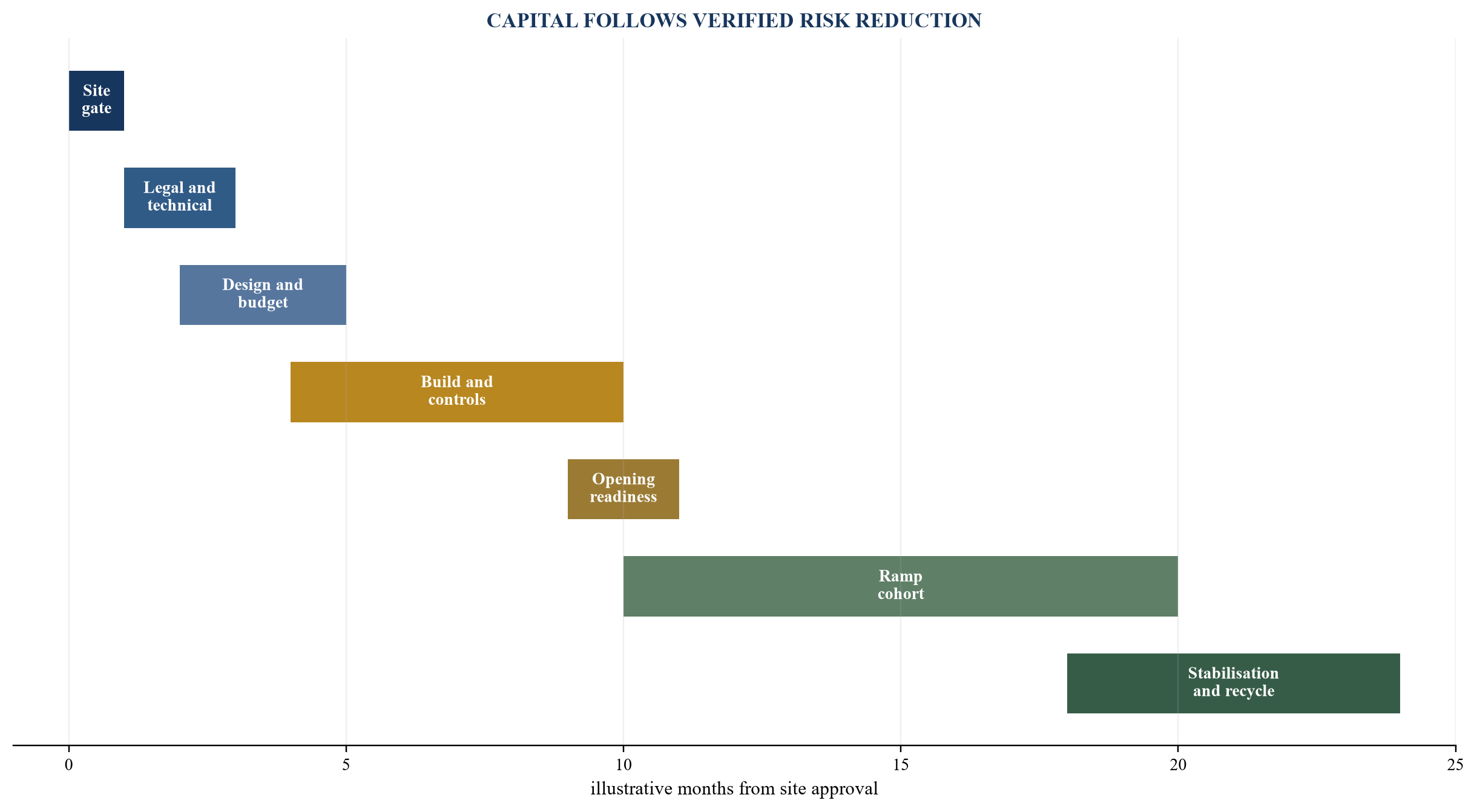
Timing is hypothetical and should be adapted to each site's legal, approval, development and operating facts.
Table 5. Illustrative milestone-linked draw plan
| Gate | Evidence required | Illustrative draw | Stop or cure response |
|---|---|---|---|
| site approval | completed scorecard, diligence plan and commercial terms | 5% | do not sign binding commitment |
| legal and design | site control, title or lease diligence, concept and approvals route | 10% | cure conditions before major spend |
| cost certainty | approved budget, contractor package, contingency and funded completion | 30% | resize scope or add sponsor support |
| operating readiness | leadership, systems, suppliers, licences and opening liquidity | 30% | delay opening and preserve reserve |
| ramp and stabilisation | cohort KPIs, minimum cash, contribution and audit evidence | 25% | pause next site and execute recovery |
Percentages are hypothetical shares of the committed site capital.
23. Build an investment-ready data room
The data room should allow an investor to reproduce the investment case. Corporate materials should include ownership, constitutional documents, board records, related parties, material contracts, disputes, intellectual property and compliance. Financial materials should include audited accounts, management accounts, general ledgers, bank statements, tax records, budgets, cash forecasts, debt, leases and capital expenditure.
Property folders should follow one structure for every site. They should include site documents, approvals, technical reports, design, budget, procurement, programme, operator or franchise arrangements, insurance, licences, employee plans, opening readiness and performance. A pipeline folder should separate signed, controlled, negotiated and prospect sites so that investors can understand commitment and probability.
Operating evidence should be granular enough to test unit economics. Property management, channel, guest, labour, procurement and maintenance extracts should reconcile to management reporting. Definitions should be documented. Where historic data are incomplete, management should state the limitation and propose the control that will close it.
The data room should have a request log and responsible owner. Documents should be current, searchable and protected appropriately. Answers given during diligence should be captured and reflected in the model or disclosure. A polished deck cannot compensate for a financial model that does not reconcile or for site rights that remain unclear.
24. Execute a ninety-day capital-readiness programme
During the first thirty days, management should define the format, economic unit and legal perimeter; reconcile property and group reporting; complete the site pipeline classification; and identify missing evidence. The board should agree minimum liquidity, approval thresholds and the range of acceptable ownership structures. The financial model should move from annual totals to site and monthly cash.
By day sixty, the priority sites should have completed scorecards, diligence plans, sources and uses, opening schedules and downside cases. The cohort dashboard should be operating for existing properties. Investor materials should explain how mature site cash, central cost and future site capital connect. Legal and tax advisers should review the intended instrument and foreign-investment route where applicable.
By day ninety, management should be ready to present a controlled growth plan rather than a broad expansion story. The data room, financial model, valuation bridge, investor rights, milestone draw plan and post-investment governance should use the same assumptions. Exceptions should be visible. The board should know which sites proceed if capital is smaller, later or more expensive than expected.
The strongest growth-capital case is a system of evidence. A defined format attracts demand in selected catchments; the unit produces cash after all recurring costs; opening cohorts improve; management capacity expands ahead of commitments; and capital has a planned route back through operating cash or recycling. That system allows investors and founders to make each expansion decision with a common language and an explicit downside.
References
- Ministry of Tourism, Government of India, India Tourism Data Portal, 2025 dashboard. https://tourism.gov.in/india-tourism-data-portal
- Indian Hotels Company Limited, Annual Report 2025-26 and investor information. https://ihcldigitaldirectory.com/ihcl_annual_report_2025_26/
- Indian Hotels Company Limited, Investor presentation and results materials, July 2025. https://investor.ihcltata.com/
- Lemon Tree Hotels Limited, Investor presentations, Q2 and H1 FY2025-26 and Q3 and 9M FY2025-26. https://www.lemontreehotels.com/investors
- Securities and Exchange Board of India, Alternative Investment Funds Regulations, last amended 14 July 2026. https://www.sebi.gov.in/legal/regulations/jul-2026/securities-and-exchange-board-of-india-alternative-investment-funds-regulations-2012-last-amended-on-july-14-2026-_102975.html
- Securities and Exchange Board of India, Master Circular for Alternative Investment Funds, 3 June 2026. https://www.sebi.gov.in/legal/master-circulars/jun-2026/master-circular-for-alternative-investment-funds-aifs-_101850.html
- Securities and Exchange Board of India, Issue of Capital and Disclosure Requirements Regulations, last amended 21 March 2026. https://www.sebi.gov.in/legal/regulations/mar-2026/securities-and-exchange-board-of-india-issue-of-capital-and-disclosure-requirements-regulations-2018-last-amended-on-march-21-2026-_100767.html
- Securities and Exchange Board of India, Master Circular for Issue of Capital and Disclosure Requirements, 9 February 2026. https://www.sebi.gov.in/legal/master-circulars/feb-2026/master-circular-for-issue-of-capital-and-disclosure-requirements_99788.html
- Department for Promotion of Industry and Internal Trade, Consolidated FDI Policy. https://dpiit.gov.in/foreign-direct-investment/foreign-direct-investment-policy
- Reserve Bank of India, Master Direction, Foreign Investment in India, updated 8 August 2024. https://www.rbi.org.in/Scripts/BS_ViewMasDirections.aspx?id=11200
- IFRS Foundation, IFRS 13 Fair Value Measurement. https://www.ifrs.org/issued-standards/list-of-standards/ifrs-13-fair-value-measurement/
- IFRS Foundation, IAS 36 Impairment of Assets. https://www.ifrs.org/issued-standards/list-of-standards/ias-36-impairment-of-assets/
- IFRS Foundation, IFRS 15 Revenue from Contracts with Customers. https://www.ifrs.org/issued-standards/list-of-standards/ifrs-15-revenue-from-contracts-with-customers/
- IFRS Foundation, IFRS 16 Leases. https://www.ifrs.org/issued-standards/list-of-standards/ifrs-16-leases/
- Ministry of Tourism, Government of India, Annual Report 2025-26. https://tourism.gov.in/annual-reports
- Ministry of Tourism, Government of India, National Integrated Database of Hospitality Industry, NIDHI+. https://nidhi.tourism.gov.in/
- Ministry of Tourism, Government of India, Discontinuation of the voluntary project approval and classification scheme for operational hotels, 16 March 2026. https://tourism.gov.in/
- Securities and Exchange Board of India, GARUDA mechanism for filing and review of AIF placement memoranda, 30 July 2026. https://www.sebi.gov.in/legal/circulars/jul-2026/
- Ministry of Corporate Affairs, Companies Act and rules. https://www.mca.gov.in/content/mca/global/en/acts-rules/ebooks.html
- Securities and Exchange Board of India, listed-company financial disclosures and corporate-filings framework. https://www.sebi.gov.in/legal.html
