

1. Introduction
An institutional due diligence questionnaire has two jobs. It should help an allocator understand a manager's organisation and investment process. It should also produce data that can survive comparison, investment-committee review, legal negotiation, portfolio monitoring and future audit. A questionnaire that completes the first job and fails the second creates a fragile decision record.
The Gulf private-market ecosystem spans managers established in the UAE and other GCC jurisdictions, offshore fund vehicles, regional operating assets, international limited partners and multiple reporting conventions. The same manager can provide a fundraising presentation, private placement memorandum, data room, track-record workbook, audited accounts, administrator report and regulatory return with different definitions and dates. The institutional task is to reconcile those materials.
Several current developments raise the standard expected of the data. ILPA's updated Reporting Template and Performance Template were released in 2025 and are intended for defined groups of funds operating from 2026.[1][2] ILPA's updated Capital Call and Distribution Template supports more consistent transaction reporting and, depending on adoption of the Performance Template, enters use for relevant funds from 2026 or 2027.[3] The 2025 IPEV Valuation Guidelines are effective for quarterly reporting periods beginning on or after 1 April 2026.[4] ADGM's FSRA finalised periodic fund-reporting requirements in September 2025, with the information and frequency varying by fund type.[5] These sources have different purposes. Together they show a direction toward structured, comparable and controlled private-market information.
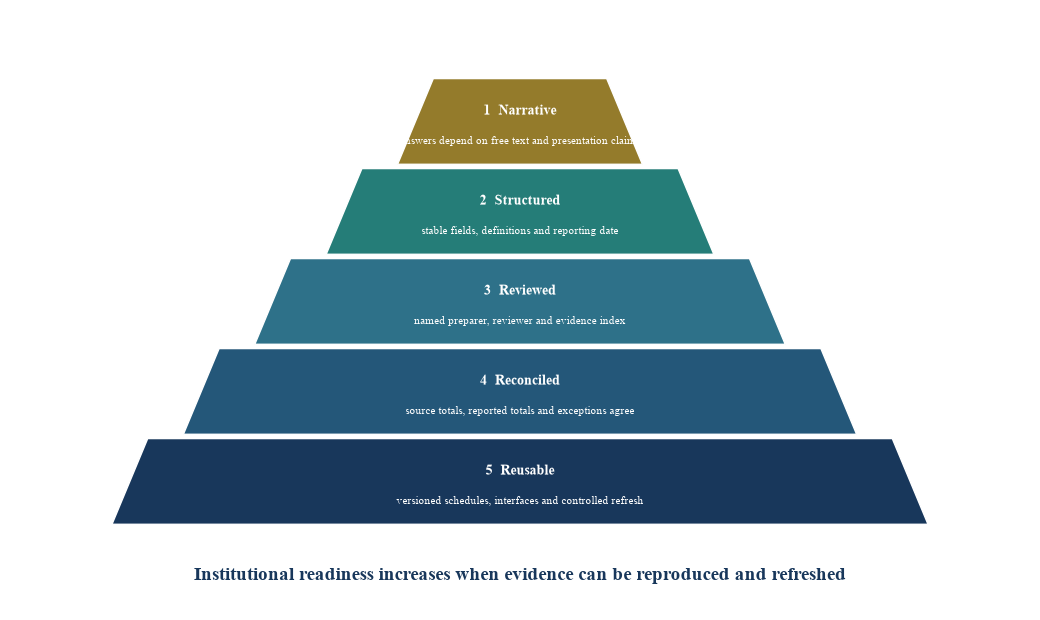
The proposed Gulf Manager Data Standard translates that direction into an allocator's diligence file. It uses one principle: a material assertion should connect to a definition, reporting period, source record, calculation method, control owner and decision use. This connection allows the investment committee to see both the answer and its evidential strength.
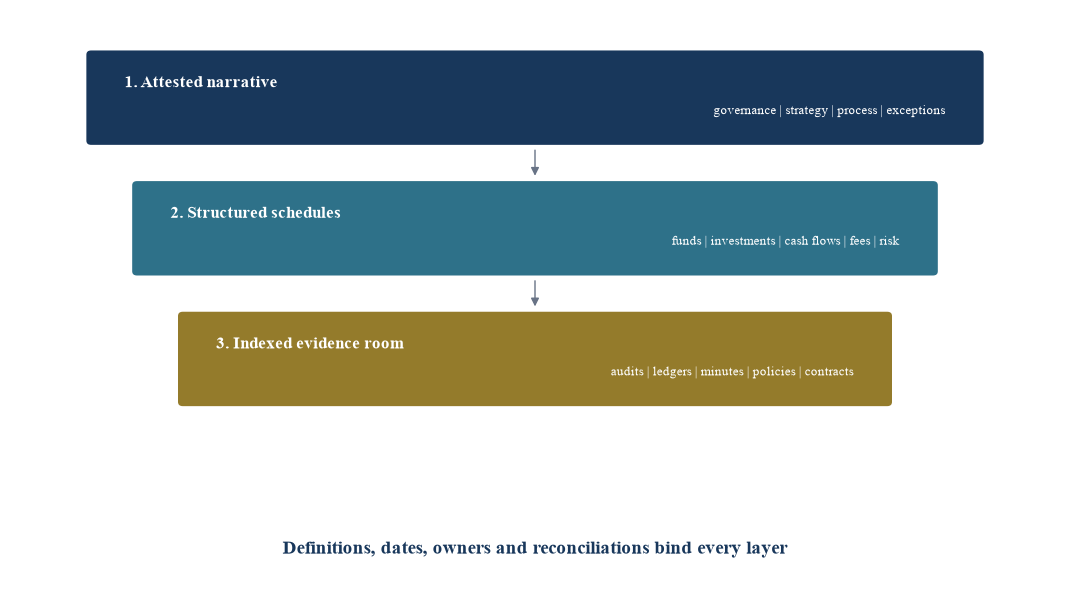
Author framework. The layers supplement applicable law, fund documents and specialist diligence.
2. Define the standard's role
The standard is an allocator specification. It defines the information needed to reach and maintain an investment decision. It should sit beside the manager's offering documents, limited partnership agreement, regulatory obligations, financial statements and existing investor reports. It should avoid creating a competing accounting or legal definition.
The specification starts with a data dictionary. Terms such as committed capital, invested capital, cost, fair value, realised proceeds, recallable distribution, gross return, net return, fund leverage and portfolio-company leverage need an explicit meaning. The dictionary records currency, unit, sign convention, calculation date, treatment of subscription facilities, treatment of fees and carried interest, foreign-exchange method and consolidation approach.
The second element is a reporting perimeter. The manager should list every entity and vehicle relevant to the diligence: management company, general partner, adviser, carry vehicle, main fund, parallel funds, feeders, alternative investment vehicles, continuation vehicles, co-investment vehicles and material service providers. The list should identify jurisdiction, legal form, regulator, ownership, audit status and relationship to the proposed commitment.
The third element is time. Point-in-time fields, period flows and life-to-date measures should be distinguished. A portfolio valuation has a measurement date. A fee is a period flow. Distributed to paid-in capital is a cumulative ratio. The DDQ should state the latest closed reporting period and identify subsequent events separately.
The fourth element is accountability. Every schedule should have a preparer, reviewer and approval status. Each exception should include its cause, financial or decision effect, remediation owner and target date. Attestation should describe the level of review performed and should avoid implying assurance that has not occurred.
3. Use current standards as source architecture
The ILPA DDQ 2.0 covers twenty areas, including firm and fund information, succession, investment strategy, co-investment, continuation funds, credit facilities, team, alignment, governance, track record, valuation, reporting, legal, technology, ESG and diversity.[6] It is a strong narrative and document-request base. A Gulf data standard can retain that breadth and attach quantitative schedules and evidence references to the most decision-sensitive answers.
ILPA's Reporting Template 2.0 promotes uniform reporting of fees, expenses and carried interest. ILPA states that it is intended to replace the 2016 template for funds still in their investment period during the first quarter of 2026 or funds commencing operations on or after 1 January 2026.[1] The Performance Template standardises return calculations and corresponding contributions and distributions; ILPA states that it should be used for funds commencing operations on or after 1 January 2026.[2]
The updated Capital Call and Distribution Template provides transaction-level detail needed to monitor calls and distributions. ILPA states that the updated template should first be delivered in the first quarter of 2027 for funds not adopting the Performance Template, while relevant funds adopting the Performance Template use it for funds launched on or after the first quarter of 2026.[3] An allocator preparing a 2027 DDQ can ask how the manager maps current notices to these structures.
The IPEV Guidelines address fair-value practice for private capital investments. The 2025 edition supersedes the 2022 edition and applies to quarterly reporting periods beginning on or after 1 April 2026, with early adoption encouraged.[4] The DDQ should therefore obtain the manager's valuation policy, its adoption date, investment-level methodology and evidence of governance.
Regulatory reporting provides a separate lens. ADGM's FSRA requires periodic reporting for funds managed by authorised fund managers, with reporting content and frequency varying by fund type.[5] The published template includes static fund data and fields addressing fund type, legal structure, strategy, geography and valuation frequency, among other items.[7] The DFSA also describes annual reporting for marketing and selling funds, alongside its collective-investment-fund regime and ongoing supervision.[8] Institutional diligence should reconcile regulatory classifications with investor materials.
Table 1. Current source standards and allocator use
| Source | Current purpose | Allocator data use | Evidence requested |
|---|---|---|---|
| ILPA DDQ 2.0 | standardise common manager diligence questions | narrative coverage, governance, alignment and document list | completed questionnaire, exception schedule and document index |
| ILPA Reporting Template 2.0 | improve fee, expense and carried-interest reporting | fund-economics schedule and quarterly reconciliation | populated template, general-ledger mapping and administrator review |
| ILPA Performance Template | standardise cash-flow mapping and performance calculations | reproducible gross and net return analysis | transaction-level cash flows, methodology selection and formula control |
| ILPA Capital Call and Distribution Template 2.0 | standardise notice-level transaction information | liquidity forecasting and call/distribution classification | sample notices, adoption map and reconciliation to fund cash flows |
| IPEV Valuation Guidelines 2025 | support fair-value practice in private capital | investment-level valuation method and governance | valuation policy, committee records, models and back-testing |
| ADGM periodic fund return | provide the FSRA with fund activity and risk information | regulatory-perimeter and data-control cross-check | filed or prepared returns, ownership map and submission controls |
| DFSA fund information | support supervision and fund marketing reporting | licence, fund classification and marketing-perimeter cross-check | public-register extract, filings and compliance calendar |
Effective dates and application depend on the source's own scope and guidance. The DDQ should record the manager's actual adoption status.
4. Design a three-layer DDQ
Layer one is the attested narrative. It explains the manager's history, ownership, governance, strategy, sourcing, decision rights, portfolio-management process, valuation governance, conflicts, compliance, technology and material changes. Each answer should use a defined reporting date. Statements covering a future plan should identify the responsible owner and expected completion date.
Layer two is structured data. The preferred format is a set of protected worksheets or equivalent machine-readable tables with stable field names. Free-text cells are reserved for explanations and exceptions. Identifiers link the manager, fund, vehicle, investment, security, cash flow, valuation and incident records. This structure allows an allocator to compare managers and refresh the file without rebuilding the model.
Layer three is source evidence. Every decision-sensitive field should have an evidence identifier linked to an indexed file or system report. Examples include audited accounts, administrator capital-account statements, bank records, investment-committee minutes, valuation models, policies, regulatory filings, legal documents and service-provider reports. Access restrictions can be managed through staged disclosure, clean teams or on-site review.
The DDQ should record data quality explicitly. A field can be final, provisional, estimated or unavailable. An estimated field needs a method and owner. An unavailable field needs a reason, decision impact and remediation path. The allocator should avoid converting missing data into a zero.
5. Establish the core data dictionary
The data dictionary is the centre of comparability. It should define identifiers, units, time periods and calculations before the allocator imports a track record. The fund record includes legal name, vintage definition, strategy, domicile, base currency, committed capital, target, hard cap, close dates, investment period, term, extensions and audit information.
The investment record includes acquisition and exit dates, sector, geography, security, ownership, board rights, entry and exit enterprise values, equity invested, follow-on capital, proceeds, remaining cost and fair value. If the manager aggregates related securities or entities, the aggregation method should be stated.
The cash-flow record contains date, amount, currency, transaction type, fund, investment, investor or vehicle, and treatment in gross and net return calculations. Subscription-facility draws and repayments should be identifiable. Foreign-exchange conversion should use a stated source and date convention.
The valuation record includes measurement date, method, key inputs, comparable set, discount, calibration, value, ownership bridge, debt, cash, adjustments, reviewer and committee approval date. The record should distinguish external valuation support from manager responsibility.
Table 2. Minimum data dictionary for institutional diligence
| Domain | Required identifiers and measures | Control question | Decision supported |
|---|---|---|---|
| Manager | legal entities, owners, controllers, key persons, committees and regulated permissions | can governance and responsibility be traced across entities? | counterparty, succession and regulatory assessment |
| Fund | vehicle, vintage, strategy, currency, commitment, closes, term and audit | do documents, accounts and marketing materials use consistent facts? | mandate fit and legal diligence |
| Investment | asset, security, geography, sector, dates, ownership, cost, value and proceeds | can each investment be reconciled from entry to current status? | attribution and portfolio-risk review |
| Cash flow | date, amount, currency, type, facility treatment and calculation mapping | can gross and net returns be reproduced? | performance and liquidity assessment |
| Fees and carry | basis, rate, offsets, expenses, accruals, crystallisation and allocation | can reported economics be tied to governing documents and ledger? | alignment and net-return analysis |
| Valuation | method, inputs, calibration, debt, adjustments, reviewer and approval | is fair value reproducible and governed? | NAV reliance and downside testing |
| Risk | concentration, leverage, liquidity, currency, incidents and covenant headroom | are portfolio risks measured consistently through time? | commitment sizing and monitoring |
| Sustainability | material metrics, boundaries, methods, estimates and assurance | are claims connected to decision-useful evidence? | risk, reporting and mandate compliance |
Field-level requirements should be tailored to strategy, jurisdiction and materiality.
6. Rebuild the track record from source cash flows
Track record is often the most modelled and least reproducible part of a manager data room. A presentation can show gross internal rate of return, net internal rate of return, total value to paid-in capital, distributed to paid-in capital and loss ratio. An allocator needs the transaction records and calculation rules behind those measures.
The reconstruction starts with all relevant funds and investments. The manager should explain attribution of prior-firm investments, team participation, shared deals, warehoused assets, continuation transfers and investments excluded from the presentation. The reporting perimeter should match the claim being evaluated.
Cash flows should be provided at their actual dates. Each flow should have a transaction type, including acquisition, follow-on, fee, expense, dividend, interest, return of capital, realisation, write-off and transfer. The DDQ should document how subscription facilities change the timing presented to investors and how gross calculations treat fund-level costs.
Currency treatment can materially change a regional track record. The manager should provide local-currency cash flows, fund-currency cash flows and the exchange-rate convention. An allocator can then distinguish operating value creation from currency movement.
Realised and unrealised performance should be separated. Unrealised value needs the valuation date and evidence. Partially realised investments need a bridge across proceeds, remaining cost and fair value. A continuation transaction needs the transfer terms, valuation process, conflicts governance and treatment in predecessor and successor performance.
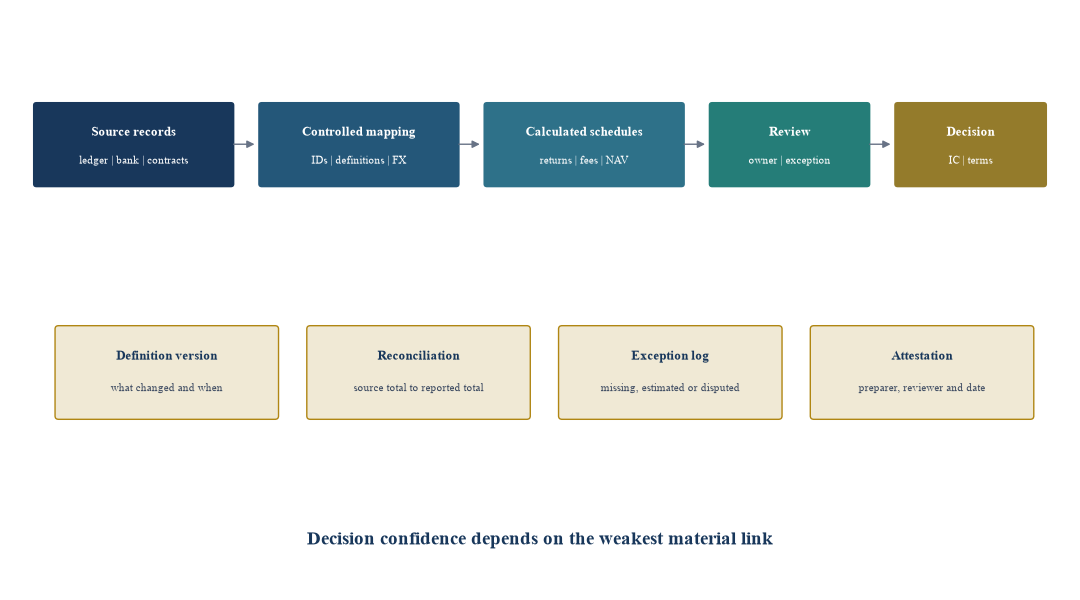
Author framework. Each arrow represents a documented reconciliation and review.
Table 3. Institutional tests for a manager track record
| Test | Required schedule | Reconciliation | Committee question |
|---|---|---|---|
| Completeness | all funds, investments and exclusions | presentation perimeter to legal and audited vehicle list | which outcomes are outside the marketed record and why? |
| Cash-flow integrity | dated investment and fund cash flows | source cash, administrator records and performance template | can gross and net returns be reproduced? |
| Attribution | deal leadership, committee role and prior-firm rights | personnel records and investment files | which members of the current team created the result? |
| Value creation | revenue, margin, leverage, multiple and cash-flow bridges | entry, current and exit financial records | which return drivers are repeatable in the proposed strategy? |
| Valuation | method, inputs, calibration and approval by period | valuation models to audited NAV | how sensitive is the record to current unrealised marks? |
| Facility effect | subscription-line draws, repayments, costs and timing | bank and administrator flows to performance calculations | how much does financing timing change reported returns? |
| Currency effect | local and fund-currency cash flows and rates | exchange-rate source and translation schedule | how much return comes from currency movement? |
| Loss analysis | impairment, write-off, restructuring and recovery | investment records to realised and unrealised status | what caused permanent capital loss and what changed? |
Tests should be applied to the specific strategy and the claims presented by the manager.
7. Separate performance from presentation
The DDQ should preserve the manager's disclosed measures and calculate an allocator view from the source data. This creates a bridge rather than a debate over one preferred number. The bridge identifies differences arising from perimeter, cash-flow timing, facility treatment, currency, fees, valuation dates and methodology.
Gross and net return should be connected. The manager should show management fees, fund expenses, transaction fees, offsets, carried interest, credit-facility cost and other deductions between the two. The allocator should test whether the net result represents the proposed investor class and whether equalisation, tax, currency or side-letter terms create differences.
The result also needs time and scale context. A high internal rate of return on a short holding period can coexist with limited multiple. A high multiple can require a long duration. Early funds can have concentrated outcomes. The DDQ should show dispersion by investment, fund, vintage, sector, geography, lead partner and realised status.
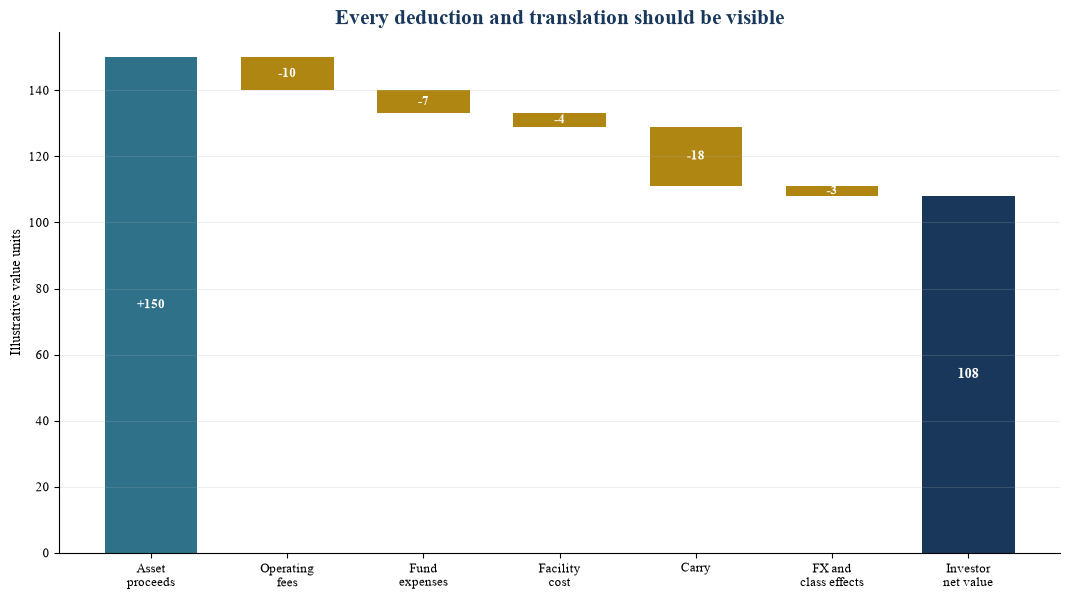
Author framework. The bridge should preserve each manager-reported measure and document adjustments.
8. Make fund economics machine-readable
Fund economics should be recorded in both legal and calculated form. The legal schedule contains management-fee rates, fee bases, step-downs, offsets, organisational-expense caps, partnership expenses, transaction fees, broken-deal expenses, carried-interest rate, hurdle, catch-up, waterfall, clawback and general-partner commitment.
The calculated schedule shows actual and forecast amounts. It reconciles fees and expenses from notices and quarterly reports to the ledger and financial statements. It should allow the allocator to model a commitment under multiple deployment, exit and extension cases.
Related-party arrangements require a separate register. The manager should identify affiliates that receive fees, service-provider selection, allocation methodology, rebates and governance. The DDQ should connect each arrangement to governing documents and conflict approval.
Continuation vehicles and cross-fund transactions need transaction-specific disclosures. The file should state the seller and buyer funds, valuation process, adviser roles, limited-partner advisory committee process, election alternatives, financing and how performance is recorded in each vehicle.
9. Test valuation as a governed process
The valuation policy should identify the applicable accounting framework, IPEV adoption status, hierarchy of methods, calibration practice, review frequency, committee composition, conflicts and use of external valuation providers. The investment-level schedule should explain the selected method and the evidence supporting material inputs.
Entry calibration is important. The manager should record the transaction price, enterprise value, capital structure and market conditions at entry. Subsequent valuation should explain changes in operating performance, market multiples, discount rates, debt, cash, dilution, instrument rights and probability-weighted outcomes.
Back-testing strengthens the control environment. The manager can compare prior marks with actual exit proceeds, refinancing values, third-party transactions or later funding rounds. Variances should be explained by events and method changes. The allocator should ask how back-testing affects policy and review.
Valuation independence should be described precisely. An external provider can support a valuation while the manager remains responsible for fair value. A committee containing deal professionals can still operate controlled challenge if conflicts, voting rights, evidence and minutes are clear.
10. Capture leverage, liquidity and concentration
The data standard should distinguish leverage at fund, holding-company and portfolio-company levels. Each facility record should include borrower, lender, commitment, drawn amount, maturity, pricing, collateral, covenant tests, purpose and recourse. Subscription lines require dates of draw and repayment so their effect on returns and liquidity can be analysed.
Portfolio-company leverage should be reported with a defined EBITDA or cash-flow measure, net-debt bridge, covenant headroom and maturity schedule. The measure used in marketing should be reconciled to financial statements and financing documents. Material adjustments need definitions and limits.
Liquidity information includes uncalled commitments, available facilities, expected calls, expected distributions, restricted cash, refinancing needs and exit assumptions. A commitment model should test delayed exits, lower distributions, extension periods and currency movement.
Concentration should be available by investment, sector, geography, currency, sponsor, counterparty and value driver. Related exposures, such as several assets dependent on one government customer, grid connection or commodity price, should be visible beyond legal-entity labels.
11. Treat operations and technology as investment data
Operational due diligence needs an entity and responsibility map. The manager should identify fund administrator, auditor, depositary or custodian where applicable, legal counsel, tax adviser, valuation provider, technology vendors and outsourced functions. The map should state the service, jurisdiction, access to data, subcontracting and termination plan.
The technology schedule should cover key applications, data flows, access controls, privileged accounts, change management, backups, recovery objectives, incident response, penetration testing and vendor monitoring. The evidence room can include relevant assurance reports, test summaries and remediation registers subject to security restrictions.
ADGM's FSRA has used standardised templates for technology and cyber incident reporting, including an initial report and progressive reports.[9] This provides a useful governance pattern: incident data should be time-stamped, owned and updated as facts develop. The DDQ should request a material incident register, the manager's reporting thresholds and evidence that lessons are incorporated into controls.
Table 4. Operational and technology diligence record
| Control domain | Structured fields | Evidence | Escalation condition |
|---|---|---|---|
| Entity and outsourcing | legal owner, process owner, provider, location and subcontractor | contracts, responsibility matrix and oversight reports | unclear ownership or material service outside oversight perimeter |
| Access security | application, role, privileged access, approval and recertification | access reviews and exception log | orphaned, excessive or unreviewed privileged access |
| Data management | source, transfer, storage, retention and deletion | data map, policies and sample control records | material investor or portfolio data lacks controlled lineage |
| Resilience | recovery time, recovery point, backup and test date | business-continuity and disaster-recovery tests | untested critical process or recovery gap beyond tolerance |
| Cyber incidents | date, scope, impact, notification, response and closure | incident register and post-incident review | unresolved material event or late required notification |
| Vendor risk | criticality, diligence, monitoring, concentration and exit | vendor assessments and termination plan | critical dependency without tested alternative or data-return route |
| Change control | request, testing, approval, deployment and rollback | change tickets and release records | material calculation or report changed without documented approval |
Sensitive evidence can be reviewed through controlled access arrangements.
12. Integrate regulatory, AML and sanctions evidence
Regulatory status should be verified against the relevant public register and legal entity. The manager should provide permissions, fund classifications, material conditions, filings, inspections, breaches, remediation and regulatory correspondence subject to appropriate confidentiality.
The AML and sanctions schedule should identify the policy owner, risk assessment date, customer and investor due-diligence process, beneficial-ownership controls, screening systems, escalation, suspicious-activity reporting governance, training and independent testing. The DDQ should seek evidence of operation, such as anonymised control statistics and remediation records, while respecting legal restrictions.
Marketing and placement arrangements also require data. The manager should list jurisdictions, distributors, placement agents, introducers, fees, approvals and investor classifications. This supports assessment of conduct, conflicts and contingent liabilities.
The standard should maintain a compliance calendar. Each return, notification, renewal, board approval and policy review has an entity, due date, responsible owner, reviewer and completion evidence. Exceptions enter the same register used for investment monitoring.
13. Add sustainability data with defined boundaries
Sustainability information should follow the same data rules as financial information. A metric needs a boundary, methodology, period, unit, source, estimation status and review. The manager should distinguish firm-level policy, fund mandate, investment process and portfolio outcome.
The DDQ should ask which sustainability risks and opportunities affect investment decisions, how they enter diligence, who approves exceptions and how portfolio companies report. Metrics should be selected for materiality to the strategy. The allocator should obtain coverage percentages and identify estimates separately from measured data.
IFRS S2 requires disclosure of climate-related risks and opportunities that could reasonably affect cash flows, access to finance or cost of capital. The ISSB issued targeted amendments in December 2025 that take effect for reporting periods beginning on or after 1 January 2027, with early application permitted.[10] The amendments include clarifications and reliefs relevant to financed emissions. A 2027 DDQ should ask which framework and version the manager uses, the scope of reported assets and the method for exclusions.
The manager should avoid presenting an ESG score without the underlying field definitions. The evidence file should show the asset boundary, ownership share, reporting period, methodology and assurance status. This makes the data usable for both mandate monitoring and risk analysis.
14. Move from annual diligence to continuous monitoring
A completed pre-commitment DDQ is a baseline. The limited partnership agreement and side letter should establish ongoing reporting, notification and information rights. The allocator should map the agreed requirements into a monitoring calendar before funding.
Quarterly updates should cover fund cash flows, performance, valuation, fees, portfolio status, leverage, liquidity, concentration and material incidents. Annual updates should cover audited accounts, compliance, valuation-policy review, insurance, business continuity, cybersecurity, conflicts, sustainability and key-person succession. Event-driven notices should cover key-person events, control changes, regulatory issues, material litigation, cyber incidents, valuation changes, defaults, extensions and continuation transactions.
Version control is essential. Each schedule should retain the prior submission, current submission and change log. The manager should explain restatements and method changes. The allocator can then distinguish new economic information from a definition change.
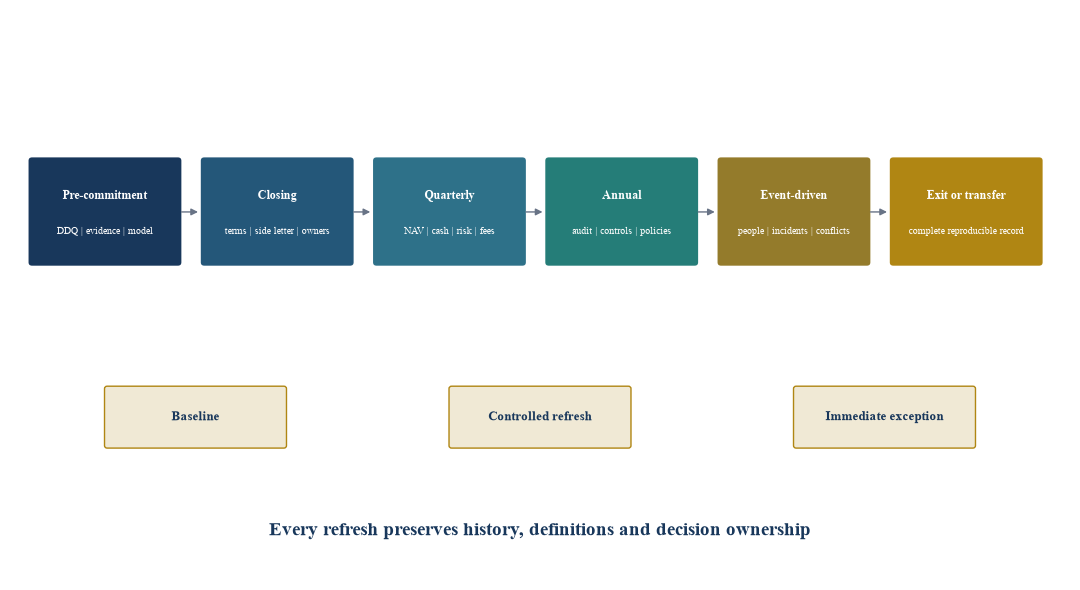
Author framework. Contractual reporting frequency should follow fund documents and applicable requirements.
Table 5. Institutional manager monitoring pack
| Frequency | Data pack | Reconciliation | Escalation output |
|---|---|---|---|
| Quarterly | cash flows, performance, NAV, fees, leverage, liquidity, concentration and portfolio events | administrator, ledger, valuation and investment schedules | exception report to portfolio owner or committee |
| Annual | audited accounts, controls, compliance, insurance, policy updates, cyber testing and sustainability | audited records, regulatory calendar and evidence index | annual manager review and watchlist decision |
| Event-driven | key person, control, litigation, breach, default, incident, conflict or continuation transaction | notice to underlying records and governing-document requirement | immediate decision-right and remedy assessment |
| Fundraising | successor fund, strategy drift, team attribution and allocation of opportunities | prior-fund deployment, pipeline and allocation records | re-up decision and pacing analysis |
| Exit or transfer | final cash flows, valuation, tax, legal and ownership evidence | complete history to audited and transaction records | realised attribution and lessons-learned file |
Exact requirements should be negotiated in fund documents and tailored to the strategy.
15. Score evidence maturity without false precision
An allocator can score data maturity across the eight domains. A lower score means that material answers are narrative, definitions are unstable or evidence is missing. A higher score means that schedules are standardised, reconciled, reviewed, versioned and reusable. The score directs diligence work. It does not determine manager quality or expected return.
Consider three hypothetical managers. Manager Alpha has mature administrator integration and valuation controls, while its portfolio sustainability data remains partly estimated. Manager Beta has a strong realised track record and limited formal data governance. Manager Gamma is a first-time institutional fund with experienced principals, a newly implemented administrator and incomplete back-testing history. These descriptions and all scores are management assumptions for demonstration.
The framework directs different actions. Alpha needs coverage and methodology work in the sustainability schedule. Beta needs track-record reconstruction, data ownership and operating-control evidence. Gamma needs clear prior-firm attribution, operating tests and staged reporting milestones. The committee receives the unresolved items as conditions, monitoring requirements or reasons to pause.
Author framework. Maturity describes the information system, not investment merit.
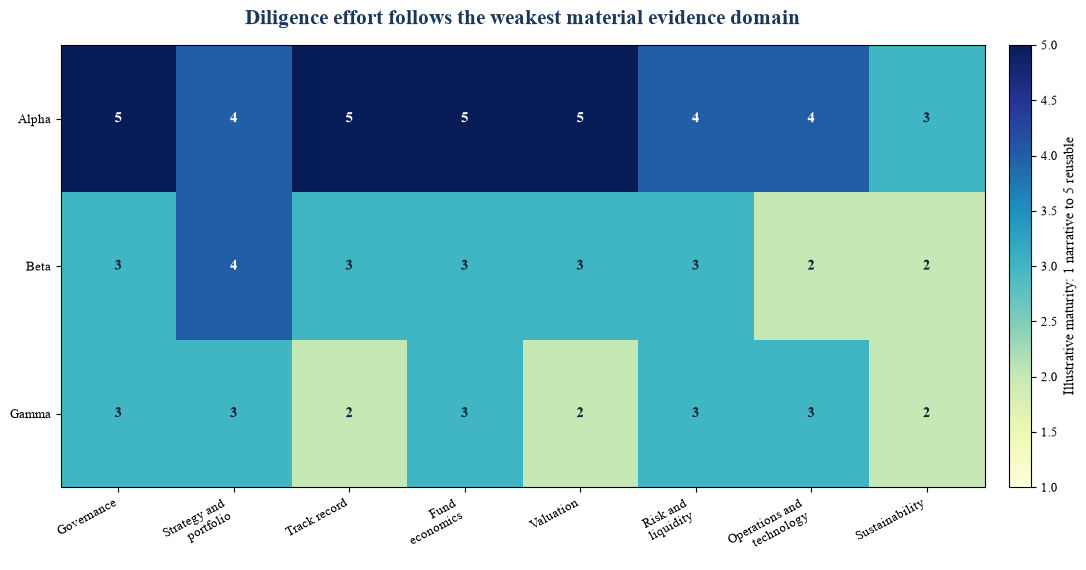
Every score is a management assumption for method demonstration. Scores do not represent actual managers or investment recommendations.
16. Implement the standard in twelve weeks
Weeks one and two establish governance and scope. The allocator defines the strategies, manager types, jurisdictions and decisions covered. It selects the required standards, creates the data dictionary and assigns internal owners across investments, risk, operations, legal, tax and sustainability.
Weeks three and four design the schedules. The team builds the entity, fund, investment, cash-flow, performance, fee, valuation, leverage, incident and sustainability tables. It defines identifiers, validations, reporting dates and permitted exception codes.
Weeks five and six map evidence. Each field and questionnaire section receives a source requirement and evidence identifier. The team designs the data-room index, access tiers, confidentiality controls and attestation wording.
Weeks seven and eight pilot the standard on one manager. The allocator imports the track record, reconstructs returns, reconciles fund economics, tests valuation records and identifies unclear definitions. The manager receives a single exception log instead of multiple disconnected requests.
Weeks nine and ten refine the decision pack. The team converts findings into committee questions, legal terms, side-letter reporting, monitoring thresholds and remediation milestones. It documents differences from the manager's existing templates.
Weeks eleven and twelve approve and operationalise. The allocator freezes the version, trains users, establishes a secure submission route and creates the quarterly, annual and event-driven calendar. Future changes use controlled versioning and release notes.
Table 6. Twelve-week Gulf manager data-standard implementation
| Weeks | Workstream | Deliverable | Approval gate |
|---|---|---|---|
| 1 to 2 | scope and governance | decision map, standards register, owners and materiality rules | investment, legal and operations scope accepted |
| 3 to 4 | data design | dictionary, identifiers, schedules and validation rules | fields support required committee decisions |
| 5 to 6 | evidence architecture | evidence index, access tiers, attestations and exception codes | every material field has a source route |
| 7 to 8 | manager pilot | populated schedules, track-record reconstruction and issue log | reported measures reproduce or differences are explained |
| 9 to 10 | terms and monitoring | committee pack, reporting terms, thresholds and remediation | unresolved items have owners and decision treatment |
| 11 to 12 | controlled launch | approved version, training, secure submission and change log | standard enters monitored operation |
Timing should be adapted to available systems, confidentiality requirements and live transaction deadlines.
17. Limitations and conclusion
The sources in this paper serve different functions. ILPA materials are industry templates and guidance. IPEV provides valuation guidance. ADGM and DFSA materials relate to their respective regulatory frameworks. IFRS sustainability standards have their own application and adoption requirements. The proposed standard does not combine these sources into one legal obligation.
Fund structures, investor needs, strategies and jurisdictions vary. A venture fund, private-credit fund, real-estate fund and infrastructure fund require different portfolio and risk fields. The allocator should tailor the standard while preserving common identifiers, definitions and reconciliation rules.
Confidentiality, privilege, cybersecurity and data-protection requirements can limit document access. A controlled review, redacted evidence, clean team or specialist assurance report can address some constraints. The decision file should record the actual evidence reviewed.
The hypothetical manager scores and track-record bridge are management assumptions created only to demonstrate the method. They do not describe a manager, market benchmark, expected return or regulatory conclusion.
The central institutional requirement is reproducibility. A committee should be able to trace a material claim from source record through definition, calculation, review and decision. The same chain should remain available during quarterly monitoring, a key-person event, a valuation challenge, a re-up and an eventual transfer or exit.
A manager able to provide this chain gives an allocator a more governable relationship. A manager still building the chain can be assessed through explicit gaps, conditions and milestones. The Gulf Manager Data Standard creates the common architecture for both cases.
References
- [1] Institutional Limited Partners Association, ILPA Reporting Template, version 2.0 and implementation information, accessed 12 August 2026. https://ilpa.org/industry-guidance/templates-standards-model-documents/ilpa-templates-hub/ilpa-reporting-template/
- [2] Institutional Limited Partners Association, ILPA Performance Template, version 1.1 and implementation information, accessed 12 August 2026. https://ilpa.org/industry-guidance/templates-standards-model-documents/ilpa-templates-hub/ilpa-performance-template/
- [3] Institutional Limited Partners Association, ILPA Capital Call and Distribution Template, version 2.0 and implementation information, accessed 12 August 2026. https://ilpa.org/industry-guidance/templates-standards-model-documents/ilpa-templates-hub/ilpa-capital-call-and-distribution-template/
- [4] International Private Equity and Venture Capital Valuation Board, International Private Equity and Venture Capital Valuation Guidelines, December 2025. https://www.privateequityvaluation.com/Portals/0/Documents/Guidelines/2025%20IPEV%20Valuation%20Guidelines.pdf
- [5] Abu Dhabi Global Market Financial Services Regulatory Authority, FSRA Implements Regulatory Reporting Requirements for Funds, 25 September 2025. https://www.adgm.com/media/announcements/adgm-fsra-implements-regulatory-reporting-requirements-for-funds
- [6] Institutional Limited Partners Association, Due Diligence Questionnaire 2.0, November 2021. https://ilpa.org/wp-content/uploads/2021/11/ILPA-DDQ-2.0.pdf
- [7] Abu Dhabi Global Market Financial Services Regulatory Authority, Funds Reporting Template, published with the periodic fund-reporting framework. https://assets.adgm.com/download/assets/Attachment%2B2%2B-%2BFunds%2BReporting%2BTemplate.pdf/c4a457cc030a11f0b639ceb45ed71b36
- [8] Dubai Financial Services Authority, Collective Investment Funds, reporting and fund-regime information, accessed 12 August 2026. https://www.dfsa.ae/what-we-do/collective-investment-funds
- [9] Abu Dhabi Global Market Financial Services Regulatory Authority, Notice No. FSRA/13/2025, Information Technology and Cyber Incident Reporting, 4 February 2025. https://assets.adgm.com/download/assets/FSRA%2BNotice%2B13%2Bof%2B2025%2B-%2BInformation%2BTechnology%2Band%2BCyber%2BIncident%2BReporting.pdf/b31aa2e2e2f611efb6ee769067822a45
- [10] IFRS Foundation, ISSB Issues Targeted Amendments to IFRS S2 to Support Implementation, December 2025. https://www.ifrs.org/news-and-events/news/2025/12/issb-issues-targeted-amendments-ifrs-s2/
- [11] Institutional Limited Partners Association, ILPA Reporting Template version 2.0, resource page, 21 January 2025. https://ilpa.org/resources-tools/resource-library/ilpa-reporting-template-v-2-0/
- [12] Institutional Limited Partners Association, Updated Capital Call and Distribution Template Strengthens Transparency, 11 September 2025. https://ilpa.org/news/capital-call-and-distribution-update/
- [13] Abu Dhabi Global Market Financial Services Regulatory Authority, Regulatory Reporting and Requirements, accessed 12 August 2026. https://www.adgm.com/operating-in-adgm/additional-obligations-of-financial-services-entities/supervision/regulatory-reporting-and-requirements
- [14] IFRS Foundation, IFRS S2 Climate-related Disclosures and supporting materials, accessed 12 August 2026. https://www.ifrs.org/issued-standards/ifrs-sustainability-standards-navigator/ifrs-s2-climate-related-disclosures/
