

1. Put care continuity inside the transaction thesis
A healthcare acquisition creates value only if the combined organisation can deliver appropriate care, retain the capacity that produces that care, convert completed activity into valid claims and collect cash within a controlled operating model. Scale is therefore an operating condition rather than a result in itself. A larger group can possess more sites, clinicians and contracts while becoming harder to schedule, govern, bill or navigate.
The integration thesis should identify the precise clinical and economic mechanisms expected to improve. Examples include extending services across a broader catchment, increasing utilisation of diagnostics or theatre capacity, coordinating referrals, improving procurement terms, reducing duplicate administration, strengthening quality systems or financing technology that a standalone provider could not support. Each mechanism needs a patient pathway, operating owner, data source, implementation cost, timing, risk limit and cash bridge.
Patient continuity is the first constraint. WHO describes integrated people-centred services as coordinated across the continuum and safe, effective, timely and responsive.[1] Applied to a transaction, this means the integration plan should preserve the sequence through which a patient is booked, assessed, diagnosed, treated, referred, monitored and able to escalate a concern. The legal entity or brand can change while the patient's need remains continuous.
The board should approve a care continuity perimeter before Day 1. The perimeter lists services and transitions where interruption could cause harm or material delay. It covers urgent appointments, high-risk results, medicine and device dependencies, open referrals, planned procedures, follow-up intervals, safeguarding cases, complex patients, records access and clinical escalation. Every item receives an owner, operating standard, fallback route, evidence source and breach protocol.
Integration decisions can then be grouped into three classes. Protected decisions cannot proceed until clinical continuity evidence and safety approval exist. Controlled decisions can proceed through a pilot with defined limits and rollback. Reversible decisions can be tested with lighter governance. This classification moves the programme away from a single calendar and towards risk-adjusted sequencing.
Table 1. Care-and-cash evidence states for a healthcare roll-up
| Evidence state | Required support | Permitted board use | Principal control |
|---|---|---|---|
| opportunity | initial clinical, operational or financial analysis | prioritise diligence and design work | disclose assumptions, exclusions and confidence |
| approved intervention | frozen baseline, owner, cost, timing and patient safeguards | release conditional resources | clinical, operational and finance approval |
| validated operating result | repeated pathway, capacity or claims evidence | assess recurring operating effect | compare with baseline and contemporaneous factors |
| accounting result | ledger entries and policy conclusion | statutory and management reporting | reconcile to general ledger and disclosure policy |
| realised cash | payer remittance, bank, working-capital and implementation evidence | assess liquidity and debt reduction | reconcile claims timing, denials, taxes and one-off cash |
The categories are a management-control system. Clinical, legal and accounting conclusions require applicable professional review.
2. Freeze the baseline before changing the network
The baseline should describe how care and cash move through each acquired business before integration. It should cover at least one complete operating cycle and enough history to explain seasonality, payer behaviour, clinician leave, referral variation and billing delays. The period should be frozen and preserved. Subsequent corrections need a change log, because an overwritten baseline removes the ability to distinguish integration performance from revised history.
The patient-pathway baseline begins with demand. It records referral source, appointment request, urgency, speciality, site, clinician, scheduled slot, attendance, cancellation, procedure or consultation, diagnostics, result, follow-up, discharge and escalation. It should segment the pathway by service line and care setting. Aggregate activity can conceal a reduction in continuity for a smaller but higher-risk group.
The capacity baseline reconciles clinician contracts and rosters to scheduled time, patient-facing time, completed activity and non-clinical obligations. Teaching, supervision, governance, training, administration and recovery time are real requirements. Treating every paid hour as available patient capacity produces an inflated synergy model and can create unsafe workloads.
The claims baseline connects clinical activity to authorisation, documentation, coding, charge capture, claim creation, submission, payer edits, acceptance, adjudication, denial, resubmission, remittance, patient balance and cash. Each step needs system identifiers and ownership. CMS guidance illustrates that changes of ownership, acquisitions and consolidations can affect provider-enrolment and claims records in the United States.[4] Other jurisdictions and payers use different rules, which must be mapped separately.
The financial baseline reconciles pathway and claim records to revenue recognition, receivables, cash, direct clinical cost, consumables, laboratories, imaging, pharmacy, facilities, technology and overhead. The counterfactual should state how each business was expected to perform without the transaction. Volume, price, staffing, payer mix and cost inflation should be separated so the combined result is not credited with unrelated market movement.
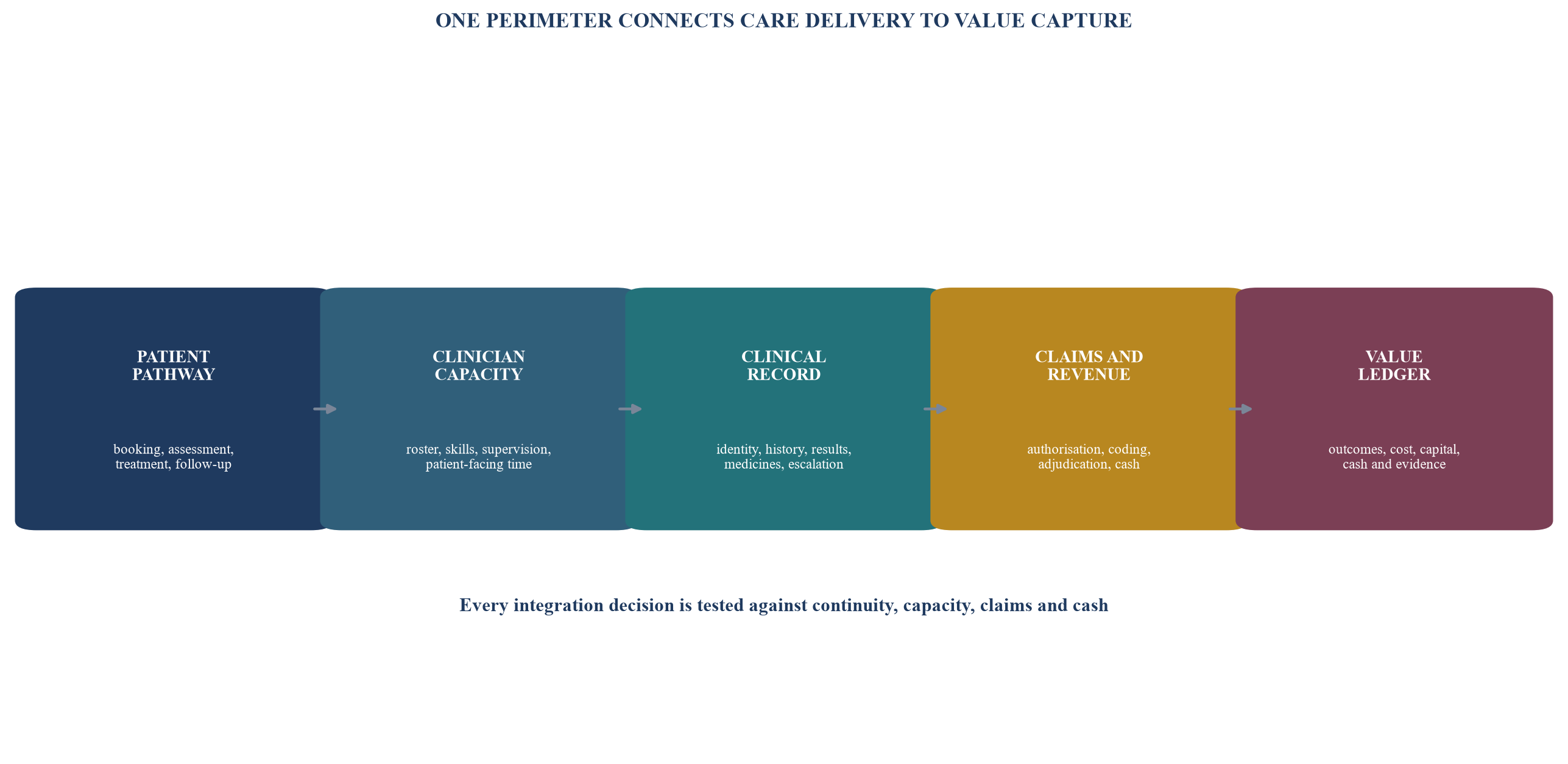
The framework keeps patient continuity, clinical capacity and cash conversion inside one governed transaction perimeter.
3. Protect clinician capacity as a scarce operating resource
Clinician capacity is often the binding constraint in a roll-up. A transaction can add patient demand and sites immediately while the supply of licensed, credentialled and appropriately skilled professionals changes slowly. OECD's Health at a Glance 2025 devotes a full evidence section to doctors, nurses, migration, graduates and remuneration, reflecting the strategic importance of workforce availability and distribution.[7]
Capacity should be measured through a waterfall. Contracted hours are reduced for leave, training, supervision, governance and other required activity to reach rosterable hours. Rosterable hours are reduced for vacancies, credentialling constraints and skill-location mismatch to reach schedulable hours. Schedulable hours are reduced for unused slots and late changes to reach booked hours. Booked hours are reduced for cancellations and non-attendance to reach delivered patient-facing time. Delivered time is then linked to completed, documented and claimable activity.
This distinction prevents several false benefits. Extending clinic hours is not a capacity gain when staffing depends on unsustainable overtime. Moving work between sites is not a gain when travel or handover reduces clinical time. Centralising administration is not a gain when clinicians absorb new documentation tasks. Increasing booked appointments is not a gain when cancellations, delays or incomplete records rise.
The integration team should build a clinician-role inventory by speciality, licence, credential, location, employment status, contracted commitment, notice period, restrictive covenant, supervision responsibility, language, procedure rights and critical pathway. The inventory should identify single points of failure, including a clinician whose departure would close a service, interrupt supervision or invalidate a payer or regulatory requirement.
Retention measures should protect roles and pathways rather than rely only on broad financial awards. Clear decision rights, workable rosters, preserved clinical autonomy, access to equipment and support, transparent performance measures and credible communication can matter alongside compensation. The board should monitor regretted departures, vacancy duration, locum dependence, overtime, cancelled capacity, supervision ratios and patient continuity by service line.
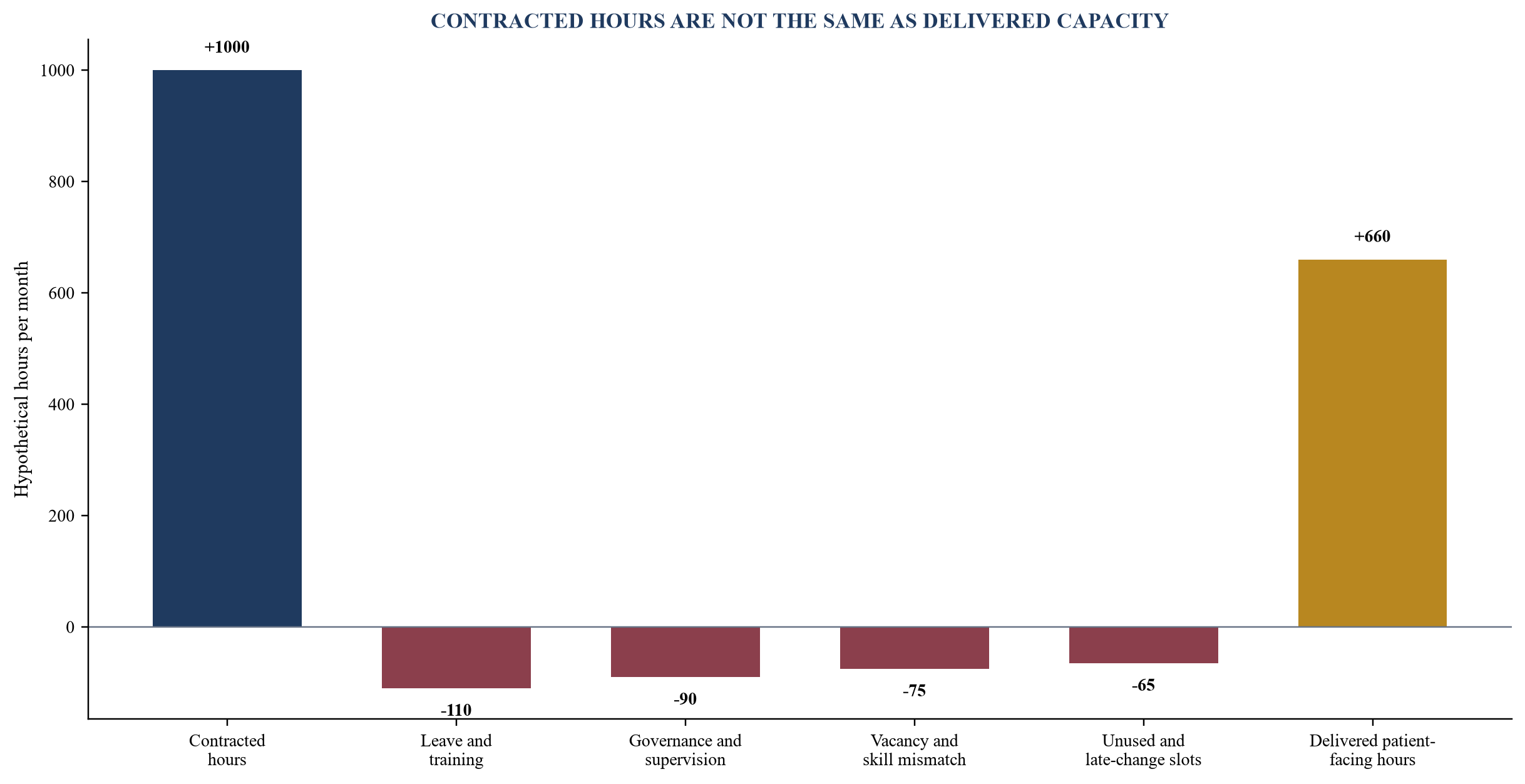
Values are hypothetical hours per month. The waterfall separates paid time, protected obligations, schedulable capacity and completed patient-facing activity.
Table 2. Clinician-capacity control record
| Capacity layer | Required evidence | Integration question | Failure signal |
|---|---|---|---|
| contracted supply | contracts, licences and credential records | what capacity can legally and practically be rostered? | expired, restricted or site-specific credentials |
| protected obligations | leave, training, supervision and governance schedules | which hours must remain outside direct care? | patient-facing plan consumes required safety activity |
| schedulable supply | roster, rooms, equipment and support staff | can the complete care team and asset set operate? | clinician available without room, device or support |
| booked demand | appointment and referral records | is capacity placed against appropriate demand? | long wait in one pathway and unused slots in another |
| delivered activity | attendance, procedure and note completion | was care completed and documented? | cancellations, delays or incomplete records rise |
| claimable output | authorisation, coding and charge capture | can completed care enter the revenue cycle? | delivered work remains unbilled or is rejected |
Measures should be segmented by service line, site, skill and applicable clinical governance requirements.
4. Make patient continuity a named operating account
Patient continuity becomes fragile when responsibility is distributed across entities, systems and teams. A patient may have an appointment in one system, a diagnostic result in another, a referral held by a third party and a follow-up expectation recorded only in a clinician's note. The integration plan needs a single continuity record that connects these obligations without assuming that immediate system consolidation is safe.
The record should classify open episodes by urgency, dependency and next required action. It should identify the responsible clinician or team, current location, scheduled date, required information, outstanding authorisation, result or medicine dependency, communication status and escalation route. High-risk exceptions should be reviewed daily during transition waves. Lower-risk episodes can be sampled against service standards.
Identity matching is a central control. Duplicate or incorrectly merged patient records can place prior history, allergies, results and balances under the wrong identity. The programme should define matching attributes, confidence thresholds, manual review, prohibited automatic merges, audit history and reversal. Where national or payer identifiers exist, local validation rules still matter because data can be incomplete or inconsistent.
Communication should explain what is changing, what remains available and how the patient can obtain help. Contact channels, language, accessibility and consent requirements should be built into the plan. The message should avoid promising a benefit before operating evidence exists. Complaints, abandoned calls, failed messages, missed appointments and repeated contacts can provide early evidence of friction.
The continuity map should extend to referral partners and external care providers. A roll-up may change laboratory, imaging, pharmacy, hospital, ambulance, home-care or specialist interfaces. Every interface needs a named sender, receiver, information standard, expected response, fallback and reconciliation. WHO's continuity guidance emphasises coordination across services and settings; this principle is directly applicable to transition governance.[1][12]
Table 3. Patient continuity map
| Pathway obligation | Minimum record | Transition control | Escalation trigger |
|---|---|---|---|
| booked appointment or procedure | patient, service, clinician, site, date and prerequisites | reconcile old and new schedules before cutover | missing, duplicated or materially delayed booking |
| diagnostic result | order, specimen or study, status, responsible reviewer | maintain result-routing and acknowledgement log | result lacks accountable review or communication |
| medicine or device dependency | item, dose or specification, prescriber, supplier and renewal | preserve authorised supply and clinical review | interrupted supply, incompatible substitution or missed review |
| open referral | reason, urgency, sender, receiver and expected response | confirm receipt and ownership at both ends | no acceptance, ageing beyond threshold or lost information |
| follow-up and surveillance | interval, condition, due date and responsible team | migrate recall lists with count and exception reconciliation | patient disappears from due or overdue population |
| safeguarding or complex-care flag | minimum necessary alert, owner and approved access | role-based transfer with explicit acknowledgement | unavailable alert, excessive access or unclear ownership |
The map is an operating checklist and does not replace clinical judgement or jurisdiction-specific requirements.
5. Map the complete claims and revenue cycle
Claims integration should begin before legal completion because billing continuity depends on identifiers, contracts, credentials and system rules that may change with ownership or operating structure. The integration team should create a payer-by-service matrix showing provider entity, location, clinician, speciality, contract, tariff or fee schedule, authorisation requirement, submission channel, coding logic, clearinghouse, bank account, remittance route and dispute process.
The end-to-end claim should be traced from demand to cash. Eligibility and coverage are confirmed before or at service. Required authorisation is obtained and linked. Clinical documentation supports the service. Coding and charge capture translate activity into a claim. The correct provider and payer identifiers are applied. Edits are passed, the claim is accepted, adjudicated and paid, and remittance is reconciled to the patient and general ledger. Each step can fail independently.
The programme should distinguish rejected claims, denied claims, underpayments, pending claims and unbilled activity. A rejection often indicates a format, identifier or eligibility failure before adjudication. A denial indicates that the payer assessed and refused all or part of the claim. Underpayment compares the remittance with the contracted entitlement. Pending claims require ageing and next action. Unbilled activity may indicate incomplete documentation, missing charge capture or an integration queue.
Cutover should use parallel control totals. For each payer and service, management should reconcile appointments, completed activity, documented activity, charges, submitted claims, accepted claims, adjudicated claims, remittances and cash. The counts and values should bridge across the old and new environments. A successful interface message does not prove that downstream adjudication or payment works.
Revenue recognition and cash are separate questions. Claim submission does not itself establish recognition, collectability or cash. Accounting policy should be applied to the actual contract and facts. Integration benefits should remain outside realised cash until bank and remittance evidence exists. This separation also protects the board from celebrating a lower denial percentage while unbilled activity or delayed submission grows.
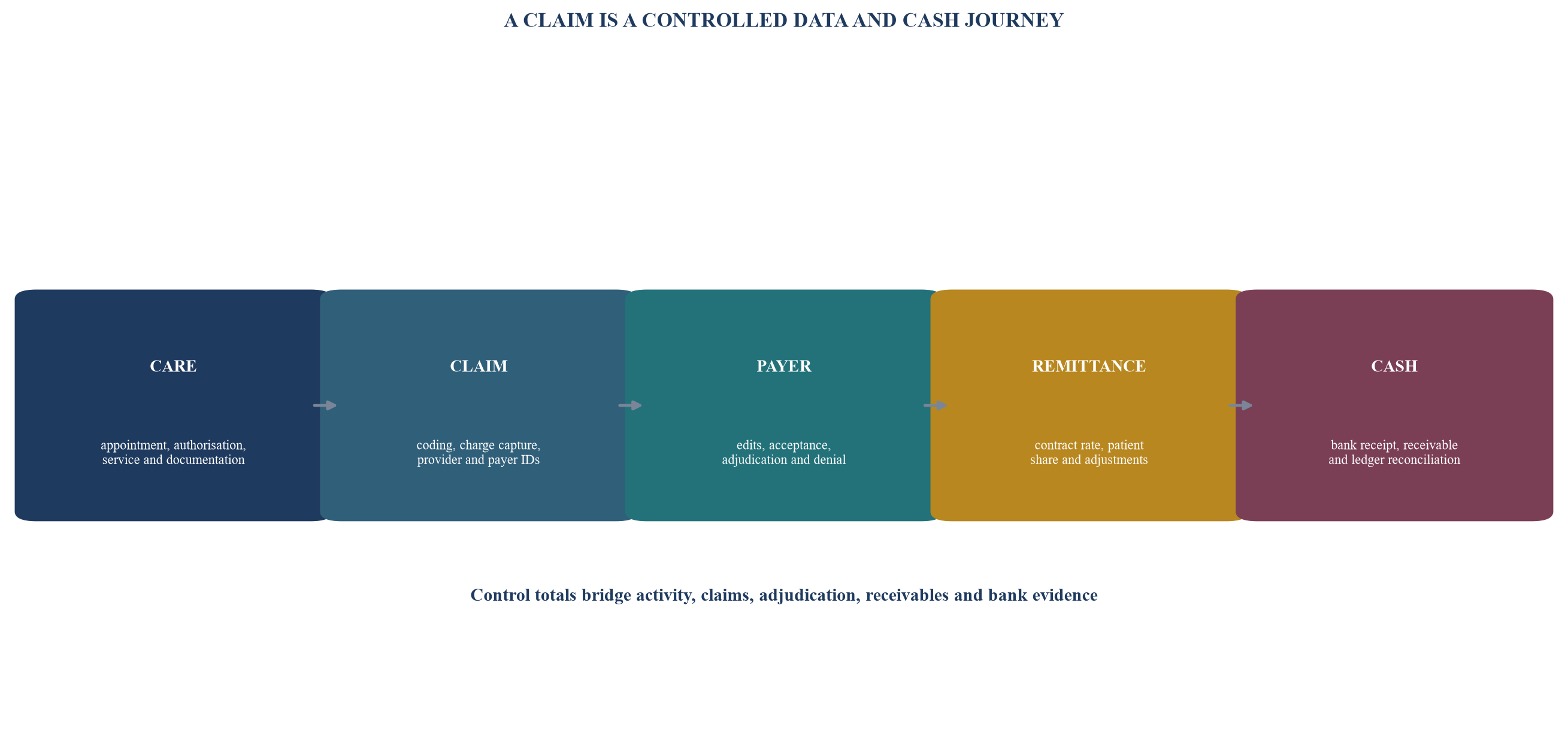
Every hand-off requires identifiers, ownership, control totals, exception management and reconciliation to cash.
6. Sequence systems integration through clinical safety gates
Immediate system standardisation can appear efficient because it promises one patient record, one scheduler, one claims platform and one reporting model. The risk lies in compressing configuration, data migration, interface testing, workflow redesign, training and safety assurance into a transaction timetable. The safer sequence begins with interoperability and control, then consolidates only where evidence supports the change.
NHS England's DCB0129 and DCB0160 standards distinguish clinical risk management for manufacturers and for care organisations that deploy and use health IT.[3] Its guidance describes clinical safety assurance as a formal risk-management activity and requires an accountable clinical safety officer in the applicable context.[13] These requirements are jurisdiction-specific, while the general governance principle is useful elsewhere: technology change affecting care needs named clinical safety ownership, a hazard record, evidence and post-implementation monitoring.
The integration architecture should inventory every system, interface, data store, identity service, device connection, external party and manual workaround. It should identify the source of truth for patients, clinicians, schedules, clinical documentation, results, charges, claims, suppliers and finance.
Migration should be treated as a controlled clinical and financial event. Required fields, history depth, terminology mapping, attachments, provenance, access rights, consent, retention and audit trails should be defined. Test cases should include high-risk and unusual pathways, not only common records. Counts, hashes, samples and exception logs provide different forms of assurance and should be combined.
Rollback must be practical. A theoretical ability to restore a database is insufficient when clinics cannot access the prior application, reconnect interfaces or resume paper workflows. The cutover plan should identify the last safe point, decision authority, data reconciliation after rollback and communication route. Downtime procedures should be rehearsed before the integration wave.
7. Protect health information and operational resilience
Healthcare integration changes access, networks, vendors, devices and data movement. Each change can expand the attack surface or create excessive privileges. HHS states that the HIPAA Security Rule requires administrative, physical and technical safeguards for electronic protected health information in the United States.[5] HHS also publishes healthcare-specific cybersecurity performance goals that prioritise high-impact controls against common attack paths.[6] Other jurisdictions impose their own privacy, security and health-data requirements.
The Day-1 access model should apply role, site, patient relationship and minimum-necessary principles where required. Joiners, movers and leavers need rapid processing. Privileged accounts, remote access, service accounts and vendor access need named ownership and logging. The programme should not simply combine directories and inherit all historical permissions.
Asset and dependency inventories should include clinical systems, connected medical devices, network equipment, backups, identity providers, cloud services, telecommunications, clearinghouses, laboratories, payers and key vendors. A critical service can fail through a third party even when internal applications remain available. Recovery priorities should follow patient and operational impact rather than application popularity.
Incident response should connect cyber, clinical, privacy, operational, communications and executive leadership. The first question is which care pathways and records are affected. The second is how services can continue safely. Financial, regulatory and forensic work then proceeds without losing the care-delivery perspective. The Change Healthcare incident guidance from HHS highlights the link between a cyber event, patient care, privacy and the wider provider ecosystem.[14]
Resilience tests should measure restoration and usable service. A restored system that lacks current schedules, interfaces or verified user access has not restored the pathway. The board dashboard should show tested recovery for critical services, unresolved high-risk dependencies, access exceptions, backup integrity and incident actions.
8. Design the target operating model around decisions
Roll-ups can centralise finance, procurement, technology, HR, marketing and revenue-cycle activity while retaining local clinical delivery. The operating-model question is which decisions need group consistency, which require local clinical authority and which depend on jurisdiction, payer or service-line evidence. A chart of reporting lines does not answer this question.
Decision rights should be documented for clinical protocols, workforce scheduling, credentialling, payer contracting, coding, procurement substitutions, technology configuration, data access, pricing, referral relationships, capital expenditure and service closure or expansion. Each decision needs an accountable role, required consultation, evidence, approval threshold and escalation route.
Centralisation should be tested for service quality and capacity. A shared call centre may reduce cost while lengthening booking time or weakening speciality knowledge. A central claims team may improve standardisation while losing payer-specific expertise. A group procurement function may negotiate better prices while reducing availability of clinician-preferred products. The operating model should measure these counter-effects.
Management information should follow accountability. A clinic leader needs pathway, capacity, quality and claims exceptions that can be acted upon locally. A functional leader needs cross-site consistency and process performance. The board needs a portfolio view of continuity, clinical risk, cash and value capture. One oversized dashboard rarely serves all three.
9. Convert procurement scale into safe net value
Healthcare procurement spans ordinary corporate spend and clinically sensitive inputs. Facilities, telecoms or office supplies may support rapid consolidation. Medicines, devices, implants, diagnostics, sterile supplies and clinical services require stronger evidence. Price is only one component of value; specification, availability, training, compatibility, patient suitability, waste, inventory, service and recall capability also matter.
The procurement bridge begins with verified addressable spend. It removes excluded contracts, pass-through items, patient-specific products and volumes that cannot be consolidated. It then applies contracted unit economics, rebates, logistics, inventory, transition cost, training, equipment conversion, write-offs and service effects. The net recurring benefit is separated from one-off cash and working-capital movement.
Clinical substitutions should have a formal review route. The record should state the proposed item, intended use, evidence, affected pathways, clinician input, regulatory status, device or system compatibility, training, inventory transition, fallback and post-change monitoring. A saving remains conditional until the clinical and operational gates are complete.
Supplier concentration can create resilience risk. The group may secure a lower price by committing more volume to one supplier while increasing exposure to disruption. The decision should assess alternative supply, lead time, safety stock, recall scope, manufacturing location, financial strength and contract rights. Resilience cost belongs in the same value record as the discount.
Working capital needs separate treatment. A bulk purchase may improve unit price while increasing inventory and expiry risk. Longer payment terms may release cash while causing a smaller critical supplier to reduce service. Faster standardisation may produce write-offs of existing stock. The ledger should show operating benefit, balance-sheet movement and cash timing distinctly.
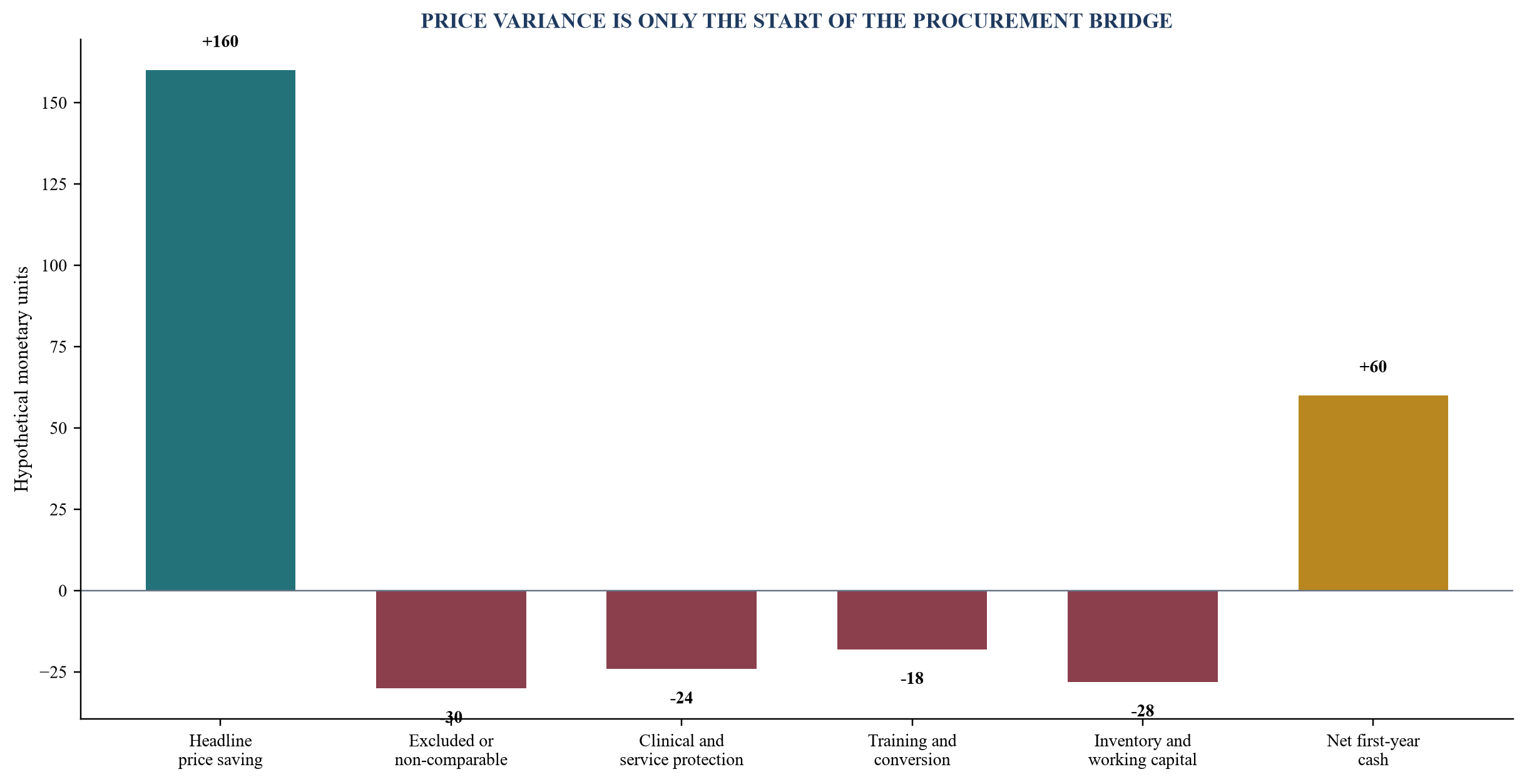
Values are hypothetical monetary units and illustrate the difference between headline price savings and net realised cash.
Table 4. Procurement benefit and protection record
| Ledger field | Required evidence | Value question | Protection question |
|---|---|---|---|
| addressable volume | item, site, use, volume and contract history | what volume can genuinely be combined? | which uses or patients require exclusion? |
| comparable economics | unit, specification, rebate, freight, tax and service | what is the like-for-like cost difference? | are service, quality and supply terms equivalent? |
| transition requirement | stock, equipment, training, validation and cutover | what one-off cost and time are required? | can the change be reversed safely? |
| resilience | alternate supply, lead time, safety stock and recall | what economic premium buys resilience? | does concentration create a critical dependency? |
| realised result | purchase order, receipt, usage, waste, payable and cash | what reached margin, working capital and bank? | did availability, quality or pathway performance deteriorate? |
Clinically sensitive categories require appropriate clinical, regulatory and operational approval.
10. Govern quality, safety and regulatory continuity
Quality and safety governance should remain operational during organisational change. Committee names may be harmonised later; incident reporting, investigation, escalation, learning and action ownership need continuity from Day 1. The programme should map existing governance forums, accountable clinicians, regulatory registrations, policies, audits, open actions and external reporting.
WHO's Global Patient Safety Action Plan provides a system-level framework for reducing avoidable harm and improving safety across care domains.[2] A transaction programme can apply this orientation by treating patient-safety risks as design inputs rather than post-implementation outcomes. The hazard record should connect the proposed change, affected pathway, possible harm, existing control, additional control, owner, evidence and residual decision.
Registration and ownership changes can have operational consequences. The Care Quality Commission explains that a location sold or taken over by a new provider may require registration treatment and that regulatory history can follow the service in defined circumstances in England.[15] CMS maintains change-of-ownership information and provider-enrolment processes in the United States.[4][16] The integration team should map the rules for every entity, location, service and professional jurisdiction in scope.
Regulatory permissions should be treated as dependencies in the wave plan. A corporate filing does not establish that a site, service, clinician, device, laboratory, pharmacy or billing arrangement can operate in the intended way. Evidence should include applications, acknowledgements, approvals, conditions, effective dates and interim arrangements.
11. Build the first-100-day integration control tower
The first 100 days should be organised around decision gates rather than a list of activities. Day 1 protects legal and operational continuity. The first month validates patient, clinician, payer and system baselines. The next period pilots changes where risk is controlled. Later waves scale only after acceptance criteria are met.
The control tower needs a compact set of linked records. The continuity register tracks open patient obligations and breaches. The capacity ledger tracks roster-to-delivery performance. The claims ledger tracks activity-to-cash. The hazard and incident record tracks safety risk. The synergy ledger tracks economics, cost, cash and evidence. The dependency map connects decisions that cannot proceed independently.
Meetings should have defined purposes. A daily continuity huddle reviews high-risk patient, staffing, system and claims exceptions during cutover. A weekly integration forum approves pilots, resolves dependencies and challenges benefits. A monthly executive committee reviews trajectory, capital and risk. The board reviews material exceptions, irreversible decisions and the value bridge.
Red and amber status should represent a defined condition. A red capacity item might mean a service lacks safe staffing for a scheduled period. A red claims item might mean accepted-claim counts fall outside the approved tolerance for a payer. A red continuity item might mean an open high-risk obligation lacks accountable follow-up. Colour without a definition, owner and action has little control value.
Change capacity should also be monitored. Clinicians and managers can absorb only a finite number of simultaneous workflow, system and reporting changes. The wave plan should show cumulative burden by site and role. A programme can delay a lower-value initiative to protect the adoption of a higher-risk change.
Table 5. First-100-day healthcare integration programme
| Period | Primary objective | Required evidence | Board gate |
|---|---|---|---|
| pre-close to Day 1 | preserve legal, clinical, payer, workforce and system continuity | permits, contracts, access, rosters, open pathways, fallback and communications | approve continuity perimeter and Day-1 exceptions |
| days 1-30 | validate baselines and expose control breaks | reconciled pathway, capacity, claims, cash, incidents and dependencies | freeze evidence baseline and remediation priorities |
| days 31-60 | pilot reversible operating changes | acceptance criteria, clinical safety, user training, control totals and rollback | approve continuation, revision or stop |
| days 61-100 | scale proven interventions and verify economics | repeated operating evidence, one-off cost, working capital and cash bridge | approve next wave and benefit status |
| continuing | institutionalise governance and impairment awareness | policy ownership, monitoring, audit trail, forecasts and scenario tests | challenge durability, risk and capital allocation |
Timing is illustrative. The live sequence depends on transaction, jurisdiction, service and risk evidence.
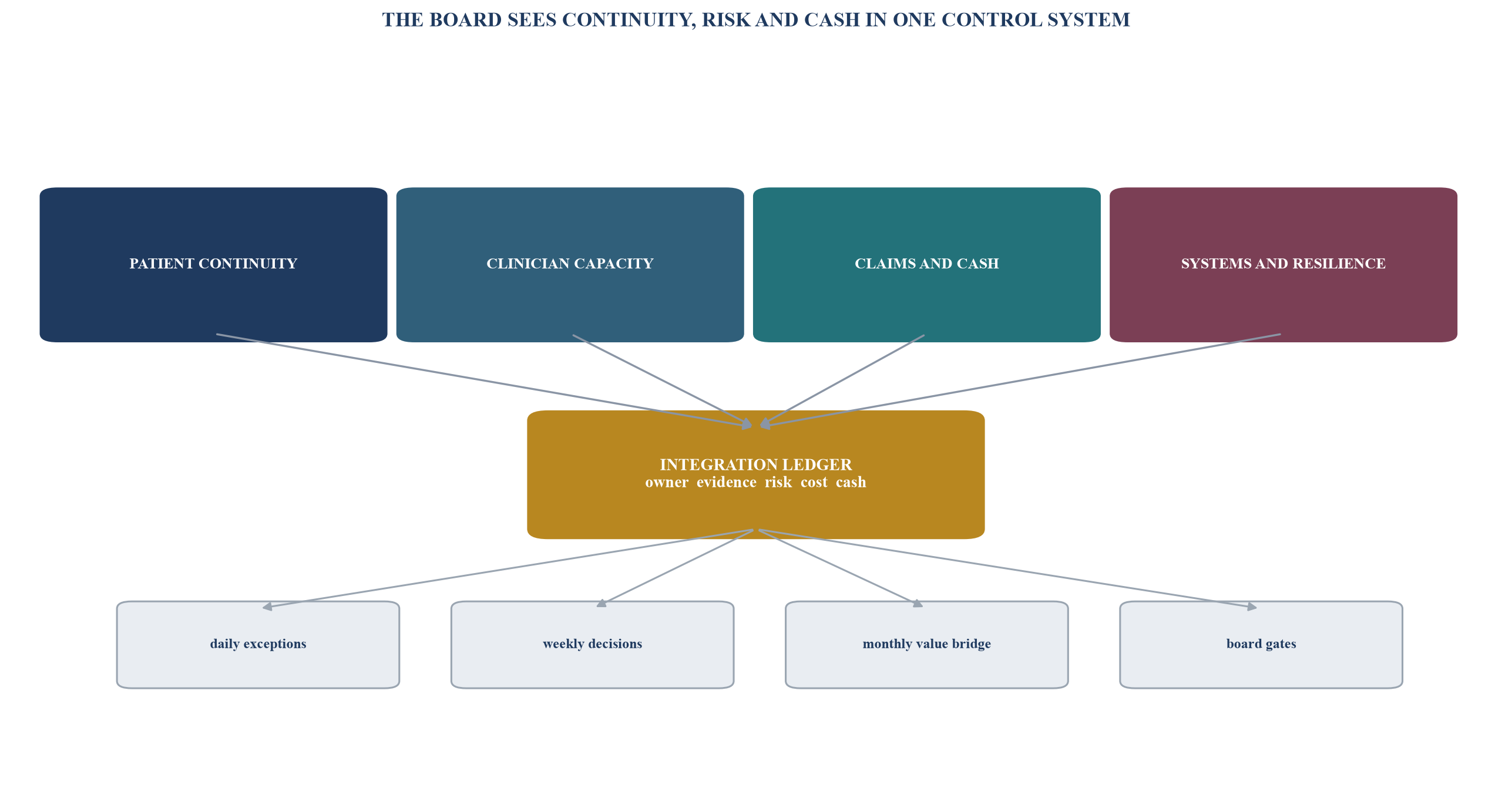
The dashboard connects care continuity, capacity, claims, resilience and verified economics without combining distinct evidence states.
12. Verify value without weakening care
The benefit ledger should begin with the standalone counterfactual and keep gross opportunity, approved action, operating result, accounting result and realised cash separate. This prevents one initiative from being counted at several stages. It also prevents a capacity improvement, revenue opportunity and cash receipt from being added when they describe the same underlying activity.
Each initiative should include the formula and data lineage. A clinician-capacity initiative can measure additional delivered hours against the baseline, then identify completed activity, valid claims, net revenue, direct cost, working capital and cash. A procurement initiative can measure comparable unit economics, received volume, usage, waste, service performance, payable timing and bank movement.
Benefits should be net of dis-synergies and implementation cost. A scheduling improvement may need additional support staff. A central claims model may require technology and specialist payer expertise. A site consolidation may increase travel, referral leakage or patient communication cost. A procurement saving may require training and inventory write-off. These effects belong in the same initiative record.
The CMA's merger guidance provides a useful evidence discipline even when a transaction is outside UK review. It expects relevant efficiency claims to be timely, likely, sufficient, merger-specific and supported by verifiable evidence in its competition assessment.[11] A board can adapt those questions to internal value governance: is the effect caused by the transaction, is the evidence reproducible, will the benefit arrive in the decision period, and are patients or customers protected?
Independent validation should be proportionate to materiality. Finance can validate ledger and cash evidence. Clinical governance can validate patient and safety evidence. Revenue-cycle specialists can validate payer mechanics. Internal audit or another independent function can test data lineage, approval and duplicate claims. Initiative owners should not be the sole validators of their own benefits.
Table 6. Board dashboard and verification questions
| Dashboard domain | Example measure | Verification question | Required action if adverse |
|---|---|---|---|
| continuity | open high-risk obligations without acknowledged owner | can every affected patient pathway be traced to the next action? | assign owner, restore pathway and review cause |
| capacity | contracted-to-delivered hours by service and site | did integration release usable clinical time without unsafe workload? | stop or revise change; protect roster and support |
| claims | unbilled, rejected, denied, pending and underpaid value | does completed activity reach valid claim and cash? | isolate payer, identifier, coding or workflow break |
| systems and cyber | unresolved high-risk hazards, access exceptions and recovery tests | can critical care and records continue through disruption? | invoke safety, access or resilience remediation |
| economics | approved, validated, accounting and cash benefit by initiative | is each evidence state separate and net of cost and dis-synergy? | reverse unsupported value and update forecast |
Targets and tolerances require transaction-specific approval; the examples below are control categories rather than benchmarks.
13. Transaction accounting, goodwill and integration cost
IFRS 3 establishes the acquisition method for business combinations and requires recognition and measurement of identifiable assets acquired, liabilities assumed and any non-controlling interest, with goodwill or a bargain purchase result determined from the transaction facts.[8] An assembled workforce is not recognised as a separate identifiable asset under IFRS 3; its value is subsumed into goodwill. This accounting outcome reinforces the operating importance of clinician retention without turning the workforce into a separately recognised acquisition asset.
Acquisition-related costs and post-combination integration expenditure need appropriate classification. The commercial synergy ledger should not dictate statutory accounting. Finance should determine whether a cost is consideration, acquisition-related expense, restructuring, compensation, capital expenditure, inventory, an intangible asset or ordinary operating expense under the applicable standards and facts.
IAS 37 limits recognition of restructuring provisions and distinguishes direct restructuring expenditure from costs associated with continuing activities.[10] Training, marketing and investment in new systems commonly require separate analysis. A broad integration reserve can obscure the nature and timing of expenditure and weaken both accounting and management control.
IAS 36 requires assets within scope to be carried no higher than recoverable amount and applies impairment testing to cash-generating units, including units containing goodwill.[9] A roll-up whose clinician departures, claim disruption, patient leakage or delayed systems weaken cash flow can therefore affect the assumptions supporting goodwill recoverability. The integration dashboard should feed the forecast and impairment process rather than operate as a separate optimistic narrative.
Purchase price allocation, synergy planning and performance reporting should reconcile while retaining distinct purposes. The valuation work identifies acquired assets and liabilities. The integration plan identifies actions and costs. Management reporting measures operating and cash performance. The board should be able to trace how updated evidence affects forecasts, covenant headroom, capital needs and recoverability.
14. Hypothetical multi-clinic integration example
Consider a hypothetical acquisition of six outpatient clinics by a three-clinic platform. The acquired group provides primary and specialist consultations, diagnostics and minor procedures. It uses two scheduling systems, three claims workflows and several laboratory and consumables suppliers. The figures below are illustrative assumptions and do not describe an actual provider or market.
The initial thesis identifies three opportunity pools. First, unused diagnostic capacity at platform sites could serve acquired referrals. Second, payer and coding controls could reduce rework and accelerate valid submission. Third, combined procurement could improve selected consumables economics. The thesis excludes clinician headcount reduction because demand and service continuity require existing capacity.
The baseline reveals constraints. One specialist service depends on two clinicians with site-specific credentials. Open diagnostic results are routed through a legacy inbox. A major payer contract uses provider identifiers that cannot change until its approval process is complete. Some consumables are tied to equipment and clinician technique. The integration committee therefore places these items inside the protected perimeter.
Day 1 preserves separate claims submission and records access while establishing common control totals and a group escalation route. During days 1-30, the team reconciles appointments, delivered activity, claims and cash by clinic. It discovers that some apparent diagnostic under-utilisation reflects equipment maintenance windows and staffing skill mix. The opportunity is revised before any patient referrals move.
A limited referral pilot then transfers defined low-risk diagnostic activity between two nearby sites. Acceptance criteria cover appointment delay, result routing, patient communication, clinician acknowledgement, claim acceptance and net contribution. The pilot adds transport and coordination cost that reduces the gross benefit. Management records the net operating result and waits for repeated payer remittance before recognising realised cash in the synergy ledger.
Procurement proceeds category by category. Ordinary corporate spend moves first. A clinical consumables category enters review with user evidence, product equivalence, training, inventory and fallback. The group retains dual supply for a critical item, accepting a smaller discount in exchange for resilience. The board sees both the economic and protection decisions.
At day 100, the platform has not forced complete system uniformity. It has a reconciled group view of continuity, capacity, claims and cash; tested interfaces; named safety ownership; and an approved sequence for later consolidation. The measured benefit is lower than the original gross opportunity while the evidence is stronger and the patient pathway remains controlled.
15. Implementation principles
Begin with the patient obligation. Every major integration workstream should state which patient pathway, clinician decision or cash process it affects. This keeps technical and financial activity connected to service reality.
Freeze definitions and lineage. A metric should identify its numerator, denominator, period, source, owner and change history. When systems change, use a documented bridge rather than assuming continuity.
Separate capacity, activity, revenue and cash. Each is valuable information; they represent different evidence states. The board should see the bridge between them.
Pilot where the decision is reversible. Predefine clinical, operational, financial and patient acceptance criteria. Preserve a credible rollback route and learn from negative evidence.
Treat safety, cyber and resilience as design constraints. Integrate hazard management, access, recovery and incident response into the wave plan. Approval should precede irreversible change.
16. Limitations and research agenda
The framework is analytical and operational. It does not establish clinical standards, safe staffing ratios, payer rules, legal duties, tax treatment, accounting conclusions, merger-control outcomes or valuation. Those depend on jurisdiction, service, transaction structure and verified evidence.
Healthcare providers differ materially. A primary-care network, dental chain, diagnostics platform, hospital group, home-care provider and behavioural-health business have different pathways, workforce constraints, records, claims and regulatory requirements. The control system should be adapted rather than copied mechanically.
Data can be incomplete or non-comparable. Scheduling systems may use different slot definitions. Clinical activity can be documented at different levels. Denial reasons can change during payer or coding updates. Patient outcomes can require long observation periods and appropriate risk adjustment. Management should preserve uncertainty and avoid precision unsupported by the data.
Attribution is difficult. Volume, staffing, payer policy, disease patterns, seasonality and macroeconomic conditions can move during integration. A counterfactual, pilots, contemporaneous controls and repeated observation can strengthen inference, while they do not establish certainty in every setting.
Future research should test the framework using anonymised transaction datasets across service lines and jurisdictions. Useful questions include which early continuity indicators predict later patient leakage, how clinician capacity changes through integration waves, which claims controls most reliably protect cash, how system consolidation affects safety and productivity, and which procurement benefits remain durable after inventory and service effects.
17. Conclusion
Healthcare roll-up integration is a care, capacity, claims and cash problem. The transaction thesis becomes credible when each benefit is connected to a patient pathway, clinician resource, operating intervention, implementation cost, evidence state and accountable owner.
The control system begins with a frozen baseline and a protected continuity perimeter. It measures clinician capacity from contract to delivered and claimable activity. It maps claims from authorisation to bank. It sequences systems through clinical safety gates, protects information and recovery, distinguishes central standards from justified local variation, and converts procurement scale into net value after service and resilience effects.
The board receives one connected view without collapsing distinct evidence. Patient continuity, capacity, claims, cyber, quality, implementation cost, accounting and realised cash remain visible. Opportunities can be challenged, pilots can be stopped, unsupported benefits can be reversed and validated interventions can be scaled.
The result is a roll-up that can grow through evidence. Organisational scale is converted into operating capability while the patient pathway remains the governing constraint.
References
- World Health Organization, Integrated people-centred care, https://www.who.int/health-topics/integrated-people-centered-care
- World Health Organization, Global Patient Safety Action Plan 2021-2030, 2021, https://www.who.int/publications/i/item/9789240032705
- NHS England, Digital clinical safety assurance and DCB0129/DCB0160 guidance, updated 4 March 2025, https://www.england.nhs.uk/long-read/digital-clinical-safety-assurance/
- Centers for Medicare & Medicaid Services, Change of Ownership, Acquisition/Merger and Consolidation Provider Enrollment Scenarios, https://www.cms.gov/regulations-and-guidance/guidance/transmittals/downloads/r250otn.pdf
- US Department of Health and Human Services, Summary of the HIPAA Security Rule, updated August 2026, https://www.hhs.gov/hipaa/for-professionals/security/laws-regulations/index.html
- US Department of Health and Human Services, Healthcare and Public Health Cybersecurity Performance Goals, https://hhscyber.hhs.gov/cybersecurity-performance-goals.html
- OECD, Health at a Glance 2025, 2025, https://www.oecd.org/content/dam/oecd/en/publications/reports/2025/11/health-at-a-glance-2025_a894f72e/8f9e3f98-en.pdf
- IFRS Foundation, IFRS 3 Business Combinations, https://www.ifrs.org/issued-standards/list-of-standards/ifrs-3-business-combinations/
- IFRS Foundation, IAS 36 Impairment of Assets, https://www.ifrs.org/issued-standards/list-of-standards/ias-36-impairment-of-assets/
- IFRS Foundation, IAS 37 Provisions, Contingent Liabilities and Contingent Assets, https://www.ifrs.org/issued-standards/list-of-standards/ias-37-provisions-contingent-liabilities-and-contingent-assets/
- UK Competition and Markets Authority, Merger Assessment Guidelines, updated 3 June 2026, https://www.gov.uk/government/publications/merger-assessment-guidelines/merger-assessment-guidelines-html-version
- World Health Organization, Continuity and coordination of care: a practice brief, 2018, https://www.who.int/publications/i/item/9789241514033
- NHS England, National review of clinical risk management standards DCB0129 and DCB0160: supporting information, 29 June 2026, https://www.england.nhs.uk/long-read/national-review-of-clinical-risk-management-standardsdcb0129-and-dcb0160-supporting-information/
- US Department of Health and Human Services, Change Healthcare Cybersecurity Incident Frequently Asked Questions, updated 14 March 2025, https://www.hhs.gov/hipaa/for-professionals/special-topics/change-healthcare-cybersecurity-incident-frequently-asked-questions/
- Care Quality Commission, Continuation of regulatory history, updated 4 February 2026, https://www.cqc.org.uk/guidance-regulation/providers/registration/continuation-regulatory-history
- Centers for Medicare & Medicaid Services, Hospital Change of Ownership Owner Information, Q2 2026, https://data.cms.gov/provider-characteristics/hospitals-and-other-facilities/hospital-change-of-ownership-owner-information
Appendix: Appendix A. Minimum healthcare integration ledger fields
1. Initiative identity, service line, site, pathway and accountable executive. 2. Patient-continuity classification, clinical owner, hazard record and acceptance criteria. 3. Frozen baseline period, counterfactual, source systems and data-quality assessment. 4. Clinician role, licence, credential, roster, protected obligations and delivered capacity. 5. Payer, contract, provider identifier, authorisation, coding, submission and remittance route. 6. System, interface, data owner, access model, migration control and rollback plan. 7. Supplier, category, specification, volume, unit economics, resilience and transition cost. 8. Gross opportunity, approved intervention, validated operating result, accounting result and realised cash. 9. One-off cost, capital expenditure, working-capital movement, tax and financing effect. 10. Patient, workforce, quality, cyber, regulatory and competition safeguards. 11. Dependencies, milestones, decision gates, approvals, changes and reversals. 12. Evidence links, finance validation, clinical validation and independent review.
