

1. Treat hedge accounting as part of transaction design
An acquisition can expose the buyer to exchange-rate, interest-rate, commodity-price and refinancing risk between signing, closing and post-close integration. Treasury can use derivatives or natural offsets to reduce those exposures. The commercial hedge can perform as intended and still create volatility in reported profit or loss when the accounting treatment does not align with the risk-management relationship.
The deal model should therefore connect three views. The first is the economic view: the value and cash effects of the exposure and the hedge. The second is the legal view: the purchase agreement, financing commitments, derivative documentation and conditions to closing. The third is the accounting view: recognition, measurement, designation, effectiveness, presentation and disclosure.
IFRS 9 states an objective for hedge accounting that represents the effect of an entity's risk-management activities in the financial statements [1]. Qualification requires more than management intent. The hedging instrument, hedged item, risk component and hedge relationship must satisfy the applicable requirements, and the entity must document the relationship at inception.
The proposed Deal-to-Ledger Hedge Accounting Test begins before execution. It defines the underlying exposure, selects the commercial hedge, identifies the accounting route, tests sources of mismatch, specifies evidence and journal pathways, and creates monitoring and discontinuation controls. The test does not assume that hedge accounting is always available or preferable.
2. Separate economic protection from accounting qualification
An economic hedge changes cash-flow or value sensitivity. Hedge accounting changes the timing or location of gains and losses in financial statements when qualifying requirements are met. The two decisions are related and remain distinct.
A derivative is generally measured at fair value. Without hedge accounting, changes in fair value commonly affect profit or loss as they arise. The underlying forecast transaction, firm commitment, asset, liability or net investment can be recognised on a different date or measured on a different basis. This timing or measurement difference can create reported volatility even when the combined economics are substantially protected.
Hedge accounting can align part of that accounting result with the hedged exposure. A cash-flow hedge can defer the effective portion in other comprehensive income and later reclassify it or include it in the initial cost of a non-financial asset or liability where the standard requires. A fair-value hedge can recognise changes in the hedged item's carrying amount attributable to the designated risk alongside changes in the hedging instrument. A net-investment hedge has its own presentation pathway.
The qualification decision should be supported by the controller, treasury, valuation specialists and external auditor where appropriate. A forecast transaction that is commercially expected can still fail an accounting requirement if occurrence is insufficiently probable, documentation is late, the risk component is not separately identifiable and reliably measurable, or the economic relationship is not supported.
3. Map the transaction from signing to the ledger
The architecture begins with the acquisition agreement and ends with financial-statement presentation. Between those points sit approvals, exposure data, hedge execution, confirmations, valuation, designation, effectiveness assessment, closing evidence, purchase accounting, financing drawdown, journal entries and disclosures.
Every link has a date. Signing may create a forecast transaction or an unrecognised firm commitment. Regulatory approval and other conditions may affect closing probability. A foreign-exchange hedge may start at signing, while an interest-rate hedge may begin at debt commitment, debt pricing or closing. The accounting designation date cannot be assumed to backdate to the commercial decision.
The team should create one transaction map with legal entities, currencies, reporting periods, derivative counterparties, debt issuers and accounting books. This prevents a hedge held by one entity from being designated against an exposure that belongs to another entity without a qualifying relationship.
The map should also show what happens if the transaction closes late, closes for a different amount, changes funding mix or fails. Deal-contingent derivatives can address termination economics, while their valuation and accounting still require transaction-specific analysis.
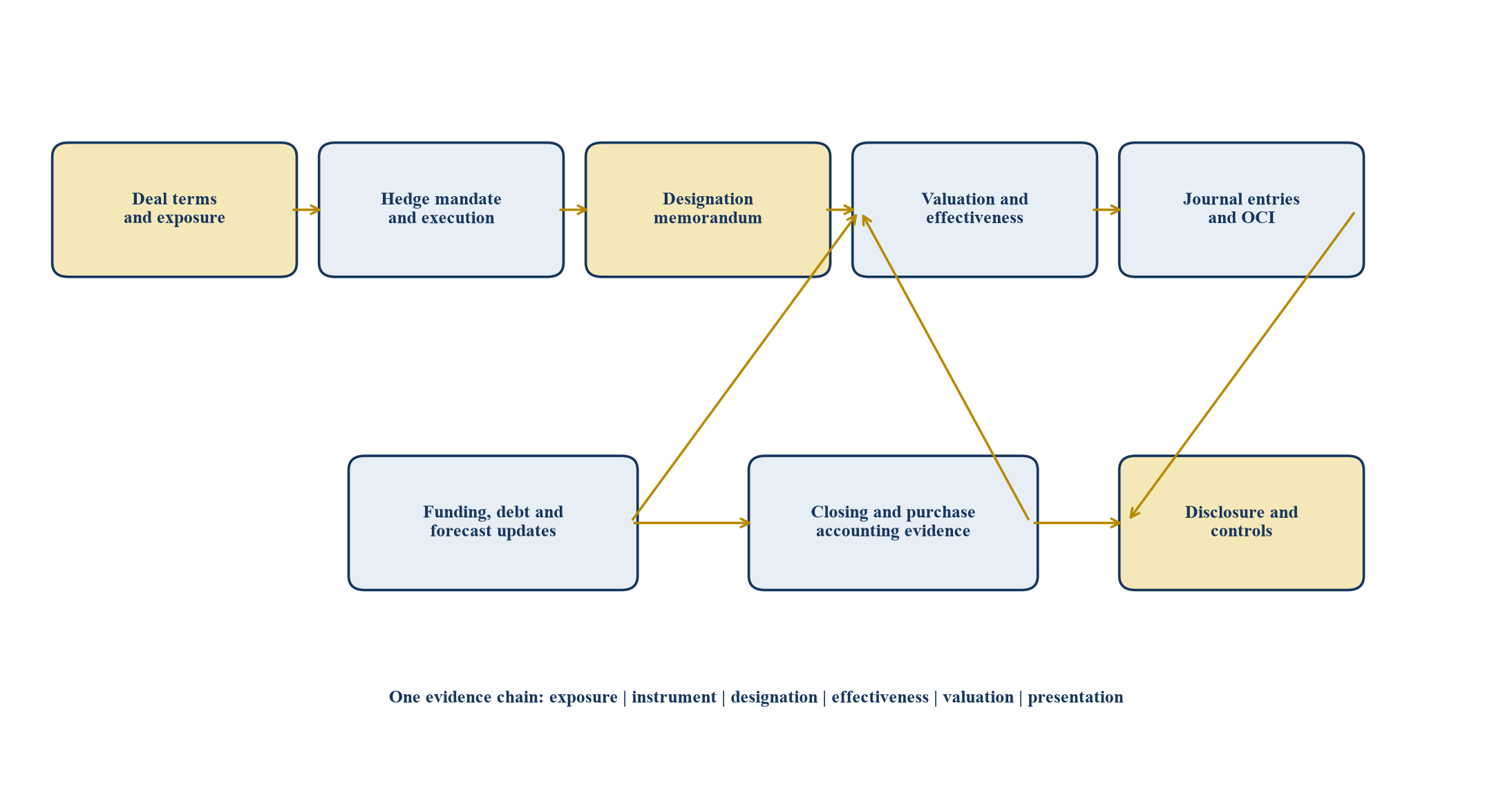
The architecture connects commercial exposure, legal execution, accounting designation, valuation, journal entries and disclosure through one controlled evidence chain.
4. Define the hypothetical acquisition
The worked case assumes a US-dollar functional and reporting currency buyer signs an agreement to acquire a euro-area operating company for EUR 600 million. Closing is expected in six months, subject to customary conditions. The buyer expects to fund EUR 240 million from dollar cash and EUR 360 million equivalent through a dollar term loan.
At signing, the illustrative spot rate is USD 1.10 per euro. The board tests closing rates of USD 0.95, USD 1.10 and USD 1.25 per euro. Those rates describe scenarios rather than probabilities. The unhedged dollar purchase price ranges from USD 570 million to USD 750 million across them.
The buyer considers a six-month deal-contingent EUR call/USD put option with a strike of USD 1.10 per euro for the full purchase price. The illustrative premium is USD 15 million and is payable only if the transaction closes. The commercial terms are simplified and do not represent a dealer quotation.
For post-close financing, the buyer considers USD 396 million of five-year floating-rate debt. It models a pay-fixed, receive-floating interest-rate swap for 75 per cent of the debt notional. The illustrative starting floating reference rate is 4.0 per cent and the fixed swap rate is 3.7 per cent. Credit spread, fees, tax and counterparty collateral are treated separately.
| Item | Illustrative assumption | Primary model effect | Evidence required before approval |
|---|---|---|---|
| Purchase price | EUR 600m | Dollar cash requirement varies with EUR/USD | Executed acquisition agreement |
| Expected close | Six months after signing | Defines initial hedge tenor | Regulatory and closing timetable |
| Signing spot rate | USD 1.10 per EUR | Reference case equals USD 660m | Observable market evidence |
| Closing FX scenarios | 0.95; 1.10; 1.25 USD per EUR | Unhedged price equals USD 570m; 660m; 750m | Scenario governance |
| FX instrument | Deal-contingent EUR call/USD put | Caps strengthening-euro exposure | Executed confirmation and valuation |
| Illustrative premium | USD 15m if closing occurs | Adds to cash cost | Dealer terms and accounting analysis |
| Floating-rate debt | USD 396m for five years | Exposes earnings and cash interest to rates | Commitment and facility agreement |
| Interest-rate hedge | Pay fixed on 75% of debt | Reduces floating-rate sensitivity | ISDA documentation and confirmation |
All values and terms are illustrative. Market rates, closing probability, premiums and accounting outcomes require transaction-specific evidence.
5. Build one integrated deal model
The integrated model should show purchase consideration, hedge cash flows, financing, accounting presentation and covenant effects by reporting period. A separate treasury spreadsheet can hide interactions with acquisition accounting, earnings, tax and leverage.
The first schedule should model the unhedged exposure. It should identify the currency, notional range, expected dates and conditions. The second should calculate derivative cash flows and fair values. The third should map accounting recognition by period. The fourth should connect those results to cash, debt, interest, earnings, other comprehensive income, equity and covenant measures.
The model must preserve gross information. Netting the derivative against purchase price too early can obscure premium, settlement, excluded components, ineffectiveness and liquidity. The accounting schedule should distinguish realised cash from fair-value movement and distinguish profit or loss from other comprehensive income.
Transaction teams should run the model at signing, each reporting date, closing, purchase-price allocation and the first post-close reporting periods. The model should retain an audit trail of market data, assumptions, versions and approvals.
6. Identify the eligible hedged item
The proposed hedged item determines the accounting analysis. Before closing, the buyer can consider whether the foreign-currency exposure arises from a forecast transaction or an unrecognised firm commitment. The legal status of the agreement, conditions to closing and applicable accounting requirements matter.
IFRS 9 permits designated hedged items and risk components when the qualifying criteria are met [1]. A risk component must be separately identifiable and reliably measurable. IFRIC discussion has emphasised that assessment in the context of the relevant market structure [4].
The team should avoid vague descriptions such as “acquisition risk.” The designation should specify the transaction, legal entity, currency amount or layer, time period, risk, benchmark, hedge ratio and method for assessing the economic relationship and ineffectiveness.
If the final purchase price changes, only part closes or timing moves beyond the designated window, the relationship may require rebalancing or discontinuation. The model should contain those pathways before the hedge is executed.
7. Select the hedging instrument and designated component
The hedging instrument can be a forward, option, swap, cross-currency swap or another qualifying instrument. The commercial decision should consider premium, downside participation, collateral, counterparty credit, termination, liquidity and the transaction's probability.
An option can preserve favourable movement while limiting adverse movement. Its intrinsic value and time value may have different accounting consequences. IFRS 9 contains a cost-of-hedging approach for certain excluded components [1]. The designation must state whether the full option or a component is designated.
A forward can provide a fixed rate with no upfront premium in a simplified description, though credit, funding and termination economics remain. A deal-contingent instrument can reduce break exposure if closing fails, usually at a price. The accounting analysis should follow the executed terms.
The interest-rate swap should match the debt's notional, reference rate, reset dates, tenor and payment conventions as closely as commercially appropriate. Mismatch can create ineffectiveness even when the broad risk direction is correct.
8. Document the relationship at inception
The designation memorandum should be ready when the relationship begins. It should identify the entity's risk-management objective and strategy, the hedging instrument, hedged item, nature of risk and method for assessing whether the qualifying criteria continue to be met.
The documentation should connect to board authority, treasury policy, transaction approval and the deal model. A memorandum prepared after a reporting-period result is known cannot establish a timely designation for the earlier period.
The evidence pack should include the purchase agreement, financing commitment, derivative confirmation, probability assessment, market data, valuation controls, effectiveness methodology, accounting conclusion, journal map and disclosure plan. Each document should have an owner and approval date.
The team should also document excluded components, sources of expected ineffectiveness, credit-risk considerations and the treatment if closing is delayed or abandoned. A short memorandum that names an instrument without these mechanics leaves the close process exposed.
9. Test the economic relationship and hedge ratio
The economic relationship assessment asks whether the hedged item and hedging instrument generally move in opposite directions because of the same underlying risk. The analysis should examine terms, market structure and sources of mismatch rather than relying solely on a statistical result.
The hedge ratio should reflect the quantities actually used for risk management, subject to requirements intended to prevent an accounting outcome inconsistent with the economic relationship. A buyer should not create a ratio solely to suppress reported ineffectiveness.
Possible mismatch includes different currencies, benchmark rates, maturities, reset dates, day-count conventions, notional profiles, option features, credit risk and timing. Acquisition closing uncertainty adds another source because the hedged exposure may not arise when expected.
The model should quantify these sources under ordinary and stressed conditions. It should explain what evidence triggers rebalancing and what evidence requires discontinuation.
10. Model effectiveness and ineffectiveness separately
Effectiveness testing should be designed before the first reporting date. The method should suit the relationship and remain consistent with the designation. A qualitative assessment can be appropriate when critical terms align and the facts support it. Quantitative methods can include a dollar-offset comparison, hypothetical derivative or regression, depending on the relationship and requirements.
Ineffectiveness can arise from timing differences, basis differences, changes in credit risk, different notional amounts, prepayment, floors, caps, transaction probability and valuation adjustments. It should be measured and presented according to the applicable requirements rather than assumed to be immaterial.
IFRS 7 requires disclosures that explain risk-management strategy, effects on future cash flows and the effect of hedge accounting on financial position and performance [2]. The deal model should therefore retain the information needed for both measurement and disclosure.
The close calendar should include independent valuation, market-data validation, effectiveness review, journal preparation, disclosure support and sign-off. These tasks should not depend on a single treasury workbook.
| Pathway | Illustrative designation | Potential presentation | Principal volatility risk |
|---|---|---|---|
| No hedge accounting | Derivative held economically | Derivative fair-value changes generally enter profit or loss | Timing mismatch before the underlying item is recognised |
| Cash-flow hedge | Forecast FX cash flow or floating-rate interest, if qualifying | Effective portion in OCI; later reclassification or basis adjustment as applicable | Ineffectiveness, excluded components and forecast-probability changes |
| Fair-value hedge | Qualifying firm commitment or recognised item exposed to designated risk | Instrument and hedged-item adjustment recognised in profit or loss | Basis, timing, credit and measurement mismatch |
| Late or failed designation | Relationship lacks timely or sufficient evidence | Accounting follows normal derivative requirements until a valid prospective designation | Immediate fair-value movement and inability to backdate treatment |
| Discontinued relationship | Criteria cease or risk management changes | Amounts accumulated in OCI follow the applicable subsequent-treatment rules | Reversal or reclassification when the forecast transaction changes |
The table describes simplified pathways. Actual recognition and presentation depend on executed terms, applicable standards and transaction facts.
11. Map cash-flow hedge presentation
For a qualifying cash-flow hedge, the effective portion of gain or loss on the hedging instrument is recognised in other comprehensive income within the cash-flow hedge reserve, subject to the standard's requirements. Ineffectiveness is recognised in profit or loss.
When the forecast transaction later results in recognition of a non-financial asset or liability, the accumulated amount can be removed from the reserve and included directly in the initial cost or carrying amount where IFRS 9 requires that treatment [1]. For other outcomes, reclassification can occur when the hedged cash flows affect profit or loss.
The acquisition case requires careful identification of what transaction is being hedged and how the resulting acquisition accounting operates. The team should obtain a transaction-specific technical conclusion rather than assume that every purchase-price hedge follows the same basis-adjustment route.
The debt hedge has a more familiar recurring cash-flow pattern. The effective portion can remain in the reserve and be reclassified as the hedged interest payments affect profit or loss, if the relationship qualifies. The journal map should show each reporting period.
12. Map fair-value hedge presentation
A fair-value hedge addresses exposure to changes in fair value of a recognised item or qualifying unrecognised firm commitment attributable to a designated risk. The gain or loss on the hedging instrument is recognised in profit or loss, subject to specific requirements. The hedging gain or loss on the hedged item adjusts its carrying amount or is recognised for a firm commitment and is also presented in profit or loss.
The model should show how the firm-commitment asset or liability develops and how it affects the initial carrying amount when the transaction occurs. It should also show amortisation or other subsequent treatment of adjustments where applicable.
Fair-value hedge accounting can create a matched profit-or-loss presentation, while residual mismatch remains visible. The team should not treat it as a mechanism that guarantees zero volatility.
The choice between cash-flow and fair-value hedge treatment follows the nature of the designated exposure, the entity's risk-management approach and the standards. It is not an elective presentation overlay detached from those facts.
13. Account for option time value and forward elements
An option premium contains components whose values change for different reasons. If only intrinsic value is designated, time value may be treated as a cost of hedging when the relevant requirements are met. Forward points or foreign-currency basis spread can also have specific treatment when excluded from designation.
The model should separate these components from inception. Combining them into one derivative line can misstate the timing of expense and obscure differences between transaction-related and time-period-related costs.
The designation memorandum should identify the component designated, the valuation source and the intended treatment of excluded components. The close process should reconcile the dealer valuation, independent valuation and accounting component split.
For a deal-contingent option, premium payment terms and transaction outcome matter. The team should document whether premium is payable, refundable or contingent and how the instrument terminates when conditions fail.
14. Incorporate fair value and credit adjustments
IFRS 13 defines fair value and provides a measurement framework when another standard requires or permits fair value measurement [3]. Derivative valuation can require observable curves, volatility, correlations, discounting and credit adjustments.
Counterparty and own-credit effects can alter derivative fair value and hedge ineffectiveness. A transaction model that uses only settlement payoffs can therefore diverge from the accounting valuation during the life of the hedge.
The valuation control should identify data sources, model, calibration, independent price verification, reserves and hierarchy disclosures. It should also address collateral, netting and master-agreement terms where relevant.
The board model need not reproduce every valuation engine calculation. It should reconcile the approved exposure and expected cash flows to the accounting valuation and explain material differences.
15. Distinguish closing, measurement and payment dates
Acquisition signing, regulatory approval, hedge execution, reporting dates, closing, purchase-price payment, debt drawdown and derivative settlement can occur on different dates. The accounting model should use the actual legal and cash chronology.
A delay can extend the exposure beyond the derivative maturity. An early close can require accelerated settlement. A partial close or purchase-price adjustment can change notional. A failed transaction can remove the forecast exposure while leaving break costs or premium.
The model should include a date table and a fallback for each mismatch. The hedge confirmation and financing documents should be reviewed against the acquisition timetable.
Forecast updates should be controlled. A commercial team's revised expected close should not automatically change accounting treatment without supporting evidence and approval.
16. Quantify post-close earnings sensitivity
The board needs a bridge from market movement to cash and reported earnings. In the hypothetical case, the unhedged euro purchase price changes by USD 90 million between the reference rate of 1.10 and the adverse rate of 1.25. A qualifying option can cap much of that cash exposure, subject to strike, premium and exact terms.
Without hedge accounting, the option's pre-close fair-value movement may enter profit or loss before the acquisition is recognised. If the option gains USD 80 million in an illustrative adverse-rate scenario while the purchase-price exposure is not yet recognised through profit or loss, reported earnings can show a large gain followed by different post-close measurement. The amount is illustrative.
A qualifying hedge relationship can alter timing and presentation. The model should still show ineffectiveness, excluded components and any amount that cannot remain in the reserve. It should also show the effect on equity and leverage metrics used in financing agreements.
For the interest-rate swap, a one-percentage-point increase on the unhedged 25 per cent of USD 396 million creates approximately USD 0.99 million of additional annual cash interest before tax. The hedged portion has fixed economics subject to the swap and debt basis matching. Accounting presentation depends on qualification and actual terms.
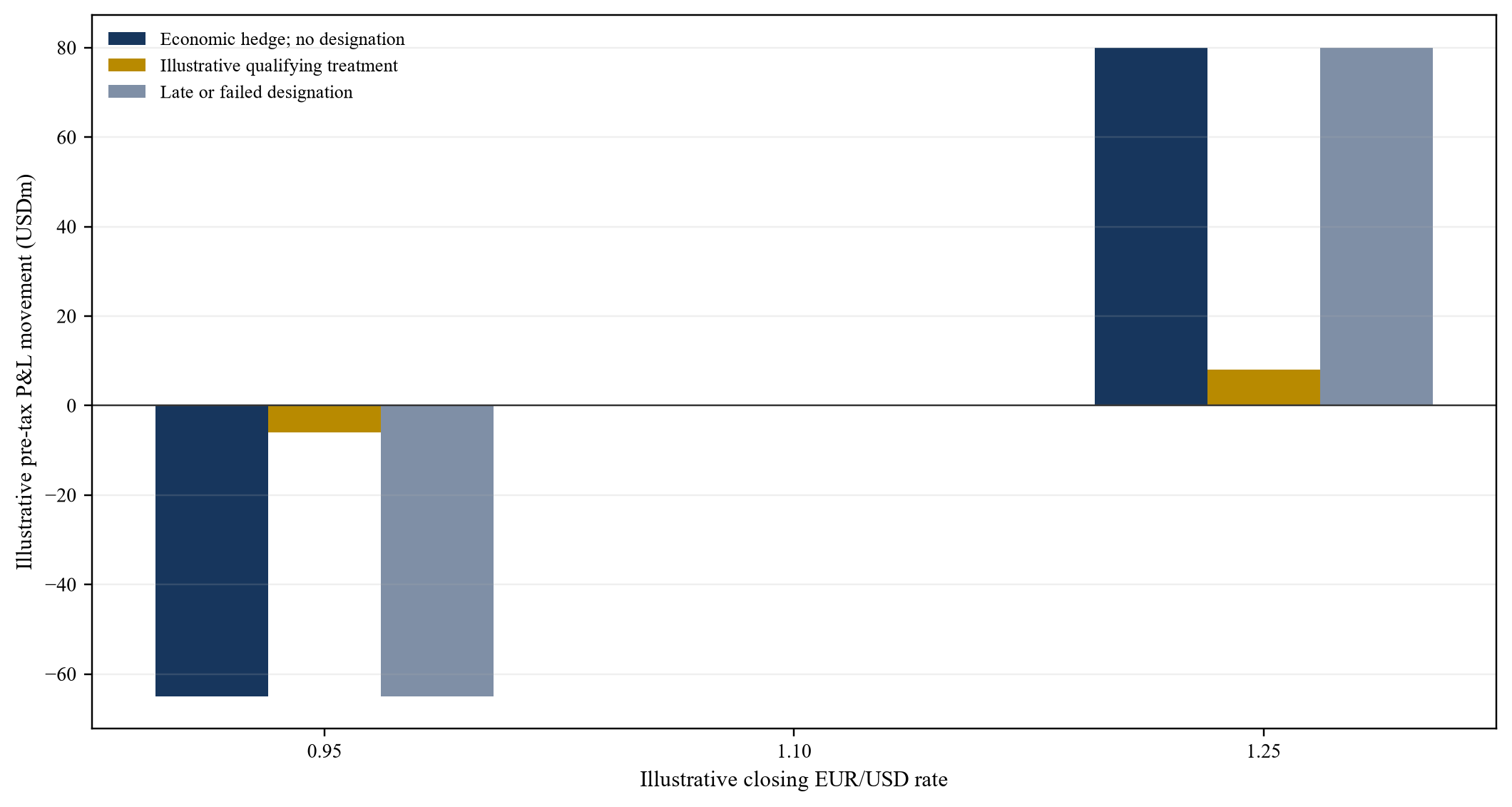
Values are illustrative directional scenarios for a reporting date before closing. They do not predict market movement or establish an accounting conclusion.
17. Protect the deal model from false precision
Accounting outcome depends on facts that develop over time. The model should distinguish observed market data, executed terms, management scenarios and technical conclusions. It should not convert a provisional assumption into a fixed accounting result.
The scenario range should include transaction failure, delayed close, lower purchase price, partial hedging, counterparty downgrade, debt repricing, benchmark mismatch and hedge discontinuation. Each scenario should show cash, profit or loss, other comprehensive income, equity and covenant effects.
The team should disclose model limitations to decision-makers. Premium, liquidity, tax, regulatory capital and collateral can materially change the preferred commercial structure. Auditor agreement may depend on evidence unavailable at signing.
Sensitivity analysis should support governance rather than create a false probability distribution. The board should approve ranges and triggers, while management updates them with evidence.
18. Link purchase accounting and hedge accounting
IFRS 3 governs recognition and measurement in a business combination [5]. The acquisition date, consideration transferred, identifiable assets and liabilities, goodwill and measurement-period adjustments create accounting interfaces with transaction hedges.
The purchase-accounting workstream should receive the hedge designation, settlement and basis-adjustment analysis. Treasury should receive the final purchase-price and closing evidence. The controller should reconcile derivative settlement cash, financing drawdown and consideration paid.
The team should avoid double counting. A hedge result incorporated into an asset's initial amount should not also remain in another model line. Transaction costs, financing fees and derivative premiums may follow different accounting pathways.
The post-close opening balance sheet should include a reconciliation from the signing model to actual closing. That reconciliation should be approved before the first external reporting date.
19. Integrate the debt hedge with acquisition financing
Acquisition financing can move from bridge commitments to term debt and later refinancing. A hedge tied to the expected term structure may become mismatched if the bridge remains outstanding longer or debt is refinanced earlier.
The rate-risk model should identify debt notional, benchmark, margin, floor, reset frequency, amortisation, prepayment and maturity. The derivative should be tested against those terms. A pay-fixed swap does not hedge the credit spread or every financing cost.
Lender covenants may treat derivative assets, liabilities, cash settlement, other comprehensive income and exceptional transaction items differently. The financing model should use the executed definitions.
The treasury mandate should specify authority to resize, novate or terminate the hedge after refinancing. Accounting consequences should be assessed before action where timing permits.
20. Establish a close and disclosure control matrix
IFRS 7 requires qualitative and quantitative information about financial instruments and risk [2]. The disclosure process should begin with the transaction map, not at year-end drafting.
The control matrix should cover completeness of instruments, confirmation matching, market data, valuation, designation, effectiveness, journal entries, other comprehensive income roll-forward, reclassification, cash-flow classification and notes. It should name preparers, reviewers, evidence and deadlines.
The US accounting framework also continues to evolve. FASB issued ASU 2025-09 on hedge-accounting improvements, effective for periods beginning after 15 December 2025, with provisions affecting areas including forecasted transactions and certain hedge relationships [8]. US GAAP reporters should apply the current codification and effective dates to their facts.
The IASB began a post-implementation review of IFRS 9 hedge accounting in 2026 and planned a request for information for September 2026 [7]. The transaction team should monitor authoritative developments without assuming future amendments.
| Risk | Potential result | Preventive control | Monitoring evidence |
|---|---|---|---|
| Late designation | Pre-designation fair-value movement in profit or loss | Prepare and approve memorandum at relationship inception | Timestamped approval and executed confirmation |
| Forecast transaction changes | Rebalancing, discontinuation or reclassification questions | Controlled probability and timing assessment | Approved closing forecast and legal-status update |
| Notional mismatch | Hedge ineffectiveness or over-hedging | Layer designation and notional limits | Exposure-to-derivative reconciliation |
| Basis or reset mismatch | Residual cash and accounting volatility | Match contractual terms where appropriate | Critical-terms comparison and quantitative test |
| Valuation weakness | Misstatement of derivative and ineffectiveness | Independent valuation and data validation | Dealer-to-independent price reconciliation |
| Credit deterioration | Fair-value change and effectiveness impact | Counterparty limits, collateral and credit monitoring | Credit and CVA review |
| Journal or OCI error | Misclassification across earnings and equity | Pre-approved journal map and roll-forward | Ledger reconciliation and disclosure tie-out |
| Transaction failure | Unhedged derivative settlement or premium cost | Break-cost model and deal-contingent terms | Termination scenario and board authority |
The matrix is a proposed transaction-control tool. Owners and evidence should be adapted to the reporting framework and executed transaction.
21. Apply the Deal-to-Ledger Hedge Accounting Test
The proposed test has six gates. Gate one verifies the enforceable or sufficiently supported exposure. Gate two verifies the economic hedge and board authority. Gate three identifies the proposed accounting relationship. Gate four verifies timely documentation and evidence. Gate five quantifies effectiveness, valuation and presentation. Gate six establishes post-close controls and disclosure.
The gate pack should reconcile legal documents, treasury records, the deal model and accounting papers. A missing item should be shown as an open decision rather than silently assumed.
The accounting conclusion should identify the reporting framework, entity, reporting periods and material judgements. It should state the alternative treatment if qualification is not achieved.
The board should receive both outcomes. This allows a commercial hedge to proceed when economically justified while management understands the possible reported-volatility consequence.
| Gate | Required evidence | Decision output | Accountable owner |
|---|---|---|---|
| Exposure | Agreement, forecast, entity, currency, amount and date | Defined hedged exposure and range | Deal lead and treasury |
| Economics | Scenario model, quotes, liquidity and break costs | Instrument, notional, tenor and limits | CFO and treasury |
| Accounting route | Applicable standards and eligible relationship analysis | Proposed cash-flow, fair-value, net-investment or no-designation path | Controller |
| Designation | Inception memorandum, hedge ratio and methodology | Approved relationship and documentation date | Controller and treasury |
| Measurement | Independent fair value, effectiveness and journal map | Period-end amounts and presentation | Valuation and finance |
| Closing | Purchase-price, funding and settlement reconciliation | Actual exposure and basis or reclassification treatment | Deal accounting lead |
| Monitoring | Forecast, notional, maturity, credit and trigger report | Continue, rebalance or discontinue | Treasury committee |
| Disclosure | IFRS 7 or applicable framework checklist and tie-out | Complete financial-statement support | Financial reporting |
Each gate requires transaction-specific evidence and approval. Passing the commercial gate does not establish accounting qualification.
22. Use an explicit decision sequence
The sequence begins with the transaction rather than the derivative. The team first defines the exposure and closing conditions. It then chooses the economic hedge and models cash outcomes. The controller identifies possible accounting pathways and evidence requirements before execution.
After execution, the designation and confirmation are matched. Valuation and effectiveness controls operate at every reporting date. Closing triggers a reconciliation of actual price, timing, funding and derivative settlement. Post-close accounting follows the documented outcome.
Any material change returns to an earlier gate. A delayed close returns to exposure and tenor. A purchase-price change returns to notional. A refinancing returns to the rate-risk relationship. A counterparty event returns to valuation and credit.
This sequence creates a repeatable control loop while preserving transaction-specific judgement.
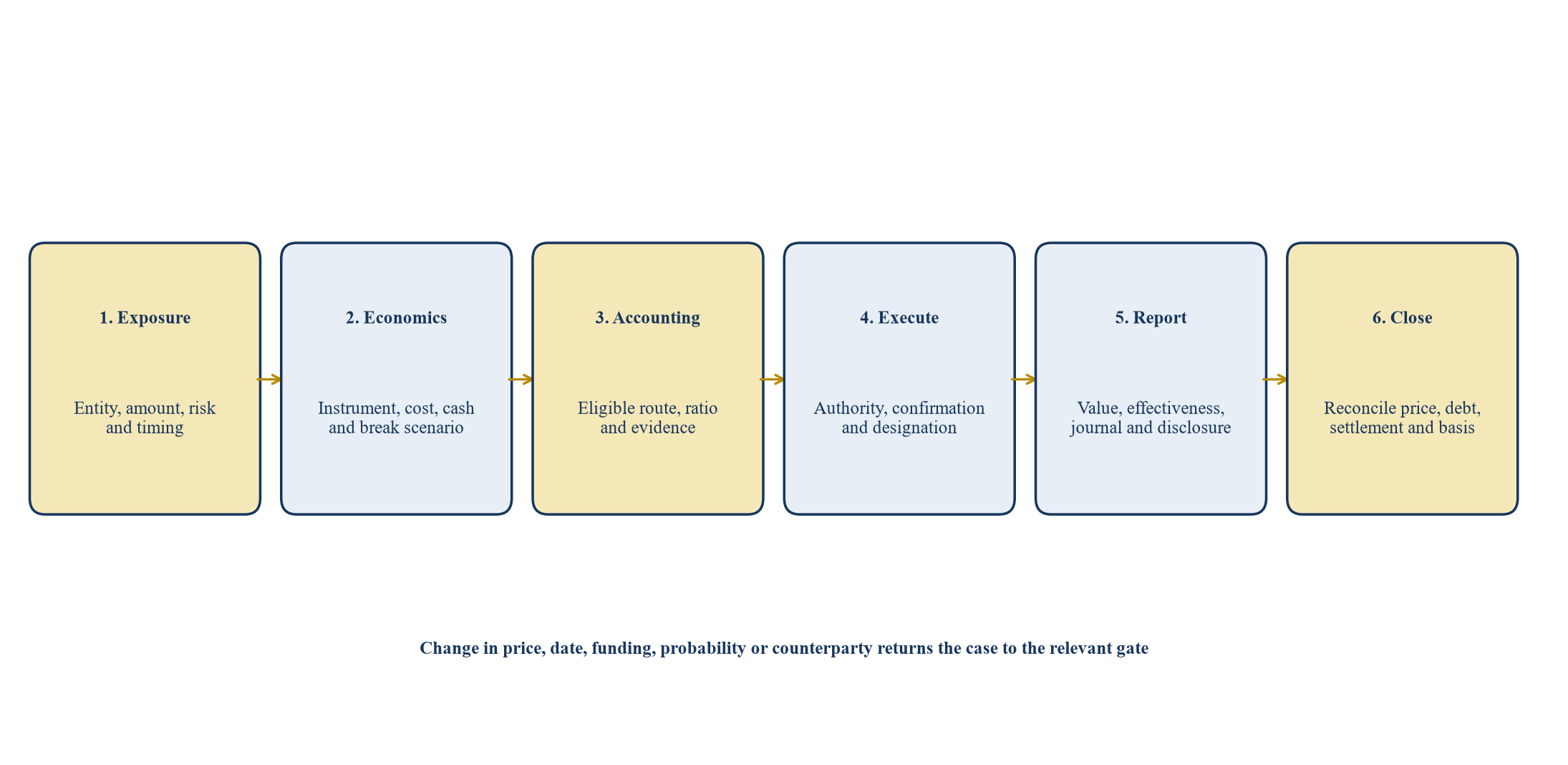
The sequence connects exposure definition, economic approval, accounting design, execution, period-end evidence, closing and post-close monitoring.
23. Execute a controlled signing-to-reporting roadmap
Before signing, the team should identify exposures, test instruments, obtain indicative pricing and prepare an accounting options paper. The board should approve the risk appetite, maximum premium or break cost, counterparty limits and delegated authority.
At signing and hedge execution, legal and treasury teams should confirm the exposure, instrument and conditions. Finance should finalise the designation and evidence at the required time. The first reporting close should be rehearsed before the reporting date.
During the pre-close period, the team should update transaction probability, timing, purchase price and funding. Treasury should reconcile hedge notional. Valuation and accounting should complete period-end measurement and disclosures.
At closing, the team should reconcile consideration, derivative settlement, debt drawdown, cash, purchase accounting and journal entries. During the first post-close year, it should monitor the debt hedge, reserve movements, reclassification, refinancing and disclosures.
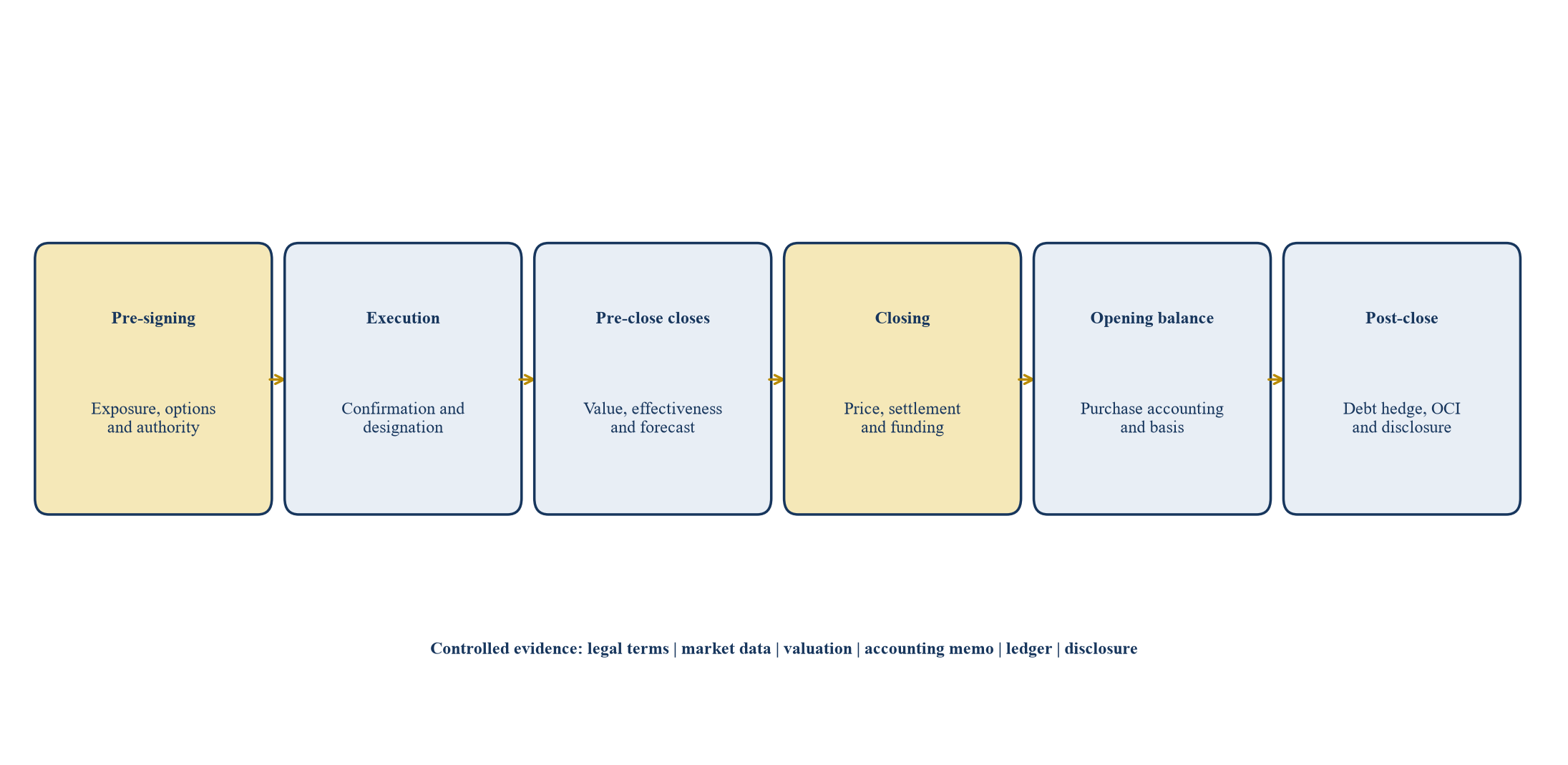
The roadmap assigns evidence and decisions across transaction approval, execution, reporting dates, closing and the first post-close reporting cycle.
24. Rehearse the first reporting close
The first reporting close can occur before acquisition completion, immediately after completion or during purchase-price allocation. Each timing creates a different evidence requirement. The team should therefore run a close rehearsal using a selected historical market date and the current transaction forecast.
The rehearsal begins with a complete instrument inventory. Treasury confirms trade date, effective date, maturity, notional, currency, strike, premium, reset terms, settlement and counterparty. Legal confirms that the executed confirmation agrees with the mandate and master agreement. Finance confirms the entity that holds the instrument and the ledger in which it will be recognised.
The valuation team then obtains independent market data and calculates fair value, designated component, excluded component and relevant credit adjustments. Dealer marks can support reconciliation but should not be the only control where independent verification is required. Differences outside tolerance should be investigated before a journal is posted.
The accounting team applies the designation and effectiveness method to the actual terms. It calculates the amount recognised in profit or loss, the amount recognised in other comprehensive income, any reserve movement and any basis or reclassification consequence expected at closing. The calculation should tie to the derivative valuation and the exposure schedule.
The journal rehearsal should include accounts, entities, currencies, tax codes, cash-flow classifications and consolidation eliminations. It should show the reversal or continuation entries for the next period. A technically correct memo can still fail operationally when the chart of accounts cannot preserve the required distinctions.
The disclosure rehearsal should populate the proposed tables and narrative from the same controlled data. IFRS 7 asks users to be able to evaluate risk-management strategy, future cash-flow effects and financial-statement effects [2]. Preparing those outputs early can reveal missing maturity, notional, average-price, reserve or ineffectiveness data.
The rehearsal concludes with a signed exception log. Exceptions can include missing confirmations, stale curves, unresolved legal terms, unmatched notional, late forecast evidence, valuation differences, journal mapping gaps or disclosure-data gaps. Each exception should have an owner, due date, consequence and escalation path.
25. Design discontinuation and recovery pathways
The team should model discontinuation before it becomes necessary. A hedge relationship can cease to meet qualifying criteria because the risk-management objective changes, the instrument expires or is terminated, the economic relationship no longer exists, credit risk dominates the value changes or the forecast transaction changes.
Discontinuation is not a single accounting result. The treatment of amounts accumulated in the cash-flow hedge reserve depends on whether the forecast cash flows are still expected to occur and on the later outcome. The team should create a decision record for delayed, reduced, cancelled and restructured transactions.
If the acquisition is delayed while still expected to close, the derivative may mature first. Management can consider an extension, replacement or layered hedge within its authority. The accounting analysis should address the existing relationship and any new relationship prospectively. Commercial continuity does not remove the need for separate documentation.
If the purchase price is reduced, the original notional may exceed the expected exposure. The team should identify any portion that no longer reflects risk management and assess rebalancing or discontinuation. The liquidity model should include termination value and collateral release or payment.
If the acquisition fails, the buyer should activate the contractual close-out or contingent feature, update the forecast-transaction conclusion, account for reserve amounts under the applicable requirements and explain the effect to the board. A failed deal can generate derivative cash, premium expense, advisory costs and public disclosure in the same period.
Post-close recovery controls matter as well. An incorrect designation, market input or journal can be detected after reporting. The control framework should specify how errors are investigated, corrected, approved and disclosed. It should preserve the original evidence and document why the correction does or does not affect prior periods.
26. Establish governance and escalation
The board or delegated committee should approve the transaction hedge mandate, maximum notional, permitted instruments, premium or break-cost limits, counterparties and reporting. The CFO should own the integrated outcome across cash, earnings and covenants.
Treasury should own exposure execution and monitoring. The controller should own accounting conclusions, designation evidence and journal integrity. The deal team should own closing facts and purchase-price updates. Legal should own agreement and derivative-document consistency.
Escalation triggers should include delayed or failed closing, material purchase-price change, hedge notional outside tolerance, ineffective relationship, credit deterioration, valuation dispute, refinancing, covenant pressure and a change in authoritative accounting requirements.
Each trigger should have a deadline and decision authority. The control system should retain the evidence of what management knew and decided at each reporting date.
27. Limitations and conclusion
This paper provides a decision framework and does not constitute investment, accounting, audit, legal, tax, treasury or regulatory advice. Qualification for hedge accounting and financial-statement presentation depend on the reporting framework, entity, executed terms, timing, evidence and professional judgements.
The worked case is hypothetical. Exchange rates, interest rates, premiums, fair values, transaction probability and accounting results are illustrative. They exclude many transaction-specific effects, including tax, collateral, liquidity, credit spread, regulatory capital and detailed purchase accounting.
The central decision is to design the commercial hedge and accounting architecture before execution. The transaction model should identify the exposure, instrument, designation, effectiveness, valuation, journal path, disclosures and discontinuation scenarios in one controlled chain.
An economically successful hedge can create reported volatility when recognition timing differs. A qualifying accounting relationship can reduce that mismatch, subject to continuing evidence and measurement. The board should receive both the cash outcome and the financial-statement outcome before approving the hedge.
Sources
- IFRS Foundation, IFRS 9 Financial Instruments, standard overview and hedge-accounting requirements, accessed 17 September 2026, Read the primary source
- IFRS Foundation, IFRS 7 Financial Instruments: Disclosures, standard overview and hedge-accounting disclosures, accessed 17 September 2026, Read the primary source
- IFRS Foundation, IFRS 13 Fair Value Measurement, standard overview, accessed 17 September 2026, Read the primary source
- IFRS Foundation, IFRIC Update September 2019, separately identifiable risk components and hedge-accounting objective, accessed 17 September 2026, Read the primary source
- IFRS Foundation, IFRS 3 Business Combinations, standard overview, accessed 17 September 2026, Read the primary source
- IFRS Foundation, IAS 21 The Effects of Changes in Foreign Exchange Rates, issued standard text, accessed 17 September 2026, Read the primary source
- IFRS Foundation, IASB Update July 2026, post-implementation review of IFRS 9 hedge accounting, accessed 17 September 2026, Read the primary source
- Financial Accounting Standards Board, Accounting Standards Update 2025-09, Derivatives and Hedging Topic 815: Hedge Accounting Improvements, accessed 17 September 2026, Read the primary source
- Financial Accounting Standards Board, Board meeting tentative decisions on hedge-accounting improvements, 26 March 2025, accessed 17 September 2026, Read the primary source
- International Swaps and Derivatives Association, 2021 Interest Rate Derivatives Definitions, accessed 17 September 2026, Read the primary source
- International Swaps and Derivatives Association, 2026 FX Definitions, accessed 17 September 2026, Read the primary source
- International Swaps and Derivatives Association, Accounting Masterclass learning objectives, accessed 17 September 2026, Read the primary source
- Bank for International Settlements, FX debt and optimal exchange rate hedging, BIS Working Papers No 1303, 18 November 2025, accessed 17 September 2026, Read the primary source
- Bank for International Settlements, OTC derivatives statistics at end-December 2025, accessed 17 September 2026, Read the primary source
- US Securities and Exchange Commission, Current Accounting and Disclosure Issues in the Division of Corporation Finance, derivative and hedge disclosures, accessed 17 September 2026, Read the primary source
- US Securities and Exchange Commission, derivatives and hedge-accounting disclosure example, accessed 17 September 2026, Read the primary source
- IFRS Foundation, Financial Instruments: Hedge Accounting, completed project, accessed 17 September 2026, Read the primary source
- IFRS Foundation, IFRIC 16 Hedges of a Net Investment in a Foreign Operation, issued interpretation, accessed 17 September 2026, Read the primary source
