

1. Define the return that needs protection
The headline coupon is the beginning of a private-credit return calculation. A loan paying a reference rate plus a contractual spread generates asset income when it is drawn and performing. The lender's realised return also depends on fees, funding, hedging, currency, utilisation, operating cost, tax where relevant, default, recovery and time.
The governing body should define the objective before selecting an instrument. It can seek to stabilise borrower debt service, protect lender net interest income, protect economic value, preserve a minimum investor return, limit a specified currency loss, reduce refinancing exposure or keep risk within an approved limit. Those objectives can require different hedge designs.
The exposure owner also matters. A borrower may hedge its floating coupon. A bank may hedge a banking-book gap. A private-credit fund may hedge a loan or aggregate portfolio. A fund investor may hedge subscription, NAV or distribution currency. One party's hedge can leave another party exposed.
The decision record should state the exposure, objective, horizon, authority and risk tolerance. A statement such as protect the coupon is incomplete until it identifies which cash flow, for whom, against which movement and over which period.
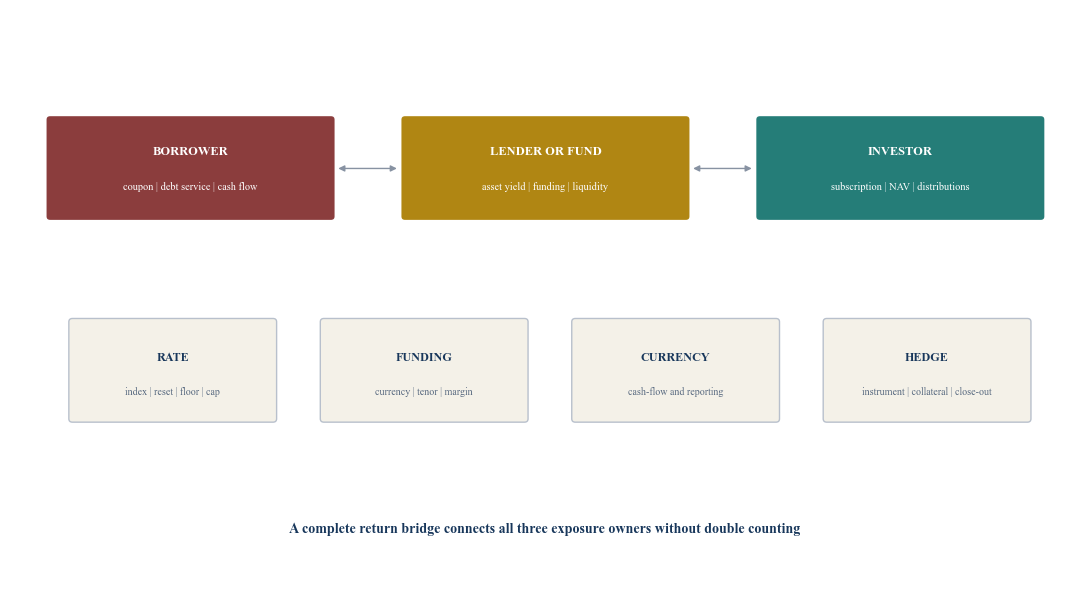
Author framework. Each layer has a separate owner, objective, evidence set and decision.
2. Start from the contractual cash-flow engine
The lender should reconstruct the contractual payment calculation from the executed documents. It should identify currency, reference rate, tenor, observation method, reset date, payment date, day count, business-day rule, fallback, floor, cap, spread, default margin, fee, amortisation, prepayment, commitment and tax mechanics.
EIBOR is the UAE dirham interbank reference rate. The CBUAE describes it as the daily rate at which panel banks are able and willing to access UAE dirham funding in reasonable market size for a given tenor from the UAE money market before the specified time.[4] The loan document determines which EIBOR tenor and fixing apply.
SOFR is a broad measure of the cost of overnight borrowing collateralised by US Treasury securities. The Federal Reserve Bank of New York publishes SOFR and describes its transaction inputs and volume-weighted median methodology.[7] Overnight SOFR, compounded SOFR, a published SOFR average and a term rate are not interchangeable. The executed definition controls.
Floors and caps create optionality. A loan with a zero or positive base-rate floor can preserve asset income when the reference rate falls. It can also create a mismatch when funding cost or a hedge follows the benchmark without the same floor. A borrower cap can reduce debt-service exposure and reduce lender upside.
The lender should build a date-level cash-flow schedule. Each projected payment should show notional, draw state, benchmark, contractual adjustment, spread, fee and currency. The same schedule becomes the foundation for credit analysis, hedge design, valuation and monitoring.
3. Decompose the headline coupon
A quoted coupon of reference rate plus spread can conceal several separate economic drivers. The reference rate compensates for the time value and market benchmark specified in the facility. The credit spread compensates for credit, liquidity, structure, complexity and return requirements under the agreed economics. Fees can depend on commitment, utilisation, amendment, exit or other events.
The gross asset coupon should be reconciled to cash received. Delayed payment, capitalised interest, payment-in-kind amounts, withholding, disputed fees and defaulted amounts have different economic value from current cash.
The net return then deducts lender funding, hedge cost, collateral and liquidity cost, administration, servicing and credit loss. Currency translation is applied to the relevant cash flow, with realised and unrealised effects distinguished according to the reporting purpose.
The bridge should also show optionality. Prepayment can remove high-spread future income and require hedge termination. Extension can leave an asset beyond the hedge maturity. An undrawn commitment can leave a purchased hedge with excess notional. A base-rate floor can create income when the corresponding hedge continues to pay floating.
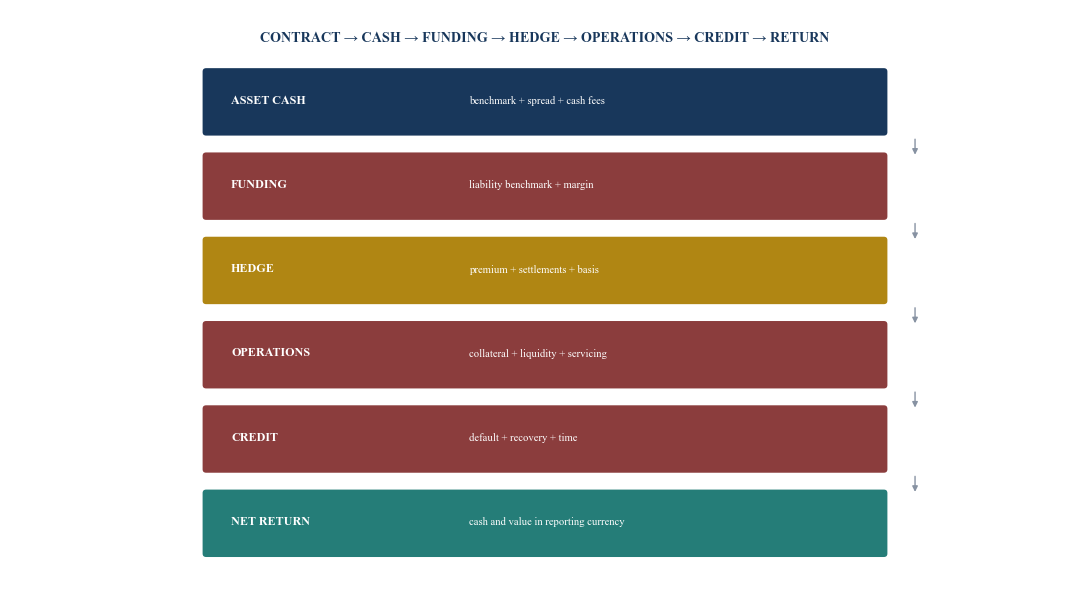
Author framework. Items and treatment depend on the facility, fund and hedge documents.
4. Map the current UAE rate and currency context
The CBUAE maintains a Base Rate for its Overnight Deposit Facility. The CBUAE announced on 17 June 2026 that it maintained the Base Rate at 3.65 percent.[3] The Federal Reserve's implementation note on the same date maintained the interest rate on reserve balances at 3.65 percent and the federal-funds target range at 3.50 to 3.75 percent.[6] These official values are date-specific and are not transaction quotes.
The CBUAE states that it intervenes automatically in the foreign-exchange market to maintain the stability of the UAE dirham peg against the US dollar. Its official domestic-market-operations page publishes intervention rates of 3.672 when buying US dollars and 3.673 when selling US dollars.[5]
The peg does not make every GCC private-credit currency exposure identical. A UAE borrower can earn in euro, sterling, yuan or another currency while borrowing in AED or USD. A fund can hold assets in several GCC currencies, fund itself in another currency and report to investors in multiple currencies. Benchmarks, tenors, settlement dates, funding spreads and liquidity can also differ even when principal currencies are closely linked.
The model should therefore identify actual cash-flow currency and benchmark. It should avoid using the stability of AED/USD as a substitute for analysing non-USD revenue, other GCC currencies, cross-currency funding, settlement or basis.
5. Build an exposure dictionary before choosing a hedge
Every exposure should be identified at cash-flow level. The dictionary records legal entity, facility, payer, receiver, currency, notional, draw state, index, reset, floor, cap, spread, maturity, amortisation, optionality, collateral and reporting purpose.
The source hierarchy begins with executed documents and current positions. Treasury systems, agent notices, bank statements, valuation reports, capital-call records and investor ledgers provide supporting evidence. A term sheet or model should not override the executed confirmation.
The exposure is dynamic. Drawings increase. Amortisation reduces principal. A borrower prepays. A facility extends. The hedge can be fixed while the exposure changes. The data process should reconcile exposure and hedge at every approved monitoring date.
Table 1. Exposure dictionary for a hedged private-credit return
| Field | Source | Decision use | Control question |
|---|---|---|---|
| Loan notional and draw | agent notice and ledger | hedge amount and interest cash flow | drawn, committed or projected? |
| Loan currency | facility and payment record | FX and settlement exposure | which entity receives which currency? |
| Reference rate | facility definition and fixing source | benchmark sensitivity | exact index, tenor and fallback? |
| Reset and payment dates | cash-flow schedule | timing and compounding | lookback, lockout or lag? |
| Floor and cap | facility terms | embedded optionality | mirrored in hedge or retained? |
| Spread and fees | facility and invoices | gross return and credit economics | cash, capitalised or contingent? |
| Funding notional | financing ledger | net interest and liquidity | matched to asset or portfolio? |
| Funding benchmark | funding documents | basis and repricing gap | same index and reset as asset? |
| Currency cash flows | bank, facility and fund ledger | realised FX exposure | principal, interest, fee or NAV? |
| Hedge terms | master agreement and confirmation | risk reduction and valuation | exact product, index and notional? |
| Collateral terms | credit-support documents | liquidity and counterparty exposure | thresholds, eligible collateral and timing? |
| Optional events | facility and hedge documents | prepayment, extension and termination | who has the option and what cost follows? |
Definitions and evidence depend on the executed transaction and reporting purpose.
6. Analyse the borrower's floating-rate capacity
The borrower is the primary source of loan repayment. A floating-rate asset can increase lender income when the benchmark rises while weakening the borrower's debt-service capacity. The credit and market-risk effects should be analysed together.
The lender should calculate interest expense under base and stressed benchmark paths. It should include the contractual floor, margin, drawn notional, reset timing, amortisation and other debt. EBITDA or cash earnings alone are insufficient. Working capital, tax, maintenance capital, lease payments and required investment affect cash available for debt service.
A borrower hedge can limit the rate path. The credit team should verify notional, maturity, counterparty, collateral, termination and accounting or cash effects. A hedge held by another group entity can fail to protect the obligated borrower unless cash and legal support reach the correct entity.
Credit structure can complement a hedge. A cash reserve, minimum interest-cover covenant, amortisation, cash sweep, restricted distribution, debt cap or mandatory hedge requirement can protect capacity. The term should match the identified credit mechanism.
7. Analyse the lender's funding and repricing gap
A lender can own a floating-rate loan and still have interest-rate risk. The asset and liability can reset on different dates, use different benchmarks, have different floors, mature at different times or respond differently to market conditions.
The CBUAE's in-force interest-rate-risk framework requires banks within scope to identify, measure, monitor, report, control and mitigate interest-rate risk in the banking book. Its guidance addresses gap risk, basis risk, repricing, optionality, material currencies, economic value and net interest income.[1][2]
Private-credit funds can face analogous economic questions even when a bank-specific rule does not apply to them. A subscription line, NAV facility, warehouse or leverage facility can reprice before the underlying assets. Investor redemptions or fund maturity can create liquidity pressure. A fixed-rate asset financed floating has different exposure from a floating-rate asset financed fixed.
The gap schedule should show asset and liability cash flows by currency, index, reset and maturity. It should distinguish contractual funding from expected refinancing. A hedge objective can target income, economic value or both.
8. Identify currency exposure at each stage
Currency risk can arise at origination, funding, interest collection, principal repayment, recovery, investor subscription, NAV reporting and distribution. Each cash flow has an amount, date and confidence.
A committed investment creates a different exposure from a drawn loan. A projected interest payment can cease after default or prepayment. A recovery can arrive late and in a different amount. Hedging forecast cash flows too far in advance can create over-hedging when the asset changes.
The lender should distinguish transaction exposure, translation exposure and economic exposure. A forward can lock the conversion of a specified cash flow. It cannot restore borrower demand lost because the borrower's operating currency moved. A cross-currency swap can exchange principal and interest under defined terms. It creates counterparty, collateral, basis and close-out exposure.
The official AED/USD intervention mechanism is relevant to AED and USD cash flows.[5] It does not remove the need to reconcile settlement, timing, counterparty and other currencies.
9. Compare available instruments with the exposure
An instrument should be selected against a defined objective and approved eligibility. A fixed-for-floating interest-rate swap exchanges specified rate cash flows on an agreed notional. A cap can compensate above a strike while preserving benefit below it, subject to premium and terms. A floor can protect a minimum reference rate. A collar combines options and changes the payoff range.
A currency forward fixes an exchange rate for a specified amount and date. A rolling forward programme renews exposure and creates rollover, price and settlement risk. A cross-currency swap can exchange principal and periodic cash flows in different currencies. A natural hedge uses matching operating, asset or liability cash flows.
The ISDA 2021 Interest Rate Derivatives Definitions provide a current industry framework for privately negotiated interest-rate and currency derivative confirmations and include benchmark and contingency provisions.[8] The actual master agreement, schedule, credit-support document and confirmation determine the transaction.
Table 2. Hedge instrument comparison
| Instrument | Risk addressed | Economic feature | Residual or introduced risk |
|---|---|---|---|
| Pay-fixed swap | rising floating benchmark | converts specified floating leg to fixed | basis, counterparty, collateral, break cost and over-hedge |
| Receive-fixed swap | falling fixed-asset value or income objective | exchanges fixed receipt for floating under terms | benchmark and funding mismatch |
| Interest-rate cap | benchmark above strike | preserves benefit below strike after premium | premium, strike, tenor and basis |
| Interest-rate floor | benchmark below strike | protects specified minimum | premium, mismatch with asset floor and counterparty |
| Collar | benchmark outside agreed band | combines cap and floor economics | surrendered upside, basis and close-out |
| Currency forward | specified currency amount and date | fixes conversion rate | forecast error, rollover and settlement |
| Cross-currency swap | principal and interest across currencies | changes currency and rate profile | basis, collateral, counterparty and termination |
| Natural hedge | recurring matched cash flows | reduces derivative notional | timing, amount, entity and operating mismatch |
| Cash reserve | near-term volatility | absorbs payment or margin call | carry cost and finite protection |
| Facility structure | credit and cash-flow volatility | covenant, amortisation or draw control | borrower flexibility and execution risk |
Availability, price, accounting and suitability require transaction-specific professional advice.
10. Design the hedge around amount, time and basis
Hedge effectiveness begins with matching. The design compares exposure and instrument across notional, currency, index, tenor, reset date, day count, payment frequency, maturity, amortisation, floor, cap and optionality.
Perfect matching is often unavailable or uneconomic. The institution should define an approved hedge ratio and tolerance. It should state whether the hedge covers current draws, expected draws, committed amount, principal, interest, NAV or distributions.
Basis risk remains when the loan and hedge reference different indices or tenors. A three-month EIBOR loan hedged with another AED rate or a SOFR-funded AED asset creates basis. Different reset dates can generate temporary mismatch. Credit spread and funding spread can move even when the base rates are matched.
Time creates further risk. A shorter hedge leaves terminal exposure. A longer hedge can remain after prepayment. An amortising hedge can follow scheduled principal and diverge from actual principal. The exit plan should be designed at inception.
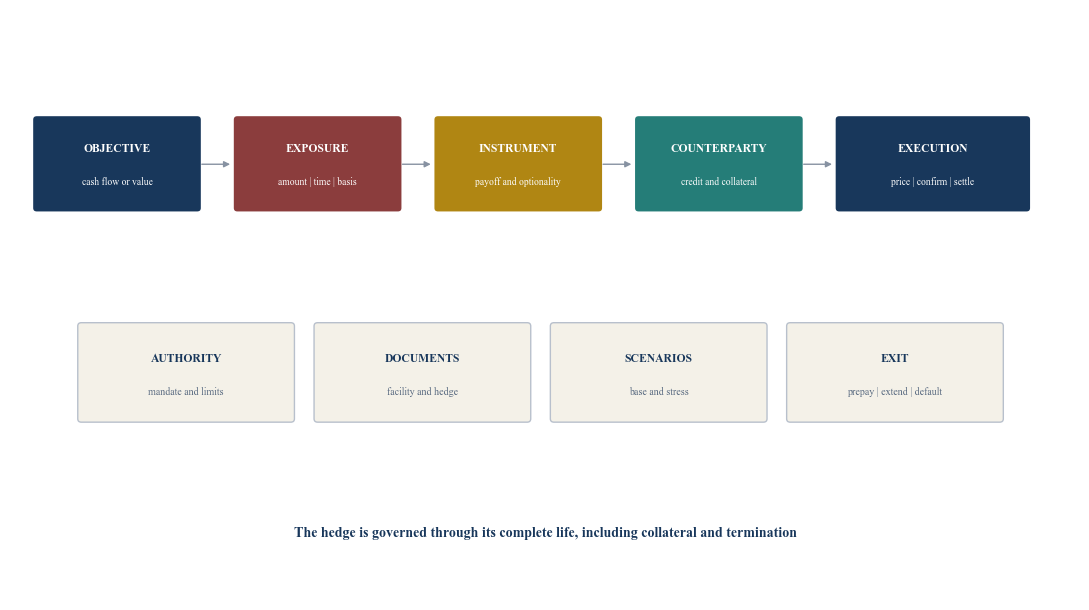
Author framework. Execution follows authority, documentation, pricing and independent checks.
11. Price the hedge as a complete economic package
The quoted fixed rate, premium or forward rate is one component of hedge economics. The institution should include bid-offer, credit charge, collateral terms, documentation, clearing, custody, settlement, valuation, accounting, tax where relevant, operations and expected termination cost.
Counterparty credit exposure changes with market value. Collateral can reduce credit exposure and create liquidity needs. Basel and IOSCO margin standards establish minimum requirements for covered non-centrally cleared derivatives within their scope and explain the role of initial and variation margin.[9]
A private fund should test margin calls or collateral transfers under adverse movements. An economically successful hedge can consume cash before the protected asset pays. The liquidity plan should identify eligible collateral, threshold, minimum transfer amount, timing, dispute process and backup sources from the actual documents.
Execution should use approved counterparties and a documented price process. A comparison should normalise product, notional, schedule, collateral and credit terms. A lower headline rate can be less attractive when other terms differ.
12. Connect the hedge to borrower and fund scenarios
The scenario set should combine benchmark, currency, credit and liquidity rather than shock each in isolation. Rates can rise while borrower earnings weaken. Currency can move while recovery timing extends. A hedge can gain value and require or release collateral depending on its direction and documents.
The borrower scenario recalculates interest, debt-service coverage, liquidity and covenants. The fund scenario recalculates asset income, funding, hedge settlement, collateral, fees, default, recovery and investor-currency return.
Scenarios should include rate up, rate down, curve shape, basis, spread, prepayment, extension, partial draw, default, delayed recovery, currency move and hedge-counterparty event where material. The institution should avoid assigning probabilities without an approved basis.
Table 3. Hedge-design and scenario matrix
| Exposure | Base question | Stress question | Hedge-design implication |
|---|---|---|---|
| Floating borrower coupon | can current cash cover reference plus spread? | what benchmark path breaches headroom? | cap, swap or structural protection aligned to capacity |
| Asset and funding basis | do indices and resets match? | how does basis widen or change sign? | basis tolerance and residual-risk limit |
| Drawn notional | what amount currently earns coupon? | what if draw, amortisation or prepayment changes? | dynamic ratio and rebalancing rule |
| Maturity | when do asset and funding end? | what if the loan extends or refinances late? | hedge horizon and extension process |
| Currency cash flow | what amount and date are reasonably certain? | what if default or recovery changes them? | hedge confidence tiers and unwind rule |
| Counterparty | what netting and collateral apply? | what if value and exposure increase together? | counterparty limit and collateral liquidity |
| Fund liquidity | what cash and eligible collateral exist? | can margin and borrower delay coincide? | reserve, facility and escalation threshold |
| Investor return | which currency and cash metric matter? | what translation and timing can be tolerated? | subscription, NAV or distribution hedge policy |
| Optionality | who can prepay, extend or cancel? | what close-out follows option exercise? | instrument choice and termination reserve |
| Accounting and tax | what treatment applies to the actual structure? | what volatility or cash tax can arise? | specialist approval before execution |
Scenario values and actions require approved methodology and verified transaction terms.
13. Demonstrate the cash-flow bridge with a hypothetical case
Consider a hypothetical GCC private-credit fund holding an AED loan and reporting returns in US dollars. Every borrower, amount, rate, benchmark, currency, hedge, cost, default, recovery and result in this example is a management assumption created solely to demonstrate the framework. It does not describe a client, quote, executed transaction or recommendation.
The assumed facility has an AED 200 million commitment and AED 160 million initial draw. The loan pays three-month EIBOR plus 6.50 percent with a zero-percent base-rate floor. It amortises AED 20 million at the end of year two and matures at the end of year three. The hypothetical fund has an AED-equivalent funding allocation that reprices with SOFR plus 2.50 percent and reports in US dollars.
The example assumes an initial three-month EIBOR input of 3.80 percent and SOFR input of 3.65 percent. These are management assumptions and are not current executable rates. The starting loan cash coupon is therefore assumed to be 10.30 percent before fees and events. The assumed funding rate is 6.15 percent.
The fund considers a two-year pay-fixed, receive-floating hedge on AED 120 million of current exposure and a rolling currency programme for defined net cash flows. The example assumes a fixed rate, basis, execution cost, collateral terms and forward rates solely for calculation. It does not claim that the instruments are available on those terms.
Under an illustrative rate-rise path, loan income increases, funding expense rises, borrower debt-service coverage falls and the rate hedge changes fund cash flow. The remaining unhedged notional and basis preserve some rate sensitivity. Under prepayment, the fund closes part of the hedge and recognises the assumed termination value.
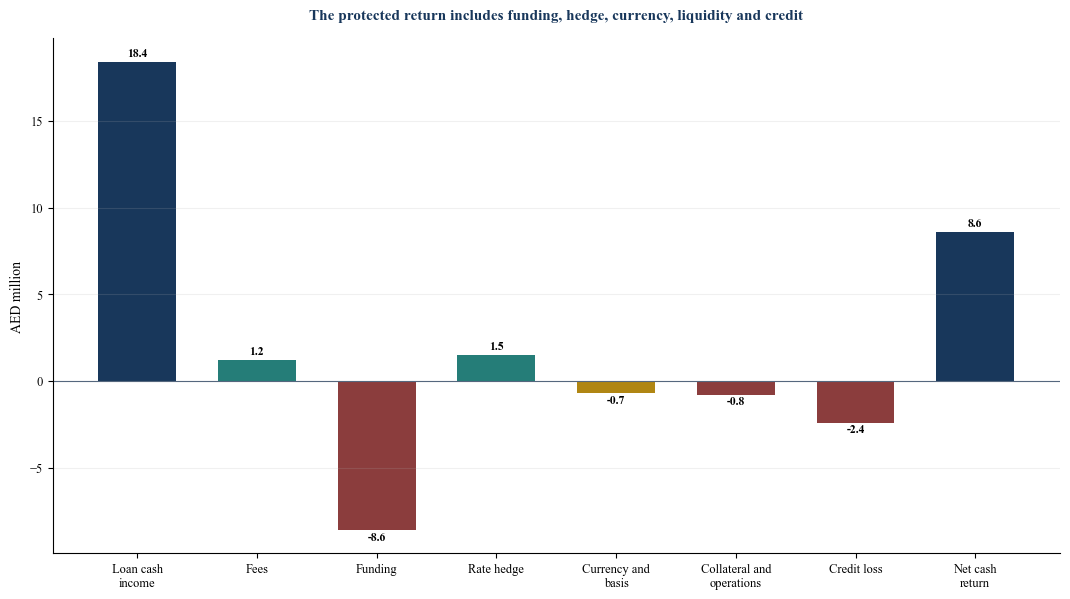
Every amount is an illustrative management assumption in AED millions.
14. Preserve borrower credit discipline after hedging
A rate hedge can improve debt-service predictability. It does not repair weak operating cash flow, excessive leverage, poor liquidity or an unviable maturity.
The credit committee should see debt-service capacity before and after the hedge, the hedge's expiry, collateral requirements, break cost and failure modes. A borrower cap can protect against higher rates and leave exposure after the cap maturity. A swap can create a fixed obligation even when the loan prepays.
Mandatory hedging covenants require precision. The documents should define eligible instrument, counterparty, minimum percentage, period, evidence, maintenance, replacement, termination and cure. The lender should confirm legal and operational ability to enforce or respond to non-compliance.
The borrower's hedge counterparty can have security, set-off or collateral rights that affect the lender. Intercreditor and permitted-debt analysis should cover the actual arrangement. The recovery model should include close-out claims and priority where relevant.
15. Plan for prepayment, extension, default and close-out
The hedge life rarely follows the base schedule exactly. A loan can prepay, extend, default or restructure. A fund can sell or transfer the asset. A hedge counterparty can default. A benchmark or market disruption can trigger contractual fallbacks.
The exit plan should state who can terminate, calculation method, notice, settlement timing, collateral release, valuation challenge and accounting or tax review. The institution should model positive and negative close-out values.
On borrower default, the loan can stop paying while the hedge remains. A pay-fixed swap can continue to exchange cash flows. A currency forward can require settlement against a loan payment that did not arrive. The risk team should decide whether to close, resize or retain the hedge under valid authority.
Recovery should show gross asset proceeds, enforcement costs, time, hedge close-out, collateral, counterparty claim, funding repayment and currency conversion. Net recovery belongs to the correct entity and reporting currency.
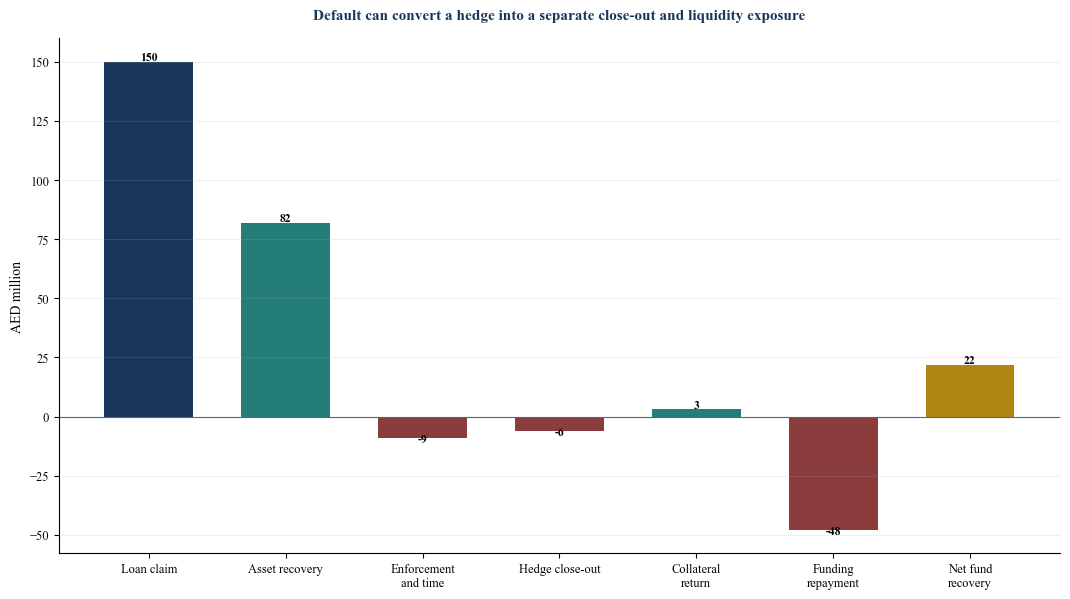
Every amount is an illustrative management assumption in AED millions.
16. Monitor the hedge and return together
Monitoring should reconcile the underlying exposure, hedge position, counterparty, collateral and realised return. A hedge dashboard without the asset can show a profitable derivative while the loan is deteriorating. A loan dashboard without the hedge can misstate net cash and liquidity.
The monitoring pack should include current and projected loan notional, benchmark, reset, coupon, borrower coverage, funding, hedge notional, mark-to-market, settlements, basis, collateral, counterparty limit, currency cash flows, realised return and exceptions.
Triggers need an owner and action. Notional mismatch can require resize. A maturity gap can require extension review. A counterparty downgrade can require limit action under policy. A borrower watch-list event can change forecast cash confidence and reduce a currency hedge.
Table 4. Hedge and return signal-to-action controls
| Signal | Verification | Risk question | Controlled action |
|---|---|---|---|
| Loan draw changes | reconcile agent notice and ledger | is hedge notional outside tolerance? | resize, document exception or retain within authority |
| Borrower prepays | confirm amount, date and contractual economics | what hedge and funding remain? | calculate close-out and execute approved unwind |
| Loan extends | verify amendment and revised cash flow | does hedge expire before asset? | renew, restructure or accept documented gap |
| Benchmark basis widens | compare asset, funding and hedge indices | has net income sensitivity changed? | refresh scenario and basis limit |
| Borrower coverage weakens | reconcile earnings, cash and debt service | can higher rates trigger credit deterioration? | rating, covenant, reserve or restructuring action |
| Hedge value moves materially | independent valuation and document review | what counterparty and collateral exposure follows? | collateral, limit and liquidity action |
| Margin call increases | verify valuation, threshold and eligible collateral | can fund liquidity absorb the call? | transfer, dispute or invoke contingency plan |
| Currency cash forecast falls | update collection, default and recovery case | is the hedge larger than probable cash? | reduce hedge within approved confidence rule |
| Counterparty event occurs | verify rating, default and documentation | are replacement and close-out rights available? | legal, credit and treasury escalation |
| Return deviates from bridge | reconcile income, funding, hedge, FX and loss | which driver caused the variance? | correct data, update policy or take exposure action |
Actions depend on verified facts, mandate, policy and executed documents.
17. Demonstrate a hypothetical decision and dashboard
The hypothetical AED facility described earlier has an initial draw of AED 160 million. The example assumes a borrower EBITDA of AED 52 million, total cash interest of AED 19 million before the new hedge and debt-service coverage of 1.45 times after other required cash outflows under the selected definition.
Under the illustrative rising-rate case, the benchmark increases by 200 basis points. Annual loan interest increases by AED 3.2 million on the initial draw before amortisation and day-count effects. The borrower's cash interest rises accordingly on unhedged debt, and assumed coverage falls to 1.24 times before mitigation.
The borrower purchases an assumed cap on AED 120 million with a two-year term and an illustrative strike. The fund separately hedges part of its funding mismatch. The two arrangements have different purposes, counterparties and documents.
The hypothetical fund committee approves a 75 percent current-draw hedge ratio for the identified rate mismatch, a rolling six-month currency hedge for highly probable net interest cash flows, counterparty and collateral limits, a prepayment unwind rule and monthly reporting. The remaining exposures are explicitly accepted within assumed limits. No executed hedge or result is claimed.
Table 5. Hypothetical hedged-coupon decision
| Measure | Assumed base | Illustrative stress or hedge | Decision interpretation |
|---|---|---|---|
| Facility commitment | AED 200m | no change | committed amount exceeds current draw |
| Initial draw | AED 160m | amortises to AED 140m | hedge follows approved current exposure |
| Loan benchmark | 3.80% | 5.80% rate-rise case | date-specific market claim is not made |
| Loan spread | 6.50% | unchanged in rate case | credit spread remains separate risk |
| Starting cash coupon | 10.30% | 12.30% before cap effects | borrower service increases with benchmark |
| Fund funding input | 6.15% | 8.15% rate-rise case | assumed SOFR and funding margin |
| Rate hedge notional | none initially | AED 120m | 75% of current draw at inception |
| Currency programme | unhedged net cash | six-month highly probable net cash | forecast confidence limits hedge amount |
| Borrower coverage | 1.45x | 1.24x before mitigation | credit headroom remains monitored |
| Hedge collateral | none initially | AED 6m stress call | liquidity reserve and counterparty terms matter |
| Prepayment | none | AED 40m at month 18 | resize and assumed close-out required |
| Outcome | floating exposure | controlled partial hedge | residual basis, credit and liquidity remain |
Every amount, rate, ratio, instrument and outcome is an illustrative management assumption.
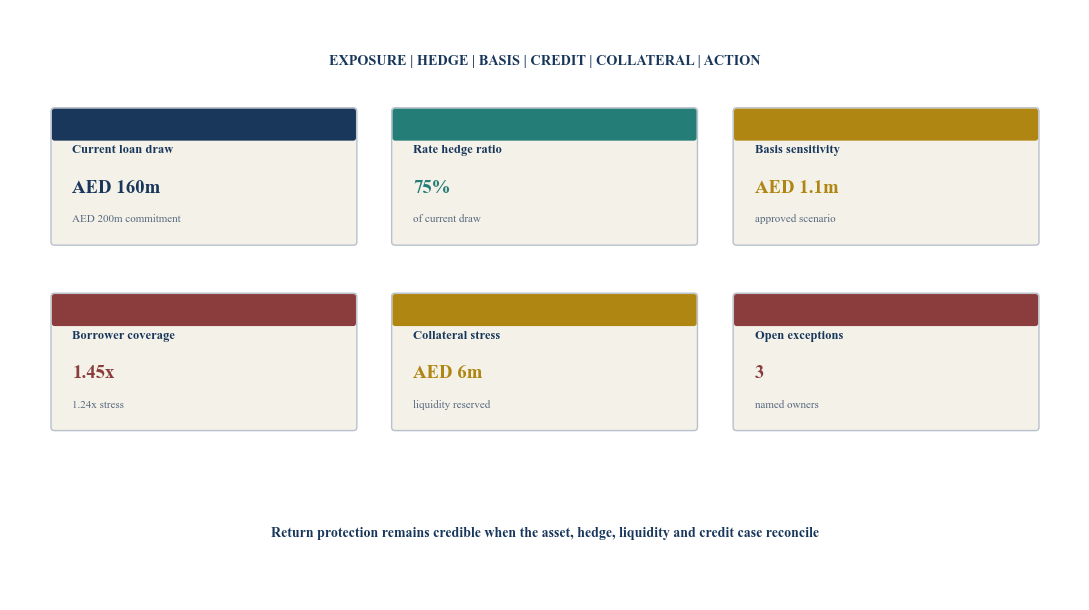
Every displayed value is an illustrative management assumption.
18. Implement a controlled programme in 100 days
Days one to fifteen establish the governing objective, entities, portfolio perimeter, eligible instruments, risk appetite, authority and accountable owners. Legal, regulatory, Shari'a, accounting, tax, credit and treasury specialists identify the current requirements for the actual structure.
Days sixteen to thirty build the exposure dictionary and contractual cash-flow engine. The team reconciles loans, funding, currencies, investor cash flows, benchmarks, options and current hedges.
Days thirty-one to fifty create the scenario library, borrower credit bridge, asset-liability gap, currency forecast-confidence tiers, counterparty analysis and collateral liquidity plan. Independent review tests data and calculations.
Days fifty-one to seventy design hedge ratios, instrument eligibility, maturity, rebalancing, execution, valuation, documentation and termination controls. The team runs selected exposures in shadow mode without trading.
Days seventy-one to eighty-five complete counterparty onboarding, master and credit-support documents, price-checking, settlement, accounting, reporting and incident procedures. Days eighty-six to one hundred approve a limited launch after all material conditions close.
Table 6. One-hundred-day hedged-coupon programme
| Days | Workstream | Controlled deliverable | Gate |
|---|---|---|---|
| 1 to 10 | mandate | objective, entities, exposures, limits and owners | governing body confirms authority and purpose |
| 11 to 20 | perimeter | legal, regulatory, Shari'a, accounting, tax and policy map | specialist owners accept scope and open items |
| 21 to 30 | cash-flow engine | facility, funding, currency and investor schedules | executed terms reconcile to ledger and cash |
| 31 to 40 | risk measurement | rate, curve, basis, currency and optionality sensitivities | independent reviewer reproduces results |
| 41 to 50 | credit and liquidity | borrower capacity, collateral and margin scenarios | credit and treasury accept combined downside |
| 51 to 60 | hedge policy | eligible instruments, ratios, tenors and residual limits | committee approves selection rules |
| 61 to 70 | shadow portfolio | selected assets monitored without execution | mismatches and operational breaks resolved |
| 71 to 80 | documentation | master, credit support, confirmation and settlement | legal and operations confirm readiness |
| 81 to 90 | execution control | counterparties, price process, mandate and maker-checker | test transaction completes end to end |
| 91 to 100 | controlled launch | dashboard, exceptions, unwind and review calendar | senior approval with material conditions closed |
Timing depends on mandate, portfolio, counterparties, documentation, systems and approvals.
19. Limitations and conclusion
The current CBUAE regulations and guidance cited in this paper apply within their stated scopes and should be interpreted with the complete UAE regulatory framework.[1][2] Bank-specific capital, interest-rate and market-risk requirements should not be assumed to apply identically to a private fund or borrower.
The June 2026 CBUAE Base Rate, Federal Reserve policy settings, EIBOR observations and official AED/USD intervention mechanics are date-specific.[3][4][5][6] They are not current executable hedge prices and do not determine future rates or currency outcomes.
SOFR and EIBOR have different underlying markets and methodologies.[4][7] The ISDA definitions provide an industry documentation framework and do not replace transaction-specific legal review.[8] Basel and IOSCO margin standards apply within their defined scope.[9]
Every loan, borrower, funding line, benchmark, spread, hedge rate, currency rate, notional, collateral amount, default, recovery and outcome in this paper's worked example is an illustrative management assumption. No client position, market quote, executed derivative, observed default probability or guaranteed return is claimed.
A controlled hedged-coupon process begins with the exact return objective and exposure owner. It reconstructs contractual cash flows. It separates borrower rate capacity, lender funding mismatch and investor currency exposure. It selects instruments against amount, time, basis and optionality. It prices counterparty, collateral, liquidity and termination. It integrates credit scenarios and monitors asset and hedge together.
That architecture can reduce specified volatility while keeping residual risk visible, authorised and actionable.
References
- [1] Central Bank of the UAE, Interest Rate and Rate of Return Risk in the Banking Book Regulation, C 165/2018, status in force when accessed 13 August 2026. https://rulebook.centralbank.ae/en/rulebook/interest-rate-and-rate-return-risk-banking-book-regulation
- [2] Central Bank of the UAE, Guidance on Interest Rate Risk in the Banking Book, including basis, repricing, scenario, EVE and NII guidance, status in force when accessed 13 August 2026. https://rulebook.centralbank.ae/en/rulebook/f-interest-rate-risk-banking-book-irrbb
- [3] Central Bank of the UAE, CBUAE Maintains the Base Rate at 3.65%, 17 June 2026. https://www.centralbank.ae/en/news-and-publications/news-and-insights/press-release/cbuae-maintains-the-base-rate-at-3-65-3/
- [4] Central Bank of the UAE, EIBOR Rates and Regulations Regarding EIBOR Submissions, current materials accessed 13 August 2026. https://www.centralbank.ae/en/forex-eibor/eibor-rates/
- [5] Central Bank of the UAE, Domestic Market Operations, foreign-exchange intervention and Overnight Deposit Facility description, accessed 13 August 2026. https://centralbank.ae/en/our-operations/monetary-policy-and-domestic-markets/domestic-market-operations/
- [6] Board of Governors of the Federal Reserve System, Implementation Note, 17 June 2026. https://www.federalreserve.gov/newsevents/pressreleases/monetary20260617a1.htm
- [7] Federal Reserve Bank of New York, Secured Overnight Financing Rate Data and methodology, current materials accessed 13 August 2026. https://www.newyorkfed.org/markets/reference-rates/sofr
- [8] International Swaps and Derivatives Association, 2021 Interest Rate Derivatives Definitions InfoHub, version history through 22 May 2026. https://www.isda.org/2021/10/04/2021-isda-interest-rate-derivatives-definitions/
- [9] Basel Committee on Banking Supervision and IOSCO, Margin Requirements for Non-Centrally Cleared Derivatives, consolidated standard, April 2020. https://www.bis.org/bcbs/publ/d499.htm
- [10] Basel Committee on Banking Supervision, Application Guidance on Interest Rate Risk in the Banking Book, consolidated framework chapter effective 1 January 2026. https://www.bis.org/basel_framework/chapter/SRP/98.htm
About the Author
Chennakeshav Adya is an independent researcher and Managing Partner of Matchpoint Partners. His research focuses on investment strategy, capital formation, transaction execution, governance and operating-model design across the Gulf and international markets.
