

1. Define the reset as a cash and financeability programme
A hospitality reset should answer one board question: what recurring cash can this property produce, with what capital, service standard and risk, under conditions that a lender or buyer can verify? The answer cannot begin with an aspirational EBITDA target. It begins with the property, its market, its rooms and other revenue outlets, its guest promise, its contractual perimeter and the condition of the physical asset.
Hotels combine several businesses. Rooms create perishable inventory. Food and beverage converts covers, events and resident demand through multiple outlets. Meetings and banqueting depend on space, calendar, sales conversion and operational delivery. Spas, parking, retail, clubs and other services have different capacity constraints and margins. The same guest can touch several departments, distribution systems and payment routes. A single top-line growth percentage cannot describe these economics.
The board should set five evidence states. An opportunity is an analytical hypothesis. An approved intervention has an owner, budget, timing, controls and acceptance criteria. An operating result is repeated evidence against a frozen baseline. An accounting result is the treatment recognised under applicable policies. Realised cash is the movement reconciled to receivables, payables, taxes, capital expenditure, financing and bank balances. Keeping these states separate prevents a pricing idea from being presented as EBITDA and prevents EBITDA from being presented as debt reduction before cash arrives.
Financeability adds another discipline. A lender considers cash flow, leverage, debt service, security, asset condition, management capability, covenants and downside resilience. A buyer considers maintainable earnings, required capital, contractual constraints, market positioning and the credibility of the operating team. The reset should serve both audiences through one evidence system while preserving their different decisions.
Table 1. Evidence states for a hospitality value-reset programme
| Evidence state | Required support | Permitted board use | Principal control |
|---|---|---|---|
| opportunity | property analysis, market evidence and stated assumptions | prioritise diligence and design | disclose exclusions, uncertainty and dependencies |
| approved intervention | owner, budget, timing, guest safeguards and acceptance criteria | release conditional resources | commercial, operational and finance approval |
| validated operating result | repeated revenue, service, labour or cost evidence | assess recurring economic effect | compare with frozen baseline and contemporaneous factors |
| accounting result | ledger entries and documented policy conclusion | management and statutory reporting | reconcile to general ledger and disclosures |
| realised cash | receipts, payments, working capital, tax and capital records | assess liquidity and debt capacity | reconcile timing, leakage and one-off effects |
The categories separate hypotheses, approvals, operating evidence, accounting and cash. Transaction-specific conclusions require professional review.
2. Freeze a property-level operating baseline
The baseline should preserve at least one complete seasonal cycle where data quality permits. It records available rooms, rooms out of order, occupancy, average daily rate, revenue per available room, cancellations, no-shows, complimentary rooms, upgrades and length of stay. It then connects room nights to guest segment, booking window, channel, rate plan, package, payment type, loyalty status and source market. The baseline remains frozen; every correction receives a dated change record.
The rooms baseline is only the start. Food and beverage requires covers, average spend, menu mix, waste, labour hours and event activity by outlet and service period. Meetings and banqueting need enquiries, proposals, conversion, contracted value, cancellations, room displacement and actual contribution. Ancillary departments need their own volume, price, direct cost and capacity drivers. Departmental and undistributed expenses should follow a consistent chart of accounts so that apparent savings are not produced by reclassification.
USALI provides a common operating-statement architecture for owners and operators.[1] The reset should map each property's general ledger to the reporting structure actually used for management, financing and valuation, with transparent reconciliations where definitions differ. Gross operating profit, EBITDA, owner-adjusted EBITDA, earnings before fixed charges and cash available for debt service are not interchangeable. Management fees, franchise fees, insurance, property taxes, rent, replacement reserves, owner payroll and exceptional items must be shown explicitly.
The physical baseline matters because current earnings may depend on deferred spending. Engineering condition, statutory compliance, life-safety systems, guestrooms, public areas, kitchens, plant, digital infrastructure and back-of-house facilities require an asset register with condition, remaining life, failure consequence and estimated intervention window. A property with temporarily strong EBITDA and a large maintenance backlog has a different financeability profile from a maintained property producing the same current earnings.
Table 2. Minimum property baseline for revenue, operations and capital
| Domain | Minimum operating record | Financial bridge | Failure signal |
|---|---|---|---|
| rooms inventory | available, occupied, out-of-order and complimentary rooms | room revenue to collected cash | inventory counts do not reconcile across systems |
| demand and price | segment, channel, booking window, rate plan and cancellation | gross rate to net contribution | rate growth depends on hidden discount or displacement |
| outlets and events | covers, spend, menu or package, hours and conversion | outlet revenue to departmental profit | volume grows without labour or waste control |
| workforce | paid, scheduled, productive, training, leave and agency hours | payroll to service output | payroll falls while service recovery and turnover rise |
| property condition | asset, condition, remaining life and intervention date | maintenance and capex cash requirements | recurring repairs mask replacement need |
| contracts | brand, management, franchise, lease, supplier and technology terms | fees, liabilities and termination economics | reported EBITDA omits binding future cost |
The baseline should be frozen by property and period, with reconciliations to source systems and the general ledger.
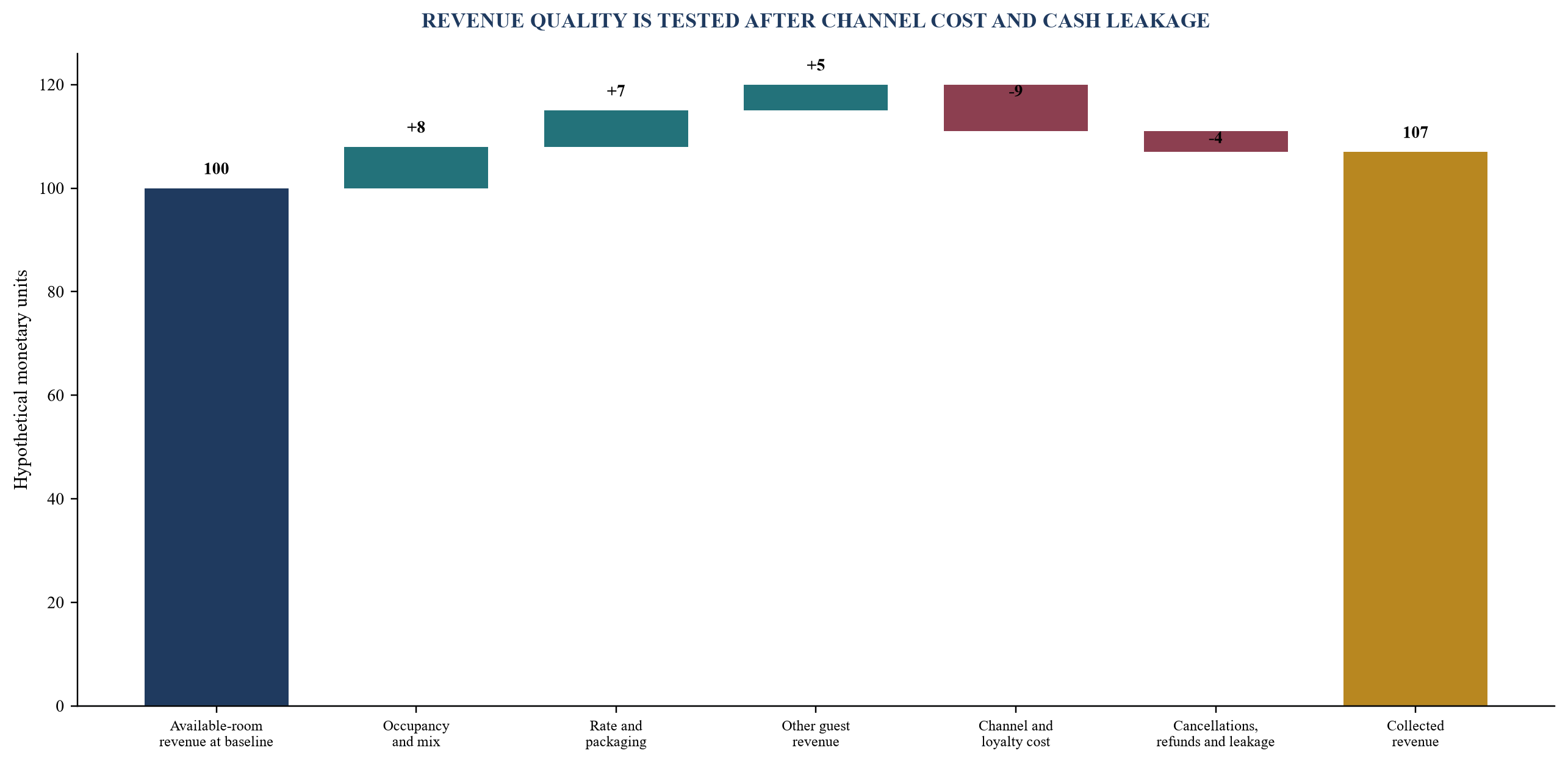
Values are hypothetical monetary units. The bridge separates inventory, occupancy, rate, channel leakage and cash timing.
3. Rebuild rooms revenue from available inventory to cash
Revenue management should be reconstructed as a sequence. Available rooms become sellable rooms after removing genuine closures and out-of-order inventory. Sellable rooms become booked rooms after pricing, distribution and group-allocation decisions. Booked rooms become occupied rooms after cancellations and no-shows. Occupied rooms become recognised revenue after package allocation, taxes, rebates and service delivery. Recognised revenue becomes collected cash after payment fees, chargebacks, refunds, receivables and settlement timing.
The reset should avoid using occupancy, average daily rate or revenue per available room alone. Marriott's public reporting presents occupancy, average daily rate and RevPAR together because each explains a different part of comparable hotel performance.[8] A property can raise RevPAR through rate while losing profitable direct demand, or raise occupancy through discounted third-party inventory that consumes service capacity. The commercial account therefore needs a contribution view by segment and channel.
Demand segmentation should be decision-relevant. Corporate negotiated, transient business, leisure, group, wholesale, crew, government, long-stay and package demand can differ in booking window, cancellation, length of stay, ancillary spend, acquisition cost and displacement. Segment names inherited from a property-management system are useful only when they reconcile to actual economics. The board should see which segment supplied incremental demand and which displaced higher-value demand.
Pricing tests require a contemporaneous control. A rate increase during a citywide event cannot be attributed to a pricing intervention without considering market compression. A decline in occupancy may be acceptable when contribution and service quality improve. A promotion may be attractive if it fills genuinely perishable inventory and produces ancillary spend; it may destroy value if it shifts customers who would have booked at a higher rate.
Forecasting should use a rolling demand curve by stay date, booking date, segment, channel and room type. Pickup, wash, cancellation and price changes need an audit trail. Commercial teams should record why inventory or price changed, what counterfactual was expected and what happened after the decision. This produces organisational learning and allows a lender or buyer to distinguish a repeatable capability from a favourable month.
4. Measure channels on net contribution and customer ownership
Distribution is a portfolio decision. Direct web, voice, corporate sales, global distribution systems, online travel agents, wholesalers, tour operators and group intermediaries provide different reach, conversion, data, payment, cancellation and service economics. The correct question is what incremental guest contribution and relationship each channel creates after all avoidable and unavoidable costs.
Booking Holdings reported USD 26.9 billion of 2025 revenue across merchant, agency, advertising and other models, with accommodation reservations forming the majority of merchant revenue.[7] This scale illustrates why a hotel cannot treat an intermediary solely as a commission line. Merchant collection, payment facilitation, merchandising, cancellation policies, ranking, marketing reach and data access affect the complete economics and operating workload.
Within the European Economic Area, the Digital Markets Act prohibits Booking.com parity clauses and measures with equivalent effect. The European Commission states that hotels can offer different prices and conditions on their own channels and obtain continuing access to data generated through the platform.[6] This creates a commercial design opportunity. It does not establish that every direct booking is cheaper or that withdrawing inventory from an intermediary will improve demand. Each hotel must test acquisition, conversion, payment, cancellation, loyalty and service costs.
The channel account starts with room revenue and subtracts commission, override, media contribution, loyalty expense, payment cost, call-centre or reservation cost, cancellation and chargeback cost, customer-service workload and incremental on-property delivery cost. It adds ancillary contribution and an evidenced value for repeat direct demand only when repeat behaviour is observed. Brand and operator charges should be allocated consistently with the contract and management purpose.
Customer ownership is operational. The property should know whether it can communicate before arrival, recognise preferences, sell upgrades, manage disruption and seek repeat business with appropriate consent. A low-commission channel that withholds useful data can be expensive for service and retention. A high-commission channel can be profitable when it supplies demand the property could not acquire directly. The board should manage both economics and strategic dependence.
Table 3. Channel contribution and control record
| Channel field | Required evidence | Contribution question | Strategic question |
|---|---|---|---|
| realised room revenue | folio, rate, package allocation and taxes | what room revenue was retained? | did the channel access a valuable segment? |
| acquisition and transaction cost | commission, media, loyalty, payment and service cost | what contribution remained after avoidable cost? | which costs can be redesigned without losing demand? |
| cancellation and collection | cancellation, refund, chargeback and settlement timing | how much recognised revenue converted to cash? | who bears demand and payment risk? |
| guest data and communication | consent, contactability, preference and pre-arrival access | did better communication increase spend or reduce failure? | can the property build an enduring relationship? |
| displacement | stay-date demand curve and rejected alternatives | what higher-value demand was displaced? | when should inventory close or reopen? |
Channel comparisons require consistent allocation rules and should preserve incremental-demand evidence.
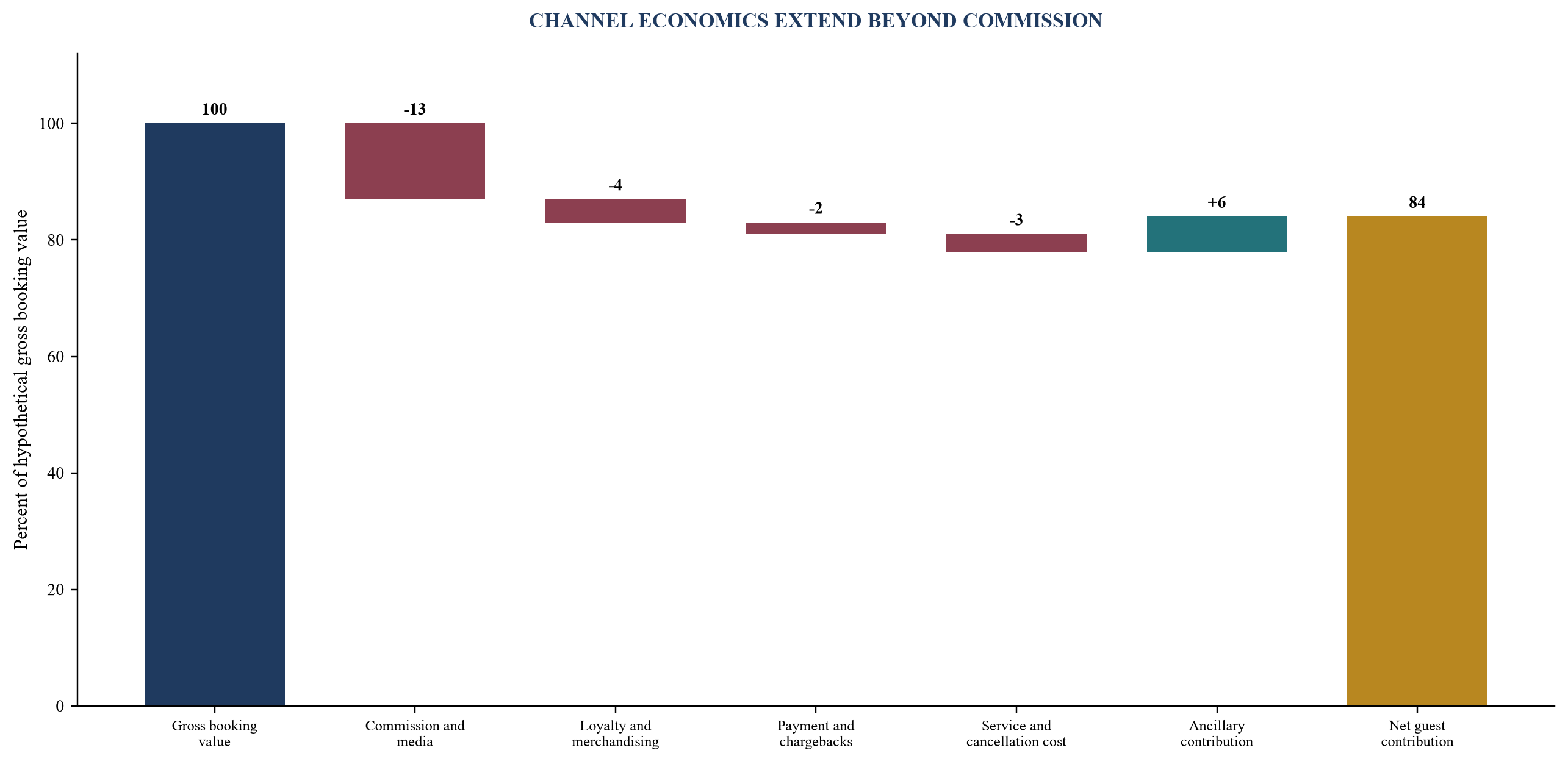
Values are hypothetical percentages of gross booking value and illustrate a comparable channel-cost account.
5. Convert food, beverage, events and ancillary demand into contribution
Non-room revenue should be managed through capacity and occasion. A restaurant serves resident guests, local customers, groups and events across specific periods. Revenue can rise through more covers, higher spend, mix, private events, delivery or extended hours. Each route consumes kitchen, service, space and management capacity differently. The reset should identify the occasions the property can win and the contribution after food cost, waste, labour, commissions, discounts and incremental utilities.
Menu engineering requires item-level data that reconciles recipe cost, realised selling price, preparation time, waste and sales mix. Theoretical food cost is insufficient when purchasing, yield, portion control and spoilage are weak. A price increase may improve unit margin while reducing covers or altering mix. The intervention record should state the intended behaviour and preserve a control period or outlet where practicable.
Meetings and events need a complete enquiry-to-cash funnel. Enquiry volume, response time, proposal quality, conversion, contracted revenue, deposits, room-block pickup, food and beverage, audio-visual, third-party commissions, cancellations and final collection all matter. Event contribution should account for room displacement and the operational peak it creates. A group that fills low-demand dates and produces banquet contribution can be valuable at a lower room rate; the same group can destroy value during compression.
Ancillary offers should solve a guest need and fit the service model. Parking, transfers, spa, club access, early arrival, late departure, room upgrades and local experiences can increase contribution, but every offer adds inventory, fulfilment, refund and service-recovery requirements. The board should require a named owner, capacity rule, unit economics and guest-outcome measure before scaling.
6. Link labour hours to service output and guest outcomes
Payroll is commonly the largest controllable operating cost, yet aggregate payroll ratios can prompt destructive action. Labour should be measured from contracted hours to scheduled hours, productive hours, service outputs and guest outcomes. Leave, training, supervision, meetings and legally required rest remain real. Agency hours, overtime, split shifts and vacant roles should be visible because each can change cost, resilience and service.
The operating denominator must match the work. Housekeeping can use occupied rooms, departures, stayovers, room condition and rework. Front office can use arrivals, departures, contacts, payments and service recovery. Food and beverage can use covers, sales mix and service periods. Engineering can use preventive work, work orders, downtime and asset criticality. Sales can use qualified enquiries, conversion, contribution and collection rather than activity alone.
The US Bureau of Labor Statistics reported that traveller-accommodation labour productivity declined in 2025 while output, hours and compensation moved differently.[11] This demonstrates the need to measure both numerator and denominator. A hotel-specific programme should use its own service data; an industry statistic cannot replace property evidence.
Roster design should follow demand shape. Forecast occupancy, arrivals, departures, events, covers and maintenance requirements by interval and skill. Establish minimum safe or service staffing, then flex variable work around credible demand. Managers should record forecast error, schedule changes, absence, agency use and service failure. The objective is a repeatable operating system that protects the guest promise while reducing avoidable hours and premium labour.
Technology can remove hand-offs and administrative work when workflow changes with it. Mobile check-in, digital keys, housekeeping applications, revenue systems, procurement platforms and predictive maintenance may improve capacity. A licence purchase alone does not create productivity. The evidence should connect adoption, process time, staffing, service outcome, cash cost and recurring benefit.
Table 4. Labour-productivity control by hotel service line
| Service line | Productive unit | Required quality control | Adverse signal |
|---|---|---|---|
| housekeeping | completed departure and stayover rooms adjusted for room type | inspection, rework, readiness and colleague safety | faster rooms with more defects or late availability |
| front office | arrivals, departures, contacts and resolved cases | queue, accuracy, recovery and guest communication | fewer hours with abandoned contacts or unresolved balances |
| food and beverage | covers and events adjusted for service format | ticket time, waste, food safety and guest outcome | payroll falls while waste or complaints rise |
| engineering | preventive tasks and resolved work orders by criticality | downtime, repeat failure and statutory completion | apparent efficiency from deferred work |
| sales and revenue | qualified demand, conversion and contribution | displacement, cancellation and collection | activity rises without profitable converted business |
Every measure needs a demand-adjusted denominator and a service or safety control.
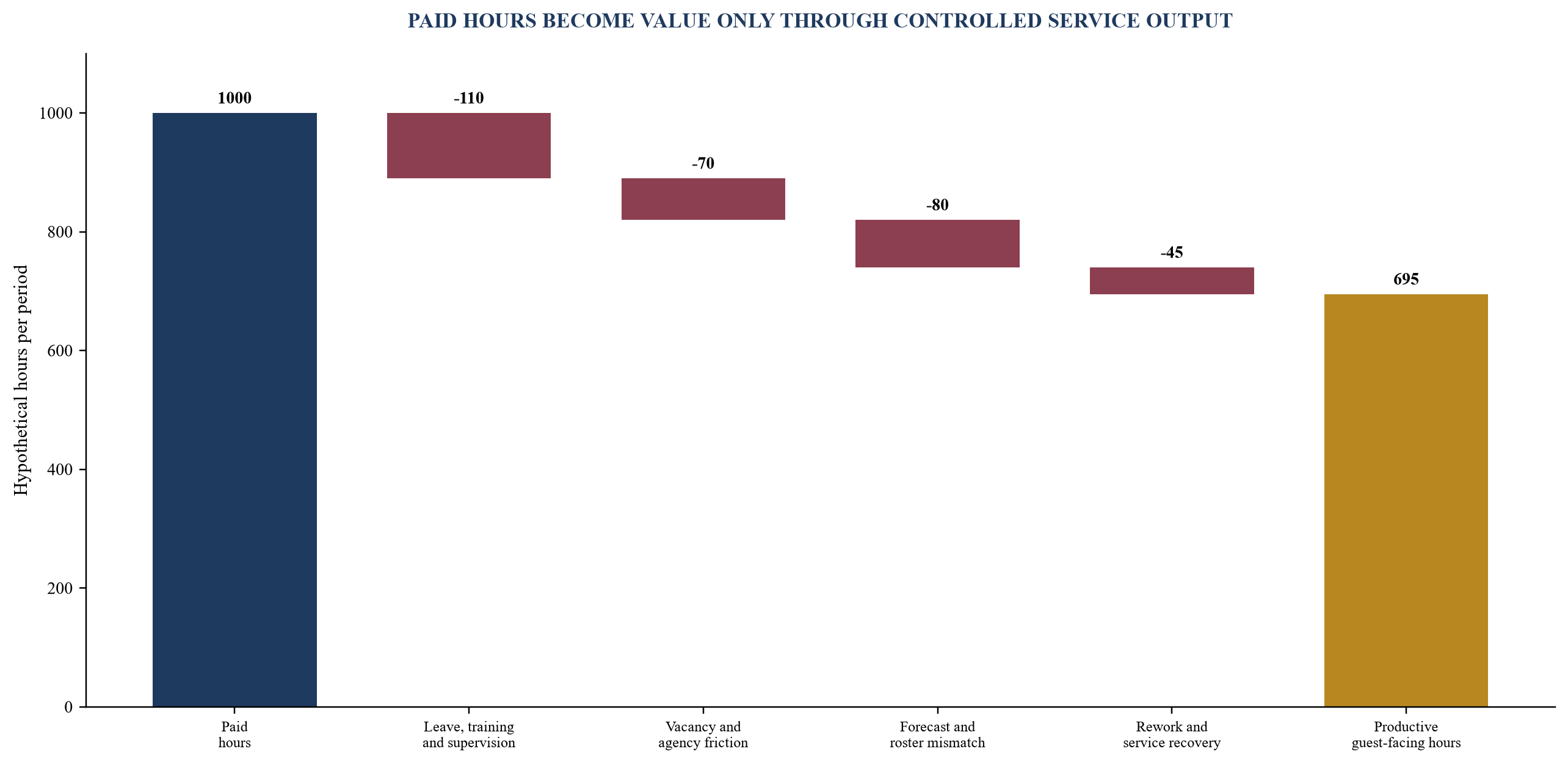
Values are hypothetical hours per period. The bridge protects required non-productive time and tests schedule loss, vacancy and rework.
7. Reset procurement without weakening availability or quality
Procurement savings should be measured from addressable volume to realised cash. The analysis first removes taxes, pass-through items, contracted exclusions and volumes that cannot be combined. It then compares specification, unit, freight, payment, minimum order, inventory, rebate and service conditions. A lower price is useful only when the item remains available, compliant, suitable for the property and acceptable to the people who use it.
Hotel procurement spans ordinary corporate spend and guest-facing or asset-critical categories. Food, beverages, linen, amenities, cleaning products, technology, security, lifts, fire systems, HVAC, laundry, kitchen equipment and specialist maintenance carry different substitution risks. A change in linen or amenity specification can affect brand compliance and guest perception. A change in engineering supplier can alter response time and asset uptime. The category plan should record operational approval and fallback supply.
Benefits should be recognised only when purchase orders, receipts, usage, payable timing and bank movements support them. A favourable unit-price variance should remain distinct from a volume reduction caused by lower occupancy. Rebates should be recorded according to their contractual basis and period. One-time credits do not establish recurring EBITDA.
8. Separate maintenance, compliance and growth capital
Capital expenditure should be organised around the asset and the commercial thesis. Maintenance capital preserves current operation and useful life. Compliance and life-safety capital protects the licence to operate and legal obligations. Brand-mandated or contractual capital preserves an agreed standard. Growth capital changes capacity, positioning, rate potential, service format or operating cost. Some projects serve several purposes; their rationale and benefit pools should still be separated.
IAS 16 frames recognition and depreciation of property, plant and equipment, while IAS 36 requires assets or cash-generating units not to be carried above recoverable amount.[3][5] IFRS 16 adds lease assets and liabilities to the financial picture for lessees.[4] These accounting classifications do not decide commercial priority, but they prevent a cash programme from treating every project as an immediate operating expense or every refurbishment as value creation.
The property-condition survey should link asset, location, age, condition, failure probability, failure consequence, replacement lead time, statutory requirement, guest impact and cost range. Recurring reactive maintenance may indicate a replacement need. Rooms kept in service despite condition issues may support short-term occupancy and weaken future rate, satisfaction and saleability. Conversely, a cosmetic refurbishment should not outrank a critical plant or safety intervention merely because its revenue story is easier to present.
Each growth project needs a commercial baseline, intervention logic, room or outlet closure plan, expected ramp, direct and indirect cost, working-capital effect and downside case. Renovation displaces revenue while work occurs. The programme should record rooms out of order, alternative inventory, guest communication, contractor access, noise, dust, safety and handover. Benefits begin only when the asset is available, marketed, sold and delivered consistently.
Table 5. Capital-priority and benefit-control matrix
| Capital class | Primary evidence | Approval question | Benefit and risk control |
|---|---|---|---|
| life safety and compliance | inspection, regulation, licence and hazard record | what must be completed, by when and under whose authority? | completion evidence, operating continuity and residual risk |
| asset preservation | condition, failure history, downtime and remaining life | does intervention repair, overhaul or replace the asset? | avoided failure separated from operating improvement |
| brand or contract | property-improvement plan, standard and agreement | what obligation, waiver or sequencing flexibility exists? | acceptance by relevant counterparty and cost-to-comply record |
| revenue growth | demand, product gap, rate or capacity hypothesis | what profitable demand will the project unlock? | test availability, ramp, displacement and net contribution |
| productivity | workflow, hours, error, maintenance or utility baseline | what repeatable cost or capacity change will occur? | adoption, service outcome and cash evidence |
Priority is property-specific. Compliance, safety and contractual obligations can override financial ranking.
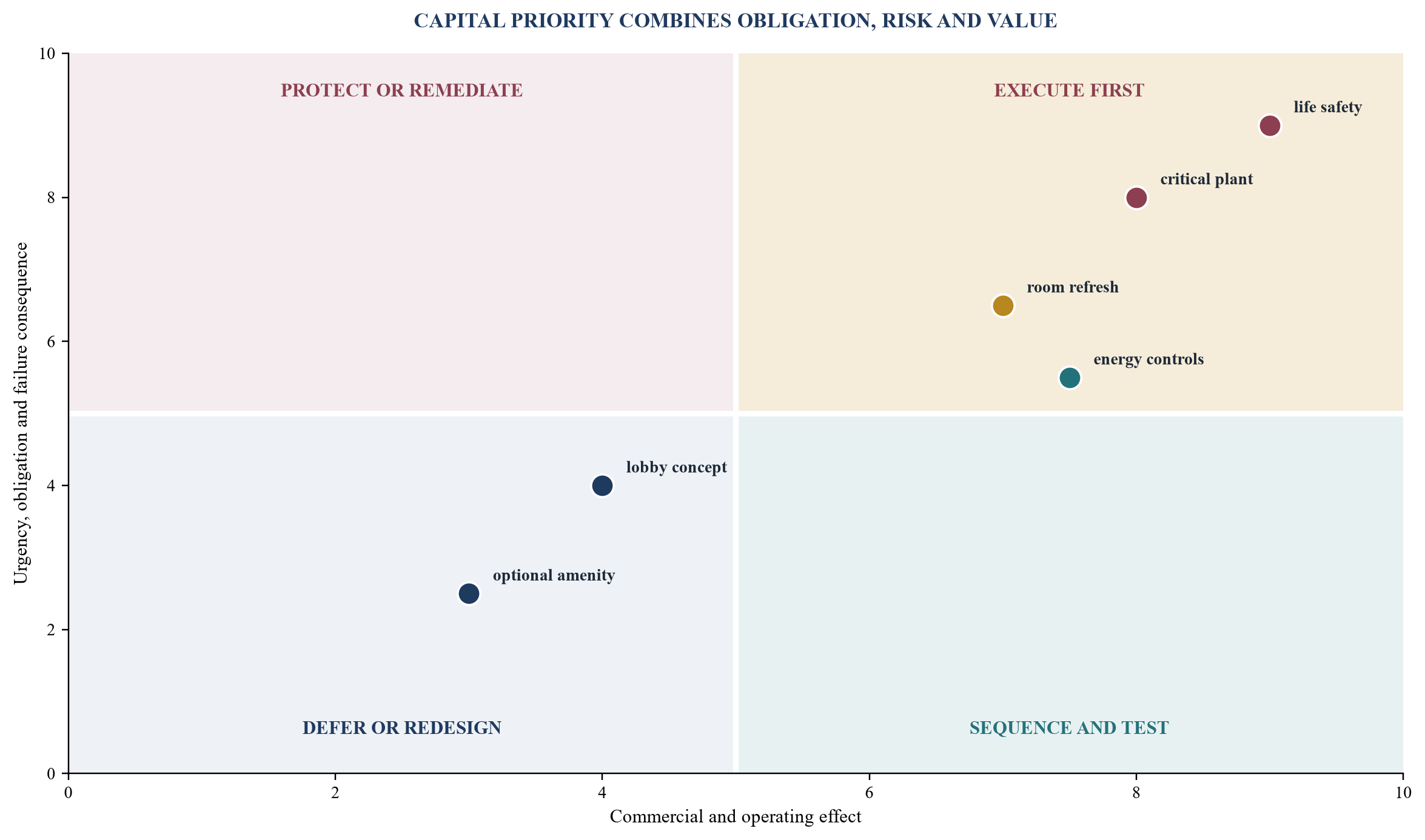
The matrix is a decision architecture. Project placement depends on verified property evidence and professional judgement.
9. Govern renovation as an operating transition
A renovation is a live operating transition, not a construction project beside the hotel. The plan should connect design, permits, procurement, contractor mobilisation, room closures, guest routing, staff workflow, temporary services, commissioning, marketing and reopening. Every work package needs an operating owner as well as a project owner.
Phasing should protect the property's cash and reputation. Closing too many rooms may improve contractor productivity while reducing revenue and disrupting public areas. Closing too few can extend the programme, increase mobilisation cost and expose more guests to noise and circulation changes. The schedule should optimise total value after displacement, delay, financing cost and risk rather than construction cost alone.
Room and outlet handover requires acceptance criteria. Visual completion is insufficient when HVAC balancing, hot water, acoustics, connectivity, locks, fire systems, lighting controls, housekeeping access or point-of-sale interfaces are not stable. A soft-opening protocol should test the complete guest journey, maintenance response and billing before broad inventory release.
10. Create a single value ledger across operations, accounting and cash
The value ledger should begin with the standalone counterfactual and preserve gross opportunity, approved action, operating result, accounting result and realised cash. A pricing intervention may raise room contribution while higher commissions absorb part of the benefit. A labour intervention may release scheduled hours while redundancy, recruitment or technology cost delays cash. A renovation may lift rate and add depreciation, financing cost and replacement-reserve requirements.
Attribution is the central challenge. Occupancy, price, mix, calendar, competitor supply, events, inflation, exchange rates and macroeconomic conditions can change during the programme. The ledger should define a baseline, comparison period, control where available, calculation method, owner and change history. Management should preserve confidence ranges when evidence cannot isolate one cause precisely.
Benefits should be net of dis-synergies and implementation cost. Direct-booking growth can increase digital marketing, loyalty and call-centre expense. Leaner rosters can increase agency use, overtime or service recovery. Central procurement can increase inventory and transition write-offs. A room refurbishment can raise rate and reduce availability during works. Combining these effects in one transparent record improves credibility.
Accounting policies remain distinct from the management benefit case. IAS 36 recoverable amount is the higher of value in use and fair value less costs of disposal, with cash-generating-unit requirements where individual assets do not generate independent cash flows.[5] A management forecast created for a refinance or sale should reconcile to, and not silently replace, the assumptions used for impairment, going concern, budgeting or statutory reporting.
Independent validation should follow materiality. Finance can validate ledger and cash evidence. Revenue specialists can test displacement and channel mechanics. Engineering can confirm asset condition and project completion. Operators can validate service and labour effects. A valuer or lender applies its own professional methods and requirements. Initiative owners should not be the only approvers of their claimed benefits.
11. Translate operating evidence into financeability
Refinancing readiness begins with debt facts. The borrower should maintain a facility register covering lender, borrower, principal, currency, maturity, amortisation, interest basis, hedge, security, guarantees, covenants, cash controls, reserves, information undertakings and consent requirements. The property model should reconcile monthly operating cash, capital expenditure, working capital and debt service to this register.
The Bank of England reported in July 2026 that lenders remained selective and had less appetite for hospitality and smaller firms, while larger and stronger borrowers retained access.[9] Its Q2 2026 Credit Conditions Survey reported unchanged overall corporate credit availability, a slight decrease for small and medium businesses, and unchanged spreads for small and medium firms.[10] These are UK system-level observations rather than hotel lending terms. They illustrate why a property should present evidence of resilience rather than assume that market liquidity will compensate for weak preparation.
The lender case should include historical financial statements, monthly management accounts, property and departmental operating data, revenue segmentation, capital history, condition survey, forecast, downside cases, debt schedule, covenant calculations, ownership, contracts, insurance, licences and tax. Every adjustment to earnings should state whether it is recurring, contracted, implemented, cash-backed and independently supportable.
Debt-service capacity should be tested under occupancy, rate, channel, payroll, utility, capital and interest-rate shocks. A downside case should preserve operational reality. Cutting maintenance or minimum staffing simply to protect a ratio creates a model that cannot be delivered. Liquidity headroom should include renovation disruption, seasonal working capital, reserve requirements, tax and timing of intermediary settlements.
12. Prepare sale earnings that a buyer can reproduce
RICS guidance treats hotels as trade-related property and describes valuation with reference to trading potential, commonly using a profits method within the income approach.[2] The fair maintainable operating profit considered by a valuer is a professional conclusion. Management's role is to provide reconciled operating evidence, explain the asset and contracts, and disclose the capital required to sustain the presented earnings.
The sale earnings bridge should start with reported results and identify consistent, documented adjustments. One-off closure, exceptional legal cost, owner-specific expense, start-up cost, discontinued outlet, insurance receipt, grant, unusual rebate and non-recurring compensation may require analysis. Every adjustment needs source evidence, period, cash status, recurrence assessment and treatment under the relevant reporting basis.
Future savings should be categorised. Implemented and repeated savings have stronger support than contracted but unobserved savings. Approved projects have different confidence from opportunities. A buyer may adopt its own view of brand, management, central costs, capital and synergies. Presenting a transparent ladder allows diligence to challenge individual assumptions without rejecting the entire case.
Capital needs should accompany earnings. A room product can support current rate while approaching renovation. Plant can operate while carrying failure risk. A brand agreement may require a property-improvement plan. The buyer should be able to reproduce which cash flows require maintenance, contractual or growth capital and when that capital falls due.
Data-room design should follow the claim structure. Each major revenue, cost, capital and contract claim links to source records, reconciliations, owner and limitations. The same metric should have one definition across the information memorandum, management presentation, forecast and diligence responses. Version control and question logs reduce the risk of contradictory answers.
Table 6. Refinance and sale evidence pack
| Evidence domain | Minimum contents | Verification question | Decision supported |
|---|---|---|---|
| historical performance | audited accounts, management accounts, operating data and reconciliations | can reported earnings be reproduced by property and period? | baseline credibility |
| revenue quality | segment, channel, rate, cancellation, contribution and cash | which demand and price effects are recurring? | sustainable revenue and downside |
| operating productivity | hours, service outputs, procurement and guest controls | did cost change preserve delivery and resilience? | maintainable operating profit |
| capital and condition | survey, history, commitments, projects, closures and benefits | what capital is required to sustain or improve earnings? | liquidity, valuation and execution risk |
| financing and contracts | facilities, covenants, security, leases, brand and management terms | what obligations constrain cash or control? | structure, consent and headroom |
| value ledger | initiative evidence, accounting treatment, cash and independent review | which adjustments have moved from plan to cash? | underwritten EBITDA and value bridge |
The evidence pack supports diligence and underwriting. It does not replace lender, valuer, accounting, legal or tax conclusions.
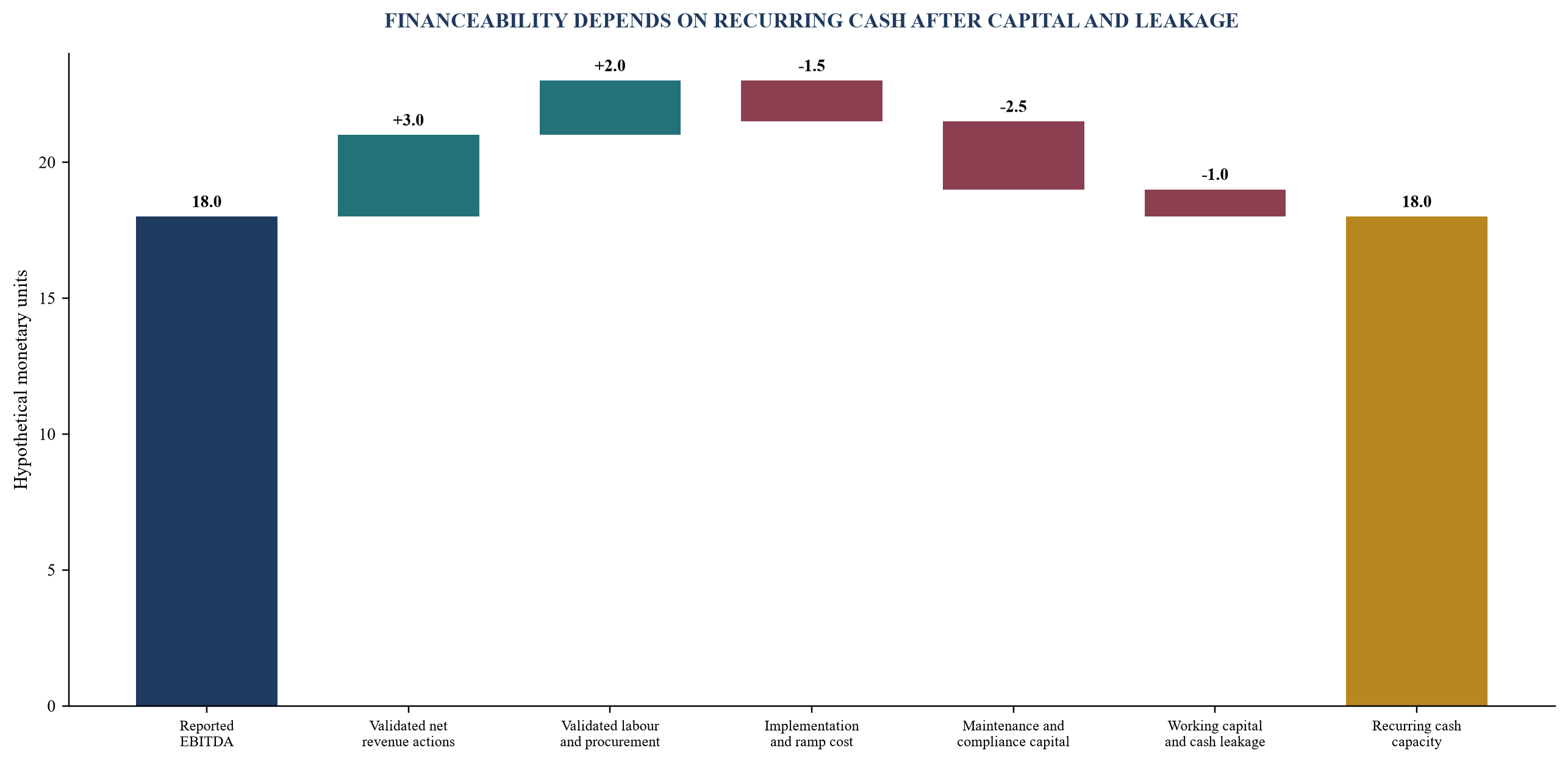
Values are hypothetical monetary units. The bridge keeps implementation, maintenance capital and working-capital effects visible.
13. Run a 120-day reset through decision gates
The first thirty days establish facts. Freeze source data, reconcile rooms inventory and revenue, map channels, capture labour hours, inspect capital condition, inventory contracts and rebuild the debt schedule. Immediate action should protect licence, safety, cash, critical service and lender reporting. The board approves metric definitions, evidence states, owners and acceptance criteria.
Days thirty-one to sixty test reversible interventions. Pricing, inventory controls, direct-conversion changes, roster design, menu engineering and procurement pilots should be limited by property, date, segment or outlet. The programme records guest outcomes, operating effort, accounting and cash. Capital scopes are validated by engineering, operations and commercial teams before commitment.
Days sixty-one to ninety scale interventions that have repeated evidence. The team negotiates contracts, updates systems and standard operating procedures, trains managers and embeds weekly review. Capital projects move only with approved design, closure plan, contingency, commissioning and benefit ownership. The forecast is rebuilt from observed operating drivers rather than applying percentage savings to the original plan.
Days ninety-one to one hundred and twenty institutionalise financeability. The lender or buyer pack is reconciled to the general ledger and property systems. Downside cases, covenant calculations, reserve needs and capital schedules are challenged independently. Management rehearses explanations of revenue quality, service protection, capital need and cash conversion. Open limitations remain visible.
The control tower should have a daily operating exception review, a weekly intervention forum and a monthly board or investment-committee gate. Red and amber status require a defined condition, owner, action and deadline. Colour without a measurable threshold has little control value. The board should stop or redesign interventions that fail guest, safety, cash or evidence criteria.
14. Protect governance, data and operating resilience
Hotel resets touch personal data, payment data, employment records, access systems, guest communications, pricing logic and commercially sensitive contracts. Access should follow role and minimum necessity. Joiners, movers and leavers require prompt processing. Third-party systems need named owners, service levels, backup, incident response and exit arrangements.
Revenue and operating systems can disagree on room inventory, channel, payment, package, tax or guest identity. The programme should define systems of record and reconciliation points. Automated transfers require control totals and exception queues. A successful interface message does not prove that a booking, charge or payment reached the correct account.
Management agreements, franchise agreements, leases and owner approvals can allocate control in ways that differ from the organisation chart. Decision rights for pricing, hiring, procurement, capital, systems, bank accounts and contracts should be mapped explicitly. A reset cannot rely on an action the owner or operator lacks authority to implement.
15. Hypothetical worked example
Consider a hypothetical 220-room full-service hotel preparing for refinancing in eighteen months. It has rooms, two food and beverage outlets, meeting space and parking. The property is trading, but management information combines gross room revenue, channel cost and loyalty expense across several accounts. Labour reporting shows departments and cost, without reliable productive hours. Engineering records indicate recurring HVAC failures and an approaching guestroom refresh.
The baseline separates available, sellable, booked, occupied and collected room revenue. It shows that reported rate improvement is partly offset by higher merchant-channel cost, refunds and package discounting. Several high-demand dates remain open too long on lower-contribution channels. The property also rejects profitable shoulder-night group business because room-block and meeting-space decisions are not connected.
A controlled revenue pilot adjusts inventory close-outs, package rules and pre-arrival upselling for selected dates. Management records displacement, cancellation, guest contacts, ancillary contribution and cash. The pilot produces a smaller gross-revenue increase than the original opportunity case, with stronger net contribution and fewer service failures. The value ledger records the observed result and excludes unrelated market compression.
The labour map reconciles paid hours to productive hours and service outputs. Housekeeping rework and late room release explain part of the apparent shortage. A roster pilot aligns supervisor coverage and departure-room sequencing, while preserving training and safety requirements. Agency hours fall, room readiness improves and guest compensation declines. The result is accepted only after several comparable operating periods.
The capital matrix places critical HVAC replacement and life-safety work ahead of the full guestroom refresh. A sample-room and limited-floor pilot tests design, installation time, room closure and achieved rate. Procurement and contractor terms are evaluated with operating disruption and commissioning included. The financing model separates obligatory capital from growth capital and tests liquidity under delay.
At the end of the programme, management does not present every opportunity as an adjustment. It presents reported EBITDA, implemented recurring operating effects, transition costs, maintenance and compliance capital, working-capital movement and recurring cash capacity. The lender can trace each material claim to source data, and the board can decide whether to refinance, extend the reset or prepare a sale.
16. Implementation principles
Start with the property and the guest promise. Define which services, standards, contracts and asset conditions must be protected. A value programme that weakens the delivered product will eventually appear in rate, demand, compensation, reputation or capital need.
Freeze definitions and lineage. Every metric should identify source, numerator, denominator, period, owner and change history. Reconcile operating systems to the general ledger and bank rather than allowing parallel commercial narratives.
Measure contribution and cash. Occupancy, average rate, payroll ratio and purchase-price variance are useful diagnostic measures. Board decisions require the bridge from those measures to recurring contribution, capital and liquidity.
Pilot reversible changes. Use limited dates, channels, outlets, floors or teams with acceptance and rollback criteria. Scale when evidence repeats and service remains protected.
Keep capital visible. Separate maintenance, compliance, contractual and growth requirements. Include displacement, financing, commissioning and ramp in every material project case.
Challenge attribution. Compare against a frozen baseline and contemporaneous conditions. Preserve uncertainty when several causes move together. Independent review should increase with materiality.
17. Limitations and research agenda
The framework is analytical and operational. It does not establish hotel market benchmarks, lending terms, valuation conclusions, accounting treatments or legal requirements. Hotels vary by geography, market, segment, ownership, brand, management model, asset condition and customer mix. Transaction-specific evidence and professional judgement remain essential.
Property systems may use inconsistent identifiers and definitions. Channel costs can be allocated differently. Loyalty, marketing and central-service economics may sit outside property accounts. Labour hours may be captured through payroll, scheduling and operational systems with different periods. Capital histories can omit owner-funded or emergency work. Reconciliation work is therefore part of the reset, not a preliminary administrative task.
Future research should test the framework using anonymised property-level datasets across markets and operating models. Useful questions include how channel contribution changes after parity restrictions, which labour measures predict service failure, how renovation phasing affects total project value, how lenders treat verified operating interventions and which capital disclosures reduce diligence friction.
18. Conclusion
A hotel preparing for refinance or sale needs a coherent account of revenue quality, operating productivity, asset condition, capital requirements and cash. The reset begins by freezing property-level evidence and reconstructing the path from available inventory to collected cash. It measures channels after complete acquisition and service cost, links labour hours to delivered outcomes, and ranks capital through obligation, risk and commercial value.
The board then governs interventions through evidence states. Opportunities remain distinct from approvals. Operating outcomes remain distinct from accounting. EBITDA remains distinct from recurring cash after implementation, maintenance capital and working capital. This discipline improves internal decisions and creates a diligence trail that lenders and buyers can reproduce.
The result is a property that can explain how value is created, what capital is required, which risks remain and how cash supports financing. A credible reset does not depend on a single heroic forecast. It depends on controlled operating evidence, reconciled accounts and decisions that protect the guest and the asset while improving financeability.
References
- Hospitality Financial and Technology Professionals, “USALI 12th Revised Edition: An Expert Overview of the Updates,” 2025, https://www.hftp.org/downloads/documents/usali/tfh24sp_usali12overview.pdf
- Royal Institution of Chartered Surveyors, RICS Valuation Global Standards, VPGA 4 Valuation of trade related properties, effective 31 January 2025, https://www.rics.org/content/dam/ricsglobal/documents/standards/Red-Book-Global-Standards-incorporating-IVS.pdf
- IFRS Foundation, IAS 16 Property, Plant and Equipment, https://www.ifrs.org/issued-standards/list-of-standards/ias-16-property-plant-and-equipment/
- IFRS Foundation, IFRS 16 Leases, https://www.ifrs.org/issued-standards/list-of-standards/ifrs-16-leases/
- IFRS Foundation, IAS 36 Impairment of Assets, https://www.ifrs.org/issued-standards/list-of-standards/ias-36-impairment-of-assets/
- European Commission, “Booking must now comply with the Digital Markets Act,” updated 13 May 2025, https://digital-strategy.ec.europa.eu/en/news/booking-must-now-comply-digital-markets-act
- Booking Holdings Inc., Annual Report on Form 10-K for the year ended 31 December 2025, filed 18 February 2026, https://www.sec.gov/Archives/edgar/data/1075531/000107553126000009/bkng-20251231.htm
- Marriott International Inc., 2025 Annual Report, 2026, https://www.sec.gov/Archives/edgar/data/1048286/000114036126011592/ny20062722x773_ars.pdf
- Bank of England, Agents’ summary of business conditions, July 2026, https://www.bankofengland.co.uk/agents-summary/2026/july-2026
- Bank of England, Credit Conditions Survey, 2026 Q2, published 2 July 2026, https://www.bankofengland.co.uk/credit-conditions-survey/2026/2026-q2
- US Bureau of Labor Statistics, Productivity and Costs by Industry: Selected Service-Providing Industries, 2025 results, 26 August 2026, https://www.bls.gov/news.release/prin2.htm
- UN Tourism, “International tourist arrivals grew 5% in Q1 2025,” 27 May 2025, https://www.unwto.org/news/international-tourist-arrivals-grew-5-in-q1-2025
- European Commission, Annual Report on the Digital Markets Act 2024, 25 April 2025, https://eur-lex.europa.eu/legal-content/EN/TXT/?uri=celex:52025DC0166
- IFRS Foundation, IAS 7 Statement of Cash Flows, https://www.ifrs.org/issued-standards/list-of-standards/ias-7-statement-of-cash-flows/
- IFRS Foundation, IFRS 15 Revenue from Contracts with Customers, https://www.ifrs.org/issued-standards/list-of-standards/ifrs-15-revenue-from-contracts-with-customers/
- Bank of England, Financial Stability Report, July 2026, https://www.bankofengland.co.uk/financial-stability-report/2026/july-2026
