

Introduction
In-space manufacturing can use microgravity, vacuum, radiation, thermal conditions or orbital access to produce materials, biological products or components with properties that may be difficult to obtain on Earth. A commercial service may include payload design, feedstock preparation, launch integration, orbital processing, telemetry, return, recovery, analysis and terrestrial finishing. Financing must cover the full chain because revenue normally depends on a delivered and accepted result rather than on the orbital process alone.
Project finance relies on a ring-fenced project company, predictable cash flow, enforceable contracts and a clear allocation of construction and operating risks. Early in-space manufacturing projects have weaker versions of each feature. Their capacity may exist as engineering hardware rather than an operating asset. Launch and return services are purchased from third parties. Output quality can vary between missions. Customer contracts may be research agreements or letters of intent. A licence, launch slot or platform reservation may be conditional, time-limited or non-transferable.
The financing task is therefore to convert a development programme into a sequence of financeable states. Each state should have objective acceptance evidence, an identified source of capital, a defined allocation of failure cost and a decision about whether the next capital layer can enter. This paper provides that sequence and a worked hypothetical financing case. It does not value a named company or recommend a financing instrument for a specific project.
1 Define the financed service and completion state
The project company should define the service before it defines the capital stack. A contract may sell an experiment slot, a payload-development service, reserved orbital-processing time, a returned sample, material within a technical specification, a qualified component or a finished product. These are different revenue units with different completion evidence.
The completion state should describe the operating asset that lenders and contracted customers expect to exist. A useful definition covers the flight-qualified hardware configuration, production process, launch and return arrangements, customer specification, accepted yield, annual cadence, operating licences, insurance, data systems and working capital. A statement that the spacecraft is operational is too narrow when the financed business depends on accepted material and repeat missions.
The project boundary also determines which contracts must sit inside the special purpose vehicle. The project company may need title or long-term rights to the processing hardware, intellectual property, flight software, customer agreements, launch reservations, platform access, return capacity, testing contracts and insurance proceeds. If a sponsor or affiliate retains critical rights, the financing documents should provide licences, direct agreements and step-in rights that survive sponsor distress.
2 Build an evidence ladder for capital release
An evidence ladder prevents capital from being advanced against an undefined promise. The first state may be a validated terrestrial mechanism. The second may be a flight-qualified payload. Later states include successful launch, controlled orbital operation, safe return, recovered output, independent specification testing, customer acceptance and repeat production. Each state should identify the documents, test results and third-party confirmations required for acceptance.
NASA's Commercial Orbital Transportation Services programme provides a relevant public model. NASA used pre-negotiated, fixed-price performance milestones with stated acceptance criteria, payment amounts and due dates. Payments followed accepted completion. GAO reported that the structure limited NASA's exposure and that an agreement could be terminated when a partner missed technical and financial milestones. The programme addressed transportation rather than manufacturing yield, so an orbital manufacturing contract needs additional product and customer-acceptance tests. [1][2][3]
Milestones should measure outcomes under the counterparty's control. A design review can support a development payment. A launch event should release payment only when the purchased service is launch or deployment. A manufacturing milestone should require process telemetry and output evidence. A customer-qualification milestone should use the customer's agreed protocol and documented acceptance. Milestones based only on spending or elapsed time transfer too much performance risk to the capital provider.
3 Match capital type to technical state
Equity should fund the uncertainty that cannot yet be transferred through contracts. This includes early process development, first-of-a-kind hardware, unallocated integration effort and the cost of learning from unsuccessful missions. Public grants or co-funding may support defined technology and strategic capability objectives, subject to the award terms. Strategic customers may fund product-specific development when the work has a defined scope, data rights and deliverable.
Prepayments can finance reserved capacity after the customer understands the dependency chain. They should be separated from revenue recognition and from unconditional project liquidity. Refund rights, credits and reflight obligations can turn a prepayment into a contingent liability. The cash-flow model should therefore classify restricted cash, refundable cash and earned cash separately.
Senior debt becomes more credible after the project demonstrates repeatable operations and contracted cash flow. Before that point, a milestone facility or venture debt instrument may be more appropriate because it can price development risk and use sponsor recourse, warrants, cash controls or minimum-liquidity covenants. The instrument label matters less than the actual risk allocation and draw conditions.
4 Design the special purpose vehicle
The project company should hold the assets and contracts that generate cash and support continuity. Its constitutional documents should restrict unrelated business, additional debt, asset disposals, distributions and changes to key contracts. Bank accounts should follow an agreed waterfall. Material affiliate transactions should use documented arm's-length terms.
The sponsor may supply engineering staff, intellectual property, software, procurement or mission operations. Each service should be documented with performance standards, pricing and continuity rights. A lender should be able to replace an affiliate service or require continued performance during a cure period. A licence that terminates automatically after sponsor insolvency would undermine the project-company structure.
Project-company separateness does not remove operating interdependence. Launch, orbital platform, communications, return, recovery and testing providers may remain outside the group. The financing analysis should identify which dependency can be replaced, how long replacement would take, and which approvals would need to be repeated.
5 Convert technical work into milestone contracts
Each milestone should include an entrance condition, a defined activity, an acceptance test, evidence deliverables, an approver, a review period and a consequence for non-acceptance. The contract should distinguish a failed test from delayed evidence and from an excused event. It should state whether the contractor may cure, repeat the test or use an alternate method.
Design milestones can include system requirements review, preliminary design review and critical design review. Hardware milestones can include qualification testing, environmental testing, software verification and payload acceptance. Mission milestones can cover integration, launch, orbital commissioning, process execution, reentry and recovery. Product milestones can cover chain of custody, independent analysis, specification compliance and customer qualification.
Payment should follow accepted evidence. A small mobilisation payment can support early procurement, but it should be protected by a parent guarantee, escrow, title transfer, performance security or a refund obligation where appropriate. Milestone value should reflect the cost and risk retired rather than the contractor's expenditure alone.
6 Separate availability from accepted production
Capacity has at least four meanings in an orbital manufacturing project. Hardware capacity describes what the equipment can process. Mission capacity describes what can be launched, operated and returned. Productive capacity describes output that meets a technical specification. Commercial capacity describes output that customers accept and pay for.
A contract that reserves kilograms of payload mass may provide little cash-flow protection if the customer pays only for accepted product. A contract that reserves processing time may remain valuable even when the output is experimental, provided the customer purchases the service rather than a result. The revenue model must use the same capacity definition as the contract.
The project model should therefore show reserved payload mass, launched mass, processed mass, returned mass, within-specification output and customer-accepted output. It should also identify unused capacity, rework, failed runs and recovery losses. Debt sizing should use the cash-generating unit supported by enforceable contracts.
7 Structure customer development funding
Strategic customers may pay for feasibility studies, payload adaptation, sample campaigns or qualification programmes. The development agreement should identify the technical question, deliverables, background intellectual property, newly created intellectual property, data access, publication rights, confidentiality and the customer's path to commercial supply.
The agreement should also state what happens when a scientific result is negative. A genuine research service may be earned when the agreed work and evidence are delivered, even if the hypothesis is not confirmed. A product-development payment may depend on performance. Mixing these models creates disputes and unreliable cash forecasts.
Customer funding can improve bankability when it establishes paid engagement and a defined route to procurement. It does not prove future volume unless the customer has an enforceable purchase obligation. A lender should review the customer's termination rights, technical conditions, budget approvals and liability caps.
8 Design capacity reservations and offtake
An offtake agreement can include a non-refundable reservation fee, a capacity payment, a mission payment, an acceptance payment and a variable price for additional output. The structure should match the risk being transferred. A reservation fee compensates the project for holding scarce capacity. A capacity payment supports fixed costs when the project makes agreed capacity available. A mission payment compensates execution. An acceptance payment aligns part of the consideration with delivered quality.
Take-or-pay concepts require careful adaptation. A customer should not pay for unavailable capacity or for a project failure outside the customer contract. The project may seek payment when capacity is available and the customer does not nominate payloads. The customer may retain credits or termination rights after repeated service failures. Minimum volume commitments should define the product, specification, scheduling process and relief events.
Price escalation can address launch costs, insurance premiums or third-party platform charges. Pass-through should apply only to defined external costs and should use evidence, caps and audit rights. Efficiency risk should normally remain with the project company unless the customer changes the specification or mission profile.
9 Allocate launch integration and schedule risk
Launch contracts should identify the reserved mission, payload parameters, integration responsibilities, schedule-change rights, termination payments and refund or reflight remedies. A provider may have broad rights to change the launch date or manifest. Those rights should be reconciled with customer delivery commitments and debt-service assumptions.
The project model should use a probability-weighted launch schedule rather than a single date. It should include storage, remanifesting, refreshed testing, staff retention and insurance-extension costs. A launch delay can consume liquidity even when the launch price remains unchanged.
A direct agreement can require notice before termination and allow the project company or lenders to cure payment defaults. Assignment and change-of-control restrictions should be addressed before financing. The project should avoid promising a customer remedy that exceeds the remedy available from the launch provider unless a funded reserve or insurance supports the difference.
10 Allocate orbital platform and operations risk
Platform access may involve power, thermal control, communications, crew time, robotic handling, storage and safety interfaces. The project should translate each dependency into an availability standard and an evidence record. A general promise of platform support is insufficient for a production schedule.
The agreement should distinguish project-equipment failure from platform unavailability. It should state the priority of payload operations, maintenance windows, data ownership, cyber controls, anomaly response and the procedure for repeating an interrupted run. Service credits may compensate minor outages, while material failures may require reflight or termination rights.
NASA's commercial low-Earth-orbit strategy and destination-development work show continued use of phased capability development and commercial service acquisition. These programmes create potential infrastructure and demand, but each manufacturing project must still secure its own capacity and contractual priority. [4][5][6][7]
11 Allocate return recovery and custody risk
Return is a separate service from orbital production. The contract should define the return vehicle, reentry licence responsibility, payload conditions, landing or recovery site, environmental limits, recovery time, custody transfer and transport to the laboratory. A technically successful orbital process can lose commercial value through return delay, contamination, shock, temperature excursion or incomplete custody records.
The United States requires launch and reentry licensing and payload review under Part 450. FAA states that payload review can consider physical characteristics, hazardous materials, ownership, intended operations and the designated reentry site. The United Kingdom also regulates launch and return activity through its spaceflight framework. Licences and approvals should therefore appear as conditions precedent and continuing covenants rather than narrative assumptions. [9][10][11][12]
Return providers should supply telemetry and recovery evidence needed for customer acceptance. Liability caps, exclusions and insurance should be compared with the value at risk. The project may need a customer-specific policy or reserve when the carrier's liability is limited.
12 Define product acceptance and customer remedies
The customer-acceptance protocol should specify sample identity, test method, laboratory, measurement uncertainty, acceptance range, retained samples, retest procedure and decision authority. It should be agreed before the mission. A protocol created after results are available can favour one party and weaken lender confidence.
Remedies should follow the cause of failure. A project process failure may trigger re-performance, replacement, a credit or refund. A launch or return failure may trigger a reflight subject to the provider's remedy and available capacity. A customer-caused payload problem should not create project liability. An inconclusive laboratory result should activate the agreed retest process.
Repeated failures should create escalation and termination rights. The project should cap open-ended reflight obligations and fund expected remedy costs. Customer credits should be modelled as liabilities that reduce future cash collection.
13 Establish completion tests
Completion is the transition from development recourse to operating risk. The test should require more than mechanical completion. It can include a flight-qualified commercial configuration, all material licences, two successful missions, controlled return, a minimum accepted yield, customer qualification, contracted capacity, operating insurance, reserve funding and delivery of as-built documentation.
An independent technical adviser should verify the test against agreed evidence. The adviser should report exceptions rather than issue a broad comfort statement. Waivers should identify the residual risk, the compensating support and the party approving the waiver.
Provisional completion can permit a limited debt draw while sponsor support remains in place. Final completion can release sponsor guarantees and permit distributions. The model should show how delay in either date changes interest, commitment fees, liquidity and customer remedies.
14 Design sponsor completion support
Sponsor support can include a cost-overrun commitment, contingent equity, subordinated debt, a letter of credit, a guarantee or a pledged completion account. It should state the maximum amount, draw conditions, funding timing and expiry. A vague statement of sponsor intent provides little credit support.
The support amount should cover identified remaining costs, a quantified contingency and debt service through the expected completion date. The project should reassess the amount after a failed test or schedule reset. Support can reduce after defined milestones only when the remaining risk and liquidity are demonstrably lower.
World Bank project-finance guidance describes completion support, purchase guarantees, reserve accounts and security assignments as tools for allocating construction and operating risk. The same logic applies here, with technical completion extended through returned and accepted output. [18][19][20][21]
15 Use public funding without overstating demand
Public grants, co-funding and milestone awards can reduce sponsor capital and validate strategic relevance. ESA's Boost programme supported design, launch, in-orbit operation and return work for commercial transport services. NASA's phased commercial programmes have used funded agreements and fixed-price contracts to advance capability. [3][4][8]
The financing model should reflect the legal conditions of each award. Funds may be reimbursable, restricted to eligible costs, conditional on matching finance or subject to audit and clawback. Change of control, location, intellectual-property and procurement conditions can affect a future financing or sale.
A grant is not customer revenue unless the award purchases a service or product under enforceable terms. Lenders should classify strategic support, development funding and contracted demand separately.
16 Structure milestone and delayed draw facilities
A milestone facility can commit capital while limiting draw availability. Each draw should require evidence, budget compliance, minimum liquidity, no material default and confirmation that the next milestone remains funded. Later tranches can have lower pricing when risk has reduced.
Delayed-draw senior debt should begin after completion conditions establish operating cash flow. The commitment period should accommodate realistic mission schedules. Long-stop dates should include extension mechanics, revised pricing and sponsor support rather than an automatic funding cliff.
Interest may be capitalised during development, but capitalisation increases the completion amount and can hide a deteriorating schedule. The model should show cash interest, capitalised interest, commitment fees and reserve funding separately. A debt-service reserve should be funded before distributions and sized to the volatility of the operating schedule.
17 Design the security and direct agreement package
The security package can include shares in the project company, bank accounts, receivables, insurance proceeds, hardware, intellectual property and contractual rights. The practical value depends on transferability and continuity. Space hardware with limited alternative use may provide weak recovery value without the software, licences, staff and service contracts needed to operate it.
Direct agreements with launch, platform, return, testing and key customer counterparties can provide notice, cure periods, consent to assignment and lender step-in rights. The counterparty should recognise a replacement operator that meets defined technical and regulatory conditions. Step-in cannot bypass legal licensing requirements.
The project should maintain an asset and rights register. It should identify ownership, liens, location, condition, insurance and replacement lead time. Data repositories, encryption keys, ground systems and configuration records should be part of the continuity plan.
18 Size reserves and insurance
The project may need reserves for debt service, mission delay, reflight, maintenance, launch price escalation, insurance deductibles and customer credits. Each reserve should have a defined purpose, target balance, funding priority and release test. Combining all contingencies in one general reserve can obscure shortfalls.
Insurance may cover launch, in-orbit operation, reentry, physical damage, third-party liability, business interruption or specific payload risks. Policy exclusions, waiting periods, valuation bases and claims-control provisions matter as much as the headline limit. The project should identify which losses remain uninsured or commercially uninsurable.
Insurance proceeds should follow a reinstatement or debt-prepayment waterfall. A lender may permit reinstatement when the project remains viable and sponsor support covers the shortfall. Customers should not receive overlapping recoveries that exceed the project company's insurance and reserve resources.
19 Build the operating cash waterfall
Cash receipts should enter controlled project accounts. The waterfall can pay taxes, essential operations, insurance, approved maintenance, customer remedies, senior debt service, reserve top-ups, subordinated debt and permitted distributions in that order. The precise order should reflect local law and the commercial structure.
Restricted customer prepayments should remain segregated until the contractual earning event. Public funds may require separate accounts and cost evidence. Insurance proceeds may be restricted to reinstatement. The financial model should mirror these legal restrictions.
Distribution tests can include completion, no default, minimum reserve balances, historic and projected debt-service coverage ratios, contract coverage and compliance with mission and customer-performance thresholds. A cash trap can preserve liquidity after a delayed mission or customer rejection.
20 Model delay failure and remedy cash flows
The base case should not be the only financing case. The project should model launch delay, payload failure, mission interruption, return failure, specification failure, customer rejection and provider insolvency. Each scenario should show schedule, additional cost, lost or deferred revenue, refund obligations, insurance recovery timing and sponsor funding.
Correlated failures matter. A launch delay can move the mission into a different customer budget period. A return failure can require new hardware while the customer has a termination right. A failed batch can consume the next reserved mission and displace another customer.
The model should include a minimum-liquidity test after every scenario. A project that remains economically valuable can still default when remedies and replacement spending occur before insurance or sponsor funding arrives.
21 Protect against demand concentration
Early projects may depend on one strategic customer, one public buyer or one application. The lender should examine termination rights, qualification status, credit quality, procurement approvals and the customer's ability to shift work to terrestrial alternatives.
Portfolio diversification should be measured by contracted cash flow rather than by the number of conversations or letters of intent. Customers can also share a common technical dependency, so apparently diverse contracts may fail together after a process or return problem.
The project can reduce concentration through staged capacity sales, application-specific development agreements and limits on exclusivity. A cornerstone customer may receive priority or pricing rights in return for firm funding, while the project preserves capacity for other users.
22 Govern data intellectual property and change
The project company should control the data needed to prove performance and operate the asset. Contracts should distinguish background intellectual property, project-created intellectual property, customer materials, process data, payload telemetry and analytical results. Rights should survive termination to the extent required for safety, compliance, warranty and lender continuity.
Configuration change can invalidate completion evidence. Hardware, software, feedstock, analytical method or mission profile changes should follow a documented process. Material changes may require customer consent, adviser review or a repeat qualification test.
Cybersecurity and export controls can restrict data access and replacement operators. The diligence file should identify hosting, access control, audit logs, encryption, jurisdiction and incident response. A lender's security interest does not create a right to use controlled technology.
23 Establish governance and reporting
The board should receive an integrated schedule, funding forecast, milestone-evidence register, risk log, contract status, licensing status and customer pipeline. Technical and financial reporting should use the same baseline. A mission described as on schedule should also be funded through its acceptance and remedy period.
Reserved matters can include budget changes, new debt, material contract amendments, changes to the technical baseline, related-party transactions and settlements of material claims. Lenders may receive observer rights and consent rights over changes that affect completion or security.
Reporting should identify variances and corrective actions. A green milestone should mean that the defined evidence has been accepted, not that management expects acceptance.
24 Make the financing decision
The investment committee should approve a specific financeable state. Before repeat production, it may approve a development facility supported by equity, milestone funding and sponsor recourse. After completion, it may approve delayed-draw senior debt sized to contracted and stress-tested cash flow.
The committee should receive a sources-and-uses model, completion test, milestone schedule, contract matrix, licence register, insurance analysis, downside cases, security package and independent technical report. Each assumption should identify its evidence and owner.
The hypothetical case requires USD 240 million. The proposed capital covers the stated programme only if public and customer funding remains available, sponsor standby support is funded on time and senior debt draws after completion conditions. The senior facility should not fund first-of-a-kind risk merely because the total sources equal the budget.
25 Prevent circular completion and revenue tests
A financing can appear protected while its tests depend on one another. Completion may require a minimum cash balance that is achieved only by drawing debt. The debt draw may require completion. Contracted revenue may include a customer payment that becomes due only after the debt-funded mission. These circular conditions should be identified before signing.
The sources-and-uses model should tag each source by earliest availability and each cost by latest payment date. The model should then test whether committed funds cover the programme through every draw condition without relying on the draw being tested. A financing gap between launch integration and customer acceptance can be material even when total committed sources exceed total budget.
Revenue tests should distinguish executed contracts, conditions precedent, customer termination rights and the earning event. A contract with a stated value can contribute less to debt capacity when payment depends on uncompleted qualification, annual budget approval or a customer option. The lender may apply a probability or eligibility test, while the project-company model retains the full contractual schedule for operational planning.
The same discipline applies to reserves. A debt-service reserve funded from senior debt increases debt and may not address development liquidity. A reflight reserve funded from customer prepayments may be unavailable for general costs. Each reserve should be funded from an eligible source before the exposure it protects begins.
26 Plan refinancing ownership change and exit
The development capital stack should anticipate the transition to operating finance. Refinancing conditions can include final completion, a defined operating history, minimum contracted revenue, no material claims, confirmed licences, reserve funding and clean security priority. The operating case should show how refinancing proceeds repay milestone or venture debt without removing essential liquidity.
Change-of-control provisions can affect grants, licences, launch reservations, platform access and customer contracts. A buyer or new lender may require consent from several parties. The project should maintain a consent matrix and begin engagement early enough to avoid a closing condition that cannot be satisfied within the transaction timetable.
An exit should preserve obligations owed to customers and public funders. Intellectual-property licences, data rights, export-control requirements and location commitments may limit asset separation. A sale of the sponsor does not necessarily transfer a project-company contract when the contract contains indirect change-of-control language.
Lenders should also consider enforcement outcomes. A replacement owner needs technical staff, software access, regulatory standing and service-provider cooperation. The highest-value outcome may be a consensual transfer of the project company rather than a sale of isolated hardware. Direct agreements and a current continuity plan improve that option.
The financing committee should approve the intended take-out path and a downside path. The intended path may be operating debt, infrastructure capital, strategic acquisition or project-company refinancing. The downside path may involve sponsor cure, controlled sale, contract transfer or programme wind-down. Both paths should identify the cash, consents and obligations required.
Conclusion
Unproven in-space manufacturing capacity can become financeable through a sequence of controlled evidence states and aligned contracts. The project must define the service, completion state, customer payment events, remedy rules and continuity rights before debt sizing.
Milestone capital should fund measured progress. Customer funding should purchase defined work or capacity under explicit conditions. Sponsor support should cover completion and timing risk. Senior debt should enter after repeat operations, accepted output, contracted cash flow and enforceable project rights exist.
The decisive test is whether the project company can continue producing and collecting cash after a technical delay, a provider failure or a sponsor problem. A capital stack that depends on informal support, optimistic mission dates or unconditional treatment of refundable customer cash is not bankable.
Appendix A Hypothetical financing case
The hypothetical project company develops a reusable orbital manufacturing service for advanced materials. The financed programme includes commercial payload hardware, two demonstration missions, two customer-qualification missions, operating licences, launch and return capacity, testing, working capital and reserves. Total funding required through qualified repeat production is USD 240 million.
The proposed sources are USD 55 million of funded sponsor equity, USD 25 million of public milestone support, USD 40 million of strategic-customer development funding, USD 30 million of customer capacity prepayments, USD 20 million of sponsor standby support and USD 70 million of delayed-draw senior debt. Development and customer funds are released against accepted milestones. Capacity prepayments remain restricted until the project makes qualifying capacity available. Senior debt remains undrawn during first-of-a-kind development.
The completion test requires the commercial hardware configuration, a valid launch and reentry path, controlled recovery, two accepted production runs, at least USD 54 million of annual contracted capacity and service revenue, operating insurance, funded reserves and delivery of technical records. The senior facility has a five-year tenor after completion and uses a debt-service reserve. These terms are illustrative and do not represent a market quote.
The base case assumes six missions per year after completion. Annual prepared payload is 360 kilograms, returned output is 216 kilograms, within-specification output is 144 kilograms and customer-accepted output is 108 kilograms. Contracted revenue includes capacity, mission and acceptance payments. The model does not assume that every reserved kilogram becomes accepted product.
Appendix B Contract and diligence file
The minimum file should include the project perimeter, ownership chart, constitutional documents, asset register, intellectual-property licences, development budget, integrated schedule, milestone definitions, technical baseline, qualification records, launch and return contracts, platform agreement, customer agreements, public funding awards, licence register, insurance policies, environmental and safety evidence, financial model, reserve policy, security documents, direct agreements and sponsor-support instruments.
Every payment event should link to evidence and an accounting treatment. Every material dependency should identify its provider, replacement path, remedy and time to cure. The file should preserve version history and approvals.
Appendix C Red flag tests
Red flags include treating letters of intent as contracted revenue; using payload mass as accepted capacity; counting refundable prepayments as unrestricted cash; drawing senior debt before completion evidence; defining completion as launch or spacecraft commissioning only; failing to fund reflight obligations; promising customer remedies greater than supplier remedies; relying on a sponsor-owned licence that terminates after distress; omitting return and recovery from the critical path; assuming regulatory approvals transfer automatically; using a grant as proof of market demand; failing to distinguish research services from product supply; leaving material affiliate services undocumented; using one undifferentiated contingency reserve; and releasing sponsor support before repeat customer acceptance.
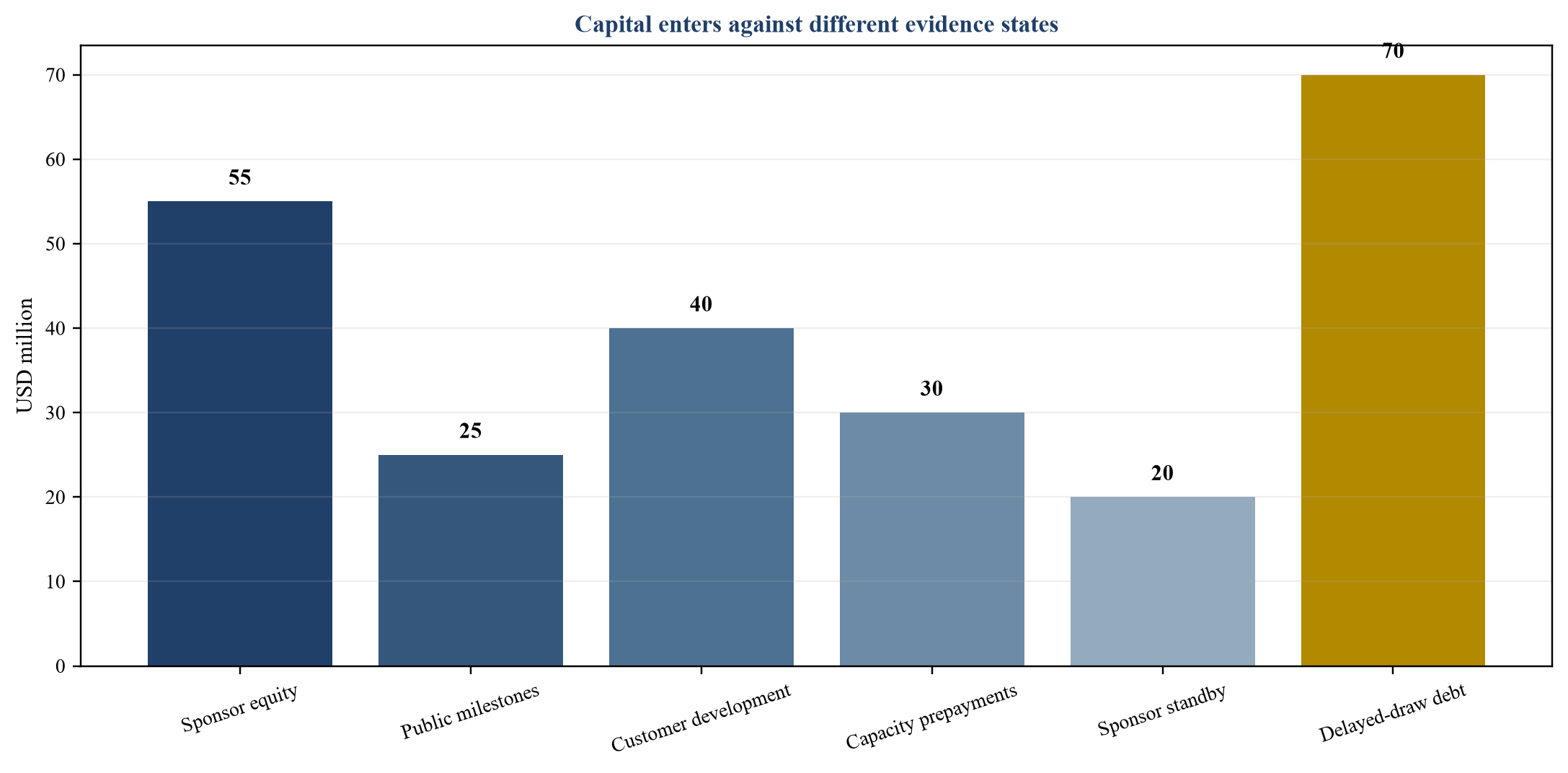
Illustrative USD millions; each source remains subject to its contractual conditions.
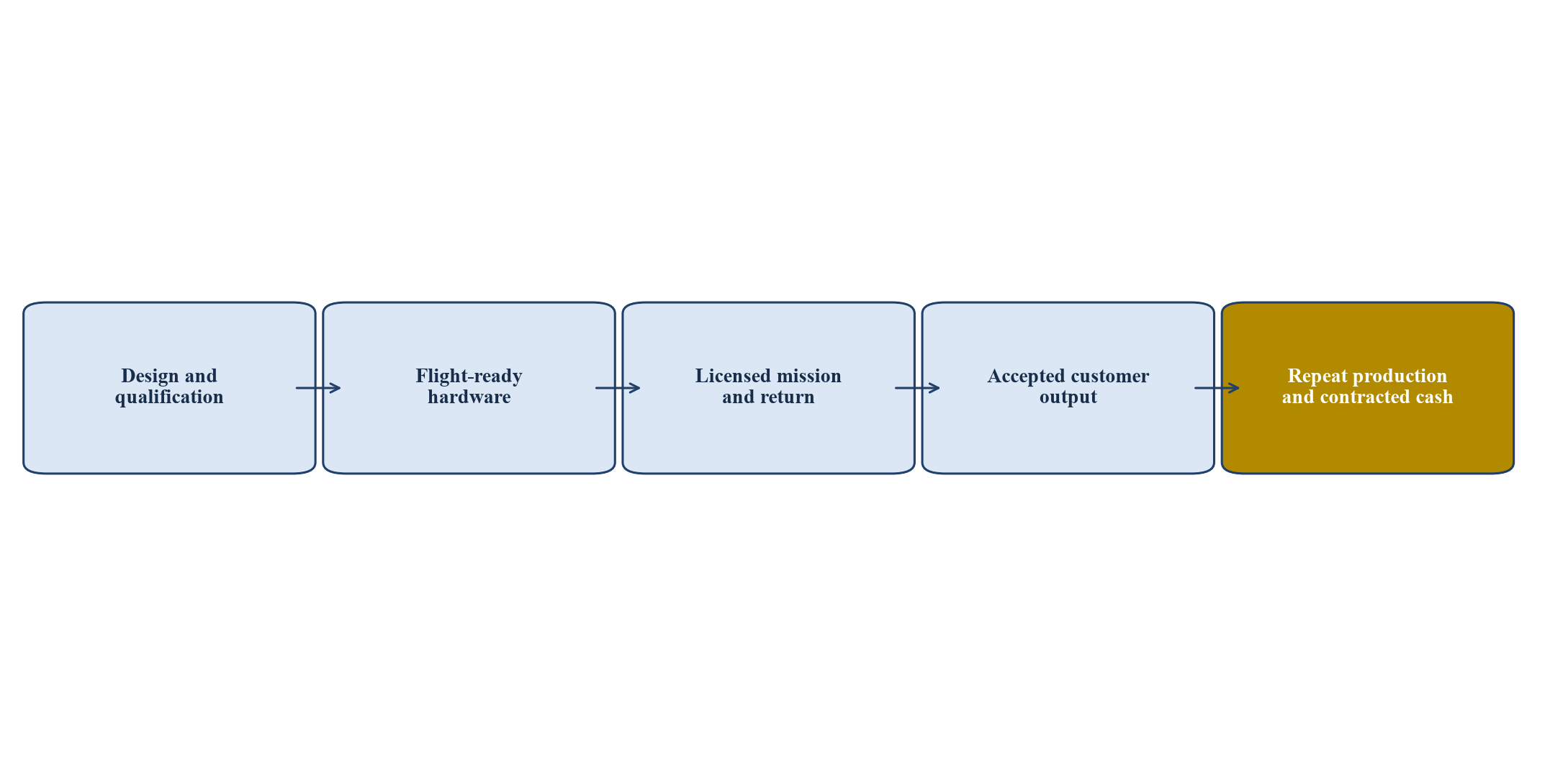
Proposed sequence from development funding to operating debt.
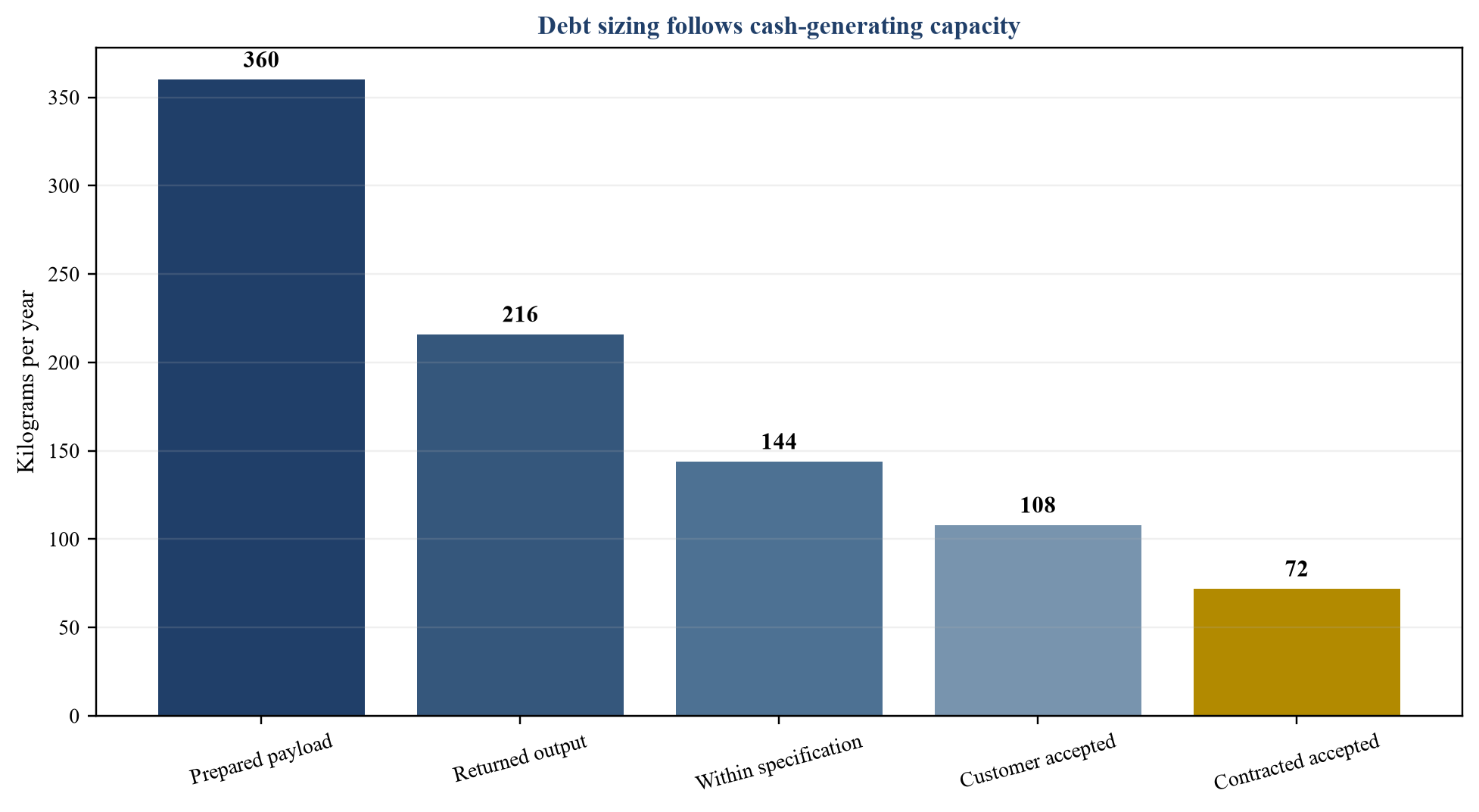
Illustrative kilograms after completion; accepted output remains below prepared payload.
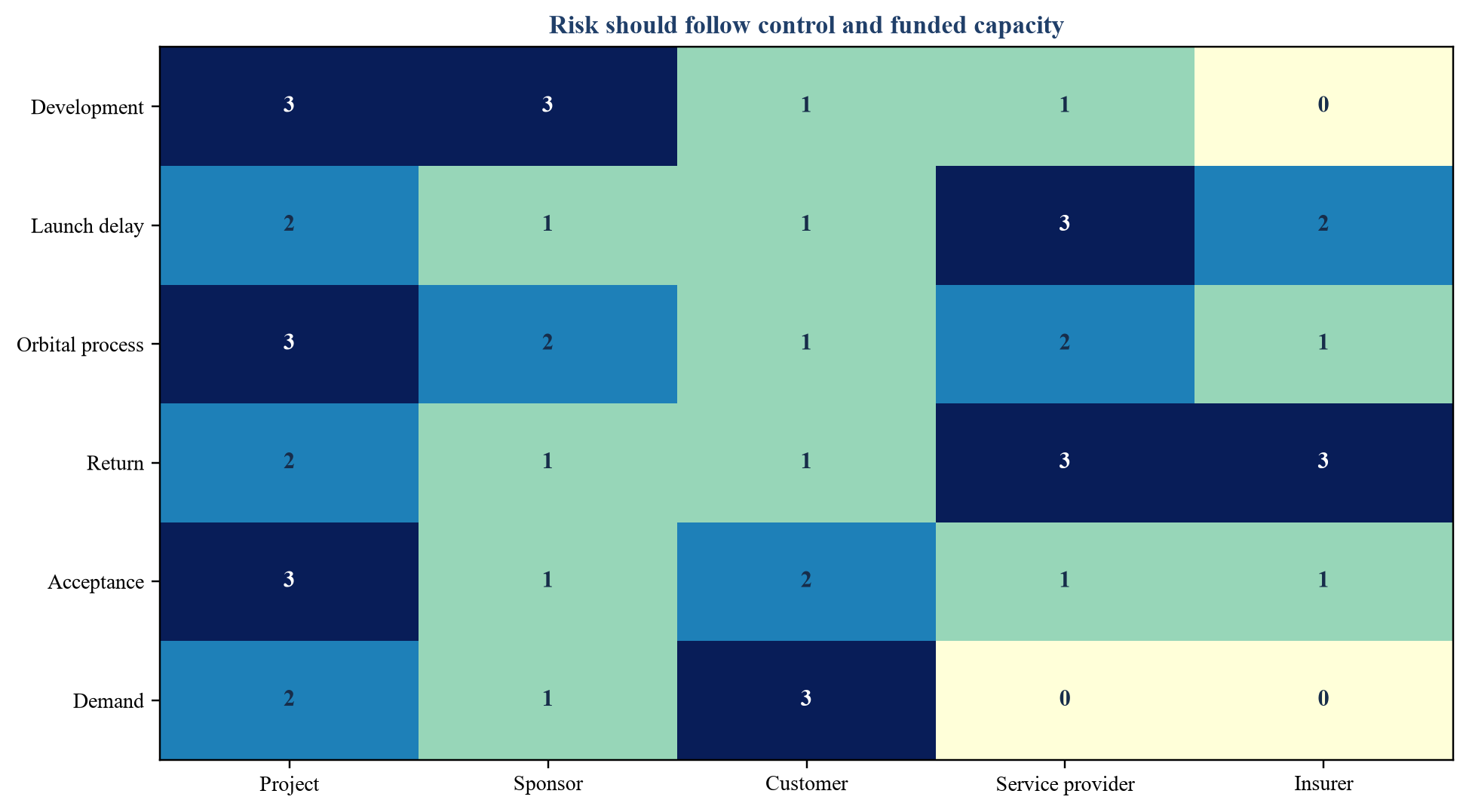
Proposed allocation; darker cells indicate greater retained exposure.
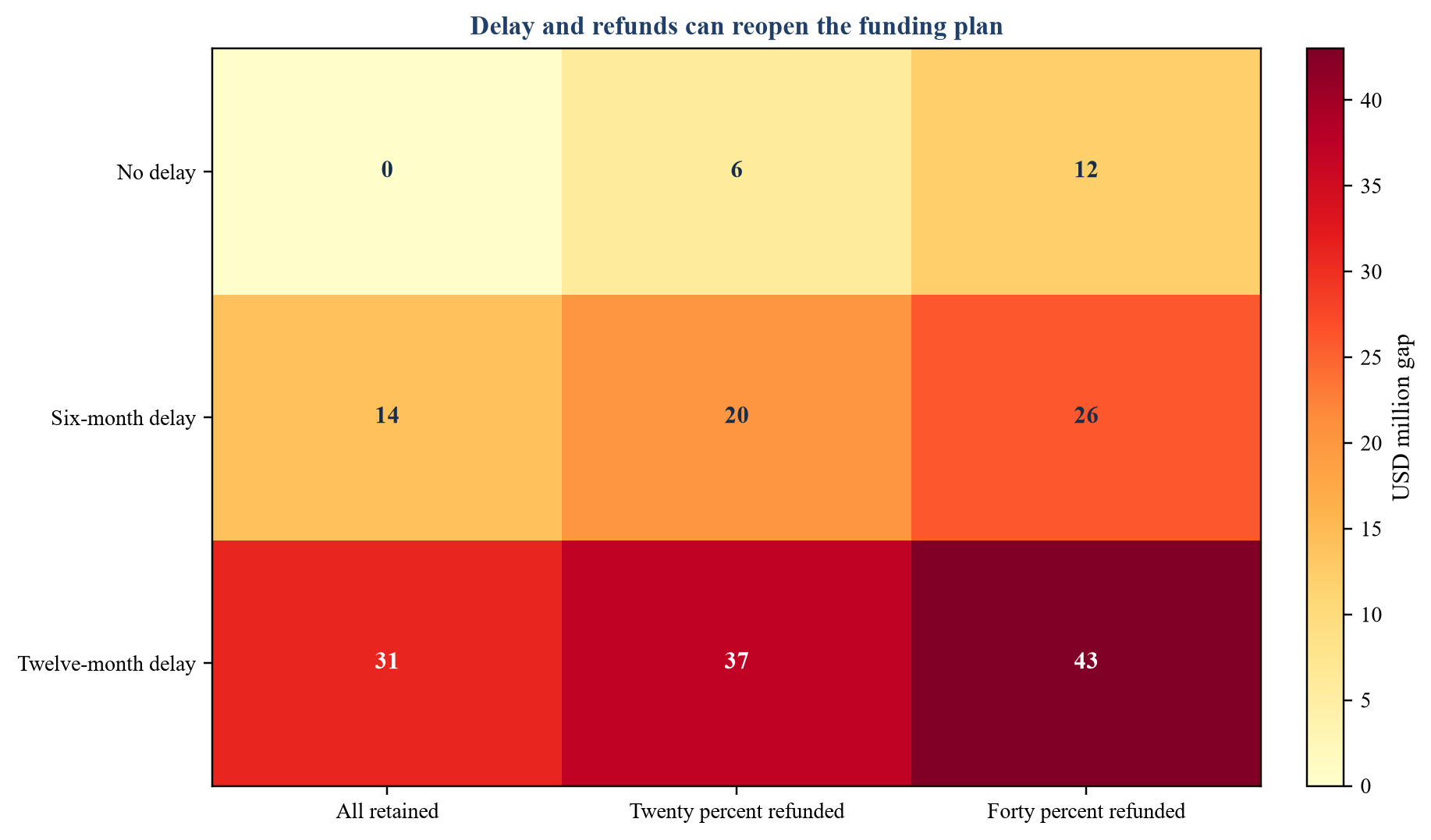
Illustrative USD millions under schedule delay and customer-prepayment retention assumptions.
| Contract | Purchased outcome | Core evidence | Principal remedy |
|---|---|---|---|
| Development agreement | defined engineering or scientific work | accepted deliverables and data | cure repeat work or scoped refund |
| Capacity reservation | access to specified future capacity | availability under nomination rules | credit rescheduling or termination |
| Mission service | integration launch orbital operation and return | mission and custody record | reflight credit or defined refund |
| Product supply | accepted output meeting specification | qualification and acceptance result | replacement credit or refund |
| Platform service | power thermal communications and handling | availability and service logs | service credit cure or termination |
Proposed allocation of deliverables and remedies.
| Source | USDm | Release basis | Principal risk retained |
|---|---|---|---|
| Funded sponsor equity | 55 | funded at close | first-loss development risk |
| Public milestone support | 25 | accepted eligible milestones | programme conditions and timing |
| Customer development funding | 40 | accepted customer work packages | technical delivery and termination |
| Capacity prepayments | 30 | reservation contract and restrictions | refund credit and reflight liability |
| Sponsor standby support | 20 | defined overrun or delay trigger | sponsor credit and funding timing |
| Delayed-draw senior debt | 70 | completion and contract tests | operating and counterparty risk |
Illustrative USD millions; no financing commitment is implied.
| Milestone | Acceptance evidence | Payment treatment |
|---|---|---|
| Critical design | approved design baseline and closed actions | development milestone payment |
| Flight readiness | qualification tests integration approval and licences | restricted mission funding release |
| Orbital operation | telemetry showing defined process execution | mission payment subject to return terms |
| Controlled return | reentry recovery and custody record | return-service payment |
| Customer qualification | independent test and customer acceptance | qualification payment and next-phase draw |
| Repeat production | two accepted runs using commercial configuration | completion and senior-debt availability |
Proposed evidence requirements.
| Payment | What it purchases | Typical condition | Failure treatment |
|---|---|---|---|
| Reservation fee | scheduling priority | capacity held under nomination rules | limited credit or agreed forfeiture |
| Capacity payment | available processing and mission capacity | project makes capacity available | credit if unavailable |
| Mission payment | executed mission service | launch and defined orbital operations | reflight or supplier-linked remedy |
| Acceptance payment | compliant output | specification and customer protocol | replacement credit or refund |
| Variable output payment | incremental accepted units | measured accepted quantity | no payment for rejected units |
Proposed separation of payment events.
| Asset or right | Security or control | Continuity question |
|---|---|---|
| Project-company shares | share pledge | can control transfer after enforcement |
| Bank accounts and receivables | account control and assignment | are restricted funds properly separated |
| Hardware | charge title and asset register | can hardware operate with replacement services |
| Intellectual property and software | assignment or durable licence | do rights survive sponsor distress and step-in |
| Key contracts | assignment and direct agreements | do counterparties provide notice cure and step-in |
| Insurance proceeds | loss-payee and proceeds waterfall | does coverage support reinstatement or repayment |
Proposed lender review.
| Case | Immediate effect | Contract consequence | Funding response |
|---|---|---|---|
| Six-month launch delay | added holding and staff cost | customer rescheduling and possible credits | sponsor standby and delay reserve |
| Orbital process failure | no compliant output | cure reflight or development reset | equity milestone facility and insurance if covered |
| Return failure | output unavailable | reflight or refund obligation | return-provider remedy insurance and reserve |
| Customer rejection | lower collected revenue | retest replacement or credit | cash trap and qualification budget |
| Provider insolvency | schedule interruption | replacement and consent process | liquidity reserve and direct-agreement step-in |
Illustrative effects; project-specific modelling is required.
| Gate | Decision question | Minimum evidence |
|---|---|---|
| Service | what exact outcome is sold | product definition and contract form |
| Completion | when development recourse ends | independent completion test |
| Contracts | which cash flows are enforceable | executed agreements and counterparty review |
| Capital | who funds each evidence state | committed sources and draw conditions |
| Downside | what happens after delay or failure | integrated stress cases and remedies |
| Security | can the project continue after default | rights register direct agreements and licences |
| Debt | what recurring cash supports repayment | contracted revenue yield evidence and reserves |
Proposed minimum record.
Sources
- NASA, Commercial Orbital Transportation Services, 2014. Read the primary source
- U.S. Government Accountability Office, Commercial Partners Are Making Progress but Face Aggressive Schedules, 2009. Read the primary source
- NASA, Space Act Agreement for Commercial Orbital Transportation Services. Read the primary source
- NASA, Directive on Revised Commercial Low Earth Orbit Destinations Phase 2 Acquisition Strategy, 4 August 2025. Read the primary source
- NASA, Low Earth Orbit Microgravity Strategy, December 2024. Read the primary source
- NASA, Commercial Partners Make Progress on Low Earth Orbit Projects, 25 November 2024. Read the primary source
- NASA, Commercial Destination Utilization Requirements, 2 July 2024. Read the primary source
- European Space Agency, Microgravity on Demand with Earth Return through Boost, 27 September 2021. Read the primary source
- Federal Aviation Administration, Payload Reviews. Read the primary source
- Federal Aviation Administration, Streamlines Commercial Space License Approvals, 17 March 2026. Read the primary source
- Electronic Code of Federal Regulations, 14 CFR Part 450 Launch and Reentry License Requirements. Read the primary source
- UK Civil Aviation Authority, Applying for a Launch or Return Operator Licence. Read the primary source
- UK Government, Space Industry Regulations 2021. Read the primary source
- European Space Agency Business in Space Growth Network, Space Forge. Read the primary source
- European Space Agency Space Solutions, AURORA In-Space Manufacturing Feasibility Study. Read the primary source
- NASA, In Space Production Applications. Read the primary source
- NASA, Forecasting Future NASA Demand in Low Earth Orbit Revision Two, 7 June 2019. Read the primary source
- World Bank Group, Project Finance Key Concepts. Read the primary source
- World Bank Group, Mitigating Commercial Risks in Project Finance. Read the primary source
- World Bank Group, Intercreditor Arrangements. Read the primary source
- World Bank Group, Risk Mitigation Mechanisms. Read the primary source
- World Bank Group, PPP Reference Guide Version 3. Read the primary source
- International Finance Corporation, Performance Standards on Environmental and Social Sustainability, 2012. Read the primary source
- IFRS Foundation, IFRS 15 Revenue from Contracts with Customers. Read the primary source
- IFRS Foundation, IFRS 9 Financial Instruments. Read the primary source
- IFRS Foundation, IAS 23 Borrowing Costs. Read the primary source
- U.S. Government Accountability Office, Satellite Acquisitions Agencies May Recover a Limited Portion of Contract Value When Satellites Fail, 2017. Read the primary source
- Federal Aviation Administration, Aerospace Forecast Fiscal Years 2026 to 2046. Read the primary source
- NASA Technical Reports Server, NASA Development of Commercial Low Earth Orbit, 10 October 2024. Read the primary source
- European Space Agency Commercialisation Gateway, ESA Grand Challenge for In-Space Manufacturing, 14 December 2023. Read the primary source
