

1. Define the financed asset
The decision question is which accelerators, servers, network, storage, licences, spares and installation costs create eligible collateral. The evidence file should begin with purchase orders, invoices, bills of entry, serial records, title documents, configuration manifests and payment evidence. Each item should record source, date, owner, responsible reviewer, expiry or refresh date and the relevant serial numbers or cluster. Industry growth can explain why compute is being installed. It does not establish a lender's repayment source or recovery value. [1][2]
The principal failure is that the credit memo describes a GPU cluster while the security schedule cannot identify the components, rights and dependencies required to operate it. GPU finance converts supplier payments into credit exposure before the equipment has generated a stable collection record. The lender therefore needs a traceable chain from purchase and acceptance to productive use, billed revenue, collected cash, remaining useful service and an executable sale or redeployment route.
The recommended response is to establish a serial-level asset register and exclude non-transferable, unverified or unsupported value from eligibility. Management estimates may support a scenario when clearly identified and reconciled to observed data. The central case should use current contracts, measured performance and recent market evidence. Downside analysis should combine technology transition, price compression, lower utilisation, customer loss, operational interruption and sale friction.
2. Map the technology cycle
The decision question is how architecture cadence, memory, interconnect, software and workload requirements alter economic usefulness. The evidence file should begin with vendor roadmaps, supported product documentation, benchmark releases, customer workload tests and service history. Each item should record source, date, owner, responsible reviewer, expiry or refresh date and the relevant serial numbers or cluster. Industry growth can explain why compute is being installed. It does not establish a lender's repayment source or recovery value. [3][4]
The principal failure is that accounting life is treated as a forecast of competitiveness despite rapid platform transitions. GPU finance converts supplier payments into credit exposure before the equipment has generated a stable collection record. The lender therefore needs a traceable chain from purchase and acceptance to productive use, billed revenue, collected cash, remaining useful service and an executable sale or redeployment route.
The recommended response is to refresh the technology map quarterly and link each change to workload fitness, revenue and recovery assumptions. Management estimates may support a scenario when clearly identified and reconciled to observed data. The central case should use current contracts, measured performance and recent market evidence. Downside analysis should combine technology transition, price compression, lower utilisation, customer loss, operational interruption and sale friction.
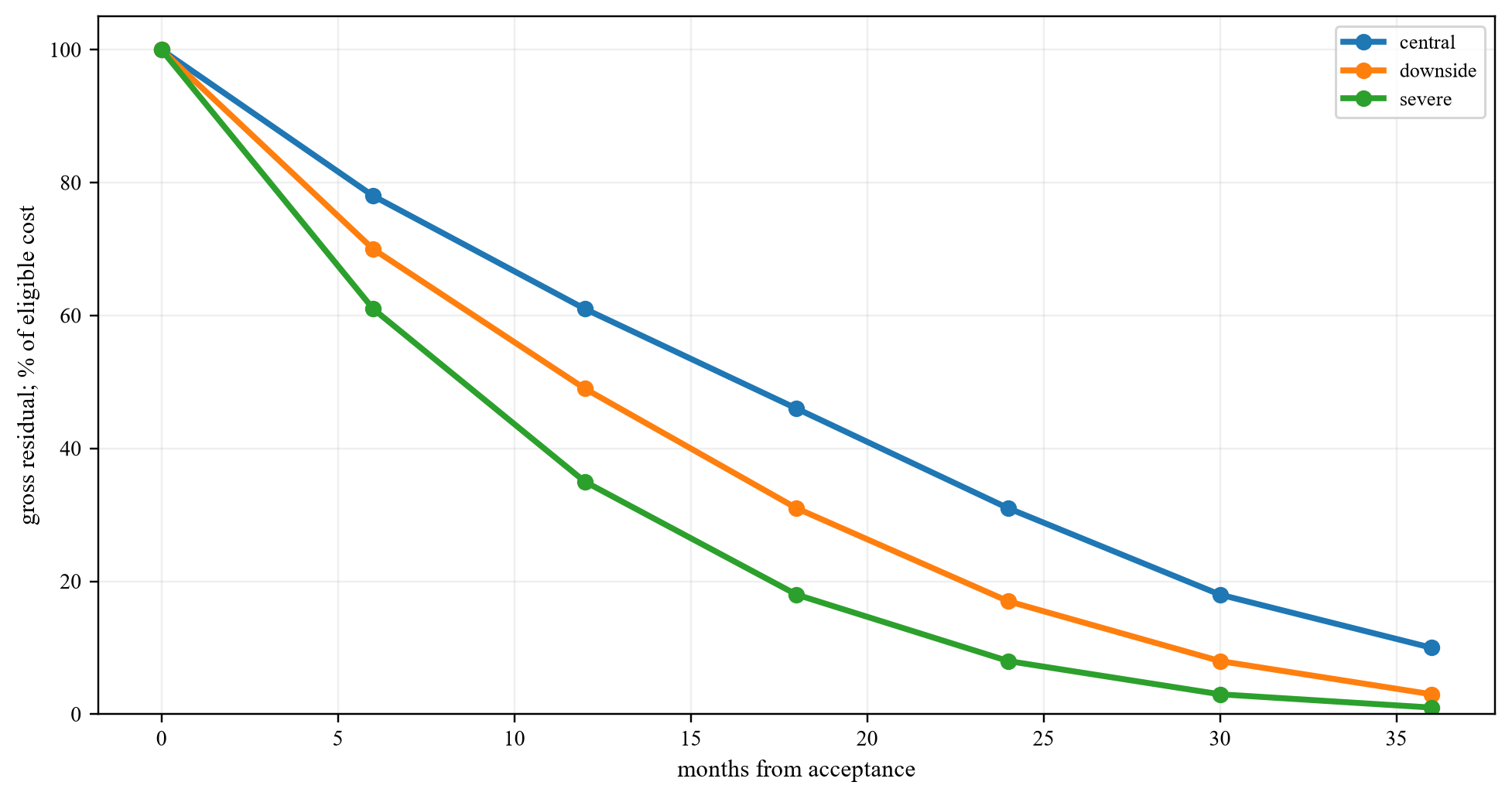
Wholly hypothetical; percentage of eligible cost before recovery expenses.
3. Separate four value concepts
The decision question is how carrying value, continued-use value, orderly-sale value and enforcement recovery differ. The evidence file should begin with Ind AS accounts, utilisation records, service contracts, market quotations, sale evidence and disposal costs. Each item should record source, date, owner, responsible reviewer, expiry or refresh date and the relevant serial numbers or cluster. Industry growth can explain why compute is being installed. It does not establish a lender's repayment source or recovery value. [5][6]
The principal failure is that one residual percentage is used for accounting, covenant compliance and enforcement recovery. GPU finance converts supplier payments into credit exposure before the equipment has generated a stable collection record. The lender therefore needs a traceable chain from purchase and acceptance to productive use, billed revenue, collected cash, remaining useful service and an executable sale or redeployment route.
The recommended response is to record each value purpose, valuation date, assumptions, market participant and cost deduction separately. Management estimates may support a scenario when clearly identified and reconciled to observed data. The central case should use current contracts, measured performance and recent market evidence. Downside analysis should combine technology transition, price compression, lower utilisation, customer loss, operational interruption and sale friction.
| Value concept | Principal question | Required evidence |
|---|---|---|
| carrying value | what amount appears in the accounts? | cost, depreciation and impairment |
| continued-use value | what cash can this configuration still generate? | workload, utilisation, price and cost |
| orderly-sale value | what would a willing market participant pay? | comparable sales, bids and condition |
| net enforcement recovery | what cash reaches the lender after action? | rights, time, costs, taxes and collection |
Proposed classification; accounting and transaction-specific standards control reported values.
4. Create the residual-value evidence ladder
The decision question is which evidence deserves weight in a lender valuation. The evidence file should begin with completed sales, binding bids, current offers, dealer quotes, cloud pricing, benchmark results and vendor list prices. Each item should record source, date, owner, responsible reviewer, expiry or refresh date and the relevant serial numbers or cluster. Industry growth can explain why compute is being installed. It does not establish a lender's repayment source or recovery value. [6][7]
The principal failure is that invoice cost or an unsupported broker opinion anchors value after market conditions change. GPU finance converts supplier payments into credit exposure before the equipment has generated a stable collection record. The lender therefore needs a traceable chain from purchase and acceptance to productive use, billed revenue, collected cash, remaining useful service and an executable sale or redeployment route.
The recommended response is to weight executable and recent evidence above indicative evidence and apply explicit age, configuration and location adjustments. Management estimates may support a scenario when clearly identified and reconciled to observed data. The central case should use current contracts, measured performance and recent market evidence. Downside analysis should combine technology transition, price compression, lower utilisation, customer loss, operational interruption and sale friction.
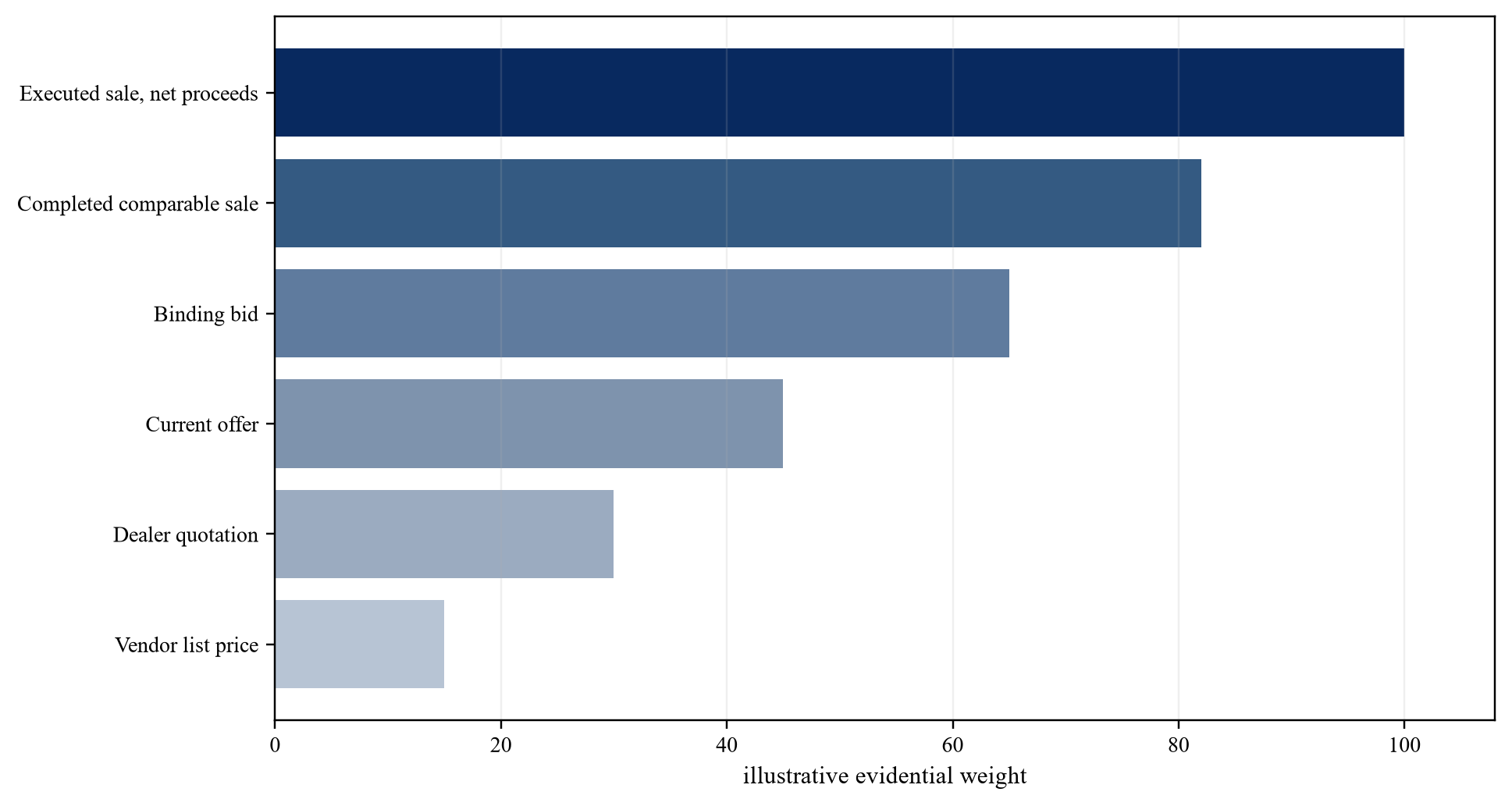
Proposed hierarchy; transaction-specific evidence and valuation judgement remain necessary.
| Evidence | Adjustment required | Control |
|---|---|---|
| completed sale | age, condition, configuration and location | verify invoice and settlement |
| binding bid | conditions, expiry and buyer capacity | confirm executable terms |
| dealer quote | margin, stock and warranty | seek multiple current quotes |
| cloud price | utilisation, operating cost and service scope | derive continued-use value only |
| benchmark | software version and workload relevance | reproduce independently |
| vendor list price | discount, supply and generation | context only |
Proposed lender schedule; the valuation date and market must be explicit.
5. Verify title and import status
The decision question is whether the borrower can grant enforceable security and a buyer can lawfully acquire and use the equipment. The evidence file should begin with contracts, invoices, customs records, end-user statements, security filings, licences and legal review. Each item should record source, date, owner, responsible reviewer, expiry or refresh date and the relevant serial numbers or cluster. Industry growth can explain why compute is being installed. It does not establish a lender's repayment source or recovery value. [8][9]
The principal failure is that equipment is present in India while title, permitted use, transfer restrictions or security priority remain uncertain. GPU finance converts supplier payments into credit exposure before the equipment has generated a stable collection record. The lender therefore needs a traceable chain from purchase and acceptance to productive use, billed revenue, collected cash, remaining useful service and an executable sale or redeployment route.
The recommended response is to complete ownership, import, use and transfer diligence before first draw and after any relocation or modification. Management estimates may support a scenario when clearly identified and reconciled to observed data. The central case should use current contracts, measured performance and recent market evidence. Downside analysis should combine technology transition, price compression, lower utilisation, customer loss, operational interruption and sale friction.
6. Test export and re-export constraints
The decision question is whether a recovery or cross-border sale requires authorisation or faces end-user restrictions. The evidence file should begin with classification, destination, end user, supplier terms, licences, screening and legal advice. Each item should record source, date, owner, responsible reviewer, expiry or refresh date and the relevant serial numbers or cluster. Industry growth can explain why compute is being installed. It does not establish a lender's repayment source or recovery value. [9][10]
The principal failure is that the recovery model assumes a global buyer pool that cannot lawfully receive the equipment. GPU finance converts supplier payments into credit exposure before the equipment has generated a stable collection record. The lender therefore needs a traceable chain from purchase and acceptance to productive use, billed revenue, collected cash, remaining useful service and an executable sale or redeployment route.
The recommended response is to limit recovery value to buyers and routes supported by current legal and contractual evidence. Management estimates may support a scenario when clearly identified and reconciled to observed data. The central case should use current contracts, measured performance and recent market evidence. Downside analysis should combine technology transition, price compression, lower utilisation, customer loss, operational interruption and sale friction.
7. Establish technical acceptance
The decision question is whether the delivered cluster performs as contracted under representative workloads. The evidence file should begin with factory records, installation reports, burn-in tests, benchmark results, network tests, defects and acceptance certificates. Each item should record source, date, owner, responsible reviewer, expiry or refresh date and the relevant serial numbers or cluster. Industry growth can explain why compute is being installed. It does not establish a lender's repayment source or recovery value. [2][11]
The principal failure is that payment and debt draw occur before cluster-level performance and stability are demonstrated. GPU finance converts supplier payments into credit exposure before the equipment has generated a stable collection record. The lender therefore needs a traceable chain from purchase and acceptance to productive use, billed revenue, collected cash, remaining useful service and an executable sale or redeployment route.
The recommended response is to make draw eligibility conditional on witnessed acceptance and a reconciled defect and warranty register. Management estimates may support a scenario when clearly identified and reconciled to observed data. The central case should use current contracts, measured performance and recent market evidence. Downside analysis should combine technology transition, price compression, lower utilisation, customer loss, operational interruption and sale friction.
| Gate | Evidence | Failure response |
|---|---|---|
| identity | serial and configuration manifest | exclude asset |
| title | invoice, payment and customs evidence | stop draw |
| installation | site and network completion | retain funding |
| performance | witnessed workload and burn-in tests | cure or reject |
| support | warranty and entitlement | haircut or renew |
| security | filing, insurance and site acknowledgement | no eligibility |
Proposed control; executed purchase and finance documents determine conditions.
8. Rebuild eligible cost
The decision question is which equipment, taxes, logistics, installation, software and financing amounts qualify for funded value. The evidence file should begin with invoices, payment proof, tax treatment, contracts, cost ledger and independent verification. Each item should record source, date, owner, responsible reviewer, expiry or refresh date and the relevant serial numbers or cluster. Industry growth can explain why compute is being installed. It does not establish a lender's repayment source or recovery value. [5][12]
The principal failure is that soft cost, refundable tax and non-transferable software are included in the collateral base. GPU finance converts supplier payments into credit exposure before the equipment has generated a stable collection record. The lender therefore needs a traceable chain from purchase and acceptance to productive use, billed revenue, collected cash, remaining useful service and an executable sale or redeployment route.
The recommended response is to separate cash cost, eligible equipment cost and recoverable collateral value in the sources-and-uses schedule. Management estimates may support a scenario when clearly identified and reconciled to observed data. The central case should use current contracts, measured performance and recent market evidence. Downside analysis should combine technology transition, price compression, lower utilisation, customer loss, operational interruption and sale friction.
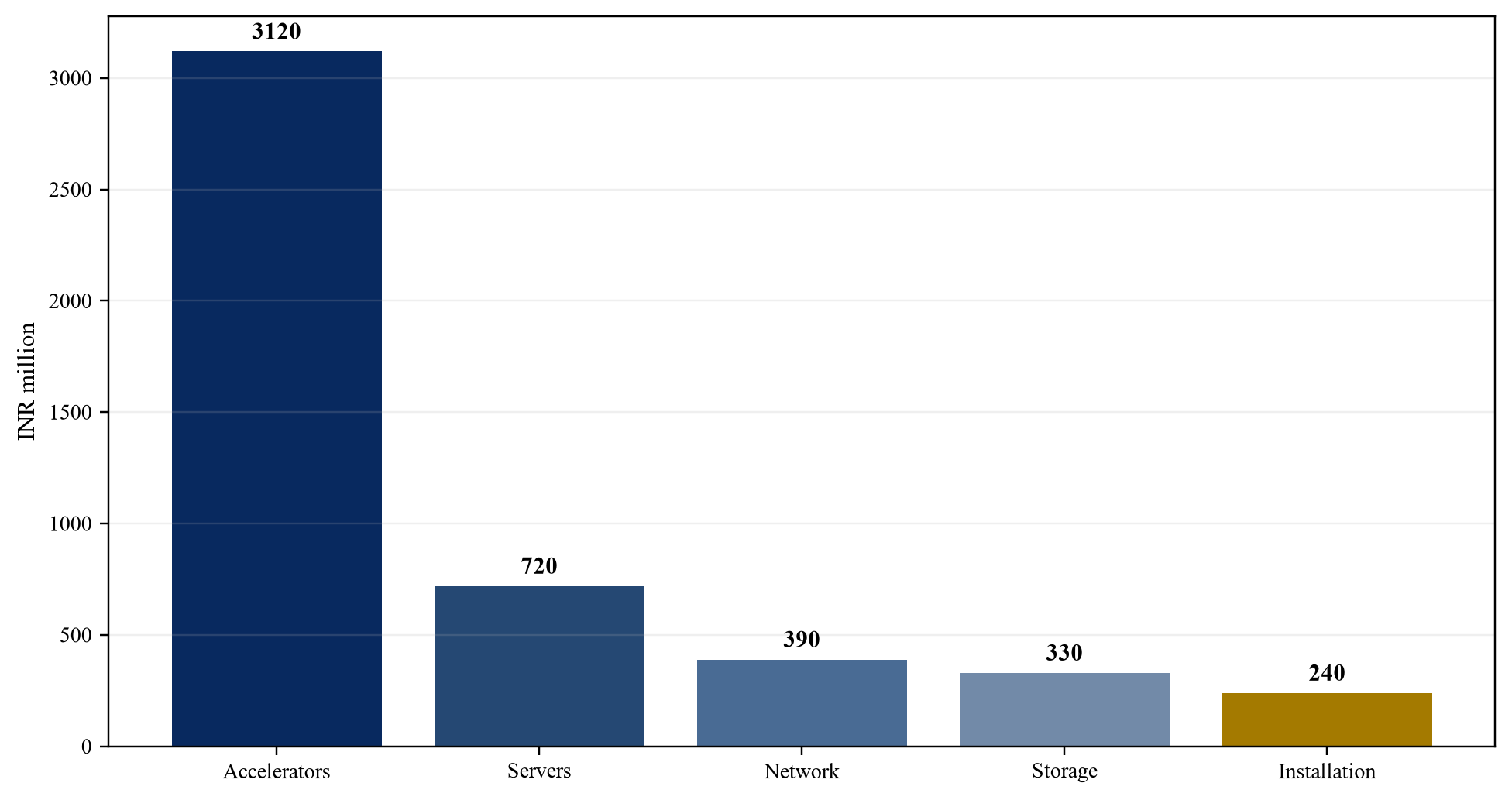
Wholly hypothetical; INR million.
9. Design the advance-rate waterfall
The decision question is how cost, useful life, performance, liquidity, concentration and recovery cost determine debt availability. The evidence file should begin with eligible cost, tested configuration, comparable evidence, utilisation, contracts and recovery budget. Each item should record source, date, owner, responsible reviewer, expiry or refresh date and the relevant serial numbers or cluster. Industry growth can explain why compute is being installed. It does not establish a lender's repayment source or recovery value. [6][13]
The principal failure is that a single loan-to-cost ratio overlooks the speed and asymmetry of technology value decline. GPU finance converts supplier payments into credit exposure before the equipment has generated a stable collection record. The lender therefore needs a traceable chain from purchase and acceptance to productive use, billed revenue, collected cash, remaining useful service and an executable sale or redeployment route.
The recommended response is to apply sequential haircuts and cap debt at the lower of cash-flow capacity and stressed net recovery. Management estimates may support a scenario when clearly identified and reconciled to observed data. The central case should use current contracts, measured performance and recent market evidence. Downside analysis should combine technology transition, price compression, lower utilisation, customer loss, operational interruption and sale friction.
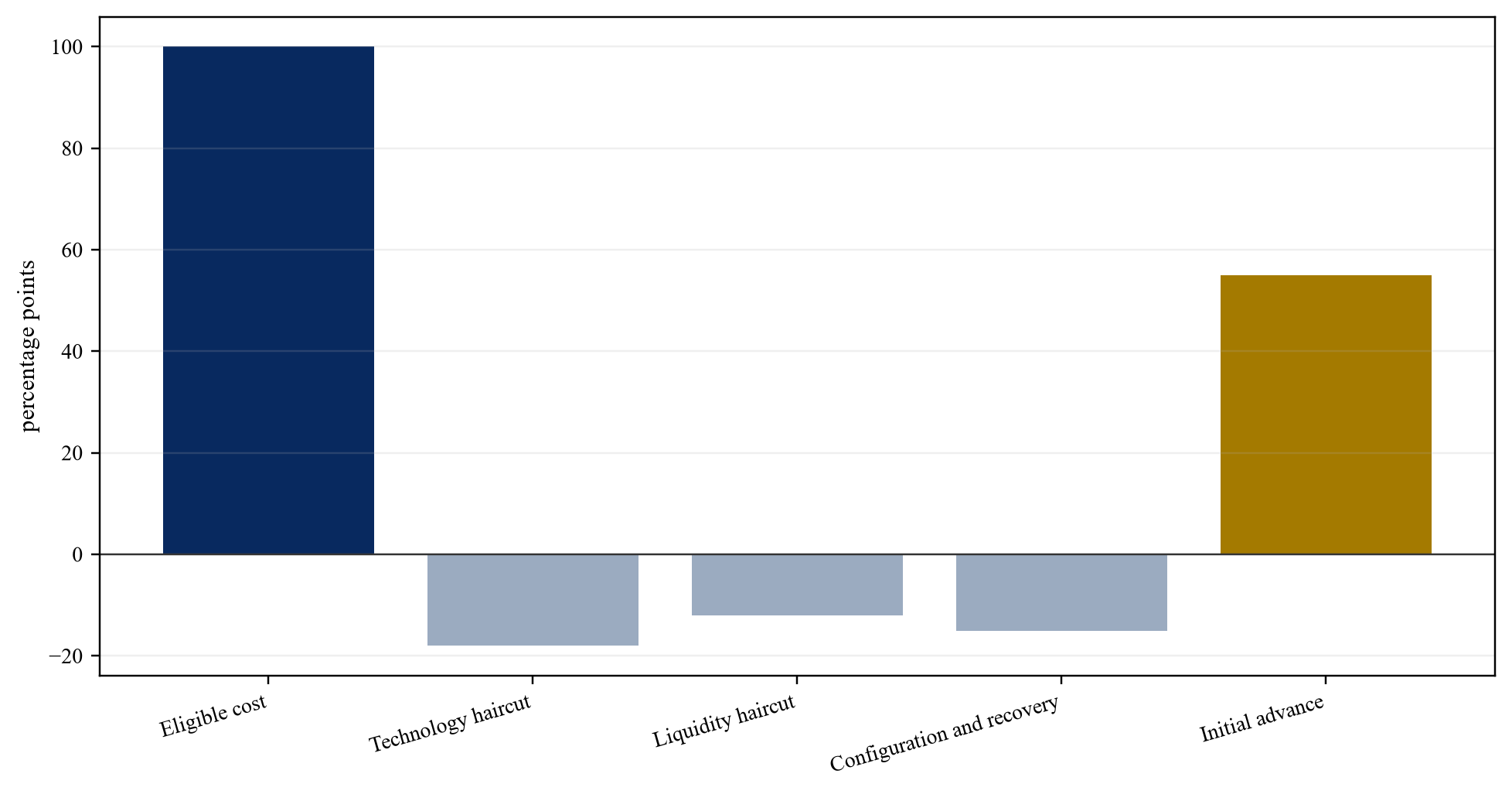
Wholly hypothetical; percentage of eligible cost.
| Step | Percentage of eligible cost | Rationale |
|---|---|---|
| verified eligible cost | 100% | reconciled cash equipment cost |
| technology-cycle haircut | (18%) | performance and generation transition |
| market-liquidity haircut | (12%) | buyer depth and price dispersion |
| configuration and recovery haircut | (15%) | removal, support and execution |
| maximum initial advance | 55% | before cash-flow cap |
Wholly hypothetical; percentages do not describe market terms.
10. Set amortisation from value decay
The decision question is how principal decline should compare with expected net recovery and useful cash generation. The evidence file should begin with debt schedule, residual curves, revenue forecast, maintenance cost and downside scenarios. Each item should record source, date, owner, responsible reviewer, expiry or refresh date and the relevant serial numbers or cluster. Industry growth can explain why compute is being installed. It does not establish a lender's repayment source or recovery value. [3][6]
The principal failure is that back-ended repayment leaves debt above recovery value during the fastest period of obsolescence. GPU finance converts supplier payments into credit exposure before the equipment has generated a stable collection record. The lender therefore needs a traceable chain from purchase and acceptance to productive use, billed revenue, collected cash, remaining useful service and an executable sale or redeployment route.
The recommended response is to require principal to remain below a conservative recovery curve throughout the facility life. Management estimates may support a scenario when clearly identified and reconciled to observed data. The central case should use current contracts, measured performance and recent market evidence. Downside analysis should combine technology transition, price compression, lower utilisation, customer loss, operational interruption and sale friction.
11. Build the borrowing base
The decision question is which assets remain eligible each reporting period and how availability adjusts. The evidence file should begin with serial register, location, performance, utilisation, contracts, insurance, support and valuation evidence. Each item should record source, date, owner, responsible reviewer, expiry or refresh date and the relevant serial numbers or cluster. Industry growth can explain why compute is being installed. It does not establish a lender's repayment source or recovery value. [13][14]
The principal failure is that equipment remains in the borrowing base after failure, relocation, unsupported modification or loss of market relevance. GPU finance converts supplier payments into credit exposure before the equipment has generated a stable collection record. The lender therefore needs a traceable chain from purchase and acceptance to productive use, billed revenue, collected cash, remaining useful service and an executable sale or redeployment route.
The recommended response is to recalculate eligibility monthly and require immediate prepayment for objective ineligibility events. Management estimates may support a scenario when clearly identified and reconciled to observed data. The central case should use current contracts, measured performance and recent market evidence. Downside analysis should combine technology transition, price compression, lower utilisation, customer loss, operational interruption and sale friction.
| Test | Evidence | Ineligibility event |
|---|---|---|
| existence and location | serial API and inspection | missing or moved |
| tested operation | telemetry and incident log | material failure |
| support | active OEM entitlement | lapse or restriction |
| utilisation | metered productive hours | threshold breach |
| customer concentration | billed revenue by customer | limit breach |
| market evidence | current bids and comparables | value shortfall |
Proposed framework; lender policy and documents determine thresholds.
12. Measure performance relevance
The decision question is whether benchmark and workload performance remain commercially useful. The evidence file should begin with MLPerf or comparable results, customer tests, throughput, latency, memory, power and software support. Each item should record source, date, owner, responsible reviewer, expiry or refresh date and the relevant serial numbers or cluster. Industry growth can explain why compute is being installed. It does not establish a lender's repayment source or recovery value. [11][15]
The principal failure is that headline peak performance substitutes for the borrower workloads that generate cash. GPU finance converts supplier payments into credit exposure before the equipment has generated a stable collection record. The lender therefore needs a traceable chain from purchase and acceptance to productive use, billed revenue, collected cash, remaining useful service and an executable sale or redeployment route.
The recommended response is to use a workload-specific performance score with version control and independent reproducibility. Management estimates may support a scenario when clearly identified and reconciled to observed data. The central case should use current contracts, measured performance and recent market evidence. Downside analysis should combine technology transition, price compression, lower utilisation, customer loss, operational interruption and sale friction.
13. Track utilisation and realised pricing
The decision question is how productive hours and net realised compute price support debt service. The evidence file should begin with scheduler logs, metering, invoices, credits, customer contracts, collection records and IndiaAI pricing. Each item should record source, date, owner, responsible reviewer, expiry or refresh date and the relevant serial numbers or cluster. Industry growth can explain why compute is being installed. It does not establish a lender's repayment source or recovery value. [1][16]
The principal failure is that booked capacity is treated as cash revenue despite idle time, discounts, credits and failed collection. GPU finance converts supplier payments into credit exposure before the equipment has generated a stable collection record. The lender therefore needs a traceable chain from purchase and acceptance to productive use, billed revenue, collected cash, remaining useful service and an executable sale or redeployment route.
The recommended response is to reconcile physical usage to billed and collected revenue and test price compression each month. Management estimates may support a scenario when clearly identified and reconciled to observed data. The central case should use current contracts, measured performance and recent market evidence. Downside analysis should combine technology transition, price compression, lower utilisation, customer loss, operational interruption and sale friction.
14. Control customer concentration
The decision question is how tenant, reseller and workload dependence affect cash and resale flexibility. The evidence file should begin with customer contracts, termination rights, usage history, concentration, portability and pipeline. Each item should record source, date, owner, responsible reviewer, expiry or refresh date and the relevant serial numbers or cluster. Industry growth can explain why compute is being installed. It does not establish a lender's repayment source or recovery value. [16][17]
The principal failure is that a high utilisation rate hides dependence on one short-term customer or workload. GPU finance converts supplier payments into credit exposure before the equipment has generated a stable collection record. The lender therefore needs a traceable chain from purchase and acceptance to productive use, billed revenue, collected cash, remaining useful service and an executable sale or redeployment route.
The recommended response is to apply concentration limits and maintain a substitution plan for both customers and workloads. Management estimates may support a scenario when clearly identified and reconciled to observed data. The central case should use current contracts, measured performance and recent market evidence. Downside analysis should combine technology transition, price compression, lower utilisation, customer loss, operational interruption and sale friction.
15. Model operating cash generation
The decision question is whether compute revenue covers power, hosting, network, maintenance, tax and debt service. The evidence file should begin with contracts, invoices, energy bills, hosting terms, staffing, tax and collection evidence. Each item should record source, date, owner, responsible reviewer, expiry or refresh date and the relevant serial numbers or cluster. Industry growth can explain why compute is being installed. It does not establish a lender's repayment source or recovery value. [1][18]
The principal failure is that gross GPU-hour revenue is presented as EBITDA without idle capacity and operating cost. GPU finance converts supplier payments into credit exposure before the equipment has generated a stable collection record. The lender therefore needs a traceable chain from purchase and acceptance to productive use, billed revenue, collected cash, remaining useful service and an executable sale or redeployment route.
The recommended response is to build the cash model from available hours to collected contribution after every variable and fixed cost. Management estimates may support a scenario when clearly identified and reconciled to observed data. The central case should use current contracts, measured performance and recent market evidence. Downside analysis should combine technology transition, price compression, lower utilisation, customer loss, operational interruption and sale friction.
16. Protect location and operating dependencies
The decision question is which data-centre services, power, cooling, network and access are required to preserve value. The evidence file should begin with colocation agreement, service levels, power allocation, access rights, insurance and step-in terms. Each item should record source, date, owner, responsible reviewer, expiry or refresh date and the relevant serial numbers or cluster. Industry growth can explain why compute is being installed. It does not establish a lender's repayment source or recovery value. [18][19]
The principal failure is that security over equipment cannot be exercised without site access, shutdown coordination or safe removal. GPU finance converts supplier payments into credit exposure before the equipment has generated a stable collection record. The lender therefore needs a traceable chain from purchase and acceptance to productive use, billed revenue, collected cash, remaining useful service and an executable sale or redeployment route.
The recommended response is to obtain acknowledgement, access, cure and removal arrangements from each essential site counterparty. Management estimates may support a scenario when clearly identified and reconciled to observed data. The central case should use current contracts, measured performance and recent market evidence. Downside analysis should combine technology transition, price compression, lower utilisation, customer loss, operational interruption and sale friction.
17. Preserve warranty and support
The decision question is which warranties, service contracts, firmware rights and spare arrangements follow the asset. The evidence file should begin with OEM terms, serial status, support invoices, maintenance logs, entitlement transfer and defect records. Each item should record source, date, owner, responsible reviewer, expiry or refresh date and the relevant serial numbers or cluster. Industry growth can explain why compute is being installed. It does not establish a lender's repayment source or recovery value. [2][3]
The principal failure is that hardware value assumes continuing support that terminates on transfer or after unauthorised modification. GPU finance converts supplier payments into credit exposure before the equipment has generated a stable collection record. The lender therefore needs a traceable chain from purchase and acceptance to productive use, billed revenue, collected cash, remaining useful service and an executable sale or redeployment route.
The recommended response is to verify transferability and cost support renewal or haircut the recovery value accordingly. Management estimates may support a scenario when clearly identified and reconciled to observed data. The central case should use current contracts, measured performance and recent market evidence. Downside analysis should combine technology transition, price compression, lower utilisation, customer loss, operational interruption and sale friction.
18. Govern refresh and substitution
The decision question is when new equipment, trade-in, upgrade or mixed clusters affect lender risk. The evidence file should begin with refresh plan, vendor offers, benchmark data, customer demand, cash budget and security documents. Each item should record source, date, owner, responsible reviewer, expiry or refresh date and the relevant serial numbers or cluster. Industry growth can explain why compute is being installed. It does not establish a lender's repayment source or recovery value. [3][14]
The principal failure is that the borrower replaces or mixes assets without releasing liens, updating registers or preserving cash. GPU finance converts supplier payments into credit exposure before the equipment has generated a stable collection record. The lender therefore needs a traceable chain from purchase and acceptance to productive use, billed revenue, collected cash, remaining useful service and an executable sale or redeployment route.
The recommended response is to require consent, simultaneous security and a minimum value or cash sweep for every substitution. Management estimates may support a scenario when clearly identified and reconciled to observed data. The central case should use current contracts, measured performance and recent market evidence. Downside analysis should combine technology transition, price compression, lower utilisation, customer loss, operational interruption and sale friction.
19. Control insurance and casualty
The decision question is whether physical damage, transit loss, cyber events and business interruption produce adequate proceeds. The evidence file should begin with policies, endorsements, insured values, exclusions, claims process and loss-payee evidence. Each item should record source, date, owner, responsible reviewer, expiry or refresh date and the relevant serial numbers or cluster. Industry growth can explain why compute is being installed. It does not establish a lender's repayment source or recovery value. [14][19]
The principal failure is that invoice value is insured while consequential shutdown and reinstatement costs remain uncovered. GPU finance converts supplier payments into credit exposure before the equipment has generated a stable collection record. The lender therefore needs a traceable chain from purchase and acceptance to productive use, billed revenue, collected cash, remaining useful service and an executable sale or redeployment route.
The recommended response is to align cover with current replacement, interruption and recovery exposures and verify it annually. Management estimates may support a scenario when clearly identified and reconciled to observed data. The central case should use current contracts, measured performance and recent market evidence. Downside analysis should combine technology transition, price compression, lower utilisation, customer loss, operational interruption and sale friction.
20. Plan compliant end-of-life treatment
The decision question is how refurbishment, resale, parts recovery, data sanitisation and recycling affect net value. The evidence file should begin with asset condition, data-erasure evidence, environmental rules, recycler contracts and sale channels. Each item should record source, date, owner, responsible reviewer, expiry or refresh date and the relevant serial numbers or cluster. Industry growth can explain why compute is being installed. It does not establish a lender's repayment source or recovery value. [20][21]
The principal failure is that gross component value ignores secure data handling, dismantling and regulated disposal cost. GPU finance converts supplier payments into credit exposure before the equipment has generated a stable collection record. The lender therefore needs a traceable chain from purchase and acceptance to productive use, billed revenue, collected cash, remaining useful service and an executable sale or redeployment route.
The recommended response is to include compliant processing and evidence-chain costs in every recovery estimate. Management estimates may support a scenario when clearly identified and reconciled to observed data. The central case should use current contracts, measured performance and recent market evidence. Downside analysis should combine technology transition, price compression, lower utilisation, customer loss, operational interruption and sale friction.
21. Apply the hypothetical financing case
The decision question is how INR 4.80 billion of eligible cost and INR 2.64 billion of debt behave through a rapid product cycle. The evidence file should begin with the stated hypothetical cost, advance rate, term, utilisation, pricing, residual and recovery assumptions. Each item should record source, date, owner, responsible reviewer, expiry or refresh date and the relevant serial numbers or cluster. Industry growth can explain why compute is being installed. It does not establish a lender's repayment source or recovery value. [1][3]
The principal failure is that one base case conceals the point at which price compression and lower residual value break coverage. GPU finance converts supplier payments into credit exposure before the equipment has generated a stable collection record. The lender therefore needs a traceable chain from purchase and acceptance to productive use, billed revenue, collected cash, remaining useful service and an executable sale or redeployment route.
The recommended response is to show monthly debt, cash contribution, gross residual, recovery cost and net collateral coverage. Management estimates may support a scenario when clearly identified and reconciled to observed data. The central case should use current contracts, measured performance and recent market evidence. Downside analysis should combine technology transition, price compression, lower utilisation, customer loss, operational interruption and sale friction.
| Metric | Central assumption | Downside range |
|---|---|---|
| accelerators | 512 | 512 |
| eligible equipment cost | INR 4,800m | INR 4,800m |
| initial senior debt | INR 2,640m | capped at INR 2,640m |
| initial advance rate | 55% | lower after tests |
| principal amortisation | 30 months | accelerated after triggers |
| gross residual at month 30 | 18% | 3%-8% |
| recovery and remarketing cost | 10% | 15%-25% |
| collection factor | 90% | 70%-85% |
Wholly hypothetical; figures do not describe an identified financing.
22. Stress the residual curve
The decision question is which age, architecture, utilisation, condition and liquidity combinations impair collateral coverage. The evidence file should begin with sale evidence, technology map, utilisation, condition, buyer depth and recovery cost. Each item should record source, date, owner, responsible reviewer, expiry or refresh date and the relevant serial numbers or cluster. Industry growth can explain why compute is being installed. It does not establish a lender's repayment source or recovery value. [3][6]
The principal failure is that a single terminal residual assumption misses earlier value breaks and correlated market supply. GPU finance converts supplier payments into credit exposure before the equipment has generated a stable collection record. The lender therefore needs a traceable chain from purchase and acceptance to productive use, billed revenue, collected cash, remaining useful service and an executable sale or redeployment route.
The recommended response is to run central, downside and severe curves at each quarterly measurement date. Management estimates may support a scenario when clearly identified and reconciled to observed data. The central case should use current contracts, measured performance and recent market evidence. Downside analysis should combine technology transition, price compression, lower utilisation, customer loss, operational interruption and sale friction.
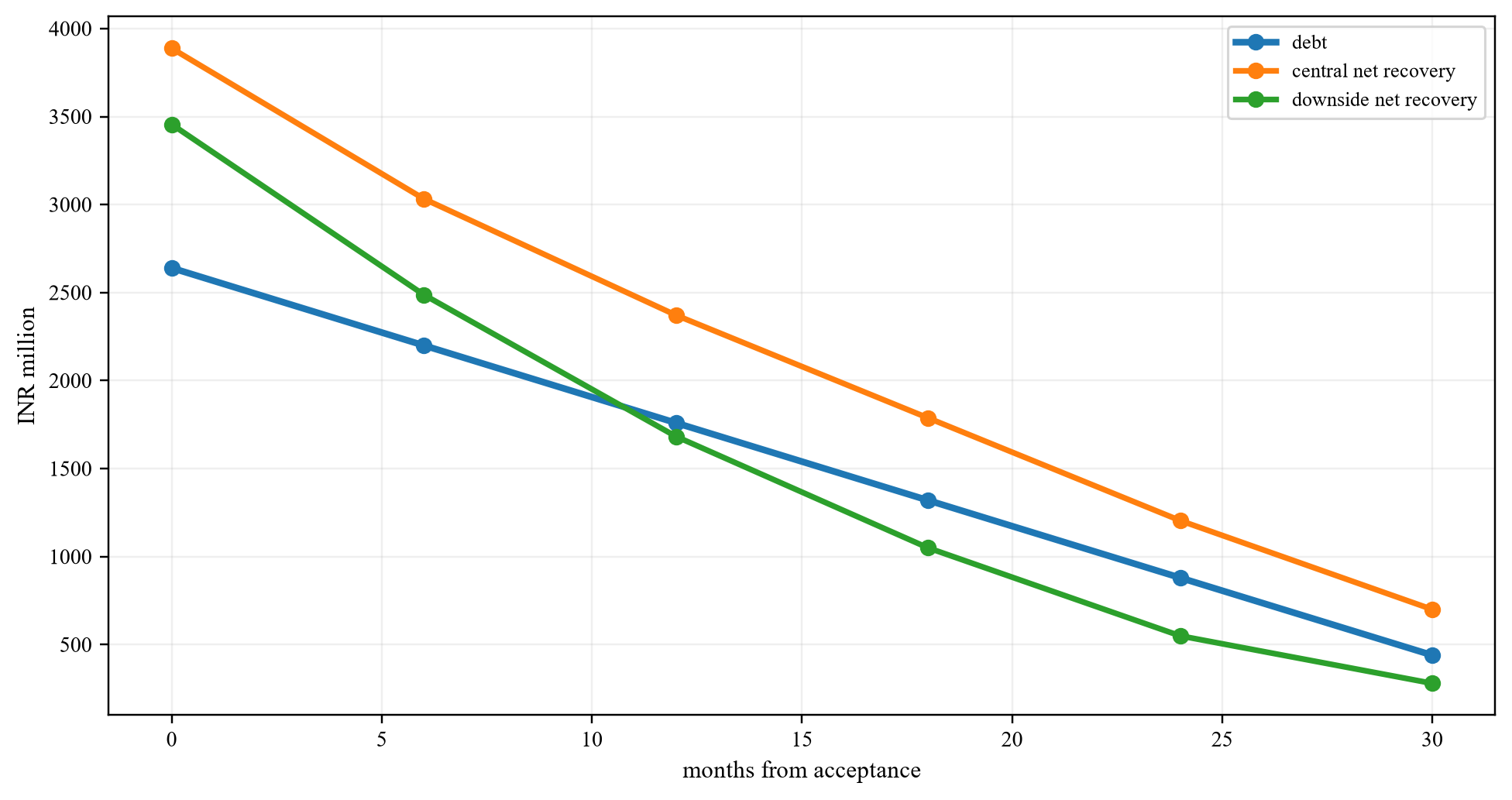
Wholly hypothetical; INR million.
23. Stress revenue and utilisation together
The decision question is how lower realised price and productive hours compound cash-flow pressure. The evidence file should begin with metered usage, price schedules, discounts, customer terms, downtime and cost structure. Each item should record source, date, owner, responsible reviewer, expiry or refresh date and the relevant serial numbers or cluster. Industry growth can explain why compute is being installed. It does not establish a lender's repayment source or recovery value. [1][16]
The principal failure is that independent sensitivities understate the effect of new supply, customer churn and technology transition. GPU finance converts supplier payments into credit exposure before the equipment has generated a stable collection record. The lender therefore needs a traceable chain from purchase and acceptance to productive use, billed revenue, collected cash, remaining useful service and an executable sale or redeployment route.
The recommended response is to combine price, utilisation, downtime and collection shocks with stated management actions. Management estimates may support a scenario when clearly identified and reconciled to observed data. The central case should use current contracts, measured performance and recent market evidence. Downside analysis should combine technology transition, price compression, lower utilisation, customer loss, operational interruption and sale friction.
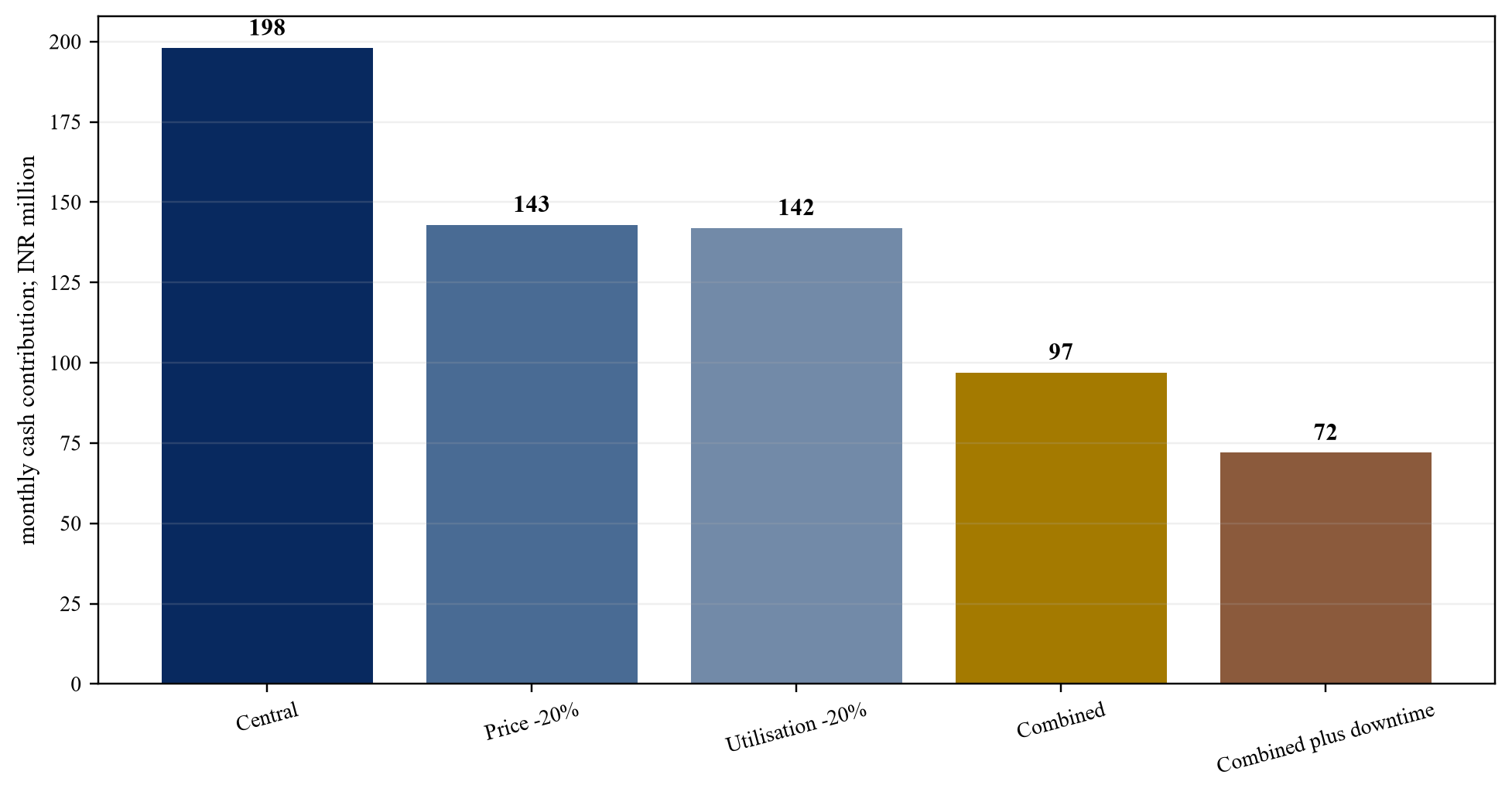
Wholly hypothetical; INR million before debt service.
24. Set triggers and cash controls
The decision question is which observable deterioration requires cash retention, prepayment, additional collateral or enforcement planning. The evidence file should begin with borrowing base, utilisation, realised price, coverage, support, concentration and valuation reports. Each item should record source, date, owner, responsible reviewer, expiry or refresh date and the relevant serial numbers or cluster. Industry growth can explain why compute is being installed. It does not establish a lender's repayment source or recovery value. [13][14]
The principal failure is that action begins after payment default even though collateral and cash evidence deteriorated earlier. GPU finance converts supplier payments into credit exposure before the equipment has generated a stable collection record. The lender therefore needs a traceable chain from purchase and acceptance to productive use, billed revenue, collected cash, remaining useful service and an executable sale or redeployment route.
The recommended response is to use staged triggers tied to forward coverage and verified collateral evidence. Management estimates may support a scenario when clearly identified and reconciled to observed data. The central case should use current contracts, measured performance and recent market evidence. Downside analysis should combine technology transition, price compression, lower utilisation, customer loss, operational interruption and sale friction.
25. Design monitoring and audit
The decision question is who verifies the asset, performance, revenue, location, support and market evidence. The evidence file should begin with monthly certificates, API extracts, site inspections, independent tests, valuation reports and audit trails. Each item should record source, date, owner, responsible reviewer, expiry or refresh date and the relevant serial numbers or cluster. Industry growth can explain why compute is being installed. It does not establish a lender's repayment source or recovery value. [13][15]
The principal failure is that borrower-generated spreadsheets remain the only evidence for both collateral and cash flow. GPU finance converts supplier payments into credit exposure before the equipment has generated a stable collection record. The lender therefore needs a traceable chain from purchase and acceptance to productive use, billed revenue, collected cash, remaining useful service and an executable sale or redeployment route.
The recommended response is to combine system data, third-party evidence and periodic physical inspection with exception ownership. Management estimates may support a scenario when clearly identified and reconciled to observed data. The central case should use current contracts, measured performance and recent market evidence. Downside analysis should combine technology transition, price compression, lower utilisation, customer loss, operational interruption and sale friction.
26. Prepare recovery before default
The decision question is which operating sale, portfolio sale, refinance, trade-in, removal or parts route maximises proceeds. The evidence file should begin with buyer list, site access, configuration, licences, support, removal plan, costs and timing. Each item should record source, date, owner, responsible reviewer, expiry or refresh date and the relevant serial numbers or cluster. Industry growth can explain why compute is being installed. It does not establish a lender's repayment source or recovery value. [6][19]
The principal failure is that the first recovery work begins after default when support, customer continuity and buyer confidence have weakened. GPU finance converts supplier payments into credit exposure before the equipment has generated a stable collection record. The lender therefore needs a traceable chain from purchase and acceptance to productive use, billed revenue, collected cash, remaining useful service and an executable sale or redeployment route.
The recommended response is to maintain a quarterly recovery dossier and executable contact and access plan. Management estimates may support a scenario when clearly identified and reconciled to observed data. The central case should use current contracts, measured performance and recent market evidence. Downside analysis should combine technology transition, price compression, lower utilisation, customer loss, operational interruption and sale friction.
27. Compare operating and piecemeal recovery
The decision question is whether value is higher as a working cluster, reconfigured system or separate components. The evidence file should begin with cash contribution, customer transferability, site rights, buyer demand, removal cost and transaction time. Each item should record source, date, owner, responsible reviewer, expiry or refresh date and the relevant serial numbers or cluster. Industry growth can explain why compute is being installed. It does not establish a lender's repayment source or recovery value. [6][20]
The principal failure is that component quotations are added together without recognising configuration loss and sale delay. GPU finance converts supplier payments into credit exposure before the equipment has generated a stable collection record. The lender therefore needs a traceable chain from purchase and acceptance to productive use, billed revenue, collected cash, remaining useful service and an executable sale or redeployment route.
The recommended response is to compare net present proceeds under each route after all cure, operation, tax and disposal costs. Management estimates may support a scenario when clearly identified and reconciled to observed data. The central case should use current contracts, measured performance and recent market evidence. Downside analysis should combine technology transition, price compression, lower utilisation, customer loss, operational interruption and sale friction.
28. Reach the credit decision
The decision question is whether verified cash generation, rapid amortisation and executable recovery support the proposed facility. The evidence file should begin with asset register, acceptance, technology map, borrowing base, downside model, security and recovery dossier. Each item should record source, date, owner, responsible reviewer, expiry or refresh date and the relevant serial numbers or cluster. Industry growth can explain why compute is being installed. It does not establish a lender's repayment source or recovery value. [1][13]
The principal failure is that strategic demand for AI displaces transaction-specific evidence on repayment and collateral. GPU finance converts supplier payments into credit exposure before the equipment has generated a stable collection record. The lender therefore needs a traceable chain from purchase and acceptance to productive use, billed revenue, collected cash, remaining useful service and an executable sale or redeployment route.
The recommended response is to approve only exposure that remains covered by stressed cash flow and conservative net recovery throughout the term. Management estimates may support a scenario when clearly identified and reconciled to observed data. The central case should use current contracts, measured performance and recent market evidence. Downside analysis should combine technology transition, price compression, lower utilisation, customer loss, operational interruption and sale friction.
| Decision | Minimum evidence | Possible action |
|---|---|---|
| commitment | cost, title, acceptance and downside | approve or resize |
| each draw | asset eligibility and remaining funds | fund or stop |
| monthly base | serial, utilisation, support and value | maintain or prepay |
| refresh | substitution and value preservation | consent or reject |
| deterioration | cash and recovery impact | sweep, cure or enforce |
| exit | operating and piecemeal bids | refinance, sell or recover |
Proposed governance; transaction-specific approval remains necessary.
Sources
- IndiaAI, *IndiaAI Compute Portal*. Read the primary source
- Ministry of Electronics and Information Technology, *IndiaAI Expert Group Report*. Read the primary source
- NVIDIA, *Quarterly Report on Form 10-Q, fiscal 2026*. Read the primary source
- NVIDIA, *Data Center Products*. Read the primary source
- Ministry of Corporate Affairs, *Indian Accounting Standard 16: Property, Plant and Equipment*. Read the primary source
- IFRS Foundation, *IFRS 13 Fair Value Measurement*. Read the primary source
- Insolvency and Bankruptcy Board of India, *Plant and Machinery Valuation Examination Syllabus*. Read the primary source
- Ministry of Finance, Central Board of Indirect Taxes and Customs, *Indian Customs*. Read the primary source
- U.S. Department of Commerce, Bureau of Industry and Security, *Export Administration Regulations Part 740*. Read the primary source
- Directorate General of Foreign Trade, *SCOMET: Special Chemicals, Organisms, Materials, Equipment and Technologies*. Read the primary source
- MLCommons, *MLPerf Benchmarks*. Read the primary source
- Central Board of Indirect Taxes and Customs, *Goods and Services Tax*. Read the primary source
- Reserve Bank of India, *Guidelines on Bank Finance to Non-Banking Financial Companies*. Read the primary source
- Reserve Bank of India, *Handbook of Regulations at a Glance*. Read the primary source
- National Institute of Standards and Technology, *AI Risk Management Framework*. Read the primary source
- IndiaAI, *AI Compute Price Calculator*. Read the primary source
- Competition Commission of India, *Competition Act and Regulations*. Read the primary source
- International Energy Agency, *Energy and AI*. Read the primary source
- Office of the Comptroller of the Currency, *Project Finance*. Read the primary source
- Ministry of Environment, Forest and Climate Change, *E-Waste (Management) Rules, 2022*. Read the primary source
- Central Pollution Control Board, *E-Waste Management*. Read the primary source
- IFRS Foundation, *IFRS 9 Financial Instruments*. Read the primary source
- Ministry of Corporate Affairs, *Indian Accounting Standard 36: Impairment of Assets*. Read the primary source
- Insolvency and Bankruptcy Board of India, *Registered Valuer Organisations and Entities*. Read the primary source
- World Bank Group, *Public-Private Partnership Reference Guide*. Read the primary source
- Basel Committee on Banking Supervision, *Principles for the Management of Credit Risk*. Read the primary source
