

1. Define the credit decision
The decision is whether a specified transmission project can repay private credit from contracted and controllable cash flow through construction, commissioning and operations. Strategic relevance is an input to that decision. It is not evidence of timely land access, executable project documents, sufficient contingency or debt-service capacity. The lender should identify the exact borrower, project perimeter, revenue entitlement, completion test, security package and source of repayment before considering leverage.
The appraisal should distinguish three propositions. The system may need additional transfer capability. The selected project may be the appropriate response to that need. The project company may be able to deliver the response on the proposed cost and schedule. Congestion forecasting informs the first two propositions. Contracts, engineering, procurement and finance determine the third. Each proposition needs its own evidence and approval.
India's National Electricity Plan for transmission provides a national roadmap and the Ministry of Power reports a large pipeline of transmission investment through 2032 [1,2]. Those publications describe system opportunity. A credit committee still requires project-specific evidence. The release decision should permit four outcomes: proceed, proceed with conditions, redesign the financing, or decline.
| Decision area | Evidence required | Credit question | Release condition |
|---|---|---|---|
| System need | Planning study, transfer requirement and alternatives | Is the project required in the tested system cases? | Approved planning basis and scheme scope |
| Revenue | Bid documents, licence, TSA and tariff commencement | Is cash contractually available after accepted completion? | Executed revenue package and payment model |
| Delivery | Land, right of way, permits, EPC and equipment plan | Can the project reach scheduled commissioning within funded contingency? | Independent-engineer baseline and milestone plan |
| Forecasting | Source data, model purpose, validation and scenario range | Does the forecast inform decisions without becoming an unsupported credit claim? | Approved model-governance record |
| Capital | Uses, equity, debt, reserves and cost to complete | Is committed capital sufficient under credible delay? | Fully funded base and downside uses |
| Debt | Drawdowns, interest, amortisation, covenants and liquidity | Does protected cash cover debt under central and correlated stress? | Lender-tested downside and executable remedies |
| Refinancing | Operating evidence, residual life and exit market | Can construction risk convert into durable operating credit? | Objective seasoning and refinance conditions |
Original framework. Each gate requires project-specific technical, contractual, regulatory and credit review.
2. Place the project within the national transmission plan
The Central Electricity Authority plans the transmission system on a national basis and publishes the National Electricity Plan, planning criteria and renewable-integration plans [1,3,4]. The Ministry of Power states that demand and generation additions require a major expansion of the network, including renewable evacuation, storage and supply to emerging industrial hubs [2]. These sources establish the policy and engineering context for a new corridor.
A lender should locate the project within that context. The data room should show the generation zone, demand centre, existing transfer capability, committed generation, storage, competing schemes and the proposed commissioning sequence. The project case should explain whether it relieves an existing constraint, enables committed capacity, provides resilience, or anticipates forecast load. Each purpose has a different dependence on timing and utilisation.
The planning case should remain traceable when assumptions change. Renewable projects can be delayed, industrial demand can move, storage can alter peak flows and another line can enter service first. The project may remain necessary under those changes, but the reason may differ. Credit documents should use the current approved scheme and avoid converting a long-range planning scenario into a guaranteed utilisation claim.
3. Define the physical and contractual perimeter
The project perimeter should list every line, substation, transformer, reactive-power device, communication system, protection system, bay and interface required for commercial operation. It should identify which works sit with the project company, central transmission utility, state utility, generator, contractor and land authority. A missing interface can delay revenue after the borrower's own assets are physically complete.
The contractual perimeter should align with the physical one. Standard tariff-based competitive bidding documents allocate development and operation obligations through the transmission service agreement and associated project documents [5,6]. Lenders should map each obligation to a deliverable, counterparty, date, remedy and source of evidence. Defined terms for availability, commercial operation and force majeure should match the engineering test protocol.
The security perimeter should include the project company's rights in contracts, accounts, receivables, insurance, permits and material claims. Direct agreements should preserve cure and substitution rights without interrupting essential grid service. A lender cannot rely on an asset description that omits the agreements and interfaces required to earn revenue.
4. Build a controlled grid evidence room
The evidence room should contain approved planning cases, network topology, load and generation histories, outage records, connectivity grants, right-of-way status, surveys, equipment specifications, construction schedule, project agreements and financing assumptions. Each material record needs a source, owner, date, version and permitted use. Public planning data can support context while project decisions rely on controlled project evidence.
Data quality matters because congestion is calculated rather than directly observed as one stable value. Meter errors, topology changes, outage classifications, missing dispatch records and inconsistent time intervals can change the result. The model register should state how missing values are treated, how network versions are reconciled and which cases are excluded from training or validation.
Lenders should receive an evidence index rather than an uncontrolled file dump. The index should connect each credit assumption to the source record and approval. An unresolved assumption should retain an owner, deadline and financing consequence. This structure allows the credit case to be refreshed without rebuilding its provenance.
5. Model congestion as a distribution
Congestion arises when desired power transfers exceed a secure operating limit under the actual network configuration. Its frequency and severity depend on generation, load, outages, weather, maintenance, storage, market schedules and operating rules. A historical average cannot represent the combinations that drive a corridor's value or stress.
The forecast should therefore produce a distribution across time and scenarios. It may estimate constrained hours, unserved transfer, shadow price, redispatch, renewable curtailment or overload probability. The chosen metric must match the decision. A construction lender may care about whether project need persists at commissioning. An operating lender may care about availability revenue and counterparty payment rather than merchant congestion rent.
The Central Electricity Regulatory Commission's General Network Access rules recognise that transmission constraints can require curtailment and set an order for affected transactions [7]. The forecast should implement current rules and test proposed changes separately. Regulatory treatment is a model input, not a fixed physical property.
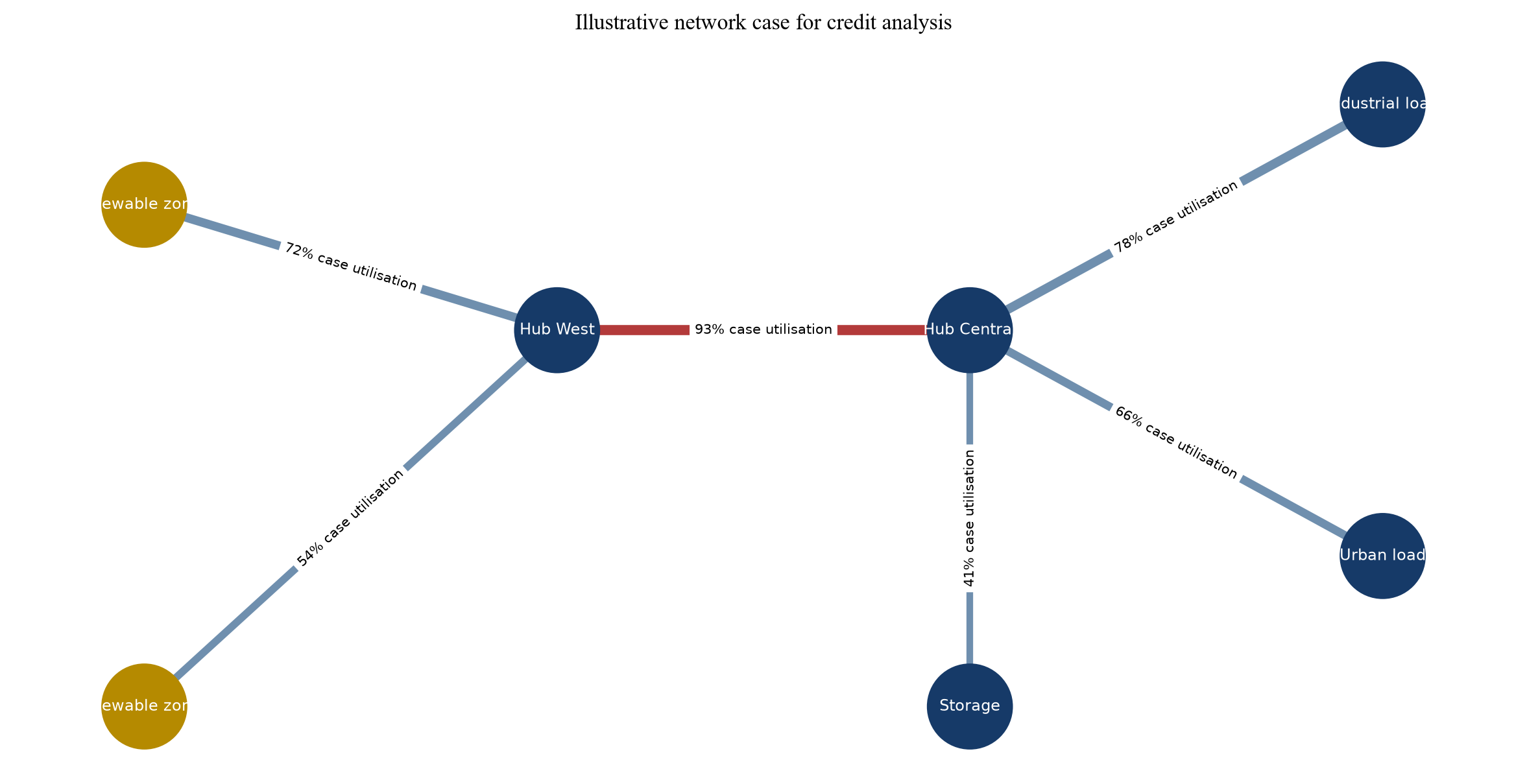
Hypothetical topology and values. The diagram explains the financing method and does not represent an actual network.
6. Forecast load and generation jointly
Load growth should be modelled with generation and storage because network flows depend on their location and timing. National demand projections provide a planning reference. The project case should then use local evidence for industrial connections, data centres, transport electrification, green-hydrogen facilities, urban expansion and distribution-system upgrades. Announced demand without land, power application, financing or implementation evidence should remain a scenario.
Renewable output requires weather-linked profiles, commissioning probability and curtailment treatment. Thermal, hydro, nuclear and storage availability also affect transfers. The model should preserve correlations. High solar output and low local demand can increase export pressure, while a coincident line outage may create the decisive stress.
The result should show percentile ranges and scenario weights approved for the decision. Confidence should widen with forecast horizon. Management may select a base case inside the distribution, but the debt structure should also use a downside with correlated delays and adverse network conditions.
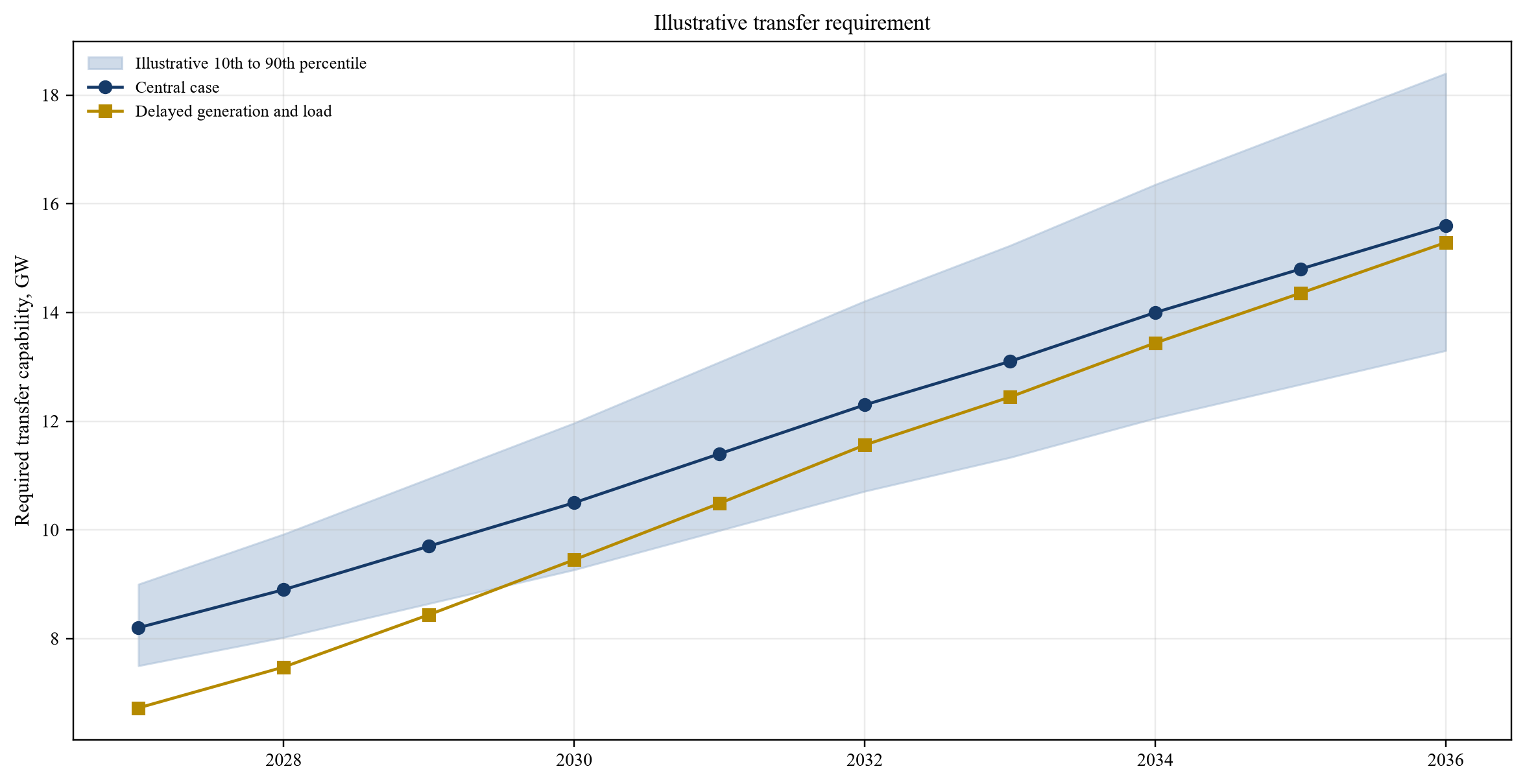
Management assumptions only. Confidence ranges illustrate uncertainty and are not observed grid forecasts.
7. Separate forecast usefulness from contractual revenue
A transmission forecast can establish need and help sequence investment. It does not automatically create project revenue. The project documents determine the tariff, commencement date, availability standard, deductions, billing process and payment responsibility. The lender base case should use those executed terms.
Availability-based revenue can reduce utilisation risk when the project is paid for making the system available rather than for actual energy transferred. It still leaves completion, asset performance, deduction, billing and collection risks. The model should show the bridge from accepted commercial operation to monthly invoice and cash receipt.
Forecast outputs may inform covenants without becoming payment inputs. A persistent reduction in projected transfer need could trigger information rights or refinancing review. It should not create an unsupported deduction when the contract provides availability-based payment. Contract and model governance should preserve that boundary.
8. Price right-of-way and land risk before drawdown
Right of way can determine the critical path even when engineering and financing are ready. The diligence record should identify route survey status, statutory notices, forest and environmental interfaces, compensation process, litigation, access constraints and unresolved parcels. A percentage-complete statement should distinguish legally available route, physically accessible route and towers actually released for construction.
Debt drawdowns should follow evidence. Early funding can cover controlled design, equipment deposits and released construction fronts. Funding for unreleased route should depend on a verified acquisition plan, adequate contingency and sponsor support. A long-stop date should activate redesign, alternate alignment, contractor relief and financing remedies.
The cost model should include compensation, route change, idle resources, storage, escalation and interest during construction. Right-of-way delay can produce several costs at once. A single contingency percentage may understate that correlation.
9. Match equipment procurement to the financing schedule
Transformers, reactors, switchgear, conductors, towers, protection systems and communication equipment have different lead times and payment profiles. The procurement schedule should identify approved vendors, manufacturing slots, technical approvals, foreign-exchange exposure, testing, transport, storage and warranty commencement. Deposits should be protected by guarantees and clear title to work in progress.
The lender should test concentration and substitution. A vendor delay can affect several substations when equipment is standardised. A substitute may require fresh type tests or regulatory approval. The project should maintain an approved alternate-vendor plan for critical components where practical.
Milestone payments should align with independently verified progress. A factory invoice is not evidence that the complete system can be commissioned on time. Drawdown conditions should connect procurement, civil works, route release and interface readiness.
10. Govern AI as a credit-control tool
The model-governance record should state purpose, users, data, method, validation, limitations, approval and change control. A congestion model used for route selection has a different risk from a model used to release debt. Each consequential use needs a defined human decision owner and fallback.
Validation should include out-of-sample periods, network changes, extreme events and comparison with engineering studies. Performance should be measured on the metric relevant to the decision. A model can predict average flow accurately while missing rare corridor overloads that matter to the credit case.
India's AI-governance guidance supports accountable, safe and inclusive deployment [8]. The project should also apply cybersecurity, access control, versioning and audit requirements. Lenders should be able to reproduce the approved forecast from retained inputs and code or receive an independently verified equivalent.
11. Structure the construction funding package
Construction capital can combine sponsor equity, senior project debt, subordinated debt, reserve facilities and contingent support. The funding plan should specify priority, commitment, availability period, draw conditions, cancellation rights and currency. Every use should have a committed source under the downside cost-to-complete case.
Equity should enter early enough to demonstrate sponsor commitment and protect lenders from front-loaded development risk. The precise sequence should reflect the contract and risk allocation. A mechanical debt-to-equity ratio is insufficient when unresolved land, permits or equipment exposure remains.
Private credit can fund timing gaps or bespoke risks when pricing and controls reflect the exposure. It can also provide a bridge to operating-stage refinancing. The structure should identify the objective exit conditions at initial close rather than depend on an assumed market window.
12. Apply a hypothetical integrated case
Assume a project company develops an inter-state transmission package under a competitive procurement. The case uses a high-voltage corridor, substations and associated control systems. It is designed only to demonstrate the financing method.
Total initial uses are INR 58.0 billion. EPC and equipment represent INR 42.5 billion, land and right-of-way costs INR 3.0 billion, development and owner costs INR 2.5 billion, financing and transaction costs INR 4.0 billion, initial reserves INR 2.5 billion and contingency INR 3.5 billion. Sources comprise INR 14.5 billion of sponsor equity, INR 37.7 billion of senior debt, an INR 2.9 billion reserve facility and INR 2.9 billion of sponsor contingency support.
| Uses | INR billion | Sources | INR billion |
|---|---|---|---|
| EPC and equipment | 42.5 | Sponsor equity | 14.5 |
| Land and right of way | 3.0 | Senior debt | 37.7 |
| Development and owner costs | 2.5 | Reserve facility | 2.9 |
| Financing and transaction costs | 4.0 | Sponsor contingency support | 2.9 |
| Initial reserves | 2.5 | Total sources | 58.0 |
| Contingency | 3.5 | ||
| Total uses | 58.0 |
INR billion. All values are management assumptions and do not describe an observed project or approved financing.
Central annual contracted revenue is INR 8.4 billion. Operating cost of INR 1.2 billion, lifecycle funding of INR 0.5 billion and tax and other adjustments of INR 0.5 billion leave INR 6.2 billion of cash available for debt service. Annual debt service is INR 4.5 billion, producing 1.38 times coverage.
13. Size debt to verified cost to complete
The initial leverage decision should use the independent engineer's cost estimate, committed contract price, exclusions, contingency and remaining interfaces. It should test cost escalation, tax, foreign exchange, route change, delay and contractor distress. The debt quantum should not rely on uncommitted future savings from AI-assisted planning.
At each draw, the project should demonstrate that remaining committed funding covers remaining verified cost to complete. This test needs current contracts, claims, schedule and contingency. Sponsor support should be available before the shortfall becomes a payment default.
The facility should distinguish ordinary construction draws, cost-overrun funding and emergency liquidity. Conditions and pricing can differ. Clear classification makes a later waiver or cure more credible.
14. Link drawdowns to evidence milestones
Drawdown milestones should reflect credit risk rather than accounting progress alone. Examples include route release, permit effectiveness, design approval, factory acceptance, foundation completion, tower erection, stringing, substation energisation, protection testing and interface readiness.
An independent engineer should verify the milestone and remaining path. Evidence may include survey records, inspection certificates, test results, photographs, invoices and updated schedule. Automated progress analytics can support review, while approval remains with authorised people.
A milestone should not be released when a downstream dependency is missing. Equipment delivery has limited value without storage and construction access. A completed line segment does not earn revenue without the connected substations and system approval.
15. Sculpt debt around tariff commencement
Interest during construction should be modelled through the actual draw profile and downside schedule. The facility may capitalise interest before commercial operation, followed by a grace period and sculpted amortisation. The model should show each period's opening debt, draw, interest, repayment and closing balance.
Tariff commencement should follow the executed project documents. Partial commissioning may create partial revenue when permitted. A mismatch between asset readiness and upstream or downstream systems requires defined relief. Lenders should avoid assuming payment for an unavailable interface without contractual support.
Debt sculpting should preserve minimum and average coverage under the central case and credible stress. It should also leave enough principal reduction to support refinancing. Back-ended amortisation can improve early ratios while increasing exit risk.
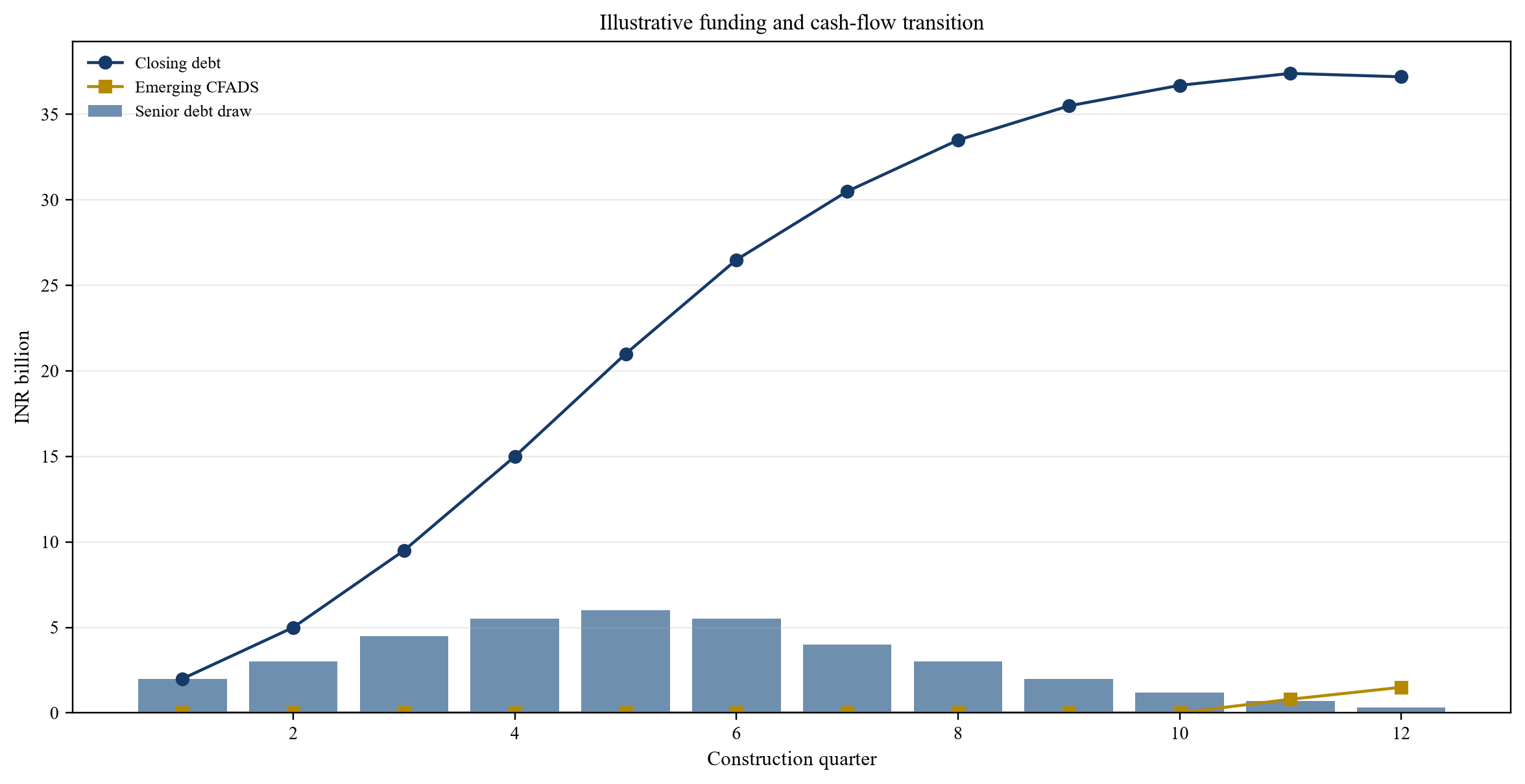
Management assumptions only. Values illustrate the method and are not a credit offer.
16. Test correlated downside before close
Single-variable sensitivities help explain the model. Credit approval requires correlated cases. Right-of-way delay can increase contractor cost, interest during construction and equipment storage while postponing tariff commencement. A transformer delay can affect completion tests and liquidated damages. Counterparty payment delay can coincide with a reserve draw after operations begin.
The hypothetical downside assumes delayed completion, higher operating cost, availability deductions and slower collection. Cash available for debt service falls to INR 4.1 billion against INR 4.5 billion of debt service, equal to 0.91 times. This result indicates a funding and covenant problem before remedies.
The remedial case uses approved drawdown deferral, sponsor support, reserve use, operating measures and debt re-sculpting. Cash available for debt service becomes INR 5.4 billion, producing 1.20 times coverage. The model should state which actions are contractual, which require lender consent and which depend on future negotiation.
| Item | Central | Correlated downside | Remedial case |
|---|---|---|---|
| Contracted revenue and receipts | 8.4 | 6.7 | 7.6 |
| Operating cost | (1.2) | (1.5) | (1.3) |
| Lifecycle funding | (0.5) | (0.6) | (0.5) |
| Tax and other adjustments | (0.5) | (0.5) | (0.4) |
| Cash available for debt service | 6.2 | 4.1 | 5.4 |
| Debt service | (4.5) | (4.5) | (4.5) |
| Debt-service coverage | 1.38x | 0.91x | 1.20x |
INR billion except ratios. All values are hypothetical management assumptions.
17. Build liquidity before relying on waivers
The financing should include funded reserves and contingent liquidity sized to the risks. A debt-service reserve can address collection timing. A cost-overrun facility can support verified completion costs. A sponsor commitment can cover defined development and delay exposure. Each source needs enforceable availability and clear release conditions.
Liquidity should be drawn before a shortfall becomes irreversible. Forecast deterioration can trigger enhanced reporting, distribution lock-up and a funding plan. A covenant breach should activate agreed remedies rather than begin the first discussion about available support.
Reserve replenishment and release should follow objective tests. Cash should remain trapped while unresolved defects, claims or payment delays threaten debt service. Release should require accepted operation, current payments and adequate forward coverage.
18. Design covenants around controllable evidence
Financial covenants can include minimum debt-service coverage, liquidity, reserve funding, leverage and distribution tests. Construction covenants can address cost to complete, schedule variance, route release, equipment delivery and sponsor support. Operating covenants can cover availability, maintenance, insurance, cybersecurity and material contracts.
Forecast metrics should be used carefully. A decline in predicted congestion may justify review of refinancing or strategic assumptions. It should not cause default when revenue remains contractually protected and the model is uncertain. A forecast breach should require validation and accountable assessment before financial consequences.
The covenant certificate should reconcile controlled records to the finance model. It should identify exceptions, waivers and actions. Lenders need sufficient information to act before liquidity is exhausted.
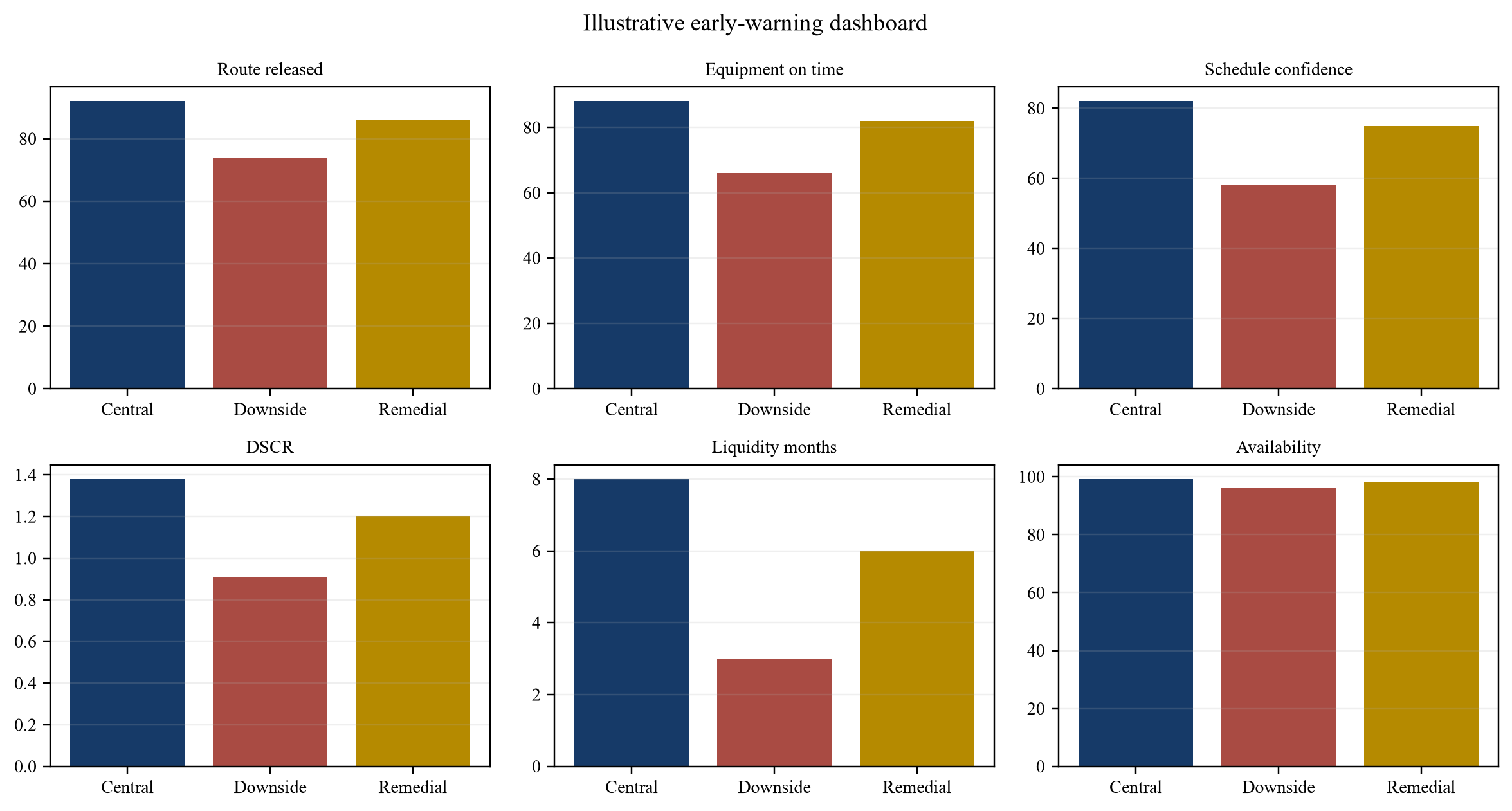
Thresholds are hypothetical management assumptions. The dashboard supports review and does not replace contractual calculation.
19. Preserve payment and counterparty discipline
The invoice process should define calculation, certification, due date, rebate, surcharge, dispute and payment security. The model should distinguish billed revenue, recognised revenue and cash receipt. A strong tariff does not service debt when collection is delayed.
Payment security can include letters of credit, escrow, reserves, guarantees or statutory mechanisms depending on the project. Lenders should test enforceability, amount, replenishment and interaction with dispute. A support instrument should supplement credit appraisal rather than replace it.
Accounts should follow a controlled waterfall from revenue through tax, operating cost, reserves, debt service and permitted distributions. Set-off and leakage should be limited. Direct agreements should preserve project continuity during cure or substitution.
20. Allocate curtailment and congestion risk explicitly
The regulatory framework can curtail transactions when transmission constraints or grid security require it [7]. The project documents should state whether and how such events affect revenue, availability and relief. The answer depends on project scope and contract rather than a general assumption.
The credit model should separate physical congestion, commercial curtailment and project unavailability. Physical congestion may demonstrate the line's need. Commercial curtailment may affect connected generators. Project unavailability can reduce transmission revenue through deductions. Combining them obscures the party that controls each risk.
Change in law and regulatory change should have notice, mitigation, evidence and compensation processes. A proposed congestion charge or access amendment should enter a scenario until adopted. The model should retain the version used at approval.
21. Plan the construction-to-operating refinance
Construction credit carries delivery risk and uncertainty. Operating credit can rely on accepted assets, established availability, payment history and remaining contract life. The initial financing should define the evidence required to move between those risk states.
Refinancing options may include bank debt, infrastructure debt funds, bonds and InvIT capital. RBI directions govern project finance and refinancing by regulated entities, while SEBI's InvIT framework governs listed or privately placed infrastructure trusts [9,10,11]. The applicable route requires current legal and regulatory review.
The refinance model should test residual debt, tenor, interest rate, coverage, reserve release, transaction cost and distribution. It should avoid assuming a valuation multiple or market spread. A delayed refinance should remain serviceable under the original facility.
22. Use operating data to support refinancing
The operating evidence pack should include commercial-operation acceptance, availability, deductions, invoices, cash collection, operating cost, maintenance, outages, insurance, claims, reserves and covenant compliance. Forecasts should be compared with actual flows and system conditions to explain divergence.
Seasoning requirements should reflect the risks. A short period may prove invoice mechanics but fail to capture monsoon, summer peak or planned maintenance. The lender should select evidence periods that cover material operating states.
The valuation and debt-capacity case should use current performance and remaining obligations. It should retain lifecycle expenditure, major maintenance and technology obsolescence. Distributions should follow verified headroom after refinancing.
23. Establish independent verification
The independent engineer should review design, schedule, progress, testing, cost to complete and operating performance. The model verifier should review forecast purpose, data, method, validation and change control. The account bank or calculation agent may verify cash movement and covenant calculations. These roles should be independent from model development and project management where conflicts could arise.
Reports should state scope, evidence, exceptions and limitations. A verifier should reproduce material results or explain why reproduction is not possible. Reliance should be defined for lenders and other parties.
Persistent data or model exceptions should trigger a remediation plan. Manual fallback should be documented and time limited. The project should remain operable and financially auditable when the AI system is unavailable.
24. Sequence the first 180 days
The first thirty days should define the credit decision, project perimeter, planning basis, data room, parties, revenue mechanism and approval map. The sponsor and lenders should identify each missing item and the decision it prevents.
Days thirty to ninety should complete route, permit, equipment, interface and contract diligence. The team should build the network cases, probabilistic forecasts, base financial model, cost-to-complete schedule and initial security package. Model governance should be approved before forecast outputs enter drawdown or covenant design.
Days ninety to one hundred and twenty should test correlated downside, support facilities, payment security, direct agreements and refinancing. Market sounding should test financing capacity without treating indicative interest as committed funding.
Days one hundred and twenty to one hundred and eighty should finalise credit approval, conditions precedent, monitoring, drawdown verification and closing deliverables. Release should occur only when committed sources cover verified downside uses.
| Gate | Required output | Decision owner | Stop or redesign trigger |
|---|---|---|---|
| System need | Approved scheme and tested alternatives | Planning authority | Project need depends on one unsupported scenario |
| Revenue | Executed project documents and invoice model | Contract and finance owners | Tariff commencement or payment is unresolved |
| Delivery | Route, permit, EPC, equipment and interface baseline | Project company | Critical path lacks access or executable remedy |
| Forecasting | Controlled data, validation and scenario report | Model owner and verifier | Material output cannot be reproduced |
| Capital | Funded uses, contingency and cost-to-complete case | Sponsor and lenders | Committed sources do not cover downside uses |
| Debt | Sculpted cash flow, security, liquidity and covenants | Credit committee | Correlated downside lacks cure or liquidity |
| Refinancing | Objective seasoning and exit conditions | Financing owner | Original facility cannot survive delayed exit |
The memorandum records evidence, conditions and accountable decisions. It does not replace statutory, regulatory or lender approvals.
25. Use one approval record through financial close
The final credit memorandum should state the system need, project perimeter, contracts, delivery plan, forecasts, risk allocation, funding, debt structure, security, liquidity, covenants and refinancing. It should link every conclusion to controlled evidence. Open items need an owner, deadline, required proof and consequence.
The record should continue through documentation. Changes to route, equipment, tariff, schedule, model or financing should update the same decision case. Legal documents, engineering schedules and the financial model should use consistent definitions and dates.
Financial close should establish the opening data and model configuration. Authorised parties should approve each source, assumption and fallback. A later model version should run in parallel and receive validation before it affects a drawdown, covenant or refinancing decision.
Credit approval should rely on contractual cash flow and executable remedies. Congestion forecasting improves the quality of planning, timing and monitoring when uncertainty remains visible. It should strengthen the evidence for a financing decision without being presented as a guarantee of project need, performance or repayment.
26. Maintain post-close assurance
Construction reporting should reconcile physical progress, committed cost, forecast cost to complete, contingency and funding. The independent engineer should explain changes in the critical path. Drawdown should stop when remaining committed sources and support no longer cover verified cost to complete.
The project should monitor route release, equipment, civil works, interfaces, testing and regulatory milestones. Forecast updates should explain changes in generation, load, topology and scheme timing. The credit response should follow the contract and facility rather than an automated model instruction.
Commissioning should test every asset and the integrated protection, control, communication and metering systems. Commercial operation should require the certificates and system approvals specified in the project documents. Temporary arrangements should have defined scope, owner and expiry.
Monthly operating reports should reconcile availability, outages, deductions, invoices, collections, operating cost, reserves and debt service. The report should compare forecast system conditions with actual flows and identify why they differ. Material model drift should trigger investigation and revalidation.
Quarterly governance should review cybersecurity, access, data quality, override, model change, asset condition, claims, liquidity and covenant headroom. Technical, commercial and finance owners should approve actions. The board and lenders need one integrated view of service and cash flow.
Annual assurance should refresh the operating case, lifecycle plan, downside and refinance options. A distribution or refinancing decision should use current verified performance and retain liquidity for known works and credible stress. Independent review may be appropriate after a material route change, model change, repeated outage, cyber incident or contract amendment.
The financing should also plan for transfer, InvIT ownership or handback where relevant. Data rights, software access, model documentation, spares, staff capability and asset condition affect continuity. A transmission asset remains bankable when its essential service and cash-flow evidence can continue without an inaccessible vendor model.
Post-close assurance should retain the distinction between the system forecast and the contractual credit case. Network flows can move away from the forecast because generation, demand, storage, market behaviour or another project changes. The technical team should explain the change and update the planning cases. The finance team should test whether revenue, deductions, reserves, covenants or refinancing are affected. A change in predicted congestion should not be converted directly into a cash-flow adjustment when the executed transmission agreement uses availability-based revenue.
The monitoring system should maintain one calendar for project obligations. It should include route and permit milestones, equipment inspections, construction interfaces, testing, commercial-operation requirements, invoice dates, reserve tests, covenant certificates, insurance renewals and refinancing conditions. The calendar should identify the responsible party, evidence and escalation path. This prevents a forecasting programme from receiving attention while a basic contractual condition is missed.
Cybersecurity should cover operational technology, information technology and the analytical environment. Network models can reveal sensitive topology, equipment and operating information. Access should follow role and purpose, with multi-factor authentication, logging, backup, incident response and tested recovery. A model provider should not retain uncontrolled remote access to operational systems. Material cyber incidents should enter the project risk register, lender reporting and model-validation process.
Change control should assess the full consequence of an update. A new data source, algorithm, network model, equipment configuration or regulatory rule can change forecast outputs. The change record should state the reason, evidence, validation result, affected decisions, approval and effective date. Historical results should remain reproducible. Where a new model materially changes the credit view, management and lenders should review the related covenant and refinancing assumptions before use.
The project company should retain competent staff and independent challenge. Forecasting expertise, transmission engineering, commercial administration and project finance are separate disciplines. A single vendor or individual should not control data preparation, model development, validation and approval. Succession, documentation and training should allow the process to continue when personnel or suppliers change.
Claims and disputes should preserve evidence. Route delay, equipment defect, interface failure, tariff deduction and payment delay can create competing explanations. Time-stamped source data, approved models, correspondence, test records and financial calculations should be retained under the contract. A model visualisation can help explain events, while the underlying records and contractual rules determine entitlement.
The refinancing process should begin before market execution. Management should maintain a current lender model, operating evidence pack, legal compliance record, asset-condition report and forecast validation report. Indicative pricing should be treated as market evidence with an expiry date. The board should compare refinancing, amortisation, sponsor funding and InvIT alternatives using the same downside assumptions and transaction costs.
An effective framework therefore connects the engineering need, project agreement, delivery plan, model governance and capital structure. Each layer should remain auditable on its own and reconciled with the others. Private credit can support accelerated transmission investment when committed capital covers downside uses, debt follows evidence, liquidity precedes stress and refinancing depends on verified operating performance. AI-supported forecasts add value when they improve the timing and quality of accountable decisions.
Portfolio lenders should also test concentration. Several transmission borrowers may depend on the same equipment supplier, contractor, state, renewable zone, payment mechanism or refinancing market. Project-level security does not remove a correlated portfolio exposure. The credit portfolio should aggregate those dependencies and establish limits, information rights and contingency plans. Forecast models should use consistent definitions where comparisons are intended, while preserving each project's topology, contract and evidence.
Inflation and foreign-exchange exposure require separate treatment. Domestic construction can still depend on imported components, commodities and financing benchmarks. The cost model should identify currency, hedge, escalation mechanism, procurement date and residual exposure. A tariff index may adjust over a different period from the project's cash cost. The financing should retain liquidity for that timing difference and avoid treating an unexecuted hedge as protection.
Environmental and social obligations can affect route, schedule and lender access. The diligence plan should identify applicable assessments, forest interfaces, community engagement, compensation, labour standards, biodiversity and grievance processes. Compliance evidence should sit beside engineering progress because unresolved obligations can stop construction or impair refinancing. Lender standards, statutory requirements and project commitments should be mapped explicitly instead of merged into one general representation.
Insurance should reflect the construction and operating risk. Coverage may include marine transit, erection, delay in start-up, property damage, machinery breakdown, business interruption, liability and cyber events. The lender should review limits, deductibles, exclusions, insured parties, loss-payee provisions and the relationship between insurance proceeds and repair obligations. Insurance cannot substitute for adequate contingency or a feasible recovery plan.
The closing checklist should therefore test evidence, authority and operability. Each condition precedent should have a document owner, reviewer, expiration check and satisfaction record. The project company should demonstrate the first draw, account waterfall, reporting pack and model fallback before close. A financing is ready when the parties can operate its controls with the actual contracts and systems, rather than relying on a memorandum that describes controls still to be created.
The final lender review should reconcile the approval memorandum with the executed documents. Pricing, tenor, amortisation, reserve thresholds, completion tests, information rights and cure periods should match the approved risk response. Any deviation should return to the authorised decision maker with its quantified effect. This reconciliation is particularly important when negotiations change the project after credit approval. The signed financing package becomes the operating control, and its requirements should be incorporated into the project schedule, reporting system and board calendar from the first day.
The closing record should also preserve the final forecast inputs, validation results and approved limitations so future reviewers can reproduce the decision basis.
Sources
- Central Electricity Authority, National Electricity Plan Volume II Transmission. Read the primary source
- Ministry of Power, Annual Report 2025-26. Read the primary source
- Central Electricity Authority, Transmission Plan for Integration of over 900 GW Non-Fossil Fuel Capacity by 2035-36. Read the primary source
- Central Electricity Authority, Manual on Transmission Planning Criteria 2023. Read the primary source
- Central Transmission Utility of India, Revised Guidelines and Standard Bidding Documents for TBCB. Read the primary source
- Central Transmission Utility of India, Transmission Service Agreement for an Inter-State Transmission System. Read the primary source
- Central Electricity Regulatory Commission, Connectivity and General Network Access to the Inter-State Transmission System Regulations 2022. Read the primary source
- Ministry of Electronics and Information Technology, India AI Governance Guidelines. Read the primary source
- Reserve Bank of India, Project Finance Directions 2025. Read the primary source
- Reserve Bank of India, Refinancing of Project Loans by NBFCs. Read the primary source
- Securities and Exchange Board of India, Master Circular for Infrastructure Investment Trusts. Read the primary source
- Central Electricity Regulatory Commission, Indian Electricity Grid Code Regulations 2023. Read the primary source
- Central Electricity Regulatory Commission, Sharing of Inter-State Transmission Charges and Losses Regulations. Read the primary source
- Central Electricity Regulatory Commission, Measures to Relieve Congestion in Real Time Operation Regulations. Read the primary source
- Central Electricity Regulatory Commission, Rate of Congestion Charge in Real-Time Operation, 2026 proceeding. Read the primary source
- Ministry of Power, Measures for Integration of Renewable Energy into the National Grid. Read the primary source
- Ministry of Power, Transmission System for Integration of over 500 GW Renewable Energy Capacity by 2030. Read the primary source
- NITI Aayog, Turning Around the Power Distribution Sector. Read the primary source
- Power System Operation Corporation, Report on Renewable Energy Curtailment and Grid Integration. Read the primary source
- Grid Controller of India, Annual Report 2024-25. Read the primary source
- Reserve Bank of India, Flexible Structuring of Long-Term Project Loans to Infrastructure. Read the primary source
- Reserve Bank of India, Infrastructure Debt Fund NBFC Directions. Read the primary source
- Securities and Exchange Board of India, Infrastructure Investment Trust Regulations. Read the primary source
- International Energy Agency, Electricity Grids and Secure Energy Transitions. Read the primary source
- World Bank, PPP Reference Guide Version 3. Read the primary source
- National Institute of Standards and Technology, Artificial Intelligence Risk Management Framework 1.0. Read the primary source
